EP0789084A1 - Procédé de finissage de surfaces d'une pièce métallique et pièce obtenue - Google Patents
Procédé de finissage de surfaces d'une pièce métallique et pièce obtenue Download PDFInfo
- Publication number
- EP0789084A1 EP0789084A1 EP96120083A EP96120083A EP0789084A1 EP 0789084 A1 EP0789084 A1 EP 0789084A1 EP 96120083 A EP96120083 A EP 96120083A EP 96120083 A EP96120083 A EP 96120083A EP 0789084 A1 EP0789084 A1 EP 0789084A1
- Authority
- EP
- European Patent Office
- Prior art keywords
- melted
- metallic member
- treated
- layer
- resolidified
- Prior art date
- Legal status (The legal status is an assumption and is not a legal conclusion. Google has not performed a legal analysis and makes no representation as to the accuracy of the status listed.)
- Withdrawn
Links
- 238000000034 method Methods 0.000 title claims abstract description 38
- 229910052751 metal Inorganic materials 0.000 title description 5
- 239000002184 metal Substances 0.000 title description 5
- 239000002344 surface layer Substances 0.000 claims abstract description 23
- 238000001816 cooling Methods 0.000 claims abstract description 14
- 238000005299 abrasion Methods 0.000 claims abstract description 6
- 239000010410 layer Substances 0.000 claims description 18
- 230000003746 surface roughness Effects 0.000 abstract description 13
- 238000012423 maintenance Methods 0.000 abstract description 5
- 230000001747 exhibiting effect Effects 0.000 abstract 1
- 238000010894 electron beam technology Methods 0.000 description 35
- 229910000831 Steel Inorganic materials 0.000 description 8
- 239000010959 steel Substances 0.000 description 8
- 238000009499 grossing Methods 0.000 description 6
- 239000000463 material Substances 0.000 description 6
- 230000000694 effects Effects 0.000 description 5
- 230000000630 rising effect Effects 0.000 description 5
- XEEYBQQBJWHFJM-UHFFFAOYSA-N Iron Chemical compound [Fe] XEEYBQQBJWHFJM-UHFFFAOYSA-N 0.000 description 4
- 230000004927 fusion Effects 0.000 description 3
- 230000005484 gravity Effects 0.000 description 3
- 229910000838 Al alloy Inorganic materials 0.000 description 2
- 229910052782 aluminium Inorganic materials 0.000 description 2
- XAGFODPZIPBFFR-UHFFFAOYSA-N aluminium Chemical compound [Al] XAGFODPZIPBFFR-UHFFFAOYSA-N 0.000 description 2
- 238000007730 finishing process Methods 0.000 description 2
- 229910052742 iron Inorganic materials 0.000 description 2
- 238000005498 polishing Methods 0.000 description 2
- 238000004381 surface treatment Methods 0.000 description 2
- 238000007666 vacuum forming Methods 0.000 description 2
- 229910001209 Low-carbon steel Inorganic materials 0.000 description 1
- 235000010627 Phaseolus vulgaris Nutrition 0.000 description 1
- 244000046052 Phaseolus vulgaris Species 0.000 description 1
- 238000009825 accumulation Methods 0.000 description 1
- 230000002411 adverse Effects 0.000 description 1
- 239000004411 aluminium Substances 0.000 description 1
- 238000010276 construction Methods 0.000 description 1
- 230000002708 enhancing effect Effects 0.000 description 1
- 230000001678 irradiating effect Effects 0.000 description 1
- 238000004519 manufacturing process Methods 0.000 description 1
- 150000002739 metals Chemical class 0.000 description 1
- 239000000203 mixture Substances 0.000 description 1
- 238000011160 research Methods 0.000 description 1
- 239000004576 sand Substances 0.000 description 1
- 238000007711 solidification Methods 0.000 description 1
- 230000008023 solidification Effects 0.000 description 1
- 239000000126 substance Substances 0.000 description 1
Images



Classifications
-
- B—PERFORMING OPERATIONS; TRANSPORTING
- B23—MACHINE TOOLS; METAL-WORKING NOT OTHERWISE PROVIDED FOR
- B23K—SOLDERING OR UNSOLDERING; WELDING; CLADDING OR PLATING BY SOLDERING OR WELDING; CUTTING BY APPLYING HEAT LOCALLY, e.g. FLAME CUTTING; WORKING BY LASER BEAM
- B23K15/00—Electron-beam welding or cutting
-
- C—CHEMISTRY; METALLURGY
- C21—METALLURGY OF IRON
- C21D—MODIFYING THE PHYSICAL STRUCTURE OF FERROUS METALS; GENERAL DEVICES FOR HEAT TREATMENT OF FERROUS OR NON-FERROUS METALS OR ALLOYS; MAKING METAL MALLEABLE, e.g. BY DECARBURISATION OR TEMPERING
- C21D1/00—General methods or devices for heat treatment, e.g. annealing, hardening, quenching or tempering
- C21D1/06—Surface hardening
- C21D1/09—Surface hardening by direct application of electrical or wave energy; by particle radiation
Definitions
- the present invention relates to a surface finishing method for a metallic member (a method for reducing surface roughness) and the metallic member obtained by the method.
- the present inventors have found the following fact as a result of their arduous researches for accomplishing the above object.
- the present invention has been made in consideration of the above-described facts.
- One of the most characteristic parts of the present invention relating to the surface finishing method for metallic member is that a high-density energy beam is emitted to irradiate a surface of the metallic member to be treated so that only the irradiated surface layer is melted, and the melted portion is resolidified subsequently, thereby enabling the provision of the metallic member having a smoothed surface with an improved surface roughness.
- the melted portion comprising the fully melted layer and the half melted layer, because a poor surface smoothing result such as a wavy surface which is likely to be formed on the melted and resolidified portions can be prevented.
- the energy beam to be projected for irradiation is divided so that a plurality of portions on the surface layer to be treated can be melted simultaneously, the plurality of portions can be treated in a single operation, further reducing the cycle time for treatment.
- the natural cooling is preferable for maintaining a required surface finishing precision, but forced cooling such as gas cooling may also be employed.
- one of the characteristic parts of the present invention relating to the surface-finished metallic member is that the surface-finished metallic member has a smoothed portion, only the surface layer of which is melted and resolidified " .
- the metallic member to be treated according to the present invention may be of iron-based metal such as steel or the like, aluminium, aluminium alloy, or other nonferrous metals.
- the surface treatment method according to the present invention is characterized, as described previously, in that a high-density energy beam is emitted to irradiate a surface of the metallic member to be treated so that only the irradiated surface layer is melted, and the melted portion is resolidified subsequently.
- the high-density beam such as electron beam (EB), laser beam, or the like
- the surface layer of the metallic member can be melted locally and shallowly within a short period of time (for example, within 0.05 second, that is, almost instantaneously).
- the melted layer solidifies immediately while maintaining a smooth surface thereof by natural cooling, that is, without forced cooling. This is because the melted layer is so thin that the heat of the melted layer is quickly transmitted to the base member portion (non-melted portion).
- the melted portion is resolidified by natural cooling to maintain a required surface precision.
- the thickness of the fusion layer may be reduced further using the forced cooling such as gas cooling.
- the precision of the shape of the member to be treated is scarcely affected by the heat. Therefore, according to the method of the present invention, the surface roughness of the member can be reduced partially or entirely without adversely affecting the precision of the shape thereof.
- the conditions under which the high-density energy beam is projected for irradiation are adjusted (for example, by reducing the output while slightly increasing the duration) so that the locally melted layer to be formed on the surface layer of the metallic member comprises a completely melted layer " and an incompletely melted layer" adjacent thereto and lying thereunder.
- the aforementioned incompletely melted layer serves as a buffer member to absorb any strain generated. Accordingly, an inappropriate smoothing result such as a wavy surface which is likely to appear on the portion to be treated (the portion to be melted and resolidified) can be avoided with certainty.
- the condition of the incompletely melted layer can be confirmed by observing the cross section of the member after the treatment thereof has been terminated.
- the high-density energy beam such as the electron beam can be divided to irradiate a plurality of portions.
- even a plurality of portions on the surface layer to be treated can be melted simultaneously by dividing the high-density energy beam. In this way, a plurality of portions can be treated in a single operation, thereby further enhancing the efficiency in treatment.
- the transmitted heat does not cause the temperature of the member to be thermally treated to rise over a wide range thereof, a plurality of surface portions can be smoothed simultaneously exactly within a predetermined area.
- the surface finishing method according to the present invention can be implemented within a short period of time, which enhances the efficiency in treatment and allows a surface of highly precise smoothness to be obtained.
- any troublesome problem regarding the maintenance thereof can be eliminated.
- the characteristic part of the present invention relating to the surface-finished metallic member lies in that the metallic member has a smoothed portion, only the surface layer of which is melted and resolidified " .
- the surface layer portion melted and resolidified " has a reduced surface roughness and a highly precise smoothness, thereby ensuring a low friction coefficient and an excellent abrasion resistance. Accordingly, it is quite advantageous to employ the thus-treated surface in any of the mechanical parts requiring a high abrasion resistance.
- the embodiments of the present invention will be described in the following.
- Fig.1 illustrates an example of a surface finishing device for implementing the method of the present invention.
- Fig.2 illustrates the shape of a workpiece (a circular-tray-shaped steel member) used in this embodiment.
- Fig.3 is a graph comparing surface roughness of the surface-finished portion and that of the non-surface-finished portion.
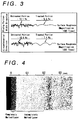
- Fig.4 is a metallographic cross-sectional photograph of the treated portion of a surface-finished metallic member.
- Fig.5 is an illustration of another example of a surface finishing device for implementing the method of the present invention.
- Fig.6 illustrates an example in which two areas are treated simultaneously.
- Fig.7 illustrates a condition under which two areas are irradiated with an electron beam simultaneously.
- Fig.8 illustrates an example of the irradiation locus of the electron beam.
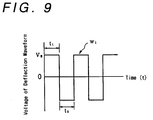
- Fig.9 shows an example of a deflection waveform of the electron beam emitted for irradiation.
- Fig.1 shows an example of a device designed to finish the external surface of a rising portion (flanged portion) of a circular-tray-shaped material according to the method of the present invention.
- a vacuum processing chamber case having a sealed construction is denoted by numeral 1, a vacuum processing chamber surrounded by the vacuum processing chamber case 1 by 2, and a vacuum forming and air exhausting system for forming a vacuum state in the vacuum processing chamber 2 by 3.
- a workpiece supporting shaft 4 is installed such that it is able to rotate about the axis thereof. The shaft 4 is driven and caused to rotate by a motor 5 disposed outside the vacuum processing chamber case 1.
- the vacuum processing chamber case 1 is connected to a beam tube 6, and an electron beam gun 7 is installed on one end of the beam tube 6.
- a focusing lens 8 is installed on the down stream side of the electron beam gun 7 in order to focus an electron beam BM generated by the electron beam gun 7.
- the electron beam gun 7 is connected to a high-voltage power source 9.
- the focusing lens 8 is connected to an EB focusing and deflection control device 10.
- the vacuum forming and air exhausting system 3, motor 5, high-voltage power source 9 and EB focusing and deflection control device 10 are controlled by a general control device 11.
- the surface finishing (surface roughness improving) method was applied to the external surface of the rising portion of a workpiece of low-carbon steel (a press-formed circular-tray-shaped workpiece), using the above-described surface finishing device.
- Fig.2 illustrates the shape of the circular-tray-shaped material (workpiece) as an object to be treated.
- the circular-tray-shaped steel member is supported by the workpiece supporting shaft 4 of the surface finishing device, the center of the circular-tray-shaped member being aligned with the supporting shaft 4, and the circular-tray-shaped member is rotated about its central axis so that the external surface of the rising portion thereof is irradiated by the electron beam EB (output: 4.6KW).
- the rotating speed of the surface area (external surface of the rising portion of the workpiece) to be irradiated by the electron beam was adjusted to 16.7m/min.
- the irradiated portion When the portion to be treated on the circular-tray-shaped steel member is irradiated with the electron beam, the irradiated portion is heated to a fusing temperature equal to or higher than 1,500°C and then melted. However, as the circular-tray-shaped steel member is in rotation, the portion irradiated with the electron beam is shifted continuously towards the adjacent portion along the circumference. Thus, the heat of the melted surface layer is quickly (almost instantaneously) transmitted to the base material portion, causing the melted layer to solidify.
- Fig.3 shows a graph comparing the surface roughness (Rz) of the circular-tray-shaped steel member treated by the method according to the present invention and that of an untreated surface of the same. As seen from Fig.3, the portion treated by the method according to the present invention is improved in terms of surface roughness and smoothed remarkably.
- Fig.4 shows a cross-sectional microstructure of the member which underwent the surface finishing process. As seen from Fig.4, it can be confirmed that the completely melted layer " and the incompletely melted layer " comprising a melted portion adjacent to the completely melted portion and an unmelted heated portion exist.
- FIG. 5 Another example of a device designed to implement the surface finishing method according to the present invention is shown in Fig. 5.
- This device is designed to finish a plurality of surface portions.
- the same reference numerals are allocated to the same components of the surface finishing device as shown in Fig.1.
- the most characteristic difference that discriminates the surface finishing device as shown in Fig. 5 from that as shown in Fig.1 consists in that the device as shown in Fig.5 has, on the downstream side of the electron beam gun 7, a deflection lens 12 for deflecting the electron beam BM to shift the portion to be irradiated, in addition to the focusing lens 8, and in that a focusing and deflecting control device 13 is connected to the focusing lens 8 and the deflection lens 12.
- the surface finishing device as shown in Fig.5 is capable of deflecting the electron beam EB emitted from the electron beam gun 7 to freely change the portions to be irradiated, so that the surface finishing of a plurality of portions can be conducted simultaneously.
- Fig.6 illustrates two surface-finished areas on the circular-tray-shaped workpiece, in which both treated areas AR1 and AR2 respectively located in a flat-plate portion 14 and a rising portion 15 cover the entire circumference of the circular-tray-shaped workpiece to be treated.
- the two areas can be treated simultaneously by deflecting the electron beam BM as shown in Fig.7.
- Fig.7 illustrates conditions under which irradiation with the electron bean is carried out in treating the above two areas simultaneously.
- the electron beam BM emitted from the aforementioned electron beam gun 7 is deflected by a deflection lens (not shown) to alternately irradiate the areas AR1 and AR2.
- the areas AR1 and AR2 can be treated simultaneously for surface finishing.
- Fig.8 shows an example of the locus of the electron beam BM emitted for irradiation.
- the electron beam EB is emitted for irradiation in accordance with two circular deflection loci C1 and C2.
- the electron beam is emitted to irradiate the areas AR1 and AR2 in accordance with the circular deflection loci C1 and C2 respectively.
- the circular-tray-shaped workpiece is caused to rotate about the central axis thereof.
- the locus of the electron beam BM onto the areas AR1 and AR2 to be treated moves in the direction of arrow H.
- Each of the circular deflection loci C1 and C2 generates a sinusodial deflection waveform in both x- and y-axis directions and formed by combining the deflections. Moreover, in order to alternately irradiate the areas AR1 and AR2 to be treated with the electron beam BM, the deflection waveform w1 is generated as shown in Fig.9, and the deflection waveform w1 is superposed on the deflection waveform in the direction of the y-axis.
- the area AR1 to be thermally treated is irradiated with the electron beam BM during a period t1 over which voltage VE is positive, whereas the area AR2 to be thermally treated is irradiated with the electron beam BM during a period t2 over which the voltage VE is negative.
- the time required for the treatment can also be reduced.
- the method according to the present invention is applicable to any metallic member whose surface layer needs smoothing entirely or partially, such as lock-up clutch piston of a torque converter, oil pump plate, and so forth, regardless of its composition, shape, or dimension.
Landscapes
- Chemical & Material Sciences (AREA)
- Engineering & Computer Science (AREA)
- Mechanical Engineering (AREA)
- Physics & Mathematics (AREA)
- Thermal Sciences (AREA)
- Crystallography & Structural Chemistry (AREA)
- Materials Engineering (AREA)
- Metallurgy (AREA)
- Organic Chemistry (AREA)
- Welding Or Cutting Using Electron Beams (AREA)
- Laser Beam Processing (AREA)
- Other Surface Treatments For Metallic Materials (AREA)
Applications Claiming Priority (2)
| Application Number | Priority Date | Filing Date | Title |
|---|---|---|---|
| JP8044107A JPH09216075A (ja) | 1996-02-06 | 1996-02-06 | 金属部材の表面仕上方法及びそれにより得られる金属部材 |
| JP44107/96 | 1996-02-06 |
Publications (1)
| Publication Number | Publication Date |
|---|---|
| EP0789084A1 true EP0789084A1 (fr) | 1997-08-13 |
Family
ID=12682397
Family Applications (1)
| Application Number | Title | Priority Date | Filing Date |
|---|---|---|---|
| EP96120083A Withdrawn EP0789084A1 (fr) | 1996-02-06 | 1996-12-13 | Procédé de finissage de surfaces d'une pièce métallique et pièce obtenue |
Country Status (3)
| Country | Link |
|---|---|
| EP (1) | EP0789084A1 (fr) |
| JP (1) | JPH09216075A (fr) |
| KR (1) | KR970061427A (fr) |
Cited By (3)
| Publication number | Priority date | Publication date | Assignee | Title |
|---|---|---|---|---|
| EP0837146A3 (fr) * | 1996-10-16 | 1998-10-14 | Aisin Aw Co., Ltd. | Procédé de traitement thermique de surfaces de pièces an acier |
| DE19919611A1 (de) * | 1999-04-17 | 2000-10-19 | Saechsische Elektronenstrahl G | Verfahren zum Umschmelzen von Oberflächen mittels Ladungsträgerstrahlen |
| WO2000063890A1 (fr) * | 1999-04-16 | 2000-10-26 | International Business Machines Corporation | Levier de chargement/dechargement pour lecteur de disque |
Families Citing this family (15)
| Publication number | Priority date | Publication date | Assignee | Title |
|---|---|---|---|---|
| JP2003106265A (ja) * | 2001-09-27 | 2003-04-09 | Aisin Aw Co Ltd | アルミ製オイルポンプ及びその製造方法 |
| WO2007018117A1 (fr) * | 2005-08-05 | 2007-02-15 | Yuzo Mori | Procédé eem assisté par faisceau électronique |
| JP4571561B2 (ja) | 2005-09-08 | 2010-10-27 | トーカロ株式会社 | 耐プラズマエロージョン性に優れる溶射皮膜被覆部材およびその製造方法 |
| US7850864B2 (en) | 2006-03-20 | 2010-12-14 | Tokyo Electron Limited | Plasma treating apparatus and plasma treating method |
| US7648782B2 (en) | 2006-03-20 | 2010-01-19 | Tokyo Electron Limited | Ceramic coating member for semiconductor processing apparatus |
| JP4546447B2 (ja) * | 2006-12-22 | 2010-09-15 | トーカロ株式会社 | 耐プラズマエロージョン性に優れる溶射皮膜被覆部材およびその製造方法 |
| JP4546448B2 (ja) * | 2006-12-22 | 2010-09-15 | トーカロ株式会社 | 耐プラズマエロージョン性に優れる溶射皮膜被覆部材およびその製造方法 |
| JP5112103B2 (ja) * | 2008-02-14 | 2013-01-09 | 株式会社東芝 | 蒸気タービン翼およびその表面改質方法 |
| JP5258402B2 (ja) * | 2008-06-10 | 2013-08-07 | 三菱電機株式会社 | 電子ビーム表面処理装置及び電子ビーム表面処理方法 |
| CN102319985A (zh) * | 2011-08-16 | 2012-01-18 | 浙江海亮股份有限公司 | 抱钳工作面粗化工艺 |
| JP2013121623A (ja) * | 2013-01-22 | 2013-06-20 | Mitsubishi Electric Corp | 電子ビーム表面処理装置及び電子ビーム表面処理方法 |
| JP5677554B1 (ja) * | 2013-11-22 | 2015-02-25 | モリマシナリー株式会社 | ロータリプレスに用いる上杵又は下杵と、上杵又は下杵の先端面の改質方法 |
| JP2014210292A (ja) * | 2014-08-20 | 2014-11-13 | 三菱電機株式会社 | 電子ビーム表面処理装置及び電子ビーム表面処理方法 |
| KR101694324B1 (ko) * | 2015-12-18 | 2017-01-10 | 한국생산기술연구원 | 전자빔을 이용한 표면 열처리 방법 |
| JP7329093B1 (ja) * | 2022-03-24 | 2023-08-17 | 本田技研工業株式会社 | 金属の表面処理方法及び表面処理装置 |
Citations (7)
| Publication number | Priority date | Publication date | Assignee | Title |
|---|---|---|---|---|
| US3802927A (en) * | 1970-09-14 | 1974-04-09 | N Gomada | Apex seal for rotary piston engine and method of producing same |
| GB2027752A (en) * | 1978-07-07 | 1980-02-27 | Sumitomo Metal Ind | Surface hardening by high energy beam |
| US4533815A (en) * | 1983-08-01 | 1985-08-06 | Smith International, Inc. | Process for treating a bearing surface to modify microasperities |
| EP0419999A1 (fr) * | 1989-09-28 | 1991-04-03 | Adam Opel Aktiengesellschaft | Méthode de façonnage des surfaces chargées par friction des moteurs à combustion interne |
| RU1799703C (ru) * | 1990-08-15 | 1993-03-07 | Научно-исследовательский институт авиационной технологии и организации производства | Способ оплавлени поверхности детали |
| EP0601451A1 (fr) * | 1992-12-10 | 1994-06-15 | Adam Opel Ag | Procédé de durcissement et éventuellement de lissage de pièces de machine et pièces fabriquées selon ce procédé |
| JPH0752098A (ja) * | 1993-08-09 | 1995-02-28 | Sanjiyou Kikai Seisakusho:Kk | ロータリーダイ若しくはフラットダイの切断刃の改質方法 |
-
1996
- 1996-02-06 JP JP8044107A patent/JPH09216075A/ja active Pending
- 1996-12-13 EP EP96120083A patent/EP0789084A1/fr not_active Withdrawn
- 1996-12-17 KR KR1019960066575A patent/KR970061427A/ko not_active Withdrawn
Patent Citations (7)
| Publication number | Priority date | Publication date | Assignee | Title |
|---|---|---|---|---|
| US3802927A (en) * | 1970-09-14 | 1974-04-09 | N Gomada | Apex seal for rotary piston engine and method of producing same |
| GB2027752A (en) * | 1978-07-07 | 1980-02-27 | Sumitomo Metal Ind | Surface hardening by high energy beam |
| US4533815A (en) * | 1983-08-01 | 1985-08-06 | Smith International, Inc. | Process for treating a bearing surface to modify microasperities |
| EP0419999A1 (fr) * | 1989-09-28 | 1991-04-03 | Adam Opel Aktiengesellschaft | Méthode de façonnage des surfaces chargées par friction des moteurs à combustion interne |
| RU1799703C (ru) * | 1990-08-15 | 1993-03-07 | Научно-исследовательский институт авиационной технологии и организации производства | Способ оплавлени поверхности детали |
| EP0601451A1 (fr) * | 1992-12-10 | 1994-06-15 | Adam Opel Ag | Procédé de durcissement et éventuellement de lissage de pièces de machine et pièces fabriquées selon ce procédé |
| JPH0752098A (ja) * | 1993-08-09 | 1995-02-28 | Sanjiyou Kikai Seisakusho:Kk | ロータリーダイ若しくはフラットダイの切断刃の改質方法 |
Non-Patent Citations (2)
| Title |
|---|
| DATABASE WPI Week 9419, Derwent World Patents Index; AN 94-158000, XP002032223 * |
| PATENT ABSTRACTS OF JAPAN vol. 095, no. 005 30 June 1995 (1995-06-30) * |
Cited By (4)
| Publication number | Priority date | Publication date | Assignee | Title |
|---|---|---|---|---|
| EP0837146A3 (fr) * | 1996-10-16 | 1998-10-14 | Aisin Aw Co., Ltd. | Procédé de traitement thermique de surfaces de pièces an acier |
| WO2000063890A1 (fr) * | 1999-04-16 | 2000-10-26 | International Business Machines Corporation | Levier de chargement/dechargement pour lecteur de disque |
| DE19919611A1 (de) * | 1999-04-17 | 2000-10-19 | Saechsische Elektronenstrahl G | Verfahren zum Umschmelzen von Oberflächen mittels Ladungsträgerstrahlen |
| DE19919611C2 (de) * | 1999-04-17 | 2001-04-26 | Saechsische Elektronenstrahl G | Verfahren zum Umschmelzen von Oberflächen mittels Ladungsträgerstrahlen |
Also Published As
| Publication number | Publication date |
|---|---|
| KR970061427A (ko) | 1997-09-12 |
| JPH09216075A (ja) | 1997-08-19 |
Similar Documents
| Publication | Publication Date | Title |
|---|---|---|
| EP0789084A1 (fr) | Procédé de finissage de surfaces d'une pièce métallique et pièce obtenue | |
| US3952180A (en) | Cladding | |
| CA1244325A (fr) | Methode et dispositif de trempe de l'acier par recours au laser | |
| EP0531139B1 (fr) | Méthode de soudage au laser de tôles d'épaisseur différente | |
| EP0276461B1 (fr) | Procédé de traitement de grandes matrices en fonte notamment pour le formage à la presse de tôles métalliques pour véhicules, et dispositif pour sa mise en oeuvre | |
| JPH0550277A (ja) | 異板厚素材のレーザ溶接方法 | |
| EP0151165B1 (fr) | Amelioration a un procede et a un dispositif de traitement thermique | |
| JPH07286528A (ja) | タービンロータ軸の電子ビーム接合方法 | |
| CA1254082A (fr) | Article a base de fer avec couche de refonte, et sa fabrication | |
| CN111005022B (zh) | 利用三激光协同制备铍青铜铜辊表面高硬度铁基涂层的方法 | |
| JP2926240B2 (ja) | 摺動材およびその表面処理方法 | |
| US4502273A (en) | Spinning rotor in an open-end spinning frame | |
| JPS6195769A (ja) | 蒸気タ−ビン翼への侵食防止部材の固定方法 | |
| US5709952A (en) | Process for joining components made of metal | |
| JPH04138889A (ja) | レーザ加工用ヘッド装置 | |
| JPH10121125A (ja) | 鋼部材の表面処理方法及び表面処理鋼部材 | |
| US5961751A (en) | Surface processing method for a steel member and surface processed steel member | |
| RU2033435C1 (ru) | Способ упрочнения штампа | |
| US6713191B2 (en) | Surface-alloyed cylindrical, partially cylindrical or hollow cylindrical component | |
| GB2125832A (en) | An arrangement for cooling the edges of cam-followers during hardening | |
| Bonss et al. | Diode laser applications hardening and welding | |
| JP3630148B2 (ja) | トルクコンバータ用ロックアップクラッチピストン | |
| Bloehs et al. | Recent progress in laser surface treatment: II. Adopted processing for high efficiency and quality | |
| EP3983567A1 (fr) | Procédé et système de chauffage au moyen d'un faisceau d'énergie | |
| KR19990079499A (ko) | 피라미드 미러를 이용한 광폭 레이저 빔 가공장치 |
Legal Events
| Date | Code | Title | Description |
|---|---|---|---|
| PUAI | Public reference made under article 153(3) epc to a published international application that has entered the european phase |
Free format text: ORIGINAL CODE: 0009012 |
|
| 17P | Request for examination filed |
Effective date: 19970109 |
|
| AK | Designated contracting states |
Kind code of ref document: A1 Designated state(s): DE FR GB |
|
| 17Q | First examination report despatched |
Effective date: 19990927 |
|
| STAA | Information on the status of an ep patent application or granted ep patent |
Free format text: STATUS: THE APPLICATION IS DEEMED TO BE WITHDRAWN |
|
| 18D | Application deemed to be withdrawn |
Effective date: 20000208 |