EP0789367A1 - Méthode de fabrication de classes sélectives d'aimants à base de terres rares utilisant une pluralité de groupes de particules - Google Patents
Méthode de fabrication de classes sélectives d'aimants à base de terres rares utilisant une pluralité de groupes de particules Download PDFInfo
- Publication number
- EP0789367A1 EP0789367A1 EP96308727A EP96308727A EP0789367A1 EP 0789367 A1 EP0789367 A1 EP 0789367A1 EP 96308727 A EP96308727 A EP 96308727A EP 96308727 A EP96308727 A EP 96308727A EP 0789367 A1 EP0789367 A1 EP 0789367A1
- Authority
- EP
- European Patent Office
- Prior art keywords
- rare earth
- earth element
- particle
- permanent magnet
- batches
- Prior art date
- Legal status (The legal status is an assumption and is not a legal conclusion. Google has not performed a legal analysis and makes no representation as to the accuracy of the status listed.)
- Withdrawn
Links
Images

Classifications
-
- H—ELECTRICITY
- H01—ELECTRIC ELEMENTS
- H01F—MAGNETS; INDUCTANCES; TRANSFORMERS; SELECTION OF MATERIALS FOR THEIR MAGNETIC PROPERTIES
- H01F1/00—Magnets or magnetic bodies characterised by the magnetic materials therefor; Selection of materials for their magnetic properties
- H01F1/01—Magnets or magnetic bodies characterised by the magnetic materials therefor; Selection of materials for their magnetic properties of inorganic materials
- H01F1/03—Magnets or magnetic bodies characterised by the magnetic materials therefor; Selection of materials for their magnetic properties of inorganic materials characterised by their coercivity
- H01F1/032—Magnets or magnetic bodies characterised by the magnetic materials therefor; Selection of materials for their magnetic properties of inorganic materials characterised by their coercivity of hard-magnetic materials
- H01F1/04—Magnets or magnetic bodies characterised by the magnetic materials therefor; Selection of materials for their magnetic properties of inorganic materials characterised by their coercivity of hard-magnetic materials metals or alloys
- H01F1/047—Alloys characterised by their composition
- H01F1/053—Alloys characterised by their composition containing rare earth metals
- H01F1/055—Alloys characterised by their composition containing rare earth metals and magnetic transition metals, e.g. SmCo5
- H01F1/0551—Alloys characterised by their composition containing rare earth metals and magnetic transition metals, e.g. SmCo5 in the form of particles, e.g. rapid quenched powders or ribbon flakes
-
- H—ELECTRICITY
- H01—ELECTRIC ELEMENTS
- H01F—MAGNETS; INDUCTANCES; TRANSFORMERS; SELECTION OF MATERIALS FOR THEIR MAGNETIC PROPERTIES
- H01F1/00—Magnets or magnetic bodies characterised by the magnetic materials therefor; Selection of materials for their magnetic properties
- H01F1/01—Magnets or magnetic bodies characterised by the magnetic materials therefor; Selection of materials for their magnetic properties of inorganic materials
- H01F1/03—Magnets or magnetic bodies characterised by the magnetic materials therefor; Selection of materials for their magnetic properties of inorganic materials characterised by their coercivity
- H01F1/032—Magnets or magnetic bodies characterised by the magnetic materials therefor; Selection of materials for their magnetic properties of inorganic materials characterised by their coercivity of hard-magnetic materials
- H01F1/04—Magnets or magnetic bodies characterised by the magnetic materials therefor; Selection of materials for their magnetic properties of inorganic materials characterised by their coercivity of hard-magnetic materials metals or alloys
- H01F1/047—Alloys characterised by their composition
- H01F1/053—Alloys characterised by their composition containing rare earth metals
- H01F1/055—Alloys characterised by their composition containing rare earth metals and magnetic transition metals, e.g. SmCo5
- H01F1/057—Alloys characterised by their composition containing rare earth metals and magnetic transition metals, e.g. SmCo5 and IIIa elements, e.g. Nd2Fe14B
- H01F1/0571—Alloys characterised by their composition containing rare earth metals and magnetic transition metals, e.g. SmCo5 and IIIa elements, e.g. Nd2Fe14B in the form of particles, e.g. rapid quenched powders or ribbon flakes
Definitions
- the invention relates to a method for producing selected grades of rare earth element containing permanent magnets by admixing or blending a plurality of batches of rare earth element containing permanent magnet alloys with each of the batches having a different chemical composition and different magnetic properties.
- various grades of rare earth element containing permanent magnets may be produced without requiring the production of a specific alloy corresponding to each of the grades to be produced.
- Magnets of this type are used in various applications, including electric motors, loudspeakers, imaging devices, and the like.
- the alloy for each magnet grade has the alloying constituents thereof present in amounts necessary to achieve the desired properties in the magnet for the intended application. This production and inventory of a specific alloy for each magnet grade to be produced adds considerably to the final cost of the magnets and thus the products with which they are employed.
- the method thereof provides for producing selected grades of a rare earth element containing permanent magnet by producing a plurality of particle batches of rare earth element containing permanent magnet alloys, with each of the batches having a different chemical composition and different permanent magnet properties.
- the batches are blended in varying amounts to achieve particle mixtures each having selected different compositions which has been determined that when processed to produce a permanent magnet will exhibit selected combinations of permanent magnet properties different from permanent properties of permanent magnets produced from each batch and different from each of the other mixtures.
- One of these mixtures is then processed in any conventional manner to produce the desired, selected grade of rare earth element containing permanent magnet therefrom.
- the processing may include sintering.
- this may be achieved by a practice including selectively increasing the heavy rare earth element content of the resulting mixture to increase intrinsic coercivity and correspondingly decrease remanence and energy product and vice versa, with respect to the desired grade of magnet to be produced from the blended particle batch.
- a more specific advantage of the invention is to provide a method for producing rare earth element containing permanent magnets wherein the combination of desired magnetic properties may be varied to produce various magnet grades by a practice that includes blending or admixing a plurality of particle batches of different permanent magnet alloy compositions to achieve a final magnet composition that will result in the desired combination of magnetic properties.
- At least one of the permanent magnet alloys of the particle batches preferably has a heavy rare earth element and a light rare earth element.
- the heavy rare earth element may be Dy and the light rare earth element may be Nd.
- the heavy rare earth elements Ho and Tb may also be present.
- the plurality of particle batches may be of the composition having a rare earth element content, a transition metal, and boron.
- the total rare earth element content may be 25 to 40%, with Nd being greater than 50% of the total rare earth element content, up to 15% of at least one heavy rare earth element of Tb, Ho and Dy, 40 to 75% total transition element content, with Fe being 30 to 100% of the total transition element content, Co up to 20%, 0.8 to 1.5% B, and up to 20% of at least one of Al, Cu, Ag, Ga, Sn, Nb, W, Mo, Cr, V, Ti, and Zn.
- Each of the batches may have a different rare earth element content and different permanent magnet properties.
- one particle batch may have a heavy rare earth element content of up to 7% and the second particle batch may have a heavy rare earth element content of 4 to 15%.
- the heavy rare earth element content may be Dy, Tb, or Ho. Each of these may have the same or varying amounts of the above-listed elements.
- the total rare earth element content of one batch may be 26 to 32% with a heavy rare earth element content of up to 7%
- a second particle batch may have a total rare earth element content of 30 to 34% with a heavy rare earth element content of up to 7%
- the third particle batch may have a total rare earth element content of 30 to 36% with a heavy rare earth element content of 4 to 15%.
- Sintered magnets have been made by conventional powder metallurgy processing from either cast ingots or atomized powder.
- the predetermined alloy compositions are melted in an inert gas atmosphere and the melt is poured into a metallic mold to make cast ingots or alternately is atomized into powders by the use of inert gas.
- the ingots With ingot production, the ingots are coarsely crushed.
- either the coarse particles or atomized powders may be exposed to a hydrogen atmosphere for hydrogen decrepitation.
- the coarse hydrogen decrepitated particles are further ground, as by milling, into fine powders with particle sizes ranging from about 1 to 20 microns.
- the fine particles are magnetically aligned and compacted.
- the resulting compacts are then sintered at temperatures between 900 and 1200°C and aged at 400 to 700°C.
- the fully densified magnets resulting from this operation are then machined to final shape and coated with a corrosion protection layer.
- the magnets are generally prepared directly from a single alloy.
- a plurality of alloys and specifically preferably two alloys may be prepared and blended to achieve various alloys suitable for desired grades of permanent magnets, each exhibiting different combinations of magnetic properties suitable for use in the manufacture of specific final products.
- Table 1 alloys were hydrided and jet milled into powders having average particle size of one to five microns.
- the milled powders were blended into the predetermined ratios as listed in Table 2.
- the blends were put into the rubber molds, magnetically aligned, and cold isostatically pressed.
- the pressed compacts were sintered in a vacuum furnace at 1050°C for 1.5 hours and aged at 520°C for one hour.
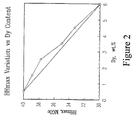
- the magnets from the blended alloys exhibit slightly higher B r and BH max than the predicted values (or single alloys), while the H ci of those coincide to the predicted values.
- the magnets produced from the blends of two master alloys exhibit equal or improved magnet properties compared to magnets made from the single alloys.
- grade means a chemical composition of a finished magnet with selected, defined magnet properties.
Landscapes
- Chemical & Material Sciences (AREA)
- Crystallography & Structural Chemistry (AREA)
- Inorganic Chemistry (AREA)
- Engineering & Computer Science (AREA)
- Power Engineering (AREA)
- Hard Magnetic Materials (AREA)
Applications Claiming Priority (2)
| Application Number | Priority Date | Filing Date | Title |
|---|---|---|---|
| US59884796A | 1996-02-09 | 1996-02-09 | |
| US598847 | 1996-02-09 |
Publications (1)
| Publication Number | Publication Date |
|---|---|
| EP0789367A1 true EP0789367A1 (fr) | 1997-08-13 |
Family
ID=24397165
Family Applications (1)
| Application Number | Title | Priority Date | Filing Date |
|---|---|---|---|
| EP96308727A Withdrawn EP0789367A1 (fr) | 1996-02-09 | 1996-12-03 | Méthode de fabrication de classes sélectives d'aimants à base de terres rares utilisant une pluralité de groupes de particules |
Country Status (2)
| Country | Link |
|---|---|
| EP (1) | EP0789367A1 (fr) |
| JP (1) | JPH1022112A (fr) |
Cited By (1)
| Publication number | Priority date | Publication date | Assignee | Title |
|---|---|---|---|---|
| CN103526107A (zh) * | 2012-07-04 | 2014-01-22 | 宁波科宁达工业有限公司 | 制备烧结钕铁硼磁体的方法 |
Citations (2)
| Publication number | Priority date | Publication date | Assignee | Title |
|---|---|---|---|---|
| EP0561650A2 (fr) * | 1992-03-19 | 1993-09-22 | Sumitomo Special Metal Co., Ltd. | Matière en poudre d'alliage pour aimants permanents R-Fe-B |
| EP0601943A1 (fr) * | 1992-12-08 | 1994-06-15 | Ugimag S.A. | Poudre magnétique de type Fe-TR-B et aimants frittés correspondants et leur méthode de préparation |
-
1996
- 1996-12-03 EP EP96308727A patent/EP0789367A1/fr not_active Withdrawn
-
1997
- 1997-01-10 JP JP9013247A patent/JPH1022112A/ja active Pending
Patent Citations (2)
| Publication number | Priority date | Publication date | Assignee | Title |
|---|---|---|---|---|
| EP0561650A2 (fr) * | 1992-03-19 | 1993-09-22 | Sumitomo Special Metal Co., Ltd. | Matière en poudre d'alliage pour aimants permanents R-Fe-B |
| EP0601943A1 (fr) * | 1992-12-08 | 1994-06-15 | Ugimag S.A. | Poudre magnétique de type Fe-TR-B et aimants frittés correspondants et leur méthode de préparation |
Non-Patent Citations (1)
| Title |
|---|
| E.WOLFARTH ET AL: "Ferromagnetic Materials Vol 4", 1988, ELSEVIER, AMSTERDAM NL, XP002032140 * |
Cited By (2)
| Publication number | Priority date | Publication date | Assignee | Title |
|---|---|---|---|---|
| CN103526107A (zh) * | 2012-07-04 | 2014-01-22 | 宁波科宁达工业有限公司 | 制备烧结钕铁硼磁体的方法 |
| CN103526107B (zh) * | 2012-07-04 | 2017-03-15 | 宁波科宁达工业有限公司 | 制备烧结钕铁硼磁体的方法 |
Also Published As
| Publication number | Publication date |
|---|---|
| JPH1022112A (ja) | 1998-01-23 |
Similar Documents
| Publication | Publication Date | Title |
|---|---|---|
| EP0251871B1 (fr) | Aimant permanent à base de terre rare | |
| EP2387044B1 (fr) | Aimant fritté aux terres rares R-T-B | |
| EP0175214B2 (fr) | Alliage magnétique permanent et méthode pour sa fabrication | |
| EP1014392B1 (fr) | Alliage à base de terre rare/fer/bore pour aimant permanent | |
| EP1420418B1 (fr) | Aimant fritté à base de R-Fe-B | |
| EP0302947B1 (fr) | Aimant a base de fer-elements de terres rares et procede de production | |
| EP0553527B1 (fr) | Matériau en poudre pour des aimants permanents à base de terre rare-fer-bore | |
| JP2746818B2 (ja) | 希土類焼結永久磁石の製造方法 | |
| EP0237416B1 (fr) | Aimant permanent à base de terres rares | |
| EP0680054B2 (fr) | Aimants de TR-Fe-B et leurs procédé de fabrication | |
| JP2000234151A (ja) | R−Fe−B系希土類永久磁石材料 | |
| EP0595477A1 (fr) | Méthode de fabrication de matériau pulvérulent pour aimants anisotropes et méthode de fabrication d'aimants utilisant le matériau pulvérulent | |
| EP0362805A2 (fr) | Aimant permanent et procédé de fabrication | |
| EP1961506A1 (fr) | Aimant agglomere de terre rare et procede pour le produire | |
| EP0517355A1 (fr) | Alliage magnétique permanent résistant à la corrosion et procédé pour la fabrication d'un aimant permanent à partir de cet alliage | |
| JP4260087B2 (ja) | 希土類焼結磁石及びその製造方法 | |
| EP0789367A1 (fr) | Méthode de fabrication de classes sélectives d'aimants à base de terres rares utilisant une pluralité de groupes de particules | |
| JP2874392B2 (ja) | 希土類コバルト1−5系永久磁石合金の製造方法 | |
| JPH01155603A (ja) | 耐酸化性希土類永久磁石の製造方法 | |
| JPH0524975B2 (fr) | ||
| JP2886384B2 (ja) | R−Fe−B系永久磁石用原料粉末の製造方法 | |
| JPH08288112A (ja) | 希土類永久磁石及びその製造方法 | |
| JPH06283318A (ja) | 希土類永久磁石の製造方法 | |
| JPH0119461B2 (fr) | ||
| JPH09232121A (ja) | R−m−b磁石 |
Legal Events
| Date | Code | Title | Description |
|---|---|---|---|
| PUAI | Public reference made under article 153(3) epc to a published international application that has entered the european phase |
Free format text: ORIGINAL CODE: 0009012 |
|
| AK | Designated contracting states |
Kind code of ref document: A1 Designated state(s): AT BE CH DE DK ES FI FR GB GR IE IT LI LU MC NL PT SE |
|
| 17P | Request for examination filed |
Effective date: 19980212 |
|
| RAP1 | Party data changed (applicant data changed or rights of an application transferred) |
Owner name: YBM MAGNEX, INC. |
|
| 17Q | First examination report despatched |
Effective date: 19990802 |
|
| STAA | Information on the status of an ep patent application or granted ep patent |
Free format text: STATUS: THE APPLICATION HAS BEEN WITHDRAWN |
|
| 18W | Application withdrawn |
Withdrawal date: 19991201 |