EP0790621A1 - Verfahren zur Verhinderung der Ablagerung von radioaktiven Korrosionsprodukten in einem Kernkraftwerk - Google Patents
Verfahren zur Verhinderung der Ablagerung von radioaktiven Korrosionsprodukten in einem Kernkraftwerk Download PDFInfo
- Publication number
- EP0790621A1 EP0790621A1 EP97850012A EP97850012A EP0790621A1 EP 0790621 A1 EP0790621 A1 EP 0790621A1 EP 97850012 A EP97850012 A EP 97850012A EP 97850012 A EP97850012 A EP 97850012A EP 0790621 A1 EP0790621 A1 EP 0790621A1
- Authority
- EP
- European Patent Office
- Prior art keywords
- water
- ions
- reactor
- zinc
- counter
- Prior art date
- Legal status (The legal status is an assumption and is not a legal conclusion. Google has not performed a legal analysis and makes no representation as to the accuracy of the status listed.)
- Granted
Links
- 238000000034 method Methods 0.000 title claims description 48
- 230000007797 corrosion Effects 0.000 title claims description 18
- 238000005260 corrosion Methods 0.000 title claims description 18
- 230000002285 radioactive effect Effects 0.000 title claims description 15
- 230000008021 deposition Effects 0.000 title claims description 4
- XLYOFNOQVPJJNP-UHFFFAOYSA-N water Substances O XLYOFNOQVPJJNP-UHFFFAOYSA-N 0.000 claims abstract description 101
- 238000000354 decomposition reaction Methods 0.000 claims abstract description 22
- 150000002736 metal compounds Chemical class 0.000 claims abstract description 17
- 239000002002 slurry Substances 0.000 claims abstract description 13
- 239000000203 mixture Substances 0.000 claims abstract description 8
- XEEYBQQBJWHFJM-UHFFFAOYSA-N Iron Chemical compound [Fe] XEEYBQQBJWHFJM-UHFFFAOYSA-N 0.000 claims description 30
- 150000002500 ions Chemical class 0.000 claims description 17
- 150000001875 compounds Chemical class 0.000 claims description 14
- 229910052742 iron Inorganic materials 0.000 claims description 13
- 229910001429 cobalt ion Inorganic materials 0.000 claims description 12
- XLJKHNWPARRRJB-UHFFFAOYSA-N cobalt(2+) Chemical compound [Co+2] XLJKHNWPARRRJB-UHFFFAOYSA-N 0.000 claims description 12
- MHAJPDPJQMAIIY-UHFFFAOYSA-N Hydrogen peroxide Chemical compound OO MHAJPDPJQMAIIY-UHFFFAOYSA-N 0.000 claims description 11
- HCHKCACWOHOZIP-UHFFFAOYSA-N Zinc Chemical compound [Zn] HCHKCACWOHOZIP-UHFFFAOYSA-N 0.000 claims description 10
- 239000007800 oxidant agent Substances 0.000 claims description 10
- 239000011701 zinc Substances 0.000 claims description 10
- 229910052725 zinc Inorganic materials 0.000 claims description 10
- PTFCDOFLOPIGGS-UHFFFAOYSA-N Zinc dication Chemical compound [Zn+2] PTFCDOFLOPIGGS-UHFFFAOYSA-N 0.000 claims description 9
- 239000002184 metal Substances 0.000 claims description 9
- 229910052751 metal Inorganic materials 0.000 claims description 9
- VEPSWGHMGZQCIN-UHFFFAOYSA-H ferric oxalate Chemical compound [Fe+3].[Fe+3].[O-]C(=O)C([O-])=O.[O-]C(=O)C([O-])=O.[O-]C(=O)C([O-])=O VEPSWGHMGZQCIN-UHFFFAOYSA-H 0.000 claims description 6
- -1 iron (III) ions Chemical class 0.000 claims description 6
- 150000003839 salts Chemical class 0.000 claims description 5
- 238000009281 ultraviolet germicidal irradiation Methods 0.000 claims description 5
- 238000009835 boiling Methods 0.000 claims description 4
- 238000001179 sorption measurement Methods 0.000 claims description 4
- CBENFWSGALASAD-UHFFFAOYSA-N Ozone Chemical compound [O-][O+]=O CBENFWSGALASAD-UHFFFAOYSA-N 0.000 claims description 3
- 229910044991 metal oxide Inorganic materials 0.000 claims description 3
- 150000004706 metal oxides Chemical class 0.000 claims description 3
- CANRESZKMUPMAE-UHFFFAOYSA-L Zinc lactate Chemical compound [Zn+2].CC(O)C([O-])=O.CC(O)C([O-])=O CANRESZKMUPMAE-UHFFFAOYSA-L 0.000 claims description 2
- PVFSDGKDKFSOTB-UHFFFAOYSA-K iron(3+);triacetate Chemical compound [Fe+3].CC([O-])=O.CC([O-])=O.CC([O-])=O PVFSDGKDKFSOTB-UHFFFAOYSA-K 0.000 claims description 2
- 229910001960 metal nitrate Inorganic materials 0.000 claims description 2
- 229910052566 spinel group Inorganic materials 0.000 claims description 2
- WGIWBXUNRXCYRA-UHFFFAOYSA-H trizinc;2-hydroxypropane-1,2,3-tricarboxylate Chemical compound [Zn+2].[Zn+2].[Zn+2].[O-]C(=O)CC(O)(CC([O-])=O)C([O-])=O.[O-]C(=O)CC(O)(CC([O-])=O)C([O-])=O WGIWBXUNRXCYRA-UHFFFAOYSA-H 0.000 claims description 2
- 235000006076 zinc citrate Nutrition 0.000 claims description 2
- 239000011746 zinc citrate Substances 0.000 claims description 2
- 229940068475 zinc citrate Drugs 0.000 claims description 2
- 229940050168 zinc lactate Drugs 0.000 claims description 2
- 235000000193 zinc lactate Nutrition 0.000 claims description 2
- 239000011576 zinc lactate Substances 0.000 claims description 2
- 229940006174 zinc valerate Drugs 0.000 claims description 2
- VRGNUPCISFMPEM-ZVGUSBNCSA-L zinc;(2r,3r)-2,3-dihydroxybutanedioate Chemical compound [Zn+2].[O-]C(=O)[C@H](O)[C@@H](O)C([O-])=O VRGNUPCISFMPEM-ZVGUSBNCSA-L 0.000 claims description 2
- ZPEJZWGMHAKWNL-UHFFFAOYSA-L zinc;oxalate Chemical compound [Zn+2].[O-]C(=O)C([O-])=O ZPEJZWGMHAKWNL-UHFFFAOYSA-L 0.000 claims description 2
- BUDAIZWUWHWZPQ-UHFFFAOYSA-L zinc;pentanoate Chemical compound [Zn+2].CCCCC([O-])=O.CCCCC([O-])=O BUDAIZWUWHWZPQ-UHFFFAOYSA-L 0.000 claims description 2
- UXDZLUCNRYCZCG-UHFFFAOYSA-L zinc;phthalate Chemical compound [Zn+2].[O-]C(=O)C1=CC=CC=C1C([O-])=O UXDZLUCNRYCZCG-UHFFFAOYSA-L 0.000 claims description 2
- 238000004519 manufacturing process Methods 0.000 claims 2
- 238000006243 chemical reaction Methods 0.000 abstract description 9
- 229910021645 metal ion Inorganic materials 0.000 abstract description 9
- 238000007872 degassing Methods 0.000 abstract description 4
- 239000000243 solution Substances 0.000 description 15
- CURLTUGMZLYLDI-UHFFFAOYSA-N Carbon dioxide Chemical compound O=C=O CURLTUGMZLYLDI-UHFFFAOYSA-N 0.000 description 10
- 230000005855 radiation Effects 0.000 description 8
- 238000000746 purification Methods 0.000 description 7
- PXHVJJICTQNCMI-UHFFFAOYSA-N Nickel Chemical compound [Ni] PXHVJJICTQNCMI-UHFFFAOYSA-N 0.000 description 6
- GUTLYIVDDKVIGB-UHFFFAOYSA-N cobalt atom Chemical compound [Co] GUTLYIVDDKVIGB-UHFFFAOYSA-N 0.000 description 6
- MUBZPKHOEPUJKR-UHFFFAOYSA-L Oxalate Chemical compound [O-]C(=O)C([O-])=O MUBZPKHOEPUJKR-UHFFFAOYSA-L 0.000 description 5
- 239000003795 chemical substances by application Substances 0.000 description 5
- 229910017052 cobalt Inorganic materials 0.000 description 5
- 239000010941 cobalt Substances 0.000 description 5
- 238000001816 cooling Methods 0.000 description 5
- 238000010438 heat treatment Methods 0.000 description 5
- 239000001569 carbon dioxide Substances 0.000 description 4
- 229910002092 carbon dioxide Inorganic materials 0.000 description 4
- 230000007423 decrease Effects 0.000 description 4
- LIKBJVNGSGBSGK-UHFFFAOYSA-N iron(3+);oxygen(2-) Chemical compound [O-2].[O-2].[O-2].[Fe+3].[Fe+3] LIKBJVNGSGBSGK-UHFFFAOYSA-N 0.000 description 4
- JEIPFZHSYJVQDO-UHFFFAOYSA-N iron(III) oxide Inorganic materials O=[Fe]O[Fe]=O JEIPFZHSYJVQDO-UHFFFAOYSA-N 0.000 description 4
- 239000002245 particle Substances 0.000 description 4
- 238000013459 approach Methods 0.000 description 3
- 230000015572 biosynthetic process Effects 0.000 description 3
- 239000000498 cooling water Substances 0.000 description 3
- 230000006735 deficit Effects 0.000 description 3
- 229910052596 spinel Inorganic materials 0.000 description 3
- 239000011029 spinel Substances 0.000 description 3
- 238000003756 stirring Methods 0.000 description 3
- 239000004035 construction material Substances 0.000 description 2
- 238000004090 dissolution Methods 0.000 description 2
- 239000000446 fuel Substances 0.000 description 2
- VUZPPFZMUPKLLV-UHFFFAOYSA-N methane;hydrate Chemical compound C.O VUZPPFZMUPKLLV-UHFFFAOYSA-N 0.000 description 2
- 150000007524 organic acids Chemical class 0.000 description 2
- 235000005985 organic acids Nutrition 0.000 description 2
- 150000001450 anions Chemical group 0.000 description 1
- 238000005253 cladding Methods 0.000 description 1
- 230000000694 effects Effects 0.000 description 1
- MSNWSDPPULHLDL-UHFFFAOYSA-K ferric hydroxide Chemical compound [OH-].[OH-].[OH-].[Fe+3] MSNWSDPPULHLDL-UHFFFAOYSA-K 0.000 description 1
- 239000007789 gas Substances 0.000 description 1
- 229910052595 hematite Inorganic materials 0.000 description 1
- 239000011019 hematite Substances 0.000 description 1
- 150000004679 hydroxides Chemical class 0.000 description 1
- IEECXTSVVFWGSE-UHFFFAOYSA-M iron(3+);oxygen(2-);hydroxide Chemical compound [OH-].[O-2].[Fe+3] IEECXTSVVFWGSE-UHFFFAOYSA-M 0.000 description 1
- 229910000462 iron(III) oxide hydroxide Inorganic materials 0.000 description 1
- 229910021519 iron(III) oxide-hydroxide Inorganic materials 0.000 description 1
- 239000000463 material Substances 0.000 description 1
- 150000002739 metals Chemical class 0.000 description 1
- 229910052759 nickel Inorganic materials 0.000 description 1
- 229910000480 nickel oxide Inorganic materials 0.000 description 1
- 150000002823 nitrates Chemical class 0.000 description 1
- 239000003758 nuclear fuel Substances 0.000 description 1
- GNRSAWUEBMWBQH-UHFFFAOYSA-N oxonickel Chemical compound [Ni]=O GNRSAWUEBMWBQH-UHFFFAOYSA-N 0.000 description 1
- 230000001376 precipitating effect Effects 0.000 description 1
- 238000001556 precipitation Methods 0.000 description 1
- 239000012857 radioactive material Substances 0.000 description 1
- 230000009291 secondary effect Effects 0.000 description 1
- 229910001220 stainless steel Inorganic materials 0.000 description 1
- 239000010935 stainless steel Substances 0.000 description 1
- 238000009210 therapy by ultrasound Methods 0.000 description 1
- 150000003752 zinc compounds Chemical class 0.000 description 1
Images
Classifications
-
- G—PHYSICS
- G21—NUCLEAR PHYSICS; NUCLEAR ENGINEERING
- G21C—NUCLEAR REACTORS
- G21C19/00—Arrangements for treating, for handling, or for facilitating the handling of, fuel or other materials which are used within the reactor, e.g. within its pressure vessel
- G21C19/28—Arrangements for introducing fluent material into the reactor core; Arrangements for removing fluent material from the reactor core
-
- Y—GENERAL TAGGING OF NEW TECHNOLOGICAL DEVELOPMENTS; GENERAL TAGGING OF CROSS-SECTIONAL TECHNOLOGIES SPANNING OVER SEVERAL SECTIONS OF THE IPC; TECHNICAL SUBJECTS COVERED BY FORMER USPC CROSS-REFERENCE ART COLLECTIONS [XRACs] AND DIGESTS
- Y02—TECHNOLOGIES OR APPLICATIONS FOR MITIGATION OR ADAPTATION AGAINST CLIMATE CHANGE
- Y02E—REDUCTION OF GREENHOUSE GAS [GHG] EMISSIONS, RELATED TO ENERGY GENERATION, TRANSMISSION OR DISTRIBUTION
- Y02E30/00—Energy generation of nuclear origin
- Y02E30/30—Nuclear fission reactors
Definitions
- the present invention relates to a method of preventing the deposition of radioactive corrosion products in nuclear plants of the boiling water reactor type, which comprises a reactor with a reactor core, onto surfaces outside the reactor core in direct or indirect contact with reactor water.
- the metal atoms in the crud surfacing are transformed into isotopes, a part of these being radioactive.
- Particles fall off and ions are precipitated from the radioactive crud-surfacing and are in that way transferred to the water.
- the particles and the ions are transported together with the reactor water to parts located outside the core and thereby spread radioactive material to those parts.
- the radioactive particles and the ions are then deposited as a secondary deposited crud-surfacing onto surfaces outside the core. Accordingly, a radioactive crud-surfacing is also produced outside the core, and it is this crud-surfacing that results in the personnel being subjected to radiation doses during service and reparation operations.
- the crud-surfacing on the fuel is affected such that it is transformed to oxide structures with low solubility, for example a spinel structure.
- the reaction (I) may for instance be used (Ni,Co)O + Fe 3 O 3 ⁇ (Ni,Co) Fe 2 O 4 where (Ni,Co)O indicates nickel oxide contaminated with cobalt, Fe 2 O 3 indicates hematite, and (Ni,Co)Fe 2 O 4 indicates structures of a spinel type, the two first mentioned having a higher solubility in water than the last one during operation conditions.
- Another Japanese method according to prior art adds iron (III) oxide to the reactor water through anodic dissolution of iron.
- Another method according to prior art adds iron (III) ions in the shape of iron (III) oxalate.
- the oxalate ion is thereby decomposed in the reactor.
- the method has the advantage that iron (III) oxalate is soluble in water while a decomposition of the oxalate ion only results in carbon dioxide and water, the carbon dioxide leaving the water in the shape of gas together with steam.
- a disadvantage is that, during the decomposition of the oxalate ion, carbonic acid is formed, which lowers the pH-value and thereby may result in attacks onto the construction material and the crud-surfacing.
- the oxalate ion is not decomposed momentarily, but remains a short time in the reactor water, and it is possible that, during this time, it may create problems concerning spreading of radioactivity and corrosion.
- Prior art concerning addition of zinc ions to the reactor water or feed water in a nuclear plant provides a method where the zinc ions are added in the shape of organic salts and where the organic counter-ion is decomposed to gaseous products and water in the reactor.
- this method has the disadvantage of the counter-ion existing in the cooling water during a time period before it is decomposed, and organic acids and finally carbonic acid being formed during the decomposition.
- prior art does not provide any accessible method that is substantially free from secondary effects and effective in preventing the deposition of radioactive corrosion products onto surfaces of system parts located outside the core.
- the object of the present invention is to provide a method that solves the above problems.
- This object is obtained by means of the method initially defined, which is characterized by the steps of preparing a solution comprising ions of at least one metal by dissolving at least one soluble compound of this metal, decomposing the counter-ions from the compound in the solution to gaseous products, and adding the compound, which possibly has been transformed into a mixture or a slurry, to a circuit for reactor water or feed water.
- the advantage of the method according to the invention is that the metal ions are added to the circuit in the absence of other ions that may disturb the processes in the plant. Because no decomposition of organic ions is taking place in the reactor, no organic acids which lower the pH-value of the cooling water and thereby may result in attacks on the construction material and the crud-surfacing are formed.
- the counter-ions decomposed to gaseous products are degassed from the solution/mixture/slurry before the latter is added to the reactor water or feed water. This implies that, in a reliable way, it is guaranteed that no such ions in the shape of gaseous products dissolved in water are supplied to the primary cooling circuit.
- the solution is prepared by dissolving at least one soluble metal compound that has one or more counter-ions which at least not only result in gaseous products while being decomposed, and, before the decomposition and addition to the circuit for the reactor water or the feed water, exchanging these counter-ions for counter-ions that result in gaseous products when being decomposed.
- the use of this exchange of counter-ions is suitable when metal compounds soluble in water and containing counter-ions that are decomposable to gaseous products are missing, are of difficult access or are extremely expensive. The embodiment thus makes the use of the method according to the invention possible also in such cases.
- the decomposition is accomplished by an increase of the temperature.
- the embodiment has the advantage that no agents are added to the solution during the decomposition, which agents could create problems concerning the spreading of activity and corrosion.
- the decomposition is accomplished through the addition of one or more oxidizing agents.
- oxidizing agents that are gaseous or that result in gaseous products when being decomposed are used.
- at least one of hydrogen peroxide and ozone is used as the oxidizing agent. Thanks to these oxidizing agents being gaseous, it is guaranteed that no such agents remain in the reactor water or the feed water.
- the decomposition is accomplished through the use of UV-irradiation.
- the lack of compounds added during the decomposition implies a guarantee that no agents thereof are added to the reactor water or the feed water.
- the decomposition is accomplished through the use of ultrasonics. Likewise to the preceding embodiment, this guarantees that no agents, originating from the decomposition treatment, are added to the reactor water or feed water.
- the metal compound is an organic salt.
- the counter-ion is organic and thereby possible to decompose to gaseous products, such as carbon dioxide, and water.
- the metal compound comprises iron.
- the metal compound comprises iron (III) ions. These ions are active at conditions of iron deficit in the reactor water.
- the supply of iron to the reactor or feed water is controlled such that conditions are created where a formation of corrosion products, such as spinels, MeFe 2 O 4 , with comparatively lower dissolving rates during operation conditions are promoted while a formation of corrosion products such as metal oxides, MeO, with a comparatively higher dissolving rate in water at operation conditions are suppressed.
- the compound is at least one of iron (III) oxalate and iron (III) acetate. Both these compounds are soluble in water and provide counter-ions which only result in gaseous products after being decomposed.
- the metal compound comprises zinc.
- the supply of zinc to the reactor water or the feed water is controlled such that the zinc content of the water is kept at such a level that the zinc ions compete with the cobalt ions concerning adsorption onto said surfaces. Thereby, a part of the cobalt ions will not make part of the corrosion products but will be in the shape of ions in the water.
- the zinc content of the water is kept at such a level that the zinc ions generally outcompete the cobalt ions during adsorption on said surfaces.
- the oxide surfacing will therefore generally contain zinc instead of cobalt and Co60, which will find themselves dissolved in the water.
- the cobalt ions in the water in the reactor water circuit or the feed water circuit are separated.
- the compound is at least one of zinc citrate, zinc phthalate, zinc lactate, zinc oxalate, zinc tartrate and zinc valerate. Each one of these zinc compounds is soluble in water and has an organic counter-ion which only results in gaseous products while being decomposed.
- the exchange of counter-ions is accomplished through the use of an ion exchanger.
- the metal compound that comprises counter-ions which not only produce gaseous products while being decomposed is an inorganic metal salt.
- the metal compound is a metal nitrate. Nitrates in general are soluble and, therefore, suitable to use as a soluble initial compound.
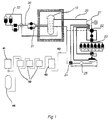
- a heat generating nuclear power plant with a boiling water reactor in which a heat producing core with fuel elements and control rods are arranged in a reactor tank 10 filled with water is shown.
- the reactor core is cooled through systems of circuits 20, 30 for the reactor and feed water connected to the reactor tank 10.
- Steam formed in the reactor core is conducted to a steam turbine 21 where the steam is expanded while providing energy to a rotor of the turbine 21.
- the steam is condensed in a condenser 22 which comprises cooling water circuits with pumps.
- the condensate pumps pump the condensate from the condenser 22 through a condensate purification filter 23, and after preheating in a preheater 24, back into the reactor tank 10 by means of a pump 25.
- Shown in the figure is also a circulation system 30 with means 31 for the cooling of the reactor water in connection to the shut off of the reactor, and means 32 for purification of reactor water.
- metal ions in a suitable shape are supplied to the water which circulates in the reactor tank 10 and the circuits 20 and 30.
- the metal ions are supplied in the shape of a solution, mixture or slurry from an equipment arrangement 40.
- This solution, mixture or slurry is prepared by dissolving a soluble metal compound, the counter-ion of which is possible to decompose to gaseous products and water, in water in a reaction vessel 41 in the equipment 40.
- the dissolution takes place while stirring and possibly, while heating and results in a solution that comprises metal ions and counter-ions.
- the solution is then conducted to a series of vessels 42 for decomposing the counter-ion to gaseous products and water.
- This decomposition takes place during stirring, by means of heating, adding of oxidizing agents, UV-irradiation of the solution or ultrasonic treatment of the same. It is suitable to use a combination of heating, oxidizing agents and UV-irradiation.
- Suitable oxidizing agents are such ones that produce gaseous products and possibly water when being decomposed, such as hydrogen peroxide and ozone.
- the solution is transformed to a finally dispersed slurry which is conducted to a vessel 43 for degassing the gaseous products before the slurry is supplied to the circuits 20 and 30.
- Suitable metal ions to be supplied to the primary cooling circuits 20, 30 are, as previously mentioned, iron (III) ions and zinc ions. These ions supplied to the feed water are present in the same state as the ions that are supplied to the water in the circuits 20 and 30 and the reactor tank 10 through natural corrosion. The addition of metal ions is controlled such that an optimum content is obtained and maintained in the feed water.
- the positioning of the arrangement 40 for the use of the method according to the invention is not critical, and, in principal, it may be located wherever in connection to the circuits 20 and 30, preferably in connection to the circuit 20.
- Iron (III) oxalate Fe 2 (C 2 O 4 ) 3
- the solution is then conducted to the series of vessels 42 for decomposing the counter-ion under the action of heating, addition of hydrogen peroxide and UV-irradiation.
- the oxalate ion thereby reacts with the hydrogen peroxide according to the reaction: C 2 O 4 2- + H 2 O 2 ⁇ 2CO 2 (aq) + 2OH - the hydroxide ions formed during the reaction precipitating iron (III) hydroxide and corresponding oxide hydroxides, alternatively oxides.
- a slurry of iron (III) oxide hydroxide which is finely distributed in water and free from other ions is formed.
- the slurry is conducted to the vessel 43 for degassing the carbon dioxide, whereafter it is supplied to the primary cooling circuit 20. Thanks to the slurry being finely distributed, the iron (III) ions are easily accessible for a reaction in the circuit 20 or 30.
Landscapes
- Physics & Mathematics (AREA)
- Engineering & Computer Science (AREA)
- Plasma & Fusion (AREA)
- General Engineering & Computer Science (AREA)
- High Energy & Nuclear Physics (AREA)
- Preventing Corrosion Or Incrustation Of Metals (AREA)
Applications Claiming Priority (2)
| Application Number | Priority Date | Filing Date | Title |
|---|---|---|---|
| SE9600496 | 1996-02-15 | ||
| SE9600496A SE506009C2 (sv) | 1996-02-15 | 1996-02-15 | Förfarande för att i nukleära anläggningar förhindra deponering av radioaktiva korrosionsprodukter på ytor utanför reaktorhärden |
Publications (2)
| Publication Number | Publication Date |
|---|---|
| EP0790621A1 true EP0790621A1 (de) | 1997-08-20 |
| EP0790621B1 EP0790621B1 (de) | 2001-08-22 |
Family
ID=20401350
Family Applications (1)
| Application Number | Title | Priority Date | Filing Date |
|---|---|---|---|
| EP97850012A Expired - Lifetime EP0790621B1 (de) | 1996-02-15 | 1997-01-29 | Verfahren zur Verhinderung der Ablagerung von radioaktiven Korrosionsprodukten in einem Kernkraftwerk |
Country Status (5)
| Country | Link |
|---|---|
| US (1) | US5896433A (de) |
| EP (1) | EP0790621B1 (de) |
| DE (1) | DE69706207T2 (de) |
| ES (1) | ES2161432T3 (de) |
| SE (1) | SE506009C2 (de) |
Cited By (4)
| Publication number | Priority date | Publication date | Assignee | Title |
|---|---|---|---|---|
| WO1999013476A3 (de) * | 1997-09-09 | 1999-05-27 | Siemens Ag | Verfahren zum einbringen von zink in ein wasser enthaltendes bauteil des primärsystems eines kernkraftwerkes |
| WO2000022627A1 (en) * | 1998-10-13 | 2000-04-20 | General Electric Company | Application of noble metals to internal surfaces of operating boiling water reactors in the presence of zinc in reactor water |
| CN104409118A (zh) * | 2014-10-23 | 2015-03-11 | 华北电力大学 | 研究聚变堆腐蚀产物沉积的热工水力实验系统及方法 |
| EP2503030A4 (de) * | 2009-11-16 | 2015-05-20 | Toshiba Kk | Korrosionsbeständige struktur und korrosionsschutzverfahren in einem hochtemperatur-wassersystem |
Families Citing this family (8)
| Publication number | Priority date | Publication date | Assignee | Title |
|---|---|---|---|---|
| DE60044619D1 (de) * | 2000-12-29 | 2010-08-12 | Cognis Ip Man Gmbh | Verflüssiger für invert-emulsionen |
| US6887832B2 (en) * | 2000-12-29 | 2005-05-03 | Halliburton Energy Service,S Inc. | Method of formulating and using a drilling mud with fragile gels |
| US7456135B2 (en) * | 2000-12-29 | 2008-11-25 | Halliburton Energy Services, Inc. | Methods of drilling using flat rheology drilling fluids |
| JP2003098294A (ja) * | 2001-09-27 | 2003-04-03 | Hitachi Ltd | オゾンを用いた除染方法及びその装置 |
| US20070028719A1 (en) * | 2005-08-03 | 2007-02-08 | General Electric | Method of manufacture of noble metal/zinc oxide hybrid product for simultaneous dose reduction and SCC mitigation of nuclear power plants |
| US20100246745A1 (en) * | 2006-12-29 | 2010-09-30 | Samson Hettiarachchi | Methods for operating and methods for reducing post-shutdown radiation levels of nuclear reactors |
| JP5118576B2 (ja) * | 2008-08-12 | 2013-01-16 | 三菱重工業株式会社 | 原子力プラントの運転方法 |
| US10770191B2 (en) | 2014-04-30 | 2020-09-08 | Ge-Hitachi Nuclear Energy Americas Llc | Systems and methods for reducing surface deposition and contamination |
Citations (4)
| Publication number | Priority date | Publication date | Assignee | Title |
|---|---|---|---|---|
| US4950449A (en) * | 1986-08-27 | 1990-08-21 | General Electric Company | Inhibition of radioactive cobalt deposition in water-cooled nuclear reactors |
| US5171515A (en) * | 1988-04-20 | 1992-12-15 | Westinghouse Electric Corp. | Process for inhibiting corrosion in a pressurized water nuclear reactor |
| EP0671486A1 (de) * | 1994-03-10 | 1995-09-13 | General Electric Company | Verfahren zum Datieren oder Beschichten von Rissflächen in Metallteilen mit Edelmetallen zum Schutz von Metallen von Spannungsnisskorrosion |
| WO1996000447A1 (en) * | 1994-06-24 | 1996-01-04 | General Electric Company | Modification of oxide film electrical conductivity to maintain low corrosion potential in high-temperature water |
Family Cites Families (3)
| Publication number | Priority date | Publication date | Assignee | Title |
|---|---|---|---|---|
| US4926449A (en) * | 1988-02-22 | 1990-05-15 | Burda Paul A | Corrosion inhibition of closed cooling water auxiliary system for nuclear power plants |
| US5015436A (en) * | 1988-03-30 | 1991-05-14 | Hitachi, Ltd. | Water-cooled direct cycle nuclear power plant |
| US5245642A (en) * | 1991-10-31 | 1993-09-14 | General Electric Company | Method of controlling co-60 radiation contamination of structure surfaces of cooling water circuits of nuclear reactors |
-
1996
- 1996-02-15 SE SE9600496A patent/SE506009C2/sv not_active IP Right Cessation
-
1997
- 1997-01-29 DE DE69706207T patent/DE69706207T2/de not_active Expired - Fee Related
- 1997-01-29 EP EP97850012A patent/EP0790621B1/de not_active Expired - Lifetime
- 1997-01-29 ES ES97850012T patent/ES2161432T3/es not_active Expired - Lifetime
- 1997-02-12 US US08/799,630 patent/US5896433A/en not_active Expired - Lifetime
Patent Citations (4)
| Publication number | Priority date | Publication date | Assignee | Title |
|---|---|---|---|---|
| US4950449A (en) * | 1986-08-27 | 1990-08-21 | General Electric Company | Inhibition of radioactive cobalt deposition in water-cooled nuclear reactors |
| US5171515A (en) * | 1988-04-20 | 1992-12-15 | Westinghouse Electric Corp. | Process for inhibiting corrosion in a pressurized water nuclear reactor |
| EP0671486A1 (de) * | 1994-03-10 | 1995-09-13 | General Electric Company | Verfahren zum Datieren oder Beschichten von Rissflächen in Metallteilen mit Edelmetallen zum Schutz von Metallen von Spannungsnisskorrosion |
| WO1996000447A1 (en) * | 1994-06-24 | 1996-01-04 | General Electric Company | Modification of oxide film electrical conductivity to maintain low corrosion potential in high-temperature water |
Cited By (7)
| Publication number | Priority date | Publication date | Assignee | Title |
|---|---|---|---|---|
| WO1999013476A3 (de) * | 1997-09-09 | 1999-05-27 | Siemens Ag | Verfahren zum einbringen von zink in ein wasser enthaltendes bauteil des primärsystems eines kernkraftwerkes |
| US6314153B1 (en) | 1997-09-09 | 2001-11-06 | Siemens Aktiengesellschaft | Process for introducing zinc into a water-containing component of the primary system of a nuclear power plant |
| WO2000022627A1 (en) * | 1998-10-13 | 2000-04-20 | General Electric Company | Application of noble metals to internal surfaces of operating boiling water reactors in the presence of zinc in reactor water |
| EP2503030A4 (de) * | 2009-11-16 | 2015-05-20 | Toshiba Kk | Korrosionsbeständige struktur und korrosionsschutzverfahren in einem hochtemperatur-wassersystem |
| US9771482B2 (en) | 2009-11-16 | 2017-09-26 | Kabushiki Kaisha Toshiba | Corrosion-resistant structure for high-temperature water system and corrosion-preventing method thereof |
| US9969889B2 (en) | 2009-11-16 | 2018-05-15 | Kabushiki Kaisha Toshiba | Corrosion-resistant structure for high-temperature water system and corrosion-preventing method thereof |
| CN104409118A (zh) * | 2014-10-23 | 2015-03-11 | 华北电力大学 | 研究聚变堆腐蚀产物沉积的热工水力实验系统及方法 |
Also Published As
| Publication number | Publication date |
|---|---|
| SE506009C2 (sv) | 1997-11-03 |
| SE9600496D0 (sv) | 1996-02-15 |
| SE9600496L (sv) | 1997-08-16 |
| DE69706207D1 (de) | 2001-09-27 |
| ES2161432T3 (es) | 2001-12-01 |
| EP0790621B1 (de) | 2001-08-22 |
| US5896433A (en) | 1999-04-20 |
| DE69706207T2 (de) | 2002-05-29 |
Similar Documents
| Publication | Publication Date | Title |
|---|---|---|
| US4756768A (en) | Method for the chemical decontamination of metallic parts of a nuclear reactor | |
| EP1220233B1 (de) | Chemisches Dekontaminierungsverfahren | |
| EP0790621B1 (de) | Verfahren zur Verhinderung der Ablagerung von radioaktiven Korrosionsprodukten in einem Kernkraftwerk | |
| EP0138289A1 (de) | Dekontamination metallischer oberflächen in Kernkraftreaktoren | |
| CA3003488C (en) | Method of decontaminating metal surfaces in a heavy water cooled and moderated nuclear reactor | |
| US10762997B2 (en) | Decontamination method reducing radioactive waste | |
| US10340050B2 (en) | Method of decontaminating metal surfaces in a cooling system of a nuclear reactor | |
| CA2805772A1 (en) | Reactor decontamination process and reagent | |
| US4476047A (en) | Process for treatment of oxide films prior to chemical cleaning | |
| US6944254B2 (en) | Pressurized water reactor shutdown method | |
| EP0134664B1 (de) | Ozon-Oxidation von Ablagerungen in Kühlanlagen von Nuklearreaktoren | |
| EP0164988B1 (de) | Verfahren zur Dekontamination metallischer Oberflächen | |
| US5093072A (en) | Process for the radioactive decontamination of metal surfaces, particularly portions of primary circuits of water-cooled nuclear reactors | |
| JP7344132B2 (ja) | 原子力プラントの炭素鋼部材への貴金属付着方法及び原子力プラントの炭素鋼部材への放射性核種の付着抑制方法 | |
| JP2008051530A (ja) | 構造材からのニッケル及びコバルトの溶出抑制方法 | |
| JP2018173391A (ja) | 除染処理水処理方法 | |
| Jenks et al. | WATER CHEMISTRY IN PRESSURIZED AND BOILING WATER POWER REACTORS. | |
| JP2000162383A (ja) | 原子力発電プラントの運転方法 | |
| JP2020160030A (ja) | 原子力プラント構成部材の線量抑制方法 | |
| JP7475171B2 (ja) | 化学除染方法および化学除染装置 | |
| JP2009109318A (ja) | タービン系の線量低減方法および原子力発電プラント | |
| JPH0784090A (ja) | 原子炉一次冷却材中への金属イオンの注入方法およびその装置 | |
| JPH041599A (ja) | 原子力発電プラントの放射性物質低減方法 | |
| Kormuth | The control of cobalt-58 dissolution during refueling shutdowns of pressurized water reactors using a hydrogen peroxide addition | |
| JPS642919B2 (de) |
Legal Events
| Date | Code | Title | Description |
|---|---|---|---|
| PUAI | Public reference made under article 153(3) epc to a published international application that has entered the european phase |
Free format text: ORIGINAL CODE: 0009012 |
|
| AK | Designated contracting states |
Kind code of ref document: A1 Designated state(s): CH DE ES FI LI |
|
| 17P | Request for examination filed |
Effective date: 19980216 |
|
| GRAG | Despatch of communication of intention to grant |
Free format text: ORIGINAL CODE: EPIDOS AGRA |
|
| 17Q | First examination report despatched |
Effective date: 20000822 |
|
| GRAG | Despatch of communication of intention to grant |
Free format text: ORIGINAL CODE: EPIDOS AGRA |
|
| GRAH | Despatch of communication of intention to grant a patent |
Free format text: ORIGINAL CODE: EPIDOS IGRA |
|
| RAP1 | Party data changed (applicant data changed or rights of an application transferred) |
Owner name: WESTINGHOUSE ATOM AB |
|
| GRAH | Despatch of communication of intention to grant a patent |
Free format text: ORIGINAL CODE: EPIDOS IGRA |
|
| GRAA | (expected) grant |
Free format text: ORIGINAL CODE: 0009210 |
|
| AK | Designated contracting states |
Kind code of ref document: B1 Designated state(s): CH DE ES FI LI |
|
| REG | Reference to a national code |
Ref country code: CH Ref legal event code: NV Representative=s name: RITSCHER & SEIFERT Ref country code: CH Ref legal event code: EP |
|
| REF | Corresponds to: |
Ref document number: 69706207 Country of ref document: DE Date of ref document: 20010927 |
|
| REG | Reference to a national code |
Ref country code: ES Ref legal event code: FG2A Ref document number: 2161432 Country of ref document: ES Kind code of ref document: T3 |
|
| PLBE | No opposition filed within time limit |
Free format text: ORIGINAL CODE: 0009261 |
|
| STAA | Information on the status of an ep patent application or granted ep patent |
Free format text: STATUS: NO OPPOSITION FILED WITHIN TIME LIMIT |
|
| 26N | No opposition filed | ||
| PGFP | Annual fee paid to national office [announced via postgrant information from national office to epo] |
Ref country code: CH Payment date: 20040115 Year of fee payment: 8 |
|
| PGFP | Annual fee paid to national office [announced via postgrant information from national office to epo] |
Ref country code: FI Payment date: 20040116 Year of fee payment: 8 |
|
| PGFP | Annual fee paid to national office [announced via postgrant information from national office to epo] |
Ref country code: ES Payment date: 20040123 Year of fee payment: 8 |
|
| PGFP | Annual fee paid to national office [announced via postgrant information from national office to epo] |
Ref country code: DE Payment date: 20040126 Year of fee payment: 8 |
|
| PG25 | Lapsed in a contracting state [announced via postgrant information from national office to epo] |
Ref country code: FI Free format text: LAPSE BECAUSE OF NON-PAYMENT OF DUE FEES Effective date: 20050129 |
|
| PG25 | Lapsed in a contracting state [announced via postgrant information from national office to epo] |
Ref country code: LI Free format text: LAPSE BECAUSE OF NON-PAYMENT OF DUE FEES Effective date: 20050131 Ref country code: ES Free format text: LAPSE BECAUSE OF NON-PAYMENT OF DUE FEES Effective date: 20050131 Ref country code: CH Free format text: LAPSE BECAUSE OF NON-PAYMENT OF DUE FEES Effective date: 20050131 |
|
| PG25 | Lapsed in a contracting state [announced via postgrant information from national office to epo] |
Ref country code: DE Free format text: LAPSE BECAUSE OF NON-PAYMENT OF DUE FEES Effective date: 20050802 |
|
| REG | Reference to a national code |
Ref country code: CH Ref legal event code: PL |
|
| REG | Reference to a national code |
Ref country code: ES Ref legal event code: FD2A Effective date: 20050131 |