EP0790748A1 - Signalisierungsverwaltungsverfahren in Vermittlungssystem mit Funk-Feststationen - Google Patents
Signalisierungsverwaltungsverfahren in Vermittlungssystem mit Funk-Feststationen Download PDFInfo
- Publication number
- EP0790748A1 EP0790748A1 EP97400314A EP97400314A EP0790748A1 EP 0790748 A1 EP0790748 A1 EP 0790748A1 EP 97400314 A EP97400314 A EP 97400314A EP 97400314 A EP97400314 A EP 97400314A EP 0790748 A1 EP0790748 A1 EP 0790748A1
- Authority
- EP
- European Patent Office
- Prior art keywords
- control unit
- cluster control
- access point
- radio
- radio access
- Prior art date
- Legal status (The legal status is an assumption and is not a legal conclusion. Google has not performed a legal analysis and makes no representation as to the accuracy of the status listed.)
- Granted
Links
- 230000011664 signaling Effects 0.000 title claims description 35
- 238000007726 management method Methods 0.000 title claims description 20
- 238000004891 communication Methods 0.000 claims abstract description 50
- 238000000034 method Methods 0.000 claims abstract description 30
- 238000012545 processing Methods 0.000 claims description 12
- 230000004807 localization Effects 0.000 claims description 11
- 230000008569 process Effects 0.000 claims description 5
- 230000005540 biological transmission Effects 0.000 claims description 4
- 230000000737 periodic effect Effects 0.000 claims description 4
- 238000010276 construction Methods 0.000 claims description 3
- 238000006677 Appel reaction Methods 0.000 description 17
- 238000010586 diagram Methods 0.000 description 11
- 210000000056 organ Anatomy 0.000 description 7
- 230000006870 function Effects 0.000 description 6
- 239000011159 matrix material Substances 0.000 description 5
- 230000015654 memory Effects 0.000 description 4
- 238000001514 detection method Methods 0.000 description 3
- 238000004458 analytical method Methods 0.000 description 2
- 230000008901 benefit Effects 0.000 description 2
- 238000013519 translation Methods 0.000 description 2
- 230000014616 translation Effects 0.000 description 2
- 230000008859 change Effects 0.000 description 1
- 238000009792 diffusion process Methods 0.000 description 1
- 230000008520 organization Effects 0.000 description 1
- 239000013643 reference control Substances 0.000 description 1
- 238000011160 research Methods 0.000 description 1
- 238000000926 separation method Methods 0.000 description 1
- 230000007723 transport mechanism Effects 0.000 description 1
- 238000012795 verification Methods 0.000 description 1
Images





Classifications
-
- H—ELECTRICITY
- H04—ELECTRIC COMMUNICATION TECHNIQUE
- H04W—WIRELESS COMMUNICATION NETWORKS
- H04W68/00—User notification, e.g. alerting and paging, for incoming communication, change of service or the like
-
- H—ELECTRICITY
- H04—ELECTRIC COMMUNICATION TECHNIQUE
- H04W—WIRELESS COMMUNICATION NETWORKS
- H04W76/00—Connection management
- H04W76/20—Manipulation of established connections
-
- H—ELECTRICITY
- H04—ELECTRIC COMMUNICATION TECHNIQUE
- H04W—WIRELESS COMMUNICATION NETWORKS
- H04W92/00—Interfaces specially adapted for wireless communication networks
- H04W92/02—Inter-networking arrangements
-
- H—ELECTRICITY
- H04—ELECTRIC COMMUNICATION TECHNIQUE
- H04W—WIRELESS COMMUNICATION NETWORKS
- H04W92/00—Interfaces specially adapted for wireless communication networks
- H04W92/16—Interfaces between hierarchically similar devices
- H04W92/20—Interfaces between hierarchically similar devices between access points
Definitions
- the present invention relates to a signaling management method in a self-switching system equipped with radio terminals to allow the connection of mobile terminals.
- the invention applies more particularly to a self-switching system in which the access points (lines to terminals or radio terminals, connections to networks or to dedicated lines, etc.) are organized into clusters each managed by a cluster control unit (UCG).
- Each cluster control unit has a certain autonomy to manage communications or other provision of services involving the access points which depend on it.
- the UCG has a memory in which tables are stored containing various data relating to the terminals which are connected to it and in particular making it possible to manage the faculties which the terminals have.
- Signaling processing concerning the establishment of a communication (or other provision of service) through an access point includes on the one hand control tasks of the access point to identify events (off-hook, on-hook, numbering , occupation ...) from the access point and translate them into messages from the auto-switching system and to address various commands to the access point (ringtone, tones, displays ...), and on the other hand tasks management system to process requests concerning the access point (depending in particular on the rights defined in the tables) and to supervise the access point control tasks.
- the signaling relating to a communication between several access points proceeds by exchanges of messages between the half-calls concerned.
- the management tasks use messages according to formats and protocols standardized in the auto-switching system, while the access point control tasks provide the translations necessary to take account of the specific characteristics of the different types of terminals or networks likely to 'be connected.
- the above architecture is well suited to the case of fixed terminals linked to UCGs at fixed addresses.
- the half-call concerning such a terminal can be entirely executed at the level of the UCG to which it is connected.
- Each mobile terminal is associated with a reference UCG where the relevant data concerning this terminal are stored.
- the procedures used for fixed terminals are applicable mutatis mutandis.
- the system comprises several clusters provided with radio terminals, it is useful to provide procedures allowing the mobile terminals to enter into communication by means of radio terminals linked to visited UCGs distinct from their reference UCGs. The absence of such procedures would seriously limit the offer of mobile service.
- the relevant data concerning the mobile terminal is transferred from the reference UCG to the UCGs visited during the movements of the mobile terminal, which makes it possible to perform the call management tasks in the UCGs visited .
- This type of procedure has the drawback of being very complex in terms of signaling protocol, unless the amenities and services to which the mobile terminal can access outside its reference cluster are severely limited.
- the second type of procedure consists in establishing the communication with the mobile terminal, necessarily passing through its reference UCG. This amounts to putting two communications end to end, one between the visited UCG and the reference UCG, the other between the reference UCG and the UCG providing the connection with the other terminal involved in the communication .
- This solution is not optimal in terms of using the available channels.
- the offer of services during communication which requires knowledge not only of the rights of the mobile user but also of elements of dynamic context participating in the decision to accept a request for such a service, presupposes that the signaling protocols be enriched to allow this dynamic context to be associated in the reference UCG with two communications placed end to end. Such an enrichment of the protocol is problematic, particularly in a multisite framework where the UCGs concerned can be located in geographically distinct sites.
- An object of the present invention is to propose an efficient management method for signaling relating to mobile terminals which allows them to access practically the same services as fixed terminals whatever their location within the system.
- the invention thus proposes a signaling management method in a self-switching system comprising several cluster control units each providing access points to the system, radio terminals being provided for providing radio links with mobile terminals and being each linked to a radio access point of a respective cluster control unit, the mobile terminals being respectively associated with reference cluster control units, method in which the signaling processing concerning the establishment of a communication through an access point include, with respect to this access point, on the one hand, control tasks of the access point to translate into signaling messages of the system events from the access point and send commands to the access point, and secondly call management tasks to deal with requests concerning the access point and supervise the access point control tasks when establishing communication.
- the call management tasks relating to said radio access point are carried out in the reference cluster control unit and at least part of the radio access point control tasks are carried out in said reference control unit cluster visited, the traffic path established in the auto-switching system between the radio access point and a second access point to support the communication being chosen independently of the signaling path used to exchange signaling messages specific to the communication system.
- This signaling management method shows great flexibility to take into account the mobility of the terminals.
- the mobile terminal can recover its rights as soon as it issues a request (call or service request).
- a priori he can access the same services as a fixed terminal (multiple call, automatic call back, entry into a third party, etc.).
- the mobile terminal can everywhere express its requests as if it were in connection with its reference UCG (it can in particular use the specific numbering plan if there is one), which gives it maximum comfort of use.
- Another terminal fixed or mobile
- the cells can each correspond to a respective UCG equipped with radio terminals.
- the division into cells can nevertheless advantageously be adapted to the particular architecture of the private network, by grouping UCGs whose radio terminals serve nearby areas (for example all or part of a site in the case of a multisite system).
- FIG. 1 shows, by way of illustration, an example of an auto-switching system constructed from four auto-switches (PABX) 10, 20, 30, 40.
- Each auto-switching device has an organization in clusters. It thus comprises one or more cluster control units (UCG) 11, 12, 13, 21, 22, 23, 31, 32, 33, 34, 41 each comprising a set of system access points.
- the access points can be used to interface with different types of lines, depending on the desired compatibility of the system.
- One can in particular provide access points for the connection of analog telephone terminals 50 (simple S63 terminals or "intelligent" terminals), digital terminals 51 for X25 networks or with integrated services ...
- some at least UCGs have access points connected for example to lines of the public switched telephone network (PSTN), of a digital integrated services network (ISDN) and / or of a digital packet switching network ( X25).
- PSTN public switched telephone network
- ISDN digital integrated services network
- X25 digital packet switching network
- some of the UCGs include radio access points respectively connected to radio terminals 15, 16, 25, 35, 45.
- the radio communications between the terminals and the mobile terminals are perform for example according to CT2 or DECT standards.
- Each UCG has sufficient resources to support communications between its own access points.
- Each switch 10, 20, 30 comprising several UCGs is equipped with a transport loop 18, 28, 38, allowing inter-UCG exchanges so as to support communications between several access points belonging to this switch.
- the loop 18, 28, 38 can be a digital line at 40 Mbits / s organized in timeshare to support 512 circuit-switching channels (hereinafter called “circuit channels”) and 70 switching channels packets (hereinafter called “packet channels”).
- Circuit channels are provided for access points whose operation requires the reservation of a circuit resource, while packet channels are provided for access points used by packet-switched communications and for command exchanges specific to the self-switching system (in particular the functions of signage).
- Control units not shown are provided in the automatic switches 10, 20, 30 to supervise the operation of the transport loops 18, 28, 38.
- inter-PABX lines 55-58 are provided between UCG gateways 13, 22, 23, 33, 34, 41 of the different automatic exchanges. These lines can be private (for example in the case of two automatic exchanges located on the same geographic site) or leased to a public operator in the case of a multisite system.
- the gateway UCGs are arranged to transparently transmit signaling and traffic on the inter-PABX lines 55-58. In the case for example of a telephone communication between an access point of the UCG 11 and an access point of the UCG 21 in the configuration of FIG.
- an initial signaling message sent for example by the UCG 11 can be inserted into a packet channel of loop 18, detected by the gateway UCG 13 and transmitted by the latter transparently to the gateway UCG 22 via line 55.
- the UCG 22 inserts this message in a packet channel of the loop 28, and the concerned UCG 21 detects the call intended for it and can then exchange messages with the UCG 11 along the signaling path 18, 55, 28 thus created to seek to obtain the allocation of circuit resources necessary for the transport of speech signals.
- the circuit resources which will be allocated to the communication are a priori independent of the signaling path used.
- the circuit reservation procedure may lead , after detection of this unavailability, to reserve a circuit channel on loop 28 between UCG 21 and 23, a channel on line 57, a circuit channel on loop 38 between UCG gateways 33 and 34, a channel on line 56 and a circuit channel on loop 18 between UCG 13 and 11.
- FIG. 2 is a block diagram of a UCG 13 having for example access points for analog terminals 50, one or more radio access points for the connection of terminals 16 and one or more gateway access points for the connection of inter-PABX lines 55.
- the UCG 13 has an interface 60 with the transport loop 18 of the automatic exchange, consisting for example of repeaters for retransmitting the frames circulating on the loop 18, associated with a separation automaton packet channels and circuit channels and to buffer memories for extracting and inserting signals relating to the UCG.
- Each access point of the UCG consists of a physical interface 61, 62, 63.
- Each interface 61, 62, 63 provides the physical signaling (detection of events, commands, etc.) and translation functions necessary for the compatibility of the devices connected to the access points with the formats used in the auto-switching system.
- the various interfaces 60-63 are connected to a switching matrix 64 which ensures the routing of the signals.
- the operation of the UCG 13 is controlled by a processor 65 associated with a memory 66.
- the processor 65 controls the interfaces 60-63 via its bus 67 either directly (interfaces 60, 62, 63 in the example of Figure 2) either through the switching matrix 64 (interfaces 61).
- the processor 65 provides in particular the signaling processing concerning the access points of the UCG: it is informed of the events detected by the interfaces 60-63 and performs the appropriate processing to configure the switching matrix 64, to send signaling messages to interface 60 and commands to physical interfaces 61-63.
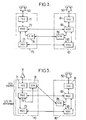
- processor 65 For the interface with the PABX transport loop, processor 65 has two software utilities: the GIC (Inter Manager Communications) which manages the packet channels and the GIM (Multisite Time Interval Manager) which manages the circuit channels.
- GIC Inter Manager Communications
- GIM Multisite Time Interval Manager
- the call processing is addressed to the GIC in the form of primitives.
- the GIC manages the routing of messages.
- the call processing is addressed to the GIM also in the form of primitives.
- the GIM utilities of the two half-calls interact directly with each other.
- the organ manager is adapted to the type of organ it controls, the MAS is independent of the type of organ. This independence is preserved by the MAS / MGO interface, the formats of which are standardized within the system. MGO is common to a family of applications while IGO is more specific. For example, one can provide, for radio communications, a single MGO module and several types of IGO mobiles, for example an IGO for the CT2 case and an IGO for the DECT case.
- Each mobile terminal is associated with a respective reference UCG where the tables defining in particular the access rights of this terminal are stored.
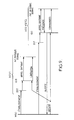
- FIG. 4 illustrates the course of an origin half-call from a mobile terminal in connection with a radio terminal connected to a visited UCG different from its reference UCG.
- the IGO task is executed in the UCG visited, while the MGO and MAS tasks are executed in the reference UCG associated with the terminal.
- an IGO task is created in the UCG visited.
- the IGO then broadcasts an establishment message including an identity of the mobile terminal constituted by its number in the numbering plan specific to the radio links. This avoids that all UCGs equipped with radio terminals need to store correspondence tables between the numbers in the radio plan and the numbers in the private plan with regard to all mobile terminals.
- Each UCG has a utility, called DST, to monitor the messages broadcast on the PABX transport loops and take the necessary measures when these messages concern the UCG in question.
- DST a utility
- the UCGs other than the reference UCG ignore the establishment message broadcast by the IGO, while the DST utility of the reference UCG, after having detected that the requesting mobile terminal is associated with this UCG, creates an MGO task.
- the DST also translates the identity from the terminal to supply the terminal number in the private dialing plan of the auto-switching system, the radio plan / private plan correspondence table only needing to be stored in the reference UCG of the terminal.
- the MGO task created in the reference UCG in turn creates a MAS task by providing it with an establishment message translated according to the standard formats of the MGO / MAS interface.
- the MAS then manages the half-call by transmitting event request messages to the MGO, which translates them for the IGO, to collect the dialed numbers on the mobile terminal.
- the IGO issues commands to the physical terminal interface to produce appropriate tones or displays at the terminal.
- the MAS Once the MAS has collected all the event messages it needs to define the request formulated by the terminal, it indicates to the MGO and, from there, to the IGO that the call is being processed.
- the IGO then controls the terminal to produce the appropriate tones and displays.
- the MAS examines the request, consulting the tables relating to the mobile terminal.
- the MAS sends an establishment message to the UCG comprising the requested access point (other fixed or mobile terminal, output trunk, etc.) by identifying in this message the identity (in the radio numbering plan) of the requesting terminal, the address of the radio access point or the UCG visited from which the call originates and the identity (in the private numbering plan ) from the destination access point.
- the MAS of the reference UCG transmits the alert message to the MGO, and withdraws after receiving an acknowledgment message from the part of the MGO.
- the alert message is sent to the IGO in the UCG visited, the IGO then producing the appropriate commands (for example ringing tone of the called station) to the mobile terminal.
- the MAS having withdrawn, the MGO dialogues directly with its counterpart of the other half-call. It receives a "connect" message after picking up the called station, then sends a connection request to the GIM of the UCG visited.
- the "connect" message is transmitted to the IGO so that it notifies the requesting terminal and controls the switching matrix of the UCG visited so that it ensures the physical connection of the reserved circuit.
- the reference UCG MGO confirms to its counterpart that the communication can start in an acknowledgment message.
- the GIM utility involved in the originating half-call is that of the UCG visited, which is identified in the establishment message having created the MAS of the recipient half-call.
- the voice path selected between the UCG visited and the destination UCG is therefore independent of the signaling path passing through the reference UCG.
- FIG. 6 is a diagram corresponding to that of FIG. 4 in the case of a call intended for a mobile terminal in connection with a radio terminal connected to a visited UCG different from its reference UCG.
- the reception of the establishment message from the MAS of the originating half-call creates a MAS task in the reference UCG.
- This MAS task in turn creates an MGO task in the reference UCG, provided that the mobile terminal has not activated a service such as call forwarding or non-fault, which the processing of calls made by the MAS allow verification by consulting the tables concerning the destination terminal identified in the establishment message.
- a service such as call forwarding or non-fault
- the MGO confirms to the MAS, in a call in progress message, that it is looking for the mobile terminal, and it transmits the establishment message, suitably translated, to the UCG visited according to a process which will be detailed later.
- the establishment message is received by the MAS and transmitted to the MGO with the identity of the terminal in the private plan of the auto-switching system (standard MAS format), and the MGO transmits the establishment message to the UCG visited with the identity of the terminal in the radio plan since the private plan / radio plan correspondences are not all known in the UCGs equipped with radio terminals.
- the reception of the establishment message creates an IGO task which indicates the incoming call to the physical interface of the radio terminal concerned (or to the physical interfaces of all radio terminals depending on the UCG visited) .
- the IGO alerts the MGO of the reference UCG, which in turn alerts the MAS.
- the MAS then sends to the GIM of the UCG visited (for example via the GIM of the reference UCG) a request to establish the voice path indicating the identity of the requesting terminal and the address of the point d access from which the call originates, which it received in the initial establishment message.
- the GIM of the UCG visited dialogues with its counterpart of the original half-call to obtain the reservation of the necessary circuit resources, which do not pass mandatory by the reference UCG.
- the GIM of the UCG visited notifies the MAS of the reference UCG.
- the latter then sends an alert message identifying the reserved circuits to its counterpart of the originating half-call.
- the MAS of the reference UCG then withdraws after sending an acknowledgment message to the MGO.
- the MGO transmits the acknowledgment message to the IGO of the UCG visited so that it can send the appropriate commands to ring and / or display appropriate messages on the radio to the physical interface of the radio terminal. terminal called.
- the IGG of the UCG visited sends an event message to the MGO of the reference UCG, which then addresses the message "connect" to its counterpart of the origin half-call.
- the benchmark UCG MGO address its request to connect to the GIM of the UCG visited (for example through the GIM of the reference UCG).
- the MGO transmits an "acknowledgment connect" message to the IGO so that the latter notifies the called terminal and commands the switching matrix of the UCG visited to ensure the physical connection of the reserved circuit.
- Routing a call to a mobile terminal requires that measures be taken to locate the mobile terminals within the system, i.e. to identify the UCGs which include the radio access points providing good links. with mobile terminals.
- the invention thus provides two location procedures implemented one periodically and the other when setting up a call for a mobile terminal.
- Each UCG constituting the reference UCG of at least one mobile terminal stores a location table indicating, for each mobile terminal which is associated with it and which is in connection with a radio terminal, a location cell consisting of one or more UCG equipped with radio terminals and including at least the UCG comprising the radio access point to which this radio terminal is connected.
- the establishment message produced by the MGO of the reference UCG (FIG. 6) is in fact broadcast to all UCGs comprising at least one access point radio, and this message includes, in addition to the identity in the radio plane of the called terminal, an identity of a search area of the terminal.
- This search area corresponds to the cell of location indicated in the location table of the called terminal.
- the DST utility of each UCG processes the establishment message to create the IGO task only if the cell corresponding to the identified search area covers the UCG in question.
- An IGO task controls the radio access points of each UCG in the indicated location cell to search for the terminal.
- the search for a mobile terminal is initiated by the terminals: the radio access points are then controlled by the IGO to initiate the search (paging) of the terminal by sending appropriate interrogations on the radio channel.
- the terminals which identify themselves with the terminals which serve them it is the terminals which identify themselves with the terminals which serve them.
- the search commissioned by the IGO consists for the terminals in determining whether the called terminal appears in the lists of terminals they serve.
- the mobile terminal responds to the search carried out from the visited UCG which is included in its location cell.
- the IGG of the UCG visited then sends a positive alert message to the MGO.
- the acknowledgment message returned by the MGO is also broadcast, and it includes the identity of the location cell of the mobile terminal. If applicable, the IGO tasks in progress in the UCGs of the location cell other than the UCG visited are withdrawn upon receipt of this acknowledgment message.
- the mobile terminal does not respond to the search carried out in the UCG1 (s) included in the location cell indicated in its location table.
- the MGO broadcasts the establishment message again with the identity of the called terminal, but this time identifying a search zone corresponding to one or more cells different from the indicated localization cell. in the location table.
- These cells themselves include one or more UCGs.
- the cells of the new search area are determined by the MGO in the reference UCG by consulting a prerecorded neighborhood table giving, for each cell, a list of the cell or cells most likely to provide a radio link in the case a small movement of the terminal.
- the DST utility of each UCG receiving this new establishment message determines whether this UCG is part of one of the cells of the identified search area, and creates an IGO task if so.
- the UCG visited receives the second establishment message, and the IGO task sends a positive alert message to the MGO after detection of the physical presence of the terminal within range of one of the points d of the UCG visited.
- This alert message identifies the UCG cell visited and the radio access point providing the link (or the best link) with the terminal.
- the MGO updates the location table with respect to the terminal called in the reference UCG on the basis of the identity of the cell designated in the positive alert message.
- the acknowledgment message produced by the MGO after the withdrawal of the MAS is also broadcast. As in the case of FIG.
- the IGG of the UCG visited addresses the appropriate commands to the radio access point providing the link with the terminal.
- the other IGO tasks created by the first or second establishment message are withdrawn after having received the acknowledgment message and after having released the radio terminals with respect to the search for the called terminal.
- the MGO may, after another time delay, for example 3 seconds, broadcast the message again. establishment, but without specifying a search area. All UCGs fitted with radio terminals are then affected and carry out a search procedure as explained above. If again no positive alert message is not received by the MGO, the latter informs the MAS, which in turn notifies the MAS of the origin half-call that the called terminal cannot be reached.
- timings mentioned could be carried out by the IGO tasks, with a negative alert message being sent back to the MGO if the search carried out under the control of an IGO fails during the delay period.
- a location table can also be updated with regard to a mobile terminal when this terminal requests the establishment of a call in the manner explained with reference to FIG. 4.
- the periodic localization procedure proceeds by successive cycles carried out for example every 3 minutes. Such a cycle is illustrated in Figure 10.
- Each UCG constituting the reference UCG of at least one mobile terminal stores, in addition to its location table, a list L1 of identities, in the radio plane, of sought mobile terminals.
- each UCG equipped with at least one radio terminal stores a list L2 of identities, in the radio plane, of the mobile terminals that it serves.
- the reference UCGs broadcast their respective LLs to UCGs equipped with radio terminals (step 90).
- each UCG controls its radio access points to search for the terminals identified in these lists L1 and in the list L2 memorized by this UCG (step 91).
- the UCG proceeds to update 92 of its list L2 for the following cycle.
- the updated list L2 is made up of the identities of the terminals which were located in step 91.
- the UCG equipped with radio terminals also broadcasts a CR report message intended for the reference UCGs. This message CR contains an identity of the cell to which the UCG which distributes it belongs and the list of identities of the mobile terminals that this UCG could not locate in step 91.
- Each reference UCG receives report messages from UCGs equipped with radio terminals, and filters them to take account only of the identities of the terminals associated with it. On the basis of the filtered CR messages and of the list L1 which it has disseminated at the start of the cycle, the reference UCG updates its localization table (step 94) and its list L1 for the next cycle (step 95) .
- step 94 the localization table of the reference UCG is updated with respect to each terminal identified in the list L1 which it has broadcast at the start of the cycle and not identified in one of the messages report, indicating for this terminal the cell identified in said report message.
- the other entries in the location table remain unchanged.
- step 95 the reference UCG deletes from the list L1 the identities of its associated terminals for which the location table is modified in step 94.
- the reference UCG adds to the list L1 the identities of its associated terminals which, without being part of the list L1 which it distributed at the start of the cycle, appear in one of the report messages.
Landscapes
- Engineering & Computer Science (AREA)
- Computer Networks & Wireless Communication (AREA)
- Signal Processing (AREA)
- Mobile Radio Communication Systems (AREA)
- Time-Division Multiplex Systems (AREA)
- Radio Relay Systems (AREA)
Applications Claiming Priority (2)
| Application Number | Priority Date | Filing Date | Title |
|---|---|---|---|
| FR9601877 | 1996-02-15 | ||
| FR9601877A FR2745140B1 (fr) | 1996-02-15 | 1996-02-15 | Procede de gestion de signalisation dans un systeme d'autocommutation equipe de bornes radio |
Publications (2)
| Publication Number | Publication Date |
|---|---|
| EP0790748A1 true EP0790748A1 (de) | 1997-08-20 |
| EP0790748B1 EP0790748B1 (de) | 2003-07-09 |
Family
ID=9489229
Family Applications (1)
| Application Number | Title | Priority Date | Filing Date |
|---|---|---|---|
| EP97400314A Expired - Lifetime EP0790748B1 (de) | 1996-02-15 | 1997-02-12 | Signalisierungsverwaltungsverfahren in Vermittlungssystem mit Funk-Feststationen |
Country Status (5)
| Country | Link |
|---|---|
| EP (1) | EP0790748B1 (de) |
| AT (1) | ATE244976T1 (de) |
| DE (1) | DE69723330T2 (de) |
| ES (1) | ES2203764T3 (de) |
| FR (1) | FR2745140B1 (de) |
Cited By (2)
| Publication number | Priority date | Publication date | Assignee | Title |
|---|---|---|---|---|
| FR2799324A1 (fr) * | 1999-10-05 | 2001-04-06 | Matra Nortel Communications | Procede d'etablissement de communication entre des terminaux relies a un systeme de commutation, et systeme de commutation mettant en oeuvre le procede |
| US7480285B2 (en) | 2000-12-22 | 2009-01-20 | Aastra Matra Telecom | Method for setting up communication paths between access points of a switching system, and switching system implementing the method |
Citations (4)
| Publication number | Priority date | Publication date | Assignee | Title |
|---|---|---|---|---|
| EP0456547A1 (de) * | 1990-05-09 | 1991-11-13 | Dassault Automatismes Et Telecommunications | Verfahren und Einrichtung für telefonische Verbindungen für ein Netzwerk mit selbständigen Stationen |
| WO1993016543A1 (en) * | 1992-02-17 | 1993-08-19 | Telefonaktiebolaget Lm Ericsson | A method of producing an intelligent network service |
| WO1994006251A1 (en) * | 1992-08-28 | 1994-03-17 | Telefonaktiebolaget Lm Ericsson | Network structure and a signalling protocol for a telecommunication network |
| US5461669A (en) * | 1992-07-29 | 1995-10-24 | Alcatel N.V. | Telecommunication network with separate call control and connection control |
Family Cites Families (1)
| Publication number | Priority date | Publication date | Assignee | Title |
|---|---|---|---|---|
| US5659544A (en) * | 1994-10-17 | 1997-08-19 | Lucent Technologies Inc. | Method and system for distributed control in wireless cellular and personal communication systems |
-
1996
- 1996-02-15 FR FR9601877A patent/FR2745140B1/fr not_active Expired - Fee Related
-
1997
- 1997-02-12 ES ES97400314T patent/ES2203764T3/es not_active Expired - Lifetime
- 1997-02-12 EP EP97400314A patent/EP0790748B1/de not_active Expired - Lifetime
- 1997-02-12 AT AT97400314T patent/ATE244976T1/de not_active IP Right Cessation
- 1997-02-12 DE DE69723330T patent/DE69723330T2/de not_active Expired - Fee Related
Patent Citations (4)
| Publication number | Priority date | Publication date | Assignee | Title |
|---|---|---|---|---|
| EP0456547A1 (de) * | 1990-05-09 | 1991-11-13 | Dassault Automatismes Et Telecommunications | Verfahren und Einrichtung für telefonische Verbindungen für ein Netzwerk mit selbständigen Stationen |
| WO1993016543A1 (en) * | 1992-02-17 | 1993-08-19 | Telefonaktiebolaget Lm Ericsson | A method of producing an intelligent network service |
| US5461669A (en) * | 1992-07-29 | 1995-10-24 | Alcatel N.V. | Telecommunication network with separate call control and connection control |
| WO1994006251A1 (en) * | 1992-08-28 | 1994-03-17 | Telefonaktiebolaget Lm Ericsson | Network structure and a signalling protocol for a telecommunication network |
Non-Patent Citations (2)
| Title |
|---|
| LA PORTA T F: "DISTRIBUTED CALL PROCESSING FOR PERSONAL COMMUNICATIONS SERVICES", IEEE COMMUNICATIONS MAGAZINE, vol. 33, no. 6, 1 June 1995 (1995-06-01), pages 66 - 75, XP000545327 * |
| SODERBERG L: "EVOLVING AN INTELLIGENT ARCHITECTURE FOR PERSONAL TELECOMMUNICATION", ERICSSON REVIEW, vol. 70, no. 4, 1 January 1993 (1993-01-01), pages 156 - 171, XP000415352 * |
Cited By (3)
| Publication number | Priority date | Publication date | Assignee | Title |
|---|---|---|---|---|
| FR2799324A1 (fr) * | 1999-10-05 | 2001-04-06 | Matra Nortel Communications | Procede d'etablissement de communication entre des terminaux relies a un systeme de commutation, et systeme de commutation mettant en oeuvre le procede |
| WO2001026351A3 (fr) * | 1999-10-05 | 2002-01-17 | Eads Defence & Security Ntwk | Procede d'etablissement de communication entre des terminaux relies a un systeme de commutation, et systeme de commutation mettant en oeuvre le procede |
| US7480285B2 (en) | 2000-12-22 | 2009-01-20 | Aastra Matra Telecom | Method for setting up communication paths between access points of a switching system, and switching system implementing the method |
Also Published As
| Publication number | Publication date |
|---|---|
| ES2203764T3 (es) | 2004-04-16 |
| DE69723330D1 (de) | 2003-08-14 |
| ATE244976T1 (de) | 2003-07-15 |
| FR2745140A1 (fr) | 1997-08-22 |
| FR2745140B1 (fr) | 1998-04-24 |
| DE69723330T2 (de) | 2004-05-27 |
| EP0790748B1 (de) | 2003-07-09 |
Similar Documents
| Publication | Publication Date | Title |
|---|---|---|
| EP0276754B1 (de) | Nachrichtenwegesuchverfahren für Netzwerk von digitalen Zeitmultiplexvermittlungsanlagen | |
| FR2851710A1 (fr) | Procede permettant a un usager mobile passant d'un reseau public de telecommunication a un autre, de recevoir des appels via le reseau le plus adapte a sa localisation; et dispositifs pour la mise en ouvre de ce procede | |
| CA2043291A1 (fr) | Procede de maintenance centralisee, pour un reseau de telephonie sans fil | |
| FR2753862A1 (fr) | Procede et systeme de communication interactive entre deux appareils telephoniques via le reseau internet | |
| FR2694466A1 (fr) | Réseau de télécommunication réalisant séparément un traitement d'appel et un traitement de connexion. | |
| FR2778809A1 (fr) | Installation de transmission de messages a stations perfectionnees, et procede correspondant | |
| FR2481558A1 (fr) | Dispositif destine a un systeme de radiotelephonie mobile | |
| FR2472897A1 (fr) | Dispositif de transmission d'information de commande dans un systeme de commutation | |
| FR2671925A1 (fr) | Procede d'etablissement d'une connexion d'appel dans un systeme de standard prive avec un systeme de recherche de personnes. | |
| JPH09214614A (ja) | リモート端末に接続された電話加入者に対し、複数の電話サービスプロバイダーからサービスを提供する装置 | |
| FR2718313A1 (fr) | Procédé et système de gestion de données utilisées par un logiciel d'application dans un réseau de télécommunications hétérogène. | |
| EP0456547A1 (de) | Verfahren und Einrichtung für telefonische Verbindungen für ein Netzwerk mit selbständigen Stationen | |
| EP0790748B1 (de) | Signalisierungsverwaltungsverfahren in Vermittlungssystem mit Funk-Feststationen | |
| EP1692882B1 (de) | Verfahren und server zur koordination von telekommunikationsdiensten | |
| EP1354463B1 (de) | Telefonsystem das ein oder mehrere mikrocomputer benutzt | |
| WO2001011803A1 (fr) | Procede de radiocommunication entre une station de base et des terminaux mobiles, stations de base et terminaux mobiles pour la mise en oeuvre d'un tel procede | |
| EP0798944B1 (de) | Lokales Netz mit Zugang zu mobilen Teilnehmern | |
| FR2772953A1 (fr) | Systeme de commutation de donnees | |
| FR2858904A1 (fr) | Dispositif de communication mobile du type a ilots | |
| FR2818854A1 (fr) | Procede d'etablissement de chemins de communication entre des points d'acces d'un systeme de commutation, et systeme de commutation mettant en oeuvre le procede | |
| CA2295997C (fr) | Dispositif interface de communication entre une installation terminale d'abonne d'un reseau externe et un reseau interne | |
| EP0831668A1 (de) | Selbstanpassendes Protokoll zwischen Basisstationen eines zellularen Telefonnetzwerkes | |
| BE1021478B1 (fr) | Amelorations apportees a des registres de localisation | |
| FR2801454A1 (fr) | Reseau x25 et procede de transmission de donnees | |
| WO2003071776A1 (fr) | Systeme et procede de cooperation d'une plateforme de service telephonique avec une plateforme de service de type internet |
Legal Events
| Date | Code | Title | Description |
|---|---|---|---|
| PUAI | Public reference made under article 153(3) epc to a published international application that has entered the european phase |
Free format text: ORIGINAL CODE: 0009012 |
|
| AK | Designated contracting states |
Kind code of ref document: A1 Designated state(s): AT BE CH DE DK ES FI GB IT LI NL PT SE |
|
| 17P | Request for examination filed |
Effective date: 19970915 |
|
| RAP1 | Party data changed (applicant data changed or rights of an application transferred) |
Owner name: MATRA NORTEL COMMUNICATIONS |
|
| 17Q | First examination report despatched |
Effective date: 20010625 |
|
| RAP1 | Party data changed (applicant data changed or rights of an application transferred) |
Owner name: EADS DEFENCE AND SECURITY NETWORKS |
|
| GRAH | Despatch of communication of intention to grant a patent |
Free format text: ORIGINAL CODE: EPIDOS IGRA |
|
| GRAH | Despatch of communication of intention to grant a patent |
Free format text: ORIGINAL CODE: EPIDOS IGRA |
|
| GRAA | (expected) grant |
Free format text: ORIGINAL CODE: 0009210 |
|
| RAP1 | Party data changed (applicant data changed or rights of an application transferred) |
Owner name: EADS TELECOM |
|
| AK | Designated contracting states |
Designated state(s): AT BE CH DE DK ES FI GB IT LI NL PT SE |
|
| PG25 | Lapsed in a contracting state [announced via postgrant information from national office to epo] |
Ref country code: NL Free format text: LAPSE BECAUSE OF FAILURE TO SUBMIT A TRANSLATION OF THE DESCRIPTION OR TO PAY THE FEE WITHIN THE PRESCRIBED TIME-LIMIT Effective date: 20030709 Ref country code: FI Free format text: LAPSE BECAUSE OF FAILURE TO SUBMIT A TRANSLATION OF THE DESCRIPTION OR TO PAY THE FEE WITHIN THE PRESCRIBED TIME-LIMIT Effective date: 20030709 Ref country code: AT Free format text: LAPSE BECAUSE OF FAILURE TO SUBMIT A TRANSLATION OF THE DESCRIPTION OR TO PAY THE FEE WITHIN THE PRESCRIBED TIME-LIMIT Effective date: 20030709 |
|
| REG | Reference to a national code |
Ref country code: GB Ref legal event code: FG4D Free format text: NOT ENGLISH |
|
| REG | Reference to a national code |
Ref country code: CH Ref legal event code: EP |
|
| REF | Corresponds to: |
Ref document number: 69723330 Country of ref document: DE Date of ref document: 20030814 Kind code of ref document: P |
|
| PG25 | Lapsed in a contracting state [announced via postgrant information from national office to epo] |
Ref country code: SE Free format text: LAPSE BECAUSE OF FAILURE TO SUBMIT A TRANSLATION OF THE DESCRIPTION OR TO PAY THE FEE WITHIN THE PRESCRIBED TIME-LIMIT Effective date: 20031009 Ref country code: DK Free format text: LAPSE BECAUSE OF FAILURE TO SUBMIT A TRANSLATION OF THE DESCRIPTION OR TO PAY THE FEE WITHIN THE PRESCRIBED TIME-LIMIT Effective date: 20031009 |
|
| GBT | Gb: translation of ep patent filed (gb section 77(6)(a)/1977) |
Effective date: 20031027 |
|
| NLV1 | Nl: lapsed or annulled due to failure to fulfill the requirements of art. 29p and 29m of the patents act | ||
| PG25 | Lapsed in a contracting state [announced via postgrant information from national office to epo] |
Ref country code: PT Free format text: LAPSE BECAUSE OF FAILURE TO SUBMIT A TRANSLATION OF THE DESCRIPTION OR TO PAY THE FEE WITHIN THE PRESCRIBED TIME-LIMIT Effective date: 20031209 |
|
| PG25 | Lapsed in a contracting state [announced via postgrant information from national office to epo] |
Ref country code: BE Free format text: LAPSE BECAUSE OF NON-PAYMENT OF DUE FEES Effective date: 20040228 |
|
| PG25 | Lapsed in a contracting state [announced via postgrant information from national office to epo] |
Ref country code: LI Free format text: LAPSE BECAUSE OF NON-PAYMENT OF DUE FEES Effective date: 20040229 Ref country code: CH Free format text: LAPSE BECAUSE OF NON-PAYMENT OF DUE FEES Effective date: 20040229 |
|
| REG | Reference to a national code |
Ref country code: ES Ref legal event code: FG2A Ref document number: 2203764 Country of ref document: ES Kind code of ref document: T3 |
|
| PLBE | No opposition filed within time limit |
Free format text: ORIGINAL CODE: 0009261 |
|
| STAA | Information on the status of an ep patent application or granted ep patent |
Free format text: STATUS: NO OPPOSITION FILED WITHIN TIME LIMIT |
|
| 26N | No opposition filed |
Effective date: 20040414 |
|
| BERE | Be: lapsed |
Owner name: *EADS TELECOM Effective date: 20040228 |
|
| REG | Reference to a national code |
Ref country code: CH Ref legal event code: PL |
|
| REG | Reference to a national code |
Ref country code: GB Ref legal event code: 732E |
|
| PGFP | Annual fee paid to national office [announced via postgrant information from national office to epo] |
Ref country code: ES Payment date: 20080221 Year of fee payment: 12 |
|
| PGFP | Annual fee paid to national office [announced via postgrant information from national office to epo] |
Ref country code: IT Payment date: 20080228 Year of fee payment: 12 Ref country code: GB Payment date: 20080222 Year of fee payment: 12 |
|
| PGFP | Annual fee paid to national office [announced via postgrant information from national office to epo] |
Ref country code: DE Payment date: 20080423 Year of fee payment: 12 |
|
| GBPC | Gb: european patent ceased through non-payment of renewal fee |
Effective date: 20090212 |
|
| PG25 | Lapsed in a contracting state [announced via postgrant information from national office to epo] |
Ref country code: DE Free format text: LAPSE BECAUSE OF NON-PAYMENT OF DUE FEES Effective date: 20090901 |
|
| REG | Reference to a national code |
Ref country code: ES Ref legal event code: FD2A Effective date: 20090213 |
|
| PG25 | Lapsed in a contracting state [announced via postgrant information from national office to epo] |
Ref country code: GB Free format text: LAPSE BECAUSE OF NON-PAYMENT OF DUE FEES Effective date: 20090212 |
|
| PG25 | Lapsed in a contracting state [announced via postgrant information from national office to epo] |
Ref country code: ES Free format text: LAPSE BECAUSE OF NON-PAYMENT OF DUE FEES Effective date: 20090213 |
|
| PG25 | Lapsed in a contracting state [announced via postgrant information from national office to epo] |
Ref country code: IT Free format text: LAPSE BECAUSE OF NON-PAYMENT OF DUE FEES Effective date: 20090212 |