EP0791388A2 - Procédé d'adsorption à vide alterné avec récupération d'énergie - Google Patents
Procédé d'adsorption à vide alterné avec récupération d'énergie Download PDFInfo
- Publication number
- EP0791388A2 EP0791388A2 EP97301055A EP97301055A EP0791388A2 EP 0791388 A2 EP0791388 A2 EP 0791388A2 EP 97301055 A EP97301055 A EP 97301055A EP 97301055 A EP97301055 A EP 97301055A EP 0791388 A2 EP0791388 A2 EP 0791388A2
- Authority
- EP
- European Patent Office
- Prior art keywords
- bed
- vacuum pump
- pressure
- adsorbable component
- feed
- Prior art date
- Legal status (The legal status is an assumption and is not a legal conclusion. Google has not performed a legal analysis and makes no representation as to the accuracy of the status listed.)
- Granted
Links
- 238000000034 method Methods 0.000 title claims abstract description 84
- 238000001179 sorption measurement Methods 0.000 title claims abstract description 51
- 238000011084 recovery Methods 0.000 title claims description 19
- 239000007789 gas Substances 0.000 claims abstract description 112
- 238000010926 purge Methods 0.000 claims abstract description 52
- 239000003463 adsorbent Substances 0.000 claims abstract description 39
- QVGXLLKOCUKJST-UHFFFAOYSA-N atomic oxygen Chemical compound [O] QVGXLLKOCUKJST-UHFFFAOYSA-N 0.000 claims abstract description 37
- 239000001301 oxygen Substances 0.000 claims abstract description 37
- 229910052760 oxygen Inorganic materials 0.000 claims abstract description 37
- 239000000203 mixture Substances 0.000 claims abstract description 31
- IJGRMHOSHXDMSA-UHFFFAOYSA-N nitrogen Substances N#N IJGRMHOSHXDMSA-UHFFFAOYSA-N 0.000 claims description 38
- 229910052757 nitrogen Inorganic materials 0.000 claims description 20
- 238000006073 displacement reaction Methods 0.000 claims description 8
- 229910001868 water Inorganic materials 0.000 claims description 8
- XLYOFNOQVPJJNP-UHFFFAOYSA-N water Substances O XLYOFNOQVPJJNP-UHFFFAOYSA-N 0.000 claims description 7
- 230000005540 biological transmission Effects 0.000 claims description 4
- QJGQUHMNIGDVPM-UHFFFAOYSA-N nitrogen group Chemical group [N] QJGQUHMNIGDVPM-UHFFFAOYSA-N 0.000 claims description 2
- 239000000047 product Substances 0.000 description 56
- 239000003570 air Substances 0.000 description 29
- CURLTUGMZLYLDI-UHFFFAOYSA-N Carbon dioxide Chemical compound O=C=O CURLTUGMZLYLDI-UHFFFAOYSA-N 0.000 description 11
- 239000012080 ambient air Substances 0.000 description 8
- 238000004519 manufacturing process Methods 0.000 description 7
- 229910002092 carbon dioxide Inorganic materials 0.000 description 6
- 239000001569 carbon dioxide Substances 0.000 description 5
- 238000000926 separation method Methods 0.000 description 5
- 230000008901 benefit Effects 0.000 description 4
- 230000000274 adsorptive effect Effects 0.000 description 3
- 238000013459 approach Methods 0.000 description 3
- 230000009977 dual effect Effects 0.000 description 3
- 238000005516 engineering process Methods 0.000 description 3
- 238000003860 storage Methods 0.000 description 3
- VYPSYNLAJGMNEJ-UHFFFAOYSA-N Silicium dioxide Chemical compound O=[Si]=O VYPSYNLAJGMNEJ-UHFFFAOYSA-N 0.000 description 2
- 239000006227 byproduct Substances 0.000 description 2
- 230000000977 initiatory effect Effects 0.000 description 2
- 238000005086 pumping Methods 0.000 description 2
- 230000008929 regeneration Effects 0.000 description 2
- 238000011069 regeneration method Methods 0.000 description 2
- 239000010457 zeolite Substances 0.000 description 2
- -1 NaX Chemical compound 0.000 description 1
- 229910000831 Steel Inorganic materials 0.000 description 1
- 229910021536 Zeolite Inorganic materials 0.000 description 1
- 238000004458 analytical method Methods 0.000 description 1
- 150000001768 cations Chemical class 0.000 description 1
- 230000002860 competitive effect Effects 0.000 description 1
- HNPSIPDUKPIQMN-UHFFFAOYSA-N dioxosilane;oxo(oxoalumanyloxy)alumane Chemical compound O=[Si]=O.O=[Al]O[Al]=O HNPSIPDUKPIQMN-UHFFFAOYSA-N 0.000 description 1
- 238000004821 distillation Methods 0.000 description 1
- 238000009826 distribution Methods 0.000 description 1
- 238000005265 energy consumption Methods 0.000 description 1
- 238000011156 evaluation Methods 0.000 description 1
- 239000000499 gel Substances 0.000 description 1
- 239000011521 glass Substances 0.000 description 1
- 239000012535 impurity Substances 0.000 description 1
- 230000010354 integration Effects 0.000 description 1
- 239000002808 molecular sieve Substances 0.000 description 1
- 238000005457 optimization Methods 0.000 description 1
- 239000002245 particle Substances 0.000 description 1
- 238000004076 pulp bleaching Methods 0.000 description 1
- 230000009467 reduction Effects 0.000 description 1
- 239000000377 silicon dioxide Substances 0.000 description 1
- URGAHOPLAPQHLN-UHFFFAOYSA-N sodium aluminosilicate Chemical compound [Na+].[Al+3].[O-][Si]([O-])=O.[O-][Si]([O-])=O URGAHOPLAPQHLN-UHFFFAOYSA-N 0.000 description 1
- 239000010959 steel Substances 0.000 description 1
- 239000000126 substance Substances 0.000 description 1
- 239000011800 void material Substances 0.000 description 1
- 239000002699 waste material Substances 0.000 description 1
- 238000004065 wastewater treatment Methods 0.000 description 1
Images
Classifications
-
- B—PERFORMING OPERATIONS; TRANSPORTING
- B01—PHYSICAL OR CHEMICAL PROCESSES OR APPARATUS IN GENERAL
- B01D—SEPARATION
- B01D53/00—Separation of gases or vapours; Recovering vapours of volatile solvents from gases; Chemical or biological purification of waste gases, e.g. engine exhaust gases, smoke, fumes, flue gases, aerosols
- B01D53/02—Separation of gases or vapours; Recovering vapours of volatile solvents from gases; Chemical or biological purification of waste gases, e.g. engine exhaust gases, smoke, fumes, flue gases, aerosols by adsorption, e.g. preparative gas chromatography
- B01D53/04—Separation of gases or vapours; Recovering vapours of volatile solvents from gases; Chemical or biological purification of waste gases, e.g. engine exhaust gases, smoke, fumes, flue gases, aerosols by adsorption, e.g. preparative gas chromatography with stationary adsorbents
- B01D53/047—Pressure swing adsorption
- B01D53/0476—Vacuum pressure swing adsorption
-
- B—PERFORMING OPERATIONS; TRANSPORTING
- B01—PHYSICAL OR CHEMICAL PROCESSES OR APPARATUS IN GENERAL
- B01D—SEPARATION
- B01D53/00—Separation of gases or vapours; Recovering vapours of volatile solvents from gases; Chemical or biological purification of waste gases, e.g. engine exhaust gases, smoke, fumes, flue gases, aerosols
- B01D53/02—Separation of gases or vapours; Recovering vapours of volatile solvents from gases; Chemical or biological purification of waste gases, e.g. engine exhaust gases, smoke, fumes, flue gases, aerosols by adsorption, e.g. preparative gas chromatography
- B01D53/04—Separation of gases or vapours; Recovering vapours of volatile solvents from gases; Chemical or biological purification of waste gases, e.g. engine exhaust gases, smoke, fumes, flue gases, aerosols by adsorption, e.g. preparative gas chromatography with stationary adsorbents
- B01D53/047—Pressure swing adsorption
- B01D53/053—Pressure swing adsorption with storage or buffer vessel
-
- B—PERFORMING OPERATIONS; TRANSPORTING
- B01—PHYSICAL OR CHEMICAL PROCESSES OR APPARATUS IN GENERAL
- B01D—SEPARATION
- B01D2256/00—Main component in the product gas stream after treatment
- B01D2256/12—Oxygen
-
- B—PERFORMING OPERATIONS; TRANSPORTING
- B01—PHYSICAL OR CHEMICAL PROCESSES OR APPARATUS IN GENERAL
- B01D—SEPARATION
- B01D2259/00—Type of treatment
- B01D2259/40—Further details for adsorption processes and devices
- B01D2259/40011—Methods relating to the process cycle in pressure or temperature swing adsorption
- B01D2259/40043—Purging
- B01D2259/4005—Nature of purge gas
- B01D2259/40052—Recycled product or process gas
-
- B—PERFORMING OPERATIONS; TRANSPORTING
- B01—PHYSICAL OR CHEMICAL PROCESSES OR APPARATUS IN GENERAL
- B01D—SEPARATION
- B01D2259/00—Type of treatment
- B01D2259/40—Further details for adsorption processes and devices
- B01D2259/40011—Methods relating to the process cycle in pressure or temperature swing adsorption
- B01D2259/40058—Number of sequence steps, including sub-steps, per cycle
- B01D2259/40067—Seven
-
- B—PERFORMING OPERATIONS; TRANSPORTING
- B01—PHYSICAL OR CHEMICAL PROCESSES OR APPARATUS IN GENERAL
- B01D—SEPARATION
- B01D2259/00—Type of treatment
- B01D2259/40—Further details for adsorption processes and devices
- B01D2259/40011—Methods relating to the process cycle in pressure or temperature swing adsorption
- B01D2259/40077—Direction of flow
- B01D2259/40079—Co-current
-
- B—PERFORMING OPERATIONS; TRANSPORTING
- B01—PHYSICAL OR CHEMICAL PROCESSES OR APPARATUS IN GENERAL
- B01D—SEPARATION
- B01D2259/00—Type of treatment
- B01D2259/40—Further details for adsorption processes and devices
- B01D2259/40011—Methods relating to the process cycle in pressure or temperature swing adsorption
- B01D2259/40077—Direction of flow
- B01D2259/40081—Counter-current
-
- B—PERFORMING OPERATIONS; TRANSPORTING
- B01—PHYSICAL OR CHEMICAL PROCESSES OR APPARATUS IN GENERAL
- B01D—SEPARATION
- B01D2259/00—Type of treatment
- B01D2259/40—Further details for adsorption processes and devices
- B01D2259/403—Further details for adsorption processes and devices using three beds
-
- B—PERFORMING OPERATIONS; TRANSPORTING
- B01—PHYSICAL OR CHEMICAL PROCESSES OR APPARATUS IN GENERAL
- B01D—SEPARATION
- B01D53/00—Separation of gases or vapours; Recovering vapours of volatile solvents from gases; Chemical or biological purification of waste gases, e.g. engine exhaust gases, smoke, fumes, flue gases, aerosols
- B01D53/02—Separation of gases or vapours; Recovering vapours of volatile solvents from gases; Chemical or biological purification of waste gases, e.g. engine exhaust gases, smoke, fumes, flue gases, aerosols by adsorption, e.g. preparative gas chromatography
- B01D53/04—Separation of gases or vapours; Recovering vapours of volatile solvents from gases; Chemical or biological purification of waste gases, e.g. engine exhaust gases, smoke, fumes, flue gases, aerosols by adsorption, e.g. preparative gas chromatography with stationary adsorbents
- B01D53/0407—Constructional details of adsorbing systems
- B01D53/0446—Means for feeding or distributing gases
Definitions
- the present invention is directed to a vacuum swing adsorption process for the separation of a more strongly adsorbable component from a less strongly adsorbable component in a gas mixture with high recovery of the less strongly adsorbable component at approximately feed pressure. More specifically, the present invention is a vacuum swing adsorption process for the separation of air to recover oxygen as a relatively unadsorbed product at high recovery and approximately feed pressure, using overlapping evacuation steps and various techniques for recovering the pressure energy contained within the process gas streams.
- Oxygen is a commodity chemical in the industrial gas industry. It has numerous applications including waste water treatment, pulp bleaching, glass manufacturing, and steel manufacturing.
- One of the most common methods of oxygen production is by adsorptive gas separation.
- this technology is not competitive for large size oxygen plants (>90 US tons per day (“TPD”); >80 tonnes/day (“tpd”) O 2 ).
- TPD US tons per day
- tpd tonnes/day
- the technology of choice for this size range is cryogenic distillation of air.
- PSA pressure swing adsorption processes
- VSA vacuum swing adsorption processes
- the pressure swing adsorption processes carry out the adsorption (feed) step at pressures much higher than ambient and adsorbent regeneration at pressures close to ambient.
- the adsorbent beds go through secondary process steps, such as pressure equalizations, depressurizations, blowdowns, and purge or various combinations of these during the cycle.
- Typical of the O 2 PSA processes are US-A-3,430,418; US-A-4,589,888; US-A-4,650,501; and US-A-4,981,499.
- O 2 PSA processes tend to be energy intensive and more suitable for smaller oxygen plants producing less than 20 tons (18 tonnes) of oxygen per day and preferably less than 5 tons (4.5 tonnes) of oxygen per day.
- a subset of O 2 PSA processes is a rapid pressure swing adsorption (RPSA) process. As the name implies, this process involves similar steps as a PSA process, but carries out these steps very quickly. Again, this process tends to be energy intensive and suitable for oxygen plants even smaller than O 2 PSA's.
- RPSA rapid pressure swing adsorption
- VSA vacuum swing adsorption
- adsorption is carried out at pressure slightly above ambient and adsorbent regeneration is carried out at sub-atmospheric levels.
- the adsorbent beds go through several secondary steps with the primary aim of increasing oxygen recovery and reducing adsorbent inventory per unit of product gas.
- Most commercial O 2 VSA processes employ two or three adsorbers, a feed blower, vacuum blower, and possibly a product surge tank.
- US-A-4,917,710 describes a two bed O 2 VSA process with a product storage vessel.
- Process cycle steps are: adsorption, cocurrent depressurization, simultaneous cocurrent depressurization and evacuation, evacuation, vacuum purge by product, vacuum purge by gas obtained in a cocurrent depressurization step, simultaneous pressure equalization and product repressurization, and simultaneous feed and product repressurization.
- Gas for product repressurization and product purge is obtained from the product storage vessel.
- Gas for pressure equalization is obtained from the bed on simultaneous cocurrent depressurization and evacuation step.
- US-A-4,781,735 describes a three bed O 2 VSA process with steps: adsorption, feed to feed or dual end pressure equalization, cocurrent depressurization, evacuation, vacuum purge by gas obtained in cocurrent depressurization step, product repressurization from bed on feed step, simultaneous feed repressurization and feed to feed or dual end pressure equalization.
- EP-A-0 354 259 outlines various options for a two bed O 2 VSA process: adsorption, cocurrent depressurization, evacuation, pressure equalization with gas obtained in cocurrent depressurization step and feed repressurization.
- An option includes vacuum purge by product gas from the bed on adsorption step.
- US-A-5,015,271 describes an O 2 VSA process with the steps: adsorption, simultaneous cocurrent depressurization and countercurrent evacuation or feed, countercurrent evacuation, simultaneous product to product pressure equalization and feed repressurization, or vacuum purge, simultaneous feed and product repressurization and feed repressurization.
- US-A-5,122, 164 describes an O 2 VSA process with the steps: adsorption, simultaneous cocurrent depressurization and countercurrent evacuation, countercurrent evacuation, vacuum purge, pressure equalization with gas from a bed undergoing cocurrent depressurization and product repressurization.
- US-A-5,223,004 describes an O 2 VSA process with the steps: adsorption, simultaneous cocurrent depressurization and countercurrent evacuation, countercurrent evacuation, purge, repressurization with product and cocurrent depressurization gas from another bed and repressurization with product and feed.
- US-A-5,429,666 describes a 2 bed O 2 VSA process with the steps: adsorption, simultaneous cocurrent depressurization and countercurrent evacuation, countercurrent evacuation, purge, simultaneous repressurization with feed gas mixture and cocurrent depressurization gas, and repressurization with several combinations of feed gas, product gas, and ambient air.
- Table 1 summarizes the results of an exergy analysis on the two-bed process described in US-A-5,429,666. TABLE 1 Lost Work Distribution Cycle/Sieve/Beds 34% Vacuum Blower 32% Feed Blower 18% Waste Stream 7% Vacuum Line, DP, DT 6% Feed Line, DP, DT 3% The theoretical work of separation represents only 15% of the total power consumption. Vacuum and feed blower inefficiencies contribute half the lost work in the system. Lost expansion energy contributes another 33%.
- US-A-5,393,326 describes an oxygen VSA process which incorporates two stages of evacuation. Each stage is carried out by a separate vacuum machine. These machines could be of the same type or different types, e.g. volumetric and centrifugal.
- US-A-5,330,561 describes a 4 bed O 2 VSA process with 2 vacuum pumps with the steps: adsorption, cocurrent depressurization to provide purge gas, simultaneous countercurrent evacuation and cocurrent depressurization to provide pressure equalization gas, countercurrent evacuation in two successive pumping sub-steps, countercurrent purge, receipt of aforementioned pressure equalization gas and repressurization with several combinations of product gas, feed gas, or ambient air.
- US-A-5,411,578 describes a 4 bed O 2 VSA process with 2 vacuum pumps with the steps: adsorption, cocurrent depressurization to provide product gas, cocurrent depressurization to provide purge gas, two successive sub-steps of countercurrent evacuation, countercurrent purge, partial repressurization with product gas, followed by further repressurization with feed gas.
- Options include simultaneous cocurrent depressurization to provide pressure equalization gas following the provide purge step and simultaneous ambient air repressurization during the partial product repressurization step.
- US-A-5,246,676 describes a process for producing oxygen from air containing at least three beds and undergoing the following steps: adsorption, countercurrent evacuation including at least two successive pumping sub-steps, and product repressurization.
- Various options on the cycle include: cocurrent depressurization to provide purge gas to the bed under vacuum, further cocurrent depressurization to provide partial repressurization gas, and cocurrent depressurization to a storage tank from where some of the purge gas is withdrawn.
- the above described dual vacuum cycles have the capability to increase single train capacity beyond 90 TPD (80 tpd) and to reduce power consumption by allowing more time for the evacuation phase and by allowing more efficient machines to be used in the deep vacuum region. They do not, however, offer any significant improvement in adsorbent productivity relative to the 2 or 3 bed cycles.
- the present invention provides a VSA process for selectively separating a more strongly adsorbable component from a less strongly adsorbable component of a feed gas mixture, in a plurality of adsorption beds containing an adsorbent selective for the more strongly adsorbable component, utilizing two vacuum pumps, and comprising for each bed the phased sequential steps of:
- the bed can be simultaneously repressurized with less strongly adsorbable component and feed gas mixture in step (g).
- step (b) the pressure equalization of step (b) is performed to complete equalization of the pressures in the two beds engaged in the pressure equalizing step.
- both vacuum pumps and the air blower are mounted on the same motor shaft to simplify the transmission of recovered power.
- the air blower is a positive displacement Roots type blower.
- the first vacuum pump is a single stage positive displacement Roots type blower.
- the second vacuum pump is a two stage, water injected positive displacement Roots type blower, or a centrifugal type machine.
- the purge gas can be expanded through an expander to recover the pressure energy contained there in and use it to reduce the power requirement of the countercurrent purge of step (e).
- the cocurrent depressurization gas of step (b) can be expanded through an expander to recover energy to further reduce the power requirement the countercurrent evacuation of step (d).
- the feed gas mixture is air, the more strongly adsorbable component is nitrogen and the less strongly adsorbable component is oxygen.
- the process is carried out in three adsorbers.
- the present invention provides a process for selectively separating nitrogen from oxygen in air, utilizing two vacuum pumps and three adsorption beds containing an adsorbent selective for nitrogen, comprising the steps of:
- the first bed is repressurized in step (g) with oxygen product and elevated pressure feed air simultaneously.
- the feed air is at a pressure in the range of 15-30 psia (100-200 kPa).
- the feed air is at a pressure in the range of 15-24 psia (100-165 kPa).
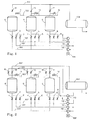
- Fig. 1 is a schematic drawing of a first preferred embodiment of the present invention using three parallel adsorption beds, two vacuum pumps, and appropriate valve manifolding for feed, evacuation, purge, equalization, and repressurization. It permits recovery of the pressure energy contained in the countercurrent depressurization and ambient air repressurization streams.
- Fig. 2 is a schematic drawing of a second preferred embodiment of the present invention using three adsorption beds, two vacuum pumps, an expander, and appropriate valve manifolding. It permits additional recovery of the pressure energy contained in the concurrent depressurization/pressure equalization and product purge streams.
- a process cycle chart is outlined in Table 2.
- FIG. 1 depicts a schematic for the first preferred embodiment with recovery of expansion energy from the countercurrent depressurization stream of step (2) and the ambient air repressurization stream of step (6).
- Table 3 outlines the corresponding valve sequence for a typical cycle time. Detailed process description of the cycle at typical operating conditions for the process option described in Fig. 1 and Tables 2 and 3 is given below: TABLE 3 Valve Sequence: 3 Bed O 2 VSA - Embodiment #1 Time (sec) Valve No.
- Ambient air compressed to feed pressure (21 psia; 145 kPa) by a feed blower 110 driven by motor 108 comprises the elevated feed gas mixture and enters through manifold 100 and open valve 1 into first Bed A, which has already been pressurized to adsorption pressure.
- Beds A, B and C are packed with adsorbent(s) selective for the removal of water, carbon dioxide, and nitrogen from air.
- Oxygen product is withdrawn via open valve 10 and manifold 104 to product reservoir 109. Part of the product oxygen is removed through manifold 103 and open valves 11 and 13 as purge gas for Bed B.
- Feed flow is discontinued after a preset limit determined by a predetermined time or nitrogen concentration in the effluent from Bed A or the approach of the adsorption front to the bed outlet.
- Pressure in Bed A is reduced to about 15 psia (100 kPa) by closing valves 1 and 10 and opening valves 11 and 13 and connecting Bed A with Bed B via manifold 103.
- Bed A is simultaneously depressured via open valve 2 and manifold 101 through vacuum pump 111. The energy recovered from this expanding stream is used to reduce the power requirement of vacuum pump 112.
- Valve 11 is then closed and valve 2 remains opened until Bed A reaches an evacuation level pressure about 7 psia (50 kPa).
- Valve 2 then closes and Bed A continues evacuating to about 4 psia (30 kPa) via open valve 3 and manifold 102 through vacuum pump 112.
- Valve 3 is kept open for a predetermined time while valve 11 is opened to vacuum purge Bed A through manifold 103 with product oxygen from Bed C via open valve 15.
- Valve 3 is then closed and valves 1, 11, and 15 are opened for simultaneous ambient feed air and Bed C cocurrent depressurization gas repressurization through manifolds 100 and 103, respectively.
- the energy recovered from the ambient feed air as it expands through the feed blower before entering the subatmospheric pressure of the adsorber, is used to reduce the power requirement for vacuum pump 112.
- Valves 11 and 15 are kept open until the pressures in Beds A and C equalize. Then valves 11 and 15 close and Bed A is pressurized up to adsorption pressure about 21 psia (145 kPa) with elevated pressure feed air from manifold 100. Valve 10 is opened to remove product oxygen through manifold 104. Bed A is now ready to start a new cycle. All three beds go through a similar sequence of operation 120 degrees out of phase with each other, in which the operation of Bed B associated with valves 4, 5, 6, 12 and 13 and Bed C associated with valves 7, 8, 9, 14 and 15 is comparable to the operation described for Bed A. The feed blower 110 and the vacuum pumps 111 and 112 run continuously off the same motor shaft, allowing simplification of operation and transmission of recovered power.
- Fig. 2 depicts a schematic for a second preferred embodiment. It permits additional recovery of expansion energy from the cocurrent pressure equalization stream of step (2) and the product purge stream of step (5).
- Table 4 outlines the corresponding valve sequence for a typical cycle time. Detailed process description of the cycle at typical operating conditions for the process option described in Fig. 2 and Tables 2 and 4 is given below: TABLE 4 Valve Sequence: 3 Bed O 2 VSA - Embodiment #2 Time (sec) Valve No.
- Ambient air compressed to feed pressure (21 psia; 145 kPa) by a feed blower 110' driven by motor 108' comprises the elevated feed gas mixture and enters through manifold 100' and open valve 1' into first Bed A', which has already been pressurized to adsorption pressure. Beds A', B' and C' are packed with adsorbent(s) selective for the removal of water, carbon dioxide, and nitrogen from air. Oxygen product is withdrawn via open valve 10' and manifold 104' to product reservoir 109'. Part of the product oxygen is removed through manifolds 105 and 103' and open valves 16 and 13' as purge gas for Bed B'. Energy is recovered from the purge gas stream as it passes through expander 113.
- Feed flow is discontinued after a preset limit determined by a predetermined time or nitrogen concentration in the effluent from Bed A' or the approach of the adsorption front to the bed outlet.
- Pressure in Bed A' is reduced by closing valves 1' and 10' and opening valves 16 and 13' and connecting Bed A' with Bed B' via manifolds 105 and 103'.
- Energy is recovered from the pressure equalization stream as it passes through expander 113.
- Bed A' is simultaneously depressured via open valve 2' and manifold 101' through vacuum pump 111'. The energy recovered from the cocurrent depressurization/pressure equalization stream is used to reduce the power requirement of vacuum pump 112'.
- Valve 16 is closed and valve 2' remains opened until Bed A' reaches an evacuation level pressure about 7 psia (50 kPa). Valve 2' then closes and Bed A' continues evacuating to about 4 psia (30 kPa) via open valve 3' and manifold 102' through vacuum pump 112'. Valve 3' is kept open for a predetermined time while valve 11' is opened to vacuum purge Bed A' through manifolds 103' and 105 with product oxygen from Bed C' via open valve 18. Valve 3' is then closed and valves 1', 11', and 18 are opened for simultaneous ambient feed air and Bed C' cocurrent depressurization gas repressurization through manifolds 100', 103', and 105, respectively.
- Valves 11' and 18 are kept open until the pressures in Beds A' and C' equalize. Then valves 11' and 18 close and Bed A' is pressurized up to adsorption pressure about 21 psia (145 kPa) with elevated pressure feed air from manifold 100'. Valve 10' is opened to remove product oxygen through manifold 104'. Bed A' is now ready to start a new cycle.
- All three beds go through a similar sequence of operation 120 degrees out of phase with each other, in which Bed B' and associated valves 4', 5', 6', 12', 13' and 17, and Bed C' and associated valves 7', 8', 9', 14', 15' and 18.
- the feed blower 110', the vacuum pumps 111' and 112', and the expander 113 run continuously off the same motor shaft, allowing simplification of operation and transmission of recovered power.
- an adsorbent that selectively removes water, carbon dioxide, and nitrogen from air include zeolitic molecular sieves such as NaX, NaA, LiX, MgA, CaX, CaA and other adsorbents with binary cations.
- zeolitic molecular sieves such as NaX, NaA, LiX, MgA, CaX, CaA and other adsorbents with binary cations.
- Examples of adsorbents capable of removing water and carbon dioxide from air are aluminas, silica gels, and zeolites.
- adsorbents are (i) high crush strength, (ii) high attrition resistance, (iii) large bulk density, (iv) low interparticle void, (v) high heat capacity, (vi) large thermal conductivity, (vii) high N 2 /O 2 selectivity, (viii) low oxygen capacity, and (ix) small particle size. Pressure drop through the adsorbent beds during adsorption and evacuation steps is also important for adsorbent selection.
- the present invention achieves this desirable lower cost of producing oxygen using three unique innovations.
- the minimum total cycle time for US-A-5,429,666 and US-A-5,411,578 both of which have an adsorber connected to a vacuum pump for one-half of the total cycle time) is 80 seconds.
- the present invention has an inherent 33% advantage in minimum total cycle time, which translates directly to a 33% advantage in adsorbent productivity and adsorber/adsorbent related costs.
- the E2 machine evacuates the adsorber to a relatively shallow 7 psia (50 kPa) and as such can be a single stage dry machine.
- a single stage dry vacuum pump costs about 1/3 as much as a two stage wet machine.
- the present invention is able to achieve power reductions of 2.5 to 5%.
- the first preferred embodiment does this very simply.
- power generated during the countercurrent depressurization of step 2 and ambient repressurization of step 6 can be directly transferred to the second vacuum pump to reduce its power consumption.
- No special energy recovery equipment is required, and the recoverable energy represents approximately 2.5% of the total process requirement.
- Approximately 5% of the total process power requirement is recovered in the second preferred embodiment.
- Additional capital equipment in the form of 3 valves and a dedicated expander are required to capture and utilize the pressure energy contained in the product purge and cocurrent DP streams.
- the first preferred embodiment would be the most economic design.
- the second preferred embodiment would be more economic in a very large plant with expensive power.
- the present invention can be used with a four bed process using three vacuum pumps. Each bed would spend 3T/4 of the total cycle time hooked to at least one of the vacuum pumps. In fact, each vacuum pump will be connected to a bed for T/4 of T time period. A bed will spend T/4 of the T on adsorption, repressurization steps.
Landscapes
- Chemical & Material Sciences (AREA)
- Engineering & Computer Science (AREA)
- Analytical Chemistry (AREA)
- General Chemical & Material Sciences (AREA)
- Oil, Petroleum & Natural Gas (AREA)
- Chemical Kinetics & Catalysis (AREA)
- Separation Of Gases By Adsorption (AREA)
- Oxygen, Ozone, And Oxides In General (AREA)
Applications Claiming Priority (2)
| Application Number | Priority Date | Filing Date | Title |
|---|---|---|---|
| US606137 | 1996-02-23 | ||
| US08/606,137 US5656067A (en) | 1996-02-23 | 1996-02-23 | VSA adsorption process with energy recovery |
Publications (3)
| Publication Number | Publication Date |
|---|---|
| EP0791388A2 true EP0791388A2 (fr) | 1997-08-27 |
| EP0791388A3 EP0791388A3 (fr) | 1997-09-24 |
| EP0791388B1 EP0791388B1 (fr) | 2000-09-06 |
Family
ID=24426712
Family Applications (1)
| Application Number | Title | Priority Date | Filing Date |
|---|---|---|---|
| EP97301055A Expired - Lifetime EP0791388B1 (fr) | 1996-02-23 | 1997-02-19 | Procédé d'adsorption à vide alterné avec récupération d'énergie |
Country Status (5)
| Country | Link |
|---|---|
| US (1) | US5656067A (fr) |
| EP (1) | EP0791388B1 (fr) |
| CA (1) | CA2197738C (fr) |
| DE (1) | DE69702991T2 (fr) |
| ES (1) | ES2149550T3 (fr) |
Cited By (3)
| Publication number | Priority date | Publication date | Assignee | Title |
|---|---|---|---|---|
| EP0988882A3 (fr) * | 1998-07-24 | 2000-08-30 | The Boc Group, Inc. | Procédé et dispositif de séparation d'un mélange gazeux par adsorption à variation de pression |
| NL1013314C2 (nl) * | 1999-10-16 | 2001-04-18 | Esselink B V | Drukwisseladsorptiewerkwijze. |
| EP1484207A1 (fr) * | 2003-06-02 | 2004-12-08 | Digital Automobile Co., Ltd. | Système de purification d'air pour véhicule automobile avec une fonction de fournisseur d'oxygène |
Families Citing this family (45)
| Publication number | Priority date | Publication date | Assignee | Title |
|---|---|---|---|---|
| USRE38493E1 (en) | 1996-04-24 | 2004-04-13 | Questair Technologies Inc. | Flow regulated pressure swing adsorption system |
| DE29719775U1 (de) * | 1996-12-11 | 1998-02-05 | SGI-Prozesstechnik GmbH, 63674 Altenstadt | Druckwechselanlage zur Gewinnung von Sauerstoff aus der Luft |
| ATE261757T1 (de) * | 1996-12-11 | 2004-04-15 | Sgi Prozess Technik Gmbh | Verfahren zum betrieb einer druckwechselanlage zur gewinnung von sauerstoff aus der luft |
| US5882380A (en) * | 1997-05-14 | 1999-03-16 | Air Products And Chemicals, Inc. | Pressure swing adsorption process with a single adsorbent bed |
| US6183537B1 (en) * | 1997-11-04 | 2001-02-06 | Praxair Technology, Inc. | Rotary blowers for pressure swing adsorption process and system |
| CA2264418C (fr) * | 1998-03-12 | 2002-05-14 | Adeola Florence Ojo | Elimination du dioxyde de carbone des flux gazeux |
| US6921597B2 (en) * | 1998-09-14 | 2005-07-26 | Questair Technologies Inc. | Electrical current generation system |
| US6080226A (en) * | 1998-09-30 | 2000-06-27 | Uop Llc | Nitrous oxide purification by pressure swing adsorption |
| AU5381200A (en) | 1999-06-09 | 2001-01-02 | Questair Technologies, Inc. | Rotary pressure swing adsorption apparatus |
| AU5381300A (en) * | 1999-06-10 | 2001-01-02 | Questair Technologies, Inc. | Chemical reactor with pressure swing adsorption |
| US7250073B2 (en) * | 1999-12-09 | 2007-07-31 | Questair Technologies, Inc. | Life support oxygen concentrator |
| US6514319B2 (en) | 1999-12-09 | 2003-02-04 | Questair Technologies Inc. | Life support oxygen concentrator |
| CA2306311C (fr) | 2000-04-20 | 2007-04-10 | Quest Air Gases Inc. | Structures lamellees adsorbantes |
| US6558451B2 (en) * | 2000-05-10 | 2003-05-06 | Airsep Corporation | Multiple bed pressure swing adsorption method and apparatus |
| US6428607B1 (en) | 2000-06-26 | 2002-08-06 | Air Products And Chemicals, Inc. | Pressure swing adsorption process which provides product gas at decreasing bed pressure |
| WO2002035623A2 (fr) | 2000-10-27 | 2002-05-02 | Questair Technologies Inc. | Systemes et procedes d'alimentation d'hydrogene dans des piles a combustible |
| US7097925B2 (en) * | 2000-10-30 | 2006-08-29 | Questair Technologies Inc. | High temperature fuel cell power plant |
| CA2325072A1 (fr) * | 2000-10-30 | 2002-04-30 | Questair Technologies Inc. | Systeme de separation de gaz pour pile a combustible a carbonates fondus |
| AU2002215752A1 (en) * | 2000-12-08 | 2002-06-18 | Denis Connor | Methods and apparatuses for gas separation by pressure swing adsorption with partial gas product feed to fuel cell power source |
| CA2329475A1 (fr) | 2000-12-11 | 2002-06-11 | Andrea Gibbs | Amp a cycle eleve avec adsorbants sensibles a l'humidite atmospherique |
| US6751958B1 (en) | 2001-09-06 | 2004-06-22 | Honeywell International Inc. | Physical chemistry compression |
| KR100495974B1 (ko) * | 2002-01-16 | 2005-06-17 | 디지털오토모빌(주) | 산소공급기능을 갖는 자동차용 공기정화장치 |
| CN100493670C (zh) * | 2002-03-14 | 2009-06-03 | 探索空气技术公司 | 结合压力波动和置换净化进行气体分离的设备和系统 |
| JP2006505095A (ja) * | 2002-03-14 | 2006-02-09 | クエストエアー テクノロジーズ インコーポレイテッド | 固体酸化物燃料電池用の水素リサイクル |
| US6641645B1 (en) | 2002-06-13 | 2003-11-04 | Air Products And Chemicals, Inc. | Vacuum swing adsorption process with controlled waste gas withdrawal |
| US7285350B2 (en) | 2002-09-27 | 2007-10-23 | Questair Technologies Inc. | Enhanced solid oxide fuel cell systems |
| US6699307B1 (en) * | 2002-10-11 | 2004-03-02 | H2Gen Innovations, Inc. | High recovery PSA cycles and apparatus with reduced complexity |
| US6802889B2 (en) * | 2002-12-05 | 2004-10-12 | Air Products And Chemicals, Inc. | Pressure swing adsorption system for gas separation |
| US20040197612A1 (en) * | 2003-02-26 | 2004-10-07 | Questair Technologies Inc. | Hydrogen recycle for high temperature fuel cells |
| CN100506586C (zh) * | 2003-04-25 | 2009-07-01 | 数字汽车株式会社 | 具有供氧功能的汽车空车净化装置 |
| US6878186B2 (en) * | 2003-09-09 | 2005-04-12 | David Lloyd Neary | Pure vacuum swing adsorption system and apparatus |
| US20050098034A1 (en) * | 2003-11-12 | 2005-05-12 | Gittleman Craig S. | Hydrogen purification process using pressure swing adsorption for fuel cell applications |
| US7443803B2 (en) * | 2004-03-23 | 2008-10-28 | Fujitsu Limited | Estimating and managing network traffic |
| US7179324B2 (en) * | 2004-05-19 | 2007-02-20 | Praxair Technology, Inc. | Continuous feed three-bed pressure swing adsorption system |
| US7189280B2 (en) * | 2004-06-29 | 2007-03-13 | Questair Technologies Inc. | Adsorptive separation of gas streams |
| WO2006052937A2 (fr) * | 2004-11-05 | 2006-05-18 | Questair Technologies, Inc. | Separation de dioxyde de carbone d'autres gaz |
| US7954490B2 (en) | 2005-02-09 | 2011-06-07 | Vbox, Incorporated | Method of providing ambulatory oxygen |
| US7651549B2 (en) * | 2006-06-13 | 2010-01-26 | Air Products And Chemicals, Inc. | Pressure swing adsorption process with improved recovery of high-purity product |
| US7763100B2 (en) * | 2006-07-06 | 2010-07-27 | Praxair Technology, Inc. | Vacuum pressure swing adsorption process and enhanced oxygen recovery |
| FR2937258B1 (fr) * | 2008-10-21 | 2011-05-20 | Air Liquide | Repressurisation d'un vsa traitant un melange gazeux comprenant un combustible |
| US8137435B2 (en) | 2009-03-31 | 2012-03-20 | L'air Liquide Societe Anonyme Pour L'etude Et L'exploitation Des Procedes Georges Claude | Carbon dioxide recovery from low concentration sources |
| US9782715B2 (en) * | 2014-12-30 | 2017-10-10 | Pacific Consolidated Industries, Llc | Load following single bed reversing blower adsorption air separation system |
| US10259711B2 (en) | 2016-04-20 | 2019-04-16 | Exxonmobil Research And Engineering Company | Pressure swing adsorption for oxygen production |
| IT201700074132A1 (it) * | 2017-07-03 | 2019-01-03 | Ecospray Tech Srl | Sistema e metodo di filtraggio per gas |
| US12491467B1 (en) * | 2025-05-12 | 2025-12-09 | Provocative Science Holdings, Inc. | Carbon capture systems and methods of use |
Family Cites Families (32)
| Publication number | Priority date | Publication date | Assignee | Title |
|---|---|---|---|---|
| US3430418A (en) * | 1967-08-09 | 1969-03-04 | Union Carbide Corp | Selective adsorption process |
| US3498025A (en) * | 1968-06-25 | 1970-03-03 | Alco Standard Corp | Adsorption process and apparatus |
| FR2097633A5 (fr) * | 1970-07-16 | 1972-03-03 | Air Liquide | |
| US4449990A (en) * | 1982-09-10 | 1984-05-22 | Invacare Respiratory Corp. | Method and apparatus for fractioning oxygen |
| US4778670A (en) * | 1984-03-02 | 1988-10-18 | Imperial Chemical Industries Plc | Technical hydrogen |
| DE3413895A1 (de) * | 1984-04-13 | 1985-10-17 | Bayer Ag, 5090 Leverkusen | Druckwechselverfahren zur adsorptiven trennung von gasgemischen |
| US4589888A (en) * | 1984-10-05 | 1986-05-20 | Union Carbide Corporation | Pressure swing adsorption process |
| US4650501A (en) * | 1984-10-05 | 1987-03-17 | Union Carbide Corporation | Pressure swing adsorption process |
| DE3543468A1 (de) * | 1985-12-09 | 1987-06-11 | Linde Ag | Druckwechseladsorptionsverfahren |
| US4793832A (en) * | 1986-04-14 | 1988-12-27 | Fmc Corporation | Air purification and temperature controlling system and method |
| FR2599274B1 (fr) * | 1986-06-02 | 1988-08-26 | Air Liquide | Procede et installation de separation d'un melange gazeux par adsorption. |
| JPS63166702A (ja) * | 1986-12-26 | 1988-07-09 | Osaka Oxygen Ind Ltd | 酸素ガス濃縮法 |
| CA1325182C (fr) * | 1987-12-29 | 1993-12-14 | Union Carbide Corporation | Procede d'adsorption modulee en pression |
| US4892565A (en) * | 1987-12-29 | 1990-01-09 | Air Products And Chemicals, Inc. | Adsorptive separation utilizing multiple adsorption beds |
| US4810265A (en) * | 1987-12-29 | 1989-03-07 | Union Carbide Corporation | Pressure swing adsorption process for gas separation |
| JP2683806B2 (ja) * | 1988-03-17 | 1997-12-03 | 住友精化株式会社 | 濃縮酸素回収方法 |
| DE3829584A1 (de) * | 1988-09-01 | 1990-03-08 | Bayer Ag | Trennung von gasgemischen durch vakuum swing adsorption in einem zwei-adsorber-system |
| US5213593A (en) * | 1989-01-06 | 1993-05-25 | Pall Corporation | Pressure swing sorption system and method |
| US5223004A (en) * | 1990-03-02 | 1993-06-29 | L'air Liquide, Societe Anonyme Pour L'etude Et L'exploitation Des Procedes Georges Claude | Method for producing oxygen by adsorption separation from air |
| DE69124276T2 (de) * | 1990-03-29 | 1997-05-07 | Boc Group Inc | Verfahren zur Herstellung eines mit Sauerstoff angereicherten Produktstroms |
| US5084075A (en) * | 1990-04-10 | 1992-01-28 | Air Products And Chemicals, Inc. | Vacuum swing adsorption process for production of 95+% n2 from ambient air |
| US5298054A (en) * | 1990-10-01 | 1994-03-29 | Fmc Corporation | Pressure and temperature swing adsorption system |
| FR2672818B1 (fr) * | 1991-02-20 | 1993-04-23 | Air Liquide | Procede de production d'oxygene par adsorption. |
| FR2684023B1 (fr) * | 1991-11-26 | 1994-01-14 | Air Liquide | Procede de production d'un gaz a teneur substantielle en oxygene. |
| US5256172A (en) * | 1992-04-17 | 1993-10-26 | Keefer Bowie | Thermally coupled pressure swing adsorption |
| US5328503A (en) * | 1992-11-16 | 1994-07-12 | Air Products And Chemicals, Inc. | Adsorption process with mixed repressurization and purge/equalization |
| US5403384A (en) * | 1993-10-14 | 1995-04-04 | Fmc Corporation | Apparatus and method for avoidance of turbomachinery pressure surge |
| US5429666A (en) * | 1994-02-03 | 1995-07-04 | Air Products And Chemicals, Inc. | VSA adsorption process with continuous operation |
| US5540758A (en) * | 1994-02-03 | 1996-07-30 | Air Products And Chemicals, Inc. | VSA adsorption process with feed/vacuum advance and provide purge |
| FR2718056B1 (fr) * | 1994-03-30 | 1996-05-03 | Air Liquide | Procédé de production d'un gaz par adsorption. |
| US5411578A (en) * | 1994-05-10 | 1995-05-02 | Air Products And Chemicals, Inc. | Vacuum swing adsorption process with mixed repressurization and provide product depressurization |
| FR2721531B1 (fr) * | 1994-06-27 | 1996-08-23 | Air Liquide | Procédé de traitement d'un mélange gazeux par adsorption à variation de pression. |
-
1996
- 1996-02-23 US US08/606,137 patent/US5656067A/en not_active Expired - Fee Related
-
1997
- 1997-02-17 CA CA002197738A patent/CA2197738C/fr not_active Expired - Fee Related
- 1997-02-19 DE DE69702991T patent/DE69702991T2/de not_active Expired - Fee Related
- 1997-02-19 EP EP97301055A patent/EP0791388B1/fr not_active Expired - Lifetime
- 1997-02-19 ES ES97301055T patent/ES2149550T3/es not_active Expired - Lifetime
Cited By (5)
| Publication number | Priority date | Publication date | Assignee | Title |
|---|---|---|---|---|
| EP0988882A3 (fr) * | 1998-07-24 | 2000-08-30 | The Boc Group, Inc. | Procédé et dispositif de séparation d'un mélange gazeux par adsorption à variation de pression |
| NL1013314C2 (nl) * | 1999-10-16 | 2001-04-18 | Esselink B V | Drukwisseladsorptiewerkwijze. |
| WO2001028660A1 (fr) * | 1999-10-16 | 2001-04-26 | Esselink B.V. | Procede d'adsorption par alternance de pression |
| US6579346B1 (en) | 1999-10-16 | 2003-06-17 | Esselink Bv | Pressure swing adsorption process |
| EP1484207A1 (fr) * | 2003-06-02 | 2004-12-08 | Digital Automobile Co., Ltd. | Système de purification d'air pour véhicule automobile avec une fonction de fournisseur d'oxygène |
Also Published As
| Publication number | Publication date |
|---|---|
| EP0791388B1 (fr) | 2000-09-06 |
| DE69702991D1 (de) | 2000-10-12 |
| DE69702991T2 (de) | 2000-12-28 |
| EP0791388A3 (fr) | 1997-09-24 |
| ES2149550T3 (es) | 2000-11-01 |
| US5656067A (en) | 1997-08-12 |
| CA2197738A1 (fr) | 1997-08-24 |
| CA2197738C (fr) | 2000-11-07 |
Similar Documents
| Publication | Publication Date | Title |
|---|---|---|
| EP0791388B1 (fr) | Procédé d'adsorption à vide alterné avec récupération d'énergie | |
| US5429666A (en) | VSA adsorption process with continuous operation | |
| US5540758A (en) | VSA adsorption process with feed/vacuum advance and provide purge | |
| CA2148527C (fr) | Procede d'adsorption a depression, comportant une depressurisation servant a fournir du produit combinee a une repressurisation | |
| JP2634022B2 (ja) | 真空スイング吸着法によるガス成分の分離方法 | |
| KR100254295B1 (ko) | 단일 흡착 베드를 이용한 압력 스윙 흡착 방법 | |
| KR960004606B1 (ko) | 공기로부터 고순도의 산소가스를 제조하는 방법 | |
| KR100300939B1 (ko) | 진공 압력 순환 흡착 방법 | |
| US6010555A (en) | Vacuum pressure swing adsorption system and method | |
| JP3232003B2 (ja) | 圧力スイング式吸着法における還流 | |
| EP2046483B1 (fr) | Processus et dispositif d'adsorption modulée en pression de vapeur et extraction améliorée d'oxygène | |
| KR100289876B1 (ko) | 대용량 진공 압력 순환 흡착 방법 및 시스템 | |
| TW436316B (en) | Pressure swing process and system using single adsorber and single blower for separating a gas mixture | |
| EP0327732A1 (fr) | Séparation par adsorption en utilisant plusieurs lits d'adsorption | |
| EP0873776B1 (fr) | Procédé d'adsorption à pression alternée | |
| EP0699467B1 (fr) | Procédé d'adsorption à pression alternée comprenant des étapes simultanées | |
| JPH08224428A (ja) | 圧力スイング吸着によってガス混合物の成分を分離するための連続法 | |
| JP2000153124A (ja) | 酸素が富化されたガスを製造する圧力スイング吸着方法 | |
| US5997611A (en) | Single vessel gas adsorption system and process | |
| EP0354259B1 (fr) | Procédé d'adsorption par pression alternée | |
| JPH11292506A (ja) | 低圧酸素濃縮法 | |
| KR930000267B1 (ko) | 개량된 압력진동 흡착공정 |
Legal Events
| Date | Code | Title | Description |
|---|---|---|---|
| PUAI | Public reference made under article 153(3) epc to a published international application that has entered the european phase |
Free format text: ORIGINAL CODE: 0009012 |
|
| PUAL | Search report despatched |
Free format text: ORIGINAL CODE: 0009013 |
|
| AK | Designated contracting states |
Kind code of ref document: A2 Designated state(s): DE ES FR GB NL |
|
| AK | Designated contracting states |
Kind code of ref document: A3 Designated state(s): DE ES FR GB NL |
|
| 17P | Request for examination filed |
Effective date: 19971103 |
|
| GRAG | Despatch of communication of intention to grant |
Free format text: ORIGINAL CODE: EPIDOS AGRA |
|
| 17Q | First examination report despatched |
Effective date: 19991027 |
|
| GRAG | Despatch of communication of intention to grant |
Free format text: ORIGINAL CODE: EPIDOS AGRA |
|
| GRAH | Despatch of communication of intention to grant a patent |
Free format text: ORIGINAL CODE: EPIDOS IGRA |
|
| GRAH | Despatch of communication of intention to grant a patent |
Free format text: ORIGINAL CODE: EPIDOS IGRA |
|
| GRAA | (expected) grant |
Free format text: ORIGINAL CODE: 0009210 |
|
| AK | Designated contracting states |
Kind code of ref document: B1 Designated state(s): DE ES FR GB NL |
|
| REF | Corresponds to: |
Ref document number: 69702991 Country of ref document: DE Date of ref document: 20001012 |
|
| ET | Fr: translation filed | ||
| REG | Reference to a national code |
Ref country code: ES Ref legal event code: FG2A Ref document number: 2149550 Country of ref document: ES Kind code of ref document: T3 |
|
| PLBE | No opposition filed within time limit |
Free format text: ORIGINAL CODE: 0009261 |
|
| STAA | Information on the status of an ep patent application or granted ep patent |
Free format text: STATUS: NO OPPOSITION FILED WITHIN TIME LIMIT |
|
| 26N | No opposition filed | ||
| REG | Reference to a national code |
Ref country code: GB Ref legal event code: IF02 |
|
| PGFP | Annual fee paid to national office [announced via postgrant information from national office to epo] |
Ref country code: GB Payment date: 20030106 Year of fee payment: 7 |
|
| PGFP | Annual fee paid to national office [announced via postgrant information from national office to epo] |
Ref country code: NL Payment date: 20030110 Year of fee payment: 7 |
|
| PGFP | Annual fee paid to national office [announced via postgrant information from national office to epo] |
Ref country code: FR Payment date: 20030204 Year of fee payment: 7 |
|
| PGFP | Annual fee paid to national office [announced via postgrant information from national office to epo] |
Ref country code: ES Payment date: 20030220 Year of fee payment: 7 |
|
| PGFP | Annual fee paid to national office [announced via postgrant information from national office to epo] |
Ref country code: DE Payment date: 20030228 Year of fee payment: 7 |
|
| PG25 | Lapsed in a contracting state [announced via postgrant information from national office to epo] |
Ref country code: GB Free format text: LAPSE BECAUSE OF NON-PAYMENT OF DUE FEES Effective date: 20040219 |
|
| PG25 | Lapsed in a contracting state [announced via postgrant information from national office to epo] |
Ref country code: ES Free format text: LAPSE BECAUSE OF NON-PAYMENT OF DUE FEES Effective date: 20040220 |
|
| PG25 | Lapsed in a contracting state [announced via postgrant information from national office to epo] |
Ref country code: NL Free format text: LAPSE BECAUSE OF NON-PAYMENT OF DUE FEES Effective date: 20040901 Ref country code: DE Free format text: LAPSE BECAUSE OF NON-PAYMENT OF DUE FEES Effective date: 20040901 |
|
| GBPC | Gb: european patent ceased through non-payment of renewal fee |
Effective date: 20040219 |
|
| PG25 | Lapsed in a contracting state [announced via postgrant information from national office to epo] |
Ref country code: FR Free format text: LAPSE BECAUSE OF NON-PAYMENT OF DUE FEES Effective date: 20041029 |
|
| NLV4 | Nl: lapsed or anulled due to non-payment of the annual fee |
Effective date: 20040901 |
|
| REG | Reference to a national code |
Ref country code: FR Ref legal event code: ST |
|
| REG | Reference to a national code |
Ref country code: ES Ref legal event code: FD2A Effective date: 20040220 |