EP0793352A2 - Vorrichtung zur Bestimmung des Fehlerwert-Polynoms zur Verwendung in einem Reed-Solomon Dekodierer - Google Patents
Vorrichtung zur Bestimmung des Fehlerwert-Polynoms zur Verwendung in einem Reed-Solomon Dekodierer Download PDFInfo
- Publication number
- EP0793352A2 EP0793352A2 EP97103367A EP97103367A EP0793352A2 EP 0793352 A2 EP0793352 A2 EP 0793352A2 EP 97103367 A EP97103367 A EP 97103367A EP 97103367 A EP97103367 A EP 97103367A EP 0793352 A2 EP0793352 A2 EP 0793352A2
- Authority
- EP
- European Patent Office
- Prior art keywords
- output
- error
- providing
- polynomial
- coefficients
- Prior art date
- Legal status (The legal status is an assumption and is not a legal conclusion. Google has not performed a legal analysis and makes no representation as to the accuracy of the status listed.)
- Granted
Links
Images

Classifications
-
- H—ELECTRICITY
- H03—ELECTRONIC CIRCUITRY
- H03M—CODING; DECODING; CODE CONVERSION IN GENERAL
- H03M13/00—Coding, decoding or code conversion, for error detection or error correction; Coding theory basic assumptions; Coding bounds; Error probability evaluation methods; Channel models; Simulation or testing of codes
- H03M13/03—Error detection or forward error correction by redundancy in data representation, i.e. code words containing more digits than the source words
- H03M13/05—Error detection or forward error correction by redundancy in data representation, i.e. code words containing more digits than the source words using block codes, i.e. a predetermined number of check bits joined to a predetermined number of information bits
- H03M13/13—Linear codes
- H03M13/15—Cyclic codes, i.e. cyclic shifts of codewords produce other codewords, e.g. codes defined by a generator polynomial, Bose-Chaudhuri-Hocquenghem [BCH] codes
- H03M13/151—Cyclic codes, i.e. cyclic shifts of codewords produce other codewords, e.g. codes defined by a generator polynomial, Bose-Chaudhuri-Hocquenghem [BCH] codes using error location or error correction polynomials
Definitions
- the present invention relates to an apparatus for correcting errors present in stored or transmitted data; and, more particularly, to an apparatus for determining coefficients of an error evaluator polynomial which are used in correcting errors in the data encoded by using a Reed-Solomon code.
- Noises occurring during a process of transmitting, storing or retrieving data can in turn cause errors in the transmitted, stored or retrieved data. Accordingly, various encoding techniques, having the capability of rectifying such errors, for encoding the data to be transmitted or stored have been developed.
- a set of check bits is appended to a group of message or information bits to form a codeword.
- the check bits which are determined by an encoder, are used to detect and correct the errors.
- the encoder essentially treats the bits comprising the message bits as coefficients of a binary message polynomial and derives the check bits by multiplying the message polynomial i(X) with a code generating polynomial g(X) or dividing i(X) by g(X), to thereby provide a codeword polynomial c(X).
- the code generating polynomial is selected to impart desired properties to a codeword upon which it operates so that the codeword will belong to a particular class of error-correcting binary group codes (see, e.g., S. Lin et al., "Error Control Coding: Fundamentals and Applications", Prentice-Hall, 1983).
- error correcting codes is the well-known BCH (Bose-Chaudhuri-Hocquenghen) code class, which includes the Reed-Solomon ("RS") code.
- BCH Reed-Solomon
- the mathematical basis of the RS code is explained in, e.g., the aforementioned reference by Lin et al. and also in Berlekamp, "Algebraic Coding Theory", McGraw-Hill, 1968, which is further referred to in U.S Pat. NO. 4,162,480 issued to Berlekamp.
- roots of the code generating polynomial g(X) of the RS code are 2T consecutive powers of ⁇ as in Eq. (1), as many as T errors can be corrected: wherein ⁇ is a primitive element in a finite field GF(2 m ).
- syndromes S 0 , S 1 , ..., S 2T-1 are calculated from a received codeword polynomial r(X), i.e., an (N-1)st order polynomial representing the received codeword.
- the received codeword polynomial r(X) is represented as r N-1 X N-1 +r N- 2 X N-2 + ⁇ +r 1 X 1 +r 0 , wherein r j is an (N-j)th symbol of a codeword.
- coefficients of an error locator polynomial ⁇ (X) are calculated.
- the error locator polynomial ⁇ (X) is solved to obtain its roots, which represent the error locations in the received codewords. Specifically, if substituting a power of the primary element, ⁇ -j , for a variable X in the error locator polynomial ⁇ (X) results in 0 (i.e., ⁇ -j becomes a root of ⁇ (X)), it means that an error has occurred in r j , i.e., a (N-j)th symbol of a codeword.
- error values are calculated by using the error locations and the syndromes.
- Mathematical expressions for the syndromes and the coefficients of the error locator polynomial are set forth in the afore-referenced U.S. Pat. No. 4,162,480 issued to Berlekamp.
- an error value e j may be calculated as wherein ⁇ '(X) is the first derivative of the error locator polynomial ⁇ (X); ⁇ -j is the root of the error locator polynomial obtained in the third step; and the error value e j corresponds to the (N-j)th symbol which is an error location obtained in the third step.
- the original codeword can be recovered by adding the error values to the corresponding symbols.
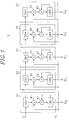
- the apparatus 1 includes 5 error evaluator polynomial calculating cells (21 to 25), each of which includes a syndrome register (SRi), a coefficient register (CRi), a Galois field (“GF”) multiplier and a Galois field adder.
- the syndrome registers SR1 to SR5 are serially connected so that the syndrome values stored therein may be shifted right.
- coefficients of the error locator polynomial, ⁇ i 's are provided sequentially.
- the syndrome registers SR1 to SR5 are initialized with syndrome values S 0 to S 4 , respectively, and the coefficient registers CR1 to CR5 are initialized with 0's.
- a first step of the error evaluator polynomial calculating procedure follows. Specifically, ⁇ 0 , whose value is 1, is fed to each multiplier and multiplied with S 0 to S 4 provided from SR1 to SR5 at the multipliers 41 to 45, respectively.
- the multiplication result, S i-1 i being 1 to 5, provided from the multiplier (4i) is applied to the adder (6i).
- the adder (6i) the multiplication result is added to the content, i.e., 0, of the coefficient register CRi and the addition result, S i-1 , is fed back to the CRi.
- each of the syndrome values stored at the syndrome registers is shifted right, S 4 stored at SR5 is shifted out and 0 is fed to SR1. Then, ⁇ 1 is fed to each multiplier 4i and multiplied with 0, S 0 , S 1 , S 2 , and S 3 provided from SR1 to SR5, respectively.
- Each of the multiplication results i.e., 0, ⁇ 1 S 0 , ⁇ 1 S 1 , ⁇ 1 S 2 , and ⁇ 1 S 3 , is added with the contents of the corresponding coefficient register CRi, and each of the addition results, S 0 , S 1 + ⁇ 1 S 0 , S 2 + ⁇ 1 S 1 , S 3 + ⁇ 1 S 2 , and S 4 + ⁇ 1 S 3 , is fed back to the CRi.
- SRi's and CRi's are updated as shown in Tables 1 and 2.
- a first column represents a step number, wherein each step may correspond to one system clock cycle. It should be noted that S 0 equals 1 and, therefore, replaced as 1 in the Tables.
- FIG. 2 there is provided a block diagram of an error evaluator polynomial calculating apparatus 2 in accordance with a first embodiment of the present invention.
- the error evaluator polynomial calculating apparatus 2 shown in Fig. 2 which is capable of determining (T) coefficients simultaneously, does not include (T+1) cells.
- T is set to 4 for the purpose of simplicity.
- the error evaluator polynomial calculating apparatus 2 includes a GF multiplier 11 and a GF adder 13 which directly correspond to the GF multipliers 41 to 45 and the GF adders 61 to 65 shown in Fig. 1, respectively. It further includes a register block 15 which corresponds to the registers CR1 to CR5 shown in Fig.
- a coefficient input block 10 which provides coefficients of the syndrome and the error locator polynomial to the GF multiplier 11 in a predetermined order
- a multiplexor (“MUX") 17 which selectively provides the coefficients of the error locator polynomial supplied from the coefficient input block 10 or an output of the adder 13 to a demultiplexor (“DEMUX”) 15b included in the register block 15 in response to a selection signal SEL1.
- SEL1 controls the MUX 17 to select the output of the coefficient input block 10 on an input port 1 for the 0th iteration, and to select the output of the GF adder 13 on an input port 0 for all the iterations exept the 0th iteration.
- the register block 15 includes 4 registers (R0 to R3) which are connected in parallel, and a MUX 15a and the DEMUX 15b which control the output from and input to the registers, respectively. Edge triggered D flip-flops may be used as the registers.
- first to fourth coefficients, ⁇ 1 to ⁇ 4 of the error evaluator polynomial are calculated in the apparatus 2, wherein each of the coefficients are provided from each of the registers R0 to R3 after the operation for calculating the coefficients is completed.
- 0th coefficient ⁇ 0 is not calculated at the apparatus 2, for its value is known as 1.
- the registers R0 to R3 are initialized with the coefficients of the error locator polynomial ⁇ 1 to ⁇ 4 , respectively.
- the coefficient input block 10 sequentially provides ⁇ 1 to ⁇ 4 as a first output value, i.e. ⁇ i , to the MUX 17; and the MUX 17 provides the coefficients to the DEMUX 15b in response to SEL1.
- OR the MUX 17 selects the coefficients of the error locator polynomial supplied from the coefficient input block 10 in case SEL1 is in a high state; and provides the output of the adder 13 in case SEL1 is in a low state, to thereby sequentially provide the selected inputs to the DEMUX 15b.
- the DEMUX 15b provides each of the coefficients, to a corresponding register in response to a control signal SEL2.
- SEL2 designates one of the 4 registers for each bit clock cycle.
- the DEMUX 15b provides ⁇ 1 to R0 to be stored therein; ⁇ 2 to R1; ⁇ 3 to R2; and ⁇ 4 to R3.
- the DEMUX 15b may provide the coefficients to the registers in such a manner that each coefficient is clocked into a corresponding register at a rising edge of a system clock signal which is represented as CLK in Fig. 2.
- a second output of the coefficient input block 10, i.e., S j may be in a "don't care" state, which means that S j does not affect the initialization procedure.
- the coefficient input block 10 After the registers are initialized with ⁇ 1 to ⁇ 4 , the coefficient input block 10 provides ⁇ 0 , i.e., 1, as the first output ⁇ i and S 1 as the second output S j, shown in Fig. 2, to the GF multiplier 11 wherein they are multiplied to provide ⁇ 0 S 1 , i.e., S 1 , to the GF adder 13. Concurrently, the content of R0, ⁇ 1 , is also provided through the MUX 15a to the GF adder 13 in response to a control signal SEL3. SEL3 controls the MUX 15a to provide ⁇ i in a timely manner.
- SEL3 controls the MUX 15a to provide ⁇ i in a timely manner.
- the GF adder 13 adds S 1 and ⁇ 1 and provides an addition result, S 1 + ⁇ 1 , to the MUX 17.
- the MUX 17 selects the addition result and provides it to the DEMUX 15b in response to SEL1.
- the DEMUX 15b provides S 1 + ⁇ 1 back to R0, to be stored therein in response to SEL2.
- the contents of R1 is updated in a similar manner.
- the coefficients input block provides ⁇ 0 , i.e., 1, and S 2 to the multiplier 11, to be multiplied therein.
- the GF multiplier 11 provides S 2 to the GF adder 13.
- S 2 is added to ⁇ 2 provided from R1 through the MUX 15a in response to SEL3, to thereby provide S 2 + ⁇ 2 to the DEMUX 15b through MUX 17.
- S 2 + ⁇ 2 is clocked into R1.
- the contents of the registers are sequentially updated as given in Table. 3.
- First two columns of Table 3 represent outputs ⁇ i and S j of the input coefficient block 10, and contents of third to sixth columns in each row represent contents of each register after the register is updated by using the output of the coefficient input block 10 specified in the row.
- Table 3 ⁇ i S j R0 R1 R2 R3 ⁇ 0 S 1 S 1 + ⁇ 1 ⁇ 2 ⁇ 3 ⁇ 4 ⁇ 0 S 2 S 1 + ⁇ 1 S 2 + ⁇ 2 ⁇ 3 ⁇ 4 ⁇ 0 S 3 S 1 + ⁇ 1 S 2 + ⁇ 2 S 3 + ⁇ 3 ⁇ 4 ⁇ 0 S 4 S 1 + ⁇ 1 S 2 + ⁇ 2 S 3 + ⁇ 3 S 4 + ⁇ 4 + ⁇ 4
- the coefficient input block 10 provides ⁇ 1 as ⁇ i and also sequentially supplies S 1 , S 2 , and S 3 to the multiplier 11.
- the GF multiplier 11 sequentially provides ⁇ 1 S 1 , ⁇ 1 S 2 , and ⁇ 1 S 3 to the GF adder 13.
- ⁇ 1 S 1 , ⁇ 1 S 2 , and ⁇ 1 S 3 are added to the contents of the registers R1 to R3 provided through MUX 15a in reponse to SEL3, respectively, to thereby provide the addition results back to R1 to R3.
- R1 becomes ⁇ 2 and no futher updating for R1 is needed.
- R2 and R3 are futher updated with ⁇ 2 provided as ⁇ i and sequentially provided S 1 , S 2 as S j and then, finally, R3 is updated with ⁇ 3 as ⁇ i and S 1 as S j as specified in Table 4, so that each register may provide a corresponding coefficient of the error evaluator polynomial at the end of the operation. That is, ⁇ 1 is stored in R0, ⁇ 2 in R1, ⁇ 3 in R2, and ⁇ 4 in R3.
- the error evaluator polynomial calculating apparatus 2 in accordance with a first embodiment of the present invention provides coefficients of the error evaluator polynomial.
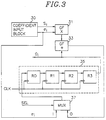
- FIG. 3 there is provided a block diagram of an error evaluator polynomial calculating apparatus 3 in accordance with a second embodiment of the present invention.
- the structure of the error evaluator polynomial calculating apparatus 3 shown in Fig. 3 is substantially same as that of Fig. 2. However, unlike the apparatus 2 shown in Fig. 2, the register block 35 includes 4 registers (R0 to R3) connected in serial. The apparatus 3 shown in Fig. 3 also provides first to fourth coefficients, ⁇ 1 to ⁇ 4 , of the error evaluator polynomial.
- the registers R0 to R3 are initialized with the coefficients of the error locator polynomial ⁇ 4 to ⁇ 1 , respectively.
- a coefficient input block 30 sequentially provides ⁇ 1 to ⁇ 4 as a first output, i.e., ⁇ i , to a MUX 37; and the MUX 37 sequentially provides the coefficients to R0 in response to a control signal SEL.
- SEL controls the MUX 37 to select the output of the coefficient input block 30 on an input port 1 during the initialization, and to select the output of the GF adder 33 on an input port 0 otherwise.
- the contents of the registers are shifted right so that R0 to R3 store ⁇ 4 to ⁇ 1 , respectively.
- the coefficient input block 30 provides ⁇ 0 , i.e., 1, as the first output, ⁇ i , and S 1 as the second output, S j , to the GF multiplier 31 wherein they are multiplied to provide ⁇ 0 S 1 , i.e., S 1 , to the GF adder 33.
- the content of R3, ⁇ 1 is also provided to the GF adder 33.
- the GF adder 33 provides an addition result, S 1 + ⁇ 1 to the MUX 37.
- the MUX 37 selects the addition result in response to SEL and provides it to R0, to be stored therein, and the contents of registers are shifted right.
- the contents of R0 to R3 become S 1 + ⁇ 1 , ⁇ 4 , ⁇ 3 and ⁇ 2 , respectively.
- the coefficients input block 30 provides ⁇ 0 , i.e., 1, and S 2 to the multiplier 31, to be multiplied therein.
- the GF multiplier 31 provides S 2 to the GF adder 33.
- S 2 is added to ⁇ 2 provided from R3, to thereby provide S 2 + ⁇ 2 to R0, to be stored therein.
- the contents of the registers are sequentially updated as given in Table. 5, wherein first two columns represent outputs ⁇ i and S j of the input coefficient block 30, and contents of third to sixth columns in each row represent contents of each register after the register is updated by using the output of the coefficient input block 30 specified in the row.
- the coefficient input block 30 provides ⁇ i and S j as specified in Table 5. That is, in case a register need not be updated, the coefficient input block 30 provides 0, as shown in the second column in Table.5 so that 0 is added to the contents of the register.
- ⁇ 1 is stored in R3, ⁇ 2 in R2, ⁇ 3 in R1, and ⁇ 4 in R0. They are sequentially provided therefrom, to be used in other parts of the Reed-Solomon decoder (not shown).
Landscapes
- Physics & Mathematics (AREA)
- Mathematical Physics (AREA)
- Algebra (AREA)
- General Physics & Mathematics (AREA)
- Pure & Applied Mathematics (AREA)
- Probability & Statistics with Applications (AREA)
- Engineering & Computer Science (AREA)
- Theoretical Computer Science (AREA)
- Error Detection And Correction (AREA)
- Detection And Correction Of Errors (AREA)
Applications Claiming Priority (4)
| Application Number | Priority Date | Filing Date | Title |
|---|---|---|---|
| KR1019960005128A KR100192788B1 (ko) | 1996-02-28 | 1996-02-28 | 리드 솔로몬 복호기에서의 에러 평가 다항식의 계수계산장치 |
| KR9605128 | 1996-02-28 | ||
| KR9605444 | 1996-02-29 | ||
| KR1019960005444A KR100192790B1 (ko) | 1996-02-29 | 1996-02-29 | 리드 솔로몬 복호기에서의 에러 평가 다항식의 계수계산장치 |
Publications (3)
| Publication Number | Publication Date |
|---|---|
| EP0793352A2 true EP0793352A2 (de) | 1997-09-03 |
| EP0793352A3 EP0793352A3 (de) | 1997-09-24 |
| EP0793352B1 EP0793352B1 (de) | 1999-06-23 |
Family
ID=26631658
Family Applications (1)
| Application Number | Title | Priority Date | Filing Date |
|---|---|---|---|
| EP97103367A Expired - Lifetime EP0793352B1 (de) | 1996-02-28 | 1997-02-28 | Vorrichtung zur Bestimmung des Fehlerwert-Polynoms zur Verwendung in einem Reed-Solomon Dekodierer |
Country Status (5)
| Country | Link |
|---|---|
| US (1) | US5787100A (de) |
| EP (1) | EP0793352B1 (de) |
| JP (1) | JP3812983B2 (de) |
| CN (1) | CN1123980C (de) |
| DE (1) | DE69700283D1 (de) |
Families Citing this family (5)
| Publication number | Priority date | Publication date | Assignee | Title |
|---|---|---|---|---|
| KR100192795B1 (ko) * | 1996-05-14 | 1999-06-15 | 전주범 | 리드 솔로몬 복호기의 에러 위치 다항식 계산 장치 |
| US7032162B1 (en) * | 2002-04-25 | 2006-04-18 | Lattice Semiconductor Corporation | Polynomial expander for generating coefficients of a polynomial from roots of the polynomial |
| US7028247B2 (en) * | 2002-12-25 | 2006-04-11 | Faraday Technology Corp. | Error correction code circuit with reduced hardware complexity |
| CN101325706B (zh) * | 2007-06-13 | 2010-11-03 | 卓胜微电子(上海)有限公司 | 低硬件开销Reed-Solomon解码器 |
| CN101277119B (zh) * | 2008-05-14 | 2010-06-02 | 清华大学 | 里德所罗门码解码器硬件复用方法及其低硬件复杂度解码装置 |
Family Cites Families (8)
| Publication number | Priority date | Publication date | Assignee | Title |
|---|---|---|---|---|
| EP0329789B1 (de) * | 1987-06-30 | 1995-02-08 | Matsushita Electric Industrial Co., Ltd. | Galois-feld-recheneinheit |
| US4868828A (en) * | 1987-10-05 | 1989-09-19 | California Institute Of Technology | Architecture for time or transform domain decoding of reed-solomon codes |
| JPH03190326A (ja) * | 1989-12-20 | 1991-08-20 | Hitachi Ltd | 誤り訂正演算用多項式生成回路 |
| US5537426A (en) * | 1992-05-29 | 1996-07-16 | Goldstar Co., Ltd. | Operation apparatus for deriving erasure position Γ(x) and Forney syndrome T(x) polynomials of a Galois field employing a single multiplier |
| KR950001056B1 (ko) * | 1992-05-29 | 1995-02-08 | 주식회사 금성사 | 갈로아 필드 곱셈기 |
| KR940011659B1 (ko) * | 1992-06-25 | 1994-12-23 | 주식회사 금성사 | 유클리드 알고리즘 연산장치 |
| US5517509A (en) * | 1993-03-31 | 1996-05-14 | Kabushiki Kaisha Toshiba | Decoder for decoding ECC using Euclid's algorithm |
| US5642367A (en) * | 1994-02-07 | 1997-06-24 | Mitsubishi Semiconductor America, Inc. | Finite field polynomial processing module for error control coding |
-
1997
- 1997-02-28 JP JP04609597A patent/JP3812983B2/ja not_active Expired - Fee Related
- 1997-02-28 CN CN97109998A patent/CN1123980C/zh not_active Expired - Fee Related
- 1997-02-28 DE DE69700283T patent/DE69700283D1/de not_active Expired - Lifetime
- 1997-02-28 US US08/810,502 patent/US5787100A/en not_active Expired - Lifetime
- 1997-02-28 EP EP97103367A patent/EP0793352B1/de not_active Expired - Lifetime
Also Published As
| Publication number | Publication date |
|---|---|
| EP0793352B1 (de) | 1999-06-23 |
| DE69700283D1 (de) | 1999-07-29 |
| JPH1032497A (ja) | 1998-02-03 |
| CN1123980C (zh) | 2003-10-08 |
| CN1170281A (zh) | 1998-01-14 |
| JP3812983B2 (ja) | 2006-08-23 |
| EP0793352A3 (de) | 1997-09-24 |
| US5787100A (en) | 1998-07-28 |
Similar Documents
| Publication | Publication Date | Title |
|---|---|---|
| US6374383B1 (en) | Determining error locations using error correction codes | |
| US4584686A (en) | Reed-Solomon error correction apparatus | |
| US5170399A (en) | Reed-Solomon Euclid algorithm decoder having a process configurable Euclid stack | |
| US5715262A (en) | Errors and erasures correcting reed-solomon decoder | |
| US5517509A (en) | Decoder for decoding ECC using Euclid's algorithm | |
| US5805617A (en) | Apparatus for computing error correction syndromes | |
| US4873688A (en) | High-speed real-time Reed-Solomon decoder | |
| US6119262A (en) | Method and apparatus for solving key equation polynomials in decoding error correction codes | |
| JP3233860B2 (ja) | リードソロモン復号器 | |
| US7096409B2 (en) | Reed-solomon decoder and decoding method for errors and erasures decoding | |
| US20030192007A1 (en) | Code-programmable field-programmable architecturally-systolic Reed-Solomon BCH error correction decoder integrated circuit and error correction decoding method | |
| US20050138533A1 (en) | Encoding/decoding device using a reed-solomon encoder/decoder | |
| EP0808029A2 (de) | Gerät zur Feststellung eines Fehlerlokalisierungspolynoms zum Gebrauch in einem Reed-Solomon Dekoder | |
| EP0204576A2 (de) | Anordnung und Verfahren zur Dekodierung eines BCH-Kodes | |
| EP1502356B1 (de) | Methode zur dekodierung von reed-solomon kodes mittels feinentscheidung | |
| US6263471B1 (en) | Method and apparatus for decoding an error correction code | |
| KR100258951B1 (ko) | 리드-솔로몬(rs) 복호기와 그 복호방법 | |
| US5971607A (en) | Polynomial evaluator for use in a Reed-Solomon decoder | |
| EP0793352B1 (de) | Vorrichtung zur Bestimmung des Fehlerwert-Polynoms zur Verwendung in einem Reed-Solomon Dekodierer | |
| JP2662472B2 (ja) | 誤り訂正処理用シンドローム演算回路 | |
| US5978950A (en) | Polynomial evaluator for use in a reed-solomon decoder | |
| US6598201B1 (en) | Error coding structure and method | |
| US5751732A (en) | Polynomial evaluator for use in a reed-solomon decoder | |
| JP2591611B2 (ja) | t重誤り訂正符号の符号化復号化回路 | |
| KR100192802B1 (ko) | 리드 솔로몬 디코더의 에러값 계산 및 정정 장치 |
Legal Events
| Date | Code | Title | Description |
|---|---|---|---|
| PUAI | Public reference made under article 153(3) epc to a published international application that has entered the european phase |
Free format text: ORIGINAL CODE: 0009012 |
|
| PUAL | Search report despatched |
Free format text: ORIGINAL CODE: 0009013 |
|
| AK | Designated contracting states |
Kind code of ref document: A2 Designated state(s): DE FR GB IT NL |
|
| AK | Designated contracting states |
Kind code of ref document: A3 Designated state(s): DE FR GB IT NL |
|
| 17P | Request for examination filed |
Effective date: 19980205 |
|
| 17Q | First examination report despatched |
Effective date: 19980227 |
|
| GRAG | Despatch of communication of intention to grant |
Free format text: ORIGINAL CODE: EPIDOS AGRA |
|
| GRAG | Despatch of communication of intention to grant |
Free format text: ORIGINAL CODE: EPIDOS AGRA |
|
| GRAH | Despatch of communication of intention to grant a patent |
Free format text: ORIGINAL CODE: EPIDOS IGRA |
|
| GRAH | Despatch of communication of intention to grant a patent |
Free format text: ORIGINAL CODE: EPIDOS IGRA |
|
| GRAA | (expected) grant |
Free format text: ORIGINAL CODE: 0009210 |
|
| RAP1 | Party data changed (applicant data changed or rights of an application transferred) |
Owner name: DAEWOO ELECTRONICS CO., LTD |
|
| AK | Designated contracting states |
Kind code of ref document: B1 Designated state(s): DE FR GB IT NL |
|
| PG25 | Lapsed in a contracting state [announced via postgrant information from national office to epo] |
Ref country code: NL Free format text: LAPSE BECAUSE OF FAILURE TO SUBMIT A TRANSLATION OF THE DESCRIPTION OR TO PAY THE FEE WITHIN THE PRESCRIBED TIME-LIMIT Effective date: 19990623 Ref country code: IT Free format text: LAPSE BECAUSE OF FAILURE TO SUBMIT A TRANSLATION OF THE DESCRIPTION OR TO PAY THE FEE WITHIN THE PRESCRIBED TIME-LIMIT;WARNING: LAPSES OF ITALIAN PATENTS WITH EFFECTIVE DATE BEFORE 2007 MAY HAVE OCCURRED AT ANY TIME BEFORE 2007. THE CORRECT EFFECTIVE DATE MAY BE DIFFERENT FROM THE ONE RECORDED. Effective date: 19990623 |
|
| REF | Corresponds to: |
Ref document number: 69700283 Country of ref document: DE Date of ref document: 19990729 |
|
| ET | Fr: translation filed | ||
| PG25 | Lapsed in a contracting state [announced via postgrant information from national office to epo] |
Ref country code: DE Free format text: LAPSE BECAUSE OF FAILURE TO SUBMIT A TRANSLATION OF THE DESCRIPTION OR TO PAY THE FEE WITHIN THE PRESCRIBED TIME-LIMIT Effective date: 19990924 |
|
| NLV1 | Nl: lapsed or annulled due to failure to fulfill the requirements of art. 29p and 29m of the patents act | ||
| PLBE | No opposition filed within time limit |
Free format text: ORIGINAL CODE: 0009261 |
|
| STAA | Information on the status of an ep patent application or granted ep patent |
Free format text: STATUS: NO OPPOSITION FILED WITHIN TIME LIMIT |
|
| 26N | No opposition filed | ||
| REG | Reference to a national code |
Ref country code: GB Ref legal event code: IF02 |
|
| REG | Reference to a national code |
Ref country code: GB Ref legal event code: 732E |
|
| REG | Reference to a national code |
Ref country code: FR Ref legal event code: TP |
|
| REG | Reference to a national code |
Ref country code: GB Ref legal event code: 732E Free format text: REGISTERED BETWEEN 20130404 AND 20130410 |
|
| REG | Reference to a national code |
Ref country code: FR Ref legal event code: TP Owner name: MAPLE VISION TECHNOLOGIES INC., CA Effective date: 20131226 |
|
| PGFP | Annual fee paid to national office [announced via postgrant information from national office to epo] |
Ref country code: FR Payment date: 20140211 Year of fee payment: 18 |
|
| PGFP | Annual fee paid to national office [announced via postgrant information from national office to epo] |
Ref country code: GB Payment date: 20140226 Year of fee payment: 18 |
|
| GBPC | Gb: european patent ceased through non-payment of renewal fee |
Effective date: 20150228 |
|
| REG | Reference to a national code |
Ref country code: FR Ref legal event code: ST Effective date: 20151030 |
|
| PG25 | Lapsed in a contracting state [announced via postgrant information from national office to epo] |
Ref country code: GB Free format text: LAPSE BECAUSE OF NON-PAYMENT OF DUE FEES Effective date: 20150228 |
|
| PG25 | Lapsed in a contracting state [announced via postgrant information from national office to epo] |
Ref country code: FR Free format text: LAPSE BECAUSE OF NON-PAYMENT OF DUE FEES Effective date: 20150302 |