EP0793440B1 - Laryngoskopdruckfühler und alarmvorrichtung - Google Patents
Laryngoskopdruckfühler und alarmvorrichtung Download PDFInfo
- Publication number
- EP0793440B1 EP0793440B1 EP95943576A EP95943576A EP0793440B1 EP 0793440 B1 EP0793440 B1 EP 0793440B1 EP 95943576 A EP95943576 A EP 95943576A EP 95943576 A EP95943576 A EP 95943576A EP 0793440 B1 EP0793440 B1 EP 0793440B1
- Authority
- EP
- European Patent Office
- Prior art keywords
- laryngoscope
- alarm
- sensor
- alarm system
- sensing means
- Prior art date
- Legal status (The legal status is an assumption and is not a legal conclusion. Google has not performed a legal analysis and makes no representation as to the accuracy of the status listed.)
- Expired - Lifetime
Links
- 125000006850 spacer group Chemical group 0.000 claims description 14
- 239000000853 adhesive Substances 0.000 claims description 10
- 230000001070 adhesive effect Effects 0.000 claims description 10
- 239000004020 conductor Substances 0.000 claims description 8
- 238000000576 coating method Methods 0.000 claims 1
- 239000012528 membrane Substances 0.000 abstract description 18
- 239000000463 material Substances 0.000 description 15
- 229920002799 BoPET Polymers 0.000 description 3
- 229920006370 Kynar Polymers 0.000 description 3
- 229920001971 elastomer Polymers 0.000 description 3
- 239000000806 elastomer Substances 0.000 description 3
- 238000001465 metallisation Methods 0.000 description 3
- 229920002635 polyurethane Polymers 0.000 description 3
- 239000004814 polyurethane Substances 0.000 description 3
- 230000035945 sensitivity Effects 0.000 description 3
- 210000003437 trachea Anatomy 0.000 description 3
- 210000003811 finger Anatomy 0.000 description 2
- 239000002184 metal Substances 0.000 description 2
- 206010002091 Anaesthesia Diseases 0.000 description 1
- 239000002033 PVDF binder Substances 0.000 description 1
- 239000004820 Pressure-sensitive adhesive Substances 0.000 description 1
- 230000037005 anaesthesia Effects 0.000 description 1
- 229920002457 flexible plastic Polymers 0.000 description 1
- 210000004704 glottis Anatomy 0.000 description 1
- 210000000867 larynx Anatomy 0.000 description 1
- 238000012986 modification Methods 0.000 description 1
- 230000004048 modification Effects 0.000 description 1
- 230000007935 neutral effect Effects 0.000 description 1
- 238000011017 operating method Methods 0.000 description 1
- 239000004033 plastic Substances 0.000 description 1
- 229920003023 plastic Polymers 0.000 description 1
- 229920002981 polyvinylidene fluoride Polymers 0.000 description 1
- 230000000135 prohibitive effect Effects 0.000 description 1
- 239000007921 spray Substances 0.000 description 1
- 238000001356 surgical procedure Methods 0.000 description 1
- 210000003813 thumb Anatomy 0.000 description 1
- 238000002627 tracheal intubation Methods 0.000 description 1
Images

Classifications
-
- A—HUMAN NECESSITIES
- A61—MEDICAL OR VETERINARY SCIENCE; HYGIENE
- A61B—DIAGNOSIS; SURGERY; IDENTIFICATION
- A61B1/00—Instruments for performing medical examinations of the interior of cavities or tubes of the body by visual or photographical inspection, e.g. endoscopes; Illuminating arrangements therefor
- A61B1/267—Instruments for performing medical examinations of the interior of cavities or tubes of the body by visual or photographical inspection, e.g. endoscopes; Illuminating arrangements therefor for the respiratory tract, e.g. laryngoscopes, bronchoscopes
-
- A—HUMAN NECESSITIES
- A61—MEDICAL OR VETERINARY SCIENCE; HYGIENE
- A61B—DIAGNOSIS; SURGERY; IDENTIFICATION
- A61B1/00—Instruments for performing medical examinations of the interior of cavities or tubes of the body by visual or photographical inspection, e.g. endoscopes; Illuminating arrangements therefor
- A61B1/00002—Operational features of endoscopes
- A61B1/00043—Operational features of endoscopes provided with output arrangements
- A61B1/00055—Operational features of endoscopes provided with output arrangements for alerting the user
-
- A—HUMAN NECESSITIES
- A61—MEDICAL OR VETERINARY SCIENCE; HYGIENE
- A61B—DIAGNOSIS; SURGERY; IDENTIFICATION
- A61B17/00—Surgical instruments, devices or methods
- A61B2017/00017—Electrical control of surgical instruments
- A61B2017/00115—Electrical control of surgical instruments with audible or visual output
- A61B2017/00119—Electrical control of surgical instruments with audible or visual output alarm; indicating an abnormal situation
-
- A—HUMAN NECESSITIES
- A61—MEDICAL OR VETERINARY SCIENCE; HYGIENE
- A61B—DIAGNOSIS; SURGERY; IDENTIFICATION
- A61B2562/00—Details of sensors; Constructional details of sensor housings or probes; Accessories for sensors
- A61B2562/02—Details of sensors specially adapted for in-vivo measurements
- A61B2562/0247—Pressure sensors
Definitions
- This invention relates generally to pressure sensors and, more particularly, to a replaceable pressure sensing system for detecting undue pressure applied to a patient's teeth by a laryngoscope.
- Medical personnel such as anesthesiologists, use laryngoscopes to gain access to the trachea for inserting tubes during surgery.
- the tubes are introduced past the glottis and into the trachea or windpipe for permitting the patient to breath and for administering anesthesia.
- the patient's head is placed in a neutral or sniffing position and the tip of a laryngoscope blade is inserted into the vallecula.
- the laryngoscope is held with the index finger and thumb of the left hand and the patient's chin is held with the ring and middle fingers of the same hand.
- the laryngoscope handle and blade are pulled away from the patient at, preferably, a 45° angle. Endotracheal tubes are then passed through the patient's mouth or throat along the laryngoscope blade and into the trachea.
- Laryngoscopes having either a pivotally mounted laryngoscope flange or a built-in pressure plate and alarm have been described in the art for alleviating this problem.
- U.S. Patent No. 4,295,465, issued to Racz et al. describes a laryngoscope blade including an elongated base member carrying a projecting flange.
- the base member has a rear portion, a mid-portion and a tip portion, wherein the rear portion is securely attached to the laryngoscope handle.
- the flange is pivotally connected by resilient means to the base member and projects upward along the rear and mid-portions such that when the blade is inserted into a patient's mouth, the flange may contact the patient's upper teeth and pivot with respect to the base member. This limits pressure applied to the upper teeth as the flange pivots; however, there is no alarm for indicating when pivoting has ended and excess pressure is being applied.
- the rotatable flange is an integral part of the laryngoscope, to utilize this feature a complete laryngoscope must be purchased. This may be cost prohibitive.
- U.S. Patent No. 4,384,570 discloses a laryngoscope including a pressure plate positioned on the flange for detecting undue pressure applied to the upper teeth.
- the plate is electrically connected to a battery and alarm situated in the handle. An electrical signal is transmitted to the alarm for alerting the user thereof to pressure being applied to the plate.
- the laryngoscope described by Roberts includes a handle section having rigid and movable portions adapted to be pivoted and locked at a desired position.
- the pressure plate system is not a replaceable sterile unit, separable from the handle configuration.
- the pressure sensing system described by Roberts is not independently functioning dental protection which can be supplied as a retrofit device for currently used laryngoscopes.
- the pressure plate does not cushion the contact with the teeth.
- a sterile, replaceable laryngoscope pressure sensing system having cushioning properties is needed.
- Sensors for detecting pressure with equal sensitivity at any point along the length thereof may be of the linear membrane variety or may use piezoelectric film, such as the film used in U.S. Patent No. 4,488,873, issued to Bloomfield et al which describes a dental impression strip prepared from a piezoelectric film coated with conventional deformable wax impression material. The film and wax assembly is folded to provide information about the forces exerted during occlusal analysis.
- the film is KYNAR® piezofilm, a polyvinylidene fluoride product of the Pennwalt Corporation of Philadelphia, Pennsylvania, which may be configured for use in the present invention.
- Another object of the invention is to provide a sterile, replaceable pressure sensing system, including a battery and an alarm, for a laryngoscope.
- Yet another object of the invention is to provide a sterile, replaceable pressure sensor for a variety of laryngoscopes, including disposable and foldable laryngoscopes.
- Still another object of the invention is to provide a sterile, replaceable pressure sensing system for a variety of laryngoscopes, including disposable and foldable laryngoscopes.
- a further object of the invention is to provide a sterile, replaceable pressure sensor adapted to be used on a laryngoscope for detecting pressure applied at any point along the length thereof with equal sensitivity and which exhibits cushioning properties to prevent tooth damage.
- a still further object of the invention is to provide a sterile, replaceable pressure sensor and alarm for detecting pressure from a patient's teeth and indicating this condition.
- Yet a still further object of the invention is to provide a linear membrane pressure sensor for detecting pressure applied by teeth along the length thereof.
- Yet still another object of the invention is to provide a piezoelectric film laryngoscope pressure sensor for detecting pressure applied by teeth along the length thereof.
- a replaceable assembly including an elongated, resilient sensor or switch electrically connectable to a battery and an audio warning system or alarm.
- the elongated sensor is of the type wherein pressure applied at any point along the length thereof activates the sensor.
- the battery and alarm may be carried by the elongated sensor to form a single, replaceable unit or, alternatively, they may be more permanently attached to the laryngoscope. In the latter situation, the sensor is releasably connected in circuit with the battery and alarm device.
- the pressure sensor of the present invention may be discarded if unsterile or damaged and a replacement inexpensively and immediately provided.
- the elongated sensor includes a first resilient, flexible elongated member and a second flexible elongated member held in parallel spaced relation and having a pressure sensor situated therebetween.
- the sensor is a linear membrane switch including two conductive ribbons or members carried in spaced face-to-face relation on opposite sides of an apertured spacer layer.
- the first member preferably made from polyurethane, carries a first conductive ribbon along the length thereof and the second member, preferably made from a Mylar® film, carries a second conductive ribbon along the length thereof.
- the members are separated by a spacer strip made of a suitable elastomer. The spacer resides between the first and second conductive ribbons to normally maintain them in spaced relation.
- the second member carries an adhesive backing on the exposed surface thereof for adhering the linear membrane switch to the laryngoscope.
- a piezoelectric film such as KYNAR® piezofilm
- first and second members to form an elongated pressure sensor or switch.
- the members may be made of the same material used in the linear membrane switch embodiment.
- An operational amplifier circuit such as the one described in U.S. Patent No. 4,488,873, issued to Bloomfield et al., and shown at Figure 5 in that patent, may be used to convert the high impedance output from the piezofilm assembly to a low impedance voltage output which can be transmitted to an alarm. The voltage output and, thus, the alarm intensity varies with the pressure applied to the piezofilm.
- the amount of force required to activate the sensor will depend on the stiffness, thickness and resiliency characteristics of the first and second members. In the conductive ribbon embodiment, the amount of force required will also depend on the thickness and resiliency of the spacer, and the width of the opening between ribbons.
- the first and second members, and the spacer may be manufactured with material having varying densities, affecting the amount of force required to activate the sensor. The cushioning afforded by the material chosen improves the dental protection provided by the resilient elongated sensor when tooth contact is made. Thus, sensors made of material having different thicknesses and resiliency characteristics may be built and chosen to accommodate the various needs of different patients.
- the battery, alarm and any required circuitry may be carried by the sensor of either embodiment. Since the present invention is a replaceable device, the battery may be small and totally encapsulated by the members, or simply secured to either member.
- the alarm may be a visible or audible alarm encapsulated or secured to either member, such that the visible alarm may be seen and the audible alarm may be heard.
- any required circuitry may be encapsulated or simply secured to either member.
- the battery, the alarm and any required circuitry may be carried by the laryngoscope itself. In such a case, the sensor of the present invention is replaceable.
- the battery employed may be that used to conventionally illuminate the airway and the alarm device may be mounted to the handle of the laryngoscope in any manner, such as with screws or adhesive.
- the sensor portion of either embodiment may be long enough to attach to the flange and the handle of the laryngoscope or, in the alternative, the sensor may be situated only on the laryngoscope flange. In the latter situation, the sensor is electrically connected, such as with wires, to the battery, alarm and any required circuitry which may be carried by the member portion attached to the handle or, in the alternative, carried by the laryngoscope itself.
- a pressure sensor is attached to the flange and wires connect the sensor to the battery, alarm and required circuitry carried by the member portion attached to the handle.
- An expandable member portion and excess wire is provided between the sensor and the alarm electronics so the pressure sensor and alarm system may be attached to a laryngoscope in the folded position which may then be subsequently deployed or refolded without affecting the pressure sensor and alarm system.
- a pressure sensor and alarm system embodying the ideas of the present invention and indicated generally by numeral 2
- the pressure sensor 4 preferably comprises an elongated, flexible portion for detecting pressure with essentially equal sensitivity at any position along the length thereof.
- the pressure sensor 4 is made to complete a circuit between the alarm 8, which may be either an audible or a visible indicator, and a battery 6 when a predetermined pressure is applied.
- the opposed major surfaces of the system 2 are preferably made of a resilient, flexible material.
- the back side carries a suitable pressure sensitive adhesive 10 which is protected prior to use by a backing material 12, such as a conventional release paper.
- the paper may be peeled away to uncover the adhesive 10 allowing the pressure sensor and alarm 2 to be adhered to a laryngoscope, indicated by the numeral 14 and shown in Figure 2.
- the pressure sensor and alarm system 2 may be releasably attached in another manner to the laryngoscope 14 or another device.
- the laryngoscope 14 includes a handle portion 16 and a flange 20 attached to a blade 18.
- the flexible pressure sensor portion 4 can be made to conform to the illustrated surfaces of the laryngoscope 14 and the battery 6 and alarm 8 positioned next to the handle 16.
- the tip 22 of the laryngoscope 14 is passed through the mouth of the patient and into the throat area.
- the handle 16 is pulled away from the mouth at approximately a 45° angle to pull down on the mouth and open the throat passageway. Medical personnel may then look into the throat area and tubes may be inserted.
- the handle 16 of the laryngoscope 14 is pulled away from the mouth, the patient's upper front teeth 24 are sometimes used as a fulcrum. If a predetermined pressure is exceeded, the upper teeth 24 pushing on the pressure sensor 4 will cause the alarm 8 to be activated.
- the pressure sensor portion 4 both cushions the teeth and senses when undo pressure is being exerted by the laryngoscope 14. The alarm 8 notifies the user thereof to ease back on the laryngoscope 14.
- the pressure sensor portion 4 is either a linear membrane switch or a piezoelectric film pressure sensor.
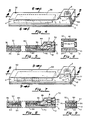
- the linear membrane switch embodiment indicated generally by the numeral 30, includes a first elongated membrane strip 32 and a second elongated membrane strip 34.
- First and second strip members 32 and 34 extend the full length of the linear membrane system 30 and may be made from the same flexible material.
- the first strip member 32 is made from a resilient plastic material, such as polyurethane
- the second member 34 is made from a flexible plastic material, such as MYLAR® film.
- Spacer 36 made from a suitable elastomer, holds strip members 32 and 34 in spaced relation and defines a contact area 38 between strip members 32 and 34.
- a pattern of metalization comprising two elongated conductive ribbons 40 and 42 are carried in spaced, face-to-face relation by strip members 32 and 34, respectively, such that pressure applied to strip members 32 and 34 urges the conductive ribbons 40 and 42 toward one another.
- the alarm 8 and battery 6 are press fit into the first strip member 32.
- the alarm 8 is activated when conductive ribbons 40 and 42 are shorted together by a predetermined pressure applied to the first and second strip members 32 and 34.
- the pressure required varies depending on the characteristics of the material used to make members 32 and 34, the distance conductive ribbons 40 and 42 are held apart and the characteristics of the material used to make the spacer 36.
- the first conductive ribbon 40 is connected to alarm 8 with wire 44 and the second conductive ribbon 42 is connected to the battery 6 with wire 46.
- the battery 6 is also in electrical contact with the alarm 8. Contacting the elongated conductive ribbons 40 and 42 together completes the circuit and activates the alarm 8 to notify the user thereof that the predetermined pressure limit has been reached.
- the linear membrane embodiment 30 may be adhered to the laryngoscope 14 in any manner and in the preferred embodiment, an adhesive 10 is applied to the second elongated strip member 34 and covered with release paper layer 12.
- the membrane switch embodiment 30 is adhered to the laryngoscope 14 by peeling the release paper 12 away and pressing the adhesive surface to the flange 20 and handle 16 of the laryngoscope 14.
- the pressure sensor is a piezoelectric film assembly, indicated by the numeral 50, including first and second elongated strip members 52 and 54 held in spaced relation.
- the first member 52 is made of polyurethane and the second member 54 is made of MYLAR®.
- Spacer 56 comprise a metallization pattern and made of a suitable elastomer, defines a pressure sensor area 58 between strip members 52 and 54.
- An electronic circuit 60 converts the output of a piezoelectric film 62 from a high impedance signal to a low impedance voltage signal, which is sent to the alarm 8.
- the electronic circuit 60, battery 6 and alarm device 8 are press fit into the first strip member 52.
- the pressure sensor of the piezoelectric film embodiment 50 includes a piezoelectric film member 62, made from a material such as KYNAR®, and having metal electrodes 64 and 66 spray coated or otherwise attached to the opposed major surfaces.
- the metal electrodes 64 and 66 are electrically connected to the electronic circuit 60 by wires 68 and 70.
- the electronic circuit 60 is in electrical contact with the alarm 8 and the battery 6 and wire 72 serves as a second connection between the battery 6 and the circuit 60.
- the piezoelectric film embodiment 50 of the present invention cushions the teeth and indicates to the user thereof the amount of pressure being applied.
- Either embodiment of the pressure sensing portion 4 may be supplied in a sterile pack as an independent unit which can be releasably attached to a reusable or disposable laryngoscope 14.
- the linear membrane switch embodiment 30 is attached to the flange 20 and handle 16 of the laryngoscope 14.
- the pressure sensing portion 4 includes first and second elongated strip members 32 and 34 carrying elongated conductive ribbons 40 and 42 in spaced relation. Contacts 90 and 92 are provided for connecting the pressure sensing portion 4 through wires 94 and 96 to the battery 6 and alarm 8 carried in the handle 16. Wire 98 connects the battery 6 and alarm 8. The pressure sensor portion 4 may then be replaced after each use.
- the pressure sensing portion 4 of the piezoelectric film embodiment 50 may be adhered to the flange 20 of a laryngoscope 14 wherein the handle 16 carries the electric circuit 60, the battery 6 and the alarm 8. Also, in the linear membrane embodiment 30, the alarm 8 may be carried by the pressure sensing portion 4 with only the battery 6 situated in the handle 16 and, in the piezoelectric film embodiment 50, the alarm 8 and the electric circuit 60 may be carried by the pressure sensing portion 4 with only the battery 6 situated in the handle 16.
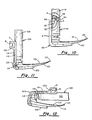
- an expandable, flexible member portion 100 is formed in the first and second members between the sensor 102 and alarm portion 104.
- the sensor 102 and alarm portion 104 are attached, such as with a releasable adhesive, to a laryngoscope.
- the laryngoscope is a foldable laryngoscope 106 having a handle 108, blade 110 and flange 112.
- the sensor 102 is releasably attached to the flange 112 and the alarm portion 104 is releasably attached to the handle 108.
- the accordion like flexible member portion 100 is not attached to the foldable laryngoscope 106.
- the sensor 102 may be either the linear membrane switch or the piezoelectric film sensor.
- the sensor 102 shown in Figures 11 and 12, is the linear membrane switch, which is electrically connected to the alarm 8 and battery 6 secured in the alarm portion 104.
- Wires 114 and 116 electrically connect the sensor 102 to the battery 6 and alarm 8.
- the electrical connection could also be made with an expandable conductive material attached to the folds of the expandable, flexible member portion 100.
- the wires 114 and 116 are long enough to reach around the folding end 118 of the foldable laryngoscope 106 when it is in the folded position, as shown in Figure 12. When the foldable laryngoscope 106 is deployed, as shown in Figure 11, the excess wire is stored in the expandable, flexible member portion 100.
Landscapes
- Health & Medical Sciences (AREA)
- Life Sciences & Earth Sciences (AREA)
- Surgery (AREA)
- Radiology & Medical Imaging (AREA)
- Engineering & Computer Science (AREA)
- Veterinary Medicine (AREA)
- Biophysics (AREA)
- Nuclear Medicine, Radiotherapy & Molecular Imaging (AREA)
- Optics & Photonics (AREA)
- Pathology (AREA)
- Public Health (AREA)
- General Health & Medical Sciences (AREA)
- Physics & Mathematics (AREA)
- Biomedical Technology (AREA)
- Heart & Thoracic Surgery (AREA)
- Medical Informatics (AREA)
- Molecular Biology (AREA)
- Animal Behavior & Ethology (AREA)
- Otolaryngology (AREA)
- Physiology (AREA)
- Pulmonology (AREA)
- Endoscopes (AREA)
Claims (10)
- Alarmsystem (2), das lösbar an einem Laryngoskop (14) befestigbar ist, um Druck auf die Zähne eines Patienten anzuzeigen, der einen vorbestimmten Wert überschreitet, umfassend:eine längliche, flexible Sensoreinrichtung (4) mit einer Schichtstruktur, umfassend eine erste (32, 52) und eine zweite (34, 54) Schicht, die jeweils eine innere und eine äußere Hauptfläche aufweisen und voneinander über eine dazwischen liegende Beabstandungsschicht (36, 56) beabstandet sind, wobei die Beabstandungsschicht eine längliche Öffnung (38) aufweist, wobei eine der ersten und der zweiten Schicht ein Haftmittel (10) auf der äußeren Hauptfläche umfasst, um die Schicht auf einer vorgegebenen Oberfläche des Laryngoskops haftend zu befestigen, wobei die erste und die zweite Schicht ein Muster aus leitendem Material auf ihren inneren Hauptflächen umfassen, welche über die Öffnung in der Beabstandungsschicht aufeinanderzu weisen; undeine Anzeigeeinrichtung (8), welche elektrisch mit dem leitenden Material der Sensoreinrichtung verschaltet ist, um ein wahrnehmbares Signal bei übermäßiger Druckausübung auf die Zähne des Patienten bereitzustellen.
- Alarmsystem (2), das an einem Laryngoskop (14) lösbar befestigbar ist, um Druck auf die Zähne eines Patienten anzuzeigen, der einen vorbestimmten Wert überschreitet, umfassend:eine längliche, flexible Sensoreinrichtung (4) mit einer Schichtstruktur umfassend eine erste (32, 52) und eine zweite (34, 54) Schicht, die jeweils eine innere und eine äußere Hauptfläche aufweisen und voneinander über eine dazwischen liegende Beabstandungsschicht (36, 56) beabstandet sind, wobei die Beabstandungsschicht eine längliche Öffnung umfasst, wobei eine der ersten und der zweiten Schicht ein Haftmittel (10) auf seiner äußeren Hauptfläche umfasst, um die Schicht an eine vorbestimmte Oberfläche des Laryngoskops haftend zu befestigen, und wobei ein piezoelektrischer Film leitende Materialelektroden aufweist, mit denen seine gegenüberliegenden Hauptflächen beschichtet sind oder welche auf andere Weise auf den Hauptflächen befestigt sind, und innerhalb der Öffnung angeordnet ist; undeine Anzeigeeinrichtung (8), welche elektrisch mit dem leitenden Material der Sensoreinrichtung verschaltet ist, um ein wahrnehmbares Signal bei übermäßiger Druckausübung auf die Zähne des Patienten bereitzustellen.
- Alarmsystem (2) nach Anspruch 1 oder Anspruch 2, wobei das Laryngoskop (14) einen Flansch (20) und einen Handgriff (16) umfasst, und die Sensoreinrichtung (4) dazu ausgelegt ist, um an dem Flansch und dem Handgriff über das Haftmittel (10) auf der äußeren Hauptfläche der einen der ersten (32) und der zweiten Schicht (34) befestigt zu werden.
- Alarmsystem (2) nach Anspruch 3, wobei ein erster Abschnitt der Sensoreinrichtung (4), der unterhalb der Öffnung (38) liegt, dazu ausgelegt ist, um an dem Flansch (20) befestigt zu werden, und wobei ein zweiter Abschnitt der Sensoreinrichtung eine Batterie (6) und die Anzeigeeinrichtung (8) trägt, wobei der zweite Abschnitt dazu ausgelegt ist, um an dem Griff (16) befestigt zu werden.
- Alarmsystem (2) nach Anspruch 4, wobei die Sensoreinrichtung (4) einen dehnbaren flexiblen Abschnitt (100) zwischen dem ersten Abschnitt der Sensoreinrichtung (4), die unterhalb der Öffnung liegt, und dem zweiten Abschnitt der Sensoreinrichtung, der die Batterie (6) und die Anzeigeeinrichtung (8) trägt, umfasst.
- Alarmsystem (2) nach Anspruch 1 oder Anspruch 2, wobei das Laryngoskop (14) ein Blatt (18) und einen Handgriff (16) aufweist und wobei die Sensoreinrichtung (4) dazu ausgelegt ist, um haftend an dem Blatt befestigt zu werden, und wobei ein Abschnitt einer der ersten (32) und der zweiten Schicht (34), der die Anzeigeeinrichtung (8) aufweist, dazu ausgelegt ist, um an dem Handgriff (16) befestigt zu werden.
- Alarmsystem (2) nach Anspruch 1 oder Anspruch 2, ferner umfassend eine Stromversorgung, um elektrische Energie dem Alarmsystem zuzuführen.
- Alarmsystem (2) nach Anspruch 2, ferner umfassend einen elektrischen Stromkreis, der mit den leitenden Beschichtungen des piezoelekrischen Films (62) verbunden ist.
- Alarmsystem (2) nach Anspruch 8, wobei die Anzeigeeinrichtung (8) mit dem elektrischen Schaltkreis verbunden ist.
- Alarmsystem (2) nach Anspruch 2, wobei die leitenden Materialelektroden in einem Muster auf der ersten (32, 52) und der zweiten (34, 54) Schicht angeordnet sind.
Applications Claiming Priority (3)
| Application Number | Priority Date | Filing Date | Title |
|---|---|---|---|
| US08/344,457 US5536245A (en) | 1994-11-23 | 1994-11-23 | Laryngoscope pressure sensor and alarm |
| US344457 | 1994-11-23 | ||
| PCT/US1995/014498 WO1996015711A1 (en) | 1994-11-23 | 1995-11-21 | Laryngoscope pressure sensor and alarm |
Publications (3)
| Publication Number | Publication Date |
|---|---|
| EP0793440A1 EP0793440A1 (de) | 1997-09-10 |
| EP0793440A4 EP0793440A4 (de) | 1998-08-19 |
| EP0793440B1 true EP0793440B1 (de) | 2004-11-03 |
Family
ID=23350620
Family Applications (1)
| Application Number | Title | Priority Date | Filing Date |
|---|---|---|---|
| EP95943576A Expired - Lifetime EP0793440B1 (de) | 1994-11-23 | 1995-11-21 | Laryngoskopdruckfühler und alarmvorrichtung |
Country Status (8)
| Country | Link |
|---|---|
| US (1) | US5536245A (de) |
| EP (1) | EP0793440B1 (de) |
| JP (1) | JPH10509614A (de) |
| AT (1) | ATE281113T1 (de) |
| AU (1) | AU4501496A (de) |
| CA (1) | CA2205655A1 (de) |
| DE (1) | DE69533726D1 (de) |
| WO (1) | WO1996015711A1 (de) |
Cited By (2)
| Publication number | Priority date | Publication date | Assignee | Title |
|---|---|---|---|---|
| WO2014109659A1 (pt) | 2013-01-10 | 2014-07-17 | Universidade Do Porto | Laringoscópio digital |
| FR3160877A1 (fr) * | 2024-04-08 | 2025-10-10 | Hélène BENOIT-FALLET | Dispositif de protection à usage unique du type languette destiné à se positionner de façon amovible sur une face supérieure d’une lame d'intubation |
Families Citing this family (37)
| Publication number | Priority date | Publication date | Assignee | Title |
|---|---|---|---|---|
| EP0701456B1 (de) * | 1993-06-01 | 1998-06-03 | GUIGNARD, Mireille | Vorrichtung zur einbringung einer flüssigkeit unter einem bestimmten druck in eine körperhöhle eines menschen oder tieres |
| GB2329837B (en) * | 1997-09-30 | 2002-01-16 | Peter John Kimber | Laryngoscope |
| US6217514B1 (en) | 1999-02-05 | 2001-04-17 | Gruhan Technologies, Inc. | Laryngoscope |
| US20040122292A1 (en) * | 2001-03-14 | 2004-06-24 | Philip Dey | Laryngoscope |
| US6623425B2 (en) * | 2001-07-23 | 2003-09-23 | Cartledge Medical Products, Llc | Modified laryngoscope blade to reduce dental injuries during intubation |
| US7458932B2 (en) * | 2003-12-09 | 2008-12-02 | Sun William Y | Tongue stabilizer for laryngoscope blade |
| US20050159649A1 (en) * | 2004-01-16 | 2005-07-21 | Patel Rajeev J. | Laryngoscope and associated method of intubating a patient |
| US7819870B2 (en) | 2005-10-13 | 2010-10-26 | St. Jude Medical, Atrial Fibrillation Division, Inc. | Tissue contact and thermal assessment for brush electrodes |
| US7744529B2 (en) | 2004-02-12 | 2010-06-29 | Carl Kaoru Sakamoto | Laryngoscope blade |
| JP4547496B2 (ja) * | 2004-11-25 | 2010-09-22 | 国立大学法人九州工業大学 | 気管挿管用喉頭鏡システム |
| US20060183978A1 (en) * | 2005-02-14 | 2006-08-17 | Howard Gregory L | Laryngoscope |
| US8672936B2 (en) | 2005-10-13 | 2014-03-18 | St. Jude Medical, Atrial Fibrillation Division, Inc. | Systems and methods for assessing tissue contact |
| US8679109B2 (en) * | 2005-10-13 | 2014-03-25 | St. Jude Medical, Atrial Fibrillation Division, Inc. | Dynamic contact assessment for electrode catheters |
| WO2007050960A2 (en) * | 2005-10-27 | 2007-05-03 | St. Jude Medical, Atrial Fibrillation Division, Inc. | Systems and methods for electrode contact assessment |
| AU2006326932A1 (en) * | 2005-12-19 | 2007-06-28 | Sydney West Area Health Service | Induction coil sensing |
| US20070287888A1 (en) * | 2006-06-09 | 2007-12-13 | Dp Medical | Integrated laryngoscope and suction device |
| US10085798B2 (en) | 2006-12-29 | 2018-10-02 | St. Jude Medical, Atrial Fibrillation Division, Inc. | Ablation electrode with tactile sensor |
| US8226648B2 (en) | 2007-12-31 | 2012-07-24 | St. Jude Medical, Atrial Fibrillation Division, Inc. | Pressure-sensitive flexible polymer bipolar electrode |
| US20080176198A1 (en) * | 2007-01-19 | 2008-07-24 | Murtuza Ansari | System and method for dental education simulation |
| US7695433B2 (en) * | 2007-01-24 | 2010-04-13 | Zeppelin Designs, Inc. | Laryngoscope with disposable blade cover |
| US20080294010A1 (en) * | 2007-05-25 | 2008-11-27 | Cooper John D | Laryngoscope that indicates contact |
| EP2417595B1 (de) | 2009-04-09 | 2018-11-14 | BlueLight Analytics Inc. | Verfahren und system zur messung der freigesetzten härtungsenergie bei simulierten zahnersätzen |
| US8579630B2 (en) * | 2009-08-12 | 2013-11-12 | Ashish Kakar | Apparatus and method for measuring dentin hypersensitivity |
| JP5733726B2 (ja) * | 2009-11-02 | 2015-06-10 | 公立大学法人名古屋市立大学 | 喉頭拡径具 |
| US8376937B2 (en) * | 2010-01-28 | 2013-02-19 | Warsaw Orhtopedic, Inc. | Tissue monitoring surgical retractor system |
| US9289114B2 (en) * | 2010-07-30 | 2016-03-22 | Nilesh R. Vasan | Disposable, self-contained laryngoscope and method of using same |
| ES2391859B1 (es) * | 2010-10-08 | 2013-10-07 | Universidad De Castilla La Mancha | Laringoscopio con alarma. |
| US20140046137A1 (en) * | 2012-08-08 | 2014-02-13 | Ronda Duke Brown | Retractor Cover Apparatus and Associated Methods |
| US9198567B1 (en) | 2013-06-12 | 2015-12-01 | Nkosiyalinda Dube | Laryngoscope with pressure sensitive blade |
| US9573484B2 (en) * | 2014-01-24 | 2017-02-21 | GM Global Technology Operations LLC | Systems and methods for determining battery state information based on internal battery pressure |
| CN106333637B (zh) * | 2015-07-07 | 2019-02-22 | 宏达国际电子股份有限公司 | 医疗检测装置及其控制方法 |
| EP3664688A4 (de) * | 2017-08-07 | 2021-04-14 | Baylor College of Medicine | Kraftempfindlicher laryngoskopsensor |
| USD876625S1 (en) | 2018-08-07 | 2020-02-25 | Adroit Surgical, Llc | Laryngoscope |
| WO2021133936A1 (en) | 2019-12-23 | 2021-07-01 | The Trustees Of Columbia University In The City Of New York | A medical apparatus for insertion into a body passage and methods for use |
| KR102214952B1 (ko) * | 2020-07-09 | 2021-02-10 | (주)비스코인스트루먼트 | 치아 손상 방지용 후두경 |
| CN113069067B (zh) * | 2021-03-29 | 2022-06-28 | 无锡市妇幼保健院 | 一种带震动反馈的口镜及其使用方法 |
| WO2023033665A1 (en) * | 2021-09-01 | 2023-03-09 | Hamad Medical Corporation | Videolaryngoscopy device for endotracheal intubation |
Family Cites Families (11)
| Publication number | Priority date | Publication date | Assignee | Title |
|---|---|---|---|---|
| US3888117A (en) * | 1973-07-16 | 1975-06-10 | Minnesota Mining & Mfg | Pressure sensor and instrument utilizing same |
| US4384570A (en) * | 1979-01-02 | 1983-05-24 | Roberts James T | Laryngoscope |
| US4263900A (en) * | 1979-04-20 | 1981-04-28 | Codman And Shurtleff, Inc. | Pressure-responsive surgical tool assembly |
| US4295465A (en) * | 1980-04-03 | 1981-10-20 | N.A.D., Inc. | Laryngoscope blade |
| US4426884A (en) * | 1982-02-01 | 1984-01-24 | The Langer Biomechanics Group, Inc. | Flexible force sensor |
| US4488873A (en) * | 1983-06-14 | 1984-12-18 | Pennwalt Corporation | Piezoelectric polymeric film occlusal force indicator |
| US4791940A (en) * | 1987-02-02 | 1988-12-20 | Florida Probe Corporation | Electronic periodontal probe with a constant force applier |
| US4841987A (en) * | 1987-07-02 | 1989-06-27 | Accudent, Inc. | Automatically resetting, force-sensing probe and related method of operation |
| US5063907A (en) * | 1989-06-14 | 1991-11-12 | Musicant Belmont S | Disposable and/or sterilizable cushioning device for a laryngoscope |
| US5070859A (en) * | 1989-09-05 | 1991-12-10 | Narco-Med Ag. | Laryngoscope |
| EP0503397A1 (de) * | 1991-03-08 | 1992-09-16 | Narco-Med AG | Laryngoskop |
-
1994
- 1994-11-23 US US08/344,457 patent/US5536245A/en not_active Expired - Lifetime
-
1995
- 1995-11-21 WO PCT/US1995/014498 patent/WO1996015711A1/en not_active Ceased
- 1995-11-21 AU AU45014/96A patent/AU4501496A/en not_active Abandoned
- 1995-11-21 JP JP8516921A patent/JPH10509614A/ja not_active Ceased
- 1995-11-21 DE DE69533726T patent/DE69533726D1/de not_active Expired - Fee Related
- 1995-11-21 CA CA002205655A patent/CA2205655A1/en not_active Abandoned
- 1995-11-21 AT AT95943576T patent/ATE281113T1/de not_active IP Right Cessation
- 1995-11-21 EP EP95943576A patent/EP0793440B1/de not_active Expired - Lifetime
Cited By (3)
| Publication number | Priority date | Publication date | Assignee | Title |
|---|---|---|---|---|
| WO2014109659A1 (pt) | 2013-01-10 | 2014-07-17 | Universidade Do Porto | Laringoscópio digital |
| FR3160877A1 (fr) * | 2024-04-08 | 2025-10-10 | Hélène BENOIT-FALLET | Dispositif de protection à usage unique du type languette destiné à se positionner de façon amovible sur une face supérieure d’une lame d'intubation |
| WO2025214618A1 (fr) * | 2024-04-08 | 2025-10-16 | Benoit Fallet Helene | Dispositif de protection à usage unique du type languette destiné à se positionner de façon amovible sur une face supérieure d'une lame d'intubation |
Also Published As
| Publication number | Publication date |
|---|---|
| JPH10509614A (ja) | 1998-09-22 |
| EP0793440A1 (de) | 1997-09-10 |
| CA2205655A1 (en) | 1996-05-30 |
| DE69533726D1 (de) | 2004-12-09 |
| WO1996015711A1 (en) | 1996-05-30 |
| ATE281113T1 (de) | 2004-11-15 |
| AU4501496A (en) | 1996-06-17 |
| US5536245A (en) | 1996-07-16 |
| EP0793440A4 (de) | 1998-08-19 |
Similar Documents
| Publication | Publication Date | Title |
|---|---|---|
| EP0793440B1 (de) | Laryngoskopdruckfühler und alarmvorrichtung | |
| US5735287A (en) | Biodegradable air tube and spirometer employing same | |
| US20050187434A1 (en) | Laryngoscope | |
| CA1166701A (en) | Vital signs monitor | |
| US5660168A (en) | Attachment arrangement | |
| US20120296191A1 (en) | Transducer mountings and wearable monitors | |
| US5743270A (en) | Resistive element for spirometer | |
| US20200375447A1 (en) | Force-sensitive laryngoscope sensor | |
| JP2005110816A (ja) | オキシメーターのプローブ、プローブカバー及びカバー付きプローブ | |
| US5663533A (en) | Stethoscope ruler device | |
| US7794412B2 (en) | Device for applying and gauging cricoid pressure | |
| EP0657136B1 (de) | Elektrokardiograph | |
| CN111643072A (zh) | 一种心电电极片及心电监测装置 | |
| AU2002238280B2 (en) | Laryngoscope | |
| AU2007216622B2 (en) | Endoscope | |
| AU2002238280B8 (en) | Laryngoscope | |
| CN121129174A (zh) | 牙科口镜 | |
| AU2002238280A1 (en) | Laryngoscope | |
| JP2025178604A (ja) | 舌圧測定装置及びセンサユニット | |
| HK1013400B (en) | Electrocardiograph |
Legal Events
| Date | Code | Title | Description |
|---|---|---|---|
| PUAI | Public reference made under article 153(3) epc to a published international application that has entered the european phase |
Free format text: ORIGINAL CODE: 0009012 |
|
| 17P | Request for examination filed |
Effective date: 19970523 |
|
| AK | Designated contracting states |
Kind code of ref document: A1 Designated state(s): AT BE CH DE DK ES FR GB GR IE IT LI NL PT SE |
|
| A4 | Supplementary search report drawn up and despatched |
Effective date: 19980701 |
|
| AK | Designated contracting states |
Kind code of ref document: A4 Designated state(s): AT BE CH DE DK ES FR GB GR IE IT LI NL PT SE |
|
| RHK1 | Main classification (correction) |
Ipc: A61B 1/267 |
|
| 17Q | First examination report despatched |
Effective date: 20020204 |
|
| GRAP | Despatch of communication of intention to grant a patent |
Free format text: ORIGINAL CODE: EPIDOSNIGR1 |
|
| GRAS | Grant fee paid |
Free format text: ORIGINAL CODE: EPIDOSNIGR3 |
|
| GRAA | (expected) grant |
Free format text: ORIGINAL CODE: 0009210 |
|
| AK | Designated contracting states |
Kind code of ref document: B1 Designated state(s): AT BE CH DE DK ES FR GB GR IE IT LI NL PT SE |
|
| PG25 | Lapsed in a contracting state [announced via postgrant information from national office to epo] |
Ref country code: SE Free format text: LAPSE BECAUSE OF FAILURE TO SUBMIT A TRANSLATION OF THE DESCRIPTION OR TO PAY THE FEE WITHIN THE PRESCRIBED TIME-LIMIT Effective date: 20041103 Ref country code: NL Free format text: LAPSE BECAUSE OF FAILURE TO SUBMIT A TRANSLATION OF THE DESCRIPTION OR TO PAY THE FEE WITHIN THE PRESCRIBED TIME-LIMIT Effective date: 20041103 Ref country code: LI Free format text: LAPSE BECAUSE OF FAILURE TO SUBMIT A TRANSLATION OF THE DESCRIPTION OR TO PAY THE FEE WITHIN THE PRESCRIBED TIME-LIMIT Effective date: 20041103 Ref country code: IT Free format text: LAPSE BECAUSE OF FAILURE TO SUBMIT A TRANSLATION OF THE DESCRIPTION OR TO PAY THE FEE WITHIN THE PRESCRIBED TIME-LIMIT;WARNING: LAPSES OF ITALIAN PATENTS WITH EFFECTIVE DATE BEFORE 2007 MAY HAVE OCCURRED AT ANY TIME BEFORE 2007. THE CORRECT EFFECTIVE DATE MAY BE DIFFERENT FROM THE ONE RECORDED. Effective date: 20041103 Ref country code: FR Free format text: LAPSE BECAUSE OF FAILURE TO SUBMIT A TRANSLATION OF THE DESCRIPTION OR TO PAY THE FEE WITHIN THE PRESCRIBED TIME-LIMIT Effective date: 20041103 Ref country code: CH Free format text: LAPSE BECAUSE OF FAILURE TO SUBMIT A TRANSLATION OF THE DESCRIPTION OR TO PAY THE FEE WITHIN THE PRESCRIBED TIME-LIMIT Effective date: 20041103 Ref country code: BE Free format text: LAPSE BECAUSE OF FAILURE TO SUBMIT A TRANSLATION OF THE DESCRIPTION OR TO PAY THE FEE WITHIN THE PRESCRIBED TIME-LIMIT Effective date: 20041103 Ref country code: AT Free format text: LAPSE BECAUSE OF FAILURE TO SUBMIT A TRANSLATION OF THE DESCRIPTION OR TO PAY THE FEE WITHIN THE PRESCRIBED TIME-LIMIT Effective date: 20041103 |
|
| REG | Reference to a national code |
Ref country code: GB Ref legal event code: FG4D |
|
| REG | Reference to a national code |
Ref country code: CH Ref legal event code: EP |
|
| PG25 | Lapsed in a contracting state [announced via postgrant information from national office to epo] |
Ref country code: IE Free format text: LAPSE BECAUSE OF NON-PAYMENT OF DUE FEES Effective date: 20041122 |
|
| REF | Corresponds to: |
Ref document number: 69533726 Country of ref document: DE Date of ref document: 20041209 Kind code of ref document: P |
|
| REG | Reference to a national code |
Ref country code: IE Ref legal event code: FG4D |
|
| PG25 | Lapsed in a contracting state [announced via postgrant information from national office to epo] |
Ref country code: GR Free format text: LAPSE BECAUSE OF FAILURE TO SUBMIT A TRANSLATION OF THE DESCRIPTION OR TO PAY THE FEE WITHIN THE PRESCRIBED TIME-LIMIT Effective date: 20050203 Ref country code: GB Free format text: LAPSE BECAUSE OF NON-PAYMENT OF DUE FEES Effective date: 20050203 Ref country code: DK Free format text: LAPSE BECAUSE OF FAILURE TO SUBMIT A TRANSLATION OF THE DESCRIPTION OR TO PAY THE FEE WITHIN THE PRESCRIBED TIME-LIMIT Effective date: 20050203 |
|
| PG25 | Lapsed in a contracting state [announced via postgrant information from national office to epo] |
Ref country code: ES Free format text: LAPSE BECAUSE OF FAILURE TO SUBMIT A TRANSLATION OF THE DESCRIPTION OR TO PAY THE FEE WITHIN THE PRESCRIBED TIME-LIMIT Effective date: 20050214 |
|
| NLV1 | Nl: lapsed or annulled due to failure to fulfill the requirements of art. 29p and 29m of the patents act | ||
| REG | Reference to a national code |
Ref country code: CH Ref legal event code: PL |
|
| PG25 | Lapsed in a contracting state [announced via postgrant information from national office to epo] |
Ref country code: DE Free format text: LAPSE BECAUSE OF NON-PAYMENT OF DUE FEES Effective date: 20050601 |
|
| PLBE | No opposition filed within time limit |
Free format text: ORIGINAL CODE: 0009261 |
|
| STAA | Information on the status of an ep patent application or granted ep patent |
Free format text: STATUS: NO OPPOSITION FILED WITHIN TIME LIMIT |
|
| GBPC | Gb: european patent ceased through non-payment of renewal fee |
Effective date: 20050203 |
|
| 26N | No opposition filed |
Effective date: 20050804 |
|
| EN | Fr: translation not filed | ||
| REG | Reference to a national code |
Ref country code: IE Ref legal event code: MM4A |
|
| PG25 | Lapsed in a contracting state [announced via postgrant information from national office to epo] |
Ref country code: PT Free format text: LAPSE BECAUSE OF NON-PAYMENT OF DUE FEES Effective date: 20050403 |