EP0793973A2 - Spritze - Google Patents
Spritze Download PDFInfo
- Publication number
- EP0793973A2 EP0793973A2 EP97104350A EP97104350A EP0793973A2 EP 0793973 A2 EP0793973 A2 EP 0793973A2 EP 97104350 A EP97104350 A EP 97104350A EP 97104350 A EP97104350 A EP 97104350A EP 0793973 A2 EP0793973 A2 EP 0793973A2
- Authority
- EP
- European Patent Office
- Prior art keywords
- liquid
- sealing member
- syringe
- set forth
- barrel
- Prior art date
- Legal status (The legal status is an assumption and is not a legal conclusion. Google has not performed a legal analysis and makes no representation as to the accuracy of the status listed.)
- Granted
Links
Images







Classifications
-
- A—HUMAN NECESSITIES
- A61—MEDICAL OR VETERINARY SCIENCE; HYGIENE
- A61M—DEVICES FOR INTRODUCING MEDIA INTO, OR ONTO, THE BODY; DEVICES FOR TRANSDUCING BODY MEDIA OR FOR TAKING MEDIA FROM THE BODY; DEVICES FOR PRODUCING OR ENDING SLEEP OR STUPOR
- A61M5/00—Devices for bringing media into the body in a subcutaneous, intra-vascular or intramuscular way; Accessories therefor, e.g. filling or cleaning devices, arm-rests
- A61M5/178—Syringes
- A61M5/28—Syringe ampoules or carpules, i.e. ampoules or carpules provided with a needle
- A61M5/284—Syringe ampoules or carpules, i.e. ampoules or carpules provided with a needle comprising means for injection of two or more media, e.g. by mixing
-
- A—HUMAN NECESSITIES
- A61—MEDICAL OR VETERINARY SCIENCE; HYGIENE
- A61M—DEVICES FOR INTRODUCING MEDIA INTO, OR ONTO, THE BODY; DEVICES FOR TRANSDUCING BODY MEDIA OR FOR TAKING MEDIA FROM THE BODY; DEVICES FOR PRODUCING OR ENDING SLEEP OR STUPOR
- A61M5/00—Devices for bringing media into the body in a subcutaneous, intra-vascular or intramuscular way; Accessories therefor, e.g. filling or cleaning devices, arm-rests
- A61M5/178—Syringes
- A61M5/31—Details
- A61M5/315—Pistons; Piston-rods; Guiding, blocking or restricting the movement of the rod or piston; Appliances on the rod for facilitating dosing ; Dosing mechanisms
- A61M5/31511—Piston or piston-rod constructions, e.g. connection of piston with piston-rod
-
- A—HUMAN NECESSITIES
- A61—MEDICAL OR VETERINARY SCIENCE; HYGIENE
- A61M—DEVICES FOR INTRODUCING MEDIA INTO, OR ONTO, THE BODY; DEVICES FOR TRANSDUCING BODY MEDIA OR FOR TAKING MEDIA FROM THE BODY; DEVICES FOR PRODUCING OR ENDING SLEEP OR STUPOR
- A61M5/00—Devices for bringing media into the body in a subcutaneous, intra-vascular or intramuscular way; Accessories therefor, e.g. filling or cleaning devices, arm-rests
- A61M5/178—Syringes
- A61M5/31—Details
- A61M2005/3101—Leak prevention means for proximal end of syringes, i.e. syringe end opposite to needle mounting end
-
- A—HUMAN NECESSITIES
- A61—MEDICAL OR VETERINARY SCIENCE; HYGIENE
- A61M—DEVICES FOR INTRODUCING MEDIA INTO, OR ONTO, THE BODY; DEVICES FOR TRANSDUCING BODY MEDIA OR FOR TAKING MEDIA FROM THE BODY; DEVICES FOR PRODUCING OR ENDING SLEEP OR STUPOR
- A61M5/00—Devices for bringing media into the body in a subcutaneous, intra-vascular or intramuscular way; Accessories therefor, e.g. filling or cleaning devices, arm-rests
- A61M5/178—Syringes
- A61M5/31—Details
- A61M2005/3117—Means preventing contamination of the medicament compartment of a syringe
- A61M2005/3121—Means preventing contamination of the medicament compartment of a syringe via the proximal end of a syringe, i.e. syringe end opposite to needle cannula mounting end
-
- A—HUMAN NECESSITIES
- A61—MEDICAL OR VETERINARY SCIENCE; HYGIENE
- A61M—DEVICES FOR INTRODUCING MEDIA INTO, OR ONTO, THE BODY; DEVICES FOR TRANSDUCING BODY MEDIA OR FOR TAKING MEDIA FROM THE BODY; DEVICES FOR PRODUCING OR ENDING SLEEP OR STUPOR
- A61M5/00—Devices for bringing media into the body in a subcutaneous, intra-vascular or intramuscular way; Accessories therefor, e.g. filling or cleaning devices, arm-rests
- A61M5/178—Syringes
- A61M5/31—Details
- A61M5/3129—Syringe barrels
- A61M2005/3132—Syringe barrels having flow passages for injection agents at the distal end of the barrel to bypass a sealing stopper after its displacement to this end due to internal pressure increase
-
- A—HUMAN NECESSITIES
- A61—MEDICAL OR VETERINARY SCIENCE; HYGIENE
- A61M—DEVICES FOR INTRODUCING MEDIA INTO, OR ONTO, THE BODY; DEVICES FOR TRANSDUCING BODY MEDIA OR FOR TAKING MEDIA FROM THE BODY; DEVICES FOR PRODUCING OR ENDING SLEEP OR STUPOR
- A61M5/00—Devices for bringing media into the body in a subcutaneous, intra-vascular or intramuscular way; Accessories therefor, e.g. filling or cleaning devices, arm-rests
- A61M5/178—Syringes
- A61M5/31—Details
- A61M5/315—Pistons; Piston-rods; Guiding, blocking or restricting the movement of the rod or piston; Appliances on the rod for facilitating dosing ; Dosing mechanisms
- A61M5/31501—Means for blocking or restricting the movement of the rod or piston
-
- A—HUMAN NECESSITIES
- A61—MEDICAL OR VETERINARY SCIENCE; HYGIENE
- A61M—DEVICES FOR INTRODUCING MEDIA INTO, OR ONTO, THE BODY; DEVICES FOR TRANSDUCING BODY MEDIA OR FOR TAKING MEDIA FROM THE BODY; DEVICES FOR PRODUCING OR ENDING SLEEP OR STUPOR
- A61M5/00—Devices for bringing media into the body in a subcutaneous, intra-vascular or intramuscular way; Accessories therefor, e.g. filling or cleaning devices, arm-rests
- A61M5/178—Syringes
- A61M5/31—Details
- A61M5/315—Pistons; Piston-rods; Guiding, blocking or restricting the movement of the rod or piston; Appliances on the rod for facilitating dosing ; Dosing mechanisms
- A61M5/31501—Means for blocking or restricting the movement of the rod or piston
- A61M5/31505—Integral with the syringe barrel, i.e. connected to the barrel so as to make up a single complete piece or unit
Definitions
- the present invention relates to a syringe with a liquid leak preventing mechanism, and specifically to a mechanism for preventing liquid leaking from syringe.
- pre-filled syringes In a two-ingredient type pre-filled syringe charged with a predetermined medicine and a liquid such as its dissolution liquid, its dispersing liquid or other medicinal liquids in the separated states, of the disposable type syringes previously filled with a medicine, so-called pre-filled syringes, conventionally as exemplified in Fig. 10, there has been known in Japanese Patent Publication No. 49-14465, a syringe having such a construction that an end sealing member 32 is inserted through a rear end opening into a cylindrical receptacle or barrel 31 provided at its leading end portion with a mounting portion for a needle.
- the barrel 31 has an intermediate sealing member 33 arranged therein so as to be slidable in a longitudinal or axial direction and to have a first chamber 34 on the leading end side and a second chamber 35 on the rear end side divided therein to receive a medicine P and a dissolution liquid L within the respective chambers with its leading end portion closed by a cap 37.
- This type one has such a construction that the first chamber 34 on the leading end side ahead of the intermediate slidable sealing member 33 has a bypass portion, usually an outward protruded bypass channel 36 arranged in the side wall of the barrel 31.
- the intermediate sealing member 33 is advanced together with the liquid L within the second chamber 35 by pushing the end sealing member 32 by means of a rod as shown in Fig. 11 and the liquid L within the second chamber 35 is made to flow into the first chamber 34 through the bypass channel 36 when the intermediate sealing member 33 reaches the channel 36.
- the intermediate sealing member 33 is pushed by the leading end of the end sealing member 32 to perform the dissolution, the dispersion or the mixing within the first chamber 34 and then the liquid is pushed out of the leading end.
- a low-viscosity medicinal liquid, a small surface-tension liquid and the likes happen to pass through a gap between the partition plate provided in the plunger rod and the barrel inner wall, and it is apprehended that the medicinal liquid remaining in the partition plate is flowed out when the plunger rod is removed from the syringe for fractional scrapping.
- a syringe with a liquid leak preventing mechanism which is capable of preventing a medicinal liquid from passing out through a gap between a receptacle or barrel inner wall and a partition plate and also from flowing out when a plunger rod is dismounted from the syringe for fractional scrapping.
- a syringe comprising:
- the meaning of "positioned behind one of end faces of said end sealing member opposite to said second chamber in said barrel” includes any cases that the liquid-absorbent element is positioned behind said end sealing member with respect to a longitudinal direction of the barrel.
- said liquid-absorbent element may be positioned at no or some intervals from said end face of said end sealing member with respect to the longitudinal direction of the barrel.
- said liquid-absorbent element may be positioned as an end stopper for closing an end opening of said barrel.
- a two-chamber syringe including at least one intermediate slidable sealing member inserted into a cylindrical barrel having a leading end portion to which a needle is mounted and a rear end opening into which a plunger rod is inserted
- said barrel is divided into a forward first chamber and a backward second chamber by the intermediate sealing member, said first chamber receiving a certain medicine and said second chamber receiving a liquid to be mixed with the medicine.
- the rear end side of the backward second chamber which has received the liquid can be closed by inserting therein an end slidable sealing member adapted to be pushed by a leading end of said plunger rod.
- Said intermediate slidable sealing member is displaced forwards to a region of the bypass portion by means of said plunger rod, so that the liquid within the second chamber can be made to flow into the first chamber through the bypass portion and is mixed with the medicine within the first chamber.
- Said liquid-absorbent mechanism or element is arranged behind said end slidable sealing member with no or some intervals and is capable of absorbing and holding the liquid flowing out behind the end sealing member.
- the liquid flowing out behind the end slidable sealing member is absorbed and held by the liquid-absorbent mechanism, so that it is possible to prevent the liquid leakage and dispersion out of the syringe barrel even when the plunger rod after use is removed at the time of fractional scrapping.
- the syringe barrel is transparent so that the residual liquid can be seen from outside, and it is apprehended that the leak occurs because the syringe barrel is merely shielded.
- the liquid itself is securely held in the absorbed and held condition, so that it becomes possible to dissolve such a problem.
- liquid-absorbent material is impregnated with a water-holding and liquid-absorbing agent, it is possible to perfectly attain a liquid-absorbent and holding effect even though a clearance exists between the liquid-absorbent element and the inner surface of the syringe.
- the material can contain an antimicrobial active agent together with the water-holding and liquid-absorbing agent or separately. Therefore, it is possible to prevent the increasing of the microorganism which tends to grow in the liquid-absorbent material and thereby to enhance a safety at the time of fractional scrapping.
- the liquid absorbing mechanism or element M may be mounted in the barrel by three ways as follows.
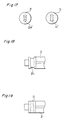
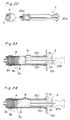
- the liquid-absorbent element M can be provided by winding the filter paper or the fibers in the form of yarn, fabric, or non-woven fabric around a winding groove 2c formed at the leading end of the plunger rod 2 as shown in Fig. 18 (refer to Fig. 19). Though Fig. 19 shows the one which is mounted only to the leading end by the winding, it may be wound along the longitudinal direction of the plunger rod.
- the clearance may be made small so as to become 0.2 - 1.0 mm in the case of the liquid having a small surface tension like an alcohol and may be made large so as to become 0.2 - 1.5 mm in the case of the one having a comparatively large surface tension like a water.
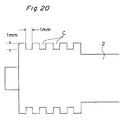
- the above-mentioned liquid-absorbent element M is embodied by such a material as to have the liquid absorbing capability, it may be constructed by utilizing the capillary phenomenon provided by annular or spiral liquid absorbing grooves C formed at the leading end of the plunger rod 2 as shown in Fig. 20. Further, as shown in Fig. 21, the grooves may be provided by arranging a plurality of disks 2e side by side in a stacked state in addition to and behind the disk 2d at the leading end of the plunger rod 2 as shown in Fig. 21. Also in this case, it is preferable to define a groove width and its depth in consideration of the viscosity and the surface tension of the liquid.
- the above-mentioned liquid-absorbent element M may have the cylindrical barrel formed of a slidable cylindrical liquid-absorbent material R which is detachably mounted to the leading end portion of the plunger rod 2.
- a threaded portion to which the end sealing member 3c is mounted with being fixedly secured by means of thread is projected from the leading end 20a of the plunger rod 2, and four shallow grooves as stoppers for preventing the rotating of the liquid-absorbent material R are formed in the surrounding thereof as well as four lugs are formed therebetween to prevent the removal of the liquid-absorbent material R.
- a radius of this leading end portion 20a is a little larger than a radius of a hole of the liquid-absorbent material R.
- 20b designates a pushing portion of the rod 2.
- an entire length of the cylindrical liquid-absorbent material R is longer than that of the disk-shaped liquid-absorbent material D as shown in Fig. 15 in a longitudinal direction of the barrel or the advancing direction of the plunger rod 2
- the liquid-absorbent material is preferably at least one kind of material selected from the group consisting of polyvinylformal, polyester fiber, pulp, polyester fiber containing pulp or acetate fiber, cellulose sponge, polyvinylformal sponge (PVA sponge available from KANEBOU Co. Ltd. in Japan) and liquid absorbent resin.
- the liquid-absorbent material is preferably impregnated with a water-holding and liquid-absorbing accelerator for accelerating its liquid-absorbing effect.
- This water-holding and liquid-absorbing accelerator is selected from the group consisting of glycerine, propylene glycol, polyethylene glycol, D-sorbitol, polyoxyethylene cetyl ether, and benzyl alcohol, and the impregnation is performed by dipping the liquid-absorbent material into the medium such as a water containing 1 - 30 weight percent thereof. Thereupon, an interfacial active agent such as polysolvate 80 may be added thereto for use.
- the liquid-absorbent material may contain an antimicrobial active agent.
- the antimicrobial active agent is at least one kind of material selected from the group consisting of benzalkonium chloride, benzethonium chloride, dodecyldiamino-ethylglycine, dodecyldimethylbenzylammonium chloride, polyhexa-methylenebiguanide, cetylpyridium chloride and aIkyldiaminoethylglycine hydrochloride, and its amount can be adjusted in accordance with a use condition.
- the liquid-absorbent material may be colored to make it invisible through a transparent barrel a colored traces caused by he liquid or the mixture absorbed therein.
- the coloring agent are Powdered Catechutannic Acid, Indigocarmine, Turmeric Extract, Methylrosanilinium Chloride, Yellow Oxide of Iron, Yellow Ferric Oxide, Opalux AS-6178 (Trademark of NIHON Calacon Co. Ltd.), Carbon Black, Color Paste 1, Color Paste 2, Color Paste 3 (Trademark of NIHON Calacon Co.
- Caramel Carmine
- ⁇ -Carotene Carotene Solution
- Gold Leaf Black Oxide of Iron
- Kekketsu Zinc Oxide
- Titanium Oxide Real Ferric Oxide
- Dis Azo Yellow Food Yellow No. 4, Food Yellow No. 5, Food Blue No, 1, Food Yellow No. 4 Aluminum Lake, Food Red No. 102, Food Red No. 2, Food Red No.
- the liquid-absorbent material may contains a deactivating agent, which may be selected from the group consisting of Ethanol, Methanol, Hydrogen Peroxide, Sodium Hypochlorite, Sodium Hydroxide, Potassium Hydroxide, Magnesium Hydroxide, Sodium Hydrogencarbonate, Sodium Carbonate, Boric Acid, Sulfuric Acid, Phosphoric Acid, Tri-sodium Phosphate, Di-sodium Phosphate, Tri-potassium Phosphate, Di-potassium Phophate Hydrochloric Acid, Lactic Acid, Aqueous Ammonia, Hydrargyrum and so on.
- a deactivating agent which may be selected from the group consisting of Ethanol, Methanol, Hydrogen Peroxide, Sodium Hypochlorite, Sodium Hydroxide, Potassium Hydroxide, Magnesium Hydroxide, Sodium Hydrogencarbonate, Sodium Carbonate, Boric Acid, Sulfuric Acid, Phosphoric Acid, Tri
- a larger effect for preventing the leakage can be obtained in an embodiment of having substantially no clearance between the outer circumference of the liquid-absorbent element and the inner wall of the syringe.
- the clearance can make it possible to improve the slidability of the liquid-absorbent material and to simplify the fragmental scrapping.
- the syringe provided at its rear end with a finger grip, it becomes necessary to provide the clearance depending on a configuration of the grip.
- a liquid absorbing rate decreases a little. But, the liquid absorbing rate can be improved to 100 % by making the material contain the water-holding and liquid absorbing accelerator.
- the two-chamber type syringe according to the present invention can be applied to the following mode.
- the liquid leak preventing element is designated by M in the respective drawings. As its function and construction are the same as the above-mentioned ones, explanations thereof will be omitted.
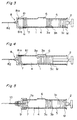
- Fig. 1 is a sectional view showing a basic construction of a practical mode of the present invention.
- the cylindrical barrel 1 is uniformly cylindrical as a whole except a bypass channel 6 defining the bypass portion to be described later and has its opposed ends fully opened.
- the end slidable sealing member 3C mounted to the rod 2 is inserted into this cylindrical barrel 1 from its rear end side as well as an intermediate slidable sealing member 3 is inserted therein so as to divide the interior of the barrel 1 into a first chamber 4 and a second chamber 5.
- This slidable sealing member 3 is divided into a forward slidable sealing member 3a and a backward slidable sealing member 3b.
- These forward slidable sealing member 3a and backward slidable sealing member 3b may be in contact with each other or have a predetermined space therebetween as illustrated.
- a suitable lug may be formed in at least one of the opposed surfaces of the forward slidable sealing member 3a and the backward slidable sealing member 3b.
- a sealing member 7 is mounted to the leading end opening portion 1a of the cylindrical barrel 1.
- a cap with a needle may be mounted to the leading end portion of this cylindrical barrel 1 when we need injection as described later, or the needle may be mounted thereto by such a known means as to attach a double-pointed needle to a holder member and make its rear end pierce through the sealing member 7.
- the first chamber 4 is charged with powder medicine P and the second chamber 5 is charged with a dissolution liquid, a dispersion liquid or various kinds of medicinal liquids L respectively.
- the bypass channel 6 is formed in a side wall of the first chamber 4 of the cylindrical barrel 1 so as to have a predetermined width and to be swelled or protruded outward. A length of this bypass channel 6 in the axial direction of the cylindrical barrel 1 is set longer by a predetermined degree than a total length of both the forward slidable sealing member 3a and the backward slidable sealing member 3b.
- a total length of the slidable sealing members 3a, 3b and the end portion sealing member 3c in the axial direction is set longer by a predetermined degree than an axial length of the bypass channel 6. This length adjustment can be made readily by regulating a length of the end slidable sealing member.
- both the forward slidable sealing member 3a and the backward slidable sealing member 3b are advanced via a body of the liquid L within the second chamber 5 by pushing the end slidable sealing member 3c mounted on the rod 2 (referred to as a plunger member hereinafter) toward its leading end side and these reach the formation position of the bypass channel 6 so that the first chamber 4 and the second chamber 5 are put in communication with each other. Thereupon, the liquid L within the second chamber 5 flows into the first chamber 4.
- this member 3b is directly pushed to advance the forward and backward slidable sealing members 3a, 3b and to stop the pushing at a position where at least a fore half portion of the forward slidable sealing member 3a reaches ahead of the leading end portion of the bypass channel 6 and at least a rear half portion of the sealing member 3c of the plunger member does not reach the bypass channel 6 to hold the slidable condition relative to the inner wall of the cylindrical barrel 1.
- the injection liquid prepared by the dissolution, the dispersion or the mixing is injected through the needle mounted to the leading end of the barrel 1.
- the liquid leak preventing element M absorbs and holds the residual liquid within the bypass channel.
- the dissolution liquid, the dispersion liquid or the medicinal liquid L is charged into the second chamber 5 and the end portion seeing member 3c is inserted therein on condition that the backward slidable sealing member 3b is inserted into the cylindrical barrel 1.
- the dispersion liquid or the medical liquid L made by a steam heating on this condition, the inner surface of the first chamber 4 is dried up.
- the dissolution liquid, the dispersion liquid or the medicinal liquid L within the second chamber 5 containing an activation substance is treated at such a temperature as not to destroy the substance, for example at most 50 - 60 °C.
- the forward slidable sealing member 3a is inserted into the cylindrical barrel 1 through its leading end opening portion 1a on the previously sufficiently dried-up condition to be brought into intimate contact with the backward slidable sealing member 3b or at a position near thereto spaced apart a very short distance.
- the powder medicine P is charged into the first chamber 4 through its leading end opening portion 1a on that condition, the two-ingredient pre-filled syringe shown in Fig. 1 can be obtained by mounting the stationary sealing member 7 to the leading end opening portion 1a. In this case, there may be employed either one of the rods 2 mounted originally or mounted later.
- Fig. 3 is a sectional view showing an example in which as the sealing member 7 to be inserted into the leading end opening portion of the cylindrical barrel 1 is used the slidable type one.
- This example shows a barrel 1 wherein a cap 8 is mounted with the needle onto a distal end thereof.
- the cap 8 has a needle 82 mounted to a tip end of a cup-shaped cap main body 81 and has such a construction that a groove 81a communicating with the needle 82 is formed in the inner circumference of the main body 81.
- the main body 81 has a void space 81b which projects toward the distal end side from the end opening portion 1a of the cylindrical barrel 1 by a predetermined distance and into which the sealing member 7 can be inserted.
- the sealing member 7 is moved into the void space of the main body 81 of the cap 8 with the needle.
- the injection liquid within the first chamber 4 enters the needle 82 through the groove 81a formed in the main body 81 of the cap 8 and then is injected.
- the cap 8 with the needle may be prepared at the time of injection or may be already mounted before the injection.
- the sealing member 7 may be so constructed as to be spaced apart a short distance from the leading end of the cylindrical barrel 1 when the sealing member 7 is arranged within the barrel 1 and stay at the leading end portion of the cylindrical barrel 1 when flowing of the liquid within the second chamber 5 into the first chamber 4 by the plunger 2 is completed. Since the fore and rear ends of the first chamber 4 are completely closed, even when the barrel 1 is shaken at the time of dissolving or dispersing, the liquid does not leak from anywhere.
- Fig. 5 is a sectional view showing an example in which as the sealing member 7 a stationary type one is used.
- a double-pointed needle 10 is put at its rear end portion through the sealing member 7 so as to project into the first chamber 4 by mounting the cap 9 serving also as a needle holding member to the leading end portion of the cylindrical barrel 1 and inserting the double-pointed needle 10 through this cap 9 to a predetermined position.
- this plunger member should be stopped once at a suitable position.
- the medicine liquid is injected through the needle 82.
- the rear end of the end sealing member 3c passes the bypass channel 6, the residual liquid within the bypass channel 6 tends to leak backward. Therefore, according to the present invention, the liquid leak preventing element M is arranged at the rear end of the end sealing member 3c.
- Figs. 6 and 7 show an embodiment in which such operations are simplified.
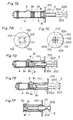
- a convex portion 101 projecting circumferentially inward beyond the inner peripheral surface of the cylindrical barrel 1 is formed in the inner peripheral surface of a finger grip 100 mounted to the proximal or rear end portion of the cylindrical barrel 1, and a plurality of lugs 201 are formed in the rod 2 along the same circumference at a predetermined position in the axial direction of the rod.
- each lug 201 in the axial direction of the rod 2 is set to such a position that the lugs 201 are brought into contact with the convex portion 101 of the finger grip 100 on a condition that the leading end face of the forward slidable sealing member 3a reaches ahead of the leading end portion of the bypass channel 6 as well as the rear end face of the backward slidable sealing member 3b is brought into contact with the leading end surface of the end sealing member 3c and further the rear half portion of the end sealing member 3c doesn't enter the bypass channel 6 to keep the sliding state relative to the inner wall of the cylindrical barrel 1.
- a distance between the axis of the rod 2 and a point of each lug is a little larger than an inner diameter of the convex portion 101 of the finger grip 100.
- a material of the finger grip 100 is a flexible one, for example like a synthetic resin.
- the convex portion 101 is similarly formed in the inner peripheral surface of the finger grip 100 mounted to the rear end portion of the cylindrical barrel 1.
- a plurality of cut-out grooves 102 are formed in this convex portion 101 as well as the same number of blades 202 are formed in the rod 2.
- a distance from the center of the rod 20 to the point of each blade 202 is larger than the inner diameter of the convex portion 101 of the finger grip 100 and shorter than a distance from the center of the finger grip 100 to the bottom of each cut-out groove 102.
- a position of the leading end of each blade 202 is so set that the blades 202 are brought into contact with the rear end face of the finger grip 100 on a condition that the leading end face of the forward slidable sealing member 3a reaches ahead of the leading end portion of the bypass channel 6 owing to the pushing by the end sealing member 3c as well as the rear end face of the backward sealing member 3b and the leading end face of the plunger 3c are in contact with each other and further the rear half portion of the end sealing member 3c doesn't enter the bypass channel 6 to keep the sliding condition relative to the inner wall of the barrel 1.
- the injection liquid after the dissolution, the dispersion or the mixing can be injected to a living body.
- the forward and the backward slidable sealing members 3a, 3b or the end slidable sealing member 3c may be constructed by a plurality of ribs projecting circumferentially from the outer peripheral surface thereof respectively so as to hold a liquid-tightness between the first chamber 4 and the second chamber 5 or a liquid- tightness between the second chamber 5 and the outside of the barrel 1, and in addition, to keep their slidabilities within the barrel 1.
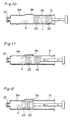
- Fig. 8 is a sectional view of an embodiment to which such a countermeasure is applied.
- a plurality of circular ribs 300 are formed in the forward slidable sealing member 3a, the backward slidable sealing member 3b and the end sealing member 3c respectively and a plurality of longitudinal ribs 301 are formed between the respective circular ribs so as to have nearly the same height as those of these ribs. Void spaces formed between the respective circular ribs 300 are partitioned by these respective longitudinal ribs 301 to a plurality of smaller void spaces respectively.
- the four longitudinal ribs 301 are formed within the respective void spaces of the respective sealing members 3a, 3b, 3c at such positions as to divide the respective outer circumferences equally into four portions, so that the respective void spaces between the circular ribs 300 are divided equally into four portions (refer to Fig. 9).
- the number of the longitudinal ribs 301 arranged within the respective void spaces between the circular ribs 300 is not limited to four but can be selected optionally to at least two. It becomes possible to decrease the loss quantity of the injection liquid as the number thereof increases more, but to the contrary, since the slidability of each sealing member lowers accordingly thereto, it is preferable to select the suitable number in consideration both of them.
- the longitudinal ribs 301 may be formed only in the forward and the backward slidable sealing members 3a, 3b.
- the above-mentioned liquid-absorbent element M may be formed from the cylindrical liquid-absorbent member R slidable relative to the cylindrical barrel and detachably mounted to the leading g end portion of the plunger rod.
- This liquid-absorbent material R is manufactured by stamping a liquid-absorbent material sheet in a predetermined configuration, which may be selected from the group consisting of polyvinylformal, polyester fiber, pulp, polyester fiber containing pulp, polyester fiber containing acetate fiber, acetate fiber, cellulose sponge, polyvinyl alcohol sponge and liquid-absorbent resin and may be impregnated by dipping with a water-holding and liquid-absorbing accelerator, which may be selected from the group consisting of glycerine, propylene glycol, polyethylene glycol, D-sorbitol, polyoxyethylene cetyl ether, and benzyl alcohol.
- the liquid-absorbent material may be impregnated with an antimicrobia active agent selected from benzalkonium chloride, benzethonium chloride, dodecyldiamino-ethylglycine, dodecyldimethylbenzylammonium chloride, polyhexa-methylenebiguanide and alkyldiaminoethylglycine hydrochloride.
- an antimicrobia active agent selected from benzalkonium chloride, benzethonium chloride, dodecyldiamino-ethylglycine, dodecyldimethylbenzylammonium chloride, polyhexa-methylenebiguanide and alkyldiaminoethylglycine hydrochloride.
Landscapes
- Health & Medical Sciences (AREA)
- Hematology (AREA)
- Engineering & Computer Science (AREA)
- Anesthesiology (AREA)
- Biomedical Technology (AREA)
- Heart & Thoracic Surgery (AREA)
- Vascular Medicine (AREA)
- Life Sciences & Earth Sciences (AREA)
- Animal Behavior & Ethology (AREA)
- General Health & Medical Sciences (AREA)
- Public Health (AREA)
- Veterinary Medicine (AREA)
- Infusion, Injection, And Reservoir Apparatuses (AREA)
- Absorbent Articles And Supports Therefor (AREA)
Applications Claiming Priority (6)
| Application Number | Priority Date | Filing Date | Title |
|---|---|---|---|
| JP8768896 | 1996-03-15 | ||
| JP87688/96 | 1996-03-15 | ||
| JP8768896 | 1996-03-15 | ||
| JP321151/96 | 1996-11-15 | ||
| JP32115196 | 1996-11-15 | ||
| JP32115196 | 1996-11-15 |
Publications (3)
| Publication Number | Publication Date |
|---|---|
| EP0793973A2 true EP0793973A2 (de) | 1997-09-10 |
| EP0793973A3 EP0793973A3 (de) | 1997-11-12 |
| EP0793973B1 EP0793973B1 (de) | 2002-08-07 |
Family
ID=26428939
Family Applications (1)
| Application Number | Title | Priority Date | Filing Date |
|---|---|---|---|
| EP97104350A Expired - Lifetime EP0793973B1 (de) | 1996-03-15 | 1997-03-14 | Injektionspritze |
Country Status (5)
| Country | Link |
|---|---|
| US (1) | US5891087A (de) |
| EP (1) | EP0793973B1 (de) |
| AT (1) | ATE221791T1 (de) |
| CA (1) | CA2200030C (de) |
| DE (1) | DE69714493T2 (de) |
Cited By (9)
| Publication number | Priority date | Publication date | Assignee | Title |
|---|---|---|---|---|
| EP0911046A3 (de) * | 1997-09-16 | 1999-09-08 | Takeda Chemical Industries, Ltd. | Vorgefüllte Spritze |
| EP1287841A3 (de) * | 2001-08-18 | 2003-07-02 | Arzneimittel GmbH Apotheker Vetter & Co. Ravensburg | Verfahren zur Durchmischung einer schwer löslichen pharmazeutischen Substanz mit einem Lösungsmittel und Spritze zur Anwendung des Verfahrens |
| WO2006012770A1 (de) * | 2004-08-06 | 2006-02-09 | Tecpharma Licensing Ag | Mehrkammerampulle mit bypass und kolbendichtung |
| CN100368031C (zh) * | 2005-12-31 | 2008-02-13 | 湖南千山制药机械股份有限公司 | 带易折杆的混合注射药物的预充注射器 |
| US7998106B2 (en) | 2004-05-03 | 2011-08-16 | Thorne Jr Gale H | Safety dispensing system for hazardous substances |
| US8216180B2 (en) | 2007-04-05 | 2012-07-10 | Tecpharma Licensing Ag | Administering apparatus with functional drive element |
| WO2013135549A1 (en) * | 2012-03-16 | 2013-09-19 | Carebay Europe Ltd | Medicament delivery device |
| EP3075403A4 (de) * | 2013-11-27 | 2017-06-21 | Nipro Corporation | Vorgefüllte spritze |
| IT201700039712A1 (it) * | 2017-04-11 | 2018-10-11 | Orofino Pharmaceuticals Group Srl | Dispositivo di iniezione pre-riempito |
Families Citing this family (29)
| Publication number | Priority date | Publication date | Assignee | Title |
|---|---|---|---|---|
| USD427676S (en) * | 1999-03-22 | 2000-07-04 | Bracco Research, Usa | Plunger rod |
| USD437050S1 (en) | 1999-03-22 | 2001-01-30 | Bracco Research Usa | Plunger rod |
| US6554792B2 (en) | 1999-05-21 | 2003-04-29 | Mallinckrodt Inc. | Suspension device and method |
| JP2003510135A (ja) * | 1999-09-29 | 2003-03-18 | スターリング メディヴェイションズ インコーポレイテッド | 再使用可能な医薬注入装置 |
| USD432231S (en) * | 1999-09-29 | 2000-10-17 | Bracco Diagnostics, Inc. | Plunger rod |
| US6981963B2 (en) * | 2001-03-13 | 2006-01-03 | Mdc Investment Holdings, Inc. | Pre-filled safety diluent injector |
| US6815408B2 (en) * | 2002-02-11 | 2004-11-09 | Paul C. Wegner | Hydrogen peroxide stabilizer and resulting product and applications |
| RU2246321C1 (ru) * | 2003-08-04 | 2005-02-20 | Мамаев Геннадий Викторович | Шприц-контейнер |
| RU2264231C2 (ru) * | 2003-08-04 | 2005-11-20 | Мамаев Геннадий Викторович | Шприц-контейнер |
| EP1652540B1 (de) * | 2003-09-30 | 2007-05-23 | 3M Espe Ag | Spritzenanordnung |
| KR101153898B1 (ko) * | 2004-03-23 | 2012-06-18 | 니프로 가부시키가이샤 | 프리필드 시린지 |
| US6997910B2 (en) * | 2004-05-03 | 2006-02-14 | Infusive Technologies, Llc | Multi-chamber, sequential dose dispensing syringe |
| US20060178644A1 (en) * | 2004-12-03 | 2006-08-10 | Reynolds David L | Pharmaceutical cartridge assembly and method of filling same |
| US7644520B2 (en) * | 2005-03-07 | 2010-01-12 | Sellers David R | Detachable sole for an ankle and foot covering |
| DE102005025640A1 (de) * | 2005-06-03 | 2006-12-07 | Scienion Ag | Mikrodispenser und zugehöriges Betriebsverfahren |
| RU2440151C1 (ru) * | 2010-04-27 | 2012-01-20 | Владимир Васильевич Агеев | Одноразовый шприц-картридж с подвижной иглой (варианты) |
| US8834449B2 (en) | 2012-01-23 | 2014-09-16 | Ikomed Technologies, Inc. | Mixing syringe |
| US9751056B2 (en) | 2012-01-23 | 2017-09-05 | Merit Medical Systems, Inc. | Mixing syringe |
| US9731076B2 (en) * | 2012-06-29 | 2017-08-15 | Ethicon, Inc. | Multi-compartment pre-filled mixing syringes with bypass |
| US9321581B2 (en) * | 2012-10-12 | 2016-04-26 | Eli Lilly And Company | Process and device for delivery of fluid by chemical reaction |
| KR20160088852A (ko) | 2013-07-16 | 2016-07-26 | 유니트랙트 시린지 피티와이 엘티디 | 주사 가능 물질의 반복적 혼합 및 주입용 주사기 |
| JP6537969B2 (ja) * | 2013-09-06 | 2019-07-03 | テルモ株式会社 | シリンジ用外筒及び射出成形用金型 |
| JP6841937B2 (ja) | 2017-02-17 | 2021-03-10 | イーライ リリー アンド カンパニー | 化学反応による流体の送達のためのプロセスおよびデバイス |
| WO2018191300A1 (en) | 2017-04-10 | 2018-10-18 | Sage Products, Llc | Twist seal oral fluid delivery device |
| WO2019050791A1 (en) | 2017-09-08 | 2019-03-14 | Eli Lilly And Company | SYSTEM FOR CONTROLLING GENERATION OF GAS IN A DRUG DELIVERY DEVICE |
| EP3897779B1 (de) | 2018-12-19 | 2024-08-07 | Eli Lilly and Company | Vorrichtungen und verfahren zur abgabe therapeutischer flüssigkeiten |
| US12133972B2 (en) | 2018-12-19 | 2024-11-05 | Eli Lilly And Company | Systems, devices, and processes for delivery of therapeutic fluids |
| SE2130015A1 (en) * | 2021-01-15 | 2022-02-15 | Wepo Ab | Hydration triggered aqueous diluter |
| CN113350626A (zh) * | 2021-06-04 | 2021-09-07 | 天津洪源海科技有限公司 | 一种药液分离式针筒 |
Family Cites Families (8)
| Publication number | Priority date | Publication date | Assignee | Title |
|---|---|---|---|---|
| US4572210A (en) * | 1981-07-01 | 1986-02-25 | Marquest Medical Products, Inc. | Syringe with means for allowing passage of air while preventing the passage of blood to obtain a gas-free blood sample |
| US4613326A (en) * | 1985-07-12 | 1986-09-23 | Becton, Dickinson And Company | Two-component medication syringe assembly |
| US4732162A (en) * | 1985-10-18 | 1988-03-22 | Martell Medical Products, Inc. | Automatic and position-sensitive syringe and method for nonaspirating or aspirating obtaining of blood samples |
| GB8723454D0 (en) * | 1987-10-06 | 1987-11-11 | Beecham Group Plc | Device |
| AU665067B2 (en) * | 1992-04-30 | 1995-12-14 | Takeda Pharmaceutical Company Limited | Prefilled syringe |
| US5476449A (en) * | 1992-12-28 | 1995-12-19 | Richmond; Frank M. | Needleless multi-liquid medicament delivery system with membranes |
| US5395325A (en) * | 1993-03-10 | 1995-03-07 | Moreno; Saul | Double chamber disposable syringe |
| SK3296A3 (en) * | 1993-12-28 | 1996-05-08 | Tetsuro Higashikawa | The syringe |
-
1997
- 1997-03-14 CA CA002200030A patent/CA2200030C/en not_active Expired - Lifetime
- 1997-03-14 DE DE69714493T patent/DE69714493T2/de not_active Expired - Lifetime
- 1997-03-14 AT AT97104350T patent/ATE221791T1/de not_active IP Right Cessation
- 1997-03-14 US US08/818,679 patent/US5891087A/en not_active Expired - Lifetime
- 1997-03-14 EP EP97104350A patent/EP0793973B1/de not_active Expired - Lifetime
Cited By (16)
| Publication number | Priority date | Publication date | Assignee | Title |
|---|---|---|---|---|
| US6371941B1 (en) | 1997-09-16 | 2002-04-16 | Takeda Chemical Industries, Ltd. | Prefilled syringe |
| EP0911046A3 (de) * | 1997-09-16 | 1999-09-08 | Takeda Chemical Industries, Ltd. | Vorgefüllte Spritze |
| EP1287841A3 (de) * | 2001-08-18 | 2003-07-02 | Arzneimittel GmbH Apotheker Vetter & Co. Ravensburg | Verfahren zur Durchmischung einer schwer löslichen pharmazeutischen Substanz mit einem Lösungsmittel und Spritze zur Anwendung des Verfahrens |
| US7998106B2 (en) | 2004-05-03 | 2011-08-16 | Thorne Jr Gale H | Safety dispensing system for hazardous substances |
| WO2006012770A1 (de) * | 2004-08-06 | 2006-02-09 | Tecpharma Licensing Ag | Mehrkammerampulle mit bypass und kolbendichtung |
| US7686782B2 (en) | 2004-08-06 | 2010-03-30 | Tecpharma Licensing Ag | Multi-chamber ampoule with bypass and piston seal |
| CN100368031C (zh) * | 2005-12-31 | 2008-02-13 | 湖南千山制药机械股份有限公司 | 带易折杆的混合注射药物的预充注射器 |
| US8758292B2 (en) | 2007-04-05 | 2014-06-24 | Tecpharma Licensing Ag | Administering apparatus with functional drive element |
| US8216180B2 (en) | 2007-04-05 | 2012-07-10 | Tecpharma Licensing Ag | Administering apparatus with functional drive element |
| WO2013135549A1 (en) * | 2012-03-16 | 2013-09-19 | Carebay Europe Ltd | Medicament delivery device |
| CN104168938A (zh) * | 2012-03-16 | 2014-11-26 | 卡贝欧洲有限公司 | 药剂输送装置 |
| AU2013231449B2 (en) * | 2012-03-16 | 2015-06-04 | Shl Medical Ag | Medicament delivery device |
| US10092700B2 (en) | 2012-03-16 | 2018-10-09 | Carebay Europe Ltd | Medicament delivery device |
| EP3075403A4 (de) * | 2013-11-27 | 2017-06-21 | Nipro Corporation | Vorgefüllte spritze |
| US10576215B2 (en) | 2013-11-27 | 2020-03-03 | Nipro Corporation | Pre-filled syringe |
| IT201700039712A1 (it) * | 2017-04-11 | 2018-10-11 | Orofino Pharmaceuticals Group Srl | Dispositivo di iniezione pre-riempito |
Also Published As
| Publication number | Publication date |
|---|---|
| US5891087A (en) | 1999-04-06 |
| DE69714493D1 (de) | 2002-09-12 |
| CA2200030A1 (en) | 1997-09-15 |
| EP0793973B1 (de) | 2002-08-07 |
| ATE221791T1 (de) | 2002-08-15 |
| CA2200030C (en) | 2006-04-25 |
| DE69714493T2 (de) | 2003-01-02 |
| EP0793973A3 (de) | 1997-11-12 |
Similar Documents
| Publication | Publication Date | Title |
|---|---|---|
| EP0793973B1 (de) | Injektionspritze | |
| JP2683628B2 (ja) | 注射装置の改良 | |
| US7186241B2 (en) | Syringe with needle penetrable and laser resealable stopper | |
| EP1377326B1 (de) | Vorgefüllter sicherheits-diluentinjektor | |
| US7004929B2 (en) | Safety pre-filled cartridge injector | |
| AU2002365290B2 (en) | A safety needle assembly | |
| EP1557189B1 (de) | Injektionsgerät | |
| DK153444B (da) | Sproejte, navnlig injektionssproejte, samt naaleholder dertil. | |
| US5944700A (en) | Adjustable injection length pen needle | |
| US3678931A (en) | Syringe | |
| CN100574822C (zh) | 湿/干自动注射器装置 | |
| AU2016383022A1 (en) | Auto injector with cartridge retention system | |
| JPH1176405A5 (de) | ||
| EP0511183A1 (de) | Injektionsbehälter | |
| US20240091445A1 (en) | Treatment of dual chamber syringe and methods of use thereof | |
| JP2015509800A (ja) | 薬剤送達装置 | |
| JP4235267B2 (ja) | シリンジ | |
| CA2085371C (en) | Combined syringe and needle shield | |
| CN114728128B (zh) | 用于药剂输送装置的容器保持架组件及药剂输送装置 | |
| JP2007090083A (ja) | シリンジ | |
| CN1143693C (zh) | 注射器 | |
| WO2003084589A1 (en) | Safety pre-filled cartridge injector | |
| AU2002247333A1 (en) | Pre-filled safety diluent injector | |
| US20140074043A1 (en) | Needle hub and needle | |
| JPH08155028A (ja) | 薬液充填注射器 |
Legal Events
| Date | Code | Title | Description |
|---|---|---|---|
| PUAI | Public reference made under article 153(3) epc to a published international application that has entered the european phase |
Free format text: ORIGINAL CODE: 0009012 |
|
| AK | Designated contracting states |
Kind code of ref document: A2 Designated state(s): AT BE CH DE DK ES FI FR GB GR IE IT LI LU NL PT SE |
|
| RHK1 | Main classification (correction) |
Ipc: A61M 5/178 |
|
| PUAL | Search report despatched |
Free format text: ORIGINAL CODE: 0009013 |
|
| AK | Designated contracting states |
Kind code of ref document: A3 Designated state(s): AT BE CH DE DK ES FI FR GB GR IE IT LI LU NL PT SE |
|
| 17P | Request for examination filed |
Effective date: 19980123 |
|
| 17Q | First examination report despatched |
Effective date: 20010116 |
|
| GRAG | Despatch of communication of intention to grant |
Free format text: ORIGINAL CODE: EPIDOS AGRA |
|
| GRAG | Despatch of communication of intention to grant |
Free format text: ORIGINAL CODE: EPIDOS AGRA |
|
| GRAH | Despatch of communication of intention to grant a patent |
Free format text: ORIGINAL CODE: EPIDOS IGRA |
|
| GRAH | Despatch of communication of intention to grant a patent |
Free format text: ORIGINAL CODE: EPIDOS IGRA |
|
| GRAA | (expected) grant |
Free format text: ORIGINAL CODE: 0009210 |
|
| AK | Designated contracting states |
Kind code of ref document: B1 Designated state(s): AT BE CH DE DK ES FI FR GB GR IE IT LI LU NL PT SE |
|
| PG25 | Lapsed in a contracting state [announced via postgrant information from national office to epo] |
Ref country code: NL Free format text: LAPSE BECAUSE OF FAILURE TO SUBMIT A TRANSLATION OF THE DESCRIPTION OR TO PAY THE FEE WITHIN THE PRESCRIBED TIME-LIMIT Effective date: 20020807 Ref country code: GR Free format text: LAPSE BECAUSE OF FAILURE TO SUBMIT A TRANSLATION OF THE DESCRIPTION OR TO PAY THE FEE WITHIN THE PRESCRIBED TIME-LIMIT Effective date: 20020807 Ref country code: FI Free format text: LAPSE BECAUSE OF FAILURE TO SUBMIT A TRANSLATION OF THE DESCRIPTION OR TO PAY THE FEE WITHIN THE PRESCRIBED TIME-LIMIT Effective date: 20020807 Ref country code: BE Free format text: LAPSE BECAUSE OF FAILURE TO SUBMIT A TRANSLATION OF THE DESCRIPTION OR TO PAY THE FEE WITHIN THE PRESCRIBED TIME-LIMIT Effective date: 20020807 Ref country code: AT Free format text: LAPSE BECAUSE OF FAILURE TO SUBMIT A TRANSLATION OF THE DESCRIPTION OR TO PAY THE FEE WITHIN THE PRESCRIBED TIME-LIMIT Effective date: 20020807 |
|
| RAP1 | Party data changed (applicant data changed or rights of an application transferred) |
Owner name: ARTE CORPORATION Owner name: TAKEDA CHEMICAL INDUSTRIES, LTD. |
|
| REF | Corresponds to: |
Ref document number: 221791 Country of ref document: AT Date of ref document: 20020815 Kind code of ref document: T |
|
| REG | Reference to a national code |
Ref country code: GB Ref legal event code: FG4D |
|
| RIN1 | Information on inventor provided before grant (corrected) |
Inventor name: MATSUDA, TERUO Inventor name: YOKOKAWA, KATSUYUKI Inventor name: TANAKA, NOBUO Inventor name: OHTANI, SEIJI |
|
| REG | Reference to a national code |
Ref country code: CH Ref legal event code: EP |
|
| REG | Reference to a national code |
Ref country code: IE Ref legal event code: FG4D |
|
| REF | Corresponds to: |
Ref document number: 69714493 Country of ref document: DE Date of ref document: 20020912 |
|
| PG25 | Lapsed in a contracting state [announced via postgrant information from national office to epo] |
Ref country code: SE Free format text: LAPSE BECAUSE OF FAILURE TO SUBMIT A TRANSLATION OF THE DESCRIPTION OR TO PAY THE FEE WITHIN THE PRESCRIBED TIME-LIMIT Effective date: 20021107 Ref country code: DK Free format text: LAPSE BECAUSE OF FAILURE TO SUBMIT A TRANSLATION OF THE DESCRIPTION OR TO PAY THE FEE WITHIN THE PRESCRIBED TIME-LIMIT Effective date: 20021107 |
|
| REG | Reference to a national code |
Ref country code: CH Ref legal event code: NV Representative=s name: BOVARD AG PATENTANWAELTE |
|
| PG25 | Lapsed in a contracting state [announced via postgrant information from national office to epo] |
Ref country code: PT Free format text: LAPSE BECAUSE OF FAILURE TO SUBMIT A TRANSLATION OF THE DESCRIPTION OR TO PAY THE FEE WITHIN THE PRESCRIBED TIME-LIMIT Effective date: 20021122 |
|
| NLV1 | Nl: lapsed or annulled due to failure to fulfill the requirements of art. 29p and 29m of the patents act | ||
| ET | Fr: translation filed | ||
| PG25 | Lapsed in a contracting state [announced via postgrant information from national office to epo] |
Ref country code: ES Free format text: LAPSE BECAUSE OF FAILURE TO SUBMIT A TRANSLATION OF THE DESCRIPTION OR TO PAY THE FEE WITHIN THE PRESCRIBED TIME-LIMIT Effective date: 20030228 |
|
| PG25 | Lapsed in a contracting state [announced via postgrant information from national office to epo] |
Ref country code: LU Free format text: LAPSE BECAUSE OF NON-PAYMENT OF DUE FEES Effective date: 20030314 Ref country code: IE Free format text: LAPSE BECAUSE OF NON-PAYMENT OF DUE FEES Effective date: 20030314 |
|
| PLBE | No opposition filed within time limit |
Free format text: ORIGINAL CODE: 0009261 |
|
| STAA | Information on the status of an ep patent application or granted ep patent |
Free format text: STATUS: NO OPPOSITION FILED WITHIN TIME LIMIT |
|
| 26N | No opposition filed |
Effective date: 20030508 |
|
| REG | Reference to a national code |
Ref country code: IE Ref legal event code: MM4A |
|
| REG | Reference to a national code |
Ref country code: CH Ref legal event code: PFA Owner name: ARTE CORPORATION Free format text: TAKEDA CHEMICAL INDUSTRIES, LTD.#1-1, DOSHOMACHI 4-CHOME#CHUO-KU, OSAKA 541 (JP) $ ARTE CORPORATION#5-8 IWAMOTOCHO 1-CHOME#CHIYODA-KU, TOKYO 101 (JP) -TRANSFER TO- ARTE CORPORATION#5-8 IWAMOTOCHO 1-CHOME#CHIYODA-KU, TOKYO 101 (JP) $ TAKEDA PHARMACEUTICAL COMPANY LIMITED#1-1, DOSHOMACHI 4-CHOME CHUO-KU#OSAKA (JP) |
|
| REG | Reference to a national code |
Ref country code: FR Ref legal event code: CD |
|
| REG | Reference to a national code |
Ref country code: CH Ref legal event code: PFA Owner name: ARTE CORPORATION Free format text: ARTE CORPORATION#5-8 IWAMOTOCHO 1-CHOME#CHIYODA-KU, TOKYO 101 (JP) $ TAKEDA PHARMACEUTICAL COMPANY LIMITED#1-1, DOSHOMACHI 4-CHOME CHUO-KU#OSAKA (JP) -TRANSFER TO- ARTE CORPORATION#5-8 IWAMOTOCHO 1-CHOME#CHIYODA-KU, TOKYO 101 (JP) $ TAKEDA PHARMACEUTICAL COMPANY LIMITED#1-1, DOSHOMACHI 4-CHOME CHUO-KU#OSAKA (JP) |
|
| REG | Reference to a national code |
Ref country code: FR Ref legal event code: PLFP Year of fee payment: 20 |
|
| PGFP | Annual fee paid to national office [announced via postgrant information from national office to epo] |
Ref country code: CH Payment date: 20160311 Year of fee payment: 20 Ref country code: DE Payment date: 20160308 Year of fee payment: 20 |
|
| PGFP | Annual fee paid to national office [announced via postgrant information from national office to epo] |
Ref country code: FR Payment date: 20160208 Year of fee payment: 20 Ref country code: GB Payment date: 20160309 Year of fee payment: 20 |
|
| PGFP | Annual fee paid to national office [announced via postgrant information from national office to epo] |
Ref country code: IT Payment date: 20160324 Year of fee payment: 20 |
|
| REG | Reference to a national code |
Ref country code: DE Ref legal event code: R071 Ref document number: 69714493 Country of ref document: DE |
|
| REG | Reference to a national code |
Ref country code: CH Ref legal event code: PL |
|
| REG | Reference to a national code |
Ref country code: GB Ref legal event code: PE20 Expiry date: 20170313 |
|
| PG25 | Lapsed in a contracting state [announced via postgrant information from national office to epo] |
Ref country code: GB Free format text: LAPSE BECAUSE OF EXPIRATION OF PROTECTION Effective date: 20170313 |