EP0794401A2 - Condenseur de vapeur - Google Patents
Condenseur de vapeur Download PDFInfo
- Publication number
- EP0794401A2 EP0794401A2 EP97300956A EP97300956A EP0794401A2 EP 0794401 A2 EP0794401 A2 EP 0794401A2 EP 97300956 A EP97300956 A EP 97300956A EP 97300956 A EP97300956 A EP 97300956A EP 0794401 A2 EP0794401 A2 EP 0794401A2
- Authority
- EP
- European Patent Office
- Prior art keywords
- steam
- condenser
- heat pipes
- header
- condensing apparatus
- Prior art date
- Legal status (The legal status is an assumption and is not a legal conclusion. Google has not performed a legal analysis and makes no representation as to the accuracy of the status listed.)
- Withdrawn
Links
Images


Classifications
-
- F—MECHANICAL ENGINEERING; LIGHTING; HEATING; WEAPONS; BLASTING
- F28—HEAT EXCHANGE IN GENERAL
- F28B—STEAM OR VAPOUR CONDENSERS
- F28B1/00—Condensers in which the steam or vapour is separate from the cooling medium by walls, e.g. surface condenser
-
- F—MECHANICAL ENGINEERING; LIGHTING; HEATING; WEAPONS; BLASTING
- F28—HEAT EXCHANGE IN GENERAL
- F28F—DETAILS OF HEAT-EXCHANGE AND HEAT-TRANSFER APPARATUS, OF GENERAL APPLICATION
- F28F19/00—Preventing the formation of deposits or corrosion, e.g. by using filters or scrapers
- F28F19/02—Preventing the formation of deposits or corrosion, e.g. by using filters or scrapers by using coatings, e.g. vitreous or enamel coatings
- F28F19/04—Preventing the formation of deposits or corrosion, e.g. by using filters or scrapers by using coatings, e.g. vitreous or enamel coatings of rubber; of plastics material; of varnish
-
- F—MECHANICAL ENGINEERING; LIGHTING; HEATING; WEAPONS; BLASTING
- F28—HEAT EXCHANGE IN GENERAL
- F28B—STEAM OR VAPOUR CONDENSERS
- F28B1/00—Condensers in which the steam or vapour is separate from the cooling medium by walls, e.g. surface condenser
- F28B1/06—Condensers in which the steam or vapour is separate from the cooling medium by walls, e.g. surface condenser using air or other gas as the cooling medium
-
- F—MECHANICAL ENGINEERING; LIGHTING; HEATING; WEAPONS; BLASTING
- F28—HEAT EXCHANGE IN GENERAL
- F28D—HEAT-EXCHANGE APPARATUS, NOT PROVIDED FOR IN ANOTHER SUBCLASS, IN WHICH THE HEAT-EXCHANGE MEDIA DO NOT COME INTO DIRECT CONTACT
- F28D15/00—Heat-exchange apparatus with the intermediate heat-transfer medium in closed tubes passing into or through the conduit walls ; Heat-exchange apparatus employing intermediate heat-transfer medium or bodies
- F28D15/02—Heat-exchange apparatus with the intermediate heat-transfer medium in closed tubes passing into or through the conduit walls ; Heat-exchange apparatus employing intermediate heat-transfer medium or bodies in which the medium condenses and evaporates, e.g. heat pipes
-
- F—MECHANICAL ENGINEERING; LIGHTING; HEATING; WEAPONS; BLASTING
- F28—HEAT EXCHANGE IN GENERAL
- F28B—STEAM OR VAPOUR CONDENSERS
- F28B1/00—Condensers in which the steam or vapour is separate from the cooling medium by walls, e.g. surface condenser
- F28B1/06—Condensers in which the steam or vapour is separate from the cooling medium by walls, e.g. surface condenser using air or other gas as the cooling medium
- F28B2001/065—Condensers in which the steam or vapour is separate from the cooling medium by walls, e.g. surface condenser using air or other gas as the cooling medium with secondary condenser, e.g. reflux condenser or dephlegmator
Definitions
- the invention relates to steam condensing apparatus, and in particular to such apparatus that combines the use of steam condensing technology with heat pipe technology.
- Air-cooled steam condensers used in the steam power-generation cycle are typically arranged in an A-frame construction with a fan at the base and inclined condenser tube bundles on each side. Air flows through the fan and across several sections of the steam condenser. The steam inlet is at the top of each bundle and the vapour and condensate flow concurrently downwards.
- the differences in tube row exit pressures are resolved by steam and noncondensable gases in the rear header entering the ends of the tube rows that have a lower pressure. Since the lower tube rows have lower exit pressures, they have steam entering both ends and, over time, noncondensable gases collect in the tubes. These pockets of noncondensable gases block local steam flow, allowing condensate to freeze during cold weather, which can result in tube rupture. Noncondensable gases are normally vented from the rear header with vacuum pumps or air ejectors. To overcome this problem, the classical solution has been to design for excess steam flow through each tube row. The excess steam prevents the accumulation of noncondensable gases and maintains condensate temperatures above freezing.
- This excess steam typically twenty to thirty-three percent of the total steam flow, is condensed in a secondary or vent condenser.
- the typical vent condenser is a dephlegmator (reflux condenser) which has steam flow up an inclined tube, condensation on the tube walls, and drainage of the condensate downwardly.
- the noncondensable gases flow upwards out of the tube and are removed by vacuum pumps or air ejectors.
- Steam condenser freezing problems have also been overcome in the past through the use of heat pipes. Heat pipes were used to condense steam. The steam was passed over the evaporator side of the heat pipes and condensed while ambient air was forced over the condenser side of the heat pipes. The condensate was collected at the bottom of the steam duct and returned to the boiler for reuse.
- Embodiments of the invention provide an air-cooled steam condenser that also uses heat pipe technology so as to be freeze proof under any ambient conditions, and offering a simple approach to the management of noncondensable gases.
- Steam flows through the main condenser with concurrent steam and condensate flow downwardly.
- the heat transfer surface area and fan air flow are designed such that, over the range of operating conditions, all of the steam does not completely condense and vapour continuously exits each tube row. This continuous flow of steam vapour purges these rows of noncondensable gases.
- the excess steam flows into the lower header to a secondary condenser section that utilizes heat pipes. In the secondary condenser section, the excess steam condenses on the evaporator side external surface of the heat pipes.
- the noncondensable gases that remain in the lower header are vented with an air removal system similar to that of conventional condensers. Condensate in the lower header drains to a condensate tank for reuse in the power generation cycle.
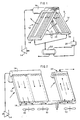
- air-cooled steam condensers are typically arranged in an A-frame construction with a fan 10 at the base and inclined condenser tube bundles 12 on each side. Air flows through the fan 10 across several sections of the steam condenser. Steam from a steam turbine 14 is directed to an upper steam header 16 which provides a steam inlet at the top of each bundle 12. The vapour and condensate flow concurrently downwards in the bundle 12 to a lower or rear header 18. An air ejector or vacuum pump 20 is used to vent noncondensable gases from the rear header 18. The condensate is collected in a tank 22 and directed to condensate pumps (not shown) for reuse.
- FIG. 2 illustrates a previously-proposed solution to prevent freezing of condensate.
- the condenser tube bundle 12 is designed to cause excess steam flow through each tube row.
- the excess steam prevents the accumulation of noncondensable gases and maintains condensate temperatures above freezing.
- This excess steam is condensed in a secondary or vent condenser 24.
- the typical vent condenser 24 is a dephlegmator (reflux condenser) which has steam flow up an inclined tube, condensation on the tube walls, and drainage of the condensate downwardly.
- the noncondensable gases flow upwards out of the tube and are removed by vacuum pumps or air ejectors.
- FIG. 3 illustrates another previously-proposed solution to prevent freezing of condensate.
- Heat pipes 26 are set up in a Y configuration.
- the evaporator side of the heat pipes is enclosed in a steam header 28.
- the steam is condensed as it passes across the evaporator side of the heat pipes 26.
- the condensate is collected at the bottom of the header 28 and returned to the boiler for reuse.
- the fan 10 causes induced air flow across the condenser sides of the heat pipes to cause cooling and recondensation of the working fluid contained in the heat pipes.
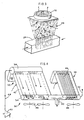
- a steam condensing apparatus 30 generally comprises a main condenser 32, a lower header 34, and a secondary condenser 36.
- the main condenser 32 is formed from an upper steam header 38 and one or more tube bundles 40.
- the upper steam header 38 receives steam from a steam turbine 42 via a line 44 and then directs the steam into the tube bundles 40.
- Each tube bundle 40 is similar to tube bundles generally known and used in the industry in that several rows of tubes, usually four, are provided for receiving and condensing steam.
- the main difference in the tube bundles of the present apparatus compared to the prior art is that they are not designed to condense as much of the steam as possible. Instead, the heat transfer surface area and fan air flow from fans 46 are designed such that, over the range of operating conditions, all of the steam does not completely condense and steam vapour continuously exits the bottom of each tube row into the lower header 34.
- sixty-seven to eighty percent of the available surface area is used in the tube bundles 40. This surface area, combined with fan air flow, results in approximately twenty to eighty percent of the steam being condensed in the main condenser 32.
- the continuous flow of steam vapour purges the tube rows in the main condenser 32 of noncondensable gases. The excess uncondensed steam and noncondensable gases flow into the lower header 34 and then to the secondary condenser 36.
- the secondary condenser 36 is in fluid communication with the lower header 34 and positioned in line with the main condenser 32.
- Heat pipes 48 are positioned in the secondary condenser 36 such that the evaporator side of each heat pipe is at the lower end of the secondary condenser 36, and extends into the lower header 34.
- the condenser side of each heat pipe is positioned towards the upper end of the secondary condenser 36. In this manner, the uncondensed steam from the main condenser 32 condenses on the evaporator side of the heat pipes 48 and flows out of the lower header 34 through a condensate drain 50. Noncondensable gases are vented off to an ejector 52.
- Figure 5 illustrates an alternative embodiment of the invention wherein the main condenser 32 and the secondary condenser 36 are oriented in a W-shaped configuration instead of an in-line configuration.
- the apparatus condenses the excess steam in the secondary condenser 36. Noncondensable gases are vented off via lines 54.
- FIG. 6 illustrates another alternative embodiment of the invention wherein the main and secondary condensers described above are consolidated into a single condenser 56.
- the single condenser 56 includes conventional finned tubes 58 that direct steam flow from top to bottom, and heat pipes 26.
- the heat transfer surface area and fan air flow are designed such that, over the range of operating conditions, all of the steam is not condensed in the tubes 58.
- the continuous flow of steam purges the tubes 58 of noncondensable gases.
- the remaining steam that exits the bottom of the tubes 58 is condensed by the heat pipes 26 which have their evaporator side extending below the exit end of the tubes 58 in the lower header 34.
- Figure 6 illustrates four rows of pipes, with the heat pipes 26 being the lower or first row. It should be understood that the heat pipes 26 may be positioned in any row of the tube bundle
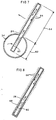
- FIG. 7 is a detailed sectional view of one of the heat pipes 26 and the lower header 34.
- the heat pipes 26 may be fabricated out of straight round, elliptical, or flat oval tubes that may or may not contain an internal wick.
- the heat pipes 26 are sealed at both ends and contain a predetermined quantity of heat transfer fluid 60 at a predetermined vapour pressure.
- the fluid used will depend upon the application and conditions. Examples of heat transfer fluids used in different heat pipe applications include, but are not limited to, methanol, ammonia and freon.
- the heat transfer fluid 60 normally resides in the evaporator section 62 of the heat pipe 26.
- the heat transfer fluid 60 vapourizes, removing heat from the steam and causing condensation thereof, and travels upwards into the condenser section 64 where the fluid is cooled and condensed, releasing the fluid heat to the air flow.
- the heat transfer fluid condensate returns to the evaporator section 62 by gravity flow.
- the condenser section 64 may be provided with fins 66 to provide a large heat rejection surface area.
- the fins 66 may be extruded, embedded, or wrapped aluminium or steel, and can be solid or serrated depending upon the pressure drop and heat transfer requirements.
- the heat pipes 26 may be placed in inline or triangular tube pitches depending upon the pressure drop and heat transfer requirements of the system.
- the system shown in Figure 8 includes a heat pipe 26 that has the outer diameter of the evaporator section sleeved with a low friction coating 68 such as polytetrafluoroethylene.
- the low friction coating 68 promotes drop-wise condensation which improves the condensing heat transfer rate by about one order of magnitude.
- the coating provides a corrosion-proof boundary that allows the use of inexpensive carbon steel based tubes for the heat pipes 26.
- FIGs 9 and 10 illustrate an embodiment of the lower header 34 that is provided with a plurality of thermowells or sleeves 70 that are welded directly to the lower header 34 to form a leak-proof seal.
- Each sleeve 70 is sized to provide a small slip-fit clearance between the inner diameter of the sleeve 70 and the outer diameter of the evaporator section of the heat pipe 26, so as to reduce thermal resistance.
- a thermally conductive substance such as grease or a suitable liquid may be used to fill the annulus.
- the heat pipes 26 are held in place by gravity and by the tube supports (not shown) commonly found in the condenser bundle frame. This provides another means of eliminating corrosive contact of the heat pipes 26 with the steam.
- the exterior of the sleeves 70 may be coated with a low friction coating to promote drop-wise condensation, thus improving the condensing heat transfer rate.
Landscapes
- Engineering & Computer Science (AREA)
- Mechanical Engineering (AREA)
- General Engineering & Computer Science (AREA)
- Physics & Mathematics (AREA)
- Thermal Sciences (AREA)
- Life Sciences & Earth Sciences (AREA)
- Sustainable Development (AREA)
- Heat-Exchange Devices With Radiators And Conduit Assemblies (AREA)
- Vaporization, Distillation, Condensation, Sublimation, And Cold Traps (AREA)
Applications Claiming Priority (2)
| Application Number | Priority Date | Filing Date | Title |
|---|---|---|---|
| US61056796A | 1996-03-06 | 1996-03-06 | |
| US610567 | 1996-03-06 |
Publications (2)
| Publication Number | Publication Date |
|---|---|
| EP0794401A2 true EP0794401A2 (fr) | 1997-09-10 |
| EP0794401A3 EP0794401A3 (fr) | 1998-09-23 |
Family
ID=24445557
Family Applications (1)
| Application Number | Title | Priority Date | Filing Date |
|---|---|---|---|
| EP97300956A Withdrawn EP0794401A3 (fr) | 1996-03-06 | 1997-02-14 | Condenseur de vapeur |
Country Status (9)
| Country | Link |
|---|---|
| EP (1) | EP0794401A3 (fr) |
| JP (1) | JP2807992B2 (fr) |
| KR (1) | KR100250863B1 (fr) |
| AU (1) | AU690048B2 (fr) |
| BR (1) | BR9701200A (fr) |
| CA (1) | CA2199209C (fr) |
| ID (1) | ID16111A (fr) |
| SG (1) | SG54463A1 (fr) |
| TW (1) | TW360769B (fr) |
Cited By (16)
| Publication number | Priority date | Publication date | Assignee | Title |
|---|---|---|---|---|
| EP2149682A1 (fr) * | 2008-07-29 | 2010-02-03 | General Electric Company | Condensateur pour centrale à cycle combiné |
| US8015790B2 (en) | 2008-07-29 | 2011-09-13 | General Electric Company | Apparatus and method employing heat pipe for start-up of power plant |
| US8157512B2 (en) | 2008-07-29 | 2012-04-17 | General Electric Company | Heat pipe intercooler for a turbomachine |
| US8186152B2 (en) | 2008-07-23 | 2012-05-29 | General Electric Company | Apparatus and method for cooling turbomachine exhaust gas |
| US8359824B2 (en) | 2008-07-29 | 2013-01-29 | General Electric Company | Heat recovery steam generator for a combined cycle power plant |
| US8425223B2 (en) | 2008-07-29 | 2013-04-23 | General Electric Company | Apparatus, system and method for heating fuel gas using gas turbine exhaust |
| US8596073B2 (en) | 2008-07-18 | 2013-12-03 | General Electric Company | Heat pipe for removing thermal energy from exhaust gas |
| CN103977891A (zh) * | 2013-02-11 | 2014-08-13 | 通用电气公司 | 用于煤精选的系统和方法 |
| EP2429690A4 (fr) * | 2009-05-15 | 2014-09-24 | Spx Cooling Technologies Inc | Condenseur de vapeur d'eau refroidi par air à tirage naturel et procédé |
| EP2635865A4 (fr) * | 2010-11-03 | 2014-11-05 | Spx Cooling Technologies Inc | Condenseur à tirage naturel |
| CN105833582A (zh) * | 2016-05-23 | 2016-08-10 | 沈玮 | 一种生物医药技术用的快速冷却装置 |
| CN108917418A (zh) * | 2018-08-02 | 2018-11-30 | 山西大学 | 一种空冷岛顺流管束抽真空装置 |
| EP3480548A1 (fr) * | 2017-11-07 | 2019-05-08 | SPX Dry Cooling Belgium sprl | Échangeur de chaleur à trois étages pour un condenseur refroidi par air |
| CN113035386A (zh) * | 2021-03-05 | 2021-06-25 | 哈尔滨工程大学 | 一种采用双轮双叶复合动力吸气式的安全壳内置高效换热器 |
| CN113532141A (zh) * | 2020-04-20 | 2021-10-22 | 齐秀 | 一种高寒地区空冷岛防冻的方法 |
| US11703285B1 (en) * | 2023-02-27 | 2023-07-18 | Helen Skop | Apparatus and method for latent energy exchange |
Families Citing this family (7)
| Publication number | Priority date | Publication date | Assignee | Title |
|---|---|---|---|---|
| DE202005005302U1 (de) * | 2005-04-04 | 2005-06-02 | Spx-Cooling Technologies Gmbh | Luftkondensator |
| BR112014000879A2 (pt) * | 2011-07-15 | 2017-02-21 | Univ Stellenbosch | deflegmador |
| CN102788516A (zh) * | 2012-09-11 | 2012-11-21 | 哈尔滨工业大学(威海) | 一种电站直接空冷凝汽器单元 |
| CN103697639B (zh) * | 2013-12-12 | 2016-03-02 | 华南理工大学 | 一种基于具有强化凝结作用热管束的吸收式制冷机冷凝器 |
| RU184773U1 (ru) * | 2018-06-15 | 2018-11-08 | Федеральное государственное бюджетное образовательное учреждение высшего образования "Калининградский государственный технический университет" | Установка охлаждения природного газа |
| KR102055708B1 (ko) * | 2018-06-26 | 2019-12-13 | 동일플랜트 주식회사 | 스팀 배기관에 삽입된 히트파이프를 이용한 드래프트 방식 복수기 |
| CN111397389B (zh) * | 2020-03-20 | 2021-07-27 | 太原理工大学 | 一种防止管束冻结的电厂直接空冷系统 |
Family Cites Families (6)
| Publication number | Priority date | Publication date | Assignee | Title |
|---|---|---|---|---|
| US4149588A (en) * | 1976-03-15 | 1979-04-17 | Mcdonnell Douglas Corporation | Dry cooling system |
| IT1135516B (it) * | 1981-02-18 | 1986-08-27 | Nuovo Pignone Spa | Condensatore perfezionato di vapore con raffreddamento ad aria |
| DE3106973C2 (de) * | 1981-02-25 | 1985-03-07 | Balcke-Dürr AG, 4030 Ratingen | Luftgekühlte Kondensationsanlage |
| DE3114948C2 (de) * | 1981-04-13 | 1985-05-02 | Balcke-Dürr AG, 4030 Ratingen | Luftgekühlte Kondensationsanlage |
| SU1326864A1 (ru) * | 1985-01-18 | 1987-07-30 | А. А. Бородин и С..С. Ясаков | Установка дл охлаждени |
| SU1672187A1 (ru) * | 1989-09-27 | 1991-08-23 | Всесоюзный государственный научно-исследовательский и проектно-изыскательский институт "Теплоэлектропроект" | Установка дл охлаждени |
-
1997
- 1997-02-14 EP EP97300956A patent/EP0794401A3/fr not_active Withdrawn
- 1997-02-15 SG SG1997000345A patent/SG54463A1/en unknown
- 1997-02-20 KR KR1019970005136A patent/KR100250863B1/ko not_active Expired - Fee Related
- 1997-02-25 JP JP9055424A patent/JP2807992B2/ja not_active Expired - Lifetime
- 1997-03-03 ID IDP970656A patent/ID16111A/id unknown
- 1997-03-04 AU AU15093/97A patent/AU690048B2/en not_active Ceased
- 1997-03-05 CA CA002199209A patent/CA2199209C/fr not_active Expired - Fee Related
- 1997-03-05 BR BR9701200A patent/BR9701200A/pt not_active IP Right Cessation
- 1997-03-13 TW TW086103123A patent/TW360769B/zh active
Cited By (22)
| Publication number | Priority date | Publication date | Assignee | Title |
|---|---|---|---|---|
| US8596073B2 (en) | 2008-07-18 | 2013-12-03 | General Electric Company | Heat pipe for removing thermal energy from exhaust gas |
| US8186152B2 (en) | 2008-07-23 | 2012-05-29 | General Electric Company | Apparatus and method for cooling turbomachine exhaust gas |
| US8015790B2 (en) | 2008-07-29 | 2011-09-13 | General Electric Company | Apparatus and method employing heat pipe for start-up of power plant |
| US8157512B2 (en) | 2008-07-29 | 2012-04-17 | General Electric Company | Heat pipe intercooler for a turbomachine |
| US8359824B2 (en) | 2008-07-29 | 2013-01-29 | General Electric Company | Heat recovery steam generator for a combined cycle power plant |
| US8425223B2 (en) | 2008-07-29 | 2013-04-23 | General Electric Company | Apparatus, system and method for heating fuel gas using gas turbine exhaust |
| EP2149682A1 (fr) * | 2008-07-29 | 2010-02-03 | General Electric Company | Condensateur pour centrale à cycle combiné |
| EP2429690A4 (fr) * | 2009-05-15 | 2014-09-24 | Spx Cooling Technologies Inc | Condenseur de vapeur d'eau refroidi par air à tirage naturel et procédé |
| EP2635865A4 (fr) * | 2010-11-03 | 2014-11-05 | Spx Cooling Technologies Inc | Condenseur à tirage naturel |
| US20140223882A1 (en) * | 2013-02-11 | 2014-08-14 | General Electric Company | Systems and methods for coal beneficiation |
| CN103977891A (zh) * | 2013-02-11 | 2014-08-13 | 通用电气公司 | 用于煤精选的系统和方法 |
| CN105833582A (zh) * | 2016-05-23 | 2016-08-10 | 沈玮 | 一种生物医药技术用的快速冷却装置 |
| US11378339B2 (en) | 2017-11-07 | 2022-07-05 | Spg Dry Cooling Belgium | Three-stage heat exchanger for an air-cooled condenser |
| EP3480548A1 (fr) * | 2017-11-07 | 2019-05-08 | SPX Dry Cooling Belgium sprl | Échangeur de chaleur à trois étages pour un condenseur refroidi par air |
| WO2019091869A1 (fr) * | 2017-11-07 | 2019-05-16 | Spx Dry Cooling Belgium | Échangeur de chaleur à trois niveaux pour condenseur à air |
| KR20200085283A (ko) * | 2017-11-07 | 2020-07-14 | 에스피쥐 드라이 쿨링 벨지엄 | 공냉식 응축기를 위한 3단계 열교환기 |
| KR102662738B1 (ko) | 2017-11-07 | 2024-05-07 | 에스피쥐 드라이 쿨링 벨지엄 | 공냉식 응축기를 위한 3단계 열교환기 |
| CN108917418A (zh) * | 2018-08-02 | 2018-11-30 | 山西大学 | 一种空冷岛顺流管束抽真空装置 |
| CN113532141A (zh) * | 2020-04-20 | 2021-10-22 | 齐秀 | 一种高寒地区空冷岛防冻的方法 |
| CN113035386A (zh) * | 2021-03-05 | 2021-06-25 | 哈尔滨工程大学 | 一种采用双轮双叶复合动力吸气式的安全壳内置高效换热器 |
| CN113035386B (zh) * | 2021-03-05 | 2022-11-18 | 哈尔滨工程大学 | 一种采用双轮双叶复合动力吸气式的安全壳内置高效换热器 |
| US11703285B1 (en) * | 2023-02-27 | 2023-07-18 | Helen Skop | Apparatus and method for latent energy exchange |
Also Published As
| Publication number | Publication date |
|---|---|
| AU1509397A (en) | 1997-10-09 |
| MX9701495A (es) | 1998-06-28 |
| SG54463A1 (en) | 1998-11-16 |
| BR9701200A (pt) | 1998-12-15 |
| ID16111A (id) | 1997-09-04 |
| AU690048B2 (en) | 1998-04-09 |
| EP0794401A3 (fr) | 1998-09-23 |
| CA2199209C (fr) | 2000-05-16 |
| TW360769B (en) | 1999-06-11 |
| KR100250863B1 (ko) | 2000-04-01 |
| JPH102683A (ja) | 1998-01-06 |
| JP2807992B2 (ja) | 1998-10-08 |
| CA2199209A1 (fr) | 1997-09-06 |
| KR970066264A (ko) | 1997-10-13 |
Similar Documents
| Publication | Publication Date | Title |
|---|---|---|
| CA2199209C (fr) | Appareil de condensation de vapeur | |
| JP4331689B2 (ja) | 複合型空冷凝縮器 | |
| RU2734089C2 (ru) | Промышленный конденсатор пара с полностью вторичным воздушным охлаждением | |
| US6332494B1 (en) | Air-cooled condenser | |
| US5115645A (en) | Heat exchanger for refrigerant recovery system | |
| US4905474A (en) | Air-cooled vacuum steam condenser | |
| US6241009B1 (en) | Integrated heat pipe vent condenser | |
| US5787970A (en) | Air-cooled vacuum steam condenser with mixed flow bundle | |
| US8157898B2 (en) | Condenser | |
| RU2190173C2 (ru) | Конденсатор с воздушным охлаждением | |
| AU610358B2 (en) | Heat exchanger for condensing vapor containing non- condensable gases | |
| US6296049B1 (en) | Condenser | |
| CN1162103A (zh) | 蒸汽冷凝器 | |
| CN101031767B (zh) | 两通路蒸汽冷凝器 | |
| US8833082B2 (en) | Natural draft condenser | |
| KR20260032452A (ko) | 전자 부품의 액침 냉각을 위한 냉각 시스템 | |
| EP0346848B1 (fr) | Aérocondenseur de vapeur à vide | |
| JP2025528559A (ja) | 有機ランキンサイクル設備のための空気凝縮器 | |
| MXPA97001495A (es) | Aparato condensador de vapor | |
| JP3697331B2 (ja) | 復水器 | |
| US5159975A (en) | Unit to enhance heat transfer through heat exchanger tube | |
| JPS5947836B2 (ja) | 蒸気復水器 | |
| RU2126287C1 (ru) | Конденсатор воздушного охлаждения | |
| SU1672187A1 (ru) | Установка дл охлаждени | |
| EP0074384B1 (fr) | Echangeur de chaleur |
Legal Events
| Date | Code | Title | Description |
|---|---|---|---|
| PUAI | Public reference made under article 153(3) epc to a published international application that has entered the european phase |
Free format text: ORIGINAL CODE: 0009012 |
|
| AK | Designated contracting states |
Kind code of ref document: A2 Designated state(s): DE ES FR GB IT |
|
| PUAL | Search report despatched |
Free format text: ORIGINAL CODE: 0009013 |
|
| AK | Designated contracting states |
Kind code of ref document: A3 Designated state(s): DE ES FR GB IT |
|
| 17P | Request for examination filed |
Effective date: 19990301 |
|
| 17Q | First examination report despatched |
Effective date: 20000307 |
|
| STAA | Information on the status of an ep patent application or granted ep patent |
Free format text: STATUS: THE APPLICATION IS DEEMED TO BE WITHDRAWN |
|
| 18D | Application deemed to be withdrawn |
Effective date: 20000718 |