EP0795280A2 - Noyau d'une chaussure de cyclisme, procédé et dispositif de moulage pour sa fabrication - Google Patents
Noyau d'une chaussure de cyclisme, procédé et dispositif de moulage pour sa fabrication Download PDFInfo
- Publication number
- EP0795280A2 EP0795280A2 EP97301445A EP97301445A EP0795280A2 EP 0795280 A2 EP0795280 A2 EP 0795280A2 EP 97301445 A EP97301445 A EP 97301445A EP 97301445 A EP97301445 A EP 97301445A EP 0795280 A2 EP0795280 A2 EP 0795280A2
- Authority
- EP
- European Patent Office
- Prior art keywords
- core
- side component
- component
- cycling shoe
- bonding strength
- Prior art date
- Legal status (The legal status is an assumption and is not a legal conclusion. Google has not performed a legal analysis and makes no representation as to the accuracy of the status listed.)
- Granted
Links
- 230000001351 cycling effect Effects 0.000 title claims abstract description 27
- 238000000465 moulding Methods 0.000 title claims abstract description 12
- 238000000034 method Methods 0.000 title claims abstract description 11
- 238000001746 injection moulding Methods 0.000 claims abstract description 8
- 230000003014 reinforcing effect Effects 0.000 claims description 17
- 239000000463 material Substances 0.000 claims description 13
- 239000004677 Nylon Substances 0.000 claims description 6
- 229920001778 nylon Polymers 0.000 claims description 6
- 229920001971 elastomer Polymers 0.000 claims description 4
- 239000000806 elastomer Substances 0.000 claims description 4
- 239000011347 resin Substances 0.000 claims description 4
- 229920005989 resin Polymers 0.000 claims description 4
- 239000011162 core material Substances 0.000 claims 68
- 239000004033 plastic Substances 0.000 claims 1
- 229920003023 plastic Polymers 0.000 claims 1
- 229920002635 polyurethane Polymers 0.000 claims 1
- 239000004814 polyurethane Substances 0.000 claims 1
- 239000000853 adhesive Substances 0.000 description 3
- 238000005452 bending Methods 0.000 description 2
- 238000002347 injection Methods 0.000 description 2
- 239000007924 injection Substances 0.000 description 2
- 238000002372 labelling Methods 0.000 description 2
- 239000007779 soft material Substances 0.000 description 2
- OKTJSMMVPCPJKN-UHFFFAOYSA-N Carbon Chemical compound [C] OKTJSMMVPCPJKN-UHFFFAOYSA-N 0.000 description 1
- 230000001070 adhesive effect Effects 0.000 description 1
- 229910052799 carbon Inorganic materials 0.000 description 1
- 238000010276 construction Methods 0.000 description 1
- 238000001816 cooling Methods 0.000 description 1
- 230000009977 dual effect Effects 0.000 description 1
- 230000002349 favourable effect Effects 0.000 description 1
- 239000011521 glass Substances 0.000 description 1
- 239000003365 glass fiber Substances 0.000 description 1
- 238000003780 insertion Methods 0.000 description 1
- 230000037431 insertion Effects 0.000 description 1
- 238000004519 manufacturing process Methods 0.000 description 1
- 238000002844 melting Methods 0.000 description 1
- 230000008018 melting Effects 0.000 description 1
- 238000012986 modification Methods 0.000 description 1
- 230000004048 modification Effects 0.000 description 1
- 239000012768 molten material Substances 0.000 description 1
- 229920003225 polyurethane elastomer Polymers 0.000 description 1
- 230000002787 reinforcement Effects 0.000 description 1
- 238000000926 separation method Methods 0.000 description 1
- 230000002459 sustained effect Effects 0.000 description 1
Images


Classifications
-
- B—PERFORMING OPERATIONS; TRANSPORTING
- B29—WORKING OF PLASTICS; WORKING OF SUBSTANCES IN A PLASTIC STATE IN GENERAL
- B29D—PRODUCING PARTICULAR ARTICLES FROM PLASTICS OR FROM SUBSTANCES IN A PLASTIC STATE
- B29D35/00—Producing footwear
- B29D35/0009—Producing footwear by injection moulding; Apparatus therefor
- B29D35/0018—Moulds
- B29D35/0036—Moulds with displaceable sole plates
-
- A—HUMAN NECESSITIES
- A43—FOOTWEAR
- A43B—CHARACTERISTIC FEATURES OF FOOTWEAR; PARTS OF FOOTWEAR
- A43B5/00—Footwear for sporting purposes
- A43B5/14—Shoes for cyclists
-
- B—PERFORMING OPERATIONS; TRANSPORTING
- B29—WORKING OF PLASTICS; WORKING OF SUBSTANCES IN A PLASTIC STATE IN GENERAL
- B29D—PRODUCING PARTICULAR ARTICLES FROM PLASTICS OR FROM SUBSTANCES IN A PLASTIC STATE
- B29D35/00—Producing footwear
- B29D35/02—Producing footwear made in one piece using a moulding technique, e.g. by injection moulding or casting
- B29D35/04—Producing footwear made in one piece using a moulding technique, e.g. by injection moulding or casting having multilayered parts
-
- B—PERFORMING OPERATIONS; TRANSPORTING
- B29—WORKING OF PLASTICS; WORKING OF SUBSTANCES IN A PLASTIC STATE IN GENERAL
- B29D—PRODUCING PARTICULAR ARTICLES FROM PLASTICS OR FROM SUBSTANCES IN A PLASTIC STATE
- B29D35/00—Producing footwear
- B29D35/12—Producing parts thereof, e.g. soles, heels, uppers, by a moulding technique
- B29D35/14—Multilayered parts
- B29D35/142—Soles
Definitions
- the present invention is directed to bicycling shoes and, more particularly, to a sole core for such a shoe together with the method and apparatus for molding the core.
- the sole core of a cycling shoe that has a cleat for driving a bicycle pedal is such that the sole supporting the arch is molded hard in order to impart rigidity to the shoe.
- This rigidity is an important physical element in terms of transmitting the force of the leg to the pedal as the leg lifts or depresses the pedal.
- the sole is made up of a first core that is molded from a harder material, and a second core that is joined around the periphery of this first core. It is preferable for the material of the second core to be more flexible than that of the first core. The reason for this is that the first core primarily imparts rigidity to the shoe, while the second core imparts flexibility. This dual property of rigidity and flexibility allows the leg force to be transmitted efficiently to the pedal while still ensuring that the shoes will be easy to walk in, and that leg movement with respect to the pedal will be relatively free.
- An upper which is the part that covers the top of the foot, and left and right side components, which link the sole and the upper, are continuously attached to the second core.
- the left and right side components are tightened with laces, straps, or the like.
- Overall rigidity is imparted so that the upper, the side components, and the sole will move integrally, which allows the leg force to be transmitted efficiently to the pedal.
- a surface-attaching fastener is used for the straps. This fastener allows the tightness to be freely adjusted before and after sustained riding.
- the integral assembly of the first core and the second core, which are made of different materials, has been accomplished up to now by a bonding method in which an adhesive agent is used.
- This time-consuming bonding work is a factor that drives up the cost of the product.
- a bonding method such as this results in unstable bonding strength between the first core and the second core.
- the means for integrally bonding the side components and the upper to the second core has exclusively been stitching up to now. This work is another factor in higher cost, and the bonding strength between the side components and the upper is weak, so there is poor integrity between the foot and the shoe or pedal.
- the present invention is directed to a cycling shoe sole core that provides superior integrity between the foot and the pedal or shoe sole, and particularly between first and second sole cores, while reducing the cost of the product.
- the present invention also is directed to a method for molding a cycling shoe core that has the above advantages while also reducing fabrication costs.
- a cycling shoe core includes a first core having a curved longitudinal shape and a cleat attachment hole, and a second core affixed to the first core on a left side component and a right side component of the first core.
- the first core is stiffer than the second core, and the second core has at least one upwardly extending side component.
- the sole cores are integrated by injection molding. As a result, the two cores are uniformly integrated over their entire surfaces without requiring an adhesive agent.
- the second core includes a left side (outside) component extending upwardly from the left side component of the first core, a right side (inside) component extending upwardly from the right side component of the first core, a second core lower covering component disposed beneath a lower surface of the first core, and a second core upper covering component covering an upper surface of the first core.
- the side components that rise up integrally with the second core are relatively flexible, and can be easily bonded with the other components by stitching.
- the outside side component which may rise up higher than the inside side component, is bent over and readily constitutes the upper.
- the inside side component resiliently supports the side of the foot.
- the portion of the second core that covers the upper surface of the first core softens and attenuates the strong impact between the foot and the pedal or cleat.
- the second core lower covering component disposed beneath the lower surface of the first core does not weaken the force transmitted between the foot and the cleat, but during walking it softens and attenuates the impact between the foot and the ground.
- the first core and the second core can be manufactured at low cost by insert injection molding.
- the side components are also molded at the same time as the second core.
- the molten material of the second core is injected at a suitable pressure into the reinforcing structure holes provided to the first core, which firmly bonds the first core to the second core.
- the side components and their curved components can be molded by means of three mold elements. Since the second core is flexible, the mold element can be removed from the second core even though the second core has molded side components.
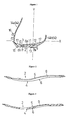
- Figure 1 is a cross sectional view of an embodiment of a left side cycling shoe sole core pertaining to the present invention.
- the left side in Figure 1 is the outside of a shoe for the left foot.
- the cycling shoe sole core 1 is made up of a first core 2 that forms the middle portion of the sole core 1, and a second core 3 that is joined on at least both side surfaces of the first core 2.
- the second core 3 is an injection molded article.
- the first core 2 is equipped with a fixing component for fixing a cleat.
- the cleat and its fixing component are not shown in the figure.
- the cleat fixing component is a concave component molded on the back of the first core 2.
- the upper and lower surfaces of the first core 2 are molded as curved surfaces 4 and 5.
- the curved line in a center cross section has an inflection point 6.
- the upper surface of the arch is molded such that it is concave below.
- Figure 4 shows the cleat attachment holes 7 that are used to attach the cleat.
- the first core 2 has a first core center component 8a that forms the center component, and left and right first core side components 8b.
- the first core side components 8b are molded integrally with the first core center component 8a.
- the left and right first core side components 8b are contiguous at the rear.
- the first core side components 8b that are contiguous at the rear go more or less all the way around.
- the first core center component 8a is formed thicker, while the first core side components 8b are formed thinner.
- the upper surface of the first core center component 8a and the upper surface of the first core side components 8b are a curved surface molded into a single contiguous surface.
- Bonding strength reinforcing holes 9 are made in a line in the first core side components 8b.
- Figure 3 is a cross section taken along the III-III line of Figure 4. As shown in Figure 3, the bonding strength reinforcing holes 9 go all the way through the upper and lower surfaces. The material of the second core 3 is injected into the bonding strength reinforcing holes 9 during the injection molding of the second core 3.
- the second core 3 is joined to the first core 2 such that it covers the first core 2 except for the center band on the lower surface of the first core 2.
- the second core 3 is molded from a second core covering component 11 that is joined to the upper surface of the first core 2 and covers the upper surface, and left and right second core side components 12 that are joined to the left and right side surfaces of the first core 2.
- the second core side components 12 are integrally joined to the side surfaces of the first core center component 8a, the side surfaces of the first core side components 8b, and the lower surface of the first core center component 8a.
- the second core side components 12 have a second core lower covering component 13 that cover from below a part of the lower surface of the first core 2.
- the second core side component 12 on the outside has a lower protrusion component 15 that sticks out to a position that is lower than the lower surface of the first core 2 .
- the second core side components 12 integrally include riser components 14 that curve upward and extend to the sides.
- the riser components 14 comprise an outside riser component or outside second core curved side component 14a, and an inside riser component or an inside second core curved side component 14b.
- the outside second core curved side component 14a rises up to a higher position than the inside second core curved side component 14b.
- the outside second core curved side component 14a has molded into it a reinforcing protrusion structure 16 that serves to reinforce the structure.
- Concave components 17 that serve to increase the bendability of the riser components 14 are provided at the boundaries between the riser components 14 and the second core side components 12.
- the first core 2 is molded from a relatively hard material, while the second core 3 is molded from a relatively soft material.
- the hard material used to produce the first core 2 may be a nylon resin containing glass fibers, and the soft material used to produce the second core 3 may be a nylon elastomer. More specifically, the material of the hard first core is nylon containing 30 to 50% glass, and its flexural modulus is 70,000 to 140,000 kg/cm 2 . Carbon can also be used, although the cost will be higher.
- the flexural modulus of the first core of a similar shoe currently being manufactured by the firm applying for the present invention should be approximately 25,000 to 50,000 kg/cm 2 .
- Favorable materials for the softer second core include polyurethane elastomers and nylon elastomers.
- the flexural modulus should be approximately 1000 to 3000 kg/cm 2 .
- Figure 5 shows the sole core 1 in which the second core 3 has been integrated with the first core 2 by injection molding, and is a side cross section viewed along the V-V line in Figure 6.
- Figure 6 is a bottom view.
- the second core 3 has molded into it a rearward extension component 22 that extends rearward and has a heel component 21, and a forward extension component 24 that extends forward and has a toe component 23.
- the heel component 21 and the toe component 23 are curved such that they are convex outwardly.
- a decorative hole 25 that provides ease of bending is made in the outside second core curved side component 14a.
- the second core 3 is provided with a cleat fastening hole 26 at a position corresponding to the cleat attachment holes 7.
- insertion holes 27 that are used to insert and fix spikes are made in the forward extension component 24.
- Figure 7 is an elevation of Figure 6, which is a bottom view.
- a strap fastening hole 28 that is used to fastening the end of the strap to the rearward extension component 22 is made to the rear of the reinforcing protrusion structure 16.
- a reinforcing molded band component 29 is provided in order to integrally connect the second core side components 12 on both sides of the second core 3 and structurally reinforce the second core side components 12.
- Figure 8 shows the state when the upper member has been stitched to the sole core 1 shown in Figures 5 through 7.
- a first upper member 31 is fastened by stitching to the upper edge of the inside second core curved side component 14b, and a second upper member 32 is fastened by stitching to the upper edge of the first upper member 31.
- a hole 33 that provides ease of bending is made in the first upper member 31.
- Figures 9 and 10 show the completed state of the cycling shoe in which the sole core 1 is used.
- the first upper member 31 and the second upper member 32 overlap from above the outside second core curved side component 14a.
- the outside second core curved side component 14a is tightened and held down by a plurality of partially overlapping straps 34 below the first upper member 31 and the second upper member 32.
- a surface-attaching fastener is attached at the portions where the straps overlap above and below.
- decorative members, a toe reinforcement member 36, and the like are fastened on by an adhesive or stitching.
- the bendability of the relatively flexible outside second core curved side component 14a is enhanced by the decorative hole 25.
- the bendability of the first upper member 31 is enhanced by the hole 33.
- the rigidity of the sole core 1 is primarily provided by the first core 2. This rigidity elastically permits relative inclination motion between the foot and the pedal.
- the second core covering component 11 is between the bottom of the foot and the first core 2, where it softens and attenuates impacts.
- the second core lower covering component 13 and the lower protrusion component 15 soften impacts during walking.
- the portion of the second core 3 that goes through the bonding strength reinforcing holes 9 strengthens the bond between the first core 2 and the second core 3.
- the outside second core curved side component 14a and the inside second core curved side component 14b are joined to the second core 3 and preserve rigidity, while they also are deformable and conform adsorptively to the foot.
- the concave components 17 enhance this deformability.
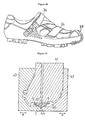
- Figure 11 illustrates a molding method and apparatus for molding the cycling shoe sole core pertaining to the present invention.
- Figure 11 illustrates a molding method and a mold apparatus thereof for the cycling shoe sole core 1 that is composed of a first core 2 equipped with a fixing component for fixing a cleat, and a second core 3 that is integrally joined to the left and right sides of the first core 2 and has second core curved side components that curve upward, and in which the material of the first core 2 is harder than that of the second core 3.
- the mold apparatus consists of a fixed side mold element 41 and two movable side mold elements 42 and 43. The movable side mold elements 42 and 43 move back and forth in the direction indicated by the arrow a.
- a plurality of protrusions 44 used for positioning are formed on the first core 2' produced in a previous step.
- the first core 2' has already been inserted into an injection molding mold apparatus. These protrusions 44 are removed upon completion of the step discussed below.
- the positioning holes into which the protrusions 44 are inserted are molded into the side mold elements 42 and 43.
- a cavity 46 is formed by the fixed side mold element 41, the movable side mold elements 42 and 43, and the first core 2'.
- the movable side mold element 42 and/or the movable side mold element 43 form the lower surface of the second core 3, and the movable side mold elements 42 and 43 form the outside curve surface of the left and right curved side components of the second core.
- the first core 2' forms a joining surface with the second core 3.
- the other joining surfaces shown in Figure 1 are formed by the first core 2'.
- a gate 47 is formed in the fixed side mold element 41.
- the molten resin material that is used to mold the second core 3 is injected from the gate 47 of the closed mold apparatus.
- the injected molten resin material exerts pressure on all surfaces except the lower surface of the first core 2', and infiltrates under pressure the bonding strength reinforcing holes 9 made in the first core 2'.
- the movable side mold elements 42 and 43 are separated in the direction of the arrow a. This separation is possible because of the flexibility of the second core 3.
- the sole core 1 is pulled or pushed out of the fixed side mold element 41, and the protrusions 44 are removed.
- the pushing rod is not shown.
- the first core 2 and the second core 3 are securely joined together by means of the melting heat. This joining is further strengthened by the presence of the bonding strength reinforcing holes 9.
- the mold apparatus can also comprise four or more parts rather than three.
Landscapes
- Engineering & Computer Science (AREA)
- Mechanical Engineering (AREA)
- Health & Medical Sciences (AREA)
- General Health & Medical Sciences (AREA)
- Physical Education & Sports Medicine (AREA)
- Footwear And Its Accessory, Manufacturing Method And Apparatuses (AREA)
- Injection Moulding Of Plastics Or The Like (AREA)
Applications Claiming Priority (3)
| Application Number | Priority Date | Filing Date | Title |
|---|---|---|---|
| JP8733696 | 1996-03-15 | ||
| JP87336/96 | 1996-03-15 | ||
| JP08733696A JP3199357B2 (ja) | 1996-03-15 | 1996-03-15 | サイクリングシューズの靴底芯体及びその成形方法並びにその型装置 |
Publications (3)
| Publication Number | Publication Date |
|---|---|
| EP0795280A2 true EP0795280A2 (fr) | 1997-09-17 |
| EP0795280A3 EP0795280A3 (fr) | 1998-04-22 |
| EP0795280B1 EP0795280B1 (fr) | 2005-09-14 |
Family
ID=13912036
Family Applications (1)
| Application Number | Title | Priority Date | Filing Date |
|---|---|---|---|
| EP19970301445 Expired - Lifetime EP0795280B1 (fr) | 1996-03-15 | 1997-03-04 | Noyau d'une chaussure de cyclisme, procédé et dispositif de moulage pour sa fabrication |
Country Status (5)
| Country | Link |
|---|---|
| EP (1) | EP0795280B1 (fr) |
| JP (1) | JP3199357B2 (fr) |
| CN (1) | CN1106170C (fr) |
| DE (1) | DE69734171T2 (fr) |
| TW (1) | TW327128B (fr) |
Cited By (18)
| Publication number | Priority date | Publication date | Assignee | Title |
|---|---|---|---|---|
| EP1442670A1 (fr) * | 2003-02-03 | 2004-08-04 | Shimano Inc. | Semelle de chaussure pour bicyclette |
| WO2005055754A1 (fr) * | 2003-11-26 | 2005-06-23 | Saucony, Inc. | Semelle intercalaire rapportee a grilles |
| WO2006048908A3 (fr) * | 2004-11-02 | 2006-07-27 | Novation S P A | Article a structure integree de materiau composite et de materiau thermoplastique ou elastomere, et procede de production |
| EP2312963A4 (fr) * | 2008-08-12 | 2013-08-28 | Myung Kye Jang | Méthode de fabrication d'une chaussure et d'une semelle intermédiaire utilisant une structure d'inserts à deux états |
| GB2518956A (en) * | 2012-07-06 | 2015-04-08 | Specialized Bicycle Components | Cycling shoe |
| EP3305352A1 (fr) * | 2011-12-07 | 2018-04-11 | Becton, Dickinson and Company | Dispositif d'infusion avec raccord de liquide amovible |
| US11020922B2 (en) * | 2018-07-27 | 2021-06-01 | Adidas Ag | Footwear with padding and midsole structures and the method of making the same |
| IT202000004162A1 (it) * | 2020-03-02 | 2021-09-02 | Eng Team | Suola assemblata con due elementi separati di diversi materiali per calzature sportive |
| USD974005S1 (en) | 2020-12-23 | 2023-01-03 | Specialized Bicycle Components, Inc. | Shoe |
| IT202100017591A1 (it) * | 2021-07-05 | 2023-01-05 | Securesì Srl | Suola assemblata con due elementi separati di diversi materiali per calzature sportive e relativo procedimento di assemblaggio |
| USD975970S1 (en) | 2020-12-23 | 2023-01-24 | Specialized Bicycle Components, Inc. | Shoe |
| USD975969S1 (en) | 2020-10-27 | 2023-01-24 | Specialized Bicycle Components, Inc. | Shoe |
| USD980609S1 (en) | 2020-07-31 | 2023-03-14 | Specialized Bicycle Components, Inc. | Bicycle shoe |
| USD1030260S1 (en) | 2021-09-27 | 2024-06-11 | Specialized Bicycle Components, Inc. | Shoe |
| USD1050685S1 (en) | 2021-10-15 | 2024-11-12 | Specialized Bicycle Components, Inc. | Shoe |
| USD1052853S1 (en) | 2021-12-06 | 2024-12-03 | Specialized Bicycle Components, Inc. | Shoe |
| USD1111324S1 (en) | 2023-07-10 | 2026-02-10 | Specialized Bicycle Components, Inc. | Shoe |
| USD1115230S1 (en) | 2023-07-10 | 2026-03-03 | Specialized Bicycle Components, Inc. | Shoe |
Families Citing this family (6)
| Publication number | Priority date | Publication date | Assignee | Title |
|---|---|---|---|---|
| US8173262B2 (en) | 2003-10-03 | 2012-05-08 | Daicel-Evonik Ltd. | Molded composite article, process for producing the same, and a joinable resin |
| JP4864349B2 (ja) * | 2005-05-30 | 2012-02-01 | 株式会社ハイドロストッパー | 氷結路面用耐滑材及びそれを用いた履物底 |
| JP5037185B2 (ja) * | 2007-03-15 | 2012-09-26 | ダンロップスポーツ株式会社 | スポーツ靴用インソール |
| IT1401244B1 (it) * | 2010-07-15 | 2013-07-12 | Selle Royal Spa | Struttura di calzatura da ciclismo dotata di una suola composita e metodo per realizzare tale struttura. |
| WO2021064987A1 (fr) * | 2019-10-04 | 2021-04-08 | 株式会社アシックス | Chaussure |
| USD975405S1 (en) | 2021-01-14 | 2023-01-17 | Specialized Bicycle Components, Inc. | Shoe |
Family Cites Families (7)
| Publication number | Priority date | Publication date | Assignee | Title |
|---|---|---|---|---|
| US3807062A (en) * | 1971-01-22 | 1974-04-30 | Karku Sport Ab | Athletic boot |
| FR2331297A1 (fr) * | 1975-11-13 | 1977-06-10 | Ours Rosette | Procede de fabrication de chaussures a tige haute et chaussures ainsi fabriquees |
| FR2405037A1 (fr) * | 1977-10-06 | 1979-05-04 | Pohu Georges | Procede de fabrication d'une semelle pour chaussure de cycliste et chaussure equipee d'une telle semelle |
| FR2555417B1 (fr) * | 1983-11-30 | 1986-10-24 | Delatour Pierre | Chaussure de sport |
| FR2653089B1 (fr) * | 1989-10-16 | 1994-04-08 | Jean Beyl | Dispositif de fixation d'une chaussure sur une pedale de bicyclette ou d'engin analogue, pedale de bicyclette, cale et semelle de chaussure pour un tel dispositif. |
| US5086576A (en) | 1990-05-29 | 1992-02-11 | Lamson Donald W | Bicycle shoe |
| JP3590141B2 (ja) * | 1995-06-23 | 2004-11-17 | 株式会社シマノ | サンダル |
-
1996
- 1996-03-15 JP JP08733696A patent/JP3199357B2/ja not_active Expired - Fee Related
- 1996-12-10 TW TW085115255A patent/TW327128B/zh active
-
1997
- 1997-03-04 DE DE1997634171 patent/DE69734171T2/de not_active Expired - Fee Related
- 1997-03-04 EP EP19970301445 patent/EP0795280B1/fr not_active Expired - Lifetime
- 1997-03-15 CN CN 97103072 patent/CN1106170C/zh not_active Expired - Fee Related
Cited By (28)
| Publication number | Priority date | Publication date | Assignee | Title |
|---|---|---|---|---|
| EP1442670A1 (fr) * | 2003-02-03 | 2004-08-04 | Shimano Inc. | Semelle de chaussure pour bicyclette |
| WO2005055754A1 (fr) * | 2003-11-26 | 2005-06-23 | Saucony, Inc. | Semelle intercalaire rapportee a grilles |
| US7207125B2 (en) | 2003-11-26 | 2007-04-24 | Saucony, Inc. | Grid midsole insert |
| WO2006048908A3 (fr) * | 2004-11-02 | 2006-07-27 | Novation S P A | Article a structure integree de materiau composite et de materiau thermoplastique ou elastomere, et procede de production |
| EP2312963A4 (fr) * | 2008-08-12 | 2013-08-28 | Myung Kye Jang | Méthode de fabrication d'une chaussure et d'une semelle intermédiaire utilisant une structure d'inserts à deux états |
| US10342967B2 (en) | 2011-12-07 | 2019-07-09 | Becton, Dickinson And Company | Infusion device with releasable fluid connector |
| US10792487B2 (en) | 2011-12-07 | 2020-10-06 | Becton, Dickinson And Company | Method of manufacturing a base element of a medicament delivery device |
| EP3305352A1 (fr) * | 2011-12-07 | 2018-04-11 | Becton, Dickinson and Company | Dispositif d'infusion avec raccord de liquide amovible |
| US10758721B2 (en) | 2011-12-07 | 2020-09-01 | Becton, Dickinson And Company | Infusion device with releasable fluid connector |
| US11291266B2 (en) | 2012-07-06 | 2022-04-05 | Specialized Bicycle Components, Inc. | Cycling shoe |
| US10206451B2 (en) | 2012-07-06 | 2019-02-19 | Specialized Bicycle Components, Inc. | Cycling shoe |
| GB2518956B (en) * | 2012-07-06 | 2015-12-09 | Specialized Bicycle Components | Cycling shoe |
| GB2518956A (en) * | 2012-07-06 | 2015-04-08 | Specialized Bicycle Components | Cycling shoe |
| US11020922B2 (en) * | 2018-07-27 | 2021-06-01 | Adidas Ag | Footwear with padding and midsole structures and the method of making the same |
| IT202000004162A1 (it) * | 2020-03-02 | 2021-09-02 | Eng Team | Suola assemblata con due elementi separati di diversi materiali per calzature sportive |
| USD980609S1 (en) | 2020-07-31 | 2023-03-14 | Specialized Bicycle Components, Inc. | Bicycle shoe |
| USD975969S1 (en) | 2020-10-27 | 2023-01-24 | Specialized Bicycle Components, Inc. | Shoe |
| USD1108097S1 (en) | 2020-10-27 | 2026-01-06 | Specialized Bicycle Components, Inc. | Pair of shoes |
| USD975970S1 (en) | 2020-12-23 | 2023-01-24 | Specialized Bicycle Components, Inc. | Shoe |
| USD974005S1 (en) | 2020-12-23 | 2023-01-03 | Specialized Bicycle Components, Inc. | Shoe |
| USD1076352S1 (en) | 2020-12-23 | 2025-05-27 | Specialized Bicycle Components, Inc. | Shoe |
| IT202100017591A1 (it) * | 2021-07-05 | 2023-01-05 | Securesì Srl | Suola assemblata con due elementi separati di diversi materiali per calzature sportive e relativo procedimento di assemblaggio |
| USD1030260S1 (en) | 2021-09-27 | 2024-06-11 | Specialized Bicycle Components, Inc. | Shoe |
| USD1050685S1 (en) | 2021-10-15 | 2024-11-12 | Specialized Bicycle Components, Inc. | Shoe |
| USD1109499S1 (en) | 2021-10-15 | 2026-01-20 | Specialized Bicycle Components, Inc. | Shoe |
| USD1052853S1 (en) | 2021-12-06 | 2024-12-03 | Specialized Bicycle Components, Inc. | Shoe |
| USD1111324S1 (en) | 2023-07-10 | 2026-02-10 | Specialized Bicycle Components, Inc. | Shoe |
| USD1115230S1 (en) | 2023-07-10 | 2026-03-03 | Specialized Bicycle Components, Inc. | Shoe |
Also Published As
| Publication number | Publication date |
|---|---|
| EP0795280B1 (fr) | 2005-09-14 |
| EP0795280A3 (fr) | 1998-04-22 |
| TW327128B (en) | 1998-02-21 |
| CN1163082A (zh) | 1997-10-29 |
| JP3199357B2 (ja) | 2001-08-20 |
| DE69734171D1 (de) | 2005-10-20 |
| CN1106170C (zh) | 2003-04-23 |
| DE69734171T2 (de) | 2006-06-29 |
| JPH09248201A (ja) | 1997-09-22 |
Similar Documents
| Publication | Publication Date | Title |
|---|---|---|
| EP0795280B1 (fr) | Noyau d'une chaussure de cyclisme, procédé et dispositif de moulage pour sa fabrication | |
| US12179087B2 (en) | Skate with injected boot form | |
| EP0726037B1 (fr) | Chaussures de cyclisme | |
| JP4790650B2 (ja) | シューズ | |
| KR0184709B1 (ko) | 스노우보딩용 부츠 | |
| EP0117372B1 (fr) | Chaussure de patinage composite, et procédé pour former celle-ci | |
| AU779654B2 (en) | Sole in the form of a midsole, inner sole or insertable sole for a shoe and a shoe with said sole | |
| US5875566A (en) | Boot and process for assembling a boot | |
| CN102548443A (zh) | 具有加强件的热成型鞋面工艺 | |
| US20030233771A1 (en) | Shoe upper and methods of manufacture | |
| CZ288092B6 (cs) | Podešev sportovní boty | |
| JP2000296001A (ja) | スポーツ用シューズのソール構造 | |
| US5761835A (en) | Snowboard boot | |
| CA3014387A1 (fr) | Patin ou autres chaussures | |
| US4266314A (en) | Method of manufacture of sports shoes, and shoes manufactured by said method | |
| US20080209767A1 (en) | Systems and methods for shoe construction | |
| US4793077A (en) | Article of athletic footwear, especially a ski boot | |
| JP4308429B2 (ja) | サンダル | |
| CN114617333A (zh) | 鞋类物品 | |
| EP1809463B1 (fr) | Article a structure integree de materiau composite et de materiau thermoplastique ou elastomere, et procede de production | |
| US20230123179A1 (en) | Figure Skating Boot with Flexing Upper Cuff | |
| WO2003005845A1 (fr) | Procede de fabrication d'une chaussure de sport a crampons et chaussure obtenue | |
| JP2793981B2 (ja) | ヒールカップつきスノーボードブーツ | |
| JP4766411B2 (ja) | 履物、その製造方法及びこれに用いる中底 | |
| JPH064723Y2 (ja) | 靴 底 |
Legal Events
| Date | Code | Title | Description |
|---|---|---|---|
| PUAI | Public reference made under article 153(3) epc to a published international application that has entered the european phase |
Free format text: ORIGINAL CODE: 0009012 |
|
| 17P | Request for examination filed |
Effective date: 19970321 |
|
| AK | Designated contracting states |
Kind code of ref document: A2 Designated state(s): DE FR IT |
|
| PUAL | Search report despatched |
Free format text: ORIGINAL CODE: 0009013 |
|
| AK | Designated contracting states |
Kind code of ref document: A3 Designated state(s): DE FR IT |
|
| 17Q | First examination report despatched |
Effective date: 20000929 |
|
| GRAP | Despatch of communication of intention to grant a patent |
Free format text: ORIGINAL CODE: EPIDOSNIGR1 |
|
| GRAS | Grant fee paid |
Free format text: ORIGINAL CODE: EPIDOSNIGR3 |
|
| GRAA | (expected) grant |
Free format text: ORIGINAL CODE: 0009210 |
|
| AK | Designated contracting states |
Kind code of ref document: B1 Designated state(s): DE FR IT |
|
| REF | Corresponds to: |
Ref document number: 69734171 Country of ref document: DE Date of ref document: 20051020 Kind code of ref document: P |
|
| PGFP | Annual fee paid to national office [announced via postgrant information from national office to epo] |
Ref country code: FR Payment date: 20060216 Year of fee payment: 10 |
|
| PGFP | Annual fee paid to national office [announced via postgrant information from national office to epo] |
Ref country code: DE Payment date: 20060330 Year of fee payment: 10 |
|
| PGFP | Annual fee paid to national office [announced via postgrant information from national office to epo] |
Ref country code: IT Payment date: 20060331 Year of fee payment: 10 |
|
| ET | Fr: translation filed | ||
| PLBE | No opposition filed within time limit |
Free format text: ORIGINAL CODE: 0009261 |
|
| STAA | Information on the status of an ep patent application or granted ep patent |
Free format text: STATUS: NO OPPOSITION FILED WITHIN TIME LIMIT |
|
| RAP2 | Party data changed (patent owner data changed or rights of a patent transferred) |
Owner name: SHIMANO INC. |
|
| 26N | No opposition filed |
Effective date: 20060615 |
|
| REG | Reference to a national code |
Ref country code: FR Ref legal event code: ST Effective date: 20071130 |
|
| PG25 | Lapsed in a contracting state [announced via postgrant information from national office to epo] |
Ref country code: DE Free format text: LAPSE BECAUSE OF NON-PAYMENT OF DUE FEES Effective date: 20071002 |
|
| PG25 | Lapsed in a contracting state [announced via postgrant information from national office to epo] |
Ref country code: FR Free format text: LAPSE BECAUSE OF NON-PAYMENT OF DUE FEES Effective date: 20070402 |
|
| PG25 | Lapsed in a contracting state [announced via postgrant information from national office to epo] |
Ref country code: IT Free format text: LAPSE BECAUSE OF NON-PAYMENT OF DUE FEES Effective date: 20070304 |