EP0795563B1 - Thermosensibilisierbarer Latex - Google Patents
Thermosensibilisierbarer Latex Download PDFInfo
- Publication number
- EP0795563B1 EP0795563B1 EP97103567A EP97103567A EP0795563B1 EP 0795563 B1 EP0795563 B1 EP 0795563B1 EP 97103567 A EP97103567 A EP 97103567A EP 97103567 A EP97103567 A EP 97103567A EP 0795563 B1 EP0795563 B1 EP 0795563B1
- Authority
- EP
- European Patent Office
- Prior art keywords
- monomaleate
- latex
- phm
- range
- integer
- Prior art date
- Legal status (The legal status is an assumption and is not a legal conclusion. Google has not performed a legal analysis and makes no representation as to the accuracy of the status listed.)
- Expired - Lifetime
Links
- 229920000126 latex Polymers 0.000 title claims description 73
- 239000004816 latex Substances 0.000 title claims description 67
- 239000000178 monomer Substances 0.000 claims description 45
- 125000000217 alkyl group Chemical group 0.000 claims description 28
- -1 polysiloxane Polymers 0.000 claims description 28
- 238000006116 polymerization reaction Methods 0.000 claims description 26
- 239000003995 emulsifying agent Substances 0.000 claims description 16
- 229920001296 polysiloxane Polymers 0.000 claims description 16
- XLYOFNOQVPJJNP-UHFFFAOYSA-N water Substances O XLYOFNOQVPJJNP-UHFFFAOYSA-N 0.000 claims description 16
- 239000000203 mixture Substances 0.000 claims description 14
- 229920001971 elastomer Polymers 0.000 claims description 10
- 238000000034 method Methods 0.000 claims description 10
- 239000007787 solid Substances 0.000 claims description 9
- 150000001993 dienes Chemical class 0.000 claims description 8
- 229920000459 Nitrile rubber Polymers 0.000 claims description 3
- 230000000379 polymerizing effect Effects 0.000 claims description 3
- 239000000945 filler Substances 0.000 claims description 2
- 238000004519 manufacturing process Methods 0.000 claims description 2
- 238000010526 radical polymerization reaction Methods 0.000 claims description 2
- 239000004745 nonwoven fabric Substances 0.000 description 16
- 150000003254 radicals Chemical class 0.000 description 9
- 229920002554 vinyl polymer Polymers 0.000 description 8
- NIXOWILDQLNWCW-UHFFFAOYSA-N 2-Propenoic acid Natural products OC(=O)C=C NIXOWILDQLNWCW-UHFFFAOYSA-N 0.000 description 7
- 238000002474 experimental method Methods 0.000 description 7
- 239000003999 initiator Substances 0.000 description 7
- KAKZBPTYRLMSJV-UHFFFAOYSA-N Butadiene Chemical compound C=CC=C KAKZBPTYRLMSJV-UHFFFAOYSA-N 0.000 description 6
- 125000004432 carbon atom Chemical group C* 0.000 description 6
- 238000006243 chemical reaction Methods 0.000 description 6
- 230000015271 coagulation Effects 0.000 description 6
- 238000005345 coagulation Methods 0.000 description 6
- 238000003756 stirring Methods 0.000 description 5
- 241000408710 Hansa Species 0.000 description 4
- PPBRXRYQALVLMV-UHFFFAOYSA-N Styrene Chemical compound C=CC1=CC=CC=C1 PPBRXRYQALVLMV-UHFFFAOYSA-N 0.000 description 4
- 239000011230 binding agent Substances 0.000 description 4
- CQEYYJKEWSMYFG-UHFFFAOYSA-N butyl acrylate Chemical compound CCCCOC(=O)C=C CQEYYJKEWSMYFG-UHFFFAOYSA-N 0.000 description 4
- 125000003178 carboxy group Chemical group [H]OC(*)=O 0.000 description 4
- 238000007720 emulsion polymerization reaction Methods 0.000 description 4
- 229920000642 polymer Polymers 0.000 description 4
- 239000000126 substance Substances 0.000 description 4
- IEQAICDLOKRSRL-UHFFFAOYSA-N 2-[2-[2-[2-[2-[2-[2-[2-[2-[2-[2-[2-[2-[2-[2-[2-[2-[2-[2-[2-[2-[2-(2-dodecoxyethoxy)ethoxy]ethoxy]ethoxy]ethoxy]ethoxy]ethoxy]ethoxy]ethoxy]ethoxy]ethoxy]ethoxy]ethoxy]ethoxy]ethoxy]ethoxy]ethoxy]ethoxy]ethoxy]ethoxy]ethoxy]ethoxy]ethanol Chemical compound CCCCCCCCCCCCOCCOCCOCCOCCOCCOCCOCCOCCOCCOCCOCCOCCOCCOCCOCCOCCOCCOCCOCCOCCOCCOCCOCCO IEQAICDLOKRSRL-UHFFFAOYSA-N 0.000 description 3
- KWYUFKZDYYNOTN-UHFFFAOYSA-M Potassium hydroxide Chemical compound [OH-].[K+] KWYUFKZDYYNOTN-UHFFFAOYSA-M 0.000 description 3
- 239000012874 anionic emulsifier Substances 0.000 description 3
- 239000003795 chemical substances by application Substances 0.000 description 3
- 239000000701 coagulant Substances 0.000 description 3
- 230000000052 comparative effect Effects 0.000 description 3
- 125000002496 methyl group Chemical group [H]C([H])([H])* 0.000 description 3
- 239000012875 nonionic emulsifier Substances 0.000 description 3
- USHAGKDGDHPEEY-UHFFFAOYSA-L potassium persulfate Chemical compound [K+].[K+].[O-]S(=O)(=O)OOS([O-])(=O)=O USHAGKDGDHPEEY-UHFFFAOYSA-L 0.000 description 3
- NLHHRLWOUZZQLW-UHFFFAOYSA-N Acrylonitrile Chemical compound C=CC#N NLHHRLWOUZZQLW-UHFFFAOYSA-N 0.000 description 2
- QGZKDVFQNNGYKY-UHFFFAOYSA-N Ammonia Chemical compound N QGZKDVFQNNGYKY-UHFFFAOYSA-N 0.000 description 2
- SOGAXMICEFXMKE-UHFFFAOYSA-N Butylmethacrylate Chemical compound CCCCOC(=O)C(C)=C SOGAXMICEFXMKE-UHFFFAOYSA-N 0.000 description 2
- LFQSCWFLJHTTHZ-UHFFFAOYSA-N Ethanol Chemical compound CCO LFQSCWFLJHTTHZ-UHFFFAOYSA-N 0.000 description 2
- XLYMOEINVGRTEX-ARJAWSKDSA-N Ethyl hydrogen fumarate Chemical compound CCOC(=O)\C=C/C(O)=O XLYMOEINVGRTEX-ARJAWSKDSA-N 0.000 description 2
- MHAJPDPJQMAIIY-UHFFFAOYSA-N Hydrogen peroxide Chemical compound OO MHAJPDPJQMAIIY-UHFFFAOYSA-N 0.000 description 2
- RRHGJUQNOFWUDK-UHFFFAOYSA-N Isoprene Chemical compound CC(=C)C=C RRHGJUQNOFWUDK-UHFFFAOYSA-N 0.000 description 2
- BAPJBEWLBFYGME-UHFFFAOYSA-N Methyl acrylate Chemical compound COC(=O)C=C BAPJBEWLBFYGME-UHFFFAOYSA-N 0.000 description 2
- GSEJCLTVZPLZKY-UHFFFAOYSA-N Triethanolamine Chemical compound OCCN(CCO)CCO GSEJCLTVZPLZKY-UHFFFAOYSA-N 0.000 description 2
- YRKCREAYFQTBPV-UHFFFAOYSA-N acetylacetone Chemical compound CC(=O)CC(C)=O YRKCREAYFQTBPV-UHFFFAOYSA-N 0.000 description 2
- 150000001298 alcohols Chemical class 0.000 description 2
- ROOXNKNUYICQNP-UHFFFAOYSA-N ammonium peroxydisulfate Substances [NH4+].[NH4+].[O-]S(=O)(=O)OOS([O-])(=O)=O ROOXNKNUYICQNP-UHFFFAOYSA-N 0.000 description 2
- VAZSKTXWXKYQJF-UHFFFAOYSA-N ammonium persulfate Chemical compound [NH4+].[NH4+].[O-]S(=O)OOS([O-])=O VAZSKTXWXKYQJF-UHFFFAOYSA-N 0.000 description 2
- 229910001870 ammonium persulfate Inorganic materials 0.000 description 2
- 150000001875 compounds Chemical class 0.000 description 2
- 230000007423 decrease Effects 0.000 description 2
- 230000003247 decreasing effect Effects 0.000 description 2
- 239000006185 dispersion Substances 0.000 description 2
- 239000011521 glass Substances 0.000 description 2
- FPYJFEHAWHCUMM-UHFFFAOYSA-N maleic anhydride Chemical compound O=C1OC(=O)C=C1 FPYJFEHAWHCUMM-UHFFFAOYSA-N 0.000 description 2
- 238000013021 overheating Methods 0.000 description 2
- JRKICGRDRMAZLK-UHFFFAOYSA-L peroxydisulfate Chemical compound [O-]S(=O)(=O)OOS([O-])(=O)=O JRKICGRDRMAZLK-UHFFFAOYSA-L 0.000 description 2
- 230000001235 sensitizing effect Effects 0.000 description 2
- WRXCBRHBHGNNQA-UHFFFAOYSA-N (2,4-dichlorobenzoyl) 2,4-dichlorobenzenecarboperoxoate Chemical compound ClC1=CC(Cl)=CC=C1C(=O)OOC(=O)C1=CC=C(Cl)C=C1Cl WRXCBRHBHGNNQA-UHFFFAOYSA-N 0.000 description 1
- QEQBMZQFDDDTPN-UHFFFAOYSA-N (2-methylpropan-2-yl)oxy benzenecarboperoxoate Chemical compound CC(C)(C)OOOC(=O)C1=CC=CC=C1 QEQBMZQFDDDTPN-UHFFFAOYSA-N 0.000 description 1
- XCDCTFPGEHOHEQ-HWKANZROSA-N (E)-2-(3-oxobutanoyloxy)but-2-enedioic acid Chemical compound CC(=O)CC(=O)O\C(C(O)=O)=C\C(O)=O XCDCTFPGEHOHEQ-HWKANZROSA-N 0.000 description 1
- BLKRGXCGFRXRNQ-SNAWJCMRSA-N (z)-3-carbonoperoxoyl-4,4-dimethylpent-2-enoic acid Chemical compound OC(=O)/C=C(C(C)(C)C)\C(=O)OO BLKRGXCGFRXRNQ-SNAWJCMRSA-N 0.000 description 1
- HSLFISVKRDQEBY-UHFFFAOYSA-N 1,1-bis(tert-butylperoxy)cyclohexane Chemical compound CC(C)(C)OOC1(OOC(C)(C)C)CCCCC1 HSLFISVKRDQEBY-UHFFFAOYSA-N 0.000 description 1
- XSZYESUNPWGWFQ-UHFFFAOYSA-N 1-(2-hydroperoxypropan-2-yl)-4-methylcyclohexane Chemical compound CC1CCC(C(C)(C)OO)CC1 XSZYESUNPWGWFQ-UHFFFAOYSA-N 0.000 description 1
- UXKQGJYFPNFUJY-UHFFFAOYSA-N 1-(2-methylbutan-2-yldiazenyl)cyclohexane-1-carbonitrile Chemical compound CCC(C)(C)N=NC1(C#N)CCCCC1 UXKQGJYFPNFUJY-UHFFFAOYSA-N 0.000 description 1
- VDNSZPNSUQRUMS-UHFFFAOYSA-N 1-cyclohexyl-4-ethenylbenzene Chemical compound C1=CC(C=C)=CC=C1C1CCCCC1 VDNSZPNSUQRUMS-UHFFFAOYSA-N 0.000 description 1
- WJNKJKGZKFOLOJ-UHFFFAOYSA-N 1-dodecyl-4-ethenylbenzene Chemical compound CCCCCCCCCCCCC1=CC=C(C=C)C=C1 WJNKJKGZKFOLOJ-UHFFFAOYSA-N 0.000 description 1
- LGJCFVYMIJLQJO-UHFFFAOYSA-N 1-dodecylperoxydodecane Chemical compound CCCCCCCCCCCCOOCCCCCCCCCCCC LGJCFVYMIJLQJO-UHFFFAOYSA-N 0.000 description 1
- JZHGRUMIRATHIU-UHFFFAOYSA-N 1-ethenyl-3-methylbenzene Chemical compound CC1=CC=CC(C=C)=C1 JZHGRUMIRATHIU-UHFFFAOYSA-N 0.000 description 1
- JHTICDZLXFNVKL-UHFFFAOYSA-N 1-ethenyl-4-(4-phenylbutyl)benzene Chemical compound C1=CC(C=C)=CC=C1CCCCC1=CC=CC=C1 JHTICDZLXFNVKL-UHFFFAOYSA-N 0.000 description 1
- VVTGQMLRTKFKAM-UHFFFAOYSA-N 1-ethenyl-4-propylbenzene Chemical compound CCCC1=CC=C(C=C)C=C1 VVTGQMLRTKFKAM-UHFFFAOYSA-N 0.000 description 1
- HQOVXPHOJANJBR-UHFFFAOYSA-N 2,2-bis(tert-butylperoxy)butane Chemical compound CC(C)(C)OOC(C)(CC)OOC(C)(C)C HQOVXPHOJANJBR-UHFFFAOYSA-N 0.000 description 1
- OZAIFHULBGXAKX-UHFFFAOYSA-N 2-(2-cyanopropan-2-yldiazenyl)-2-methylpropanenitrile Chemical compound N#CC(C)(C)N=NC(C)(C)C#N OZAIFHULBGXAKX-UHFFFAOYSA-N 0.000 description 1
- XMNIXWIUMCBBBL-UHFFFAOYSA-N 2-(2-phenylpropan-2-ylperoxy)propan-2-ylbenzene Chemical compound C=1C=CC=CC=1C(C)(C)OOC(C)(C)C1=CC=CC=C1 XMNIXWIUMCBBBL-UHFFFAOYSA-N 0.000 description 1
- PYKCEDJHRUUDRK-UHFFFAOYSA-N 2-(tert-butyldiazenyl)-2-methylpropanenitrile Chemical compound CC(C)(C)N=NC(C)(C)C#N PYKCEDJHRUUDRK-UHFFFAOYSA-N 0.000 description 1
- WGUWOLAXPCRPKH-UHFFFAOYSA-N 2-(tert-butyldiazenyl)cyclohexane-1-carbonitrile Chemical compound CC(C)(C)N=NC1CCCCC1C#N WGUWOLAXPCRPKH-UHFFFAOYSA-N 0.000 description 1
- DXIJHCSGLOHNES-UHFFFAOYSA-N 3,3-dimethylbut-1-enylbenzene Chemical compound CC(C)(C)C=CC1=CC=CC=C1 DXIJHCSGLOHNES-UHFFFAOYSA-N 0.000 description 1
- FRIBMENBGGCKPD-UHFFFAOYSA-N 3-(2,3-dimethoxyphenyl)prop-2-enal Chemical compound COC1=CC=CC(C=CC=O)=C1OC FRIBMENBGGCKPD-UHFFFAOYSA-N 0.000 description 1
- DXFURPHVJQITAC-UHFFFAOYSA-N 4-benzyl-1-ethenyl-2-ethylbenzene Chemical compound C1=C(C=C)C(CC)=CC(CC=2C=CC=CC=2)=C1 DXFURPHVJQITAC-UHFFFAOYSA-N 0.000 description 1
- 239000004342 Benzoyl peroxide Substances 0.000 description 1
- OMPJBNCRMGITSC-UHFFFAOYSA-N Benzoylperoxide Chemical compound C=1C=CC=CC=1C(=O)OOC(=O)C1=CC=CC=C1 OMPJBNCRMGITSC-UHFFFAOYSA-N 0.000 description 1
- 229920000742 Cotton Polymers 0.000 description 1
- JIGUQPWFLRLWPJ-UHFFFAOYSA-N Ethyl acrylate Chemical compound CCOC(=O)C=C JIGUQPWFLRLWPJ-UHFFFAOYSA-N 0.000 description 1
- DGAQECJNVWCQMB-PUAWFVPOSA-M Ilexoside XXIX Chemical compound C[C@@H]1CC[C@@]2(CC[C@@]3(C(=CC[C@H]4[C@]3(CC[C@@H]5[C@@]4(CC[C@@H](C5(C)C)OS(=O)(=O)[O-])C)C)[C@@H]2[C@]1(C)O)C)C(=O)O[C@H]6[C@@H]([C@H]([C@@H]([C@H](O6)CO)O)O)O.[Na+] DGAQECJNVWCQMB-PUAWFVPOSA-M 0.000 description 1
- VVQNEPGJFQJSBK-UHFFFAOYSA-N Methyl methacrylate Chemical compound COC(=O)C(C)=C VVQNEPGJFQJSBK-UHFFFAOYSA-N 0.000 description 1
- 229920003171 Poly (ethylene oxide) Polymers 0.000 description 1
- 239000004698 Polyethylene Substances 0.000 description 1
- 239000004743 Polypropylene Substances 0.000 description 1
- WPMWEFXCIYCJSA-UHFFFAOYSA-N Tetraethylene glycol monododecyl ether Chemical compound CCCCCCCCCCCCOCCOCCOCCOCCO WPMWEFXCIYCJSA-UHFFFAOYSA-N 0.000 description 1
- XLOMVQKBTHCTTD-UHFFFAOYSA-N Zinc monoxide Chemical compound [Zn]=O XLOMVQKBTHCTTD-UHFFFAOYSA-N 0.000 description 1
- 239000000011 acetone peroxide Substances 0.000 description 1
- 235000019401 acetone peroxide Nutrition 0.000 description 1
- 239000013543 active substance Substances 0.000 description 1
- 229910021529 ammonia Inorganic materials 0.000 description 1
- 125000000129 anionic group Chemical group 0.000 description 1
- 239000008346 aqueous phase Substances 0.000 description 1
- 235000019400 benzoyl peroxide Nutrition 0.000 description 1
- 239000013043 chemical agent Substances 0.000 description 1
- 238000013329 compounding Methods 0.000 description 1
- BSVQJWUUZCXSOL-UHFFFAOYSA-N cyclohexylsulfonyl ethaneperoxoate Chemical compound CC(=O)OOS(=O)(=O)C1CCCCC1 BSVQJWUUZCXSOL-UHFFFAOYSA-N 0.000 description 1
- XJOBOFWTZOKMOH-UHFFFAOYSA-N decanoyl decaneperoxoate Chemical compound CCCCCCCCCC(=O)OOC(=O)CCCCCCCCC XJOBOFWTZOKMOH-UHFFFAOYSA-N 0.000 description 1
- LSXWFXONGKSEMY-UHFFFAOYSA-N di-tert-butyl peroxide Chemical compound CC(C)(C)OOC(C)(C)C LSXWFXONGKSEMY-UHFFFAOYSA-N 0.000 description 1
- 239000000839 emulsion Substances 0.000 description 1
- SUPCQIBBMFXVTL-UHFFFAOYSA-N ethyl 2-methylprop-2-enoate Chemical compound CCOC(=O)C(C)=C SUPCQIBBMFXVTL-UHFFFAOYSA-N 0.000 description 1
- HARQWLDROVMFJE-UHFFFAOYSA-N ethyl 3,3-bis(tert-butylperoxy)butanoate Chemical compound CCOC(=O)CC(C)(OOC(C)(C)C)OOC(C)(C)C HARQWLDROVMFJE-UHFFFAOYSA-N 0.000 description 1
- 230000009477 glass transition Effects 0.000 description 1
- 238000010438 heat treatment Methods 0.000 description 1
- QWVBGCWRHHXMRM-UHFFFAOYSA-N hexadecoxycarbonyloxy hexadecyl carbonate Chemical compound CCCCCCCCCCCCCCCCOC(=O)OOC(=O)OCCCCCCCCCCCCCCCC QWVBGCWRHHXMRM-UHFFFAOYSA-N 0.000 description 1
- 125000004435 hydrogen atom Chemical group [H]* 0.000 description 1
- 239000004615 ingredient Substances 0.000 description 1
- 239000000463 material Substances 0.000 description 1
- 229910052751 metal Inorganic materials 0.000 description 1
- 239000002184 metal Substances 0.000 description 1
- ZQMHJBXHRFJKOT-UHFFFAOYSA-N methyl 2-[(1-methoxy-2-methyl-1-oxopropan-2-yl)diazenyl]-2-methylpropanoate Chemical compound COC(=O)C(C)(C)N=NC(C)(C)C(=O)OC ZQMHJBXHRFJKOT-UHFFFAOYSA-N 0.000 description 1
- 238000012986 modification Methods 0.000 description 1
- 230000004048 modification Effects 0.000 description 1
- PSZYNBSKGUBXEH-UHFFFAOYSA-M naphthalene-1-sulfonate Chemical compound C1=CC=C2C(S(=O)(=O)[O-])=CC=CC2=C1 PSZYNBSKGUBXEH-UHFFFAOYSA-M 0.000 description 1
- 239000012188 paraffin wax Substances 0.000 description 1
- 239000002245 particle Substances 0.000 description 1
- PNJWIWWMYCMZRO-UHFFFAOYSA-N pent‐4‐en‐2‐one Natural products CC(=O)CC=C PNJWIWWMYCMZRO-UHFFFAOYSA-N 0.000 description 1
- 230000000704 physical effect Effects 0.000 description 1
- 239000000049 pigment Substances 0.000 description 1
- 229920000728 polyester Polymers 0.000 description 1
- 229920000573 polyethylene Polymers 0.000 description 1
- 229920006324 polyoxymethylene Polymers 0.000 description 1
- 229920001155 polypropylene Polymers 0.000 description 1
- 230000002035 prolonged effect Effects 0.000 description 1
- LYBIZMNPXTXVMV-UHFFFAOYSA-N propan-2-yl prop-2-enoate Chemical compound CC(C)OC(=O)C=C LYBIZMNPXTXVMV-UHFFFAOYSA-N 0.000 description 1
- NHARPDSAXCBDDR-UHFFFAOYSA-N propyl 2-methylprop-2-enoate Chemical compound CCCOC(=O)C(C)=C NHARPDSAXCBDDR-UHFFFAOYSA-N 0.000 description 1
- PNXMTCDJUBJHQJ-UHFFFAOYSA-N propyl prop-2-enoate Chemical compound CCCOC(=O)C=C PNXMTCDJUBJHQJ-UHFFFAOYSA-N 0.000 description 1
- 230000005855 radiation Effects 0.000 description 1
- 239000011541 reaction mixture Substances 0.000 description 1
- 229920006395 saturated elastomer Polymers 0.000 description 1
- 229910052708 sodium Inorganic materials 0.000 description 1
- 239000011734 sodium Substances 0.000 description 1
- 229910001220 stainless steel Inorganic materials 0.000 description 1
- 239000010935 stainless steel Substances 0.000 description 1
- 238000003860 storage Methods 0.000 description 1
- BDHFUVZGWQCTTF-UHFFFAOYSA-M sulfonate Chemical compound [O-]S(=O)=O BDHFUVZGWQCTTF-UHFFFAOYSA-M 0.000 description 1
- SWAXTRYEYUTSAP-UHFFFAOYSA-N tert-butyl ethaneperoxoate Chemical compound CC(=O)OOC(C)(C)C SWAXTRYEYUTSAP-UHFFFAOYSA-N 0.000 description 1
- CIHOLLKRGTVIJN-UHFFFAOYSA-N tert‐butyl hydroperoxide Chemical compound CC(C)(C)OO CIHOLLKRGTVIJN-UHFFFAOYSA-N 0.000 description 1
- 239000002562 thickening agent Substances 0.000 description 1
- 210000002268 wool Anatomy 0.000 description 1
Classifications
-
- C—CHEMISTRY; METALLURGY
- C08—ORGANIC MACROMOLECULAR COMPOUNDS; THEIR PREPARATION OR CHEMICAL WORKING-UP; COMPOSITIONS BASED THEREON
- C08L—COMPOSITIONS OF MACROMOLECULAR COMPOUNDS
- C08L23/00—Compositions of homopolymers or copolymers of unsaturated aliphatic hydrocarbons having only one carbon-to-carbon double bond; Compositions of derivatives of such polymers
- C08L23/02—Compositions of homopolymers or copolymers of unsaturated aliphatic hydrocarbons having only one carbon-to-carbon double bond; Compositions of derivatives of such polymers not modified by chemical after-treatment
- C08L23/04—Homopolymers or copolymers of ethene
- C08L23/08—Copolymers of ethene
- C08L23/0846—Copolymers of ethene with unsaturated hydrocarbons containing atoms other than carbon or hydrogen
- C08L23/0869—Copolymers of ethene with unsaturated hydrocarbons containing atoms other than carbon or hydrogen with unsaturated acids, e.g. [meth]acrylic acid; with unsaturated esters, e.g. [meth]acrylic acid esters
-
- C—CHEMISTRY; METALLURGY
- C08—ORGANIC MACROMOLECULAR COMPOUNDS; THEIR PREPARATION OR CHEMICAL WORKING-UP; COMPOSITIONS BASED THEREON
- C08C—TREATMENT OR CHEMICAL MODIFICATION OF RUBBERS
- C08C1/00—Treatment of rubber latex
- C08C1/14—Coagulation
- C08C1/145—Heat-sensitising agents
-
- C—CHEMISTRY; METALLURGY
- C08—ORGANIC MACROMOLECULAR COMPOUNDS; THEIR PREPARATION OR CHEMICAL WORKING-UP; COMPOSITIONS BASED THEREON
- C08F—MACROMOLECULAR COMPOUNDS OBTAINED BY REACTIONS ONLY INVOLVING CARBON-TO-CARBON UNSATURATED BONDS
- C08F2/00—Processes of polymerisation
- C08F2/12—Polymerisation in non-solvents
- C08F2/16—Aqueous medium
- C08F2/22—Emulsion polymerisation
-
- C—CHEMISTRY; METALLURGY
- C08—ORGANIC MACROMOLECULAR COMPOUNDS; THEIR PREPARATION OR CHEMICAL WORKING-UP; COMPOSITIONS BASED THEREON
- C08F—MACROMOLECULAR COMPOUNDS OBTAINED BY REACTIONS ONLY INVOLVING CARBON-TO-CARBON UNSATURATED BONDS
- C08F36/00—Homopolymers and copolymers of compounds having one or more unsaturated aliphatic radicals, at least one having two or more carbon-to-carbon double bonds
- C08F36/02—Homopolymers and copolymers of compounds having one or more unsaturated aliphatic radicals, at least one having two or more carbon-to-carbon double bonds the radical having only two carbon-to-carbon double bonds
- C08F36/04—Homopolymers and copolymers of compounds having one or more unsaturated aliphatic radicals, at least one having two or more carbon-to-carbon double bonds the radical having only two carbon-to-carbon double bonds conjugated
-
- C—CHEMISTRY; METALLURGY
- C08—ORGANIC MACROMOLECULAR COMPOUNDS; THEIR PREPARATION OR CHEMICAL WORKING-UP; COMPOSITIONS BASED THEREON
- C08L—COMPOSITIONS OF MACROMOLECULAR COMPOUNDS
- C08L83/00—Compositions of macromolecular compounds obtained by reactions forming in the main chain of the macromolecule a linkage containing silicon with or without sulfur, nitrogen, oxygen or carbon only; Compositions of derivatives of such polymers
- C08L83/04—Polysiloxanes
Definitions
- Latex is commonly utilized as a chemical binder for nonwoven fabrics to provide the nonwoven fabric with desired physical characteristics, such as higher strength.
- the nonwoven fabric is generally dipped into the latex to saturate it with the latex. If the nonwoven fabric has a thickness of less than about 3 mm (millimeters), it can simply be dried to remove the water from the latex; this leaves the polymer from the latex dispersed throughout the nonwoven fabric. However, in cases where the nonwoven fabric is thicker than about 3 mm, the water from the latex tends to become entrapped within the nonwoven fabric.
- heat sensitizable latex is commonly utilized as the chemical binder for nonwoven fabrics which are thicker than about 3 mm.
- nonwoven fabrics After being saturated with heat sensitizable latex, nonwoven fabrics can be heated to above the coagulation temperature of the latex to induce coagulation. After coagulation occurs, the water can be squeezed out of the nonwoven fabric which eliminates the problem of water being entrapped within the nonwoven fabric. The rubbery polymer which is dispersed throughout the nonwoven fabric can then, of course, be cured to attain the desired physical characteristics.
- heat sensitizable latices as chemical binders for nonwoven fabrics is well known.
- United States Patent 4,001,162 and United States Patent 4,535,111 disclose that heat-sensitized latex mixtures may be used for impregnating nonwoven materials and for producing hollow bodies, for example gloves, by the dip process.
- United States Patent 4,535,111 also indicates that water-soluble organically modified polysiloxanes, such as oxalkylated polysiloxanes, can act as heat sensitizing agents.
- numerous publications disclose other heat sensitizing agents, such as polyvinylalkylethers, polyacetals, cation-active substances, polyetheramines and polyethylene oxides.
- United States Patent 4,250,071 discloses that mixtures of ammonia and alkoxylated polysiloxanes can be used as heat sensitizers for rubber latices and that heat sensitizable latices thus obtained are stable so that no coagulation occurs even in the event of prolonged storage or under mechanical stressing.
- Heat sensitizable latex is normally synthesized by polymerizing one or more conjugated diolefin monomers, at least one carboxyl group containing monomer, and optionally additional monomers which are copolymerizable therewith in an emulsion which contains both an anionic emulsifier and a nonionic emulsifier. Accordingly, such heat sensitizable latices generally contain both an anionic emulsifier and a nonionic emulsifier as well as a rubbery polymer which contains a carboxyl group containing monomer.
- latices which are capable of being rendered heat sensitizable can by synthesized without including a carboxyl group containing monomer in the monomer charge composition. Accordingly, the need to incorporate a carboxyl group containing monomer into the rubbery polymer of the latex is eliminated. The need to include both an anionic emulsifier and a nonionic emulsifier in the polymerization medium is also eliminated.
- This invention more specifically discloses a process for preparing a heat sensitizable latex which comprises the steps of (1) polymerizing at least one conjugated diolefin monomer in an aqueous polymerization medium by free radical polymerization in the presence of an emulsifier system which is comprised of a fatty ethoxylated monomaleate and optionally an alkyl monomaleate to produce a first latex composition; and (2) adding a water-soluble organically modified polysiloxane to the first latex composition to produce the heat sensitizable latex.
- the subject invention also reveals a latex which can be rendered heat sensitizable which is comprised of (1) at least one rubbery polymer, (2) water and (3) an emulsifier system which is comprised of a fatty ethoxylated monomaleate and optionally an alkyl monomaleate.
- the present invention further discloses a heat sensitizable latex composition which is comprised of (1) at least one rubbery polymer, (2) water, (3) an emulsifier system which is comprised of a fatty ethoxylated monomaleate and optionally an alkyl monomaleate and (4) at least one water-soluble organically modified polysiloxane.
- the latices of this invention are made by a free radical emulsion polymerization process.
- at least one conjugated diolefin monomer is polymerized in a aqueous polymerization medium. It is also possible to copolymerize the conjugated diolefin monomer with additional monomers which are copolymerizable therewith, such as vinyl aromatic monomers, acrylonitrile or alkyl propenoic acid ester monomers.
- the conjugated diolefin monomer will normally contain from 4 to about 8 carbon atoms with 1,3-butadiene and isoprene being typical examples.
- vinyl aromatic monomers which is known to polymerize in free radical systems can be copolymerized with the conjugated diolefin monomers.
- vinyl aromatic monomers typically contain from 8 to 20 carbon atoms.
- the vinyl aromatic monomer will contain from 8 to 14 carbon atoms.
- vinyl aromatic monomers that can be utilized include styrene, 1-vinyl napthalene, 2-vinyl napthalene, 3-methyl styrene, 4-propyl styrene, t-butyl styrene, 4-cyclohexyl styrene, 4-dodecyl styrene, 2-ethyl-4-benzyl styrene, 4-(phenylbutyl) styrene, and the like.
- Styrene is generally the most preferred vinyl aromatic monomer.
- Alkyl propenoic acid ester monomers can also be copolymerized with the conjugated diolefin monomers to produce the latex.
- Methyl methacrylate, ethyl methacrylate, propyl methacrylate and n-butyl methacrylate are representative examples of alkyl methacrylate monomers which could be used.
- the alkyl group in the alkyl propenoic acid ester monomer will preferably contain from 1 to 4 carbon atoms with alkyl groups which contain 4 carbon atoms being most preferred. Accordingly, methyl acrylate, ethyl acrylate, propyl acrylate and butyl acrylate are preferred alkyl propenoic acid ester monomers with butyl acrylate being the most preferred.
- the alkyl groups in such alkyl propenoic acid ester monomers can be straight chained or branched. Thus, normal-propyl acrylate, isopropyl acrylate, normal-butyl acrylate or tertiary-butyl acrylate can be employed. Normal-butyl acrylate is a particularly preferred monomer.
- the first step of the polymerization process is carried out by adding the appropriate monomers and a very specific emulsifier system to water in order to form an aqueous polymerization medium. Polymerization of the monomers is then initiated with a free radical generator.
- the ratio between the total amount of monomers present in the charge composition and water can range between about 0.2:1 and about 1.2:1. It is generally preferred for the ratio of monomers including alkylmonomaleate to water in the charge composition to be within the range of about 0.8:1 to about 1.1:1. For instance, it is normally very satisfactory to utilize a ratio of monomers including alkylmonomaleate to water in the charge composition which is within the range of 0.8:1 to about 1:1.
- the aqueous polymerization medium will also contain an emulsifier system which is comprised of a fatty ethoxylated monomaleate and optionally an alkyl monomaleate.
- the fatty ethoxylated monomaleates which can be used will normally be of the structural formula: wherein x represents an integer from 1 to about 30 and wherein y represents an integer from 5 to about 20. It is normally preferred from x to represent an integer from 2 to 20 and for y to represent an integer from 8 to 16. It is generally most preferred for x to represent an integer from 3 to 8 and for y to represent an integer from 10 to 12.
- alkyl monomaleates which can be used will normally be of the structural formula: wherein n represents an integer from 0 to 7. It is normally preferred for n to represent an integer from 1 to 4 with 1 or 2 being most preferred. It is the very most preferred for n to represent 1.
- the fatty ethoxylated monomaleate will normally be added to the aqueous polymerization medium in an amount which is within the range of about 0.5 to about 6 phm (parts by weight per 100 parts by weight of monomers including alkylmonomaleate). Thus, it will typically be present in the latex in an amount which is within the range of about 0.5 to about 6 phdl (parts by weight per 100 parts by weight of dry latex). It is normally preferred for the fatty ethoxylated monomaleate to be present in an amount which is within the range of about 1 phm to about 4 phm. It is generally more preferred for the fatty ethoxylated monomaleate to be present in an amount which is within the range of about 2 phm to about 3 phm.
- the alkyl monomaleate will normally be added to the aqueous polymerization medium in an amount which is within the range of about 0 to about 8 phm. It is normally preferred for the alkyl monomaleate to be present in an amount which is within the range of about 1 phm to about 5 phm. It is generally more preferred for the alkylmonomaleate to be present in an amount which is within the range of about 3 phm to about 4 phm.
- the precise amount of emulsifier system required in order to attain optimal results will, of course, vary with the polymer being synthesized, with the polymerization conditions, and with the specific emulsifier being used.
- the polymerization reaction rate increases with higher levels of the fatty ethoxylated monomaleate. Accordingly, lower reaction temperatures will be utilized with increasing levels of the fatty ethoxylated monomaleate.
- persons skilled in the art will be able to easily ascertain the specific amount of emulsifier required in order to attain optimal results.
- free radical generator can be used to initiate the free radical emulsion polymerization.
- free radical generating chemical compounds ultra-violet light or radiation can be used.
- free radical generating chemical agents are generally used with good results.
- free radical initiators which are commonly used include the various peroxygen compounds such as potassium persulfate, ammonium persulfate, benzoyl peroxide, hydrogen peroxide, di-t-butyl peroxide, dicumyl peroxide, 2,4-dichlorobenzoyl peroxide, decanoyl peroxide, lauryl peroxide, cumene hydroperoxide, p-menthane hydroperoxide, t-butyl hydroperoxide, acetyl acetone peroxide, dicetyl peroxydicarbonate, t-butyl peroxyacetate, t-butyl peroxymaleic acid, t-butyl peroxybenzoate, acetyl cyclohexyl sulfonyl peroxide, and the like; the various azo compounds such as 2-t-butylazo-2-cyanopropane, dimethyl azodiisobutyrate, azodiiso
- the amount of initiator employed will vary with the monomers being polymerized and with the desired molecular weight of the polymer being synthesized. Higher molecular weights are achieved by utilizing smaller quantities of the initiator and lower molecular weights are attained by employing larger quantities of the initiator. However, as a general rule from 0.005 to 1 phm (parts by weight per 100 parts by weight of monomer) of the initiator will be included in the reaction mixture. In the case of metal persulfate initiators, most commonly from 0.1 to 0.5 phm will be employed in the polymerization medium.
- the free radical emulsion polymerization will typically be carried out at a temperature which is within the range of about 5°C to about 70°C. It is generally more typical for the polymerization to be carried out at a temperature which is within the range of about 15°C to about 55°C.
- the polymerization step is allowed to continue until a very high conversion of monomers to polymer is attained. Typically the conversion reached will be in excess of about 96 percent. More typically monomer conversions in excess of about 98 percent will be attained with it being preferred for an essentially quantitative conversion in excess of 99 percent to be realized.
- the solids content which is reached will normally be in the range of about 35 percent to about 55 percent. It is normally preferred for the latex to have a solids content which is within the range of about 40 percent to about 50 percent. However, the latex will normally be diluted with additional water subsequent to polymerization but before being utilized in an application as a heat sensitizable latex. The heat sensitizable latex will normally be diluted to a solids content which is within the range of about 5 to about 40 percent.
- the latex is made to be heat sensitizable by adding at least one water-soluble organically modified polysiloxane to the latex.
- water-soluble organically modified polysiloxanes are commercially available from a variety of sources. For instance, Hansa Textilchemie sells a water-soluble organically modified polysiloxane as Hansa® Coagulant 4710.
- the water-soluble organically modified polysiloxane will typically be added in an amount which is within the range of about 0.1 to 1 phdl (parts by weight per 100 parts by weight of dry latex).
- the water-soluble organically modified polysiloxane will typically be added to the latex in an amount which is within the range of about 0.2 to 0.5 phdl.
- the coagulation temperature of the heat sensitizable latex decreases with increasing quantities of polysiloxane.
- the coagulation temperature of the latex also decreases with increasing solids contents.
- heat sensitizable latex Various other compounding ingredients will also typically be added to the heat sensitizable latex to provide the nonwoven fabric being treated with the desired physical properties.
- fillers, thickening agents, pigments, curatives and accelerators will typically be added to the heat sensitizable latex. It can then be utilized as a chemical binder for virtually any type of natural or synthetic nonwoven fabric. For example, it can be employed to treat nonwoven fabrics which are comprised of polypropylene, polyethylene, cotton, wool or polyester, and the like.
- a fatty ethoxylated monomaleate (Brij30 monomaleate) was synthesized by mixing 39.4 g of fatty ethoxylated alcohol having the structural formula CH 3 (CH 2 ) 11 (O-CH 2 -CH 2 OH with 10.7 g of maleic anhydride in a glass flask under gentle stirring and maintaining the flask at a temperature of 50°C overnight.
- alkyl monomaleate (ethyl monomaleate) was also synthesized by mixing 21.1 g of ethanol with 45 g of maleic anhydride in a glass flask under gentle stirring and maintaining the flask at a temperature of 50°C overnight.
- a latex was synthesized utilizing the techniques of this invention.
- a aqueous phase was prepared by heating 1677 g of water to a temperature of 60°C and then adding 48 g of the Brij30 monomaleate, 64 g of the ethyl monomaleate, and 4.8 g of naphthalene sulfonate (a dispersion agent).
- the mixture was stirred and its pH was adjusted to be within the range of 10 to 11 by the addition of potassium hydroxide.
- the stirring was continued until the solution became transparent and was of a very low viscosity. It was then charged into a 5-liter stainless steel reactor and cooled to a temperature of 35°C.
- the reactor was equipped with three paddles for stirring its contents which were operated at a speed of 400 rpm. After about 15 minutes of mixing at a temperature of 35°C, polymerization was initiated by injecting 160 g of a 5 percent potassium persulfate solution into the reactor. The polymerization was allowed to continue for a period of about 8 hours after which the latex made was discharged from the reactor. Residual 1,3-butadiene monomer was removed from the latex by stirring it in a flask under aspiration for several hours.
- the latex made was determined to have a solids content of 46 percent, a pH of 7.4, a surface tension of 46 mN/m, a Brookfield viscosity (spindle #1 at 60 rpm) of 25 mPa ⁇ sec, and a particle size of 140 nm.
- the nitrile rubber in the latex was determined to have a glass transition temperature of -22°C.
- a heat sensitizable latex was then made by mixing 434 g of the latex with 1.5 g of sodium paraffin sulfonate, 1.5 g of fatty ethoxylated alcohol, 25 g of a 40 percent zinc oxide (ZnO) dispersion, and 0.2 g of Hansa® Coagulant 4710 polysiloxane. Water was then added to adjust the latex to a final solids content of 30 percent with the latex being blended for 1 hour in a 1-liter beaker equipped with a magnetic stirrer.
- Example 1 The polymerization procedure utilized in Example 1 was repeated in this experiment except for the fact that only 3 phm of octylmonomaleate and no Brij 30 monomaleate was utilized in the emulsifier system. However, in this experiment, a very low conversion of only about 52 percent resulted. It should be noted that in Example 1 the emulsifier system contained 3 phm of Brij30 monomaleate and 4 phm of ethyl monomaleate.
- Example 1 The polymerization procedure utilized in Example 1 was repeated in this experiment except for the fact that 4 phm of octylmonomaleate and 5 phm of acetoacetoxymonomaleate was utilized as the emulsifier system. In this experiment, overheating occurred and the latex was not evaluated.
- Example 3 The polymerization procedure utilized in Example 3 was repeated in this experiment except for the fact that the level of octylmonomaleate was decreased to 3 phm. The reduced level of the octylmonomaleate decreased the polymerization rate which kept the polymerization from overheating. However, the latex made was not heat sensitizable without the post addition of a large amount of both nonionic and anionic emulsifiers.
Landscapes
- Chemical & Material Sciences (AREA)
- Health & Medical Sciences (AREA)
- Chemical Kinetics & Catalysis (AREA)
- Medicinal Chemistry (AREA)
- Polymers & Plastics (AREA)
- Organic Chemistry (AREA)
- General Chemical & Material Sciences (AREA)
- Polymerisation Methods In General (AREA)
- Addition Polymer Or Copolymer, Post-Treatments, Or Chemical Modifications (AREA)
- Compositions Of Macromolecular Compounds (AREA)
- Graft Or Block Polymers (AREA)
- Nonwoven Fabrics (AREA)
Claims (10)
- Verfahren zur Herstellung eines thermosensibilisierbaren Latex, welches gekennzeichnet ist durch die Schritte (1) des Polymerisierens mindestens eines konjugierten Diolefin-Monomers in einem wässrigen Polymerisationsmedium durch radikalische Polymerisation in Gegenwart eines Emulgatorsystems, welches ein ethoxyliertes Fettmonomaleat und gegebenenfalls ein Alkylmonomaleat umfaßt, um eine erste Latexzusammensetzung herzustellen; und (2) der Zugabe eines wasserlöslichen organisch modifizierten Polysiloxans zu der ersten Latexzusammensetzung, um den thermosensibilisierbaren Latex herzustellen.
- Latex, welcher thermosensibilisiert werden kann und dadurch gekennzeichnet ist, daß er umfaßt (1) mindestens ein kautschukartiges Polymer, (2) Wasser und (3) ein Emulgatorsystem, welches ein ethoxyliertes Fettmonomaleat und gegebenenfalls ein Alkylmonomaleat umfaßt.
- Thermosensibilisierbare Latexzusammensetzung, welche dadurch gekennzeichnet ist, daß sie (1) mindestens ein kautschukartiges Polymer, (2) Wasser, (3) ein Emulgatorsystem, welches ein ethoxyliertes Fettmonomaleat und gegebenenfalls ein Alkylmonomaleat umfaßt, und (4) mindestens ein wasserlösliches organisch modifiziertes Polysiloxan umfaßt.
- Latex nach Anspruch 2, dadurch gekennzeichnet, daß das kautschukartige Polymer ein Nitrilkautschuk ist; worin das ethoxylierte Fettmonomaleat in dem Latex in einer Menge im Bereich von 0,5 ThM bis 6 ThM (ThM bedeutet Gewichtsteile pro 100 Gewichtsteile Monomere einschließlich Alkylmonomaleat) vorhanden ist; worin das Alkylmonomaleat in dem Latex in einer Menge im Bereich von 0 bis 8 ThM vorhanden ist; und worin der Latex einen Feststoffgehalt im Bereich von 35% bis 55% aufweist.
- Latex nach Anspruch 4, dadurch gekennzeichnet, daß das ethoxylierte Fettmonomaleat die folgende Strukturformel hat:worin x eine ganze Zahl von 1 bis 30 bedeutet und worin y eine ganze Zahl von 5 bis 20 bedeutet; worin das Alkylmonomaleat die folgende Strukturformel hat:
 worin n für eine ganze Zahl von 0 bis 4 steht; worin das ethoxylierte Fettmonomaleat in einer Menge im Bereich von 1 ThM bis 4 ThM vorhanden ist; und worin das Alkylmonomaleat in einer Menge im Bereich von 1 ThM bis 5 ThM vorhanden ist.
- Latex nach Anspruch 5, dadurch gekennzeichnet, daß das ethoxylierte Fettmonomaleat die folgende Strukturformel hat:worin x eine ganze Zahl von 2 bis 20 bedeutet und worin y eine ganze Zahl von 8 bis 16 bedeutet; worin das Alkylmonomaleat die folgende Strukturformel hat:
 worin n für die ganze Zahl 1 oder 2 steht; worin das ethoxylierte Fettmonomaleat in einer Menge im Bereich von 2 ThM bis 3 ThM vorhanden ist; und worin das Alkylmonomaleat in einer Menge im Bereich von 3 ThM bis 4 ThM vorhanden ist.
- Latex nach Anspruch 6, dadurch gekennzeichnet, daß das ethoxylierte Fettmonomaleat die folgende Strukturformel hat:worin x für eine ganze Zahl von 3 bis 8 steht und worin y für eine ganze Zahl von 10 bis 12 steht; worin das Alkylmonomaleat die folgende Strukturformel hat:
 worin n für die ganze Zahl 1 steht; und worin der Latex einen Feststoffgehalt im Bereich von 40% bis 50% aufweist.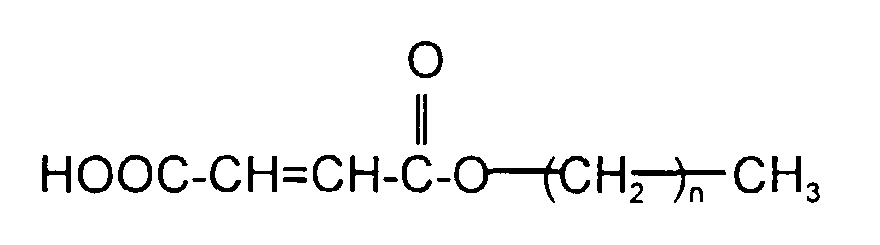
- Thermosensibilisierbarer Latex nach Anspruch 3, dadurch gekennzeichnet, daß 0,1 ThtL bis 1 ThtL (ThtL bedeutet Gewichtsteile pro 100 Gewichtsteile trockener Latex) des wasserlöslichen organisch modifizierten Polysiloxans vorhanden sind; worin das ethoxylierte Fettmonomaleat die folgende Strukturformel hat:worin x für eine ganze Zahl von 1 bis 30 steht und worin y für eine ganze Zahl von 5 bis 20 steht; worin das Alkylmonomaleat die folgende Strukturformel hat:
 worin n für eine ganze Zahl von 0 bis 4 steht; worin das ethoxylierte Fettmonomaleat in einer Menge im Bereich von 1 ThM bis 4 ThM (ThM bedeutet Gewichtsteile pro 100 Gewichtsteile Monomere einschließlich Alkylmonomaleat) vorhanden ist; und worin das Alkylmonomaleat in einer Menge im Bereich von 1 ThM bis 5 ThM vorhanden ist; worin das kautschukartige Polymer ein Nitrilkautschuk ist; und worin der thermosensibilisierbare Latex einen Feststoffgehalt im Bereich von 5% bis 40% aufweist.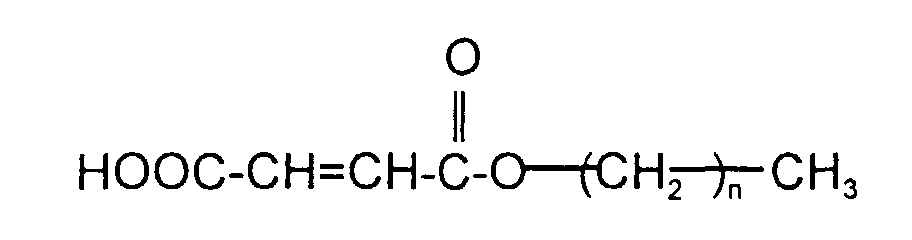
- Thermosensibilisierbarer Latex nach Anspruch 8, dadurch gekennzeichnet, daß das ethoxylierte Fettmonomaleat in einer Menge im Bereich von 2 ThM bis 3 ThM vorhanden ist; worin das Alkylmonomaleat in einer Menge im Bereich von 3 ThM bis 4 ThM vorhanden ist; worin das ethoxylierte Fettmonomaleat die folgende Strukturformel hat:worin x für eine ganze Zahl von 3 bis 8 steht und worin y für eine ganze Zahl von 10 bis 12 steht; und worin das Alkylmonomaleat die folgende Strukturformel hat:
 worin n für die ganze Zahl 1 steht; und worin der thermosensibilisierbare Latex weiter einen Füllstoff, ein Vulkanisationsmittel und einen Beschleuniger umfaßt.
- Verfahren nach Anspruch 1, worin die Polymerisation bei einer Temperatur im Bereich von 5°C bis 70°C durchgeführt wird; worin das Verhältnis zwischen der Gesamtmenge an in der Beschickungszusammensetzung vorhandenen Monomeren und Wasser im Bereich zwischen 0,2:1 und 1,2:1 liegt; worin das Emulgatorsystem nur aus dem ethoxylierten Fettmonomaleat und dem Alkylmonomaleat besteht.
Applications Claiming Priority (2)
| Application Number | Priority Date | Filing Date | Title |
|---|---|---|---|
| US1316496P | 1996-03-11 | 1996-03-11 | |
| US13164 | 1996-03-11 |
Publications (2)
| Publication Number | Publication Date |
|---|---|
| EP0795563A1 EP0795563A1 (de) | 1997-09-17 |
| EP0795563B1 true EP0795563B1 (de) | 1999-12-29 |
Family
ID=21758629
Family Applications (1)
| Application Number | Title | Priority Date | Filing Date |
|---|---|---|---|
| EP97103567A Expired - Lifetime EP0795563B1 (de) | 1996-03-11 | 1997-03-04 | Thermosensibilisierbarer Latex |
Country Status (8)
| Country | Link |
|---|---|
| US (2) | US5780544A (de) |
| EP (1) | EP0795563B1 (de) |
| JP (1) | JPH09328580A (de) |
| KR (1) | KR970065646A (de) |
| BR (1) | BR9701258A (de) |
| CA (1) | CA2199224A1 (de) |
| DE (1) | DE69701009T2 (de) |
| ES (1) | ES2140926T3 (de) |
Families Citing this family (2)
| Publication number | Priority date | Publication date | Assignee | Title |
|---|---|---|---|---|
| JP4554767B2 (ja) * | 1999-06-21 | 2010-09-29 | 日本エイアンドエル株式会社 | ディップ成形用ラテックス組成物及びディップ成形物 |
| ES2391433T3 (es) * | 2009-06-27 | 2012-11-26 | Cognis Ip Management Gmbh | Agentes tensioactivos copolimerizables |
Family Cites Families (3)
| Publication number | Priority date | Publication date | Assignee | Title |
|---|---|---|---|---|
| DE2705555A1 (de) * | 1977-02-10 | 1978-08-17 | Bayer Ag | Stabile waermesensible latexmischungen |
| US4202809A (en) * | 1977-07-15 | 1980-05-13 | The Dow Chemical Company | Styrene-butadiene-acrylonitrile interpolymer latex based cement additives |
| DE3119612A1 (de) * | 1981-05-16 | 1982-12-02 | Bayer Ag, 5090 Leverkusen | Verfahren zur herstellung thermosensibilisierbarer synthesekautschuk-latices |
-
1997
- 1997-03-04 DE DE69701009T patent/DE69701009T2/de not_active Expired - Fee Related
- 1997-03-04 ES ES97103567T patent/ES2140926T3/es not_active Expired - Lifetime
- 1997-03-04 EP EP97103567A patent/EP0795563B1/de not_active Expired - Lifetime
- 1997-03-05 US US08/811,479 patent/US5780544A/en not_active Expired - Fee Related
- 1997-03-05 CA CA002199224A patent/CA2199224A1/en not_active Abandoned
- 1997-03-10 KR KR1019970007888A patent/KR970065646A/ko not_active Withdrawn
- 1997-03-11 BR BR9701258A patent/BR9701258A/pt active Search and Examination
- 1997-03-11 JP JP9055948A patent/JPH09328580A/ja active Pending
-
1998
- 1998-03-24 US US09/046,972 patent/US5804651A/en not_active Expired - Fee Related
Also Published As
| Publication number | Publication date |
|---|---|
| JPH09328580A (ja) | 1997-12-22 |
| DE69701009D1 (de) | 2000-02-03 |
| US5780544A (en) | 1998-07-14 |
| BR9701258A (pt) | 1998-08-25 |
| MX9701751A (es) | 1997-09-30 |
| US5804651A (en) | 1998-09-08 |
| EP0795563A1 (de) | 1997-09-17 |
| ES2140926T3 (es) | 2000-03-01 |
| CA2199224A1 (en) | 1997-09-11 |
| DE69701009T2 (de) | 2000-07-06 |
| KR970065646A (ko) | 1997-10-13 |
Similar Documents
| Publication | Publication Date | Title |
|---|---|---|
| EP0709412B1 (de) | Latex für Hochleistungsabdeckband | |
| US3706697A (en) | Emulsion polymerization of acryloxy-alkylsilanes with alkylacrylic esters and other vinyl monomers | |
| EP2513174B1 (de) | Emulsionspolymerisierung von estern der itakonsäure | |
| US20100234506A1 (en) | Aqueous binder for fibrous or granular substrates | |
| CN107602769A (zh) | 一种合成mbs树脂的方法 | |
| US20090160077A1 (en) | Aqueous binder for fibrous or granular substrates | |
| CN104892817A (zh) | 一种有机硅苯丙细乳液的制备方法 | |
| EP0115468B1 (de) | Verfahren zur Herstellung von stabilen Latices mit grossen Partikeln | |
| JPH035405B2 (de) | ||
| EP0795563B1 (de) | Thermosensibilisierbarer Latex | |
| CN104861107B (zh) | 硅丙细乳液的制备方法 | |
| JPH1060055A (ja) | 十分に加水分解されたポリ(ビニルアルコール)の存在下で製造されたアクリルエマルジョン | |
| KR101345217B1 (ko) | 친수성 사슬이동제 및 이를 이용하여 제조된 말단 변성 스티렌-부타디엔 공중합체 | |
| US2847404A (en) | High stability latices | |
| CN115746224A (zh) | 一种聚乙烯蜡改性丙烯酸乳液及其制备方法 | |
| US20030032741A1 (en) | Method for producing caoutchouc particles | |
| WO2002042344A2 (en) | Formaldehyde-free crosslinked core-shell latex for textile | |
| KR101152672B1 (ko) | 친수성 티오 에테르기로 말단변성된 스티렌-부타디엔 공중합체 및 이의 실리카 복합재 | |
| ATE309274T1 (de) | Verfahren zur herstellung von wässrigen polymerdispersionen | |
| US5476897A (en) | Process for the production of high solids latex | |
| US5268431A (en) | Method for preparing ultra-low molecular weight toner resin | |
| Mahdavian et al. | The comparison between initial charge, shot and modified shot processes and their effects on macrostructure of particles in emulsion copolymerization of styrene–butadiene–acrylic acid | |
| JPS624070B2 (de) | ||
| MXPA97001751A (en) | Latex thermally sensitized | |
| US5504143A (en) | Paint resin for use in paraffinic solvents |
Legal Events
| Date | Code | Title | Description |
|---|---|---|---|
| PUAI | Public reference made under article 153(3) epc to a published international application that has entered the european phase |
Free format text: ORIGINAL CODE: 0009012 |
|
| 17P | Request for examination filed |
Effective date: 19970304 |
|
| AK | Designated contracting states |
Kind code of ref document: A1 Designated state(s): DE ES FR GB IT |
|
| GRAG | Despatch of communication of intention to grant |
Free format text: ORIGINAL CODE: EPIDOS AGRA |
|
| 17Q | First examination report despatched |
Effective date: 19990115 |
|
| GRAG | Despatch of communication of intention to grant |
Free format text: ORIGINAL CODE: EPIDOS AGRA |
|
| GRAG | Despatch of communication of intention to grant |
Free format text: ORIGINAL CODE: EPIDOS AGRA |
|
| GRAH | Despatch of communication of intention to grant a patent |
Free format text: ORIGINAL CODE: EPIDOS IGRA |
|
| GRAH | Despatch of communication of intention to grant a patent |
Free format text: ORIGINAL CODE: EPIDOS IGRA |
|
| GRAA | (expected) grant |
Free format text: ORIGINAL CODE: 0009210 |
|
| AK | Designated contracting states |
Kind code of ref document: B1 Designated state(s): DE ES FR GB IT |
|
| RIN1 | Information on inventor provided before grant (corrected) |
Inventor name: MULLER, PASCALE FRANCINE JEANNE Inventor name: ROUVIERE, FABIENNE |
|
| REF | Corresponds to: |
Ref document number: 69701009 Country of ref document: DE Date of ref document: 20000203 |
|
| ET | Fr: translation filed | ||
| REG | Reference to a national code |
Ref country code: ES Ref legal event code: FG2A Ref document number: 2140926 Country of ref document: ES Kind code of ref document: T3 |
|
| ITF | It: translation for a ep patent filed | ||
| PLBE | No opposition filed within time limit |
Free format text: ORIGINAL CODE: 0009261 |
|
| STAA | Information on the status of an ep patent application or granted ep patent |
Free format text: STATUS: NO OPPOSITION FILED WITHIN TIME LIMIT |
|
| 26N | No opposition filed | ||
| REG | Reference to a national code |
Ref country code: GB Ref legal event code: IF02 |
|
| PGFP | Annual fee paid to national office [announced via postgrant information from national office to epo] |
Ref country code: GB Payment date: 20020205 Year of fee payment: 6 |
|
| PGFP | Annual fee paid to national office [announced via postgrant information from national office to epo] |
Ref country code: FR Payment date: 20020228 Year of fee payment: 6 |
|
| PGFP | Annual fee paid to national office [announced via postgrant information from national office to epo] |
Ref country code: ES Payment date: 20020314 Year of fee payment: 6 |
|
| PGFP | Annual fee paid to national office [announced via postgrant information from national office to epo] |
Ref country code: DE Payment date: 20020327 Year of fee payment: 6 |
|
| PG25 | Lapsed in a contracting state [announced via postgrant information from national office to epo] |
Ref country code: GB Free format text: LAPSE BECAUSE OF NON-PAYMENT OF DUE FEES Effective date: 20030304 |
|
| PG25 | Lapsed in a contracting state [announced via postgrant information from national office to epo] |
Ref country code: ES Free format text: LAPSE BECAUSE OF NON-PAYMENT OF DUE FEES Effective date: 20030305 |
|
| PG25 | Lapsed in a contracting state [announced via postgrant information from national office to epo] |
Ref country code: DE Free format text: LAPSE BECAUSE OF NON-PAYMENT OF DUE FEES Effective date: 20031001 |
|
| GBPC | Gb: european patent ceased through non-payment of renewal fee | ||
| PG25 | Lapsed in a contracting state [announced via postgrant information from national office to epo] |
Ref country code: FR Free format text: LAPSE BECAUSE OF NON-PAYMENT OF DUE FEES Effective date: 20031127 |
|
| REG | Reference to a national code |
Ref country code: FR Ref legal event code: ST |
|
| REG | Reference to a national code |
Ref country code: ES Ref legal event code: FD2A Effective date: 20030305 |
|
| PG25 | Lapsed in a contracting state [announced via postgrant information from national office to epo] |
Ref country code: IT Free format text: LAPSE BECAUSE OF NON-PAYMENT OF DUE FEES Effective date: 20050304 |