EP0795567B1 - Procédé de préparation de copolymères solubles dans l'eau d'au moins un n-vinyllactam soluble dans l'eau et d'au moins un comonomère hydrophobe - Google Patents
Procédé de préparation de copolymères solubles dans l'eau d'au moins un n-vinyllactam soluble dans l'eau et d'au moins un comonomère hydrophobe Download PDFInfo
- Publication number
- EP0795567B1 EP0795567B1 EP97104190A EP97104190A EP0795567B1 EP 0795567 B1 EP0795567 B1 EP 0795567B1 EP 97104190 A EP97104190 A EP 97104190A EP 97104190 A EP97104190 A EP 97104190A EP 0795567 B1 EP0795567 B1 EP 0795567B1
- Authority
- EP
- European Patent Office
- Prior art keywords
- water
- weight
- azobis
- solution
- polymerization
- Prior art date
- Legal status (The legal status is an assumption and is not a legal conclusion. Google has not performed a legal analysis and makes no representation as to the accuracy of the status listed.)
- Expired - Lifetime
Links
Classifications
-
- A—HUMAN NECESSITIES
- A61—MEDICAL OR VETERINARY SCIENCE; HYGIENE
- A61Q—SPECIFIC USE OF COSMETICS OR SIMILAR TOILETRY PREPARATIONS
- A61Q5/00—Preparations for care of the hair
- A61Q5/06—Preparations for styling the hair, e.g. by temporary shaping or colouring
-
- A—HUMAN NECESSITIES
- A61—MEDICAL OR VETERINARY SCIENCE; HYGIENE
- A61K—PREPARATIONS FOR MEDICAL, DENTAL OR TOILETRY PURPOSES
- A61K47/00—Medicinal preparations characterised by the non-active ingredients used, e.g. carriers or inert additives; Targeting or modifying agents chemically bound to the active ingredient
- A61K47/30—Macromolecular organic or inorganic compounds, e.g. inorganic polyphosphates
- A61K47/32—Macromolecular compounds obtained by reactions only involving carbon-to-carbon unsaturated bonds, e.g. carbomers, poly(meth)acrylates, or polyvinyl pyrrolidone
-
- A—HUMAN NECESSITIES
- A61—MEDICAL OR VETERINARY SCIENCE; HYGIENE
- A61K—PREPARATIONS FOR MEDICAL, DENTAL OR TOILETRY PURPOSES
- A61K8/00—Cosmetics or similar toiletry preparations
- A61K8/18—Cosmetics or similar toiletry preparations characterised by the composition
- A61K8/72—Cosmetics or similar toiletry preparations characterised by the composition containing organic macromolecular compounds
- A61K8/81—Cosmetics or similar toiletry preparations characterised by the composition containing organic macromolecular compounds obtained by reactions involving only carbon-to-carbon unsaturated bonds
- A61K8/817—Compositions of homopolymers or copolymers of compounds having one or more unsaturated aliphatic radicals, each having only one carbon-to-carbon double bond, and at least one being terminated by a single or double bond to nitrogen or by a heterocyclic ring containing nitrogen; Compositions or derivatives of such polymers, e.g. vinylimidazol, vinylcaprolactame, allylamines (Polyquaternium 6)
-
- A—HUMAN NECESSITIES
- A61—MEDICAL OR VETERINARY SCIENCE; HYGIENE
- A61K—PREPARATIONS FOR MEDICAL, DENTAL OR TOILETRY PURPOSES
- A61K8/00—Cosmetics or similar toiletry preparations
- A61K8/18—Cosmetics or similar toiletry preparations characterised by the composition
- A61K8/72—Cosmetics or similar toiletry preparations characterised by the composition containing organic macromolecular compounds
- A61K8/81—Cosmetics or similar toiletry preparations characterised by the composition containing organic macromolecular compounds obtained by reactions involving only carbon-to-carbon unsaturated bonds
- A61K8/817—Compositions of homopolymers or copolymers of compounds having one or more unsaturated aliphatic radicals, each having only one carbon-to-carbon double bond, and at least one being terminated by a single or double bond to nitrogen or by a heterocyclic ring containing nitrogen; Compositions or derivatives of such polymers, e.g. vinylimidazol, vinylcaprolactame, allylamines (Polyquaternium 6)
- A61K8/8182—Copolymers of vinyl-pyrrolidones. Compositions of derivatives of such polymers
-
- A—HUMAN NECESSITIES
- A61—MEDICAL OR VETERINARY SCIENCE; HYGIENE
- A61Q—SPECIFIC USE OF COSMETICS OR SIMILAR TOILETRY PREPARATIONS
- A61Q19/00—Preparations for care of the skin
-
- C—CHEMISTRY; METALLURGY
- C08—ORGANIC MACROMOLECULAR COMPOUNDS; THEIR PREPARATION OR CHEMICAL WORKING-UP; COMPOSITIONS BASED THEREON
- C08F—MACROMOLECULAR COMPOUNDS OBTAINED BY REACTIONS ONLY INVOLVING CARBON-TO-CARBON UNSATURATED BONDS
- C08F226/00—Copolymers of compounds having one or more unsaturated aliphatic radicals, each having only one carbon-to-carbon double bond, and at least one being terminated by a single or double bond to nitrogen or by a heterocyclic ring containing nitrogen
- C08F226/06—Copolymers of compounds having one or more unsaturated aliphatic radicals, each having only one carbon-to-carbon double bond, and at least one being terminated by a single or double bond to nitrogen or by a heterocyclic ring containing nitrogen by a heterocyclic ring containing nitrogen
Definitions
- the present invention relates to a method for manufacturing water-soluble copolymers of at least one water-soluble N-vinyl lactam and at least one hydrophobic comonomer by radical polymerization of the monomers in an aqueous Solvents, and the copolymers obtainable by the process and their use.
- copolymers from N-vinyl lactams and hydrophobic Comonomers by radical polymerization are known. Copolymers are desired for many applications, which are clearly soluble in water, i.e. the FNU value of one 5% by weight solution should be ⁇ 20.
- the manufacture of such Copolymers are carried out in an organic solvent, for example an alcohol or a mixture of water and organic solvent with a high proportion of solvent.
- No. 5,395,904 describes the polymerization of vinylpyrrolidone and vinyl acetate by the feed method. It will be a alcoholic solvent used, up to 50 wt .-% water may contain.
- the polymers are water soluble but have only a low molecular weight in the range of 6000 to 50000 g / mol, corresponding to a K value (according to H. Fikentscher, Cellulose-Chemie, Vol. 13, 1932, pp. 58-64) from 10 to 40.
- copolymerization in the aqueous phase would have been clear Advantages over the conventional procedures.
- copolymerization affects water not as a regulator, so copolymers with high molecular weights (K values> 50) would be accessible. It would then exist the possibility of using appropriate molecular weight Set the controller specifically. Also let yourself be conscious Dispensing with organic solvents reduces production costs reduce existing production processes and reduce their environmental impact improve. Have copolymerizations in water but so far not the desired clear water-soluble copolymers result.
- DE-OS 22 18 935 describes the copolymerization of N-vinylpyrrolidone with various water-soluble and water-insoluble Comonomers.
- Water-insoluble initiators are used which in the form of a finely divided suspension in an aqueous Solution of the copolymers are used. This leads to However, the case of the water-insoluble comonomers also does not the desired water-soluble copolymers with an FNU value ⁇ 20.
- WO 93/18073 describes a process for the preparation of copolymers from monoethylenically unsaturated monomers with acid groups and N-vinyl lactams by copolymerization of the monomers in the presence of radical-forming polymerization initiators Meaning of a solution polymerization in water at a pH of at least 6, whereby to adjust the pH of the aqueous Reaction solution an alkali metal and / or alkaline earth metal base is used.
- EP-A 215 379 describes the production of polyvinylpyrrolidone in aqueous solution with hydrogen peroxide as a starter, where the pH of the reaction solution using NaOH, KOH, their Carbonate or bicarbonate is kept between 7 and 11.
- the present invention is therefore based on the object Process for the production of clearly water-soluble copolymers from at least one hydrophilic N-vinyl lactam and at least a hydrophobic comonomer by radical copolymerization to provide in an aqueous solvent.
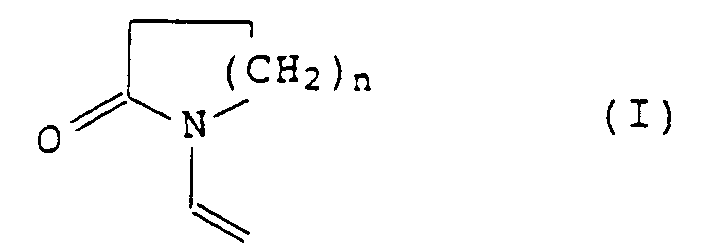
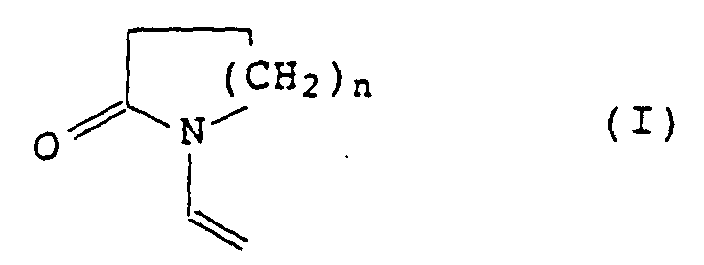
- the object is achieved according to the invention by a process for the preparation of clearly water-soluble copolymers which are composed of 40 to 90% by weight of at least one water-soluble N-vinyl lactam of the general formula I, wherein n is 1 or 2, and 60 to 10 wt .-%, each based on the monomer mixture, of at least one hydrophobic comonomer with a water solubility at 20 ° C in the range of 1 to 100 g / l, by radical polymerization of the monomers in aqueous solution according to a feed process in the presence of an initiator selected from azo initiators, H 2 O 2 , hydroperoxides in combination with reducing agents and persalts, characterized in that the initiator is dissolved in water and / or a C 1 -C 4 - Alcohol is added to the reaction mixture, and the majority of the monomers, optionally as a solution in water and / or a C 1 -C 4 alcohol, are metered into the reaction mixture such that no se
- the method according to the invention is suitable for production water-soluble polymers from monomer mixtures, their content of hydrophobic monomers in the range from 10 to 60% by weight, preferably 10 to 40% by weight, based on the monomer mixture, lies.
- Suitable hydrophobic monomers with water solubility in the range from 1 to 100 g / l are, for example, vinyl acetate, vinyl propionate, N-vinylcaprolactam, methyl acrylate, ethyl acrylate, n-propyl acrylate, n-butyl acrylate, t-butyl acrylate, methyl methacrylate, Ethyl methacrylate, acrylonitrile or methacrylonitrile.
- Azo compounds come as initiators for the radical polymerization in question for radical polymerization in aqueous solution are suitable.
- Aliphatic are particularly suitable or cycloaliphatic azo compounds, e.g. 2,2'-azobis (isobutyronitrile), 2,2'-azobis (2-methylbutyronitrile), 2,2'-azobis (2,4-dimethylvaleronitrile), 1,1'-azobis (1-cyclohexane carbonitrile), 2- (carbamoylazo) isobutyronitrile, 4,4'-azobis (4-cyanovaleric acid) and their alkali metal and ammonium salts, e.g.
- the sodium salt dimethyl 2,2'-azobisisobutyrate, 2,2'-azobis [2- (2-imidazolin-2-yl) propane], 2,2'-azobis (2-amidinopropane) and the acid addition salts of the latter two compounds, e.g. the dihydrochlorides.
- the water-soluble initiators are particularly preferred.
- Hydrogen peroxide and hydroperoxides also come as initiators in combination with reducing agents and persalts.
- suitable Hydroperoxides are, for example, t-butyl hydroperoxide, t-amyl hydroperoxide, cumene hydroperoxide and pinane hydroperoxide each in combination with, for example, a salt of hydroxymethanesulfinic acid, an iron (II) salt or ascorbic acid.
- suitable Persalts are especially alkali metal peroxydisulfates.
- the amount of initiator used, based on the monomers, is in the range from 0.02 to 15 mol%, preferably 0.05 to 3 mol%.
- the initiator is used as a solution, depending on the solubility, in water and / or in a C 1 -C 4 alcohol.
- the initiator concentration is in the range from 0.02 to 2 mol%, preferably 0.1 to 2 mol%, based on the solvent.
- the polymerization medium is water, which can contain up to 10% by weight, preferably up to 5% by weight, based on the entire batch, of a C 1 to C 4 alcohol.
- the polymerization medium preferably contains only as much alcohol as is necessary for dissolving and metering in the polymerization initiators, some of which are only partially soluble in water. Water is particularly preferably used as the sole solvent.
- the polymerization is usually carried out at a neutral pH in the range from 5 to 9. If necessary, the pH is adjusted or maintained by adding a base, such as ammonia, NaOH or an acid, such as HCl.
- the monomers can be introduced in the aqueous solvent (batch process).
- the monomers preferably as a solution in water and / or a C 1 -C 4 alcohol, are preferably metered into the reaction mixture (feed process).
- the monomers are metered in such that no separation occurs in the reaction mixture, ie there is always a clear solution. This ensures that the hydrophobic monomer can react evenly with the water-soluble N-vinyl lactam I.
- the mixture is then brought to the reaction temperature and the remaining amount of monomers are metered in continuously or in several portions simultaneously with the remaining initiator solution and, if appropriate, a regulator.
- the metering is generally carried out over a period of 4 to 14 hours, preferably 5 to 12 hours, ideally 6 to 10 hours. If N-vinylcaprolactam is used as the hydrophobic monomer, then the batch process is preferably carried out using water as the sole solvent.
- the concentration of the monomers in the reaction mixture is in the range from 10 to 40% by weight, preferably 15 to 30% by weight, based on the reaction mixture.
- the initiator solution is run in continuously or in several portions, in particular over a period of 1 to 4 hours.
- the reaction temperature is usually in the range from 60 to 90 ° C, but it can also be up to 130 ° C.
- the implementation can at normal pressure, under autogenous pressure or under protective gas pressure be performed.
- a suitable protective gas is, for example Nitrogen.
- the polymers obtained by the polymerization process according to the invention generally have a relatively high molecular weight. If lower molecular weights are desired, these can be adjusted by adding a regulator to the polymerization batch. Suitable regulators are, for example, aldehydes, such as formaldehyde, acetaldehyde, propionaldehyde, n-butyraldehyde and isobutyraldehyde, formic acid, ammonium formate, hydroxylammonium sulfate and hydroxylammonium phosphate. It is also possible to use regulators which contain sulfur in organically bound form.
- regulators preferably contain sulfur in the form of SH groups. Examples of such regulators are n-butyl mercaptan, n-hexyl mercaptan or n-dodecyl mercaptan.
- Water-soluble, sulfur-containing polymerization regulators such as, for example, hydrogen sulfites, disulfites and compounds such as ethylthioglycolate, cysteine, 2-mercaptoethanol, 1,3-mercaptopropanol, 3-mercaptopropan-1,2-diol, 1,4-mercaptobutanol, mercaptoacetic acid, 3 are particularly preferred -Mercaptopropionic acid, mercaptosuccinic acid, thioglycerin, diethanol sulfide, thiodiglycol, ethylthioethanol, thiourea and dimethyl sulfoxide.
- allyl compounds such as allyl alcohol or allyl bromide
- benzyl compounds such as benzyl chloride or alkyl halides such as chloroform or carbon tetrachloride.
- the regulator optionally as a solution in water and / or a C 1 -C 4 alcohol, is metered into the reaction mixture.
- the polymer solution is preferably used following the polymerization reaction one or more polymerization initiators and heats the polymer solution, e.g. to the polymerization temperature or at temperatures above the polymerization temperature, to complete the polymerization.
- aqueous solution Initiators for example peroxides, hydroperoxides, peroxodisulfates, Percarbonates, peroxoesters and hydrogen peroxide.
- the solutions created during the polymerization usually contain 10 to 60% by weight, preferably 15 up to 40% by weight of polymer.
- the solutions obtained can then of the polymerization, including physical post-treatment, for example a steam distillation or Stripping with nitrogen, being subjected to steam volatile impurities are removed from the solution.
- aqueous solutions of the copolymer can optionally by a drying process corresponding to the state of the art be converted into solid powder.
- a drying process those are considered for drying from aqueous solution are suitable.
- Preferred methods are, for example Spray drying, spray fluidized bed drying, roller drying and the belt drying. Freeze drying is also applicable and the freeze concentration.
- the polymers obtained generally have a K value (determined at 25 ° C. in a 1% by weight aqueous or ethanolic solution) in the range from 20 to 100, in particular> 40 to 100 and particularly preferably ⁇ 60 to 100 Determination of the K value is described in H. Fikentscher "Systematics of celluloses based on their viscosity in solution", Cellulose-Chemie 13 (1932), 58-64 and 71-74 as well as Encyclopedia of Chemical Technology, Vol. 21, 2. Edition, 427-428 (1970).
- Nephelometric is used as a measure of their water solubility Turbidity unit FNU (or NTU), which at 5 ° C on a 5 wt .-% aqueous solution of the polymer measured and by calibration with Formazin is set as an artificial opacifier.
- FNU water solubility Turbidity unit
- NTU water solubility Turbidity unit
- the polymers obtained by the process according to the invention act as a thickener in an aqueous medium and are on the other hand able to form water soluble films. They are coming therefore especially for use in cosmetic and pharmaceutical Preparations, for example as additives or carriers in hair lacquer, hair set or hairspray; in skin cosmetic preparations, as skin adhesive gels or as immunochemicals, e.g. B. as catheter coatings.
- Special pharmaceutical applications of the Polymers according to the invention particularly include use as moist or dry binders, matrix retardants or coating retardants (for slow release dosage forms), Gelling agents, instant release coatings and coating aids.
- the polymers prepared according to the invention can also as auxiliaries for agrochemicals, for example for the seed coating or for soil release fertilizer formulations or as an aid in the production of fish food granules be used.
- the polymers according to the invention come as Rust preventers or rust removers from metallic surfaces, as a scale inhibitor or scale remover, as a dispersant in dye pigment dispersions, for example in Printing inks, in question.
- Rust preventers or rust removers from metallic surfaces
- scale inhibitor or scale remover as a dispersant in dye pigment dispersions
- dispersant in dye pigment dispersions for example in Printing inks, in question.
- the high inclination is still of interest from an application point of view of the polymers according to the invention, complexes with organic compounds (e.g. lower hydrocarbons, phenols, tannins and various antioxidants), with enzymes and proteins, or with to form other organic polymers.
- the invention Polymer complexes with inorganic compounds, especially with hydrogen peroxide, halides, metals or metal salts.
- the invention Polymers to remove tannins, phenols, proteins or polyvalent cations from aqueous medium, in ion exchangers, to stabilize hydrogen peroxide, for example in disinfectants, to stabilize antioxidants, for example in preservatives, as a polymeric coligand for metal complexes of reversible oxygen absorption or used for catalysts.
- the invention Polymers can also be used to stabilize metal colloids be used. In this context, be on the use of the polymers according to the invention as noble metal crystallization nuclei for silver precipitation and as a stabilizer for silver halide emulsions.
- the polymers according to the invention are also suitable for modification of surface and interface properties.
- she can be used, for example, to hydrophilize surfaces use and can therefore as textile auxiliaries, for example as a peeling and leveling aid for textile dyeing, can be used as a lightening agent in textile printing etc.
- the agents according to the invention as coatings, for. B. for polyolefins can be used for glass and glass fibers. Because of their surface active They continue to be effective as protective colloids, for example in the stabilization of metal colloids or in radical aqueous emulsion polymerization use.
- the use of the invention should also be considered Polymers as an aid in oil production from oil-containing water, as an aid in crude oil and natural gas production as well as the transportation of oil and gas.
- the polymers according to the invention are used as Aid in the treatment of waste water, be it as a flocculation aid or when removing paint and oil residues from wastewater.
- the polymers according to the invention can also as phase transfer catalysts and as solubility improvers be used.
- the polymers according to the invention are also used in the dyeing of polyolefins, as color transfer inhibitors, as color mixing inhibitors for photographic diffusion transfer materials, as an adhesion promoter for dyes, as Tools for lithography, for photo imaging, for Diazotype, as an aid for metal casting and hardening, as tools for metal quench baths, as tools for gas analysis, as a component in ceramic binders, as a paper aid for special papers, as binders in paper coating colors and as a binder component in plaster bandages.
- the polymers according to the invention are also suitable as proton conductors and can in electrically conductive layers, e.g. B. with charge transfer cathodes, as solid electrolytes, e.g. B. in fixed batteries such as lithium batteries.
- Polymers can include contact lenses, synthetic fibers, Air filter, e.g. B. cigarette filter, or membrane become.
- the polymers according to the invention are also found Use in heat resistant layers, heat sensitive Layers and heat sensitive resistors.
- the turbidity of the aqueous copolymer solution was determined by nephelometric Turbidity measurement determined (modified method according to DIN 38404). With this method, the solution is scattered Light determined photometrically, with the light scattering through the interaction between the light rays and the particles or droplets in the solution, the number and size of which Level of turbidity is caused. Serves as a measurand the nephelometric turbidity unit FNU (or NTU), the measured at 25 ° C on a 5 wt .-% aqueous solution of the polymer and by calibration with formazin as an artificial opacifier is set. The higher the FNU value, the more cloudy is the solution.
- FNU nephelometric Turbidity unit
- the pH of the template and the starter feed 1 was diluted with Ammonia solution adjusted to pH 5.
- the colorless, viscous solution of the polymer obtained had one Solids content of 19.4 wt .-% and the K value of the product (measured 1% in water) was 79.1.
- impurities were ⁇ 0.005% N-vinyl pyrrolidone and 0.1% pyrrolidone found.
- the FNU value of the 5% by weight solution in water was 1.5.
- the colorless, low-viscosity solution of the polymer obtained indicated a solids content of 28.5% by weight and the K value of the product (measured 1% in ethanol) was 37.7. As impurities 0.005% N-vinyl pyrrolidone and 0.12% pyrrolidone were found. The FNU value of the 5% by weight solution in water was included 4.0.
- Example 1 Example 2
- Example 3 Example 5 Solids content 19.7% by weight 19.9% by weight 18.7% by weight 35.7% by weight K value 73.4 69.5 71.5 62.0
- FNU 3.4 5.2 6.7 3.5 colour colorless colorless colorless colorless pollution N-vinylpyrrolidone 0.005% by weight 0.006% by weight 0.01% by weight 0.007% by weight pyrrolidone 0.087% by weight 0.117% by weight 0.03% by weight 0.11% by weight
- Example 9 Solids content 29.3% by weight K value 23.0 FNU 3.5 colour yellowish pollution N-vinylpyrrolidone 0.015% by weight N-vinyl caprolactam ⁇ 0.005% by weight
- Example 1 of DE-A-2218935 was repeated. You get an inhomogeneous, partially coagulated, viscous polymer solution.
- Example 3 of DE-A-2218935 was repeated. You get a low-viscosity, incompletely polymerized and very cloudy Polymer solution (FNU> 200).
Landscapes
- Health & Medical Sciences (AREA)
- Life Sciences & Earth Sciences (AREA)
- Animal Behavior & Ethology (AREA)
- Veterinary Medicine (AREA)
- Public Health (AREA)
- General Health & Medical Sciences (AREA)
- Chemical & Material Sciences (AREA)
- Epidemiology (AREA)
- Birds (AREA)
- Medicinal Chemistry (AREA)
- Chemical Kinetics & Catalysis (AREA)
- Pharmacology & Pharmacy (AREA)
- Polymers & Plastics (AREA)
- Organic Chemistry (AREA)
- Inorganic Chemistry (AREA)
- Dermatology (AREA)
- Addition Polymer Or Copolymer, Post-Treatments, Or Chemical Modifications (AREA)
- Polymerization Catalysts (AREA)
- Medicinal Preparation (AREA)
- Polymerisation Methods In General (AREA)
- Agricultural Chemicals And Associated Chemicals (AREA)
- Polyamides (AREA)
- Cephalosporin Compounds (AREA)
Claims (11)
- Procédé pour la préparation de copolymères hydrosolubles limpides, qui sont élaborés à partir de 40 à 90 % en poids d'au moins un N-vinyllactame hydrosoluble de formule générale I,où n vaut 1 ou 2, et de 60 à 10 % en poids, à chaque fois par rapport au mélange de monomères, d'au moins un comonomère hydrophobe ayant une solubilité dans l'eau à 20°C dans l'intervalle de 1 à 100 g/l, par polymérisation radicalaire des monomères en solution aqueuse selon un procédé par flux en présence d'un initiateur, qui est choisi parmi les initiateurs azoiques, H2O2, les hydroperoxydes en combinaison avec des agents réducteurs, et les persels, caractérisé par le fait qu'on ajoute l'initiateur sous forme de solution dans l'eau et/ou un alcool en C1-C4 à la charge réactionnelle, et tandis qu'on ajoute la majeure partie des monomères, éventuellement sous forme de solution dans l'eau et/ou un alcool en C1-C4, à la charge réactionnelle en quantité dosée de telle façon qu'il ne se produise aucune démixtion dans la charge réactionnelle pendant la polymérisation.
- Procédé selon la revendication 1, caractérisé par le fait qu'on utilise 10 à 40 % en poids, par rapport au poids total des monomères, du comonomére hydrophobe.
- Procédé selon la revendication 1 ou 2, caractérisé par le fait qu'on utilise comme comonomère hydrophobe l'acétate de vinyle, le propionate de vinyle, le N-vinylcaprolactame, l'acrylate de méthyle, l'acrylate d'éthyle, l'acrylate de n-propyle, l'acrylate de n-butyle, l'acrylate de t-butyle, le méthacrylate de méthyle, le méthacrylate d'éthyle, l'acrylonitrile, le méthacrylonitrile ou leurs mélanges.
- Procédé selon l'une des revendications précédentes, caractérisé par le fait qu'on utilise comme initiateur un composé azoique aliphatique ou cycloaliphatique.
- Procédé selon la revendication 4, caractérisé par le fait qu'on utilise comme initiateur le 2,2'-azobis[2-(2-imidazoline-2-yl)propane], le 2,2'-azobis(2-amidinopropane), l'acide 4,4'-azobis(4-cyanovalérique) ou un sel de ces composés, le 2,2'-azobis(isobutyr-amide), le 2,2'-azobis(isobutyronitrile), le 2,2'-azobis(2-méthylbutyronitrile), le diméthyl-2,2'-azobisisobutyrate, le 2,2'-azobis(4-méthoxy-2,4-diméthylvaléronitrile), le 2,2'-azobis(2,4-diméthylvaléronitrile) et/ou le 1,1'-azobis(1-cyclohexanecarbonitrile).
- Procédé selon l'une des revendications précédentes, caractérisé par le fait qu'on effectue la réaction de polymérisation dans de l'eau, qui peut éventuellement contenir jusqu'à 10, de préférence jusqu'à 5 % en poids d'un alcool en C1-C4.
- Procédé selon l'une des revendications précédentes, caractérisé par le fait qu'on réalise la polymérisation en présence d'un régulateur.
- Copolymères hydrosolubles limpides ayant un indice K de ≥ 50, qui sont élaborés à partir de 40 à 90 % en poids d'au moins un N-vinyllactame hydrosoluble de formule générale I,où n vaut 1 ou 2, et de 60 à 10 % en poids, à chaque fois par rapport au poids total des monomères, d'au moins un comonomére hydrophobe ayant une solubilité dans l'eau à 20°C dans l'intervalle de 1 à 100 g/l.
- Copolymère selon la revendication 8, tandis que pour le comonomère hydrophobe il s'agit d'acétate de vinyle, de propionate de vinyle, de N-vinylcaprolactame, d'acrylate de méthyle, d'acrylate d'éthyle, d'acrylate de n-propyle, d'acrylate de n-butyle, d'acrylate de t-butyle, de méthacrylate de méthyle, de méthacrylate d'éthyle, d'acrylonitrile, de méthacrylonitrile ou de leurs mélanges.
- Copolymères selon l'une des revendications 8 ou 9 ayant un indice FNU (ou NTU) ≤ 20.
- Utilisation des copolymères selon l'une des revendications 8 à 10 dans des préparations cosmétiques ou pharmaceutiques et comme adjuvants en agrochimie.
Applications Claiming Priority (2)
| Application Number | Priority Date | Filing Date | Title |
|---|---|---|---|
| DE19609864 | 1996-03-13 | ||
| DE19609864A DE19609864A1 (de) | 1996-03-13 | 1996-03-13 | Verfahren zur Herstellung von wasserlöslichen Copolymerisaten aus wenigstens einem wasserlöslichen N-Vinyllactam und wenigstens einem hydrophoben Comonomeren |
Publications (3)
| Publication Number | Publication Date |
|---|---|
| EP0795567A2 EP0795567A2 (fr) | 1997-09-17 |
| EP0795567A3 EP0795567A3 (fr) | 1999-05-12 |
| EP0795567B1 true EP0795567B1 (fr) | 2002-06-12 |
Family
ID=7788161
Family Applications (1)
| Application Number | Title | Priority Date | Filing Date |
|---|---|---|---|
| EP97104190A Expired - Lifetime EP0795567B1 (fr) | 1996-03-13 | 1997-03-12 | Procédé de préparation de copolymères solubles dans l'eau d'au moins un n-vinyllactam soluble dans l'eau et d'au moins un comonomère hydrophobe |
Country Status (10)
| Country | Link |
|---|---|
| US (1) | US6103820A (fr) |
| EP (1) | EP0795567B1 (fr) |
| JP (1) | JP3798501B2 (fr) |
| CN (1) | CN1086396C (fr) |
| AT (1) | ATE219111T1 (fr) |
| CA (1) | CA2199054A1 (fr) |
| DE (2) | DE19609864A1 (fr) |
| DK (1) | DK0795567T3 (fr) |
| ES (1) | ES2177847T3 (fr) |
| PT (1) | PT795567E (fr) |
Families Citing this family (28)
| Publication number | Priority date | Publication date | Assignee | Title |
|---|---|---|---|---|
| US6107397A (en) * | 1997-03-24 | 2000-08-22 | Basf Aktiengesellschaft | Aqueous copolymer dispersions of water-soluble monomers with N-vinyl groups and hydrophobic monomers |
| JP4523126B2 (ja) * | 1999-07-30 | 2010-08-11 | 株式会社日本触媒 | スケール防止剤 |
| DE19962197A1 (de) * | 1999-12-22 | 2001-07-05 | Innovation Pro Terra Gmbh & Co | Absorber, vorzugsweise Stoff zur Aufnahme und/oder zum Austausch von Ionen |
| US6465592B1 (en) * | 2000-06-15 | 2002-10-15 | Dai-Ichi Kogyo Seiyaku Co., Ltd. | Process for preparing vinylpyrrolidone polymer |
| US20040091645A1 (en) * | 2001-02-05 | 2004-05-13 | Heederik Peter Johannes | Topcoat compositions, substrates containing a topcoat derived therefrom, and methods of preparing the same |
| JP4881518B2 (ja) * | 2001-08-01 | 2012-02-22 | 第一工業製薬株式会社 | ビニルラクタム系重合体の製造方法 |
| DE10252010A1 (de) * | 2002-11-06 | 2004-05-27 | Basf Ag | Vinyllactamcopolymerisate als Gashydratinhibitoren |
| DE10259815A1 (de) * | 2002-12-19 | 2004-07-01 | Basf Ag | Polymere enthaltend Pyrrolidon-4-carbonsäuregruppen und deren Verwendung |
| DE102004052957A1 (de) * | 2004-10-29 | 2006-05-04 | Basf Ag | Verfahren zur Herstellung von gekrepptem Papier |
| DE112005002724T5 (de) * | 2004-11-05 | 2007-09-20 | Nippon Shokubai Co., Ltd. | Yinylpyrrolidon/Vinylacetat-Copolymerisat, Verfahren zu dessen Herstellung, und dessen Anwendung |
| US20070149737A1 (en) * | 2005-12-23 | 2007-06-28 | Basf Aktiengesellschaft | Method of producing water-soluble nonturbid copolymers of at least one water-soluble n-vinyllactam and at least one hydrophobic comonomer |
| US7572871B2 (en) * | 2005-12-23 | 2009-08-11 | Basf Se | Method of producing water-soluble nonturbid copolymers of at least one water-soluble N-vinyllactam and at least one hydrophobic comonomer |
| US7847044B2 (en) * | 2005-12-23 | 2010-12-07 | Basf Se | Method of producing water-soluble nonturbid copolymers of at least one water-soluble N-vinyllactam and at least one hydrophobic comonomer by polymerization under increased pressure |
| US7442751B2 (en) * | 2005-12-23 | 2008-10-28 | Basf Se | Method of producing water-soluble nonturbid copolymers of at least one water-soluble N-vinyllactam and at least one hydrophobic comonomer |
| US7572870B2 (en) * | 2005-12-23 | 2009-08-11 | Basf Se | Method of producing water-soluble nonturbid copolymers of at least one water-soluble N-vinyllactam and at least one hydrophobic comonomer |
| US7449531B2 (en) * | 2005-12-23 | 2008-11-11 | Basf Se | Method of producing water-soluble nonturbid copolymers of at least one water-soluble N-vinyllactam and at least one hydrophobic comonomer |
| DE102007052412A1 (de) * | 2006-11-29 | 2008-06-05 | Basf Se | Verfahren zur Herstellung von wasserlöslichen trübungsfreien Copolymerisaten aus wenigstens einem wasserlöslichen N-Vinyllactam und wenigstens einem hydrophoben Comonomeren |
| JP5669354B2 (ja) * | 2007-02-05 | 2015-02-12 | 株式会社日本触媒 | 粒子状吸水剤およびその製造方法 |
| WO2009040248A1 (fr) * | 2007-09-27 | 2009-04-02 | Basf Se | Agents améliorant la systémicité |
| US20090095384A1 (en) | 2007-10-11 | 2009-04-16 | Houghton Technical Corp. | Aqueous quenching media and use thereof in quenching metal substrates |
| CN101945576B (zh) * | 2008-02-21 | 2014-08-06 | 巴斯夫欧洲公司 | 涂覆的惰性颗粒 |
| WO2010070097A1 (fr) | 2008-12-19 | 2010-06-24 | Basf Se | Procédé de fabrication de copolymères n-vinylpyrrolidone/acétate de vinyle |
| US20130004667A1 (en) * | 2010-01-11 | 2013-01-03 | Isp Investments Inc. | Compositions comprising a reactive monomer and with a urea or urethane functional group |
| US10202341B2 (en) | 2010-01-11 | 2019-02-12 | Isp Investments Llc | Compositions comprising a reactive monomer and with a urea or urethane functional group |
| EP2643363B1 (fr) * | 2010-11-23 | 2017-05-31 | Basf Se | Procédé pour produire des polymères vinyllactame réticulés pauvres en peroxyde |
| HUE035342T2 (en) * | 2012-04-04 | 2018-05-02 | Basf Se | Agroforulation with an amide, polyalkylene glycol (meth) acrylate and alkyl (meth) acrylate copolymer |
| JP6189183B2 (ja) * | 2013-11-12 | 2017-08-30 | 大塚化学株式会社 | 顔料分散剤及びそれを含む顔料分散組成物 |
| EP3838905A1 (fr) * | 2019-12-18 | 2021-06-23 | Evonik Operations GmbH | Procédé de fabrication de polysulfansilanes au moyen d'une catalyse de transfert de phase |
Family Cites Families (8)
| Publication number | Priority date | Publication date | Assignee | Title |
|---|---|---|---|---|
| US2982762A (en) * | 1957-07-29 | 1961-05-02 | Dow Chemical Co | Continuous polymerization of n-vinyl lactams |
| DE2218935C3 (de) * | 1972-04-19 | 1980-01-31 | Basf Ag, 6700 Ludwigshafen | Verfahren zur Herstellung von wäßrigen Lösungen von N-Vinylpyrrolidonpolymerisaten |
| JPS5551987A (en) * | 1978-10-12 | 1980-04-16 | Sanden Corp | Positive displacement fluid compressor |
| US4554311A (en) * | 1982-09-20 | 1985-11-19 | Gaf Corporation | Method of preparing an aqueous solution comprising vinylpyrrolidone/vinyl acetate copolymers of various molecular weights using a single initiator system consisting essentially of t-Butylperoxypivalate |
| US4520179A (en) * | 1982-09-20 | 1985-05-28 | Gaf Corporation | Preparation of vinylpyrrolidone/vinyl acetate copolymers of various molecular weights using a single initiator system consisting essentially of t-Butylperoxypivalate |
| DE3532747A1 (de) * | 1985-09-13 | 1987-03-26 | Basf Ag | Verfahren zur herstellung von polyvinylpyrrolidon |
| DE4207900A1 (de) * | 1992-03-12 | 1993-09-16 | Basf Ag | Verfahren zur herstellung von copolymerisaten aus saeuregruppen enthaltenden monoethylenisch ungesaettigten monomeren und n-vinyllactamen |
| US5502136A (en) * | 1994-12-28 | 1996-03-26 | Isp Investments Inc. | Process for making substantially homogeneous copolymers of vinyl pyrrolidone and vinyl acetate which form clear aqueous solutions |
-
1996
- 1996-03-13 DE DE19609864A patent/DE19609864A1/de not_active Withdrawn
-
1997
- 1997-02-25 US US08/805,547 patent/US6103820A/en not_active Expired - Lifetime
- 1997-03-03 CA CA002199054A patent/CA2199054A1/fr not_active Abandoned
- 1997-03-12 DE DE59707456T patent/DE59707456D1/de not_active Expired - Lifetime
- 1997-03-12 EP EP97104190A patent/EP0795567B1/fr not_active Expired - Lifetime
- 1997-03-12 CN CN97103116A patent/CN1086396C/zh not_active Expired - Lifetime
- 1997-03-12 AT AT97104190T patent/ATE219111T1/de not_active IP Right Cessation
- 1997-03-12 PT PT97104190T patent/PT795567E/pt unknown
- 1997-03-12 DK DK97104190T patent/DK0795567T3/da active
- 1997-03-12 ES ES97104190T patent/ES2177847T3/es not_active Expired - Lifetime
- 1997-03-13 JP JP05819097A patent/JP3798501B2/ja not_active Expired - Lifetime
Also Published As
| Publication number | Publication date |
|---|---|
| DE59707456D1 (de) | 2002-07-18 |
| ES2177847T3 (es) | 2002-12-16 |
| DE19609864A1 (de) | 1997-09-18 |
| JP3798501B2 (ja) | 2006-07-19 |
| CA2199054A1 (fr) | 1997-09-13 |
| US6103820A (en) | 2000-08-15 |
| CN1086396C (zh) | 2002-06-19 |
| CN1163900A (zh) | 1997-11-05 |
| ATE219111T1 (de) | 2002-06-15 |
| JPH101519A (ja) | 1998-01-06 |
| EP0795567A2 (fr) | 1997-09-17 |
| DK0795567T3 (da) | 2002-07-15 |
| PT795567E (pt) | 2002-10-31 |
| EP0795567A3 (fr) | 1999-05-12 |
Similar Documents
| Publication | Publication Date | Title |
|---|---|---|
| EP0795567A2 (fr) | Procédé de préparation de copolymères solubles dans l'eau d'au moins un n-vinyllactam soluble dans l'eau et d'au moins un comonomère hydrophobe | |
| EP0867455A2 (fr) | Dispersions aqueuses de polymères dérivés de monomères hydrosolubles avec un groupe N-vinylique et des monomères hydrosolubles | |
| EP0698046B1 (fr) | Homopolymeres et copolymeres de 1-vinylimidazole, procede de preparation et utilisation | |
| DE3624813C2 (fr) | ||
| EP0887360B1 (fr) | Procédé pour la préparation d'homopolymères de N-vinylpyrrolidone à bas poids moléculaire | |
| DE4207900A1 (de) | Verfahren zur herstellung von copolymerisaten aus saeuregruppen enthaltenden monoethylenisch ungesaettigten monomeren und n-vinyllactamen | |
| EP0168684B1 (fr) | Terpolymères solubles dans l'eau, leur procédé de préparation et leur utilisation comme adhésifs | |
| DE3037870C2 (fr) | ||
| DE1108436B (de) | Verfahren zur Herstellung stabiler, kationaktiver Kunststoffdispersionen | |
| DE60305335T2 (de) | Verfahren zur herstellung von wässrigen dispersionen kationischer homo- und copolymere unter verwendung von amphoteren schutzkolloiden | |
| DE3524197C2 (fr) | ||
| EP0805169B1 (fr) | Procédé de préparation de copolymères à base de (méth)acrylates solubles en milieu alcalin | |
| EP2882783A1 (fr) | Procédé permettant de préparer des solutions aqueuses de polymères de vinyllactame et leur poudres | |
| EP0765379B1 (fr) | Inhibiteurs de migration des couleurs pour produits de lavage et de nettoyage | |
| DE4341072A1 (de) | Verfahren zur Herstellung von Polymerisaten von Alkyl-1-vinylimidazolen und ihre Verwendung | |
| EP0944657B1 (fr) | Polymerisats greffes amphiphiles avec des bases greffees contenant des unites n-amide d'acide carboxylique vinylique, procedes permettant de les preparer et leur utilisation | |
| DE10139003B4 (de) | Verfahren zur Herstellung eines N-Vinyl-Verbindungs-Polymers | |
| DE19908184A1 (de) | Verfahren zur Herstellung wässriger Dispersionen von Copolymerisaten aus hydrophilen und hydrophoben Monomeren sowie daraus erhältliche Copolymerisate und deren Anwendungen | |
| EP0733075B1 (fr) | Procede de production de polymeres pulverulents a base de n-vinylcaprolactame | |
| EP0761699A2 (fr) | Procédé de préparation d'homopolymères de N-vinylpyrrolidone à bas poids moléculaires et à teneur en pyrrolidone bas | |
| WO2006018135A1 (fr) | Utilisation de copolymeres amphiphiles comme agents de solubilisation | |
| DE19712247A1 (de) | Wässrige Copolymerisatdispersionen aus wasserlöslichen Monomeren mit N-Vinylgruppen und hydrophoben Monomeren | |
| DE4421936A1 (de) | Verfahren zur Herstellung von in Wasser klar löslichen, restmonomerenarmen Copolymerisaten aus N-Vinylpyrrolidon und Vinylacetat | |
| EP0855412A2 (fr) | Procédé de préparation de polymères de N-vinylcaprolactame | |
| WO2010070097A1 (fr) | Procédé de fabrication de copolymères n-vinylpyrrolidone/acétate de vinyle |
Legal Events
| Date | Code | Title | Description |
|---|---|---|---|
| PUAI | Public reference made under article 153(3) epc to a published international application that has entered the european phase |
Free format text: ORIGINAL CODE: 0009012 |
|
| AK | Designated contracting states |
Kind code of ref document: A2 Designated state(s): AT BE CH DE DK ES FR GB IE IT LI NL PT SE |
|
| PUAL | Search report despatched |
Free format text: ORIGINAL CODE: 0009013 |
|
| AK | Designated contracting states |
Kind code of ref document: A3 Designated state(s): AT BE CH DE DK ES FR GB IE IT LI NL PT SE |
|
| 17P | Request for examination filed |
Effective date: 19991013 |
|
| 17Q | First examination report despatched |
Effective date: 20000118 |
|
| GRAG | Despatch of communication of intention to grant |
Free format text: ORIGINAL CODE: EPIDOS AGRA |
|
| GRAG | Despatch of communication of intention to grant |
Free format text: ORIGINAL CODE: EPIDOS AGRA |
|
| GRAH | Despatch of communication of intention to grant a patent |
Free format text: ORIGINAL CODE: EPIDOS IGRA |
|
| GRAH | Despatch of communication of intention to grant a patent |
Free format text: ORIGINAL CODE: EPIDOS IGRA |
|
| GRAA | (expected) grant |
Free format text: ORIGINAL CODE: 0009210 |
|
| AK | Designated contracting states |
Kind code of ref document: B1 Designated state(s): AT BE CH DE DK ES FR GB IE IT LI NL PT SE |
|
| REF | Corresponds to: |
Ref document number: 219111 Country of ref document: AT Date of ref document: 20020615 Kind code of ref document: T |
|
| REG | Reference to a national code |
Ref country code: GB Ref legal event code: FG4D Free format text: NOT ENGLISH |
|
| REG | Reference to a national code |
Ref country code: CH Ref legal event code: EP |
|
| REG | Reference to a national code |
Ref country code: CH Ref legal event code: NV Representative=s name: SCHMAUDER & PARTNER AG PATENTANWALTSBUERO |
|
| REG | Reference to a national code |
Ref country code: DK Ref legal event code: T3 |
|
| REF | Corresponds to: |
Ref document number: 59707456 Country of ref document: DE Date of ref document: 20020718 |
|
| REG | Reference to a national code |
Ref country code: IE Ref legal event code: FG4D Free format text: GERMAN |
|
| GBT | Gb: translation of ep patent filed (gb section 77(6)(a)/1977) |
Effective date: 20020721 |
|
| REG | Reference to a national code |
Ref country code: PT Ref legal event code: SC4A Free format text: AVAILABILITY OF NATIONAL TRANSLATION Effective date: 20020816 |
|
| ET | Fr: translation filed | ||
| REG | Reference to a national code |
Ref country code: ES Ref legal event code: FG2A Ref document number: 2177847 Country of ref document: ES Kind code of ref document: T3 |
|
| PGFP | Annual fee paid to national office [announced via postgrant information from national office to epo] |
Ref country code: SE Payment date: 20030214 Year of fee payment: 7 Ref country code: NL Payment date: 20030214 Year of fee payment: 7 |
|
| PGFP | Annual fee paid to national office [announced via postgrant information from national office to epo] |
Ref country code: PT Payment date: 20030218 Year of fee payment: 7 |
|
| PGFP | Annual fee paid to national office [announced via postgrant information from national office to epo] |
Ref country code: AT Payment date: 20030221 Year of fee payment: 7 |
|
| PGFP | Annual fee paid to national office [announced via postgrant information from national office to epo] |
Ref country code: DK Payment date: 20030224 Year of fee payment: 7 |
|
| PGFP | Annual fee paid to national office [announced via postgrant information from national office to epo] |
Ref country code: CH Payment date: 20030227 Year of fee payment: 7 |
|
| PGFP | Annual fee paid to national office [announced via postgrant information from national office to epo] |
Ref country code: IE Payment date: 20030228 Year of fee payment: 7 |
|
| PGFP | Annual fee paid to national office [announced via postgrant information from national office to epo] |
Ref country code: BE Payment date: 20030312 Year of fee payment: 7 |
|
| PLBE | No opposition filed within time limit |
Free format text: ORIGINAL CODE: 0009261 |
|
| STAA | Information on the status of an ep patent application or granted ep patent |
Free format text: STATUS: NO OPPOSITION FILED WITHIN TIME LIMIT |
|
| 26N | No opposition filed |
Effective date: 20030313 |
|
| PG25 | Lapsed in a contracting state [announced via postgrant information from national office to epo] |
Ref country code: IE Free format text: LAPSE BECAUSE OF NON-PAYMENT OF DUE FEES Effective date: 20040312 Ref country code: AT Free format text: LAPSE BECAUSE OF NON-PAYMENT OF DUE FEES Effective date: 20040312 |
|
| PG25 | Lapsed in a contracting state [announced via postgrant information from national office to epo] |
Ref country code: SE Free format text: LAPSE BECAUSE OF NON-PAYMENT OF DUE FEES Effective date: 20040313 |
|
| PG25 | Lapsed in a contracting state [announced via postgrant information from national office to epo] |
Ref country code: LI Free format text: LAPSE BECAUSE OF NON-PAYMENT OF DUE FEES Effective date: 20040331 Ref country code: DK Free format text: LAPSE BECAUSE OF NON-PAYMENT OF DUE FEES Effective date: 20040331 Ref country code: CH Free format text: LAPSE BECAUSE OF NON-PAYMENT OF DUE FEES Effective date: 20040331 Ref country code: BE Free format text: LAPSE BECAUSE OF NON-PAYMENT OF DUE FEES Effective date: 20040331 |
|
| BERE | Be: lapsed |
Owner name: *BASF A.G. Effective date: 20040331 |
|
| PG25 | Lapsed in a contracting state [announced via postgrant information from national office to epo] |
Ref country code: NL Free format text: LAPSE BECAUSE OF NON-PAYMENT OF DUE FEES Effective date: 20041001 |
|
| PG25 | Lapsed in a contracting state [announced via postgrant information from national office to epo] |
Ref country code: PT Free format text: LAPSE BECAUSE OF NON-PAYMENT OF DUE FEES Effective date: 20041015 |
|
| EUG | Se: european patent has lapsed | ||
| REG | Reference to a national code |
Ref country code: CH Ref legal event code: PL |
|
| REG | Reference to a national code |
Ref country code: PT Ref legal event code: MM4A Free format text: LAPSE DUE TO NON-PAYMENT OF FEES Effective date: 20040930 |
|
| NLV4 | Nl: lapsed or anulled due to non-payment of the annual fee |
Effective date: 20041001 |
|
| REG | Reference to a national code |
Ref country code: IE Ref legal event code: MM4A |
|
| PG25 | Lapsed in a contracting state [announced via postgrant information from national office to epo] |
Ref country code: PT Free format text: LAPSE BECAUSE OF NON-PAYMENT OF DUE FEES Effective date: 20040312 |
|
| PGFP | Annual fee paid to national office [announced via postgrant information from national office to epo] |
Ref country code: IT Payment date: 20100319 Year of fee payment: 14 Ref country code: FR Payment date: 20100324 Year of fee payment: 14 |
|
| PGFP | Annual fee paid to national office [announced via postgrant information from national office to epo] |
Ref country code: GB Payment date: 20100310 Year of fee payment: 14 |
|
| PGFP | Annual fee paid to national office [announced via postgrant information from national office to epo] |
Ref country code: ES Payment date: 20100408 Year of fee payment: 14 |
|
| GBPC | Gb: european patent ceased through non-payment of renewal fee |
Effective date: 20110312 |
|
| REG | Reference to a national code |
Ref country code: FR Ref legal event code: ST Effective date: 20111130 |
|
| PG25 | Lapsed in a contracting state [announced via postgrant information from national office to epo] |
Ref country code: FR Free format text: LAPSE BECAUSE OF NON-PAYMENT OF DUE FEES Effective date: 20110331 |
|
| PG25 | Lapsed in a contracting state [announced via postgrant information from national office to epo] |
Ref country code: GB Free format text: LAPSE BECAUSE OF NON-PAYMENT OF DUE FEES Effective date: 20110312 Ref country code: IT Free format text: LAPSE BECAUSE OF NON-PAYMENT OF DUE FEES Effective date: 20110312 |
|
| REG | Reference to a national code |
Ref country code: ES Ref legal event code: FD2A Effective date: 20120424 |
|
| PG25 | Lapsed in a contracting state [announced via postgrant information from national office to epo] |
Ref country code: ES Free format text: LAPSE BECAUSE OF NON-PAYMENT OF DUE FEES Effective date: 20110313 |
|
| PGFP | Annual fee paid to national office [announced via postgrant information from national office to epo] |
Ref country code: DE Payment date: 20160531 Year of fee payment: 20 |
|
| REG | Reference to a national code |
Ref country code: DE Ref legal event code: R071 Ref document number: 59707456 Country of ref document: DE |