EP0795986A2 - Détecteur de signaux à multifréquence employant un filter IIR adaptatif - Google Patents
Détecteur de signaux à multifréquence employant un filter IIR adaptatif Download PDFInfo
- Publication number
- EP0795986A2 EP0795986A2 EP97301456A EP97301456A EP0795986A2 EP 0795986 A2 EP0795986 A2 EP 0795986A2 EP 97301456 A EP97301456 A EP 97301456A EP 97301456 A EP97301456 A EP 97301456A EP 0795986 A2 EP0795986 A2 EP 0795986A2
- Authority
- EP
- European Patent Office
- Prior art keywords
- input signal
- frequency
- plane
- filter
- causing
- Prior art date
- Legal status (The legal status is an assumption and is not a legal conclusion. Google has not performed a legal analysis and makes no representation as to the accuracy of the status listed.)
- Ceased
Links
- 230000003044 adaptive effect Effects 0.000 title claims abstract description 48
- 238000000034 method Methods 0.000 claims abstract description 39
- 230000004044 response Effects 0.000 claims abstract description 18
- 238000005070 sampling Methods 0.000 claims abstract description 16
- 230000006870 function Effects 0.000 claims description 21
- 230000006978 adaptation Effects 0.000 claims description 20
- 238000006073 displacement reaction Methods 0.000 claims description 5
- 230000001419 dependent effect Effects 0.000 claims 1
- 230000008569 process Effects 0.000 abstract description 7
- 238000013459 approach Methods 0.000 abstract description 5
- 230000000903 blocking effect Effects 0.000 abstract 1
- 238000001514 detection method Methods 0.000 description 10
- 238000010586 diagram Methods 0.000 description 9
- 238000010606 normalization Methods 0.000 description 7
- 238000012545 processing Methods 0.000 description 7
- 238000012937 correction Methods 0.000 description 6
- 239000000654 additive Substances 0.000 description 5
- 230000000996 additive effect Effects 0.000 description 5
- 238000012546 transfer Methods 0.000 description 4
- 230000005484 gravity Effects 0.000 description 3
- 238000012544 monitoring process Methods 0.000 description 3
- 230000011664 signaling Effects 0.000 description 3
- 230000008901 benefit Effects 0.000 description 2
- 230000007423 decrease Effects 0.000 description 2
- 238000009795 derivation Methods 0.000 description 2
- 238000011161 development Methods 0.000 description 2
- 238000001228 spectrum Methods 0.000 description 2
- 239000000126 substance Substances 0.000 description 2
- 101100445834 Drosophila melanogaster E(z) gene Proteins 0.000 description 1
- 230000004075 alteration Effects 0.000 description 1
- 230000001668 ameliorated effect Effects 0.000 description 1
- 238000004883 computer application Methods 0.000 description 1
- 239000004020 conductor Substances 0.000 description 1
- 230000003247 decreasing effect Effects 0.000 description 1
- 238000013461 design Methods 0.000 description 1
- 230000009977 dual effect Effects 0.000 description 1
- 230000000694 effects Effects 0.000 description 1
- 238000001914 filtration Methods 0.000 description 1
- 230000006872 improvement Effects 0.000 description 1
- 230000010354 integration Effects 0.000 description 1
- 239000011159 matrix material Substances 0.000 description 1
- 238000004377 microelectronic Methods 0.000 description 1
- 238000002360 preparation method Methods 0.000 description 1
- 230000001902 propagating effect Effects 0.000 description 1
- 238000012552 review Methods 0.000 description 1
- 238000006467 substitution reaction Methods 0.000 description 1
- XLYOFNOQVPJJNP-UHFFFAOYSA-N water Substances O XLYOFNOQVPJJNP-UHFFFAOYSA-N 0.000 description 1
Images




Classifications
-
- H—ELECTRICITY
- H04—ELECTRIC COMMUNICATION TECHNIQUE
- H04L—TRANSMISSION OF DIGITAL INFORMATION, e.g. TELEGRAPHIC COMMUNICATION
- H04L27/00—Modulated-carrier systems
- H04L27/26—Systems using multi-frequency codes
- H04L27/30—Systems using multi-frequency codes wherein each code element is represented by a combination of frequencies
Definitions
- This application is related to digital signal processing and more particularly to an apparatus and method for adaptively detecting one or more tones in an unknown input signal.
- the DTMF tones which are used for various signaling purposes in telephony, notably providing signaling information to a central office switch as to digits dialed by a user from a dialpad, represent each of the digits 0 through 9, along with "#" and "*", as a sum of two sinusoidal tones (or frequencies).
- These 12 digits and symbols are commonly deployed as a matrix of four rows and three columns, and accordingly the two tones representing each digit or symbol correspond to a row frequency and a column frequency for the position of the selected digit or symbol.
- all of the DTMF tones may be represented by various combinations of seven frequencies taken two at a time.
- One means which has been used to so detect those tones is an array of seven notch filters, each tuned to one of the primary DTMF frequencies, all acting on the input DTMF signal.
- the two filters in such an array having a substantially reduced output, compared to the input signal, would therefore provide an indication of the primary tones in the input signal.
- a table lookup can then be provided to relate that combination of tones to the selected digit or symbol.
- DSP Digital Signal Processing
- ⁇ T is the angle (measured in radians) of the poles, relative to the x axis. More particularly, the variable “ ⁇ ” is the radian frequency and the variable “T” is the sampling period. The value “f” is the frequency of the tone to be generated. The value “f sample “ is the sampling frequency (measured in the same units that are used to measure "f", usually in Hz).
- y ( n ) 2 cos(2 ⁇ f f sample ) y ( n -1)- y ( n -2)
- FIG. 1 An illustrative example of an adaptive digital filter in shown in Figure 2.
- a sinusoidal signal including a frequency of interest is generated by Source 1. That signal, which will also contain gaussian noise, will be operated on by Digitizer 5 to sample the signal over a time interval and provide a sequence of numeric values proportional to the values of the sinusoidal input signal at the sampling interval.
- the digitized signal is then fed to Processor 10 which computes a predicted value for the frequency of interest based on prior values of the input signal (and, in certain cases explained below, of the output signal as well), compares that predicted value with the actual value of the input signal and produces an error signal related to the difference.
- That error signal is then fed back to Processor 10, where it is used to update an adaptation term used in the prediction process for computing the predicted value of the next value of the input signal.
- That adaptation term is itself a function of the predicted frequency for the input signal.
- the frequency determined by the adaptation term is selected as the frequency of interest.
- FIR Finite Impulse Response
- IIR Infinite Impulse Response
- Equation 6 A qualitative explanation of Equation 6 is that the coefficient B is adapted in the direction opposite that which results in maximizing the error, e(n).
- the assumption (which is borne out well in practice) is that the direction opposite that which maximizes the error is a direction which minimizes the error.
- Equation 6 is the cornerstone equation of the class of adaptive filter algorithms known as Steepest-Descent algorithms, which in turn are the most popular adaptive filter algorithms, owing to their simplicity and ease of implementation.
- the ⁇ in Equation 6 is the step-size parameter of the adaptive filter update process. Setting the value high ensures faster convergence rate, but coarser granularity in the frequency estimate, or possibly adaptation instability. Setting the value low increases adaptation stability and promotes finer granularity in the frequency estimate, but leads to slower convergence.
- Methods for determining the optimal value for ⁇ are well known. [See, e.g., Adaptive Filter Theory , Simon Haykin, pp 275-295, Prentice-Hall, 1991]. These methods require computation of complex statistics of the input signal and therefore motivate the use of trial-and-error settings for ⁇ when the real-time constraints of the application do not allow for such complex computations.
- One such method is to simulate the expected range of an input signal and pick a value for ⁇ that results in good convergence speed without adaptation instability.
- Equation 6 The normalization with respect to input power in Equation 6 allows one to pick a step size and not have to vary it based upon input signal amplitude.
- Equation 7 shows that the FIR tone detector is based upon an FIR notch filter with a conjugate pair of zeroes on the unit circle (as long as B is between -1.0 and 1.0).
- LMS Least Mean Squares
- Finite Impulse Response (FIR) filter will work quite well for single-frequency inputs when there is little-to-no additive noise.
- the frequency estimate given by the filter will tend toward the "frequency center of gravity" between the frequency of the tone and the center frequency of the noise, assuming a flat noise power spectrum over a frequency interval.
- the higher the noise power the more the filter frequency estimate will be biased toward the center frequency of the noise.
- the filter will still adapt the locations of the zeros on the unit circle to minimize the total power that gets through the filter and, accordingly, the filter finds the "frequency center of gravity" of the input stream.
- a primary object of the invention is the achievement of an adaptive digital filter that adapts closely to the frequency of a signal of interest in the presence of significant noise in the signal channel.
- a method for detecting at least one frequency in an input signal, where that input signal contains significant noise, by carrying out the following steps:
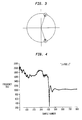
- Figure 1 shows a Z-plane diagram for a second order digital filter.
- Figure 2 depicts in block diagram form a generalized adaptive digital filter.
- Figure 3 shows a Z-plane diagram for a second order IIR digital notch filter.
- Figures 4 & 5 provide plots of Frequency Estimate and Signal-to-Error Ratio for an IIR adaptive tone detector developed according to the method of the invention.
- Figure 6 shows the frequency gain characteristic for such an IIR adaptive tone detector.
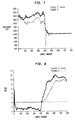
- Figures 7 & 8 provide a comparison of the performance of fixed-radius and adaptive-radius IIR tone detectors developed according to the method of the invention.
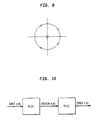
- Figure 9 shows the Z-plane pole-zero plot for a dual-tone generator.
- Figure 10 shows in block diagram form the detection of dual tones according to the method of the invention.
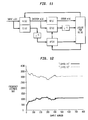
- Figure 11 provides a block diagram showing further detail of a multitone frequency detector according to the invention.
- Figures 12 & 13 show Frequency Estimation and Signal-To-Error Ratio for a dual-tone detector developed according to the method of the invention.
- Figures 14 & 15 show the corresponding performance of such a dual-tone in the case of signal power and noise power being equal.
- an algorithm may be seen as a self-contained sequence of steps leading to a desired result. These steps generally involve manipulations of physical quantities. Usually, though not necessarily, these quantities take the form of electrical or magnetic signals capable of being stored, transferred, combined, compared and otherwise manipulated. For convenience of reference, as well as to comport with common usage, these signals will be described from time to time in terms of bits, values, elements, symbols, characters, terms, numbers, or the like. However, it should be emphasized that these and similar terms are to be associated with the appropriate physical quantities -- such terms being merely convenient labels applied to those quantities.
- the present invention relates to methods for operating a computer in processing electrical or other (e.g., mechanical, chemical) physical signals to generate other desired physical signals.
- processors For clarity of explanation, the illustrative embodiment of the present invention is presented as comprising individual functional blocks (including functional blocks labeled as "processors"). The functions these blocks represent may be provided through the use of either shared or dedicated hardware, including, but not limited to, hardware capable of executing software. For example the functions of processors presented in Figures 1, 10 & 11 may be provided by a single shared processor. (Use of the term "processor” should not be construed to refer exclusively to hardware capable of executing software.)
- Illustrative embodiments may comprise microprocessor and/or digital signal processor (DSP) hardware, such as the AT&T DSP16 or DSP32C, read-only memory (ROM) for storing software performing the operations discussed below, and random access memory (RAM) for storing results.
- DSP digital signal processor
- ROM read-only memory
- RAM random access memory
- VLSI Very large scale integration
- the main fault of the FIR tone detector is that the width of what is really an adaptive notch-filter is too wide -- an inherent characteristic of FIR notch filters. It follows that significant improvement in the frequency estimate can be realized if the filter that is used is a narrow-band notch filter. Such a narrow-band notch filter can be effected with an Infinite Impulse Response (IIR) filter.
- IIR Infinite Impulse Response
- Equation 6 In a general-case digital filter, there is more than one filter coefficient to adapt. Equation 6 above is then applied for each coefficient. The variable B in Equation 6 is replaced by the coefficient term being adapted, and the equation is used to update each coefficient at a time.
- IIR filter which includes feedback terms
- the adaptation depends upon the gradient of the error signal with respect to the coefficient being adapted. But, for an IIR filter, the error signal depends upon past outputs and the associated coefficients (whereas, for an FIR filter, only past inputs are involved), which in turn depend upon past outputs and the associated coefficients, and so on back to the origin of time.
- the closed form of the gradient term in Equation 6 is difficult to derive and complex to implement (which bears heavily upon real-time design constraints).
- pole positions may adapt to points outside the unit circle. Once this happens it is highly likely that the filter will become unstable -- producing wildly large outputs in response to perhaps infinitesimal inputs.
- a Z-plane pole-zero plot for a second-order IIR digital notch filter is shown in Figure 3.
- the argument to the cos( ) function is the angle of the zeroes (and, as well, the poles) of the filter.
- the radius of the poles in the figure is the variable ⁇ in Equation 12.
- the filter will be stable.
- the sharper the notch i.e. the narrower the notch-band
- the step response of the filter increases as the poles approach the unit circle.
- Equation 3 Equation 13: where E ( z ) and Y ( z ) are the Z transforms of e(n) and y(n) respectively, C ( z ) is a defined function of Y ( z ), and c ( n ) is the inverse Z transform of C( z ).
- ⁇ e ( n ) 2[cos( ⁇ T )- B ( n )] c (
- Equation 15 shows that the function c(n-1) is exactly in phase with e(n) when the necessary correction to B is positive and exactly out of phase with e(n) when the necessary correction to B is negative. Therefore the product e(n)c(n-1) is always of the same sign as the necessary correction to B.
- B ( n +1) B ( n )+ ⁇ e n c n -1 ⁇ c 2 where the normalization with respect to the power in the c(n) signal is added for the same reason the normalization was added in the case of the adaptive FIR tone detector.
- Figures 4 and 5 provide plots of Frequency Estimate and Signal-to-Error Ratio for this IIR adaptive tone detector, based on the following illustrative characteristics:
- the average frequency estimate of the last 200 samples is 1000.81 Hz.
- the range of the last 200 frequency estimates is 989.337 Hz to 1010.52 Hz.
- an adaptive IIR filter is hereafter described which overcomes a limitation of the previously described IIR filter. It was noted in the Background section that an FIR filter has the characteristic of converging quickly, although to the wrong answer when significant additive white noise is present. The general IIR filter, on the other hand, converges slower, but to a much more accurate answer. In this further embodiment of the invention, a methodology, in the nature of a hybrid of an FIR filter and an IIR filter, is described for achieving a faster, more accurate filter.
- an FIR filter is an IIR filter with the pole radii set to 0, and would accordingly be expected to have a quicker step response.
- the approach then for this further embodiment is to start the IIR filter with the pole radius set to 0 and increase it slowly toward 1.0, as the apparent signal-to-error ratio is above a decided threshold.
- Filter stability is guaranteed by ensuring that, after the radius is increased in accordance with Equation 17, the radius value is clipped at some set threshold.
- a limit of ⁇ max 0.99 was used.
- Figures 7 and 8 also provide a comparison of the performance of the fixed-radius and adaptive-radius IIR tone detectors. Both filters were presented with the same input stream. In the case of the fixed-radius filter, the step size that exhibited the best performance was 0.05. In the case of the adaptive-radius filter, the step size that exhibited the best performance was 0.01. The curves in solid lines in the figures represent the adaptive-radius filter and the curves in dotted lines represent the fixed-radius filter.
- the average of the last 200 frequency estimates of the adaptive-radius IIR filter is 999.443 Hz.
- the range of the last 200 frequency estimates is 997.895 Hz to 1000.49 Hz.
- the high-performance single-frequency tone detector described in the previous section can now be used as a building block to construct a multiple-tone detector.
- a dual-tone generator shown in Figure 9 (the zero at the origin is fourth-order).
- the transfer function for such a generator is:
- the approach, then, of the methodology of the invention is to build a dual-tone detector by cascading two single-tone detectors (using the single-tone methodology described above), and adapting each one to detect one tone (not the tone that the other block is seeking).
- the conceptual arrangement is shown in block diagram form in Figure 10.
- the second block functions exactly like the single-frequency tone detector developed above: Its error output is the error output of the entire cascaded system, and its input is w(n). Therefore the update equation for the second block is:
- Equations 17, 18, 24 and 26 are therefore the update equations for the adaptive-radius adaptive IIR dual-tone detector. A block diagram of this process is shown in Figure 11.
- Figures 12 and 13 show the frequency-estimation and signal-to-noise-ratio performance of the dual-tone detector based on the following exemplary characteristics:
- Figures 14 & 15 show the performance of the filter when the noise power is raised to -17 dBm. In such a case, the noise power and the power of each tone is the same.
- the average of the last 200 frequency estimates is 996.635 Hz and 3001.25 Hz.
- the range of frequency estimates for the block that adapted to the 1 Khz tone is 985.226 Hz to 1008.00 Hz.
- the range of frequency estimates for the block that adapted to the 3 Khz tone is 2998.04 Hz to 3006.12 Hz.
- this filter can be used to cancel out interference in an input stream when the interference consists of added tones.
- the frequency estimate variables (B) one can determine the frequencies of the tones in the input stream.
- the state variables of the filter one can determine both the amplitude and the phases of the tones.
- the input, error output, and interim signals i.e. the w(n) signal in the dual-frequency case
Landscapes
- Engineering & Computer Science (AREA)
- Computer Networks & Wireless Communication (AREA)
- Signal Processing (AREA)
- Filters That Use Time-Delay Elements (AREA)
- Digital Transmission Methods That Use Modulated Carrier Waves (AREA)
- Measurement Of Mechanical Vibrations Or Ultrasonic Waves (AREA)
Applications Claiming Priority (2)
| Application Number | Priority Date | Filing Date | Title |
|---|---|---|---|
| US08/615,547 US5734577A (en) | 1996-03-11 | 1996-03-11 | Adaptive IIR multitone detector |
| US615547 | 1996-03-11 |
Publications (2)
| Publication Number | Publication Date |
|---|---|
| EP0795986A2 true EP0795986A2 (fr) | 1997-09-17 |
| EP0795986A3 EP0795986A3 (fr) | 2000-11-22 |
Family
ID=24465863
Family Applications (1)
| Application Number | Title | Priority Date | Filing Date |
|---|---|---|---|
| EP97301456A Ceased EP0795986A3 (fr) | 1996-03-11 | 1997-03-04 | Détecteur de signaux à multifréquence employant un filter IIR adaptatif |
Country Status (4)
| Country | Link |
|---|---|
| US (1) | US5734577A (fr) |
| EP (1) | EP0795986A3 (fr) |
| JP (1) | JPH09307402A (fr) |
| CA (1) | CA2196010C (fr) |
Cited By (3)
| Publication number | Priority date | Publication date | Assignee | Title |
|---|---|---|---|---|
| RU2169993C1 (ru) * | 1999-12-23 | 2001-06-27 | Ишмухаметов Башир Гарифович | Приемник последовательных многочастотных сигналов |
| RU2207732C2 (ru) * | 2000-03-01 | 2003-06-27 | Сибирский государственный университет телекоммуникаций и информатики | Способ приема параллельного многочастотного составного сигнала и устройство для его осуществления |
| WO2006092571A1 (fr) | 2005-03-04 | 2006-09-08 | Ttpcom Limited | Filtre accordable pour detection de tonalite |
Families Citing this family (19)
| Publication number | Priority date | Publication date | Assignee | Title |
|---|---|---|---|---|
| DE19605023C2 (de) * | 1996-01-31 | 1999-08-05 | Siemens Ag | Verfahren zum Erfassen einer sprunghaften Änderung einer elektrischen Wechselgröße |
| US5995557A (en) * | 1997-06-12 | 1999-11-30 | Nortel Networks Corporation | Tone detection with aliasing bandpass filters |
| US6711205B1 (en) * | 1998-09-25 | 2004-03-23 | Intel Corporation | Tone detector for use in a modem |
| US6661848B1 (en) | 1998-09-25 | 2003-12-09 | Intel Corporation | Integrated audio and modem device |
| US6711206B1 (en) | 1998-09-25 | 2004-03-23 | Intel Corporation | Modem using a digital signal processor and separate transmit and receive sequencers |
| US6374312B1 (en) * | 1998-09-25 | 2002-04-16 | Intel Corporation | System for dedicating a host processor to running one of a plurality of modem programs and dedicating a DSP to running another one of the modem programs |
| JP3721003B2 (ja) * | 1999-04-01 | 2005-11-30 | 沖電気工業株式会社 | トーン信号検出方法及びトーン信号検出器 |
| US6850616B2 (en) * | 2001-01-22 | 2005-02-01 | Cirrus Logic, Inc. | Frequency error detection methods and systems using the same |
| CA2349041A1 (fr) * | 2001-05-28 | 2002-11-28 | Alireza Karimi Ziarani | Systeme et methode d'extraction de sinusoides a caracteristiques variables dans le temps |
| US6674397B2 (en) * | 2002-05-13 | 2004-01-06 | Honeywell International Inc. | Methods and apparatus for minimum computation phase demodulation |
| JP2005229312A (ja) * | 2004-02-12 | 2005-08-25 | Daihen Corp | 適応型ディジタルフィルタ |
| US7254200B2 (en) * | 2004-05-13 | 2007-08-07 | Hellosoft, Inc. | System and method for frequency burst detection for GSM/GPRS |
| US7428281B2 (en) * | 2004-08-31 | 2008-09-23 | Texas Instruments Incorporated | System and method of removing discrete spurious signals in cable broadband and other RF environments |
| US8064542B1 (en) * | 2006-03-16 | 2011-11-22 | Marvell International Ltd. | Systems and methods for I/Q imbalance correction and calibration of variable modulus signals |
| JP6079045B2 (ja) * | 2012-08-21 | 2017-02-15 | 沖電気工業株式会社 | ハウリング抑圧装置及びプログラム、並びに、適応ノッチフィルタ及びプログラム |
| JP6098992B2 (ja) * | 2013-01-03 | 2017-03-22 | 有限会社シー・アンド・エス国際研究所 | デジタルノッチフィルタ |
| TWI503687B (zh) * | 2013-08-08 | 2015-10-11 | Univ Asia | 適應性線性時變濾波方法 |
| JP7238415B2 (ja) * | 2019-01-17 | 2023-03-14 | 沖電気工業株式会社 | 単一周波数信号検出装置及び単一周波数検出方法 |
| CN111678584A (zh) * | 2020-06-17 | 2020-09-18 | 珠海任驰光电科技有限公司 | 一种带光源频移校准辅助通道的光纤振动测量装置及方法 |
Family Cites Families (5)
| Publication number | Priority date | Publication date | Assignee | Title |
|---|---|---|---|---|
| US4403298A (en) * | 1981-06-15 | 1983-09-06 | Bell Telephone Laboratories, Incorporated | Adaptive techniques for automatic frequency determination and measurement |
| JP2775651B2 (ja) * | 1990-05-14 | 1998-07-16 | カシオ計算機株式会社 | 音階検出装置及びそれを用いた電子楽器 |
| US5317524A (en) * | 1991-09-19 | 1994-05-31 | Allied-Signal Inc. | Spectral signal analyzer system |
| US5179542A (en) * | 1991-12-31 | 1993-01-12 | Raytheon Company | Signal processor |
| DE4316297C1 (de) * | 1993-05-14 | 1994-04-07 | Fraunhofer Ges Forschung | Frequenzanalyseverfahren |
-
1996
- 1996-03-11 US US08/615,547 patent/US5734577A/en not_active Expired - Lifetime
-
1997
- 1997-01-27 CA CA002196010A patent/CA2196010C/fr not_active Expired - Fee Related
- 1997-02-14 JP JP9030098A patent/JPH09307402A/ja active Pending
- 1997-03-04 EP EP97301456A patent/EP0795986A3/fr not_active Ceased
Non-Patent Citations (2)
| Title |
|---|
| CAIN G D ET AL: "REAL-TIME IIR NOTCH FILTERING USING DARWINIAN ADAPTION" PROCEEDINGS OF THE INTERNATIONAL SYMPOSIUM ON CIRCUITS AND SYSTEMS,US,NEW YORK, IEEE, vol. SYMP. 24, 11 June 1991 (1991-06-11), pages 432-435, XP000384801 ISBN: 0-7803-0050-5 * |
| NEHORAI A: "A MINIMAL PARAMETER ADAPTIVE NOTCH FILTER WITH CONSTRAINED POLES AND ZEROS" IEEE TRANSACTIONS ON ACOUSTICS, SPEECH AND SIGNAL PROCESSING,US,IEEE INC. NEW YORK, vol. ASSP-33, no. 4, 1 August 1985 (1985-08-01), pages 983-996, XP000676139 * |
Cited By (4)
| Publication number | Priority date | Publication date | Assignee | Title |
|---|---|---|---|---|
| RU2169993C1 (ru) * | 1999-12-23 | 2001-06-27 | Ишмухаметов Башир Гарифович | Приемник последовательных многочастотных сигналов |
| RU2207732C2 (ru) * | 2000-03-01 | 2003-06-27 | Сибирский государственный университет телекоммуникаций и информатики | Способ приема параллельного многочастотного составного сигнала и устройство для его осуществления |
| WO2006092571A1 (fr) | 2005-03-04 | 2006-09-08 | Ttpcom Limited | Filtre accordable pour detection de tonalite |
| US8270458B2 (en) | 2005-03-04 | 2012-09-18 | Mstar Semiconductor, Inc. | Tunable filter for tone detection |
Also Published As
| Publication number | Publication date |
|---|---|
| EP0795986A3 (fr) | 2000-11-22 |
| JPH09307402A (ja) | 1997-11-28 |
| CA2196010C (fr) | 1999-11-16 |
| US5734577A (en) | 1998-03-31 |
| CA2196010A1 (fr) | 1997-09-11 |
Similar Documents
| Publication | Publication Date | Title |
|---|---|---|
| US5734577A (en) | Adaptive IIR multitone detector | |
| Streit et al. | Frequency line tracking using hidden Markov models | |
| US4232192A (en) | Moving-average notch filter | |
| Jacobsen et al. | The sliding DFT | |
| Pierce et al. | Multiple diversity with nonindependent fading | |
| CN102163972A (zh) | 对adc中非线性的修正 | |
| Ulrych et al. | Autoregressive and mixed autoregressive-moving average models and spectra | |
| US4403298A (en) | Adaptive techniques for automatic frequency determination and measurement | |
| US4839842A (en) | Digital tone detection and generation | |
| US7529363B2 (en) | Tone detector and method therefor | |
| EP0502681B1 (fr) | Système adaptatif pour mesurer un rapport signal à large bande-bruit d'un canal de transmission | |
| US5136531A (en) | Method and apparatus for detecting a wideband tone | |
| Zhu et al. | Design of digital fir filter based on long short-term memory neural network | |
| Gudovskiy et al. | An accurate and stable sliding DFT computed by a modified CIC filter | |
| CN101133655B (zh) | 用于音调检测的可调谐滤波器 | |
| US5790412A (en) | Recursive frequency aging estimation and prediction devices, methods and computer programs for crystal oscillators | |
| WO1999060701A1 (fr) | Procede et dispositif de filtrage d'un signal numerique avec un retard fractionne | |
| Anderson et al. | Real-number convolutional codes for speech-like quasi-stationary sources (Corresp.) | |
| Lee et al. | Realization of adaptive digital filters using the Fermat number transform | |
| Park et al. | Multiplication-free adaptive digital filters | |
| Jacobsen et al. | Sliding spectrum analysis | |
| Wang et al. | A novel neural networks-based approach for designing FIR filters | |
| Gentili et al. | Evolutionary design of FIR digital filters with power-of-two coefficients | |
| Aguirre et al. | Relationship between the structure and performance of identified nonlinear polynomial models | |
| Hein et al. | Theoretical and numerical aspects of an SVD-based method for band-limiting finite-extent sequences |
Legal Events
| Date | Code | Title | Description |
|---|---|---|---|
| PUAI | Public reference made under article 153(3) epc to a published international application that has entered the european phase |
Free format text: ORIGINAL CODE: 0009012 |
|
| AK | Designated contracting states |
Kind code of ref document: A2 Designated state(s): DE FR GB |
|
| PUAL | Search report despatched |
Free format text: ORIGINAL CODE: 0009013 |
|
| AK | Designated contracting states |
Kind code of ref document: A3 Designated state(s): DE FR GB |
|
| RIC1 | Information provided on ipc code assigned before grant |
Free format text: 7H 04L 27/30 A, 7H 03H 21/00 B |
|
| 17P | Request for examination filed |
Effective date: 20010511 |
|
| STAA | Information on the status of an ep patent application or granted ep patent |
Free format text: STATUS: THE APPLICATION HAS BEEN REFUSED |
|
| 18R | Application refused |
Effective date: 20061006 |