EP0796229B1 - Verfahren zur herstellung von glaskapillaren und deren verwendung - Google Patents
Verfahren zur herstellung von glaskapillaren und deren verwendung Download PDFInfo
- Publication number
- EP0796229B1 EP0796229B1 EP95940995A EP95940995A EP0796229B1 EP 0796229 B1 EP0796229 B1 EP 0796229B1 EP 95940995 A EP95940995 A EP 95940995A EP 95940995 A EP95940995 A EP 95940995A EP 0796229 B1 EP0796229 B1 EP 0796229B1
- Authority
- EP
- European Patent Office
- Prior art keywords
- capillaries
- glass tube
- cavity
- glass
- capillary
- Prior art date
- Legal status (The legal status is an assumption and is not a legal conclusion. Google has not performed a legal analysis and makes no representation as to the accuracy of the status listed.)
- Expired - Lifetime
Links
Images
Classifications
-
- C—CHEMISTRY; METALLURGY
- C03—GLASS; MINERAL OR SLAG WOOL
- C03B—MANUFACTURE, SHAPING, OR SUPPLEMENTARY PROCESSES
- C03B23/00—Re-forming shaped glass
- C03B23/04—Re-forming tubes or rods
- C03B23/057—Re-forming tubes or rods by fusing, e.g. for flame sealing
-
- C—CHEMISTRY; METALLURGY
- C03—GLASS; MINERAL OR SLAG WOOL
- C03B—MANUFACTURE, SHAPING, OR SUPPLEMENTARY PROCESSES
- C03B23/00—Re-forming shaped glass
- C03B23/04—Re-forming tubes or rods
- C03B23/047—Re-forming tubes or rods by drawing
- C03B23/0473—Re-forming tubes or rods by drawing for forming constrictions
-
- G—PHYSICS
- G21—NUCLEAR PHYSICS; NUCLEAR ENGINEERING
- G21K—HANDLING OF PARTICLES OR IONISING RADIATION NOT OTHERWISE PROVIDED FOR; IRRADIATION DEVICES; GAMMA RAY OR X-RAY MICROSCOPES
- G21K1/00—Arrangements for handling particles or ionising radiation, e.g. focusing or moderating
- G21K1/06—Arrangements for handling particles or ionising radiation, e.g. focusing or moderating using diffraction, refraction or reflection, e.g. monochromators
Definitions
- the invention relates to a method for producing capillaries according to the preamble of claim 1, and their Use.
- Capillary technology began in 1970 when cylindrical was first used Capillaries used for beam transmission in X-ray tubes were. At the beginning of the 80s, conical capillaries became used for focusing. These capillaries can use x-rays focus from 4 to 8 keV.
- GB-A-1096361 describes the production of capillaries, the opening of which is less than 50 in diameter ⁇ m. Tubes are used for this, their inner diameter has a diameter of not more than 100 microns. An air bubble is now enclosed in this tube by heating. Subsequent heating of the area to the air bubble expands to the thin liquid of the material and forms an elongated cavity with tapered ends.
- this cavity becomes a capillary drawn.
- This capillary also ends in tips, however, has no elliptical shape.
- EP-A-0 748 299 which falls under Article 54 (3) EPC, is the manufacture by pulling capillaries described for focusing X-rays.
- the object of the invention is to provide a method of e. G. Kind of like that to design that capillaries with optimal focusing properties can be produced.
- Heavy metal additives not only increase the reflectivity for x-rays, but also improve the options for capillary production through lower operating temperature and longer intervention time ("long" glass).
- the capillaries become thinner, more homogeneous and smoother. In the preparation of are lower operating temperatures and higher drawing speeds possible.
- the heavy metal content should be so high that an optimal one Focusing of the X-rays used is achieved.
- the heavy metal content can be between 0 and 60% by weight.
- the ideal capillary shape results from elementary geometric Considerations and subsequent detailed calculations.
- Convex shapes are e.g. B. the paraboloid and the ellipsoid.
- the paraboloid combines incident radiation in one Point, while the ellipsoid bundles radiation from a point source.
- the ellipsoid In the case of an X-ray tube or radiation emitted by a synchrotron is more likely to be from one Point source can be assumed.
- the ellipsoid is therefore considered the ideal form.
- the ellipsoid combines the Rays that arise in one focus, in the other.
- the diameter of the electron beam on the beam L of the synchrotron DORIS III is 1 mm for a fine focus tube can be reached 0.1 mm. In these cases the ellipse is confirmed as the ideal shape by more detailed calculations.
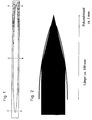
- FIG. 1 shows a drawn ellipsoid and FIG. 2. an example with dimensions.
- the capillaries are manufactured in a multi-stage process Method.
- a gas bubble is placed in a glass rod melted down.
- the Bladder elongates, its diameter shrinks.
- the emerging Ellipsoid has a semi-axis ratio of at least 1,000: 1.
- the capillary cut in the middle and the two ends are opened. The three levels for these separation operations are in FIG. 1 shown.
- a cavity is made into a glass rod melted down, the perfect by the surface tension achieved spherical symmetry.
- the creation of this cavity is made from a glass tube, which is initially in one place is collapsed by heating. At some distance it will Tube collapsed a second time. The resulting cavity has at this point in time exactly the volume that later which will have spherical inclusion.
- This Volume i.e. by the distance between the two collapsed
- the total volume of the resulting capillaries becomes points from each other fixed.
- the volume is calculated as one Cylinder with the diameter equal to the inside diameter of the used glass tube and the length of the unaffected tube plus the tapered sections on the two collapsed areas.
- V 1 / 4 ⁇ * pd2 (1 + 2/3 l ')
- Knowing the melted volume allows the calculation the diameter of the resulting spherical cavity.
- the radius can be used of the cavity and the process conditions the shape of the capillary predict.
- the dimensions also result from the following equations (3.3).
- the glass rod is made using a capillary drawing machine through a possibly computer-controlled glass drawing process stretched.
- the GDM-1B capillary drawing machine the Herbert Arnold company in Weilburg / Lahn has in their Basic equipment via a gearbox in 10 stages adjustable actuator with a speed of 5 - 25 mm / min, an electrically heated furnace with a temperature up to 950 ° C and a constancy of better than 5 °, as well as one constant output with 800 mm / min. This results in a draw ratio from 32: 1 to 160: 1.
- the ellipse is characterized by the two variables a and b, which measured the large or small semi-axis. Of the The distance between the two foci of an ellipse is 2c, where c to (a2 - b2) 1/2.
- the distance of the focal plane can be determined from the semi-axis ratio calculate from the end of the ellipsoidal cavity.
- the focal plane is therefore almost at the end of the capillary.
- the opening results from the required working distance of 1 mm the capillary at the exit according to the equation below.
- the outer diameter of the glass tube is determined by the same Laws like the inside diameter. Currently glass rods initially used with 10 mm. This creates capillaries with 0.8 mm outer diameter, which is mechanically stable are enough to be easy to handle.
- any existing ones are added Surface roughness down to less than 1 nm "smoothed out" so that even hard X-rays on the Surface is totally reflected.
- the method described above can be controlled by a computer.
- the formerly constant downforce is made variable in its speed.
- any desired aspect ratio can be infinitely selected.
- the computer calculates the aspect ratio as Function of time and gives this information to the controller the stepper motor. According to the specifications Capillary removed from the machine.
Landscapes
- Chemical & Material Sciences (AREA)
- Engineering & Computer Science (AREA)
- Materials Engineering (AREA)
- Organic Chemistry (AREA)
- Physics & Mathematics (AREA)
- General Engineering & Computer Science (AREA)
- Spectroscopy & Molecular Physics (AREA)
- High Energy & Nuclear Physics (AREA)
- Exposure And Positioning Against Photoresist Photosensitive Materials (AREA)
- Analysing Materials By The Use Of Radiation (AREA)
- Glass Compositions (AREA)
- Microscoopes, Condenser (AREA)
- Re-Forming, After-Treatment, Cutting And Transporting Of Glass Products (AREA)
Description
- das Expansionsverhalten im Ziehbereich, durch die Poissonzahl µ
- den Erweichungsbereich (Transformationsbereich)
- den Ziehbereich (ca. 150 - 200° höher als der Erweichungsbereich)
- das Temperaturintervall, in dem die Viskosität zwischen 104 und 108 Poise liegt.
- senkt den Beginn von Erweichungs- und Ziehbereich und vergrößert diese Bereiche,
- vergrößert das Temperaturintervall, in dem die für das Ziehen notwendige Viskosität von 104 und 108 Poise vorliegt und
- verlängert damit die Bearbeitungszeit.
d der Durchmesser des Rohres, 1 die Länge des zylindrischen Teils des Einschlusses, 1' die Länge eines der beiden kegelförmigen Endstücke, V das Volumen des Einschlusses, dann gilt:
r der Radius des sphärischen Hohlraums, π die Zahl Pi,
dann gilt:
- n
- das Verstreckungsverhältnis,
- d
- der Durchmesser des Hohlraums,
- l
- die Länge des Ellipsoiden,
- d'
- der Durchmesser des Ellipsoiden,
a:b das Halbachsenverhältnis,
f der Abstand der Fokalebene,
dann gilt:
- n
- das Verstreckungsverhältnis,
- a
- die große Halbachse,
- döff
- der Austrittsdurchmesser,
- Röntgendiffraktion an Kristallen
- Strukturaufklärung von Biogroßmolekülen durch Diffraktion
- Ortsaufgelöste Röntgenfluoreszenz mit Röhren
- Verbesserung der Nachweisgrenzen bei der Röntgenfluoreszenz
- Medizinische Anwendungen, bei denen kleine Strahlquerschnitte erforderlich sind
- Mikrotomographie
- Röntgenabsorption im Mikro- und Nanobereich
- Röntgenlithographie
- Röntgenmikroskopie.
Claims (4)
- Verfahren zur Herstellung von Glaskapillaren durch Erhitzen und Ziehen einer Glasröhre, wobei durch Erhitzen der Glasröhre diese an zwei benachbarten Positionen durch Kollabieren verschlossen wird, dadurch gekennzeichnet, daß die Glasröhre erst an einer, dann an einer benachbarten Position erhitzt und durch Kollabieren verschlossen wird, der gesamte Bereich der Glasröhre zwischen den beiden kollabierten Stellen erhitzt wird, wobei sich durch die Oberflächenspannung ein kugelförmiger Hohlraum sphärischer Symmetrie bildet und dieser Hohlraum in eine langgestreckte Form gezogen wird, wobei die Temperatur während des Ziehprozesses innerhalb eines Bereiches von kleiner als 5° C konstant gehalten und durch die Abstimmung von Ziehtemperatur und Ziehgeschwindigkeit ein Ellipsoid gebildet wird.
- Verfahren nach Anspruch 1, dadurch gekennzeichnet, daß Glassorten mit Schwermetallanteil verwendet werden.
- Verfahren nach Anspruch 1 oder 2, dadurch gekennzeichnet, daß die Kapillare in der Mitte zerteilt und an ihren Enden geöffnet wird.
- Verwendung der Kapillaren, hergestellt durch ein Verfahren gemäß Anspruch 3 zur Fokussierung von Röntgenstrahlung.
Applications Claiming Priority (3)
| Application Number | Priority Date | Filing Date | Title |
|---|---|---|---|
| DE4444102 | 1994-12-10 | ||
| DE4444102A DE4444102C1 (de) | 1994-12-10 | 1994-12-10 | Verfahren zur Herstellung von Glaskapillaren und deren Verwendung |
| PCT/EP1995/004591 WO1996018584A1 (de) | 1994-12-10 | 1995-11-22 | Verfahren zur herstellung von glaskapillaren und deren verwendung |
Publications (2)
| Publication Number | Publication Date |
|---|---|
| EP0796229A1 EP0796229A1 (de) | 1997-09-24 |
| EP0796229B1 true EP0796229B1 (de) | 1998-10-21 |
Family
ID=6535517
Family Applications (1)
| Application Number | Title | Priority Date | Filing Date |
|---|---|---|---|
| EP95940995A Expired - Lifetime EP0796229B1 (de) | 1994-12-10 | 1995-11-22 | Verfahren zur herstellung von glaskapillaren und deren verwendung |
Country Status (4)
| Country | Link |
|---|---|
| EP (1) | EP0796229B1 (de) |
| AT (1) | ATE172444T1 (de) |
| DE (2) | DE4444102C1 (de) |
| WO (1) | WO1996018584A1 (de) |
Families Citing this family (3)
| Publication number | Priority date | Publication date | Assignee | Title |
|---|---|---|---|---|
| JPH09329557A (ja) * | 1996-06-11 | 1997-12-22 | Seiko Instr Inc | マイクロ蛍光x線分析装置 |
| DE19852722C1 (de) * | 1998-11-16 | 2000-06-15 | Karlsruhe Forschzent | Verfahren zur Innenbeschichtung von Kapillaren und deren Verwendung |
| CN115212937A (zh) * | 2022-07-14 | 2022-10-21 | 上海交通大学医学院附属第九人民医院 | 用于细胞显微取样装样的玻璃管、制作方法及其使用方法 |
Family Cites Families (4)
| Publication number | Priority date | Publication date | Assignee | Title |
|---|---|---|---|---|
| NL6406270A (de) * | 1964-06-03 | 1965-12-06 | ||
| US5101422A (en) * | 1990-10-31 | 1992-03-31 | Cornell Research Foundation, Inc. | Mounting for X-ray capillary |
| JPH05107571A (ja) * | 1991-10-14 | 1993-04-30 | Showa Electric Wire & Cable Co Ltd | キヤピラリの製造方法 |
| SE9400729D0 (sv) * | 1994-03-03 | 1994-03-03 | Anders Rindby | Metod för tillverkning av elliptiskt formade glas kapillärer |
-
1994
- 1994-12-10 DE DE4444102A patent/DE4444102C1/de not_active Expired - Fee Related
-
1995
- 1995-11-22 EP EP95940995A patent/EP0796229B1/de not_active Expired - Lifetime
- 1995-11-22 DE DE59504021T patent/DE59504021D1/de not_active Expired - Fee Related
- 1995-11-22 AT AT95940995T patent/ATE172444T1/de not_active IP Right Cessation
- 1995-11-22 WO PCT/EP1995/004591 patent/WO1996018584A1/de not_active Ceased
Also Published As
| Publication number | Publication date |
|---|---|
| ATE172444T1 (de) | 1998-11-15 |
| DE59504021D1 (de) | 1998-11-26 |
| DE4444102C1 (de) | 1996-03-28 |
| EP0796229A1 (de) | 1997-09-24 |
| WO1996018584A1 (de) | 1996-06-20 |
Similar Documents
| Publication | Publication Date | Title |
|---|---|---|
| EP2556397B1 (de) | Verfahren und anordnung zum erzeugen eines laserstrahls mit unterschiedlicher strahlprofilcharakteristik mittels einer mehrfachclad-faser | |
| DE60313403T2 (de) | Design einer Sondenspitze für ein optisches Nahfeldmikroskop | |
| DE2937257C2 (de) | Verfahren zur Herstellung eines geordneten Faserbündels zur Bildübertragung | |
| DE2723972C2 (de) | Optisches Kopplungselement sowie Positioniervorrichtungen für derartige Elemente | |
| DE60005486T3 (de) | Doppelbrechende photonische kristallfasern und methoden zu ihrer herstellung | |
| DE19705732A1 (de) | Verfahren zur Herstellung von monolithischen kapillaren Röntgenstrahl-Linsen, monolithische kapillare Röntgenstrahl-Linse und eine solche Linse verwendende Einrichtungen | |
| EP1770417B1 (de) | Optische Faser und Verfahren zu ihrer Herstellung | |
| DE2351354B2 (de) | Verfahren zur herstellung einer optischen faser aus quarzglas | |
| DE69609846T2 (de) | Optische Faser aus Chalcogenidglas | |
| EP4015473A1 (de) | Antiresonanzelementvorformling zur herstellung einer antiresonanten hohlkernfaser | |
| DE10112928C1 (de) | Kapillaroptisches Element bestehend aus Kanäle bildenden Kapillaren und Verfahren zu dessen Herstellung | |
| DE2907650C3 (de) | Multimode-Lichtleiter | |
| DE4411330C2 (de) | Verfahren zur Herstellung von polykapillaren oder monokapillaren Elementen sowie Verwendungen der Elemente | |
| DE3201342C2 (de) | Optische Faser für Einmodenwelle mit einer einzigen Polarisation und Verfahren zu ihrer Herstellung | |
| DE102019218995A1 (de) | Verfahren und optisches System zum Laserstrahl-Modifizieren eines für den Laserstrahl zumindest weitgehend transparenten Materials | |
| DE60123199T2 (de) | Vorrichtung und Verfahren zur Herstellung einer optischen Apertur | |
| DE4444102C1 (de) | Verfahren zur Herstellung von Glaskapillaren und deren Verwendung | |
| DE1237802B (de) | Verfahren zur Herstellung einer Faseroptik aus verschmolzenen Faeden | |
| DE60030411T2 (de) | Optisches System zur Homogenisierung von Lichtstrahlen mit variablem Ausgangs-Querschnitt | |
| DE2004955C3 (de) | Verfahren zur Herstellung einer Lichtleitfaser | |
| DE4206182C2 (de) | Bauteil für die Übertragung von energiereichem Licht und Verwendung des Bauteils | |
| DE102009031476B4 (de) | Röntgenrolllinse | |
| DE102022104180A1 (de) | Abschirmmaske für ionisierende Streustrahlung und Verfahren zu dessen Herstellung | |
| DE4339666C1 (de) | Strahlenablenkungssystem | |
| DE1949275B2 (de) | Verfahren zur herstellung einer optischen gradientenfaser aus glas |
Legal Events
| Date | Code | Title | Description |
|---|---|---|---|
| PUAI | Public reference made under article 153(3) epc to a published international application that has entered the european phase |
Free format text: ORIGINAL CODE: 0009012 |
|
| 17P | Request for examination filed |
Effective date: 19970502 |
|
| AK | Designated contracting states |
Kind code of ref document: A1 Designated state(s): AT CH DE FR GB LI |
|
| 17Q | First examination report despatched |
Effective date: 19970827 |
|
| GRAG | Despatch of communication of intention to grant |
Free format text: ORIGINAL CODE: EPIDOS AGRA |
|
| GRAG | Despatch of communication of intention to grant |
Free format text: ORIGINAL CODE: EPIDOS AGRA |
|
| GRAH | Despatch of communication of intention to grant a patent |
Free format text: ORIGINAL CODE: EPIDOS IGRA |
|
| GRAH | Despatch of communication of intention to grant a patent |
Free format text: ORIGINAL CODE: EPIDOS IGRA |
|
| GRAA | (expected) grant |
Free format text: ORIGINAL CODE: 0009210 |
|
| AK | Designated contracting states |
Kind code of ref document: B1 Designated state(s): AT CH DE FR GB LI |
|
| REF | Corresponds to: |
Ref document number: 172444 Country of ref document: AT Date of ref document: 19981115 Kind code of ref document: T |
|
| REG | Reference to a national code |
Ref country code: CH Ref legal event code: NV Representative=s name: ROTTMANN, ZIMMERMANN + PARTNER AG Ref country code: CH Ref legal event code: EP |
|
| REF | Corresponds to: |
Ref document number: 59504021 Country of ref document: DE Date of ref document: 19981126 |
|
| ET | Fr: translation filed | ||
| GBT | Gb: translation of ep patent filed (gb section 77(6)(a)/1977) |
Effective date: 19990115 |
|
| PLBE | No opposition filed within time limit |
Free format text: ORIGINAL CODE: 0009261 |
|
| STAA | Information on the status of an ep patent application or granted ep patent |
Free format text: STATUS: NO OPPOSITION FILED WITHIN TIME LIMIT |
|
| 26N | No opposition filed | ||
| PGFP | Annual fee paid to national office [announced via postgrant information from national office to epo] |
Ref country code: GB Payment date: 20000822 Year of fee payment: 6 |
|
| PGFP | Annual fee paid to national office [announced via postgrant information from national office to epo] |
Ref country code: DE Payment date: 20000921 Year of fee payment: 6 |
|
| PGFP | Annual fee paid to national office [announced via postgrant information from national office to epo] |
Ref country code: CH Payment date: 20001030 Year of fee payment: 6 |
|
| PGFP | Annual fee paid to national office [announced via postgrant information from national office to epo] |
Ref country code: AT Payment date: 20001123 Year of fee payment: 6 |
|
| PGFP | Annual fee paid to national office [announced via postgrant information from national office to epo] |
Ref country code: FR Payment date: 20001129 Year of fee payment: 6 |
|
| PG25 | Lapsed in a contracting state [announced via postgrant information from national office to epo] |
Ref country code: GB Free format text: LAPSE BECAUSE OF NON-PAYMENT OF DUE FEES Effective date: 20011122 Ref country code: AT Free format text: LAPSE BECAUSE OF NON-PAYMENT OF DUE FEES Effective date: 20011122 |
|
| PG25 | Lapsed in a contracting state [announced via postgrant information from national office to epo] |
Ref country code: LI Free format text: LAPSE BECAUSE OF NON-PAYMENT OF DUE FEES Effective date: 20011130 Ref country code: CH Free format text: LAPSE BECAUSE OF NON-PAYMENT OF DUE FEES Effective date: 20011130 |
|
| REG | Reference to a national code |
Ref country code: GB Ref legal event code: IF02 |
|
| PG25 | Lapsed in a contracting state [announced via postgrant information from national office to epo] |
Ref country code: DE Free format text: LAPSE BECAUSE OF NON-PAYMENT OF DUE FEES Effective date: 20020702 |
|
| GBPC | Gb: european patent ceased through non-payment of renewal fee |
Effective date: 20011122 |
|
| REG | Reference to a national code |
Ref country code: CH Ref legal event code: PL |
|
| PG25 | Lapsed in a contracting state [announced via postgrant information from national office to epo] |
Ref country code: FR Free format text: LAPSE BECAUSE OF NON-PAYMENT OF DUE FEES Effective date: 20020730 |
|
| REG | Reference to a national code |
Ref country code: FR Ref legal event code: ST |
|
| REG | Reference to a national code |
Ref country code: FR Ref legal event code: ST |