EP0796607A2 - Funktionalisiertes und polymerisierbares Polymer - Google Patents
Funktionalisiertes und polymerisierbares Polymer Download PDFInfo
- Publication number
- EP0796607A2 EP0796607A2 EP97250080A EP97250080A EP0796607A2 EP 0796607 A2 EP0796607 A2 EP 0796607A2 EP 97250080 A EP97250080 A EP 97250080A EP 97250080 A EP97250080 A EP 97250080A EP 0796607 A2 EP0796607 A2 EP 0796607A2
- Authority
- EP
- European Patent Office
- Prior art keywords
- cooh
- polymer
- alkyl
- unsubstituted
- substituted
- Prior art date
- Legal status (The legal status is an assumption and is not a legal conclusion. Google has not performed a legal analysis and makes no representation as to the accuracy of the status listed.)
- Granted
Links
Classifications
-
- C—CHEMISTRY; METALLURGY
- C08—ORGANIC MACROMOLECULAR COMPOUNDS; THEIR PREPARATION OR CHEMICAL WORKING-UP; COMPOSITIONS BASED THEREON
- C08G—MACROMOLECULAR COMPOUNDS OBTAINED OTHERWISE THAN BY REACTIONS ONLY INVOLVING UNSATURATED CARBON-TO-CARBON BONDS
- C08G61/00—Macromolecular compounds obtained by reactions forming a carbon-to-carbon link in the main chain of the macromolecule
- C08G61/02—Macromolecular compounds containing only carbon atoms in the main chain of the macromolecule, e.g. polyxylylenes
- C08G61/04—Macromolecular compounds containing only carbon atoms in the main chain of the macromolecule, e.g. polyxylylenes only aliphatic carbon atoms
- C08G61/06—Macromolecular compounds containing only carbon atoms in the main chain of the macromolecule, e.g. polyxylylenes only aliphatic carbon atoms prepared by ring-opening of carbocyclic compounds
- C08G61/08—Macromolecular compounds containing only carbon atoms in the main chain of the macromolecule, e.g. polyxylylenes only aliphatic carbon atoms prepared by ring-opening of carbocyclic compounds of carbocyclic compounds containing one or more carbon-to-carbon double bonds in the ring
-
- A—HUMAN NECESSITIES
- A61—MEDICAL OR VETERINARY SCIENCE; HYGIENE
- A61K—PREPARATIONS FOR MEDICAL, DENTAL OR TOILETRY PURPOSES
- A61K6/00—Preparations for dentistry
- A61K6/70—Preparations for dentistry comprising inorganic additives
- A61K6/71—Fillers
- A61K6/77—Glass
-
- C—CHEMISTRY; METALLURGY
- C08—ORGANIC MACROMOLECULAR COMPOUNDS; THEIR PREPARATION OR CHEMICAL WORKING-UP; COMPOSITIONS BASED THEREON
- C08G—MACROMOLECULAR COMPOUNDS OBTAINED OTHERWISE THAN BY REACTIONS ONLY INVOLVING UNSATURATED CARBON-TO-CARBON BONDS
- C08G61/00—Macromolecular compounds obtained by reactions forming a carbon-to-carbon link in the main chain of the macromolecule
- C08G61/12—Macromolecular compounds containing atoms other than carbon in the main chain of the macromolecule
Definitions
- the invention relates to a functionalized and polymerizable polymer, a process for its production, its use and compositions containing the polymer.
- Polymers functionalized by carboxyl groups such as poly (acrylic acid) and poly (methacrylic acid) and homopolymers and copolymers based on maleic acid or fumaric acid, are widely used in industry. They are used, inter alia, as flocculants or thickeners, as a component of coatings or adhesives and as leather or textile auxiliaries (cf.Ullmann's Encyclopedia of Industrial Chemistry, 5th Ed., Vol. A21, VCH Publisher, Weinheim 1992, p. 143 ff. and Encyclopedia of Polymer Science and Engineering, Vol. 9, Wiley & Sons, New York 1987, p. 225 ff.).
- Polyacrylic acid is also used in the dental field as a component of so-called carboxylate cements or of alumosilicate-polyacrylic acid cements (see K. Körber, K. Ludwig, Dental Materials Science and Technology, Thieme-Verlag, Stuttgart-New York 1982, p. 57 ff.) .
- glass ionomer cements have found great practical interest in recent years. They are cements made from mixtures of a Ca-Al-F silicate glass powder be prepared with an aqueous solution, for example an acrylic acid-maleic acid copolymer. They are used as fastening cements, filling materials, underfilling materials, adhesives or fissure sealants in the dental field (cf. AD Wilson, JD McLean, Glasionomerzement, Quintessens-Verlag, Berlin 1988, p. 21 ff.).
- polycarboxylic acids which carry pendant polymerizable groups.
- Such polycarboxylic acids can be obtained, for example, by polymer-analogous reaction of polyacrylic acid with allyl isocyanate or 2-isocyanatoethyl methacrylate (cf. EP-B-323 120 and SB Mitra, Amer. Chem. Soc., Polym. Div., Polym. Prep.
- Bicyclic methacrylates are also known.
- US-A-4 054 233 discloses the synthesis and polymerization of bicyclo [2.2.1] hept-5-en-2-ylmethyl methacrylate in connection with peroxidically crosslinkable layers.
- bicyclo [2.2.1] hept-5-en-2-ylmethyl methacrylate or borneol methacrylate are used in the production of PVC with improved heat stability.
- CA-A-1 013 095 discloses adhesive polymers based on reaction products of bicycl10 [2.2.1] hept-5-ene-2,3-dicarboxylic acid anhydride with hydroxyalkyl (meth) acrylates, such as, for example, 2-hydroxyethyl methacrylate.
- hydroxyalkyl (meth) acrylates such as, for example, 2-hydroxyethyl methacrylate.
- free-radically crosslinkable polyimides are known which are accessible via 7-oxa-5,6-dicarboxyimid-N-yl-bicyclo [2.2.1] hept-2-enacrylate.
- products of the reaction of dicyclopentadiene with (meth) acrylic acid are also known (cf. S. Teshigahara, Y. Kano, Toso Kenkyu Hokoko, 35 (1991) p. 47 and Chem. Abstr. 116 , 84740).
- the invention is based on the object of providing a functionalized and polymerizable polymer which can be prepared in a simple manner and can be polymerized by free radicals at room temperature, shows high adhesion to various substrates, with reactive fillers, cements forms and can therefore be used in particular as a component of cements, coating materials, adhesives or composites and preferably of dental materials.
- This object is achieved by the functionalized and polymerizable polymer according to claims 1 and 2.
- the present invention also relates to a process for the preparation of the polymer according to claim 3, its use according to claims 4 and 5 and compositions containing the polymer according to claims 6 to 9.
- the polymer is preferably composed of the units (IA) and optionally (IB) and optionally (IC).
- A-B and X in the individual five-membered rings are selected independently of one another.
- alkyl and aryl groups of Z, R 1 , R 2 , R 3 , R 4 and R 5 can optionally with one or more simple functional groups, in particular COOH, OH, C 1 - to C 6 -alkoxy or halogen , be substituted.
- preferred compounds are those in which at least one of the variables of the formula (I) has the preferred definition described above.
- the bicyclic compound (II) or, if appropriate, mixtures of (II) with the bicyclic compound (III) and / or the bicyclic compound (IV) is subjected to a ring-opening metathesis polymerization in the presence of a catalyst and cleaved when protected compounds are used Then reactants from existing protective groups. After the metathesis polymerization, the positions of A and B with the residues attached to them can no longer be distinguished from one another. Instead of (II), (III) and (IV), it is also possible to use those compounds as starting materials in which only the positions of A and B are interchanged with the radicals attached to them.
- Suitable protecting groups are trimethylsilyl and tetrahydropyranyl groups.
- the polymer (I) according to the invention is also accessible by polymer-analogous reaction of the polymer (V) with polymerizable starting materials P-halogen in accordance with the following reaction equation:
- the polymer (V) can be prepared by ring-opening metathesis polymerization of a mixture of the bicyclic compound (VI) with the bicyclic compound (III) and the bicyclic compound (IV) in the presence of a suitable catalyst.
- catalyst systems based on compounds of transition metals from subgroups IV to VIII can be used as catalysts for ring-opening methathesis polymerization (R ⁇ MP) (cf.Encyclopedia of Polymer Science and Engineering, Vol. 9, J. Wiley & Sons, New York 1987, pp.
- aprotic solvents such as THF, benzene, chlorobenzene, toluene, pentane or dichloromethane are used, while with Rucl 3 the ring-opening metathesis polymerization is usually carried out in an aqueous-alcoholic medium.
- the use of 1-alkenes, cis-2-butene-1,4-diol or acrylic acid is particularly suitable for regulating the molar mass of the polymers obtained.
- the temperature at which the polymerization is carried out is normally in the range from 15-60 ° C. when using metal carbenes as catalyst and in the case of Rucl 3, for example, at 40 to 70 ° C.
- bicyclic compounds of the formulas (II), (III), (IV) and (VI) used as starting materials for the preparation of the polymer according to the invention are known or can be prepared in a simple manner by known processes.
- Representatives of the general formula (II) are, for example, bicyclo [2.2.1] hept-5-en-2-ylmethyl allyl ether (VII), bicyclo [2.2.1] hept-5-en-2-ylmethyl acrylate (VIII), bicyclo [2.2.1] hept-2,5-dien-2-ylmethyl methacrylate (IX), 7-oxabicyclo [2.2.1] hept-5-en-2-ylmethyl methacrylate (X), bicyclo [2.2.1] hept-5 -en-2-ylmethyl methacrylate (XI) or the 1: 1 reaction product (XII) of bicyclo [2.2.1] hept-5-en-2,3-dicarboxylic acid anhydride and 2-hydroxyethyl methacrylate, where (XI) and (XII) are known.
- Representatives of the general formula (III) are, for example, bicyclo [2.2.1] hept-5-en-2-carboxylic acid (XIII), bicyclo [2.2.1] hept-5-en-2,3-dicarboxylic acid monomethyl ester (XIV), bicyclo [2.2.1] hept-2,5-diene-2,3-dicarboxylic acid (XV), bicyclo [2.2.1] hept-5-ene-2,3-dicarboxylic acid (XVI) or 7-oxabicyclo [2.2.1 ] hept-5-ene-2,3-dicarboxylic acid (XVII), where (XVI) and (XVII) are known.
- Representatives of the general formula (IV) are, for example, bicyclo [2.2.1] hept-5-en-2,3-dicarboximide (XVIII), bicyclo [2.2.1] hept-2,5-diene-2,3-dicarboxylic acid anhydride ( XIX), bicyclo [2.2.1] hept-2,5-diene-2,3-dicarboxylic acid-N-phenylimide (XX), bicyclo [2.2.1] hept-5-ene-2,3-dicarboxylic anhydride (XXI) or 7-oxabicyclo [2.2.1] hept-5-en-2,3-dicarboxylic anhydride (XXII), where (XXI) and (XXII) (see O.
- the bicyclic compounds of the formulas (II) to (IV) and those of the formula (VI) can be obtained in a simple manner by the Diels-Alder reaction (cf. H. Wollweber, Diels-Alder reaction, G. Thieme-Verlag 1972) of cyclopentadiene or furan with suitable dienophiles, such as maleic acid, acetylenedicarboxylic acid or acrylic acids or their derivatives, and, if appropriate, subsequent modification, for example by reduction, hydrolysis, etherification or esterification, of the bicyclic compounds obtained.
- Diels-Alder reaction cf. H. Wollweber, Diels-Alder reaction, G. Thieme-Verlag 1972
- suitable dienophiles such as maleic acid, acetylenedicarboxylic acid or acrylic acids or their derivatives
- compound (VII) can be synthesized by Diels-Alder reaction of cyclopentadiene with methyl acrylate, subsequent reduction of the bicyclic adduct to 5-norbornene-2-methanol (XXVI) and its etherification with allyl bromide.
- Special polymers according to the invention can be obtained in particular by ring-opening metathesis copolymerization of the known bicyclo [2.2.1] hept-5-en-2-ylmethyl methacrylate (XI) with a trimethylsilyl- or tetrahydropyranyl-protected commercial bicyclo [2.2.1] hept-5- en-2,3-dicarboxylic acid in the presence of a suitable molybdenum-carbene catalyst and subsequent deprotection by acid hydrolysis.
- polymers according to the invention can also be obtained by copolymerizing 7-oxabicyclo [2.2.1] hept-5-en-2-ylmethyl methacrylate (X) with the known 7-oxabicyclo [2.2.1] hept-5-en-2,3- dicarboxylic anhydride (XXII) can be obtained in the presence of ruthenium (III) chloride in an aqueous-alcoholic medium.
- the polymer according to the invention is particularly suitable as constituents of cements, coating materials and composites and in particular of adhesives.
- the polymer according to the invention is particularly preferably used as a dental material or as a component of dental material, in particular as a component of dental adhesives. Its ability proves to be advantageous in that on the one hand it is able to bond with the material to be fastened, e.g. via polymerizable groups such as (meth) acrylate groups, e.g. a composite material, and, on the other hand, can form an interaction with the substrate, such as, in particular, the hard tooth substance, which promotes adhesion, via carboxyl groups.
- the polymer according to the invention When used as a constituent of dental materials, it is usually used in an amount of 0.1 to 60, in particular 1.0 to 40,% by weight, based on the dental material.
- the polymer according to the invention is used in particular with polymerizable organic binders, crosslinking monomers, fillers, reactive fillers, polymerization initiators and / or other additives, such as conventional stabilizers, e.g. Hydroquinone monomethyl ether (MEHQ) or 2,6-di-tert-butyl-4-methylphenol (BHT), UV absorbers, pigments, dyes or solvents, combined.
- MEHQ Hydroquinone monomethyl ether
- BHT 2,6-di-tert-butyl-4-methylphenol
- Suitable polymerizable organic binders are all binders that can be used for a dental material, in particular monofunctional or polyfunctional (meth) acrylates, which alone or can be used in mixtures.
- Preferred examples of these compounds are methyl (meth) acrylate, isobutyl (meth) acrylate, cyclohexyl (meth) acrylate, tetraethylene glycol di (meth) acrylate, triethylene glycol di (meth) acrylate, diethylene glycol di (meth) acrylate, ethylene glycol di (meth) acrylate, polyethylene glycol di ( meth) acrylate, butanediol di (meth) acrylate, hexanediol di (meth) acrylate, decanediol di (meth) acrylate, dodecanediol di (meth) acrylate, bisphenol-A-di (meth) acrylate, trimethylolpropane
- Particularly preferred examples of the last-mentioned products are by reaction of 1 mol of hexamethylene diisocyanate with 2 mol of 2-hydroxyethylene methacrylate, of 1 mol of tri- (6-isocyanatohexyl) biuret with 3 mol of 2-hydroxyethyl methacrylate and of 1 mol of 2,2,4-trimethylhexamethylene diisocyanate available with 2 moles of 2-hydroxyethyl methacrylate.
- the organic binders are usually used in an amount of 0 to 90% by weight in the dental material according to the invention.
- polyfunctional (meth) acrylates in particular triethylene glycol di (meth) acrylate, polyethylene glycol di (meth) acrylate, bis-GMA or urethane di (meth) acrylates, are particularly suitable as crosslinking monomer.
- the crosslinking monomer is usually used in an amount of 0 to 80% by weight in the dental material according to the invention.
- Examples of preferred fillers are quartz, glass ceramic and glass powders, in particular barium silicate glasses, Li / Al silicate glasses and barium glasses, aluminum or silicon oxides, very finely divided silicas, in particular pyrogenic or precipitated silicas, X-ray-opaque fillers such as ytterbium trifluoride.
- the fillers are typically used in an amount of 0 to 85% by weight, based on the dental material.
- Fluoroalumosilicate glasses and other glasses used in glass ionomer cements are particularly suitable as reactive fillers.
- the reactive fillers are usually used in an amount of 0 to 80% by weight in the dental material according to the invention.
- Particularly preferred dental materials according to the invention are light-curing glass ionomer cements, dentin adhesives and compomers.
- the dental materials according to the invention and the polymers according to the invention can be polymerized hot, cold or by light.
- the known peroxides such as dibenzoyl peroxide, dilauroyl peroxide, tert-butyl peroctoate or tert-butyl perbenzoate can be used as initiators for the hot polymerization.
- 2,2'-Azoisobutyronitrile (AIBN), benzpinacol and 2,2'-dialkylbenzpinacols are also suitable.
- benzophenone and its derivatives and benzoin and its derivatives can be used as initiators for the photopolymerization.
- Further preferred photoinitiators are the ⁇ -diketones such as 9,10-phenanthrenequinone, diacetyl, furil, anisil, 4,4'-dichlorobenzil and 4,4'-dialkoxybenzil.
- Camphorquinone is particularly preferably used.
- the group of acylphosphine oxides is also suitable for initiating photopolymerization.
- the photoinitiators are preferably used together with a reducing agent, particularly preferably with an amine, in particular an aromatic amine.
- Radical-producing redox systems for example benzoyl or lauroyl peroxide, are used as initiators for the cold polymerization together with amines such as N, N-dimethyl-p-toluidine, N, N-dihydroxyethyl-p-toluidine or other structurally related amines.
- photoinitiators with different redox systems has proven particularly useful for dental materials for cementing dental restorations, such as glass ceramic inlays, onlays, partial crowns and crowns.
- Combinations of camphorquinone, benzoyl peroxide and amines such as N, N-dimethyl-p-toluidine and / or N, N-cyanoethylmethylaniline are preferred.
- the concentration of the initiators is preferably in the range from 0.05 to 2.0% by weight, particularly preferably in the range from 0.1 to 0.8% by weight, based on the dental material.
- Example 4 Synthesis of a molybdenum-carbene complex that can be used as a catalyst
- the ring-opening metathesis polymerization with transition metal-carbene complexes is carried out under an inert gas atmosphere in absolute aprotic solvents such as chlorobenzene, benzene, toluene, THF or dichloromethane, 1-alkenes, e.g. 1-hexene can be used as a chain transfer agent to adjust the molecular weight.
- absolute aprotic solvents such as chlorobenzene, benzene, toluene, THF or dichloromethane
- 1-alkenes e.g. 1-hexene can be used as a chain transfer agent to adjust the molecular weight.
- the polymer is dissolved in THF, and the solution formed is slowly added dropwise to a hot solution of about 50 mg of p-toluenesulfonic acid in 30 ml of stabilized ethanol, so that the turbidity which arises in each case dissolves.
- the mixture is stirred for a further 20 minutes and the ethanol-soluble polymer (4) is precipitated from a mixture of pentane / diethyl ether (2/1 parts by volume).
- the molecular weight was determined by means of gel permeation chromatography (GPC) with calibration using polystyrene standards.
- the polymerization solution quickly becomes highly viscous. After 2 hours, the polymerization is stopped by dropping the polymerization solution in about 100 ml of ethanol. The precipitated polymer is filtered off and dried and has a number-average molar mass (GPC, calibration with polystyrene standards) of 31000 g / mol.
- GPC number-average molar mass
- the polymer is dissolved in 10 ml of THF and the solution is slowly added dropwise to a solution of 30 mg of p-toluenesulfonic acid in 50 ml of ethanol at 50 ° C. so slowly that the precipitate formed dissolves again and again.
- terpolymer (5) 1.3 g (68% yield) of terpolymer (5) are finally obtained by dropping the polymer solution obtained in 400 ml of diethyl ether and drying the residue obtained in vacuo.
- the number average molecular weight determined by GPC is 14000 g / mol, the 1 H-NMR spectrum showing that the composition of the terpolymer corresponds to the composition of the monomer mixture used.
- Example 7 Synthesis of polymers according to the invention by ring-opening metathesis polymerization of monomer (3) and subsequent polymer-analogous reaction with GMA
- Example 5 Analogously to Example 5, a solution of 50 mg is converted into a solution of 23 g of monomer (3) and 153 mg of 1-hexene in 80 ml of chlorobenzene HF catalyst added to 2 ml of chlorobenzene. After 2 hours, the same amount of catalyst solution is added again. The polymerization is terminated after 4 hours. The polymerization solution is diluted with 300 ml of ethanol and, after the addition of 50 mg of p-toluenesulfonic acid, is refluxed for 30 minutes to split off the protective group. The solution obtained is then evaporated to dryness in vacuo.
- Example 8 Dentine adhesive based on the copolymer (4)
- a 1-component dentin adhesive with the following composition is produced on the basis of copolymer (4) :
- Copolymer (4) 18.0% by weight Water, deionized: 32.4% by weight 2-hydroxyethyl methacrylate: 44.2% by weight
- Maleic acid 3.0% by weight
- Camphorquinone 0.3% by weight
- MeHQ 0.1% by weight
- Ammonium fluoride 1.0% by weight
- Diphenyliodonium hexafluorophosphate 1.0% by weight
- the dentin surfaces of extracted, embedded teeth were first ground with 500 and 1000 abrasive paper. Then the dentin surfaces were lightly dried with pulp. The dentin adhesive was applied to the surfaces in two layers, dried with compressed air and exposed with a Heliolux GTE dental light source (Vivadent). Then a commercially available filling composite, namely Compoglass from Vivadent, Liechtenstein, was applied in two layers and each exposed for 40 seconds. The test specimens obtained were then placed in distilled water and stored there at 37 ° C. for 24 hours.
- the shear bond strength was finally determined in accordance with ISO proposal ISO-TR 11405: "Dental material - Guidance on testing of adhesion to tooth structure ", determined at 15.6 + 7.8 MPa.
- Example 9 Light-curing glass ionomer cement based on the copolymer (4)
- Liquid 1 Urethane dimethacrylate 1) : 56.5% by weight 2-hydroxyethyl methacrylate: 18.8% by weight PEG-600 dimethacrylate: 18.8% by weight 1% aqueous solution of p-toluenesulfonic acid: 5.1% by weight 2-cyanoethylmethylaniline: 0.5% by weight Camphorquinone: 0.3% by weight Powder 2: Reactive glass powder 2) : 92.5% by weight Copolymer ( 4 ): 6.0% by weight L (+) - tartaric acid: 1.5% by weight 1) Urethane dimethacrylate from 2 moles of 2-hydroxyethyl methacrylate and 1 mole of 2,2,4-trimethylhexamethylene diisocyanate-1,6.
- a mixture is produced from one part by weight of the liquid 1 and the powder 2.
- Test specimens are produced with the material, which are stored in H 2 O for 2 hours at 37 ° C. and then twice for 90 seconds using a dental radiation source, Spectramat (Vivadent), are irradiated.
- the compressive strength determined according to ISO standard 9917 (Dental water-based cements) is 128.4 MPa, compared to 117.1 MPa for a material in which the copolymer ( 4 ) in the powder is made up of the same proportion of Plex 4779 polyacrylic acid was replaced.
Landscapes
- Health & Medical Sciences (AREA)
- Chemical & Material Sciences (AREA)
- Chemical Kinetics & Catalysis (AREA)
- Medicinal Chemistry (AREA)
- Polymers & Plastics (AREA)
- Organic Chemistry (AREA)
- Animal Behavior & Ethology (AREA)
- Veterinary Medicine (AREA)
- Epidemiology (AREA)
- Life Sciences & Earth Sciences (AREA)
- Inorganic Chemistry (AREA)
- General Health & Medical Sciences (AREA)
- Public Health (AREA)
- Oral & Maxillofacial Surgery (AREA)
- Addition Polymer Or Copolymer, Post-Treatments, Or Chemical Modifications (AREA)
- Polyoxymethylene Polymers And Polymers With Carbon-To-Carbon Bonds (AREA)
- Dental Preparations (AREA)
- Compositions Of Macromolecular Compounds (AREA)
- Paints Or Removers (AREA)
- Adhesives Or Adhesive Processes (AREA)
Abstract
Description
- Die Erfindung betrifft ein funktionalisiertes und polymerisierbares Polymer, ein Verfahren zu dessen Herstellung, dessen Verwendung sowie Zusammensetzungen mit Gehalt an dem Polymer.
- Durch Carboxylgruppen funktionalisierte Polymere, wie Poly(acrylsäure) und Poly(methacrylsäure) sowie Homo- und Copolymerisate auf der Basis von Maleinsäure oder Fumarsäure, finden in der Technik breite Anwendung. Sie werden unter anderem als Flockungs- oder Verdickungsmittel, als Komponente von Beschichtungen oder Klebstoffen sowie als Leder- oder Textilhilfsmittel eingesetzt (vgl. Ullmann's Encyclopedia of Industrial Chemistry, 5. Ed., Vol. A21, VCH Publisher, Weinheim 1992, S. 143 ff. und Encyclopedia of Polymer Science and Engineering, Vol. 9, Wiley & Sons, New York 1987, S. 225 ff.). Polyacrylsäure wird im Dentalbereich auch als Bestandteil von sogenannten Carboxylatzementen oder von Alumosilikat-Polyacrylsäure-Zementen verwendet (vgl. K. Körber, K. Ludwig, Zahnärztliche Werkstoffkunde und Technologie, Thieme-Verlag, Stuttgart-New York 1982, S. 57 ff.).
- Weiter haben in den letzten Jahren die sogenannten Glasionomerzemente großes praktisches Interesse gefunden. Es handelt sich bei ihnen um Zemente, die aus Mischungen eines Ca-Al-F-Silikatglaspulvers mit einer wäßrigen Lösung, z.B. eines Acrylsäure-Maleinsäure-Copolymeren, hergestellt werden. Sie werden als Befestigungszemente, Füllungsmaterialien, Unterfüllungsmateria-lien, Adhäsive oder Fissurenversiegler im Dentalbereich angewen-det (vgl. A. D. Wilson, J. D. McLean, Glasionomerzement, Quintessens-Verlag, Berlin 1988, S. 21 ff.). Im Falle der sogenannten lichthärtenden Glasionomerzemente werden üblichen Glasionomerzementen noch polymerisierbare Vernetzermonomere und Initiator zugegeben, was zu einer Beschleunigung der Materialaushärtung und Verbesserung der mechanischen Eigenschaften führt. Dabei kann durch den Einsatz von Polycarbonsäuren, die seitenständige polymerisationsfähige Gruppen tragen, eine weitere Verbesserung der Materialeigenschaften erreicht werden. Solche Polycarbonsäuren können z.B. durch polymeranaloge Umsetzung von Polyacrylsäure mit Allylisocyanat oder 2-Isocyanatoethylmethacrylat (vgl. EP-B-323 120 und S. B. Mitra, Amer. Chem. Soc., Polym. Div., Polym. Prep. 32, (1991) S. 517) oder z.B. durch Reaktion von Oligomaleinsäureanhydrid mit 2-Hydroxyethylmethacrylat (vgl. EP-B-219 058) hergestellt werden. Entsprechende Polymere können auch durch polymeranaloge Umsetzung von Polyacrylsäure mit Glycidylmethacrylat (vgl. US-A-3 872 047) erhalten werden. Bei allen diesen Reaktionen müssen jedoch die bekannten Nachteile polymeranaloger Umsetzungen, wie behinderte Zugänglichkeit der funktionellen Gruppen, Nichtabtrennbarkeit von Nebenprodukten oder das Ablaufen von Ringschluß- oder Vernetzungsreaktionen, in Kauf genommen werden (vgl. M. Fedtke, Reaktionen an Polymeren, Verlag für Grundstoffindustrie, Leipzig 1985, S. 17 ff.).
- Weiter ist es bekannt, daß mono- oder bicyclische Alkene, wie z.B. Cyclopenten oder Norbornen, mit Katalysatoren der Olefinmetathese, z.B. MoO3/Al2O3 oder WCl6/(C2H5)2Al, einer Ringöffnungspolymerisation unterworfen werden können. Dieser Reaktionstyp wird auch als Metathesepolymerisation bezeichnet (vgl. Encyclopedia of Polymer Science and Engineering, Vol. 9, J. Wiley & Sons, New York, 1987, S. 634 ff. und K. J. Ivin, Olefin Metathesis, Academic Press, London 1983). Auch bei polaren Verbindungen, wie z.B. 7-Oxa-bicyclo[2.2.1]hept-5-en-Derivaten, die in 2- oder 3-Stellung polare Substituenten, wie Alkoxy, Hydroxyalkyl, Alkoxycarbonyl, Carboxyl oder Carbonsäureanhydrid, aufweisen, ist in wäßrig-alkoholischem Reaktionsmedium mit Ruthenium(III)-chlorid als Katalysator eine ringöffnende Metathesepolymerisation (RÖMP) möglich (vgl. B. M. Novak, R. H. Grubbs, J. Amer. Chem. Soc. 110, (1988) S. 960, 7542, W. J. Feast, D. B. Mallison, Polymer 32 (1991) S. 558 und A. Y. Lu et al. Makromol. Chem. Phys. 195 (1994) S. 1273). Weiter ist auch die RÖMP von Cyclooct-5-enylmethacrylat bekannt, die zu radikalisch vernetzbaren Polymeren führt (vgl. B. R. Maughon, R. H. Grubbs, Amer. Chem. Soc., Polym. Div., Polym. Prep. 36 , (1995) S. 471).
- Außerdem sind auch bicyclische Methacrylate bekannt. So offenbart US-A-4 054 233 die Synthese und Polymerisation von Bicyclo[2.2.1]hept-5-en-2-ylmethylmethacrylat im Zusammenhang mit peroxidisch venetzbaren Schichten. Gemäß SU-A-1 776 673 und Chem. Abst. 199, 272563, finden Bicyclo[2.2.1]hept-5-en-2-ylmethylmethacrylat oder Borneolmethacrylat bei der Herstellung von PVC mit verbesserter Wärmestabilität Verwendung. CA-A-1 013 095 offenbart adhäsive Polymere auf der Basis von Umsetzungsprodukten von Bicycl1o[2.2.1]hept-5-en-2,3-dicarbonsäureanhydrid mit Hydroxyalkyl(meth)acrylaten, wie z.B. 2-Hydroxyethylmethacrylat. Aus T. M. Pyriadi, I. U. Altmamimi, Macromol. Rep. A31, (1994) S. 191, sind radikalisch vernetzbare Polyimide bekannt, welche über 7-Oxa-5,6-dicarboxyimid-N-yl-bicyclo[2.2.l]hept-2-enacrylat zugänglich sind. Schließlich sind auch Produkte der Umsetzung von Dicyclopentadien mit (Meth)acrylsäure bekannt (vgl. S. Teshigahara, Y. Kano, Toso Kenkyu Hokoko, 35 (1991) S. 47 und Chem. Abstr. 116 , 84740).
- Der Erfindung liegt nunmehr die Aufgabe zugrunde, ein funktionalisiertes und polymerisierbares Polymer zur Verfügung zu stellen, das auf einfache Weise hergestellt und bei Raumtemperatur radikalisch polymerisiert werden kann, eine hohe Haftung auf verschiedenen Substraten zeigt, mit reaktiven Füllstoffen Zemente bildet und daher insbesondere als Komponente von Zementen, Beschichtungsmaterialien, Adhäsiven oder Kompositen und vorzugsweise von Dentalmaterialien eingesetzt werden kann. Diese Aufgabe wird durch das funktionalisierte und polymerisierbare Polymer nach den Ansprüchen 1 und 2 gelöst.
- Gegenstand der vorliegenden Erfindung sind ebenfalls ein Verfahren zur Herstellung des Polymers nach Anspruch 3, dessen Verwendung nach den Ansprüchen 4 und 5 sowie Zusammensetzungen mit Gehalt an dem Polymer nach den Ansprüchen 6 bis 9.
- Das erfindungsgemäße funktionalisierte und polymerisierbare Polymer zeichnet sich dadurch aus, daß es die folgenden wiederkehrenden Einheiten (IA), (IB) und (IC) aufweist:

- X =
- CH2 oder O;
- A-B =
- C-C oder C=C;
- Y =
- CH2O, CO-O oder COO-R1-O,
wobei R1 = substituiertes oder unsubstituiertes C1- bis C5-Alkylen oder -Oxyalkylen; - P =
- eine polymerisierbare Gruppe, nämlich CH2=CH-CO-, CH2=C(CH3)-CO-, CH2=CH-CH2- oder CH2=CH-C6C5-CH2-;
- Z =
- H, COOH, substituiertes oder unsubstituiertes C1- bis C12-Alkyl oder COOR4,
wobei R4 = substituiertes oder unsubstituiertes C1- bis C12-Alkyl oder C6- bis C14-Aryl, - U =
- COOH oder COOR5,
wobei R5 = substituiertes oder unsubstituiertes C1- bis C12-Alkyl oder C6- bis C14-Aryl; - V =
- H, COOH, CH2-OH, OR2 oder CO-OR2,
wobei R2 = substituiertes oder unsubstituiertes C1- bis C12-Alkyl oder C6- bis C14-Aryl; und - T =
- O, NH oder NHR3,
wobei R3 = substituiertes oder unsubstituiertes C1- bis C12-Alkyl oder C6- bis C14-Aryl; - a =
- 0,05 bis 1,0;
- b =
- 0 bis 0,95; und
- c =
- 0 bis 0,90.
- Bevorzugt ist das Polymer aus den Einheiten (IA) und gegebenenfalls (IB) und gegebenenfalls (IC) aufgebaut.
- Weiter sind auch A-B und X in den einzelnen fünfgliedrigen Ringen unabhängig voneinander gewählt.
- Die Alkyl- und Aryl-Gruppen von Z, R1, R2, R3, R4 und R5 können ggf. mit einer oder mehreren einfachen funktionellen Gruppen, insbesondere COOH, OH, C1- bis C6-Alkoxy oder Halogen, substituiert sein.
- Zur Vereinfachung wird das erfindungsgemäße Polymer im folgenden durch die nachstehende allgemeine Formel (I) wiedergegeben:

- Der in Formel (I) gewählte Typ der vereinfachenden Darstellung wird in der Beschreibung und den Ansprüchen analog auch für andere Verbindungen verwendet.
- Für die oben angegebenen Variablen des erfindungsgemäßen Polymers existieren unabhängig voneinander wählbare bevorzugte Definitionen, und diese sind wie folgt:
- X =
- CH2 oder O;
- A-B =
- C-C;
- Y =
- CH2O oder CO-O-R1-O;
- R1 =
- CH2CH2 oder CH2-CHOH-CH2;
- P =
- CH2=C(CH3)-CO;
- Z =
- H oder COOH;
- R4 =
- CH3, C2H5 oder Phenyl;
- U =
- COOH;
- R5 =
- CH3, C2H5 oder Phenyl;
- V =
- H oder COOH;
- R2 =
- CH3 oder C2H5;
- T =
- O;
- R3 =
- CH3 oder Phenyl;
- a =
- 0,10 bis 0,80;
- b =
- 0 bis 0,80; und/oder
- c =
- 0 bis 0,60.
- Bevorzugte Verbindungen sind demgemäß solche, bei denen mindestens eine der Variablen der Formel (I) die vorstehend beschriebende bevorzugte Definition aufweist.
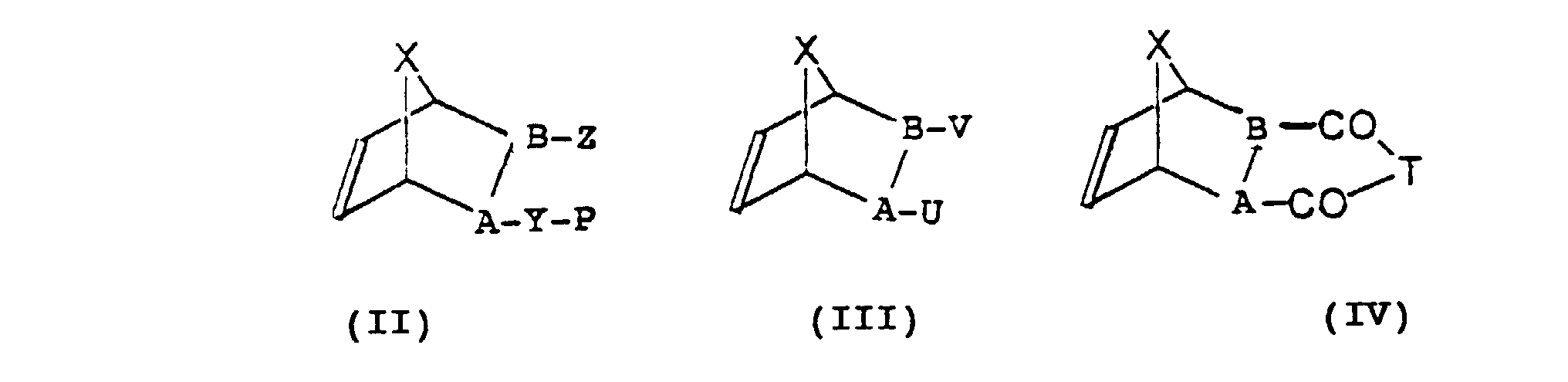
- Zur Herstellung des erfindungsgemäßen Polymers unterzieht man die bicyclische Verbindung (II) oder ggf. Mischungen von (II) mit der bicyclischen Verbindung (III) und/oder der bicyclischen Verbindung (IV) in Gegenwart eines Katalysators einer ringöffnenden Metathesepolymerisation und spaltet bei Einsatz von geschützten Edukten anschließend vorhandene Schutzgruppen ab. Dabei sind nach der Metathesepolymerisation die Positionen von A und B mit den daran gebundenen Resten nicht mehr voneinander unterscheidbar. Es können anstelle von (II), (III) und (IV) auch solche Verbindungen als Edukte eingesetzt werden, bei denen lediglich die Positionen von A und B mit den daran gebundenen Resten vertauscht sind.
- Beispiele für geeignete Schutzgruppen sind Trimethylsilyl- und Tetrahydropyranyl-Gruppen.
- Darüber hinaus ist das erfindungsgemäße Polymer (I) auch durch polymeranaloge Umsetzung des Polymers (V) mit polymerisationsfähigen Edukten P-Halogen entsprechend nachstehender Reaktionsgleichung zugänglich:


- Die als Edukte zur Herstellung des erfindungsgemäßen Polymers eingesetzten bicyclischen Verbindungen der Formeln (II), (III), (IV) und (VI) sind bekannt oder können nach bekannten Verfahren in einfacher Weise hergestellt werden.
- Vertreter der allgemeinen Formel (II) sind z.B. Bicyclo[2.2.1]hept-5-en-2-ylmethyl-allylether (VII), Bicyclo[2.2.1]hept-5-en-2-ylmethylacrylat (VIII), Bicyclo[2.2.1]hept-2,5-dien-2-ylmethylmethacrylat (IX), 7-Oxabicyclo[2.2.1]hept-5-en-2-ylmethylmethacrylat (X), Bicyclo[2.2.1]hept-5-en-2-ylmethylmethacrylat (XI) oder das 1:1-Umsetzungsprodukt (XII) von Bicyclo[2.2.1]hept-5-en-2,3-dicarbonsäureanhydrid und 2-Hydroxyethylmethacrylat, wobei (XI) und (XII) bekannt sind.


- Vertreter der allgemeinen Formel (III) sind z.B. Bicyclo[2.2.1]hept-5-en-2-carbonsäure (XIII), Bicyclo[2.2.1]hept-5-en-2,3-dicarbonsäuremonomethylester (XIV), Bicyclo[2.2.1]hept-2,5-dien-2,3-dicarbonsäure (XV), Bicyclo[2.2.1]hept-5-en-2,3-dicarbonsäure (XVI) oder 7-Oxabicyclo[2.2.1]hept-5-en-2,3-dicarbonsäure (XVII), wobei (XVI) und (XVII) bekannt sind.


- Spezielle erfindungsgemäße Polymere lassen sich insbesondere durch ringöffnende Metathese-Copolymerisation von dem bekannten Bicyclo[2.2.1]hept-5-en-2-ylmethylmethacrylat (XI) mit einer trimethylsilyl- oder tetrahydropyranylgeschützten, käuflichen Bicyclo[2.2.1]hept-5-en-2,3-dicarbonsäure in Gegenwart eines geeigneten Molybdän-Carben-Katalysators und nachfolgende Entschützung durch saure Hydrolyse herstellen. Analog dazu können erfindungsgemäße Polymere auch durch Copolymerisation von 7-Oxabicyclo[2.2.1]hept-5-en-2-ylmethylmethacrylat (X) mit dem bekannten 7-Oxabicyclo[2.2.1]hept-5-en-2,3-dicarbonsäureanhydrid (XXII) in Gegenwart von Ruthenium(III)-chlorid in wäßrigalkohlischem Medium erhalten werden.
- Das erfindungsgemäße Polymer eignet sich besonders als Bestandteile von Zementen, Beschichtungsmaterialien und Kompositen und insbesondere von Adhäsiven. Besonders bevorzugt wird das erfindungsgemäße Polymer als Dentalmaterial oder Bestandteil von Dentalmaterial, insbesondere als Bestandteil von Dentaladhäsiven, verwendet. Dabei erweist sich seine Fähigkeit als vorteilhaft, daß es einerseits über vorhandene polymerisierbare Gruppen, wie (Meth)acrylatgruppen einen Verbund mit dem zu befestigenden Material, z.B. einem Kompositmaterial, bildet und andererseits über Carboxylgruppen eine die Haftung fördernde Wechselwirkung mit dem Substrat, wie insbesondere der Zahnhartsubstanz, ausbilden kann.
- Bei Verwendung des erfindungsgemäßen Polymers als Bestandteil von Dentalmaterialien wird es üblicherweise in einer Menge von 0,1 bis 60, insbesondere 1,0 bis 40 Gew.-%, bezogen auf das Dentalmaterial, eingesetzt. Zur Herstellung der Dentalmaterialien wird das erfindungsgemäße Polymer insbesondere mit polymerisierbaren organischen Bindemitteln, Vernetzermonomeren, Füllstoffen, reaktiven Füllstoffen, Polymerisationsinitiatoren und/oder weiteren Zusätzen, wie üblichen Stabilisatoren, z.B. Hydrochinonmonomethylether (MEHQ) oder 2,6-Di-tert.-butyl-4-methylphenol (BHT), UV-Absorbern, Pigmenten, Farbstoffen oder Lösungsmitteln, kombiniert.
- Als polymerisierbare organische Bindemittel eignen sich alle für einen Dentalwerkstoff brauchbaren Bindemittel, insbesondere monofunktionelle oder polyfunktionelle (Meth)acrylate, die allein oder in Mischungen eingesetzt werden können. Bevorzugte Beispiele für diese Verbindungen sind Methyl(meth)acrylat, Isobutyl(meth)acrylat, Cyclohexyl(meth)acrylat, Tetraethylenglycoldi(meth)acrylat, Triethylenglycoldi(meth)acrylat, Diethylenglycoldi(meth)acrylat, Ethylenglycoldi(meth)acrylat, Polyethylenglycoldi(meth)acrylat, Butandioldi(meth)acrylat, Hexandioldi(meth)acrylat, Decandioldi(meth)acrylat, Dodecandioldi(meth)acrylat, Bisphenol-A-di(meth)acrylat, Trimethylolpropantri(meth)acrylat, 2,2-Bis-4-(3-methacryloxy-2-hydroxy-propoxy)-phenylpropan (Bis-GMA) sowie die Produkte der Reaktion von Isocyanaten, insbesondere Di- und/oder Triisocyanaten, mit OH-gruppenhaltigen (Meth)acrylaten. Besonders bevorzugte Beispiele für die zuletzt genannten Produkte sind durch Reaktion von 1 Mol Hexamethylendiisocyanat mit 2 Mol 2-Hydroxyethylenmethacrylat, von 1 Mol Tri-(6-isocyanatohexyl)biuret mit 3 Mol 2-Hydroxyethylmethacrylat und von 1 Mol 2,2,4-Trimethylhexamethylendiisocyanat mit 2 Mol 2-Hydroxyethylmethacrylat erhältlich.
- Die organischen Bindemittel werden üblicherweise in einer Menge von 0 bis 90 Gew.-% in dem erfindungsgemäßen Dentalmaterial eingesetzt.
- Als Vernetzermonomere eignen sich insbesondere die vorstehend genannten polyfunktionellen (Meth)acrylate, insbesondere Triethylenglycoldi(meth)acrylat, Polyethylenglycoldi(meth)acrylat, Bis-GMA oder Urethandi(meth)acrylate.
- Die Vernetzermonomere werden üblicherweise in einer Menge von 0 bis 80 Gew.-% in dem erfindungsgemäßen Dentalmaterial eingesetzt.
- Beispiele für bevorzugte Füllstoffe sind Quarz-, Glaskeramik- und Glaspulver, insbesondere Bariumsilikatgläser, Li/Al-Silikatgläser und Bariumgläser, Aluminium- oder Siliciumoxide, feinstteilige Kieselsäuren, insbesondere pyrogene oder gefällte Kieselsäuren, röntgenopake Füllstoffe, wie Ytterbiumtrifluorid.
- Die Füllstoffe werden typischerweise in einer Menge von 0 bis 85 Gew.-%, bezogen auf das Dentalmaterial, eingesetzt.
- Als reaktive Füllstoffe kommen vor allem Fluoralumosilicat-Gläser und andere bei Glasionomer-Zementen eingesetzte Gläser in Frage. Die reaktiven Füllstoffe werden üblicherweise in einer Menge von 0 bis 80 Gew.-% in dem erfindungsgemäßen Dentalmaterial verwendet.
- Besonders bevorzugte erfindungsgemäße Dentalmaterialien sind lichthärtende Glasionomerzemente, Dentinadhäsive und Compomere.
- Ganz besonders vorteilhafte Glasionomerzemente, Dentinadhäsive und Compomere und deren jeweilige Komponenten sind nachstehend angegeben:
-
- erfindungsgemäßes Polymer,
- reaktives Glaspulver, insbesondere übliche Fluoralumosilicatgläser einer mittleren Teilchengröße von ca. 0,05 bis 15µm (vgl. A. D. Wilson, J. W. McLean, Glasionomerzement, Quintessenz Verlags-GmbH, Berlin 1988, S. 21 ff.),
- Polymere mit Carboxylgruppen, z.B. Acrylsäure oder Maleinsäure-Polymere, die ggf. seitenständig gebundene polymerisationsfähige Gruppen, z.B. (Meth)acrylgruppen tragen,
- Photoinitiatoren und Stabilistoren,
- H2O, und
- Vernetzermonomere.
-
- erfindungsgemäßes Polymer,
- Hydrophile Monomere, wie 2-Hydroxyethyl- oder 2-Hydroxypropyl(meth)acrylat oder Polyethylenglycolmono- oder -dimethacrylate oder n-Vinylpyrrolidon,
- polymerisationsfähige Carbonsäuren oder Phosphorsäuren, wie z.B. Maleinsäure oder 2-(Meth)acryloyloxyethyldihydrogenphosphat,
- Vernetzermonomere,
- Wasser, Alkohol oder Aceton und
- Photoinitiatoren und Stabilisatoren.
-
- erfindungsgemäßes Polymer,
- Glaspulver, insbesondere für Glasionomerzemente übliche Fluoralumosilicatgläser einer mittleren Partikelgröße von ca. 0,05 bis 5 µm (vgl. A. D. Wilson, J. W. McLean, Glasionomerzement, Quintessenz Verlags-GmbH, Berlin 1988, S. 21 ff.),
- Photoinitiatoren und Stabilisatoren,
- übliche Vernetzermonomere,
- carboxylgruppenhaltige Venetzermonomere, wie die Umsetzungsprodukte von 2 Mol 2-Hydroxyethyl(meth)acrylat oder 2-Hydroxypropyl(meth)acrylat mit 1 Mol 5-(2,5-Dioxotetrahydrofuryl)-3-methylcyclohex-3-en-1,2-dicarbonsäureanhydrid oder den Dianhydriden von z.B. der käuflichen Tetrahydrofuran-2,3,4,5-tetracarbonsäure, der Cyclohexan-1,2,3,4,5,6-hexacarbonsäure oder der Butan-1,2,3,4-tetracarbonsäure, sowie entsprechende Umsetzungsprodukte dieser multifunktionellen Carbonsäuren mit mehr als 1 Mol Glycidylmethacrylat.
- Die erfindungsgemäßen Dentalmaterialien und die erfindungsgemäßen Polymere können heiß, kalt oder durch Licht polymerisiert werden. Als Initiatoren für die Heißpolymerisation können die bekannten Peroxide wie Dibenzoylperoxid, Dilauroylperoxid, tert.-Butylperoctoat oder tert.-Butylperbenzoat eingesetzt werden. Darüber hinaus sind auch 2,2'-Azoisobuttersäurenitril (AIBN), Benzpinakol und 2,2'-Dialkylbenzpinakole geeignet.
- Als Initiatoren für die Photopolymerisation können zum Beispiel Benzophenon und seine Derivate sowie Benzoin und seine Derivate verwendet werden. Weitere bevorzugte Photoinitiatoren sind die α-Diketone wie 9,10-Phenanthrenchinon, Diacetyl, Furil, Anisil, 4,4'-Dichlorbenzil und 4,4'-Dialkoxybenzil. Besonders bevorzugt wird Campherchinon verwendet. Darüber hinaus eignet sich auch die Gruppe der Acylphosphinoxide gut zur Initiierung der Photopolymerisation. Zur Beschleunigung der Initiierung werden die Photoinitiatoren vorzugsweise zusammen mit einem Reduktionsmittel, besonders bevorzugt mit einem Amin, insbesondere einem aromatischen Amin, eingesetzt.
- Als Initiatoren für die Kaltpolymerisation werden Radikale liefernde Redox-Systeme, zum Beispiel Benzoyl- oder Lauroylperoxid zusammen mit Aminen wie N,N-Dimethyl-p-toluidin, N,N-Dihydroxyethyl-p-toluidin oder anderen strukturverwandten Aminen eingesetzt.
- Speziell bei Dentalmaterialien zur Zementierung von Dentalre-staurationen, wie Glaskeramik-Inlays, -Onlays, -Teilkronen und - Kronen, hat sich die Kombination von Photoinitiatoren mit unterschiedlichen Redoxsystemen bewährt. Bevorzugt sind Kombinationen aus Campherchinon, Benzoylperoxid und Aminen wie N,N-Dimethyl-p-toluidin und/oder N,N-Cyanoethylmethylanilin.
- Die Konzentration der Initiatoren liegt bevorzugt im Bereich von 0,05 bis 2,0 Gew.-%, besonders bevorzugt im Bereich von 0,1 bis 0,8 Gew.-%, bezogen auf das Dentalmaterial.
- Im folgenden wird die Erfindung anhand von Beispielen näher erläutert.
- In einem 1500 ml Sulfierkolben mit mechanischem Rührwerk, 150 ml Tropftrichter und Thermometer werden 31,7 g (0,25 Mol) 2-(Hydroxymethyl)-5-norbornen (Gemisch von endo/exo-Isomeren), 400 ml getrocknetes Tetrahydrofuran (THF), 26,8 g (0,27 Mol) frisch destilliertes Triethylamin (TEA) und 0,01 g 2,6-Di.-tert.-butyl-cresol (BHT) bei 0°C unter Rühren und Argon-Schutzgasatmosphäre vorgelegt. Dazu tropft man eine Lösung von 29,5 g (0,28 Mol) Methacrylsäurechlorid in 100 ml THF so langsam zu, daß die Temperatur zwischen 0°C und 5°C bleibt. Dann läßt man das Reaktionsgemisch unter weiterem Rühren innerhalb von 60 Minuten auf Raumtemperatur kommen. Der Ansatz wird nun über eine Nutsche filtriert, und der abfiltrierte Rückstand wird mit 150-200 ml Diethylether gewaschen. Das Filtrat wird mit 150 ml einer gesättigten NaCl-Lösung extrahiert, die mit konzentrierter HCl auf pH 1-2 eingestellt ist. Dann werden die vereinigten organischen Phasen mit 2 × 100 ml gesättigter NaCl-Lösung neutral gewaschen und nachfolgend mit 150 ml einer gesättigten NaCl-Lösung extrahiert, die mit 50 ml 10%-iger Na2CO3-Lösung basisch eingestellt ist. Abschließend wird die organische Phase mit 2 × 100 ml gesättigter NaCl-Lösung neutral gewaschen, mit 50 g wasserfreiem Na2SO4 unter Rühren 20 Minuten lang getrocknet, filtriert und am Rotationsverdampfer bei 30°C eingeengt. Der erhaltene Rückstand wird im Feinvakuum (0,02 mbar) bei einer Badtemperatur von ca. 110°C innerhalb von 35 Minuten destilliert, wobei 23,5 g (55 % Ausbeute) einer farblosen Flüssigkeit (Kp0,02mbar = 70-74 °C) erhalten werden.
Elementaranalyse: C12H16O2: Ber.: C 74,96 H 8,39 (192,25) Gef.: C 74,44 H 8,33 - 1H-NMR (90MHz, CDCl3):
- 0,56 und 0,72 (m, 1H, CH-CH2O); 1,25-1,60 (m, 2H, CH 2 -CH-CH2O); 1,70-1,95 und 2,41-2,7 (m, 2 × 1H, CH-norbornen); 2,00 (s, 3H, CH3); 2,75-3,0 (b, 2H, CH2-norbornen); 3,65-4,30 (m, 2H, CH2O); 5,60 und 6,18 (s, 2 × 1H, CH2=,); 5,95-6,14 und 6,17-6,30 (m, 2 × 1H, CH=CH, von CH2= überlagert)
- IR (Film, cm-1):
- 1719(C=O); 1636(C=C)
- In einem 500 ml Sulfierkolben mit mechanischem Rührwerk, Tropftrichter und Thermometer werden 14,8 g (0,1 Mol) 7-Oxabicyclo[2.2.1]hept-5-en-2,3-endo/exo-dicarbonsäure in 150 ml getrocknetem THF gelöst. Die Apparatur wird mit Argon gespült, und die vorgelegte Mischung wird unter Rühren auf 10-15°C abgekühlt. Es werden dann 20,2 g (0,2 Mol) TEA und 21,7 g (0,2 Mol) Trimethylsilylchlorid zugetropft. Zur Vervollständigung der Reaktion rührt man noch 3 Stunden lang nach. Der gebildete Niederschlag aus TEA-Hydrochlorid wird unter Argon abgesaugt, mit THF gewaschen, und die vereinigten organischen Phasen werden am Rotationsverdampfer bei 30-40 °C eingeengt. Nach dem Trocknen im Feinvakuum erhält man ca. 32 g eines farblosen Öls, das nach Abkühlen im Tiefkühlschrank fest wird. Zur Reinigung wird aus 900 ml wasserfreiem Petrolether umkristallisiert und im Feinvakuum getrocknet. Es werden 18,6 g (58 % Ausbeute) farblose Kristalle (Schmp.: 65-70 °C) erhalten.
Elementaranalyse: C14H24O5Si2 Ber.: C 51,18 H 7,36 (328,50) Gef.: C 50,90 H 6,18 - 1H-NMR (90 MHz, CDCl3):
- 0,26 (s, 18H, CH3Si); 2,78 (d, 3H, CHCOO-exo); 3,34 (m, 7H, CHCOO-endo); 5,10 (b, 7H, CHOCH-endo); 5,22 (b, 3H, CHOCH-exo); 6,48 (s, 3H, CH=CH-exo); 6,55 (s, 7H, CH=CH-endo),
- 13C-NMR (75 MHz, CDCl3):
- 0,02 (CH3 ↑); 47,7 und 49,5 (CH-C=O ↑); 80,4 (C-O-C ↑); 135,1 und 135,5 (C=C ↑); 170,8 und 175,3 (C=O (-)).
- Zu einer Lösung von 18,2 g (0,10 Mol) 5-Norbornen-2,3-endo/exo-dicarbonsäure und 1,5 g (6 mMol) Pyridiniumtosylat in 100 ml absolutem Dichlormethan werden 21,2 g (0,25 Mol) 3,4-Dihydro-2H-pyran (DHP) bei Raumtemperatur zugegeben, und die Mischung wird 42 Stunden lang gerührt. Die gebildete gelblich gefärbte Lösung wird mit 2 × 50 ml gesättigter NaHCO3-Lösung ausgeschüttelt. Die erhaltene organische Phase wird über wasserfreiem Na2SO4 getrocknet und durch eine Schicht aus basischem Al2O3 abgesaugt. Schließlich werden das Lösungsmittel und überschüssiges DHP im Rotationsverdampfer abgezogen. Das verbleibende Öl wird in 200 ml Hexan bei 50 °C gelöst und nochmals durch eine Schicht aus basischem Al2O3 filtriert. Nach Einengen der filtrierten Hexan-Lösung auf ca. 70 ml und Akühlen fallen ca. 25 g (71 % Ausbeute) farblose Kristalle aus (Schmp.: 82-96 °C).

- 1H-NMR (300MHz, CDCl3):
- 1,40-1,90 (14H, m, H7, H11, H12, H13), 2,26 (1H, dd, H2), 3,20 (1H, br. s, H1), 3,33 (1H, br. s, H4), 3,46 (1H, m, H3), 3,70 (2H, m, H10), 3,85 (2H, m, H10), 5,95 (1H, br. s, H9), 6,02 (1H, br. s, H9), 6,13 (1H, m, H5) und 6,33 (1H, dd, H6)
- 13C-NMR (75 MHz, CDCl3):
- 18,6, 25,2, 25,5, 31,3 (C11, C12, C13), 46,0 (C4), 47,0-48,4 (C1, C2, C3, C7), 63,1 (C10), 93,0 (C9), 135,2 (C5), 137,6 (C6), 171,8, 173,1 und 179,3 (C=O)
- Der in diesem Beispiel beschriebene Katalysator besitzt die nachstehende Strukturformel und wird im folgenden als Katalysator HF bezeichnet.

- 1H-NMR (300MHz, CDCl3):
- 1,04 (s, 1H, MOCHCMe3), 1,16 (d, 12H, CH(CH 3 )2), 1,37 (s, 6H, OCMe(CF3)2), 3,54 (sept, 2H, CHMe2), 6,94 (m, 3H, NAr) und 12,06 (s, 1H, MOCHCMe3)
- Die ringöffnende Metathesepolymerisation mit Übergangsmetall-carben-Komplexen wird unter Inertgasatmosphäre in absoluten aprotischen Lösungsmitteln, wie Chlorbenzol, Benzol, Toluol, THF oder Dichlormethan, durchgeführt, wobei 1-Alkene, z.B. 1-Hexen, als Kettenüberträger zur Einstellung der Molmasse verwendet werden.
- So werden unter Rühren zu einer 10-20 Gew.-%-igen Lösung von 100-1000 Gew.-Teilen Monomeren 1-25 Gew.-Teile Kettenüberträger und eine 10 Gew.-%-ige Lösung von 1 Gew.-Teil Katalysator zugegeben. Man polymerisiert bei Raumtemperatur. Nach Beendigung der Polymerisation wird mit Benzaldehyd abgebrochen, und das Polymer wird in Methanol ausgefällt und durch Umfällen gereinigt.
- 8,00 g (22,8 mMol) Monomer (3) (vgl. Beispiel 3) und 1,10 g (5,7 mMol) Monomer (1) (vgl. Beispiel 1) werden unter Schutzgas zusammen mit 25 mg (0,30 Mol) 1-Hexen in 40 ml Chlorbenzol gelöst. Zu dieser Lösung wird unter Rühren eine Lösung von 30 mg (0,043 mMol) Katalysator HF gegeben. Nach 4 Stunden wird die Polymerisation mit ca. 0,3 ml Benzaldehyd abgebrochen, und das erhaltene Polymer wird in 300 ml mit BHT (100 ppm) stabilisiertem Ethanol ausgefällt und anschließend getrocknet. Zur Abspaltung der THP-Schutzgruppe wird das Polymer in THF gelöst, und die gebildete Lösung wird in eine heiße Lösung von ca. 50 mg p-Toluolsulfonsäure in 30 ml stabilisiertem Ethanol so langsam eingetropft, daß sich die jeweils entstehende Trübung auflöst. Man rührt noch 20 Minuten lang und fällt das in Ethanol lösliche Polymer (4) aus einem Gemisch aus Pentan/Diethylether (2/1-Volumenteile) aus. Das erhaltene Polymer wird schließlich unter Lichtschutz im Feinvakuum getrocknet, und sein zahlenmittleres Molekulargewicht wird zu (Mn = 13500 g/Mol) bestimmt. Die Molekulargewichtsbestimmung erfolgte mittels Gelpermeationschromatographie (GPC) bei Kalibrierung mit Polystyrolstandards.

- Analog zu Beispiel 5 wird zu einer Lösung von 2,63 g (7,5 mMol) Monomer (3), 0,29 g (1,5 mMol) Monomer (1), 0,24 g (1,0 mMol) Bicyclo[2.2.1]hept-5-en-2,3-exo/endo-dicarbonsäure-N-phenylimid, das einfach durch Diels-Alder-Reaktion von Cyclopentadien und N-Phenylmaleinimid zugänglich ist, und 6,1 mg (0,072 mMol) 1-Hexen in 8 ml Methylenchlorid eine Lösung von 23,2 mg (0,033 mMol) Katalysator HF in 2 ml Methylenchlorid zugegeben. Die Polymerisationslösung wird rasch hochviskos. Nach 2 Stunden wird die Polymerisation durch Eintropfen der Polymerisationslösung in ca. 100 ml Ethanol abgebrochen. Das ausgefallene Polymer wird abfiltriert und getrocknet und zeigt eine zahlenmittlere Molmasse (GPC, Kalibrierung mit Polystyrolstandards) von 31000 g/Mol. Zur Abspaltung der THP-Schutzgruppe wird das Polymer in 10 ml THF gelöst und die Lösung in eine 50°C warme Lösung von 30 mg p-Toluolsulfonsäure in 50 ml Ethanol so langsam eingetropft, daß sich der gebildete Niederschlag immer wieder auflöst. 1,3 g (68 % Ausbeute) an Terpolymer (5) werden schließlich durch Eintropfen der erhaltenen Polymerlösung in 400 ml Diethylether und Trocknen des erhaltenen Rückstandes im Vakuum erhalten. Die mittels GPC bestimmte zahlenmittlere Molmasse beträgt 14000 g/Mol, wobei das 1H-NMR-Spektrum zeigt, daß die Zusammensetzung des Terpolymers der Zusammensetzung der eingesetzten Monomer-Mischung entspricht.

- Analog zu Beispiel 5 wird zu einer Lösung von 23 g Monomer (3) und 153 mg 1-Hexen in 80 ml Chlorbenzol eine Lösung von 50 mg Katalysator HF in 2 ml Chlorbenzol gegeben. Nach 2 Stunden wird nochmals die gleiche Menge an Katalysatorlösung hinzugefügt. Nach 4 Stunden wird die Polymerisation abgebrochen. Die Polymerisationslösung wird mit 300 ml Ethanol verdünnt und nach Zugabe von 50 mg p-Toluolsulfonsäure zur Abspaltung der Schutzgruppe 30 Minuten lang unter Rückfluß erhitzt. Die erhaltene Lösung wird dann im Vakuum nahezu bis zur Trockene eingeengt. Der entstandene Rückstand wird in THF gelöst, und die THF-Lösung wird in 200 ml Diethylether eingetropft, woraufhin ein Niederschlag ausfällt. Nach Abtrennung und Trocknen im Feinvakuum werden ca. 11 g (Ausbeute 92 %) Polymer (6) mit einer zahlenmittleren Molmasse von 1200 g/Mol (Gelpermationschromatographie (GPC) - mit Polystyrolstandard) erhalten.

- Zu einer Lösung von 5 g (27,2 mMol) Polymer (6) in 20 ml sec. Butanol werden 1,55 g (10,9 mMol) GMA, 11,6 mg (0,11 mMol) Lithiumperchlorat als Katalysator und eine Spatelspitze Hydrochinonmonomethylether (MeHQ) gegeben. Die Reaktionsmischung wird 24 Stunden lang bei 60 °C gerührt. Das Reaktionsprodukt wird dann durch Eingabe der Mischung in 150 ml Ethylacetat ausgefällt, in Methanol gelöst und durch Eintropfen der erhaltenen Lösung in Ethylacetat erneut ausgefällt und schließlich im Feinvakuum getrocknet. Es werden 3,8 g Polymer (7) erhalten, wobei die Struktur mittels Titration der freien Carboxylgruppen und 1H-NMR-spektroskopisch bestätigt wurde.

- Auf der Basis von Copolymer (4) wird ein 1-Komponenten-Dentinadhäsiv folgender Zusammensetzung hergestellt:
Copolymer (4): 18,0 Gew.-% Wasser, deionisiert: 32,4 Gew.-% 2-Hydroxyethylmethacrylat: 44,2 Gew.-% Maleinsäure: 3,0 Gew.-% Campherchinon: 0,3 Gew.-% MeHQ: 0,1 Gew.-% Ammoniumfluorid: 1,0 Gew.-% Diphenyliodoniumhexafluorophosphat: 1,0 Gew.-% - Zur Ermittlung der mit diesem Dentinadhäsiv erzielbaren Scherhaf-tung wurden zuerst Dentinoberflächen von extrahierten, eingebetteten Zähnen mit 500-er und 1000-er Schleifpapier plangeschliffen. Dann wurden die Dentinoberflächen mit Zellstoff leicht getrocknet. Auf die Oberflächen wurde das Dentinadhäsiv in 2 Schichten aufgetragen, mit Druckluft getrocknet und mit einer dentalen Lichtquelle Heliolux GTE (Fa. Vivadent) belichtet. Dann wurde ein kommerziell erhältliches Füllungs-Komposit, nämlich Compoglass der Firma Vivadent, Liechtenstein, in 2 Schichten aufgetragen und jeweils 40 Sekunden lang belichtet. Danach wurden die erhaltenen Prüfkörper in destilliertes Wasser gelegt und dort 24 Stunden lang bei 37 °C gelagert. Die Scherhaftfestigkeit wurde schließlich gemäß ISO-Vorschlag ISO-TR 11405: "Dental material - Guidance on testing of adhesion to tooth structure", zu 15,6 + 7,8 MPa bestimmt. Eine analoge Rezeptur, bei der das Polymer (4) durch herkömmliche Polyacrylsäure, nämlich Plex 4779 der Fa. Röhm ersetzt wurde, ergab nur Werte von 3,9 ± 0,6 MPa.
-
Flüssigkeit 1: Urethandimethacrylat1) : 56,5 Gew.-% 2-Hydroxyethylmethacrylat: 18,8 Gew.-% PEG-600-Dimethacrylat: 18,8 Gew.-% 1-%ige wäßrige Lösung von p-Toluolsulfonsäure: 5,1 Gew.-% 2-Cyanoethylmethylanilin: 0,5 Gew.-% Campherchinon: 0,3 Gew.-% Pulver 2: Reaktives Glaspulver2): 92,5 Gew.-% Copolymer (4): 6,0 Gew.-% L(+)-Weinsäure: 1,5 Gew.-% 1) Urethandimethacrylat aus 2 Mol 2-Hydroxyethylmethacrylat und 1 Mol 2,2,4-Trimethylhexamethylendiisocyanat-1,6. 2) Glaszusammensetzung (gemäß Atomabsorptionsspektrometrie und Titration für Fluorid-Bestimmung) (Gew.-%): SiO2: 25,5, Al2O3: 23,8, Na2O: 1,8, CaO: 16,4, P2O5: 8,2, BaO: 11,2 und Fluorid: 17,0; mittlere Korngröße 8 µm. - Aus jeweils einem Gewichtsteil der Flüssigkeit 1 und des Pulvers 2 wird eine Mischung hergestellt. Mit dem Material werden Prüfkörper hergestellt, die 2 Stunden lang bei 37 °C in H2O gelagert und anschließend zweimal 90 Sekunden lang mittels einer dentalen Strahlungsquelle, Spectramat (Fa. Vivadent), bestrahlt werden. Die nach der ISO-Norm 9917 (Dental water-based cements) bestimmte Druckfestigkeit beträgt 128,4 MPa, im Vergleich zu 117,1 MPa für ein Material, bei dem das Copolymer (4) im Pulver durch den gleichen Anteil an Polyacrylsäure Plex 4779 ersetzt wurde.
wobei der Molenbruch a der Einheit (IA), der Molenbruch b der Einheit (IB) und der Molenbruch c der Einheit (IC) wie folgt sind:
Claims (9)
- Funktionalisiertes und polymerisierbares Polymer, dadurch gekennzeichnet, daß es die folgenden wiederkehrenden Einheiten (IA), (IB) und (IC) aufweist:
 X = CH2 oder O;A-B = C-C oder C=C;Y = CH2O, CO-O oder COO-R1-O,
wobei R1 = substituiertes oder unsubstituiertes C1- bis C5-Alkylen oder -Oxyalkylen;P = eine polymerisierbare Gruppe, nämlich CH2=CH-CO-, CH2=C(CH3)-CO-, CH2=CH-CH2- oder CH2=CH-C6H5-CH2-;Z = H, COOH, substituiertes oder unsubstituiertes C1- bis C12-Alkyl oder COOR4,
wobei R4 = substituiertes oder unsubstituiertes C1 - bis C12-Alkyl oder C6- bis C14-Aryl;U = COOH oder COOR5,
wobei R5 = substituiertes oder unsubstituiertes C1- bis C12-Alkyl oder C6- bis C14-Aryl;V = H, COOH, CH2-OH, OR2 oder CO-OR2,
wobei R2 = substituiertes oder unsubstituiertes C1- bis C12-Alkyl oder C6- bis C14-Aryl; undT = O, NH oder NHR3,und
wobei R3 = substituiertes oder unsubstituiertes C1 - bis C12-Alkyl oder C6- bis C14-Aryl;
wobei der Molenbruch a der Einheit (IA), der Molenbruch b der Einheit (IB) und der Molenbruch c der Einheit (IC) wie folgt sind:a = 0,05 bis 1,0;b = 0 bis 0,95; undc = 0 bis 0,90. - Polymer nach Anspruch 1, dadurch gekennzeichnet, daß die Variablen unabhängig voneinander die folgende Bedeutung haben:X = CH2 oder O;A-B = C-C;Y = CH2O oder CO-O-R1-O;R1 = CH2CH2 oder CH2-CHOH-CH2;P = CH2=C(CH3)-CO;Z = H oder COOH;R4 = CH3, C2H5 oder Phenyl;U = COOH;R5 = CH3, C2H5 oder Phenyl;V = H oder COOH;R2 = CH3 oder C2H5;T = O;R3 = CH3 oder Phenyl;a = 0,10 bis 0,80;b = 0 bis 0,80; und/oderc = 0 bis 0,60.
- Verfahren zur Herstellung des Polymers gemäß Anspruch 1 oder 2, dadurch gekennzeichnet, daß man Mischungen von gegebenenfalls geschützten bicyclischen Verbindungen in Gegenwart eines Katalysators einer ringöffnenden Metathesepolymerisation unterzieht und anschließend eventuell vorhandene Schutzgruppen abspaltet, wobei die Mischungen(a) die bicyclische Verbindung der allgemeinen Formel (II) und(b) gegebenenfalls die bicyclische Verbindung der allgemeinen Formel (III) und(c) gegebenenfalls die bicyclische Verbindung der allgemeinen Formel (IV)

- Verwendung des Polymers gemäß Anspruch 1 oder 2 als Bestandteil von Zementen, Beschichtungsmaterialien, Kompositen und Adhäsiven.
- Verwendung des Polymers gemäß Anspruch 1 oder 2 als Dentalmaterial oder Bestandteil von Dentalmaterial, insbesondere als Bestandteil von Dentaladhäsiven.
- Zusammensetzung mit Gehalt an dem polymerisierbaren Polymer gemäß Anspruch 1 oder 2.
- Zusammensetzung nach Anspruch 6, dadurch gekennzeichnet, daß sie ein Zement, Beschichtungsmaterial, Komposit oder Adhäsiv ist.
- Zusammensetzung nach Anspruch 6, dadurch gekennzeichnet, daß sie ein Dentalmaterial und insbesondere ein Dentinadhäsiv ist.
- Zusammensetzung nach einem der Ansprüche 6 bis 8, dadurch gekennzeichnet, daß sie das polymerisierbare Polymer in zumindest teilweise polymerisierter Form enthält.
Applications Claiming Priority (4)
| Application Number | Priority Date | Filing Date | Title |
|---|---|---|---|
| DE19613017 | 1996-03-20 | ||
| DE19613017 | 1996-03-20 | ||
| DE19616183A DE19616183C2 (de) | 1996-03-20 | 1996-04-12 | Funktionalisiertes und polymerisierbares Polymer |
| DE19616183 | 1996-04-12 |
Publications (3)
| Publication Number | Publication Date |
|---|---|
| EP0796607A2 true EP0796607A2 (de) | 1997-09-24 |
| EP0796607A3 EP0796607A3 (de) | 1997-12-10 |
| EP0796607B1 EP0796607B1 (de) | 2003-02-12 |
Family
ID=26024375
Family Applications (1)
| Application Number | Title | Priority Date | Filing Date |
|---|---|---|---|
| EP97250080A Expired - Lifetime EP0796607B1 (de) | 1996-03-20 | 1997-03-17 | Funktionalisiertes und polymerisierbares Polymer |
Country Status (4)
| Country | Link |
|---|---|
| EP (1) | EP0796607B1 (de) |
| JP (1) | JP3106111B2 (de) |
| AT (1) | ATE232377T1 (de) |
| CA (1) | CA2199567C (de) |
Cited By (21)
| Publication number | Priority date | Publication date | Assignee | Title |
|---|---|---|---|---|
| WO1999050331A1 (en) * | 1998-03-31 | 1999-10-07 | Cryovac, Inc. | Novel regio-regular copolymer and methods of forming same |
| WO2000018579A1 (en) * | 1998-09-29 | 2000-04-06 | Cryovac, Inc. | Regio-regular functionalized polymeric packaging material |
| WO2002032338A3 (en) * | 2000-10-17 | 2002-10-10 | Kerr Corp | Dental impression material utilizing ruthenium catalyst |
| US6586619B2 (en) * | 1998-08-26 | 2003-07-01 | Hyundai Electronics Industries Co., Ltd. | Photoresist monomer having hydroxy group and carboxy group, copolymer thereof and photoresist composition using the same |
| US6649146B2 (en) | 2000-10-17 | 2003-11-18 | Kerr Corporation | Dental impression material utilizing ruthenium metathesis catalyst |
| EP0904767A3 (de) * | 1997-09-29 | 2004-02-04 | 3M Espe Ag | Dentalmassen auf der Basis von ROMP-Oligomeren oder -Polymeren |
| EP0904766A3 (de) * | 1997-09-29 | 2004-03-10 | 3M Espe Ag | Durch ROMP härtbare Dentalmassen |
| US6844409B2 (en) | 2002-05-06 | 2005-01-18 | Kerr Corporation | Composition curable by metathesis reaction |
| US6861386B2 (en) | 2001-12-06 | 2005-03-01 | Kerr Corporation | Accelerator for metathesis catalyst |
| US7001590B1 (en) | 2004-11-15 | 2006-02-21 | Kerr Corporation | Metathesis-curable composition |
| US7060770B2 (en) | 2003-05-06 | 2006-06-13 | Kerr Corporation | Metathesis-curable composition with a reaction control agent |
| US7060769B2 (en) | 2003-05-06 | 2006-06-13 | Kerr Corporation | Method of curing composition by metathesis reaction using reaction control agent |
| US7173097B2 (en) | 2003-05-06 | 2007-02-06 | Kerr Corporation | Metathesis-curable composition with a reaction control agent |
| US7538172B2 (en) | 2004-06-30 | 2009-05-26 | Ivoclar Vivadent Ag | Dental materials polymerizable by photo-induced ring-opening metathesis polymerization of cyclic olefins |
| US7625991B2 (en) | 2006-02-21 | 2009-12-01 | Kerr Corporation | Method for making alkoxy-siloxane polyether carboxylates terminated with functional olefin groups |
| US7625551B2 (en) | 2004-11-15 | 2009-12-01 | Kerr Corporation | Polyether-based dental impression material curable by metathesis reaction |
| US7645443B2 (en) | 2004-11-15 | 2010-01-12 | Kerr Corporation | Polyether-based composition curable by metathesis reaction |
| US7683148B2 (en) | 2003-05-06 | 2010-03-23 | Kerr Corporation | Metathesis-curable composition with a reaction control agent |
| US7691919B2 (en) | 2004-01-15 | 2010-04-06 | Ivoclar Vivadent Ag | Dental materials based on ROMP composites |
| EP1950216A4 (de) * | 2005-10-20 | 2011-02-16 | Mitsui Chemicals Inc | Verfahren zur herstellung einer organischen übergangsmetallkomplexverbindung, durch das verfahren hergestellter metathesekatalysator, durch ringöffnende polymerisierung damit gebildetes metathesepolymer und verfahren zur polymerproduktion damit |
| EP3995525A1 (de) * | 2020-11-10 | 2022-05-11 | Hilti Aktiengesellschaft | Monomer mit zwei polymerisierbaren gruppen (für romp und für radikalische polymerisation) und dessen verwendung |
Families Citing this family (7)
| Publication number | Priority date | Publication date | Assignee | Title |
|---|---|---|---|---|
| JP4562819B2 (ja) * | 1997-12-26 | 2010-10-13 | サンメディカル株式会社 | コーティング材組成物 |
| TW593406B (en) * | 1999-12-07 | 2004-06-21 | Zeon Corp | Copolymer formed by ring-opening polymerization, hydrogenation product of copolymer formed by ring-opening polymerization, and process for producing these |
| TWI300429B (en) * | 2000-04-18 | 2008-09-01 | Zeon Corp | Photosensitive resin composition |
| JP2008069358A (ja) * | 2002-11-14 | 2008-03-27 | Jsr Corp | 光学フィルム |
| CN1298762C (zh) * | 2002-11-14 | 2007-02-07 | Jsr株式会社 | 降冰片烯系开环聚合物 |
| JP2005171234A (ja) * | 2003-11-18 | 2005-06-30 | Jsr Corp | 新規な(共)重合体およびその製造方法並びにカルボキシル基含有(共)重合体の製造方法 |
| ES2721026T3 (es) | 2015-07-22 | 2019-07-26 | Ivoclar Vivadent Ag | Materiales dentales adhesivos con polímeros adhesivos muy ácidos |
Family Cites Families (2)
| Publication number | Priority date | Publication date | Assignee | Title |
|---|---|---|---|---|
| US4054233A (en) * | 1976-05-05 | 1977-10-18 | Eastman Kodak Company | Fluid container for photographic processing material |
| DE3536076A1 (de) * | 1985-10-09 | 1987-04-09 | Muehlbauer Ernst Kg | Polymerisierbare zementmischungen |
-
1997
- 1997-03-10 CA CA002199567A patent/CA2199567C/en not_active Expired - Fee Related
- 1997-03-17 EP EP97250080A patent/EP0796607B1/de not_active Expired - Lifetime
- 1997-03-17 AT AT97250080T patent/ATE232377T1/de not_active IP Right Cessation
- 1997-03-18 JP JP09065063A patent/JP3106111B2/ja not_active Expired - Fee Related
Cited By (25)
| Publication number | Priority date | Publication date | Assignee | Title |
|---|---|---|---|---|
| EP0904767A3 (de) * | 1997-09-29 | 2004-02-04 | 3M Espe Ag | Dentalmassen auf der Basis von ROMP-Oligomeren oder -Polymeren |
| EP0904766A3 (de) * | 1997-09-29 | 2004-03-10 | 3M Espe Ag | Durch ROMP härtbare Dentalmassen |
| WO1999050331A1 (en) * | 1998-03-31 | 1999-10-07 | Cryovac, Inc. | Novel regio-regular copolymer and methods of forming same |
| US6153714A (en) * | 1998-03-31 | 2000-11-28 | Cryovac, Inc. | Regio-regular copolymer and methods of forming same |
| US6506860B1 (en) * | 1998-03-31 | 2003-01-14 | Cryovac, Inc. | Regio-regular copolymer and methods of forming same |
| US6586619B2 (en) * | 1998-08-26 | 2003-07-01 | Hyundai Electronics Industries Co., Ltd. | Photoresist monomer having hydroxy group and carboxy group, copolymer thereof and photoresist composition using the same |
| WO2000018579A1 (en) * | 1998-09-29 | 2000-04-06 | Cryovac, Inc. | Regio-regular functionalized polymeric packaging material |
| US6203923B1 (en) | 1998-09-29 | 2001-03-20 | Cryovac, Inc. | Regio-regular functionalized polymeric packaging material |
| US6649146B2 (en) | 2000-10-17 | 2003-11-18 | Kerr Corporation | Dental impression material utilizing ruthenium metathesis catalyst |
| WO2002032338A3 (en) * | 2000-10-17 | 2002-10-10 | Kerr Corp | Dental impression material utilizing ruthenium catalyst |
| US6861386B2 (en) | 2001-12-06 | 2005-03-01 | Kerr Corporation | Accelerator for metathesis catalyst |
| US6844409B2 (en) | 2002-05-06 | 2005-01-18 | Kerr Corporation | Composition curable by metathesis reaction |
| US7683148B2 (en) | 2003-05-06 | 2010-03-23 | Kerr Corporation | Metathesis-curable composition with a reaction control agent |
| US7060770B2 (en) | 2003-05-06 | 2006-06-13 | Kerr Corporation | Metathesis-curable composition with a reaction control agent |
| US7060769B2 (en) | 2003-05-06 | 2006-06-13 | Kerr Corporation | Method of curing composition by metathesis reaction using reaction control agent |
| US7173097B2 (en) | 2003-05-06 | 2007-02-06 | Kerr Corporation | Metathesis-curable composition with a reaction control agent |
| US7691919B2 (en) | 2004-01-15 | 2010-04-06 | Ivoclar Vivadent Ag | Dental materials based on ROMP composites |
| US7538172B2 (en) | 2004-06-30 | 2009-05-26 | Ivoclar Vivadent Ag | Dental materials polymerizable by photo-induced ring-opening metathesis polymerization of cyclic olefins |
| US7001590B1 (en) | 2004-11-15 | 2006-02-21 | Kerr Corporation | Metathesis-curable composition |
| US7645443B2 (en) | 2004-11-15 | 2010-01-12 | Kerr Corporation | Polyether-based composition curable by metathesis reaction |
| US7625551B2 (en) | 2004-11-15 | 2009-12-01 | Kerr Corporation | Polyether-based dental impression material curable by metathesis reaction |
| EP1950216A4 (de) * | 2005-10-20 | 2011-02-16 | Mitsui Chemicals Inc | Verfahren zur herstellung einer organischen übergangsmetallkomplexverbindung, durch das verfahren hergestellter metathesekatalysator, durch ringöffnende polymerisierung damit gebildetes metathesepolymer und verfahren zur polymerproduktion damit |
| US8143429B2 (en) | 2005-10-20 | 2012-03-27 | Mitsui Chemicals, Inc. | Process for producing organic transition metal complex compound, metathesis catalyst produced by using the same, ring-opening metathesis polymer obtainable with the metathesis catalyst, and process for producing the polymer |
| US7625991B2 (en) | 2006-02-21 | 2009-12-01 | Kerr Corporation | Method for making alkoxy-siloxane polyether carboxylates terminated with functional olefin groups |
| EP3995525A1 (de) * | 2020-11-10 | 2022-05-11 | Hilti Aktiengesellschaft | Monomer mit zwei polymerisierbaren gruppen (für romp und für radikalische polymerisation) und dessen verwendung |
Also Published As
| Publication number | Publication date |
|---|---|
| EP0796607B1 (de) | 2003-02-12 |
| EP0796607A3 (de) | 1997-12-10 |
| ATE232377T1 (de) | 2003-02-15 |
| JP3106111B2 (ja) | 2000-11-06 |
| JPH1030018A (ja) | 1998-02-03 |
| CA2199567C (en) | 2003-01-14 |
| CA2199567A1 (en) | 1997-09-20 |
Similar Documents
| Publication | Publication Date | Title |
|---|---|---|
| DE19616183C2 (de) | Funktionalisiertes und polymerisierbares Polymer | |
| EP0796607B1 (de) | Funktionalisiertes und polymerisierbares Polymer | |
| DE19608316C2 (de) | Funktionalisierte bicyclische (Meth)acrylate, Verfahren zu deren Herstellung und deren Verwendung #### | |
| DE19608313C2 (de) | Polymerisierbare Hybridmonomere, Verfahren zu deren Herstellung und deren Verwendung | |
| DE19525941C2 (de) | Polymerisierbares flüssigkristallines Monomer, Dentalmaterialien auf der Basis von flüssig-kristallinen Monomeren und Verwendung eines polymerisierbaren Monomers mit flüssigkristallinen Eigenschaften zur Herstellung eines Dentalmaterials | |
| EP2436365B1 (de) | Kompositmaterial umfassend ein Monomer mit einem polyalicyclischen Strukturelement | |
| EP2436668B1 (de) | Polymerisierbare Verbindungen umfassend ein polyalicyclisches Strukturelement | |
| EP2753291B1 (de) | Dentalmaterialien auf basis von verbindungen mit debonding-on-demand eigenschaften | |
| DE10249324A1 (de) | Polymerisationsfähige bicyclische Cyclopropanderivate und deren Verwendung zur Herstellung von Dentalmaterialien | |
| DE19742981B4 (de) | Durch ROMP härtbare Dentalmassen | |
| EP0206074A2 (de) | (Meth)-acrylsäureester und ihre Verwendung | |
| EP3156031B9 (de) | Polymerisierbare zusammensetzungen auf basis von thermisch spaltbaren verbindungen | |
| EP0321841A2 (de) | Ester-Urethan-(Meth)-acrylsäurederivate | |
| EP0798286B1 (de) | Multifunktionelle Vinylcyclopropan-Derivate | |
| DE102016214389B4 (de) | Dentalmaterialien auf der Basis von monofunktionellen Vinylcyclopropan-Derivaten | |
| EP1688125B1 (de) | Polymerisierbare Cyclopropylacrylate enthaltende Zusammensetzung | |
| EP3278786B1 (de) | Dentalmaterialien auf der basis von urethangruppenhaltigen vinylcyclopropan-derivaten | |
| EP0709387B1 (de) | Bicycloaliphatische 2-Methylen-1,3-dioxepane | |
| EP0943601A1 (de) | Vinylcyclopropan-(Meth) acrylate und deren Verwendung |
Legal Events
| Date | Code | Title | Description |
|---|---|---|---|
| PUAI | Public reference made under article 153(3) epc to a published international application that has entered the european phase |
Free format text: ORIGINAL CODE: 0009012 |
|
| AK | Designated contracting states |
Kind code of ref document: A2 Designated state(s): AT CH DE FR GB IT LI SE |
|
| PUAL | Search report despatched |
Free format text: ORIGINAL CODE: 0009013 |
|
| AK | Designated contracting states |
Kind code of ref document: A3 Designated state(s): AT CH DE FR GB IT LI SE |
|
| 17P | Request for examination filed |
Effective date: 19980204 |
|
| 17Q | First examination report despatched |
Effective date: 20010118 |
|
| RAP1 | Party data changed (applicant data changed or rights of an application transferred) |
Owner name: IVOCLAR VIVADENT AG |
|
| GRAG | Despatch of communication of intention to grant |
Free format text: ORIGINAL CODE: EPIDOS AGRA |
|
| GRAG | Despatch of communication of intention to grant |
Free format text: ORIGINAL CODE: EPIDOS AGRA |
|
| GRAH | Despatch of communication of intention to grant a patent |
Free format text: ORIGINAL CODE: EPIDOS IGRA |
|
| GRAH | Despatch of communication of intention to grant a patent |
Free format text: ORIGINAL CODE: EPIDOS IGRA |
|
| GRAA | (expected) grant |
Free format text: ORIGINAL CODE: 0009210 |
|
| AK | Designated contracting states |
Designated state(s): AT CH DE FR GB IT LI SE |
|
| REG | Reference to a national code |
Ref country code: GB Ref legal event code: FG4D Free format text: NOT ENGLISH |
|
| REG | Reference to a national code |
Ref country code: CH Ref legal event code: EP |
|
| REG | Reference to a national code |
Ref country code: CH Ref legal event code: NV Representative=s name: KELLER & PARTNER PATENTANWAELTE AG |
|
| GBT | Gb: translation of ep patent filed (gb section 77(6)(a)/1977) |
Effective date: 20030212 |
|
| REF | Corresponds to: |
Ref document number: 59709291 Country of ref document: DE Date of ref document: 20030320 Kind code of ref document: P |
|
| ET | Fr: translation filed | ||
| PLBE | No opposition filed within time limit |
Free format text: ORIGINAL CODE: 0009261 |
|
| STAA | Information on the status of an ep patent application or granted ep patent |
Free format text: STATUS: NO OPPOSITION FILED WITHIN TIME LIMIT |
|
| 26N | No opposition filed |
Effective date: 20031113 |
|
| PGFP | Annual fee paid to national office [announced via postgrant information from national office to epo] |
Ref country code: AT Payment date: 20070323 Year of fee payment: 11 |
|
| PGFP | Annual fee paid to national office [announced via postgrant information from national office to epo] |
Ref country code: IT Payment date: 20070605 Year of fee payment: 11 |
|
| PG25 | Lapsed in a contracting state [announced via postgrant information from national office to epo] |
Ref country code: AT Free format text: LAPSE BECAUSE OF NON-PAYMENT OF DUE FEES Effective date: 20080317 |
|
| PGFP | Annual fee paid to national office [announced via postgrant information from national office to epo] |
Ref country code: GB Payment date: 20090324 Year of fee payment: 13 Ref country code: CH Payment date: 20090325 Year of fee payment: 13 |
|
| PG25 | Lapsed in a contracting state [announced via postgrant information from national office to epo] |
Ref country code: IT Free format text: LAPSE BECAUSE OF NON-PAYMENT OF DUE FEES Effective date: 20080317 |
|
| PGFP | Annual fee paid to national office [announced via postgrant information from national office to epo] |
Ref country code: SE Payment date: 20090325 Year of fee payment: 13 |
|
| PGFP | Annual fee paid to national office [announced via postgrant information from national office to epo] |
Ref country code: FR Payment date: 20090318 Year of fee payment: 13 |
|
| REG | Reference to a national code |
Ref country code: CH Ref legal event code: PL |
|
| EUG | Se: european patent has lapsed | ||
| GBPC | Gb: european patent ceased through non-payment of renewal fee |
Effective date: 20100317 |
|
| REG | Reference to a national code |
Ref country code: FR Ref legal event code: ST Effective date: 20101130 |
|
| PG25 | Lapsed in a contracting state [announced via postgrant information from national office to epo] |
Ref country code: FR Free format text: LAPSE BECAUSE OF NON-PAYMENT OF DUE FEES Effective date: 20100331 |
|
| PG25 | Lapsed in a contracting state [announced via postgrant information from national office to epo] |
Ref country code: LI Free format text: LAPSE BECAUSE OF NON-PAYMENT OF DUE FEES Effective date: 20100331 Ref country code: CH Free format text: LAPSE BECAUSE OF NON-PAYMENT OF DUE FEES Effective date: 20100331 |
|
| PG25 | Lapsed in a contracting state [announced via postgrant information from national office to epo] |
Ref country code: GB Free format text: LAPSE BECAUSE OF NON-PAYMENT OF DUE FEES Effective date: 20100317 |
|
| PG25 | Lapsed in a contracting state [announced via postgrant information from national office to epo] |
Ref country code: SE Free format text: LAPSE BECAUSE OF NON-PAYMENT OF DUE FEES Effective date: 20100318 |
|
| PGFP | Annual fee paid to national office [announced via postgrant information from national office to epo] |
Ref country code: DE Payment date: 20140325 Year of fee payment: 18 |
|
| REG | Reference to a national code |
Ref country code: DE Ref legal event code: R119 Ref document number: 59709291 Country of ref document: DE |
|
| PG25 | Lapsed in a contracting state [announced via postgrant information from national office to epo] |
Ref country code: DE Free format text: LAPSE BECAUSE OF NON-PAYMENT OF DUE FEES Effective date: 20151001 |