EP0206074A2 - (Meth)-acrylsäureester und ihre Verwendung - Google Patents
(Meth)-acrylsäureester und ihre Verwendung Download PDFInfo
- Publication number
- EP0206074A2 EP0206074A2 EP86107838A EP86107838A EP0206074A2 EP 0206074 A2 EP0206074 A2 EP 0206074A2 EP 86107838 A EP86107838 A EP 86107838A EP 86107838 A EP86107838 A EP 86107838A EP 0206074 A2 EP0206074 A2 EP 0206074A2
- Authority
- EP
- European Patent Office
- Prior art keywords
- meth
- acrylic acid
- hydrogen
- tricyclodecanes
- acid derivatives
- Prior art date
- Legal status (The legal status is an assumption and is not a legal conclusion. Google has not performed a legal analysis and makes no representation as to the accuracy of the status listed.)
- Granted
Links
- 125000005397 methacrylic acid ester group Chemical group 0.000 title 1
- CERQOIWHTDAKMF-UHFFFAOYSA-N Methacrylic acid Chemical class CC(=C)C(O)=O CERQOIWHTDAKMF-UHFFFAOYSA-N 0.000 claims abstract description 31
- 239000001257 hydrogen Substances 0.000 claims abstract description 23
- 229910052739 hydrogen Inorganic materials 0.000 claims abstract description 23
- UFHFLCQGNIYNRP-UHFFFAOYSA-N Hydrogen Chemical compound [H][H] UFHFLCQGNIYNRP-UHFFFAOYSA-N 0.000 claims abstract description 17
- 125000002496 methyl group Chemical group [H]C([H])([H])* 0.000 claims abstract description 15
- 125000000217 alkyl group Chemical group 0.000 claims abstract description 13
- 150000002431 hydrogen Chemical class 0.000 claims abstract description 13
- NIXOWILDQLNWCW-UHFFFAOYSA-M Acrylate Chemical compound [O-]C(=O)C=C NIXOWILDQLNWCW-UHFFFAOYSA-M 0.000 claims abstract description 12
- 125000004432 carbon atom Chemical group C* 0.000 claims abstract description 12
- 239000001301 oxygen Substances 0.000 claims abstract description 12
- 229910052760 oxygen Inorganic materials 0.000 claims abstract description 12
- 229910052736 halogen Inorganic materials 0.000 claims abstract description 11
- 150000002367 halogens Chemical class 0.000 claims abstract description 11
- 125000002023 trifluoromethyl group Chemical group FC(F)(F)* 0.000 claims abstract description 9
- 125000003545 alkoxy group Chemical group 0.000 claims abstract description 8
- 125000001997 phenyl group Chemical group [H]C1=C([H])C([H])=C(*)C([H])=C1[H] 0.000 claims abstract description 7
- UUEVFMOUBSLVJW-UHFFFAOYSA-N oxo-[[1-[2-[2-[2-[4-(oxoazaniumylmethylidene)pyridin-1-yl]ethoxy]ethoxy]ethyl]pyridin-4-ylidene]methyl]azanium;dibromide Chemical compound [Br-].[Br-].C1=CC(=C[NH+]=O)C=CN1CCOCCOCCN1C=CC(=C[NH+]=O)C=C1 UUEVFMOUBSLVJW-UHFFFAOYSA-N 0.000 claims abstract description 5
- 125000001183 hydrocarbyl group Chemical group 0.000 claims abstract 6
- 239000000203 mixture Substances 0.000 claims description 24
- CERQOIWHTDAKMF-UHFFFAOYSA-M methacrylate group Chemical group C(C(=C)C)(=O)[O-] CERQOIWHTDAKMF-UHFFFAOYSA-M 0.000 claims description 12
- 238000000034 method Methods 0.000 claims description 11
- 239000003054 catalyst Substances 0.000 claims description 8
- 229920000642 polymer Polymers 0.000 claims description 5
- QVGXLLKOCUKJST-UHFFFAOYSA-N atomic oxygen Chemical compound [O] QVGXLLKOCUKJST-UHFFFAOYSA-N 0.000 claims description 4
- 239000000463 material Substances 0.000 claims description 4
- 239000012442 inert solvent Substances 0.000 claims description 3
- 238000002360 preparation method Methods 0.000 claims description 3
- 239000008199 coating composition Substances 0.000 claims description 2
- 150000001875 compounds Chemical class 0.000 abstract description 10
- 239000005548 dental material Substances 0.000 abstract description 2
- 239000000178 monomer Substances 0.000 description 23
- -1 hydrocarbon radical Chemical class 0.000 description 12
- 238000006116 polymerization reaction Methods 0.000 description 12
- 239000000243 solution Substances 0.000 description 12
- 238000006243 chemical reaction Methods 0.000 description 8
- HWSSEYVMGDIFMH-UHFFFAOYSA-N 2-[2-[2-(2-methylprop-2-enoyloxy)ethoxy]ethoxy]ethyl 2-methylprop-2-enoate Chemical compound CC(=C)C(=O)OCCOCCOCCOC(=O)C(C)=C HWSSEYVMGDIFMH-UHFFFAOYSA-N 0.000 description 7
- 239000000945 filler Substances 0.000 description 7
- WEVYAHXRMPXWCK-UHFFFAOYSA-N Acetonitrile Chemical compound CC#N WEVYAHXRMPXWCK-UHFFFAOYSA-N 0.000 description 6
- UHOVQNZJYSORNB-UHFFFAOYSA-N Benzene Chemical compound C1=CC=CC=C1 UHOVQNZJYSORNB-UHFFFAOYSA-N 0.000 description 6
- YMWUJEATGCHHMB-UHFFFAOYSA-N Dichloromethane Chemical compound ClCCl YMWUJEATGCHHMB-UHFFFAOYSA-N 0.000 description 6
- VYPSYNLAJGMNEJ-UHFFFAOYSA-N Silicium dioxide Chemical compound O=[Si]=O VYPSYNLAJGMNEJ-UHFFFAOYSA-N 0.000 description 6
- OMPJBNCRMGITSC-UHFFFAOYSA-N Benzoylperoxide Chemical compound C=1C=CC=CC=1C(=O)OOC(=O)C1=CC=CC=C1 OMPJBNCRMGITSC-UHFFFAOYSA-N 0.000 description 5
- 150000001252 acrylic acid derivatives Chemical class 0.000 description 5
- 239000002241 glass-ceramic Substances 0.000 description 5
- 150000002430 hydrocarbons Chemical group 0.000 description 5
- 239000003112 inhibitor Substances 0.000 description 5
- 239000002904 solvent Substances 0.000 description 5
- ORJURVOBDQLQME-UHFFFAOYSA-N 1-(diisocyanatomethyl)tricyclo[5.2.1.02,6]decane Chemical compound C12CCCC2C2(C(N=C=O)N=C=O)CC1CC2 ORJURVOBDQLQME-UHFFFAOYSA-N 0.000 description 4
- IJGRMHOSHXDMSA-UHFFFAOYSA-N Atomic nitrogen Chemical compound N#N IJGRMHOSHXDMSA-UHFFFAOYSA-N 0.000 description 4
- HEDRZPFGACZZDS-UHFFFAOYSA-N Chloroform Chemical compound ClC(Cl)Cl HEDRZPFGACZZDS-UHFFFAOYSA-N 0.000 description 4
- WYURNTSHIVDZCO-UHFFFAOYSA-N Tetrahydrofuran Chemical compound C1CCOC1 WYURNTSHIVDZCO-UHFFFAOYSA-N 0.000 description 4
- UKLDJPRMSDWDSL-UHFFFAOYSA-L [dibutyl(dodecanoyloxy)stannyl] dodecanoate Chemical compound CCCCCCCCCCCC(=O)O[Sn](CCCC)(CCCC)OC(=O)CCCCCCCCCCC UKLDJPRMSDWDSL-UHFFFAOYSA-L 0.000 description 4
- OKTJSMMVPCPJKN-UHFFFAOYSA-N activated carbon Substances [C] OKTJSMMVPCPJKN-UHFFFAOYSA-N 0.000 description 4
- 150000001412 amines Chemical class 0.000 description 4
- 235000019400 benzoyl peroxide Nutrition 0.000 description 4
- 229930006711 bornane-2,3-dione Natural products 0.000 description 4
- 125000000484 butyl group Chemical group [H]C([*])([H])C([H])([H])C([H])([H])C([H])([H])[H] 0.000 description 4
- 125000005442 diisocyanate group Chemical group 0.000 description 4
- 239000004611 light stabiliser Substances 0.000 description 4
- 150000002978 peroxides Chemical class 0.000 description 4
- 239000003381 stabilizer Substances 0.000 description 4
- VNQXSTWCDUXYEZ-UHFFFAOYSA-N 1,7,7-trimethylbicyclo[2.2.1]heptane-2,3-dione Chemical compound C1CC2(C)C(=O)C(=O)C1C2(C)C VNQXSTWCDUXYEZ-UHFFFAOYSA-N 0.000 description 3
- 239000004342 Benzoyl peroxide Substances 0.000 description 3
- NLZUEZXRPGMBCV-UHFFFAOYSA-N Butylhydroxytoluene Chemical compound CC1=CC(C(C)(C)C)=C(O)C(C(C)(C)C)=C1 NLZUEZXRPGMBCV-UHFFFAOYSA-N 0.000 description 3
- 0 C*NC(N(C)*)=O Chemical compound C*NC(N(C)*)=O 0.000 description 3
- YXFVVABEGXRONW-UHFFFAOYSA-N Toluene Chemical compound CC1=CC=CC=C1 YXFVVABEGXRONW-UHFFFAOYSA-N 0.000 description 3
- UKMBKKFLJMFCSA-UHFFFAOYSA-N [3-hydroxy-2-(2-methylprop-2-enoyloxy)propyl] 2-methylprop-2-enoate Chemical compound CC(=C)C(=O)OCC(CO)OC(=O)C(C)=C UKMBKKFLJMFCSA-UHFFFAOYSA-N 0.000 description 3
- 239000012190 activator Substances 0.000 description 3
- 235000010354 butylated hydroxytoluene Nutrition 0.000 description 3
- 239000012975 dibutyltin dilaurate Substances 0.000 description 3
- 239000007788 liquid Substances 0.000 description 3
- 238000004519 manufacturing process Methods 0.000 description 3
- 229910052757 nitrogen Inorganic materials 0.000 description 3
- 239000011541 reaction mixture Substances 0.000 description 3
- 238000003756 stirring Methods 0.000 description 3
- 229920002818 (Hydroxyethyl)methacrylate Polymers 0.000 description 2
- RXYPXQSKLGGKOL-UHFFFAOYSA-N 1,4-dimethylpiperazine Chemical compound CN1CCN(C)CC1 RXYPXQSKLGGKOL-UHFFFAOYSA-N 0.000 description 2
- KWVGIHKZDCUPEU-UHFFFAOYSA-N 2,2-dimethoxy-2-phenylacetophenone Chemical compound C=1C=CC=CC=1C(OC)(OC)C(=O)C1=CC=CC=C1 KWVGIHKZDCUPEU-UHFFFAOYSA-N 0.000 description 2
- XFCMNSHQOZQILR-UHFFFAOYSA-N 2-[2-(2-methylprop-2-enoyloxy)ethoxy]ethyl 2-methylprop-2-enoate Chemical compound CC(=C)C(=O)OCCOCCOC(=O)C(C)=C XFCMNSHQOZQILR-UHFFFAOYSA-N 0.000 description 2
- 239000004215 Carbon black (E152) Substances 0.000 description 2
- ZAMOUSCENKQFHK-UHFFFAOYSA-N Chlorine atom Chemical compound [Cl] ZAMOUSCENKQFHK-UHFFFAOYSA-N 0.000 description 2
- PXGOKWXKJXAPGV-UHFFFAOYSA-N Fluorine Chemical compound FF PXGOKWXKJXAPGV-UHFFFAOYSA-N 0.000 description 2
- WOBHKFSMXKNTIM-UHFFFAOYSA-N Hydroxyethyl methacrylate Chemical compound CC(=C)C(=O)OCCO WOBHKFSMXKNTIM-UHFFFAOYSA-N 0.000 description 2
- ATUOYWHBWRKTHZ-UHFFFAOYSA-N Propane Chemical compound CCC ATUOYWHBWRKTHZ-UHFFFAOYSA-N 0.000 description 2
- JUJWROOIHBZHMG-UHFFFAOYSA-N Pyridine Chemical compound C1=CC=NC=C1 JUJWROOIHBZHMG-UHFFFAOYSA-N 0.000 description 2
- ZJCCRDAZUWHFQH-UHFFFAOYSA-N Trimethylolpropane Chemical compound CCC(CO)(CO)CO ZJCCRDAZUWHFQH-UHFFFAOYSA-N 0.000 description 2
- 239000002253 acid Substances 0.000 description 2
- 229910052801 chlorine Inorganic materials 0.000 description 2
- 239000000460 chlorine Substances 0.000 description 2
- 239000011248 coating agent Substances 0.000 description 2
- 208000002925 dental caries Diseases 0.000 description 2
- 239000003085 diluting agent Substances 0.000 description 2
- 125000001495 ethyl group Chemical group [H]C([H])([H])C([H])([H])* 0.000 description 2
- 229910052731 fluorine Inorganic materials 0.000 description 2
- 239000011737 fluorine Substances 0.000 description 2
- 125000004051 hexyl group Chemical group [H]C([H])([H])C([H])([H])C([H])([H])C([H])([H])C([H])([H])C([H])([H])* 0.000 description 2
- 229930195733 hydrocarbon Natural products 0.000 description 2
- 125000002887 hydroxy group Chemical group [H]O* 0.000 description 2
- 239000003999 initiator Substances 0.000 description 2
- 239000011256 inorganic filler Substances 0.000 description 2
- 229910003475 inorganic filler Inorganic materials 0.000 description 2
- 229910052740 iodine Inorganic materials 0.000 description 2
- 125000000959 isobutyl group Chemical group [H]C([H])([H])C([H])(C([H])([H])[H])C([H])([H])* 0.000 description 2
- IQPQWNKOIGAROB-UHFFFAOYSA-N isocyanate group Chemical group [N-]=C=O IQPQWNKOIGAROB-UHFFFAOYSA-N 0.000 description 2
- 125000004491 isohexyl group Chemical group C(CCC(C)C)* 0.000 description 2
- 125000001972 isopentyl group Chemical group [H]C([H])([H])C([H])(C([H])([H])[H])C([H])([H])C([H])([H])* 0.000 description 2
- 125000001449 isopropyl group Chemical group [H]C([H])([H])C([H])(*)C([H])([H])[H] 0.000 description 2
- TWNQGVIAIRXVLR-UHFFFAOYSA-N oxo(oxoalumanyloxy)alumane Chemical compound O=[Al]O[Al]=O TWNQGVIAIRXVLR-UHFFFAOYSA-N 0.000 description 2
- 239000002245 particle Substances 0.000 description 2
- 125000001147 pentyl group Chemical group C(CCCC)* 0.000 description 2
- 239000001294 propane Substances 0.000 description 2
- 125000001436 propyl group Chemical group [H]C([*])([H])C([H])([H])C([H])([H])[H] 0.000 description 2
- 239000000376 reactant Substances 0.000 description 2
- 125000001424 substituent group Chemical group 0.000 description 2
- 150000003513 tertiary aromatic amines Chemical class 0.000 description 2
- YLQBMQCUIZJEEH-UHFFFAOYSA-N tetrahydrofuran Natural products C=1C=COC=1 YLQBMQCUIZJEEH-UHFFFAOYSA-N 0.000 description 2
- 229940113165 trimethylolpropane Drugs 0.000 description 2
- 239000002966 varnish Substances 0.000 description 2
- XLYOFNOQVPJJNP-UHFFFAOYSA-N water Substances O XLYOFNOQVPJJNP-UHFFFAOYSA-N 0.000 description 2
- VNQXSTWCDUXYEZ-LDWIPMOCSA-N (+/-)-Camphorquinone Chemical compound C1C[C@@]2(C)C(=O)C(=O)[C@@H]1C2(C)C VNQXSTWCDUXYEZ-LDWIPMOCSA-N 0.000 description 1
- SWFHGTMLYIBPPA-UHFFFAOYSA-N (4-methoxyphenyl)-phenylmethanone Chemical compound C1=CC(OC)=CC=C1C(=O)C1=CC=CC=C1 SWFHGTMLYIBPPA-UHFFFAOYSA-N 0.000 description 1
- RYHBNJHYFVUHQT-UHFFFAOYSA-N 1,4-Dioxane Chemical compound C1COCCO1 RYHBNJHYFVUHQT-UHFFFAOYSA-N 0.000 description 1
- NUIPOEWADWHGSP-UHFFFAOYSA-N 1-hydroxypropyl 2-methylprop-2-enoate Chemical compound CCC(O)OC(=O)C(C)=C NUIPOEWADWHGSP-UHFFFAOYSA-N 0.000 description 1
- HYQASEVIBPSPMK-UHFFFAOYSA-N 12-(2-methylprop-2-enoyloxy)dodecyl 2-methylprop-2-enoate Chemical compound CC(=C)C(=O)OCCCCCCCCCCCCOC(=O)C(C)=C HYQASEVIBPSPMK-UHFFFAOYSA-N 0.000 description 1
- 238000005160 1H NMR spectroscopy Methods 0.000 description 1
- DKCPKDPYUFEZCP-UHFFFAOYSA-N 2,6-di-tert-butylphenol Chemical compound CC(C)(C)C1=CC=CC(C(C)(C)C)=C1O DKCPKDPYUFEZCP-UHFFFAOYSA-N 0.000 description 1
- JLZIIHMTTRXXIN-UHFFFAOYSA-N 2-(2-hydroxy-4-methoxybenzoyl)benzoic acid Chemical compound OC1=CC(OC)=CC=C1C(=O)C1=CC=CC=C1C(O)=O JLZIIHMTTRXXIN-UHFFFAOYSA-N 0.000 description 1
- SMZOUWXMTYCWNB-UHFFFAOYSA-N 2-(2-methoxy-5-methylphenyl)ethanamine Chemical compound COC1=CC=C(C)C=C1CCN SMZOUWXMTYCWNB-UHFFFAOYSA-N 0.000 description 1
- JKNCOURZONDCGV-UHFFFAOYSA-N 2-(dimethylamino)ethyl 2-methylprop-2-enoate Chemical compound CN(C)CCOC(=O)C(C)=C JKNCOURZONDCGV-UHFFFAOYSA-N 0.000 description 1
- NIXOWILDQLNWCW-UHFFFAOYSA-N 2-Propenoic acid Natural products OC(=O)C=C NIXOWILDQLNWCW-UHFFFAOYSA-N 0.000 description 1
- LTHJXDSHSVNJKG-UHFFFAOYSA-N 2-[2-[2-[2-(2-methylprop-2-enoyloxy)ethoxy]ethoxy]ethoxy]ethyl 2-methylprop-2-enoate Chemical compound CC(=C)C(=O)OCCOCCOCCOCCOC(=O)C(C)=C LTHJXDSHSVNJKG-UHFFFAOYSA-N 0.000 description 1
- TXBCBTDQIULDIA-UHFFFAOYSA-N 2-[[3-hydroxy-2,2-bis(hydroxymethyl)propoxy]methyl]-2-(hydroxymethyl)propane-1,3-diol Chemical compound OCC(CO)(CO)COCC(CO)(CO)CO TXBCBTDQIULDIA-UHFFFAOYSA-N 0.000 description 1
- JWQRYFYKHVZIDQ-UHFFFAOYSA-N 2-[n-(2-hydroxyethyl)-3,5-dimethylanilino]ethanol Chemical compound CC1=CC(C)=CC(N(CCO)CCO)=C1 JWQRYFYKHVZIDQ-UHFFFAOYSA-N 0.000 description 1
- JUVSRZCUMWZBFK-UHFFFAOYSA-N 2-[n-(2-hydroxyethyl)-4-methylanilino]ethanol Chemical compound CC1=CC=C(N(CCO)CCO)C=C1 JUVSRZCUMWZBFK-UHFFFAOYSA-N 0.000 description 1
- VHSHLMUCYSAUQU-UHFFFAOYSA-N 2-hydroxypropyl methacrylate Chemical compound CC(O)COC(=O)C(C)=C VHSHLMUCYSAUQU-UHFFFAOYSA-N 0.000 description 1
- BSKHPKMHTQYZBB-UHFFFAOYSA-N 2-methylpyridine Chemical compound CC1=CC=CC=N1 BSKHPKMHTQYZBB-UHFFFAOYSA-N 0.000 description 1
- GNSFRPWPOGYVLO-UHFFFAOYSA-N 3-hydroxypropyl 2-methylprop-2-enoate Chemical compound CC(=C)C(=O)OCCCO GNSFRPWPOGYVLO-UHFFFAOYSA-N 0.000 description 1
- XDLMVUHYZWKMMD-UHFFFAOYSA-N 3-trimethoxysilylpropyl 2-methylprop-2-enoate Chemical compound CO[Si](OC)(OC)CCCOC(=O)C(C)=C XDLMVUHYZWKMMD-UHFFFAOYSA-N 0.000 description 1
- UPMLOUAZCHDJJD-UHFFFAOYSA-N 4,4'-Diphenylmethane Diisocyanate Chemical compound C1=CC(N=C=O)=CC=C1CC1=CC=C(N=C=O)C=C1 UPMLOUAZCHDJJD-UHFFFAOYSA-N 0.000 description 1
- BGNGWHSBYQYVRX-UHFFFAOYSA-N 4-(dimethylamino)benzaldehyde Chemical compound CN(C)C1=CC=C(C=O)C=C1 BGNGWHSBYQYVRX-UHFFFAOYSA-N 0.000 description 1
- SWZOQAGVRGQLDV-UHFFFAOYSA-N 4-[2-(4-hydroxy-2,2,6,6-tetramethylpiperidin-1-yl)ethoxy]-4-oxobutanoic acid Chemical compound CC1(C)CC(O)CC(C)(C)N1CCOC(=O)CCC(O)=O SWZOQAGVRGQLDV-UHFFFAOYSA-N 0.000 description 1
- LZAIWKMQABZIDI-UHFFFAOYSA-N 4-methyl-2,6-dioctadecylphenol Chemical compound CCCCCCCCCCCCCCCCCCC1=CC(C)=CC(CCCCCCCCCCCCCCCCCC)=C1O LZAIWKMQABZIDI-UHFFFAOYSA-N 0.000 description 1
- SAPGBCWOQLHKKZ-UHFFFAOYSA-N 6-(2-methylprop-2-enoyloxy)hexyl 2-methylprop-2-enoate Chemical compound CC(=C)C(=O)OCCCCCCOC(=O)C(C)=C SAPGBCWOQLHKKZ-UHFFFAOYSA-N 0.000 description 1
- ZCYVEMRRCGMTRW-UHFFFAOYSA-N 7553-56-2 Chemical compound [I] ZCYVEMRRCGMTRW-UHFFFAOYSA-N 0.000 description 1
- YYVYAPXYZVYDHN-UHFFFAOYSA-N 9,10-phenanthroquinone Chemical compound C1=CC=C2C(=O)C(=O)C3=CC=CC=C3C2=C1 YYVYAPXYZVYDHN-UHFFFAOYSA-N 0.000 description 1
- CSCPPACGZOOCGX-UHFFFAOYSA-N Acetone Chemical compound CC(C)=O CSCPPACGZOOCGX-UHFFFAOYSA-N 0.000 description 1
- PNEYBMLMFCGWSK-UHFFFAOYSA-N Alumina Chemical compound [O-2].[O-2].[O-2].[Al+3].[Al+3] PNEYBMLMFCGWSK-UHFFFAOYSA-N 0.000 description 1
- WKBOTKDWSSQWDR-UHFFFAOYSA-N Bromine atom Chemical compound [Br] WKBOTKDWSSQWDR-UHFFFAOYSA-N 0.000 description 1
- COSWCAGTKRUTQV-UHFFFAOYSA-N CNC(N(C)C)=O Chemical compound CNC(N(C)C)=O COSWCAGTKRUTQV-UHFFFAOYSA-N 0.000 description 1
- GAWIXWVDTYZWAW-UHFFFAOYSA-N C[CH]O Chemical group C[CH]O GAWIXWVDTYZWAW-UHFFFAOYSA-N 0.000 description 1
- PEDCQBHIVMGVHV-UHFFFAOYSA-N Glycerine Chemical compound OCC(O)CO PEDCQBHIVMGVHV-UHFFFAOYSA-N 0.000 description 1
- YIVJZNGAASQVEM-UHFFFAOYSA-N Lauroyl peroxide Chemical compound CCCCCCCCCCCC(=O)OOC(=O)CCCCCCCCCCC YIVJZNGAASQVEM-UHFFFAOYSA-N 0.000 description 1
- YGYAWVDWMABLBF-UHFFFAOYSA-N Phosgene Chemical compound ClC(Cl)=O YGYAWVDWMABLBF-UHFFFAOYSA-N 0.000 description 1
- QOSMNYMQXIVWKY-UHFFFAOYSA-N Propyl levulinate Chemical compound CCCOC(=O)CCC(C)=O QOSMNYMQXIVWKY-UHFFFAOYSA-N 0.000 description 1
- 244000028419 Styrax benzoin Species 0.000 description 1
- 235000000126 Styrax benzoin Nutrition 0.000 description 1
- 235000008411 Sumatra benzointree Nutrition 0.000 description 1
- GSEJCLTVZPLZKY-UHFFFAOYSA-N Triethanolamine Chemical compound OCCN(CCO)CCO GSEJCLTVZPLZKY-UHFFFAOYSA-N 0.000 description 1
- 239000000654 additive Substances 0.000 description 1
- 239000002318 adhesion promoter Substances 0.000 description 1
- 239000003463 adsorbent Substances 0.000 description 1
- 229960002130 benzoin Drugs 0.000 description 1
- RWCCWEUUXYIKHB-UHFFFAOYSA-N benzophenone Chemical compound C=1C=CC=CC=1C(=O)C1=CC=CC=C1 RWCCWEUUXYIKHB-UHFFFAOYSA-N 0.000 description 1
- 239000012965 benzophenone Substances 0.000 description 1
- XITRBUPOXXBIJN-UHFFFAOYSA-N bis(2,2,6,6-tetramethylpiperidin-4-yl) decanedioate Chemical compound C1C(C)(C)NC(C)(C)CC1OC(=O)CCCCCCCCC(=O)OC1CC(C)(C)NC(C)(C)C1 XITRBUPOXXBIJN-UHFFFAOYSA-N 0.000 description 1
- 238000004061 bleaching Methods 0.000 description 1
- 238000007664 blowing Methods 0.000 description 1
- 238000009835 boiling Methods 0.000 description 1
- GDTBXPJZTBHREO-UHFFFAOYSA-N bromine Substances BrBr GDTBXPJZTBHREO-UHFFFAOYSA-N 0.000 description 1
- 229910052794 bromium Inorganic materials 0.000 description 1
- 239000007795 chemical reaction product Substances 0.000 description 1
- 239000003638 chemical reducing agent Substances 0.000 description 1
- 238000004140 cleaning Methods 0.000 description 1
- 238000000576 coating method Methods 0.000 description 1
- 239000013078 crystal Substances 0.000 description 1
- ISAOCJYIOMOJEB-UHFFFAOYSA-N desyl alcohol Natural products C=1C=CC=CC=1C(O)C(=O)C1=CC=CC=C1 ISAOCJYIOMOJEB-UHFFFAOYSA-N 0.000 description 1
- JQZRVMZHTADUSY-UHFFFAOYSA-L di(octanoyloxy)tin Chemical compound [Sn+2].CCCCCCCC([O-])=O.CCCCCCCC([O-])=O JQZRVMZHTADUSY-UHFFFAOYSA-L 0.000 description 1
- 235000014113 dietary fatty acids Nutrition 0.000 description 1
- XXBDWLFCJWSEKW-UHFFFAOYSA-N dimethylbenzylamine Chemical compound CN(C)CC1=CC=CC=C1 XXBDWLFCJWSEKW-UHFFFAOYSA-N 0.000 description 1
- MCPKSFINULVDNX-UHFFFAOYSA-N drometrizole Chemical compound CC1=CC=C(O)C(N2N=C3C=CC=CC3=N2)=C1 MCPKSFINULVDNX-UHFFFAOYSA-N 0.000 description 1
- 150000002118 epoxides Chemical class 0.000 description 1
- QUPDWYMUPZLYJZ-UHFFFAOYSA-N ethyl Chemical compound C[CH2] QUPDWYMUPZLYJZ-UHFFFAOYSA-N 0.000 description 1
- 239000000194 fatty acid Substances 0.000 description 1
- 229930195729 fatty acid Natural products 0.000 description 1
- 150000004665 fatty acids Chemical class 0.000 description 1
- YLQWCDOCJODRMT-UHFFFAOYSA-N fluoren-9-one Chemical compound C1=CC=C2C(=O)C3=CC=CC=C3C2=C1 YLQWCDOCJODRMT-UHFFFAOYSA-N 0.000 description 1
- 239000011521 glass Substances 0.000 description 1
- 235000011187 glycerol Nutrition 0.000 description 1
- 229910002804 graphite Inorganic materials 0.000 description 1
- 239000010439 graphite Substances 0.000 description 1
- 235000019382 gum benzoic Nutrition 0.000 description 1
- 150000004820 halides Chemical class 0.000 description 1
- 150000002440 hydroxy compounds Chemical class 0.000 description 1
- 238000002329 infrared spectrum Methods 0.000 description 1
- 239000011630 iodine Substances 0.000 description 1
- 238000004898 kneading Methods 0.000 description 1
- 239000004922 lacquer Substances 0.000 description 1
- 239000011159 matrix material Substances 0.000 description 1
- 238000005259 measurement Methods 0.000 description 1
- 229910052751 metal Inorganic materials 0.000 description 1
- 239000002184 metal Substances 0.000 description 1
- 125000000956 methoxy group Chemical group [H]C([H])([H])O* 0.000 description 1
- GYVGXEWAOAAJEU-UHFFFAOYSA-N n,n,4-trimethylaniline Chemical compound CN(C)C1=CC=C(C)C=C1 GYVGXEWAOAAJEU-UHFFFAOYSA-N 0.000 description 1
- 239000012454 non-polar solvent Substances 0.000 description 1
- 150000003961 organosilicon compounds Chemical class 0.000 description 1
- WXZMFSXDPGVJKK-UHFFFAOYSA-N pentaerythritol Chemical compound OCC(CO)(CO)CO WXZMFSXDPGVJKK-UHFFFAOYSA-N 0.000 description 1
- 239000000049 pigment Substances 0.000 description 1
- 229920000193 polymethacrylate Polymers 0.000 description 1
- UMJSCPRVCHMLSP-UHFFFAOYSA-N pyridine Natural products COC1=CC=CN=C1 UMJSCPRVCHMLSP-UHFFFAOYSA-N 0.000 description 1
- 238000007717 redox polymerization reaction Methods 0.000 description 1
- 239000011034 rock crystal Substances 0.000 description 1
- 150000003839 salts Chemical class 0.000 description 1
- 239000000741 silica gel Substances 0.000 description 1
- 229910002027 silica gel Inorganic materials 0.000 description 1
- 239000000377 silicon dioxide Substances 0.000 description 1
- 239000007787 solid Substances 0.000 description 1
- 230000002195 synergetic effect Effects 0.000 description 1
- 125000001302 tertiary amino group Chemical group 0.000 description 1
- YRHRIQCWCFGUEQ-UHFFFAOYSA-N thioxanthen-9-one Chemical compound C1=CC=C2C(=O)C3=CC=CC=C3SC2=C1 YRHRIQCWCFGUEQ-UHFFFAOYSA-N 0.000 description 1
- 150000003609 titanium compounds Chemical class 0.000 description 1
- 229910052845 zircon Inorganic materials 0.000 description 1
- GFQYVLUOOAAOGM-UHFFFAOYSA-N zirconium(iv) silicate Chemical compound [Zr+4].[O-][Si]([O-])([O-])[O-] GFQYVLUOOAAOGM-UHFFFAOYSA-N 0.000 description 1
Classifications
-
- C—CHEMISTRY; METALLURGY
- C07—ORGANIC CHEMISTRY
- C07C—ACYCLIC OR CARBOCYCLIC COMPOUNDS
- C07C269/00—Preparation of derivatives of carbamic acid, i.e. compounds containing any of the groups, the nitrogen atom not being part of nitro or nitroso groups
- C07C269/02—Preparation of derivatives of carbamic acid, i.e. compounds containing any of the groups, the nitrogen atom not being part of nitro or nitroso groups from isocyanates with formation of carbamate groups
-
- C—CHEMISTRY; METALLURGY
- C07—ORGANIC CHEMISTRY
- C07C—ACYCLIC OR CARBOCYCLIC COMPOUNDS
- C07C271/00—Derivatives of carbamic acids, i.e. compounds containing any of the groups, the nitrogen atom not being part of nitro or nitroso groups
- C07C271/06—Esters of carbamic acids
- C07C271/08—Esters of carbamic acids having oxygen atoms of carbamate groups bound to acyclic carbon atoms
- C07C271/10—Esters of carbamic acids having oxygen atoms of carbamate groups bound to acyclic carbon atoms with the nitrogen atoms of the carbamate groups bound to hydrogen atoms or to acyclic carbon atoms
- C07C271/20—Esters of carbamic acids having oxygen atoms of carbamate groups bound to acyclic carbon atoms with the nitrogen atoms of the carbamate groups bound to hydrogen atoms or to acyclic carbon atoms to carbon atoms of hydrocarbon radicals substituted by nitrogen atoms not being part of nitro or nitroso groups
-
- A—HUMAN NECESSITIES
- A61—MEDICAL OR VETERINARY SCIENCE; HYGIENE
- A61K—PREPARATIONS FOR MEDICAL, DENTAL OR TOILETRY PURPOSES
- A61K6/00—Preparations for dentistry
- A61K6/80—Preparations for artificial teeth, for filling teeth or for capping teeth
- A61K6/884—Preparations for artificial teeth, for filling teeth or for capping teeth comprising natural or synthetic resins
- A61K6/887—Compounds obtained by reactions only involving carbon-to-carbon unsaturated bonds
-
- A—HUMAN NECESSITIES
- A61—MEDICAL OR VETERINARY SCIENCE; HYGIENE
- A61K—PREPARATIONS FOR MEDICAL, DENTAL OR TOILETRY PURPOSES
- A61K6/00—Preparations for dentistry
- A61K6/80—Preparations for artificial teeth, for filling teeth or for capping teeth
- A61K6/884—Preparations for artificial teeth, for filling teeth or for capping teeth comprising natural or synthetic resins
- A61K6/891—Compounds obtained otherwise than by reactions only involving carbon-to-carbon unsaturated bonds
- A61K6/893—Polyurethanes
-
- C—CHEMISTRY; METALLURGY
- C08—ORGANIC MACROMOLECULAR COMPOUNDS; THEIR PREPARATION OR CHEMICAL WORKING-UP; COMPOSITIONS BASED THEREON
- C08F—MACROMOLECULAR COMPOUNDS OBTAINED BY REACTIONS ONLY INVOLVING CARBON-TO-CARBON UNSATURATED BONDS
- C08F20/00—Homopolymers and copolymers of compounds having one or more unsaturated aliphatic radicals, each having only one carbon-to-carbon double bond, and only one being terminated by only one carboxyl radical or a salt, anhydride, ester, amide, imide or nitrile thereof
- C08F20/02—Monocarboxylic acids having less than ten carbon atoms, Derivatives thereof
- C08F20/10—Esters
- C08F20/34—Esters containing nitrogen, e.g. N,N-dimethylaminoethyl (meth)acrylate
- C08F20/36—Esters containing nitrogen, e.g. N,N-dimethylaminoethyl (meth)acrylate containing oxygen in addition to the carboxy oxygen, e.g. 2-N-morpholinoethyl (meth)acrylate or 2-isocyanatoethyl (meth)acrylate
Definitions
- the invention relates to new acrylic acid and methacrylic acid derivatives, hereinafter called (meth) acrylic acid derivatives, of tricyclodecanes and their preparation.
- the new compounds can be used as monomers for use in the dental field.
- Dental compositions containing polymerizable (meth) acrylic acid esters of tricyclodecanes are known from DE-OS 2 931 926. However, these dental compositions still show an undesired polymerization shrinkage when used.
- Dental compositions which are based on the (meth) acrylic acid derivatives of tricyclodecanes, surprisingly show a significantly lower polymerization shrinkage and are therefore particularly suitable for use in practice.
- Lower alkoxy can mean a straight-chain or branched hydrocarbon radical having 1 to about 6 carbon atoms which is bonded via oxygen.
- the following lower alkoxy radicals may be mentioned, for example: methoxy, ethoxy, propoxy, isopropoxy, butoxy, isobutoxy, pentoxy, isopentoxy, hexoxy and isohexoxy.
- the methoxy and ethoxy radicals are preferred.
- Halogen can mean fluorine, chlorine, bromine or iodine. Preferred halogens are fluorine and chlorine.
- Y is generally a straight-chain or branched hydrocarbon chain with 2 to 10 carbon atoms, which is optionally substituted by 1 to 4 methacrylate or acrylate residues.
- the hydrocarbon chain can optionally contain 1 to 3, preferably 1 to 2, oxygen groups.
- Y may be mentioned: ethylene, propylene, 2- (meth) -acrylolyloxy-1,3-propylene, 3- (meth) -acrylolyloxy-1,2-propylene, 2- (meth) -acrylolyloxymethyl-2 -ethyl-1,3-propylene, 2,2-bis (meth) acrylolyloxymethyl-1,3-propylene.
- the substituents R 3 and R 4 are alkyloxycarbonylamino radicals containing methacrylate groups, which can be obtained, for example, by reacting corresponding isocyanate groups with hydroxyl compounds containing methacrylate groups.
- Preferred are, for example, hydroxyethyl (meth) acrylates, 2-hydroxypropyl (meth) acrylates, trimethylolpropane di (meth) acrylates, propanetriol di (meth) acrylates and pentaerythritol tri (meth) acrylicates, dipentaerythritol penta (meth) acrylates. Hydroxy compounds containing both acrylate and methacrylate groups are also well suited.
- Particularly preferred hydroxyl compounds are 2-hydroxypropyl methacrylate and propanediol methacrylate (mixture of 1,2- and 1,3-methacrylate) and hydroxymethacrylolyloxyacrylolyloxypropane (mixture of 1,2- and 1,3-diesters).
- Diisocyanatomethyl-tricyclodecanes are known per se and can be prepared, for example, by reacting diaminomethyl-tricyclodecane with phosgene.
- (Meth) acrylic acid derivatives of the formula (III) are known per se (DE 3 234 045) and can be prepared, for example, by reacting epoxides with (meth) acrylic acid.
- Inert solvents for the process according to the invention are preferably non-polar solvents which do not change under the reaction conditions.
- Particularly preferred solvents are: chloroform, tetrahydrofuran, dioxane, methylene chloride, toluene, acetonitrile and freon. Chloroform, tetrahydrofuran, freon and acetonitrile are particularly preferred.
- the process according to the invention is carried out in the absence of water.
- a maximum amount of water below 0.1% is particularly preferred.
- Catalysts for the process according to the invention are generally metal salts of higher fatty acids.
- Preferred catalysts are, for example, dibutyltin laurate or tin (II) octoate.
- the catalyst is used in an amount of 0.1 to 2.5% by weight, preferably 0.1 to 1.5% by weight, based on the total amount of the reactants.
- the process according to the invention can be carried out in the presence of a polymerization inhibitor.
- polymerization inhibitors can be compounds known from (Ullmann's Encyclopedia of Industrial Chemistry, 4th ed., Verlag Chemie, Weinheim, Vol. 8, pp. 19-45).
- Preferred polymerization inhibitors are, for example, the oxygen in the air which is introduced into the reaction mixture.
- the polymerization inhibitor is used in an amount of from 0.01 to 0.2% by weight, preferably from 0.1 to 0.05% by weight.
- the inventive process is generally in the temperature range of 0 to 100 o C, preferably from 30 to 70 ° C is performed.
- the process according to the invention is generally carried out at normal pressure. However, it is also possible to carry out the process according to the invention at low or high pressure (for example in the pressure range from 0.1 to 10 bar).
- the (meth) acrylic acid derivatives of tricyclodecanes according to the invention can be used as monomers for dental materials. It is possible to use them as monomers for polymer dental filling materials or coating agents (tooth varnishes) in the dental field.
- the (meth) acrylic acid derivatives of tricyclodecanes according to the invention can be mixed with monomers known per se, for example in order to adapt the viscosity to the intended use. Viscosities in the range from 60 to 10,000 mPas are preferred. This can be achieved by optionally adding a low viscosity comonomer as a reactive diluent to the monomers according to the invention.
- the compounds according to the invention are used in a mixture with comonomers in a proportion of approximately 30 to approximately 90% by weight, preferably 50 to 80% by weight.
- the purpose of the present invention is also to preferably use mixtures of different (meth) acrylic acid according to the invention.
- Examples include the following comonomers: glycerol dimethacrylate, triethylene glycol dimethacrylate, tetraethylene glycol dimethacrylate, 1,12-dodecanediol dimethacrylate, 1,6-hexanediol dimethacrylate, diethylene glycol dimethacrylate, 2,2-bis- [p- (2'-hydroxy-3'-methoxy) - methacryloyl phenyl] propane, 2,2-bis [p- (2'-acryloyloxyethoxy meth) -phenyll-propane, trimethylol-propane tri (meth) acrylate, bis (meth) -acryloyloxyethoxymethyl- tricyclo [ 5.2.1.0 2 ' 6 ] -decane (DE-OS 29 31 925 and DE-OS 29 31 926).
- Comonomers which have a boiling point above 100 ° C. at 13 mbar are particularly preferred.
- the (meth) acrylic acid esters according to the invention can, if appropriate, be cured in mixtures with the comonomers mentioned using polymers which are known to be crosslinked (Am.Chem.Soc., Symp.Ser.212, 359-371 (1983)).
- peroxides are: dibenzoyl peroxide, dilauroyl peroxide and di-4-chlorobenzoyl peroxide.
- tertiary aromatic amines are N, N-dimethyl-p-toluidine, bis- (2-hydroxyethyl) -p-toluidine, bis- (2-hydroxyethyl) -3,5-dimethylaniline and N-methyl-N- (2nd -methylcarbamoyloxypropyl) -3,5-dimethylaniline called.
- concentration of the peroxide or of the amine is advantageously chosen so that it is 0.1 to 5% by weight, preferably 0.5 to 3% by weight, based on the monomer mixture.
- the peroxide- or amine-containing monomer mixtures are stored separately until use.
- the monomers according to the invention can also be brought to polymerization by irradiation with UV light or visible light (for example in the wavelength range from 230 to 650 nm).
- Suitable initiators for the photo-initiated polymerization are, for example, benzene, benzene dimethyl ketal, benzoin monoalkyl ether, benzophenone, p-methoxybenzophenone, fluorenone, thioxanthone, phenanthrenequinone and 2,3-bornanedione (camphorquinone), optionally in the presence of synergistic activators, such as N, N-dimethylaminoethyl methacrylate, triethanolamine, 4-N, N-dimethylaminobenzenesulfonic acid diallylamide.
- synergistic activators such as N, N-dimethylaminoethyl methacrylate, triethanolamine, 4-N, N-dimethylaminobenzene
- the light stabilizers and stabilizers known per se for this purpose can be added to the (meth) acrylic acid derivatives according to the invention.
- Light stabilizers are described for example in (Ghariter, Müller, Taschenbuch der Kunststoff-Additive, 2nd edition, Carl Hauser Verlag). Examples include the following light stabilizers: Cyasorb UV9®, Tinuvin P®, Tinuvin 770®, Tinuvin 622 0 , Tinuvin 765 0 .
- Stabilizers are described, for example, in (Ullmann's Encyclopedia of Industrial Chemistry, 4th Edition, Vol. 8).
- the following stabilizers may be mentioned: 2,6-di-tert-butylphenol, 2,6-di-tert-butyl-4-methylphenol, 2,6-di-octadecyl-4-methylphenol, 1,1 '-Methylene-bis (naphthol-2) et al
- the light stabilizers and the stabilizers can each be used in an amount of 0.01 to 0.5 parts by weight, based on 100 parts by weight of the monomer mixture.
- the monomer mixtures can be used as coating agents (tooth varnishes) without the addition of fillers.
- fillers are generally added to the monomer mixtures obtained.
- monomer mixtures which have a high viscosity in the range from 60 to 10,000 mPas are particularly advantageous.
- Inorganic fillers are preferably added to the (meth) acrylic acid derivatives of tricyclodecanes according to the invention.
- rock crystal, graphite, crystal ballite, quartz glass, finely divided silica, aluminum oxide and glass ceramics, for example glass ceramics containing lantane and zircon (DE-OS 23 740 501) may be mentioned.
- the inorganic fillers are preferably pretreated with an adhesion promoter. Bonding can be achieved, for example, by treatment with organosilicon compounds (Progress in Organic Coatings 11 297-308 (1983)).
- 3-Methacryloyloxypropyl trimethoxysilane is preferably used.
- the fillers for the dental filling materials according to the invention generally have an average particle diameter of 0.01 to 100 ⁇ m, preferably 0.05 to 50 ⁇ m, particularly preferably 0.05 to 5 ⁇ m. It can also be advantageous to use several fillers next to one another which have a different particle diameter.
- the proportion of filler in the tooth filling compound is generally 5 to 85% by weight, preferably 50 to 80% by weight.
- the components are used for the production of the tooth filling compounds using commercially available kneading machines.
- the proportion of the (meth) acrylic acid derivatives of tricyclodecanes according to the invention in the fillers is generally 5 to 85% by weight, based on the filler.
- the tooth lacquers and tooth filling compound according to the invention surprisingly have a particularly low polymerization shrinkage and good mechanical skills.
- glycerol dimethacrylate 0.5 g of dibutyltin dilaurate and 0.063 g of Jonol are dissolved in 200 ml of methylene chloride in a suitably equipped reaction vessel. 615 g of diisocyanate are added dropwise to this solution at room temperature. The reaction mixture is then stirred at 40-50 ° C. for 50 hours. After the solvent has been distilled off on a rotary evaporator, a clear, colorless liquid is obtained.
Landscapes
- Health & Medical Sciences (AREA)
- Chemical & Material Sciences (AREA)
- Organic Chemistry (AREA)
- Oral & Maxillofacial Surgery (AREA)
- Veterinary Medicine (AREA)
- Epidemiology (AREA)
- Life Sciences & Earth Sciences (AREA)
- Animal Behavior & Ethology (AREA)
- General Health & Medical Sciences (AREA)
- Public Health (AREA)
- Plastic & Reconstructive Surgery (AREA)
- Polymers & Plastics (AREA)
- Medicinal Chemistry (AREA)
- Chemical Kinetics & Catalysis (AREA)
- Organic Low-Molecular-Weight Compounds And Preparation Thereof (AREA)
- Dental Preparations (AREA)
- Addition Polymer Or Copolymer, Post-Treatments, Or Chemical Modifications (AREA)
- Low-Molecular Organic Synthesis Reactions Using Catalysts (AREA)
- Cosmetics (AREA)
- Emulsifying, Dispersing, Foam-Producing Or Wetting Agents (AREA)
- Optical Fibers, Optical Fiber Cores, And Optical Fiber Bundles (AREA)
Abstract
Description
- Die Erfindung betrifft neue Acrylsäure- und Methacrylsäurederivate, im folgenden (Meth)-acrylsäurederivate genannt, von Tricyclodecanen und ihre Herstellung. Die neuen Verbindungen können als Monomere für die Anwendung im Dentalbereich eingesetzt werden.
- Aus der DE-OS 2 931 926 sind Dentalmassen bekannt, die polymerisierbare (Meth)-acrylsäureester von Tricyclodecanen enthalten. Diese Dentalmassen zeigen bei der Anwendung jedoch immer noch einen nicht gewünschten Polymerisationsschrumpf.
- Es wurden neue (Meth)-acrylsäure-Derivate von Tricyclodecanen der Formel

- R1 und R2 gleich oder verschieden sind und Wasserstoff, Niederalkyl, Niederalkoxy, Halogen oder Trifluormethyl bedeuten, und
- R3 und R4 gleich oder verschieden sind und für die Gruppen
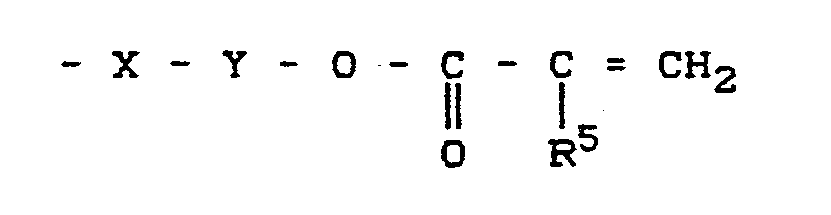
- X ein zweibindiges Brückenglied aus der Gruppe

- Y eine geradkettige oder verzweigte Kohlenwasserstoffkette mit 2 bis 10 Kohlenstoffatomen ist, die gegebenenfalls Sauerstoffbrücken enthalten kann und durch gegebenenfalls 1 bis 4 Acrylat- oder Methacrylatreste substituiert ist,
- R5 für Wasserstoff oder Methyl und R6 für Wasserstoff, Niederalkyl oder Phenyl stehen,
- Dentalmassen, bei denen von den erfindungsgemäßen (Meth)-acrylsäure-Derivaten von Tricyclodecanen ausgegangen wird, zeigen überraschenderweise einen wesentlich geringeren Polymerisationsschrumpf und sind daher für die Anwendung in der Praxis besonders geeignet.
- Im Rahmen der vorliegenden Erfindung können die Substituenten die folgende Bedeutung haben:
- Niederalkyl kann einen geradkettigen oder verzweigten Kohlenwasserstoffrest mit 1 bis etwa 6 Kohlenstoffatomen bedeuten. Beispielsweise seien die folgenden Niederalkylreste genannt: Methyl, Ethyl, Propyl, Isopropyl, Butyl, tert. Butyl, Isobutyl, Pentyl, Isopentyl, Hexyl und Isohexyl. Bevorzugt werden der Methyl- und der Ethylrest.
- Niederalkoxy kann ein über Sauerstoff gebundener geradkettiger oder verzweigter Kohlenwasserstoffrest mit 1 bis etwa 6 Kohlenstoffatomen bedeuten. Beispielsweise seien die folgenden Niederalkoxyreste genannt: Methoxy, Ethoxy, Propoxy, Isopropoxy, Butoxy, Isobutoxy, Pentoxy, Isopentoxy, Hexoxy und Isohexoxy. Bevorzugt sind der Methoxy- und der Ethoxyrest.
- Halogen kann Fluor, Chlor, Brom oder Jod bedeuten. Bevorzugte Halogene sind Fluor und Chlor.
- Y ist im allgemeinen eine geradkettige oder verzweigte Kohlenwasserstoffkette mit 2 bis 10 Kohlenstoffatomen, die durch gegebenenfalls 1 bis 4 Methacrylat- oder Acrylatreste substituiert ist. Die Kohlenwasserstoffkette kann gegebenenfalls 1 bis 3, bevorzugt 1 bis 2 , Sauerstoffgruppen enthalten. Beispielsweise seien die folgenden Bedeutungen für Y genannt: Ethylen, Propylen, 2-(Meth)-acrylolyloxy-1,3-propylen, 3-(Meth)-acrylolyloxy-1,2-propylen, 2-(Meth)-acrylolyloxymethyl-2-ethyl-1,3-propylen, 2,2-Bis-(meth)-acrylolyloxymethyl-1,3-propylen.
- Bevorzugt werden (Meth)-acrylsäure-Derivate von Tricyclodecanen nach Formel I, bei denen
- R1 und R2 Wasserstoff bedeuten,
- R3 und R4 gleich oder verschieden sind und für die Gruppe

- Y eine geradkettige oder verzweigte Kohlenwasserstoffkette mit 2 bis 10 Kohlenstoffatomen ist, die gegebenenfalls 1 bis 3 Sauerstoffbrücken enthalten und gegebenenfalls durch 1 bis 4 Acrylat- oder Methacrylatreste substituiert sein kann, wobei
- R5 für Wasserstoff oder Methyl steht.
- Bei den Substituenten R3 und R4 handelt es sich um Methacrylatgruppen enthaltende Alkyloxycarbonylaminoreste, die man z.B. durch Umsetzung entsprechender Isocyanatgruppen mit Methacrylatgruppen enthaltenden Hydroxylverbindungen erhalten kann. Bevorzugt sind z.B. Hydroxyethyl(meth)acrylate, 2-Hydroxypropyl(meth)acrylate, Trimethylolpropandi-(meth)acrylate, Propantrioldi(meth)acrylate sowie Penta- erythrittri(meth)acry1ate, Dipentaerythritpenta(meth)-acrylate. Auch Hydroxyverbindungen, die sowohl Acrylatals auch Methacrylatgruppen enthalten, sind gut geeignet. Besonders bevorzugte Hydroxylverbindungen sind 2-Hydroxypropylmethacrylat und Propandiolmethacrylat (Gemisch von 1,2- und 1,3-Methacrylat) und Hydroxy-methacrylolyloxyacrylolyloxypropan (Gemisch von 1,2- und 1,3-Diester).
- Beispielsweise seien die folgenden (Meth)-acrylsäureDerivate von Tricyclodecanen genannt:





- Es wurde auch ein Verfahren zur Herstellung der erfindungsgemäßen (Meth)-acrylsäure-Derivaten von Tricyclodecanen gefunden, das dadurch gekennzeichnet ist, daß man Diisocyanatomethyltricyclodecane der Formel

- R1 und R2 gleich oder verschieden sind und Wasserstoff, Niederalkyl, Niederalkoxy, Halogen oder Trifluormethyl bedeuten,
- Y eine geradkettige oder verzweigte Kohlenwasserstoffkette mit 2 bis 10 Kohlenstoffatomen ist, die gegebenenfalls Sauerstoffbrücken enthalten kann und durch gegebenenfalls 1 bis 4 Acrylat- oder Methacrylatreste substituiert ist, wobei
- R5 für Wasserstoff oder Methyl steht,
- Diisocyanatomethyl-tricyclodecane sind an sich bekannt und können beispielsweisedurch Umsetzung von Diaminomethyl-tricyclodecan mit Phosgen hergestellt werden.
- (Meth)-acrylsäure-Derivate der Formel (III) sind an sich bekannt (DE 3 234 045) und können beispielsweise durch Umsetzung von Epoxiden mit (Meth)acrylsäure hergestellt werden.
- (Meth)-acrylsäure-Derivate der Formel (IV) sind an sich bekannt (DAS 1 235 896) und können beispielsweise durch Umsetzung von Alkanolaminen mit Säurehalogeniden hergestellt werden.
- Es ist möglich, das erfindungsgemäße Verfahren ohne Lösungsmittel durchzuführen. Inerte Lösungsmittel für das erfindungsgemäße Verfahren sind bevorzugt unpolare Lösungsmittel, die sich unter den Reaktionsbedingungen nicht verändern. Als Lösungsmittel werden insbesondere bevorzugt: Chloroform, Tetrahydrofuran, Dioxan, Methylenchlorid, Toluol, Acetonitril und Freon. Insbesondere bevorzugt werden Chloroform, Tetrahydrofuran, Freon und Acetonitril.
- In einer besonderen Ausführungsform wird das erfindungsgemäße Verfahren unter Ausschluß von Wasser durchgeführt. Besonders bevorzugt wird eine maximale Menge von Wasser unter 0,1 %.
- Katalysatoren für das erfindungsgemäße Verfahren sind im allgemeinen Metallsalze höherer Fettsäuren. Bevorzugte Katalysatoren sind beispielsweise Dibutylzinnlaurat oder Zinn-(II)-octoat. Bevorzugt sind aber auch Verbindungen mit tertiären Aminogruppen, wie Pyridin, Methylpyridin, N,N'Dimethylpiperazin, N,N-Dimethylbenzylamin, u.a. und Titanverbindungen.
- Im allgemeinen wird der Katalysator in einer Menge von 0,1 bis 2,5 Gew.-%, bevorzugt von 0,1 bis 1,5 Gew.-%, bezogen auf die Gesamtmenge der Reaktanten eingesetzt.
- In einer bevorzugten Ausführungsform kann das erfindungsgemäße Verfahren in Gegenwart eines Polymerisationsinhibitors durchgeführt werden. Polymerisationsinhibitoren können beispielsweise für diesen Zweck aus (Ullmanns Encyklopädie der technischen Chemie, 4. Aufl., Verlag Chemie, Weinheim, Bd. 8, S.19-45) bekannte Verbindungen sein. Beispielsweise sei 2,6-Di-tert.-butyl-4-methylphenol genannt. Bevorzugter Polymerisationsinhibitoren ist beispielsweise auch der Sauerstoff der Luft, die in das Reaktionsgemisch eingeleitet wird.
- Im allgemeinen wird der Polymerisationsinhibitor in einer Menge von 0,01 bis 0,2 Gew.-X, bevorzugt von 0,1 bis 0,05 Gew.-%, eingesetzt.
- Das erfindungsgemäße Verfahren wird im allgemeinen im Temperaturbereich von 0 bis 100oC, vorzugsweise von 30 bis 70°C, durchgeführt. Das erfindungsgemäße Verfahren wird im allgemeinen bei Normaldruck durchgeführt. Es ist aber auch möglich, das erfindungsgemäße Verfahren beim Unter-oder Überdruck (beispielsweise im Druckbereich von 0,1 bis 10 bar) durchzuführen.
- Das erfindungsgemäße Verfahren kann beispielsweise wie folgt durchgeführt werden:
- Die Reaktanten werden in dem Lösungsmittel gelöst und unter Rühren mit dem Katalysator und gegebenenfalls dem Polymerisationsinhibitor versetzt. Der zeitliche Verlauf der Umsetzung kann beispielsweise durch Messung der IR-Spektren verfolgt werden. Nach vollständiger Umsetzung der Isocyanatgruppen werden die Reaktionsprodukte durch Entfernen des Lösungsmittels isoliert. Eine vorherige Reinigung mit Hilfe von Adsorbentien, bzw. Aktivkohle, Bleicherde, Kieselgel oder Aluminiumoxid ist möglich.
- Die erfindungsgemäßen (Meth)-acrylsäure-Derivate von Tricyclodecanen können als Monomere für Dentalmaterialien verwendet werden. Es ist möglich, sie als Monomere für polymere Zahnfüllmassen oder Beschichtungsmittel (Zahnlacke) im Dentalbereich einzusetzen.
- Für die Anwendung als Monomere für polymere Zahnfüllmassen oder Beschichtungsmittel im Dentalbereich können die erfindungsgemäßen (Meth)-acrylsäure-Derivate von Tricyclodecanen mit an sich bekannten Monomeren gemischt werden, um beispielsweise die Viskosität dem Verwendungszweck anzupassen. Hierbei werden Viskositäten im Bereich von 60 bis 10.000 mPas bevorzugt. Dieses ist dadurch erreichbar, daß man den erfindungsgemäßen Monomeren gegebenenfalls ein Comonomer niedriger Viskosität als Reaktivverdünner zumischt. Die erfindungsgemäßen Verbindungen werden in der Mischung mit Comonomeren mit einem Anteil von ca. 30 bis ca. 90 Gew.-%, bevorzugt von 50 bis 80 Gew.-%, eingesetzt. Zweck der vorliegenden Erfindung ist es, ebenfalls bevorzugt Mischungen verschiedener erfindungsgemäßer (Meth)-acrylsäure einzusetzen.
- Es ist auch möglich, Monomermischungen einzusetzen, die mehrere Comonomere als Reaktivverdünner enthalten.
- Beispielsweise seien die folgenden Comonomeren genannt: Glycerindimethacrylat, Triethylenglykoldimethacrylat, Tetraethylenglykoldimethacrylat, 1,12-Dodecandioldimethacrylat, 1,6-Hexandioldimethacrylat, Diethylenglykoldimethacrylat, 2,2-Bis-[p- (2'-hydroxy-3'-methacryloyl- oxypropoxy)-phenyl]-propan, 2,2-Bis-[p-(2'-meth- acryloyloxyethoxy) -phenyll-propan, Trimethylol-propan- tri-(meth)-acrylat, Bis-(meth)-acryloyloxyethoxymethyl- tricyclo-[5.2.1.02'6]-decan (DE-OS 29 31 925 und DE-OS 29 31 926).
- Insbesondere bevorzugt werden Comonomere, die bei 13 mbar einen Siedepunkt über 100°C besitzen.
- Die erfindungsgemäßen (Meth)-acrylsäureester lassen sich gegebenenfalls in Mischungen mit den genannten Comonomeren mit an sich bekannten Methoden zu vernetzenden Polymerisaten aushärten (Am.Chem.Soc., Symp.Ser.212, 359-371 (1983)). Für die sogenannte Redoxpolymerisation ist ein System aus einer peroxidischen Verbindung und einem Reduktionsmittel, beispielsweise auf Basis tertiärer aromatischer Amine, geeignet. Beispiele für Peroxide sind: Dibenzoylperoxid, Dilauroylperoxid und Di-4-chlorbenzoylperoxid.
- Als tertiäre aromatische Amine seien beispielsweise N,N-Dimethyl-p-toluidin, Bis-(2-hydroxyethyl)-p-toluidin, Bis-(2-hydroxyethyl)-3,5-dimethylanilin und N-Methyl-N-(2-methylcarbamoyloxypropyl)-3,5-dimethylanilin genannt. Die Konzentration des Peroxids bzw. des Amins werden vorteilhaft so gewählt, daß sie 0,1 bis 5 Gew.-X, bevorzugt 0,5 bis 3 Gew.-X, bezogen auf die Monomermischung betragen. Die peroxid- bzw. aminhaltigen Monomermischungen werden bis zur Anwendung getrennt gelagert.
- Die erfindungsgemäßen Monomeren können auch durch Bestrahlung mit UV-Licht oder sichtbarem Licht (beispielsweise im Wellenlängenbereich von 230 bis 650 nm) zur Polymerisation gebracht werden. Als Initiatoren für die photoinitiierte Polymerisation eignen sich beispielsweise Benzol, Benzoldimethylketal, Benzoinmonoalkylether, Benzophenon, p-Methoxybenzophenon, Fluorenon, Thioxanthon, Phenanthrenchinon und 2,3-Bornandion (Campherchinon), gegebenenfalls Gegenwart von synergistisch wirkenden Aktivatoren, wie N,N-Dimethylaminoethylmethacrylat, Triethanolamin, 4-N,N-Dimethylaminobenzolsulfonsäurediallylamid. Die Durchführung der Photopolymerisation ist beispielsweise in der DE-PS 3 135 115 beschrieben.
- Neben den oben beschriebenen Initiatoren können den erfindungsgemäßen (Meth)-acrylsäure-Derivaten an sich für diesen Einsatzzweck bekannte Lichtschutzmittel und Stabilisatoren zugesetzt werden.
- Lichtschutzmittel sind beispielsweise in (Gächter, Müller, Taschenbuch der Kunststoff-Additive, 2. Ausgabe, Carl Hauser Verlag) beschrieben. Beispielsweise seien die folgenden Lichtschutzmittel genannt: Cyasorb UV9®, Tinuvin P®, Tinuvin 770®, Tinuvin 6220, Tinuvin 7650.
- Stabilisatoren sind beispielsweise in (Ullmanns Encyklopädie der technischen Chemie, 4. Aufl., Bd. 8) beschrieben. Beispielsweise seien die folgenden Stabilisatoren genannt: 2,6-Di-tert.-butylphenol, 2,6-Di- tert.-butyl-4-methylphenol, 2,6-Di-octadecyl-4-methyl-phenol, 1,1'-Methylen-bis(naphthol-2) u.a.
- Die Lichtschutzmittel und die Stabilisatoren können jeweils in einer Menge von 0,01 bis 0,5 Gew.-Tln, bezogen auf 100 Gew.-Tle der Monomermischung, eingesetzt werden. Die Monomermischungen können ohne Zusatz von Füllstoffen als Beschichtungsmittel (Zahnlacke) eingesetzt werden. Bei der Verwendung als Zahnfüllmassen setzt man den erhaltenen Monomermischungen im allgemeinen Füllstoffe zu. Um einen hohen Füllgrad erreichen zu können, sind Monomermischungen, die eine hohe Viskosität im Bereich von 60 bis 10.000 mPas besitzen, besonders vorteilhaft.
- Vorzugsweise mischt man den erfindungsgemäßen (Meth)-acrylsäure-Derivaten von Tricyclodecanen anorganische Füllstoffe zu. Beispielsweise seien Bergkristall, Graphit, Kristoballit, Quarzglas, hochdisperse Kieselsäure, Aluminiumoxid und Glaskeramiken, beispielsweise Lantan und Zirkon enthaltende Glaskeramiken (DE-OS 23 740 501) genannt. Die anorganischen Füllstoffe werden zur Verbesserung des Verbunds zur Polymermatrix des Polymethacrylats, vorzugsweise mit einem Haftvermittler vorbehandelt. Die Haftvermittlung kann beispielsweise durch eine Behandlung mit Organosiliciumverbindungen erreicht werden (Progress in Organic Coatings 11 297-308 (1983)). Bevorzugt wird 3-Methacryloyloxipropyl -trimethoxisilan eingesetzt. Die Füllstoffe für die erfindungsgemäßen Zahnfüllmassen weisen im allgemeinen einen mittleren Teilchendurchmesser von 0,01 bis 100 σm, vorzugsweise von 0,05 bis 50 αm, besonders bevorzugt von 0,05 bis 5 σm auf. Es kann auch vorteilhaft sein, mehrere Füllstoffe nebeneinander einzusetzen, die einen voneinander verschiedenen Teilchendurchmesser besitzen.
- Der Füllstoffanteil in der Zahnfüllmasse beträgt im allgemeinen 5 bis 85 Gew.-X, vorzugsweise 50 bis 80 Gew.-X. Für die Herstellung der Zahnfüllmassen werden die Komponenten unter Verwendung handelsüblicher Knetmaschinen verwendet.
- Der Anteil der erfindungsgemäßen (Meth)-acrylsäure-Derivate von Tricyclodecanen in den Füllmassen beträgt im allgemeinen 5 bis 85 Gew.-%, bezogen auf die Füllmasse.
- Die erfindungsgemäßen Zahnlacke und Zahnfüllmasse haben überraschenderweise einen besonders niedrigen Polymerisationsschrumpf und gute mechanische Fertigkeiten.
- In einem geeignet ausgerüsteten Reaktionsgefäß werden unter Rühren und Durchblasen von trockener Luft 0,8 Mol Hydroxyethylmethacrylat, 0,4 Mol Diisocyanat, 0,13 g 2,6-Di-tert.-butyl-4-methyl-phenol (Jonol), und 0,5 g Dibutylzinndilaurat 6 h bei 50°C zur Reaktion gebracht.

- Molekulargewicht (osmometrisch): 500 - 511 (berechnet 506)
- 0,8 Mol 2-Hydroxymethacrylsäurepropylester, 0,4 Mol Diisocyanat, 0,13 g Jonol und 0,15 g Dibutylzinndilaurat werden wie in 1.)beschrieben zur Reaktion gebracht.

- Molekulargewicht (osmometrisch): 527 (berechnet 534) Viskosität (25°C): 356.000 mPas.
- In einem geeignet ausgerüsteten Reaktionsgefäß werden 0,7 Mol N-t-butylaminoethylmethacrylat vorgelegt und unter Rühren und Durchleiten von trockener Luft langsam 0,35 Mol Diisocyanat zugegeben. Nach Beendigung der Zugabe wird die Reaktionsmischung noch 30 min. nachgerührt.
- In einem geeignet ausgerüsteten Reaktionsgefäß werden 114 g Glycerindimethacrylat 0,5 g Dibutylzinndilaurat und 0,063 g Jonol in 200 ml Methylenchlorid gelöst. In diese Lösung tropft man bei Raumtemperatur 615 g Diisocyanat. Anschließend wird das Reaktionsgemisch 50 Stunden bei 40-50°C gerührt. Nach Abdestillieren des Lösungsmittels am Rotationsverdampfer erhält man eine klare, farblose Flüssigkeit.
- IR (cm-1): 3380 (N-H); 1725 (C=O); 1715 (C=O); 1160 (C-O) 1H-NMR (ppm) in CDC13/TMS: 6.16, 5.62 (= CH2,8H); 5.1-5.5 (=CH3-4H); 4.2-4.5 (COO-CH2-, 8H), 3.0 (-CONH-CH2-, 4H), 1.95, 2.5-2.0, 1.7-1 (CH3, TCD-CH2, 26H).

- Molekulargewicht (osmometrisch): 627 (berechnet 616) Viskosität (25°C): 1.220.000 mPas.
- 5. Messung des Polymerisationsschrumpfes:
- Im reinen Monomer werden 2 % Benzoylperoxid gelöst. 5 g dieser Lösung werden in ein zylindrisches Glasgefäß von 3 cm Durchmesser gefüllt und mit Stickstoff überschichtet. Die Lösungen werden 1 h auf 80°C und 15 min. auf 130°C erhitzt, wobei die Monomeren polymerisieren. Von den erhaltenen Probekörpern wird die Dichte bestimmt und durch Vergleich mit der Dichte der flüssigen Monomeren der Polymerisationsschrumpf bestimmt.

-
- a) Redoxhärtendes System
- Peroxidpaste: In einer Mischung aus 70 Teilen Monomer aus 1.) und 30 Teilen Triethylenglycoldimethacrylat werden 2 % Benzoylperoxid gelöst. 10 g silanisierte Glaskeramik werden mit 4 g dieser Lösung zu einer Paste verarbeitet.
- Aminpaste: In einer Mischung von 70 Teilen 1.a) und 30 Teilen Triethylenglycoldimethacrylat werden 1,3 % N-Methyl-N-ß-(methylcarbamoyloxy)-propyl-3,5-dimethylanilin gelöst. 4 g dieser Lösung werden mit 10 g silanisierter Glaskeramik zu einer Paste verarbeitet.
Werden gleiche Teile Aminpaste und Peroxidpaste miteinander gemischt, so härtet die Mischung in 2 Minuten aus. Die Pasten können mit Pigmenten eingefärbt werden und eignen sich zum Füllen von Zahnhohlräumen. - b) Lichthärtendes System In einer Mischung von 70 Teilen Monomer aus 1.) und 30 Teilen Triethylenglycoldimethacrylat werden 0,5 % N,N-Diallyl-p-dimethylaminobenzolsulfonsäure- amid, 0,2 % Campherchinon und 0,125 % Benzildimethylketal gelöst. 10 g silanisierte Glaskeramik werden mit 4 g dieser Lösung zu einer Paste verarbeitet. Bestrahlt man diese Masse mit einer handelsüblichen Dentallampe (Translux, Fa. Kulzer), so ist nach 40 sec eine Schicht von 7 mm durchgehärtet.
-
- a) Redoxhärtendes System
- Katalysatorlösung: In einer Mischung aus 10 Teilen Triethylenglycoldimethacrylat und 90 Teilen Monomer 2) werden 2 % Benzoylperoxid gelöst.
- Aktivatorlösung: In einer Mischung aus 10 Teilen Triethylenglycoldimethacrylat und 90 Teilen Monomer 2) werden 2,15 % N-Methyl-N-ß-(methylcarbamoyloxy)-propyl-3,5-dimethylanilin gelöst.
Eine Mischung aus gleichen Teilen Katalysatorlösung und Aktivatorlösung härtet in 1 min aus. - b) Lichthärtender Sealer
- In einer Mischung aus 30 Teilen Triethylenglycoldimethacrylat und 70 Teilen Monomer 3) werden 0,5 X N,N-Diallyl-p-dimethylaminohenzol- sulfonsäureamid, 0,2 X Campherchinon und 0,125 % Benzildimethylketal gelöst.
- Beim Bestrahlen mit einer handelsüblichen Dentallampe (Translux, Fa. Kulzer) härtet die Flüssigkeit zu einem festen Film aus.
mit (Meth)-acrylsäure-Derivaten der Formeln
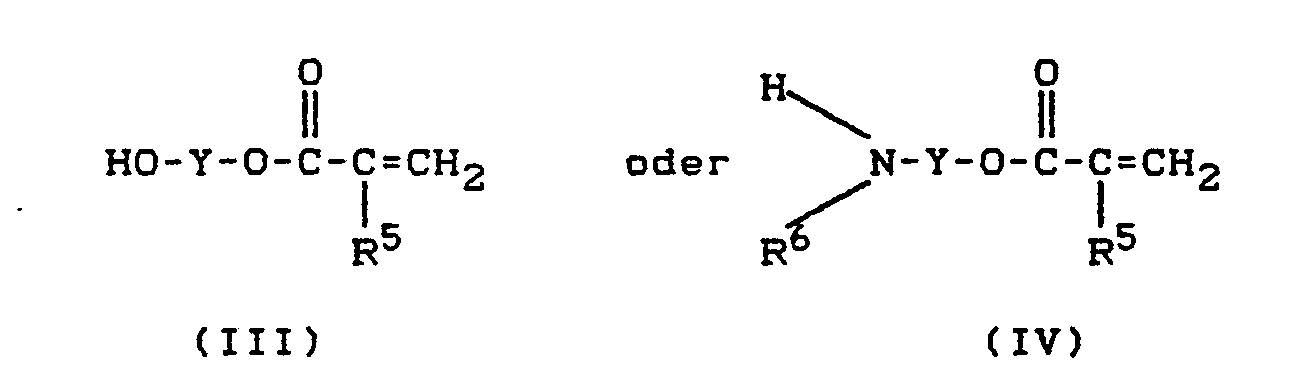
gegebenenfalls in einem inerten Lösungsmittel in Gegenwart eines Katalysators im Temperaturbereich von 0 bis 100°C umsetzt.
Claims (9)


wobei

wobei

mit (Meth)-acrylsäure-Derivaten der Formeln

wobei
gegebenenfalls in einem inerten Lösungsmittel in Gegenwart eines Katalysators im Temperaturbereich von 0 bis 100°C umsetzt.


wobei


wobei
enthalten.
Priority Applications (1)
| Application Number | Priority Date | Filing Date | Title |
|---|---|---|---|
| AT86107838T ATE55113T1 (de) | 1985-06-20 | 1986-06-09 | (meth)-acrylsaeureester und ihre verwendung. |
Applications Claiming Priority (2)
| Application Number | Priority Date | Filing Date | Title |
|---|---|---|---|
| DE19853522005 DE3522005A1 (de) | 1985-06-20 | 1985-06-20 | (meth)-acrylsaeureester und ihre verwendung |
| DE3522005 | 1985-06-20 |
Publications (3)
| Publication Number | Publication Date |
|---|---|
| EP0206074A2 true EP0206074A2 (de) | 1986-12-30 |
| EP0206074A3 EP0206074A3 (en) | 1988-01-13 |
| EP0206074B1 EP0206074B1 (de) | 1990-08-01 |
Family
ID=6273692
Family Applications (1)
| Application Number | Title | Priority Date | Filing Date |
|---|---|---|---|
| EP86107838A Expired - Lifetime EP0206074B1 (de) | 1985-06-20 | 1986-06-09 | (Meth)-acrylsäureester und ihre Verwendung |
Country Status (18)
| Country | Link |
|---|---|
| US (1) | US4744828A (de) |
| EP (1) | EP0206074B1 (de) |
| JP (1) | JPH072705B2 (de) |
| KR (1) | KR870000288A (de) |
| CN (1) | CN1018892B (de) |
| AT (1) | ATE55113T1 (de) |
| AU (1) | AU584428B2 (de) |
| CA (1) | CA1276168C (de) |
| DE (2) | DE3522005A1 (de) |
| DK (1) | DK162387C (de) |
| ES (1) | ES8801194A1 (de) |
| FI (1) | FI862621A7 (de) |
| GR (1) | GR861573B (de) |
| HU (1) | HUT42107A (de) |
| IE (1) | IE58561B1 (de) |
| IL (1) | IL79128A0 (de) |
| NO (1) | NO163096C (de) |
| ZA (1) | ZA864572B (de) |
Cited By (12)
| Publication number | Priority date | Publication date | Assignee | Title |
|---|---|---|---|---|
| EP0209700B1 (de) * | 1985-06-20 | 1990-08-01 | Bayer Ag | (Meth)-acrylsäure-Derivate von Tricyclodecanen und ihre Verwendung |
| DE4024365A1 (de) * | 1989-08-09 | 1991-02-14 | Battelle Institut E V | Neuartige monomerbausteine aus hydroxyfettsaeuren zur herstellung von kunststoffen |
| US5312889A (en) * | 1989-08-09 | 1994-05-17 | Battelle-Institut E.V. | Hydroxyfatty-acid-based monomers for producing plastics |
| EP0709387A1 (de) * | 1994-10-26 | 1996-05-01 | Ivoclar Ag | Bicycloaliphatische 2-Methylen-1,3-dioxepane |
| EP0776650A3 (de) * | 1995-11-30 | 2000-05-03 | Heraeus Kulzer GmbH & Co.KG | Dentaladhäsive |
| WO2014026672A1 (de) | 2012-08-16 | 2014-02-20 | Bess Pro Gmbh | Bioresorbierbare klebstoffe und deren verwendung im medizinischen bereich |
| US8669302B2 (en) | 2010-09-30 | 2014-03-11 | Voco Gmbh | Composite material comprising a monomer with a polyalicyclic structure element as a sealing material |
| US8697772B2 (en) | 2010-11-08 | 2014-04-15 | Voco Gmbh | Polymerizable phosphoric acid derivatives comprising a polyalicylic structure element |
| US9023916B2 (en) | 2010-09-30 | 2015-05-05 | Voco Gmbh | Composite material comprising a monomer with a polyalicyclic structure element |
| US9079828B2 (en) | 2010-09-30 | 2015-07-14 | Voco Gmbh | Polymerizable compounds comprising a polyalicylic structure element |
| US10603143B2 (en) | 2017-02-15 | 2020-03-31 | Voco Gmbh | Dental milling blank for the production of permanent indirect restorations and computer-aided process for producing the permanent indirect restorations |
| US10835453B2 (en) | 2016-12-21 | 2020-11-17 | Voco Gmbh | Storage-stable resin-modified glass ionomer cement |
Families Citing this family (24)
| Publication number | Priority date | Publication date | Assignee | Title |
|---|---|---|---|---|
| DE3636189A1 (de) * | 1986-10-24 | 1988-04-28 | Bayer Ag | (meth)-acrylsaeure-derivate von triisocyanaten und ihre verwendung |
| DE3917320A1 (de) * | 1989-05-27 | 1990-12-20 | Bayer Ag | Harnstoffgruppen enthaltende (meth)-acrylsaeure-derivate von triisocyanaten und ihre verwendung |
| US6353061B1 (en) | 1993-05-26 | 2002-03-05 | Dentsply Gmbh | α, ω-methacrylate terminated macromonomer compounds |
| US5998499A (en) | 1994-03-25 | 1999-12-07 | Dentsply G.M.B.H. | Liquid crystalline (meth)acrylate compounds, composition and method |
| US6369164B1 (en) | 1993-05-26 | 2002-04-09 | Dentsply G.M.B.H. | Polymerizable compounds and compositions |
| CA2146816A1 (en) | 1994-04-22 | 1995-10-23 | Joachim E. Klee | Process and composition for preparing a dental polymer product |
| EP0758103B1 (de) | 1995-08-08 | 2001-12-12 | Agfa-Gevaert N.V. | Verfahren zur Bildung von metallischen Bildern |
| EP0762214A1 (de) | 1995-09-05 | 1997-03-12 | Agfa-Gevaert N.V. | Lichtempfindliches Element, das eine Bildaufbauschicht und eine photopolymerisierbare Schicht enthält |
| US20050124721A1 (en) * | 2003-12-03 | 2005-06-09 | Arthur Samuel D. | Bulky monomers leading to resins exhibiting low polymerization shrinkage |
| DE102009016025B4 (de) | 2009-04-02 | 2014-12-11 | Voco Gmbh | Kunststoffmodifizierter Glasionomerzement, seine Verwendung sowie Verfahren zu seiner Herstellung |
| JP2011202012A (ja) * | 2010-03-25 | 2011-10-13 | Nitto Denko Corp | アクリル系粘着剤組成物およびアクリル系粘着テープ |
| DE102010003883A1 (de) | 2010-04-12 | 2011-10-13 | Voco Gmbh | Lichthärtbares Kompositmaterial |
| DE102010003881A1 (de) | 2010-04-12 | 2011-10-13 | Voco Gmbh | Dentale Abdeckmasse |
| DE102010003884A1 (de) | 2010-04-12 | 2011-10-13 | Voco Gmbh | Dualhärtende, mehrkomponentige dentale Zusammensetzung |
| EP2436363B1 (de) | 2010-09-30 | 2017-01-18 | VOCO GmbH | Zusammensetzung umfassend ein Monomer mit einem polyalicyclischen Strukturelement zum Füllen und/oder Versiegeln eines Wurzelkanals |
| EP2436364B1 (de) | 2010-09-30 | 2017-05-31 | VOCO GmbH | Lackzusammensetzung umfassend ein Monomer mit einem polyalicyclischen Strukturelement |
| US9173820B2 (en) | 2011-08-11 | 2015-11-03 | 3M Innovative Properties Company | Dental composition, method of producing and use thereof |
| DE102013008176A1 (de) | 2012-10-05 | 2014-04-10 | Voco Gmbh | Kit und Verfahren zur indirekten chairside Herstellung von Kompositinlays |
| EP3011949B1 (de) | 2014-10-23 | 2021-05-05 | VOCO GmbH | Härtbares dentalmaterial |
| DE102017105841A1 (de) | 2017-03-17 | 2018-09-20 | Voco Gmbh | Fräsrohling zur Herstellung einer indirekten dentalen Restauration, entsprechende Verwendungen und Verfahren |
| DE102018103415A1 (de) | 2018-02-15 | 2019-08-22 | Voco Gmbh | Dentale Formkörper mit kontinuierlichem Farbverlauf |
| DE102018114690A1 (de) | 2018-06-19 | 2019-12-19 | Voco Gmbh | Thermowirksame dentale Kompositzusammensetzung |
| CN114349903B (zh) * | 2021-12-20 | 2022-10-25 | 华南理工大学 | 一种不含双酚a结构的可流动性大块充填复合树脂及其制备与应用 |
| DE102021134260A1 (de) | 2021-12-22 | 2023-06-22 | Voco Gmbh | Dentale lichthärtbare Zusammensetzung sowie entsprechende Restaurationen, Herstellverfahren und Verwendungen |
Family Cites Families (13)
| Publication number | Priority date | Publication date | Assignee | Title |
|---|---|---|---|---|
| DE2714538C3 (de) * | 1977-04-01 | 1979-11-15 | Henkel Kgaa, 4000 Duesseldorf | Methacrylsäureester von auf tricyclischen Decanolen aufgebauten Verbindungen |
| CH629664A5 (en) * | 1977-04-19 | 1982-05-14 | Espe Pharm Praep | Polymerisable composition for dental purposes |
| US4131729A (en) * | 1978-04-21 | 1978-12-26 | Espe Fabrik Pharmazeutischer Praparate Gmbh | Dental compositions comprising acrylic esters of tricyclo [5.2.1.02,6 ] decane polymers |
| DE2931925A1 (de) * | 1979-08-07 | 1981-02-26 | Bayer Ag | (meth)acrylsaeureester von ethergruppen enthaltenden tricyclischen decandiolen |
| DE2931926A1 (de) * | 1979-08-07 | 1981-02-26 | Bayer Ag | Dentalmassen |
| GB2074590B (en) * | 1980-04-29 | 1984-02-22 | Kuraray Co | Acrylate urethane binders in dental cement compositions |
| US4379695A (en) * | 1980-06-02 | 1983-04-12 | Scientific Pharmaceuticals, Inc. | Dental material comprising dimethyacrylate adducts of glycidyl methacrylate with diesters of bis(hydroxymethyl) tricyclo[5.2.1.02,6 ]decane and dicarboxylic acids |
| DE3070209D1 (en) * | 1980-07-23 | 1985-03-28 | Blendax Werke Schneider Co | Adducts from diisocyanates and methacryloylalkylethers, -alcoxybenzenes resp. -alcoxycycloalcanes and their use |
| DE3135115A1 (de) * | 1981-09-04 | 1983-03-24 | Bayer Ag, 5090 Leverkusen | Photopolymerisationsverfahren und hierfuer geeignete photoaktivatoren |
| US4420306A (en) * | 1982-06-24 | 1983-12-13 | Blendax-Werke R. Schneider Gmbh & Co. | Tetraacrylic and tetramethacrylic esters and dental materials containing same |
| DE3338077A1 (de) * | 1983-10-20 | 1985-05-09 | Bayer Ag, 5090 Leverkusen | Ungesaettigte esterisocyanate, ein verfahren zu ihrer herstellung und ihre verwendung bei der herstellung von olefinisch ungesaettigten oligourethanen |
| EP0171847B1 (de) * | 1984-08-17 | 1988-06-01 | Akzo N.V. | Flüssige, vernetzbare Überzugszusammensetzung mit einem Hydroxygruppen enthaltenden Additionspolymer als Binder |
| DE3522006A1 (de) * | 1985-06-20 | 1987-01-02 | Bayer Ag | (meth)-acrylsaeure-derivate von tricyclodecanen und ihre verwendung |
-
1985
- 1985-06-20 DE DE19853522005 patent/DE3522005A1/de active Pending
-
1986
- 1986-06-02 AU AU58270/86A patent/AU584428B2/en not_active Expired
- 1986-06-04 US US06/870,610 patent/US4744828A/en not_active Expired - Lifetime
- 1986-06-09 AT AT86107838T patent/ATE55113T1/de not_active IP Right Cessation
- 1986-06-09 EP EP86107838A patent/EP0206074B1/de not_active Expired - Lifetime
- 1986-06-09 DE DE8686107838T patent/DE3673085D1/de not_active Expired - Lifetime
- 1986-06-11 NO NO862333A patent/NO163096C/no unknown
- 1986-06-17 IL IL79128A patent/IL79128A0/xx unknown
- 1986-06-18 FI FI862621A patent/FI862621A7/fi not_active Application Discontinuation
- 1986-06-18 CA CA000511897A patent/CA1276168C/en not_active Expired - Lifetime
- 1986-06-18 GR GR861573A patent/GR861573B/el unknown
- 1986-06-19 ZA ZA864572A patent/ZA864572B/xx unknown
- 1986-06-19 DK DK287986A patent/DK162387C/da active
- 1986-06-19 KR KR1019860004879A patent/KR870000288A/ko not_active Abandoned
- 1986-06-19 HU HU862583A patent/HUT42107A/hu unknown
- 1986-06-19 IE IE163786A patent/IE58561B1/en not_active IP Right Cessation
- 1986-06-19 ES ES556288A patent/ES8801194A1/es not_active Expired
- 1986-06-20 JP JP61143147A patent/JPH072705B2/ja not_active Expired - Lifetime
- 1986-06-20 CN CN86104260A patent/CN1018892B/zh not_active Expired
Cited By (15)
| Publication number | Priority date | Publication date | Assignee | Title |
|---|---|---|---|---|
| EP0209700B1 (de) * | 1985-06-20 | 1990-08-01 | Bayer Ag | (Meth)-acrylsäure-Derivate von Tricyclodecanen und ihre Verwendung |
| DE4024365A1 (de) * | 1989-08-09 | 1991-02-14 | Battelle Institut E V | Neuartige monomerbausteine aus hydroxyfettsaeuren zur herstellung von kunststoffen |
| US5312889A (en) * | 1989-08-09 | 1994-05-17 | Battelle-Institut E.V. | Hydroxyfatty-acid-based monomers for producing plastics |
| EP0709387A1 (de) * | 1994-10-26 | 1996-05-01 | Ivoclar Ag | Bicycloaliphatische 2-Methylen-1,3-dioxepane |
| US5703249A (en) * | 1994-10-26 | 1997-12-30 | Ivoclar Ag | Bicycloaliphatic 2-methylene-1,3-dioxepanes |
| EP0776650A3 (de) * | 1995-11-30 | 2000-05-03 | Heraeus Kulzer GmbH & Co.KG | Dentaladhäsive |
| US9079828B2 (en) | 2010-09-30 | 2015-07-14 | Voco Gmbh | Polymerizable compounds comprising a polyalicylic structure element |
| US9023916B2 (en) | 2010-09-30 | 2015-05-05 | Voco Gmbh | Composite material comprising a monomer with a polyalicyclic structure element |
| US8669302B2 (en) | 2010-09-30 | 2014-03-11 | Voco Gmbh | Composite material comprising a monomer with a polyalicyclic structure element as a sealing material |
| US8697772B2 (en) | 2010-11-08 | 2014-04-15 | Voco Gmbh | Polymerizable phosphoric acid derivatives comprising a polyalicylic structure element |
| DE102012107535A1 (de) | 2012-08-16 | 2014-02-20 | Bess Pro Gmbh | Bioresorbierbare Klebstoffe und deren Verwendung im medizinischen Bereich |
| WO2014026672A1 (de) | 2012-08-16 | 2014-02-20 | Bess Pro Gmbh | Bioresorbierbare klebstoffe und deren verwendung im medizinischen bereich |
| US10835453B2 (en) | 2016-12-21 | 2020-11-17 | Voco Gmbh | Storage-stable resin-modified glass ionomer cement |
| US10603143B2 (en) | 2017-02-15 | 2020-03-31 | Voco Gmbh | Dental milling blank for the production of permanent indirect restorations and computer-aided process for producing the permanent indirect restorations |
| US11400028B2 (en) | 2017-02-15 | 2022-08-02 | Voco Gmbh | Dental milling blank for the production of permanent indirect restorations and computer-aided process for producing the permanent indirect restorations |
Also Published As
| Publication number | Publication date |
|---|---|
| DE3673085D1 (de) | 1990-09-06 |
| ES556288A0 (es) | 1987-12-16 |
| DK162387C (da) | 1992-03-09 |
| ATE55113T1 (de) | 1990-08-15 |
| CN1018892B (zh) | 1992-11-04 |
| IL79128A0 (en) | 1986-09-30 |
| CA1276168C (en) | 1990-11-13 |
| FI862621A7 (fi) | 1986-12-21 |
| DK287986A (da) | 1986-12-21 |
| DK287986D0 (da) | 1986-06-19 |
| JPH072705B2 (ja) | 1995-01-18 |
| HUT42107A (en) | 1987-06-29 |
| US4744828A (en) | 1988-05-17 |
| KR870000288A (ko) | 1987-02-17 |
| EP0206074B1 (de) | 1990-08-01 |
| ZA864572B (en) | 1987-02-25 |
| EP0206074A3 (en) | 1988-01-13 |
| AU5827086A (en) | 1986-12-24 |
| FI862621A0 (fi) | 1986-06-18 |
| NO862333L (no) | 1986-12-22 |
| IE58561B1 (en) | 1993-01-06 |
| NO163096B (no) | 1989-12-27 |
| NO862333D0 (no) | 1986-06-11 |
| NO163096C (no) | 1990-04-04 |
| DE3522005A1 (de) | 1987-01-02 |
| DK162387B (da) | 1991-10-21 |
| IE861637L (en) | 1986-12-20 |
| JPS61293960A (ja) | 1986-12-24 |
| ES8801194A1 (es) | 1987-12-16 |
| CN86104260A (zh) | 1987-06-17 |
| AU584428B2 (en) | 1989-05-25 |
| GR861573B (en) | 1986-10-17 |
Similar Documents
| Publication | Publication Date | Title |
|---|---|---|
| EP0206074B1 (de) | (Meth)-acrylsäureester und ihre Verwendung | |
| EP0209700B1 (de) | (Meth)-acrylsäure-Derivate von Tricyclodecanen und ihre Verwendung | |
| EP0201031B1 (de) | (Meth)-Acrylsäureester und ihre Verwendung | |
| EP0254185B1 (de) | Urethangruppen enthaltende (Meth)-acrylsäurederivate von Tricyclo [5.2.1.02.6]decanen | |
| EP0201778B1 (de) | (Meth)-Acrylsäureester und ihre Verwendung | |
| EP0254950B1 (de) | (Meth)-acrylsäureester | |
| EP0264551B1 (de) | Urethangruppen enthaltende (Meth)-acrylsäurederivate | |
| EP0321841B1 (de) | Ester-Urethan-(Meth)-acrylsäurederivate | |
| EP0779290A1 (de) | Urethan-(Meth)acrylate mit cyclischen Carbonatgruppen und deren Verwendung zur Herstellung von Dentalwerkstoffen oder lithographischen Druckplatten | |
| EP0693487B1 (de) | Di(meth)acrylate mit cyclischen Carbonatgruppen | |
| EP0635478A1 (de) | Acrylate und Methacrylate auf Basis von Cyclohexyldiphenolen | |
| EP0400383B1 (de) | Harnstoffgruppen enthaltende (Meth)-Acrylsäure-Derivate von Triisocyanaten und ihre Verwendung | |
| EP0266589B1 (de) | (Meth)-Acrylsäure-Derivate von Triisocyanaten und ihre Verwendung | |
| EP0273245B1 (de) | (Meth)-Acrylsäure-Derivate von Triisocyanaten und ihre Verwendung | |
| EP0443370B1 (de) | Dentalwerkstoffe |
Legal Events
| Date | Code | Title | Description |
|---|---|---|---|
| PUAI | Public reference made under article 153(3) epc to a published international application that has entered the european phase |
Free format text: ORIGINAL CODE: 0009012 |
|
| 17P | Request for examination filed |
Effective date: 19860609 |
|
| AK | Designated contracting states |
Kind code of ref document: A2 Designated state(s): AT BE CH DE FR GB IT LI NL SE |
|
| PUAL | Search report despatched |
Free format text: ORIGINAL CODE: 0009013 |
|
| AK | Designated contracting states |
Kind code of ref document: A3 Designated state(s): AT BE CH DE FR GB IT LI NL SE |
|
| 17Q | First examination report despatched |
Effective date: 19890608 |
|
| GRAA | (expected) grant |
Free format text: ORIGINAL CODE: 0009210 |
|
| AK | Designated contracting states |
Kind code of ref document: B1 Designated state(s): AT BE CH DE FR GB IT LI NL SE |
|
| REF | Corresponds to: |
Ref document number: 55113 Country of ref document: AT Date of ref document: 19900815 Kind code of ref document: T |
|
| REF | Corresponds to: |
Ref document number: 3673085 Country of ref document: DE Date of ref document: 19900906 |
|
| GBT | Gb: translation of ep patent filed (gb section 77(6)(a)/1977) | ||
| ITF | It: translation for a ep patent filed | ||
| ET | Fr: translation filed | ||
| PLBE | No opposition filed within time limit |
Free format text: ORIGINAL CODE: 0009261 |
|
| STAA | Information on the status of an ep patent application or granted ep patent |
Free format text: STATUS: NO OPPOSITION FILED WITHIN TIME LIMIT |
|
| 26N | No opposition filed | ||
| ITTA | It: last paid annual fee | ||
| EAL | Se: european patent in force in sweden |
Ref document number: 86107838.4 |
|
| NLS | Nl: assignments of ep-patents |
Owner name: HERAEUS KULZER GMBH |
|
| REG | Reference to a national code |
Ref country code: CH Ref legal event code: PUE Owner name: BAYER AKTIENGESELLSCHAFT TRANSFER- HERAEUS KULZER |
|
| REG | Reference to a national code |
Ref country code: FR Ref legal event code: TP |
|
| REG | Reference to a national code |
Ref country code: GB Ref legal event code: 732E |
|
| BECA | Be: change of holder's address |
Free format text: 960626 *HERAEUS KULZER G.M.B.H. & CO. K.G.:D-63450 HANAU |
|
| REG | Reference to a national code |
Ref country code: GB Ref legal event code: IF02 |
|
| PGFP | Annual fee paid to national office [announced via postgrant information from national office to epo] |
Ref country code: GB Payment date: 20050531 Year of fee payment: 20 |
|
| PGFP | Annual fee paid to national office [announced via postgrant information from national office to epo] |
Ref country code: FR Payment date: 20050610 Year of fee payment: 20 |
|
| PGFP | Annual fee paid to national office [announced via postgrant information from national office to epo] |
Ref country code: DE Payment date: 20050613 Year of fee payment: 20 |
|
| PGFP | Annual fee paid to national office [announced via postgrant information from national office to epo] |
Ref country code: SE Payment date: 20050614 Year of fee payment: 20 Ref country code: CH Payment date: 20050614 Year of fee payment: 20 |
|
| PGFP | Annual fee paid to national office [announced via postgrant information from national office to epo] |
Ref country code: NL Payment date: 20050615 Year of fee payment: 20 Ref country code: AT Payment date: 20050615 Year of fee payment: 20 |
|
| PGFP | Annual fee paid to national office [announced via postgrant information from national office to epo] |
Ref country code: IT Payment date: 20050621 Year of fee payment: 20 |
|
| REG | Reference to a national code |
Ref country code: GB Ref legal event code: PE20 |
|
| PGFP | Annual fee paid to national office [announced via postgrant information from national office to epo] |
Ref country code: BE Payment date: 20050704 Year of fee payment: 20 |
|
| PG25 | Lapsed in a contracting state [announced via postgrant information from national office to epo] |
Ref country code: GB Free format text: LAPSE BECAUSE OF EXPIRATION OF PROTECTION Effective date: 20060608 |
|
| PG25 | Lapsed in a contracting state [announced via postgrant information from national office to epo] |
Ref country code: NL Free format text: LAPSE BECAUSE OF EXPIRATION OF PROTECTION Effective date: 20060609 |
|
| REG | Reference to a national code |
Ref country code: CH Ref legal event code: PL |
|
| NLV7 | Nl: ceased due to reaching the maximum lifetime of a patent |
Effective date: 20060609 |
|
| EUG | Se: european patent has lapsed | ||
| BE20 | Be: patent expired |
Owner name: *HERAEUS KULZER G.M.B.H. & CO. K.G. Effective date: 20060609 |