EP0796723B1 - Verfahren zur herstellung von kontaktlinsen und die so hergestellten kontaktlinsen - Google Patents
Verfahren zur herstellung von kontaktlinsen und die so hergestellten kontaktlinsen Download PDFInfo
- Publication number
- EP0796723B1 EP0796723B1 EP96929534A EP96929534A EP0796723B1 EP 0796723 B1 EP0796723 B1 EP 0796723B1 EP 96929534 A EP96929534 A EP 96929534A EP 96929534 A EP96929534 A EP 96929534A EP 0796723 B1 EP0796723 B1 EP 0796723B1
- Authority
- EP
- European Patent Office
- Prior art keywords
- group
- polymer
- acrylate
- meth
- formula
- Prior art date
- Legal status (The legal status is an assumption and is not a legal conclusion. Google has not performed a legal analysis and makes no representation as to the accuracy of the status listed.)
- Expired - Lifetime
Links
- 238000000034 method Methods 0.000 title claims description 85
- NIXOWILDQLNWCW-UHFFFAOYSA-M Acrylate Chemical compound [O-]C(=O)C=C NIXOWILDQLNWCW-UHFFFAOYSA-M 0.000 claims description 125
- 229920000642 polymer Polymers 0.000 claims description 109
- -1 polysiloxane Polymers 0.000 claims description 77
- 125000002947 alkylene group Chemical group 0.000 claims description 39
- 150000001875 compounds Chemical class 0.000 claims description 38
- LFQSCWFLJHTTHZ-UHFFFAOYSA-N Ethanol Chemical compound CCO LFQSCWFLJHTTHZ-UHFFFAOYSA-N 0.000 claims description 34
- LRHPLDYGYMQRHN-UHFFFAOYSA-N N-Butanol Chemical compound CCCCO LRHPLDYGYMQRHN-UHFFFAOYSA-N 0.000 claims description 34
- AMQJEAYHLZJPGS-UHFFFAOYSA-N N-Pentanol Chemical compound CCCCCO AMQJEAYHLZJPGS-UHFFFAOYSA-N 0.000 claims description 34
- XLYOFNOQVPJJNP-UHFFFAOYSA-N water Substances O XLYOFNOQVPJJNP-UHFFFAOYSA-N 0.000 claims description 32
- 238000006116 polymerization reaction Methods 0.000 claims description 27
- 125000002768 hydroxyalkyl group Chemical group 0.000 claims description 26
- 125000004430 oxygen atom Chemical group O* 0.000 claims description 24
- XUIMIQQOPSSXEZ-UHFFFAOYSA-N Silicon Chemical compound [Si] XUIMIQQOPSSXEZ-UHFFFAOYSA-N 0.000 claims description 23
- 125000003827 glycol group Chemical group 0.000 claims description 23
- 229910052710 silicon Inorganic materials 0.000 claims description 23
- 239000010703 silicon Substances 0.000 claims description 23
- 239000000203 mixture Substances 0.000 claims description 20
- BDERNNFJNOPAEC-UHFFFAOYSA-N propan-1-ol Chemical compound CCCO BDERNNFJNOPAEC-UHFFFAOYSA-N 0.000 claims description 15
- 230000036571 hydration Effects 0.000 claims description 13
- 238000006703 hydration reaction Methods 0.000 claims description 13
- 229920001296 polysiloxane Polymers 0.000 claims description 12
- 125000005250 alkyl acrylate group Chemical group 0.000 claims description 11
- 125000005442 diisocyanate group Chemical group 0.000 claims description 10
- KPUWHANPEXNPJT-UHFFFAOYSA-N disiloxane Chemical class [SiH3]O[SiH3] KPUWHANPEXNPJT-UHFFFAOYSA-N 0.000 claims description 7
- 125000003903 2-propenyl group Chemical group [H]C([*])([H])C([H])=C([H])[H] 0.000 claims description 5
- 230000000887 hydrating effect Effects 0.000 claims description 5
- 125000001997 phenyl group Chemical group [H]C1=C([H])C([H])=C(*)C([H])=C1[H] 0.000 claims description 5
- 125000000391 vinyl group Chemical group [H]C([*])=C([H])[H] 0.000 claims description 5
- PPBAWVJOPQUAMY-UHFFFAOYSA-N 3-tris(trimethylsilyloxy)silylpropyl prop-2-enoate Chemical group C[Si](C)(C)O[Si](O[Si](C)(C)C)(O[Si](C)(C)C)CCCOC(=O)C=C PPBAWVJOPQUAMY-UHFFFAOYSA-N 0.000 claims description 4
- 125000003647 acryloyl group Chemical group O=C([*])C([H])=C([H])[H] 0.000 claims description 3
- GAWIXWVDTYZWAW-UHFFFAOYSA-N C[CH]O Chemical group C[CH]O GAWIXWVDTYZWAW-UHFFFAOYSA-N 0.000 claims description 2
- 125000002723 alicyclic group Chemical group 0.000 claims 2
- 125000001931 aliphatic group Chemical group 0.000 claims 2
- 125000006273 (C1-C3) alkyl group Chemical group 0.000 claims 1
- 125000003161 (C1-C6) alkylene group Chemical group 0.000 claims 1
- 125000001183 hydrocarbyl group Chemical group 0.000 claims 1
- 239000003960 organic solvent Substances 0.000 description 104
- 125000004432 carbon atom Chemical group C* 0.000 description 28
- 239000000178 monomer Substances 0.000 description 27
- QVGXLLKOCUKJST-UHFFFAOYSA-N atomic oxygen Chemical compound [O] QVGXLLKOCUKJST-UHFFFAOYSA-N 0.000 description 25
- 239000001301 oxygen Substances 0.000 description 25
- 229910052760 oxygen Inorganic materials 0.000 description 25
- 230000035699 permeability Effects 0.000 description 25
- 239000000463 material Substances 0.000 description 21
- 239000002210 silicon-based material Substances 0.000 description 20
- YCKRFDGAMUMZLT-UHFFFAOYSA-N Fluorine atom Chemical compound [F] YCKRFDGAMUMZLT-UHFFFAOYSA-N 0.000 description 19
- 229910052731 fluorine Inorganic materials 0.000 description 19
- 239000011737 fluorine Substances 0.000 description 19
- UHOVQNZJYSORNB-UHFFFAOYSA-N Benzene Chemical compound C1=CC=CC=C1 UHOVQNZJYSORNB-UHFFFAOYSA-N 0.000 description 18
- 238000010438 heat treatment Methods 0.000 description 15
- 230000000694 effects Effects 0.000 description 13
- 239000003505 polymerization initiator Substances 0.000 description 12
- CSCPPACGZOOCGX-UHFFFAOYSA-N Acetone Chemical compound CC(C)=O CSCPPACGZOOCGX-UHFFFAOYSA-N 0.000 description 10
- 238000009835 boiling Methods 0.000 description 10
- 230000000052 comparative effect Effects 0.000 description 10
- 238000001035 drying Methods 0.000 description 10
- 238000012719 thermal polymerization Methods 0.000 description 10
- WRIDQFICGBMAFQ-UHFFFAOYSA-N (E)-8-Octadecenoic acid Natural products CCCCCCCCCC=CCCCCCCC(O)=O WRIDQFICGBMAFQ-UHFFFAOYSA-N 0.000 description 9
- LQJBNNIYVWPHFW-UHFFFAOYSA-N 20:1omega9c fatty acid Natural products CCCCCCCCCCC=CCCCCCCCC(O)=O LQJBNNIYVWPHFW-UHFFFAOYSA-N 0.000 description 9
- QSBYPNXLFMSGKH-UHFFFAOYSA-N 9-Heptadecensaeure Natural products CCCCCCCC=CCCCCCCCC(O)=O QSBYPNXLFMSGKH-UHFFFAOYSA-N 0.000 description 9
- 239000005642 Oleic acid Substances 0.000 description 9
- ZQPPMHVWECSIRJ-UHFFFAOYSA-N Oleic acid Natural products CCCCCCCCC=CCCCCCCCC(O)=O ZQPPMHVWECSIRJ-UHFFFAOYSA-N 0.000 description 9
- QXJSBBXBKPUZAA-UHFFFAOYSA-N isooleic acid Natural products CCCCCCCC=CCCCCCCCCC(O)=O QXJSBBXBKPUZAA-UHFFFAOYSA-N 0.000 description 9
- ZQPPMHVWECSIRJ-KTKRTIGZSA-N oleic acid Chemical compound CCCCCCCC\C=C/CCCCCCCC(O)=O ZQPPMHVWECSIRJ-KTKRTIGZSA-N 0.000 description 9
- 239000002904 solvent Substances 0.000 description 9
- LYCAIKOWRPUZTN-UHFFFAOYSA-N ethylene glycol Natural products OCCO LYCAIKOWRPUZTN-UHFFFAOYSA-N 0.000 description 8
- 125000000217 alkyl group Chemical group 0.000 description 7
- 230000008961 swelling Effects 0.000 description 7
- ZWEHNKRNPOVVGH-UHFFFAOYSA-N 2-Butanone Chemical compound CCC(C)=O ZWEHNKRNPOVVGH-UHFFFAOYSA-N 0.000 description 6
- ATUOYWHBWRKTHZ-UHFFFAOYSA-N Propane Chemical compound CCC ATUOYWHBWRKTHZ-UHFFFAOYSA-N 0.000 description 6
- DNIAPMSPPWPWGF-UHFFFAOYSA-N Propylene glycol Chemical compound CC(O)CO DNIAPMSPPWPWGF-UHFFFAOYSA-N 0.000 description 6
- 239000012153 distilled water Substances 0.000 description 6
- AHNYHYYIECFEQY-UHFFFAOYSA-N 2-phenylethenylsilicon Chemical compound [Si]C=CC1=CC=CC=C1 AHNYHYYIECFEQY-UHFFFAOYSA-N 0.000 description 5
- 239000007983 Tris buffer Substances 0.000 description 5
- 125000002887 hydroxy group Chemical group [H]O* 0.000 description 5
- 230000003287 optical effect Effects 0.000 description 5
- 238000005191 phase separation Methods 0.000 description 5
- HRPVXLWXLXDGHG-UHFFFAOYSA-N Acrylamide Chemical compound NC(=O)C=C HRPVXLWXLXDGHG-UHFFFAOYSA-N 0.000 description 4
- 239000007789 gas Substances 0.000 description 4
- 150000002576 ketones Chemical class 0.000 description 4
- 239000007870 radical polymerization initiator Substances 0.000 description 4
- 150000003440 styrenes Chemical class 0.000 description 4
- WEVYAHXRMPXWCK-UHFFFAOYSA-N Acetonitrile Chemical compound CC#N WEVYAHXRMPXWCK-UHFFFAOYSA-N 0.000 description 3
- 0 C1CC=C*C1 Chemical compound C1CC=C*C1 0.000 description 3
- OKKJLVBELUTLKV-UHFFFAOYSA-N Methanol Chemical compound OC OKKJLVBELUTLKV-UHFFFAOYSA-N 0.000 description 3
- FAPWRFPIFSIZLT-UHFFFAOYSA-M Sodium chloride Chemical compound [Na+].[Cl-] FAPWRFPIFSIZLT-UHFFFAOYSA-M 0.000 description 3
- 150000001252 acrylic acid derivatives Chemical class 0.000 description 3
- 229920001577 copolymer Polymers 0.000 description 3
- MTHSVFCYNBDYFN-UHFFFAOYSA-N diethylene glycol Chemical compound OCCOCCO MTHSVFCYNBDYFN-UHFFFAOYSA-N 0.000 description 3
- 238000011156 evaluation Methods 0.000 description 3
- 239000001294 propane Substances 0.000 description 3
- 125000005401 siloxanyl group Chemical group 0.000 description 3
- MYRTYDVEIRVNKP-UHFFFAOYSA-N 1,2-Divinylbenzene Chemical compound C=CC1=CC=CC=C1C=C MYRTYDVEIRVNKP-UHFFFAOYSA-N 0.000 description 2
- KBPLFHHGFOOTCA-UHFFFAOYSA-N 1-Octanol Chemical compound CCCCCCCCO KBPLFHHGFOOTCA-UHFFFAOYSA-N 0.000 description 2
- 125000004206 2,2,2-trifluoroethyl group Chemical group [H]C([H])(*)C(F)(F)F 0.000 description 2
- OZAIFHULBGXAKX-UHFFFAOYSA-N 2-(2-cyanopropan-2-yldiazenyl)-2-methylpropanenitrile Chemical compound N#CC(C)(C)N=NC(C)(C)C#N OZAIFHULBGXAKX-UHFFFAOYSA-N 0.000 description 2
- XMLYCEVDHLAQEL-UHFFFAOYSA-N 2-hydroxy-2-methyl-1-phenylpropan-1-one Chemical compound CC(C)(O)C(=O)C1=CC=CC=C1 XMLYCEVDHLAQEL-UHFFFAOYSA-N 0.000 description 2
- 125000000954 2-hydroxyethyl group Chemical group [H]C([*])([H])C([H])([H])O[H] 0.000 description 2
- HEDRZPFGACZZDS-UHFFFAOYSA-N Chloroform Chemical compound ClC(Cl)Cl HEDRZPFGACZZDS-UHFFFAOYSA-N 0.000 description 2
- MYMOFIZGZYHOMD-UHFFFAOYSA-N Dioxygen Chemical compound O=O MYMOFIZGZYHOMD-UHFFFAOYSA-N 0.000 description 2
- VZCYOOQTPOCHFL-OWOJBTEDSA-N Fumaric acid Chemical compound OC(=O)\C=C\C(O)=O VZCYOOQTPOCHFL-OWOJBTEDSA-N 0.000 description 2
- PPBRXRYQALVLMV-UHFFFAOYSA-N Styrene Chemical compound C=CC1=CC=CC=C1 PPBRXRYQALVLMV-UHFFFAOYSA-N 0.000 description 2
- 238000010521 absorption reaction Methods 0.000 description 2
- ISAOCJYIOMOJEB-UHFFFAOYSA-N benzoin Chemical compound C=1C=CC=CC=1C(O)C(=O)C1=CC=CC=C1 ISAOCJYIOMOJEB-UHFFFAOYSA-N 0.000 description 2
- 238000005266 casting Methods 0.000 description 2
- MWKFXSUHUHTGQN-UHFFFAOYSA-N decan-1-ol Chemical compound CCCCCCCCCCO MWKFXSUHUHTGQN-UHFFFAOYSA-N 0.000 description 2
- 238000007865 diluting Methods 0.000 description 2
- 229910001882 dioxygen Inorganic materials 0.000 description 2
- 238000010828 elution Methods 0.000 description 2
- 238000001704 evaporation Methods 0.000 description 2
- ZSIAUFGUXNUGDI-UHFFFAOYSA-N hexan-1-ol Chemical compound CCCCCCO ZSIAUFGUXNUGDI-UHFFFAOYSA-N 0.000 description 2
- WGCNASOHLSPBMP-UHFFFAOYSA-N hydroxyacetaldehyde Natural products OCC=O WGCNASOHLSPBMP-UHFFFAOYSA-N 0.000 description 2
- 230000001678 irradiating effect Effects 0.000 description 2
- 150000002632 lipids Chemical class 0.000 description 2
- 125000002496 methyl group Chemical group [H]C([H])([H])* 0.000 description 2
- 229910052757 nitrogen Inorganic materials 0.000 description 2
- 239000012466 permeate Substances 0.000 description 2
- 230000003068 static effect Effects 0.000 description 2
- FIONWRDVKJFHRC-UHFFFAOYSA-N trimethyl(2-phenylethenyl)silane Chemical compound C[Si](C)(C)C=CC1=CC=CC=C1 FIONWRDVKJFHRC-UHFFFAOYSA-N 0.000 description 2
- KOJQAZWERNDDOF-UHFFFAOYSA-N trimethyl-[2-phenylethenyl-bis(trimethylsilyloxy)silyl]oxysilane Chemical compound C[Si](C)(C)O[Si](O[Si](C)(C)C)(O[Si](C)(C)C)C=CC1=CC=CC=C1 KOJQAZWERNDDOF-UHFFFAOYSA-N 0.000 description 2
- GNWBLLYJQXKPIP-ZOGIJGBBSA-N (1s,3as,3bs,5ar,9ar,9bs,11as)-n,n-diethyl-6,9a,11a-trimethyl-7-oxo-2,3,3a,3b,4,5,5a,8,9,9b,10,11-dodecahydro-1h-indeno[5,4-f]quinoline-1-carboxamide Chemical compound CN([C@@H]1CC2)C(=O)CC[C@]1(C)[C@@H]1[C@@H]2[C@@H]2CC[C@H](C(=O)N(CC)CC)[C@@]2(C)CC1 GNWBLLYJQXKPIP-ZOGIJGBBSA-N 0.000 description 1
- NKOQNBASCBLPLE-UHFFFAOYSA-N (2,3-dihydroxy-2-methylpropyl) 2-methylprop-2-enoate Chemical compound CC(=C)C(=O)OCC(C)(O)CO NKOQNBASCBLPLE-UHFFFAOYSA-N 0.000 description 1
- DSTUKHPLWATFCG-UHFFFAOYSA-N (2-benzoylphenyl) prop-2-enoate Chemical compound C=CC(=O)OC1=CC=CC=C1C(=O)C1=CC=CC=C1 DSTUKHPLWATFCG-UHFFFAOYSA-N 0.000 description 1
- SOIIHESTBYNJRH-PMPSAXMXSA-N (3r,6r,8as)-6-(benzylsulfonylamino)-n-[3-(diaminomethylideneamino)propyl]-5-oxo-2,3,6,7,8,8a-hexahydro-[1,3]thiazolo[3,2-a]pyridine-3-carboxamide Chemical compound N([C@@H]1CC[C@@H]2SC[C@H](N2C1=O)C(=O)NCCCN=C(N)N)S(=O)(=O)CC1=CC=CC=C1 SOIIHESTBYNJRH-PMPSAXMXSA-N 0.000 description 1
- MSAHTMIQULFMRG-UHFFFAOYSA-N 1,2-diphenyl-2-propan-2-yloxyethanone Chemical compound C=1C=CC=CC=1C(OC(C)C)C(=O)C1=CC=CC=C1 MSAHTMIQULFMRG-UHFFFAOYSA-N 0.000 description 1
- KOMNUTZXSVSERR-UHFFFAOYSA-N 1,3,5-tris(prop-2-enyl)-1,3,5-triazinane-2,4,6-trione Chemical compound C=CCN1C(=O)N(CC=C)C(=O)N(CC=C)C1=O KOMNUTZXSVSERR-UHFFFAOYSA-N 0.000 description 1
- DKEGCUDAFWNSSO-UHFFFAOYSA-N 1,8-dibromooctane Chemical compound BrCCCCCCCCBr DKEGCUDAFWNSSO-UHFFFAOYSA-N 0.000 description 1
- IMDHDEPPVWETOI-UHFFFAOYSA-N 1-(4-tert-butylphenyl)-2,2,2-trichloroethanone Chemical compound CC(C)(C)C1=CC=C(C(=O)C(Cl)(Cl)Cl)C=C1 IMDHDEPPVWETOI-UHFFFAOYSA-N 0.000 description 1
- 239000012956 1-hydroxycyclohexylphenyl-ketone Substances 0.000 description 1
- QTKPMCIBUROOGY-UHFFFAOYSA-N 2,2,2-trifluoroethyl 2-methylprop-2-enoate Chemical compound CC(=C)C(=O)OCC(F)(F)F QTKPMCIBUROOGY-UHFFFAOYSA-N 0.000 description 1
- VBHXIMACZBQHPX-UHFFFAOYSA-N 2,2,2-trifluoroethyl prop-2-enoate Chemical compound FC(F)(F)COC(=O)C=C VBHXIMACZBQHPX-UHFFFAOYSA-N 0.000 description 1
- KWVGIHKZDCUPEU-UHFFFAOYSA-N 2,2-dimethoxy-2-phenylacetophenone Chemical compound C=1C=CC=CC=1C(OC)(OC)C(=O)C1=CC=CC=C1 KWVGIHKZDCUPEU-UHFFFAOYSA-N 0.000 description 1
- XMNIXWIUMCBBBL-UHFFFAOYSA-N 2-(2-phenylpropan-2-ylperoxy)propan-2-ylbenzene Chemical compound C=1C=CC=CC=1C(C)(C)OOC(C)(C)C1=CC=CC=C1 XMNIXWIUMCBBBL-UHFFFAOYSA-N 0.000 description 1
- WYGWHHGCAGTUCH-UHFFFAOYSA-N 2-[(2-cyano-4-methylpentan-2-yl)diazenyl]-2,4-dimethylpentanenitrile Chemical compound CC(C)CC(C)(C#N)N=NC(C)(C#N)CC(C)C WYGWHHGCAGTUCH-UHFFFAOYSA-N 0.000 description 1
- CZQWJCMAHCBHBX-UHFFFAOYSA-N 2-[3-(2,3,4,5,6-pentamethylphenyl)but-2-en-2-yl]-1,3,5,7,2,4,6,8-tetraoxatetrasilocane Chemical compound CC=1C(C)=C(C)C(C)=C(C)C=1C(C)=C(C)[SiH]1O[SiH2]O[SiH2]O[SiH2]O1 CZQWJCMAHCBHBX-UHFFFAOYSA-N 0.000 description 1
- DZZAHLOABNWIFA-UHFFFAOYSA-N 2-butoxy-1,2-diphenylethanone Chemical compound C=1C=CC=CC=1C(OCCCC)C(=O)C1=CC=CC=C1 DZZAHLOABNWIFA-UHFFFAOYSA-N 0.000 description 1
- ZCDADJXRUCOCJE-UHFFFAOYSA-N 2-chlorothioxanthen-9-one Chemical compound C1=CC=C2C(=O)C3=CC(Cl)=CC=C3SC2=C1 ZCDADJXRUCOCJE-UHFFFAOYSA-N 0.000 description 1
- 125000003006 2-dimethylaminoethyl group Chemical group [H]C([H])([H])N(C([H])([H])[H])C([H])([H])C([H])([H])* 0.000 description 1
- KMNCBSZOIQAUFX-UHFFFAOYSA-N 2-ethoxy-1,2-diphenylethanone Chemical compound C=1C=CC=CC=1C(OCC)C(=O)C1=CC=CC=C1 KMNCBSZOIQAUFX-UHFFFAOYSA-N 0.000 description 1
- SJEBAWHUJDUKQK-UHFFFAOYSA-N 2-ethylanthraquinone Chemical compound C1=CC=C2C(=O)C3=CC(CC)=CC=C3C(=O)C2=C1 SJEBAWHUJDUKQK-UHFFFAOYSA-N 0.000 description 1
- OMIGHNLMNHATMP-UHFFFAOYSA-N 2-hydroxyethyl prop-2-enoate Chemical compound OCCOC(=O)C=C OMIGHNLMNHATMP-UHFFFAOYSA-N 0.000 description 1
- GWZMWHWAWHPNHN-UHFFFAOYSA-N 2-hydroxypropyl prop-2-enoate Chemical compound CC(O)COC(=O)C=C GWZMWHWAWHPNHN-UHFFFAOYSA-N 0.000 description 1
- BQZJOQXSCSZQPS-UHFFFAOYSA-N 2-methoxy-1,2-diphenylethanone Chemical compound C=1C=CC=CC=1C(OC)C(=O)C1=CC=CC=C1 BQZJOQXSCSZQPS-UHFFFAOYSA-N 0.000 description 1
- 125000004200 2-methoxyethyl group Chemical group [H]C([H])([H])OC([H])([H])C([H])([H])* 0.000 description 1
- MYISVPVWAQRUTL-UHFFFAOYSA-N 2-methylthioxanthen-9-one Chemical compound C1=CC=C2C(=O)C3=CC(C)=CC=C3SC2=C1 MYISVPVWAQRUTL-UHFFFAOYSA-N 0.000 description 1
- UWRZIZXBOLBCON-UHFFFAOYSA-N 2-phenylethenamine Chemical compound NC=CC1=CC=CC=C1 UWRZIZXBOLBCON-UHFFFAOYSA-N 0.000 description 1
- XLLXMBCBJGATSP-UHFFFAOYSA-N 2-phenylethenol Chemical compound OC=CC1=CC=CC=C1 XLLXMBCBJGATSP-UHFFFAOYSA-N 0.000 description 1
- IGAWKPMXUGZZIH-UHFFFAOYSA-N 2-prop-2-enoyloxyethyl 2-methylprop-2-enoate Chemical compound CC(=C)C(=O)OCCOC(=O)C=C IGAWKPMXUGZZIH-UHFFFAOYSA-N 0.000 description 1
- DXIJHCSGLOHNES-UHFFFAOYSA-N 3,3-dimethylbut-1-enylbenzene Chemical compound CC(C)(C)C=CC1=CC=CC=C1 DXIJHCSGLOHNES-UHFFFAOYSA-N 0.000 description 1
- BESKSSIEODQWBP-UHFFFAOYSA-N 3-tris(trimethylsilyloxy)silylpropyl 2-methylprop-2-enoate Chemical compound CC(=C)C(=O)OCCC[Si](O[Si](C)(C)C)(O[Si](C)(C)C)O[Si](C)(C)C BESKSSIEODQWBP-UHFFFAOYSA-N 0.000 description 1
- SOSOLNHZGZXTFK-UHFFFAOYSA-N 4,4-dimethylpent-2-en-2-ylbenzene Chemical compound CC(C)(C)C=C(C)C1=CC=CC=C1 SOSOLNHZGZXTFK-UHFFFAOYSA-N 0.000 description 1
- JLBJTVDPSNHSKJ-UHFFFAOYSA-N 4-Methylstyrene Chemical compound CC1=CC=C(C=C)C=C1 JLBJTVDPSNHSKJ-UHFFFAOYSA-N 0.000 description 1
- DBCAQXHNJOFNGC-UHFFFAOYSA-N 4-bromo-1,1,1-trifluorobutane Chemical compound FC(F)(F)CCCBr DBCAQXHNJOFNGC-UHFFFAOYSA-N 0.000 description 1
- GQEFPXSNRRKUHO-UHFFFAOYSA-N 4-methylpent-1-enylbenzene Chemical compound CC(C)CC=CC1=CC=CC=C1 GQEFPXSNRRKUHO-UHFFFAOYSA-N 0.000 description 1
- ZMLUFWCXBNYKGC-UHFFFAOYSA-N 5-methylhex-2-en-2-ylbenzene Chemical compound CC(C)CC=C(C)C1=CC=CC=C1 ZMLUFWCXBNYKGC-UHFFFAOYSA-N 0.000 description 1
- IJGRMHOSHXDMSA-UHFFFAOYSA-N Atomic nitrogen Chemical compound N#N IJGRMHOSHXDMSA-UHFFFAOYSA-N 0.000 description 1
- 241000894006 Bacteria Species 0.000 description 1
- 239000004342 Benzoyl peroxide Substances 0.000 description 1
- OMPJBNCRMGITSC-UHFFFAOYSA-N Benzoylperoxide Chemical compound C=1C=CC=CC=1C(=O)OOC(=O)C1=CC=CC=C1 OMPJBNCRMGITSC-UHFFFAOYSA-N 0.000 description 1
- DSLBQGARIVGGCP-UHFFFAOYSA-N CCCC1=C(CCC)C(CCC)=C(C)C(C)=C1C(C)=C(C)[SiH]1O[SiH2]O[SiH2]O[SiH2]O1 Chemical compound CCCC1=C(CCC)C(CCC)=C(C)C(C)=C1C(C)=C(C)[SiH]1O[SiH2]O[SiH2]O[SiH2]O1 DSLBQGARIVGGCP-UHFFFAOYSA-N 0.000 description 1
- AOKYWKLTXQYQCZ-UHFFFAOYSA-N C[Si](OC1=C(C(=C([SiH3])O[Si](O[Si](C)(C)C)(O[Si](C)(C)C)O[Si](C)(C)C)O[Si](O[Si](C)(C)C)(O[Si](C)(C)C)O[Si](C)(C)C)C=CC=C1)(C)C Chemical compound C[Si](OC1=C(C(=C([SiH3])O[Si](O[Si](C)(C)C)(O[Si](C)(C)C)O[Si](C)(C)C)O[Si](O[Si](C)(C)C)(O[Si](C)(C)C)O[Si](C)(C)C)C=CC=C1)(C)C AOKYWKLTXQYQCZ-UHFFFAOYSA-N 0.000 description 1
- 239000004641 Diallyl-phthalate Substances 0.000 description 1
- 206010016275 Fear Diseases 0.000 description 1
- WOBHKFSMXKNTIM-UHFFFAOYSA-N Hydroxyethyl methacrylate Chemical compound CC(=C)C(=O)OCCO WOBHKFSMXKNTIM-UHFFFAOYSA-N 0.000 description 1
- CERQOIWHTDAKMF-UHFFFAOYSA-N Methacrylic acid Chemical compound CC(=C)C(O)=O CERQOIWHTDAKMF-UHFFFAOYSA-N 0.000 description 1
- NQSMEZJWJJVYOI-UHFFFAOYSA-N Methyl 2-benzoylbenzoate Chemical compound COC(=O)C1=CC=CC=C1C(=O)C1=CC=CC=C1 NQSMEZJWJJVYOI-UHFFFAOYSA-N 0.000 description 1
- WHNWPMSKXPGLAX-UHFFFAOYSA-N N-Vinyl-2-pyrrolidone Chemical compound C=CN1CCCC1=O WHNWPMSKXPGLAX-UHFFFAOYSA-N 0.000 description 1
- 239000004743 Polypropylene Substances 0.000 description 1
- 244000028419 Styrax benzoin Species 0.000 description 1
- 235000000126 Styrax benzoin Nutrition 0.000 description 1
- 235000008411 Sumatra benzointree Nutrition 0.000 description 1
- ZJCCRDAZUWHFQH-UHFFFAOYSA-N Trimethylolpropane Chemical compound CCC(CO)(CO)CO ZJCCRDAZUWHFQH-UHFFFAOYSA-N 0.000 description 1
- WYGWHHGCAGTUCH-ISLYRVAYSA-N V-65 Substances CC(C)CC(C)(C#N)\N=N\C(C)(C#N)CC(C)C WYGWHHGCAGTUCH-ISLYRVAYSA-N 0.000 description 1
- JOSCXWSJJYBKMF-UHFFFAOYSA-N [1-(disilyloxymethylsilyl)-2-(2,3,4,5,6-pentamethylphenyl)ethenoxy]-trimethylsilane Chemical compound C[Si](OC(=CC1=C(C(=C(C(=C1C)C)C)C)C)[SiH2]C(O[SiH3])O[SiH3])(C)C JOSCXWSJJYBKMF-UHFFFAOYSA-N 0.000 description 1
- PKCOKSNKTPRERZ-UHFFFAOYSA-N [2-phenylethenyl-bis(trimethylsilyloxy)silyl] bis(trimethylsilyl) tris(trimethylsilyloxy)silyl silicate Chemical compound C[Si](C)(C)O[Si](O[Si](C)(C)C)(O[Si](C)(C)C)O[Si](O[Si](C)(C)C)(O[Si](C)(C)C)O[Si](O[Si](C)(C)C)(O[Si](C)(C)C)C=CC1=CC=CC=C1 PKCOKSNKTPRERZ-UHFFFAOYSA-N 0.000 description 1
- YGNLKROUXMGSQL-UHFFFAOYSA-N [2-phenylethenyl-bis[tris(trimethylsilyloxy)silyloxy]silyl] tris(trimethylsilyl) silicate Chemical compound C[Si](C)(C)O[Si](O[Si](C)(C)C)(O[Si](C)(C)C)O[Si](O[Si](O[Si](C)(C)C)(O[Si](C)(C)C)O[Si](C)(C)C)(O[Si](O[Si](C)(C)C)(O[Si](C)(C)C)O[Si](C)(C)C)C=CC1=CC=CC=C1 YGNLKROUXMGSQL-UHFFFAOYSA-N 0.000 description 1
- QHNRDKVKDHWXTP-UHFFFAOYSA-N [dimethyl(2-phenylethenyl)silyl]oxy-[[[[[[[[[[[[dimethyl(trimethylsilyloxy)silyl]oxy-dimethylsilyl]oxy-dimethylsilyl]oxy-dimethylsilyl]oxy-dimethylsilyl]oxy-dimethylsilyl]oxy-dimethylsilyl]oxy-dimethylsilyl]oxy-dimethylsilyl]oxy-dimethylsilyl]oxy-dimethyl Chemical compound C[Si](C)(C)O[Si](C)(C)O[Si](C)(C)O[Si](C)(C)O[Si](C)(C)O[Si](C)(C)O[Si](C)(C)O[Si](C)(C)O[Si](C)(C)O[Si](C)(C)O[Si](C)(C)O[Si](C)(C)O[Si](C)(C)O[Si](C)(C)O[Si](C)(C)C=CC1=CC=CC=C1 QHNRDKVKDHWXTP-UHFFFAOYSA-N 0.000 description 1
- GZLHVCOPNAIWQJ-UHFFFAOYSA-N [dimethyl(2-phenylethenyl)silyl]oxy-[[[[[[[[[[dimethyl(trimethylsilyloxy)silyl]oxy-dimethylsilyl]oxy-dimethylsilyl]oxy-dimethylsilyl]oxy-dimethylsilyl]oxy-dimethylsilyl]oxy-dimethylsilyl]oxy-dimethylsilyl]oxy-dimethylsilyl]oxy-dimethylsilyl]oxy-dimethylsi Chemical compound C[Si](C)(C)O[Si](C)(C)O[Si](C)(C)O[Si](C)(C)O[Si](C)(C)O[Si](C)(C)O[Si](C)(C)O[Si](C)(C)O[Si](C)(C)O[Si](C)(C)O[Si](C)(C)O[Si](C)(C)O[Si](C)(C)C=CC1=CC=CC=C1 GZLHVCOPNAIWQJ-UHFFFAOYSA-N 0.000 description 1
- ZQISTAKUGRVCKV-UHFFFAOYSA-N [dimethyl(2-phenylethenyl)silyl]oxy-[[[[dimethyl(trimethylsilyloxy)silyl]oxy-dimethylsilyl]oxy-dimethylsilyl]oxy-dimethylsilyl]oxy-dimethylsilane Chemical compound C[Si](C)(C)O[Si](C)(C)O[Si](C)(C)O[Si](C)(C)O[Si](C)(C)O[Si](C)(C)O[Si](C)(C)C=CC1=CC=CC=C1 ZQISTAKUGRVCKV-UHFFFAOYSA-N 0.000 description 1
- ATHZVAWLVCGCLO-UHFFFAOYSA-N [dimethyl(2-phenylethenyl)silyl]oxy-dimethyl-trimethylsilyloxysilane Chemical compound C[Si](C)(C)O[Si](C)(C)O[Si](C)(C)C=CC1=CC=CC=C1 ATHZVAWLVCGCLO-UHFFFAOYSA-N 0.000 description 1
- 239000003570 air Substances 0.000 description 1
- 238000007605 air drying Methods 0.000 description 1
- 125000004183 alkoxy alkyl group Chemical group 0.000 description 1
- 125000006350 alkyl thio alkyl group Chemical group 0.000 description 1
- XYLMUPLGERFSHI-UHFFFAOYSA-N alpha-Methylstyrene Chemical compound CC(=C)C1=CC=CC=C1 XYLMUPLGERFSHI-UHFFFAOYSA-N 0.000 description 1
- 125000004103 aminoalkyl group Chemical group 0.000 description 1
- 239000007864 aqueous solution Substances 0.000 description 1
- 239000003125 aqueous solvent Substances 0.000 description 1
- WURBFLDFSFBTLW-UHFFFAOYSA-N benzil Chemical compound C=1C=CC=CC=1C(=O)C(=O)C1=CC=CC=C1 WURBFLDFSFBTLW-UHFFFAOYSA-N 0.000 description 1
- LHMRXAIRPKSGDE-UHFFFAOYSA-N benzo[a]anthracene-7,12-dione Chemical compound C1=CC2=CC=CC=C2C2=C1C(=O)C1=CC=CC=C1C2=O LHMRXAIRPKSGDE-UHFFFAOYSA-N 0.000 description 1
- 229960002130 benzoin Drugs 0.000 description 1
- RWCCWEUUXYIKHB-UHFFFAOYSA-N benzophenone Chemical compound C=1C=CC=CC=1C(=O)C1=CC=CC=C1 RWCCWEUUXYIKHB-UHFFFAOYSA-N 0.000 description 1
- 239000012965 benzophenone Substances 0.000 description 1
- 235000019400 benzoyl peroxide Nutrition 0.000 description 1
- QUDWYFHPNIMBFC-UHFFFAOYSA-N bis(prop-2-enyl) benzene-1,2-dicarboxylate Chemical compound C=CCOC(=O)C1=CC=CC=C1C(=O)OCC=C QUDWYFHPNIMBFC-UHFFFAOYSA-N 0.000 description 1
- FPODCVUTIPDRTE-UHFFFAOYSA-N bis(prop-2-enyl) hexanedioate Chemical compound C=CCOC(=O)CCCCC(=O)OCC=C FPODCVUTIPDRTE-UHFFFAOYSA-N 0.000 description 1
- MQDJYUACMFCOFT-UHFFFAOYSA-N bis[2-(1-hydroxycyclohexyl)phenyl]methanone Chemical compound C=1C=CC=C(C(=O)C=2C(=CC=CC=2)C2(O)CCCCC2)C=1C1(O)CCCCC1 MQDJYUACMFCOFT-UHFFFAOYSA-N 0.000 description 1
- 238000007664 blowing Methods 0.000 description 1
- MPMBRWOOISTHJV-UHFFFAOYSA-N but-1-enylbenzene Chemical compound CCC=CC1=CC=CC=C1 MPMBRWOOISTHJV-UHFFFAOYSA-N 0.000 description 1
- UGUYQBMBIJFNRM-UHFFFAOYSA-N but-2-en-2-ylbenzene Chemical compound CC=C(C)C1=CC=CC=C1 UGUYQBMBIJFNRM-UHFFFAOYSA-N 0.000 description 1
- 238000006243 chemical reaction Methods 0.000 description 1
- 238000007334 copolymerization reaction Methods 0.000 description 1
- 239000003431 cross linking reagent Substances 0.000 description 1
- 238000005520 cutting process Methods 0.000 description 1
- 125000000113 cyclohexyl group Chemical group [H]C1([H])C([H])([H])C([H])([H])C([H])(*)C([H])([H])C1([H])[H] 0.000 description 1
- 125000001511 cyclopentyl group Chemical group [H]C1([H])C([H])([H])C([H])([H])C([H])(*)C1([H])[H] 0.000 description 1
- 239000002274 desiccant Substances 0.000 description 1
- XBCUZBAUBAMRPO-UHFFFAOYSA-N dimethyl(2-phenylethenyl)silane Chemical compound C[SiH](C)C=CC1=CC=CC=C1 XBCUZBAUBAMRPO-UHFFFAOYSA-N 0.000 description 1
- ZLLVQELIBCDLLZ-UHFFFAOYSA-N dimethyl-(2-phenylethenyl)-trimethylsilyloxysilane Chemical compound C[Si](C)(C)O[Si](C)(C)C=CC1=CC=CC=C1 ZLLVQELIBCDLLZ-UHFFFAOYSA-N 0.000 description 1
- 229910001873 dinitrogen Inorganic materials 0.000 description 1
- SZXQTJUDPRGNJN-UHFFFAOYSA-N dipropylene glycol Chemical compound OCCCOCCCO SZXQTJUDPRGNJN-UHFFFAOYSA-N 0.000 description 1
- UJKWLAZYSLJTKA-UHFFFAOYSA-N edma Chemical compound O1CCOC2=CC(CC(C)NC)=CC=C21 UJKWLAZYSLJTKA-UHFFFAOYSA-N 0.000 description 1
- 125000001495 ethyl group Chemical group [H]C([H])([H])C([H])([H])* 0.000 description 1
- STVZJERGLQHEKB-UHFFFAOYSA-N ethylene glycol dimethacrylate Substances CC(=C)C(=O)OCCOC(=O)C(C)=C STVZJERGLQHEKB-UHFFFAOYSA-N 0.000 description 1
- 230000008020 evaporation Effects 0.000 description 1
- 239000012530 fluid Substances 0.000 description 1
- 238000010528 free radical solution polymerization reaction Methods 0.000 description 1
- 239000001530 fumaric acid Substances 0.000 description 1
- 150000002237 fumaric acid derivatives Chemical class 0.000 description 1
- 235000019382 gum benzoic Nutrition 0.000 description 1
- 238000011899 heat drying method Methods 0.000 description 1
- PNLSTDKQAPNMDU-UHFFFAOYSA-N hept-1-enylbenzene Chemical compound CCCCCC=CC1=CC=CC=C1 PNLSTDKQAPNMDU-UHFFFAOYSA-N 0.000 description 1
- QXMFUURXCNDYJZ-UHFFFAOYSA-N hept-2-en-2-ylbenzene Chemical compound CCCCC=C(C)C1=CC=CC=C1 QXMFUURXCNDYJZ-UHFFFAOYSA-N 0.000 description 1
- 125000003187 heptyl group Chemical group [H]C([*])([H])C([H])([H])C([H])([H])C([H])([H])C([H])([H])C([H])([H])C([H])([H])[H] 0.000 description 1
- KETWBQOXTBGBBN-UHFFFAOYSA-N hex-1-enylbenzene Chemical compound CCCCC=CC1=CC=CC=C1 KETWBQOXTBGBBN-UHFFFAOYSA-N 0.000 description 1
- DAEOFOFULGLGBC-UHFFFAOYSA-N hex-2-en-2-ylbenzene Chemical compound CCCC=C(C)C1=CC=CC=C1 DAEOFOFULGLGBC-UHFFFAOYSA-N 0.000 description 1
- 125000004051 hexyl group Chemical group [H]C([H])([H])C([H])([H])C([H])([H])C([H])([H])C([H])([H])C([H])([H])* 0.000 description 1
- 150000002430 hydrocarbons Chemical group 0.000 description 1
- 125000004435 hydrogen atom Chemical group [H]* 0.000 description 1
- 239000003999 initiator Substances 0.000 description 1
- 125000000959 isobutyl group Chemical group [H]C([H])([H])C([H])(C([H])([H])[H])C([H])([H])* 0.000 description 1
- 125000001449 isopropyl group Chemical group [H]C([H])([H])C([H])(*)C([H])([H])[H] 0.000 description 1
- FPYJFEHAWHCUMM-UHFFFAOYSA-N maleic anhydride Chemical compound O=C1OC(=O)C=C1 FPYJFEHAWHCUMM-UHFFFAOYSA-N 0.000 description 1
- 238000010297 mechanical methods and process Methods 0.000 description 1
- 230000005226 mechanical processes and functions Effects 0.000 description 1
- QSHDDOUJBYECFT-UHFFFAOYSA-N mercury Chemical compound [Hg] QSHDDOUJBYECFT-UHFFFAOYSA-N 0.000 description 1
- 229910052753 mercury Inorganic materials 0.000 description 1
- YLHXLHGIAMFFBU-UHFFFAOYSA-N methyl phenylglyoxalate Chemical compound COC(=O)C(=O)C1=CC=CC=C1 YLHXLHGIAMFFBU-UHFFFAOYSA-N 0.000 description 1
- 125000004372 methylthioethyl group Chemical group [H]C([H])([H])SC([H])([H])C([H])([H])* 0.000 description 1
- JESXATFQYMPTNL-UHFFFAOYSA-N mono-hydroxyphenyl-ethylene Natural products OC1=CC=CC=C1C=C JESXATFQYMPTNL-UHFFFAOYSA-N 0.000 description 1
- 238000000465 moulding Methods 0.000 description 1
- 229940088644 n,n-dimethylacrylamide Drugs 0.000 description 1
- YLGYACDQVQQZSW-UHFFFAOYSA-N n,n-dimethylprop-2-enamide Chemical compound CN(C)C(=O)C=C YLGYACDQVQQZSW-UHFFFAOYSA-N 0.000 description 1
- 125000004108 n-butyl group Chemical group [H]C([H])([H])C([H])([H])C([H])([H])C([H])([H])* 0.000 description 1
- 125000004123 n-propyl group Chemical group [H]C([H])([H])C([H])([H])C([H])([H])* 0.000 description 1
- 125000001400 nonyl group Chemical group [H]C([*])([H])C([H])([H])C([H])([H])C([H])([H])C([H])([H])C([H])([H])C([H])([H])C([H])([H])C([H])([H])[H] 0.000 description 1
- OZSDHKBNLIJTKL-UHFFFAOYSA-N oct-2-en-2-ylbenzene Chemical compound CCCCCC=C(C)C1=CC=CC=C1 OZSDHKBNLIJTKL-UHFFFAOYSA-N 0.000 description 1
- 229920005787 opaque polymer Polymers 0.000 description 1
- 230000003204 osmotic effect Effects 0.000 description 1
- 150000002923 oximes Chemical class 0.000 description 1
- KHMYONNPZWOTKW-UHFFFAOYSA-N pent-1-enylbenzene Chemical compound CCCC=CC1=CC=CC=C1 KHMYONNPZWOTKW-UHFFFAOYSA-N 0.000 description 1
- PLPHXVSTHYOUJO-UHFFFAOYSA-N pent-2-en-2-ylbenzene Chemical compound CCC=C(C)C1=CC=CC=C1 PLPHXVSTHYOUJO-UHFFFAOYSA-N 0.000 description 1
- 125000001147 pentyl group Chemical group C(CCCC)* 0.000 description 1
- 238000007517 polishing process Methods 0.000 description 1
- 230000000379 polymerizing effect Effects 0.000 description 1
- 229920001155 polypropylene Polymers 0.000 description 1
- 229920006395 saturated elastomer Polymers 0.000 description 1
- 125000004469 siloxy group Chemical group [SiH3]O* 0.000 description 1
- 230000003381 solubilizing effect Effects 0.000 description 1
- 239000000243 solution Substances 0.000 description 1
- 125000004079 stearyl group Chemical group [H]C([*])([H])C([H])([H])C([H])([H])C([H])([H])C([H])([H])C([H])([H])C([H])([H])C([H])([H])C([H])([H])C([H])([H])C([H])([H])C([H])([H])C([H])([H])C([H])([H])C([H])([H])C([H])([H])C([H])([H])C([H])([H])[H] 0.000 description 1
- 125000000999 tert-butyl group Chemical group [H]C([H])([H])C(*)(C([H])([H])[H])C([H])([H])[H] 0.000 description 1
- 125000001973 tert-pentyl group Chemical group [H]C([H])([H])C([H])([H])C(*)(C([H])([H])[H])C([H])([H])[H] 0.000 description 1
- CIHOLLKRGTVIJN-UHFFFAOYSA-N tert‐butyl hydroperoxide Chemical compound CC(C)(C)OO CIHOLLKRGTVIJN-UHFFFAOYSA-N 0.000 description 1
- YRHRIQCWCFGUEQ-UHFFFAOYSA-N thioxanthen-9-one Chemical compound C1=CC=C2C(=O)C3=CC=CC=C3SC2=C1 YRHRIQCWCFGUEQ-UHFFFAOYSA-N 0.000 description 1
- VZCYOOQTPOCHFL-UHFFFAOYSA-N trans-butenedioic acid Natural products OC(=O)C=CC(O)=O VZCYOOQTPOCHFL-UHFFFAOYSA-N 0.000 description 1
- ZIBGPFATKBEMQZ-UHFFFAOYSA-N triethylene glycol Chemical compound OCCOCCOCCO ZIBGPFATKBEMQZ-UHFFFAOYSA-N 0.000 description 1
- HHCAVMBNEROPOL-UHFFFAOYSA-N trimethyl-[1-phenylprop-1-en-2-yl(trimethylsilyloxy)silyl]oxysilane Chemical compound CC(=CC1=CC=CC=C1)[SiH](O[Si](C)(C)C)O[Si](C)(C)C HHCAVMBNEROPOL-UHFFFAOYSA-N 0.000 description 1
- BNELLKRHQKEAAL-UHFFFAOYSA-N tris[[methyl-bis(trimethylsilyloxy)silyl]oxy]-(2-phenylethenyl)silane Chemical compound C[Si](C)(C)O[Si](C)(O[Si](C)(C)C)O[Si](O[Si](C)(O[Si](C)(C)C)O[Si](C)(C)C)(O[Si](C)(O[Si](C)(C)C)O[Si](C)(C)C)C=CC1=CC=CC=C1 BNELLKRHQKEAAL-UHFFFAOYSA-N 0.000 description 1
- 230000008016 vaporization Effects 0.000 description 1
- 229920002554 vinyl polymer Polymers 0.000 description 1
Classifications
-
- G—PHYSICS
- G02—OPTICS
- G02B—OPTICAL ELEMENTS, SYSTEMS OR APPARATUS
- G02B1/00—Optical elements characterised by the material of which they are made; Optical coatings for optical elements
- G02B1/04—Optical elements characterised by the material of which they are made; Optical coatings for optical elements made of organic materials, e.g. plastics
- G02B1/041—Lenses
- G02B1/043—Contact lenses
Definitions
- the present invention relates to a process for producing an ocular lens and an ocular lens produced by the process. More particularly, the present invention relates to a process for extremely easily producing an ocular lens such as a contact lens or an intraocular lens, which is, in particular, remarkably excellent in transparency, has flexibility and high oxygen permeability, is excellent in stain resistance and wettability, and furthermore has high safety, and relates to an ocular lens such as a contact lens, which is produced by the process.
- a material having relatively high water-absorptive property such as a material having a water content of at least 40 % by weight has the advantage of being imparted flexibility by water even if its own flexibility is, as usual, not so high.
- oxygen permeability of the above material is insufficient and when water content in the material is increased, there generates a problem that bacteria widely breed and safety of the material is lowered.
- a material comprising a copolymer which is prepared by combining a monomer or macromonomer capable of imparting excellent oxygen permeability to the material, such as a silicon and/or fluorine-containing monomer or macromonomer with a hydrophilic monomer capable of imparting excellent wettability (hydrophilic property) to the material, such as a hydroxyl group-containing monomer so that water content of the material becomes low, and then, by copolymerizing these together with.
- a monomer or macromonomer capable of imparting excellent oxygen permeability to the material, such as a silicon and/or fluorine-containing monomer or macromonomer with a hydrophilic monomer capable of imparting excellent wettability (hydrophilic property) to the material, such as a hydroxyl group-containing monomer so that water content of the material becomes low
- the material is surely excellent in oxygen permeability, the material is poor in flexibility, and furthermore, because compatibility of the silicon and/or fluorine-containing monomer or macromonomer with the hydrophilic monomer is remarkably poor, when these components are mixed together with, sometimes phase separation is generated and only an opaque polymer is obtained by the copolymerization. Therefore, there occurs a problem that it is difficult to use the above material as a contact lens or an intraocular lens.
- a process for producing a contact lens comprising mixing a monomer composition containing a crosslinking agent with a solvent having high compatibility with the monomer composition to give a mixture, producing a formed article of polymer by molding the mixture by the static casting and removing the solvent from the formed article of polymer
- a process comprising using a monomer composition containing a silicone-containing monomer and a hydrophilic monomer in the above process for producing a contact lens
- a process comprising evaporating and removing the solvent at the specific temperature in the above process for producing a contact lens Japanese Unexamined Patent Publication No 503173/1996).
- an intraocular lens material there is proposed a material prepared by polymerizing a silicon-containing monomer capable of imparting flexibility to the material.
- the above material has a problem that a lens from the material becomes cloud in white owing to stain such as lipid after inserting the lens into an eye because the material has a high affinity for lipid, so that optical properties are lost. Then, in order to solve the problem, it is tried to develop various processes for producing an intraocular lens material. However, a process by which the desired intraocular lens can be easily produced has not been provided yet.
- the present invention has been accomplished in consideration of the above prior art, and aims at providing a process for extremely easily producing an ocular lens such as a contact lens, which is, in particular, remarkably excellent in transparency, has flexibility and high oxygen permeability, is excellent in stain resistance and wettability, and furthermore has high safety, and providing an ocular lens represented by a contact lens, which is produced by the process.
- the present invention relates to
- a polymerizable component for an ocular lens is mixed with an organic solvent (I) capable of dissolving the polymerizable component.
- the kinds of the polymerizable component for an ocular lens used in the present invention can be suitably selected in accordance with properties of the desired ocular lens and the like.
- the polymerizable component is, for instance, a component containing at least one member of a polymerizable silicon-containing compound (A-1) and a polymerizable fluorine-containing compound (A-2), and a hydroxyalkyl (meth)acrylate (B), as main components.
- the component containing at least one member of the polymerizable silicon-containing compound (A-1) and the polymerizable fluorine-containing compound (A-2), and the hydroxyalkyl (meth)acrylate (B), as main components is a polymerizable component in which the total content of both components is at least 50 % by weight.
- ⁇ (meth)acry ⁇ means at least one member of " ⁇ acry ⁇ " and " ⁇ methacry ⁇ ".
- the above polymerizable silicon-containing compound (A-1) is a component mainly used for imparting oxygen permeability to an ocular lens.
- Typical examples of the polymerizable silicon-containing compound (A-1) are, for instance, a silicon-containing (meth)acrylate such as a silicon-containing alkyl (meth)acrylate such as pentamethyldisiloxanylmethyl (meth)acrylate, trimethylsiloxydimethylsilylpropyl (meth)acrylate, methylbis(trimethylsiloxy)silylpropyl (meth)acrylate, tris(trimethylsiloxy)silylpropyl (meth)acrylate, mono[methylbis(trimethylsiloxy)siloxy]bis(trimethylsiloxy)silylpropyl (meth)acrylate, tris[methylbis(trimethylsiloxy)siloxy]silylpropyl (meth)acrylate, trimethylsilylmethyl (meth)acrylate, trimethylsilylpropyl (meth)acrylate, methylbis(trimethylsiloxy)silylethyltetramethyldisiloxanyl
- the silicon-containing styrene derivative represented by the formula (I) when p or r in the formula (I) is an integer of at least 16, there is a tendency that it is difficult to synthesize and purify the derivative. When q in the formula (I) is an integer of at least 2, there is a tendency that it is difficult to synthesize the silicon-containing styrene derivative.
- Typical examples of the above silicon-containing styrene derivative represented by the formula (I) are, for instance, tris(trimethylsiloxy)silylstyrene, methylbis(trimethylsiloxy)silylstyrene, dimethylsilylstyrene, trimethylsilylstyrene, tris(trimethylsiloxy)siloxanyldimethylsilylstyrene, [ methylbis(trimethylsiloxy)siloxanyl]dimethylsilylstyrene, pentamethyldisiloxanylstyrene, heptamethyltrisiloxanylstyrene, nonamethyltetrasiloxanylstyrene, pentadecamethylheptasiloxanylstyrene, heneicosamethyldecasiloxanylstyrene, heptacosamethyltridecasiloxanylstyrene, hentri
- a siloxanyl origomer such as a polysiloxane macromonomer in which a polymerizable group bonds to a siloxane main chain through at least one urethane bond, and which is represented by the formula (II): [wherein A 1 is a group represented by the formula (III): Y 21 -R 31 - in which Y 21 is acryloyloxy group and R 31 is a linear or branched alkylene group having 2 to 6 carbon atoms;
- the above polymerizable silicon-containing compound (A-1) can be used alone or in an admixture thereof.
- the silicon-containing (meth)acrylate is preferable, and the silicon-containing alkyl acrylate is more preferable, and tris(trimethylsiloxy)silylpropyl acrylate and the like are particularly preferable among the above polymerizable silicon-containing compounds (A-1).
- the above polysiloxane macromonomer in which a polymerizable group bonds to a siloxane main chain through at least one urethane bond represented by the formula (II) is preferable.
- the silicon-containing alkyl acrylate and the polysiloxane macromonomer in which a polymerizable group bonds to a siloxane main chain through at least one urethane bond, represented by the formula (II) are used at the same time among the polymerizable silicon-containing compounds (A-1).
- the above polymerizable fluorine-containing compound (A-2) is a component used for mainly improving mechanical strength of the ocular lens and furthermore, improving stain resistance of the ocular lens.
- Typical examples of the above fluorine-containing (meth)acrylate represented by the formula (XII) are, for instance, 2, 2, 2-trifluoroethyl (meth)acrylate, 2, 2, 3, 3-tetrafluoropropyl (meth)acrylate, 2,2,3,3-tetrafluoro-t-pentyl (meth)acrylate, 2, 2,3,4,4,4-hexafluorobutyl (meth)acrylate, 2,2,3,4,4,4-hexafluoro-t-hexyl (meth)acrylate, 2,3,4,5,5,5-hexafluoro-2,4-bis(trifluoromethyl)pentyl (meth)acrylate, 2,2,3,3,4,4-hexafluorobutyl (meth)acrylate, 2,2,2,2',2',2'-hexafluoroisopropyl (meth)acrylate, 2,2,3,3,4,4,4-heptafluorobutyl (meth)acryl
- 2, 2, 2-trifluoroethyl (meth)acrylate and 2,2,2,2',2',2'-hexafluoroisopropyl (meth)acrylate are preferable among the above fluorine-containing (meth)acrylates.
- the amount of at least one member of the above polymerizable silicon-containing compound (A-1) and the polymerizable fluorine-containing compound (A-2) in the polymerizable component is at least 3 % by weight, preferably at least 5 % by weight. Also, in order to remove a fear that stain resistance and shape stability of the ocular lens are lowered, it is desired that the amount of at least one member of the polymerizable silicon-containing compound (A-1) and the polymerizable fluorine-containing compound (A-2) in the polymerizable component is at most 85 % by weight, preferably at most 80 % by weight.
- the above hydroxyalkyl (meth)acrylate (B) is a component used for mainly imparting, in particular, stain resistance such as lipid-stain resistance and hydrophilic property to the ocular lens.
- hydroxyalkyl (meth)acrylate (B) are, for instance, a hydroxyalkyl (meth)acrylate having an alkyl group having 1 to 10 carbon atoms, such as 2-hydroxyethyl (meth)acrylate, 2-hydroxypropyl (meth)acrylate, 2, 3-dihydroxypropyl (meth)acrylate or 2,3-dihydroxy-2-methylpropyl (meth)acrylate; and the like. These can be used alone or in an admixture thereof.
- 2-hydroxyethyl (meth)acrylate, 2-hydroxypropyl (meth)acrylate, 2, 3-dihydroxypropyl (meth)acrylate and 2, 3-dihydroxy-2-methylpropyl (meth)acrylate are preferable among the above hydroxyalkyl (meth)acrylates (B).
- the amount of the above hydroxyalkyl (meth)acrylate (B) in the polymerizable component is at least 10 % by weight, preferably at least 15 % by weight. Also, in order to remove a fear that oxygen permeability of the ocular lens is lowered, it is desired that the amount of the hydroxyalkyl (meth)acrylate (B) in the polymerizable component is at most 95 % by weight, preferably at most 90 % by weight.
- a crosslinkable compound (C) having at least two polymerizable groups is contained in the polymerizable component in addition to at least one member of the above polymerizable silicon-containing compound (A-1) and the polymerizable fluorine-containing compound (A-2), and the hydroxyalkyl (meth)acrylate (B).
- crosslinkable compound (C) are, for instance, ethylene glycol di(meth)acrylate, diethylene glycol di(meth)acrylate, triethylene glycol di(meth)acrylate, propylene glycol di(meth)acrylate, dipropylene glycol di(meth)acrylate, allyl (meth)acrylate, vinyl (meth)acrylate, trimethylolpropane tri(meth)acrylate, methacryloyloxyethyl acrylate, divinylbenzene, diallyl phthalate, diallyl adipate, triallylisocyanurate, ⁇ -methylene-N-vinylpyrrolidone, 4-vinylbenzyl (meth)acrylate, 3-vinylbenzyl (meth)acrylate, 2, 2-bis(p-(meth)acryloyloxyphenyl)hexafluoropropane, 2,2-bis(m-(meth)acryloyloxyphenyl)hex
- ethylene glycol di(meth)acrylate is preferable among the above crosslinkable compound (C).
- the amount of the above crosslinkable compound (C) in the polymerizable component is at least 0.01 % by weight, preferaby at least 0.05 % by weight. Also, in order to remove a fear that flexibility of the ocular lens is remarkably lowered owing to too heightened hardness thereof, it is desired that the amount of the crosslinkable compound (C) in the polymerizable component is at most 10 % by weight, preferably at most 5 % by weight.
- a polymerizable compound (D) copolymerizable with at least one member of the polymerizable silicon-containing compound (A-1) and the polymerizable fluorine-containing compound (A-2) and the hydroxyalkyl (meth)acrylate (B) can be contained in the polymerizable component in addition to at least one member of the above polymerizable silicon-containing compound (A-1) and the polymerizable fluorine-containing compound (A-2), the hydroxyalkyl (meth)acrylate (B) and the crosslinkable compound (C).
- the polymerizable compound (D) for instance, linear, branched or cyclic alkyl (meth)acrylate, alkoxyalkyl (meth)acrylate and alkylthioalkyl (meth)acrylate such as methyl (meth)acrylate, ethyl (meth)acrylate, isopropyl (meth)acrylate, n-propyl (meth)acrylate, isobutyl (meth)acrylate, n-butyl (meth)acrylate, 2-ethylhexyl (meth)acrylate, n-octyl (meth)acrylate, n-decyl (meth)acrylate, n-dodecyl (meth)acrylate, t-butyl (meth)acrylate, pentyl (meth)acrylate, t-penty
- the polymerizable compound (D) for instance, an (alkyl)aminoalkyl (meth)acrylate such as 2-dimethylaminoethyl (meth)acrylate or 2-butylaminoethyl (meth)acrylate; an alkyl(meth)acrylamide such as N, N-dimethyl(meth)acrylamide, N, N-diethyl(meth)acrylamide or N,N-methylethyl(meth)acrylamide; an alkylene glycol mono(meth)acrylate such as propylene glycol mono(meth)acrylate; a N-vinyllactam such as N-vinylpyrroli
- the amount of the above polymerizable compound (D) in the polymerizable component may be suitably adjusted so that the total amount of the polymerizable component becomes to 100 % by weight.
- the amount of the polymerizable compound (D) in the polymerizable component is at most 50 % by weight, preferably at most 45 % by weight. Also, in order to sufficiently
- polymerizable component ( ⁇ ) a polymerizable component containing 20 to 50 % by weight of the silicon-containing alkyl acrylate, 20 to 50 % by weight of the polysiloxane macromonomer in which a polymerizable group bonds to a siloxane main chain through at least one urethane bond, represented by the formula (II), 10 to 50 % by weight of the hydroxyalkyl (meth)acrylate (B) and 0.01 to 10 % by weight of the crosslinkable compound (C) having at least two polymerizable groups.
- polymerizable component ( ⁇ ) a polymerizable component
- tris(trimethylsiloxy)silylpropyl acrylate is particularly preferable among the above silicon-containing alkyl acrylates.
- the amount of the silicon-containing alkyl acrylate in the polymerizable component ( ⁇ ) is at least 20 % by weight, preferably at least 25 % by weight. Also, in order to remove a fear that shape stability of the contact lens is lowered, the amount of the silicon-containing alkyl acrylate in the polymerizable component ( ⁇ ) is at most 50 % by weight, preferably at most 45 % by weight.
- the amount of the above polysiloxane macromonomer in the polymerizable component ( ⁇ ) is at least 20 % by weight, preferably at least 25 % by weight. Also, in order to remove a fear that shape stability of the contact lens is lowered, the amount of the polysiloxane macromonomer in the polymerizable component ( ⁇ ) is at most 50 % by weight, preferably at most 45 % by weight.
- hydroxyethyl (meth)acrylate is particularly preferable among the above hydroxyalkyl (meth)acrylates (B).
- the amount of the hydroxyalkyl (meth)acrylate (B) in the polymerizable component ( ⁇ ) is at least 10 % by weight, preferably at least 15 % by weight. Also, in order to remove a fear that oxygen permeability of the contact lens is lowered, the amount of the hydroxyalkyl (meth)acrylate (B) in the polymerizable component ( ⁇ ) is at most 50 % by weight, preferably at most 45 % by weight.
- the amount of the above crosslinkable compound (C) in the polymerizable component ( ⁇ ) is at least 0.01 % by weight, preferably at least 0.05 % by weight. Also, in order to remove a fear that flexibility of the contact lens is remarkably lowered because the contact lens becomes too hard, the amount of the crosslinkable compound (C) in the polymerizable component ( ⁇ ) is at most 10 % by weight, preferably at most 5 % by weight.
- a radical polymerization initiator, a photo polymerization initiator, a photo polymerization sensitizer and the like may be added to the polymerizable component and the polymerizable component ( ⁇ ) in which the kinds and amount of each component are suitably adjusted, in accordance with the following polymerization method such as a thermal polymerization method or a photo polymerization method.
- radical polymerization initiator examples include, for instance, azobisisobutyronitrile, azobisdimethylvaleronitrile, benzoyl peroxide, t-butyl hydroperoxide, cumene peroxide and the like.
- Typical examples of the above photo polymerization initiator are, for instance, a benzoin photo polymerization initiator such as methyl orthobenzoylbenzoate, methyl benzoylformate, benzoin methyl ether, benzoin ethyl ether, benzoin isopropyl ether, benzoin isobutyl ether or benzoin n-butyl ether; a phenone photo polymerization initiator such as 2-hydroxy-2-methyl-1-phenylpropane-1-one, p-isopropyl- ⁇ -hydroxyisobutylphenone, p-t-butyltrichloroacetophenone, 2, 2-dimethoxy-2-phenylacetophenone, ⁇ , ⁇ -dichloro-4-phenoxyacetophenone or N,N-tetraethyl-4, 4-diaminobenzophenone; 1-hydroxycyclohexyl phenyl ketone; 1-phenyl-1,2-propaned
- Typical examples of the above photo polymerization sensitizer are, for instance, 1,2-benzoanthraquinone and the like.
- the radical polymerization initiator, the photo polymerization initiator, the photo polymerization sensitizer and the like may be used by suitably selecting one member or at least two members from the above exemplified ones. It is desired that the amount of these initiators and sensitizer is 0.002 to 2 parts (part(s) by weight, hereinafter referred to as same) or so, preferably 0.01 to 1 part or so based on 100 parts of the total amount of the polymerizable component.
- the above polymerizable component is mixed with an organic solvent (I) capable of dissolving the polymerizable component.
- the above organic solvent (I) can dissolve the polymerizable component for an ocular lens used in the present invention, a mixture obtained by mixing both together with is homogenized and generates no phase separation during the following polymerization reaction, and the obtained polymer does not become cloud in white.
- Typical examples of the organic solvent (I) are, for instance, an alcohol having 1 to 12 carbon atoms, such as ethanol, propanol, butanol, pentanol, hexanol, octanol or decanol; a ketone having 2 to 4 carbon atoms, such as acetone or methyl ethyl ketone; acetonitrile, chloroform and the like.
- the organic solvent (I) may be used by suitably selecting a member capable of dissolving the used polymerizable components in accordance with the kinds of the polymerizable components. Also, these can be used alone or in an admixture thereof.
- the alcohol having 1 to 12 carbon atoms and the ketone having 2 to 4 carbon atoms are preferable among the above organic solvents (I).
- the weight ratio of the polymerizable component to the organic solvent (I) is at most 90/10, preferably at most 88/12 so that the polymerizable component is sufficiently dissolved in the organic solvent (I). Also, in order to remove a fear that it becomes hard for the obtained polymer to show compatibility with the following organic solvent (II) because the amount of the residual organic solvent (I) in the polymer is too large, it is desired that the above weight ratio is at least 10/90, preferably at least 12/88.
- At least one member of butanol and pentanol is used as an organic solvent (I) capable of dissolving the polymerizable component ( ⁇ ), and the polymerizable component ( ⁇ ) is mixed with at least one member of butanol and pentanol.
- a contact lens of the present invention in order to improve copolymerizable property of the silicon-containing alkyl acrylate and the polysiloxane macromonomer with the hydroxyalkyl (meth)acrylate (B), at least one member of butanol and pentanol is used. Also, in order to prevent evaporation of the organic solvent (I) owing to exothermic reaction during the following polymerization reaction, it is desired that a solvent of which boiling point is at least 40°C or so, preferably at least 100°C or so is used as the organic solvent (I).
- the organic solvent (I) in order to prevent deformation of a contact lens owing to heating while the solvent is removed, it is desired that a solvent of which boiling point is at most 150°C or so is used as the organic solvent (I). Therefore, from the above viewpoints, at least one member of butanol (boiling point: 117°C) and pentanol (boiling point: 102° to 137°C) is used as the organic solvent (I) mixed with the polymerizable component ( ⁇ ).
- the weight ratio of the polymerizable component ( ⁇ ) to at least one member of butanol and pentanol is at most 75/25, preferably at most 70/30 so that the polymerizable component ( ⁇ ) is sufficiently dissolved in at least one member of butanol and pentanol.
- the above weight ratio is at least 40/60, preferably at least 45/55.
- a mixture obtained by mixing the polymerizable component with the organic solvent (I) is injected into a mold having the desired shape for an ocular lens and then, the polymerization reaction is carried out to prepare a polymer.
- the above mold may be a mold having the desired shape for an ocular lens such as a contact lens or an intraocular lens.
- a mold having a shape corresponding to a one-piece intraocular lens in which an optic and haptics are united with each other may be used, and also, a mold having a shape corresponding to the optic and a mold having a shape corresponding to the haptics may be used.
- the polymerization reaction is carried out to prepare a polymer.
- a method of the polymerization reaction is not particularly limited and usual methods can be employed.
- Examples of the above method of the polymerization reaction are, for instance, a method (thermal polymerization method) comprising firstly heating a mixture of the above polymerizable component to which the radical polymerization initiator is added and the organic solvent (I) at 30° to 60°C or so for several hours to several tens of hours to polymerize the polymerizable component and then, completing the polymerization by successively increasing the temperature to 120° to 140°C or so for several hours to ten and several hours; a method (photo polymerization method) comprising irradiating a ray such as ultraviolet-ray, having a wavelength corresponding to the absorption band of activity of the photo polymerization initiator to a mixture of the above polymerizable component to which the above photo polymerization initiator is added and the organic solvent (I) to polymerize the polymerizable component; a method comprising carrying out the polymerization by using the combination of the thermal polymerization method and the photo polymerization method; and the like.
- a method thermo
- the heating may be carried out in a constant temperature bath or a constant temperature chamber, and an electromagnetic wave such as microwave may be used, and also, the heating may be carried out stepwise.
- the above photo polymerization sensitizer may be more added to the mixture.
- the thus obtained polymer is taken off from the mold and immersed in an aqueous organic solvent (II) having compatibility with the organic solvent (I).
- the present invention is largely characterized by immersing the polymer in the aqueous organic solvent (II) having compatibility with the organic solvent (I).
- the obtained polymer contains non-reacted polymerizable components in addition to the organic solvent (I) used during the polymerization reaction.
- the organic solvent (II) permeates into the polymer, and the organic solvent (II) and the organic solvent (I) contained in the polymer are dissolved with each other to dilute the organic solvent (I) in the polymer, and then, the non-reacted polymerizable components in the polymer elutes into the organic solvent (II).
- the organic solvent (II) is, as mentioned above, a solvent having compatibility with the organic solvent (I), which is used for diluting the organic solvent (I). Also, as mentioned after, even if the organic solvent (II) is not completely removed and slightly remains in the polymer, the organic solvent (II) is an aqueous solvent so that it can be completely removed by the next hydration of the polymer. Furthermore, it is desired that the organic solvent (II) is a solvent having high volatility and relatively lower boiling point of, for instance, at most 100°C or so.
- Typical examples of the organic solvent (II) are, for instance, an alcohol having 1 to 3 carbon atoms, such as methanol, ethanol or propanol; a ketone having 2 to 4 carbon atoms, such as acetone or methyl ethyl ketone; and the like. These can be used alone or in an admixture thereof.
- the kinds of the organic solvent (II) may be the same as the kinds of the above organic solvent (I) or different from the kinds of the organic solvent (I), and there are no limitations.
- compatibility with the organic solvent (I) is excellent, that compatibility with the polymerizable components such as, in particular, the polymerizable silicon-containing compound (A) and the hydroxyalkyl (meth)acrylate (B) is excellent and that non-reacted polymerizable components easily elute, an alcohol having 1 to 3 carbon atoms and a ketone having 2 to 4 carbon atoms are preferable among the above organic solvents (II).
- the time for immersing the polymer in the organic solvent (II) varies according to the kinds of the polymer and cannot unconditionally determined. It is desired that the time is a necessary time for reducing the amount of the non-reacted polymerizable component contained in the finally obtained ocular lens to at most 5 % by weight and for sufficiently diluting the organic solvent (I) in the polymer, such as 40 to 100 minutes or so.
- air may be introduced into the organic solvent (II) by, for instance, the following methods.
- the organic solvent (II) at least one member of ethanol and propanol which have compatibility with at least one member of butanol and pentanol as the organic solvent (I), and the polymer taken off from the mold is immersed in at least one member of ethanol and propanol.
- At least one member of butanol and pentanol in the polymer is more effectively diluted and non-reacted polymerizable components ( ⁇ ) largely containing, in particular, silicon-containing components in the polymer more effectively elute
- at least one member of ethanol and propanol is used. Accordingly, there is used at least one member of ethanol and propanol which is excellent in compatibility with at least one member of butanol and pentanol, immediately and easily removed during the hydration of the polymer as the next step, and shows high water-soluble property.
- the time for immersing the above polymer in at least one member of ethanol and propanol is not particularly limited and may be about the same as in the above process for producing an ocular lens.
- the organic solvent (I) which possibly remains in the polymer is more surely removed and that the organic solvent (II) which permeates into the polymer is sufficiently removed.
- the organic solvent (II) at least one member of ethanol (boiling point: 79°C ) and propanol (boiling point: 82°C ) which have lower boiling point, when the polymer is dried, the boiling point of at least one member of ethanol and propanol own is lowered based on azeotropic effects of at least one member of ethanol and propanol and the silicon-containing alkyl acrylate, so that at least one member of ethanol and propanol is more easily removed.
- the drying temperature of the polymer after immersing the polymer in the organic solvent (II) may be a temperature or so at which the organic solvent (II) in which the organic solvent (I) is dissolved is sufficiently removed, and is not particularly limited. It is desired that the drying temperature is a temperature at which the organic solvent (II) is sufficiently removed for a short period of time and is less than deformation temperature of the polymer. For instance, it is usually desired that the drying temperature is 40° to 110°C or so.
- the drying time of the above polymer may be a necessary time or so for sufficiently removing the organic solvent (II), and is not particularly limited, as the drying temperature. It is desired that the drying time is, as usual, 5 to 100 minutes or so.
- examples of a drying method of the above polymer are, for instance, an air-drying method, a method by using a drying agent, a heat-drying method, a reduced pressure-drying method and the like.
- the polymer which is, as occasion demands, dried is hydrated, so that the ocular lens of the present invention and the contact lens of the present invention can be produced.
- the organic solvent (II) which maybe contains the non-reacted polymerizable components and the organic solvent (I) slightly remains in the polymer, the organic solvent (II) immediately and easily elutes into water because the organic solvent (II) is water-soluble. Accordingly, the ocular lens (contact lens) never occurs cloud in white owing to the organic solvent (II), safety of the lens is never lowered, and producing time is shortened.
- a method for hydrating the polymer is not particularly limited, and for instance, a method comprising immersing the polymer in water such as distilled water, isotonic sodium chloride solution or an aqueous solution of which osmotic pressure and pH are suitably adjusted, and the like can be employed.
- a method for introducing air into water is not particularly limited, and there can be employed, for instance, a method comprising introducing the prescribed gas into water, vaporizing at least one part of the organic solvent (II) and the like in water with generated bubbles, capturing vaporized organic solvent (II) and the like with the bubbles and taking out captured organic solvent (II) and the like when the bubbles rise to the surface and are released out of water; and the like.
- examples of the gas which is introduced into water are, for instance, oxygen gas, nitrogen gas, air, water vapor and the like.
- the organic solvent (I) and the organic solvent (II) remain in the polymer, to make sure, it is desired that the polymer is heated at the same time as the hydration of the polymer or after the hydration of the polymer.
- a method for heating the polymer at the same time as the hydration of the polymer or after the hydration of the polymer is not particularly limited, and a method comprising boiling by electrical heating, bath-solution heating or gas heating, and the like can be employed.
- the heating temperature of the polymer is not particularly limited. It is desired that the heating temperature is a temperature at which remaining components are surely removed for a short period of time and is less than deformation temperature of the polymer. For instance, it is usually desired that the heating temperature is 35° to 100°C or so.
- the heating time of the above polymer may be a necessary time or so for surely removing the residual components, and is not particularly limited, as the heating temperature. It is desired that the heating time is, as usual, 10 to 120 minutes or so.
- the desired ocular lens (contact lens) of the present invention can be produced, and in the present invention, as occasion demands, mechanical processes such as cutting process and polishing process may be carried out. Moreover, it is usually desired that the polymer which is not hydrated yet is mechanically processed.
- phase separation and cloud in white never occur during the polymerization reaction, and there can be extremely easily produced an ocular lens such as a contact lens or an intraocular lens, which is, in particular, remarkably excellent in transparency, has flexibility, is excellent in wettability, and furthermore has high safety. Also, by suitably adjusting the kinds and amount of the polymerizable components, an ocular lens such as a contact lens, which is also excellent in oxygen permeability and stain resistance can be easily produced.
- the mold was transferred into a constant temperature bath and the thermal polymerization was carried out at 35°C for 70 hours and at 50°C for 67 hours. After that, the mold was transferred into a vacuum drier and the content in the mold was dried at 50°C for 24 hours under the reduced pressure, and furthermore, the mold was transferred into a circulating drier and the thermal polymerization was carried out at 50°C for 8 hours. Furthermore, the temperature of the content in the mold was raised to 120°C at a rate of 10°C/2 hours, the thermal polymerization was carried out at 120°C for 1 hour and the content in the mold was gradually cooled to room temperature to give a polymer having the shape of a contact lens.
- the obtained polymer was taken off from the mold and dried, and after the polymer was immersed in 100 ml of an aqueous organic solvent (II) shown in Table 2 for 60 minutes, the polymer was dried at 110°C for 60 minutes in the circulating drier.
- II aqueous organic solvent
- the dried polymer was immersed in isotonic sodium chloride solution and hydrated by the absorption of water to give a contact lens.
- the appearance of the contact lens was observed with naked eyes and evaluated on the basis of the following criteria for evaluation.
- the mold was transferred into the constant temperature bath and the photo polymerization was carried out at 35°C by irradiating a light having a wavelength of 360 nm to the content in the mold for 30 minutes using a mercury lamp to give a polymer having the shape of a contact lens.
- the obtained polymer was taken off from the mold and dried, and after the polymer was immersed in 100 ml of an aqueous organic solvent (II) shown in Table 2 for 60 minutes, the polymer was dried at 110°C for 60 minutes in the same manner as in Example 1.
- II aqueous organic solvent
- Example 2 the dried polymer was hydrated in the same manner as in Example 1 to give a contact lens.
- Water content (% by weight) at 25°C of the plate having a thickness of about 4 mm and a diameter of 14 mm was calculated on the basis of the following equation.
- Water content (% by weight) ⁇ (W-W o )/W ⁇ ⁇ 100 wherein W is a weight (g) of the contact lens in the equilibrated and hydrated state after the hydration of the polymer, and W o is a weight (g) of the contact lens in the dried state by drying in a drier after the hydration of the polymer.
- a polymer having the shape of a contact lens was produced in the same manner as in Example 1, and the polymer was taken off from the mold and dried, and then, the polymer was immersed in 100 ml of an aqueous organic solvent (II) shown in Table 2 for 60 minutes.
- II aqueous organic solvent
- Example 22 a contact lens was produced in the same manner as in Example 22 except that a three neck round bottom flask which was equipped with a separating funnel, a thermometer and a T-tube and furhter, connected to a condenser was charged with the polymer and 100 ml of distilled water, and the polymer was hydrated by a method comprising blowing air into distilled water with heating in water bath at 93°C for 30 minutes at a flow rate of 100 ml/minute so as to form bubbles having a diameter of 0.5 to 1 mm and introducing air into distilled water with dropping distilled water into the flask so as to maintain the amount of distilled water in a nearly constant state. Moreover, the gas was exhausted through the T-tube of the flask.
- Example 1 a contact lens was produced in the same manner as in Example 1 except that the organic solvent (I) was not used, that the kinds of an ocular lens component were changed to those shown in Table 3 and that the polymer obtained by the thermal polymerization was directly hydrated.
- Example 14 a contact lens was produced in the same manner as in Example 14 except that the organic solvent (I) was not used, that the kinds of an ocular lens component were changed to those shown in Table 3 and that the polymer obtained by the photo polymerization was directly hydrated.
- Example 1 a contact lens was produced in the same manner as in Example 1 except that the kinds of an ocular lens component and an organic solvent (I), and the proportion of the ocular lens component to the organic solvent (I) were changed to those shown in Table 3, and that the polymer obtained by the thermal polymerization was directly hydrated.
- Example 14 a contact lens was produced in the same manner as in Example 14 except that the kinds of an ocular lens component and an organic solvent (I), and the proportion of the ocular lens component to the organic solvent (I) were changed to those shown in Table 3, and that the polymer obtained by the photo polymerization was directly hydrated.
- Example 1 a contact lens was produced in the same manner as in Example 1 except that the kinds of an ocular lens component and an organic solvent (I), and the proportion of the ocular lens component to the organic solvent (I) were changed to those shown in Table 3, and that the polymer obtained by the thermal polymerization was dried at 110°C for 60 minutes without immersing in the aqueous organic solvent (II) and then, the polymer was hydrated.
- Example 14 a contact lens was produced in the same manner as in Example 14 except that the kinds of an ocular lens component and an organic solvent (I), and the proportion of the ocular lens component to the organic solvent (I) were changed to those shown in Table 3, and that the polymer obtained by the photo polymerization was dried at 110°C for 60 minutes without immersing in the aqueous organic solvent (II) and then, the polymer was hydrated.
- coefficient of residual monomer of both contact lenses obtained in Examples 22 and 26 was at most 0.01 % by weight, and coefficient of residual monomer of the contact lens obtained in Comparative Example 13 was 10.7 % by weight.
- Coefficient of residual monomer (% by weight) ⁇ T/T o ⁇ ⁇ 100 wherein T is a weight (g) of the residual monomers, and T o is a weight of the contact lens.
- the amount of the polymerization initiator shown in Table 1 is an amount (part) based on 100 parts of the total amount of the polymerizable component.
- the plates produced in the same manner as the contact lenses in Examples 16 and 17 have a swelling coefficient with oleic acid of about 110 %, much lower than 150 %, and are excellent in, particularly, lipid-stain resistance, and that the plates have a high oxygen permeability and are also excellent in oxygen permeability.
- the contact lenses obtained in Examples 22 and 26 have an extremely low coefficient of residual monomer of at most 0.01 % by weight and have remarkably high safety.
- phase separation and cloud in white never occur during the polymerization reaction, and there can be extremely easily produced an ocular lens such as a contact lens or an intraocular lens, which is, in particular, remarkably excellent in transparency and has flexibility, excellent wettability and further, high safety.
- an ocular lens such as a contact lens, which is also excellent in oxygen permeability and stain resistance.
- organic solvents never remain in the obtained ocular lens such as contact lens in spite of the use of the organic solvents and furthermore, non-reacted polymerizable components never remain in the ocular lens. Accordingly, effect such that safety of the obtained ocular lens such as contact lens becomes high can be exhibited.
Landscapes
- Physics & Mathematics (AREA)
- General Physics & Mathematics (AREA)
- Optics & Photonics (AREA)
- Eyeglasses (AREA)
- Materials For Medical Uses (AREA)
- Macromonomer-Based Addition Polymer (AREA)
- Treatments Of Macromolecular Shaped Articles (AREA)
- Polymerisation Methods In General (AREA)
Claims (7)
- Verfahren zum Herstellen einer Kontaktlinse, gekennzeichnet durch das Mischen einer polymerisierbaren Komponente für eine Okularlinse enthaltendmit Butanol und/oder Pentanol in einem Gewichtsverhältnis von (polymerisierbare Verbindung)/(Butanol und/oder Pentanol) von 40:60 bis 75:25,(a) 20-50 Gewichtsprozent eines siliziumhaltigen Alkylacrylats,(b) 20-50 Gewichtsprozent eines Polysiloxanmakromonomeren, in dem eine polymerisierbare Gruppe an eine Siloxanhauptkette über wenigstens eine Urethanbindung bindet, und die durch eine der folgenden allgemeinen Formeln (II), (IX) oder (X) dargestellt wird:
Y21-R31-(X21-E21)-X25-R32-(S1-U2)n-S2-R32-X25-(E21-X21)-R31-Y21- jedes Y21
- unabhängig eine Acryloyloxygruppe ist,
- jedes R31
- unabhängig eine lineare oder verzweigte C2-6-Alkengruppe ist,
- jedes -(X21-E21)-
- unabhängig eine Gruppe -NHCO- (die eine Urethanbindung mit X25 bildet) ist oder E21 eine zweiwertige Gruppe abgeleitet von einem Diisocyanat ausgewählt aus einem gesättigten aliphatischen, einem alizyklischen und einem aromatischen Diisocyanat (das Urethanbindungen mit X21 und X25 bildet) ist und X21 ein Sauerstoffatom oder eine Alkenglykolgruppe ist,
- jedes X25
- unabhängig ein Sauerstoffatom oder eine Alkenglykolgruppe ist,
- U2
- eine Gruppe -R32-X25-E24-X25-R32 ist,
- jedes R32
- unabhängig eine lineare oder verzweigte C1-6-Alkengruppe ist,
- E24
- eine zweiwertige Gruppe abgeleitet
von einem Diisocyanat ausgewählt
aus einem gesättigten
aliphatischen, einem alizyklischen
und einem aromatischen Diisocyanat
(das eine Urethanbindung mit den
benachbarten Gruppen X25 bildet)
ist,
unabhängig eine Gruppe der Formel
(VI) :
ist, worin jedes R23, R24, R25, R26, R27 und R28 unabhängig eine C1-3-Alkylgruppe oder eine Phenylgruppe ist, K eine ganze Zahl von 1 bis 1500 ist, L eine ganze Zahl von 0 bis 1499 ist, und (K + L) eine ganze Zahl von 1 bis 1500 ist; und
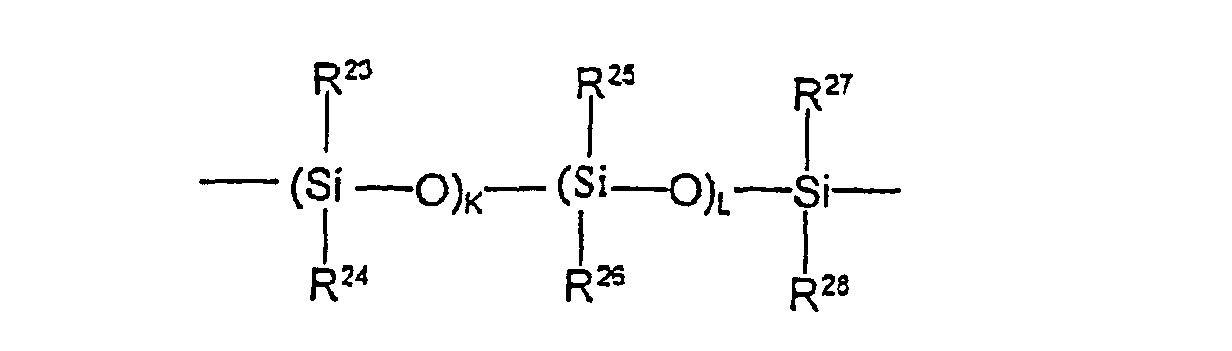
- n
- eine ganze Zahl von 1 bis 10 ist,
Y11-X11-R11-S3-R11-X11-Y11, - jedes Y11
- unabhängig eine Acryloylgruppe, eine Methacryloylgruppe, eine Vinylgruppe oder eine Allylgruppe ist,
- jedes X11
- unabhängig eine kovalente Bindung, ein Sauerstoffatom oder eine Alkenglykolgruppe ist,
- R11
- definiert ist als R32 in Formel (II), und
- S3
- definiert ist als S1 und S2 in
Formel (II).
Y41-R51-(X41-E41)-X45-R52-S4-R52-X45-(E41-X41)-R41-Y41 - Y41
- definiert ist als Y11 in Formel (IX),
- -(X41-E41)-
- definiert ist als - (X21 - E21) - in Formel (II),
- R51
- definiert ist als R31 in Formel (II),
- jedes X45
- unabhängig ein Sauerstoffatom, eine
Alkenglykolgruppe, oder eine Gruppe
der Formel
ist, worin R61 eine dreiwertige C1-6-Kohlenwasserstoffgruppe ist,

- R52
- definiert ist als R32 in Formel (II), und
- S4
- definiert ist als S1 und S2 in Formel (II),
(c) 10-50 Gewichtsprozent eines Hydroxyalkyl(meth)acrylat (B), und(d) 0,01-10 Gewichtsprozent einer vernetzbaren Verbindung (C) mit wenigstens zwei polymerisierbaren GruppenEinspritzen der erhaltenen Mischung in eine Form mit der gewünschten Gestalt für eine Kontaktlinse und dann, indem man ein Polymer durch die Polymerisationsreaktion herstellt,Eintauchen des aus dieser Form entnommenen Polymeren in Ethanol und/oder Propanol, und dannHydratisieren dieses Polymeren. - Verfahren nach Anspruch 1, worin das siliziumhaltige Alkenacrylat ein Tris(trimethylsiloxy)silylpropylacrylat ist.
- Verfahren nach Anspruch 1, worin das Hydroxyalkyl(meth)acrylat (B) Hydroxyethyl(meth)acrylat ist.
- Verfahren nach Anspruch 1, worin nachdem das Polymer in wenigstens ein Element aus Ethanol und Propanol eingetaucht ist, das Polymer getrocknet wird, bevor das Polymer hydratisiert wird.
- Verfahren nach Anspruch 1, worin das Polymer hydratisiert wird, indem Luft in Wasser, in dem das Polymer eingetaucht ist, eingeführt wird.
- Verfahren nach Anspruch 1, worin das Polymer gleichzeitig mit der Hydratation des Polymeren oder nach der Hydratation des Polymeren erhitzt wird.
- Kontaktlinse erhältlich durch das Verfahren nach einem der Ansprüche 1 bis 6.
Applications Claiming Priority (4)
| Application Number | Priority Date | Filing Date | Title |
|---|---|---|---|
| JP22938695 | 1995-09-06 | ||
| JP22938695 | 1995-09-06 | ||
| JP229386/95 | 1995-09-06 | ||
| PCT/JP1996/002520 WO1997009169A1 (en) | 1995-09-06 | 1996-09-04 | Process for producing optic lens and optic lens obtained thereby |
Publications (3)
| Publication Number | Publication Date |
|---|---|
| EP0796723A1 EP0796723A1 (de) | 1997-09-24 |
| EP0796723A4 EP0796723A4 (de) | 1998-10-28 |
| EP0796723B1 true EP0796723B1 (de) | 2001-12-05 |
Family
ID=16891384
Family Applications (1)
| Application Number | Title | Priority Date | Filing Date |
|---|---|---|---|
| EP96929534A Expired - Lifetime EP0796723B1 (de) | 1995-09-06 | 1996-09-04 | Verfahren zur herstellung von kontaktlinsen und die so hergestellten kontaktlinsen |
Country Status (5)
| Country | Link |
|---|---|
| US (1) | US5855825A (de) |
| EP (1) | EP0796723B1 (de) |
| JP (1) | JP3771940B2 (de) |
| DE (1) | DE69617637T2 (de) |
| WO (1) | WO1997009169A1 (de) |
Cited By (1)
| Publication number | Priority date | Publication date | Assignee | Title |
|---|---|---|---|---|
| RU2389608C2 (ru) * | 2005-12-20 | 2010-05-20 | Джонсон Энд Джонсон Вижн Кэа, Инк. | Способы и системы для выщелачивания и извлечения офтальмологических линз на основе силиконового гидрогеля спиртовыми растворами |
Families Citing this family (20)
| Publication number | Priority date | Publication date | Assignee | Title |
|---|---|---|---|---|
| JPH11228643A (ja) * | 1998-02-17 | 1999-08-24 | Menicon Co Ltd | 眼用レンズ材料およびその製法 |
| US6271281B1 (en) * | 1999-08-26 | 2001-08-07 | Medennium, Inc. | Homopolymers containing stable elasticity inducing crosslinkers and ocular implants made therefrom |
| EP1927882B1 (de) * | 1999-12-10 | 2015-09-23 | Novartis AG | Kontaktlinse |
| US6649722B2 (en) * | 1999-12-10 | 2003-11-18 | Novartis Ag | Contact lens |
| WO2001071415A1 (en) * | 2000-03-22 | 2001-09-27 | Menicon Co., Ltd. | Material for ocular lens |
| US6364934B1 (en) | 2000-07-31 | 2002-04-02 | Bausch & Lomb Incorporated | Method of making ocular devices |
| US6777522B2 (en) * | 2001-11-02 | 2004-08-17 | Bausch & Lomb Incorporated | High refractive index aromatic-based prepolymers |
| JP4398427B2 (ja) * | 2003-01-27 | 2010-01-13 | 株式会社メニコン | 消色性に優れたフォトクロミックコンタクトレンズ |
| WO2005026826A1 (ja) * | 2003-09-12 | 2005-03-24 | Menicon Co., Ltd. | 軟質眼用レンズ材料およびその製造方法 |
| US7354980B1 (en) | 2004-03-12 | 2008-04-08 | Key Medical Technologies, Inc. | High refractive index polymers for ophthalmic applications |
| US20060093728A1 (en) * | 2004-11-01 | 2006-05-04 | Bausch & Lomb Incorporated | Process for hydrating lenses |
| US7446157B2 (en) | 2004-12-07 | 2008-11-04 | Key Medical Technologies, Inc. | Nanohybrid polymers for ophthalmic applications |
| US8480227B2 (en) | 2010-07-30 | 2013-07-09 | Novartis Ag | Silicone hydrogel lenses with water-rich surfaces |
| JP6093705B2 (ja) | 2010-11-17 | 2017-03-08 | ベーイプシロンカー ヘミー ゲゼルシャフト ミット ベシュレンクター ハフトゥング | ポリシロキサン含有ウレタン系マクロモノマーから得ることが可能な共重合体、その製造方法およびその使用 |
| HUE029018T2 (en) | 2011-10-12 | 2017-02-28 | Novartis Ag | A method for producing UV absorbing contact lenses by coating |
| HUE031702T2 (en) | 2012-12-17 | 2017-07-28 | Novartis Ag | A method for producing improved UV absorbing ophthalmic lenses |
| HUE038809T2 (hu) | 2013-12-17 | 2018-11-28 | Novartis Ag | Térhálósított hidrofíl bevonattal ellátott szilikon hidrogél lencse |
| MY183678A (en) | 2014-08-26 | 2021-03-08 | Alcon Inc | Method for applying stable coating on silicone hydrogel contact lenses |
| KR102604468B1 (ko) | 2015-12-15 | 2023-11-22 | 알콘 인코포레이티드 | 실리콘 하이드로겔 콘택트 렌즈 상에 안정한 코팅을 적용하기 위한 방법 |
| CN117492228A (zh) | 2017-12-13 | 2024-02-02 | 爱尔康公司 | 周抛和月抛水梯度接触镜片 |
Family Cites Families (14)
| Publication number | Priority date | Publication date | Assignee | Title |
|---|---|---|---|---|
| US4141941A (en) * | 1977-09-21 | 1979-02-27 | American Optical Corporation | Contact lens casting method |
| JPS57120416A (en) * | 1981-01-21 | 1982-07-27 | Nippon Kogaku Kk <Nikon> | Manufacture of soft contact lens |
| US4680336A (en) * | 1984-11-21 | 1987-07-14 | Vistakon, Inc. | Method of forming shaped hydrogel articles |
| JPS6323126A (ja) * | 1986-02-13 | 1988-01-30 | Bio Material Yunibaasu:Kk | ソフトコンタクトレンズおよびその製造法 |
| WO1989004329A1 (en) * | 1987-11-09 | 1989-05-18 | Ioptex Research, Inc. | Controlled surface optical lens and method of surface alteration |
| JP2536897B2 (ja) * | 1988-03-05 | 1996-09-25 | 呉羽化学工業株式会社 | コンタクトレンズの製造方法 |
| US5039459A (en) * | 1988-11-25 | 1991-08-13 | Johnson & Johnson Vision Products, Inc. | Method of forming shaped hydrogel articles including contact lenses |
| US4889664A (en) * | 1988-11-25 | 1989-12-26 | Vistakon, Inc. | Method of forming shaped hydrogel articles including contact lenses |
| US5158717A (en) * | 1990-11-27 | 1992-10-27 | Bausch & Lomb Incorporated | Method of molding shaped polymeric articles |
| JPH05295144A (ja) * | 1992-04-15 | 1993-11-09 | Seiko Epson Corp | コンタクトレンズの製造方法 |
| US5260000A (en) * | 1992-08-03 | 1993-11-09 | Bausch & Lomb Incorporated | Process for making silicone containing hydrogel lenses |
| JP2774233B2 (ja) * | 1992-08-26 | 1998-07-09 | 株式会社メニコン | 眼用レンズ材料 |
| US5271874A (en) * | 1992-11-04 | 1993-12-21 | Wesley-Jessen Corporation | Method for molding a hydrophilic contact lens |
| US5457140A (en) * | 1993-07-22 | 1995-10-10 | Johnson & Johnson Vision Products, Inc. | Method of forming shaped hydrogel articles including contact lenses using inert, displaceable diluents |
-
1996
- 1996-09-04 EP EP96929534A patent/EP0796723B1/de not_active Expired - Lifetime
- 1996-09-04 JP JP51107597A patent/JP3771940B2/ja not_active Expired - Lifetime
- 1996-09-04 WO PCT/JP1996/002520 patent/WO1997009169A1/ja not_active Ceased
- 1996-09-04 DE DE69617637T patent/DE69617637T2/de not_active Expired - Fee Related
- 1996-09-04 US US08/836,017 patent/US5855825A/en not_active Expired - Lifetime
Cited By (1)
| Publication number | Priority date | Publication date | Assignee | Title |
|---|---|---|---|---|
| RU2389608C2 (ru) * | 2005-12-20 | 2010-05-20 | Джонсон Энд Джонсон Вижн Кэа, Инк. | Способы и системы для выщелачивания и извлечения офтальмологических линз на основе силиконового гидрогеля спиртовыми растворами |
Also Published As
| Publication number | Publication date |
|---|---|
| DE69617637T2 (de) | 2002-07-18 |
| WO1997009169A1 (en) | 1997-03-13 |
| EP0796723A1 (de) | 1997-09-24 |
| JP3771940B2 (ja) | 2006-05-10 |
| US5855825A (en) | 1999-01-05 |
| DE69617637D1 (de) | 2002-01-17 |
| EP0796723A4 (de) | 1998-10-28 |
Similar Documents
| Publication | Publication Date | Title |
|---|---|---|
| EP0796723B1 (de) | Verfahren zur herstellung von kontaktlinsen und die so hergestellten kontaktlinsen | |
| EP1197782B1 (de) | Material für eine okularlinse | |
| US4604479A (en) | Silicone-containing contact lens material and contact lenses made thereof | |
| EP0584826B1 (de) | Zusammensetzung für weiche Okularlinsen | |
| EP0989138B1 (de) | Augenlinsenmaterial und Verfahren zu dessen Herstellung | |
| US6255362B1 (en) | Ocular lens material and process for producing the same | |
| US6018001A (en) | Process for producing contact lens with hydrophilic surface and contact lens obtained thereby | |
| JPWO1997009169A1 (ja) | 眼用レンズの製法およびそれからえられた眼用レンズ | |
| EP0729041B1 (de) | Wasserabsorbierende weiche Kontaktlinse | |
| JPH0790030A (ja) | 眼用レンズ材料 | |
| EP0381005B1 (de) | Zusammensetzung für okulare Linsen | |
| JP3108550B2 (ja) | 軟質眼用レンズ材料 | |
| JP5668062B2 (ja) | イオン性化合物、組成物、硬化物、ハイドロゲル及び眼用レンズ | |
| EP0947856A2 (de) | Material für Okularlinse | |
| EP0781777A1 (de) | Silizium-enthaltende Verbindung und Material für Okularlinse | |
| JP3530287B2 (ja) | 低含水性眼用レンズ用材料、それからなる低含水性眼用レンズ用成形体、ならびにそれからなる低含水性眼用レンズおよびその製法 | |
| JP3063877B2 (ja) | 含水性ソフトコンタクトレンズ | |
| EP0794440B1 (de) | Okularlinse und Verfahren zu deren Herstellung | |
| JP3084180B2 (ja) | コンタクトレンズ | |
| CN116490532B (zh) | 眼科器件用改性剂 | |
| EP0854369A2 (de) | Material für Okularlinse | |
| HK1014968B (en) | Ocular lens material |
Legal Events
| Date | Code | Title | Description |
|---|---|---|---|
| PUAI | Public reference made under article 153(3) epc to a published international application that has entered the european phase |
Free format text: ORIGINAL CODE: 0009012 |
|
| AK | Designated contracting states |
Kind code of ref document: A1 Designated state(s): DE FR GB |
|
| 17P | Request for examination filed |
Effective date: 19970905 |
|
| A4 | Supplementary search report drawn up and despatched | ||
| AK | Designated contracting states |
Kind code of ref document: A4 Designated state(s): DE FR GB |
|
| 17Q | First examination report despatched |
Effective date: 19991130 |
|
| GRAG | Despatch of communication of intention to grant |
Free format text: ORIGINAL CODE: EPIDOS AGRA |
|
| GRAG | Despatch of communication of intention to grant |
Free format text: ORIGINAL CODE: EPIDOS AGRA |
|
| GRAH | Despatch of communication of intention to grant a patent |
Free format text: ORIGINAL CODE: EPIDOS IGRA |
|
| RIN1 | Information on inventor provided before grant (corrected) |
Inventor name: ITO, ERI, MENICON CO.,LTD., CENTRAL RES. LAB. |
|
| GRAH | Despatch of communication of intention to grant a patent |
Free format text: ORIGINAL CODE: EPIDOS IGRA |
|
| GRAA | (expected) grant |
Free format text: ORIGINAL CODE: 0009210 |
|
| AK | Designated contracting states |
Kind code of ref document: B1 Designated state(s): DE FR GB |
|
| REG | Reference to a national code |
Ref country code: GB Ref legal event code: IF02 |
|
| REF | Corresponds to: |
Ref document number: 69617637 Country of ref document: DE Date of ref document: 20020117 |
|
| ET | Fr: translation filed | ||
| PLBE | No opposition filed within time limit |
Free format text: ORIGINAL CODE: 0009261 |
|
| STAA | Information on the status of an ep patent application or granted ep patent |
Free format text: STATUS: NO OPPOSITION FILED WITHIN TIME LIMIT |
|
| 26N | No opposition filed | ||
| PGFP | Annual fee paid to national office [announced via postgrant information from national office to epo] |
Ref country code: FR Payment date: 20060831 Year of fee payment: 11 |
|
| PGFP | Annual fee paid to national office [announced via postgrant information from national office to epo] |
Ref country code: GB Payment date: 20060906 Year of fee payment: 11 |
|
| PGFP | Annual fee paid to national office [announced via postgrant information from national office to epo] |
Ref country code: DE Payment date: 20060921 Year of fee payment: 11 |
|
| GBPC | Gb: european patent ceased through non-payment of renewal fee |
Effective date: 20070904 |
|
| PG25 | Lapsed in a contracting state [announced via postgrant information from national office to epo] |
Ref country code: DE Free format text: LAPSE BECAUSE OF NON-PAYMENT OF DUE FEES Effective date: 20080401 |
|
| REG | Reference to a national code |
Ref country code: FR Ref legal event code: ST Effective date: 20080531 |
|
| PG25 | Lapsed in a contracting state [announced via postgrant information from national office to epo] |
Ref country code: FR Free format text: LAPSE BECAUSE OF NON-PAYMENT OF DUE FEES Effective date: 20071001 |
|
| PG25 | Lapsed in a contracting state [announced via postgrant information from national office to epo] |
Ref country code: GB Free format text: LAPSE BECAUSE OF NON-PAYMENT OF DUE FEES Effective date: 20070904 |