EP0796811A2 - Vorrichtung an Spulenablaufgattern - Google Patents
Vorrichtung an Spulenablaufgattern Download PDFInfo
- Publication number
- EP0796811A2 EP0796811A2 EP97102289A EP97102289A EP0796811A2 EP 0796811 A2 EP0796811 A2 EP 0796811A2 EP 97102289 A EP97102289 A EP 97102289A EP 97102289 A EP97102289 A EP 97102289A EP 0796811 A2 EP0796811 A2 EP 0796811A2
- Authority
- EP
- European Patent Office
- Prior art keywords
- separating elements
- rows
- thread
- balloon
- sections
- Prior art date
- Legal status (The legal status is an assumption and is not a legal conclusion. Google has not performed a legal analysis and makes no representation as to the accuracy of the status listed.)
- Granted
Links
- 238000004804 winding Methods 0.000 claims abstract description 21
- 239000002184 metal Substances 0.000 claims description 3
- 239000005300 metallic glass Substances 0.000 claims description 2
- 229920003229 poly(methyl methacrylate) Polymers 0.000 claims description 2
- 239000004926 polymethyl methacrylate Substances 0.000 claims description 2
- 230000015572 biosynthetic process Effects 0.000 description 4
- 238000005192 partition Methods 0.000 description 2
- 238000005452 bending Methods 0.000 description 1
- 238000010276 construction Methods 0.000 description 1
- 238000006073 displacement reaction Methods 0.000 description 1
- 238000004049 embossing Methods 0.000 description 1
- 238000004519 manufacturing process Methods 0.000 description 1
- 239000000463 material Substances 0.000 description 1
- 238000007493 shaping process Methods 0.000 description 1
- 230000000087 stabilizing effect Effects 0.000 description 1
- 230000001629 suppression Effects 0.000 description 1
- 230000007704 transition Effects 0.000 description 1
Images

Classifications
-
- D—TEXTILES; PAPER
- D02—YARNS; MECHANICAL FINISHING OF YARNS OR ROPES; WARPING OR BEAMING
- D02H—WARPING, BEAMING OR LEASING
- D02H1/00—Creels, i.e. apparatus for supplying a multiplicity of individual threads
-
- B—PERFORMING OPERATIONS; TRANSPORTING
- B65—CONVEYING; PACKING; STORING; HANDLING THIN OR FILAMENTARY MATERIAL
- B65H—HANDLING THIN OR FILAMENTARY MATERIAL, e.g. SHEETS, WEBS, CABLES
- B65H57/00—Guides for filamentary materials; Supports therefor
- B65H57/22—Guides for filamentary materials; Supports therefor adapted to prevent excessive ballooning of material
-
- B—PERFORMING OPERATIONS; TRANSPORTING
- B65—CONVEYING; PACKING; STORING; HANDLING THIN OR FILAMENTARY MATERIAL
- B65H—HANDLING THIN OR FILAMENTARY MATERIAL, e.g. SHEETS, WEBS, CABLES
- B65H2701/00—Handled material; Storage means
- B65H2701/30—Handled filamentary material
- B65H2701/31—Textiles threads or artificial strands of filaments
Definitions
- the invention relates to a device on bobbin drain gates, with a limitation of thread balloons in the case of overhead thread take-off of bobbins, which are arranged in rows and with which protruding into the inter-row spaces and / or arranged in the take-off direction in front of the inter-row spaces, each associated between two Extend rows of bobbins over several bobbins.
- a device with the aforementioned features is known from DE 506 027.
- Horizontal or vertical partitions are arranged between the individual bobbin rows, which protrude beyond the bobbin plane in the thread take-off direction.
- the partitions used are flat plates that require appropriate distances between adjacent coils.
- long drain gates result.
- Long discharge gates mean long thread lengths, which at high thread speeds means that the influences due to air friction are different. Threads that run from bobbins at the start of the creel, which are therefore close to the winding machine, are braked less than threads that run from bobbins that end at the creel are located. The known device is therefore not useful for long gates.
- a device for balloon limitation in which two mutually parallel rods are arranged parallel to the coil plane between the latter and a thread deflecting device, from which the thread is drawn off and wound up by the winding machine.
- the two parallel rods hinder the bobbin change and can therefore be pivoted parallel to themselves away from the bobbins in a position in which a bobbin change and thread handling are facilitated.
- the pivoting of the rods is structurally and time-consuming.
- the rods are lightly built, which favors their bending.
- the rods have to be secured against unwanted displacement and it is also disadvantageous to have to use two rods per row of bobbins.
- the known device has the advantage that it can also be used in those drain gates in which the rows of coils are offset in height.
- all winding units are equidistant from neighboring winding units.
- the coils of a row of coils protrude into the gusset formed by the coils of the adjacent rows of coils. Comparatively short gate lengths result.
- the influence of air friction on the threads can be minimized. Less space is required for the drain gate.
- the invention has for its object to improve a device with the features mentioned so that it can also be used with spool drain gates with offset division.
- the separating elements have a balloon limiting section adapted to part of the outer coil circumference, and in that these balloon limiting sections, viewed against the thread take-off direction, are arranged and / or to be arranged around the outer coil circumference in the region of the interspaces between the rows.
- the shape of the separating elements extending over a plurality of winding stations is adapted in shape to the winding stations or to the spools located on the winding stations.
- Balloon delimiting sections adapted to the outer bobbin circumference are assembled in such a way that, viewed in the direction opposite to the thread take-off direction, they are or are to be arranged around the outer bobbin circumference in the area between the rows.
- the balloon delimiting sections are thus designed in accordance with the predetermined interspaces between rows and use them in such a way that the coils can be pulled out between them or inserted between them without any obstructions. Thread handling is also readily possible since the distance between the balloon delimiting sections or between the separating elements is sufficiently large. Despite their use, only a single separating element is required for each coil row, even with spool drain gates with offset row divisions.
- the device can be designed in such a way that the separating elements are wave-shaped rods, the wavelength being equal to the pitch of the winding units. Due to the wave-like design of the rods, sufficient attention is paid to the design of the inter-row spaces between adjacent rows of coils. These distances are sufficiently large to be able to use sufficiently thick rods, which therefore have a correspondingly sufficient rigidity. This rigidity is promoted by the wave-like shape of the rods so that the use of rods of comparatively small diameter is made possible. The stiffness of the bar over the length is improved.
- the device can be improved in that the separating elements can be rotated about a central longitudinal axis.
- the rods forming the dividing elements can easily be turned by hand.
- the shaft sections lying away from the central longitudinal axis form sufficient lever arms. It’s easy to twist the dividers from a position where they’ll optimally limit the balloon, to bring them into a position in which they allow optimal winding position access.
- the device is designed so that the separating elements are arranged at a distance from the bobbins in the thread take-off direction.
- the distance can be dimensioned so that the radial expansion of the thread balloon is minimized.
- the rods are easily accessible for handling at a distance from the coil level.
- a further embodiment of the device is achieved in that the separating elements have aligned axis ends arranged in the central longitudinal axis.
- the aligned axis ends determine the axis of rotation of the separating elements or the rods.
- the arrangement of the axis ends in the central longitudinal axis causes the same adjustments of all rod areas parallel to the coil plane.
- the invention can also be designed in such a way that the separating elements in the coil area are wave-shaped sheets, the wavelength being equal to the pitch of the winding points.
- Their extension across the coil plane of the gate can be designed according to the requirements of the balloon limitation.
- the sheets have the advantage that they can be fixed to the frame. An adjustment for changing the bobbin or the like. not necessary.
- the exchange of bobbins and the thread handling between the separating elements designed as sheets are readily possible, since the distance between two separating elements is equal to the average width of the bobbin row, ie is sufficiently large. If the corrugated sheets enclose the outer circumference of the coils comparatively narrowly, it is not possible for new coils to be inserted in an undesirable manner fall down. In the case of attaching new coils, which can be of considerable weight, the sheets also have a stabilizing or attaching function.
- the design of the separating elements designed as sheet metal depends on the respective design requirements.
- the device can thus be designed, for example, so that the separating elements consist of sheet metal, perforated sheet metal or acrylic glass.
- Both the separating elements designed as rods and the separating elements designed as sheets can be shaped in such a way that the corrugated separating elements consist of shaft sections parallel to the longitudinal center axis, each of which is integrally connected by inclined sections. Each shaft therefore consists of six shaft sections, which means that the separating elements are optimally adapted to the circular outer circumference of the coils, but on the other hand allows a comparatively low amount of deformation to be achieved.
- the device can be designed, for example, in such a way that the wave-shaped separating elements consist of inclined sections arranged at an angle to the central axis. With such a shaping of the separating elements it can be achieved that the balloon-forming thread rejected by the inclined sections is rejected as far as possible by adjacent bobbins and the deformation effort required in the production of the separating elements is reduced even further.
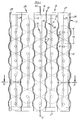
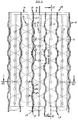
- FIG. 1 shows a rotating frame 26 in a rectangular shape, consisting of two parallel horizontal frame supports 27 and two parallel vertical frame supports 28 connecting the aforementioned ends together horizontal supports 27, a plurality of bobbin supports 29 are arranged parallel to one another, the cross section of which results from FIG.
- Coil mandrels 30 are attached to the cheeks of these U-shaped supports 29, which project on both sides of the rotating frame 26 and form a coil plane 31 on each side.
- the horizontal frame supports 27 have pivots 32, with which the rotating frame 26 can be pivotably arranged in a frame frame, not shown, together with other rotating frames in one plane.
- a plurality of rotating frames 26 arranged in alignment form a spool outlet gate or half of a spool outlet gate. Each rotating frame is accessible from one side 33, while its other side 34 is used for thread withdrawal.
- Coils 11 are plugged onto the spool 30, which is shown schematically in FIG. 6 shows coils 11 which hang on the coil spindles 30.
- the thread F wound on it is drawn off from the bobbins 11 by being wound onto a winding machine (not shown).
- the withdrawal direction is symbolized by the arrow 35 in FIGS.
- the winding machine is approximately at right angles to the plane of the bobbin, so that it is necessary to deflect the thread F when the overhead draw-off is provided. This takes place at the thread braking and deflection point 36, which is designed for such a deflection in a known manner, not shown.
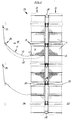
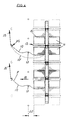
- a thread balloon 10 is formed between the bobbin and the braking and deflecting device 36, which would have the maximum course 10 'shown in FIGS. 2, 4 without any influence on its radial extension.
- the bobbin drain gate is provided with a device for limiting thread balloons 10, namely with separating elements 13, which are designed in different ways.
- the coils 11 are arranged in rows one above the other.
- Vertical coil rows 14 are arranged next to one another.
- the winding positions 15 of one coil row 14 are offset in height from the winding positions 15 of the adjacent coil row 14, namely by half the pitch 20, that is to say half the distance between two coil positions 15 from one another.
- the coils 11 can be housed as tightly packed as possible.
- the extent of the coil outlet gate in the coil plane is horizontally as small as possible, so that the coil outlet gate is correspondingly short. At maximum winding, the coils 11 protrude into the spools 11 adjacent to the gusset, but row spaces 12 remain between two adjacent rows 14.
- the separating elements are arranged in the vertical row spaces 14 according to FIG.
- the separating elements consist of balloon limiting sections 17 which are adapted to the outer circumference 16 of the coils 11. These are sheets which are sufficiently thin to be accommodated in the interspaces 12 in the rows. Its upper and lower ends are attached to the horizontal frame supports 27. As a result of their wave-like design, they are sufficiently rigid not to come into contact with the outer circumference 16 of the full coils 11. There is an adequate safety distance.
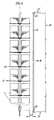
- Fig.2 shows that the sheet-like separating elements 13 extend over the entire coil height and slightly beyond. As a result, the thread F is unable to take the balloon shape 10 'shown. Rather, there is a thread balloon 10 which projects only insignificantly radially beyond the associated separating elements. There is therefore no fear that two adjacent thread balloons will meet. A thread break is avoided. If it should turn out that the balloon formation is increased at high thread speed, the separating elements can be lengthened in the thread take-off direction 18.
- the wave-like design of the separating elements 13 contributes to the smooth transition of the thread path from the suppression of the balloon to the free thread path in front of the deflection point 36, which reduces the thread break frequency.
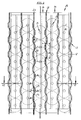
- FIGS. 3 to 7 show rotating frames 26, as have already been described in FIG. 1, so that the description is omitted in each case.
- the separating elements 13 are, however, designed as rods which are arranged at a distance 22 from the coils 11 in the space between the rotary gate 26 and the thread braking and deflecting device 36. These separating elements 13 are also adapted to the row gaps 12.
- a rigidly designed separating element 13 is provided between each two rows of spools 14, as seen against the thread take-off direction 18.
- a separating element has two rod ends 23 outside the coil area and is thus rotatably held by frame parts 37 in a manner not shown in detail.
- the design of these frame parts 37 is indicated in FIGS. 6, 7, but in principle it is arbitrary. These figures show an education a frame with frame parts 37, which also serve to hold the braking and deflection device 36.
- the separating elements 13 can be rotated. You can take up the position shown in Figure 3, as well as the positions labeled 13 'in Figure 5. It can be seen that the coils 11 can be handled between the separating elements 13 of the position 13 ', as previously described for FIGS. 1, 2. In the event of a yarn break, it is therefore only necessary to pivot the separating elements 13 adjacent to the row of bobbins with the bobbin 11 having the yarn break so that, projected against the direction of yarn withdrawal, they are arranged above the intermediate spaces 12 between the bobbins 11. In this case, each coil 11 between the separating elements 13 located in the positions 13 'can be removed, as shown in particular in FIG. 7, the coil 11' of which is smaller in diameter than the distance between the separating elements at the height of the coil mandrel 15 '. onto which the bobbin 11 'is to be placed against the thread take-off direction 18.
- the separating elements 13 If it is not necessary to bring the separating elements 13 into the position 13 ', they hinder the withdrawal of the thread F due to their arrangement or because of their partial arrangement in front of the bobbins 11. As a result, the thread balloon 10 cannot form so radially that it collides with other thread balloons of adjacent bobbins. This is prevented by the shape of the separating elements 13, which is chosen in the same way as that of the separating elements 13 in FIG. This is because there is a wave-like configuration in which there are shaft sections 24 which are spaced parallel to a central longitudinal axis 21. This distance is the wave amplitude. These mutually parallel shaft sections 24 are connected by inclined sections 25, so that the respective design shown in the figures results. However, it is possible to omit the shaft sections 24 parallel to the central longitudinal axis and to use only inclined sections which are alternately arranged at an angle to the central longitudinal axis 21.
- the embodiments of Figures 3 to 7 are structurally extremely simple.
- the dividing elements can be made from round material with embossing tools.
- the separating rods are not twisted by the striking threads F, since the rotating threads hit the separating rods from both sides.
Landscapes
- Engineering & Computer Science (AREA)
- Textile Engineering (AREA)
- Guides For Winding Or Rewinding, Or Guides For Filamentary Materials (AREA)
- Unwinding Of Filamentary Materials (AREA)
- Coil Winding Methods And Apparatuses (AREA)
- Magnetically Actuated Valves (AREA)
- Magnetic Resonance Imaging Apparatus (AREA)
Abstract
Description
- Die Erfindung bezieht sich auf eine Vorrichtung an Spulenablaufgattern, mit einer Begrenzung von Fadenballonen bei überkopf erfolgendem Fadenabzug von Spulen, die reihenweise angeordnet sind und denen in die Reihenzwischenräume hineinragende und/oder in Abzugrichtung vor den Reihenzwischenräumen angeordnete Trennelemente zugeordnet sind, die sich jeweils zwischen zwei Spulenreihen über mehrere Spulstellen erstrecken.
- Eine Vorrichtung mit den vorgenannten Merkmalen ist aus der DE 506 027 bekannt. Zwischen den einzelnen Spulenreihen sind waagerechte oder lotrechte Trennwände angeordnet, die über die Spulenebene in Fadenabzugsrichtung hinausragen. Infolgedessen wird die Ballonbildung begrenzt, d.h. die infolge des überkopf erfolgenden Fadenabzugs rotierenden Fäden benachbarter Spulen können nicht zusammenschlagen. Es wird Fadenbruch vermieden. Die verwendeten Trennwände sind ebene Platten, die entsprechende Abstände zwischen einander benachbarten Spulen erfordern. Infolgedessen ergeben sich lange Ablaufgatter. Lange Ablaufgatter bedeuten lange Fadenlauflängen, was bei hohen Fadenlaufgeschwindigkeiten dazu führt, daß die Einflüsse infolge Luftreibung unterschiedlich sind. Fäden, die von Spulen des Gatteranfangs ablaufen, die sich also nahe der Wickelmaschine befinden, werden weniger gebremst, als Fäden, die von Spulen ablaufen, welche sich am Gatterende befinden. Die bekannte Vorrichtung ist daher für lange Gatter nicht zweckmäßig.
- Aus der DE 28 41 210 C2 ist eine Einrichtung zur Ballonbegrenzung bekannt, bei der zwei einander parallele Stangen parallel zur Spulenebene zwischen dieser und einer Fadenumlenkeinrichtung angeordnet sind, von der aus der Faden von der Wickelmaschine abgezogen und aufgewickelt wird. Die beiden einander parallelen Stangen behindern beim Spulenwechsel und sind daher parallel zu sich selbst von den Spulen weg in eine Position verschwenkbar, in der ein Spulenwechsel und das Fadenhandling erleichtert werden. Das Verschwenken der Stangen ist jedoch baulich und zeitlich aufwendig. Die Stangen werden leicht gebaut, was ihr Verbiegen begünstigt. Zum Begrenzen der Fadenballone müssen die Stangen gegen ungewollte Verlagerung gesichert werden und außerdem ist es nachteilig, pro Spulenreihe zwei Stangen einsetzen zu müssen. Die bekannte Vorrichtung hat allerdings den Vorzug, daß sie auch bei solchen Ablaufgattern angewendet werden kann, bei denen die Spulenreihen höhenversetzt sind. In diesem Fall haben alle Spulstellen gleichen Abstand von benachbarten Spulstellen. Die Spulen einer Spulenreihe ragen in die von den Spulen der benachbarten Spulenreihen gebildeten Zwickel hinein. Es ergeben sich vergleichsweise kurze Gatterlängen. Der Einfluß der Luftreibung auf die Fäden kann minimiert werden. Es wird weniger Platz für das Ablaufgatter benötigt.
- Demgegenüber liegt der Erfindung die Aufgabe zugrunde, eine Vorrichtung mit den eingangs genannten Merkmalen so zu verbessern, daß sie auch bei Spulenablaufgattern mit versetzter Teilung angewendet werden kann.
- Diese Aufgabe wird dadurch gelöst, daß die Trennelemente einen Teil des Spulenaußenumfang angepaßte Ballonbegrenzungsabschnitte haben, und daß diese Ballonbegrenzungsabschnitte, entgegen der Fadenabzugsrichtung gesehen, um den Spulenaußenumfang herum im Bereich der Reihenzwischenräume angeordnet und/oder anzuordnen sind.
- Für die Erfindung ist von Bedeutung, daß die sich über mehrere Spulstellen erstreckenden Trennelemente in ihrer Formgebung an die Spulstellen bzw. an die auf den Spulstellen befindlichen Spulen formenmäßig angepaßt werden. Dem Spulenaußenumfang angepaßte Ballonbegrenzungsabschnitte werden so zusammengesetzt, daß sie, entgegen der Fadenabzugsrichtung gesehen, um den Spulenaußenumfang herum im Bereich der Reihenzwischenräume angeordnet sind oder anzuordnen sind. Die Ballonbegrenzungsabschnitte werden also entsprechend den vorgegebenen Reihenzwischenräumen ausgebildet und nutzen diese derart, daß die Spulen zwischen ihnen herausgezogen oder zwischen sie hineingesteckt werden können, ohne daß dabei Behinderungen auftreten. Auch das Fadenhandling ist ohne weiteres möglich, da der Abstand zwischen den Ballonbegrenzungsabschnitten bzw. zwischen den Trennelementen genügend groß ist. Dabei wird trotz ihres Einsatzes auch bei Spulenablaufgattern mit versetzten Reihenteilungen nur ein einziges Trennelement je Spulenreihe benötigt.
- Die Vorrichtung kann dahingehend ausgebildet werden, daß die Trennelemente wellenartig geformte Stangen sind, wobei die Wellenlänge gleich dem Teilungsabstand der Spulstellen ist. Durch die wellenartige Ausbildung der Stangen wird in ausreichender Weise auf die Ausgestaltung der Reihenzwischenräume zwischen einander benachbarten Spulenreihen Rücksicht genommen. Diese Abstände sind hinreichend groß, um ausreichend dicke Stange einsetzen zu können, die also eine entsprechend ausreichende Steifigkeit besitzen. Diese Steifigkeit wird durch die wellenartige Form der Stangen so gefördert, daß der Einsatz von Stangen vergleichsweise geringen Durchmessers ermöglicht wird. Die Steifigkeit der Stange über die Länge gesehen wird verbessert.
- Die Vorrichtung kann dadurch verbessert werden, daß die Trennelemente um eine Mittellängsachse verdrehbar sind. Die die Trennelemente bildenden Stangen können leicht von Hand verdreht werden. Hierbei bilden die von der Mittellängsachse entfernt liegenden Wellenabschnitte hinreichende Hebelarme. Es ist unschwierig, die Trennelemente aus einer Stellung zu verdrehen, in der sie für eine optimale Ballonbegrenzung sorgen, um sie in eine Stellung zu bringen, in der sie den optimalen Spulstellenzugang ermöglichen.
- Um zu erreichen, daß eine optimale Begrenzung der Ballonbildung stattfindet, wie auch eine verbesserte Handhabung, wird die Vorrichtung so ausgebildet, daß die Trennelemente in Fadenabzugsrichtung mit Abstand zu den Spulen angeordnet sind. Der Abstand kann so bemessen werden, daß die radiale Ausweitung des Fadenballons minimiert wird. Die Stangen sind im Abstand vor der Spulenebene einer Handhabung leicht zugänglich.
- Eine weitere Ausgestaltung der Vorrichtung wird dadurch erreicht, daß die Trennelemente fluchtende, in der Mittellängsachse angeordnete Achsenden aufweisen. Die fluchtenden Achsenden bestimmen die Drehachse der Trennelemente bzw. der Stangen. Die Anordnung der Achsenden in der Mittellängsachse bewirkt jeweils gleiche Verstellungen aller Stangenbereiche parallel zur Spulenebene.
- Die Erfindung kann aber auch dahingehend ausgestaltet werden, daß die Trennelemente im Spulenbereich wellenartig geformte Bleche sind, wobei die Wellenlänge gleich dem Teilungsabstand der Spulstellen ist. Diese als Bleche ausgebildeten Trennelemente werden, soweit sie in den Zwischenraum zwischen den Spulenreihen hineinragen, den dort zwischen den Spulen vorhandenen Abstand ausnutzen und bereits dort zu einer entsprechenden Begrenzung der Ballonbildung führen. Ihre Erstreckung quer zur Spulenebene des Gatters kann den Erfordernissen der Ballonbegrenzung entsprechend ausgebildet werden. Dabei haben die Bleche den Vorteil, daß sie am Gattergestell fix montiert werden können. Eine Verstellung zwecks Spulenwechsels od.dgl. ist nicht erforderlich. Vielmehr ist das Auswechseln von Spulen und das Fadenhandling zwischen den als Bleche ausgebildeten Trennelementen ohne weiteres möglich, da der Abstand zweier Trennelemente voneinander gleich der mittleren Spulenreihenbreite ist, also hinreichend groß ist. Wenn die gewellt ausgebildeten Bleche den Außenumfang der Spulen vergleichsweise eng umfassen, ist es nicht möglich, daß neu einzusetzende Spulen in unerwünschter Weise herabfallen. Die Bleche haben also im Fall des Aufsteckens neuer Spulen, die ein beträchtliches Gewicht aufweisen können, zugleich auch eine Stabilisierungs- oder Aufsteckhilfsfunktion.
- Die Ausbildung der als Blech gestalteten Trennelemente richtet sich nach den jeweiligen konstruktiven Anforderungen. Die Vorrichtung kann also beispielsweise so ausgebildet werden, daß die Trennelemente aus Blech, aus Lochblech oder aus Acrylglas bestehen.
- Sowohl die als Stangen ausgebildeten Trennelemente, als auch die als Bleche ausgebildeten Trennelemente können derart geformt sein, daß die wellenartig geformten Trennelemente aus mittellängsachsparallelen Wellenabschnitten bestehen, die jeweils durch Schrägabschnitte einstückig verbunden sind. Mithin besteht jede Welle aus sechs Wellenabschnitten, was eine optimale Anspassung der Trennelemente an den kreisförmigen Außenumfang der Spulen bedeutet, andererseits aber mit vergleichbar geringem Verformungsaufwand auszukommen gestattet.
- Auch andere Ausgestaltungen der Trennelemente sind möglich. Die Vorrichtung kann beispielsweise so ausgebildet werden, daß die wellenartig geformten Trennelemente aus winklig zur Mittelachse angeordneten Schrägabschnitten bestehen. Bei einer derartigen Formung der Trennelemente kann erreicht werden, daß der durch die Schrägabschnitte abgewiesene ballonbildende Faden soweit wie möglich von benachbarten Spulen abgewiesen und der bei der Herstellung der Trennelemente erforderliche Verformungsaufwand noch weiter reduziert wird.
- Die Erfindung wird anhand von in der Zeichnung dargestellten Ausführungsbeispielen erläutert. Es zeigt:
- Fig.1
- eine schematische Ansicht eines Drehrahmens eines Spulenablaufgatters,
- Fig.2
- den Schnitt II-II der Fig.1,
- Fig.3
- eine der Fig.1 vergleichbare Ansicht mit abweichend ausgebildeten Trennelementen,
- Fig.4
- eine der Fig.2 entsprechende Darstellung, nämlich einen Schnitt IV-IV der Fig.3,
- Fig.5
- eine den Ansichten der Fig. 1,3 ähnliche Seitenansicht eines Drehrahmens eines Spulenablaufgatters,
- Fig.6
- den Schnitt VI-VI der Fig.5 also einen senkrechten Schnitt, und
- Fig.7
- den Schnitt VII-VII der Fig.5, nämlich einen horizontalen Schnitt durch den Drehrahmen.
- Spulengatter bzw. Spulenablaufgatter bestehen aus den unterschiedlichsten Konstruktionen zum Schaffen von Spulstellen 15. Fig.1 zeigt einen Drehrahmen 26 in rechteckiger Form, bestehend aus zwei einander parallelen horizontalen Rahmenträgern 27 und zwei die vorgenannten an ihren Enden miteinander verbindenden parallelen vertikalen Rahmenträgern 28. Zwischen den horizontalen Trägern 27 sind mehrere Spulstellenträger 29 einander parallel angeordnet, deren Querschnitt sich aus Fig.2 ergibt. An den Wangen dieser U-förmigen Träger 29 sind Spulendorne 30 befestigt, die zu beiden Seiten des Drehrahmens 26 vorspringen und auf jeder Seite je eine Spulenebene 31 bilden. Die horizontalen Rahmenträger 27 haben Drehzapfen 32, mit denen der Drehrahmen 26 in einem nicht dargestellten Gattergestell schwenkbar angeordnet werden kann, gemeinsam mit weiteren Drehrahmen in einer Ebene. Mehrere fluchtend angeordnete Drehrahmen 26 bilden ein Spulenablaufgatter oder eine Hälfte eines Spulenablaufgatters. Jeder Drehrahmen ist von einer Seite 33 zugänglich, während seine andere Seite 34 dem Fadenabzug dient.
- Auf die Spulendorne 30 sind Spulen 11 aufgesteckt, was in Fig.2 schematisch dargestellt ist. Fig.6 zeigt Spulen 11, die auf den Spulendornen 30 hängen. Von den Spulen 11 wird der auf diesen aufgewickelte Faden F abgezogen, indem er auf eine nicht dargestellte Wickelmaschine aufgewickelt wird. Die Abzugsrichtung ist in den Fig.2,4 durch den Pfeil 35 symbolisiert. Die Wickelmaschine steht etwa quer zu der Spulenebene, so daß es bei dem vorgesehenen Überkopfabzug erforderlich ist, den Faden F umzulenken. Das geschieht an der Fadenbrems- und Umlenkstelle 36, die für eine solche Umlenkung in bekannter, nicht dargestellter Weise ausgebildet ist.
- Infolge des Überkopfabzuges bildet sich zwischen der Spule und der Brems- und Umlenkvorrichtung 36 ein Fadenballon 10 aus, der ohne jede Einflußnahme auf seine radiale Erstreckung den in den Fig.2,4 angegebenen maximalen Verlauf 10' hätte. Es ist für diesen Fall leicht zu erkennen, daß Fadenballone einander benachbarter Spulen kollidieren können, so daß es zum Fadenbruch kommt und die Anlage stillgesetzt werden müßte, um den Fadenbruch zu beheben. Das Spulenablaufgatter ist infolgedessen mit einer Vorrichtung zur Begrenzung von Fadenballonen 10 versehen, nämlich mit Trennelementen 13, die in unterschiedlicher Weise ausgebildet sind.
- Die Fig.1,3 und 5 lassen erkennen, daß die Spulen 11 reihenweise übereinander angeordnet sind. Es entstehen nebeneinander angeordnete vertikale Spulenreihen 14. Die Spulstellen 15 einer Spulenreihe 14 sind zu den Spulstellen 15 der benachbarten Spulenreihe 14 höhenmäßig versezt, und zwar um den halben Teilungsabstand 20, also im halben Abstand zweier Spulenstellen 15 voneinander. Infolgedessen können die Spulen 11 so dicht gepackt wie möglich untergebracht werden. Die Erstreckung des Spulenablaufgatters in der Spulenebene ist horizontal so gering wie möglich, so daß die Spulenablaufgatter entsprechend kurz werden. Die Spulen 11 ragen bei maximaler Bewicklung in die Zwickel benachbarten Spulen 11 hinein, jedoch verbleiben Reihenzwischenräume 12 zwischen zwei benachbarten Reihen 14.
- In den vertikalen Reihenzwischenräumen 14 sind gemäß Fig.1 vertikale Trennelemente 13 angeordnet, die wellenartig geformt sind. Die Trennelemente bestehen aus Ballonbegrenzungsabschnitten 17, die dem Spulenaußenumfang 16 der Spulen 11 angepaßt sind. Es handelt sich um Bleche, die hinreichend dünn sind, um in den Reihenzwischenräumen 12 untergebracht zu werden. Ihre oberen und unteren Enden werden an den horizontalen Rahmenträgern 27 befestigt. Infolge ihrer wellenartigen Ausbildung sind sie hinreichend steif, um nicht mit dem Aussenumfang 16 der vollen Spulen 11 in Berührung zu kommen. Es ist ein hinreichender Sicherheitsabstand vorhanden. Fig.2 zeigt, daß die blechartig ausgebildeten Trennelemente 13 sich über die gesamte Spulenhöhe und etwas darüber hinaus erstrecken. Infolgedessen hat der Faden F nicht die Möglichkeit, die dargestellte Ballonform 10' anzunehmen. Vielmehr ergibt sich ein Fadenballon 10, der radial nur unwesentlich über die zugehörigen Trennelemente vorsteht. Es ist daher nicht zu befürchten, daß sich zwei benachbarte Fadenballone treffen. Ein Fadenbruch wird vermieden. Sofern sich erweisen sollte, daß die Ballonbildung bei hoher Fadenlaufgeschwindigkeit vergrössert wird, können die Trennelemente in der Fadenabzugsrichtung 18 verlängert werden.
- Ein Austausch der Spulen 11 ist ohne weiteres möglich. Leere Spulenhülsen können von den Aufsteckdornen 30 bequem abgezogen werden und volle Spulen 11 können zwischen die Bleche auf die Tragdorne 30 aufgesteckt werden. Der vorbeschriebene Betrieb und die Handhabung der Spulen 11 wäre allerdings auch möglich, wenn die Trennelemente horizontal angeordnet wären.
- Die wellenartige Ausbildung der Trennelemente 13 trägt dazu bei, daß ein sanfter Übergang des Fadenverlaufs von der Unterdrückung des Ballons zum freien Fadenlauf vor der Umlenkstelle 36 erfolgt, was die Fadenbruchhäufigkeit mindert.
- Die Ausführungsformen der Fig.3 bis 7 zeigen Drehrahmen 26, wie sie bereits in Fig.1 beschrieben wurden, so daß auf die erneute Beschreibung jeweils verzichtet wird. Entsprechendes gilt für die grundsätzliche Anordnung der Trennelemente 13 in Bezug auf die Spulstellen 15 bzw. deren Reihenzwischenräume. Die Trennelemente 13 sind allerdings als Stäbe ausgebildet, die mit Abstand 22 zu den Spulen 11 im Raum zwischen dem Drehgatter 26 und der Fadenbrems- und Umlenkeinrichtung 36 angeordnet sind. Diese Trennelemente 13 sind ebenfalls an die Reihenzwischenräume 12 angepaßt. Zwischen je zwei Spulreihen 14 ist entgegen der Fadenabzugsrichtung 18 gesehen je ein starr ausgebildetes Trennelement 13 vorhanden. Ein Trennelement hat zwei Stangenenden 23 außerhalb des Spulenbereichs und ist damit in nicht detailliert dargestellter Weise von Gestellteilen 37 drehbar gehalten. Die Ausbildung dieser Gestellteile 37 ist in den Fig.6,7 angedeutet, im Grundsatz aber beliebig. Diese Figuren zeigen eine Ausbildung eines Gestells mit Gestellteilen 37, die auch zur Halterung der Brems- und Umlenkeinrichtung 36 dienen.
- Die Trennelemente 13 können gedreht werden. Sie können also sowohl die in Fig.3 dargestellte Stellung einnehmen, wie auch die in Fig.5 mit 13' bezeichneten Stellungen. Es ist ersichtlich, daß die Spulen 11 zwischen den Trennelementen 13 der Stellung 13' gehandhabt werden können, wie dies zuvor für die Fig.1,2 beschrieben wurde. Im Falle eines Fadenbruchs ist es also lediglich erforderlich, die der Spulenreihe mit der den Fadenbruch aufweisenden Spule 11 benachbarten Trennelemente 13 so zu verschwenken, daß sie, entgegen der Fadenabzugsrichtung projiziert, über den zwischen den Spulen 11 liegenden Reihenzwischenräumen 12 angeordnet sind. In diesem Fall kann jede Spule 11 zwischen den in den Stellungen 13' befindlichen Trennelementen 13 herausgenommen werden, wie insbesondere Fig.7 zeigt, deren Spule 11' im Durchmesser kleiner ist, als der Abstand zwischen den Trennelementen auf der Höhe des Spulendorns 15', auf den die Spule 11' entgegen der Fadenabzugsrichtung 18 aufgesteckt werden soll.
- Wenn es nicht erforderlich ist, die Trennelemente 13 in die Stellung 13' zu bringen, behindern sie den Abzug des Fadens F infolge ihrer Anordnung bzw. infolge ihrer teilweisen Anordnung vor den Spulen 11. Der Fadenballon 10 kann sich infolgedessen nicht soweit radial ausbilden, daß er mit anderen Fadenballonen benachbarter Spulen kollidiert. Dies wird durch die Formgebung der Trennelemente 13 verhindert, die ebenso gewählt ist, wie die der Trennelemente 13 der Fig.1. Es liegt nämlich eine wellenartige Ausgestaltung vor, bei der Wellenabschnitte 24 vorhanden sind, die einer Mittellängsachse 21 mit Abstand parallel liegen. Dieser Abstand ist die Wellenamplitude. Diese einander parallelen Wellenabschnitte 24 sind durch Schrägabschnitte 25 verbunden, so daß sich die jeweils aus den Figuren ersichtliche Gestaltung ergibt. Es ist allerdings möglich, die mittellängsachsenparallelen Wellenabschnitte 24 wegfallen zu lassen und lediglich Schrägabschnitte zu verwenden, die winkelig zur Mittellängsachse 21 abwechselnd angeordnet sind.
- Die Ausführungsformen der Fig.3 bis 7 sind konstruktiv äußerst einfach. Die Trennelemente können aus Rundmaterial mit Prägewerkzeugen gefertigt werden. Ein Verdrehen der Trennstäbe durch die auftreffenden Fäden F ist nicht gegeben, da die rotierenden Fäden von beiden Seiten auf die Trennstäbe auftreffen.
Claims (9)
- Vorrichtung an Spulenablaufgattern, mit einer Begrenzung von Fadenballonen (10) bei überkopf erfolgendem Fadenabzug von Spulen (11), die reihenweise angeordnet sind und denen in die Reihenzwischenräume hineinragende und/oder in Abzugrichtung vor den Reihenzwischenräumen (12) angeordnete Trennelemente (13) zugeordnet sind, die sich jeweils zwischen zwei Spulenreihen (14) über mehrere Spulstellen (15) erstrecken, dadurch gekennzeichnet, daß die Trennelemente (13) einen Teil des Spulenaußenumfangs (16) angepaßte Ballonbegrenzungsabschnitte (17) haben, und daß diese Ballonbegrenzungsabschnitte (17), entgegen der Fadenabzugsrichtung (18) gesehen, um den Spulenaussenumfang (16) herum im Bereich der Reihenzwischenräume (12) angeordnet und/oder anzuordnen sind.
- Vorrichtung nach Anspruch 1, dadurch gekennzeichnet, daß die Trennelemente (13) wellenartig geformte Stangen sind, wobei die Wellenlänge (19) gleich dem Teilungsabstand (20) der Spulstellen (15) ist.
- Vorrichtung nach Anspruch 2, dadurch gekennzeichnet, daß die Trennelemente (13) um eine Mittellängsachse (21) verdrehbar sind.
- Vorrichtung nach einem der Ansprüche 2 bis 3, dadurch gekennzeichnet, daß die Trennelemente (13) in Fadenabzugsrichtung mit Abstand (22) zu den Spulen (11) angeordnet sind.
- Vorrichtung nach einem der Ansprüche 2 bis 4, dadurch gekennzeichnet, daß die Trennelemente (13) fluchtende, in der Mittellängsachse (21) angeordnete Achsenden aufweisen.
- Vorrichtung nach Anspruch 1, dadurch gekennzeichnet, daß die Trennelemente (13) im Spulenbereich wellenartig geformte Bleche sind, wobei die Wellenlänge (19) gleich dem Teilungsabstand (20) der Spulstellen (15) ist.
- Vorrichtung nach einem der Ansprüche 1 bis 6, dadurch gekennzeichnet, daß die Trennelemente (13) aus Blech, aus Lochblech oder aus Acrylglas bestehen.
- Vorrichtung nach einem der Ansprüche 1 bis 7, dadurch gekennzeichnet, daß die wellenartig geformten Trennelemente (13) aus mittellängsachsparallelen Wellenabschnitten (24) bestehen, die jeweils durch Schrägabschnitte (25) einstückig verbunden sind.
- Vorrichtung nach einem der Ansprüche 1 bis 7, dadurch gekennzeichnet, daß die wellenartig geformten Trennelemente (13) aus winklig zur Mittelachse (21) angeordneten Schrägabschnitten bestehen.
Applications Claiming Priority (2)
| Application Number | Priority Date | Filing Date | Title |
|---|---|---|---|
| DE29605326U DE29605326U1 (de) | 1996-03-22 | 1996-03-22 | Vorrichtung an Spulenablaufgattern |
| DE29605326U | 1996-03-22 |
Publications (3)
| Publication Number | Publication Date |
|---|---|
| EP0796811A2 true EP0796811A2 (de) | 1997-09-24 |
| EP0796811A3 EP0796811A3 (de) | 1998-03-11 |
| EP0796811B1 EP0796811B1 (de) | 2002-06-19 |
Family
ID=8021505
Family Applications (1)
| Application Number | Title | Priority Date | Filing Date |
|---|---|---|---|
| EP97102289A Expired - Lifetime EP0796811B1 (de) | 1996-03-22 | 1997-02-13 | Vorrichtung an Spulenablaufgattern |
Country Status (5)
| Country | Link |
|---|---|
| US (1) | US5806773A (de) |
| EP (1) | EP0796811B1 (de) |
| DE (2) | DE29605326U1 (de) |
| ES (1) | ES2177840T3 (de) |
| PT (1) | PT796811E (de) |
Families Citing this family (2)
| Publication number | Priority date | Publication date | Assignee | Title |
|---|---|---|---|---|
| JP3605566B2 (ja) * | 1998-11-06 | 2004-12-22 | インターフェイス,インコーポレイテッド | 小型クリール |
| DE202005015262U1 (de) * | 2005-09-27 | 2006-11-16 | Autefa Automation Gmbh | Gatterablauf |
Citations (2)
| Publication number | Priority date | Publication date | Assignee | Title |
|---|---|---|---|---|
| DE506027C (de) | 1928-08-29 | 1930-08-29 | Schlafhorst & Co W | Zettelgatter |
| DE2841210C2 (de) | 1977-10-24 | 1981-10-01 | Maschinenfabrik Benninger AG, 9240 Uzwil | Einrichtung zur Ballonbegrenzung an einem Spulengatter |
Family Cites Families (11)
| Publication number | Priority date | Publication date | Assignee | Title |
|---|---|---|---|---|
| US1814203A (en) * | 1928-05-28 | 1931-07-14 | Yates Henry Harrison | Creeling mechanism |
| US1872179A (en) * | 1928-06-06 | 1932-08-16 | Barber Colman Co | Warping apparatus |
| US2325974A (en) * | 1943-05-10 | 1943-08-03 | Peter C Pasquerello | Creel apparatus |
| CH479731A (de) * | 1967-09-06 | 1969-10-15 | Sulzer Ag | Fahrbares Spulengestell für Webmaschinen |
| GB1372010A (en) * | 1973-03-06 | 1974-10-30 | Benson A C | Warping creels |
| DE2736016C2 (de) * | 1977-08-10 | 1987-03-19 | W. Schlafhorst & Co, 4050 Mönchengladbach | Vorrichtung zum Brechen von Fadenballons |
| US4538776A (en) * | 1984-03-14 | 1985-09-03 | West Point Foundry & Machine Co. | Creel apparatus |
| IT207416Z2 (it) * | 1986-03-28 | 1988-01-18 | Comez Spa | Struttura di cantra per il supporto di bobine di alimentazione di fili di trama e di ordito in telai tessili. |
| CH671781A5 (en) * | 1987-03-26 | 1989-09-29 | Benninger Ag Maschf | Creel ballooning limits - are on rotating rods to contain movement and give access to automatic bobbin change systems |
| CH680785A5 (de) * | 1990-05-16 | 1992-11-13 | Benninger Ag Maschf | |
| JP2775120B2 (ja) * | 1991-03-06 | 1998-07-16 | 津田駒工業株式会社 | 巻取機などのパッケージ移送方法 |
-
1996
- 1996-03-22 DE DE29605326U patent/DE29605326U1/de not_active Expired - Lifetime
-
1997
- 1997-02-13 ES ES97102289T patent/ES2177840T3/es not_active Expired - Lifetime
- 1997-02-13 DE DE59707535T patent/DE59707535D1/de not_active Expired - Fee Related
- 1997-02-13 PT PT97102289T patent/PT796811E/pt unknown
- 1997-02-13 EP EP97102289A patent/EP0796811B1/de not_active Expired - Lifetime
- 1997-03-21 US US08/823,062 patent/US5806773A/en not_active Expired - Fee Related
Patent Citations (2)
| Publication number | Priority date | Publication date | Assignee | Title |
|---|---|---|---|---|
| DE506027C (de) | 1928-08-29 | 1930-08-29 | Schlafhorst & Co W | Zettelgatter |
| DE2841210C2 (de) | 1977-10-24 | 1981-10-01 | Maschinenfabrik Benninger AG, 9240 Uzwil | Einrichtung zur Ballonbegrenzung an einem Spulengatter |
Also Published As
| Publication number | Publication date |
|---|---|
| EP0796811A3 (de) | 1998-03-11 |
| US5806773A (en) | 1998-09-15 |
| PT796811E (pt) | 2002-11-29 |
| DE29605326U1 (de) | 1997-07-24 |
| DE59707535D1 (de) | 2002-07-25 |
| EP0796811B1 (de) | 2002-06-19 |
| ES2177840T3 (es) | 2002-12-16 |
Similar Documents
| Publication | Publication Date | Title |
|---|---|---|
| DE3119072C2 (de) | ||
| DE2363250B2 (de) | Axial nachgiebige, vorzugsweise einstückige Wickelhülse für Garne | |
| DE1907782C3 (de) | Spinnstreckspulmaschine | |
| DD249929A5 (de) | Vorrichtung zum verwirblen von multiflilen faeden | |
| EP1209264A2 (de) | Schäranlage und Schärverfahren | |
| EP0796811B1 (de) | Vorrichtung an Spulenablaufgattern | |
| CH644900A5 (de) | Zum verbinden mit den deckelstaeben einer karde bestimmter kratzenbeschlag. | |
| CH671976A5 (de) | ||
| DE2220228B2 (de) | Spinn- oder zwirnmaschine | |
| DE3815253A1 (de) | Fadenaufwickeleinrichtung | |
| DE60213702T2 (de) | Garnaufwickelhülse | |
| DE2918387C2 (de) | ||
| DE10343315A1 (de) | Vorrichtung zum Aufspulen eines Fadens auf eine Kreuzspule | |
| DE3817678C1 (en) | Cabling machine for double twisting - has supporting cross wall on machine frame after every second spindle | |
| DE3403536A1 (de) | Elektromagnetische ablenkeinheit | |
| DE4115059C2 (de) | Vorrichtung zum Begrenzen der Fadenballons an einem Spulengatter | |
| EP0534896B1 (de) | Vorrichtung und Verfahren zur Ballonbegrenzung an einem Spulengatter | |
| DE102016014977A1 (de) | Aufspulmaschine | |
| EP1918434B1 (de) | Musterkettenschärmaschine | |
| DE3835503C2 (de) | ||
| EP0638506B1 (de) | Tellerbremse für Textilfäden | |
| DE2736016C2 (de) | Vorrichtung zum Brechen von Fadenballons | |
| DE3816678C1 (de) | ||
| DE2058333A1 (de) | Spulengatter fuer Ringspinnmaschinen | |
| DE29706686U1 (de) | Raffvorhang mit einer Wickelspule |
Legal Events
| Date | Code | Title | Description |
|---|---|---|---|
| PUAI | Public reference made under article 153(3) epc to a published international application that has entered the european phase |
Free format text: ORIGINAL CODE: 0009012 |
|
| AK | Designated contracting states |
Kind code of ref document: A2 Designated state(s): BE CH DE ES FR IT LI PT |
|
| PUAL | Search report despatched |
Free format text: ORIGINAL CODE: 0009013 |
|
| AK | Designated contracting states |
Kind code of ref document: A3 Designated state(s): BE CH DE ES FR IT LI PT |
|
| 17P | Request for examination filed |
Effective date: 19980512 |
|
| 17Q | First examination report despatched |
Effective date: 20000414 |
|
| GRAG | Despatch of communication of intention to grant |
Free format text: ORIGINAL CODE: EPIDOS AGRA |
|
| GRAG | Despatch of communication of intention to grant |
Free format text: ORIGINAL CODE: EPIDOS AGRA |
|
| GRAH | Despatch of communication of intention to grant a patent |
Free format text: ORIGINAL CODE: EPIDOS IGRA |
|
| GRAH | Despatch of communication of intention to grant a patent |
Free format text: ORIGINAL CODE: EPIDOS IGRA |
|
| GRAA | (expected) grant |
Free format text: ORIGINAL CODE: 0009210 |
|
| RAP1 | Party data changed (applicant data changed or rights of an application transferred) |
Owner name: SUCKER-MUELLER-HACOBA GMBH & CO. |
|
| AK | Designated contracting states |
Kind code of ref document: B1 Designated state(s): BE CH DE ES FR IT LI PT |
|
| REG | Reference to a national code |
Ref country code: CH Ref legal event code: EP |
|
| REF | Corresponds to: |
Ref document number: 59707535 Country of ref document: DE Date of ref document: 20020725 |
|
| REG | Reference to a national code |
Ref country code: CH Ref legal event code: NV Representative=s name: E. BLUM & CO. PATENTANWAELTE |
|
| ET | Fr: translation filed | ||
| REG | Reference to a national code |
Ref country code: PT Ref legal event code: SC4A Free format text: AVAILABILITY OF NATIONAL TRANSLATION Effective date: 20020912 |
|
| REG | Reference to a national code |
Ref country code: ES Ref legal event code: FG2A Ref document number: 2177840 Country of ref document: ES Kind code of ref document: T3 |
|
| PLBE | No opposition filed within time limit |
Free format text: ORIGINAL CODE: 0009261 |
|
| STAA | Information on the status of an ep patent application or granted ep patent |
Free format text: STATUS: NO OPPOSITION FILED WITHIN TIME LIMIT |
|
| 26N | No opposition filed |
Effective date: 20030320 |
|
| REG | Reference to a national code |
Ref country code: CH Ref legal event code: PUE Owner name: MOENUS TEXTILMASCHINEN GMBH Free format text: SUCKER-MUELLER-HACOBA GMBH & CO.#BLUMENBERGER STRASSE 143-145#41061 MOENCHENGLADBACH (DE) -TRANSFER TO- MOENUS TEXTILMASCHINEN GMBH#HEINRICH-HERTZ-STRASSE 28#07552 GERA (DE) |
|
| PGFP | Annual fee paid to national office [announced via postgrant information from national office to epo] |
Ref country code: PT Payment date: 20060201 Year of fee payment: 10 |
|
| PGFP | Annual fee paid to national office [announced via postgrant information from national office to epo] |
Ref country code: BE Payment date: 20060202 Year of fee payment: 10 |
|
| PGFP | Annual fee paid to national office [announced via postgrant information from national office to epo] |
Ref country code: ES Payment date: 20060209 Year of fee payment: 10 |
|
| PGFP | Annual fee paid to national office [announced via postgrant information from national office to epo] |
Ref country code: FR Payment date: 20060301 Year of fee payment: 10 |
|
| PG25 | Lapsed in a contracting state [announced via postgrant information from national office to epo] |
Ref country code: PT Free format text: LAPSE BECAUSE OF NON-PAYMENT OF DUE FEES Effective date: 20070813 |
|
| REG | Reference to a national code |
Ref country code: PT Ref legal event code: MM4A Free format text: LAPSE DUE TO NON-PAYMENT OF FEES Effective date: 20070813 |
|
| REG | Reference to a national code |
Ref country code: CH Ref legal event code: PFA Owner name: MOENUS TEXTILMASCHINEN GMBH Free format text: MOENUS TEXTILMASCHINEN GMBH#HEINRICH-HERTZ-STRASSE 28#07552 GERA (DE) -TRANSFER TO- MOENUS TEXTILMASCHINEN GMBH#HEINRICH-HERTZ-STRASSE 28#07552 GERA (DE) |
|
| REG | Reference to a national code |
Ref country code: FR Ref legal event code: ST Effective date: 20071030 |
|
| BERE | Be: lapsed |
Owner name: *SUCKER-MULLER-HACOBA G.M.B.H. & CO. Effective date: 20070228 |
|
| PG25 | Lapsed in a contracting state [announced via postgrant information from national office to epo] |
Ref country code: BE Free format text: LAPSE BECAUSE OF NON-PAYMENT OF DUE FEES Effective date: 20070228 |
|
| PG25 | Lapsed in a contracting state [announced via postgrant information from national office to epo] |
Ref country code: FR Free format text: LAPSE BECAUSE OF NON-PAYMENT OF DUE FEES Effective date: 20070228 |
|
| REG | Reference to a national code |
Ref country code: ES Ref legal event code: FD2A Effective date: 20070214 |
|
| PG25 | Lapsed in a contracting state [announced via postgrant information from national office to epo] |
Ref country code: ES Free format text: LAPSE BECAUSE OF NON-PAYMENT OF DUE FEES Effective date: 20070214 |
|
| REG | Reference to a national code |
Ref country code: CH Ref legal event code: PUE Owner name: SUCKER TEXTILMASCHINEN GMBH Free format text: TEXMAG-ABWICKLUNGSGESELLSCHAFT MBH#HEINRICH-HERTZ-STRASSE 28#07552 GERA (DE) -TRANSFER TO- SUCKER TEXTILMASCHINEN GMBH#BLUMENBERGER STRASSE 143-145#41061 MOENCHENGLADBACH (DE) Ref country code: CH Ref legal event code: PFA Owner name: TEXMAG-ABWICKLUNGSGESELLSCHAFT MBH Free format text: MOENUS TEXTILMASCHINEN GMBH#HEINRICH-HERTZ-STRASSE 28#07552 GERA (DE) -TRANSFER TO- TEXMAG-ABWICKLUNGSGESELLSCHAFT MBH#HEINRICH-HERTZ-STRASSE 28#07552 GERA (DE) |
|
| PGFP | Annual fee paid to national office [announced via postgrant information from national office to epo] |
Ref country code: DE Payment date: 20090217 Year of fee payment: 13 |
|
| PGFP | Annual fee paid to national office [announced via postgrant information from national office to epo] |
Ref country code: CH Payment date: 20090223 Year of fee payment: 13 |
|
| PGFP | Annual fee paid to national office [announced via postgrant information from national office to epo] |
Ref country code: IT Payment date: 20090227 Year of fee payment: 13 |
|
| REG | Reference to a national code |
Ref country code: CH Ref legal event code: PL |
|
| PG25 | Lapsed in a contracting state [announced via postgrant information from national office to epo] |
Ref country code: LI Free format text: LAPSE BECAUSE OF NON-PAYMENT OF DUE FEES Effective date: 20100228 Ref country code: CH Free format text: LAPSE BECAUSE OF NON-PAYMENT OF DUE FEES Effective date: 20100228 |
|
| PG25 | Lapsed in a contracting state [announced via postgrant information from national office to epo] |
Ref country code: DE Free format text: LAPSE BECAUSE OF NON-PAYMENT OF DUE FEES Effective date: 20100901 |
|
| PG25 | Lapsed in a contracting state [announced via postgrant information from national office to epo] |
Ref country code: IT Free format text: LAPSE BECAUSE OF NON-PAYMENT OF DUE FEES Effective date: 20100213 |