EP0796829A1 - Verfahren zur Herstellung einer Platte mit Honigwabenstruktur aus einem Kohlenstoff/Kohlenstoff- oder Kohlenstoff/Keramik-Verbundkörper sowie Strukturen die eine derartige Platte enthalten - Google Patents
Verfahren zur Herstellung einer Platte mit Honigwabenstruktur aus einem Kohlenstoff/Kohlenstoff- oder Kohlenstoff/Keramik-Verbundkörper sowie Strukturen die eine derartige Platte enthalten Download PDFInfo
- Publication number
- EP0796829A1 EP0796829A1 EP97450003A EP97450003A EP0796829A1 EP 0796829 A1 EP0796829 A1 EP 0796829A1 EP 97450003 A EP97450003 A EP 97450003A EP 97450003 A EP97450003 A EP 97450003A EP 0796829 A1 EP0796829 A1 EP 0796829A1
- Authority
- EP
- European Patent Office
- Prior art keywords
- carbon
- support
- honeycomb
- skin
- fabric
- Prior art date
- Legal status (The legal status is an assumption and is not a legal conclusion. Google has not performed a legal analysis and makes no representation as to the accuracy of the status listed.)
- Granted
Links
- 229910052799 carbon Inorganic materials 0.000 title claims abstract description 29
- OKTJSMMVPCPJKN-UHFFFAOYSA-N Carbon Chemical compound [C] OKTJSMMVPCPJKN-UHFFFAOYSA-N 0.000 title claims abstract description 28
- 238000000034 method Methods 0.000 title claims abstract description 18
- 239000000919 ceramic Substances 0.000 title claims abstract description 11
- 239000002131 composite material Substances 0.000 title claims abstract description 10
- 238000004519 manufacturing process Methods 0.000 title claims description 9
- 239000011347 resin Substances 0.000 claims abstract description 31
- 229920005989 resin Polymers 0.000 claims abstract description 31
- VNWKTOKETHGBQD-UHFFFAOYSA-N methane Chemical compound C VNWKTOKETHGBQD-UHFFFAOYSA-N 0.000 claims abstract description 22
- 229920000049 Carbon (fiber) Polymers 0.000 claims abstract description 21
- 238000000197 pyrolysis Methods 0.000 claims abstract description 18
- 230000008595 infiltration Effects 0.000 claims abstract description 16
- 238000001764 infiltration Methods 0.000 claims abstract description 16
- 229920001187 thermosetting polymer Polymers 0.000 claims abstract description 11
- 239000000126 substance Substances 0.000 claims abstract description 9
- ISWSIDIOOBJBQZ-UHFFFAOYSA-N phenol group Chemical group C1(=CC=CC=C1)O ISWSIDIOOBJBQZ-UHFFFAOYSA-N 0.000 claims abstract description 4
- 229920001721 polyimide Polymers 0.000 claims abstract description 4
- 239000004642 Polyimide Substances 0.000 claims abstract description 3
- 239000004744 fabric Substances 0.000 claims description 24
- 239000011159 matrix material Substances 0.000 claims description 10
- 238000006116 polymerization reaction Methods 0.000 claims description 9
- 239000004917 carbon fiber Substances 0.000 claims description 7
- 238000000280 densification Methods 0.000 claims description 5
- 238000005470 impregnation Methods 0.000 claims description 4
- 239000002243 precursor Substances 0.000 claims description 4
- 230000002787 reinforcement Effects 0.000 claims description 4
- 238000005056 compaction Methods 0.000 claims description 3
- DWAWYEUJUWLESO-UHFFFAOYSA-N trichloromethylsilane Chemical compound [SiH3]C(Cl)(Cl)Cl DWAWYEUJUWLESO-UHFFFAOYSA-N 0.000 claims description 3
- 238000003825 pressing Methods 0.000 claims 1
- 229910052710 silicon Inorganic materials 0.000 claims 1
- 239000010703 silicon Substances 0.000 claims 1
- 238000005728 strengthening Methods 0.000 claims 1
- YLQBMQCUIZJEEH-UHFFFAOYSA-N Furan Chemical compound C=1C=COC=1 YLQBMQCUIZJEEH-UHFFFAOYSA-N 0.000 abstract 2
- 210000004027 cell Anatomy 0.000 description 7
- HBMJWWWQQXIZIP-UHFFFAOYSA-N silicon carbide Chemical compound [Si+]#[C-] HBMJWWWQQXIZIP-UHFFFAOYSA-N 0.000 description 6
- 229910010271 silicon carbide Inorganic materials 0.000 description 6
- 239000000463 material Substances 0.000 description 4
- 239000005011 phenolic resin Substances 0.000 description 4
- 229920001568 phenolic resin Polymers 0.000 description 4
- 210000001519 tissue Anatomy 0.000 description 4
- KXGFMDJXCMQABM-UHFFFAOYSA-N 2-methoxy-6-methylphenol Chemical compound [CH]OC1=CC=CC([CH])=C1O KXGFMDJXCMQABM-UHFFFAOYSA-N 0.000 description 3
- 239000000805 composite resin Substances 0.000 description 3
- 239000000835 fiber Substances 0.000 description 3
- 239000007789 gas Substances 0.000 description 3
- 239000012071 phase Substances 0.000 description 3
- 241000256815 Apocrita Species 0.000 description 2
- 239000000853 adhesive Substances 0.000 description 2
- 230000001070 adhesive effect Effects 0.000 description 2
- 239000003822 epoxy resin Substances 0.000 description 2
- 239000003292 glue Substances 0.000 description 2
- 230000003287 optical effect Effects 0.000 description 2
- 229920000647 polyepoxide Polymers 0.000 description 2
- 239000012808 vapor phase Substances 0.000 description 2
- 239000004809 Teflon Substances 0.000 description 1
- 229920006362 Teflon® Polymers 0.000 description 1
- 239000002313 adhesive film Substances 0.000 description 1
- 239000004840 adhesive resin Substances 0.000 description 1
- 229920006223 adhesive resin Polymers 0.000 description 1
- 230000015572 biosynthetic process Effects 0.000 description 1
- 210000002421 cell wall Anatomy 0.000 description 1
- 239000011248 coating agent Substances 0.000 description 1
- 238000000576 coating method Methods 0.000 description 1
- 239000000571 coke Substances 0.000 description 1
- 238000007596 consolidation process Methods 0.000 description 1
- 230000007423 decrease Effects 0.000 description 1
- 230000032798 delamination Effects 0.000 description 1
- 238000010586 diagram Methods 0.000 description 1
- 230000008020 evaporation Effects 0.000 description 1
- 238000001704 evaporation Methods 0.000 description 1
- 229910021397 glassy carbon Inorganic materials 0.000 description 1
- 230000005499 meniscus Effects 0.000 description 1
- 239000002184 metal Substances 0.000 description 1
- 230000007935 neutral effect Effects 0.000 description 1
- 230000003647 oxidation Effects 0.000 description 1
- 238000007254 oxidation reaction Methods 0.000 description 1
- 239000002245 particle Substances 0.000 description 1
- 230000002093 peripheral effect Effects 0.000 description 1
- 239000009719 polyimide resin Substances 0.000 description 1
- 229920000642 polymer Polymers 0.000 description 1
- 230000000630 rising effect Effects 0.000 description 1
- 239000007787 solid Substances 0.000 description 1
- XLYOFNOQVPJJNP-UHFFFAOYSA-N water Substances O XLYOFNOQVPJJNP-UHFFFAOYSA-N 0.000 description 1
- 230000004584 weight gain Effects 0.000 description 1
- 235000019786 weight gain Nutrition 0.000 description 1
Images
Classifications
-
- C—CHEMISTRY; METALLURGY
- C04—CEMENTS; CONCRETE; ARTIFICIAL STONE; CERAMICS; REFRACTORIES
- C04B—LIME, MAGNESIA; SLAG; CEMENTS; COMPOSITIONS THEREOF, e.g. MORTARS, CONCRETE OR LIKE BUILDING MATERIALS; ARTIFICIAL STONE; CERAMICS; REFRACTORIES; TREATMENT OF NATURAL STONE
- C04B35/00—Shaped ceramic products characterised by their composition; Ceramics compositions; Processing powders of inorganic compounds preparatory to the manufacturing of ceramic products
- C04B35/71—Ceramic products containing macroscopic reinforcing agents
- C04B35/78—Ceramic products containing macroscopic reinforcing agents containing non-metallic materials
- C04B35/80—Fibres, filaments, whiskers, platelets, or the like
- C04B35/83—Carbon fibres in a carbon matrix
Definitions
- the present invention relates to thermo-structural composite materials and more particularly to structures formed using a sandwich panel of the honeycomb type made of carbon / carbon or carbon / ceramic composite material.
- the invention relates more specifically, although not exclusively, to the production of structures intended for space applications and having to satisfy a certain number of severe constraints such as high rigidity, very great dimensional stability and lightness, absence of differential expansion.
- two skins are produced, for example made up of several plies of carbon fiber fabric pre-impregnated with an epoxy resin, the skins are placed on either side of a nest bee, for example in carbon fabric impregnated with an epoxy resin, with the interposition of a film of adhesive resin, then the assembly is subjected to a polymerization ensuring both the hardening of the skin matrix and the bonding of the latter on the honeycomb core.
- the present invention aims precisely to propose a technique for manufacturing a thermostructural composite material of the all-carbon or carbon / ceramic honeycomb sandwich type, capable of satisfying the very severe constraints imposed for the production of ultra-stable structures intended for space applications.
- the cells of the honeycomb support are formed from a fabric whose warp and weft are oriented at 45 ° from the axis of the cells, the impregnation resin being a phenolic or polyimide resin.
- the or each skin is preferably formed of a stack of folds crossed at 45 ° while respecting mirror symmetry.
- the carbon fabric interposed between the skin and the support in order to ensure bonding is impregnated with the same resin as the honeycomb support, but with a higher impregnation rate, said fabric being applied to the skin before application. in place of the latter on said support.
- the two pyrolysis operations, on the one hand of the honeycomb support, and, on the other hand, of the assembled sandwich, are carried out under the usual conditions, for example at a temperature of the order of 900 ° C.
- the polymerization of the resins of the assembled sandwich is also carried out under the usual conditions, at a temperature slightly below 200 ° C. and preferably by associating the sandwich under vacuum with the application of external pressure.
- chemical vapor infiltration is also carried out in the known manner, for example, with a view to obtaining an all-carbon assembly, with methane, at around 1000 ° C., under a pressure of 10 3 Pa and for one ten days.
- the panel thus obtained constitutes an "all-carbon" structure having remarkable qualities of rigidity, lightness, dimensional stability.
- the vapor phase infiltration is carried out using an appropriate precursor, such as trichloromethylsilane, sort of get an SiC matrix in the honeycomb backing and in the skins.
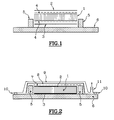
- FIG. 1 there is shown schematically, in exploded view and on the edge, a rectangular sandwich comprising a honeycomb core 1, in 2 and 3 respectively an upper skin and a lower skin, in 4 a pre-fabric impregnated interposed between each skin 2, 3 and the central core 1.
- a shims placed on the four sides of the sandwich, the assembly being supported by a metal plate 6 covered with a non-Teflon fabric porous.
- Honeycomb 1 is for example one of those sold by the company HEXCEL, consisting of a carbon fabric stiffened by thermosetting resins such as phenolic, polyimide, furanic or polycyanate resins.
- a fabric which is well suited is a fabric with balanced taffeta weave of strands of 1000 filaments of the material called "Thornel 300", the warp and the weft of this fabric being placed at 45 ° from the axis of the cells or cells of the nest. bee.
- Cells have walls, half of which is a layer of simple, uncompressed tissue.
- the specific mass of the honeycomb which depends on the grammage of the fabric used for its manufacture and the size of the cells, varies between approximately 0.032 g / cm 3 and approximately 0.32 g / cm 3 .
- the honeycomb 1 is, independently of the skins, pyrolyzed in the known manner, for example at a temperature of the order of 900 ° C.
- Skins 2 and 3 are made by draping separately before being glued to honeycomb 1.
- each skin we will use for each skin, four stacked plies, of a carbon fabric pre-impregnated with a phenolic resin for example, the chains of two consecutive plies being crossed at 45 ° respecting a mirror symmetry which allows '' obtaining skins that do not deform during polymerization and pyrolysis operations.
- a coating of glue is interposed between each skin 2, 3 and the core 1, and is preferably constituted by a fabric 4 of carbon pre-impregnated with a phenolic resin, applied to one of the faces of the skins before that these are not brought against the soul 1.
- the fabric 4 is for example of the same type as that used for the skins 2, 3, with, however, preferably, a resin impregnation rate substantially higher than that of the resin of said skins.
- the skins 2, 3 thus provided with their fabric 4 are then brought into contact with the core 1 (FIG. 2).
- the peripheral shims 5 are put in place, the assembly 1 to 4 is covered, in the known manner, with a porous fabric 7, a drainage fabric 8 and finally with a bladder 9, sealed with a putty in 10 at its periphery and provided with a valve 11 connecting it to a vacuum source (not shown).
- FIG. 2 The assembly of FIG. 2 is then placed in an autoclave to carry out a polymerization of the resin of the skins 2, 3 and of the fabrics 4, under the usual temperature conditions (less than 200 ° C.).
- the pressure exerted on the sandwich results both from the vacuum created inside the bladder 9 and from an external pressure produced in the autoclave for example of the order of 1 to 2 bars relative to the outside of the autoclave.
- the sandwich freed from its bladder 9, is replaced in an autoclave and subjected to a pyrolysis of the resins of the skins 2, 3 and of the fabrics 4, in the known manner, for example under neutral gas and at 900 ° C.
- This pyrolysis transforms the phenolic resin into vitreous carbon and is accompanied by a significant shrinkage of the matrix, resulting in an additional porosity for example of the order of 25% for a volume content of the composite fiber of the order of 60% .
- chemical vapor infiltration is carried out in a vacuum oven under usual conditions, for example using methane as a precursor, at a temperature of the order of 1000 ° C, under a pressure of 10 3 Pa and for a period of 250 hours.
- Such infiltration clogs in particular micro-cracks and micro-porosities of the skins (2 to 4) and of the core of the honeycomb and considerably consolidates the junction zones between the core 1 and the tissues 4.
- the very porous nature of the sandwich naturally favors such infiltration which takes place at depth and in a very homogeneous manner.
- This panel is also remarkable for the quasi-isotropic nature of its general behavior, resulting both from a quasi-isotropic behavior of the skins in their plane and from a quasi-isotropic behavior of the core 1 perpendicular to the skins.
- a sandwich 3, 7 cm thick consisting of a honeycomb 1 of density 0.064 with cells of 4.8 mm and skins 2, 3 each formed of four plies of a satin weave fabric of 4 and a grammage of 215 g / m 2 .
- Said skins have a thickness of 0.8 mm with a volume content of fiber of 59%, a porosity after pyrolysis of 26% and a volume content of coke of 15%.
- the weight gain of this sandwich during vapor phase infiltration has shown that the volume occupied by the pyrocarbon in the honeycomb is 1, 6 times the volume released by the pyrolysis of the resin and therefore the presence of the skins does not significantly interfere with the densification of the honeycomb or the consolidation of the adhesive junction.
- the final density of the sandwich was set at 0.2.
- the presence of the induced resin due to its ability to take up moisture, risks, especially in a spatial environment, of evaporation of the water present in the resin, likely to cause deformations of the structure.
- the all-carbon structure according to the invention is completely free from such risks.
- the invention also relates to any wall structure produced using such a sandwich, in particular structures capable of spatial applications requiring both great lightness, great rigidity and excellent dimensional stability.
- oxidation resistant structures can be produced by densifying the various elements of the sandwich with silicon carbide by chemical vapor infiltration using an appropriate precursor, by for example trichloromethylsilane, so as to coat the carbon fibers and seal the microcracks of said matrices with silicon carbide SiC.
- the invention is of course not limited to the production of structures intended for space or aeronautical applications.
Landscapes
- Chemical & Material Sciences (AREA)
- Engineering & Computer Science (AREA)
- Ceramic Engineering (AREA)
- Composite Materials (AREA)
- Chemical Kinetics & Catalysis (AREA)
- Manufacturing & Machinery (AREA)
- Materials Engineering (AREA)
- Structural Engineering (AREA)
- Organic Chemistry (AREA)
- Laminated Bodies (AREA)
- Ceramic Products (AREA)
Applications Claiming Priority (2)
| Application Number | Priority Date | Filing Date | Title |
|---|---|---|---|
| FR9603650 | 1996-03-19 | ||
| FR9603650A FR2746388B1 (fr) | 1996-03-19 | 1996-03-19 | Procede de fabrication d'un panneau du type nid d'abeille en composite carbone/carbone ou carbone/ceramique et structures constituees a partir d'un tel panneau |
Publications (2)
| Publication Number | Publication Date |
|---|---|
| EP0796829A1 true EP0796829A1 (de) | 1997-09-24 |
| EP0796829B1 EP0796829B1 (de) | 2004-01-02 |
Family
ID=9490488
Family Applications (1)
| Application Number | Title | Priority Date | Filing Date |
|---|---|---|---|
| EP97450003A Expired - Lifetime EP0796829B1 (de) | 1996-03-19 | 1997-03-17 | Verfahren zur Herstellung einer Platte mit Honigwabenstruktur aus einem Kohlenstoff/Kohlenstoff- oder Kohlenstoff/Keramik-Verbundkörper sowie Strukturen die eine derartige Platte enthalten |
Country Status (6)
| Country | Link |
|---|---|
| US (1) | US5893955A (de) |
| EP (1) | EP0796829B1 (de) |
| JP (1) | JPH1024507A (de) |
| CA (1) | CA2200349A1 (de) |
| DE (1) | DE69726997D1 (de) |
| FR (1) | FR2746388B1 (de) |
Cited By (6)
| Publication number | Priority date | Publication date | Assignee | Title |
|---|---|---|---|---|
| EP0887680A1 (de) * | 1997-12-21 | 1998-12-30 | Oerlikon Contraves Ag | Vorrichtung zur gerichteten Abstrahlung und zum gerichteten Empfang modulierter Lichtwellen |
| EP1815975A1 (de) * | 2006-01-20 | 2007-08-08 | United Technologies Corporation | Keramische Matrixlaminate |
| US20100266808A1 (en) * | 2007-12-21 | 2010-10-21 | Sonaca S.A. | Process for manufacturing a panel comprising at least one honeycomb body and a first skin made from a composite material |
| FR3001452A1 (fr) * | 2013-01-29 | 2014-08-01 | Herakles | Procede de fabrication d'un panneau d'attenuation acoustique de forme courbee |
| CN108000968A (zh) * | 2017-11-20 | 2018-05-08 | 中国科学院紫金山天文台 | 一种新型的太赫兹碳纤维复合材料面板结构 |
| US12023879B2 (en) | 2018-10-01 | 2024-07-02 | Airbus Operations Sas | Method for manufacturing deicing acoustic skin for an aircraft acoustic panel, using a fiber spacing device |
Families Citing this family (10)
| Publication number | Priority date | Publication date | Assignee | Title |
|---|---|---|---|---|
| US6280550B1 (en) * | 1998-12-15 | 2001-08-28 | General Electric Company | Fabrication of composite articles having an infiltrated matrix |
| JP3233618B2 (ja) * | 1999-07-28 | 2001-11-26 | 川崎重工業株式会社 | 複合材の吸湿方法 |
| US6311769B1 (en) * | 1999-11-08 | 2001-11-06 | Space Systems/Loral, Inc. | Thermal interface materials using thermally conductive fiber and polymer matrix materials |
| US6557702B1 (en) * | 2001-10-31 | 2003-05-06 | Skb Corporation | Golf club travel bag |
| US7226559B2 (en) * | 2000-12-08 | 2007-06-05 | Toyota Motor Sales, U.S.A., Inc. | Method for molding structures |
| DE10225953A1 (de) * | 2002-06-11 | 2003-12-24 | Schunk Kohlenstofftechnik Gmbh | Verfahren zur Herstellung eines eine Wabenstruktur aufweisenden Kohlenstoffkörpers |
| JP4110244B2 (ja) * | 2002-07-26 | 2008-07-02 | 独立行政法人産業技術総合研究所 | 炭化ケイ素系耐熱多孔質構造材及びその製造方法 |
| DE10246851C1 (de) * | 2002-10-08 | 2003-12-18 | Sgl Carbon Ag | Verfahren zur Herstellung von Bauteilen aus faserverstärkter Verbundkeramik sowie deren Verwendungen |
| FR3001409B1 (fr) * | 2013-01-29 | 2015-07-03 | Herakles | Procede de fabrication d'une structure alveolaire de forme courbee en materiau composite |
| CN119822863B (zh) * | 2025-03-17 | 2025-07-25 | 杭州幄肯新材料科技有限公司 | 一种高纯低导热低密度碳纤维/碳复合热场材料及其制备方法 |
Citations (7)
| Publication number | Priority date | Publication date | Assignee | Title |
|---|---|---|---|---|
| US3174895A (en) * | 1960-09-07 | 1965-03-23 | Union Carbide Corp | Graphite cloth laminates |
| EP0051535A1 (de) * | 1980-10-30 | 1982-05-12 | SOCIETE EUROPEENNE DE PROPULSION (S.E.P.) Société Anonyme dite: | Verfahren zum Verbinden feuerfester Gegenstände |
| US4617072A (en) * | 1983-07-30 | 1986-10-14 | Mtu Motoren-Und Turbinen-Union Muenchen Gmbh | Method for producing a composite ceramic body |
| GB2197618A (en) * | 1986-11-20 | 1988-05-25 | Dunlop Ltd | Panels |
| US4824711A (en) * | 1987-01-29 | 1989-04-25 | The United States Of America As Represented By The United States National Aeronautics And Space Administration | Ceramic honeycomb structures and method thereof |
| EP0477505A2 (de) * | 1990-09-27 | 1992-04-01 | Dornier Gmbh | Verfahren zur Herstellung von Sandwichstrukturen aus faserverstärkter Keramik |
| EP0611741A1 (de) * | 1993-02-17 | 1994-08-24 | Societe Europeenne De Propulsion | Verfahren zur Herstellung eines Verbundmaterialkörpers, insbesondere einer Sandwichplatte, aus mehreren zusammengesetzten Vorformen |
Family Cites Families (2)
| Publication number | Priority date | Publication date | Assignee | Title |
|---|---|---|---|---|
| US5360500A (en) * | 1986-11-20 | 1994-11-01 | Dunlop Limited | Method of producing light-weight high-strength stiff panels |
| US5150507A (en) * | 1989-08-03 | 1992-09-29 | Cvd Incorporated | Method of fabricating lightweight honeycomb structures |
-
1996
- 1996-03-19 FR FR9603650A patent/FR2746388B1/fr not_active Expired - Lifetime
-
1997
- 1997-03-17 EP EP97450003A patent/EP0796829B1/de not_active Expired - Lifetime
- 1997-03-17 DE DE69726997T patent/DE69726997D1/de not_active Expired - Lifetime
- 1997-03-18 CA CA002200349A patent/CA2200349A1/fr not_active Abandoned
- 1997-03-19 JP JP9085703A patent/JPH1024507A/ja active Pending
- 1997-03-19 US US08/820,527 patent/US5893955A/en not_active Expired - Fee Related
Patent Citations (7)
| Publication number | Priority date | Publication date | Assignee | Title |
|---|---|---|---|---|
| US3174895A (en) * | 1960-09-07 | 1965-03-23 | Union Carbide Corp | Graphite cloth laminates |
| EP0051535A1 (de) * | 1980-10-30 | 1982-05-12 | SOCIETE EUROPEENNE DE PROPULSION (S.E.P.) Société Anonyme dite: | Verfahren zum Verbinden feuerfester Gegenstände |
| US4617072A (en) * | 1983-07-30 | 1986-10-14 | Mtu Motoren-Und Turbinen-Union Muenchen Gmbh | Method for producing a composite ceramic body |
| GB2197618A (en) * | 1986-11-20 | 1988-05-25 | Dunlop Ltd | Panels |
| US4824711A (en) * | 1987-01-29 | 1989-04-25 | The United States Of America As Represented By The United States National Aeronautics And Space Administration | Ceramic honeycomb structures and method thereof |
| EP0477505A2 (de) * | 1990-09-27 | 1992-04-01 | Dornier Gmbh | Verfahren zur Herstellung von Sandwichstrukturen aus faserverstärkter Keramik |
| EP0611741A1 (de) * | 1993-02-17 | 1994-08-24 | Societe Europeenne De Propulsion | Verfahren zur Herstellung eines Verbundmaterialkörpers, insbesondere einer Sandwichplatte, aus mehreren zusammengesetzten Vorformen |
Cited By (11)
| Publication number | Priority date | Publication date | Assignee | Title |
|---|---|---|---|---|
| EP0887680A1 (de) * | 1997-12-21 | 1998-12-30 | Oerlikon Contraves Ag | Vorrichtung zur gerichteten Abstrahlung und zum gerichteten Empfang modulierter Lichtwellen |
| US6259558B1 (en) | 1997-12-21 | 2001-07-10 | Contraves Space Ag | Device for the directional transmission and the directional reception of modulated light waves |
| EP1815975A1 (de) * | 2006-01-20 | 2007-08-08 | United Technologies Corporation | Keramische Matrixlaminate |
| US20100266808A1 (en) * | 2007-12-21 | 2010-10-21 | Sonaca S.A. | Process for manufacturing a panel comprising at least one honeycomb body and a first skin made from a composite material |
| US9662853B2 (en) * | 2007-12-21 | 2017-05-30 | Sonaca S.A. | Process for manufacturing a panel comprising at least one honeycomb body and a first skin made from a composite material |
| FR3001452A1 (fr) * | 2013-01-29 | 2014-08-01 | Herakles | Procede de fabrication d'un panneau d'attenuation acoustique de forme courbee |
| WO2014118216A1 (fr) * | 2013-01-29 | 2014-08-07 | Herakles | Procede de fabrication d'un panneau ceramique d'attenuation acoustique de forme courbee |
| US9631519B2 (en) | 2013-01-29 | 2017-04-25 | Herakles | Method for the production of a curved ceramic sound attenuation panel |
| RU2646061C2 (ru) * | 2013-01-29 | 2018-03-01 | Эракль | Способ изготовления керамической шумозащитной панели изогнутой формы |
| CN108000968A (zh) * | 2017-11-20 | 2018-05-08 | 中国科学院紫金山天文台 | 一种新型的太赫兹碳纤维复合材料面板结构 |
| US12023879B2 (en) | 2018-10-01 | 2024-07-02 | Airbus Operations Sas | Method for manufacturing deicing acoustic skin for an aircraft acoustic panel, using a fiber spacing device |
Also Published As
| Publication number | Publication date |
|---|---|
| FR2746388A1 (fr) | 1997-09-26 |
| US5893955A (en) | 1999-04-13 |
| FR2746388B1 (fr) | 1998-06-05 |
| EP0796829B1 (de) | 2004-01-02 |
| JPH1024507A (ja) | 1998-01-27 |
| CA2200349A1 (fr) | 1997-09-19 |
| DE69726997D1 (de) | 2004-02-05 |
Similar Documents
| Publication | Publication Date | Title |
|---|---|---|
| EP0796829B1 (de) | Verfahren zur Herstellung einer Platte mit Honigwabenstruktur aus einem Kohlenstoff/Kohlenstoff- oder Kohlenstoff/Keramik-Verbundkörper sowie Strukturen die eine derartige Platte enthalten | |
| EP0522900B1 (de) | Verfahren zur Herstellung von Gegenständen aus einem Verbundwerkstoff mit Aluminiumoxidmatrix | |
| EP0051535B1 (de) | Verfahren zum Verbinden feuerfester Gegenstände | |
| EP2815118B1 (de) | Auslasskonus mit schalldämpfungsanordnung | |
| FR2803078A1 (fr) | Panneau d'attenuation acoustique a couche resistive a propriete structurale et son procede d'obtention | |
| FR2942290A1 (fr) | Bouclier de gestion thermique composite | |
| EP1651435A2 (de) | Hochtemperaturbeständige verbundstruktur mit gradientenzusammensetzung und herstellungsverfahren dafür | |
| US5061414A (en) | Method of making carbon-carbon composites | |
| EP0747547A1 (de) | Verfahren zum Herstellen einer Tafel o.dgl. mit Bau- und Akustikeigenschaften und danach erhaltene Tafel | |
| EP0376794A1 (de) | Schutzvorrichtung aus mehrlagigem keramischem Material | |
| EP0614808B1 (de) | Verfahren zum Herstellen von Wärmeschutzelementen, insbesondere für Raumfahrzeuge | |
| GB2197618A (en) | Panels | |
| FR2625793A1 (fr) | Bloc d'isolation thermique | |
| EP0786320B1 (de) | Verfahren zur Herstellung von Verbundgegenständen mit hoher Massgenauigkeit durch Aushärtung mit ionisierenden Strahlen | |
| EP0078197B1 (de) | Keramische Verbundmaterialien mit hoher mechanischer und thermischer Beständigkeit und ihre Herstellung | |
| CA2735953C (fr) | Panneau sandwich composite renforce | |
| FR2818578A1 (fr) | Procede de fabrication de structures en nid d'abeilles et outillage pour une telle fabrication | |
| WO2018234686A1 (fr) | Procédé de réalisation d'une pièce de forme tronconique ou cylindrique en matériau composite et outillage d'imprégnation d'une préforme fibreuse de forme tronconique ou cylindrique | |
| EP1812224B1 (de) | Einsatz für verbundwerkstoff und herstellungsverfahren dafür sowie verfahren zur herstellung einer sandwich-struktur mit dem einsatz | |
| FR2656146A1 (fr) | Materiau absorbant les ondes electromagnetiques et procede pour sa fabrication. | |
| CN121375229A (zh) | 一种轻质梯度化防热、隔热和承载一体化复合材料及其制备方法 | |
| FR3063674A1 (fr) | Dispositif d'application de pression mecanique, procede d'impregnation et procede de collage | |
| WO2025133540A1 (fr) | Procédé de fabrication d'un panneau composite | |
| FR2706887A1 (en) | Process for the manufacture of composite products | |
| EP2486353A1 (de) | Haltevorrichtung zum aufladen von platten |
Legal Events
| Date | Code | Title | Description |
|---|---|---|---|
| PUAI | Public reference made under article 153(3) epc to a published international application that has entered the european phase |
Free format text: ORIGINAL CODE: 0009012 |
|
| AK | Designated contracting states |
Kind code of ref document: A1 Designated state(s): BE DE ES GB IT NL |
|
| 17P | Request for examination filed |
Effective date: 19980309 |
|
| 17Q | First examination report despatched |
Effective date: 20001023 |
|
| GRAP | Despatch of communication of intention to grant a patent |
Free format text: ORIGINAL CODE: EPIDOSNIGR1 |
|
| GRAS | Grant fee paid |
Free format text: ORIGINAL CODE: EPIDOSNIGR3 |
|
| GRAA | (expected) grant |
Free format text: ORIGINAL CODE: 0009210 |
|
| RAP1 | Party data changed (applicant data changed or rights of an application transferred) |
Owner name: EUROPEAN AERONAUTIC DEFENCE AND SPACE COMPANY -EAD |
|
| AK | Designated contracting states |
Kind code of ref document: B1 Designated state(s): BE DE ES GB IT NL |
|
| PG25 | Lapsed in a contracting state [announced via postgrant information from national office to epo] |
Ref country code: NL Free format text: LAPSE BECAUSE OF FAILURE TO SUBMIT A TRANSLATION OF THE DESCRIPTION OR TO PAY THE FEE WITHIN THE PRESCRIBED TIME-LIMIT Effective date: 20040102 Ref country code: IT Free format text: LAPSE BECAUSE OF FAILURE TO SUBMIT A TRANSLATION OF THE DESCRIPTION OR TO PAY THE FEE WITHIN THE PRESCRIBED TIME-LIMIT;WARNING: LAPSES OF ITALIAN PATENTS WITH EFFECTIVE DATE BEFORE 2007 MAY HAVE OCCURRED AT ANY TIME BEFORE 2007. THE CORRECT EFFECTIVE DATE MAY BE DIFFERENT FROM THE ONE RECORDED. Effective date: 20040102 Ref country code: GB Free format text: LAPSE BECAUSE OF FAILURE TO SUBMIT A TRANSLATION OF THE DESCRIPTION OR TO PAY THE FEE WITHIN THE PRESCRIBED TIME-LIMIT Effective date: 20040102 Ref country code: ES Free format text: LAPSE BECAUSE OF FAILURE TO SUBMIT A TRANSLATION OF THE DESCRIPTION OR TO PAY THE FEE WITHIN THE PRESCRIBED TIME-LIMIT Effective date: 20040102 |
|
| REG | Reference to a national code |
Ref country code: GB Ref legal event code: FG4D Free format text: NOT ENGLISH |
|
| REF | Corresponds to: |
Ref document number: 69726997 Country of ref document: DE Date of ref document: 20040205 Kind code of ref document: P |
|
| PG25 | Lapsed in a contracting state [announced via postgrant information from national office to epo] |
Ref country code: BE Free format text: LAPSE BECAUSE OF NON-PAYMENT OF DUE FEES Effective date: 20040331 |
|
| PG25 | Lapsed in a contracting state [announced via postgrant information from national office to epo] |
Ref country code: DE Free format text: LAPSE BECAUSE OF FAILURE TO SUBMIT A TRANSLATION OF THE DESCRIPTION OR TO PAY THE FEE WITHIN THE PRESCRIBED TIME-LIMIT Effective date: 20040403 |
|
| NLV1 | Nl: lapsed or annulled due to failure to fulfill the requirements of art. 29p and 29m of the patents act | ||
| GBV | Gb: ep patent (uk) treated as always having been void in accordance with gb section 77(7)/1977 [no translation filed] |
Effective date: 20040102 |
|
| BERE | Be: lapsed |
Owner name: EUROPEAN AERONAUTIC DEFENCE AND SPACE COMPANY - EA Effective date: 20040331 |
|
| PLBE | No opposition filed within time limit |
Free format text: ORIGINAL CODE: 0009261 |
|
| STAA | Information on the status of an ep patent application or granted ep patent |
Free format text: STATUS: NO OPPOSITION FILED WITHIN TIME LIMIT |
|
| 26N | No opposition filed |
Effective date: 20041005 |