EP0797113A1 - Aktiver integriert optischer Silizium-Polymermischungs-Richtkoppler - Google Patents
Aktiver integriert optischer Silizium-Polymermischungs-Richtkoppler Download PDFInfo
- Publication number
- EP0797113A1 EP0797113A1 EP97400601A EP97400601A EP0797113A1 EP 0797113 A1 EP0797113 A1 EP 0797113A1 EP 97400601 A EP97400601 A EP 97400601A EP 97400601 A EP97400601 A EP 97400601A EP 0797113 A1 EP0797113 A1 EP 0797113A1
- Authority
- EP
- European Patent Office
- Prior art keywords
- polymer
- optical
- optical coupler
- coupler according
- index
- Prior art date
- Legal status (The legal status is an assumption and is not a legal conclusion. Google has not performed a legal analysis and makes no representation as to the accuracy of the status listed.)
- Withdrawn
Links
Images


Classifications
-
- G—PHYSICS
- G02—OPTICS
- G02B—OPTICAL ELEMENTS, SYSTEMS OR APPARATUS
- G02B6/00—Light guides; Structural details of arrangements comprising light guides and other optical elements, e.g. couplings
- G02B6/10—Light guides; Structural details of arrangements comprising light guides and other optical elements, e.g. couplings of the optical waveguide type
- G02B6/12—Light guides; Structural details of arrangements comprising light guides and other optical elements, e.g. couplings of the optical waveguide type of the integrated circuit kind
- G02B6/122—Basic optical elements, e.g. light-guiding paths
- G02B6/125—Bends, branchings or intersections
-
- G—PHYSICS
- G02—OPTICS
- G02F—OPTICAL DEVICES OR ARRANGEMENTS FOR THE CONTROL OF LIGHT BY MODIFICATION OF THE OPTICAL PROPERTIES OF THE MEDIA OF THE ELEMENTS INVOLVED THEREIN; NON-LINEAR OPTICS; FREQUENCY-CHANGING OF LIGHT; OPTICAL LOGIC ELEMENTS; OPTICAL ANALOGUE/DIGITAL CONVERTERS
- G02F1/00—Devices or arrangements for the control of the intensity, colour, phase, polarisation or direction of light arriving from an independent light source, e.g. switching, gating or modulating; Non-linear optics
- G02F1/29—Devices or arrangements for the control of the intensity, colour, phase, polarisation or direction of light arriving from an independent light source, e.g. switching, gating or modulating; Non-linear optics for the control of the position or the direction of light beams, i.e. deflection
- G02F1/31—Digital deflection, i.e. optical switching
- G02F1/313—Digital deflection, i.e. optical switching in an optical waveguide structure
- G02F1/3132—Digital deflection, i.e. optical switching in an optical waveguide structure of directional coupler type
-
- G—PHYSICS
- G02—OPTICS
- G02B—OPTICAL ELEMENTS, SYSTEMS OR APPARATUS
- G02B6/00—Light guides; Structural details of arrangements comprising light guides and other optical elements, e.g. couplings
- G02B6/10—Light guides; Structural details of arrangements comprising light guides and other optical elements, e.g. couplings of the optical waveguide type
- G02B6/12—Light guides; Structural details of arrangements comprising light guides and other optical elements, e.g. couplings of the optical waveguide type of the integrated circuit kind
- G02B2006/12133—Functions
- G02B2006/12147—Coupler
-
- G—PHYSICS
- G02—OPTICS
- G02F—OPTICAL DEVICES OR ARRANGEMENTS FOR THE CONTROL OF LIGHT BY MODIFICATION OF THE OPTICAL PROPERTIES OF THE MEDIA OF THE ELEMENTS INVOLVED THEREIN; NON-LINEAR OPTICS; FREQUENCY-CHANGING OF LIGHT; OPTICAL LOGIC ELEMENTS; OPTICAL ANALOGUE/DIGITAL CONVERTERS
- G02F1/00—Devices or arrangements for the control of the intensity, colour, phase, polarisation or direction of light arriving from an independent light source, e.g. switching, gating or modulating; Non-linear optics
- G02F1/01—Devices or arrangements for the control of the intensity, colour, phase, polarisation or direction of light arriving from an independent light source, e.g. switching, gating or modulating; Non-linear optics for the control of the intensity, phase, polarisation or colour
- G02F1/011—Devices or arrangements for the control of the intensity, colour, phase, polarisation or direction of light arriving from an independent light source, e.g. switching, gating or modulating; Non-linear optics for the control of the intensity, phase, polarisation or colour in optical waveguides, not otherwise provided for in this subclass
- G02F1/0113—Glass-based, e.g. silica-based, optical waveguides
-
- G—PHYSICS
- G02—OPTICS
- G02F—OPTICAL DEVICES OR ARRANGEMENTS FOR THE CONTROL OF LIGHT BY MODIFICATION OF THE OPTICAL PROPERTIES OF THE MEDIA OF THE ELEMENTS INVOLVED THEREIN; NON-LINEAR OPTICS; FREQUENCY-CHANGING OF LIGHT; OPTICAL LOGIC ELEMENTS; OPTICAL ANALOGUE/DIGITAL CONVERTERS
- G02F1/00—Devices or arrangements for the control of the intensity, colour, phase, polarisation or direction of light arriving from an independent light source, e.g. switching, gating or modulating; Non-linear optics
- G02F1/01—Devices or arrangements for the control of the intensity, colour, phase, polarisation or direction of light arriving from an independent light source, e.g. switching, gating or modulating; Non-linear optics for the control of the intensity, phase, polarisation or colour
- G02F1/0147—Devices or arrangements for the control of the intensity, colour, phase, polarisation or direction of light arriving from an independent light source, e.g. switching, gating or modulating; Non-linear optics for the control of the intensity, phase, polarisation or colour based on thermo-optic effects
-
- G—PHYSICS
- G02—OPTICS
- G02F—OPTICAL DEVICES OR ARRANGEMENTS FOR THE CONTROL OF LIGHT BY MODIFICATION OF THE OPTICAL PROPERTIES OF THE MEDIA OF THE ELEMENTS INVOLVED THEREIN; NON-LINEAR OPTICS; FREQUENCY-CHANGING OF LIGHT; OPTICAL LOGIC ELEMENTS; OPTICAL ANALOGUE/DIGITAL CONVERTERS
- G02F1/00—Devices or arrangements for the control of the intensity, colour, phase, polarisation or direction of light arriving from an independent light source, e.g. switching, gating or modulating; Non-linear optics
- G02F1/01—Devices or arrangements for the control of the intensity, colour, phase, polarisation or direction of light arriving from an independent light source, e.g. switching, gating or modulating; Non-linear optics for the control of the intensity, phase, polarisation or colour
- G02F1/061—Devices or arrangements for the control of the intensity, colour, phase, polarisation or direction of light arriving from an independent light source, e.g. switching, gating or modulating; Non-linear optics for the control of the intensity, phase, polarisation or colour based on electro-optical organic material
- G02F1/065—Devices or arrangements for the control of the intensity, colour, phase, polarisation or direction of light arriving from an independent light source, e.g. switching, gating or modulating; Non-linear optics for the control of the intensity, phase, polarisation or colour based on electro-optical organic material in an optical waveguide structure
-
- G—PHYSICS
- G02—OPTICS
- G02F—OPTICAL DEVICES OR ARRANGEMENTS FOR THE CONTROL OF LIGHT BY MODIFICATION OF THE OPTICAL PROPERTIES OF THE MEDIA OF THE ELEMENTS INVOLVED THEREIN; NON-LINEAR OPTICS; FREQUENCY-CHANGING OF LIGHT; OPTICAL LOGIC ELEMENTS; OPTICAL ANALOGUE/DIGITAL CONVERTERS
- G02F2202/00—Materials and properties
- G02F2202/02—Materials and properties organic material
- G02F2202/022—Materials and properties organic material polymeric
Definitions
- the invention relates to the field of directional couplers in integrated optics, and in particular to the field of active directional couplers operating in thermo-optical mode.
- the coupler 6 comprises two optical guides 8, 10 spaced by a distance c over a coupling length L C.
- the distance c is chosen small enough so that the energy can pass from one guide to another.
- FIG. 1A represents the case where an optical signal introduced into a guide 1, in the extension of the guide 8 of the coupler 6, emerges from the coupler by a guide 2 located in the extension of the guide 10 of the coupler 6. This is the state "Cross-state", obtained by choosing the distance c over the length L C.
- an optical signal is introduced into the guide 1 and comes out through the guide 4, located in the extension of the guide 8 of the coupler 6.
- Directional couplers can be activated by electro-optical effects, when they are constructed with materials with strong non-linear property such as LiNbO 3 , or even with certain polymers. This type of activation is interesting for high speed modulation, or fast switching.
- the directional couplers can also be activated by thermo-optical effect. A difference in index is induced by heat. We thus realize cheaper switches, when the activation speed of a state of the coupler does not have to be too fast (that is to say in the range of milliseconds)
- thermo-optical mode The production of directional couplers activated by thermo-optical mode is described for example in the document entitled "Polymer thermo-optic switching matrix for space-routing in transparent OFDM networks" by N. Keil et al., Published in SPIE, vol. 2449, pages 281-292 (1995).
- the structure of a directional coupler according to this document will be recalled, in conjunction with FIG. 2.
- a buffer layer 14 made of SiO X
- BDK-PMMA polymer waveguide
- Teflon buffer layer 18 A heating element 20 is deposited on the layer 18.
- the operating principle of such a device is based on the temperature dependence of the refractive index of the waveguide 16 made of polymer material.
- thermo-optical polymer coupler has the advantage, compared to a silica coupler, of a greater variation in index with temperature, and of better heat confinement.
- a guide structure made entirely of polymer requires the use of a technology which is different from that used for silica components, and which is less proven from an industrial point of view. This is in particular the case for the etching step of a polymer layer, in order to produce the optical guide (s) of the coupler.
- the realization of such a structure poses problems of adaptation of the refractive indices of the materials, when it is necessary to connect the polymer guides to silica fibers.
- Thermo-optical switches are also known, based on MACH-ZEHNDER, entirely of silica, which have low electrical consumption. But the guides of these switches are manufactured suspended, so as to avoid heat loss. This is done at the expense of simplicity, because the technology of hanging guides is delicate and expensive. In addition, response times increase from 1 to 3 milliseconds, or even 30 milliseconds, depending on the type of suspension.
- the invention seeks to solve these problems by proposing a directional optical coupler comprising at least two optical guide cores, made of silica, resting on a sheath made of a mineral dielectric material, and a covering layer made of a polymeric material, which covers the two optical guide cores, and the index of this covering layer being lower than that of the optical guide cores.
- the silica can be etched in a known manner, to produce the guide cores, and a polymer deposit can easily be produced on the assembly.
- the structure according to the invention does not require an etching of a polymer layer: only a deposition of this layer is produced on silica guides, the etching of which presents no problem.
- the coupler according to the invention eliminates the problems of connection between the guides of the coupler and silica optical fibers.
- the index of the polymer may be such that it allows unimodal operation. This condition is interesting for applications in the telecommunications field.
- Such a coupler can be combined with thermo-optical activation means, in order to produce an active thermo-optical directional coupler.
- the directional coupler according to the invention makes it possible to benefit from the good thermo-optical properties of the polymers, and from the qualities of the silica guides.
- the structure according to the invention is advantageous in that the polymers and the silica exhibit variations in refractive index with temperature, which are in opposite directions, which makes it possible to carry out the referral with smaller variations in temperature, and therefore lower electric currents than in the devices of the prior art.
- the second and third arrangements make it possible to heat both the silica cores and the optical covering sheath in polymer; as the silica and polymer materials exhibit variations in index, with temperature, antagonistic (of opposite signs), the variation in core-sheath index will be much greater than in the case of the first arrangement.
- the polymeric material may be from the family of polymethacrylates, or ⁇ -haloacrylates, or polyacrylates, or polystyrenes, or polycarbonates, or polyvinyls, or polyimides, or polysiloxanes.
- FIG. 3 represents the structure of a directional coupler according to the invention.
- This structure essentially comprises a substrate 22, for example made of silicon.
- a layer 24 (index n S ), called optical sheath, of a dielectric and mineral material, for example silica.
- This layer 24 can have a thickness of between 7 and 20 ⁇ m, and it plays the role of lower optical sheath.
- the doping of silica is chosen so as to obtain a refractive index of the hearts greater than the index of the layer 24, the difference between the two indices being substantially between, for example, 10 -3 and 10 -2 . These values make it possible to obtain adequate operation of the coupler.
- the two guide cores 26, 28 are covered with a covering layer 30, made of a polymer material.
- the index n p of this polymer material is lower than that of the optical guide cores 26, 28. If unimodal operation is necessary, a polymer having an index allowing such unimodal operation is chosen. More precisely, if n p1 denotes the value of the index of the polymer for which there is a second mode, the following relation translates the condition of unimodality: not p1 ⁇ n p
- the polymer will have an index n p of between substantially 1.450 and 1.445.
- this zone is generally quite narrow; it may for example have a width of between 2 and 6 ⁇ m.
- the silica deposition techniques fail to completely fill the interguide, and covering with a polymer makes it possible to solve this problem.
- the cores 26 and 28 being both made of silica or of doped silica, their index is compatible with the index of an optical fiber made of silica intended to transmit the light energy at the input and at the output of the coupler (fibers 1 , 2, 3, 4 in FIGS. 1A and 1B),
- the orders of magnitude of the variation in index of a polymer, under the effect of heating are between 5.10 -4 and 7.10 -3 .
- the factor dn / dT which expresses the differential variation of index compared to the differential variation of temperature, is, for a polymer, of the order of -10 -4 / K to -5.10 -4 / K, while the same factor is, for silica, about 10 -5 / K.
- the temperature variations necessary for switching on the coupler are therefore of the order of 5 to 70 ° C, values which make it possible to ensure operation of the coupler with minimal consumption, of the order of a few tens of mW.
- the polymer having the index conditions given above, may be chosen from the families of polymethacrylates, or ⁇ -haloacrylates, or polyacrylates, or polystyrenes, or polycarbonates, or polyvinyls, or polyimides, or polysiloxanes.
- a material having an adjusted index can be obtained by copolymerization of two or more monomers chosen from the families mentioned above, or by a mixture of polymers chosen from these same families.
- a test making it possible to decide whether the mixture or the copolymer obtained has a satisfactory index consists in making a film of the material in question on a substrate, and in measuring the index by "m-lines" (this technique is described for example in the article by R. ULRICH & R. TORGE “Measurement of thin film Parameters with a prism coupler", Dec. 1973 / Vol.12, n ° 12, p. 2901-2908) at the application wavelength . This technique makes it possible to measure the index with an accuracy of the order of 10 -4 to 10 -3 depending on the case.
- a copolymer which may also be suitable is a MATRIFE-MMA copolymer, that is to say trifluoroethyl methacrylate-methyl methacrylate, the fraction mass of each of them being adjusted so as to obtain the desired index.
- MMA it is also possible to copolymerize MMA with any other acrylic, methacrylic, or ⁇ -haloacrylate fluorinated monomer (for example: trifluoroethyl ⁇ -fluoroacrylate), these fluorinated monomers making it possible to reduce the refractive index of MMA (which is 1 , 49, so too high for MMA to be used alone).
- fluorine makes it possible to increase the solubility of the polymer, and therefore to be able to produce deposits in thick film: this is advantageous, in particular when it is a question of producing a covering layer 30 making it possible to cover hearts. 26, 28 having a section of approximately 8 ⁇ m.
- MATRIFE has a very low refractive index.
- the coupler activation means will for example be thermo-optical means.
- thermo-optical operating mode of the coupler according to the invention is all the more advantageous since the polymers and the silica exhibit variations in refractive index, with temperature, which are in opposite directions, which makes it possible to carry out the coupling with smaller temperature variations, and therefore lower electric currents.
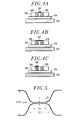
- thermo-optical directional coupler is obtained by producing, as illustrated in FIGS. 4A to 4C, a control electrode on the polymer layer 30.
- FIGS. 4A to 4C illustrate three possible positions for this electrode: it can be arranged above the inter-core space (electrode 32, FIG. 4A), or else above the two guides 26, 28, also extending to the above the inter-core zone (symmetrical positioning, electrode 34, FIG. 4B), or above one of the two guides (asymmetrical positioning, electrode 36, FIG. 4C).
- the MARCATILI method allows, for a given set of values of the above parameters, to calculate the value L C , as well as the optical bandwidth at 99% (BPO for a coupling rate, in "Cross-state", of 99%).
- the criterion chosen for this calculation is the maximization of the BPO, or of the coupling rate product multiplied by BPO
- This criterion will be adapted, as required: for a coupler intended to be used alone, the criterion bearing only on the BPO may be sufficient, while for a coupler intended to be used in cascade with other couplers, the criterion coupling rate multiplied by BPO will rather be retained.
- Parameter V (7th column of the table) designates the reduced frequency, given by formula (3) above.
- the tolerances on the interguide c and on the guide widths a are 0.15 ⁇ m, for a coupling rate of 99%.
- the coefficient A m is a coefficient which follows from MARCATILI theory, and which makes it possible to judge the satisfactory nature of the method: the smaller this parameter is before 1, the more the application of the method can be considered satisfactory. In the particular cases given here, we see that this parameter has a average value, of the order of 0.5. This explains why the results obtained for L C are affected by a relatively large error (compared to other methods), which can reach 50%: therefore, this simulation method is not very rigorous. It must first be considered as making it possible to obtain an order of magnitude for L C. A more precise value can then be obtained experimentally, starting from this approximate value.
- FIGS. 6A to 6D A method of producing a coupler according to the invention will now be described, in conjunction with FIGS. 6A to 6D.
- the sheath layer 24 of mineral dielectric material for example silica
- a substrate 22 for example of monocrystalline silicon (FIG. 6A).
- This deposition can be carried out by radio frequency plasma or microwave, from hydride or silicon chloride.
- the technique for depositing this layer 25 may be the same as that used for layer 24.
- the layer 25 is etched. This etching makes it possible to delimit the optical path of the hearts 26, 28.
- a photolithography step makes it possible to delimit the part to be etched, and to protect the area of the hearts. .
- the photolithography mask contains the pattern of the coupler to be produced. After photolithography, the etching is done by reactive ion attack (RIE) using a fluorinated gas (C 2 F 6 or CHF 3 ). This gives the structure shown in Figure 6C.
- RIE reactive ion attack
- the hearts are covered with a layer 30 of polymer, prepared and chosen as a function of its refractive index.
- the polymer is deposited with the spinner, from solutions sufficiently concentrated to obtain layers of several micrometers thick. This gives the structure illustrated in Figure 6D.
- Other deposition techniques can be used, depending on the properties of the polymer: the slow evaporation technique or screen printing.
- the metal electrodes such as the electrodes 32, 34, 36 of FIGS. 4A to 4C, are deposited.
- the deposition of electrodes can be carried out by spraying, or sublimation, of a metal of aluminum, gold, chromium type, or of any other alloy of these metals together or of other alloys of tin-lead, or lead- bismuth, for example.
- the thickness and size of the electrodes are calculated so that the Joule effect is sufficient to obtain the temperature rise which is suitable for the operation of the coupler. This thickness is generally of the order of 0.1 ⁇ m to 1 ⁇ m, or more. A uniform layer of the chosen metal is therefore deposited, having said thickness.
- the electrodes are delimited by a wet etching process, in an aqueous medium, of this previously deposited layer.
- the electrodes include a useful zone, the surface of which corresponds to the surface to be heated, this useful zone being extended on each side by a circuit for supplying the electric current.
- the third step of the process which has just been described is a step of etching a layer of doped silica, to delimit the path of the optical guides.
- This type of technique is well mastered, from an industrial point of view. Consequently, the production of a coupler according to the invention does not pose the problems encountered during the production of active directional couplers, operating in thermo-optical mode, and the guide structure of which is made entirely of polymer.
- the step of depositing the polymer layer 30 makes it possible to completely cover the interguide space between the hearts 26 and 28, even when this space is quite narrow compared to the size of the guides.
- the covering layer is a layer of silica, which does not completely fill the interguide space.
- the guide cores were produced, in accordance with the process described above, in silica on silicon technology.
- a 4 inch (101.6 mm) substrate in monocrystalline silicon is prepared, on which a layer of intrinsic silica, with a thickness of between 10 and 20 ⁇ m is deposited.
- a germanium-doped silica layer up to 8 ⁇ m thick, is deposited. This layer has a higher refractive index than that of the lower layer, and the difference is between 10 -3 and 10 -2 , for example.
- this layer is then carried out to delimit the optical path of the hearts (3rd step of the method described above). For better attack selectivity at the time of the etching, it is only etched to release 20 to 30 ⁇ m around each core, thus leaving the doped layer on the periphery of the circuit.
- a critical step is that of making the polymer.
- a methacrylic polymer was prepared, with a refractive index between 1.44 and 1.450, at the interesting wavelength (between 1.30 and 1.50 ⁇ m).
- This methacrylic polymer is then combined with a small fraction of a common polymer, chosen from the family of polymethacrylates, or ⁇ -haloacrylates, or polyacrylates, or polystyrenes, or polycarbonates, or polyvinyls, or polyimides, or polysiloxanes.
- This method is very efficient and precise, since it is difficult to directly synthesize a polymer having exactly the desired index, to within 10 -3 .
- MATRIFE trifluoroethyl methacrylate
- PMMA polymethyl methacrylate
- refractive indices of 1.41 and 1.49 respectively in the visible range were chosen. These two homopolymers are incompatible when mixed, and a copolymer of MATRIFE and MMA has been produced.
- the copolymerization of a polymer with an index of 1.445 to 1.3 ⁇ m can be carried out as follows.
- THF solvent 500 cm 3
- MATRIFE 43% (by weight) of MATRIFE (21.5 g).
- AIBN azo bis-isobutyronitrile
- the reaction takes place at 60 ° C., at reflux under an atmosphere argon, for 50 hours.
- the copolymer CP2MA
- CP2MA is precipitated in absolute ethanol, and dried in the vacuum oven for 24 hours, at 40 ° C. The final yield is greater than 80%.
- the polymer obtained is spread, on a spinning wheel, on the substrate also comprising the silica hearts.
- the electrodes are then deposited by vacuum sublimation, to obtain an aluminum film 500 nm thick on the coupling zone.
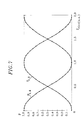
- FIG. 7 illustrates the performance of a coupler according to the invention.
- This figure represents the optical output power, on the guides 4 and 2 (see FIG. 1A), as a function of the electrical power P elec (in arbitrary unit) injected into the electrodes.
- P elec in arbitrary unit
- P 1.4 is maximum (the coupler then operates in "Bar-state” mode)
- P elec 1 (UA)
- P 1.2 is maximum
- the power P 1.4 is minimum (the coupler then operates in "Cross-state”).
- the couplers according to the invention can be used in the telecommunications field, in particular in the case of single-mode couplers.
- Multimode couplers have applications for the production of sensors.
Landscapes
- Physics & Mathematics (AREA)
- Nonlinear Science (AREA)
- General Physics & Mathematics (AREA)
- Optics & Photonics (AREA)
- Engineering & Computer Science (AREA)
- Microelectronics & Electronic Packaging (AREA)
- Optical Integrated Circuits (AREA)
Applications Claiming Priority (2)
| Application Number | Priority Date | Filing Date | Title |
|---|---|---|---|
| FR9603450 | 1996-03-20 | ||
| FR9603450A FR2746511B1 (fr) | 1996-03-20 | 1996-03-20 | Coupleur directif actif mixte silice/polymere, en optique integree |
Publications (1)
| Publication Number | Publication Date |
|---|---|
| EP0797113A1 true EP0797113A1 (de) | 1997-09-24 |
Family
ID=9490344
Family Applications (1)
| Application Number | Title | Priority Date | Filing Date |
|---|---|---|---|
| EP97400601A Withdrawn EP0797113A1 (de) | 1996-03-20 | 1997-03-18 | Aktiver integriert optischer Silizium-Polymermischungs-Richtkoppler |
Country Status (3)
| Country | Link |
|---|---|
| US (1) | US5857039A (de) |
| EP (1) | EP0797113A1 (de) |
| FR (1) | FR2746511B1 (de) |
Cited By (3)
| Publication number | Priority date | Publication date | Assignee | Title |
|---|---|---|---|---|
| US6243525B1 (en) | 1998-02-13 | 2001-06-05 | Jds Uniphase Photonics C.V. | Optical waveguide device comprising at least one bent waveguide channel |
| EP0994370A3 (de) * | 1998-10-05 | 2002-05-08 | Lucent Technologies Inc. | Verfahren und vorrichtung zur optischen Dämpfung unter Verwendung von Polymermaterial |
| US6519380B2 (en) | 2000-01-11 | 2003-02-11 | Corning Incorporated | Athermalized integrated optical waveguide devices |
Families Citing this family (39)
| Publication number | Priority date | Publication date | Assignee | Title |
|---|---|---|---|---|
| US7226966B2 (en) * | 2001-08-03 | 2007-06-05 | Nanogram Corporation | Structures incorporating polymer-inorganic particle blends |
| US6599631B2 (en) | 2001-01-26 | 2003-07-29 | Nanogram Corporation | Polymer-inorganic particle composites |
| EP0905546A3 (de) * | 1997-09-26 | 2002-06-19 | Nippon Telegraph and Telephone Corporation | Gestapelter thermooptischer Schalter, Schaltmatrix und Ein-/Ausfügemultiplexer mit dem gestapelten thermooptischen Schalter |
| US6317233B1 (en) * | 1998-03-04 | 2001-11-13 | Lg Electronics Inc. | Optical power equalizer in WDM optical communication system and variable attenuator for use therein |
| US6310999B1 (en) * | 1998-10-05 | 2001-10-30 | Lucent Technologies Inc. | Directional coupler and method using polymer material |
| CA2346130A1 (en) | 1998-11-10 | 2000-05-18 | Lightwave Microsystems Corporation | Photonic devices comprising thermo-optic polymer |
| EP1026526A1 (de) * | 1999-02-02 | 2000-08-09 | Corning Incorporated | Athermischer integrierter planarer Lichtwellenleiter mit Polymercladding und Herstellungsverfahren dafür |
| CA2271159A1 (en) * | 1999-04-30 | 2000-10-30 | Jds Fitel Inc. | Optical hybrid device |
| US6424755B1 (en) | 1999-07-02 | 2002-07-23 | Nortel Networks Limited | Slotted monolithic optical waveguides |
| DE60038121T2 (de) * | 1999-09-08 | 2009-03-05 | E.I. Du Pont De Nemours And Co., Wilmington | Hybrider integrierter optischer einfüge- und abzweigmultiplexer |
| US6324204B1 (en) | 1999-10-19 | 2001-11-27 | Sparkolor Corporation | Channel-switched tunable laser for DWDM communications |
| US6393185B1 (en) | 1999-11-03 | 2002-05-21 | Sparkolor Corporation | Differential waveguide pair |
| US6243517B1 (en) | 1999-11-04 | 2001-06-05 | Sparkolor Corporation | Channel-switched cross-connect |
| US6934313B1 (en) | 1999-11-04 | 2005-08-23 | Intel Corporation | Method of making channel-aligned resonator devices |
| GB2358712A (en) * | 2000-01-28 | 2001-08-01 | Kymata Ltd | Optical Device |
| GB2358711A (en) * | 2000-01-28 | 2001-08-01 | Kymata Ltd | Optical device |
| US6421472B1 (en) * | 2000-04-14 | 2002-07-16 | Corning Incorporated | Athermalized polymer overclad integrated planar optical waveguide device and method |
| US6674949B2 (en) * | 2000-08-15 | 2004-01-06 | Corning Incorporated | Active photonic crystal waveguide device and method |
| US20020054727A1 (en) * | 2000-09-19 | 2002-05-09 | Song Qi Wang | Wave guide switch based on electric field control of wave reflection and transmission |
| US6687425B2 (en) | 2001-07-26 | 2004-02-03 | Battelle Memorial Institute | Waveguides and devices incorporating optically functional cladding regions |
| US6782149B2 (en) | 2001-07-26 | 2004-08-24 | Battelle Memorial Institute | Contoured electric fields and poling in polarization-independent waveguides |
| US6690694B2 (en) | 2001-11-08 | 2004-02-10 | Intel Corporation | Thermally wavelength tunable lasers |
| US6969985B2 (en) * | 2001-12-14 | 2005-11-29 | Analog Devices, Inc. | Active coupler |
| US6751396B2 (en) * | 2001-12-26 | 2004-06-15 | Lucent Technologies Inc. | Integrated optical devices and method of fabrication therefor |
| KR100839268B1 (ko) * | 2002-03-06 | 2008-06-17 | 엘지전자 주식회사 | 다중 모드 간섭을 이용한 가변 광감쇄기 |
| US6795597B2 (en) * | 2002-03-15 | 2004-09-21 | Optimer Photonics, Inc. | Electrode and core arrangements for polarization-independent waveguides |
| US20040005108A1 (en) * | 2002-07-02 | 2004-01-08 | Kjetil Johannessen | Thermal compensation of waveguides by dual material core having negative thermo-optic coefficient inner core |
| US6987895B2 (en) * | 2002-07-02 | 2006-01-17 | Intel Corporation | Thermal compensation of waveguides by dual material core having positive thermo-optic coefficient inner core |
| US6879765B2 (en) * | 2002-09-16 | 2005-04-12 | Intel Corporation | Integrated selectable waveguide for optical networking components |
| AU2003291823A1 (en) * | 2002-11-21 | 2004-06-18 | Optimer Photonics, Inc. | Embedded electrode integrated optical devices and methods of fabrication |
| US7972691B2 (en) * | 2006-12-22 | 2011-07-05 | Nanogram Corporation | Composites of polymers and metal/metalloid oxide nanoparticles and methods for forming these composites |
| WO2008100568A1 (en) * | 2007-02-17 | 2008-08-21 | Nanogram Corporation | Functional composites, functional inks and applications thereof |
| JP5688032B2 (ja) * | 2009-01-08 | 2015-03-25 | ナノグラム・コーポレイションNanoGram Corporation | ポリシロキサンポリエステル及び無機ナノ粒子の複合体 |
| EP2696227B1 (de) * | 2012-08-08 | 2019-09-25 | Fraunhofer-Gesellschaft zur Förderung der angewandten Forschung e.V. | Richtkoppler und Lichtwellenleiter |
| WO2014023804A2 (en) * | 2012-08-08 | 2014-02-13 | Fraunhofer-Gesellschaft zur Förderung der angewandten Forschung e. V. | Directional coupler and optical waveguide |
| EP3014250B1 (de) | 2013-06-28 | 2023-06-07 | Nanolyze AB | Wellenleiterstruktur |
| US9500929B2 (en) * | 2015-04-15 | 2016-11-22 | Chen-Kuo Sun | Vertical electro-optically coupled switch |
| US20160306256A1 (en) * | 2015-04-15 | 2016-10-20 | Chen-Kuo Sun | Method for configuring an optical modulator |
| US10197818B2 (en) * | 2016-10-24 | 2019-02-05 | Electronics & Telecommunications Research Institute | Thermo-optic optical switch |
Citations (3)
| Publication number | Priority date | Publication date | Assignee | Title |
|---|---|---|---|---|
| EP0306956A2 (de) * | 1987-09-11 | 1989-03-15 | Hitachi, Ltd. | Optischer Multiplexer/Demultiplexer vom Wellenleiter-Typ |
| US4940328A (en) * | 1988-11-04 | 1990-07-10 | Georgia Tech Research Corporation | Optical sensing apparatus and method |
| JPH04238305A (ja) * | 1991-01-22 | 1992-08-26 | Nippon Telegr & Teleph Corp <Ntt> | ポリマーコートガラスコア光導波路 |
Family Cites Families (9)
| Publication number | Priority date | Publication date | Assignee | Title |
|---|---|---|---|---|
| US4483583A (en) * | 1981-03-07 | 1984-11-20 | Licentia Patent-Verwaltungs-Gmbh | Selective directional coupler for guided waves |
| JPH0310205A (ja) * | 1989-06-08 | 1991-01-17 | Fujikura Ltd | 基板型光導波路の製造方法 |
| JP3031426B2 (ja) * | 1990-04-16 | 2000-04-10 | 日本電信電話株式会社 | 導波型光分岐素子 |
| JPH04179931A (ja) * | 1990-11-14 | 1992-06-26 | Oki Electric Ind Co Ltd | 導波型光デバイス |
| US5321782A (en) * | 1991-01-07 | 1994-06-14 | Furukawa Electric Co., Ltd. | Directional coupler type optical function element |
| US5247594A (en) * | 1991-03-22 | 1993-09-21 | Nippon Telegraph And Telephone Corporation | Waveguide-type optical matrix switch |
| US5253319A (en) * | 1992-02-24 | 1993-10-12 | Corning Incorporated | Planar optical waveguides with planar optical elements |
| JPH06175172A (ja) * | 1992-07-13 | 1994-06-24 | Fujitsu Ltd | 非線形光学材料、その製造方法並びにそれを用いた非線形光学デバイス及び方向性結合型光スイッチ |
| US5559912A (en) * | 1995-09-15 | 1996-09-24 | International Business Machines Corporation | Wavelength-selective devices using silicon-on-insulator |
-
1996
- 1996-03-20 FR FR9603450A patent/FR2746511B1/fr not_active Expired - Fee Related
-
1997
- 1997-03-06 US US08/813,027 patent/US5857039A/en not_active Expired - Fee Related
- 1997-03-18 EP EP97400601A patent/EP0797113A1/de not_active Withdrawn
Patent Citations (3)
| Publication number | Priority date | Publication date | Assignee | Title |
|---|---|---|---|---|
| EP0306956A2 (de) * | 1987-09-11 | 1989-03-15 | Hitachi, Ltd. | Optischer Multiplexer/Demultiplexer vom Wellenleiter-Typ |
| US4940328A (en) * | 1988-11-04 | 1990-07-10 | Georgia Tech Research Corporation | Optical sensing apparatus and method |
| JPH04238305A (ja) * | 1991-01-22 | 1992-08-26 | Nippon Telegr & Teleph Corp <Ntt> | ポリマーコートガラスコア光導波路 |
Non-Patent Citations (2)
| Title |
|---|
| KEIL N ET AL: "4X4 POLYMER THERMO-OPTIC DIRECTIONAL COUPLER SWITCH AT 1,55 MUM", ELECTRONICS LETTERS, vol. 30, no. 8, 14 April 1994 (1994-04-14), pages 639/640, XP000451508 * |
| PATENT ABSTRACTS OF JAPAN vol. 017, no. 007 (P - 1465) 7 January 1993 (1993-01-07) * |
Cited By (3)
| Publication number | Priority date | Publication date | Assignee | Title |
|---|---|---|---|---|
| US6243525B1 (en) | 1998-02-13 | 2001-06-05 | Jds Uniphase Photonics C.V. | Optical waveguide device comprising at least one bent waveguide channel |
| EP0994370A3 (de) * | 1998-10-05 | 2002-05-08 | Lucent Technologies Inc. | Verfahren und vorrichtung zur optischen Dämpfung unter Verwendung von Polymermaterial |
| US6519380B2 (en) | 2000-01-11 | 2003-02-11 | Corning Incorporated | Athermalized integrated optical waveguide devices |
Also Published As
| Publication number | Publication date |
|---|---|
| US5857039A (en) | 1999-01-05 |
| FR2746511B1 (fr) | 1998-04-24 |
| FR2746511A1 (fr) | 1997-09-26 |
Similar Documents
| Publication | Publication Date | Title |
|---|---|---|
| EP0797113A1 (de) | Aktiver integriert optischer Silizium-Polymermischungs-Richtkoppler | |
| Pruessner et al. | Thermo-optic tuning and switching in SOI waveguide Fabry-Perot microcavities | |
| US6236774B1 (en) | Optoelectronic and photonic devices formed of materials which inhibit degradation and failure | |
| EP0141714B1 (de) | Optischer Modulator | |
| EP0720262B1 (de) | Laservorrichtung mit organischem Bragg-Reflektor und Herstellungsverfahren | |
| US5729641A (en) | Optical device employing edge-coupled waveguide geometry | |
| EP0473496B1 (de) | Verfahren zur Herstellung einer monomoden optischen Faser aus elektrooptischem Polymer, sowie eine solche optische Faser | |
| EP0451047A1 (de) | Vor Umwelteinflüssen geschützte integrierte optische Komponente und Verfahren zu ihrer Herstellung | |
| Lee et al. | Polymeric tunable optical attenuator with an optical monitoring tap for WDM transmission network | |
| FR2593937A1 (fr) | Fibre optique sensible a un champ magnetique | |
| EP0961154A1 (de) | Hybrid-integrierter elektrooptischer Modulator vom Pockels-Effekt-Typ | |
| Corres et al. | Tunable electro-optic wavelength filter based on lossy-guided mode resonances | |
| JP2000089046A (ja) | 再構成性のためのクラッディング感度を強化した光ファイバ回折格子デバイス | |
| FR2514155A1 (fr) | Fibre optique monomode a faible dispersion | |
| FR2694819A1 (fr) | Dispositif d'adaptation de vitesse entre des signaux élkectriques et optiques. | |
| EP0290329B1 (de) | Integrierter optischer Wellenleiter, Herstellungsverfahren und seine Verwendung in einem elekto-optischen Modulator | |
| Tian et al. | Polymer/silica hybrid integration add-drop filter based on grating-assisted contradirectional coupler | |
| FR2780520A1 (fr) | Modulateur d'intensite optique et son procede de fabrication | |
| Li et al. | Low consumption power variable optical attenuator with sol-gel derived organic/inorganic hybrid materials | |
| Tei et al. | Visible light thermo-optic switches using an Nb2O5 waveguide | |
| Nag et al. | Ultrafast compact silicon-based ring resonator modulators using metal-insulator switching of vanadium dioxide | |
| JP4758714B2 (ja) | ノーマルダークのy字型デジタル光スイッチおよび可変光減衰器 | |
| EP3599501B1 (de) | Athermischer modulator-umschalter mit zwei übereinander angeordneten ringen | |
| FR2765974A1 (fr) | Aiguilleur optique reflectif utilisant un effet thermo-optique, application aux matrices d' aiguillage optique | |
| WO2003012504A2 (fr) | Perfectionnements aux fibres optiques lentillees |
Legal Events
| Date | Code | Title | Description |
|---|---|---|---|
| PUAI | Public reference made under article 153(3) epc to a published international application that has entered the european phase |
Free format text: ORIGINAL CODE: 0009012 |
|
| AK | Designated contracting states |
Kind code of ref document: A1 Designated state(s): DE GB |
|
| 17P | Request for examination filed |
Effective date: 19980304 |
|
| STAA | Information on the status of an ep patent application or granted ep patent |
Free format text: STATUS: THE APPLICATION IS DEEMED TO BE WITHDRAWN |
|
| 18D | Application deemed to be withdrawn |
Effective date: 20031001 |