EP0797260A2 - Thermoelektrisches Material höher Temperatur und Herstellungsverfahren desselben - Google Patents
Thermoelektrisches Material höher Temperatur und Herstellungsverfahren desselben Download PDFInfo
- Publication number
- EP0797260A2 EP0797260A2 EP97301868A EP97301868A EP0797260A2 EP 0797260 A2 EP0797260 A2 EP 0797260A2 EP 97301868 A EP97301868 A EP 97301868A EP 97301868 A EP97301868 A EP 97301868A EP 0797260 A2 EP0797260 A2 EP 0797260A2
- Authority
- EP
- European Patent Office
- Prior art keywords
- cosb
- phase
- thermoelectric material
- system compound
- shaped body
- Prior art date
- Legal status (The legal status is an assumption and is not a legal conclusion. Google has not performed a legal analysis and makes no representation as to the accuracy of the status listed.)
- Withdrawn
Links
Images

Classifications
-
- C—CHEMISTRY; METALLURGY
- C22—METALLURGY; FERROUS OR NON-FERROUS ALLOYS; TREATMENT OF ALLOYS OR NON-FERROUS METALS
- C22C—ALLOYS
- C22C1/00—Making non-ferrous alloys
- C22C1/04—Making non-ferrous alloys by powder metallurgy
-
- C—CHEMISTRY; METALLURGY
- C22—METALLURGY; FERROUS OR NON-FERROUS ALLOYS; TREATMENT OF ALLOYS OR NON-FERROUS METALS
- C22C—ALLOYS
- C22C1/00—Making non-ferrous alloys
- C22C1/04—Making non-ferrous alloys by powder metallurgy
- C22C1/047—Making non-ferrous alloys by powder metallurgy comprising intermetallic compounds
-
- H—ELECTRICITY
- H10—SEMICONDUCTOR DEVICES; ELECTRIC SOLID-STATE DEVICES NOT OTHERWISE PROVIDED FOR
- H10N—ELECTRIC SOLID-STATE DEVICES NOT OTHERWISE PROVIDED FOR
- H10N10/00—Thermoelectric devices comprising a junction of dissimilar materials, i.e. devices exhibiting Seebeck or Peltier effects
- H10N10/80—Constructional details
- H10N10/85—Thermoelectric active materials
- H10N10/851—Thermoelectric active materials comprising inorganic compositions
- H10N10/853—Thermoelectric active materials comprising inorganic compositions comprising arsenic, antimony or bismuth
Definitions
- the present invention relates to a thermoelectric material for high temperature use which is used for thermoelectric power generation based on the Seebeck effect or a so-called Peltier thermoelectric effect of electronic freezing and the like effect of direct energy conversion without using a movable part, and its production method.
- thermoelectric conversion such as, thermoelectric power generation and electronic freezing
- thermoelectric material allows production of a simplified direct energy conversion apparatus of a simple, reliable, long serviceable and maintenance-easy structure not having a movable part which is a cause of vibration, noise and abrasion, etc. It is suited to direct generation of a direct current by combustion of various fossil fuels or temperature control without using a cooling medium.
- thermoelectric conversion material In evaluating characteristic properties of a thermoelectric conversion material, an electric power factor Q or a character index Z are used which are expressed by the following formulae.
- ⁇ Seebeck coefficient
- ⁇ an electric conductivity
- ⁇ thermal conductivity
- a large character index Z is desired. Namely, a higher Seebeck coefficient, a higher electric conductivity ⁇ , and a higher thermal conductivity are desired.
- thermoelectric material for thermoelectric power generation
- a thermoelectric material having a non-degradable character a sufficient strength and heat durability at high temperatures is particularly desired, as well as an economical and efficient production method thereof.
- Pb, Te, silicide compounds such as, MSi 2 (wherein, M is Cr, Mn, Fe or Co), etc., or mixtures thereof.
- thermoelectric materials having a Sb compound such as TSb 3 (wherein, T is Co, Ir or Ru), for example, CoSb 3 as a main component and an impurity added for deciding the electric conductivity type are described in the following literatures.
- thermoelectric material consisting of PbTe has a large character index Z of about 1 ⁇ 10 -3 /K at around 400°C, however, it contains a volatile component Te in the raw material composition, so that it has a low melting point and a weak chemical stability and hence cannot be used at high temperatures of exceeding 500°C. Moreover, because the thermoelectric material contains the volatile matter Te and hence its production process is rather complicated, its characteristic properties are liable to fluctuate due to fluctuation of the composition, so that efficient mass production is impossible. In addition, the raw materials per se of the thermoelectric material are expensive and highly noxious.
- they can be produced by a relatively economical production method as described in Isao Nishida and Kinichi Kamimura "Thermoelectric materials and their applications" pp. 176-180 (1983).
- silicide series materials could not have sufficient thermoelectric properties comparable to PbTe in that their character indices Z are about (1-2) ⁇ 10 -4 /K which are one order smaller than PbTe.
- thermoelectric materials having CoSb 3 in their chemical compositions the produced materials should be composed solely of a crystal phase CoSb 3 of cubic crystal system and the other crystal phases CoSb, Cosb 2 and Sb should be removed for the sake of their function of decreasing the thermoelectric properties.
- foreign phases CoS b , Cosb 2 and Sb other than CoSb 3 are precipitated at the time of solidification, and a heat treatment of a temperature of around 600°C for about 200 hrs is needed for converting the melted materials to the sole crystal phase of CoSb 3 , so that a long time-consuming production process is required.
- thermoelectric material in order to apply a thermoelectric material to electric power generation apparatuses of automobile cars using waste heat of the automobile cars, a thermoelectric material has been earnestly desired which is chemically stable and hardly deteriorated on its characteristic properties and has a sufficient heat resistant property at high temperatures of not less than 600°C.
- a thermoelectric material for high temperature use has been eagerly desired which has a high strength and thermoelectric properties at high temperatures.
- thermoelectric material for high temperature use
- An object of the present invention is to obviate such prior problems.
- Another object of the present invention is to provide a cheap thermoelectric material for high temperature use which has superior thermoelectric properties and a sufficient heat resistant property at high temperatures and is chemically stable and hardly deteriorated on the thermoelectric properties at high temperatures.
- a further object of the present invention is to provide a novel method of producing such a thermoelectric material.
- the crystal phases constituting the main components cobalt ⁇ antimony compounds are composed of a cubic crystal system compound CoSb 3 (A phase), a monoclinic crystal system compound CoSb 2 (B phase) and a hexagonal crystal system compound CoSb (C phase), and constitutional ratio of these crystal phases is (I B + I C )/(I A + I B + I C ) ⁇ 0.15 (wherein, IX (X is A, B or C) is a relative intensity of X-ray diffraction) defined by intensity ratios measured by X-ray diffraction.
- the present invention is a method for producing a thermoelectric material for high temperature use, comprising firing a shaped body of powders consisting mainly of cobalt and antimony in a non-oxidizing atmosphere under an environmental pressure, the shaped body being constituted from crystal phases of a cubic crystal system compound CoSb 3 (A phase), a monoclinic crystal system compound CoSb 2 (B phase) and a hexagonal crystal system compound CoSb (C phase), and constitutional ratio of these crystal phases being (I B + I C )/(I A + I B + I C ) ⁇ 0.15 (wherein, IX (X is A, B or C) is a relative intensity of X-ray diffraction) defined by intensity ratios measured by X-ray diffraction.
- thermoelectric material for high temperature use of the present invention relates to a thermoelectric material consisting mainly of cobalt ⁇ antimony compounds and includes Co-Sb series materials having a fundamental structure of CoSb 3 added with a minor amount of additive for deciding the conductivity type, such as, Co 1-y M y Sb 3 (wherein, M is Ni, Fe and/or Ru) and Co (Sb 1-y T y ) 3 (wherein, T is Sn, Te, Se and/or Pb).
- thermoelectric material for high temperature use of the present invention relates to a thermoelectric material composed of a sintered body consisting mainly of cobalt ⁇ antimony compounds and the sintered body is required to have a relative density of at least 75 %. If the relative density exceeds 75 %, the thermoelectric material has a high strength at high temperatures and high thermoelectric properties without damaging its electric properties, while if the relative density is less than 75 %, the thermoelectric properties, particularly electric conductivity, of the thermoelectric material become noticeably inferior and its strength becomes noticeably inferior. Thus, the sintered body is required to have a relative density of at least 75 %.
- thermoelectric material for high temperature use of the present invention is also required that its elemental ratio X is within a range of 2.7 ⁇ X ⁇ 3. If the ratio X is 3 ⁇ X, a Sb phase having a low melting point is facilitated to precipitate, so that the thermoelectric material becomes unstable at temperature regions exceeding 600°C, while if the ratio X is X ⁇ 2.7, the volumetric proportion of CoSb3 which has high thermoelectric properties is decreased, so that the thermoelectric properties of the thermoelectric material are deteriorated. Thus, the sintered body is required to have an elemental ratio X of 2.7 ⁇ X ⁇ 3.
- thermoelectric material for high temperature use of the present invention has a feature that the crystal phases constituting the main components cobalt antimony compounds are composed of a cubic crystal system compound CoSb 3 (A phase), a monoclinic crystal system compound CoSb2 (B phase) and a hexagonal crystal system compound CoSb (C phase), wherein these crystal phases preferably has a constitutional ratio of (I B + I C )/(I A + I B + I C ) ⁇ 0.15 (wherein, IX (X is A, B or C) is a relative intensity of X-ray diffraction) defined by relative intensity ratios measured by X-ray diffraction.
- thermoelectric material substantially does not contain the Sb phase of a low melting point and constituted solely from the compounds which are stable even at a high temperature range of 800°C, so that Sb is not precipitated even when the thermoelectric material is exposed to a high temperature and hence the thermoelectric material has a sufficient heat resistant property and chemical stability and its characteristic properties are hardly deteriorated at high temperatures.
- the method of producing the thermoelectric material for high temperature use relates to a method of producing a thermoelectric material for high temperature use wherein a shaped body of powders consisting mainly of cobalt and antimony is fired in a non-oxidizing atmosphere.
- a non-oxidizing atmosphere such as, argon or nitrogen
- a reducing atmosphere such as, hydrogen
- a weak reducing atmosphere which uses graphite as the container or which simultaneously heat treat a graphite chip, or a mixed atmosphere thereof.
- the method of producing the thermoelectric material for high temperature use according to the present invention has a characteristic feature that the shaped body before the firing is obtained by press shaping and subsequent heat treating a powder having an elemental ratio y of 2.7 ⁇ y ⁇ 3 and further press shaping or press shaping after pulverizing.
- the powders are mentioned a mixture of raw material powders consisting mainly of weighed cobalt and antimony, a powder obtained by pulverizing a molten member consisting mainly of cobalt and antimony of desired amounts, or a mixture thereof having a desired proportion of elements.
- the method of producing the thermoelectric material for high temperature use according to the present invention includes a step of firing a shaped body of powders consisting mainly of cobalt and antimony in a non-oxidizing atmosphere, and has a characteristic feature that the shaped body is constituted from the crystal phases consisting of a cubic crystal system compound CoSb 3 (Aphase), a monoclinic crystal system compound CoSb 2 (B phase) and a hexagonal crystal system compound CoSb (C phase).
- the shaped body of powders should have the constitutional ratio of the crystal phases of (I B + I C )/(I A + I B + I C ) ⁇ 0.15 calculated from measured values of relative intensities by X-ray diffraction.
- thermoelectric material having the constitutional ratio of the crystal phases of (I B + I C ) /(I A + I B + I C ) ⁇ 0.15 is obtained as the final product.
- the phase changes occurring at the time of the heat treatment is substantially prevented, so that the volumetric expansion can be prevented from occurring and appropriate sintering can be proceeded and the thermoelectric material having the above constitutional ratio of the crystal phases, a sufficient heat resistant property and a superior chemical stability at high temperatures and a high relative density can be provided simply by using the general sintering method.
- the shaped body having the constitutional ratio of the crystal phases of (I B + I C )/(I A + I B + I C ) ⁇ 0.15 measured by relative intensities by X-ray diffraction should be used.
- a shaped body of powders before the firing which is obtained by press forming a powder mixture of an elemental ratio y of 2.7 ⁇ y ⁇ 3, heat treating the formed mixture, and further press forming the heat treated mixture or pulverizing and press forming the heat treated mixture.
- the shaped body before the firing has the elemental ratio y of 2.7 ⁇ y ⁇ 3.
- the shaped body of powders before the firing has a relative intensity ratio of (I B + I C )/(I A + I B + I C ) ⁇ 0.15 measured by X-ray diffraction.
- the Sb phase is substantially prevented from precipitation and excessive amounts of CoSb and Cosb 2 are not contained and the shaped body before the firing having an elemental ratio y of 2.7 ⁇ y ⁇ 3 can be obtained thereby to further appropriately proceed the sintering process.
- the heat treatment of the shaped body or agglomerate of powders can reduce the time required for the diffusion of elements up to the homogenization of the shaped body, so that the shaped body of powders having a homogeneous composition can be obtained simply, easily and economically.
- Samples of the Examples 1-7 of the present invention were prepared based on the preparation procedures shown in Fig. 1. Namely, desired amounts of starting materials Co, Sb and Pd were weighed and melted in an arc-using melting device to obtain an ingot of a molten material. The molten ingot was roughly pulverized in a bowl and then pulverized in a dry system planetary rotatary ball mill to obtain a fine powder of a particle size of not more than 100 ⁇ m.
- the thus prepared powder of alloys was press formed under a pressure of 7 ton/cm 2 , heat treated at 600°C for 48 hrs, optionally pulverized, further shaped under pressure, and finally or secondary fired at a temperature of 650 - 800°C to obtain the samples of Examples 1-7 of the present invention.
- Comparative Examples were prepared in the same manner as described above except that the first firing was performed at a temperature of 600 - 630°C. Additional samples of Comparative Examples were prepared in the same manner as described above except that the shaped body was obtained by melting and pulverizing a mixture of powders having a reciped ratio of Sb/(Co+Pd) of at least 3 and shaping the pulverized mixture under pressure and the first firing was performed at a temperature of 600°C in a nitrogen atmosphere under an environmental pressure.
- Pd is an impurity element for deciding the conductivity type of the thermoelectric material to n-type, and may be substituted by another impurity element, such as, Ni, Fe, Ru, Sn, Te or Se for deciding the conductivity type.
- the powders before the first heat treatment are not limited solely to the above melted and pulverized raw materials of the respective elements, and may be substituted by a mixture of powders of the respective elements which were weighed and mixed in desirable amounts for obtaining the desired composition or a mixture of a powder obtained by melting and pulverizing and powders of the respective elements which were weighed and mixed in desirable amounts for obtaining the desired composition.
- the reciped composition is selected to exist within the range of the ratio of Sb/(Co +Pd) ⁇ 3, the Sb phase having a low melting point is not precipitated at the first heat treatment and the two phases of CoSb phase and CoSb 2 phase are constituting the main components of the crystal phases other than the cubic crystal system CoSb3 phase.
- the constitutional ratios of the crystal phases formed by the second heat treatment have substantially the same tendency as those formed by the first heat treatment.
- the samples are not sufficiently densified by the first heat treatment of the preparation histories, however, the samples can be sufficiently densified or improved by the further firing. In the circumstance, the dense property of the sintered bodies is not changed regardless of performing a pulverizing step after the first heat treatment.
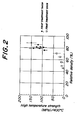
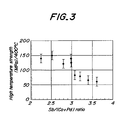
- a tendency of the measured results of strengths at 400°C of the cobalt ⁇ antimony sintered body having various bulk densities of the Examples and the Comparative Examples of depending on the relative density of the sintered body is shown in the attached Fig. 2. Also, a tendency of the measured results of strengths at 400°C of the cobalt antimony sintered bodies prepared by the Examples of depending on the amount of Sb in the sintered bodies is shown in the attached Fig. 3. As clearly seen from the results shown in Fig. 3, the strengths of the samples having relative densities of around 75 % are noticeably improved as compared with those of the samples having relative densities of around 70 %. Also, as clearly seen from the results shown in Fig. 3, the samples having chemical compositions of Sb/(Co+Pd) > 3 have extremely inferior relative strengths at 400°C as compared with the samples having the chemical compositions within the range of the present invention.
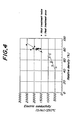
- the sample having a chemical composition ratio x of around 2.65 has extremely inferior thermoelectric properties as compared with the sample having a chemical composition ratio x of around 2.75 which is substantially the same order with those of the sample of the Comparative Example having a relative density of less than 70 % and a chemical composition ratio x of around 2.98.
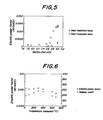
- the thermoelectric properties of the samples of the Examples containing a Sb amount satisfying a chemical composition ratio x of 2.9 are not deteriorated but maintained high at high temperatures of not less than 600°C.
- thermoelectric material for high temperature use which consists of a major component CoSb 3 and highly chemically stable subsidiary components of CoSb and CoSb 2 solely as the components other than the major component CoSb 3 and which has a high strength, superior thermoelectric properties and a sufficient heat resistant property at high temperatures with a scarce decrease of the characteristic properties at high temperatures.
- thermoelectric material consisting of a major component CoSb 3 and highly chemically stable subsidiary components of CoSb and CoSb 2 solely as the subsidiary components other than the major component CoSb 3 and having superior thermoelectric properties can be obtained by using a general sintering method. Therefore, an industrially useful method of economically and efficiently producing a thermoelectric material for high temperature use can be provided.
- thermoelectric material can be provided with a much decreased production time.
- thermoelectric material of this type has the crystal structure of the cubic crystal system CoSb as the fundamental structure, so that respective material containing p-type or n-type impurities has a same crystal structure.
- thermoelectric material having a superior heat resistant property and shaping property can be provided which is much economical and chemically stable in a wide temperature range of from room temperature to 600°C or more with a scarce decrease of the thermal property, and a method for producing the same can be realized.
- the thermoelectric material of the present invention is constituted mainly by cobalt antimony compounds and has a chemical composition ratio x of 2.7 ⁇ x ⁇ 3, so that it has high thermoelectric properties as compared with the heretofore known FeSi 2 and the like silicide compounds. Meanwhile, it enables a possibility that it can be a thermoelectric material having a higher use temperature range than PbFe, so that it realizes the provision of a thermoelectric material for high temperature use having a sufficient heat resistant property and chemical stability for high temperature use and superior thermoelectric properties with a scarce decrease of the characteristic properties.
- the present invention can provide an industrially useful, economical and efficient method of producing a thermoelectric material, particularly a dense sintered body having high thermoelectric properties at high temperatures of exceeding 600°C, while using a general sintering method.
Landscapes
- Chemical & Material Sciences (AREA)
- Engineering & Computer Science (AREA)
- Materials Engineering (AREA)
- Mechanical Engineering (AREA)
- Metallurgy (AREA)
- Organic Chemistry (AREA)
- Inorganic Chemistry (AREA)
- Powder Metallurgy (AREA)
- Compositions Of Oxide Ceramics (AREA)
Applications Claiming Priority (2)
| Application Number | Priority Date | Filing Date | Title |
|---|---|---|---|
| JP06264096A JP3541549B2 (ja) | 1996-03-19 | 1996-03-19 | 高温用熱電材料およびその製造方法 |
| JP62640/96 | 1996-03-19 |
Publications (2)
| Publication Number | Publication Date |
|---|---|
| EP0797260A2 true EP0797260A2 (de) | 1997-09-24 |
| EP0797260A3 EP0797260A3 (de) | 1998-06-24 |
Family
ID=13206141
Family Applications (1)
| Application Number | Title | Priority Date | Filing Date |
|---|---|---|---|
| EP97301868A Withdrawn EP0797260A3 (de) | 1996-03-19 | 1997-03-19 | Thermoelektrisches Material höher Temperatur und Herstellungsverfahren desselben |
Country Status (3)
| Country | Link |
|---|---|
| US (1) | US5912429A (de) |
| EP (1) | EP0797260A3 (de) |
| JP (1) | JP3541549B2 (de) |
Cited By (3)
| Publication number | Priority date | Publication date | Assignee | Title |
|---|---|---|---|---|
| EP0948061A3 (de) * | 1998-03-16 | 1999-12-29 | Ngk Insulators, Ltd. | Thermoelektrische Umwandlungssubstanz vom p-Typ und Herstellungsverfahren dafür |
| FR2781605A1 (fr) * | 1998-07-24 | 2000-01-28 | Aerospatiale | Convertisseur thermoelectrique a effet peltier, procede de fabrication de ce convertisseur, et application a un thermostat apte a effectuer des trempes calibrees de fluides critiques, notamment en microgravite |
| CN102650005A (zh) * | 2011-02-28 | 2012-08-29 | 燕山大学 | 高性能致密化填充方钴矿热电材料的高压合成制备方法 |
Families Citing this family (5)
| Publication number | Priority date | Publication date | Assignee | Title |
|---|---|---|---|---|
| JP3459328B2 (ja) * | 1996-07-26 | 2003-10-20 | 日本政策投資銀行 | 熱電半導体およびその製造方法 |
| US6700053B2 (en) * | 2000-07-03 | 2004-03-02 | Komatsu Ltd. | Thermoelectric module |
| US8309839B2 (en) * | 2004-04-30 | 2012-11-13 | GM Global Technology Operations LLC | Method of improving thermoelectric figure of merit of high efficiency thermoelectric materials |
| CN100386458C (zh) * | 2004-06-29 | 2008-05-07 | 武汉理工大学 | 纳米晶热电半导体材料的非晶晶化制备方法 |
| CN117756531B (zh) * | 2023-12-29 | 2025-09-23 | 桂林理工大学 | 一种同成份异结构热电复合材料的制备方法 |
Family Cites Families (3)
| Publication number | Priority date | Publication date | Assignee | Title |
|---|---|---|---|---|
| US3840652A (en) * | 1965-02-27 | 1974-10-08 | Philips Corp | Method of removing foreign phases from the crystals of a compound |
| US3454370A (en) * | 1966-05-26 | 1969-07-08 | American Cyanamid Co | Novel ternary semiconducting materials |
| US5610366A (en) * | 1993-08-03 | 1997-03-11 | California Institute Of Technology | High performance thermoelectric materials and methods of preparation |
-
1996
- 1996-03-19 JP JP06264096A patent/JP3541549B2/ja not_active Expired - Fee Related
-
1997
- 1997-03-19 US US08/820,025 patent/US5912429A/en not_active Expired - Lifetime
- 1997-03-19 EP EP97301868A patent/EP0797260A3/de not_active Withdrawn
Cited By (5)
| Publication number | Priority date | Publication date | Assignee | Title |
|---|---|---|---|---|
| EP0948061A3 (de) * | 1998-03-16 | 1999-12-29 | Ngk Insulators, Ltd. | Thermoelektrische Umwandlungssubstanz vom p-Typ und Herstellungsverfahren dafür |
| US6235981B1 (en) | 1998-03-16 | 2001-05-22 | Ngk Insulators, Ltd. | P-type thermoelectric converting substance and method of manufacturing the same |
| FR2781605A1 (fr) * | 1998-07-24 | 2000-01-28 | Aerospatiale | Convertisseur thermoelectrique a effet peltier, procede de fabrication de ce convertisseur, et application a un thermostat apte a effectuer des trempes calibrees de fluides critiques, notamment en microgravite |
| CN102650005A (zh) * | 2011-02-28 | 2012-08-29 | 燕山大学 | 高性能致密化填充方钴矿热电材料的高压合成制备方法 |
| CN102650005B (zh) * | 2011-02-28 | 2015-11-25 | 燕山大学 | 高性能致密化填充方钴矿热电材料的高压合成制备方法 |
Also Published As
| Publication number | Publication date |
|---|---|
| JP3541549B2 (ja) | 2004-07-14 |
| EP0797260A3 (de) | 1998-06-24 |
| US5912429A (en) | 1999-06-15 |
| JPH09260728A (ja) | 1997-10-03 |
Similar Documents
| Publication | Publication Date | Title |
|---|---|---|
| EP0874406A2 (de) | Ein, auf Co-Sb beruhendes, thermoelektrisches Material und Herstellungsverfahren dafür | |
| US5318743A (en) | Processes for producing a thermoelectric material and a thermoelectric element | |
| KR102165812B1 (ko) | 파마티나이트계 열전재료의 제조방법 | |
| JPH08111546A (ja) | 熱電材料及び熱電変換素子 | |
| KR20060125789A (ko) | 고성능 열전 물질 인듐-코발트-안티몬의 제조 방법 | |
| US20060016470A1 (en) | Filled skutterudites for advanced thermoelectric applications | |
| EP0797259B1 (de) | Ein thermoelektrisches Umwandlungsmaterial und ein Herstellungsverfahren desselben | |
| JP2000252526A (ja) | スカッテルダイト系熱電材料及び熱電カップル並びにその製造方法 | |
| EP0797260A2 (de) | Thermoelektrisches Material höher Temperatur und Herstellungsverfahren desselben | |
| JP3458587B2 (ja) | 熱電変換材料及びその製法 | |
| KR102399079B1 (ko) | 반-호이슬러계 열전 재료, 이의 제조 방법 및 이를 포함하는 열전 소자 | |
| Pi et al. | Thermal Stability, Mechanical Properties and Thermoelectric Performance of Cu11TrSb4S13 (Tr= Mn, Fe, Co, Ni, Cu, and Zn) Pi, Lee, and Kim | |
| US6403875B1 (en) | Process for producing thermoelectric material | |
| US20230116962A1 (en) | Thermoelectric conversion material, thermoelectric conversion element, thermoelectric conversion module, method of power generation, and method of heat transfer | |
| KR102121434B1 (ko) | 칼코겐 화합물, 이의 제조 방법, 및 이를 포함하는 열전소자 | |
| EP3575452B1 (de) | Chalkogenverbindung, verfahren zur herstellung davon und diese verbindung enthaltendes thermoelektrisches element | |
| JPH06144825A (ja) | 熱発電素子の製造方法 | |
| KR101469759B1 (ko) | 이터븀이 충진된 철-안티몬계 열전재료의 제조방법 | |
| JPH08186294A (ja) | 熱電材料 | |
| US3285018A (en) | Two-phase thermoelectric body comprising a silicon-carbon matrix | |
| EP3686156B1 (de) | Chalkogenverbindung, verfahren zu ihrer herstellung und diese enthaltendes thermoelement | |
| JPH10102160A (ja) | 三アンチモン化コバルト系複合材料の製造方法 | |
| WO2018135286A1 (ja) | p型熱電変換材料、熱電変換モジュール及びp型熱電変換材料の製造方法 | |
| EP0115950A2 (de) | Pulverkomprimierte n-Typ thermoelektrische Stoffe und Verfahren zum Herstellen derselben | |
| JP2003243733A (ja) | p型熱電変換材料の製造方法 |
Legal Events
| Date | Code | Title | Description |
|---|---|---|---|
| PUAI | Public reference made under article 153(3) epc to a published international application that has entered the european phase |
Free format text: ORIGINAL CODE: 0009012 |
|
| AK | Designated contracting states |
Kind code of ref document: A2 Designated state(s): DE FR GB |
|
| PUAL | Search report despatched |
Free format text: ORIGINAL CODE: 0009013 |
|
| AK | Designated contracting states |
Kind code of ref document: A3 Designated state(s): DE FR GB |
|
| 17P | Request for examination filed |
Effective date: 19981013 |
|
| 17Q | First examination report despatched |
Effective date: 20010517 |
|
| GRAH | Despatch of communication of intention to grant a patent |
Free format text: ORIGINAL CODE: EPIDOS IGRA |
|
| STAA | Information on the status of an ep patent application or granted ep patent |
Free format text: STATUS: THE APPLICATION IS DEEMED TO BE WITHDRAWN |
|
| 18D | Application deemed to be withdrawn |
Effective date: 20030531 |