EP0797823B1 - Automatisches system und verfahren zur leitweglenkung für anfrufe - Google Patents
Automatisches system und verfahren zur leitweglenkung für anfrufe Download PDFInfo
- Publication number
- EP0797823B1 EP0797823B1 EP96931575A EP96931575A EP0797823B1 EP 0797823 B1 EP0797823 B1 EP 0797823B1 EP 96931575 A EP96931575 A EP 96931575A EP 96931575 A EP96931575 A EP 96931575A EP 0797823 B1 EP0797823 B1 EP 0797823B1
- Authority
- EP
- European Patent Office
- Prior art keywords
- task
- automated
- objectives
- meaningful phrases
- meaningful
- Prior art date
- Legal status (The legal status is an assumption and is not a legal conclusion. Google has not performed a legal analysis and makes no representation as to the accuracy of the status listed.)
- Expired - Lifetime
Links
Images

Classifications
-
- G—PHYSICS
- G06—COMPUTING OR CALCULATING; COUNTING
- G06Q—INFORMATION AND COMMUNICATION TECHNOLOGY [ICT] SPECIALLY ADAPTED FOR ADMINISTRATIVE, COMMERCIAL, FINANCIAL, MANAGERIAL OR SUPERVISORY PURPOSES; SYSTEMS OR METHODS SPECIALLY ADAPTED FOR ADMINISTRATIVE, COMMERCIAL, FINANCIAL, MANAGERIAL OR SUPERVISORY PURPOSES, NOT OTHERWISE PROVIDED FOR
- G06Q30/00—Commerce
- G06Q30/06—Buying, selling or leasing transactions
-
- G—PHYSICS
- G06—COMPUTING OR CALCULATING; COUNTING
- G06F—ELECTRIC DIGITAL DATA PROCESSING
- G06F40/00—Handling natural language data
- G06F40/20—Natural language analysis
- G06F40/205—Parsing
- G06F40/216—Parsing using statistical methods
-
- G—PHYSICS
- G06—COMPUTING OR CALCULATING; COUNTING
- G06F—ELECTRIC DIGITAL DATA PROCESSING
- G06F40/00—Handling natural language data
- G06F40/20—Natural language analysis
- G06F40/279—Recognition of textual entities
-
- G—PHYSICS
- G06—COMPUTING OR CALCULATING; COUNTING
- G06F—ELECTRIC DIGITAL DATA PROCESSING
- G06F40/00—Handling natural language data
- G06F40/20—Natural language analysis
- G06F40/279—Recognition of textual entities
- G06F40/289—Phrasal analysis, e.g. finite state techniques or chunking
-
- G—PHYSICS
- G10—MUSICAL INSTRUMENTS; ACOUSTICS
- G10L—SPEECH ANALYSIS TECHNIQUES OR SPEECH SYNTHESIS; SPEECH RECOGNITION; SPEECH OR VOICE PROCESSING TECHNIQUES; SPEECH OR AUDIO CODING OR DECODING
- G10L15/00—Speech recognition
- G10L15/08—Speech classification or search
- G10L15/18—Speech classification or search using natural language modelling
- G10L15/1822—Parsing for meaning understanding
Definitions
- This invention relates to speech processing, and more particularly to a system and method for automated call routing related to the performance of one or more desired tasks.
- a menu may be presented to the calling party in the form, "please say 'collect', 'calling card', 'third number' or 'operator'"
- multi-tiered menus While such routing systems work reasonably well in cases where the number of routing choices is small, if the number of selections exceeds about 4 or 5, multi-tiered menus generally become necessary. Such multi-tiered menus are very unpopular with callers - from the perspective of a typical caller, the time and effort required to navigate through several menu layers to reach a desired objective can seem interminable. Equally important, from the perspective of both the caller and the recipient, the percentage of successful routings though such a multi-tiered menu structure can be quite low, in some cases, less than 40 percent. Stated differently, in such circumstances, more than 60 percent of the calls accessing such a multi-tiered menu structure might be either terminated without the caller having reached the desired objective or else defaulted to an operator (or other manned default station).
- An automated task classification system and method, and an automated call routing system as claimed in claims 1-45 which operates on a call-routing objective of a calling party expressed in natural speech of the calling party.
- the system incorporates a speech recognition function, as to which a calling party's natural-speech call routing objective provides an input, and which is trained to recognize a plurality of meaningful phrases, each such phrase being related to a specific call routing objective.
- an interpretation function Upon recognition of one or more of such meaningful phrases in a calling party's input speech, an interpretation function then acts on such calling party's routing objective request, depending upon a confidence function incorporated into the interpretation function, to either implement the calling party's requested routing objective or to enter into a dialog with the calling party to obtain additional information from which a sufficient confidence level can be attained to implement that routing objective.
- the meaningful phrases are determined by a grammatical inference algorithm which operates on a predetermined corpus of speech utterances, each such utterance being associated with a specific call routing objective, and wherein each utterance is marked with its associated call routing objective.
- Each meaningful phrase developed by the grammatical inference algorithm can be characterized as having both a Mutual Information value and a Salience value (relative to an associated routing objective) above a predetermined threshold.
- FIG. 1 provides illustrative examples of false and missed detection by a classifier for an automated call routing system based on use of "meaningful phrases”.
- FIG. 2 provides illustrative examples of correct detection by a classifier for an automated call routing system based on use of "meaningful phrases”.
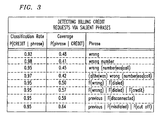
- FIG. 3 depicts an illustrative example of the advantage provided by the "meaningful phrase” classification parameter of the system of the invention.
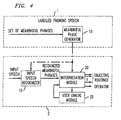
- FIG. 4 presents in block diagram form the structure of the system of the invention
- FIG. 5 depicts the methodology of the invention in flow chart form.
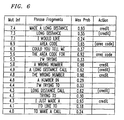
- FIG. 6 provides illustrative examples of "meaningful phrases" determined according to the invention.
- an algorithm may be seen as a self-contained sequence of steps leading to a desired result. These steps generally involve manipulations of physical quantities. Usually, though not necessarily, these quantities take the form of electrical or magnetic signals capable of being stored, transferred, combined, compared and otherwise manipulated. For convenience of reference, as well as to comport with common usage, these signals will be described from time to time in terms of bits, values, elements, symbols, characters, terms, numbers, or the like. However, it should be emphasized that these and similar terms are to be associated with the appropriate physical quantities - such'terms being merely convenient labels applied to those quantities.
- the present invention relates to methods for operating a computer in processing electrical or other (e.g., mechanical, chemical) physical signals to generate other desired physical signals.
- processors For clarity of explanation, the illustrative embodiment of the present invention is presented as comprising individual functional blocks (including functional blocks labeled as "processors"). The functions these blocks represent may be provided through the use of either shared or dedicated hardware, including, but not limited to, hardware capable of executing software. For example the functions of processors presented in Figure 4 may be provided by a single shared processor. (Use of the term "processor” should not be construed to refer exclusively to hardware capable of executing software.)
- Illustrative embodiments may comprise microprocessor and/or digital signal processor (DSP) hardware, such as the AT&T DSP16 or DSP32C, read-only memory (ROM) for storing software performing the operations discussed below, and random access memory (RAM) for storing results.
- DSP digital signal processor
- ROM read-only memory
- RAM random access memory
- VLSI Very large scale integration
- a fundamental objective of the invention is a call routing service that shifts the burden of understanding a specialized vocabulary from the calling party to the call recipient.
- the invention is represented as a call routing system having the following characteristics:
- a user In traditional telephone switching systems, a user is often required to know separate numbers and/or dialing patterns to access different services provided by a telephone carrier, as well as possibly having to navigate a menu-driven system which then routes the user to the desired objective.
- the user In the system and method of the invention the user is able to access a central number and the user's objective will be implemented by the telephone carrier on the basis of its content.
- a database of a large number of utterances each of which is related to one of a predetermined set of routing objectives.
- This database forms an input to a classification parameter algorithm.
- utterances will be extracted from actual user responses to a prompt of "How may I help you?" (or similar words to the same effect).
- Each utterance is then transcribed and labeled with one of the predetermined set of routing objectives.
- Illustrative utterances from the database utilized by the inventors are as follows:
- a salience principle as related to the system of the invention has been defined in another article co-authored by one of the inventors [Gorin, A.L., Levinson, S.E. and Sankar, A. "An Experiment in Spoken Language Acquisition," IEEE Trans. on Speech and Audio, Vol. 2, No. 1, Part II, pp. 224-240 (Jan. 1994)] [hereafter Gorin 94 ].
- the salience of a word is defined as the information content of that word for the task under consideration. It can be interpreted as a measure of how meaningful that word is for the task.
- Salience can be distinguished from and compared to the traditional Shannon information content, which measures the uncertainty that a word will occur. As is known, such traditional information content can be estimated from examples of the language, while an estimation of salience requires both language and its extra-linguistic associations.
- the baseline approach of Gorin 95 uses as a classification parameter words from test speech utterances which have a salient association with particular objective routings.
- a significant point of departure for methodology of the invention from that baseline approach resides in the use of meaningful phrases as the classification parameter, a clear improvement over that baseline approach.
- Figure 1 provides several illustrative examples of False Detections and Missed Detections from the database of speech utterances used by the inventors. While the basis for error in each of these examples is believed to be largely self-explanatory, the error in the first example in each set will be briefly described.
- the meaningful phrase is I_NEED_CREDIT_EOS, and thus this phrase would have been classified as a request for credit.
- the caller actually wanted to be transferred to another carrier (the carrier receiving this request being AT&T).
- Figure 3 provides an illustrative example of this advantage. That figure shows the Classification Rate and the Coverage for an exemplary routing objective, Billing Credit, as the phrase used for the classification parameter grows in length and/or complexity.
- the Classification Rate is defined as the probability of the routing objective (CREDIT) having been requested, given the occurrence of the selected phrase in the input speech (i.e., P(CREDIT _phrase).
- the Coverage term is defined as the probability of the selected phrase appearing in the input speech, given that the designated routing objective (CREDIT) has been requested.
- parenthesis surrounding a series of terms separated by " _" indicate one of those terms appearing in the indicated position with other terms in that row.
- the second area of improvement relates to the speech recognition function which operates on the caller's input speech.
- the larger the fragment of speech presented to such a speech recognizer the higher the probability of a correct recognition of that speech fragment.
- a speech recognizer programmed to spot one of a set of salient words can be expected to fail in its task significantly more often than such a device programmed to spot meaningful phrases, comprising two or more words.
- Figure 4 shows in block diagram form the essential structure of the invention.
- That structure comprises two related subsystems: Meaningful phrase generation subsystem 1 and Input speech classification subsystem 2.
- Meaningful phrase generation subsystem 1 operates on a database of a large number of utterances each of which is related to one of a predetermined set of routing objectives, where each such utterance is labeled with its associated routing objective.
- the operation of this subsystem is essentially carried out by Meaningful phrase processor 10 which produces as an output a set of meaningful phrases having a probabalistic relationship with one or more of the set of predetermined routing objectives with which the input speech utterances are associated.
- Meaningful phrase processor 10 is generally determined in accordance with a grammatical inference algorithm, described below.
- Operation of Input speech classification subsystem 2 begins with the inputting of a caller's routing objective request, in the caller's natural speech, to Input Speech Recognizer 15 .
- That Input Speech Recognizer may be of any known design and performs the function of detecting, or spotting, the existence of one or more meaningful phrases in the input speech.
- the meaningful phrases developed by Meaningful phrase generation subsystem 1 are provided as an input to Speech Recognizer 15 .
- Speech Recognizer 15 which will comprise the recognized meaningful phrase(s) appearing in the caller's routing objective request, is provided to Interpretation Module 20 .
- That Interpretation Module applies a confidence function, based on the probabalistic relation between the recognized meaningful phrase(s) and selected routing objectives, and makes a decision either to implement the chosen routing objective (in the case of high confidence) with an announcement to the caller that such an objective is being implemented, or to seek additional information and/or confirmation from the caller via User Dialog Module 25, in the case of lower confidence levels.
- the Interpretation Module again applies the confidence function to determine if a decision to implement a particular routing objective is appropriate. This feedback process continues until either a decision can be made to implement a particular routing objective or a determination is made that no such decision is likely, in which case the caller is defaulted to an operator position.
- Meaningful phrase generation subsystem 1 uses Input Speech Recognizer 15 , to define the phrases which the Recognizer is programmed to spot, and by Interpretation Module 20, both to define the routing objectives related to meaningful phrases input from Speech Recognizer 15 and to establish the level of confidence for a relation of such input meaningful phrase(s) to a particular routing objective.
- step 130 those salience values are compared with a predetermined salience threshold and those n-grams having a salience value below the threshold are discarded. n-grams passing the salience threshold test are stored at step 135 as the set of meaningful phrases.
- step 205 a caller accessing the router is provided a greeting similar to "How may I help you?"
- the caller's response to that greeting is obtained at step 210 and that response is examined for the presence of one or more meaningful phrases.
- the set of meaningful phrases will have been provided as an input to step 215 as well as step 220.
- step 220 an attempt is made to classify the caller's objective based on meaningful phrase(s) found in the caller's input speech.
- a confidence factor is invoked at step 225, and a decision is made as to whether a sufficient confidence level exist to implement the classified objective. If yes, the objective is implemented, at step 245 .
- a dialog with the user is carried out at step 230 .
- Such dialog will typically begin with a query to the user of the form "You want ... ?" If the user responds in the negative to such a query, at step 235 , the process returns to step 210 with a restatement by the user of its request.
- a "yes" or silence response from the user moves the process along to step 240 , where consideration is given to whether other information is needed to carry out the objective which was not in the input speech - e.g., the number to be credited in the case of a credit request. Where additional information is needed, the process returns to step 230 for additional dialog with the user. If no additional information is required, the objective is implemented at step 245 .
- the determination of the meaningful phrases used by the invention is founded in the concept of combining a measure of commonality of words and/or structure within the language -- i.e., how often groupings of things co-occur -- with a measure of significance to a defined task for such a grouping.
- that commonality measure within the language is manifested as the mutual information in n-grams derived from a database of training speech utterances and the measure of usefulness to a task is manifested as a salience measure.
- Other manifestations of these general concepts will be apparent to those skilled in the art.
- MI mutual information
- the meaningful phrase determination is implemented in a Grammatical Inference ("GI") algorithm. That GI algorithm searches the set of phrases which occur in the training database using as a selection criteria both the mutual information (within the language) of a phrase and a measure of the salience of the phrase for a task under consideration. In its general form the GI algorithm carries out the following steps.
- GI Grammatical Inference
- FIG. 6 An exemplary output of this algorithm is shown in Figure 6.
- the exemplary meaningful phrases are shown along with the MI value, the salience value, and the Action to which the meaningful phrase is directed at the probability value shown.
- the Max Probability (sometimes designated P max is used as a proxy for the salience value. That Max Probability is defined as the maximum of the distribution of probabilities of each action, given the phrase under consideration, which probabilities are determined by a sub-step of the GI algorithm.
- Session One the system immediately understands the input, based on learned associations between the content of the sentence and the selected routing objective of third-number billing. Hello, how may I help you? "I want to charge this call to my home phone. " You want to bill this call to a third-party. Please enter the billing number: As can be seen, the absence of a response from the caller during the pause between the second and third inquiries from the system was interpreted as assent to the second inquiry.
- Session Two the system encounters an ambiguous input, which is resolved via dialog. Note the hesitant response, based on the system's confidence model. Observe also that the second input involves both negative reinforcement ( no ) and additional clarifying information. Hello, how may I help you? "Can I charge this call please?" Do you want to bill this call to a third-party? "No, I want to put this on my Universal card. " You want to bill this call to a credit card. Please enter the card number:
- a novel automated call routing system which carries out the function of searching for a classification parameter in natural speech, that classification parameter being manifested as a set of meaningful phrases, which are themselves defined in terms of mutual information and a salience factor. Then, depending on whether one or more particular meaningful phrases are found in the input speech, a decision rule is applied to classify the appropriate routing objective.
- An important advantage of the system and method of the invention is that the vocabulary and grammar for the system are unconstrained, being acquired by the system during the course of performing its task. By contrast, in prior art systems, the salient vocabulary words and their meanings are explicitly provided to the system.
- the system and method of the invention brings an automated training procedure to the language recognition function - automated procedures for determining meaningful phrases in test speech utterances marked with associated objective routings - and then finds such meaningful phrases in caller input speech (possibly including confidence enhancing dialog with the caller) and implements the caller-requested objective routing.
Landscapes
- Engineering & Computer Science (AREA)
- Theoretical Computer Science (AREA)
- Physics & Mathematics (AREA)
- Health & Medical Sciences (AREA)
- Artificial Intelligence (AREA)
- Audiology, Speech & Language Pathology (AREA)
- Computational Linguistics (AREA)
- General Physics & Mathematics (AREA)
- Business, Economics & Management (AREA)
- General Health & Medical Sciences (AREA)
- General Engineering & Computer Science (AREA)
- Accounting & Taxation (AREA)
- Finance (AREA)
- Probability & Statistics with Applications (AREA)
- Development Economics (AREA)
- Economics (AREA)
- Marketing (AREA)
- Strategic Management (AREA)
- General Business, Economics & Management (AREA)
- Human Computer Interaction (AREA)
- Acoustics & Sound (AREA)
- Multimedia (AREA)
- Telephonic Communication Services (AREA)
- Machine Translation (AREA)
Claims (45)
- Automatisiertes Task-Klassifizierungssystem, welches ein Task-Ziel eines Anwenders abarbeitet, wobei das Task-Ziel in Form einer natürlichen Sprache des Anwenders ausgedrückt wird, mit:einem Generator (10) für bedeutsame Phrasen, der eine Vielzahl von bedeutungsvollen Phrasen aus einem Satz von Sprachäußerungen bestimmt, wobei jede der bedeutungsvollen Phrasen basierend auf einem Task-Ziel eines vorbestimmten Satzes von Task-Zielen ausgewählt wird;einer Eingabeerkennungseinrichtung (15) zum Erkennen von wenigstens einer der bedeutungsvollen Phrasen in der eingegebenen Sprache des Anwenders, wobei die Eingabeerkennungseinrichtung als Eingangsgröße die bedeutungsvollen Phrasen empfängt, die durch den Generator für die bedeutungsvollen Phrasen bestimmt werden; undeiner Interpretationseinrichtung (20), die auf eine Eingabe der erkannten bedeutungsvollen Phrasen anspricht, um eine Klassifizierungsentscheidung basierend auf den bedeutungsvollen Phrasen in Verbindung mit einem Task-Ziel des Satzes der vorbestimmten Task-Ziele zu treffen.
- Automatisiertes Task-Klassifizierungssystem nach Anspruch 1, bei dem die Interpretationseinrichtung femer eine Dialogeinrichtung enthält, um das System dazu zu befähigen, eine Rückkopplungsantwort von einem Anwender zu erhalten.
- Automatisiertes Task-Klassifizierungssystem nach Anspruch 2, bei dem die Rückkopplungsantwort zusätzlich Informationen in bezug auf die anfängliche eingegebene Sprache des Anwenders enthält.
- Automatisiertes Task-Klassifizierungssystem nach Anspruch 2, bei dem die Rückkopplungsantwort eine Bestätigung in bezug auf wenigstens eines des Satzes der Task-Ziele enthält, welches bei der Klassifizierungsentscheidung bestimmt wurde.
- Automatisiertes Task-Klassifizierungssystem nach Anspruch 1, bei dem eine Beziehung zwischen den bestimmten bedeutungsvollen Phrasen und dem vorbestimmten Satz der Task-Ziele ein Maß hinsichtlich der Nützlichkeit von einer der bedeutungsvollen Phrasen in bezug auf ein spezifiziertes Ziel der vorbestimmten Task-Ziele enthält.
- Automatisiertes Task-Klassifizierungssystem nach Anspruch 5, bei dem das Nützlichkeitsmaß als ein Ausgeprägtheitsmaß manifestiert ist.
- Automatisiertes Task-Klassifizierungssystem nach Anspruch 6, bei dem das Ausgeprägtheitsmaß durch eine bedingte Wahrscheinlichkeit wiedergegeben wird, daß dieses Task-Ziel angefragt wurde, und zwar unter der Voraussetzung, daß die genannten bedeutungsvollen Phrasen in der eingegebenen Sprache erscheinen, wobei die bedingte Wahrscheinlichkeit einen höchsten Wert in einer Verteilung der bedingten Wahrscheinlichkeiten über dem Satz der vorbestimmten Task-Ziele hat.
- Automatisiertes Task-Klassifizierungssystem nach Anspruch 6, bei dem jede der Vielzahl der bedeutungsvollen Phrasen, die durch die Bestimmungseinrichtung bestimmt werden, ein Ausgeprägtheitsmaß besitzt, welches einen vorbestimmten Schwellenwert überschreitet.
- Automatisiertes Task-Klassifizierungssystem nach Anspruch 1, bei dem eine Beziehung zwischen den bestimmten bedeutungsvollen Phrasen und dem vorbestimmten Satz der Task-Ziele ein Maß für die Allgemeinheit innerhalb einer Sprache der bedeutungsvollen Phrasen enthält.
- Automatisiertes Task-Klassifizierungssystem nach Anspruch 9, bei dem das Allgemeinheitsmaß als ein wechselseitiges Informationsmaß (Informationsaustauschmaß) manifestiert ist.
- Automatisiertes Task-Klassifizierungssystem nach Anspruch 10, bei dem jede der Vielzahl der bedeutungsvollen Phrasen, die durch die Bestimmungseinrichtung bestimmt wurde, ein wechselseitiges Informationsmaß aufweist, welches einen vorbestimmten Schwellenwert überschreitet.
- Automatisiertes Task-Klassifizierungssystem nach Anspruch 1, bei dem die Interpretationseinrichtung eine Vertrauensfunktion in bezug auf die Klassifizierungsentscheidung enthält.
- Automatisiertes Task-Klassifizierungssystem nach Anspruch 1, bei dem die eingegebene Sprache des Anwenders eine Anfrage darstellt, und zwar nach einem spezifizierten Ziel des Satzes der vorbestimmten Task-Ziele.
- Automatisiertes Task-Klassifizierungssystem nach Anspruch 1, bei dem die eingegebene Sprache auf eine Frage von dem System in einer Form: "Wie kann ich helfen?" anspricht.
- Automatisiertes Task-Klassifizierungssystem nach Anspruch 1, bei dem jede der Sprachäußerungen auf ein Task-Ziel des Satzes der vorbestimmten Task-Ziele gerichtet ist und bei dem jede Äußerung mit einem Task-Ziel beschriftet (labeled) ist, auf das sie gerichtet ist.
- Automatisiertes Rufleitsystem, welches ein Führungsziel einer rufenden Partei bearbeitet, wobei das Leitziel in Form einer natürlichen Sprache der rufenden Partei ausgedrückt wird, mit:einem Generator für eine bedeutungsvolle Phrase, die eine Vielzahl von bedeutungsvollen Phrasen aus einem Satz von Sprachäußerungen bestimmt, wobei jede der bedeutungsvollen Phrasen auf der Grundlage von einem Ziel eines vorbestimmten Satzes von Führungszielen ausgewählt wird;eine Eingabeerkennungseinrichtung zum Erkennen von wenigstens einer der bedeutungsvollen Phrasen in der eingegebenen Sprache der rufenden Partei, wobei die Eingabeerkennungseinrichtung als Eingabegröße die bedeutungsvollen Phrasen empfängt, die durch den Generator für die bedeutungsvollen Phrasen festgelegt wurden; undeiner Interpretationseinrichtung, die auf eine Eingabe der erkannten bedeutungsvollen Phrasen anspricht, um eine Klassifizierungsentscheidung basierend auf den bedeutungsvollen Phrasen hinsichtlich eines Führungszieles des Satzes der vorbestimmten Führungsziele zu treffen.
- Automatisiertes Rufleitsystem nach Anspruch 16, bei dem die Interpretationseinrichtung ferner eine Dialogeinrichtung enthält, um das System dazu zu befähigen, eine Rückkopplungsantwort von der rufenden Partei zu erhalten.
- Automatisiertes Rufleitsystem nach Anspruch 17, bei dem die Rückkopplungsantwort zusätzliche Informationen in bezug auf die anfängliche Spracheingabe der rufenden Partei enthält.
- Automatisiertes Rufleitsystem nach Anspruch 17, bei dem die Rückkopplungsantwort eine Bestätigung in bezug auf wenigstens eines des Satzes der Führungsziele, die bei der Klassifizierungsentscheidung bestimmt
- Automatisiertes Rufleitsystem nach Anspruch 16, bei dem eine Beziehung zwischen den vorbestimmten bedeutungsvollen Phrasen und dem vorbestimmten Satz der Leitziele ein Maß hinsichtlich der Nützlichkeit von einer der bedeutungsvollen Phrasen in bezug auf ein einzelnes spezifiziertes Führungsziel der vorbestimmten Führungsziele enthält.
- Automatisiertes Rufleitsystem nach Anspruch 20, bei dem das Nützlichkeitsmaß in Form eines Ausgeprägtheitsmaßes manifestiert ist.
- Automatisiertes Rufleitsystem nach Anspruch 21, bei dem das Ausgeprägtheitsmaß als bedingte Wahrscheinlichkeit des Führungs- oder Leitzieles wiedergegeben wird, welches angefragt wurde, und zwar unter der Voraussetzung des Erscheinens des Sprachfragments in der eingegebenen Sprache, wobei die bedingte Wahrscheinlichkeit einen höchsten Wert in einer Verteilung der bedingten Wahrscheinlichkeiten über dem Satz der vorbestimmten Führungs- oder Leitziele hat.
- Automatisiertes Rufleitsystem nach Anspruch 21, bei dem jede der Vielzahl der bedeutungsvollen Phrasen, die durch die Bestimmungseinrichtung bestimmt wurden, ein Ausgeprägtheitsmaß besitzt, welches einen vorbestimmten Schwellenwert überschreitet.
- Automatisiertes Rufleitsystem nach Anspruch 16, bei dem eine Beziehung zwischen den vorbestimmten bedeutungsvollen Phrasen und dem vorbestimmten Satz der Führungsziele ein Maß hinsichtlich der Allgemeinheit innerhalb einer Sprache der bedeutungsvollen Phrasen enthält.
- Automatisiertes Rufleitsystem nach Anspruch 24, bei dem das Allgemeinheitsmaß als ein wechselseitiges Informationsmaß manifestiert ist.
- Automatisiertes Rufleitsystem nach Anspruch 25, bei jede der Vielzahl der bedeutungsvollen Phrasen, die durch die Bestimmungseinrichtung bestimmt werden, ein wechselseitiges Informationsaustauschmaß aufweist, welches einen vorbestimmten Schwellenwert überschreitet.
- Automatisiertes Rufleitsystem nach Anspruch 16, bei dem die Interpretationseinrichtung eine Vertrauensfunktion in bezug auf die Klassifizierungsentscheidung enthält.
- Automatisiertes Rufleitsystem nach Anspruch 16, bei dem die eingegebene Sprache von dem Anwender eine Anfrage nach einem spezifizierten einen Ziel des Satzes der vorbestimmten Führungsziele wiedergibt.
- Automatisiertes Rufleitsystem nach Anspruch 16, bei dem die eingegebene Sprache auf eine Anfrage von dem System in der Form "Wie kann ich Ihnen helfen?" anspricht.
- Automatisiertes Rufleitsystem nach Anspruch 16, bei dem jede der Sprachäußerungen sich auf ein Führungsziel des Satzes der vorbestimmten Führungsziele richtet und jede Äußerung mit dem einen Führungsziel beschriftet oder versehen ist, auf die sie sich bezieht.
- Verfahren zur automatisierten Task-Klassifizierung, welches ein Task-Ziel eines Anwenders bearbeitet oder abarbeitet, wobei das Task-Ziel in natürlicher Sprache des Anwenders zum Ausdruck gebracht wird, mit den folgenden Schritten:Bestimmen einer Vielzahl von bedeutungsvollen Phrasen (100) aus einem Satz von Sprachäußerungen, wobei jede bedeutungsvolle Phrase basierend auf einem Task-Ziel eines vorbestimmten Satzes von Task-Zielen ausgewählt wird;die bestimmten bedeutungsvollen Phrasen (210) als Eingangsgrößen empfangen werden und wenigstens eine der bedeutungsvollen Phrasen in der eingegebenen Sprache des Anwenders (215) erkannt werden; undeine Klassifizierungsentscheidung (220) getroffen wird, und zwar im Ansprechen auf eine Eingabe der erkannten bedeutungsvollen Phrasen in bezug auf ein Task-Ziel des Satzes der vorbestimmten Task-Ziele.
- Automatisiertes Task-Klassifizierungsverfahren nach Anspruch 31, mit dem zusätzlichen Schritt gemäß einem Eintreten in einen Dialog mit dem Anwender, um eine Rückkopplungsantwort von dem Anwender zu erhalten.
- Automatisiertes Task-Klassifizierungsverfahren nach Anspruch 32, bei dem die Rückkopplungsantwort zusätzliche Informationen in bezug auf die anfängliche Spracheingabe des Anwenders enthält.
- Automatisiertes Task-Klassifizierungsverfahren nach Anspruch 32, bei dem die Rückkopplungsantwort eine Bestätigung in bezug auf wenigstens ein Ziel des Satzes der Task-Ziele enthält, die in der Klassifizierungsentscheidung bestimmt wurden.
- Automatisiertes Task-Klassifizierungsverfahren nach Anspruch 31, bei dem eine Beziehung zwischen den vorbestimmten bedeutungsvollen Phrasen und dem vorbestimmten Satz der Task-Ziele ein Maß für die Nützlichkeit von einer der bedeutungsvollen Phrasen in bezug auf eines der Task-Ziele der vorbestimmten Task-Ziele enthält.
- Automatisiertes Task-Klassifizierungsverfahren nach Anspruch 35, bei dem das Nützlichkeitsmaß als Ausgeprägtheitsmaß manifestiert wird.
- Automatisiertes Task-Klassifizierungsverfahren nach Anspruch 36, bei dem das Ausgeprägtheitsmaß als bedingte Wahrscheinlichkeit des Task-Ziels wiedergegeben wird, welches angefragt wurde, unter der Voraussetzung, daß die bedeutungsvolle Phrase in der eingegebenen Sprache erscheint, wobei die bedingte Wahrscheinlichkeit einen höchsten Wert innerhalb einer Verteilung von bedingten Wahrscheinlichkeiten über dem Satz der vorbestimmten Task-Ziele hat.
- Automatisiertes Task-Klassifizierungsverfahren nach Anspruch 36, bei dem jede der Vielzahl der bedeutungsvollen Phrasen, die durch den Bestimmungsschritt bestimmt wurde, ein Ausgeprägtheitsmaß aufweist, welches einen vorbestimmten Schwellenwert überschreitet.
- Automatisiertes Task-Klassifizierungsverfahren nach Anspruch 31, bei dem eine Beziehung zwischen den vorbestimmten bedeutungsvollen Phrasen und dem vorbestimmten Satz der Task-Ziele ein Maß hinsichtlich der Allgemeinheit innerhalb einer Sprache der bedeutungsvollen Phrasen enthält.
- Automatisiertes Task-Klassifizierungsverfahren nach Anspruch 39, bei dem das Maß hinsichtlich der Allgemeinheit in Form eines wechselseitigen Informationsaustauschmaßes manifestiert wird.
- Automatisiertes Task-Klassifizierungsverfahren nach Anspruch 40, bei dem jede der Vielzahl der bedeutungsvollen Phrasen, die bei dem Bestimmungsschritt bestimmt wurde, ein wechselseitiges Informationsaustauschmaß aufweist, welches einen vorbestimmten Schwellenwert überschreitet.
- Automatisiertes Task-Klassifizierungsverfahren nach Anspruch 31, bei dem der Schritt der Ausführung einer Klassifizierungsentscheidung eine Vertrauensfunktion enthält.
- Automatisiertes Task-Klassifizierungsverfahren nach Anspruch 31, bei dem die eingegebene Sprache von dem Anwender eine Anfrage nach einem spezifizierten Ziel des genannten Satzes der vorbestimmten Task-Ziele wiedergibt.
- Automatisiertes Task-Klassifizierungsverfahren nach Anspruch 31, bei dem die eingegebene Sprache auf eine Anfrage in der Form "Wie kann ich Ihnen helfen?" anspricht.
- Automatisiertes Task-Klassifizierungsverfahren nach Anspruch 31, bei dem jede der Sprachäußerungen sich auf ein Task-Ziel des Satzes der vorbestimmten Task-Ziele bezieht und bei dem jede Äußerung mit dem einen Task-Ziel beschriftet bzw. versehen ist, auf welches diese gerichtet ist.
Applications Claiming Priority (3)
| Application Number | Priority Date | Filing Date | Title |
|---|---|---|---|
| US528578 | 1995-09-15 | ||
| US08/528,578 US5675707A (en) | 1995-09-15 | 1995-09-15 | Automated call router system and method |
| PCT/US1996/014743 WO1997010589A1 (en) | 1995-09-15 | 1996-09-12 | Automated call router system and method |
Publications (3)
| Publication Number | Publication Date |
|---|---|
| EP0797823A1 EP0797823A1 (de) | 1997-10-01 |
| EP0797823A4 EP0797823A4 (de) | 1999-08-18 |
| EP0797823B1 true EP0797823B1 (de) | 2002-07-17 |
Family
ID=24106270
Family Applications (1)
| Application Number | Title | Priority Date | Filing Date |
|---|---|---|---|
| EP96931575A Expired - Lifetime EP0797823B1 (de) | 1995-09-15 | 1996-09-12 | Automatisches system und verfahren zur leitweglenkung für anfrufe |
Country Status (6)
| Country | Link |
|---|---|
| US (1) | US5675707A (de) |
| EP (1) | EP0797823B1 (de) |
| CA (1) | CA2204868C (de) |
| DE (1) | DE69622371T2 (de) |
| ES (1) | ES2179210T3 (de) |
| WO (1) | WO1997010589A1 (de) |
Families Citing this family (97)
| Publication number | Priority date | Publication date | Assignee | Title |
|---|---|---|---|---|
| US7590224B1 (en) * | 1995-09-15 | 2009-09-15 | At&T Intellectual Property, Ii, L.P. | Automated task classification system |
| US6173261B1 (en) | 1998-09-30 | 2001-01-09 | At&T Corp | Grammar fragment acquisition using syntactic and semantic clustering |
| US6192110B1 (en) * | 1995-09-15 | 2001-02-20 | At&T Corp. | Method and apparatus for generating sematically consistent inputs to a dialog manager |
| US5905773A (en) * | 1996-03-28 | 1999-05-18 | Northern Telecom Limited | Apparatus and method for reducing speech recognition vocabulary perplexity and dynamically selecting acoustic models |
| DE19708184A1 (de) * | 1997-02-28 | 1998-09-03 | Philips Patentverwaltung | Verfahren zur Spracherkennung mit Sprachmodellanpassung |
| US5860063A (en) * | 1997-07-11 | 1999-01-12 | At&T Corp | Automated meaningful phrase clustering |
| US5995926A (en) * | 1997-07-21 | 1999-11-30 | Lucent Technologies Inc. | Technique for effectively recognizing sequence of digits in voice dialing |
| US6094635A (en) * | 1997-09-17 | 2000-07-25 | Unisys Corporation | System and method for speech enabled application |
| US6044337A (en) * | 1997-10-29 | 2000-03-28 | At&T Corp | Selection of superwords based on criteria relevant to both speech recognition and understanding |
| US6021384A (en) * | 1997-10-29 | 2000-02-01 | At&T Corp. | Automatic generation of superwords |
| US6233316B1 (en) | 1998-01-27 | 2001-05-15 | Dsc Telecom, L.P. | Voice enhanced phone card |
| US6405159B2 (en) | 1998-06-03 | 2002-06-11 | Sbc Technology Resources, Inc. | Method for categorizing, describing and modeling types of system users |
| US6292778B1 (en) | 1998-10-30 | 2001-09-18 | Lucent Technologies Inc. | Task-independent utterance verification with subword-based minimum verification error training |
| US6246986B1 (en) * | 1998-12-31 | 2001-06-12 | At&T Corp. | User barge-in enablement in large vocabulary speech recognition systems |
| US6519562B1 (en) * | 1999-02-25 | 2003-02-11 | Speechworks International, Inc. | Dynamic semantic control of a speech recognition system |
| US7086007B1 (en) | 1999-05-27 | 2006-08-01 | Sbc Technology Resources, Inc. | Method for integrating user models to interface design |
| US7085720B1 (en) | 1999-11-05 | 2006-08-01 | At & T Corp. | Method for task classification using morphemes |
| US7286984B1 (en) | 1999-11-05 | 2007-10-23 | At&T Corp. | Method and system for automatically detecting morphemes in a task classification system using lattices |
| US8392188B1 (en) | 1999-11-05 | 2013-03-05 | At&T Intellectual Property Ii, L.P. | Method and system for building a phonotactic model for domain independent speech recognition |
| US20030191625A1 (en) * | 1999-11-05 | 2003-10-09 | Gorin Allen Louis | Method and system for creating a named entity language model |
| US6681206B1 (en) | 1999-11-05 | 2004-01-20 | At&T Corporation | Method for generating morphemes |
| US7725307B2 (en) | 1999-11-12 | 2010-05-25 | Phoenix Solutions, Inc. | Query engine for processing voice based queries including semantic decoding |
| US7392185B2 (en) | 1999-11-12 | 2008-06-24 | Phoenix Solutions, Inc. | Speech based learning/training system using semantic decoding |
| US7050977B1 (en) * | 1999-11-12 | 2006-05-23 | Phoenix Solutions, Inc. | Speech-enabled server for internet website and method |
| US9076448B2 (en) | 1999-11-12 | 2015-07-07 | Nuance Communications, Inc. | Distributed real time speech recognition system |
| US6598018B1 (en) * | 1999-12-15 | 2003-07-22 | Matsushita Electric Industrial Co., Ltd. | Method for natural dialog interface to car devices |
| ATE405918T1 (de) * | 1999-12-20 | 2008-09-15 | British Telecomm | Das lernen von dialogzuständen und sprachmodellen des gesprochenen informationssystems |
| US7349843B1 (en) * | 2000-01-18 | 2008-03-25 | Rockwell Electronic Commercial Corp. | Automatic call distributor with language based routing system and method |
| AU2001239880A1 (en) * | 2000-02-25 | 2001-09-03 | Pulsar Communications, Inc. | Apparatus and method for providing enhanced telecommunications services |
| US6778643B1 (en) * | 2000-03-21 | 2004-08-17 | Sbc Technology Resources, Inc. | Interface and method of designing an interface |
| US20040006473A1 (en) | 2002-07-02 | 2004-01-08 | Sbc Technology Resources, Inc. | Method and system for automated categorization of statements |
| US6925432B2 (en) | 2000-10-11 | 2005-08-02 | Lucent Technologies Inc. | Method and apparatus using discriminative training in natural language call routing and document retrieval |
| US6941266B1 (en) | 2000-11-15 | 2005-09-06 | At&T Corp. | Method and system for predicting problematic dialog situations in a task classification system |
| US20020072914A1 (en) * | 2000-12-08 | 2002-06-13 | Hiyan Alshawi | Method and apparatus for creation and user-customization of speech-enabled services |
| US6658386B2 (en) * | 2000-12-12 | 2003-12-02 | International Business Machines Corporation | Dynamically adjusting speech menu presentation style |
| US20020087310A1 (en) * | 2000-12-29 | 2002-07-04 | Lee Victor Wai Leung | Computer-implemented intelligent dialogue control method and system |
| US6751591B1 (en) | 2001-01-22 | 2004-06-15 | At&T Corp. | Method and system for predicting understanding errors in a task classification system |
| US7113903B1 (en) | 2001-01-30 | 2006-09-26 | At&T Corp. | Method and apparatus for providing stochastic finite-state machine translation |
| US6856957B1 (en) * | 2001-02-07 | 2005-02-15 | Nuance Communications | Query expansion and weighting based on results of automatic speech recognition |
| US7729918B2 (en) * | 2001-03-14 | 2010-06-01 | At&T Intellectual Property Ii, Lp | Trainable sentence planning system |
| CA2408625A1 (en) * | 2001-03-14 | 2002-09-19 | At&T Corp. | Method for automated sentence planning in a task classification system |
| US7574362B2 (en) * | 2001-03-14 | 2009-08-11 | At&T Intellectual Property Ii, L.P. | Method for automated sentence planning in a task classification system |
| US7072838B1 (en) * | 2001-03-20 | 2006-07-04 | Nuance Communications, Inc. | Method and apparatus for improving human-machine dialogs using language models learned automatically from personalized data |
| US7065201B2 (en) | 2001-07-31 | 2006-06-20 | Sbc Technology Resources, Inc. | Telephone call processing in an interactive voice response call management system |
| US20030061029A1 (en) * | 2001-08-29 | 2003-03-27 | Efraim Shaket | Device for conducting expectation based mixed initiative natural language dialogs |
| US7305070B2 (en) | 2002-01-30 | 2007-12-04 | At&T Labs, Inc. | Sequential presentation of long instructions in an interactive voice response system |
| EP1335352A1 (de) * | 2002-02-11 | 2003-08-13 | Sony International (Europe) GmbH | Dialogverwaltungsserver und Verfahren zur Dialogverwaltung |
| US6914975B2 (en) | 2002-02-21 | 2005-07-05 | Sbc Properties, L.P. | Interactive dialog-based training method |
| US7031918B2 (en) * | 2002-03-20 | 2006-04-18 | Microsoft Corporation | Generating a task-adapted acoustic model from one or more supervised and/or unsupervised corpora |
| US7006972B2 (en) * | 2002-03-20 | 2006-02-28 | Microsoft Corporation | Generating a task-adapted acoustic model from one or more different corpora |
| US7143035B2 (en) * | 2002-03-27 | 2006-11-28 | International Business Machines Corporation | Methods and apparatus for generating dialog state conditioned language models |
| US7162421B1 (en) * | 2002-05-06 | 2007-01-09 | Nuance Communications | Dynamic barge-in in a speech-responsive system |
| US20030115062A1 (en) * | 2002-10-29 | 2003-06-19 | Walker Marilyn A. | Method for automated sentence planning |
| US20040186819A1 (en) * | 2003-03-18 | 2004-09-23 | Aurilab, Llc | Telephone directory information retrieval system and method |
| US20050055216A1 (en) * | 2003-09-04 | 2005-03-10 | Sbc Knowledge Ventures, L.P. | System and method for the automated collection of data for grammar creation |
| US7415101B2 (en) * | 2003-12-15 | 2008-08-19 | At&T Knowledge Ventures, L.P. | System, method and software for a speech-enabled call routing application using an action-object matrix |
| US7027586B2 (en) | 2003-12-18 | 2006-04-11 | Sbc Knowledge Ventures, L.P. | Intelligently routing customer communications |
| US7512545B2 (en) * | 2004-01-29 | 2009-03-31 | At&T Intellectual Property I, L.P. | Method, software and system for developing interactive call center agent personas |
| US7580837B2 (en) | 2004-08-12 | 2009-08-25 | At&T Intellectual Property I, L.P. | System and method for targeted tuning module of a speech recognition system |
| US8335688B2 (en) * | 2004-08-20 | 2012-12-18 | Multimodal Technologies, Llc | Document transcription system training |
| US8412521B2 (en) * | 2004-08-20 | 2013-04-02 | Multimodal Technologies, Llc | Discriminative training of document transcription system |
| US7623632B2 (en) * | 2004-08-26 | 2009-11-24 | At&T Intellectual Property I, L.P. | Method, system and software for implementing an automated call routing application in a speech enabled call center environment |
| US7788103B2 (en) * | 2004-10-18 | 2010-08-31 | Nuance Communications, Inc. | Random confirmation in speech based systems |
| US7844465B2 (en) * | 2004-11-30 | 2010-11-30 | Scansoft, Inc. | Random confirmation in speech based systems |
| US20060122834A1 (en) * | 2004-12-03 | 2006-06-08 | Bennett Ian M | Emotion detection device & method for use in distributed systems |
| US7242751B2 (en) | 2004-12-06 | 2007-07-10 | Sbc Knowledge Ventures, L.P. | System and method for speech recognition-enabled automatic call routing |
| US8185399B2 (en) * | 2005-01-05 | 2012-05-22 | At&T Intellectual Property Ii, L.P. | System and method of providing an automated data-collection in spoken dialog systems |
| US20060149553A1 (en) * | 2005-01-05 | 2006-07-06 | At&T Corp. | System and method for using a library to interactively design natural language spoken dialog systems |
| US8478589B2 (en) | 2005-01-05 | 2013-07-02 | At&T Intellectual Property Ii, L.P. | Library of existing spoken dialog data for use in generating new natural language spoken dialog systems |
| US7751551B2 (en) | 2005-01-10 | 2010-07-06 | At&T Intellectual Property I, L.P. | System and method for speech-enabled call routing |
| US7657020B2 (en) | 2005-06-03 | 2010-02-02 | At&T Intellectual Property I, Lp | Call routing system and method of using the same |
| US7647228B2 (en) * | 2005-11-03 | 2010-01-12 | Apptera, Inc. | Method and apparatus for speech processing incorporating user intent |
| US8457973B2 (en) * | 2006-03-04 | 2013-06-04 | AT&T Intellectual Propert II, L.P. | Menu hierarchy skipping dialog for directed dialog speech recognition |
| US20070213988A1 (en) * | 2006-03-10 | 2007-09-13 | International Business Machines Corporation | Using speech processing technologies for verification sequence instances |
| TWI337712B (en) * | 2006-10-30 | 2011-02-21 | Inst Information Industry | Systems and methods for measuring behavior characteristics, and machine readable medium thereof |
| JP5100445B2 (ja) * | 2008-02-28 | 2012-12-19 | 株式会社東芝 | 機械翻訳する装置および方法 |
| JP5398602B2 (ja) * | 2009-03-20 | 2014-01-29 | 本田技研工業株式会社 | 言語処理装置 |
| US8572146B2 (en) | 2010-08-17 | 2013-10-29 | Fujitsu Limited | Comparing data samples represented by characteristic functions |
| US8583718B2 (en) | 2010-08-17 | 2013-11-12 | Fujitsu Limited | Comparing boolean functions representing sensor data |
| US8495038B2 (en) | 2010-08-17 | 2013-07-23 | Fujitsu Limited | Validating sensor data represented by characteristic functions |
| US8645108B2 (en) | 2010-08-17 | 2014-02-04 | Fujitsu Limited | Annotating binary decision diagrams representing sensor data |
| US9002781B2 (en) | 2010-08-17 | 2015-04-07 | Fujitsu Limited | Annotating environmental data represented by characteristic functions |
| US8930394B2 (en) | 2010-08-17 | 2015-01-06 | Fujitsu Limited | Querying sensor data stored as binary decision diagrams |
| US8874607B2 (en) * | 2010-08-17 | 2014-10-28 | Fujitsu Limited | Representing sensor data as binary decision diagrams |
| US9138143B2 (en) | 2010-08-17 | 2015-09-22 | Fujitsu Limited | Annotating medical data represented by characteristic functions |
| US8909592B2 (en) | 2011-09-23 | 2014-12-09 | Fujitsu Limited | Combining medical binary decision diagrams to determine data correlations |
| US8781995B2 (en) | 2011-09-23 | 2014-07-15 | Fujitsu Limited | Range queries in binary decision diagrams |
| US9176819B2 (en) | 2011-09-23 | 2015-11-03 | Fujitsu Limited | Detecting sensor malfunctions using compression analysis of binary decision diagrams |
| US8812943B2 (en) | 2011-09-23 | 2014-08-19 | Fujitsu Limited | Detecting data corruption in medical binary decision diagrams using hashing techniques |
| US9177247B2 (en) | 2011-09-23 | 2015-11-03 | Fujitsu Limited | Partitioning medical binary decision diagrams for analysis optimization |
| US9075908B2 (en) | 2011-09-23 | 2015-07-07 | Fujitsu Limited | Partitioning medical binary decision diagrams for size optimization |
| US8719214B2 (en) | 2011-09-23 | 2014-05-06 | Fujitsu Limited | Combining medical binary decision diagrams for analysis optimization |
| US8838523B2 (en) | 2011-09-23 | 2014-09-16 | Fujitsu Limited | Compression threshold analysis of binary decision diagrams |
| US8620854B2 (en) | 2011-09-23 | 2013-12-31 | Fujitsu Limited | Annotating medical binary decision diagrams with health state information |
| US8719032B1 (en) * | 2013-12-11 | 2014-05-06 | Jefferson Audio Video Systems, Inc. | Methods for presenting speech blocks from a plurality of audio input data streams to a user in an interface |
| US10559305B2 (en) | 2016-05-06 | 2020-02-11 | Sony Corporation | Information processing system, and information processing method |
| US11769487B2 (en) | 2021-03-16 | 2023-09-26 | Raytheon Applied Signal Technology, Inc. | Systems and methods for voice topic spotting |
Family Cites Families (7)
| Publication number | Priority date | Publication date | Assignee | Title |
|---|---|---|---|---|
| JPS6231467A (ja) * | 1985-08-01 | 1987-02-10 | Toshiba Corp | 文章作成装置 |
| US5029214A (en) * | 1986-08-11 | 1991-07-02 | Hollander James F | Electronic speech control apparatus and methods |
| US4866778A (en) * | 1986-08-11 | 1989-09-12 | Dragon Systems, Inc. | Interactive speech recognition apparatus |
| US5033088A (en) * | 1988-06-06 | 1991-07-16 | Voice Processing Corp. | Method and apparatus for effectively receiving voice input to a voice recognition system |
| US5384892A (en) * | 1992-12-31 | 1995-01-24 | Apple Computer, Inc. | Dynamic language model for speech recognition |
| US5390279A (en) * | 1992-12-31 | 1995-02-14 | Apple Computer, Inc. | Partitioning speech rules by context for speech recognition |
| US5434906A (en) * | 1993-09-13 | 1995-07-18 | Robinson; Michael J. | Method and apparatus for processing an incoming call in a communication system |
-
1995
- 1995-09-15 US US08/528,578 patent/US5675707A/en not_active Expired - Lifetime
-
1996
- 1996-09-12 EP EP96931575A patent/EP0797823B1/de not_active Expired - Lifetime
- 1996-09-12 ES ES96931575T patent/ES2179210T3/es not_active Expired - Lifetime
- 1996-09-12 WO PCT/US1996/014743 patent/WO1997010589A1/en not_active Ceased
- 1996-09-12 DE DE69622371T patent/DE69622371T2/de not_active Expired - Lifetime
- 1996-09-12 CA CA002204868A patent/CA2204868C/en not_active Expired - Fee Related
Also Published As
| Publication number | Publication date |
|---|---|
| US5675707A (en) | 1997-10-07 |
| MX9703425A (es) | 1997-07-31 |
| EP0797823A1 (de) | 1997-10-01 |
| WO1997010589A1 (en) | 1997-03-20 |
| CA2204868C (en) | 2002-06-25 |
| ES2179210T3 (es) | 2003-01-16 |
| EP0797823A4 (de) | 1999-08-18 |
| DE69622371D1 (de) | 2002-08-22 |
| DE69622371T2 (de) | 2002-11-14 |
| CA2204868A1 (en) | 1997-03-20 |
Similar Documents
| Publication | Publication Date | Title |
|---|---|---|
| EP0797823B1 (de) | Automatisches system und verfahren zur leitweglenkung für anfrufe | |
| US8144838B2 (en) | Automated task classification system | |
| US5794193A (en) | Automated phrase generation | |
| US5860063A (en) | Automated meaningful phrase clustering | |
| US8380514B2 (en) | Automatically providing a user with substitutes for potentially ambiguous user-defined speech commands | |
| US7720203B2 (en) | System and method for processing speech | |
| US7933773B1 (en) | Natural language understanding monitoring system for identifying a task | |
| US6839671B2 (en) | Learning of dialogue states and language model of spoken information system | |
| US9305553B2 (en) | Speech recognition accuracy improvement through speaker categories | |
| US7668710B2 (en) | Determining voice recognition accuracy in a voice recognition system | |
| US6651043B2 (en) | User barge-in enablement in large vocabulary speech recognition systems | |
| US8073699B2 (en) | Numeric weighting of error recovery prompts for transfer to a human agent from an automated speech response system | |
| US7603279B2 (en) | Grammar update system and method for speech recognition | |
| CN103533186B (zh) | 一种基于语音呼叫的业务流程实现方法及系统 | |
| US20090055176A1 (en) | Method and System of Optimal Selection Strategy for Statistical Classifications | |
| US20090287483A1 (en) | Method and system for improved speech recognition | |
| US20060020471A1 (en) | Method and apparatus for robustly locating user barge-ins in voice-activated command systems | |
| MXPA97003425A (en) | System and automated method of calling telephone | |
| Natarajan et al. | Natural Language Call Routing with BBN Call Director | |
| MXPA98005525A (es) | Agrupamiento automatizado de frases con significado | |
| Kuroiwa et al. | Automatic prank call rejection system for home country direct based on speech recognition technology |
Legal Events
| Date | Code | Title | Description |
|---|---|---|---|
| PUAI | Public reference made under article 153(3) epc to a published international application that has entered the european phase |
Free format text: ORIGINAL CODE: 0009012 |
|
| 17P | Request for examination filed |
Effective date: 19970611 |
|
| AK | Designated contracting states |
Kind code of ref document: A1 Designated state(s): DE ES FR GB IT |
|
| A4 | Supplementary search report drawn up and despatched |
Effective date: 19990707 |
|
| AK | Designated contracting states |
Kind code of ref document: A4 Designated state(s): DE ES FR GB IT |
|
| 17Q | First examination report despatched |
Effective date: 20000602 |
|
| GRAG | Despatch of communication of intention to grant |
Free format text: ORIGINAL CODE: EPIDOS AGRA |
|
| RIC1 | Information provided on ipc code assigned before grant |
Free format text: 7G 10L 15/18 A |
|
| GRAG | Despatch of communication of intention to grant |
Free format text: ORIGINAL CODE: EPIDOS AGRA |
|
| GRAH | Despatch of communication of intention to grant a patent |
Free format text: ORIGINAL CODE: EPIDOS IGRA |
|
| GRAG | Despatch of communication of intention to grant |
Free format text: ORIGINAL CODE: EPIDOS AGRA |
|
| GRAH | Despatch of communication of intention to grant a patent |
Free format text: ORIGINAL CODE: EPIDOS IGRA |
|
| GRAG | Despatch of communication of intention to grant |
Free format text: ORIGINAL CODE: EPIDOS AGRA |
|
| GRAH | Despatch of communication of intention to grant a patent |
Free format text: ORIGINAL CODE: EPIDOS IGRA |
|
| GRAH | Despatch of communication of intention to grant a patent |
Free format text: ORIGINAL CODE: EPIDOS IGRA |
|
| GRAA | (expected) grant |
Free format text: ORIGINAL CODE: 0009210 |
|
| AK | Designated contracting states |
Kind code of ref document: B1 Designated state(s): DE ES FR GB IT |
|
| REG | Reference to a national code |
Ref country code: GB Ref legal event code: FG4D |
|
| REF | Corresponds to: |
Ref document number: 69622371 Country of ref document: DE Date of ref document: 20020822 |
|
| ET | Fr: translation filed | ||
| PGFP | Annual fee paid to national office [announced via postgrant information from national office to epo] |
Ref country code: ES Payment date: 20020827 Year of fee payment: 7 |
|
| REG | Reference to a national code |
Ref country code: ES Ref legal event code: FG2A Ref document number: 2179210 Country of ref document: ES Kind code of ref document: T3 |
|
| PLBE | No opposition filed within time limit |
Free format text: ORIGINAL CODE: 0009261 |
|
| STAA | Information on the status of an ep patent application or granted ep patent |
Free format text: STATUS: NO OPPOSITION FILED WITHIN TIME LIMIT |
|
| 26N | No opposition filed |
Effective date: 20030422 |
|
| PG25 | Lapsed in a contracting state [announced via postgrant information from national office to epo] |
Ref country code: ES Free format text: LAPSE BECAUSE OF NON-PAYMENT OF DUE FEES Effective date: 20030913 |
|
| REG | Reference to a national code |
Ref country code: ES Ref legal event code: FD2A Effective date: 20030913 |
|
| PG25 | Lapsed in a contracting state [announced via postgrant information from national office to epo] |
Ref country code: IT Free format text: LAPSE BECAUSE OF NON-PAYMENT OF DUE FEES;WARNING: LAPSES OF ITALIAN PATENTS WITH EFFECTIVE DATE BEFORE 2007 MAY HAVE OCCURRED AT ANY TIME BEFORE 2007. THE CORRECT EFFECTIVE DATE MAY BE DIFFERENT FROM THE ONE RECORDED. Effective date: 20050912 |
|
| PGFP | Annual fee paid to national office [announced via postgrant information from national office to epo] |
Ref country code: GB Payment date: 20090807 Year of fee payment: 14 |
|
| PGFP | Annual fee paid to national office [announced via postgrant information from national office to epo] |
Ref country code: DE Payment date: 20100930 Year of fee payment: 15 |
|
| GBPC | Gb: european patent ceased through non-payment of renewal fee |
Effective date: 20100912 |
|
| REG | Reference to a national code |
Ref country code: FR Ref legal event code: ST Effective date: 20110531 |
|
| PG25 | Lapsed in a contracting state [announced via postgrant information from national office to epo] |
Ref country code: FR Free format text: LAPSE BECAUSE OF NON-PAYMENT OF DUE FEES Effective date: 20100930 |
|
| PG25 | Lapsed in a contracting state [announced via postgrant information from national office to epo] |
Ref country code: GB Free format text: LAPSE BECAUSE OF NON-PAYMENT OF DUE FEES Effective date: 20100912 |
|
| PGFP | Annual fee paid to national office [announced via postgrant information from national office to epo] |
Ref country code: FR Payment date: 20090916 Year of fee payment: 14 |
|
| REG | Reference to a national code |
Ref country code: DE Ref legal event code: R119 Ref document number: 69622371 Country of ref document: DE Effective date: 20120403 |
|
| PG25 | Lapsed in a contracting state [announced via postgrant information from national office to epo] |
Ref country code: DE Free format text: LAPSE BECAUSE OF NON-PAYMENT OF DUE FEES Effective date: 20120403 |
|
| REG | Reference to a national code |
Ref country code: GB Ref legal event code: 732E Free format text: REGISTERED BETWEEN 20170914 AND 20170920 |