EP0799229B1 - Maleimides dimercapto-1,3-dithiolo-2-one ou thione, compositions les contenant et leur utilisation comme agents antimicrobiens et agents contre l'encrassement maritime - Google Patents
Maleimides dimercapto-1,3-dithiolo-2-one ou thione, compositions les contenant et leur utilisation comme agents antimicrobiens et agents contre l'encrassement maritime Download PDFInfo
- Publication number
- EP0799229B1 EP0799229B1 EP95944822A EP95944822A EP0799229B1 EP 0799229 B1 EP0799229 B1 EP 0799229B1 EP 95944822 A EP95944822 A EP 95944822A EP 95944822 A EP95944822 A EP 95944822A EP 0799229 B1 EP0799229 B1 EP 0799229B1
- Authority
- EP
- European Patent Office
- Prior art keywords
- dithiolo
- compound
- dithiino
- pyrrole
- dione
- Prior art date
- Legal status (The legal status is an assumption and is not a legal conclusion. Google has not performed a legal analysis and makes no representation as to the accuracy of the status listed.)
- Expired - Lifetime
Links
- 0 CCC(C1C2C*1)C2C(C)(C)CC(C)*C(C)C1C(C)CCC1 Chemical compound CCC(C1C2C*1)C2C(C)(C)CC(C)*C(C)C1C(C)CCC1 0.000 description 3
- NMGAHXOGGGROTI-UHFFFAOYSA-N CC(C(C(C(C)=O)Cl)Cl)=O Chemical compound CC(C(C(C(C)=O)Cl)Cl)=O NMGAHXOGGGROTI-UHFFFAOYSA-N 0.000 description 1
Classifications
-
- C—CHEMISTRY; METALLURGY
- C07—ORGANIC CHEMISTRY
- C07D—HETEROCYCLIC COMPOUNDS
- C07D495/00—Heterocyclic compounds containing in the condensed system at least one hetero ring having sulfur atoms as the only ring hetero atoms
- C07D495/12—Heterocyclic compounds containing in the condensed system at least one hetero ring having sulfur atoms as the only ring hetero atoms in which the condensed system contains three hetero rings
- C07D495/14—Ortho-condensed systems
-
- A—HUMAN NECESSITIES
- A01—AGRICULTURE; FORESTRY; ANIMAL HUSBANDRY; HUNTING; TRAPPING; FISHING
- A01N—PRESERVATION OF BODIES OF HUMANS OR ANIMALS OR PLANTS OR PARTS THEREOF; BIOCIDES, e.g. AS DISINFECTANTS, AS PESTICIDES OR AS HERBICIDES; PEST REPELLANTS OR ATTRACTANTS; PLANT GROWTH REGULATORS
- A01N43/00—Biocides, pest repellants or attractants, or plant growth regulators containing heterocyclic compounds
- A01N43/90—Biocides, pest repellants or attractants, or plant growth regulators containing heterocyclic compounds having two or more relevant hetero rings, condensed among themselves or with a common carbocyclic ring system
-
- C—CHEMISTRY; METALLURGY
- C09—DYES; PAINTS; POLISHES; NATURAL RESINS; ADHESIVES; COMPOSITIONS NOT OTHERWISE PROVIDED FOR; APPLICATIONS OF MATERIALS NOT OTHERWISE PROVIDED FOR
- C09D—COATING COMPOSITIONS, e.g. PAINTS, VARNISHES OR LACQUERS; FILLING PASTES; CHEMICAL PAINT OR INK REMOVERS; INKS; CORRECTING FLUIDS; WOODSTAINS; PASTES OR SOLIDS FOR COLOURING OR PRINTING; USE OF MATERIALS THEREFOR
- C09D5/00—Coating compositions, e.g. paints, varnishes or lacquers, characterised by their physical nature or the effects produced; Filling pastes
- C09D5/14—Paints containing biocides, e.g. fungicides, insecticides or pesticides
-
- C—CHEMISTRY; METALLURGY
- C09—DYES; PAINTS; POLISHES; NATURAL RESINS; ADHESIVES; COMPOSITIONS NOT OTHERWISE PROVIDED FOR; APPLICATIONS OF MATERIALS NOT OTHERWISE PROVIDED FOR
- C09D—COATING COMPOSITIONS, e.g. PAINTS, VARNISHES OR LACQUERS; FILLING PASTES; CHEMICAL PAINT OR INK REMOVERS; INKS; CORRECTING FLUIDS; WOODSTAINS; PASTES OR SOLIDS FOR COLOURING OR PRINTING; USE OF MATERIALS THEREFOR
- C09D5/00—Coating compositions, e.g. paints, varnishes or lacquers, characterised by their physical nature or the effects produced; Filling pastes
- C09D5/16—Antifouling paints; Underwater paints
- C09D5/1606—Antifouling paints; Underwater paints characterised by the anti-fouling agent
- C09D5/1612—Non-macromolecular compounds
- C09D5/1625—Non-macromolecular compounds organic
Definitions
- the present invention is directed to certain 4,5-dimercapto-1,3-dithiolo-2-one or thione maleimides, compositions containing these type of compounds and their use as antimicrobial and marine antifouling agents.
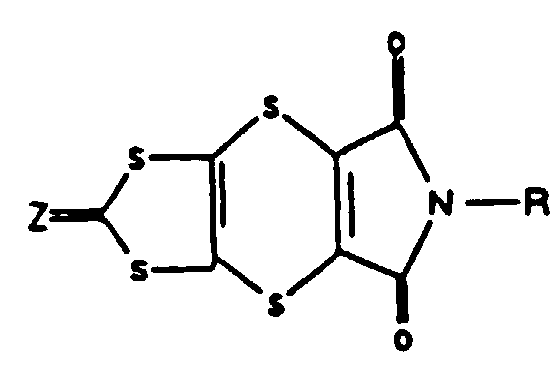
- the present invention is directed to the antimicrobial and marine antifouling uses of 4,5-dimercapto-1,3-dithiolo-2-one or thione maleimides corresponding to the formula wherein R represents -H, phenyl, benzyl, phenethyl, a C 1 -C 10 straight or branched chain alkyl radical, a C 3 -C 10 cycloalkyl radical, a C 1 -C 10 straight or branched chain alkoxy radical, a C 3 -C 10 --cycloalkoxy, an ester of the formula -CH 2 CH 2 O-C(O)-R 1 , wherein R 1 represents a C 1 -C 5 straight or branched chain alkyl radical or a C 3 -C 5 cycloalkyl radical and Z represents oxygen or sulfur
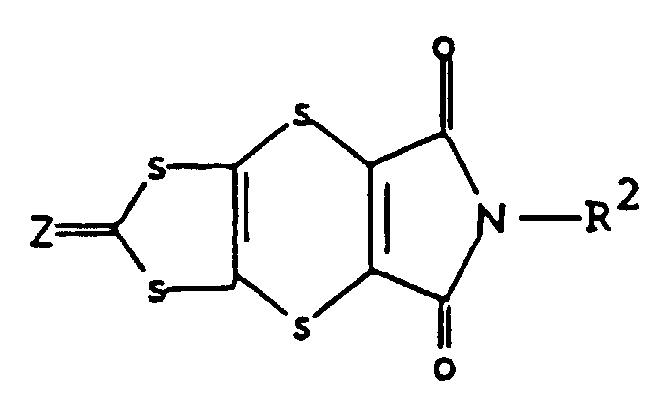
- the present invention is also directed to novel 4,5-dimercapto-1,3-dithiolo-2-one or thione maleimides corresponding to the formula wherein R 2 represents C 3 -C 10 cycloalkyl, C 1 -C 10 straight or branched chain alkoxy, C 3 -C 10 --cycloalkoxy, an ester of the formula -CH 2 CH 2 O-C(O)-R 1 , wherein R 1 represents C 1 -C 5 straight or branched chain alkyl or C 3 -C 5 cycloalkyl and Z represents oxygen or sulfur.
- the present invention is further directed to a method for inhibiting microorganisms present in a microbial habitat which comprises contacting said microbial habitat with an antimicrobial composition comprising an inert diluent in admixture with an antimicrobially-effective amount of a compound corresponding to Formula I.
- the antimicrobial compositions of the present invention can also be employed to treat surfaces exposed to a marine environment in which marine organisms grow to prevent the growth of said marine organisms on said surfaces.
- alkali metal is employed to designate sodium, potassium, lithium or cesium.
- halo is employed to designate bromo, chloro, fluoro or iodo.
- the maleimide compounds corresponding to Formula I of the present invention wherein Z is Scan be prepared employing various preparative procedures such as those set forth below.
- various preparative procedures such as those set forth below.
- certain specific alkali metals, halo groups and specific solvents are set forth. These representations are only presented for convenience and are not to be considered as an indication that these specifically representations are the only groups or materials which can be employed.
- Method A In this procedure, an alkali metal dithiolate, conveniently prepared by adding, with stirring and under a nitrogen atmosphere, an alkali metal ethoxide to a suspension of finely powdered 4,5-bis(benzoylthio) 1,3-dithiole-2-thione in absolute ethanol.
- the reaction mixture is mixed with anhydrous ether and upon standing, the alkali metal dithiolate product precipitates and is recovered for use in the present process.
- Stoichiometric amounts of the alkali metal dithiolate and an appropriately substituted 3,4-dichloromaleimide are mixed with a polar aprotic solvent, such as, for example, dimethylsulfoxide, N-methyl pyrrolidine, dry dimethylformamide and the mixture is stirred at room temperature under nitrogen from 0.5 to 10 hours or more.
- a polar aprotic solvent such as, for example, dimethylsulfoxide, N-methyl pyrrolidine, dry dimethylformamide
- the product precipitates out from the reaction mixture, if not, methanol and/or water can be added to aid in precipitation.
- the product is recovered by filtration, washed with water or methanol and air dried.
- the reaction scheme is as follows:
- Method B In this procedure, stoichiometric amounts of an alkali metal dithiolate, prepared as above in Method A, and an appropriate 3,4-dihalomaleimide such as 3,4-dichloromaleimide are mixed with a C 1 -C 8 -alkanol such as methanol, ethanol, isopropanol and butanol. The mixture is stirred at room temperature under nitrogen for about 16 hours or more. Water is slowly added to precipitate the product, which after recovery by filtration, is washed with water, air dried and recrystallized from an alkanol such as methanol or ethanol.
- the reaction scheme is as follows:
- Method D bis(tetraethylammonium) bis-(2-thioxo-1,3-dithi ole-4,5-dithiolate)zinc(II) is reacted at room temperature with an appropriate 3,4-dichloromaleimide in the presence of a solvent such as acetone or methylisobutylketone for a period from 2 to 3 days.
- a solvent such as acetone or methylisobutylketone
- the maleimide compounds corresponding to Formula I of the present invention wherein Z is O can be prepared by oxidizing the above prepared thioxo compounds with from a slight excess to about a three-fold excess of mercuric acetate.
- a mixture of the thioxo compound and mercuric acetate in a mixed solvent composed of a chlorine containing solvent such as, for example, but not limited to, chloroform, ethylene chloride, methylene chloride and hexachloroethane in admixture with acetic acid is reacted under reflux conditions from 1 to 24 hours or more.
- the reaction product is filtered to remove insoluble mercury salts and the filtrate concentrated under reduced pressure to remove most of the solvent.
- the residue is redissolved in chloroform, washed first with aqueous potassium carbonate and then with water.
- the organic phase is separated and dried over magnesium sulfate.
- the product is then recovered by removal of the solvent under vacuum.
- the filtrate is brought to dryness under vacuum followed by a thorough washing with water and then air drying to obtain the desired product.
- a reaction mixture was prepared by slowly adding (3.10 grams (g), 0.00390 mol) of bis(tetraethylammonium)-bis(2-thioxo--1,3-dithiolo-4,5-dithiolate Zn(II) to a solution of 1.60 g (0.00770 mol) of N-isopropyl-3,4--dichloromaleimide in 100 mL of tetrahydrofuran. The solution was stirred overnight (about 16 hours) at room temperature.
- the cold bath was removed and the mixture was allowed to stir at room temperature for 20 hours.
- the mixture was cooled in an acetone-ice bath to about 5°C. and 150 mL of methanol was slowly added. After stirring for 15 minutes, an additional 350 mL of N,N-dimethylformamide was added followed by 750 mL of water.
- the red-colored solution was then carefully transferred to a 5 liter three-necked flask equipped with a mechanical stirrer and an addition funnel. To the stirred solution were added, 20 g (0.5 mol) of zinc chloride in 500 mL of about 28 percent ammonium hydroxide and 500 mL of methanol.
- the compounds of this invention are useful as antimicrobial additives, and they can be added to industrial products such as paints, inks, adhesives, soaps, cutting oils, textiles, and paper and pigment slurries and to styrene-butadiene latexes used for paper coatings.
- the compounds are also useful as antimicrobial additives in such personal care products as hand creams, lotions, shampoos, and hand soaps.
- a further advantage of this invention is its cost-effectiveness for applications which need to have an antimicrobial continuously replenished, such as in cooling towers and pulp and paper mills.
- the present invention is also directed to a method for inhibiting microorganisms which comprises contacting said microorganisms or habitat thereof with an effective amount of the compounds of this invention.
- the antimicrobial compounds of this invention may be added directly to aqueous formulations susceptible to microbial growth, either undiluted or dissolved in inert diluents such as organic sanders such as glycols, alcohols, or acetone. They may also be added alone or in combination with other preservatives.
- microorganism is meant to refer to bacteria, fungi, viruses, algae, subviral agents and protozoa.
- the term "antimicrobially-effective amount” refers to that amount of one or a mixture of two or more of the compounds, or of a composition comprising such compound or compounds, of this invention needed to exhibit inhibition of selected microorganisms. Typically, this amount varies from providing 1 part per million (ppm) to 5,000 ppm by weight of the compound to a microbial habitat being contacted with the compound. Such amounts vary depending upon the particular compound tested and microorganism treated. Also, the exact concentration of the compounds to be added in the treatment of industrial and consumer formulations may vary within a product type depending upon the components of the formulation. A preferred effective amount of the com pound is from 1 ppm to 500 ppm, more preferably from 1 ppm to 50 ppm by weight, of a microbial habitat.
- microbial habitat refers to a place or type of site where a microorganism naturally or normally lives or grows.
- a microbial habitat will be an area that comprises a moisture, nutrient, and/or an oxygen source such as, for example, a cooling water tower or an air washing system.
- inhibitors refer to the suppression, stasis, kill, or any other interference with the normal life processes of microorganisms that is adverse to such microorganisms, so as to destroy or irreversibly inactivate existing microorganisms and/or prevent or control their future growth and reproduction.
- the antimicrobial activity of the compounds of the present invention is demonstrated by the following techniques.
- the antimicrobial activity of the compounds of the present invention is set forth as the minimum inhibitory concentration (MIC) for the active compounds and is determined for nine (9) bacteria, using nutrient agar, and seven (7) yeast and fungi, using malt yeast agar. This determination is conducted using a one percent solution of the test compound prepared in a mixture of acetone and water.
- MIC minimum inhibitory concentration
- Nutrient agar is prepared at pH 6.8, representing a neutral medium, and at pH 8.2, representing an alkaline medium.
- the nutrient agars are prepared by adding 23 g of nutrient agar to one-liter of deionized water.
- the alkaline medium is prepared by adjusting a 0.04 M solution of N-[tris-(hydroxymethyl)methyl]-glycine buffered deionized water with concentrated sodium hydroxide to a pH of 8.5.
- Malt yeast agar is prepared by adding 3 g yeast extract and 45 g malt agar per liter of deionized water. The specific agar is dispensed in 30 mL aliquots into 25 x 200 mm test tubes, capped and autoclaved for 15 minutes at 115°C
- test tubes containing the agar are cooled in a water bath until the temperature of the agar is 48°C. Then, an appropriate amount of the one percent solution of the test compound is added (except in the controls where no compound is added) to the respective test tubes so that the final concentrations are 500, 250, 100, 50, 25, 10, 5, 2.5, 1.0 and zero parts per million of the test compound in the agar thus having a known concentration of test compound dispersed therein.
- the contents of the test tubes are then transferred to respective petri plates. After drying for 24 hours, the petri plates containing nutrient agar are inoculated with bacteria and those containing malt yeast agar are inoculated with yeast and fungi.
- the inoculation with bacteria is accomplished by using the following procedure. Twenty-four hour-cultures of each of the bacteria are prepared by incubating the respective bacteria in tubes containing nutrient broth for 24 hours at 30°C in a shaker. Dilutions of each of the 24 hour-cultures are made so that nine separate suspensions (one for each of the nine test bacteria) are made, each containing 10 8 colony forming units (CFU) per mL of suspension of a particular bacteria. Aliquots of 0.3 mL of each of the bacterial suspensions are used to fill the individual wells of Steer's Replicator.
- 0.3 mL was used to fill three wells (that is, three wells of 0.3 mL each) so that for the nine different bacteria, 27 wells are filled.
- the Steer's Replicator is then used to inoculate both the neutral and alkaline pH nutrient agar petri plates.
- the inoculated petri plates are incubated at 30°C for 48 hours and then read to determine if the test compound which is incorporated into the agar prevented growth of the respective bacteria.
- the inoculation with the yeast and fungi is accomplished as follows. Cultures of yeast and fungi are incubated for seven days on malt yeast agar at 30°C. These cultures are used to prepare suspensions by the following procedure. A suspension of each organism is prepared by adding 10 mL of sterile saline and 10 microliters of octylphenoxy polyethoxy ethanol to the agar slant of yeast or fungi. The sterile saline/octylphenoxy polyethoxy ethanol solution is then agitated with a sterile swab to suspend the microorganism grown on the slant.
- Each resulting suspension is diluted into sterile saline (1 part suspension to 9 parts sterile saline). Aliquots of these dilutions are placed in individual wells of Steer's Replicator and petri plates inoculated as previously described. The petri plates are incubated at 30°C and read after 48 hours for yeast and 72 hours for fungi.
- Table I lists the bacteria, yeast and fungi used in the MIC test described above along with their respective American Type Culture Collection (ATCC) identification numbers.
- Tables II and III the MIC values of the compounds of the present invention as compared to the MIC of a standard commercial preservative (with 1-(3-chloroallyl)-3,5,7-triaza--1-azoniaadamantane chloride as the active agent, and referred to in Tables II and III as "STANDARD") are set forth for the bacteria organisms and yeast/fungi organisms which are listed in Table I.
- the present invention is also directed to a method for inhibiting marine organisms.
- marine organisms is meant to include marine animals, such as barnacles, serpulid, bryozoa, oysters and hydroids, and marine plants, such as green algae and brown algae.
- the method for inhibiting marine organisms comprises contacting a surface exposed to a marine environment in which marine organisms grow with a marine antifouling effective amount of the compound of this invention.
- marine antifouling effective amount refers to that amount of one or a mixture of two or more of the compounds of this invention needed to exhibit inhibition of selected marine organisms. Typically, this amount varies from providing 1 weight percent to 30 weight percent of the compound to a marine antifouling composition which is used to treat a surface exposed to a marine environment in which marine organisms live or grow. Such amounts vary depending upon the particular compound tested and marine organism to be treated. Also, the exact concentration of the compounds to be added in the preparation of industrial and consumer formulations may vary within a product type depending upon the components of the formulation.
- a composition comprising a marine antifouling effective amount of the compound will also comprise an inert diluent which may be, for example, in the form of a paint.
- an inert diluent which may be, for example, in the form of a paint.
- paints having a vinyl resin binder such as, for example, a plasticized polyvinyl chloride or a polyvinyl chloride-polyvinyl acetate type.
- the binders are formulated as latexes or emulsions.
- the compound of the present invention is preferably used in an amount from 1 to 30 weight percent and, most preferably, from 10 to 25 weight percent.
- a surface exposed to a marine environment refers to a surface where a marine organism naturally or normally lives or grows. Typically, such a surface will be an area that is in continual or periodic contact with a marine environment such as an ocean or other body of water. Typical surfaces include, for example, a ship hull.
- the marine antifouling activity of the compounds of the present invention is demonstrated by the following techniques.
- Test panels are prepared from clear, rigid polyvinyl chloride film that is 0.381 x 10 -3 m thick and has one textured surface.
- the test panels are 0.1524 m by 0.1524 m squares that have 0.00635 m holes punched at corners on 0.127 m centers.
- a 0.102 square template, with a 0.067 m diameter hole at the center, is attached to the center of the textured surface of the test panels.
- a candidate marine antifoulant compound (1.0 g) is stirred into a resinous latex binder (9.0 g). A portion of the compound/binder mixture (1.5 g) is added to the center of the test panel and uniformly spread over the circular area inside the template
- Water is added dropwise as needed to properly spread the compound/binder mixture.
- the template prevents the compound/binder mixture from spreading beyond the uncovered area.
- the test panel is allowed to sit for between 10 to 30 minutes until the edge of the spread compound/binder mixture has dried.
- the template is then removed
- the test panei is then allowed to dry for 8 to 12 hours at room temperature.
- Two test panels are prepared for each candidate marine antifoulant compound
- Two control test paneis are also prepared by oniy treating with the resinous latex binder.
- One test panei of each candidate marine suriactant compound is attached over a white background to the topside of an exposure support apparatus.
- the second test panel is attached over a black background to the underside of the exposure support apparatus.
- the exposure support apparatus is placed horizontally 0.0254 m under a marine surface with the white background topside facing up
- the exposure support apparatus is exposed to the marine environment for both 6 and 10 weeks during which time the control test panels become substantially covered with mature marine organism growth on both the topside and underside exposures.
- each test panel After being removed from the exposure support apparatus, each test panel is inspected and rated for marine organism growth on both the treated and untreated areas of the test panel. The marine organisms present on the treated and untreated areas are noted. The presence of algae spores and bacterial slime are noted but not included in rating each test panel. The test panels are rated on a scale from 10 (representing completely free of marine organism growth) to 0 (representing completely covered with marine organism growth).
- test panels were prepared using tributyl tin oxide, a known marine antifouling compound.
- One set of such panels used the tributyl tin oxide in a commercially available ship-hull paint (referred to in Table IV as "STANDARD II") which was employed in the same manner as the resinous latex binder used on the other test panels.
- a second set of such panels used the tributyl tin oxide at a 10 percent concentration in the resinous latex binder (referred to in Table IV as "STANDARD III").
- Marine Antifouling Rating for Test Compounds Marine Antifouling Ratings Compound (Example No.) 6 Week Test 10 Week Test Top Panel Bottom Panel Top Panel Bottom Panel II 9 3 2 2 Control 1 1 3 1 STANDARD II 10 10 10 STANDARD III 10 10 9 10
Landscapes
- Chemical & Material Sciences (AREA)
- Life Sciences & Earth Sciences (AREA)
- Organic Chemistry (AREA)
- Engineering & Computer Science (AREA)
- Wood Science & Technology (AREA)
- Materials Engineering (AREA)
- Plant Pathology (AREA)
- Dentistry (AREA)
- Health & Medical Sciences (AREA)
- General Health & Medical Sciences (AREA)
- Pest Control & Pesticides (AREA)
- Zoology (AREA)
- Environmental Sciences (AREA)
- Agronomy & Crop Science (AREA)
- Heterocyclic Carbon Compounds Containing A Hetero Ring Having Oxygen Or Sulfur (AREA)
- Agricultural Chemicals And Associated Chemicals (AREA)
- Pharmaceuticals Containing Other Organic And Inorganic Compounds (AREA)
- Paints Or Removers (AREA)
Claims (26)
- Composé 4,5-dimercapto-1,3-dithiolo-2-one (ou thione) maléimide correspondant à la formule:dans laquelle R2 représente un groupe cycloalkyle en C3 à C10, alcoxy à chaíne droite ou ramifiée en C1 à C10, cycloalkyle en C3 à C10, un ester de formule -CH2CH2O-C(O)-R1, dans laquelle R1 représente un groupe alkyle en C1 à C5 à chaíne droite ou ramifiée ou cycloalkyle en C3 à C5 et Z représente un atome d'oxygène ou de soufre.

- Composé selon la revendication 1, qui est la 6-cyclohexyl-2-oxo-5H-1,3-dithiolo-(5,6)(1,4)dithiino-(2, 3-C)pyrrole-5,7(6H)-dione.
- Composé selon la revendication 1, qui est la 6-(2-(acétyloxy)éthyl)-2-thioxo-5H-1,3-dithiolo-(5,6)(1,4)-dithiino (2,3-C)pyrrole-5,7(6H)-dione.
- Composition antimicrobienne comprenant un diluant inerte et une quantité efficace comme antimicrobien d'un composé 4,5-dimercapto-1,3-dithiolo-2-one(ou thione) maléimide correspondant à la formule:dans laquelle R2 représente un radical cycloalkyle en C3 à C10, un radical alcoxy en C1 à C10 à chaíne droite ou ramifiée, un radical cycloalcoxy en C3 à C10, un ester de formule -CH2CH2O-C(O)-R1, dans laquelle R1 représente un radical alkyle en C1 à C5 à chaíne droite ou ramifiée ou un radical cycloalkyle en C3 à C5 et Z représente un atome d'oxygène ou de soufre.

- Composition selon la revendication 4, dans laquelle le composé est la 6-(2-(acétyloxy)éthyl)-2-thioxo-5H-1,3-dithiolo-(5,6)(1,4)-dithiino(2,3-C)pyrrole-5,7(6H)-dione.
- Composition selon la revendication 4, dans laquelle le composé est la 6-cyclohexyl-2-oxo-5H-1,3-dithiolo-(5,6) (1,4)dithiino(2,3-C)pyrrole-5,7(6H)-dione.
- Procédé pour inhiber des micro-organismes dans un habitat microbien à l'exclusion des corps humains et animaux, consistant à mettre en contact ledit habitat microbien avec une quantité efficace comme antimicrobien d'un 4,5-dimercapto-1,3-dithiolo-2-one (ou thione) maléimide correspondant à la formule:dans laquelle R représente un atome d'hydrogène, un radical phényle, benzyle, phénéthyle, un radical alkyle en C1 à C10 à chaíne droite ou ramifiée, un radical cycloalkyle en C3 à C10, un radical alcoxy en C1 à C10 à chaíne droite ou ramifiée, un radical cycloalcoxy en C3 à C10, un ester de formule -CH2CH2O-C(O)-R1, dans laquelle R1 représente un radical alkyle en CI à C5 à chaíne droite ou ramifiée ou un radical cycloalkyle en C3 à C5 et Z représente un atome d'oxygène ou de soufre.

- Procédé selon la revendication 7, dans lequel le composé est la 2-thioxo-5H-1,3-dithiolo-(5,6)(1,4)-dithiino(2,3-C)pyrrole-5,7(6H)-dione.
- Procédé selon la revendication 7, dans lequel le composé est la 6-méthyl-2-thioxo-5H-1,3-dithiolo-(5,6)(1,4)dithiino(2,3-C)pyrrole-5,7(6H)-dione.
- Procédé selon la revendication 7, dans lequel le composé est la 6-éthyl-2-thioxo-5H-1,3-dithiolo-(5,6)-(1,4)dithiino(2,3-C)pyrrole-5,7(6H)-dione.
- Procédé selon la revendication 7, dans lequel le composé est la 6-n-propyl-2-thioxo-5H-1,3-dithiolo-(5,6)(1,4)dithiino(2,3-C)pyrrole-5,7(6H)-dione.
- Procédé selon la revendication 7, dans lequel le composé est la 6-(1-méthyléthyl)-2-thioxo-5H-1,3-dithiolo-(5,6)(1,4)dithiino(2,3-C)pyrrole-5,7(6H)-dione.
- Procédé selon la revendication 7, dans lequel le composé est la 6-n-butyl-2-thioxo-5H-1,3-dithiolo-(5,6)(1,4)dithiino(2,3-C)pyrrole-5,7(6H)-dione.
- Procédé selon la revendication 7, dans lequel le composé est la 6-(2-(acétyloxy)éthyl)-2-thioxo-5H-1,3-dithiolo-(5,6)(1,4)dithiino(2,3-C)pyrrole-5,7(6H)-dione.
- Procédé selon la revendication 7, dans lequel le composé est la 2-oxo-5H-1,3-dithiolo-(5,6)(1,4)-dithiino (2,3-C)pyrrole-5,7(6H)-dione.
- Procédé selon la revendication 7, dans lequel le composé est la 6-éthyl-2-oxo-5H-1,3-dithiolo-(5,6)-(1,4)dithiino(2,3-C)pyrrole-5,7(6H)-dione.
- Procédé selon la revendication 7, dans lequel le composé est la 6-(1-méthyléthyl)-2-oxo-5H-1,3-dithiolo-(5,6)(1,4)dithiino(2,3-C)pyrrole-5,7(6H)-dione.
- Procédé selon la revendication 7, dans lequel le composé est la 6-n-butyl-2-oxo-5H-1,3-dithiolo-(5,6)-(1,4)dithiino(2,3-C)pyrrole-5,7(6H)-dione.
- Procédé selon la revendication 7, dans lequel le composé est la 6-(1-méthylpropyl)-2-oxo-5H-1,3-dithiolo-(5,6)(1,4)dithiino(2,3-C)pyrrole-5,7 (6H)-dione.
- Procédé selon la revendication 7, dans lequel le composé est la 6-n-hexyl-2-oxo-5H-l,3-dithiolo-(5,6)-(1,4)dithiino(2,3-C)pyrrole-5,7(6H)-dione.
- Procédé selon la revendication 7, dans lequel le composé est la 6-cyclohexyl-2-oxo-5H-1,3-dithiolo-(5,6) (1,4)dithiino(2,3-C)pyrrole-5,7(6H)-dione.
- Procédé selon la revendication 7, dans lequel le composé est la 6-benzyl-2-oxo-5H-1,3-dithiolo-(5,6)-(1,4)dithiino(2,3-C)pyrrole-5,7(6H)-dione.
- Procédé selon la revendication 7, dans lequel le composé est présent dans la composition en une quantité fournissant de 1 partie par million à 5 000 parties par million en poids du composé à l'habitat microbien.
- Composition utile dans la prévention de croissance d'organismes marins sur une surface exposée à un environnement marin, dans lequel les organismes marins croissent, comprenant un diluant inerte et une quantité efficace anti-salissure marine d'un composé 4,5-dimercapto-1,3-dithiolo-2-one ou thione maléimide correspondant à la formule:dans laquelle R2 représente un radical cycloalkyle en C3 à C10, un radical alcoxy à chaíne droite ou ramifiée en C1 à C10, un cycloalcoxy en C3 à C10, un ester de formule -CH2CH2O-C(O)-R1, dans laquelle R1 représente un radical alkyle à chaíne droite ou ramifiée en C1 à C5 ou un radical cycloalkyle en C3 à C5 et Z représente un atome d'oxygène ou de soufre.
- Procédé pour empêcher la croissance d'organismes marins sur une surface exposée à un environnement marin, dans lequel les organismes marins croissent, consistant à mettre en contact ladite surface avec une quantité efficace anti-salissure marine d'un composé 4,5-dimercapto-1,3-dithiolo-2-one (ou thione) maléimide correspondant à la formule:dans laquelle R représente -H, un groupe phényle, benzyle, phénéthyle, un radical alkyle à chaíne droite ou ramifiée en C1 à C10, un radical cycloalkyle en C3 à C10, un radical alcoxy à chaíne droite ou ramifiée en C1 à C10, un groupe cycloalcoxy en C3 à C10, un ester de formule -CH2CH2O-C(O)-R1, dans laquelle R1 représente un radical alkyle à chaíne droite ou ramifiée en C1 à C3 Ou un radical cycloalkyle en C3 à C5, et Z représente un atome d'oxygène ou de soufre.
- Procédé selon la revendication 25, dans lequel le composé est mis en contact avec la surface à raison de 1 à 30 pour-cent en poids d'une composition comprenant un diluant inerte en mélange avec le composé.
Applications Claiming Priority (3)
| Application Number | Priority Date | Filing Date | Title |
|---|---|---|---|
| US360490 | 1994-12-21 | ||
| US08/360,490 US5466707A (en) | 1994-12-21 | 1994-12-21 | Dimercapto-1,3-dithiolo-2-one or thione maleimides, compositions containing them and their use as antimicrobial and marine antifouling agents |
| PCT/US1995/013495 WO1996019481A1 (fr) | 1994-12-21 | 1995-10-10 | Maleimides dimercapto-1,3-dithiolo-2-one ou thione, compositions les contenant et leur utilisation comme agents antimicrobiens et agents contre l'encrassement maritime |
Publications (2)
| Publication Number | Publication Date |
|---|---|
| EP0799229A1 EP0799229A1 (fr) | 1997-10-08 |
| EP0799229B1 true EP0799229B1 (fr) | 1998-12-02 |
Family
ID=23418183
Family Applications (1)
| Application Number | Title | Priority Date | Filing Date |
|---|---|---|---|
| EP95944822A Expired - Lifetime EP0799229B1 (fr) | 1994-12-21 | 1995-10-10 | Maleimides dimercapto-1,3-dithiolo-2-one ou thione, compositions les contenant et leur utilisation comme agents antimicrobiens et agents contre l'encrassement maritime |
Country Status (8)
| Country | Link |
|---|---|
| US (1) | US5466707A (fr) |
| EP (1) | EP0799229B1 (fr) |
| JP (1) | JPH10512853A (fr) |
| AT (1) | ATE174028T1 (fr) |
| CA (1) | CA2208366A1 (fr) |
| DE (1) | DE69506445T2 (fr) |
| NO (1) | NO972916L (fr) |
| WO (1) | WO1996019481A1 (fr) |
Families Citing this family (13)
| Publication number | Priority date | Publication date | Assignee | Title |
|---|---|---|---|---|
| US5631277A (en) * | 1996-07-10 | 1997-05-20 | The Dow Chemical Company | (2-one (or thione)-1,3-dithiole 4,5-diyl) bis(thiocyanate) compounds, compositions containing the compounds and their use as an antimicrobial and marine antifouling agents |
| US5633219A (en) * | 1996-07-10 | 1997-05-27 | The Dow Chemical Company | 5H-pyrrolo(3',4':5,6)(1,4)dithiino(2,3-C)(1,2,5)thiadiazole-5,7(6H)-dione, compositions containing them and their use as antimicrobial and marine antifouling agents |
| US5723486A (en) * | 1996-07-10 | 1998-03-03 | The Dow Chemical Company | 1,3 dithiolo(4,5)-1,3-dithiolo-2-thione derivatives, compositions and use as antimicrobial and marine antifouling agents |
| US5661176A (en) * | 1996-07-10 | 1997-08-26 | The Dow Chemical Company | (2-one (or thione)-1,3-dithiole-4,5-diyl)-bis(thiomethylthiocyanate), compounds for use as antimicrobial and marine antifouling agents |
| US5703102A (en) * | 1996-07-10 | 1997-12-30 | The Dow Chemical Company | 1,2,5-thiadiazolo-1,3-dithiole-2-one (or thione) as antimicrobial and marine antifouling agents |
| US7144992B2 (en) * | 2004-04-01 | 2006-12-05 | Kane Biotech Inc. | Synergistic antimicrobial compositions and methods for reducing biofilm formation |
| US20090200013A1 (en) * | 2009-04-23 | 2009-08-13 | Bernadette Craster | Well tubular, coating system and method for oilfield applications |
| AR077956A1 (es) * | 2009-09-14 | 2011-10-05 | Bayer Cropscience Ag | Combinaciones de compuestos activos |
| UA108638C2 (uk) * | 2010-03-04 | 2015-05-25 | Застосування солей імідів малеїнової кислоти для боротьби з фітопатогенними грибами | |
| BR112012026150A2 (pt) * | 2010-04-14 | 2015-09-08 | Bayer Cropscience Ag | derivados de tienodititina. |
| EP2558456A1 (fr) | 2010-04-14 | 2013-02-20 | Bayer Intellectual Property GmbH | Dérivés de dithiine utilisés en tant que fongicides |
| JP5869573B2 (ja) * | 2010-09-03 | 2016-02-24 | バイエル・インテレクチュアル・プロパティ・ゲゼルシャフト・ミット・ベシュレンクテル・ハフツングBayer Intellectual Property GmbH | 植物病原性菌類を防除するためのジチイン−テトラ(チオ)カルボキシイミド類 |
| WO2015181035A1 (fr) * | 2014-05-30 | 2015-12-03 | Basf Se | Mélanges fongicides à base de dérivés de 1,4-dithiine |
Family Cites Families (1)
| Publication number | Priority date | Publication date | Assignee | Title |
|---|---|---|---|---|
| US4150130A (en) * | 1978-03-03 | 1979-04-17 | The Dow Chemical Company | 5,6-Dihydro-5-oxo-1,4-dithiino (2,3-d) pyridazine-2,3-dicarbonitriles |
-
1994
- 1994-12-21 US US08/360,490 patent/US5466707A/en not_active Expired - Fee Related
-
1995
- 1995-10-10 JP JP8519773A patent/JPH10512853A/ja active Pending
- 1995-10-10 CA CA002208366A patent/CA2208366A1/fr not_active Abandoned
- 1995-10-10 WO PCT/US1995/013495 patent/WO1996019481A1/fr not_active Ceased
- 1995-10-10 DE DE69506445T patent/DE69506445T2/de not_active Expired - Fee Related
- 1995-10-10 EP EP95944822A patent/EP0799229B1/fr not_active Expired - Lifetime
- 1995-10-10 AT AT95944822T patent/ATE174028T1/de not_active IP Right Cessation
-
1997
- 1997-06-20 NO NO972916A patent/NO972916L/no not_active Application Discontinuation
Also Published As
| Publication number | Publication date |
|---|---|
| JPH10512853A (ja) | 1998-12-08 |
| NO972916L (no) | 1997-08-14 |
| US5466707A (en) | 1995-11-14 |
| NO972916D0 (no) | 1997-06-20 |
| EP0799229A1 (fr) | 1997-10-08 |
| DE69506445D1 (de) | 1999-01-14 |
| ATE174028T1 (de) | 1998-12-15 |
| DE69506445T2 (de) | 1999-04-22 |
| WO1996019481A1 (fr) | 1996-06-27 |
| CA2208366A1 (fr) | 1996-06-27 |
Similar Documents
| Publication | Publication Date | Title |
|---|---|---|
| US5466707A (en) | Dimercapto-1,3-dithiolo-2-one or thione maleimides, compositions containing them and their use as antimicrobial and marine antifouling agents | |
| US5723486A (en) | 1,3 dithiolo(4,5)-1,3-dithiolo-2-thione derivatives, compositions and use as antimicrobial and marine antifouling agents | |
| US5631277A (en) | (2-one (or thione)-1,3-dithiole 4,5-diyl) bis(thiocyanate) compounds, compositions containing the compounds and their use as an antimicrobial and marine antifouling agents | |
| US5633219A (en) | 5H-pyrrolo(3',4':5,6)(1,4)dithiino(2,3-C)(1,2,5)thiadiazole-5,7(6H)-dione, compositions containing them and their use as antimicrobial and marine antifouling agents | |
| EP0756598B1 (fr) | 5,6-dihydro-5-oxo-1,4-dithiino-(2,3-d)-pyridazine-2,3-dicarbonitriles substitues, compositions les contenant et utilisation desdites compositions en tant qu'agents anti-microbiens | |
| US5157051A (en) | Composition and use of 3-thiocyano-2-halo-2-propenenitriles as antimicrobial agents | |
| US5661165A (en) | ((4-phenyl-1,2,5-thiadiazol-3-yl)oxy)methyl ester thiocyanic acid compounds, compositions containing them and their use as antimicrobial and marine antifouling agents | |
| US5491155A (en) | Substituted thiadiazoles, compositions containing them and their use as antimicrobial and marine antifouling agents | |
| US5488060A (en) | Substituted thiadiazoles, compositions containing them and their use as antimicrobial and marine antifouling agents | |
| US5455222A (en) | 1-substituted-5-thiomethylthiocyanato-1H-tetrazoles, compositions containing them and their use as antimicrobial and marine antifouling agents | |
| US5200409A (en) | Composition and use of substituted 1,3-dithiolo-and 1,4-dithiinoquinoxalines as an antimicrobial | |
| US5885991A (en) | Thiocyanomethyloxy (and thiocyanothiomethyl)-1,2,3-benzatriazin-4(3H) ones, compositions containing them and their use as antimicrobial and marine antifouling agents | |
| US5661176A (en) | (2-one (or thione)-1,3-dithiole-4,5-diyl)-bis(thiomethylthiocyanate), compounds for use as antimicrobial and marine antifouling agents | |
| US4150130A (en) | 5,6-Dihydro-5-oxo-1,4-dithiino (2,3-d) pyridazine-2,3-dicarbonitriles | |
| US5703102A (en) | 1,2,5-thiadiazolo-1,3-dithiole-2-one (or thione) as antimicrobial and marine antifouling agents | |
| US5703114A (en) | Use of 4,5-dicyano-1-3-dithiole-2-one (or thione) as antimicrobial and marine antifouling agents | |
| US5270307A (en) | Pyrrolo(1,2-b)-(1,2)-benzothiazin-10-one and its use as an antimicrobial | |
| EP0573629B1 (fr) | Composition et utilisation de dinitriles dimercapto-substitutes en tant qu'agents antimicrobiens | |
| WO1996019464A1 (fr) | 2-(thiocyanatomethylthio)-1,3,4-oxadiazoles a substitution en 5 servant d'antimicrobiens et d'agents antisalissure | |
| US5171743A (en) | Compounds composition and use of substituted 1,3-dithiolo- and 1,4-dithino-pyridines as an antimicrobial |
Legal Events
| Date | Code | Title | Description |
|---|---|---|---|
| PUAI | Public reference made under article 153(3) epc to a published international application that has entered the european phase |
Free format text: ORIGINAL CODE: 0009012 |
|
| 17P | Request for examination filed |
Effective date: 19970717 |
|
| AK | Designated contracting states |
Kind code of ref document: A1 Designated state(s): AT BE CH DE DK ES FR GB GR IE IT LI LU MC NL PT SE |
|
| RAP3 | Party data changed (applicant data changed or rights of an application transferred) |
Owner name: THE DOW CHEMICAL COMPANY |
|
| 17Q | First examination report despatched |
Effective date: 19971223 |
|
| GRAG | Despatch of communication of intention to grant |
Free format text: ORIGINAL CODE: EPIDOS AGRA |
|
| GRAG | Despatch of communication of intention to grant |
Free format text: ORIGINAL CODE: EPIDOS AGRA |
|
| GRAH | Despatch of communication of intention to grant a patent |
Free format text: ORIGINAL CODE: EPIDOS IGRA |
|
| GRAH | Despatch of communication of intention to grant a patent |
Free format text: ORIGINAL CODE: EPIDOS IGRA |
|
| GRAA | (expected) grant |
Free format text: ORIGINAL CODE: 0009210 |
|
| AK | Designated contracting states |
Kind code of ref document: B1 Designated state(s): AT BE CH DE DK ES FR GB GR IE IT LI LU MC NL PT SE |
|
| PG25 | Lapsed in a contracting state [announced via postgrant information from national office to epo] |
Ref country code: LI Free format text: LAPSE BECAUSE OF FAILURE TO SUBMIT A TRANSLATION OF THE DESCRIPTION OR TO PAY THE FEE WITHIN THE PRESCRIBED TIME-LIMIT Effective date: 19981202 Ref country code: IT Free format text: LAPSE BECAUSE OF FAILURE TO SUBMIT A TRANSLATION OF THE DESCRIPTION OR TO PAY THE FEE WITHIN THE PRE;WARNING: LAPSES OF ITALIAN PATENTS WITH EFFECTIVE DATE BEFORE 2007 MAY HAVE OCCURRED AT ANY TIME BEFORE 2007. THE CORRECT EFFECTIVE DATE MAY BE DIFFERENT FROM THE ONE RECORDED.SCRIBED TIME-LIMIT Effective date: 19981202 Ref country code: GR Free format text: LAPSE BECAUSE OF NON-PAYMENT OF DUE FEES Effective date: 19981202 Ref country code: FR Free format text: LAPSE BECAUSE OF FAILURE TO SUBMIT A TRANSLATION OF THE DESCRIPTION OR TO PAY THE FEE WITHIN THE PRESCRIBED TIME-LIMIT Effective date: 19981202 Ref country code: ES Free format text: THE PATENT HAS BEEN ANNULLED BY A DECISION OF A NATIONAL AUTHORITY Effective date: 19981202 Ref country code: CH Free format text: LAPSE BECAUSE OF FAILURE TO SUBMIT A TRANSLATION OF THE DESCRIPTION OR TO PAY THE FEE WITHIN THE PRESCRIBED TIME-LIMIT Effective date: 19981202 Ref country code: BE Free format text: LAPSE BECAUSE OF FAILURE TO SUBMIT A TRANSLATION OF THE DESCRIPTION OR TO PAY THE FEE WITHIN THE PRESCRIBED TIME-LIMIT Effective date: 19981202 Ref country code: AT Free format text: LAPSE BECAUSE OF FAILURE TO SUBMIT A TRANSLATION OF THE DESCRIPTION OR TO PAY THE FEE WITHIN THE PRESCRIBED TIME-LIMIT Effective date: 19981202 |
|
| REF | Corresponds to: |
Ref document number: 174028 Country of ref document: AT Date of ref document: 19981215 Kind code of ref document: T |
|
| REG | Reference to a national code |
Ref country code: CH Ref legal event code: EP |
|
| REF | Corresponds to: |
Ref document number: 69506445 Country of ref document: DE Date of ref document: 19990114 |
|
| PG25 | Lapsed in a contracting state [announced via postgrant information from national office to epo] |
Ref country code: PT Free format text: LAPSE BECAUSE OF FAILURE TO SUBMIT A TRANSLATION OF THE DESCRIPTION OR TO PAY THE FEE WITHIN THE PRESCRIBED TIME-LIMIT Effective date: 19990302 Ref country code: DK Free format text: LAPSE BECAUSE OF FAILURE TO SUBMIT A TRANSLATION OF THE DESCRIPTION OR TO PAY THE FEE WITHIN THE PRESCRIBED TIME-LIMIT Effective date: 19990302 |
|
| EN | Fr: translation not filed | ||
| REG | Reference to a national code |
Ref country code: CH Ref legal event code: PL |
|
| PLBE | No opposition filed within time limit |
Free format text: ORIGINAL CODE: 0009261 |
|
| STAA | Information on the status of an ep patent application or granted ep patent |
Free format text: STATUS: NO OPPOSITION FILED WITHIN TIME LIMIT |
|
| PG25 | Lapsed in a contracting state [announced via postgrant information from national office to epo] |
Ref country code: LU Free format text: LAPSE BECAUSE OF NON-PAYMENT OF DUE FEES Effective date: 19991010 Ref country code: IE Free format text: LAPSE BECAUSE OF NON-PAYMENT OF DUE FEES Effective date: 19991010 |
|
| 26N | No opposition filed | ||
| PG25 | Lapsed in a contracting state [announced via postgrant information from national office to epo] |
Ref country code: MC Free format text: LAPSE BECAUSE OF NON-PAYMENT OF DUE FEES Effective date: 20000430 |
|
| PGFP | Annual fee paid to national office [announced via postgrant information from national office to epo] |
Ref country code: SE Payment date: 20000911 Year of fee payment: 6 Ref country code: GB Payment date: 20000911 Year of fee payment: 6 Ref country code: DE Payment date: 20000911 Year of fee payment: 6 |
|
| PGFP | Annual fee paid to national office [announced via postgrant information from national office to epo] |
Ref country code: NL Payment date: 20000912 Year of fee payment: 6 |
|
| REG | Reference to a national code |
Ref country code: IE Ref legal event code: MM4A |
|
| PG25 | Lapsed in a contracting state [announced via postgrant information from national office to epo] |
Ref country code: GB Free format text: LAPSE BECAUSE OF NON-PAYMENT OF DUE FEES Effective date: 20011010 |
|
| PG25 | Lapsed in a contracting state [announced via postgrant information from national office to epo] |
Ref country code: SE Free format text: LAPSE BECAUSE OF NON-PAYMENT OF DUE FEES Effective date: 20011011 |
|
| REG | Reference to a national code |
Ref country code: GB Ref legal event code: IF02 |
|
| PG25 | Lapsed in a contracting state [announced via postgrant information from national office to epo] |
Ref country code: NL Free format text: LAPSE BECAUSE OF NON-PAYMENT OF DUE FEES Effective date: 20020501 |
|
| GBPC | Gb: european patent ceased through non-payment of renewal fee |
Effective date: 20011010 |
|
| EUG | Se: european patent has lapsed |
Ref document number: 95944822.6 |
|
| NLV4 | Nl: lapsed or anulled due to non-payment of the annual fee |
Effective date: 20020501 |
|
| PG25 | Lapsed in a contracting state [announced via postgrant information from national office to epo] |
Ref country code: DE Free format text: LAPSE BECAUSE OF NON-PAYMENT OF DUE FEES Effective date: 20020702 |