EP0800143B1 - Procédé et dispositif pour obtenir et afficher des informations concernant des serveurs de réseau - Google Patents
Procédé et dispositif pour obtenir et afficher des informations concernant des serveurs de réseau Download PDFInfo
- Publication number
- EP0800143B1 EP0800143B1 EP97302370A EP97302370A EP0800143B1 EP 0800143 B1 EP0800143 B1 EP 0800143B1 EP 97302370 A EP97302370 A EP 97302370A EP 97302370 A EP97302370 A EP 97302370A EP 0800143 B1 EP0800143 B1 EP 0800143B1
- Authority
- EP
- European Patent Office
- Prior art keywords
- server
- identification data
- computer
- server identification
- access
- Prior art date
- Legal status (The legal status is an assumption and is not a legal conclusion. Google has not performed a legal analysis and makes no representation as to the accuracy of the status listed.)
- Expired - Lifetime
Links
Images





Classifications
-
- H—ELECTRICITY
- H04—ELECTRIC COMMUNICATION TECHNIQUE
- H04L—TRANSMISSION OF DIGITAL INFORMATION, e.g. TELEGRAPHIC COMMUNICATION
- H04L61/00—Network arrangements, protocols or services for addressing or naming
- H04L61/30—Managing network names, e.g. use of aliases or nicknames
-
- G—PHYSICS
- G06—COMPUTING OR CALCULATING; COUNTING
- G06F—ELECTRIC DIGITAL DATA PROCESSING
- G06F16/00—Information retrieval; Database structures therefor; File system structures therefor
- G06F16/90—Details of database functions independent of the retrieved data types
- G06F16/95—Retrieval from the web
- G06F16/955—Retrieval from the web using information identifiers, e.g. uniform resource locators [URL]
- G06F16/9566—URL specific, e.g. using aliases, detecting broken or misspelled links
-
- H—ELECTRICITY
- H04—ELECTRIC COMMUNICATION TECHNIQUE
- H04L—TRANSMISSION OF DIGITAL INFORMATION, e.g. TELEGRAPHIC COMMUNICATION
- H04L67/00—Network arrangements or protocols for supporting network services or applications
- H04L67/50—Network services
- H04L67/75—Indicating network or usage conditions on the user display
Definitions
- This invention relates to the capabilities of information access apparatus and information provider apparatus; and the methods and computer programming products that are used to implement them.
- a prime example of an information access apparatus is a computer using a WWW browser application.
- a prime example of an information provider apparatus is a computer using a WWW server program.
- this invention is a new and useful method, apparatus and computer program product for presenting human-friendly server identification information to a user to better indicate the origin of the information.
- WWW browser and WWW server applications are representative of the technology. As such, the majority of this application describes the invention within the context of a preferred embodiment utilizing WWW browser and WWW server applications.
- a WWW browser communicates with a WWW server using the HyperText Transfer Protocol (HTTP).
- HTTP HyperText Transfer Protocol
- This protocol continues to evolve and, although heavily used, the document describing it is considered a draft document.
- the HTTP/1.0 draft document of February 19, 1996 and the HTTP/1.1 draft document of January 19, 1996 are incorporated by reference as illustrative of the prior art.
- the WWW is a massive HyperText system. WWW users often become disoriented while navigating through the WWW. One reason for this disorientation is that the WWW initially appears to have little structure. The structure that does exist comes from the fact that the information accessible via the WWW exists on a specific server. That is, each WWW page (webpage) is stored on a specific server. In the prior art, this connection between server and information is not clearly indicated.
- WWW sites are accessed through use of their domain names (e.g., www. sun. com) or IP address (e.g., 45.212.23.1). Domain names are requested by the maintainers of the website and are approved by a third party. These addresses and domain names must be unique. Sometimes the domain name is sufficiently descriptive as to describe the WWW site. Often however, the domain name is either not descriptive or mis-descriptive of the site. For example does www. sun. com refer to the SUN OIL company or to SUN MICROSYSTEMS, Inc.? IP addresses carry no descriptive value whatsoever.
- the domain name is embedded in the URL. For example in: http://www.sun.com/index.html the "www.sun.com” is the domain name for the server. Even if the domain name is unambiguous, its placement in the URL is intimidating to inexperienced users of the WWW.
- the present invention overcomes the disadvantages of the above described systems and provides an economical, high performance, apparatus, method, and computer program product for providing server-specific identification information to a computer user.
- One aspect of the invention is a computer controlled method for obtaining server identification data, by using a domain name, and displaying this data on a display device.
- the server identification data includes descriptive information about the server identified by the domain name.
- an apparatus for accessing information on a network includes an access mechanism that uses a domain name to obtain server identification data.
- This apparatus also includes a mechanism to display the server identification data.
- the server identification data includes descriptive information about the server identified by the domain nave.
- Yet another aspect of the invention is a computer program product on a computer usable medium for causing a computer to access and display server identification data.
- the server identification data includes descriptive information about the server identified by the domain name.
- Another aspect of the invention is a computer controlled method for providing server identification data over a network Using this method the server identification data is resident on and provided by the server and the server is specified by a domain name.
- a server apparatus responsive to a domain name includes a server identification mechanism that provides server identification data about the server over a network.
- Yet a final aspect of the invention is a computer program product on a computer usable medium for causing a computer to provide server identification data.
- a procedure is a self-consistent sequence of steps leading to a desired result. These steps are those requiring physical manipulation of physical quantities. Usually these quantities take the form of electrical or magnetic signals capable of being stored, transferred, combined, compared, and otherwise manipulated. These signals are referred to as bits, values, elements, symbols characters, terms, numbers, or the like. It will be understood by those skilled in the art that all of these and similar terms are associated with the appropriate physical quantities and are merely convenient labels applied to these quantities.
- the manipulations performed by a computer when executing computer instructions are often referred to in terms, such as adding or comparing, that are commonly associated with mental operations performed by a human operator. No such capability of a human operator is necessary in any of the operations described herein that form part of the present invention; the operations are machine operations.
- Useful machines for performing the operations of the invention include programmed general purpose digital computers or similar devices. In all cases the method of computation is distinguished from the method of operation in operating a computer.
- the present invention relates to method steps for operating a computer in processing electrical or other (e.g., mechanical, chemical) physical signals to generate other desired physical signals.
- the invention also relates to apparatus for performing these operations.
- This apparatus may be specially constructed for the required purposes or it may comprise a general purpose computer as selectively activated or reconfigured by a computer program stored in the memory of a computer.
- the procedures presented herein are not inherently related to a particular computer or other apparatus.
- various general purpose machines may be used with programs written in accordance with the teachings herein, or it may prove more convenient to construct more specialized apparatus to perform the required method steps. The required structure for a variety of these machines will appear from the description below.
- the invention may be embodied in a computer readable medium encoded with either an information access application such as a WWW browser or an information provider application such as a WWW server or both.
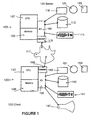
- the invention is used with computer systems.
- the server computer system 101 is configured to support a World Wide Web (WWW) server application.
- the client computer system 102 is configured to support a WWW browser applicadon.
- Some of the elements of the server computer system 101 are shown in Figure 1 , wherein a processor 103 is shown, having an Input/Output ("I/O") section 105 , a central processing unit (“CPU”) 107 and a memory section 109 .
- the VO section 105 is connected to a keyboard 111 , a disk storage unit 113 , a network interface 115 to provide access to a network 117 and a CD-ROM drive unit 119 .
- the CD-ROM unit 119 can read a CD-ROM medium 121 that typically contains programs 123 and data.
- the CD-ROM 117 and the disk storage unit 113 comprising a filestorage mechanism containing information available for network access.
- Such a computer system is capable of executing World Wide Web (WWW)server
- FIG. 1 Some of the elements the client computer 102 configured to support a WWW browser application are also shown in Figure 1 wherein a processor 133 is shown, having an Input/Output ("I/O") section 135 , a central processing unit (“CPU”) 137 and a memory section 139 .
- the I/O section 135 is connected to a keyboard 141 , a disk storage unit 143 , a network interface 145 to provide access to a network 117 , a display unit 147 and a CD-ROM drive unit 149 .
- the CD-ROM unit 149 can read a CD-ROM medium 151 that typically contains programs 153 and data.
- the CD-ROM 117 and the disk storage unit 113 comprising a filestorage mechanism.
- Such a computer system is capable of executing WWW browser applications that embody the invention.
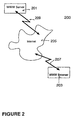
- FIG. 2 illustrates the fundamental characteristics of the WWW 200 .
- An information provider apparatus generally a computer executing a WWW server application
- the WWW server 201 and WWW browser 203 generally open a reliable communication channel 207 , 209 over the Internet 205 using an error correcting Internet protocol such as TCP/IP.
- TCP/IP error correcting Internet protocol
- the WWW server application 201 generally responds to commands from the WWW browser application 203 to provide services and information (data) to the WWW browser application 203 .
- HTTP HyperText Transfer Protocol
- the WWW server application 201 generally responds to commands from the WWW browser application 203 to provide services and information (data) to the WWW browser application 203 .
- both the WWW server application 201 and the WWW browser application 203 can be executing on the same computer and that the TCP/IP connections 207, 209 between the applications need not actually be made across the Internet 205 .
- FIG 3 illustrates a webpage provided by a WWW server apparatus executing a WWW server application as viewed on a display device using the display mechanism within the WWW browser application 203 .
- This browser application is provided by Netscape Communications, Inc.
- This Netscape browser application is one of many possible WWW browser applications that would be improved by the incorporation of the invention therein.
- the webpage information 301 is displayed in a window 303 framed 305 by the Netscape browser application 203 .
- This browser application 203 provides operator command buttons 307 , WWW navigation buttons 309 , presents the URL for the currently displayed webpage 311 , and an anchor indicator showing what part of the webpage could be evoked by activation of a pointing device (the pointing device is not shown).
- the pointing device icon is an arrowhead 313 and the anchor URL selected by the arrowhead 313 is displayed at the location labeled 315 .
- Figure 3a is a magnified view of the area labeled 311 in Figure 3.
- This illustration shows the URL 321 that references the displayed webpage.
- the "www. sun. com” is the domain name of the webpage.
- the text displayed 321 in the location field 311 now includes the server's identification data.
- the server's identification data includes the text saing "SUN MICROSYSTEMS" as descriptive information.
- the server's identification data is enclosed in parentheses “ ( ) " and separated from the URL by a space.
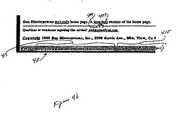
- Figures 4a and 4b illustrate the use of the invention with HyperText links.
- Figure 4a indicates the prior art method.
- the URL associated with that link is displayed at the location labeled 405 .
- Figure 4b illustrates the display presented to the user when the invention is incorporated within a WWW browser. Again, the user positions the pointing icon 409 over a HyperText link 407 .
- the URL 413 and the server's identification data 415 are both displayed at the location labeled 411 . Because the server identification data allows a WWW browser to display whatever data the server site determines to best identify the site to a user, the user is better able to understand the organization of data accessible via the WWW.
- Figure 4c illustrates how the WWW browser adds the server's identification data to the associated URL.
- the invention is also used to append a server's identification data to the bookmark facility of WWW browsers.
- the bookmark facility allows a user to capture and store URLs of interest. This allows the user to direcdy access the associated webpage without requiring the user to remember the URL or to repeat a search procedure to find the webpage of interest Generally the bookmark contains the URL and the webpage title.
- the bookmark facility displays the webpage title.
- the server's identification data is appended to the display of the webpage title in the same manner as for URLs.
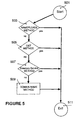
- FIG. 5 illustrates the process performed by an information access apparatus using an access mechanism to obtain server identification data.
- a WWW browser utilizing a preferred embodiment of the invention queries the WWW server for the server's identification data.
- the server and browser communicate using HTTP over this connection.
- the WWW browser is in communication with the server identification mechanism in the server computer.
- the query mechanism process for the WWW browser to obtain the server identification data starts at the terminal labeled 501 .
- the browser first attempts 503 to obtain the server's identification data by sending query request (a HTTP NAMEPLEASE message) to the server.
- query request a HTTP NAMEPLEASE message
- This message consists of the nameplease string "NAMEPLEASE” followed by a line terminator. If the query recognition mechanism within the server recognizes the message, as described below, the server's response mechanism responds with a success message followed by the server's identification data in accordance with the HyperText Transfer Protocol. This response is received by the WWW browser's receiver mechanism In this situation, the process completes through the exit terminal 511 . On the other hand, if the server did not recognize the NAMEPLEASE HTTP message or if the server does not respond within some period of time the browser attempts to obtain the server's identification data by using the well known GET HTTP message 505 . This process is also described below.
- the browser uses 509 the server's domain name as the server's identification data. This process results in the WWW browser obtaining a server's identification data for later display to the user.
- the delay times mentioned above are on the order of ten seconds.
- the actual delay times should be set short enough so that the user of the browser does not become impatient while waiting for a response, but long enough to allow the server to respond under normal network and server loading.
- Those skilled in the art will recognize that the invention is practiced using a wide range of delay time values.
- the process described above also adapts to delayed responses from previous attempts. For example, if the GET message 505 attempt has started because of the delay time-out for the NAMEPLEASE method 503 expired, but the WWW browser then receives a response to the NAMEPLEASE message, the NAMEPLEASE response is used and the GET attempt is abandoned.
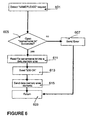
- Figure 6 illustrates the process a server identification mechanism within the server uses when responding to a NAMEPLEASE HTTP request message.
- the server first detects the "NAMEPLEASE” request message 601 .
- the server attempts to open and read a particular file residing on the server's filesystem 605 .
- This file contains the server's identification data.
- this file is named "/servername.txt”. If this file was not successfully opened and read, an error message is sent to the WWW browser 607 and the process returns 609 . On the other hand, if the file opens successfully, the file contents are read 611 into a data memory area.
- the server constructs a standard HTTP response message the indication for success "200 OK" followed 615 by a line terminator and the contents of the file that were read into the data memory area. Finally the process returns 609 .
- the success status message is of the form 2xx where the xx provide additional information about the successful operation. Thus, a preferred embodiment will detect success to any 2xx response.
- the WWW browser attempts to directly read the contents of the server's identification data file 505 .
- the browser sends the message: "GET http:// domainname /servername.txt HTTP/1.0" where "domainname” is a standard Internet domain name such as "www. sun.com”.
- the filename string is "servername. txt” in a preferred embodiment.
- This GET command message returns the server's identification data contained in the specified file to the WWW browser.
- This file is the same file that is accessed for the NAMEPLEASE process described above.
- the server's identification data is contained in the first line of the entity-body portion of the HTTP response.
- a network directory access mechanism utilizes any network directory service, available to the browser computer, to access the network directory service to retrieve a textual description associated with the domain name.
- One preferred embodiment utilizes the UNIX "whois" utility.
- Another preferred embodiment uses similar a X.500 application to access an Internet name server. If the directory service method unsuccessful, the process simply returns the domain name as the server identification data.
- a preferred embodiment of a WWW browser includes a database access mechanism that maintains a database containing a record that associates the server's domain name with the server's identification data.
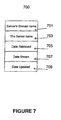
- the format of the records in this data base is illustrated in Figure 7 .
- the record 700 contains the server's domain name 701 , the server's identification data 703 , and three date fields 705, 707, and 709 .
- the Date Retrieved field 705 contains the date when the server's identification data was last retrieved.
- the Date Shown field 707 contains the date when the server's identification data was last shown to a user.
- the Date Updated field 709 contains the date of the last attempt to update the server's identification data.
- the internal structure of the record 700 may be organized in many different ways and with different data fields.
- Figure 8 illustrates how this database is used and populated.
- the process starts 801 after a webpage is downloaded to the WWW browser. Each URL on the webpage is examined 803 . If 805 a database record 700 exists containing the URL's server domain name 701 , the server's identification data 703 is retrieved from the database and the database Date Shown field 707 is updated appropriately 813 . However, if 805 the database does not contain a record matching the server's domain name, the process creates a record 807 , retrieves the server's identification data 809 , as described above, saves this data in the record 811 and initializes the date fields 705, 707, 709 and adds the record 700 to the database 813 . This process occurs for each URL contained in the downloaded webpage. Finally, the process terminates through the terminal labeled 815 .
- Figure 9 illustrates how the database is maintained. This process starts when the WWW browser is in a period of low load.
- a low load condition in one embodiment of the invention is defined to be when all of the following conditions are met:
- the database update process starts at the terminal labeled 901 .
- Each record 700 in the database is processed 905 .
- the update process completes through the terminal labeled 903 .
- the first test 907 determines whether the record 700 is old enough to be updated. If 907 the Date Retrieved field 705 of the record is less than one month prior to the current date, the record 700 is not updated and the next record 700 is examined. However, if 907 the Date Retrieved field 705 of the record is one month or more prior to the current date, the update procedure continues.
- the next test 909 determines the relevancy of the record 700 . That is, if the URL has not been accessed within some period of time, the URL is no longer of interest and the record 700 is not updated. Thus, if 909 the Date Shown field 707 is a week or more prior to the current date the record 700 is not updated and the next record 700 is examined. However, if the Date Shown field 707 of the record of interest is less than a week prior to the current date the update procedure continues. Furthermore, this test 909 deletes the record 700 if the Date Shown field 707 is more than some number of days prior to the current date. Thus this test 909 also performs a maintenance function on the database. In a preferred embodiment, the record 700 is deleted if the server's identification data has not been displayed within ninety days.
- the final test 911 limits the frequency of update attempts for the record 700 . If 911 the Date Updated field 709 is a week or less prior to the current date, the record 700 is not updated and the next record 700 is examined. However, if the Date Updated field 709 is more than a week prior to the current date the update process 913 (described below) is initiated.
- Figure 10 illustrates the process used for updating the database records. This process is implemented either within the WWW browser application or in an ancillary application that periodically executes to perform the process. The following describes this function as if it were implemented within the WWW browser. This processes is similar to the one described in Figure 5. However, there are two major differences 1) only the NAMEPLEASE and the GET methods are used; and 2) the time-out internal is significantly longer. In the preferred embodiment the time-out is set to ten times the time-out used for the process described in Figure 5.
- the update process starts at the terminal labeled 1001 .
- the WWW browser first attempts to obtain the server's identification data by sending a NAMEPLEASE HTTP message to the server 1003 .
- this HTTP message is an extension to existing HTTP facilities.
- This message consists the text "NAMEPLEASE” followed by a line terminator. If the WWW server recognizes the message, as described above for Figure 6, it responds with a success message and the server's identification data. In this situation the process completes through the successful exit terminal 1007 . On the other hand, if the server did not recognize the NAMEPLEASE message or if the WWW server does not respond for some period of time, the WWW browser attempts to obtain the server's identification data by using the well known GET HTTP message method 1005. This method is similar to the process described in Figure 5.
- the WWW browser exits through the no-update terminal labeled 1009. If this process is implemented using an ancillary application the WWW browser application and the ancillary application must coordinate access to the database. Methods to provide such coordination are well understood by those skilled in the art.
- a computer program running on a computer in the embodiment described.
- a computer program can be recorded on a recording medium (for example a magnetic disc or tape, an optical disc or an electronic memory device, such as a ROM) in a way well known to those skilled in the art.
- a suitable reading device such as a magnetic or optical disc drive
- a signal is produced which causes a computer to perform the processes described.
- the processes may also be performed by electronic means.
Landscapes
- Engineering & Computer Science (AREA)
- Databases & Information Systems (AREA)
- Theoretical Computer Science (AREA)
- Computer Networks & Wireless Communication (AREA)
- Signal Processing (AREA)
- Data Mining & Analysis (AREA)
- Physics & Mathematics (AREA)
- General Engineering & Computer Science (AREA)
- General Physics & Mathematics (AREA)
- Information Transfer Between Computers (AREA)
- Computer And Data Communications (AREA)
- Data Exchanges In Wide-Area Networks (AREA)
Claims (39)
- Appareil d'accès d'informations configuré pour accéder à des informations ; ledit appareil d'accès d'informations ayant une unité de traitement centrale (CPU), une mémoire, une interface réseau pour permettre l'accès à un réseau et un dispositif d'affichage ; ledit appareil d'accès d'informations utilisant un nom de domaine pour accéder auxdites informations présentes sur ledit réseau ; ledit appareil d'accès d'informations étant caractérisé par :un mécanisme d'accès configuré pour obtenir des données d'identification de serveur présentes sur ledit réseau et accessibles par utilisation dudit nom de domaine ; lesdites données d'identification de serveur comprenant des informations descriptives concernant un serveur ; etun mécanisme d'affichage configuré pour afficher lesdites données d'identification de serveur sur ledit dispositif d'affichage.
- Appareil d'accès d'informations selon la revendication 1 dans lequel ledit mécanisme d'accès comprend en outre un mécanisme d'accès d'annuaire de réseau configuré pour demander à un service d'annuaire de réseau de retourner une description ; ladite description étant choisie par ledit service d'annuaire de réseau sur la base dudit nom de domaine ; ladite description comprenant lesdites données d'identification de serveur.
- Appareil d'accès d'informations selon la revendication 2 dans lequel ledit mécanisme d'accès d'annuaire de réseau comprend en outre un programme utilitaire Whois.
- Appareil d'accès d'informations selon la revendication 1 dans lequel ledit mécanisme d'accès comprend en outre :un mécanisme d'interrogation configuré pour envoyer une requête d'interrogation pour amener ledit serveur à envoyer lesdites données d'identification de serveur audit appareil d'accès d'informations ; etun mécanisme récepteur configuré pour recevoir lesdites données d'identification de serveur provenant dudit serveur.
- Appareil d'accès d'informations selon la revendication 4 dans lequel ledit mécanisme d'accès comprend en outre un appareil de navigation WWW (World Wide Web) configuré pour utiliser un protocole de transfert hypertexte (HTTP) pour mettre en oeuvre ledit mécanisme d'interrogation et ledit mécanisme récepteur, ledit HTTP utilisant un localisateur de ressources uniformes (URL).
- Appareil d'accès d'informations selon la revendication 5 dans lequel ladite requête d'interrogation comprend une chaíne nameplease.
- Appareil d'accès d'informations selon la revendication 5 dans lequel ladite requête d'interrogation comprend une chaíne filename.
- Appareil d'accès d'informations selon la revendication 5 dans lequel ledit appareil de navigation WWW comprend en outre un mécanisme d'accès de base de données configuré pour accéder à et gérer une base de données ; ladite base de données comprenant un enregistrement contenant ledit URL et lesdites données d'identification de serveur.
- Appareil selon la revendication 1 comprenant un appareil serveur ayant une unité de traitement centrale (CPU), une mémoire, une interface réseau pour permettre l'accès à un réseau et un mécanisme de stockage de fichier ; ledit appareil serveur étant réactif à un nom de domaine ; ledit appareil serveur étant configuré pour transmettre des informations sur ledit réseau ; ledit appareil serveur comprenant :un mécanisme d'identification de serveur configuré pour fournir des données d'identification de serveur, lesdites données d'identification de serveur comprenant des informations descriptives concernant ledit appareil serveur.
- Appareil serveur selon la revendication 9 dans lequel ledit mécanisme d'identification de serveur comprend en outre :un mécanisme de reconnaissance d'interrogation configuré pour reconnaítre une requête d'interrogation pour lesdites données d'identification de serveur ; etun mécanisme de réponse configuré pour retourner lesdites données d'identification de serveur en réponse à ladite requête d'interrogation.
- Appareil serveur selon la revendication 10 dans lequel ledit appareil serveur comprend en outre un appareil serveur WWW (World Wide Web) configuré pour utiliser un protocole de transfert hypertexte (HTTP) pour mettre en oeuvre ledit mécanisme de reconnaissance d'interrogation et ledit mécanisme de réponse ; ledit HTTP utilisant un localisateur de ressources uniformes (URL).
- Appareil serveur selon la revendication 11 dans lequel ladite requête d'interrogation comprend une chaíne nameplease.
- Appareil serveur selon la revendication 11 dans lequel ladite requête d'interrogation comprend une chaíne filename.
- Procédé contrôlé par ordinateur pour afficher des informations ; ledit procédé utilisant un nom de domaine pour accéder auxdites informations présentes sur un réseau ; ledit procédé étant caractérisé par les étapes consistant à :a) obtenir des données d'identification de serveur, présentes sur ledit réseau et accessibles en utilisant ledit nom de domaine, lesdites données d'identification de serveur comprenant des informations descriptives relatives à un serveur ; etb) afficher lesdites données d'identification de serveur sur un dispositif d'affichage.
- Procédé contrôlé par ordinateur selon la revendication 14 dans lequel l'étape d'obtention des données d'identification de serveur comprend en outre l'étape de requête d'un service d'annuaire de réseau pour retourner une description ; ladite description étant sélectionnée par ledit service d'annuaire sur la base dudit nom de domaine ; ladite description comprenant lesdites données d'identification de serveur.
- Procédé contrôlé par ordinateur selon la revendication 15 dans lequel l'étape de requête dudit service d'annuaire de réseau comprend en outre l'étape d'accès à un programme utilitaire Whois.
- Procédé contrôlé par ordinateur selon la revendication 14 dans lequel l'étape d'obtention desdites données d'identification de serveur comprend les étapes consistant à :a1) envoyer une requête d'interrogation audit serveur ;a2) reconnaítre ladite requête d'interrogation par ledit serveur ;a3) retourner lesdites données d'identification de serveur provenant dudit serveur en réponse à ladite requête d'interrogation ; eta4) recevoir lesdites données d'identification de serveur.
- Procédé contrôlé par ordinateur selon la revendication 17 dans lequel l'étape d'obtention desdites données d'identification de serveur comprend en outre l'utilisation d'un protocole de transfert hypertexte (HTTP) pour accéder auxdites données d'identification de serveur, ledit HTTP utilisant un localisateur de ressources uniformes (URL).
- Procédé contrôlé par ordinateur selon la revendication 18 dans lequel ledit message de requête d'interrogation comprend une chaíne nameplease.
- Procédé contrôlé par ordinateur selon la revendication 18 dans lequel ledit message de requête d'interrogation comprend une chaíne filename.
- Procédé contrôlé par ordinateur selon la revendication 18 dans lequel l'étape d'obtention desdites données d'identification de serveur comprend en outre la maintenance d'une base de données pour améliorer l'accès auxdites données d'identification de serveur, ladite base de données comprenant un enregistrement contenant ledit URL et lesdites données d'identification de serveur.
- Procédé contrôlé par ordinateur selon la revendication 14 pour transmettre des informations sur un réseau en utilisant un nom de domaine ; ledit procédé comprenant en outre l'étape dans laquelle un serveur fournit des données d'identification de serveur comprenant des informations descriptives concernant ledit serveur, ledit serveur étant spécifié par ledit nom de domaine.
- Procédé contrôlé par ordinateur selon la revendication 22 dans lequel l'étape de fourniture desdites données d'identification de serveur comprend en outre les étapes consistant à :a) reconnaítre une requête d'interrogation pour lesdites données d'identification de serveur ; etb) retourner lesdites données d'identification de serveur en réponse à ladite requête d'interrogation.
- Procédé contrôlé par ordinateur selon la revendication 23 dans lequel l'étape de fourniture desdites données d'identification de serveur comprend en outre les étapes consistant à :traiter le protocole de transfert hypertexte (HTTP) ;décoder un message de requête HTTP pour reconnaítre ladite requête d'interrogation ; etcoder lesdites données d'identification de serveur dans un message de réponse HTTP ; ledit HTTP utilisant un localisateur de ressources uniformes (URL).
- Procédé contrôlé par ordinateur selon la revendication 24 dans lequel ladite requête d'interrogation comprend une chaíne nameplease.
- Procédé contrôlé par ordinateur selon la revendication 24 dans lequel ladite requête d'interrogation comprend une chaíne filename.
- Produit de programme informatique comprenant :un support utilisable sur ordinateur ayant du code lisible par ordinateur incorporé dans celui-ci pour conduire des données d'identification de serveur à être affichées, ledit produit de programme informatique comprenant :des dispositifs à code de programme lisible par ordinateur configurés pour conduire un ordinateur à mettre en oeuvre un appareil d'accès d'informations configuré pour accéder à des informations ; ledit appareil d'accès d'informations ayant une unité de traitement centrale (CPU), une mémoire, une interface réseau pour permettre l'accès à un réseau et un dispositif d'affichage ; ledit appareil d'accès d'informations utilisant un nom de domaine pour accéder auxdites informations présentes sur ledit réseau ; ledit produit de programme informatique étant en outre caractérisé par :des dispositifs à code de programme lisible par ordinateur configurés pour conduire ledit ordinateur à mettre en oeuvre un mécanisme d'accès configuré pour obtenir lesdites données d'identification de serveur présentes sur ledit réseau et accessibles en utilisant ledit nom de domaine ; lesdites données d'identification de serveur comprenant des informations descriptives concernant un serveur ; etdes dispositifs à code de programme lisible par ordinateur configurés pour conduire ledit ordinateur à mettre en oeuvre un mécanisme d'affichage configuré pour afficher lesdites données d'identification de serveur sur ledit dispositif d'affichage.
- Produit de programme informatique selon la revendication 27, dans lequel ledit mécanisme d'accès comprend en outre : un mécanisme d'accès d'annuaire de réseau configuré pour demander à un service d'annuaire de réseau de retourner une description ; ladite description étant choisie par ledit service d'annuaire sur la base dudit nom de domaine ; ladite description comprenant lesdites données d'identification de serveur.
- Produit de programme informatique selon la revendication 28 dans lequel ledit mécanisme d'accès d'annuaire de réseau comprend en outre un programme utilitaire Whois.
- Produit de programme informatique selon la revendication 27, dans lequel ledit mécanisme d'accès comprend en outre :des dispositifs à code de programme lisible par ordinateur configurés pour conduire ledit ordinateur à mettre en oeuvre un mécanisme d'interrogation configuré pour envoyer une requête d'interrogation pour conduire le serveur à envoyer lesdites données d'identification de serveur audit appareil d'accès d'informations ; etdes dispositifs à code de programme lisible par ordinateur configurés pour conduire ledit ordinateur à mettre en oeuvre un mécanisme récepteur configuré pour recevoir lesdites données d'identification de serveur provenant dudit serveur.
- Produit informatique selon la revendication 30 dans lequel ledit appareil d'accès d'informations comprend en outre des dispositifs à code de programme lisible par ordinateur configurés pour conduire ledit ordinateur à mettre en oeuvre un appareil de navigation WWW (World Wide Web) configuré pour utiliser un protocole de transfert hypertexte (HTTP) pour mettre en oeuvre ledit mécanisme d'interrogation et ledit mécanisme récepteur, ledit HTTP utilisant un localisateur de ressources uniformes (URL).
- Produit de programme informatique selon la revendication 31 dans lequel ladite requête d'interrogation comprend une chaíne nameplease.
- Produit de programme informatique selon la revendication 31 dans lequel ladite requête d'interrogation comprend une chaíne filename.
- Produit informatique selon la revendication 31 dans lequel :ledit appareil de navigation WWW comprend en outre des dispositifs à code de programme lisible par ordinateur configurés pour conduire ledit ordinateur à mettre en oeuvre un mécanisme d'accès de base de données configuré pour accéder à et gérer une base de données ; ladite base de données comprenant un enregistrement contenant ledit URL et lesdites données d'identification de serveur.
- Produit de programme informatique selon la revendication 27 comprenant en outre :un support utilisable sur ordinateur ayant du code lisible par ordinateur incorporé dans celui-ci pour fournir des données d'identification de serveur, ledit produit de programme informatique comprenant :des dispositifs à code de programme lisible par ordinateur configurés pour conduire un ordinateur à mettre en oeuvre un appareil serveur ayant une unité de traitement centrale (CPU), une mémoire, une interface réseau pour permettre l'accès à un réseau et un mécanisme de stockage de fichier ; ledit appareil serveur étant réactif à un nom de domaine ; ledit appareil serveur étant configuré pour transmettre des informations sur ledit réseau ; etledit appareil serveur comprenant en outre des dispositifs à code de programme lisible par ordinateur configurés pour conduire ledit ordinateur à mettre en oeuvre un mécanisme d'identification de serveur configuré pour fournir lesdites données d'identification de serveur, lesdites données d'identification de serveur comprenant des informations descriptives concernant ledit appareil serveur.
- Produit informatique selon la revendication 35, dans lequel ledit mécanisme d'identification de serveur comprend en outre :des dispositifs à code de programme lisible par ordinateur configurés pour conduire un ordinateur à mettre en oeuvre un mécanisme de reconnaissance d'interrogation configuré pour reconnaítre une requête d'interrogation pour lesdites données d'identification de serveur ; etdes dispositifs à code de programme lisible par ordinateur configurés pour conduire un ordinateur à mettre en oeuvre un mécanisme de réponse configuré pour retourner lesdites données d'identification de serveur en réponse à ladite requête d'interrogation.
- Produit de programme informatique selon la revendication 36 dans lequel ledit appareil serveur comprend des dispositifs à code de programme lisible par ordinateur configurés pour conduire un ordinateur à mettre en oeuvre un appareil serveur WWW (World Wide Web) configuré pour utiliser un protocole de transfert hypertexte (HTTP) pour mettre en oeuvre ledit mécanisme de reconnaissance d'interrogation et ledit mécanisme de réponse ; ledit HTTP utilisant un localisateur de ressources uniformes (URL).
- Produit de programme informatique selon la revendication 37 dans lequel ladite requête d'interrogation comprend une chaíne nameplease.
- Produit de programme informatique selon la revendication 38 dans lequel ladite requête d'interrogation comprend une chaíne filename.
Applications Claiming Priority (2)
| Application Number | Priority Date | Filing Date | Title |
|---|---|---|---|
| US628418 | 1996-04-05 | ||
| US08/628,418 US5925106A (en) | 1996-04-05 | 1996-04-05 | Method and apparatus for obtaining and displaying network server information |
Publications (3)
| Publication Number | Publication Date |
|---|---|
| EP0800143A2 EP0800143A2 (fr) | 1997-10-08 |
| EP0800143A3 EP0800143A3 (fr) | 1999-08-04 |
| EP0800143B1 true EP0800143B1 (fr) | 2004-12-22 |
Family
ID=24518794
Family Applications (1)
| Application Number | Title | Priority Date | Filing Date |
|---|---|---|---|
| EP97302370A Expired - Lifetime EP0800143B1 (fr) | 1996-04-05 | 1997-04-07 | Procédé et dispositif pour obtenir et afficher des informations concernant des serveurs de réseau |
Country Status (4)
| Country | Link |
|---|---|
| US (1) | US5925106A (fr) |
| EP (1) | EP0800143B1 (fr) |
| JP (1) | JPH1063596A (fr) |
| DE (1) | DE69731994T2 (fr) |
Families Citing this family (26)
| Publication number | Priority date | Publication date | Assignee | Title |
|---|---|---|---|---|
| US6385646B1 (en) * | 1996-08-23 | 2002-05-07 | At&T Corp. | Method and system for establishing voice communications in an internet environment |
| US8079086B1 (en) | 1997-11-06 | 2011-12-13 | Finjan, Inc. | Malicious mobile code runtime monitoring system and methods |
| US7058822B2 (en) | 2000-03-30 | 2006-06-06 | Finjan Software, Ltd. | Malicious mobile code runtime monitoring system and methods |
| US20020107946A1 (en) * | 1997-06-30 | 2002-08-08 | Michael C. Albers | Method and apparatus maintaining a to-be-visited site bookmark file |
| US6247050B1 (en) * | 1997-09-12 | 2001-06-12 | Intel Corporation | System for collecting and displaying performance improvement information for a computer |
| US6151624A (en) * | 1998-02-03 | 2000-11-21 | Realnames Corporation | Navigating network resources based on metadata |
| US6185598B1 (en) | 1998-02-10 | 2001-02-06 | Digital Island, Inc. | Optimized network resource location |
| US7949779B2 (en) * | 1998-02-10 | 2011-05-24 | Level 3 Communications, Llc | Controlling subscriber information rates in a content delivery network |
| EP1157524B1 (fr) * | 1999-03-03 | 2007-12-19 | Ultradns, Inc. | Resolution de nom de domaine efficace et evolutive |
| JP2001134504A (ja) * | 1999-11-02 | 2001-05-18 | Funai Electric Co Ltd | ネットワーク装置 |
| US7545833B2 (en) * | 1999-11-17 | 2009-06-09 | Ms Sedco | RF door activation system |
| US7765271B1 (en) | 2000-02-03 | 2010-07-27 | Hyland Software, Inc. | System and method for scanning a document in client/server environment |
| KR20010109895A (ko) * | 2000-06-03 | 2001-12-12 | 박종섭 | 차세대 이동통신시스템에서의 망 도메인 구별 방법 및그를 이용한 망 연동 서비스 방법 |
| EP1217806A1 (fr) * | 2000-12-22 | 2002-06-26 | Sun Microsystems, Inc. | Serveur de réseau et méthode pour contrôler un serveur de réseau |
| US7373644B2 (en) | 2001-10-02 | 2008-05-13 | Level 3 Communications, Llc | Automated server replication |
| US20030079027A1 (en) | 2001-10-18 | 2003-04-24 | Michael Slocombe | Content request routing and load balancing for content distribution networks |
| US20120323788A1 (en) * | 2002-02-05 | 2012-12-20 | Cardinalcommerce Corporation | Dynamic pin pad for credit/debit/other electronic transactions |
| US20080235055A1 (en) * | 2003-07-17 | 2008-09-25 | Scott Mattingly | Laboratory instrumentation information management and control network |
| US7908286B2 (en) * | 2004-12-08 | 2011-03-15 | Oracle International Corporation | Techniques for providing XQuery access using web services |
| JP2009290729A (ja) * | 2008-05-30 | 2009-12-10 | Ricoh Co Ltd | 画像形成装置、情報処理方法、及びプログラム |
| US8909683B1 (en) | 2009-07-17 | 2014-12-09 | Open Invention Network, Llc | Method and system for communicating with internet resources to identify and supply content for webpage construction |
| FR2956543B1 (fr) * | 2010-02-17 | 2012-02-03 | Evidian | Procede et dispositif de propagation d'evenements de gestion de session. |
| US9645996B1 (en) | 2010-03-25 | 2017-05-09 | Open Invention Network Llc | Method and device for automatically generating a tag from a conversation in a social networking website |
| US9565298B1 (en) * | 2010-03-25 | 2017-02-07 | Open Invention Network Llc | Method and device for appending information in a conversation in a voice based networking website |
| CN116074925B (zh) * | 2022-12-30 | 2026-04-14 | 苏州易泰勒电子科技有限公司 | 一种基于2.4g私有协议的标签二维寻址方法 |
| US12591704B2 (en) | 2023-11-28 | 2026-03-31 | International Business Machines Corporation | Entity-wide database asset index generation |
Family Cites Families (4)
| Publication number | Priority date | Publication date | Assignee | Title |
|---|---|---|---|---|
| GB2281793A (en) * | 1993-09-11 | 1995-03-15 | Ibm | A data processing system for providing user load levelling in a network |
| US5483652A (en) * | 1994-01-24 | 1996-01-09 | Digital Equipment Corporation | Mechanism for locating without search discrete application resources known by common name only in a distributed network computing environment |
| US5664185A (en) * | 1995-05-22 | 1997-09-02 | Sterling Commerce, Inc. | Nameserver administration system and method |
| US5617540A (en) * | 1995-07-31 | 1997-04-01 | At&T | System for binding host name of servers and address of available server in cache within client and for clearing cache prior to client establishes connection |
-
1996
- 1996-04-05 US US08/628,418 patent/US5925106A/en not_active Expired - Lifetime
-
1997
- 1997-04-07 JP JP9102380A patent/JPH1063596A/ja active Pending
- 1997-04-07 EP EP97302370A patent/EP0800143B1/fr not_active Expired - Lifetime
- 1997-04-07 DE DE69731994T patent/DE69731994T2/de not_active Expired - Fee Related
Also Published As
| Publication number | Publication date |
|---|---|
| EP0800143A2 (fr) | 1997-10-08 |
| US5925106A (en) | 1999-07-20 |
| DE69731994D1 (de) | 2005-01-27 |
| EP0800143A3 (fr) | 1999-08-04 |
| DE69731994T2 (de) | 2005-12-08 |
| JPH1063596A (ja) | 1998-03-06 |
Similar Documents
| Publication | Publication Date | Title |
|---|---|---|
| US5925106A (en) | Method and apparatus for obtaining and displaying network server information | |
| US6510461B1 (en) | System for managing and automatically deleting network address identified and stored during a network communication session when the network address is visited | |
| US6981210B2 (en) | Self-maintaining web browser bookmarks | |
| US6810395B1 (en) | Method and apparatus for query-specific bookmarking and data collection | |
| EP0817107B1 (fr) | Méthode et appareil de présentation d'information concernant chacun d'une pluralité d'hyperliens | |
| US5826267A (en) | Web information kiosk | |
| US5907680A (en) | Client-side, server-side and collaborative spell check of URL's | |
| KR100296361B1 (ko) | 월드와이드웹을통한정보및기타자료의관리및억세스시스템 | |
| US7359977B2 (en) | Ubiquitous visited links | |
| US6061686A (en) | Updating a copy of a remote document stored in a local computer system | |
| US20030110161A1 (en) | Method, product, and apparatus for providing search results | |
| US7386614B2 (en) | Method allowing persistent links to web-pages | |
| US6408316B1 (en) | Bookmark set creation according to user selection of selected pages satisfying a search condition | |
| US8429201B2 (en) | Updating a database from a browser | |
| US7818435B1 (en) | Reverse proxy mechanism for retrieving electronic content associated with a local network | |
| KR100307015B1 (ko) | 전자메시지를조직화하기위한방법및데이터처리시스템 | |
| CA2346156C (fr) | Procede et systeme d'obtention d'une vue d'ensemble de sites web | |
| EP1072984A2 (fr) | Procédé et système de recouvrement en langue maternelle | |
| US7143181B2 (en) | System and method of sending chunks of data over wireless devices | |
| CN1273654A (zh) | 处理超链接信息的方法 | |
| WO2002061627A2 (fr) | Systeme intelligent de liaison entre documents | |
| US20020087559A1 (en) | Method and system for retrieving documents using hyperlinks | |
| US6883020B1 (en) | Apparatus and method for filtering downloaded network sites | |
| US20030187668A1 (en) | Group administration of universal resource identifiers | |
| US6931588B1 (en) | Method, medium, display device, and hypertext display system including correspondence information between location information and link information |
Legal Events
| Date | Code | Title | Description |
|---|---|---|---|
| PUAI | Public reference made under article 153(3) epc to a published international application that has entered the european phase |
Free format text: ORIGINAL CODE: 0009012 |
|
| AK | Designated contracting states |
Kind code of ref document: A2 Designated state(s): DE FR GB NL SE |
|
| PUAL | Search report despatched |
Free format text: ORIGINAL CODE: 0009013 |
|
| AK | Designated contracting states |
Kind code of ref document: A3 Designated state(s): DE FR GB NL SE |
|
| 17P | Request for examination filed |
Effective date: 20000204 |
|
| 17Q | First examination report despatched |
Effective date: 20020924 |
|
| GRAP | Despatch of communication of intention to grant a patent |
Free format text: ORIGINAL CODE: EPIDOSNIGR1 |
|
| GRAS | Grant fee paid |
Free format text: ORIGINAL CODE: EPIDOSNIGR3 |
|
| GRAA | (expected) grant |
Free format text: ORIGINAL CODE: 0009210 |
|
| AK | Designated contracting states |
Kind code of ref document: B1 Designated state(s): DE FR GB NL SE |
|
| PG25 | Lapsed in a contracting state [announced via postgrant information from national office to epo] |
Ref country code: NL Free format text: LAPSE BECAUSE OF FAILURE TO SUBMIT A TRANSLATION OF THE DESCRIPTION OR TO PAY THE FEE WITHIN THE PRESCRIBED TIME-LIMIT Effective date: 20041222 Ref country code: FR Free format text: LAPSE BECAUSE OF FAILURE TO SUBMIT A TRANSLATION OF THE DESCRIPTION OR TO PAY THE FEE WITHIN THE PRESCRIBED TIME-LIMIT Effective date: 20041222 |
|
| REG | Reference to a national code |
Ref country code: GB Ref legal event code: FG4D |
|
| REF | Corresponds to: |
Ref document number: 69731994 Country of ref document: DE Date of ref document: 20050127 Kind code of ref document: P |
|
| PG25 | Lapsed in a contracting state [announced via postgrant information from national office to epo] |
Ref country code: SE Free format text: LAPSE BECAUSE OF FAILURE TO SUBMIT A TRANSLATION OF THE DESCRIPTION OR TO PAY THE FEE WITHIN THE PRESCRIBED TIME-LIMIT Effective date: 20050322 |
|
| NLV1 | Nl: lapsed or annulled due to failure to fulfill the requirements of art. 29p and 29m of the patents act | ||
| PLBE | No opposition filed within time limit |
Free format text: ORIGINAL CODE: 0009261 |
|
| STAA | Information on the status of an ep patent application or granted ep patent |
Free format text: STATUS: NO OPPOSITION FILED WITHIN TIME LIMIT |
|
| 26N | No opposition filed |
Effective date: 20050923 |
|
| EN | Fr: translation not filed | ||
| PGFP | Annual fee paid to national office [announced via postgrant information from national office to epo] |
Ref country code: DE Payment date: 20070405 Year of fee payment: 11 |
|
| PG25 | Lapsed in a contracting state [announced via postgrant information from national office to epo] |
Ref country code: DE Free format text: LAPSE BECAUSE OF NON-PAYMENT OF DUE FEES Effective date: 20081101 |
|
| PGFP | Annual fee paid to national office [announced via postgrant information from national office to epo] |
Ref country code: GB Payment date: 20160406 Year of fee payment: 20 |
|
| REG | Reference to a national code |
Ref country code: GB Ref legal event code: PE20 Expiry date: 20170406 |
|
| PG25 | Lapsed in a contracting state [announced via postgrant information from national office to epo] |
Ref country code: GB Free format text: LAPSE BECAUSE OF EXPIRATION OF PROTECTION Effective date: 20170406 |