EP0800741B1 - Modem - Google Patents
Modem Download PDFInfo
- Publication number
- EP0800741B1 EP0800741B1 EP96932650A EP96932650A EP0800741B1 EP 0800741 B1 EP0800741 B1 EP 0800741B1 EP 96932650 A EP96932650 A EP 96932650A EP 96932650 A EP96932650 A EP 96932650A EP 0800741 B1 EP0800741 B1 EP 0800741B1
- Authority
- EP
- European Patent Office
- Prior art keywords
- modem
- microcontroller
- card
- communication
- commands
- Prior art date
- Legal status (The legal status is an assumption and is not a legal conclusion. Google has not performed a legal analysis and makes no representation as to the accuracy of the status listed.)
- Expired - Lifetime
Links
- 238000004891 communication Methods 0.000 claims abstract description 76
- 230000005540 biological transmission Effects 0.000 claims abstract description 11
- 230000009897 systematic effect Effects 0.000 abstract 2
- 230000004044 response Effects 0.000 description 22
- 230000006870 function Effects 0.000 description 15
- 230000015654 memory Effects 0.000 description 7
- 238000003780 insertion Methods 0.000 description 4
- 230000037431 insertion Effects 0.000 description 4
- 238000000034 method Methods 0.000 description 4
- 230000009471 action Effects 0.000 description 3
- 208000031968 Cadaver Diseases 0.000 description 2
- 238000013475 authorization Methods 0.000 description 2
- 238000012937 correction Methods 0.000 description 2
- 230000002093 peripheral effect Effects 0.000 description 2
- 238000012545 processing Methods 0.000 description 2
- 230000009466 transformation Effects 0.000 description 2
- 230000004913 activation Effects 0.000 description 1
- 238000004422 calculation algorithm Methods 0.000 description 1
- 238000004364 calculation method Methods 0.000 description 1
- 238000006243 chemical reaction Methods 0.000 description 1
- 238000007906 compression Methods 0.000 description 1
- 230000006835 compression Effects 0.000 description 1
- 238000013144 data compression Methods 0.000 description 1
- 230000005764 inhibitory process Effects 0.000 description 1
- 238000004519 manufacturing process Methods 0.000 description 1
- 210000000056 organ Anatomy 0.000 description 1
- 230000008054 signal transmission Effects 0.000 description 1
- 238000013518 transcription Methods 0.000 description 1
- 230000035897 transcription Effects 0.000 description 1
- 238000013024 troubleshooting Methods 0.000 description 1
Images

Classifications
-
- H—ELECTRICITY
- H04—ELECTRIC COMMUNICATION TECHNIQUE
- H04M—TELEPHONIC COMMUNICATION
- H04M11/00—Telephonic communication systems specially adapted for combination with other electrical systems
- H04M11/06—Simultaneous speech and data transmission, e.g. telegraphic transmission over the same conductors
Definitions
- the invention relates to modems, that is to say signal modulation and demodulation devices which allow to transmit or receive data (mainly digital) between a terminal and a communication network.
- the network connects at least two terminals and a modem is placed between each terminal and the network.
- Communication terminals are a particular area of the state of the art in which modems are used.
- the document "IEEE Transactions on Consumer Electronics” discloses a terminal whose microcontroller also manages a modem communication; said terminal being also connected to a standalone smart card reader since it has its own microcontroller.
- EP 524 100 describes the association around the same and single microcontroller, terminal, modem communication and a smart card reader. In both cases, they are capable devices to independently access a network of transmission via an integrated and managed modem function directly by the terminal microcontroller considered.
- the invention relates to a different field since it relates to the modems proper, i.e. to data transmission devices by modulation / demodulation. These are used to allow communication between the terminals precisely having no means of communication clean.
- the terminal will be a computer personal and the communication network will be a network deb telephone transmission.
- the modem is a peripheral organ of the personal computer, and it can be plugged in between a communication port computer (usually a communication port serial) and the telephone network.
- the protocol signal transmission is such that the network telephone, originally designed to transmit analog signals representing speech, may transmit coded signals representing data numeric, either in "character” mode (transmission bytes representing characters), either in mode "Fax" (point image transmission).
- PC personal computer
- the modem has two main functions: Modulation of electrical signals to transform binary data into signals compatible with the telephone transmission network, this according to a well-defined protocol which makes it possible to find the meaning of these signals at another end of the network; and demodulating signals from the network, to convert them into binary data which can be used by the PC to which the modem is connected.
- the microcontroller executes programs instructions in its ROM (frozen programs or subroutines, in general directly executable). It runs these programs in command function that it receives from the terminal by through the communication port which connects the terminal to modem. These commands can be in high-level language introduced directly to terminal keyboard and transmitted in ASCII form to microcontroller. Executable instructions contain all the elements necessary for ordering one-way signal conversion circuits and in the other (from the PC to the network and from the network to the PC) and other elements allowing ordering other modem functions (data compression, error correction, switching to fax mode or alphanumeric mode, etc.).
- AT commands The principle of AT commands is as follows: if the modem's microcontroller receives an ASCII code command that begins with the letters "A" and "T" and that ends with the ASCII code corresponding to the carriage return on a keyboard, then the microcontroller considers it to be a command for the modem and it executes the requested command; the command requested is defined by an ASCII character sequence introduced after the prefix sequence 'AT' and before the carriage return.
- the command is a command which corresponds to one of the communication functions (or linked to communication) between the PC and the network.
- the command may be sufficient on its own, or may require parameters and / or data to be executed. If there are parameters and / or data, these parameters or data follow the command before the carriage return code.
- the order can be an order phone number to call a correspondent: the name of the command in plain language is 'DP' (for "Dial Pulse"); the letters DP are sent to the modem microcontroller and are followed by telephone number requested; a separator that can possibly be provided between the order and number.
- the 'DP' command is therefore always followed of a data. So to request the call from number 40 67 11 99 from the PC keyboard, a user types on the keyboard the following sequence: ATDP40671199 and ends the command by hitting the return key cart.
- the modem's microcontroller then commands all the operations for the modem to send the pulse dial signal on the line, at destination of the correspondent called by this number.
- the command would be DT (for "Dial Tone") if the signal numbering sent on the line was not made up by series of pulses in corresponding numbers to the numbers called but by frequencies or different tones corresponding to the numbers called.
- Another example command is "A”. It's here answer to an incoming call: the modem is called by a corresponding; if we want him to respond, that is to say that he enters into communication with this correspondent on the network, we must send the microcontroller the 'ATA' sequence then the carriage return which ends the ordered.
- Another example is not a single command but by a macro command defining a group of possible commands; it's here macro command "+ F”, which must be followed by the command precisely chosen from the group.
- the macro command "+ F” indicates that communication on the network must be done in "fax” mode and not in mode "character”. This macro command is therefore followed by a other command corresponding to a requested function, itself followed if necessary by parameters or data necessary for the execution of the order.
- the invention aims on the one hand to increase significantly the possibilities functions conferred on a communication system by the presence of a smart card, on the other hand reduce the manufacturing costs induced by this addition, and finally to facilitate for the user the simultaneous control of communication with the modem and the use of a smart card as part of of this communication.
- the microcontroller of a modem which provides the main control functions of the communication between a PC and a network and which responds to commands from the PC, on the one hand instruction programs for these functions communication control, and other part of instruction programs that control a connection interface circuit with a smart card.
- modem microcontroller which is also the heart of a card reader chip; commands from the PC to control the modem allow to operate the microcontroller in smart card reader, for operations involving a smart card, or allow the microcontroller to operate in network communication control unit.
- the present invention provides a modem for data communication between a terminal and a data network, the modem comprising a microcontroller having instruction programs internal to manage this communication, these programs being put into action when the terminal sends predetermined commands to the microcontroller, characterized in that the modem further comprises a slot to receive a removable smart card, a connector in this housing for the establishment of electrical connections with contacts from the card to chip, and a card interface circuit connected between the microcontroller and connector to allow the communication between the smart card and the microcontroller via the connector and the card interface circuit, the interface circuit of card being controlled by the modem microcontroller, and the microcontroller with other programs internal instructions for managing the communication between the terminal and the smart card under control of other commands issued by the terminal.
- the modem therefore contains the mechanical elements necessary for the insertion of a smart card, its held in place, and at the electrical connection with specialized contacts; these specialist contacts are connected via an interface circuit of card to the microcontroller.
- the first prefix sequence is the 'AT' command; the second prefix sequence can be the command '+ G'. Therefore, all communication instructions with the smart card begin with the specific sequence 'AT + G'.
- sequences representing the commands are written in alphanumeric characters (letters, numbers and others classic ASCII symbols) and placed in quotes. They truly correspond to what the user must type on the keyboard if the commands are entered on the keyboard.
- the signals which correspond to them and which are sent to the microcontroller are binary sequences corresponding to the ASCII transcription of these alphanumeric characters and symbols.
- the instructions specifically for communication with the card are executed by the microcontroller when it receives and recognizes the command 'AT + G' as a prefix to these instructions.
- the smart card can be used to ensure an authorization to operate the PC or modem, but also to ensure the authentication of a subscriber from a control authority connected to the network : for example, if access to a database connected to the network is controlled by a server, this one can make inquiries authentication in which the smart card plays a main role. This is also the case to validate remote transactions with smart cards.
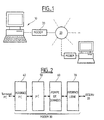
- Figure 1 shows a terminal 10, which is preferably a personal computer (PC) with sound keyboard and its screen, connected to a network of communication 20 which can simply be the network telephone.
- a modem 30 is conventionally interposed between the PC and the network to ensure that the data to be transmit by the PC to the network conform to a acceptable standard for this network.
- Other terminals are arranged at the other entry-exit points of the network and a modem is each time interposed between the terminal and network. A communication can thus be established between two PCs.
- the modem can be part of the PC; he makes in general then a specialized peripheral card in the PC; or it can be in a separate case from the computer, connected to a serial communication port on the PC.
- a microcontroller which constitutes the heart intelligent modem.
- This microcontroller includes a microprocessor (capable of receiving and executing instruction sets) and memories, including minus a program memory that has instruction programs or routines for the microprocessor.
- the different programs correspond to the different functions of round trip communication that the modem can fill : communication establishment routines (call, dialing, automatic response, etc.), error correction, redundancy, compression of data, fax mode, etc.
- the microcontroller knows that it has to configure the modem in "fax" mode and the instruction programs it will execute will correspond to a transmission protocol fax machine. Some modems do not have this "fax" mode.
- Figure 2 shows the configuration classic schematic of a modem, with a circuit 40 communication interface with the PC (usually a serial communication interface circuit), a microcontroller 50, a specialized signal processor 60 constituting the data pump ("Data Pump” in English), i.e. the circuit of modulation / demodulation proper controlled by the microcontroller, and a line interface circuit 70 (serial communication interface) connected to the network.
- PC usually a serial communication interface circuit
- microcontroller 50 usually a serial communication interface circuit
- a specialized signal processor 60 constituting the data pump ("Data Pump” in English), i.e. the circuit of modulation / demodulation proper controlled by the microcontroller
- line interface circuit 70 serial communication interface
- Figure 3 shows schematically the configuration of a modem according to the invention.
- the modem has the same components as on the Figure 2, and in addition the material elements specific to constitute a smart card reader but the heart of this reader is not a specific microcontroller programmed as a card reader but this is the microcontroller 50 of the modem, which includes software integrated (firmware) suitable for enabling communication between the card and the PC.
- the elements additional added compared to Figure 2 are, in addition to additional specific programs from firmware of the mcirocontroller, a housing 80 of receiving a smart card with an insertion slot 90, a connector in this slot, and a circuit card interface controllable by the microcontroller.
- Figure 4 shows schematically the card interface 100, the connector 110 and the card 120 with contacts 130 which can come opposite connector 110 when the card is inserted in its housing.
- any order for communication with the card begins with the sequence 'AT + G' and ends with an ASCII character corresponding to the carriage return. Following the sequence, before carriage return, precisely defines the requested command.
- Communication commands with the card can be diverse.
- the command 'AT + GON' is sent; it is followed by a parameter T1 (value between 0 and 255) defining the waiting time card insertion.
- T1 value between 0 and 255
- the response sent by the microcontroller of the modem to the terminal is made up of the sequence 'TS' followed by up to 32 characters.
- These characters can be the following parameters: T0 (character format), TAi, TBi, TCi, TDi (interface character), T1, T2 ... Tk (history characters), TCK (character control).
- the hot reset (without cutting voltage) is controlled by the sequence 'AT + GWR'.
- the answer is made up of an optional body which is a data field representing a number of words received, and a mandatory termination including two bytes SW1, SW2 called “command processing status "and” command processing qualifier "; these two bytes represent the fact that the command is correct and that there is no error on the data.
- DA write request
- APDU type commands for example a request to read an area of the map, a request calculation of signature by card, etc.
- the command is a query on the type card inserted.
- the command is 'AT + GI'. She is not not followed by parameters.
- the response is a group of two bytes R1, R2 representing the type of coupler and the type of card respectively.
- the power is turned off by the command 'AT + GOFF ", without parameters.
- the answer is byte R1 defining the type of coupler.
- the configuration of the card registers can be controlled by the terminal.
- the command is 'AT + GSR' followed by parameters S1, S2, S3 which define the registers to activate. (command "set register ").
- the response is a series of bytes confirming this activation.
- the card interface circuit 100 which is controlled by the microcontroller upon receipt of these commands is made up in a classic way (i.e. as in a smart card reader classical), so as to establish signals according to a classic communication protocol between a card and his reader.
- the connector of smart card generally includes 6 or 8 contacts from which at least the following contacts: CLK (clock), I / O data), RST (reset), VCC (power), and GND (mass). These contacts are recalled in Figure 4.
- the PC manages this security, modem access being authorized subject to that the PC has noticed that a smart card has been entered in the modem and that the secret code corresponding to this card has been introduced to the keyboard by the user.
- the procedure may be the next: the PC security program asks the user to insert a smart card into the modem and sends for example an instruction of the type 'AT + GON' to the modem microcontroller; when the card is present, it sends a response (in a communication protocol between reader and card) and this response is returned from the microcontroller to the PC (in the PC protocol); the PC asks the user to enter his secret code on the keyboard; he send this code to the card by an instruction starting with 'AT + G'; the card checks this code and returns an acceptance or refusal response; the modem microcontroller returns this acceptance or this refusal, and the PC authorizes or not the use of its "modem" device for communication with the network, depending on this acceptance or refusal.
- the PC asks the user to insert a smart card into the modem and sends for example an instruction of the type 'AT + GON' to the modem microcontroller; when the card is present, it sends a response (in a communication protocol between reader and card) and this response is returned from
- the smart card used to authorize access where transactions with a network correspondent. So this is not a security use in local mode but in mode distant.
- the PC is used to access a database.
- online data managed by a server access being authorized subject to the user being a authorized subscriber, equipped for this purpose with a smart card and a secret code that only he has.
- the card chip is then preferably a card comprising response calculation algorithms involving minus a secret key contained in the card.
- the PC establishes the connection with the network by 'AT' commands sent to the modem (but not 'AT + G' commands).
- the database server initiates a control procedure consisting of asking the PC to provide a response to random data.
- the correct response can only be sent if the PC user involves both the hazard, a secret key contained in the card and a code user-owned secret.
- the correct answer can also be calculated on the server side which knows its subscribers and therefore knows the secret keys, the secret codes and the hazard it sends. A comparison of responses by the server will allow access to the database.
- the PC After the PC has received a random on the part of the server, he commits by type commands 'AT + G' a dialogue with the card; the PC sends the hazard the modem microcontroller; this one sends it to the card in the card communication protocol; it does the same for a secret code that the PC requests from the user to enter; the card calculates a response, transmits it to the modem microcontroller which transmits it in turn to the PC; then the PC sends it over the network by a command of type 'AT' not followed by the prefix '+ G'. The server then checks the accuracy of the answer and authorize or not the access to the database data.
- the procedure would be similar to carry out a transaction validated by the fact that a response exact is provided by the card in response to a hazard.
- the microcontroller responds directly to a command specific from the network (and not from the PC) for transmit the hazard directly to the card, or other communication operations with the card without go through the PC. For example, if the procedures using the card do not require introduction of secret code on the keyboard, we can consider such direct operations, which are facilitated by the fact that it's the same microcontroller that controls at the both the modem and the smart card.
Landscapes
- Engineering & Computer Science (AREA)
- Computer Networks & Wireless Communication (AREA)
- Signal Processing (AREA)
- Communication Control (AREA)
- Computer And Data Communications (AREA)
- Telephonic Communication Services (AREA)
- Polysaccharides And Polysaccharide Derivatives (AREA)
- Retarders (AREA)
- Ultra Sonic Daignosis Equipment (AREA)
- Telephone Function (AREA)
- Credit Cards Or The Like (AREA)
Description
Modulation de signaux électriques pour transformer des données binaires en signaux compatibles avec le réseau de transmission téléphonique, ceci selon un protocole bien défini qui permet de retrouver la signification de ces signaux à une autre extrémité du réseau ; et démodulation des signaux en provenance du réseau, pour les convertir en données binaires pouvant être exploitées par le PC auquel est connecté le modem.
- d'un circuit d'interface de ligne pour fournir et recevoir des signaux dans le protocole correspondant au réseau de transmission,
- d'un circuit d'interface avec le PC pour fournir et recevoir des signaux selon le protocole du PC,
- d'un circuit de modulation/démodulation, parfois appelé pompe de données ("Data Pump" en anglais), pour transformer les signaux de données du protocole du PC vers le protocole du réseau, à l'émission de signaux, et pour faire la transformation inverse à la réception;
- d'un microcontrôleur (c'est-à-dire un microprocesseur avec ses mémoires et notamment avec une mémoire morte de programmes), pour contrôler la communication, et en particulier pour contrôler l'action des autres circuits du modem;
- et de programmes d'instructions figés contenus dans les mémoires du microcontrôleur;
si le microcontrôleur du modem reçoit une commande en code ASCII qui débute par les lettres "A" et "T" et qui se termine par le code ASCII correspondant au retour chariot sur un clavier, alors le microcontrôleur considère que c'est une commande pour le modem et il exécute la commande demandée; la commande demandée est définie par une séquence de caractères ASCII introduite après la séquence préfixe 'AT' et avant le retour chariot. La commande est une commande qui correspond à une des fonctions de communication (ou liées à la communication) entre le PC et le réseau. La commande peut être suffisante à elle seule, ou alors nécessiter des paramètres et/ou des données pour être exécutée.
S'il y a des paramètres et/ou des données, ces paramètres ou données suivent la commande avant le code de retour chariot.
- que toutes ces commandes commencent d'abord par une même première séquence préfixe reconnue par le microcontrôleur comme définissant une commande qui est destinée au modem, le microcontrôleur comportant des moyens pour reconnaítre l'arrivée de cette séquence préfixe et pour exécuter une commande qui suit cette séquence préfixe;
- et que toutes les commandes de communication avec la carte à puce se poursuivent, après la première séquence préfixe, par une deuxième séquence préfixe suivant immédiatement la première et suivie par une commande proprement dite, le microcontrôleur comportant des moyens pour reconnaítre cette deuxième séquence préfixe et pour exécuter alors ladite commande qui est une commande de communication entre le terminal et la carte.
- la figure 1 représente une configuration classique de PC raccordé à un réseau par un modem;
- la figure 2 représente la structure générale du modem;
- la figure 3 représente la structure du modem modifié selon l'invention;
- la figure 4 représente un détail de la figure 3.
- son microcontrôleur réagit à une séquence de deux caractères 'AT' pour considérer comme une commande la séquence qui suit;
- le même microcontrôleur réagit à une séquence de quatre caractères 'AT+G' pour considérer comme une commande de communication avec la carte à puce la séquence qui suit jusqu'au prochain caractère de retour de chariot;
- les commandes sont acceptées en majuscules ou en minuscules; le microcontrôleur interprète donc identiquement un caractère ASCII correspondant à un caractère alphabétique en minuscule et le caractère ASCII correspondant au même caractère alphabétique en majuscule;
- la séquence 'AT+G' est cependant d'un seul type;
- l'interprétation de la commande ne commence qu'après le retour chariot;
- les commandes pour la carte ne peuvent pas être chaínées : une commande n'est acceptée que si la précédente a été totalement exécutée et si la réponse éventuelle a été transmise; au contraire, les commandes de fonctionnement du modem pour la communication avec le réseau peuvent être chaínées;
- le nombre de caractères contenus dans une ligne de commande ne doit pas dépasser 256;
- la commande proprement dite peut être accompagnée de paramètres obligatoires ou facultatifs permettant son exécution;
- le signe égal '=' est un séparateur qui indique la présence de paramètres asociés à la commande; il est placé après la commande proprement dite; s'il y a plusieurs paramètres, ils sont séparés par une virgule (','); un paramètre peut être constitué par un ou plusieurs octets sans séparateur;
- les octets de commande reçus par le microcontrôleur sont exprimés en hexadécimal et constitués chacun par deux caractères ASCII; ils peuvent être introduits sur le clavier du PC et transmis tels quels au microcontrôleur.
- les réponses cartes sont d'un seul type (étendu) et ne peuvent pas être supprimées;
- chaque réponse commence et se termine par un retour de chariot suivi par la séquence 'LF';
- une réponse peut être constituée d'un ou plusieurs paramètres séparés par une virgule ',';
- la réponse 'ERROR' est renvoyée si la commande comporte une erreur de syntaxe ou si un ou plusieurs paramètres sont erronés.
- la commande comprend un en-tête et un corps;
- l'en-tête comprend des valeurs successives CLA, INS, P1, P2, représentées chacune par un octet (deux caractères ASSCII) ; chaque valeur est comprise entre 0 et 255; CLA est la classe d'instruction; INS est le code de l'instruction, P1 et P2 sont des paramètres;
- le corps de l'instruction comprend trois champs : Lc, Data, Le. Le champ Lc contient le nombre de mots présent dans le champ 'data'; data est le champ de données proprement dit à transmettre; "Le" est le nombre de mots attendus dans la réponse.
- paiement à distance par carte bancaire; vente par correspondance;
- accès sécurisé des réseaux d'entreprise aux réseaux extérieurs tels que le réseau "Internet";
- services de banque à domicile contrôlé par carte; virements de compte à compte; achats ou ventes de valeurs financières;
- porte-monnaie électronique;
- connexion automatique sécurisée vers des bases de données, ou vers des serveurs d'assistance logicielle fournissant des mises à jour de logiciels, des dépannages à distance, etc.
Claims (4)
- Modem (30) pour la communication de données entre un terminal (10) et un réseau de transmission de données (20), le modem (30) comportant un microcontrôleur (50) et des programmes d'instructions internes permettant de gérer cette communication, ces programmes étant mis en action lorsque le terminal (10) envoie au microcontrôleur (50) des commandes prédéterminées, caractérisé en ce que le modem (30) comporte en outre un logement (80) pour recevoir une carte à puce amovible (120), un connecteur (110) dans ce logement (80) pour l'établissement de liaisons électriques avec des contacts de la carte à puce (120), et un circuit d'interface de carte (100) relié entre le microcontrôleur (50) et le connecteur (110) pour permettre la communication entre la carte à puce (120) et le microcontrôleur (50) par l'intermédiaire du connecteur (110) et du circuit d'interface de carte (100), le circuit d'interface de carte (100) étant contrôlé par le microcontrôleur (50) du modem (30), et le microcontrôleur (50) comportant d'autres programmes d'instructions internes permettant de gérer la communication entre le terminal (10) et la carte à puce (120) sous le contrôle d'autres commandes émises par le terminal (10).
- Modem (30) selon la revendication 1, caractérisé en ce que toutes les commandes destinées au microcontrôleur (50) du modem (30) comportent une première séquence préfixe prédéterminée ('AT'), le microcontrôleur (50) comportant des moyens pour reconnaítre l'arrivée de cette séquence et pour exécuter une commande suivant cette séquence préfixe.
- Modem (30) selon la revendication 2, caractérisé en ce que toutes les commandes de communication entre le terminal (10) et la carte (120) comportent une deuxième séquence préfixe prédéterminée ('+G') suivant immédiatement la première séquence préfixe ('AT'), le microcontrôleur (50) comportant des moyens pour reconnaítre l'arrivée de cette deuxième séquence et pour exécuter une commande suivant ces deux séquences.
- Modem selon la revendication 2, caractérisé en ce que la première séquence préfixe est définie par les caractères 'AT' et la deuxième par les caractères '+G'.
Applications Claiming Priority (3)
| Application Number | Priority Date | Filing Date | Title |
|---|---|---|---|
| FR9511214A FR2739242B1 (fr) | 1995-09-25 | 1995-09-25 | Modem equipe d'un lecteur de carte a puce |
| FR9511214 | 1995-09-25 | ||
| PCT/FR1996/001497 WO1997012478A1 (fr) | 1995-09-25 | 1996-09-24 | Modem |
Publications (2)
| Publication Number | Publication Date |
|---|---|
| EP0800741A1 EP0800741A1 (fr) | 1997-10-15 |
| EP0800741B1 true EP0800741B1 (fr) | 2001-09-12 |
Family
ID=9482879
Family Applications (1)
| Application Number | Title | Priority Date | Filing Date |
|---|---|---|---|
| EP96932650A Expired - Lifetime EP0800741B1 (fr) | 1995-09-25 | 1996-09-24 | Modem |
Country Status (10)
| Country | Link |
|---|---|
| US (1) | US6181735B1 (fr) |
| EP (1) | EP0800741B1 (fr) |
| JP (1) | JP4385098B2 (fr) |
| CN (2) | CN1166254A (fr) |
| AT (1) | ATE205653T1 (fr) |
| CA (1) | CA2207121C (fr) |
| DE (1) | DE69615151T2 (fr) |
| ES (1) | ES2164262T3 (fr) |
| FR (1) | FR2739242B1 (fr) |
| WO (1) | WO1997012478A1 (fr) |
Families Citing this family (18)
| Publication number | Priority date | Publication date | Assignee | Title |
|---|---|---|---|---|
| CA2191905A1 (fr) * | 1995-12-08 | 1997-06-09 | Masayuki Ohki | Lecteur-enregistreur pour carte de monnaie electronique utilisee dans un ordinateur personnel et ordinateur personnel dote d'un tel lecteur-enregistreur |
| FR2763717A1 (fr) * | 1997-05-20 | 1998-11-27 | Scm Schneider Microsysteme Mic | Connecteur avec insertion directe ou indirecte d'une carte a puce en son sein |
| FR2763718B1 (fr) * | 1997-05-20 | 1999-07-16 | Scm Schneider Microsysteme Mic | Connecteur avec insertion directe ou indirecte d'une carte a puce en son sein |
| EP1252784B1 (fr) | 2000-02-04 | 2013-03-20 | Qualcomm Incorporated | Interface entre modem et module d'interface d'abonne |
| US20020162021A1 (en) * | 2001-04-30 | 2002-10-31 | Audebert Yves Louis Gabriel | Method and system for establishing a remote connection to a personal security device |
| US7363486B2 (en) * | 2001-04-30 | 2008-04-22 | Activcard | Method and system for authentication through a communications pipe |
| WO2002089444A1 (fr) * | 2001-04-30 | 2002-11-07 | Activcard Ireland, Limited | Procede et systeme d'authentification d'un dispositif de securite personnel vis-a-vis d'au moins un systeme informatique eloigne |
| US7225465B2 (en) * | 2001-04-30 | 2007-05-29 | Matsushita Electric Industrial Co., Ltd. | Method and system for remote management of personal security devices |
| TW552786B (en) * | 2001-04-30 | 2003-09-11 | Activcard | Method and system for remote activation and management of personal security devices |
| US7039952B2 (en) * | 2001-05-18 | 2006-05-02 | Sun Microsystems, Inc. | Using patterns to perform personal identification data substitution |
| US7076530B2 (en) * | 2001-08-31 | 2006-07-11 | Thomson Licensing | Multiple function modem including external memory adapter |
| US7162631B2 (en) * | 2001-11-02 | 2007-01-09 | Activcard | Method and system for scripting commands and data for use by a personal security device |
| US20030167399A1 (en) * | 2002-03-01 | 2003-09-04 | Yves Audebert | Method and system for performing post issuance configuration and data changes to a personal security device using a communications pipe |
| FR2853185A1 (fr) * | 2003-03-26 | 2004-10-01 | France Telecom | Dispositif de transmission d'informations sur un reseau de telecommunication. |
| GB0418215D0 (en) * | 2004-08-16 | 2004-09-15 | Matsushita Electric Industrial Co Ltd | Improved communications device |
| DE202004016235U1 (de) * | 2004-10-19 | 2005-01-13 | Klein, Frederic | Zugangs- und Abrechnungskontrolle für digitale Transportströme wie DVB und DAB Signale aus Gemeinschaftsantennenanlagen |
| US20090240567A1 (en) * | 2008-02-21 | 2009-09-24 | Micronotes, Llc | Interactive marketing system |
| US10255609B2 (en) | 2008-02-21 | 2019-04-09 | Micronotes, Inc. | Interactive marketing system |
Family Cites Families (7)
| Publication number | Priority date | Publication date | Assignee | Title |
|---|---|---|---|---|
| US5164985A (en) * | 1987-10-27 | 1992-11-17 | Nysen Paul A | Passive universal communicator system |
| US5369700A (en) * | 1991-07-16 | 1994-11-29 | Japan Business Systems, Inc. | Multi-function telephone apparatus and control method |
| AU686591B2 (en) * | 1992-12-17 | 1998-02-12 | Voxson Pty Ltd | An information transmission system for increasing the effective rate of transfer of information |
| US5624316A (en) * | 1994-06-06 | 1997-04-29 | Catapult Entertainment Inc. | Video game enhancer with intergral modem and smart card interface |
| US5546463A (en) * | 1994-07-12 | 1996-08-13 | Information Resource Engineering, Inc. | Pocket encrypting and authenticating communications device |
| US5778071A (en) * | 1994-07-12 | 1998-07-07 | Information Resource Engineering, Inc. | Pocket encrypting and authenticating communications device |
| GB9610645D0 (en) * | 1996-05-21 | 1996-07-31 | Ncr Int Inc | Financial transaction system |
-
1995
- 1995-09-25 FR FR9511214A patent/FR2739242B1/fr not_active Expired - Fee Related
-
1996
- 1996-09-24 US US08/849,640 patent/US6181735B1/en not_active Expired - Lifetime
- 1996-09-24 EP EP96932650A patent/EP0800741B1/fr not_active Expired - Lifetime
- 1996-09-24 CN CN96191117.4A patent/CN1166254A/zh active Pending
- 1996-09-24 CN CN200410047696.XA patent/CN1592343B/zh not_active Expired - Fee Related
- 1996-09-24 CA CA002207121A patent/CA2207121C/fr not_active Expired - Fee Related
- 1996-09-24 DE DE69615151T patent/DE69615151T2/de not_active Expired - Lifetime
- 1996-09-24 AT AT96932650T patent/ATE205653T1/de not_active IP Right Cessation
- 1996-09-24 JP JP50793297A patent/JP4385098B2/ja not_active Expired - Fee Related
- 1996-09-24 ES ES96932650T patent/ES2164262T3/es not_active Expired - Lifetime
- 1996-09-24 WO PCT/FR1996/001497 patent/WO1997012478A1/fr not_active Ceased
Also Published As
| Publication number | Publication date |
|---|---|
| JPH10510126A (ja) | 1998-09-29 |
| DE69615151T2 (de) | 2002-04-25 |
| JP4385098B2 (ja) | 2009-12-16 |
| FR2739242B1 (fr) | 1997-10-24 |
| CN1592343B (zh) | 2012-09-05 |
| DE69615151D1 (en) | 2001-10-18 |
| CA2207121C (fr) | 2000-07-11 |
| CA2207121A1 (fr) | 1997-04-03 |
| WO1997012478A1 (fr) | 1997-04-03 |
| ES2164262T3 (es) | 2002-02-16 |
| US6181735B1 (en) | 2001-01-30 |
| CN1592343A (zh) | 2005-03-09 |
| ATE205653T1 (de) | 2001-09-15 |
| EP0800741A1 (fr) | 1997-10-15 |
| FR2739242A1 (fr) | 1997-03-28 |
| CN1166254A (zh) | 1997-11-26 |
Similar Documents
| Publication | Publication Date | Title |
|---|---|---|
| EP0800741B1 (fr) | Modem | |
| WO2002065414A1 (fr) | Procede et systeme de telepaiement | |
| WO2003053739A2 (fr) | Procede d'acces a un service par un moyen radiofrequence associe a un objet portable a puce electronique | |
| US20110035798A1 (en) | System for identifying an individual, a method for identifying an individual or a business method | |
| FR2633411A1 (fr) | Systeme de gestion de supports d'informations portatifs | |
| EP1064769B1 (fr) | Terminal de telecommunication lecteur de carte a puce | |
| FR2795264A1 (fr) | Systeme et procedes d'acces securise a un serveur informatique utilisant ledit systeme | |
| EP1449092B1 (fr) | Procede de securisation d un acces a une ressource numerique | |
| FR2607340A1 (fr) | Dispositif de type ludique de mise en communication televideo de plusieurs correspondants | |
| KR100382882B1 (ko) | 지문을 이용한 인증 시스템 및 인증 방법 | |
| EP1174832B1 (fr) | Processeur de génération et de transmission de signature électronique et terminal de réseau de radiotéléphonie comportant un tel processeur | |
| EP0870279B1 (fr) | Dispositif portatif d'acces a au moins un service dispense par un serveur | |
| EP1301910B1 (fr) | Procede pour securiser une transaction via un reseau de telecommunication, et systeme de mise en oeuvre du procede | |
| EP1076886A1 (fr) | Procede pour effectuer une transaction securisee au moyen d'une carte a puce a travers un reseau de telecommunication | |
| KR20030092710A (ko) | 이동통신 단말기를 이용한 금융 자동화기기 거래방법 | |
| AU703028B2 (en) | Communication system for carrying out pin related services on a chipcard, a chipcard suitable for such a communication system, and method for carrying out a pin related service on the chipcard | |
| US7702313B1 (en) | Telecommunications terminal | |
| KR20050010426A (ko) | 모바일 뱅킹 서비스 방법 | |
| WO2003058916A1 (fr) | Dispositif de communication de securite notamment pour jeu de casino en ligne et procede pour effectuer des transactions personnalisees teleinformatiques | |
| FR2674345A1 (fr) | Procede et systeme de transaction et de telepaiement securises par cartes a memoire. | |
| WO2001057699A2 (fr) | Microcontroleur et procede pour la gestion d'applications interactives | |
| EP0838938A1 (fr) | Procédé de paiement de communications téléphoniques au moyen d'un numéroteur automatique | |
| KR20050086333A (ko) | 모바일 단말기를 이용한 결제 시스템 및 결제 방법과 그인증 방법 및 기록매체 | |
| WO1997017646A1 (fr) | Procede de realisation de transfert securise de donnees sur un reseau a serveurs multiples | |
| EP0790546A1 (fr) | Equipement téléphonique d'abonné à lecteur de carte et à fonction transactionnelle |
Legal Events
| Date | Code | Title | Description |
|---|---|---|---|
| PUAI | Public reference made under article 153(3) epc to a published international application that has entered the european phase |
Free format text: ORIGINAL CODE: 0009012 |
|
| AK | Designated contracting states |
Kind code of ref document: A1 Designated state(s): AT BE CH DE DK ES FR GB GR IE IT LI LU MC NL PT SE |
|
| 17P | Request for examination filed |
Effective date: 19971006 |
|
| 17Q | First examination report despatched |
Effective date: 20000121 |
|
| GRAG | Despatch of communication of intention to grant |
Free format text: ORIGINAL CODE: EPIDOS AGRA |
|
| GRAG | Despatch of communication of intention to grant |
Free format text: ORIGINAL CODE: EPIDOS AGRA |
|
| GRAH | Despatch of communication of intention to grant a patent |
Free format text: ORIGINAL CODE: EPIDOS IGRA |
|
| GRAH | Despatch of communication of intention to grant a patent |
Free format text: ORIGINAL CODE: EPIDOS IGRA |
|
| GRAA | (expected) grant |
Free format text: ORIGINAL CODE: 0009210 |
|
| AK | Designated contracting states |
Kind code of ref document: B1 Designated state(s): AT BE CH DE DK ES FR GB GR IE IT LI LU MC NL PT SE |
|
| PG25 | Lapsed in a contracting state [announced via postgrant information from national office to epo] |
Ref country code: SE Free format text: THE PATENT HAS BEEN ANNULLED BY A DECISION OF A NATIONAL AUTHORITY Effective date: 20010912 Ref country code: NL Free format text: LAPSE BECAUSE OF FAILURE TO SUBMIT A TRANSLATION OF THE DESCRIPTION OR TO PAY THE FEE WITHIN THE PRESCRIBED TIME-LIMIT Effective date: 20010912 Ref country code: IE Free format text: LAPSE BECAUSE OF FAILURE TO SUBMIT A TRANSLATION OF THE DESCRIPTION OR TO PAY THE FEE WITHIN THE PRESCRIBED TIME-LIMIT Effective date: 20010912 Ref country code: AT Free format text: LAPSE BECAUSE OF FAILURE TO SUBMIT A TRANSLATION OF THE DESCRIPTION OR TO PAY THE FEE WITHIN THE PRESCRIBED TIME-LIMIT Effective date: 20010912 |
|
| REF | Corresponds to: |
Ref document number: 205653 Country of ref document: AT Date of ref document: 20010915 Kind code of ref document: T |
|
| REG | Reference to a national code |
Ref country code: CH Ref legal event code: EP |
|
| PG25 | Lapsed in a contracting state [announced via postgrant information from national office to epo] |
Ref country code: MC Free format text: LAPSE BECAUSE OF NON-PAYMENT OF DUE FEES Effective date: 20010924 Ref country code: LU Free format text: LAPSE BECAUSE OF NON-PAYMENT OF DUE FEES Effective date: 20010924 |
|
| PG25 | Lapsed in a contracting state [announced via postgrant information from national office to epo] |
Ref country code: LI Free format text: LAPSE BECAUSE OF NON-PAYMENT OF DUE FEES Effective date: 20010930 Ref country code: CH Free format text: LAPSE BECAUSE OF NON-PAYMENT OF DUE FEES Effective date: 20010930 Ref country code: BE Free format text: LAPSE BECAUSE OF NON-PAYMENT OF DUE FEES Effective date: 20010930 |
|
| REG | Reference to a national code |
Ref country code: IE Ref legal event code: FG4D Free format text: FRENCH |
|
| REF | Corresponds to: |
Ref document number: 69615151 Country of ref document: DE Date of ref document: 20011018 |
|
| PG25 | Lapsed in a contracting state [announced via postgrant information from national office to epo] |
Ref country code: PT Free format text: LAPSE BECAUSE OF FAILURE TO SUBMIT A TRANSLATION OF THE DESCRIPTION OR TO PAY THE FEE WITHIN THE PRESCRIBED TIME-LIMIT Effective date: 20011212 Ref country code: DK Free format text: LAPSE BECAUSE OF FAILURE TO SUBMIT A TRANSLATION OF THE DESCRIPTION OR TO PAY THE FEE WITHIN THE PRESCRIBED TIME-LIMIT Effective date: 20011212 |
|
| PG25 | Lapsed in a contracting state [announced via postgrant information from national office to epo] |
Ref country code: GR Free format text: LAPSE BECAUSE OF FAILURE TO SUBMIT A TRANSLATION OF THE DESCRIPTION OR TO PAY THE FEE WITHIN THE PRESCRIBED TIME-LIMIT Effective date: 20011214 |
|
| REG | Reference to a national code |
Ref country code: GB Ref legal event code: IF02 |
|
| GBT | Gb: translation of ep patent filed (gb section 77(6)(a)/1977) |
Effective date: 20011212 |
|
| REG | Reference to a national code |
Ref country code: ES Ref legal event code: FG2A Ref document number: 2164262 Country of ref document: ES Kind code of ref document: T3 |
|
| NLV1 | Nl: lapsed or annulled due to failure to fulfill the requirements of art. 29p and 29m of the patents act | ||
| BERE | Be: lapsed |
Owner name: GEMPLUS Effective date: 20010930 |
|
| REG | Reference to a national code |
Ref country code: CH Ref legal event code: PL |
|
| REG | Reference to a national code |
Ref country code: IE Ref legal event code: FD4D |
|
| PLBE | No opposition filed within time limit |
Free format text: ORIGINAL CODE: 0009261 |
|
| STAA | Information on the status of an ep patent application or granted ep patent |
Free format text: STATUS: NO OPPOSITION FILED WITHIN TIME LIMIT |
|
| 26N | No opposition filed | ||
| REG | Reference to a national code |
Ref country code: GB Ref legal event code: S117 Free format text: REQUEST FILED; REQUEST FOR CORRECTION UNDER SECTION 117 FILED ON 26 APRIL 2010 |
|
| REG | Reference to a national code |
Ref country code: GB Ref legal event code: 732E Free format text: REGISTERED BETWEEN 20110616 AND 20110622 |
|
| PGFP | Annual fee paid to national office [announced via postgrant information from national office to epo] |
Ref country code: DE Payment date: 20110902 Year of fee payment: 16 |
|
| REG | Reference to a national code |
Ref country code: DE Ref legal event code: R042 Ref document number: 69615151 Country of ref document: DE Effective date: 20111026 |
|
| PGFP | Annual fee paid to national office [announced via postgrant information from national office to epo] |
Ref country code: GB Payment date: 20120828 Year of fee payment: 17 |
|
| PGFP | Annual fee paid to national office [announced via postgrant information from national office to epo] |
Ref country code: ES Payment date: 20120910 Year of fee payment: 17 Ref country code: IT Payment date: 20120829 Year of fee payment: 17 Ref country code: FR Payment date: 20121004 Year of fee payment: 17 |
|
| PG25 | Lapsed in a contracting state [announced via postgrant information from national office to epo] |
Ref country code: DE Free format text: THE PATENT HAS BEEN ANNULLED BY A DECISION OF A NATIONAL AUTHORITY Effective date: 20111026 |
|
| REG | Reference to a national code |
Ref country code: GB Ref legal event code: S72Z Free format text: CLAIM LODGED; CLAIM FOR REVOCATION LODGED AT THE PATENTS COURT ON 3 MAY 2011 (HC11C01178) |
|
| REG | Reference to a national code |
Ref country code: GB Ref legal event code: S72Z Free format text: PATENT REVOKED; CLAIM FOR REVOCATION LODGED AT THE PATENTS COURT ON 3 MAY 2011. IT IS ORDERED THAT THE PATENT BE REVOKED BY COURT ORDER DATED 31 JULY 2012 (HC11C01178). |
|
| PG25 | Lapsed in a contracting state [announced via postgrant information from national office to epo] |
Ref country code: GB Free format text: THE PATENT HAS BEEN ANNULLED BY A DECISION OF A NATIONAL AUTHORITY Effective date: 20120731 |
|
| REG | Reference to a national code |
Ref country code: FR Ref legal event code: ST Effective date: 20140530 |
|
| PG25 | Lapsed in a contracting state [announced via postgrant information from national office to epo] |
Ref country code: FR Free format text: LAPSE BECAUSE OF NON-PAYMENT OF DUE FEES Effective date: 20130930 Ref country code: IT Free format text: LAPSE BECAUSE OF NON-PAYMENT OF DUE FEES Effective date: 20130924 |
|
| REG | Reference to a national code |
Ref country code: ES Ref legal event code: FD2A Effective date: 20141007 |
|
| PG25 | Lapsed in a contracting state [announced via postgrant information from national office to epo] |
Ref country code: ES Free format text: LAPSE BECAUSE OF NON-PAYMENT OF DUE FEES Effective date: 20130925 |