EP0801431A1 - Aktive materialien auf nickel-hydroxidbasis für alkalische speicherbatterie und positive platte - Google Patents
Aktive materialien auf nickel-hydroxidbasis für alkalische speicherbatterie und positive platte Download PDFInfo
- Publication number
- EP0801431A1 EP0801431A1 EP96935480A EP96935480A EP0801431A1 EP 0801431 A1 EP0801431 A1 EP 0801431A1 EP 96935480 A EP96935480 A EP 96935480A EP 96935480 A EP96935480 A EP 96935480A EP 0801431 A1 EP0801431 A1 EP 0801431A1
- Authority
- EP
- European Patent Office
- Prior art keywords
- active material
- nickel hydroxide
- nickel
- storage battery
- alkaline storage
- Prior art date
- Legal status (The legal status is an assumption and is not a legal conclusion. Google has not performed a legal analysis and makes no representation as to the accuracy of the status listed.)
- Withdrawn
Links
Images
Classifications
-
- C—CHEMISTRY; METALLURGY
- C01—INORGANIC CHEMISTRY
- C01G—COMPOUNDS CONTAINING METALS NOT COVERED BY SUBCLASSES C01D OR C01F
- C01G53/00—Compounds of nickel
-
- H—ELECTRICITY
- H01—ELECTRIC ELEMENTS
- H01M—PROCESSES OR MEANS, e.g. BATTERIES, FOR THE DIRECT CONVERSION OF CHEMICAL ENERGY INTO ELECTRICAL ENERGY
- H01M4/00—Electrodes
- H01M4/02—Electrodes composed of, or comprising, active material
- H01M4/36—Selection of substances as active materials, active masses, active liquids
- H01M4/48—Selection of substances as active materials, active masses, active liquids of inorganic oxides or hydroxides
- H01M4/52—Selection of substances as active materials, active masses, active liquids of inorganic oxides or hydroxides of nickel, cobalt or iron
-
- C—CHEMISTRY; METALLURGY
- C01—INORGANIC CHEMISTRY
- C01P—INDEXING SCHEME RELATING TO STRUCTURAL AND PHYSICAL ASPECTS OF SOLID INORGANIC COMPOUNDS
- C01P2002/00—Crystal-structural characteristics
- C01P2002/70—Crystal-structural characteristics defined by measured X-ray, neutron or electron diffraction data
- C01P2002/72—Crystal-structural characteristics defined by measured X-ray, neutron or electron diffraction data by d-values or two theta-values, e.g. as X-ray diagram
-
- C—CHEMISTRY; METALLURGY
- C01—INORGANIC CHEMISTRY
- C01P—INDEXING SCHEME RELATING TO STRUCTURAL AND PHYSICAL ASPECTS OF SOLID INORGANIC COMPOUNDS
- C01P2002/00—Crystal-structural characteristics
- C01P2002/70—Crystal-structural characteristics defined by measured X-ray, neutron or electron diffraction data
- C01P2002/74—Crystal-structural characteristics defined by measured X-ray, neutron or electron diffraction data by peak-intensities or a ratio thereof only
-
- C—CHEMISTRY; METALLURGY
- C01—INORGANIC CHEMISTRY
- C01P—INDEXING SCHEME RELATING TO STRUCTURAL AND PHYSICAL ASPECTS OF SOLID INORGANIC COMPOUNDS
- C01P2006/00—Physical properties of inorganic compounds
- C01P2006/40—Electric properties
-
- Y—GENERAL TAGGING OF NEW TECHNOLOGICAL DEVELOPMENTS; GENERAL TAGGING OF CROSS-SECTIONAL TECHNOLOGIES SPANNING OVER SEVERAL SECTIONS OF THE IPC; TECHNICAL SUBJECTS COVERED BY FORMER USPC CROSS-REFERENCE ART COLLECTIONS [XRACs] AND DIGESTS
- Y02—TECHNOLOGIES OR APPLICATIONS FOR MITIGATION OR ADAPTATION AGAINST CLIMATE CHANGE
- Y02E—REDUCTION OF GREENHOUSE GAS [GHG] EMISSIONS, RELATED TO ENERGY GENERATION, TRANSMISSION OR DISTRIBUTION
- Y02E60/00—Enabling technologies; Technologies with a potential or indirect contribution to GHG emissions mitigation
- Y02E60/10—Energy storage using batteries
Definitions
- the present invention relates to a nickel hydroxide active material for alkaline storage batteries and a positive electrode for alkaline storage batteries using the same.
- a known nickel hydroxide active material for alkaline storage batteries is manganese-contained nickel hydroxide (Japanese Laid-Open Patent Publication Hei 7-335214). According to the publication, nickel (II) hydroxide powder containing manganese of which more than 50 percent is present as tervalent is obtained from an aqueous solution containing Ni(II) salt and Mn (III) salt by coprecipitation using an alkaline solution.
- Nickel hydroxide in which 10 to 40 mole percent of nickel is substituted with manganese that is obtained by the method of synthesis of the Japanese Laid-Open Patent Publication Hei 7-335214 has a crystal structure of the ⁇ -Ni(OH) 2 -type as basic skeleton which has a peak on the (006) plane within the range of diffraction angle 2 ⁇ between 5° and 14° in a powder X-ray diffraction pattern by CuK ⁇ radiation.
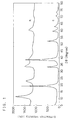
- Nickel hydroxide active materials have two crystal structures. One is ⁇ type crystal structure where the diffraction angle 2 ⁇ value has a peak on the (006) plane within the range between 5° and 14°, and the other is ⁇ type crystal structure where the diffraction angle 2 ⁇ value has a peak on the (001) plane within the range between 18° and 20.5° (FIG. 1).
- the nickel hydroxide active material now used in alkaline storage batteries has the ⁇ type crystal structure.
- the positive electrode using the ⁇ type active material particles is smaller in volume capacity density than the currently used positive electrode using the ⁇ type active material particles.
- addition of the aforementioned compounds, such as a compound of Y, can improve the charge efficiency at high temperatures up to 45°C, but an even more improvement in the high temperature area is hoped for.
- Another object of the present invention is to provide a nickel positive electrode for an alkaline storage battery with high utilization of the active material in an atmosphere over a wide temperature range from normal to even higher temperatures than 45°C.
- the present invention provides a nickel hydroxide active material for an alkaline storage battery comprising nickel hydroxide substantially of the ⁇ type containing 10 to 40 mole percent of Mn of the total amount of metal ions.
- the nickel hydroxide active material for an alkaline storage battery of the present invention has a peak P A with the peak top located within the range of diffraction angle 2 ⁇ between 5° and 14° and another peak P B with the peak top located within the range of diffraction angle 2 ⁇ between 18° and 20.5°, the relative integrated intensity ratio of the two peaks P A /P B being not larger than 1/2, in a powder X-ray diffraction pattern by CuK ⁇ radiation.
- the present invention provides a method of producing a nickel hydroxide active material for an alkaline storage battery comprising the steps of preparing a nickel hydroxide containing 10 to 40 mole percent of Mn of the total amount of metal ions by reacting an aqueous solution containing bivalent nickel ions and bivalent manganese ions with an aqueous alkaline solution and treating the nickel hydroxide thus obtained in an aqueous alkaline solution at 30 to 120°C.
- the present invention provides a nickel positive electrode for an alkaline storage battery of a paste type comprising an active material mixture containing the above-mentioned nickel hydroxide active material and a conductive support, the mixture containing a powder of a compound of at least one element selected from the group consisting of Ca, Sr, Ba, Cu, Ag, Cd, Y, and Yb.
- FIG. 1 is a graph showing powder X-ray diffraction patterns of a nickel hydroxide active material particle "c" obtained in an example of the present invention and an active material particle "h" of a comparative example.
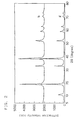
- FIG. 2 is a graph showing powder X-ray diffraction patterns of a nickel hydroxide active material particle "b" obtained in another example of the present invention and an active material particle "g" of another comparative example.
- the present invention is, as indicated above, directed to an active material for an alkaline storage battery comprising nickel hydroxide substantially of the ⁇ type containing specified amounts of Mn.
- This nickel hydroxide active material is a solid solution with manganese incorporated therein.
- Manganese incorporated in the nickel hydroxide active material shifts the charge potential in the "anodic" direction whereby the charge potential decreases and the charge acceptance is improved.
- the quantity of manganese to be contained in the active material is preferably between 10 and 40 mole percent of the total amount of metal ions in the nickel hydroxide solid solution from the point of drawing out the above-mentioned effect.
- Nickel hydroxide active material substantially of the ⁇ type can be obtained by a step of reacting an aqueous solution containing bivalent nickel ions and bivalent manganese ions with an aqueous alkaline solution to produce nickel hydroxide containing specified amounts of manganese and a subsequent step of treating the nickel hydroxide thus obtained in an aqueous alkaline solution at 30 to 120°C.
- the active material for an alkaline storage battery of the present invention has a peak P A with the peak top located within the range of diffraction angle 2 ⁇ between 5° and 14° and another peak P B with the peak top located within the range of diffraction angle 2 ⁇ between 18° and 20.5°, the relative integrated intensity ratio of the two peaks P A /P B being not higher than 1/2, preferably not higher than 1/10, in a powder X-ray diffraction pattern by CuK ⁇ radiation.
- FIG. 1 shows powder X-ray diffraction patterns by CuK ⁇ radiation of the nickel hydroxide active materials containing manganese.
- "c” indicates a typical powder X-ray diffraction pattern of the ⁇ type nickel hydroxide of the present invention and "h” is a typical powder X-ray diffraction pattern of the ⁇ type nickel hydroxide.
- "g” represents a powder X-ray diffraction pattern of the nickel hydroxide containing specified amounts of manganese obtained by reacting an aqueous solution containing bivalent nickel ions and bivalent manganese ions with an aqueous alkaline solution
- "b” represents a powder X-ray diffraction pattern of the above-mentioned nickel hydroxide treated in a hot aqueous alkaline solution.
- any peaks are hardly found within the range of diffraction angle 2 ⁇ between 5° and 14°. From this, it is clear that the ⁇ type nickel hydroxide can be obtained by treatment with a hot aqueous alkaline solution.
- the hot aqueous alkaline solution is preferably an aqueous solution at 30 to 120°C containing 5 to 50 percent by weight of hydroxide of at least one of the elements Li, K and Na. It is also preferable that the treatment with a hot aqueous alkaline solution should be conducted for at least one hour.
- the nickel hydroxide active material of the present invention has a crystal structure which has a basic skeleton of the ⁇ type with a small spacing. Therefore, this material is higher in density than the aforementioned ⁇ type active material of the Japanese Laid-Open Patent Publication Hei 7-335214. That permits highly dense filling into the support member and makes it possible to produce a high capacity density positive electrode.
- the positive electrode for an alkaline storage battery of the present invention comprises an active material mixture containing the above-mentioned nickel hydroxide active material and a conductive support, the mixture containing a powder of a compound of at least one element selected from the group consisting of Ca, Sr, Ba, Cu, Ag, Cd, Y, and Yb.
- porous materials with continuous three-dimensional pores such as foamed metal and metallic fiber felt, punching metal and metal sheet.
- the following compounds are preferable: Ca(OH) 2 , CaO, CaF 2 , CaS, CaSO 4 , CaSi 2 O 5 , CaC 2 O 4 , CaWO 4 , SrCO 3 , Sr(OH) 2 , BaO, Cu 2 O, Ag 2 O, CdO, YF 3 , Y(OH) 3 , Y 2 (CO 3 ) 3 , Y 2 O 3 , YbF 3 , Yb(OH) 3 and Yb 2 O 3 .
- the content in the active material mixture of the powder of these compounds is, in view of energy density, preferably between 0.1 and 5 parts by weight per 100 parts by weight of the nickel hydroxide active material.
- a nickel hydroxide active material with high charge acceptance under high temperature atmosphere can be obtained without the volume capacity density sacrificed. It is also possible to obtain a positive electrode with high utilization of nickel hydroxide under wide temperature range atmosphere from normal to even higher temperatures than 45°C.
- a method to control swelling of the nickel hydroxide active material by incorporating into a solid solution at least one element from among Mg, Zn, Cd and Ca and another method of raising the utilization by incorporating Co into an active material solid solution.
- Example 2 In the same way as in Example 1 except that an aqueous solution containing nickel (II) sulfate alone was used in place of the aqueous solution containing nickel (II) sulfate and manganese (II) sulfate, an active material particle "f" was obtained.
- An aqueous solution of 0.375 M manganese sulfate and 30 percent by weight of aqueous hydrogen peroxide were mixed to prepare 1,000 ml of a solution.
- an aqueous solution of 2 M potassium hydroxide was added to adjust the pH to 12.5 so that manganese is present in the tervalent state.
- This solution was then mixed with 4,000 ml of 1.125 M nickel sulfate.
- an aqueous solution of 8 M potassium hydroxide and an aqueous solution of 15 M ammonia were continuously introduced into a reaction vessel at the same flow rate while stirring, and active material particles were separated from a suspension containing the active material that was overflowing the reaction vessel.
- the active material particles obtained were poured over a hot aqueous alkaline solution at 60°C containing 31 percent by weight of KOH and stirred for 24 hours. In this way an ⁇ type nickel hydroxide active material "h" containing 25 mol percent of manganese (III) was obtained.
- Table 1 shows the ratios of metal ions in these active material particles and the relative integrated intensity ratios of peak P A /peak P B in a powder X-ray diffraction pattern.
- Table 1 Active material particle Synthesizing method Molar ratio Integrated intensity ratio P A /P B Ni Mn a Example 1 95 5 ⁇ 0.01 b
- Example 1 90 10 ⁇ 0.05 c
- Example 1 75 25 ⁇ 0.08 d
- Example 1 60
- Example 1 50 50 0.7 f Comparative Example 1 100 ⁇ 0.01 g Comparative Example 2 90 10 0.65 h Comparative Example 3 75 25 > 10
- the relative integrated intensity ratio of P A /P B was not higher than 1/10 with the active material particles "a” to “c” and “f", while not higher than 1/2 with the active material particle "d". But with the active material particle "e” which contained 50 mole percent of manganese, the P A /P B ratio exceeded 1/2. Also, the active material particle "g” of Comparative Example 2 which was not treated with the hot alkaline solution showed a P A /P B ratio of more than 1/2. The active material particle "h” of Comparative Example 3 was not lower than 10 in integrated intensity ratio.
- FIG. 1 shows powder X-ray diffraction patterns of the active material particles "c" and “h”.
- FIG. 2 shows powder X-ray diffraction patterns of the active material particle "b” which was treated with a hot alkaline solution and the active material particle "g” which was not treated with a hot alkaline solution.
- each of these nickel hydroxide active material particles were mixed and made into a paste with 10 parts by weight of cobalt hydroxide and water.
- This paste was filled into a foamed nickel substrate with a surface density of 600 g/m 2 , then dried, pressure-molded, and immersed in an aqueous dispersion of a fluorocarbon resin powder. After that, the substrate was dried again and cut to a size of 90 ⁇ 70 mm to give a nickel positive electrode.
- the electrodes using the active materials "a” to "h” were coded "A" to "H", respectively.
- Example 1 100 parts by weight of the active material particle "c" containing 25 mole percent of manganese in Example 1 were mixed and made into a paste with 10 parts by weight of cobalt hydroxide, 1 part by weight of Y 2 O 3 and water.
- Each of these positive electrodes "A” to “I” was sandwiched between separators and two pieces of known hydrogen storage alloy negative electrodes which have a larger theoretical capacity than the positive electrode to produce storage batteries (flooded cells) with 31 percent by weight of an aqueous solution of potassium hydroxide as an electrolyte.
- Table 2 shows the discharge capacity densities for the battery charged at 20°C and the ratios of the discharge capacity for the batteries charged at 45 and 55°C to the discharge capacity for the battery charged at 20°C.
- Table 2 Positive electrode Discharge capacity density (mAh/cc) 20°C Ratio of discharge capacity % (to the battery charged at 20°C) 45°C 55°C A 490 65 45 B 480 78 60 C 500 89 70 D 350 88 69 E 180 87 68 F 530 60 38 G 210 87 69 H 290 89 70 I 500 93 80
- the peak integrated intensity ratio exceeds 1/2, the capacity density will drop substantially because of the presence of abundant particles of the crystal structure with a large spacing.
- the integrated intensity ratio is not higher than 1/10.
- the positive electrode using a nickel hydroxide active material particle containing manganese is higher in charge efficiency than that containing no manganese at a high temperature. This is because incorporation of manganese results in a shift of the charge potential in the "anodic" direction. With the content of manganese less than 10 mole percent (positive electrode "A"), the effect is small. To improve the charge efficiency at a high temperature, therefore, it is preferable that the content of manganese is not lower than 10 mole percent.
- the content of manganese is preferably 10 to 40 mole percent.
- the positive electrode "C” comprising the active material particle “c” containing 25 mole percent of manganese according to the present invention is much improved over the positive electrode “H” comprising the active material “h” containing 25 mole percent of manganese of Comparative Example 3 in capacity density for the battery charged at 20°C.
- the reason for this is, as is evident from the powder X-ray diffraction patterns shown in FIG. 1, that the active material "h” of Comparative Example 3, which has a very high peak integrated intensity ratio, is an ⁇ type nickel hydroxide active material, while the active material "c” of Example 1, which has an almost zero integrated intensity ratio, is substantially a ⁇ type nickel hydroxide active material, that is, the active material itself highly intensifies in density.
- the capacity ratio of the positive electrode "I” was about 80 percent of that for the battery charged at 20°C even when charged at a temperature as high as 55°C.
- the positive electrode of the active material "f" from the comparative example, which was mixed with Y 2 O 3 was examined for the charge efficiency at a high temperature, and it was found that the capacity ratio after charging at temperatures up to 45°C was as high as 90 percent of that for the battery charged at 20°C. However, the capacity ratio after charging at 55°C was down to some 70 percent of that for the battery charged at 20°C.
- Y 2 O 3 was used as a compound to raise the oxygen evolution potential.
- the identical results can be obtained using, in place of Y 2 O 3 , the following compounds: Ca(OH) 2 , CaO, CaF 2 , CaS, CaSO 4 , CaSi 2 O 5 , CaC 2 O 4 , CaWO 4 , SrCO 3 , Sr(OH) 2 , BaO, Cu 2 O, Ag 2 O, CdO, YF 3 , Y(OH) 3 , Y 2 (CO 3 ) 3 , YbF 3 , Yb(OH) 3 or Yb 2 O 3 .
- a positive electrode active material for an alkaline storage battery can be obtained which is excellent in charge efficiency and capacity density at a high temperature.
- a high-capacity density nickel positive electrode can be obtained which is excellent in charge efficiency at a high temperature.
Landscapes
- Chemical & Material Sciences (AREA)
- Inorganic Chemistry (AREA)
- Organic Chemistry (AREA)
- Chemical Kinetics & Catalysis (AREA)
- Electrochemistry (AREA)
- General Chemical & Material Sciences (AREA)
- Battery Electrode And Active Subsutance (AREA)
Applications Claiming Priority (3)
| Application Number | Priority Date | Filing Date | Title |
|---|---|---|---|
| JP30446595 | 1995-11-22 | ||
| JP304465/95 | 1995-11-22 | ||
| PCT/JP1996/003158 WO1997019478A1 (en) | 1995-11-22 | 1996-10-28 | Nickel hydroxide active material for alkaline storage battery and positive plate |
Publications (2)
| Publication Number | Publication Date |
|---|---|
| EP0801431A1 true EP0801431A1 (de) | 1997-10-15 |
| EP0801431A4 EP0801431A4 (de) | 1999-02-24 |
Family
ID=17933353
Family Applications (1)
| Application Number | Title | Priority Date | Filing Date |
|---|---|---|---|
| EP96935480A Withdrawn EP0801431A4 (de) | 1995-11-22 | 1996-10-28 | Aktive materialien auf nickel-hydroxidbasis für alkalische speicherbatterie und positive platte |
Country Status (2)
| Country | Link |
|---|---|
| EP (1) | EP0801431A4 (de) |
| WO (1) | WO1997019478A1 (de) |
Cited By (2)
| Publication number | Priority date | Publication date | Assignee | Title |
|---|---|---|---|---|
| EP1103526A3 (de) * | 1999-11-29 | 2003-10-08 | H.C. Starck GmbH | Aktivmaterial für wiederaufladbare Batterien |
| US6752918B1 (en) | 1999-05-07 | 2004-06-22 | H. C. Starck Gmbh | Method for producing nickel hydroxides |
Families Citing this family (2)
| Publication number | Priority date | Publication date | Assignee | Title |
|---|---|---|---|---|
| JP6090672B2 (ja) * | 2012-09-28 | 2017-03-08 | 株式会社Gsユアサ | アルカリ蓄電池及びアルカリ蓄電池用の正極材 |
| JP2023076343A (ja) * | 2021-11-22 | 2023-06-01 | 京セラ株式会社 | 正極材料および二次電池 |
Family Cites Families (6)
| Publication number | Priority date | Publication date | Assignee | Title |
|---|---|---|---|---|
| JP3136668B2 (ja) * | 1991-07-08 | 2001-02-19 | 松下電器産業株式会社 | 水酸化ニッケル活物質粉末およびニッケル正極とこれを用いたアルカリ蓄電池 |
| JP3042043B2 (ja) * | 1991-07-18 | 2000-05-15 | 松下電器産業株式会社 | アルカリ蓄電池用ニッケル正極とこれを用いたニッケル・水素蓄電池 |
| DE4323007C2 (de) | 1993-07-09 | 1995-06-08 | Starck H C Gmbh Co Kg | Mangan(III)-haltiges Nickel(II)-hydroxid, ein Verfahren zu seiner Herstellung sowie seine Verwendung als Elektrodenmaterial für Sekundärbatterien |
| JPH07122271A (ja) * | 1993-10-25 | 1995-05-12 | Furukawa Electric Co Ltd:The | ニッケル極用水酸化ニッケルの製造方法、およびその水酸化ニッケルを用いたニッケル極の製造方法、ならびにそのニッケル極を組込んだアルカリ二次電池 |
| US5674643A (en) * | 1995-02-14 | 1997-10-07 | Sanyo Electric Co., Ltd. | Non-sintered nickel electrode for alkaline storage cell |
| FR2731297B1 (fr) * | 1995-03-03 | 1997-04-04 | Accumulateurs Fixes | Electrode au nickel pour accumulateur alcalin |
-
1996
- 1996-10-28 EP EP96935480A patent/EP0801431A4/de not_active Withdrawn
- 1996-10-28 WO PCT/JP1996/003158 patent/WO1997019478A1/ja not_active Ceased
Cited By (2)
| Publication number | Priority date | Publication date | Assignee | Title |
|---|---|---|---|---|
| US6752918B1 (en) | 1999-05-07 | 2004-06-22 | H. C. Starck Gmbh | Method for producing nickel hydroxides |
| EP1103526A3 (de) * | 1999-11-29 | 2003-10-08 | H.C. Starck GmbH | Aktivmaterial für wiederaufladbare Batterien |
Also Published As
| Publication number | Publication date |
|---|---|
| WO1997019478A1 (en) | 1997-05-29 |
| EP0801431A4 (de) | 1999-02-24 |
Similar Documents
| Publication | Publication Date | Title |
|---|---|---|
| EP0716462B1 (de) | Nickelelektrode aktives Material; Nickelelektrode und alkalische Nickelspeicherzelle die solches aktives Material verwendet, und solchen Material, Elektrode und Zelle Herstellungsverfahren | |
| EP0523284B1 (de) | Aktivmasse aus Nickelhydroxidpulver, positive Nickelelektrode, und ihre Verwendung in einer alkalischen Speicherbatterie | |
| EP1195824B1 (de) | Positives Elektrodenaktivmaterial für alkalische Speicherbatterien | |
| US6287726B1 (en) | Method for producing nickel positive electrode for alkaline storage batteries | |
| EP0727835A1 (de) | Nickelaktives Material für alkalische Speicherzellen und Herstellungsverfahren | |
| EP0793285B1 (de) | Aktives Material und Positivelektrode für alkalischen Akkumulator | |
| EP0940865A2 (de) | Aktives Material für die positive Elektrode von alkalischen Speicherbatterien und Verfahren zu seiner Herstellung | |
| EP0809309B1 (de) | Elektrode mit aktivem material für positive platte eines akkus | |
| KR100454542B1 (ko) | 알칼리축전지용비소결식니켈전극 | |
| KR20000070049A (ko) | 밀폐형 알칼리 축전지 | |
| US6358648B2 (en) | Nickel electrode active material for alkaline storage batteries and nickel electrode using the same | |
| KR20050099451A (ko) | 알칼리 전지 | |
| EP0881698B1 (de) | Alkalische Speicherbatterie | |
| JP4321997B2 (ja) | アルカリ蓄電池用正極活物質ならびにそれを用いた正極およびアルカリ蓄電池 | |
| JPH10125318A (ja) | アルカリ蓄電池用正極活物質および正極 | |
| EP0932211B1 (de) | Positives aktives Material für alkalische Speicherbatterie | |
| US6783892B2 (en) | Positive electrode active material for alkaline storage batteries, and positive electrode and alkaline storage battery using the same | |
| JPH11317224A (ja) | アルカリ蓄電池用正極活物質およびその製造方法 | |
| US3350198A (en) | Cadmium metal sponge | |
| EP0801431A1 (de) | Aktive materialien auf nickel-hydroxidbasis für alkalische speicherbatterie und positive platte | |
| JP3324781B2 (ja) | アルカリ二次電池 | |
| KR100404658B1 (ko) | 니켈-금속수소화물축전지및그제조방법 | |
| JPH10172559A (ja) | アルカリ蓄電池用ニッケル活物質およびその製造方法 | |
| KR100241594B1 (ko) | 이중구조 수산화니켈 활물질 및 이를 이용한 니켈양극 | |
| JP3744317B2 (ja) | アルカリ蓄電池用ニッケル正極およびこれを用いたアルカリ蓄電池 |
Legal Events
| Date | Code | Title | Description |
|---|---|---|---|
| PUAI | Public reference made under article 153(3) epc to a published international application that has entered the european phase |
Free format text: ORIGINAL CODE: 0009012 |
|
| 17P | Request for examination filed |
Effective date: 19970703 |
|
| AK | Designated contracting states |
Kind code of ref document: A1 Designated state(s): DE FR GB |
|
| A4 | Supplementary search report drawn up and despatched |
Effective date: 19990111 |
|
| AK | Designated contracting states |
Kind code of ref document: A4 Designated state(s): DE FR GB |
|
| STAA | Information on the status of an ep patent application or granted ep patent |
Free format text: STATUS: THE APPLICATION HAS BEEN WITHDRAWN |
|
| 18W | Application withdrawn |
Withdrawal date: 19991008 |