EP0801476A2 - Méthode de réception et de l'évaluation des données RDS en provenance d'une pluralité d'émetteurs - Google Patents
Méthode de réception et de l'évaluation des données RDS en provenance d'une pluralité d'émetteurs Download PDFInfo
- Publication number
- EP0801476A2 EP0801476A2 EP97105768A EP97105768A EP0801476A2 EP 0801476 A2 EP0801476 A2 EP 0801476A2 EP 97105768 A EP97105768 A EP 97105768A EP 97105768 A EP97105768 A EP 97105768A EP 0801476 A2 EP0801476 A2 EP 0801476A2
- Authority
- EP
- European Patent Office
- Prior art keywords
- transmitter
- receiver
- rds
- rds data
- data stream
- Prior art date
- Legal status (The legal status is an assumption and is not a legal conclusion. Google has not performed a legal analysis and makes no representation as to the accuracy of the status listed.)
- Granted
Links
Images
Classifications
-
- H—ELECTRICITY
- H04—ELECTRIC COMMUNICATION TECHNIQUE
- H04H—BROADCAST COMMUNICATION
- H04H20/00—Arrangements for broadcast or for distribution combined with broadcast
- H04H20/20—Arrangements for broadcast or distribution of identical information via plural systems
- H04H20/22—Arrangements for broadcast of identical information via plural broadcast systems
-
- H—ELECTRICITY
- H04—ELECTRIC COMMUNICATION TECHNIQUE
- H04H—BROADCAST COMMUNICATION
- H04H20/00—Arrangements for broadcast or for distribution combined with broadcast
- H04H20/28—Arrangements for simultaneous broadcast of plural pieces of information
- H04H20/33—Arrangements for simultaneous broadcast of plural pieces of information by plural channels
- H04H20/34—Arrangements for simultaneous broadcast of plural pieces of information by plural channels using an out-of-band subcarrier signal
-
- H—ELECTRICITY
- H04—ELECTRIC COMMUNICATION TECHNIQUE
- H04H—BROADCAST COMMUNICATION
- H04H2201/00—Aspects of broadcast communication
- H04H2201/10—Aspects of broadcast communication characterised by the type of broadcast system
- H04H2201/13—Aspects of broadcast communication characterised by the type of broadcast system radio data system/radio broadcast data system [RDS/RBDS]
Definitions
- the invention relates to a method for the reception and evaluation of RDS data streams from a plurality of transmitters, wherein in addition to the reception and playback of a first transmitter, its RDS data stream is evaluated and the RDS data stream of further transmitters is also evaluated.
- Radio receivers are known for the reception of radio transmitters which transmit an RDS data stream in addition to the audio signal.
- a first radio receiver has only a single receiver for the radio signal and a single decoder for evaluating the RDS data stream.
- Such radio receivers are manufactured, inter alia, by the applicant and are marketed under the type designation WKC 7500 RDS.
- reception of the program deteriorates at the originally set reception frequency
- another reception frequency is automatically set in the known radio receiver on which the set program can also be received.
- the alternative reception frequencies stored in a memory are checked as to whether a transmitter of sufficient quality can be received on them.
- the tuner of the radio receiver is briefly tuned from the original reception frequency to the alternative reception frequencies and the reception properties are determined. Then the tuner is tuned back to the original reception frequency. The interruption is so short that it cannot be heard in the reproduced audio signal.
- the band can also be checked for new stations.
- the tuner is tuned on a trial basis to the reception frequency for which the highest reception level was determined in order to obtain the program information (PI code) from the RDS data stream and with the program information of the program at the originally set reception frequency to compare. If a deviation is found, the tuner is tuned again to the originally set reception frequency. This check is audible in the reproduced audio signal because it takes longer.
- a search is necessary in which the reception band is searched for a station with program information that matches that of the originally set station. Such a search interrupts the playback of the audio signal for several seconds.
- a disadvantage of the known RDS radio receiver is the fact that pauses with a time period, such as are necessary for the evaluation of an RDS data stream, do not occur very often in an audio signal. Therefore, the known RDS radio receiver with regard to the switching frequency of the original station is severely restricted to other stations.
- radio receivers there are two receivers for radio signals and two decoders for evaluating RDS data streams.
- Such radio receivers are manufactured, for example, by the Becker company and sold under the type designation Mexico 2330.
- One of the receivers and decoders is used to receive the originally set program, while the second receiver and the second decoder are used to continuously receive the other receivable transmitters and to evaluate the RDS data streams.
- the data obtained by means of the second receiver and second decoder can be used, which ensures that the originally selected program is played back without interference.
- the effort for implementing the second known radio receiver is very high.
- the object of the present invention is to specify a method for receiving and evaluating RDS data streams from a plurality of transmitters with a single receiver.
- the advantage of the method according to the invention can be seen in the fact that when a radio receiver is used with a single receiver, the RDS data stream from a plurality of transmitters can be evaluated, as a result of which the functionality and the advantages of a radio receiver with two receivers can be realized with considerably less effort.
- a radio receiver according to the concept of the radio receiver described above with a single receiver and a single RDS decoder is used.
- phase-locked loop present in the receiver of the radio receiver used has a short settling time in order to be able to carry out the tuning process to the different reception frequencies as quickly as possible.
- the RDS decoder used must also be taken into account. If the settling time of the RDS decoder used is too long, a second RDS decoder can be used, which is only used for decoding the RDS data stream from the other transmitters.
- each block contains an information word and a check word, the data to be transmitted being contained in the information word, while the check word contains error protection and synchronous information for each block.
- Four blocks form a group.
- the size and duration of the individual data elements of the RDS data stream can be found in the table below.
- Data element Size in bits Duration in ms group 104 87.6 block 26 22 Information word 16 13.5
- the four blocks of each group contain an offset word as synchronous information.
- the offset words denote the blocks as A, B, C and D.
- the data content of block A always contains the program information (PI) unchanged, while the data content of blocks B, C and D can change from group to group. This is important when determining the synchronous information and when evaluating the RDS data stream and will be explained in detail later.
- the radio receiver which is tuned to a specific first transmitter and reproduces its audio signal, is briefly keyed to a second transmitter.
- the receiver is tuned to the reception frequency of the second transmitter.
- Synchronous information is obtained from the test words of the RDS data stream of the second transmitter by means of the RDS decoder, with which a timer, e.g. B. a counter is synchronized.
- the receiver is then tuned back to the reception frequency of the first transmitter, the audio signal of which is reproduced.
- the receiver can be tuned in time to the reception frequency of the second transmitter , so that the program information can be evaluated from the RDS data stream of the second transmitter. After reading out the desired block or blocks, the receiver is again tuned to the reception frequency of the first transmitter. In this way, the program information of all receivable stations can be determined and, if necessary, it is possible to switch to another station with the same program content without an audible interruption. In addition to obtaining the program information, it is in principle also possible to obtain all the other information contained in the RDS data stream.
- the length of the gating interval results from the settling times of the phase control loop for tuning to the second transmitter and the return to the first transmitter as well as from the settling time of the RDS decoder.
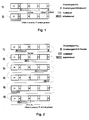
- FIG. 1 shows the synchronization according to the invention on the RDS data stream of a second transmitter and the evaluation of the RDS data stream, with a readout time on the second transmitter which is greater than the duration of two blocks (44 ms).
- the receiver In the first evaluated group 1) of the RDS data stream of the second transmitter z. B. recognized the offset word C of the third block. For the recognition of the offset words it is necessary that an entire block, consisting of information word and test word, is completely available to the RDS decoder. The timer is synchronized and started by means of the recognized offset word C. The receiver is then tuned back to the first transmitter. To evaluate the desired program information, the receiver, controlled by the timer, is re-tuned to the second transmitter in good time so that at the start of the first block of the second evaluated group 2) of the RDS data stream of the second transmitter, all transient processes have ended and the RDS Decoder can evaluate the information word of the first block, the correctness being confirmed by the recognition of the offset word A. The receiver is then tuned back to the first transmitter.
- FIG. 2 shows the synchronization according to the invention on the RDS data stream of a second transmitter, with a readout time on the second transmitter which is greater than or equal to the duration of a block (22 ms).
- the RDS decoder can only recognize the offset words if the complete information word and the associated test word are present together. If the gating time is of the order of the duration of a group, problems arise because the data content of the individual Blocks of different groups, apart from block A, which contains the program information, differ from one another.
- the receiver within each group is tuned to the second transmitter for the predetermined gating time.
- the times of the gating are selected so that the settling time is always ended when the position in the same block is reached at which the readout time in the group last received was ended. It is also possible to select the blanking so that the readout times overlap slightly. In this way it is possible to assemble an RDS data stream that has complete blocks. For this purpose, the data obtained during the read-out times are temporarily stored. B. a shift register can be used, which has a size of 26 bits in order to be able to store a complete block. Because of the already mentioned differences in the data in the individual blocks of different groups, this composition can only lead to consistent results for block A.
- the composition of block A is only completed after six groups.
- the information word and part of the test word of block A come from group 5) and the missing part of the test word from group 6).
- the synchronization described above and further evaluation of the RDS data stream are possible, the described memory for the composition of the RDS data also being used to evaluate the RDS data stream.
- the receiver is tuned to the first transmitter in order to reproduce the audio signal.
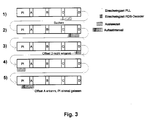
- FIG. 3 shows the synchronization according to the invention on the RDS data stream of a second transmitter, with a gating time on the second transmitter which is less than the duration of a block (22 ms).
- the RDS data stream of the second transmitter for the individual blocks is composed of different groups, as described for FIG. 2.
- the composition of the RDS data stream for block A from group 4) and 5) takes place.
- a check can then be carried out in the other groups, in which block A is reassembled and evaluated. This can be prevented with sufficient certainty that a bit combination that happens to correspond to block A is used for synchronization.
- the receiver is tuned to the first transmitter in order to reproduce the audio signal.
- either very short switching periods can be selected, i.e. less than the duration of a block of 22 ms, or times are used in which, due to the signal properties of the audio signal to be played back, the first Transmitter, the audibility is low.
- This can be, for example, zero crossings of the audio signal or masking effects (psychoacoustics).
- Another possibility is the interpolation of the audio signal to be reproduced, which can be carried out, for example, by means of an existing digital signal processor, or a combination of the measures described.
Landscapes
- Engineering & Computer Science (AREA)
- Signal Processing (AREA)
- Circuits Of Receivers In General (AREA)
- Channel Selection Circuits, Automatic Tuning Circuits (AREA)
- Radio Transmission System (AREA)
Applications Claiming Priority (2)
| Application Number | Priority Date | Filing Date | Title |
|---|---|---|---|
| DE19614322 | 1996-04-11 | ||
| DE19614322A DE19614322A1 (de) | 1996-04-11 | 1996-04-11 | Verfahren für den Empfang und die Auswertung von RDS-Datenströmen mehrerer Sender |
Publications (3)
| Publication Number | Publication Date |
|---|---|
| EP0801476A2 true EP0801476A2 (fr) | 1997-10-15 |
| EP0801476A3 EP0801476A3 (fr) | 2000-05-10 |
| EP0801476B1 EP0801476B1 (fr) | 2007-06-13 |
Family
ID=7790996
Family Applications (1)
| Application Number | Title | Priority Date | Filing Date |
|---|---|---|---|
| EP97105768A Expired - Lifetime EP0801476B1 (fr) | 1996-04-11 | 1997-04-08 | Méthode de réception et de l'évaluation des données RDS en provenance d'une pluralité d'émetteurs |
Country Status (3)
| Country | Link |
|---|---|
| EP (1) | EP0801476B1 (fr) |
| AT (1) | ATE364939T1 (fr) |
| DE (2) | DE19614322A1 (fr) |
Cited By (5)
| Publication number | Priority date | Publication date | Assignee | Title |
|---|---|---|---|---|
| EP1009114A3 (fr) * | 1998-12-10 | 2000-07-19 | Ensigma Limited | Récepteur pour la réception de transmissions de radiodiffusion numérique |
| EP0938200A3 (fr) * | 1998-02-24 | 2005-08-03 | Sanyo Electric Co., Ltd. | Circuit de synchronisation pour récepteur de signaux de radiodiffusion en modulation de fréquence, pour permettre la réception de données supplémentaires diffusés sur une sous-porteuse transmise en multiplex avec le signal en modulation de fréquence |
| EP1274175A3 (fr) * | 2001-07-06 | 2006-01-18 | Harman/Becker Automotive Systems (Becker Division) GmbH | Procédé de la vérification la reception des fréquences alternatives de reception dans une autoradio ét autoradio |
| EP2063558A1 (fr) * | 2007-11-22 | 2009-05-27 | Continental Automotive GmbH | Procédé et terminal pour selectionner un signal audio |
| EP1630988A3 (fr) * | 2004-08-27 | 2010-12-01 | Robert Bosch GmbH | Réception temporellement multiplexée aux deux fréquences porteuses pour radiodiffusion digitale |
Families Citing this family (1)
| Publication number | Priority date | Publication date | Assignee | Title |
|---|---|---|---|---|
| DE102005039054A1 (de) * | 2005-08-18 | 2007-02-22 | Bayerische Motoren Werke Ag | Verfahren und Vorrichtung zum Extrahieren von Zieldaten aus einem Zieldatenstrom |
Family Cites Families (7)
| Publication number | Priority date | Publication date | Assignee | Title |
|---|---|---|---|---|
| FR2659511A1 (fr) * | 1990-03-09 | 1991-09-13 | Portenseigne Radiotechnique | Procede d'acquisition et de comparaison des donnees d'identification de deux canaux de transmission, et appareil recepteur correspondant. |
| DE4103062C2 (de) * | 1991-02-01 | 1994-03-31 | Blaupunkt Werke Gmbh | Rundfunkempfänger |
| DE4103061C2 (de) * | 1991-02-01 | 1995-04-13 | Blaupunkt Werke Gmbh | Rundfunkempfänger |
| DE4129830A1 (de) * | 1991-09-07 | 1993-03-25 | Blaupunkt Werke Gmbh | Ukw-empfaenger mit mehreren antennen |
| DE4233758C1 (de) * | 1992-10-07 | 1994-01-27 | Blaupunkt Werke Gmbh | Rundfunkempfänger |
| JP2841309B2 (ja) * | 1992-11-13 | 1998-12-24 | クラリオン株式会社 | 多重放送受信機 |
| DE4338412C1 (de) * | 1993-11-10 | 1995-03-02 | Becker Gmbh | Verfahren zur Detektion von Informationen im RDS-Datenstrom |
-
1996
- 1996-04-11 DE DE19614322A patent/DE19614322A1/de not_active Ceased
-
1997
- 1997-04-08 EP EP97105768A patent/EP0801476B1/fr not_active Expired - Lifetime
- 1997-04-08 DE DE59712853T patent/DE59712853D1/de not_active Expired - Lifetime
- 1997-04-08 AT AT97105768T patent/ATE364939T1/de not_active IP Right Cessation
Cited By (5)
| Publication number | Priority date | Publication date | Assignee | Title |
|---|---|---|---|---|
| EP0938200A3 (fr) * | 1998-02-24 | 2005-08-03 | Sanyo Electric Co., Ltd. | Circuit de synchronisation pour récepteur de signaux de radiodiffusion en modulation de fréquence, pour permettre la réception de données supplémentaires diffusés sur une sous-porteuse transmise en multiplex avec le signal en modulation de fréquence |
| EP1009114A3 (fr) * | 1998-12-10 | 2000-07-19 | Ensigma Limited | Récepteur pour la réception de transmissions de radiodiffusion numérique |
| EP1274175A3 (fr) * | 2001-07-06 | 2006-01-18 | Harman/Becker Automotive Systems (Becker Division) GmbH | Procédé de la vérification la reception des fréquences alternatives de reception dans une autoradio ét autoradio |
| EP1630988A3 (fr) * | 2004-08-27 | 2010-12-01 | Robert Bosch GmbH | Réception temporellement multiplexée aux deux fréquences porteuses pour radiodiffusion digitale |
| EP2063558A1 (fr) * | 2007-11-22 | 2009-05-27 | Continental Automotive GmbH | Procédé et terminal pour selectionner un signal audio |
Also Published As
| Publication number | Publication date |
|---|---|
| EP0801476A3 (fr) | 2000-05-10 |
| ATE364939T1 (de) | 2007-07-15 |
| EP0801476B1 (fr) | 2007-06-13 |
| DE59712853D1 (de) | 2007-07-26 |
| DE19614322A1 (de) | 1997-10-16 |
Similar Documents
| Publication | Publication Date | Title |
|---|---|---|
| EP0497115B1 (fr) | Procédé de shuntage des interruptions de signaux audio | |
| DE3623719C2 (fr) | ||
| DE3534064C2 (fr) | ||
| DE69112871T2 (de) | Empfänger mit Vorrichtung zur Erfassung und zum Vergleich der Identifikationsdaten zweier Sendekanäle. | |
| DE69834759T2 (de) | Vorrichtung für den Empfang von Rundfunkprogrammen | |
| EP0584839B1 (fr) | Procédé d'utilisation à la réception d'informations additionnelles dans un signal radio | |
| EP0497116A2 (fr) | Récepteur de radiodiffusion avec RDS | |
| EP0829973A2 (fr) | Dispositif avec diversité de fréquence pour la réception mobile de télévision | |
| EP1256176A2 (fr) | Procede pour cacher des interruptions de reproduction de signaux de radiodiffusion re us | |
| DE4403408C1 (de) | Verfahren zur Erkennung eines Übertragungs-Modes | |
| DE2850733A1 (de) | Rundfunkempfaenger, insbesondere ukw- empfaenger, mit einer einrichtung zur programm-direktwahl | |
| EP0364749B1 (fr) | Récepteur radio | |
| EP0801476B1 (fr) | Méthode de réception et de l'évaluation des données RDS en provenance d'une pluralité d'émetteurs | |
| DE3037196C1 (de) | Verfahren zur automatischen Sendersuche bei Fernsehempfaengern zum Empfang von PAL- und SECAM-Signalen | |
| DE3718566C2 (de) | Verfahren zur Synchronisation von auf Magnetband gespeicherten Datensignalen | |
| DE69020192T2 (de) | Verfahren zum Verarbeiten eines Rundfunkdatensignals, sowie Empfänger zum Durchführen dieses Verfahrens. | |
| DE4039117C5 (de) | Stationenwahlverfahren bei RDS-Voreinstell-Empfänger | |
| DE3725487A1 (de) | Verfahren zum empfangsseitigen auswerten einer innerhalb eines rundfunksignals uebertragenen digitalen information | |
| DE69128412T2 (de) | Hochgeschwindigkeitsverfahren zur Suche einer alternativen Frequenz in einem Radiosystem | |
| EP0892496B1 (fr) | Autoradio et méthode de vérification et/ou de mise à jour d' une tabelle de fréquence enregistrée dans une autoradio | |
| DE3850954T2 (de) | Empfänger für RDS. | |
| EP0652660B1 (fr) | Méthode pour la synchronisation d'un décodeur RDS | |
| DE69010721T2 (de) | Verfahren zum Verarbeiten eines Rundfunkdatensignals, sowie Empfänger zum Durchführen dieses Verfahrens. | |
| EP0954911B1 (fr) | Procede d'evaluation de signaux numeriques, en particulier de signaux rds | |
| DE2257460A1 (de) | Verfahren zur feststellung der programmauswahl an rundfunk- und fernsehempfaengern oder dergl. sowie vorrichtung zur durchfuehrung dieses verfahrens |
Legal Events
| Date | Code | Title | Description |
|---|---|---|---|
| PUAI | Public reference made under article 153(3) epc to a published international application that has entered the european phase |
Free format text: ORIGINAL CODE: 0009012 |
|
| AK | Designated contracting states |
Kind code of ref document: A2 Designated state(s): CH DE FR GB IT LI |
|
| PUAL | Search report despatched |
Free format text: ORIGINAL CODE: 0009013 |
|
| AK | Designated contracting states |
Kind code of ref document: A3 Designated state(s): AT DE FR GB IT |
|
| 17P | Request for examination filed |
Effective date: 20001017 |
|
| RAP1 | Party data changed (applicant data changed or rights of an application transferred) |
Owner name: GRUNDIG AKTIENGESELLSCHAFT |
|
| RBV | Designated contracting states (corrected) |
Designated state(s): AT DE FR GB IT |
|
| RBV | Designated contracting states (corrected) |
Designated state(s): CH DE FR GB IT LI |
|
| 17Q | First examination report despatched |
Effective date: 20011211 |
|
| RAP1 | Party data changed (applicant data changed or rights of an application transferred) |
Owner name: GRUNDIG CAR INTERMEDIA SYSTEM GMBH |
|
| RBV | Designated contracting states (corrected) |
Designated state(s): AT DE FR GB IT |
|
| RAP1 | Party data changed (applicant data changed or rights of an application transferred) |
Owner name: DELPHI TECHNOLOGIES, INC. |
|
| GRAP | Despatch of communication of intention to grant a patent |
Free format text: ORIGINAL CODE: EPIDOSNIGR1 |
|
| GRAS | Grant fee paid |
Free format text: ORIGINAL CODE: EPIDOSNIGR3 |
|
| GRAA | (expected) grant |
Free format text: ORIGINAL CODE: 0009210 |
|
| AK | Designated contracting states |
Kind code of ref document: B1 Designated state(s): AT DE FR GB IT |
|
| REG | Reference to a national code |
Ref country code: GB Ref legal event code: FG4D Free format text: NOT ENGLISH |
|
| REF | Corresponds to: |
Ref document number: 59712853 Country of ref document: DE Date of ref document: 20070726 Kind code of ref document: P |
|
| ET | Fr: translation filed | ||
| GBV | Gb: ep patent (uk) treated as always having been void in accordance with gb section 77(7)/1977 [no translation filed] |
Effective date: 20070613 |
|
| PLBE | No opposition filed within time limit |
Free format text: ORIGINAL CODE: 0009261 |
|
| STAA | Information on the status of an ep patent application or granted ep patent |
Free format text: STATUS: NO OPPOSITION FILED WITHIN TIME LIMIT |
|
| PG25 | Lapsed in a contracting state [announced via postgrant information from national office to epo] |
Ref country code: IT Free format text: LAPSE BECAUSE OF FAILURE TO SUBMIT A TRANSLATION OF THE DESCRIPTION OR TO PAY THE FEE WITHIN THE PRESCRIBED TIME-LIMIT Effective date: 20070613 Ref country code: GB Free format text: LAPSE BECAUSE OF FAILURE TO SUBMIT A TRANSLATION OF THE DESCRIPTION OR TO PAY THE FEE WITHIN THE PRESCRIBED TIME-LIMIT Effective date: 20070613 |
|
| 26N | No opposition filed |
Effective date: 20080314 |
|
| PG25 | Lapsed in a contracting state [announced via postgrant information from national office to epo] |
Ref country code: AT Free format text: LAPSE BECAUSE OF NON-PAYMENT OF DUE FEES Effective date: 20080408 |
|
| REG | Reference to a national code |
Ref country code: FR Ref legal event code: PLFP Year of fee payment: 20 |
|
| PGFP | Annual fee paid to national office [announced via postgrant information from national office to epo] |
Ref country code: DE Payment date: 20160427 Year of fee payment: 20 |
|
| PGFP | Annual fee paid to national office [announced via postgrant information from national office to epo] |
Ref country code: FR Payment date: 20160425 Year of fee payment: 20 |
|
| REG | Reference to a national code |
Ref country code: DE Ref legal event code: R071 Ref document number: 59712853 Country of ref document: DE |