EP0801603B1 - Feuille portant un revetement et son procede de fabrication - Google Patents
Feuille portant un revetement et son procede de fabrication Download PDFInfo
- Publication number
- EP0801603B1 EP0801603B1 EP96902118A EP96902118A EP0801603B1 EP 0801603 B1 EP0801603 B1 EP 0801603B1 EP 96902118 A EP96902118 A EP 96902118A EP 96902118 A EP96902118 A EP 96902118A EP 0801603 B1 EP0801603 B1 EP 0801603B1
- Authority
- EP
- European Patent Office
- Prior art keywords
- poly
- coating
- recited
- sheet material
- polymer
- Prior art date
- Legal status (The legal status is an assumption and is not a legal conclusion. Google has not performed a legal analysis and makes no representation as to the accuracy of the status listed.)
- Expired - Lifetime
Links
- 239000000463 material Substances 0.000 title claims abstract description 195
- 238000000034 method Methods 0.000 title claims abstract description 64
- 238000000576 coating method Methods 0.000 claims abstract description 227
- 239000011248 coating agent Substances 0.000 claims abstract description 217
- 230000004888 barrier function Effects 0.000 claims abstract description 145
- 239000000758 substrate Substances 0.000 claims abstract description 121
- XLYOFNOQVPJJNP-UHFFFAOYSA-N water Substances O XLYOFNOQVPJJNP-UHFFFAOYSA-N 0.000 claims abstract description 106
- 229920000642 polymer Polymers 0.000 claims abstract description 88
- 239000008199 coating composition Substances 0.000 claims abstract description 69
- 235000013305 food Nutrition 0.000 claims abstract description 36
- 230000035515 penetration Effects 0.000 claims abstract description 31
- 239000004519 grease Substances 0.000 claims abstract description 30
- -1 fatty acid compound Chemical class 0.000 claims description 357
- 239000000123 paper Substances 0.000 claims description 70
- 229920002451 polyvinyl alcohol Polymers 0.000 claims description 70
- 239000004372 Polyvinyl alcohol Substances 0.000 claims description 53
- 239000003921 oil Substances 0.000 claims description 40
- 239000000203 mixture Substances 0.000 claims description 35
- 239000011087 paperboard Substances 0.000 claims description 30
- 239000000853 adhesive Substances 0.000 claims description 25
- 230000001070 adhesive effect Effects 0.000 claims description 25
- 239000000194 fatty acid Substances 0.000 claims description 25
- 235000014113 dietary fatty acids Nutrition 0.000 claims description 19
- 229930195729 fatty acid Natural products 0.000 claims description 19
- 239000002655 kraft paper Substances 0.000 claims description 19
- 229920001577 copolymer Polymers 0.000 claims description 18
- 239000002174 Styrene-butadiene Substances 0.000 claims description 16
- 229920003048 styrene butadiene rubber Polymers 0.000 claims description 16
- 239000003431 cross linking reagent Substances 0.000 claims description 15
- 238000010411 cooking Methods 0.000 claims description 14
- 239000007888 film coating Substances 0.000 claims description 14
- 238000009501 film coating Methods 0.000 claims description 14
- 150000004665 fatty acids Chemical class 0.000 claims description 12
- 238000004519 manufacturing process Methods 0.000 claims description 12
- 239000000945 filler Substances 0.000 claims description 11
- VYZAMTAEIAYCRO-UHFFFAOYSA-N Chromium Chemical compound [Cr] VYZAMTAEIAYCRO-UHFFFAOYSA-N 0.000 claims description 10
- 239000001913 cellulose Substances 0.000 claims description 9
- 229920002678 cellulose Polymers 0.000 claims description 9
- 239000006185 dispersion Substances 0.000 claims description 9
- 239000000049 pigment Substances 0.000 claims description 9
- 229920002554 vinyl polymer Polymers 0.000 claims description 8
- MTAZNLWOLGHBHU-UHFFFAOYSA-N butadiene-styrene rubber Chemical compound C=CC=C.C=CC1=CC=CC=C1 MTAZNLWOLGHBHU-UHFFFAOYSA-N 0.000 claims description 7
- 150000004696 coordination complex Chemical class 0.000 claims description 7
- 239000011115 styrene butadiene Substances 0.000 claims description 7
- 239000005977 Ethylene Substances 0.000 claims description 6
- 229910052804 chromium Inorganic materials 0.000 claims description 6
- 239000011651 chromium Substances 0.000 claims description 6
- 239000000975 dye Substances 0.000 claims description 6
- 229920002223 polystyrene Polymers 0.000 claims description 6
- QQONPFPTGQHPMA-UHFFFAOYSA-N propylene Natural products CC=C QQONPFPTGQHPMA-UHFFFAOYSA-N 0.000 claims description 6
- 230000005855 radiation Effects 0.000 claims description 6
- VGGSQFUCUMXWEO-UHFFFAOYSA-N Ethene Chemical compound C=C VGGSQFUCUMXWEO-UHFFFAOYSA-N 0.000 claims description 5
- 238000005266 casting Methods 0.000 claims description 5
- 229910021645 metal ion Inorganic materials 0.000 claims description 5
- 239000000126 substance Substances 0.000 claims description 5
- BRLQWZUYTZBJKN-UHFFFAOYSA-N Epichlorohydrin Chemical compound ClCC1CO1 BRLQWZUYTZBJKN-UHFFFAOYSA-N 0.000 claims description 4
- 238000013461 design Methods 0.000 claims description 4
- 229920002401 polyacrylamide Polymers 0.000 claims description 4
- 229920002635 polyurethane Polymers 0.000 claims description 4
- 229920002689 polyvinyl acetate Polymers 0.000 claims description 4
- 239000011118 polyvinyl acetate Substances 0.000 claims description 4
- 229920001311 Poly(hydroxyethyl acrylate) Polymers 0.000 claims description 3
- 229920002732 Polyanhydride Polymers 0.000 claims description 3
- 235000014633 carbohydrates Nutrition 0.000 claims description 3
- 150000001720 carbohydrates Chemical class 0.000 claims description 3
- 238000001035 drying Methods 0.000 claims description 3
- FPYJFEHAWHCUMM-UHFFFAOYSA-N maleic anhydride Chemical compound O=C1OC(=O)C=C1 FPYJFEHAWHCUMM-UHFFFAOYSA-N 0.000 claims description 3
- 229920002492 poly(sulfone) Polymers 0.000 claims description 3
- 229920000728 polyester Polymers 0.000 claims description 3
- 230000001464 adherent effect Effects 0.000 claims description 2
- 150000008064 anhydrides Chemical class 0.000 claims description 2
- 238000010894 electron beam technology Methods 0.000 claims description 2
- 125000001495 ethyl group Chemical group [H]C([H])([H])C([H])([H])* 0.000 claims description 2
- 229920000573 polyethylene Polymers 0.000 claims description 2
- 238000005096 rolling process Methods 0.000 claims 5
- 239000002318 adhesion promoter Substances 0.000 claims 3
- 239000003086 colorant Substances 0.000 claims 2
- 238000009500 colour coating Methods 0.000 claims 2
- 229920001567 vinyl ester resin Polymers 0.000 claims 2
- 235000019422 polyvinyl alcohol Nutrition 0.000 description 51
- 238000012360 testing method Methods 0.000 description 50
- 229920002799 BoPET Polymers 0.000 description 41
- 235000019198 oils Nutrition 0.000 description 35
- 239000005041 Mylar™ Substances 0.000 description 32
- 239000010410 layer Substances 0.000 description 31
- 230000008569 process Effects 0.000 description 22
- 239000007787 solid Substances 0.000 description 22
- 229920000178 Acrylic resin Polymers 0.000 description 21
- 239000004925 Acrylic resin Substances 0.000 description 21
- 239000011347 resin Substances 0.000 description 20
- 229920005989 resin Polymers 0.000 description 20
- 244000223760 Cinnamomum zeylanicum Species 0.000 description 18
- 235000017803 cinnamon Nutrition 0.000 description 18
- GWEVSGVZZGPLCZ-UHFFFAOYSA-N Titan oxide Chemical compound O=[Ti]=O GWEVSGVZZGPLCZ-UHFFFAOYSA-N 0.000 description 14
- XAGFODPZIPBFFR-UHFFFAOYSA-N aluminium Chemical compound [Al] XAGFODPZIPBFFR-UHFFFAOYSA-N 0.000 description 13
- 229920000139 polyethylene terephthalate Polymers 0.000 description 12
- 238000012546 transfer Methods 0.000 description 12
- 229910052782 aluminium Inorganic materials 0.000 description 11
- 238000004132 cross linking Methods 0.000 description 11
- 239000005020 polyethylene terephthalate Substances 0.000 description 11
- 229910052751 metal Inorganic materials 0.000 description 9
- 239000002184 metal Substances 0.000 description 9
- 239000003570 air Substances 0.000 description 7
- 239000003292 glue Substances 0.000 description 7
- 238000010438 heat treatment Methods 0.000 description 7
- 229920000915 polyvinyl chloride Polymers 0.000 description 7
- 239000004800 polyvinyl chloride Substances 0.000 description 7
- FQENQNTWSFEDLI-UHFFFAOYSA-J sodium diphosphate Chemical compound [Na+].[Na+].[Na+].[Na+].[O-]P([O-])(=O)OP([O-])([O-])=O FQENQNTWSFEDLI-UHFFFAOYSA-J 0.000 description 7
- 235000019818 tetrasodium diphosphate Nutrition 0.000 description 7
- XEEYBQQBJWHFJM-UHFFFAOYSA-N Iron Chemical compound [Fe] XEEYBQQBJWHFJM-UHFFFAOYSA-N 0.000 description 6
- 230000033228 biological regulation Effects 0.000 description 6
- 238000009472 formulation Methods 0.000 description 6
- 235000019645 odor Nutrition 0.000 description 6
- 239000011116 polymethylpentene Substances 0.000 description 6
- 229920000306 polymethylpentene Polymers 0.000 description 6
- VTYYLEPIZMXCLO-UHFFFAOYSA-L Calcium carbonate Chemical compound [Ca+2].[O-]C([O-])=O VTYYLEPIZMXCLO-UHFFFAOYSA-L 0.000 description 5
- IMROMDMJAWUWLK-UHFFFAOYSA-N Ethenol Chemical compound OC=C IMROMDMJAWUWLK-UHFFFAOYSA-N 0.000 description 5
- NIXOWILDQLNWCW-UHFFFAOYSA-N acrylic acid group Chemical group C(C=C)(=O)O NIXOWILDQLNWCW-UHFFFAOYSA-N 0.000 description 5
- 235000015173 baked goods and baking mixes Nutrition 0.000 description 5
- 239000011324 bead Substances 0.000 description 5
- 239000004927 clay Substances 0.000 description 5
- 238000010586 diagram Methods 0.000 description 5
- 229920001296 polysiloxane Polymers 0.000 description 5
- 239000004408 titanium dioxide Substances 0.000 description 5
- 239000011111 cardboard Substances 0.000 description 4
- 238000001723 curing Methods 0.000 description 4
- 239000002270 dispersing agent Substances 0.000 description 4
- 238000003475 lamination Methods 0.000 description 4
- 229920001483 poly(ethyl methacrylate) polymer Polymers 0.000 description 4
- 229920003229 poly(methyl methacrylate) Polymers 0.000 description 4
- 239000004926 polymethyl methacrylate Substances 0.000 description 4
- 239000011148 porous material Substances 0.000 description 4
- 125000000391 vinyl group Chemical group [H]C([*])=C([H])[H] 0.000 description 4
- WRAGBEWQGHCDDU-UHFFFAOYSA-M C([O-])([O-])=O.[NH4+].[Zr+] Chemical compound C([O-])([O-])=O.[NH4+].[Zr+] WRAGBEWQGHCDDU-UHFFFAOYSA-M 0.000 description 3
- RTAQQCXQSZGOHL-UHFFFAOYSA-N Titanium Chemical compound [Ti] RTAQQCXQSZGOHL-UHFFFAOYSA-N 0.000 description 3
- 239000012790 adhesive layer Substances 0.000 description 3
- 238000013459 approach Methods 0.000 description 3
- 230000008901 benefit Effects 0.000 description 3
- 150000001875 compounds Chemical class 0.000 description 3
- 238000010276 construction Methods 0.000 description 3
- 238000003851 corona treatment Methods 0.000 description 3
- 238000005520 cutting process Methods 0.000 description 3
- 230000006378 damage Effects 0.000 description 3
- 230000000694 effects Effects 0.000 description 3
- 239000004615 ingredient Substances 0.000 description 3
- 239000000976 ink Substances 0.000 description 3
- 229910052742 iron Inorganic materials 0.000 description 3
- 239000004816 latex Substances 0.000 description 3
- 229920000126 latex Polymers 0.000 description 3
- 238000001465 metallisation Methods 0.000 description 3
- 239000000178 monomer Substances 0.000 description 3
- 229920001490 poly(butyl methacrylate) polymer Polymers 0.000 description 3
- 229920001707 polybutylene terephthalate Polymers 0.000 description 3
- 239000000843 powder Substances 0.000 description 3
- 238000003756 stirring Methods 0.000 description 3
- 239000010936 titanium Substances 0.000 description 3
- 229910052719 titanium Inorganic materials 0.000 description 3
- 235000015112 vegetable and seed oil Nutrition 0.000 description 3
- 239000008158 vegetable oil Substances 0.000 description 3
- 239000000080 wetting agent Substances 0.000 description 3
- PYSRRFNXTXNWCD-UHFFFAOYSA-N 3-(2-phenylethenyl)furan-2,5-dione Chemical compound O=C1OC(=O)C(C=CC=2C=CC=CC=2)=C1 PYSRRFNXTXNWCD-UHFFFAOYSA-N 0.000 description 2
- 229920002134 Carboxymethyl cellulose Polymers 0.000 description 2
- 229920001875 Ebonite Polymers 0.000 description 2
- PEDCQBHIVMGVHV-UHFFFAOYSA-N Glycerol Natural products OCC(O)CO PEDCQBHIVMGVHV-UHFFFAOYSA-N 0.000 description 2
- 229920000663 Hydroxyethyl cellulose Polymers 0.000 description 2
- 239000004354 Hydroxyethyl cellulose Substances 0.000 description 2
- 239000004952 Polyamide Substances 0.000 description 2
- 229920002125 Sokalan® Polymers 0.000 description 2
- 229920002472 Starch Polymers 0.000 description 2
- 235000021355 Stearic acid Nutrition 0.000 description 2
- PPBRXRYQALVLMV-UHFFFAOYSA-N Styrene Chemical compound C=CC1=CC=CC=C1 PPBRXRYQALVLMV-UHFFFAOYSA-N 0.000 description 2
- 229920000147 Styrene maleic anhydride Polymers 0.000 description 2
- 230000009286 beneficial effect Effects 0.000 description 2
- IISBACLAFKSPIT-UHFFFAOYSA-N bisphenol A Chemical compound C=1C=C(O)C=CC=1C(C)(C)C1=CC=C(O)C=C1 IISBACLAFKSPIT-UHFFFAOYSA-N 0.000 description 2
- 229910000019 calcium carbonate Inorganic materials 0.000 description 2
- 239000001768 carboxy methyl cellulose Substances 0.000 description 2
- 235000010948 carboxy methyl cellulose Nutrition 0.000 description 2
- 239000008112 carboxymethyl-cellulose Substances 0.000 description 2
- BFGKITSFLPAWGI-UHFFFAOYSA-N chromium(3+) Chemical compound [Cr+3] BFGKITSFLPAWGI-UHFFFAOYSA-N 0.000 description 2
- 239000002131 composite material Substances 0.000 description 2
- 238000005336 cracking Methods 0.000 description 2
- 230000009977 dual effect Effects 0.000 description 2
- 229920001971 elastomer Polymers 0.000 description 2
- HDERJYVLTPVNRI-UHFFFAOYSA-N ethene;ethenyl acetate Chemical group C=C.CC(=O)OC=C HDERJYVLTPVNRI-UHFFFAOYSA-N 0.000 description 2
- 229920001038 ethylene copolymer Polymers 0.000 description 2
- 125000000816 ethylene group Polymers [H]C([H])([*:1])C([H])([H])[*:2] 0.000 description 2
- 238000001704 evaporation Methods 0.000 description 2
- 230000008020 evaporation Effects 0.000 description 2
- 239000011888 foil Substances 0.000 description 2
- LEQAOMBKQFMDFZ-UHFFFAOYSA-N glyoxal Chemical compound O=CC=O LEQAOMBKQFMDFZ-UHFFFAOYSA-N 0.000 description 2
- 235000015220 hamburgers Nutrition 0.000 description 2
- 125000002887 hydroxy group Chemical group [H]O* 0.000 description 2
- 235000019447 hydroxyethyl cellulose Nutrition 0.000 description 2
- 238000002156 mixing Methods 0.000 description 2
- 231100000252 nontoxic Toxicity 0.000 description 2
- 230000003000 nontoxic effect Effects 0.000 description 2
- QIQXTHQIDYTFRH-UHFFFAOYSA-N octadecanoic acid Chemical compound CCCCCCCCCCCCCCCCCC(O)=O QIQXTHQIDYTFRH-UHFFFAOYSA-N 0.000 description 2
- OQCDKBAXFALNLD-UHFFFAOYSA-N octadecanoic acid Natural products CCCCCCCC(C)CCCCCCCCC(O)=O OQCDKBAXFALNLD-UHFFFAOYSA-N 0.000 description 2
- 238000011056 performance test Methods 0.000 description 2
- 229920001485 poly(butyl acrylate) polymer Polymers 0.000 description 2
- 229920002647 polyamide Polymers 0.000 description 2
- 229920000768 polyamine Polymers 0.000 description 2
- 229920000515 polycarbonate Polymers 0.000 description 2
- 239000004417 polycarbonate Substances 0.000 description 2
- 229920000120 polyethyl acrylate Polymers 0.000 description 2
- 239000004814 polyurethane Substances 0.000 description 2
- 238000009824 pressure lamination Methods 0.000 description 2
- 239000005060 rubber Substances 0.000 description 2
- GOZDTZWAMGHLDY-UHFFFAOYSA-L sodium picosulfate Chemical compound [Na+].[Na+].C1=CC(OS(=O)(=O)[O-])=CC=C1C(C=1N=CC=CC=1)C1=CC=C(OS([O-])(=O)=O)C=C1 GOZDTZWAMGHLDY-UHFFFAOYSA-L 0.000 description 2
- 235000019698 starch Nutrition 0.000 description 2
- 239000008117 stearic acid Substances 0.000 description 2
- JMMZCWZIJXAGKW-UHFFFAOYSA-N 2-methylpent-2-ene Chemical compound CCC=C(C)C JMMZCWZIJXAGKW-UHFFFAOYSA-N 0.000 description 1
- 125000003903 2-propenyl group Chemical group [H]C([*])([H])C([H])=C([H])[H] 0.000 description 1
- GNFTZDOKVXKIBK-UHFFFAOYSA-N 3-(2-methoxyethoxy)benzohydrazide Chemical compound COCCOC1=CC=CC(C(=O)NN)=C1 GNFTZDOKVXKIBK-UHFFFAOYSA-N 0.000 description 1
- RSWGJHLUYNHPMX-UHFFFAOYSA-N Abietic-Saeure Natural products C12CCC(C(C)C)=CC2=CCC2C1(C)CCCC2(C)C(O)=O RSWGJHLUYNHPMX-UHFFFAOYSA-N 0.000 description 1
- 239000005995 Aluminium silicate Substances 0.000 description 1
- 229920000856 Amylose Polymers 0.000 description 1
- FGUUSXIOTUKUDN-IBGZPJMESA-N C1(=CC=CC=C1)N1C2=C(NC([C@H](C1)NC=1OC(=NN=1)C1=CC=CC=C1)=O)C=CC=C2 Chemical compound C1(=CC=CC=C1)N1C2=C(NC([C@H](C1)NC=1OC(=NN=1)C1=CC=CC=C1)=O)C=CC=C2 FGUUSXIOTUKUDN-IBGZPJMESA-N 0.000 description 1
- FAIFRACTBXWXGY-JTTXIWGLSA-N COc1ccc2C[C@H]3N(C)CC[C@@]45[C@@H](Oc1c24)[C@@]1(OC)C=C[C@@]35C[C@@H]1[C@](C)(O)CCc1ccccc1 Chemical compound COc1ccc2C[C@H]3N(C)CC[C@@]45[C@@H](Oc1c24)[C@@]1(OC)C=C[C@@]35C[C@@H]1[C@](C)(O)CCc1ccccc1 FAIFRACTBXWXGY-JTTXIWGLSA-N 0.000 description 1
- 229920002284 Cellulose triacetate Polymers 0.000 description 1
- 229920001634 Copolyester Polymers 0.000 description 1
- 239000001856 Ethyl cellulose Substances 0.000 description 1
- ZZSNKZQZMQGXPY-UHFFFAOYSA-N Ethyl cellulose Chemical compound CCOCC1OC(OC)C(OCC)C(OCC)C1OC1C(O)C(O)C(OC)C(CO)O1 ZZSNKZQZMQGXPY-UHFFFAOYSA-N 0.000 description 1
- VTLYFUHAOXGGBS-UHFFFAOYSA-N Fe3+ Chemical compound [Fe+3] VTLYFUHAOXGGBS-UHFFFAOYSA-N 0.000 description 1
- 229910001111 Fine metal Inorganic materials 0.000 description 1
- JHWNWJKBPDFINM-UHFFFAOYSA-N Laurolactam Chemical compound O=C1CCCCCCCCCCCN1 JHWNWJKBPDFINM-UHFFFAOYSA-N 0.000 description 1
- 235000013194 Lyophyllum decastes Nutrition 0.000 description 1
- 240000005856 Lyophyllum decastes Species 0.000 description 1
- FYYHWMGAXLPEAU-UHFFFAOYSA-N Magnesium Chemical compound [Mg] FYYHWMGAXLPEAU-UHFFFAOYSA-N 0.000 description 1
- 239000004677 Nylon Substances 0.000 description 1
- 229920000299 Nylon 12 Polymers 0.000 description 1
- 229920003188 Nylon 3 Polymers 0.000 description 1
- 229920003189 Nylon 4,6 Polymers 0.000 description 1
- 229920002292 Nylon 6 Polymers 0.000 description 1
- 229920002302 Nylon 6,6 Polymers 0.000 description 1
- 229920003171 Poly (ethylene oxide) Polymers 0.000 description 1
- 229920000562 Poly(ethylene adipate) Polymers 0.000 description 1
- 229920001054 Poly(ethylene‐co‐vinyl acetate) Polymers 0.000 description 1
- 229920002845 Poly(methacrylic acid) Polymers 0.000 description 1
- 229920002319 Poly(methyl acrylate) Polymers 0.000 description 1
- 229920000565 Poly(oxy-1,4-phenylenesulfonyl-1,4-phenylene) Polymers 0.000 description 1
- 239000004698 Polyethylene Substances 0.000 description 1
- 229920002873 Polyethylenimine Polymers 0.000 description 1
- 239000004793 Polystyrene Substances 0.000 description 1
- 229920001328 Polyvinylidene chloride Polymers 0.000 description 1
- KHPCPRHQVVSZAH-HUOMCSJISA-N Rosin Natural products O(C/C=C/c1ccccc1)[C@H]1[C@H](O)[C@@H](O)[C@@H](O)[C@@H](CO)O1 KHPCPRHQVVSZAH-HUOMCSJISA-N 0.000 description 1
- LCKIEQZJEYYRIY-UHFFFAOYSA-N Titanium ion Chemical compound [Ti+4] LCKIEQZJEYYRIY-UHFFFAOYSA-N 0.000 description 1
- BZHJMEDXRYGGRV-UHFFFAOYSA-N Vinyl chloride Polymers ClC=C BZHJMEDXRYGGRV-UHFFFAOYSA-N 0.000 description 1
- NNLVGZFZQQXQNW-ADJNRHBOSA-N [(2r,3r,4s,5r,6s)-4,5-diacetyloxy-3-[(2s,3r,4s,5r,6r)-3,4,5-triacetyloxy-6-(acetyloxymethyl)oxan-2-yl]oxy-6-[(2r,3r,4s,5r,6s)-4,5,6-triacetyloxy-2-(acetyloxymethyl)oxan-3-yl]oxyoxan-2-yl]methyl acetate Chemical compound O([C@@H]1O[C@@H]([C@H]([C@H](OC(C)=O)[C@H]1OC(C)=O)O[C@H]1[C@@H]([C@@H](OC(C)=O)[C@H](OC(C)=O)[C@@H](COC(C)=O)O1)OC(C)=O)COC(=O)C)[C@@H]1[C@@H](COC(C)=O)O[C@@H](OC(C)=O)[C@H](OC(C)=O)[C@H]1OC(C)=O NNLVGZFZQQXQNW-ADJNRHBOSA-N 0.000 description 1
- 230000006978 adaptation Effects 0.000 description 1
- 238000004026 adhesive bonding Methods 0.000 description 1
- 239000002390 adhesive tape Substances 0.000 description 1
- 239000000443 aerosol Substances 0.000 description 1
- 125000000217 alkyl group Chemical group 0.000 description 1
- 235000012211 aluminium silicate Nutrition 0.000 description 1
- 239000012080 ambient air Substances 0.000 description 1
- 230000005540 biological transmission Effects 0.000 description 1
- 229920000402 bisphenol A polycarbonate polymer Polymers 0.000 description 1
- 230000000740 bleeding effect Effects 0.000 description 1
- 238000009835 boiling Methods 0.000 description 1
- 125000000484 butyl group Chemical group [H]C([*])([H])C([H])([H])C([H])([H])C([H])([H])[H] 0.000 description 1
- ONVRITSOLPHIRW-UHFFFAOYSA-N carbamoylazanium;formate Chemical compound OC=O.NC(N)=O ONVRITSOLPHIRW-UHFFFAOYSA-N 0.000 description 1
- 125000004432 carbon atom Chemical group C* 0.000 description 1
- 229920002301 cellulose acetate Polymers 0.000 description 1
- 229920006217 cellulose acetate butyrate Polymers 0.000 description 1
- 230000008859 change Effects 0.000 description 1
- 150000001844 chromium Chemical class 0.000 description 1
- 239000011247 coating layer Substances 0.000 description 1
- 238000004040 coloring Methods 0.000 description 1
- 230000000052 comparative effect Effects 0.000 description 1
- 230000003247 decreasing effect Effects 0.000 description 1
- 230000032798 delamination Effects 0.000 description 1
- 238000011161 development Methods 0.000 description 1
- 238000007598 dipping method Methods 0.000 description 1
- 238000002845 discoloration Methods 0.000 description 1
- 238000009826 distribution Methods 0.000 description 1
- 239000000839 emulsion Substances 0.000 description 1
- 229920001249 ethyl cellulose Polymers 0.000 description 1
- 235000019325 ethyl cellulose Nutrition 0.000 description 1
- 238000001125 extrusion Methods 0.000 description 1
- 239000004744 fabric Substances 0.000 description 1
- 235000013410 fast food Nutrition 0.000 description 1
- 239000002657 fibrous material Substances 0.000 description 1
- 238000011049 filling Methods 0.000 description 1
- 239000000576 food coloring agent Substances 0.000 description 1
- 239000000989 food dye Substances 0.000 description 1
- 229940015043 glyoxal Drugs 0.000 description 1
- 229920000578 graft copolymer Polymers 0.000 description 1
- NLYAJNPCOHFWQQ-UHFFFAOYSA-N kaolin Chemical compound O.O.O=[Al]O[Si](=O)O[Si](=O)O[Al]=O NLYAJNPCOHFWQQ-UHFFFAOYSA-N 0.000 description 1
- 238000010030 laminating Methods 0.000 description 1
- 239000007788 liquid Substances 0.000 description 1
- 229910052749 magnesium Inorganic materials 0.000 description 1
- 239000011777 magnesium Substances 0.000 description 1
- 239000000395 magnesium oxide Substances 0.000 description 1
- CPLXHLVBOLITMK-UHFFFAOYSA-N magnesium oxide Inorganic materials [Mg]=O CPLXHLVBOLITMK-UHFFFAOYSA-N 0.000 description 1
- AXZKOIWUVFPNLO-UHFFFAOYSA-N magnesium;oxygen(2-) Chemical compound [O-2].[Mg+2] AXZKOIWUVFPNLO-UHFFFAOYSA-N 0.000 description 1
- 238000005259 measurement Methods 0.000 description 1
- 229920000609 methyl cellulose Polymers 0.000 description 1
- 239000001923 methylcellulose Substances 0.000 description 1
- 235000010981 methylcellulose Nutrition 0.000 description 1
- 229910052618 mica group Inorganic materials 0.000 description 1
- 238000012986 modification Methods 0.000 description 1
- 230000004048 modification Effects 0.000 description 1
- 229920003986 novolac Polymers 0.000 description 1
- 229920001778 nylon Polymers 0.000 description 1
- 125000006353 oxyethylene group Chemical group 0.000 description 1
- 238000004806 packaging method and process Methods 0.000 description 1
- 239000002245 particle Substances 0.000 description 1
- 229920003023 plastic Polymers 0.000 description 1
- 239000004033 plastic Substances 0.000 description 1
- 239000011092 plastic-coated paper Substances 0.000 description 1
- 229920001596 poly (chlorostyrenes) Polymers 0.000 description 1
- 229920002960 poly [4-(1-hydroxy-1-methylpropyl)styrene] Polymers 0.000 description 1
- 229920002942 poly [4-(2-hydroxyethoxymethyl)styrene] Polymers 0.000 description 1
- 229920002919 poly(2,4-dichlorostyrene) Polymers 0.000 description 1
- 229920002852 poly(2,6-dimethyl-1,4-phenylene oxide) polymer Polymers 0.000 description 1
- 229920001599 poly(2-chlorostyrene) Polymers 0.000 description 1
- 229920002250 poly(2-ethoxyethyl acrylate) polymer Polymers 0.000 description 1
- 229920002920 poly(2-ethoxymethyl styrene) Polymers 0.000 description 1
- 229920002883 poly(2-hydroxypropyl methacrylate) Polymers 0.000 description 1
- 229920002964 poly(2-methoxymethylstyrene) Polymers 0.000 description 1
- 229920002965 poly(2-methoxystyrene) Polymers 0.000 description 1
- 229920001618 poly(2-methyl styrene) Polymers 0.000 description 1
- 229920002929 poly(3-ethylstyrene) Polymers 0.000 description 1
- 229920002909 poly(4-[(2-butoxyethoxy) methyl]styrene) Polymers 0.000 description 1
- 229920002913 poly(4-butoxymethyl styrene) Polymers 0.000 description 1
- 229920002914 poly(4-butoxystyrene) Polymers 0.000 description 1
- 229920002885 poly(4-carboxy phenylmethacrylamide) Polymers 0.000 description 1
- 229920002915 poly(4-chloro-2-methylstyrene) Polymers 0.000 description 1
- 229920002922 poly(4-ethoxystyrene) Polymers 0.000 description 1
- 229920002931 poly(4-fluorostyrene) Polymers 0.000 description 1
- 229920002936 poly(4-hexylstyrene) Polymers 0.000 description 1
- 229920002975 poly(4-octanoylstyrene) Polymers 0.000 description 1
- 229920002976 poly(4-phenoxystyrene) Polymers 0.000 description 1
- 229920002991 poly(4-phenylstyrene) Polymers 0.000 description 1
- 229920002993 poly(4-propoxystyrene) Polymers 0.000 description 1
- 229920001820 poly(N-dodecylacrylamide) Polymers 0.000 description 1
- 229920005593 poly(benzyl methacrylate) Polymers 0.000 description 1
- 229920001084 poly(chloroprene) Polymers 0.000 description 1
- 229920002493 poly(chlorotrifluoroethylene) Polymers 0.000 description 1
- 229920000435 poly(dimethylsiloxane) Polymers 0.000 description 1
- 229920001200 poly(ethylene-vinyl acetate) Polymers 0.000 description 1
- 229920002552 poly(isobornyl acrylate) polymer Polymers 0.000 description 1
- 229920000196 poly(lauryl methacrylate) Polymers 0.000 description 1
- 229920000141 poly(maleic anhydride) Polymers 0.000 description 1
- 229920003214 poly(methacrylonitrile) Polymers 0.000 description 1
- 229920002879 poly(morpholylacrylamide) Polymers 0.000 description 1
- 229920003005 poly(oxydodecamethyleneoxycarbonyliminodecamethyleneiminocarbonyl) Polymers 0.000 description 1
- 229920002998 poly(oxyethyleneoxycarbonyliminiohexamethyleneiminocarbonyl) Polymers 0.000 description 1
- 229920002999 poly(oxyethyleneoxycarbonylimino-1,4-phenylenetrimethylene-1,4-phenyleneiminocarbonyl) Polymers 0.000 description 1
- 229920002933 poly(perfluorostyrene) Polymers 0.000 description 1
- 229920002432 poly(vinyl methyl ether) polymer Polymers 0.000 description 1
- 229920003251 poly(α-methylstyrene) Polymers 0.000 description 1
- 229920002897 poly[(2-methoxybenzoyloxy)ethylene] Polymers 0.000 description 1
- 229920002889 poly[(heptafluorobutyryloxy)ethylene] Polymers 0.000 description 1
- 229920002898 poly[3-(4-biphenylyl)styrene] Polymers 0.000 description 1
- 229920000058 polyacrylate Polymers 0.000 description 1
- 229920002239 polyacrylonitrile Polymers 0.000 description 1
- 229920006122 polyamide resin Polymers 0.000 description 1
- 229920002480 polybenzimidazole Polymers 0.000 description 1
- 229920001225 polyester resin Polymers 0.000 description 1
- 239000004645 polyester resin Substances 0.000 description 1
- 229920002720 polyhexylacrylate Polymers 0.000 description 1
- 229920000129 polyhexylmethacrylate Polymers 0.000 description 1
- 229920002338 polyhydroxyethylmethacrylate Polymers 0.000 description 1
- 229920000197 polyisopropyl acrylate Polymers 0.000 description 1
- 229920002959 polymer blend Polymers 0.000 description 1
- 229920003246 polypentenamer Polymers 0.000 description 1
- 229920000909 polytetrahydrofuran Polymers 0.000 description 1
- 229920001290 polyvinyl ester Polymers 0.000 description 1
- 229920001289 polyvinyl ether Polymers 0.000 description 1
- 229920001291 polyvinyl halide Polymers 0.000 description 1
- 229920000131 polyvinylidene Polymers 0.000 description 1
- 229940088417 precipitated calcium carbonate Drugs 0.000 description 1
- 238000003847 radiation curing Methods 0.000 description 1
- 230000009467 reduction Effects 0.000 description 1
- 230000000284 resting effect Effects 0.000 description 1
- 150000003839 salts Chemical class 0.000 description 1
- 239000004447 silicone coating Substances 0.000 description 1
- GCLGEJMYGQKIIW-UHFFFAOYSA-H sodium hexametaphosphate Chemical compound [Na]OP1(=O)OP(=O)(O[Na])OP(=O)(O[Na])OP(=O)(O[Na])OP(=O)(O[Na])OP(=O)(O[Na])O1 GCLGEJMYGQKIIW-UHFFFAOYSA-H 0.000 description 1
- 235000019982 sodium hexametaphosphate Nutrition 0.000 description 1
- 238000010186 staining Methods 0.000 description 1
- 239000008107 starch Substances 0.000 description 1
- 238000003860 storage Methods 0.000 description 1
- 230000003746 surface roughness Effects 0.000 description 1
- 239000000375 suspending agent Substances 0.000 description 1
- 239000000725 suspension Substances 0.000 description 1
- 238000010998 test method Methods 0.000 description 1
- 239000001577 tetrasodium phosphonato phosphate Substances 0.000 description 1
- KHPCPRHQVVSZAH-UHFFFAOYSA-N trans-cinnamyl beta-D-glucopyranoside Natural products OC1C(O)C(O)C(CO)OC1OCC=CC1=CC=CC=C1 KHPCPRHQVVSZAH-UHFFFAOYSA-N 0.000 description 1
- 238000002834 transmittance Methods 0.000 description 1
- ILJSQTXMGCGYMG-UHFFFAOYSA-N triacetic acid Chemical compound CC(=O)CC(=O)CC(O)=O ILJSQTXMGCGYMG-UHFFFAOYSA-N 0.000 description 1
- SZHOJFHSIKHZHA-UHFFFAOYSA-N tridecanoic acid Chemical compound CCCCCCCCCCCCC(O)=O SZHOJFHSIKHZHA-UHFFFAOYSA-N 0.000 description 1
- UJMBCXLDXJUMFB-UHFFFAOYSA-K trisodium;5-oxo-1-(4-sulfonatophenyl)-4-[(4-sulfonatophenyl)diazenyl]-4h-pyrazole-3-carboxylate Chemical compound [Na+].[Na+].[Na+].[O-]C(=O)C1=NN(C=2C=CC(=CC=2)S([O-])(=O)=O)C(=O)C1N=NC1=CC=C(S([O-])(=O)=O)C=C1 UJMBCXLDXJUMFB-UHFFFAOYSA-K 0.000 description 1
- 229910052720 vanadium Inorganic materials 0.000 description 1
- GPPXJZIENCGNKB-UHFFFAOYSA-N vanadium Chemical compound [V]#[V] GPPXJZIENCGNKB-UHFFFAOYSA-N 0.000 description 1
Images

Classifications
-
- D—TEXTILES; PAPER
- D21—PAPER-MAKING; PRODUCTION OF CELLULOSE
- D21H—PULP COMPOSITIONS; PREPARATION THEREOF NOT COVERED BY SUBCLASSES D21C OR D21D; IMPREGNATING OR COATING OF PAPER; TREATMENT OF FINISHED PAPER NOT COVERED BY CLASS B31 OR SUBCLASS D21G; PAPER NOT OTHERWISE PROVIDED FOR
- D21H19/00—Coated paper; Coating material
- D21H19/10—Coatings without pigments
- D21H19/14—Coatings without pigments applied in a form other than the aqueous solution defined in group D21H19/12
- D21H19/16—Coatings without pigments applied in a form other than the aqueous solution defined in group D21H19/12 comprising curable or polymerisable compounds
-
- D—TEXTILES; PAPER
- D21—PAPER-MAKING; PRODUCTION OF CELLULOSE
- D21H—PULP COMPOSITIONS; PREPARATION THEREOF NOT COVERED BY SUBCLASSES D21C OR D21D; IMPREGNATING OR COATING OF PAPER; TREATMENT OF FINISHED PAPER NOT COVERED BY CLASS B31 OR SUBCLASS D21G; PAPER NOT OTHERWISE PROVIDED FOR
- D21H19/00—Coated paper; Coating material
- D21H19/10—Coatings without pigments
- D21H19/14—Coatings without pigments applied in a form other than the aqueous solution defined in group D21H19/12
- D21H19/20—Coatings without pigments applied in a form other than the aqueous solution defined in group D21H19/12 comprising macromolecular compounds obtained by reactions only involving carbon-to-carbon unsaturated bonds
-
- D—TEXTILES; PAPER
- D21—PAPER-MAKING; PRODUCTION OF CELLULOSE
- D21H—PULP COMPOSITIONS; PREPARATION THEREOF NOT COVERED BY SUBCLASSES D21C OR D21D; IMPREGNATING OR COATING OF PAPER; TREATMENT OF FINISHED PAPER NOT COVERED BY CLASS B31 OR SUBCLASS D21G; PAPER NOT OTHERWISE PROVIDED FOR
- D21H19/00—Coated paper; Coating material
- D21H19/36—Coatings with pigments
- D21H19/44—Coatings with pigments characterised by the other ingredients, e.g. the binder or dispersing agent
- D21H19/56—Macromolecular organic compounds or oligomers thereof obtained by reactions only involving carbon-to-carbon unsaturated bonds
- D21H19/58—Polymers or oligomers of diolefins, aromatic vinyl monomers or unsaturated acids or derivatives thereof
-
- D—TEXTILES; PAPER
- D21—PAPER-MAKING; PRODUCTION OF CELLULOSE
- D21H—PULP COMPOSITIONS; PREPARATION THEREOF NOT COVERED BY SUBCLASSES D21C OR D21D; IMPREGNATING OR COATING OF PAPER; TREATMENT OF FINISHED PAPER NOT COVERED BY CLASS B31 OR SUBCLASS D21G; PAPER NOT OTHERWISE PROVIDED FOR
- D21H19/00—Coated paper; Coating material
- D21H19/80—Paper comprising more than one coating
- D21H19/82—Paper comprising more than one coating superposed
- D21H19/824—Paper comprising more than one coating superposed two superposed coatings, both being non-pigmented
-
- D—TEXTILES; PAPER
- D21—PAPER-MAKING; PRODUCTION OF CELLULOSE
- D21H—PULP COMPOSITIONS; PREPARATION THEREOF NOT COVERED BY SUBCLASSES D21C OR D21D; IMPREGNATING OR COATING OF PAPER; TREATMENT OF FINISHED PAPER NOT COVERED BY CLASS B31 OR SUBCLASS D21G; PAPER NOT OTHERWISE PROVIDED FOR
- D21H19/00—Coated paper; Coating material
- D21H19/80—Paper comprising more than one coating
- D21H19/82—Paper comprising more than one coating superposed
- D21H19/826—Paper comprising more than one coating superposed two superposed coatings, the first applied being pigmented and the second applied being non-pigmented
-
- D—TEXTILES; PAPER
- D21—PAPER-MAKING; PRODUCTION OF CELLULOSE
- D21H—PULP COMPOSITIONS; PREPARATION THEREOF NOT COVERED BY SUBCLASSES D21C OR D21D; IMPREGNATING OR COATING OF PAPER; TREATMENT OF FINISHED PAPER NOT COVERED BY CLASS B31 OR SUBCLASS D21G; PAPER NOT OTHERWISE PROVIDED FOR
- D21H19/00—Coated paper; Coating material
- D21H19/80—Paper comprising more than one coating
- D21H19/84—Paper comprising more than one coating on both sides of the substrate
-
- D—TEXTILES; PAPER
- D21—PAPER-MAKING; PRODUCTION OF CELLULOSE
- D21H—PULP COMPOSITIONS; PREPARATION THEREOF NOT COVERED BY SUBCLASSES D21C OR D21D; IMPREGNATING OR COATING OF PAPER; TREATMENT OF FINISHED PAPER NOT COVERED BY CLASS B31 OR SUBCLASS D21G; PAPER NOT OTHERWISE PROVIDED FOR
- D21H27/00—Special paper not otherwise provided for, e.g. made by multi-step processes
- D21H27/001—Release paper
-
- D—TEXTILES; PAPER
- D21—PAPER-MAKING; PRODUCTION OF CELLULOSE
- D21H—PULP COMPOSITIONS; PREPARATION THEREOF NOT COVERED BY SUBCLASSES D21C OR D21D; IMPREGNATING OR COATING OF PAPER; TREATMENT OF FINISHED PAPER NOT COVERED BY CLASS B31 OR SUBCLASS D21G; PAPER NOT OTHERWISE PROVIDED FOR
- D21H19/00—Coated paper; Coating material
- D21H19/02—Metal coatings
- D21H19/08—Metal coatings applied as vapour, e.g. in vacuum
-
- D—TEXTILES; PAPER
- D21—PAPER-MAKING; PRODUCTION OF CELLULOSE
- D21H—PULP COMPOSITIONS; PREPARATION THEREOF NOT COVERED BY SUBCLASSES D21C OR D21D; IMPREGNATING OR COATING OF PAPER; TREATMENT OF FINISHED PAPER NOT COVERED BY CLASS B31 OR SUBCLASS D21G; PAPER NOT OTHERWISE PROVIDED FOR
- D21H19/00—Coated paper; Coating material
- D21H19/10—Coatings without pigments
- D21H19/12—Coatings without pigments applied as a solution using water as the only solvent, e.g. in the presence of acid or alkaline compounds
-
- D—TEXTILES; PAPER
- D21—PAPER-MAKING; PRODUCTION OF CELLULOSE
- D21H—PULP COMPOSITIONS; PREPARATION THEREOF NOT COVERED BY SUBCLASSES D21C OR D21D; IMPREGNATING OR COATING OF PAPER; TREATMENT OF FINISHED PAPER NOT COVERED BY CLASS B31 OR SUBCLASS D21G; PAPER NOT OTHERWISE PROVIDED FOR
- D21H19/00—Coated paper; Coating material
- D21H19/80—Paper comprising more than one coating
- D21H19/82—Paper comprising more than one coating superposed
-
- G—PHYSICS
- G03—PHOTOGRAPHY; CINEMATOGRAPHY; ANALOGOUS TECHNIQUES USING WAVES OTHER THAN OPTICAL WAVES; ELECTROGRAPHY; HOLOGRAPHY
- G03H—HOLOGRAPHIC PROCESSES OR APPARATUS
- G03H1/00—Holographic processes or apparatus using light, infrared or ultraviolet waves for obtaining holograms or for obtaining an image from them; Details peculiar thereto
- G03H1/02—Details of features involved during the holographic process; Replication of holograms without interference recording
- G03H1/0272—Substrate bearing the hologram
-
- G—PHYSICS
- G03—PHOTOGRAPHY; CINEMATOGRAPHY; ANALOGOUS TECHNIQUES USING WAVES OTHER THAN OPTICAL WAVES; ELECTROGRAPHY; HOLOGRAPHY
- G03H—HOLOGRAPHIC PROCESSES OR APPARATUS
- G03H2270/00—Substrate bearing the hologram
- G03H2270/10—Composition
- G03H2270/12—Fibrous, e.g. paper, textile
-
- Y—GENERAL TAGGING OF NEW TECHNOLOGICAL DEVELOPMENTS; GENERAL TAGGING OF CROSS-SECTIONAL TECHNOLOGIES SPANNING OVER SEVERAL SECTIONS OF THE IPC; TECHNICAL SUBJECTS COVERED BY FORMER USPC CROSS-REFERENCE ART COLLECTIONS [XRACs] AND DIGESTS
- Y02—TECHNOLOGIES OR APPLICATIONS FOR MITIGATION OR ADAPTATION AGAINST CLIMATE CHANGE
- Y02P—CLIMATE CHANGE MITIGATION TECHNOLOGIES IN THE PRODUCTION OR PROCESSING OF GOODS
- Y02P20/00—Technologies relating to chemical industry
- Y02P20/50—Improvements relating to the production of bulk chemicals
- Y02P20/582—Recycling of unreacted starting or intermediate materials
-
- Y—GENERAL TAGGING OF NEW TECHNOLOGICAL DEVELOPMENTS; GENERAL TAGGING OF CROSS-SECTIONAL TECHNOLOGIES SPANNING OVER SEVERAL SECTIONS OF THE IPC; TECHNICAL SUBJECTS COVERED BY FORMER USPC CROSS-REFERENCE ART COLLECTIONS [XRACs] AND DIGESTS
- Y10—TECHNICAL SUBJECTS COVERED BY FORMER USPC
- Y10T—TECHNICAL SUBJECTS COVERED BY FORMER US CLASSIFICATION
- Y10T428/00—Stock material or miscellaneous articles
- Y10T428/13—Hollow or container type article [e.g., tube, vase, etc.]
- Y10T428/1303—Paper containing [e.g., paperboard, cardboard, fiberboard, etc.]
-
- Y—GENERAL TAGGING OF NEW TECHNOLOGICAL DEVELOPMENTS; GENERAL TAGGING OF CROSS-SECTIONAL TECHNOLOGIES SPANNING OVER SEVERAL SECTIONS OF THE IPC; TECHNICAL SUBJECTS COVERED BY FORMER USPC CROSS-REFERENCE ART COLLECTIONS [XRACs] AND DIGESTS
- Y10—TECHNICAL SUBJECTS COVERED BY FORMER USPC
- Y10T—TECHNICAL SUBJECTS COVERED BY FORMER US CLASSIFICATION
- Y10T428/00—Stock material or miscellaneous articles
- Y10T428/13—Hollow or container type article [e.g., tube, vase, etc.]
- Y10T428/1352—Polymer or resin containing [i.e., natural or synthetic]
- Y10T428/1379—Contains vapor or gas barrier, polymer derived from vinyl chloride or vinylidene chloride, or polymer containing a vinyl alcohol unit
-
- Y—GENERAL TAGGING OF NEW TECHNOLOGICAL DEVELOPMENTS; GENERAL TAGGING OF CROSS-SECTIONAL TECHNOLOGIES SPANNING OVER SEVERAL SECTIONS OF THE IPC; TECHNICAL SUBJECTS COVERED BY FORMER USPC CROSS-REFERENCE ART COLLECTIONS [XRACs] AND DIGESTS
- Y10—TECHNICAL SUBJECTS COVERED BY FORMER USPC
- Y10T—TECHNICAL SUBJECTS COVERED BY FORMER US CLASSIFICATION
- Y10T428/00—Stock material or miscellaneous articles
- Y10T428/13—Hollow or container type article [e.g., tube, vase, etc.]
- Y10T428/1352—Polymer or resin containing [i.e., natural or synthetic]
- Y10T428/1379—Contains vapor or gas barrier, polymer derived from vinyl chloride or vinylidene chloride, or polymer containing a vinyl alcohol unit
- Y10T428/1383—Vapor or gas barrier, polymer derived from vinyl chloride or vinylidene chloride, or polymer containing a vinyl alcohol unit is sandwiched between layers [continuous layer]
-
- Y—GENERAL TAGGING OF NEW TECHNOLOGICAL DEVELOPMENTS; GENERAL TAGGING OF CROSS-SECTIONAL TECHNOLOGIES SPANNING OVER SEVERAL SECTIONS OF THE IPC; TECHNICAL SUBJECTS COVERED BY FORMER USPC CROSS-REFERENCE ART COLLECTIONS [XRACs] AND DIGESTS
- Y10—TECHNICAL SUBJECTS COVERED BY FORMER USPC
- Y10T—TECHNICAL SUBJECTS COVERED BY FORMER US CLASSIFICATION
- Y10T428/00—Stock material or miscellaneous articles
- Y10T428/14—Layer or component removable to expose adhesive
- Y10T428/1438—Metal containing
-
- Y—GENERAL TAGGING OF NEW TECHNOLOGICAL DEVELOPMENTS; GENERAL TAGGING OF CROSS-SECTIONAL TECHNOLOGIES SPANNING OVER SEVERAL SECTIONS OF THE IPC; TECHNICAL SUBJECTS COVERED BY FORMER USPC CROSS-REFERENCE ART COLLECTIONS [XRACs] AND DIGESTS
- Y10—TECHNICAL SUBJECTS COVERED BY FORMER USPC
- Y10T—TECHNICAL SUBJECTS COVERED BY FORMER US CLASSIFICATION
- Y10T428/00—Stock material or miscellaneous articles
- Y10T428/14—Layer or component removable to expose adhesive
- Y10T428/1476—Release layer
-
- Y—GENERAL TAGGING OF NEW TECHNOLOGICAL DEVELOPMENTS; GENERAL TAGGING OF CROSS-SECTIONAL TECHNOLOGIES SPANNING OVER SEVERAL SECTIONS OF THE IPC; TECHNICAL SUBJECTS COVERED BY FORMER USPC CROSS-REFERENCE ART COLLECTIONS [XRACs] AND DIGESTS
- Y10—TECHNICAL SUBJECTS COVERED BY FORMER USPC
- Y10T—TECHNICAL SUBJECTS COVERED BY FORMER US CLASSIFICATION
- Y10T428/00—Stock material or miscellaneous articles
- Y10T428/24—Structurally defined web or sheet [e.g., overall dimension, etc.]
- Y10T428/24802—Discontinuous or differential coating, impregnation or bond [e.g., artwork, printing, retouched photograph, etc.]
-
- Y—GENERAL TAGGING OF NEW TECHNOLOGICAL DEVELOPMENTS; GENERAL TAGGING OF CROSS-SECTIONAL TECHNOLOGIES SPANNING OVER SEVERAL SECTIONS OF THE IPC; TECHNICAL SUBJECTS COVERED BY FORMER USPC CROSS-REFERENCE ART COLLECTIONS [XRACs] AND DIGESTS
- Y10—TECHNICAL SUBJECTS COVERED BY FORMER USPC
- Y10T—TECHNICAL SUBJECTS COVERED BY FORMER US CLASSIFICATION
- Y10T428/00—Stock material or miscellaneous articles
- Y10T428/31504—Composite [nonstructural laminate]
- Y10T428/31507—Of polycarbonate
-
- Y—GENERAL TAGGING OF NEW TECHNOLOGICAL DEVELOPMENTS; GENERAL TAGGING OF CROSS-SECTIONAL TECHNOLOGIES SPANNING OVER SEVERAL SECTIONS OF THE IPC; TECHNICAL SUBJECTS COVERED BY FORMER USPC CROSS-REFERENCE ART COLLECTIONS [XRACs] AND DIGESTS
- Y10—TECHNICAL SUBJECTS COVERED BY FORMER USPC
- Y10T—TECHNICAL SUBJECTS COVERED BY FORMER US CLASSIFICATION
- Y10T428/00—Stock material or miscellaneous articles
- Y10T428/31504—Composite [nonstructural laminate]
- Y10T428/3154—Of fluorinated addition polymer from unsaturated monomers
-
- Y—GENERAL TAGGING OF NEW TECHNOLOGICAL DEVELOPMENTS; GENERAL TAGGING OF CROSS-SECTIONAL TECHNOLOGIES SPANNING OVER SEVERAL SECTIONS OF THE IPC; TECHNICAL SUBJECTS COVERED BY FORMER USPC CROSS-REFERENCE ART COLLECTIONS [XRACs] AND DIGESTS
- Y10—TECHNICAL SUBJECTS COVERED BY FORMER USPC
- Y10T—TECHNICAL SUBJECTS COVERED BY FORMER US CLASSIFICATION
- Y10T428/00—Stock material or miscellaneous articles
- Y10T428/31504—Composite [nonstructural laminate]
- Y10T428/31551—Of polyamidoester [polyurethane, polyisocyanate, polycarbamate, etc.]
-
- Y—GENERAL TAGGING OF NEW TECHNOLOGICAL DEVELOPMENTS; GENERAL TAGGING OF CROSS-SECTIONAL TECHNOLOGIES SPANNING OVER SEVERAL SECTIONS OF THE IPC; TECHNICAL SUBJECTS COVERED BY FORMER USPC CROSS-REFERENCE ART COLLECTIONS [XRACs] AND DIGESTS
- Y10—TECHNICAL SUBJECTS COVERED BY FORMER USPC
- Y10T—TECHNICAL SUBJECTS COVERED BY FORMER US CLASSIFICATION
- Y10T428/00—Stock material or miscellaneous articles
- Y10T428/31504—Composite [nonstructural laminate]
- Y10T428/31551—Of polyamidoester [polyurethane, polyisocyanate, polycarbamate, etc.]
- Y10T428/31591—Next to cellulosic
-
- Y—GENERAL TAGGING OF NEW TECHNOLOGICAL DEVELOPMENTS; GENERAL TAGGING OF CROSS-SECTIONAL TECHNOLOGIES SPANNING OVER SEVERAL SECTIONS OF THE IPC; TECHNICAL SUBJECTS COVERED BY FORMER USPC CROSS-REFERENCE ART COLLECTIONS [XRACs] AND DIGESTS
- Y10—TECHNICAL SUBJECTS COVERED BY FORMER USPC
- Y10T—TECHNICAL SUBJECTS COVERED BY FORMER US CLASSIFICATION
- Y10T428/00—Stock material or miscellaneous articles
- Y10T428/31504—Composite [nonstructural laminate]
- Y10T428/31652—Of asbestos
- Y10T428/31663—As siloxane, silicone or silane
-
- Y—GENERAL TAGGING OF NEW TECHNOLOGICAL DEVELOPMENTS; GENERAL TAGGING OF CROSS-SECTIONAL TECHNOLOGIES SPANNING OVER SEVERAL SECTIONS OF THE IPC; TECHNICAL SUBJECTS COVERED BY FORMER USPC CROSS-REFERENCE ART COLLECTIONS [XRACs] AND DIGESTS
- Y10—TECHNICAL SUBJECTS COVERED BY FORMER USPC
- Y10T—TECHNICAL SUBJECTS COVERED BY FORMER US CLASSIFICATION
- Y10T428/00—Stock material or miscellaneous articles
- Y10T428/31504—Composite [nonstructural laminate]
- Y10T428/31725—Of polyamide
-
- Y—GENERAL TAGGING OF NEW TECHNOLOGICAL DEVELOPMENTS; GENERAL TAGGING OF CROSS-SECTIONAL TECHNOLOGIES SPANNING OVER SEVERAL SECTIONS OF THE IPC; TECHNICAL SUBJECTS COVERED BY FORMER USPC CROSS-REFERENCE ART COLLECTIONS [XRACs] AND DIGESTS
- Y10—TECHNICAL SUBJECTS COVERED BY FORMER USPC
- Y10T—TECHNICAL SUBJECTS COVERED BY FORMER US CLASSIFICATION
- Y10T428/00—Stock material or miscellaneous articles
- Y10T428/31504—Composite [nonstructural laminate]
- Y10T428/31725—Of polyamide
- Y10T428/31779—Next to cellulosic
-
- Y—GENERAL TAGGING OF NEW TECHNOLOGICAL DEVELOPMENTS; GENERAL TAGGING OF CROSS-SECTIONAL TECHNOLOGIES SPANNING OVER SEVERAL SECTIONS OF THE IPC; TECHNICAL SUBJECTS COVERED BY FORMER USPC CROSS-REFERENCE ART COLLECTIONS [XRACs] AND DIGESTS
- Y10—TECHNICAL SUBJECTS COVERED BY FORMER USPC
- Y10T—TECHNICAL SUBJECTS COVERED BY FORMER US CLASSIFICATION
- Y10T428/00—Stock material or miscellaneous articles
- Y10T428/31504—Composite [nonstructural laminate]
- Y10T428/31725—Of polyamide
- Y10T428/31779—Next to cellulosic
- Y10T428/31783—Paper or wood
-
- Y—GENERAL TAGGING OF NEW TECHNOLOGICAL DEVELOPMENTS; GENERAL TAGGING OF CROSS-SECTIONAL TECHNOLOGIES SPANNING OVER SEVERAL SECTIONS OF THE IPC; TECHNICAL SUBJECTS COVERED BY FORMER USPC CROSS-REFERENCE ART COLLECTIONS [XRACs] AND DIGESTS
- Y10—TECHNICAL SUBJECTS COVERED BY FORMER USPC
- Y10T—TECHNICAL SUBJECTS COVERED BY FORMER US CLASSIFICATION
- Y10T428/00—Stock material or miscellaneous articles
- Y10T428/31504—Composite [nonstructural laminate]
- Y10T428/31786—Of polyester [e.g., alkyd, etc.]
-
- Y—GENERAL TAGGING OF NEW TECHNOLOGICAL DEVELOPMENTS; GENERAL TAGGING OF CROSS-SECTIONAL TECHNOLOGIES SPANNING OVER SEVERAL SECTIONS OF THE IPC; TECHNICAL SUBJECTS COVERED BY FORMER USPC CROSS-REFERENCE ART COLLECTIONS [XRACs] AND DIGESTS
- Y10—TECHNICAL SUBJECTS COVERED BY FORMER USPC
- Y10T—TECHNICAL SUBJECTS COVERED BY FORMER US CLASSIFICATION
- Y10T428/00—Stock material or miscellaneous articles
- Y10T428/31504—Composite [nonstructural laminate]
- Y10T428/31786—Of polyester [e.g., alkyd, etc.]
- Y10T428/3179—Next to cellulosic
-
- Y—GENERAL TAGGING OF NEW TECHNOLOGICAL DEVELOPMENTS; GENERAL TAGGING OF CROSS-SECTIONAL TECHNOLOGIES SPANNING OVER SEVERAL SECTIONS OF THE IPC; TECHNICAL SUBJECTS COVERED BY FORMER USPC CROSS-REFERENCE ART COLLECTIONS [XRACs] AND DIGESTS
- Y10—TECHNICAL SUBJECTS COVERED BY FORMER USPC
- Y10T—TECHNICAL SUBJECTS COVERED BY FORMER US CLASSIFICATION
- Y10T428/00—Stock material or miscellaneous articles
- Y10T428/31504—Composite [nonstructural laminate]
- Y10T428/31855—Of addition polymer from unsaturated monomers
-
- Y—GENERAL TAGGING OF NEW TECHNOLOGICAL DEVELOPMENTS; GENERAL TAGGING OF CROSS-SECTIONAL TECHNOLOGIES SPANNING OVER SEVERAL SECTIONS OF THE IPC; TECHNICAL SUBJECTS COVERED BY FORMER USPC CROSS-REFERENCE ART COLLECTIONS [XRACs] AND DIGESTS
- Y10—TECHNICAL SUBJECTS COVERED BY FORMER USPC
- Y10T—TECHNICAL SUBJECTS COVERED BY FORMER US CLASSIFICATION
- Y10T428/00—Stock material or miscellaneous articles
- Y10T428/31504—Composite [nonstructural laminate]
- Y10T428/31855—Of addition polymer from unsaturated monomers
- Y10T428/3188—Next to cellulosic
-
- Y—GENERAL TAGGING OF NEW TECHNOLOGICAL DEVELOPMENTS; GENERAL TAGGING OF CROSS-SECTIONAL TECHNOLOGIES SPANNING OVER SEVERAL SECTIONS OF THE IPC; TECHNICAL SUBJECTS COVERED BY FORMER USPC CROSS-REFERENCE ART COLLECTIONS [XRACs] AND DIGESTS
- Y10—TECHNICAL SUBJECTS COVERED BY FORMER USPC
- Y10T—TECHNICAL SUBJECTS COVERED BY FORMER US CLASSIFICATION
- Y10T428/00—Stock material or miscellaneous articles
- Y10T428/31504—Composite [nonstructural laminate]
- Y10T428/31855—Of addition polymer from unsaturated monomers
- Y10T428/3188—Next to cellulosic
- Y10T428/31895—Paper or wood
-
- Y—GENERAL TAGGING OF NEW TECHNOLOGICAL DEVELOPMENTS; GENERAL TAGGING OF CROSS-SECTIONAL TECHNOLOGIES SPANNING OVER SEVERAL SECTIONS OF THE IPC; TECHNICAL SUBJECTS COVERED BY FORMER USPC CROSS-REFERENCE ART COLLECTIONS [XRACs] AND DIGESTS
- Y10—TECHNICAL SUBJECTS COVERED BY FORMER USPC
- Y10T—TECHNICAL SUBJECTS COVERED BY FORMER US CLASSIFICATION
- Y10T428/00—Stock material or miscellaneous articles
- Y10T428/31504—Composite [nonstructural laminate]
- Y10T428/31855—Of addition polymer from unsaturated monomers
- Y10T428/3188—Next to cellulosic
- Y10T428/31895—Paper or wood
- Y10T428/31906—Ester, halide or nitrile of addition polymer
-
- Y—GENERAL TAGGING OF NEW TECHNOLOGICAL DEVELOPMENTS; GENERAL TAGGING OF CROSS-SECTIONAL TECHNOLOGIES SPANNING OVER SEVERAL SECTIONS OF THE IPC; TECHNICAL SUBJECTS COVERED BY FORMER USPC CROSS-REFERENCE ART COLLECTIONS [XRACs] AND DIGESTS
- Y10—TECHNICAL SUBJECTS COVERED BY FORMER USPC
- Y10T—TECHNICAL SUBJECTS COVERED BY FORMER US CLASSIFICATION
- Y10T428/00—Stock material or miscellaneous articles
- Y10T428/31504—Composite [nonstructural laminate]
- Y10T428/31855—Of addition polymer from unsaturated monomers
- Y10T428/31931—Polyene monomer-containing
-
- Y—GENERAL TAGGING OF NEW TECHNOLOGICAL DEVELOPMENTS; GENERAL TAGGING OF CROSS-SECTIONAL TECHNOLOGIES SPANNING OVER SEVERAL SECTIONS OF THE IPC; TECHNICAL SUBJECTS COVERED BY FORMER USPC CROSS-REFERENCE ART COLLECTIONS [XRACs] AND DIGESTS
- Y10—TECHNICAL SUBJECTS COVERED BY FORMER USPC
- Y10T—TECHNICAL SUBJECTS COVERED BY FORMER US CLASSIFICATION
- Y10T428/00—Stock material or miscellaneous articles
- Y10T428/31504—Composite [nonstructural laminate]
- Y10T428/31855—Of addition polymer from unsaturated monomers
- Y10T428/31935—Ester, halide or nitrile of addition polymer
-
- Y—GENERAL TAGGING OF NEW TECHNOLOGICAL DEVELOPMENTS; GENERAL TAGGING OF CROSS-SECTIONAL TECHNOLOGIES SPANNING OVER SEVERAL SECTIONS OF THE IPC; TECHNICAL SUBJECTS COVERED BY FORMER USPC CROSS-REFERENCE ART COLLECTIONS [XRACs] AND DIGESTS
- Y10—TECHNICAL SUBJECTS COVERED BY FORMER USPC
- Y10T—TECHNICAL SUBJECTS COVERED BY FORMER US CLASSIFICATION
- Y10T428/00—Stock material or miscellaneous articles
- Y10T428/31504—Composite [nonstructural laminate]
- Y10T428/31942—Of aldehyde or ketone condensation product
- Y10T428/31949—Next to cellulosic
Definitions
- This invention relates generally to coated sheet materials for use in making ovenable containers, food wrappers and the like, and to ovenable containers, food wrappers and the like formed from such coated sheet materials.
- the invention also relates to methods for making same.
- aluminum pan or other such containers made of a thin sheet of aluminum or aluminum foil.
- Such aluminum containers may be preformed into a specific shape, thus avoiding the labor required for assembly of the shaped article, and can be easily stacked, thus allowing for easy storage and dispensing therefrom for use.
- aluminum containers are resistant to penetration by grease or oil, or by water moisture, and permit good browning of baked goods that are baked therein.
- An example of these sorts of aluminum containers is disclosed in United States Patent No. 3,494,896 to Smith. Though strong and readily preformable, aluminum containers generally cannot be used in microwave cooking.
- a structure should be able to withstand temperatures of up to at least 150°C (300°F) and, preferably, about 200°C (400°F or so) to be “ovenable” for purposes of a microwave oven, the structure should be strong at boiling water temperatures and should not reflect microwaves and thereby cause arcing or damage the oven's microwave generation.
- dual-ovenable containers there has been interest in achieving this result without increasing the cost of the container, or preferable by decreasing such cost.
- PET-paperboard laminates are generally not biodegradable, or not readily so, and are not readily gluable to form trays simply by folding the corners in appropriate configuration and applying an appropriate glue or adhesive. Rather, as noted above, ovenable trays are formed from the PET-paperboard laminate generally by pressure-forming the laminate into the desired shape.
- the laminate may be made by co-extruding, directly onto a paper substrate, a three-layer sandwich comprised of a barrier resin (such as polyamide resins, copolyamide resins such as nylon resins, polyester resins, or copolyester resins), a tie resin (such as chemically modified graft copolymers of methylpentene), and a release layer of polymethylpentene (the food contacting layer).
- a barrier resin such as polyamide resins, copolyamide resins such as nylon resins, polyester resins, or copolyester resins
- a tie resin such as chemically modified graft copolymers of methylpentene
- a release layer of polymethylpentene the food contacting layer
- pan liner paper may be coated with PVA followed by a coating of Quilon®.
- PVA polyvinyl alcohol
- Quilon® chrome-fatty acid complex
- the pan liner paper so coated may be added to a conventional baking tray to provide release of food from the tray.
- pan liner paper lacks the dimensional stability and strength to be used to form an ovenable tray by itself.
- pan liner paper provides poor food-browning and is expensive relative to less costly, more porous grades of paper, such as Kraft paper or newsprint paper.
- EP-A-0 009 885 relates to a transfer coating process for applying coatings to porous substrates with the aim of producing a high gloss coating.
- An uncured coating composition which has been applied to a smooth surfaced carrying web is brought into contact with the substrate, then subjected to radiation curing, and thereafter the web is removed.
- US-A-4 388 137 is a related US patent.
- EP-A-0 622 310 relates to paperboard packages for prepared food products. The paperboard is coated with a water based acrylic emulsion to form a moisture barrier. The coating is heat-cured between 250°F and 300°F.
- US-A-4 418 119 relates to an ovenable board comprising a two layer structure of polyvinyl alcohol and a silicone coating on paperboard.
- US-A-5 256 427 relates to a method of flame-treating a non-stick polymethylpentene coated paperboard container to allow improved adhesion for forming joints.
- a barrier resin is applied to a board, followed by a tie resin and finally a polymethylpentene coating.
- US-A-5 002 833 relates to a dual ovenable grease resistant paperboard structure.
- a 5 layer or 3 layer structure is coextruded onto a paperboard substrate and the buried barrier layer is bound to the polymethylpentene layer by a tie resin.
- US-A-5 231 268 relates to packaging for use in a microwave oven and specifically to providing a thermal barrier between a paperboard substrate and a printed susceptor-ink layer which is suitable for use in a microwave oven.
- the thermal barrier is required to be porous to allow the escape of water vapour under microwave heating.
- a further food contacting layer protects underlying layers from moisture, or alternatively the food contacting layer may be porous.
- a sheet material simply and economically that has the strength and dimensional stability to function as a cooking or baking tray, that may be used in both conventional and microwave ovens (i.e., that may be "dual-ovenable"), that is resistant to penetration by water moisture and by grease and oil (particularly at elevated temperatures), and that is readily formable and gluable to form a tray or other shaped article. Furthermore, it is desirable that such a sheet material allow for superior browning of baked goods and good release of items that may be used in the tray. It is further desirable that such sheet material have an aesthetically pleasing appearance.
- One aspect of the present invention provides a material comprises of: (a) a porous substrate material having at least two oppositely disposed surfaces (12, 12'); and (b) a dried and cured barrier coating (14) on at least one surface (12) of said substrate material wherein said barrier coating (14) is formed from a dispersion comprised of a mixture of: (i) a crosslinkable first polymer that is resistant to penetration by water moisture when cured, and (ii) a water-dispersible, film-forming second polymer that is resistant to penetration by grease and oil when cured.
- Coated sheet material may be folded and/or otherwise shaped, and then glued, without loss of performance to form a shaped article, such as a baking tray.
- a shaped article such as a baking tray.
- embodiments of the present invention can achieve a variety of desirable advantages and features.
- embodiments of the present invention may be readily formed into trays or other shaped articles that may be used in both conventional and microwave ovens.
- embodiments of the present invention provide coated sheet material that is resistant to penetration by grease and oil, and that is also resistant to penetration by water moisture. Accordingly, embodiments of the present invention can be useful as ovenable containers.
- Embodiments of the present invention may also provide an ovenable, coated sheet material that is readily biodegradable, as well as recyclable and repulpable. Superior browning of baked goods can be achieved with the use of embodiments of the present invention.
- Embodiments of the present invention also can provide a coated sheet material that is readily gluable with an appropriate glue or adhesive to form a shaped article such as a tray.
- the coated substrate sheet material is comprised of a porous substrate sheet material; a barrier coating, or layer, comprised of (i) a cross-linkable polymer resistant to water moisture, and (ii) a grease-resistant, water-resistant, water-dispersible, film-forming polymer; and a release coating, or layer.
- the barrier coating may also include fillers, such as clays; pigments, such as titanium dioxide; dyes, such as food coloring dyes, and suspending or dispersing agents, such as tetrasodium pyrophosphate.
- fillers such as clays; pigments, such as titanium dioxide; dyes, such as food coloring dyes, and suspending or dispersing agents, such as tetrasodium pyrophosphate.
- one preferred substrate sheet material for use in ovenable trays embodying the present invention is E-fluted corrugated paperboard having, for example, outer plies of 15kg per 93m 2 (33 lbs. per 1000 square feet) (for each outer ply), and an internal ply of 11.8kg per 93m 2 (26 lbs. per 1000 square feet).
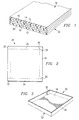
- a porous substrate sheet material 10 having oppositely disposed surfaces 12 and 12' is first coated on a surface 12 with a barrier coating 14 made from a barrier coating composition.
- the barrier coating composition may be applied, as a solution or dispersion, by roll coater, brush, doctor blade or blade coater, sprayer or other such suitable application means; however, in the manufacturing context, it will presumably be preferable to use a commercial roll coater of some sort, such as an engraved roll coater or a reverse roll coater.
- a coating-transfer processes may be used.
- the barrier coating composition is applied in sufficient amount so as to provide the level of performance desired.
- barrier coating composition is applied at a rate of about 0.23-4.5kg per 93m 2 (0.5-10 lbs. per 1000 square feet), more preferably at a rate of about 0.9-3.2kg per 93m 2 (2-7 lbs. per 1000 square feet) of substrate, and most preferably at a rate of about 2.3-2.7kg per 93m 2 (5-6 lbs. per 1000 square feet).
- the amount of barrier coating composition applied may vary widely according to the substrate used and its characteristics, such as porosity and surface roughness, as well as the rheological characteristics of the coating composition, such as viscosity.
- the sheet material 10 with barrier coating 14 is then allowed to dry and cure.
- the substrate sheet material 10 with barrier coating 14 is coated with the release coating 16.
- the release coating 16 like the barrier coating 14, may be applied, as a solution or dispersion, by roll coater, dipping, brush, doctor blade or blade coater, sprayer or other such suitable application means; however, in the manufacturing context, it will presumably be preferable to use a commercial roll coater of some sort, such as an engraved roll coater or a reverse roll coater.
- the release coating 16 is preferably applied at a rate of about 0.1-1.4kg per 93m 2 (0.2-3 lbs. per 1000 square feet), and most preferably at about 0.5-0.9kg per 93m 2 (1-2 lbs. per 1000 square feet).
- the amount applied may vary widely according to the type of release coating composition used, the type of substrate used, the type of barrier coating composition used, and other such variables.
- An optional heat-shielding coating 20 of a polymeric composition may be applied to the other surface 12' of the substrate sheet material 10 when the coated material is to be used in making an ovenable article.
- the polymeric composition that forms the heat-shielding coating 20 may be applied before or after the barrier coating 14 is applied to the oppositely disposed surface 12, and preferably is applied concurrently with the application of the release coating of 16 so as to provide a two-step coating process.
- the heat-shielding coating 20 protects the surface 12' of the substrate sheet material 10 from oven heat during cooking.
- any of a variety of polymeric compositions may be used for the heat-shielding coating 20, including, for example, PVA, acrylic resins, styrene-butadiene resins, mixtures and copolymers of the foregoing, and the like.
- the heat-shielding coating it may be noted, is not always necessary to prevent destruction of or damage to the sheet material by heat, but helps to guard against this possibility.
- the heat-shielding coating prevents discoloration of the sheet material during cooking.
- the heat-shielding coating may itself be pigmented to add to the aesthetic appearance of the substrate sheet material, particularly if the substrate sheet material is brown Kraft paper.
- the numeral 24 denotes generally the blank formed from the coated sheet material from which a shaped article, such as a tray, may be fashioned.
- the blank 24 has been scored, but not cut, along fold lines 26.
- the blank 24 has been cut along lines 28.
- the blank 24 may be folded along lines 26 to form the tray 30 depicted in Figure 3.
- Fold panels 32 may be secured to sidewalls 34 by applying adhesive or glue between them.
- the adhesive or glue used should contain a wetting agent to permit the adhesive or glue to penetrate the release coating 16 on the coated sheet material.
- the release coated surface forms the food-contacting surface 18 of the tray 30, while the heat-shielding coating is on non-food-contacting surface 22.
- the coated sheet material may be formed into a shaped article by means other than folding and gluing, such as, for example, by pressure-forming. Such shaped articles may, but need not, be used for cooking or baking purposes.
- the coated sheet material may be used to make a container (which, as such term is used herein, refers to any form of container of any size or shape, and regardless of whether such container fully encloses or only partially encloses an item placed therein) for storing food on a shelf (such as for storing pet food) while preventing penetration of grease, oil and/or water through the sheet material.
- the coated sheet material may be used to form a container such as a baking tray, as depicted in Figure 3.
- the coated sheet material may be used to form a food receptacle (which, as such term is used herein, refers to any surface for receiving or placing food), such as a paper plate.
- the coated sheet material may be used for fast-food containers, such as boxes for fried chicken, or food wrappers, such as wrapping materials for hamburgers and sandwiches.
- the coated sheet material may be used for any of a variety of applications as a food container, wrapper or receptacle.
- One embodiment of this invention relates to substrate sheet materials.
- substrate sheet materials are preferably porous, and therefore not impervious to water and oil, and may vary widely.
- substrates comprised of non-woven and woven polymers such as fabrics, porous clays such as clay baking containers, and cellulose-based materials, such as paper and cardboard substrates, and the like.
- One preferred embodiment of the present invention comprises a porous sheet material made of a cellulosic material, or a cellulose-based material, such as paper or paper-like materials.
- Such paper sheet materials include, for example, corrugated paperboard (or "cardboard"), newsprint paper, uncorrugated Kraft paper stock, pan liner paper stock, and the like.
- cellulose-based sheet materials such as pressed board
- other fibrous materials for the substrate sheet material.
- the choice of substrate will depend on economic concerns -- low cost substrates being preferred in this regard -- and the intended use of the coated sheet material.
- a stronger and more dimensionally stable substrate such as corrugated paperboard
- the coated sheet material is to be used for a food wrapper (such as a wrapping material for a hamburger)
- less dimensionally stable sheet materials may be suitable.
- an E-fluted corrugated paperboard having three plies of Kraft paper is used for the substrate sheet material.
- Such E-fluted corrugated paperboard is commonly referred to as "cardboard” and may be obtained, for example, from Willamette Industries. Without being bound by the following theory, it is believed that such corrugated paper, having air space in the interior flutes, enhances the even distribution of heat over the tray surface and enhances browning.
- corrugated paperboard having outer plies of between about 4.5 and 18.1kg per 93m 2 (10 and 40 lbs.
- corrugated paperboard having outer plies of between 9 and 18.1kg per 93m 2 (20 and 40 lbs. per 1000 square feet) (for each outer ply) are preferred.
- corrugated paperboard having outer plies of about 15kg per 93m 2 (33 lbs. per 1000 square feet) (for each outer ply) and about 11.8kg per 93m 2 (26 lbs. per 1000 square feet) for the inner ply has been found to be suitable.
- the barrier coatings of embodiments of the present invention comprise (i) a crosslinkable polymer resistant to moisture, and (ii) a grease resistant, water resistant, water dispersible, film-forming polymer.
- Such cross-linkable polymer is preferably applied to the substrate sheet material as part of a solution or dispersion.
- Crosslinkable resins are preferred in order to resist penetration by water moisture into the substrate sheet material at elevated temperatures.
- One preferred class of crosslinkable resins includes acrylic resins.
- Preferred cross-linkable acrylic resins include Michem® coat 50A, made by Michelman, Inc., and Rhoplex® P-376 and Rhoplex® B-15, made by Rohm and Haas.
- SBR styrene-butadiene resins
- Michem® coat 50H made my Michelman, Inc.
- Latex PB 6692NA Latex PB 6692NA made by Dow Chemical.
- Blends and/or copolymers of cross-linkable polymers may also be used.
- Other cross-linkable polymers such as polyvinyl alcohols, polyurethane polymers, polyamine polyamide epichlorohydrin resins and various fluorochemical polymers (e.g., Zonyl® 7040 made by Du Pont), may also provide the necessary barrier properties, although it may be that such polymers are not approved under FDA regulations or other appropriate regulations relating to food contact.
- the cross-linkable polymer and other components of the coated sheet material may, of course, be subject to a variety of federal, state and other governmental regulations, such as regulation by the FDA.
- the cross-linkable polymer and other components of the coated sheet material must be non-toxic as used therein and should lack undesirable odors that could be imparted to the food.
- the cross-linkable polymer preferably has a molecular weight, before curing, of greater than about 5,000. After curing, when the cross-linkable polymer is cross-linked (i.e., when monomer or comonomer repeat units are cross-linked to other monomer or comonomer repeat units in the polymer), the molecular weight of the polymer may be about 20,000 to 40,000 or greater.
- the cross-linkable polymer, after curing, preferably crosslinks to an extent so as to provide the desired water moisture barrier properties.
- the degree of cross-linking is between about 0.5% and about 4%, and more preferably between about 0.5% and about 2%, as expressed by the average weight percent of monomer or comonomer repeat units in the polymer that are cross-linked.
- a more specific listing of polymers that may be used as cross-linkable polymers resistant to water moisture in the barrier coating composition includes but is not limited to: polymers and copolymers of poly(dienes) such as poly(butadiene), poly(isoprene), and poly(1-pentenylene); polyacrylics and polyacrylic acids such as poly(benzyl acrylate), poly(butyl acrylate)(s), poly(2-cyanobutyl acrylate), poly(2-ethoxyethyl acrylate), poly(ethyl acrylate), poly(2-ethylhexyl acrylate), poly(fluoromethyl acrylate), poly(5,5,6,6,7,7,7-heptafluoro-3-oxahepty
- cross-linkable polymer resistant to penetration by water moisture
- any suitable means such as by heat, UV or visible light radiation, or by the use of high energy radiation, such as gamma rays, x-rays, or electron beams, or exposure to air, or by corona discharge, or by addition of a cross-linking agent.
- Heating the barrier coating composition after application thereof will generally speed up the cross-linking process.
- the addition of a cross-linking agent may enhance the degree of cross-linking achieved by the polymer and may thereby enhance the ovenability of the barrier coating, particularly as used in conventional ovens.
- an acrylic resin it may be useful to add an ammonium zirconium carbonate cross-linking agent to the acrylic resin before mixing the acrylic resin with other components of the barrier coating, described more fully below.
- an ammonium zirconium carbonate cross-linking agent when used with an acrylic resin, it may also be beneficial to add a small amount of an SBR to provide flexibility in the coating and prevent cracking thereof if the coated sheet material is folded to make a shaped article.
- cross-linking agents such as glyoxal, ethyl oxylate, and the like may be useful.
- crosslinking agents that have been found to be useful are polymers and copolymers containing anhydrides, such as ScriptsetTM 720 and other 700 series ScriptsetTM resins (Monsanto) that are copolymers of styrene and maleic anhydride, and the like.
- suitable crosslinking agents are polymers and copolymers containing epichorohydrin functionalities, such as PolycupTM 172 resins (Hercules, Inc.) which is a water soluble polyamine-polyamide-epichlorohydrin material, and the like.
- compositions containing high valent metal ions such as iron (+3), titanium (+4), chromium (+3), and the like.
- Quilon® (DuPont) formulations containing chromium (+3) complexes of fatty acids are suitable crosslinking agents.
- water-dispersible, film-forming polymer in the barrier coating composition.
- water-dispersible as used herein is intended to include water-soluble compounds, as well as compounds that may be dispersed in or borne by an aqueous mixture (i.e., "water-borne") even though the compound is not actually soluble in water.
- the water-dispersible, film-forming polymer is generally applied to the substrate sheet material as part of a solution or dispersion including the cross-linkable polymer resistant to water moisture, although the two polymers need not be applied as part of a single solution or dispersion.
- Preferred for use in the practice of embodiments of the present invention are water dispersible polymers comprised of hydroxylated polymers, such as polyvinyl alcohols (PVAs).
- hydroxylated polymers can be used both as the cross-linkable polymer and the water-dispersible film-forming polymer .
- poly(vinyl alcohol) with 0.5 to 15% cross-linking agent can be used to form a barrier coating composition.
- PVA crosslinked with the crosslinking agents of this invention provides for a flexible, formable, pin-hole free barrier coating layers that otherwise do not form using PVA alone.
- water-dispersible, film-forming polymers include poly(butylene alcohol), poly(propylene alcohol), polyvinyl acetate, poly(hydroxyethyl acrylate), hydroxyethylcellulose, carboxymethylcellulose, poly(vinyl pyrrolidone), and copolymers of any of the foregoing, and other like water-dispersible polymers.
- the water-dispersible, film-forming polymer by forming a relatively continuous film over the porous substrate, serves to resist penetration by grease and oil into the substrate sheet material and, furthermore, binds to the release coating.
- the water-dispersible, film-forming polymer should also be non-toxic and should lack undesirable characteristics such as an unpleasant odor. It should meet appropriate federal, state and other government regulations.
- the ratio of water-dispersible, film-forming polymer to cross-linkable polymer in the barrier coating composition, by weight of the solids of such polymers, can vary widely but is preferably between about 0.25:1 and about 1:1, particularly when PVA is the water-dispersible film-forming polymer and an acrylic resin is the cross-linkable polymer.
- the most preferred ratio, by weight solids, of PVA to acrylic resin is about 0.67:1.
- the ratio of water-dispersible, film-forming polymer to cross-linkable polymer can contribute to the degree of food-browning obtained when the coated sheet material is used, for example, in an ovenable baking tray. In general, it has been observed that greater degrees of browning are achieved with higher ratios of water-dispersible, film-forming polymer to cross-linkable polymer.
- the barrier coating composition may also preferably contain a small amount of filler.
- filler For example, commercially available clay fillers have been found to be suitable for use in the barrier coating.
- the filler gives the coating the desired consistency and, it is believed, helps maintain the barrier coating on the surface of the substrate sheet material, thus optimizing the grease, oil and water resistance properties of the sheet material.
- Appropriate fillers may also enhance the inherent barrier properties of the barrier coating composition. Without being bound by the following theory, it may be that the filler helps bridge pores and voids in the substrate and thereby helps prevent seepage of the barrier coating into the substrate.
- Preferred clay filler materials for the barrier coating include, for example, Kaomer 350TM clay (made by Dry Branch Kaolin Company) and Kaopeque 10TM (also made by Dry Branch Kaolin Company).
- Other filler materials such as calcium carbonate (e.g., precipitated calcium carbonate made by Pfizer Inc.), metal flakes, micas, silicas and the like may also be used.
- Pigments and dyes may be added to the barrier coating composition to give the surface of the coated sheet material a desired appearance. For example, it may be desired that the food-contacting surface of the coated sheet material be a white color. If brown Kraft paper is used as the substrate sheet material, titanium dioxide may be added to the barrier coating composition to make it white and to make the food-containing surface of the sheet material appear white when the barrier coating composition is applied. It has been found that pigments such as Ti-Pure® R-900, a titanium dioxide pigment made by DuPont, are suitable pigments for the barrier coating. Other pigments may be suitable so long as they do not significantly degrade the performance of the barrier coating composition. Dyes may be added, such as food dyes, to give desired color or appearance to coated substrates.
- a dispersing agent may be added to the barrier coating composition to help disperse and suspend the filler and pigment particles in the coating before application, and to stabilize the suspension.
- a dispersing agent may be used. For example, it has been found that dispersing agents such as tetrasodium pyrophosphate ("TSPP”) and sodium hexametaphosphate are suitable for this purpose.
- TSPP tetrasodium pyrophosphate
- sodium hexametaphosphate sodium hexametaphosphate
- the release coating may vary widely, and is preferably used to inhibit sticking of food material to the surface of the coated sheet material.
- the release coating composition is preferably comprised of a metal complex of a fatty acid, such as Quilon®.
- Quilon® is a Werner chrome complex of a fatty acid and is manufactured by DuPont.
- Quilon® L has been found to be particularly suitable.
- Other suitable release coating materials include, for example, iron(+3)-fatty acid complexes and titanium(+4)-fatty acid complexes. It has been found that best results are achieved with a trivalent or tetravalent metal complex of a fatty acid, such as those mentioned above.
- M is a metal ion, such as iron, titanium, chromium, vanadium, etc.
- n is an integer equal to or greater than 3
- R is an alkyl chain having from 6 to 30 carbon atoms
- y is a integer equal to or greater than 1.
- a minor amount of fine metal powder such as aluminum powder, or metal flakes, such as aluminum flake
- a light metal coating such as an aluminum or other metallized layer to the barrier coating composition or release coating composition to provide and aesthetically pleasing appearance, such as a metallic reflectance, or to function as a susceptor material, or as a heat shield or IR reflectance material.
- metallized layer material may enhance browning and crisping of foodstuffs that are cooked on the coated sheet material in a microwave oven.
- Susceptors generally allow for browning or crisping in microwave ovens by heating up when exposed to microwave energy, and transferring such heat to the foodstuff resting on or adjacent to the susceptor. However, too much susceptor material should be avoided because an excess of susceptor material will cause arcing in a microwave oven.
- Another aspect of the present invention relates to a method of protecting a surface from penetration by grease, oil, and water and making coated sheet materials and articles derived therefrom.
- corrugated paper when corrugated paper is to be used as the substrate sheet material, it may be useful to apply the barrier coating composition and the release coating composition to Kraft paper prior to incorporating the Kraft paper into a corrugated sheet.
- Kraft-processed paper manufactured at a paper mill may be prepared in rolled stock of 15kg per 93m 2 (33 lbs. per 1000 square feet) (step C).
- a barrier coating composition (steps A and B) pigmented white, as described above, may be applied to one surface of the rolled brown stock by roll coating at the paper mill (step D), thereby creating a Kraft paper rolled stock with barrier coating on one side.
- This coated stock may be shipped to a corrugator, and there, the release coating composition may be applied to the barrier coating on the rolled stock (steps E and F).
- a separate roll stock of Kraft paper may be coated on one surface with a heat-shielding polymeric composition (steps G and H).
- the roll stocks may then be used to manufacture corrugated Kraft paper having one outer ply with a barrier coating and release coating on one outside surface of the corrugated structure, and one outer ply with a heat-shielding coating on the other outside surface of the corrugated structure (step I).
- the release coating and heat-shielding coating are preferably applied concurrently, so that only a two step coating process is required.
- the inner ply may be, for example, a sheet of Kraft paper of 11.8kg per 93m 2 (26 lbs. per 1000 square feet).
- the coated corrugated sheet material so prepared may then be sent to a die-cutter to cut into shapes of desired form (step J), then formed into a shaped article, such as a tray (step K).
- a barrier coating composition (steps a and b) (referred to in Figure 5 as the "GR coating") may be applied to a cellulose-based sheet material roll stock manufactured at a paper mill (step c) in a coating operation (step d), followed by coating (step f) with the release coating composition (prepared in step e) and then die-cutting the coated sheet material (step g).
- This coating-transfer process may comprise first casting the film-forming barrier coating on to a substantially non-porous and non-adherent surface of a flexible carrier, partially curing the barrier coating on the surface of the carrier, and transferring the coating from the carrier onto a surface of the desired porous substrate material.
- This coating transfer process within the scope of this invention are possible.
- Advantages of such a coating-transfer process include: the ability to use a wide variety of substrate materials with widely varying pore sizes, conservation of the material required to coat porous substrates; the ability to print onto the surface of the coating which is to be laminated to the porous substrate for producing a finer print than that which is available by printing directly onto the porous substrate; the ability to incorporate an aesthetically attractive surface, such as that obtained by metallization, metal coating, dying, coloring, etc., onto the surface of a substrate which is otherwise substandard in aesthetic appearance; and the ability to transfer a high gloss or texture on the coated surface of the flexible carrier onto the porous substrate via the formed and transferred film.
- the barrier coating can be formed into a cured coating before it contacts the porous substrate, there is significant reduction in the amount of said coating material required to sufficiently cover the substrate, and which would otherwise be soaked into the pores of the substrate.
- Printing on the coating before the coating is transferred onto the substrate likewise conserves printing materials and inks. Such printing also allows for the creation of clearer and more crisp imagery to be placed onto the substrate, since the amount of "bleeding" by the inks into the pores of the substrate is thereby significantly reduced.
- an aesthetically attractive film coating can be formed onto a flexible carrier, rolled up with the flexible carrier in a form suitable for shipping, shipped to a location in which there is a supply of substrate material and simple laminating equipment, and thereat be laminated onto the face of the substrate material.
- This allows for the benefits of the present invention to be used by those who may lack either the equipment necessary to form and print film, or the quality of substrate material necessary to otherwise produce an aesthetically attractive package.
- Other processes are also possible.
- the present invention represents a truly unique approach to designing ovenable or dual ovenable sheet materials, and shaped articles therefrom, having various desirable properties and being simple and economical in design and construction.
- embodiments of the present invention achieve excellent release of foodstuffs from the cooking surface while resisting penetration of grease, oil and water into the sheet material.
- Embodiments of the present invention may be made with strong, low-cost substrates, such a cardboard or newsprint, and can achieve good biodegradability, as well as recyclability and repulpability.
- Embodiments of the present invention also allow for excellent browning of baked goods.
- embodiments of the present invention as described are easily formable without loss of performance, thus allowing for ready construction of shaped articles.
- the barrier coatings of embodiments of the present invention readily allow for the construction of shaped articles using appropriate glues or adhesives, and, hence, may dispense with the need for clip-lock designs or pressure-forming processes.
- Shaped articles embodying the present invention may be made for use in either conventional or microwave ovens, or, in view of the barrier properties exhibited by embodiments of the present invention, may be used in non-cooking applications as food wrappers, containers or receptacles.
- Embodiments of the present invention also allow for considerable process design flexibility.
- Barrier coatings can be directly applied to suitable substrates or applied by coating-transfer techniques. With the latter process, the barrier coating can be altered to provide aesthetically pleasing surfaces in addition to providing the desired performance.
- Barrier coatings can be metallized to give metallic appearances, IR reflectance, and heat insulating properties, as well as function as microwave susceptor materials for the use of coated substrates in microwave ovens.
- a barrier coating composition of the following formulation was prepared: 50g polyvinyl alcohol solution (prepared by dissolving 1 part by weight DuPont Elvanol® 71-30 in 10 parts by weight H 2 O) 30g Michem® coat 50A acrylic resin, obtained from Michelman, Inc. (total solids content of approximately 34.5-35.5%) 15g Kaomer 350TM clay, obtained from Kaolin Company 15g Ti-Pure® R-900 titanium dioxide, obtained from DuPont 0.2g TSPP, from Monsanto 10g H 2 O
- This barrier coating was prepared by first preparing the polyvinyl alcohol solution by mixing 1 part by weight Elvanol 71-30 (in powder form) in 10 parts by weight water and stirring until the Evanol 71-30 was wetted out.
- This PVA solution was then heated for about 13-14 minutes at 93°C (200°F) while stirring, and then allowed to cool to room temperature.
- the Michem® 50A acrylic resin (which, as supplied by Michelman, Inc., was 50% solids) was diluted with water to about 34.5-35.5% solids. All of the ingredients of the barrier coating composition were then placed in an Oster® blender and mixed for about 1-2 minutes, until the composition was smooth and uniform.
- the ratio of PVA to acrylic resin, by weight solids of each, was 0.43:1 -- i.e., (50 g PVA solution x 9% solids) ⁇ (30 g acrylic resin x 34.5% solids) 0.43.)
- the composition was then coated on a 0.18m by 0.14m (7" by 51 ⁇ 2") E-fluted corrugated paperboard having other plies of 15kg per 93m 2 (33 lbs. per 1000 square feet) (for each outer ply) and an inner ply of 11.8kg per 93m 2 (26 lbs. per 1000 square feet), such paperboard being supplied by Willamette Industries.
- the coating composition was applied with a Michelman blade coater at an application rate of approximately 1.4kg per 93m 2 (3 lbs. per 1000 squaree feet).
- the coated sheet material was then dried and cured; for about 5 seconds in an oven at 205°C (400°F).
- a release coating composition was prepared by dissolving 2 g Quilon® L chrome complex, obtained from Du Pont, in 98 g H 2 O.
- the Quilon® solution was then neutralized with urea formic acid to a pH of about 3.
- the solution was allowed to sit at room temperature for thirty minutes, after which the pH had stabilized at about 3.4-4.
- the Quilon® solution was applied, with a Michelman blade coater, on the dried barrier coating at a rate of about 0.9kg per 93m 2 (2 lbs. per 1000 square feet).
- the coated sheet material was then placed in an oven for about 5 seconds at about 176°C (350°F) to allow the release coating to dry and cure and to bind to the barrier coating.
- the back surface of the sheet material i.e., the non-food-contacting surface
- a polymeric composition was also coated with a polymeric composition. This composition was applied after application of the barrier coating composition and release coating composition to the oppositely-disposed food-contacting surface.
- the heat-shielding polymeric composition was comprised of the following formulation: 2.5g polyvinyl alcohol solution (Elvanol® 71-30 diluted to 9% solids) 1g Quilon® L 10g titanium dioxide 2g lake yellow 0.3g TSPP 10g calcium carbonate 25g H 2 O These ingredients were mixed for 1-2 minutes in an Oster® blender prior to application.
- the heat-shielding polymeric composition was applied at a rate of approximately 1.4kg per 93m 2 (3 lbs. per 1000 square feet) .
- the sheet material, coated with the heat-shielding polymeric composition was then placed in an oven for about 5 seconds at 205°C (400°F) to dry and cure.
- a tray was formed by scoring, cutting and folding the corners of the sheet material in the manner depicted in Figures 3 and 4, and applying an appropriate adhesive to the folds of the tray.
- the adhesive was Adhesive No. 5041.00 obtained from Timminco Universal Adhesives in Memphis, Tennessee; this adhesive included wetting agent "Aerosol OTTM,” which, it is believed, allowed penetration into the Quilon® release layer. Thus folded, the release layer formed the surface of the interior of the tray on which food would be placed.
- the tray so formed was used to bake 10 Winn DixieTM cinnamon rolls in a conventional oven for about 14 minutes and 205°C (400°F). After cooking, the pan was allowed to cool at room temperature (about 22°C (72°F)) for a period of about one hour. The rolls were removed by quickly turning the pan over and allowing the rolls to release from the surface. Release was 100%. The rolls exhibited excellent browning.
- Example 1 For comparative purposes, five trays were formed using different coating compositions, and two trays were formed using extruded, biaxially-oriented PET films. For all trays, a heat-shielding coating composition was applied as described in Example 1 to one surface of a paper substrate as in Example 1. Furthermore, for trays 1 through 4, the trays were formed from dual-ovenable sheet material prepared as in Example 1, except as follows. For tray 1, the barrier coating composition of Example 1, but without any PVA solution, was applied, and no release coating was used. For tray 2, the barrier coating composition of Example 1 was applied, and, again, no release coating was used. For tray 3, the barrier coating composition of Example 1, but without any PVA solution, was applied, followed by application of a release coating as described in Example 1. Tray 4 was made fully in accordance with Example 1. For tray 5, no barrier coating and no release coating were applied.
- Trays 6 and 7 were made with extruded, biaxially-oriented PET films.
- tray 6 a MYLARTM PET film, without a silicone release layer, was glued to E-fluted corrugated paperboard of the type referred to in Example 1.
- tray 7 a PET film laminate known and sold as "QRXTM paperboard," with a silicone release layer on the PET film, was used. All of the trays were used to bake Winn DixieTM cinnamon rolls. The results are set forth in Table 1. Tray No.
- a dual-ovenable tray was formed as in Example 1, except that in the barrier coating formulation, 30 g of Rhoplex® P-376 (an acrylic resin obtained from Rohm and Haas) was used instead of the Michem® coat 50A acrylic resin. Rhoplex® P-376 is a cross-linkable acrylic resin.
- the dual-ovenable tray of this Example exhibited excellent browning, excellent grease resistance, excellent water moisture resistance, and good gluability. All of the cinnamon rolls released when the tray was turned over.
- a dual-ovenable tray was formed as in Example 1, except that in the barrier coating formulation, 30 g of Latex PB 6692NA (a styrene-butadiene resin ("SBR") obtained from Dow Chemical) was used instead of the Michem® coat 50A acrylic resin.
- Latex PB 6692NA is a cross-linkable SBR.
- the dual-ovenable tray of this Example exhibited excellent browning, excellent grease resistance, excellent water moisture resistance, and good gluability. All of the cinnamon rolls released when the tray was turned over. However, it was noted that, because there were portions of the interior tray surface exposed to air and not covered by a cinnamon roll, the SBR created an odor that would generally be undesirable for cooking purposes.
- a dual-ovenable tray was formed as in Example 4.
- a Betty CrockerTM devil's food cake was baked in the tray at a temperature of about 176°C (350°F) for 30 minutes, the cake material filling substantially all of the tray so that almost no portion of the interior surface of the tray was exposed to air during baking.
- the tray exhibited excellent grease resistance, excellent water moisture resistance, and good gluability.
- the cake released easily when the tray was turned over and the cake pried gently with a knife. No unpleasant odor was generated by the SBR, apparently because almost no portions of the interior tray surface were exposed to air during baking.
- Example 2 Two dual-ovenable trays were formed as in Example 1, except that in the release layer formulation, an iron(+3)-fatty acid (stearic acid) complex was used for one tray, and a titanium(+4)-fatty acid (stearic acid) complex was used for the other tray. Although it is not known whether these metal-fatty acid complexes would meet FDA and/or other relevant federal or state regulations for cooking materials, the trays formed in this Example exhibited the same highly-acceptable performance in end-use performance tests as those of Examples 1, 3 and 4.
- a barrier coating composition of the following formulation was prepared: 50g polyvinyl alcohol solution (prepared by dissolving 1 part by weight DuPont Elvanol® 71-30 in 10 parts by weight H 2 O) 20g Rhoplex® P-376 acrylic resin (total solids content of approximately 35%) 1.5g Ammonium zirconium carbonate solution (BacoteTM 20 obtained from Magnesium Elektron, Inc.) 10g KaopequeTM-10 15g Ti-Pure® R-900-38 1g TSPP 5g Styrene-butadiene resin (product no. X30560.50 from Dow Chemical) This barrier coating composition was prepared by first preparing the polyvinyl alcohol solution as described in Example 1.
- Rhoplex® P-376 acrylic resin (which, as supplied by Rohm & Haas, was approximately 50% solids) was diluted with water to about 35% solids.
- SBR styrene-butadiene resin
- the composition was coated on a 0.18m by 0.14m (7" by 51 ⁇ 2") E-fluted corrugated paperboard as described in Example 1, except that the coating was applied with a squeegee rather than a Michelman blade coater.
- the sheet material so coated was dried and cured for about 5 seconds in an oven at 205°C (400°F).
- a release coating composition was then prepared and applied as described in Example 1.
- the coated sheet material was primarily tested for resistance to penetration by water by holding the coated sheet material at a 45° angle and, with an eyedropper, placing a drop of water on the surface of the coated sheet material.
- the drop of water ran down and off the coated sheet material without leaving a mark, which indicated that a sufficient amount of release coating composition and barrier coating composition had been used and coated evenly over the substrate sheet material. (If the drop of water leaves a mark or trace, it may indicate either an insufficient amount of barrier coating composition or release coating composition, or that either or both of such compositions are not evenly coated over the surface of the substrate sheet material.)
- Example 2 Two trays were formed from the coated sheet material in the manner described in Example 1. One tray so formed was used to bake 10 Winn DixieTM cinnamon rolls in a conventional oven at 205°C (400°F) for about 14 minutes. The other tray was used to bake 10 PillsburyTM cinnamon rolls at 205°C (400°F) for about 14 minutes. After baking, all of the rolls exhibited excellent browning.
- the trays formed in this Example exhibited superior performance in the end-use performance tests described in Example 1: 100% release, excellent browning, excellent grease and water resistance, and a passing grade on the gluability test.
- a dual-ovenable tray was formed as in Example 1, except that no acrylic resin was added to the barrier coating composition. Rather, the following barrier coating composition was used: 50g polyvinyl alcohol solution (Evanol® 71-30 diluted to 9% solids) 15g KaopequeTM-10 15g Ti-Pure® R-900 1g TSPP 10g H 2 O This barrier coating composition was prepared as in Example 1, except, as noted above, no acrylic resin was added to the composition. The barrier coating composition was coated on a sheet material as described in Example 1, and a release coating composition was also prepared and applied as described in that Example. No heat-shielding composition was used.
- a tray formed from this coated sheet material was used to cook 10 Winn DixieTM cinnamon rolls in a conventional oven at 205°C (400°F) for about 14 minutes.
- Another tray formed from this coated sheet material was used to bake a Betty CrockerTM devil's food cake at 176°C (350°F) for about 30 minutes.
- the tray with the cinnamon rolls did not exhibit good release characteristics; even after prodding with a fork, a residue of the rolls remained stuck to the tray.
- the tray with the cake exhibited satisfactory release characteristics. Both trays fared poorly in the test for water and grease resistance. Accordingly, this Example demonstrates the necessity of using, in the barrier coating, a cross-linkable polymer resistant to penetration by water moisture.
- a brightness meter was used to compare the browning characteristics of a tray embodying the present invention against the browning characteristics of pan liner paper, which was obtained from American Food Products.
- the pan liner paper was placed on the surface of a tray formed from uncoated corrugated paperboard as described as the substrate sheet material (before coating) in Example 1.
- Tray B of this Example as formed in accordance with Example 7.
- Six Winn DixieTM cinnamon rolls were baked in each tray at 205°C (400°F) for about 14 minutes. The rolls were then removed from the trays and visually compared.
- the rolls from Tray B were distinctly more brown than the rolls from Tray A, which were generally light brown and almost white.
- the brownness of the cinnamon rolls was further determined by measuring reflectance with a brightness meter with directional reflectance at 457 nm.
- the test was conducted in accordance with TAPPI test method T 452 om-87, which is generally used to measure the brightness of white, near-white and naturally-colored pulp, paper and paperboard.
- TAPPI test method T 452 om-87 which is generally used to measure the brightness of white, near-white and naturally-colored pulp, paper and paperboard.
- the test measures the percent of reflectance of magnesium oxide of 100.0%. Thus, a higher percent reflectance indicates higher whiteness.
- For each of the rolls three brightness readings were taken (from different regions of the roll), and regions having cinnamon powder were avoided for the readings.
- the lower average reflections of the rolls from Tray B is indicative of the increased browning achieved with embodiments of the present invention as compared to pan liner paper.
- Example 2 a tray formed as in Example 1 was tested for biodegradability against an extruded PET laminate tray, as described with respect to tray 7 in Example 2.
- the test for biodegradability was conducted by burying each tray approximately 1 foot deep in the ground, in close proximity to each other. The trays were dug up three months later. The tray of the present invention had completely degraded. In contrast, while the paperboard substrate of the PET laminate had degraded, the PET film of the PET laminate tray had not degraded at all.
- Example 2 a tray formed as in Example 1 was tested for recyclability and repulpability.
- the test for recyclability and repulpability was conducted by tearing up the tray formed as in Example 1 in to pieces approximately 0.03m x 0.04m (1" x 11 ⁇ 2").
- the torn pieces were placed in water and the pH was adjusted to about 10.5 at a water temperature of about 60°C.
- the torn-up coated sheet material comprised 1.2% by weight of the mixture.
- the mixture was placed in a TAPPI-standard T-205 disintegrator, which was run at 3000 r.p.m. for 50,000 revolutions. After disintegrating, the mixture was diluted until the pulp portion comprised 0.3% by weight. A hand sheet was then formed from the pulp. After forming, slight specks of coating were evident in the sheet, but no noticeable pieces of paper stock were visible.
- PVA can be used as both the cross-linkable polymer resistant to penetration by water moisture when cured, and the water-dispersible film-forming polymer that is resistant to penetration by grease and oil when cured. It also demonstrates the ability to use the lowest grades of porous paper and turn them into highly glossed, multi-functional, non-porous papers.
- a water solution of Airvol 125TM super hydrolyzed polyvinyl alcohol (PVA) containing 2.5% solids was cast onto a Mylar film to completely coat the surface.
- a #24 Myar Rod was then pulled across the coating to leave a uniform coating of the PVA solution on the Mylar film; the approximate coating rate was 3.2kg per 93m 2 (7 lbs per 1000 sq.ft).
- the coating was uniform and even as evidenced by the lack of any "fish-eyes" (voids) in the coating.
- the coated Mylar film was then pulled across a hot surface (coated side up) 110°C (230°F) for 30 seconds while exposed to ambient air. This caused the water in the coating to evaporate without distorting the Mylar film or the coating.
- the observed dry weight of the uncoated Mylar film was 6.50 grams, the weight of the Mylar film with the wet coating was 9.68 g, and the final weight of the Mylar film with the dried, cured coating was 6.58 g.
- This cured coating was subjected to a water resistance test, an oil resistance test, and a wet rub test.
- Vegetable oil was poured onto the coating on the Mylar film and observed through a magnifying lens. After three minutes at room temperature the oil did not penetrate or swell the coating demonstrating that this coating exhibited good oil resistance.
- a water drop was placed onto the coated surface of the Mylar film and allowed to sit for 1 minute at room temperature.
- a finger was placed on top of the water droplet and pressed down until contact with the PVA coating was made. The finger was then rubbed in a circular motion with mild pressure in the area where the water drop was sitting on the coating. In 10 seconds, the coating broke down demonstrating that the PVA coating exhibited poor wet rub characteristics.
- the PVA coated Mylar film was then coated on top of the PVA layer with a vinyl acetate ethylene copolymer based tie layer (adhesive) made by Swift Adhesives (#48105) using a # 7 Myar Rod.
- a piece of Kraft 100% virgin paper (69# stock, International Paper) was placed on top of the wet adhesive layer, and the composite structure was then run through high pressure lamination rollers, then through heated rollers 176°C (350°F) with high pressure.
- the Mylar film side should come in contact with the heated roller to assist with releasing the PVA coating from the Mylar carrier. This heated lamination process contributes to setting the adhesive and forming a strong bond between the PVA coating and the paper.
- the PVA coating When the bond between the paper and the PVA coating is greater than the bond between the PVA and the Mylar carrier, the PVA coating will easily release from the Mylar carrier and be transferred to the paper substrate.
- This coated substrate was then subjected to a water resistance test, an oil resistance test and a wet rub test as described above.
- the water resistance test demonstrated that after 5 minutes, a water drop on the coating did not penetrate the barrier coating or cause it to shadow or swell.
- the oil resistance test demonstrated that vegetable oil did not penetrate the coating after 3 minutes of exposure.
- the wet rub test demonstrated that there was no break through of the coating even after 30 seconds of rubbing. This demonstrates significantly improved wet rub characteristics.
- a release coating was applied on top of the exposed PVA coating on the paper substrate.
- the release coating was comprised of:
- a drop of water was placed onto the cured and crosslinked coated surface and the water was observed to bead up. Before the release coating was applied, the a drop of water tended to blush across the surface (wet the surface) instead of beading up. Another drop of water was placed onto the coated surface while holding the substrate at an angle. Here, the water bead traveled down the surface leaving a small trail of droplets behind. On a scale of 0 to 5, with 0 being the worst performance, this sample registered a value of 2.
- a strip of Scotch TapeTM was placed on the surface of the coated paper and 3/4 of the length of tape was smoothed over the coated surface to insure a good bond. The tape was then pulled from the surface and the force required to pull off the tape was measured. A scale of 0 to 5 was used to measure performance, with 0 being the worst (strong force needed to remove tape). This sample registered a value of 2.
- This example demonstrates the use of a simplified barrier coating formulation, metallization and film transfer process to produce a coated paper material with excellent barrier and release properties.
- a coating solution was prepared containing:
- This coating solution was cast onto a Mylar substrate using a #15 Myar Rod as in example 12. This applied the coating at a rate of 2.3kg per 93m 2 (5 lbs per 1000 sq.ft). A smooth, even coating was observed with no "fish-eyes" evident. The coating had a slight green tint.
- the coating was cured by placing the coated Mylar substrate into an oven at 126°C (260°F) for 30 seconds. The coating dried evenly with a faint clear green tint.
- This coating when subjected to the water resistance test described in example 12 exhibited resistance to a water drop for greater that 3 minutes. On subjection to the oil resistance test (example 12), vegetable oil did not penetrate the coating after 3 minutes of exposure. This coating was subjected to the tape release test described in example 12, and it registered a value of 5 demonstrating excellent release characteristics.
- the wet rub test (example 12) demonstrated that the coating exhibited frosting and shadowing after 30 seconds of rubbing.
- the coated Mylar substrate was passed through a corona discharge on the coated side. This was to prepare the surface of the coating for metallization. After the corona treatment, the coating exhibited poor water resistance and poor wet rub characteristics. This treated coating was then overcoated with a vinyl acetate ethylene copolymer based adhesive made by Swift Adhesives (#48105) using a #5 Myar Rod. This coating was then cured at 126°C (260°F) for 30 seconds. This coated substrate was then metallized (evaporated aluminum) to 20% light transmission on top of the adhesive layer. It was determined by independent experimentation that a metallized layer with 15-25 % light transmittance provided the desired appearance and was useable as a susceptor material in microwave ovens.
- the metal layer exhibited good adhesion to the coated substrate.
- This metallized coating was then coated with Swift adhesive #48105 using a #5 Myar Rod and laminated with 69# Kraft liner board as described in example 12.
- the coated paper substrate Upon removal of the Mylar carrier film, the coated paper substrate exhibited a very high gloss, aluminum foil like surface.
- This coated paper substrate was then subjected to indirect heat (1 minute at 120°C (250°F) or to a hot surface (5 seconds at 176°C (350°F) to remove the effects of the corona treatment of the barrier film. Exposure to air for an extended time also tends to reverse the affects of the corona treatment.
- This coating exhibited excellent water resistance, oil resistance, wet rub resistance, and release as determined by the water resistance test, the oil resistance test, the wet rub test and the release test described in example 12. This film was also subjected to a freeze test.
- a strip of adhesive tape was applied to the coated surface as described in the release test in example 12.
- the coated sheet material with the tape on the surface was then put into a Ziplock® polyethylene bag and sealed. This was then put into a freezer at -31°C (-25°F) for 1 hour. The bag was then removed from the freezer, and the tape was pulled from the surface. Good release characteristics were observed; the barrier coating remained bonded to the paper substrate. No cracking or delamination was observed.
- An aqueous coating formulation comprised of:
- the Mylar carrier with the cured barrier coating was overcoated with an adhesive from National Starch and Chemical Company (#309793). This was then laminated to Kraft virgin linerboard (69#, 18 pt) by passing first through cold high pressure rollers, then through hot 176°C (350°F) high pressure rollers. This process of cold then hot lamination allows the adhesive first to penetrate into the paper surface partially forming a bond. The application of heat then accelerates the evaporation of water from the adhesive layer thereby setting the bond between the coating and the paper. A cold roller 4°C (40°F) was then passed over the Mylar surface. This shocked the barrier coating and caused it to release from the Mylar carrier.
- the paper substrate containing the barrier coating was post cured at 148°C (300°F) for 3 minutes. This lamination process was repeated for the other side of the paper substrate providing a high gloss, sealed non-porous paper article.
- This substrate exhibited good water resistance (3 min), outstanding oil resistance (3 min), excellent wet rub resistance (90 seconds), but poor release characteristics (measured value of 0 in release test).
- a release coating was applied to one side of the barrier coated paper substrate.
- the release coating was comprised of:
- the treated paper substrate describe above was formed by cutting and scoring into a 0.23 x 0.11 x 0.03m (9x4.5x1 inch) baking pan. The corners were glued using an adhesive containing a wetting agent. Winn DixieTM brand cinnamon rolls (eight) were placed into the pan and baked in a gas oven for 14 minutes at 204°C (400°F). The baked rolls were removed from the oven and the pan was turned over. All eight rolls released completely and fell out. There were no odors observed from the baking pan, and there was no sign of oil penetration through the barrier layer into the paper substrate. The rolls exhibited excellent browning on the bottom.
- This example demonstrates the use of PVA crosslinked with a chromium complex as the barrier coating.
- a metal plate was heated until its surface reached 115°C (240°F).
- a non-porous Mylar carrier film was placed on the hot metal surface and the temperature of Mylar surface was monitored and controlled between 110-121°C (230-250°F).
- a coating formulation comprising DuPont Elvanol® 7130 (medium viscosity, 9% solids in water) was poured onto the hot Mylar surface then immediately spread using a #20 Myar rod. The surface of the coating in contact with the air formed a gel.
- the coated carrier film was removed from the hot plate and a 33# Kraft porous paper was placed in contact with the semi-liquidous coating.
- the composite laminate was then put under high pressure and heated to 176°C (350°F) to bond the paper substrate to the coating.
- 176°C 350°F
- the coated paper substrate was post cured in an oven for 1 minute at 149°C (300°F).
- a drop of water on the cured surface was observed to blush and spread after 3 minutes demonstrating that the coating had only fair water resistance.
- the coating also demonstrated very good oil resistance (3 min), but poor release characteristics (value of 1 in release test).
- a release coating (and cross-linking) treatment was then applied.
- the release coating/cross-linking treatment was comprised of:
- This coated paper substrate was subjected to the baking test describe in example 14. All eight cinnamon rolls released completely after baking. The paper pan exhibited excellent oil holdout, and there were no bad odors observed during the baking process. The rolls exhibited consistent browning on the bottom.
- a barrier coating composition of the following formulation was prepared:
- This cured barrier coating was overcoated with Swiftos adhesive #48105 using a #5 Myar rod.
- the wet adhesive was then bonded to 69# Kraft virgin linerboard through a high pressure lamination process.
- the laminate was then passed through a series of heated high pressure rollers 176°C (350°F) which caused the adhesive to set, and the Mylar carrier to release from the barrier coating.
- the coated paper substrate was then post cured for 30 seconds at 149°C (300°F) to evaporate any remaining water in the coating.
- the original dull surface of the Kraft paper was now extremely glossy and non-porous.
- This barrier coating exhibited excellent water resistance (3 minutes), excellent wet rub characteristics (1 minute), and the same oil resistance as before the transfer process.
- This barrier coating exhibited poor release characteristics (measured 1 in the tape release test described in example 12).
- a release coating was applied to the barrier coating comprised of:
Landscapes
- Chemical & Material Sciences (AREA)
- Chemical Kinetics & Catalysis (AREA)
- Laminated Bodies (AREA)
- Application Of Or Painting With Fluid Materials (AREA)
- Paints Or Removers (AREA)
Claims (47)
- Matériau constitué :(a) d'un substrat poreux ayant au moins deux surfaces mutuellement opposées (12, 12') ; et(b) d'un revêtement d'arrêt séché et durci (14) sur au moins une surface (12) dudit substrat, ledit revêtement d'arrêt (14) étant formé à partir d'une dispersion constituée d'un mélange : (i) d'un premier polymère réticulable qui est résistant à la pénétration par l'humidité lors de son durcissement, et (ii) d'un second polymère filmogène, dispersable dans l'eau, qui est résistant à la pénétration par les graisses et les huiles à l'état durci.
- Matériau suivant la revendication 1, comprenant en outre un revêtement de séparation (16) sur le revêtement d'arrêt (14).
- Matériau suivant la revendication 2, qui est une feuille revêtue, ledit substrat poreux étant un substrat poreux sous forme de feuille (10).
- Matériau suivant la revendication 3, dans lequel le revêtement de séparation (16) est constitué d'un dérivé d'acide gras.
- Matériau suivant la revendication 4, dans lequel le dérivé d'acide gras est un complexe métallique d'un acide gras.
- Matériau suivant la revendication 4, dans lequel le dérivé d'acide gras est un complexe de chrome d'un acide gras.
- Matériau suivant la revendication 2 ou la revendication 3, dans lequel le premier polymère réticulable a un poids moléculaire moyen avant durcissement supérieur à 5000 et est choisi dans le groupe consistant en : des poly(diènes), des polyméthacryliques, des poly(acrylamides), des poly(acides méthacryliques), des poly(éthers vinyliques), des poly(halogénures de vinyle), des poly(esters vinyliques) et leurs dérivés obtenus par hydrolyse ou hydrolyse partielle, un poly(styrène), des poly(oxydes), des poly(carbonates), des poly(esters), des poly(anhydrides), des poly(uréthannes), des poly(siloxanes), des poly(sulfones), des poly(sulfonamides), des poly(amides), des poly(imines), des poly(benzimidazoles), des glucides, un poly(alcool vinylique), un poly(alcool propylique), un poly(alcool butylique), le poly(1-(hydroxyméthyl)éthylène, le poly(1-hydroxyéthyl)-éthylène), un polymère styrène-butadiène, des polymères hydroxylés, et les copolymères dérivés de n'importe lesquels des précédents.
- Matériau suivant la revendication 3 ou la revendication 7, dans lequel le second polymère filmogène, dispersable dans l'eau, est choisi dans le groupe consistant en : le poly(butylène-alcool), le poly(propylène-alcool), le poly(alcool vinylique), le poly(acrylate d'hydroxyéthyle) et le poly(acétate de vinyle), et les copolymères dérivés de n'importe lesquels des polymères précités.
- Matériau suivant la revendication 3 ou la revendication 8, dans lequel le premier polymère réticulable et le second polymère filmogène, dispersable dans l'eau, sont choisis dans le groupe consistant en des poly(alcools vinyliques), des poly(butylène-alcools), des poly(propylène-alcools), le poly(1-(hydroxyméthyl)éthylène, le poly(1-(hydroxyéthyl)éthylène et les copolymères dérivés des polymères précités.
- Matériau suivant la revendication 7 ou la revendication 8, dans lequel le premier polymère réticulable est réticulé par un agent de réticulation choisi dans le groupe consistant en : l'anhydride maléique, des polymères comprenant de l'anhydride maléique, des copolymères comprenant de l'anhydride maléique, des glyoxals, des anhydrides, l'oxylate d'éthyle, l'épichlorhydrine, des polymères comprenant de l'épichlorhydrine, des copolymères comprenant de l'épichlorhydrine, des ions métalliques, des complexes d'acides gras d'ions métalliques, une exposition à la chaleur, un rayonnement à forte énergie, un rayonnement gamma, des rayons X, un rayonnement ultraviolet, un rayonnement visible, des faisceaux d'électrons, des décharges par effluves et leurs associations.
- Matériau suivant la revendication 2 ou la revendication 10, dans lequel le revêtement de séparation (16) comprend un complexe métallique d'un dérivé d'acide gras.
- Matériau suivant la revendication 3 ou la revendication 11, dans lequel le substrat poreux sous forme de feuille (10) comprend de la cellulose.
- Matériau suivant la revendication 12, dans lequel le substrat poreux sous forme de feuille (10) a un grammage compris dans l'intervalle d'environ 9,07 kg pour 92,9 m2 (20 lb pour 1000 ft2) de matière en feuille et d'environ 18,14 kg pour 92,9 m2 (40 lb pour 1000 ft2) de matière en feuille.
- Matériau suivant la revendication 13, dans lequel le substrat poreux sous forme de feuille (10) est une feuille ondulée et peut être traité au four dans un four classique à des températures d'environ 204°C (400°F).
- Matériau suivant la revendication 14, dans lequel la matière en feuille revêtue peut être soumise à un double traitement au four.
- Matériau suivant la revendication 15, dans lequel le substrat poreux sous forme de feuille (10) comprend de la cellulose, le revêtement d'arrêt (14) est constitué d'un poly(alcool vinylique) ; et le revêtement de séparation (16) est constitué d'un complexe d'acide gras de chrome.
- Matériau suivant la revendication 3, dans lequel le revêtement d'arrêt (14) comprend en outre n'importe quelle association de charges, de colorants, de pigments, de matières colorantes, de couches métallisées, d'impression, de brillance et de texture.
- Matériau suivant la revendication 2, dans lequel le premier polymère réticulable est un poly(alcool vinylique).
- Matériau suivant la revendication 2, dans lequel le second polymère filmogène dispersable dans l'eau est un poly(alcool vinylique).
- Procédé pour la protection d'une surface (12) contre la pénétration par la graisse, l'huile et l'eau, ledit procédé comprenant les étapes consistant :(a) à revêtir ladite surface (12) avec un revêtement d'arrêt (14) formé à partir d'une dispersion constituée d'un mélange de : (i) d'un premier polymère réticulable résistant à la pénétration par l'humidité à l'état durci, et (ii) d'un second polymère filmogène, dispersable dans l'eau, résistant à la pénétration par la graisse et l'huile à l'état durci, ledit revêtement d'arrêt (14) formant une couche d'arrêt sur ladite surface (12) ; et(b) à sécher et durcir le revêtement d'arrêt (14) pour former la couche d'arrêt sur ladite surface (12).
- Procédé suivant la revendication 20, comprenant en outre l'étape de revêtement de la couche d'arrêt avec un revêtement de séparation (16), ledit revêtement de séparation (16) formant une couche de séparation sur ladite couche d'arrêt.
- Procédé suivant la revendication 20, dans lequel la surface (12) est une surface en contact avec les aliments, disposée sur une matière à base de cellulose.
- Procédé suivant la revendication 22, dans lequel la surface (12) est une surface de contact avec les aliments et la composition de revêtement de séparation est constituée d'un complexe métallique d'un acide gras.
- Procédé suivant la revendication 20, dans lequel la surface (12) est disposée sur un substrat poreux en feuille (10).
- Procédé suivant la revendication 24, qui comprend en outre l'étape consistant à transformer le substrat poreux en feuille (10) en un article façonné qui est apte au traitement au four dans un four classique à des températures d'environ 204°C (400°F).
- Procédé suivant la revendication 25, dans lequel l'article façonné (30) est un récipient pour la cuisson d'aliments.
- Procédé suivant la revendication 25, dans lequel l'étape de transformation est constituée des étapes secondaires consistant (i) à plier le substrat poreux en feuille (10) sous une forme donnée et (ii) à maintenir ladite forme en fixant une partie de ladite matière en feuille à une autre partie de ladite matière en feuille avec un adhésif.
- Procédé pour la production d'une matière en feuille revêtue, apte au traitement au four, qui est résistante à la pénétration par la graisse, l'huile et l'eau ; ledit procédé comprenant les étapes consistant :(a) à couler un revêtement polymère d'arrêt (14) sur une surface d'un support, ledit revêtement polymère d'arrêt comprenant une dispersion constituée d'un mélange : (i) d'un premier polymère réticulable résistant à la pénétration par l'humidité à l'état durci, et (ii) d'un second polymère filmogène, dispersable dans l'eau, résistant à la pénétration par la graisse et l'huile à l'état durci, ladite surface du support étant substantiellement non poreuse et non adhérente ;(b) à faire durcir partiellement le revêtement polymère d'arrêt (14) et le support combinés pour transformer ledit revêtement polymère d'arrêt en un revêtement d'arrêt en film partiellement durci sur ladite surface du support ; et(c) à transférer le film d'arrêt du support sur la surface (12) de la matière en feuille (10) en soumettant à un rouleau presseur le revêtement d'arrêt en film et le support combinés sur la surface (12) de la matière en feuille (10), puis en éliminant le support du revêtement d'arrêt en film, ladite matière en feuille (10) étant apte au traitement au four dans un four à micro-ondes et étant capable de résister à des températures d'au moins 149°C (300°F).
- Procédé suivant la revendication 28, dans lequel le second polymère filmogène, dispersable dans l'eau, est choisi dans le groupe consistant en : le poly(alcool vinylique), le poly(butylène-alcool), le poly(propylène-alcool), le poly(acrylate d'hydroxyéthyle) et le poly(acétate de vinyle), et les copolymères dérivés de n'importe lesquels des polymères précités.
- Procédé suivant la revendication 28, dans lequel le premier polymère réticulable a un poids moléculaire moyen avant durcissement supérieur à 5000 et est choisi dans le groupe consistant en : des poly(diènes), des polymères méthacryliques, des poly(acrylamides), des poly(acides méthacryliques), des poly(éthers vinyliques), des poly(halogénures de vinyle), des poly(esters vinyliques) et leurs variantes hydrolysées ou partiellement hydrolysées, des poly(styrènes), des poly(oxydes), des poly(carbonates), des poly(esters), des poly(anhydrides), des poly(uréthannes), des poly(siloxanes), des poly(sulfones), des poly(sulfonamides), des poly(amides), des poly(imines), des poly(benzimidazoles), des glucides, un poly(alcool vinylique), un poly(alcool propylique), un poly(alcool butylique), le poly(1-(hydroxyméthyl)éthylène, le poly(1-hydroxyéthyl)éthylène, un polymère styrène-butadiène, des polymères hydroxylés et les copolymères dérivés de n'importe lesquels des polymères précités.
- Procédé suivant la revendication 28, dans lequel le premier polymère réticulable et le second polymère filmogène, dispersable dans l'eau, sont choisis dans le groupe consistant en des poly(alcools vinyliques), des poly(butylène-alcools), des poly(propylène-alcools), le poly(1-hydroxyméthyl)éthylène, le poly(1-hydroxyéthyl)-éthylène et les copolymères qui en sont dérivés.
- Procédé suivant la revendication 28, dans lequel le premier polymère réticulable est un poly(alcool vinylique) réticulé et le second polymère filmogène, dispersable dans l'eau, est un poly(alcool vinylique).
- Procédé suivant la revendication 28, comprenant en outre l'étape d'application d'un revêtement coloré de la surface revêtue avant le transfert du revêtement d'arrêt en film du support sur la surface (12) de la matière en feuille (10).
- Procédé suivant la revendication 33, dans lequel l'étape d'application d'un revêtement coloré comprend en outre l'impression d'un dessin ou de signes sur la surface revêtue.
- Procédé suivant la revendication 28, comprenant en outre le durcissement total du revêtement d'arrêt en film et de la matière en feuille (10) combinés.
- Procédé suivant la revendication 28, dans lequel l'étape de durcissement partiel est mise en oeuvre simultanément avec l'étape de transfert en utilisant un rouleau chauffé en tant qu'une partie d'un moyen d'application au rouleau par pression.
- Procédé suivant la revendication 28, dans lequel l'étape de transfert comprend en outre la coulée d'un activateur d'adhérence sur la surface revêtue, avant l'application au rouleau presseur du revêtement d'arrêt en film sur ladite surface (12) de la matière en feuille (10).
- Procédé suivant la revendication 37, dans lequel l'activateur d'adhérence est un constituant chimique du second polymère filmogène.
- Procédé suivant la revendication 28, dans lequel l'étape de transfert comprend en outre la coulée d'un activateur d'adhérence sur la surface (12) de la matière en feuille (10) qui doit être amenée à adhérer au revêtement d'arrêt en film, avant l'application au rouleau presseur du revêtement d'arrêt en film sur ladite surface (12) de la matière en feuille (10).
- Procédé suivant la revendication 28, dans lequel la matière en feuille (10) est une matière à base de cellulose servant de substrat, telle que le papier, le carton, une couverture kraft, le carton ondulé, le papier journal, le papier kraft non ondulé, le papier pour cuisson au four, le carton pressé, etc.
- Procédé suivant la revendication 28, dans lequel le support comprend une texture sur la surface du support, pour former une image de ladite texture sur le revêtement d'arrêt en film et transférer ainsi ladite texture à la matière en feuille revêtue.
- Procédé suivant la revendication 28, comprenant en outre l'enroulement du revêtement d'arrêt en film et du support combinés en un rouleau avant l'étape de transfert, pour le transport à un site géographique différent, ou l'étape de transfert est ensuite mise en oeuvre.
- Procédé suivant la revendication 28, comprenant en outre la coulée d'un revêtement de séparation (16) sur la surface exposée du revêtement d'arrêt en film après le transfert du revêtement d'arrêt en film à la matière en feuille et l'élimination du support du revêtement d'arrêt en film.
- Procédé suivant la revendication 43, dans lequel le revêtement de séparation (16) est constitué d'un dérivé d'acide gras.
- Procédé suivant la revendication 44, dans lequel le dérivé d'acide gras est un complexe métallique d'un acide gras.
- Procédé suivant la revendication 44, dans lequel le dérivé d'acide gras est un complexe de chrome d'un acide gras.
- Procédé suivant la revendication 28, qui comprend en outre n'importe laquelle des étapes consistant à ajouter des charges, des colorants, des pigments, des matières colorantes, des couches métallisées, une impression, une brillance et une texture à n'importe quels composants de la matière en feuille revêtue.
Applications Claiming Priority (3)
| Application Number | Priority Date | Filing Date | Title |
|---|---|---|---|
| US369135 | 1995-01-05 | ||
| US08/369,135 US5981011A (en) | 1992-01-22 | 1995-01-05 | Coated sheet material |
| PCT/US1996/000236 WO1996020832A1 (fr) | 1995-01-05 | 1996-01-02 | Feuille portant un revetement et son utilisation |
Publications (3)
| Publication Number | Publication Date |
|---|---|
| EP0801603A1 EP0801603A1 (fr) | 1997-10-22 |
| EP0801603A4 EP0801603A4 (fr) | 1998-09-16 |
| EP0801603B1 true EP0801603B1 (fr) | 2002-04-17 |
Family
ID=23454228
Family Applications (1)
| Application Number | Title | Priority Date | Filing Date |
|---|---|---|---|
| EP96902118A Expired - Lifetime EP0801603B1 (fr) | 1995-01-05 | 1996-01-02 | Feuille portant un revetement et son procede de fabrication |
Country Status (9)
| Country | Link |
|---|---|
| US (4) | US5981011A (fr) |
| EP (1) | EP0801603B1 (fr) |
| JP (1) | JPH10511903A (fr) |
| AT (1) | ATE216446T1 (fr) |
| AU (1) | AU710556B2 (fr) |
| CA (1) | CA2208757A1 (fr) |
| DE (1) | DE69620737T2 (fr) |
| ES (1) | ES2175065T3 (fr) |
| WO (1) | WO1996020832A1 (fr) |
Cited By (2)
| Publication number | Priority date | Publication date | Assignee | Title |
|---|---|---|---|---|
| WO2017123197A1 (fr) * | 2016-01-11 | 2017-07-20 | Multisorb Technologies, Inc. | Absorbeur d'oxygène non métallique |
| WO2018057451A1 (fr) * | 2016-09-20 | 2018-03-29 | Western Michigan University Research Foundation | Papier revêtement antiadhésif siliconé pouvant être remis en pâte pourvu d'une couche soluble |
Families Citing this family (179)
| Publication number | Priority date | Publication date | Assignee | Title |
|---|---|---|---|---|
| US6372073B1 (en) * | 1999-08-11 | 2002-04-16 | Southpac Trust International Inc. | Process for producing holographic material |
| US20040007315A1 (en) * | 1995-06-07 | 2004-01-15 | Weder Donald E. | Process for producing holographic material |
| WO1997022536A1 (fr) * | 1995-12-20 | 1997-06-26 | Tetra Laval Holdings & Finance S.A. | Materiau d'emballage multicouche, son procede de production et emballages fabriques a partir de ce materiau |
| EP0865915B1 (fr) * | 1997-03-11 | 2000-03-01 | SA-Patent AG | Stratifié d'emballage recyclable, biodégradable, résistant à la chaleur et aux basses températures utilisable en particulier pour la fabrication d'emballages d'aliments |
| US6083580A (en) * | 1998-04-20 | 2000-07-04 | Finestone; Arnold B. | Cardboard and corrugated board container having laminated walls |
| US6217432B1 (en) * | 1998-05-19 | 2001-04-17 | 3M Innovative Properties Company | Abrasive article comprising a barrier coating |
| DE29910727U1 (de) | 1999-06-14 | 1999-09-02 | Bacher und Demmler GmbH & Co. KG, 12247 Berlin | Mehrschichtige Unterlage für Süßwaren, insbesondere Kuchen und Torten |
| US20020195193A1 (en) * | 1999-08-11 | 2002-12-26 | Weder Donald E. | Method for forming a decorative cover having a holographic image thereon |
| US6454895B1 (en) * | 1999-08-11 | 2002-09-24 | Southpac Trust International, Inc. | Process for producing holographic material |
| US6444072B1 (en) * | 1999-08-11 | 2002-09-03 | Southpac Trust International | Process for producing holographic material |
| US20030000136A1 (en) * | 1999-08-11 | 2003-01-02 | Weder Donald E. | Method for forming a wrapper having a holographic image thereon |
| US20030005631A1 (en) * | 1999-08-11 | 2003-01-09 | Weder Donald E. | Decorative cover having a holographic image thereon |
| US20030029548A1 (en) * | 1999-08-11 | 2003-02-13 | Weder Donald E. | Method for forming a wrapper having a holographic image thereon |
| US6432244B1 (en) * | 1999-08-11 | 2002-08-13 | Southpac Trust Incorporated | Process for producing holographic material |
| US6294265B1 (en) * | 1999-09-23 | 2001-09-25 | Rademate Ltd. | Hydrophobic biodegradable cellulose containing composite materials |
| US6365169B1 (en) * | 1999-09-30 | 2002-04-02 | Solomon Rosenblatt | Polymeric broad spectrum antimicrobial coatings |
| US7129021B2 (en) * | 1999-12-17 | 2006-10-31 | Creo Srl | Polymer system with switchable physical properties and its use in direct exposure printing plates |
| US6503691B1 (en) * | 1999-12-17 | 2003-01-07 | Creo Srl | Polymer system with switchable physical properties and its use in direct exposure printing plates |
| US7163120B1 (en) * | 2000-01-27 | 2007-01-16 | M&Q Plastic Products, Inc. | Contour fit pan liner for a food service pan |
| JP4651783B2 (ja) * | 2000-07-07 | 2011-03-16 | ユニチカ株式会社 | ガスバリア性フィルムの製造方法 |
| GB0020180D0 (en) | 2000-08-17 | 2000-10-04 | Imerys Minerals Ltd | Kaolin products and their production |
| GB0020179D0 (en) * | 2000-08-17 | 2000-10-04 | Imerys Minerals Ltd | Kaolin products and their use |
| WO2002018129A1 (fr) * | 2000-08-25 | 2002-03-07 | International Paper Company | Structure d'emballage en carton multicouche comprenant une couche de liaison polyolefine/polyamide |
| US6692835B1 (en) * | 2000-09-14 | 2004-02-17 | R. J. Reynolds Tobacco Company | Innerwrap with polyvinyl alcohol slip coating |
| US6893693B2 (en) * | 2000-12-21 | 2005-05-17 | Georgia-Pacific Corporation | High gloss disposable pressware |
| US6521322B1 (en) | 2001-03-13 | 2003-02-18 | Bryan A. Netsch | Food package insert |
| US6794004B1 (en) | 2001-03-13 | 2004-09-21 | Bryan A. Netsch | Food package insert and decoder game |
| US6811646B1 (en) | 2001-03-13 | 2004-11-02 | Bryan A. Netsch | Food package insert and decoder game |
| GB0106410D0 (en) * | 2001-03-15 | 2001-05-02 | Ucb Sa | Labels |
| EP1284870B1 (fr) * | 2001-03-27 | 2008-12-10 | Serigraph Inc. | Article imprime reflechissant et son mode de fabrication |
| US6979487B2 (en) * | 2001-03-27 | 2005-12-27 | Serigraph Inc. | Glossy printed article and method of manufacturing same |
| WO2002076721A1 (fr) * | 2001-03-27 | 2002-10-03 | Serigraph Inc. | Article imprime brillant et procede de fabrication de l'article |
| US20060019074A1 (en) * | 2001-03-27 | 2006-01-26 | Serigraph Inc. | Printed article having texture printing and a uniform surface gloss to simulate embossing and method of manufacturing same |
| KR20030092066A (ko) | 2001-04-12 | 2003-12-03 | 애버리 데니슨 코포레이션 | 금속화된 잉크젯 기재 및 이의 제조 방법 |
| US6544629B1 (en) | 2001-05-24 | 2003-04-08 | Bryan A. Netsch | Food grade laminate |
| US20030085012A1 (en) * | 2001-09-07 | 2003-05-08 | Jones J Philip E | Hyperplaty clays and their use in paper coating and filling, methods for making same, and paper products having improved brightness |
| US20030071948A1 (en) * | 2001-10-15 | 2003-04-17 | Felder Thomas C. | Display element containing hologram and conductive layer |
| US6715630B2 (en) | 2002-01-23 | 2004-04-06 | Fort James Corporation | Disposable food container with a linear sidewall profile and an arcuate outer flange |
| WO2003064167A1 (fr) | 2002-01-31 | 2003-08-07 | Exopack, L.L.C. | Procede d'application de materiau barriere non fluorocarbone resistant a l'huile et a la graisse et emballage associe |
| US6893686B2 (en) * | 2002-01-31 | 2005-05-17 | Exopack, L.L.C. | Non-fluorocarbon oil and grease barrier methods of application and packaging |
| US20030172618A1 (en) * | 2002-03-13 | 2003-09-18 | Mueller William R. | Method and apparatus for packaging DVDs |
| US6730165B2 (en) * | 2002-04-01 | 2004-05-04 | Tembec Usa Llc | Polymer impregnation process |
| US8304004B2 (en) * | 2002-04-11 | 2012-11-06 | The Ovenable Paper Pan Company, Llc | Ovenable corrugated paper container |
| US8883237B2 (en) | 2002-04-11 | 2014-11-11 | The Ovenable Paper Pan Company LLc | Ovenable corrugated paper container |
| US8304003B1 (en) | 2002-04-11 | 2012-11-06 | The Ovenable Paper Pan Company, Llc | Ovenable corrugated paper container |
| DE10224606B4 (de) * | 2002-06-04 | 2004-05-13 | Hans Hummels Verwaltungs-Gmbh | Verpackungsmaterial mit Kantenbewachsung |
| US6852422B2 (en) | 2002-06-17 | 2005-02-08 | Appleton Papers, Inc. | Composite packaging materials and printable sheets, and methods of making |
| US6899958B2 (en) * | 2002-06-21 | 2005-05-31 | Encap Technologies, Llc. | Moisture barrier resins |
| US20040110883A1 (en) * | 2002-10-18 | 2004-06-10 | Pakan Dwight J. | Coloration of paper by binding colorants in a surface application |
| US7270876B2 (en) * | 2002-11-27 | 2007-09-18 | International Paper Company | Enhanced adhesion of polyethylene terephthalate to paperboard |
| US7189204B2 (en) | 2002-12-04 | 2007-03-13 | Cardiac Pacemakers, Inc. | Sleep detection using an adjustable threshold |
| US7048307B1 (en) | 2003-03-14 | 2006-05-23 | Serigraph, Inc. | Reflective display |
| US7290802B1 (en) | 2003-01-22 | 2007-11-06 | Serigraph, Inc. | Second surface micromotion display |
| TW200422486A (en) * | 2003-02-18 | 2004-11-01 | Maintech Co Ltd | Method for preventing paper web surface from fraying in papermaking machine, printing paper for use in offset printing, and release agent |
| US6942897B2 (en) * | 2003-02-19 | 2005-09-13 | The Board Of Trustees Of Western Michigan University | Nanoparticle barrier-coated substrate and method for making the same |
| US7112764B2 (en) * | 2003-02-27 | 2006-09-26 | Kristy Kailynn Garcia | Disposable liner for cookware |
| US7497475B1 (en) | 2003-03-14 | 2009-03-03 | Serigraph, Inc. | Multi-textured reflective display |
| US20040188871A1 (en) * | 2003-03-27 | 2004-09-30 | Klaser Technology Inc. | Holographic image shrink film and method for manufacture thereof |
| CA2521118C (fr) * | 2003-04-11 | 2007-01-16 | Csir | Emballage a couche barriere soluble dans l'eau |
| US7499750B2 (en) | 2003-04-11 | 2009-03-03 | Cardiac Pacemakers, Inc. | Noise canceling cardiac electrodes |
| US7758911B2 (en) * | 2003-05-08 | 2010-07-20 | Honeywell International Inc. | Microelectronic security coatings |
| FI20030976L (fi) * | 2003-06-30 | 2004-12-31 | M Real Oyj | Päällystetty pohjapaperi ja menetelmä päällystetyn pohjapaperin valmistamiseksi |
| EP2008581B1 (fr) | 2003-08-18 | 2011-08-17 | Cardiac Pacemakers, Inc. | Systèmes et procédés de thérapie et/ou de diagnostic, et de surveillance de patient |
| US7668591B2 (en) | 2003-09-18 | 2010-02-23 | Cardiac Pacemakers, Inc. | Automatic activation of medical processes |
| US7662101B2 (en) | 2003-09-18 | 2010-02-16 | Cardiac Pacemakers, Inc. | Therapy control based on cardiopulmonary status |
| US8606356B2 (en) | 2003-09-18 | 2013-12-10 | Cardiac Pacemakers, Inc. | Autonomic arousal detection system and method |
| US7720541B2 (en) | 2003-08-18 | 2010-05-18 | Cardiac Pacemakers, Inc. | Adaptive therapy for disordered breathing |
| US8002553B2 (en) | 2003-08-18 | 2011-08-23 | Cardiac Pacemakers, Inc. | Sleep quality data collection and evaluation |
| US7396333B2 (en) | 2003-08-18 | 2008-07-08 | Cardiac Pacemakers, Inc. | Prediction of disordered breathing |
| US7575553B2 (en) | 2003-09-18 | 2009-08-18 | Cardiac Pacemakers, Inc. | Methods and systems for assessing pulmonary disease |
| US7510531B2 (en) | 2003-09-18 | 2009-03-31 | Cardiac Pacemakers, Inc. | System and method for discrimination of central and obstructive disordered breathing events |
| US7887493B2 (en) | 2003-09-18 | 2011-02-15 | Cardiac Pacemakers, Inc. | Implantable device employing movement sensing for detecting sleep-related disorders |
| US20050042443A1 (en) * | 2003-08-22 | 2005-02-24 | Miller Gerald D. | PVOH barrier performance on substrates |
| US7491359B2 (en) * | 2003-10-16 | 2009-02-17 | Graham Packaging Pet Technologies Inc. | Delamination-resistant multilayer container, preform, article and method of manufacture |
| US8584929B2 (en) | 2003-10-20 | 2013-11-19 | Dixie Consumer Products Llc | Pressed paperboard servingware with improved rigidity and rim stiffness |
| US7097895B2 (en) * | 2003-10-20 | 2006-08-29 | Illinois Tool Works Inc. | Cross laminated oriented plastic film with integral paperboard core |
| US7819790B2 (en) | 2004-02-20 | 2010-10-26 | Dixie Consumer Products Llc | Apparatus for making paperboard pressware with controlled blank feed |
| US20050228465A1 (en) * | 2004-04-09 | 2005-10-13 | Christa Harris | Thermal device for activatable thermochemical compositions |
| US20060062947A1 (en) * | 2004-09-21 | 2006-03-23 | Scott Huffer | Packaging material with energy cured, hotmelt-receptive coating and package made therefrom |
| US7416767B2 (en) * | 2004-09-30 | 2008-08-26 | Graphic Packaging International, Inc. | Anti-blocking coatings for PVdc-coated substrates |
| US7404999B2 (en) * | 2004-09-30 | 2008-07-29 | Graphic Packaging International, Inc. | Anti-blocking barrier composite |
| US20060078740A1 (en) * | 2004-10-07 | 2006-04-13 | Zern John R | Barrier coatings |
| US7996072B2 (en) | 2004-12-21 | 2011-08-09 | Cardiac Pacemakers, Inc. | Positionally adaptable implantable cardiac device |
| EP1833918B1 (fr) | 2004-12-23 | 2011-09-28 | Dow Corning Corporation | Compositions saccharide-siloxane reticulables, et reseaux, revetements et articles obtenus a partir de celles-ci |
| US7680534B2 (en) | 2005-02-28 | 2010-03-16 | Cardiac Pacemakers, Inc. | Implantable cardiac device with dyspnea measurement |
| AP2007004271A0 (en) * | 2005-05-11 | 2007-12-31 | Arrow Coated Products Ltd | Self adhesive material with a water soluble protective layer |
| JP5122444B2 (ja) * | 2005-05-23 | 2013-01-16 | ダウ・コーニング・コーポレイション | サッカリド−シロキサンコポリマーを含むパーソナルケア組成物 |
| US7244508B2 (en) * | 2005-05-25 | 2007-07-17 | Int'l Cellulose Corp. | Frosting coating materials, articles, and methods |
| US20080241567A1 (en) * | 2005-05-25 | 2008-10-02 | Sarfraz Ahmed Siddiqui | Frosting methods, frosted articles, & frosting liquids |
| US20060270776A1 (en) * | 2005-05-27 | 2006-11-30 | Harris Research, Inc. | A matte finish composition |
| US20060286320A1 (en) * | 2005-06-21 | 2006-12-21 | Green Terrell J | Targeted reinforcement |
| US20090123736A1 (en) * | 2005-06-21 | 2009-05-14 | Green Terrell J | Repulpable packaging materials with reinforcement |
| US20090324143A1 (en) * | 2005-08-19 | 2009-12-31 | Exopack, Llc. | Bags having composite structures and related methods |
| US20070065646A1 (en) * | 2005-09-22 | 2007-03-22 | The Chaimberg 5 Holdings Inc./Gestion Chaimberg 5 Inc. | Method of fabricating high-gloss liqui-finish artwork prints |
| US20080003384A1 (en) * | 2006-06-29 | 2008-01-03 | Polymer Ventures, Inc. | Multi-layer coatings to increase water and grease resistance of porous materials and materials having such protection |
| US7282273B2 (en) * | 2005-10-26 | 2007-10-16 | Polymer Ventures, Inc. | Grease resistance and water resistance compositions and methods |
| US20070118180A1 (en) | 2005-11-18 | 2007-05-24 | Quan Ni | Cardiac resynchronization therapy for improved hemodynamics based on disordered breathing detection |
| GB0608126D0 (en) * | 2006-04-24 | 2006-06-07 | Imerys Minerals Ltd | Barrier compositions |
| EP2019678A4 (fr) * | 2006-05-23 | 2012-05-02 | Dow Corning | Nouvel agent filmogène en silicone pour la libération de principes actifs |
| US8106339B2 (en) * | 2006-06-30 | 2012-01-31 | Graphic Packaging International, Inc. | Microwave heating package with thermoset coating |
| GB2444315A (en) * | 2006-11-28 | 2008-06-04 | Three Monkey Design Ltd | Clothes hanger formed of laminated cardboard |
| DE102007026617A1 (de) * | 2007-06-08 | 2008-12-11 | Voith Patent Gmbh | Verfahren zum Aufbringen einer Doppelschicht |
| US20090098303A1 (en) * | 2007-10-15 | 2009-04-16 | Polymer Ventures, Inc. | Coatings to increase water and grease resistance of porous materials and materials having such protection |
| ES2820336T3 (es) * | 2007-12-06 | 2021-04-20 | Retec Int Inc | Revestimiento de barrera de base acuosa de formación rápida de película |
| EP2318290A4 (fr) * | 2008-05-30 | 2013-10-30 | Spectra Kote Corp | Récipient pour aliments |
| AU2013204318B9 (en) * | 2008-05-30 | 2015-03-12 | Spectra-Kote Corporation | Foodstuff container |
| US8002170B2 (en) | 2008-07-25 | 2011-08-23 | Sonoco Development, Inc. | Dual-ovenable container formed of a paper-based laminate |
| WO2010019251A2 (fr) * | 2008-08-13 | 2010-02-18 | Vacumet Corp. | Matériau barrière métallisé |
| US20110076482A1 (en) * | 2008-08-13 | 2011-03-31 | Fields Thomas R | Metallized Barrier Material |
| GB2463713B (en) * | 2008-09-12 | 2012-12-19 | Api Foils Ltd | Holographic film |
| IT1391386B1 (it) * | 2008-10-03 | 2011-12-13 | Indesit Co Spa | Rivestimento protettivo e sistema comprendente un piano cottura e detto rivestimento protettivo. |
| US8889248B2 (en) | 2008-10-31 | 2014-11-18 | Sabic Global Technologies B.V. | Multiwall sheet, an article, a method of making a multiwall sheet |
| US20100143678A1 (en) * | 2008-12-05 | 2010-06-10 | Bill Reilly | High barrier, heat-sealable roll or pouch stock |
| US9056697B2 (en) * | 2008-12-15 | 2015-06-16 | Exopack, Llc | Multi-layered bags and methods of manufacturing the same |
| WO2010099290A2 (fr) * | 2009-02-25 | 2010-09-02 | Avery Dennison Corporation | Procédé de fabrication de support d'impression multicouche par revêtement par extrusion |
| US8287974B2 (en) * | 2009-06-01 | 2012-10-16 | Polymer Ventures, Inc. | Polyol-based release paper, articles, and methods |
| US7939138B2 (en) * | 2009-06-01 | 2011-05-10 | Polymer Ventures, Inc. | Grease resistant coatings, articles and methods |
| US8273435B2 (en) * | 2009-06-01 | 2012-09-25 | Polymer Ventures, Inc. | Polyol coatings, articles, and methods |
| US20100323175A1 (en) * | 2009-06-19 | 2010-12-23 | Jian Tao | Paper Board and Making Method Thereof |
| US20110138753A1 (en) * | 2009-12-11 | 2011-06-16 | International Paper Company | Container with Repulpable Moisture Resistant Barrier |
| US8853372B2 (en) | 2010-08-23 | 2014-10-07 | Dow Corning Corporation | Saccharide siloxanes stable in aqueous environments and methods for the preparation and use of such saccharide siloxanes |
| US9358576B2 (en) | 2010-11-05 | 2016-06-07 | International Paper Company | Packaging material having moisture barrier and methods for preparing same |
| WO2012061704A1 (fr) * | 2010-11-05 | 2012-05-10 | International Paper Company | Matériau d'emballage ayant couche barrière à l'humidité et ses procédés de préparation |
| US9365980B2 (en) * | 2010-11-05 | 2016-06-14 | International Paper Company | Packaging material having moisture barrier and methods for preparing same |
| US8684260B2 (en) | 2011-04-01 | 2014-04-01 | Reynolds Consumer Products Inc. | Paperboard plate with corner walls |
| US20140050934A1 (en) * | 2011-04-20 | 2014-02-20 | Basf Se | Cellulosic barrier packaging material |
| US9040120B2 (en) | 2011-08-05 | 2015-05-26 | Frito-Lay North America, Inc. | Inorganic nanocoating primed organic film |
| US9745701B2 (en) * | 2011-08-19 | 2017-08-29 | Neenah Paper, Inc. | Casting papers and their methods of formation and use |
| US20130101855A1 (en) * | 2011-10-20 | 2013-04-25 | Frito-Lay North America, Inc. | Barrier paper packaging and process for its production |
| US9267011B2 (en) | 2012-03-20 | 2016-02-23 | Frito-Lay North America, Inc. | Composition and method for making a cavitated bio-based film |
| DE102012206832A1 (de) * | 2012-04-25 | 2013-10-31 | Kuraray Europe Gmbh | Polyvinylalkohole als Mineralölbarriere in Papier und Karton |
| US9162421B2 (en) | 2012-04-25 | 2015-10-20 | Frito-Lay North America, Inc. | Film with compostable heat seal layer |
| US9908144B2 (en) * | 2012-06-22 | 2018-03-06 | Styron Europe Gmbh | Coated substrate and system and method for making the same |
| BR112014029751A2 (pt) | 2012-06-23 | 2017-06-27 | Frito Lay North America Inc | deposição de revestimentos de óxidos inorgânicos ultrafinos em empacotamento |
| EP2870288A2 (fr) * | 2012-07-03 | 2015-05-13 | Huhtamäki Oyj | Feuille recyclable et récipient fabriqué avec cette dernière |
| US9090021B2 (en) | 2012-08-02 | 2015-07-28 | Frito-Lay North America, Inc. | Ultrasonic sealing of packages |
| US9149980B2 (en) | 2012-08-02 | 2015-10-06 | Frito-Lay North America, Inc. | Ultrasonic sealing of packages |
| US9757921B2 (en) * | 2012-08-08 | 2017-09-12 | AR Metallizing Ltd. | Packaging material formulations and packages constructed therefrom |
| WO2014172717A2 (fr) * | 2013-02-28 | 2014-10-23 | Seal Chemistry (Pty) Ltd | Agent de revêtement sans cire pour papier |
| MX2015010210A (es) | 2013-03-15 | 2015-11-25 | Basf Se | Productos reticulados preparados mediante la reticulacion ionica de un oligomero de grado solido y un polimero, que utilizan un agente reticulante ionico y metodos para preparar los mismos. |
| MX2015012047A (es) | 2013-03-15 | 2015-12-16 | Basf Se | Composiciones que comprenden un copolimero de un oligomero de graso solido y un monomero hidrofobico y/o un monomero en fase gaseosa y metodos para producir el mismo. |
| ITMI20130299U1 (it) * | 2013-08-30 | 2015-03-01 | Novacart Spa | Stampo per la cottura di alimenti, in particolare dolci |
| CN106029750B (zh) * | 2013-12-20 | 2019-04-16 | 巴斯夫欧洲公司 | 使用离子交联剂制备的组合物及其制备方法 |
| US9463916B2 (en) * | 2014-04-08 | 2016-10-11 | B.S.C. Technologies, Inc. | Zone heat-sealable packaging film and resulting pouch |
| US10674738B2 (en) * | 2014-12-31 | 2020-06-09 | Toray Plastics (America), Inc. | Starch coated polyester film for release of canned meat products |
| US9670621B2 (en) * | 2015-02-11 | 2017-06-06 | Westrock Mwv, Llc | Compostable paperboard with oil, grease, and moisture resistance |
| US9920485B2 (en) | 2015-02-11 | 2018-03-20 | Westrock Mwv, Llc | Printable compostable paperboard |
| US9863094B2 (en) * | 2015-02-11 | 2018-01-09 | Westrock Mwv, Llc | Printable compostable paperboard |
| US9771688B2 (en) * | 2015-02-11 | 2017-09-26 | Westrock Mwv, Llc | Oil, grease, and moisture resistant paperboard |
| US10583977B2 (en) | 2016-08-16 | 2020-03-10 | Mp Global Products, L.L.C. | Method of making an insulation material and an insulated mailer |
| CN106335311B (zh) * | 2016-08-25 | 2019-03-12 | 宁波创源文化发展股份有限公司 | 一种纸卡镂空图案的加工方法 |
| US10704200B2 (en) * | 2016-11-17 | 2020-07-07 | Westrock Mwv, Llc | Oil and grease resistant paperboard |
| US11814795B2 (en) | 2017-04-03 | 2023-11-14 | Jl Darling Llc | Coating for recyclable paper |
| US10800595B2 (en) | 2017-04-07 | 2020-10-13 | Pratt Retail Specialties, Llc | Box liner |
| US10604304B2 (en) * | 2017-05-09 | 2020-03-31 | Pratt Retail Specialties, Llc | Insulated bag with handles |
| US10954057B2 (en) | 2017-05-09 | 2021-03-23 | Pratt Retail Specialties, Llc | Insulated box |
| BR112019025570A2 (pt) * | 2017-07-10 | 2020-06-16 | Westrock Mwv, Llc | Papelão, recipiente de papelão, e método para usar um artigo de papelão |
| US10551110B2 (en) | 2017-07-31 | 2020-02-04 | Pratt Retail Specialties, Llc | Modular box assembly |
| CN111295421B (zh) | 2017-11-22 | 2023-07-21 | 三菱化学株式会社 | 乙烯-乙烯醇系共聚物组合物、多层结构体及包装体 |
| US10507968B2 (en) | 2017-12-18 | 2019-12-17 | Pratt Retail Specialties, Llc | Modular box assembly |
| US20230220627A1 (en) * | 2018-02-13 | 2023-07-13 | Multi-Forms Corporation | Water & Oil Impermeable Paper Products, Paper Bags and the Process for Manufacturing the Same |
| DE102018001940A1 (de) * | 2018-03-09 | 2019-09-12 | Giesecke+Devrient Currency Technology Gmbh | Oberflächenleimungsmittel für ein Papiererzeugnis, seine Verwendung, Papiererzeugnis und Verfahren zum Beschichten eines Papiererzeugnisses |
| JP2021535019A (ja) * | 2018-08-30 | 2021-12-16 | フォリア ウォーター インコーポレイテッド | 金属ナノ粒子を含む基材を含む食物包装用品 |
| US20200094509A1 (en) * | 2018-09-21 | 2020-03-26 | Changzhou City Cheng Xin Environmental Protection Technology Co., Ltd. | Method for Manufacturing Fibrous Paper-plastic Disc-shaped Product |
| US11066228B2 (en) | 2018-11-13 | 2021-07-20 | Pratt Retail Specialties, Llc | Insulated box assembly and temperature-regulating lid therefor |
| US10858141B2 (en) | 2018-11-13 | 2020-12-08 | Pratt Retail Specialties, Llc | Insulated box assembly with overlapping panels |
| CN109653021B (zh) * | 2018-11-21 | 2021-05-11 | 珠海华丰纸业有限公司 | 一种立体防伪白卡纸的制备方法 |
| CN109468885A (zh) * | 2018-12-26 | 2019-03-15 | 江苏理文造纸有限公司 | 一种环保挂面箱板纸的生产工艺 |
| US11027875B2 (en) | 2019-05-02 | 2021-06-08 | Pratt Retail Specialties, Llc | Telescoping insulated boxes |
| US10882684B2 (en) | 2019-05-02 | 2021-01-05 | Pratt Retail Specialties, Llc | Box defining walls with insulation cavities |
| CN114096626B (zh) * | 2019-07-10 | 2023-11-03 | 布莱特普卢斯公司 | 用于形成可生物降解或可循环利用的杂化材料组合物的方法 |
| US12115761B2 (en) * | 2020-03-04 | 2024-10-15 | Westrock Mwv, Llc | Coffee stain-resistant cellulosic structures and associated containers and methods |
| US11718464B2 (en) | 2020-05-05 | 2023-08-08 | Pratt Retail Specialties, Llc | Hinged wrap insulated container |
| CN113817218A (zh) * | 2020-12-25 | 2021-12-21 | 北京蔚蓝天纳科技有限公司 | 一种生物聚合物复合膜及其制备方法 |
| US12270153B2 (en) | 2021-02-11 | 2025-04-08 | Pratt Corrugated Holdings, Inc. | Starch-cellulose composite material |
| KR20230101132A (ko) * | 2021-12-29 | 2023-07-06 | 주식회사 케이티앤지 | 매질 세그먼트, 에어로졸 생성 물품 및 이를 포함하는 시스템 |
| US12129602B2 (en) | 2022-03-07 | 2024-10-29 | Appvion, Llc | Multi-functional barrier coating for molded fiber containers |
| EP4628552A1 (fr) * | 2024-04-03 | 2025-10-08 | Daikin Industries, Ltd. | Matériau composite, composition pour former le matériau composite et procédé de formation du matériau composite |
| WO2025264670A1 (fr) | 2024-06-17 | 2025-12-26 | Pakitgreen, Inc. | Composition biodégradable, repulpable, compostable et recyclable comprenant un polyester modifié pour un revêtement barrière pour emballage, articles comprenant le revêtement barrière, et procédés associés |
Family Cites Families (141)
| Publication number | Priority date | Publication date | Assignee | Title |
|---|---|---|---|---|
| US32270A (en) * | 1861-05-14 | Latch-bolt | ||
| US2899922A (en) * | 1959-08-18 | Apparatus for forming receptacles | ||
| US2273040A (en) * | 1940-09-26 | 1942-02-17 | Du Pont | Chemical process and product |
| US3940385A (en) * | 1956-03-30 | 1976-02-24 | The Sherwin-Williams Company | Glossy emulsion coating compositions containing surface treated pigments of oilophilic nature and method |
| US3102772A (en) * | 1956-03-30 | 1963-09-03 | Du Pont | Process of after-tanning with chromium werner type complex |
| US2975018A (en) * | 1959-05-26 | 1961-03-14 | Schubert Adolf | Treatment of feathers with werner-type chromium complexes |
| US3099377A (en) * | 1960-08-17 | 1963-07-30 | American Can Co | Dish or the like |
| US3238078A (en) * | 1961-08-18 | 1966-03-01 | Johns Manville | Method of making laminates and molded articles |
| US3229886A (en) * | 1963-07-31 | 1966-01-18 | Reynolds Metals Co | Pie plate construction |
| US3300364A (en) * | 1964-05-05 | 1967-01-24 | Albemarle Paper Co | Process for smoothly laminating a thin film on an unsmoothed paper base |
| US3607527A (en) * | 1967-06-05 | 1971-09-21 | Dymo Industries Inc | Addressing methods |
| US3496896A (en) * | 1967-09-13 | 1970-02-24 | Aluminum Co Of America | High strength receptacle |
| US3463651A (en) * | 1967-09-19 | 1969-08-26 | Rubin Warsager | Multicolor surface decoration and process for producing same |
| US3655481A (en) * | 1967-11-13 | 1972-04-11 | Scm Corp | Adhering resins to substrates, especially metal, by radiation |
| US3493106A (en) * | 1968-02-05 | 1970-02-03 | Grace W R & Co | Package and method |
| US3580876A (en) * | 1968-04-19 | 1971-05-25 | Standard Brands Chem Ind Inc | Film-forming composition of interpolymer latex and coalescing agent |
| US3640735A (en) * | 1968-10-18 | 1972-02-08 | Tee Pak Inc | Fibrous reinforced polyvinyl alcohol casings |
| US3656991A (en) * | 1968-11-25 | 1972-04-18 | Du Pont | Process of treating water swellable cellulosic materials |
| US3627719A (en) * | 1968-12-31 | 1971-12-14 | Diamond Shamrock Corp | Compositions containing polyurethane resin treating agents derived from mannich base condensates |
| GB1264338A (fr) * | 1969-07-15 | 1972-02-23 | ||
| US3713798A (en) * | 1971-01-06 | 1973-01-30 | Ppg Industries Inc | Method of press shaping glass sheets |
| US3733346A (en) * | 1971-02-19 | 1973-05-15 | Du Pont | Werner chromium complexes and method for their preparation |
| US3869488A (en) * | 1971-02-19 | 1975-03-04 | Du Pont | Werner chromium complexes and methods for their preparation |
| FR2094932A5 (fr) * | 1971-02-24 | 1972-02-04 | Muntzer Emile | |
| CS150413B1 (fr) * | 1971-04-30 | 1973-09-04 | ||
| FR2172014B1 (fr) * | 1972-02-18 | 1974-12-13 | Seppic Sa | |
| BE795256A (fr) * | 1972-02-28 | 1973-08-09 | Champion Paper Co Ltd | Systeme non adhesif |
| US4182788A (en) * | 1972-02-28 | 1980-01-08 | Champion International Corporation | Microcapsular release system |
| US3890158A (en) * | 1972-05-25 | 1975-06-17 | Mobil Oil Corp | Wax emulsions for controlling transpiration in plants |
| US4012352A (en) * | 1972-06-05 | 1977-03-15 | E. I. Du Pont De Nemours And Company | Polyvinyl alcohol microgels |
| US3793067A (en) * | 1972-06-16 | 1974-02-19 | Lowe Paper Co | Food release coating |
| US3811848A (en) * | 1972-06-30 | 1974-05-21 | Du Pont | Antistatic additive compositions |
| US3807977A (en) * | 1972-06-30 | 1974-04-30 | Du Pont | Antistatic additive compositions |
| US3924013A (en) * | 1972-08-18 | 1975-12-02 | Du Pont | Method of cooking food in a polythylene terephthalate/paperboard laminated container |
| DE2240597C3 (de) * | 1972-08-18 | 1976-10-07 | Pfersee Chem Fab | Konzentrierte lagerbestaendige, waessrige hydrophobiermittelemulsion und verfahren zu deren herstellung |
| US3847655A (en) * | 1972-12-07 | 1974-11-12 | Owens Corning Fiberglass Corp | Fast coloring of glass fibers and glass fabrics |
| US3875211A (en) * | 1973-01-22 | 1975-04-01 | Alcolac Inc | Process for preparing 2-hydroxyalkylacrylates and 2-hydroxyalkylmethacrylates |
| US3922143A (en) * | 1973-07-25 | 1975-11-25 | Minnesota Mining & Mfg | Polycarbodiimide treatments |
| JPS5223368B2 (fr) * | 1973-11-26 | 1977-06-23 | ||
| US3954496A (en) * | 1974-10-09 | 1976-05-04 | E. I. Du Pont De Nemours And Company | Preparation of dense silica-encapsulated aluminum flake pigment treated with a carboxylic chromic chloride |
| US3994212A (en) * | 1975-03-10 | 1976-11-30 | The Raymond Lee Organization, Inc. | Drain pan for microwave oven |
| US4012552A (en) * | 1975-03-10 | 1977-03-15 | Dennison Manufacturing Company | Decorative metal film heat transfer decalcomania |
| DE2615954C3 (de) * | 1975-04-22 | 1981-04-23 | Kuraray Co., Ltd., Kurashiki, Okayama | Membran auf Basis von Polyvinylalkohol |
| US4006079A (en) * | 1975-05-16 | 1977-02-01 | Owens-Corning Fiberglas Corporation | Oil absorbent material and method of oil removal |
| US4391833A (en) * | 1975-09-04 | 1983-07-05 | International Paper Company | Method of making and using heat resistant resin coated paperboard product and product thereof |
| US4153494A (en) * | 1975-12-12 | 1979-05-08 | Enrique Vilaprinyo Oliva | Process for obtaining brightly metallized surfaces |
| DE2557557C3 (de) * | 1975-12-20 | 1979-02-08 | Hoechst Ag, 6000 Frankfurt | Verfahren zur Herstellung von Polyvinylalkohol enthaltenden Filmen und Beschichtungen mit verminderter Wasserlöslichkeit |
| US4022643A (en) * | 1975-12-24 | 1977-05-10 | Congoleum Corporation | Methods of manufacturing embossed resinous products |
| US4085244A (en) * | 1976-02-10 | 1978-04-18 | Champion International Corporation | Balanced orientated flexible packaging composite |
| JPS52148027A (en) * | 1976-05-28 | 1977-12-08 | Toshiba Corp | Preparation of dibasic carboxylic acid chromium complexes |
| US4096309A (en) * | 1976-08-12 | 1978-06-20 | Champion International Corporation | Laminated packaging material |
| US4129183A (en) * | 1977-06-30 | 1978-12-12 | Texaco Inc. | Use of organic acid chrome complexes to treat clay containing formations |
| US4134004A (en) * | 1977-07-18 | 1979-01-09 | American Can Company | Electrically heated pizza package |
| US4173823A (en) * | 1977-07-18 | 1979-11-13 | American Can Company | Resistance heater for a pizza carton |
| JPS54111580A (en) * | 1978-02-21 | 1979-08-31 | Unitika Ltd | Preparation of simultaneously biaxially oriented polyvinyl alcohol film |
| US4215170A (en) * | 1978-02-28 | 1980-07-29 | Eurographics Holding, N. V. | Metallization process |
| US4304815A (en) * | 1978-03-13 | 1981-12-08 | Congoleum Corporation | Aqueous release coating compositions and substrates coated therewith |
| US4147836A (en) * | 1978-03-28 | 1979-04-03 | American Can Company | Polyester coated paperboard for forming food containers and process for producing the same |
| USRE32270E (en) | 1978-03-28 | 1986-10-28 | James River-Norwalk, Inc. | Polyester coated paperboard for forming food containers and process for producing the same |
| US4216268A (en) * | 1978-04-18 | 1980-08-05 | Champion International Corporation | Balanced oriented flexible packaging composite |
| US4250209A (en) * | 1978-05-10 | 1981-02-10 | Lurex B.V. | Transfer metallizing process and product produced thereby |
| US4529464A (en) * | 1978-07-21 | 1985-07-16 | Champion International Corporation | Process for manufacturing a food container by extrusion and vacuum forming |
| DE2966367D1 (en) * | 1978-09-01 | 1983-12-08 | Mobil Oil Corp | Method for applying coatings to substrates |
| GB2030473B (en) * | 1978-10-03 | 1982-07-14 | Pakcel Converters Ltd | Coated laminate |
| US4388137A (en) * | 1978-12-07 | 1983-06-14 | Mobil Oil Corporation | Process for transfer coating with radiation-curable compositions |
| US4214035A (en) * | 1979-01-31 | 1980-07-22 | American Hoechst Corporation | Antistatic coated polyester film |
| JPS6040379B2 (ja) * | 1979-01-16 | 1985-09-10 | 三井化学株式会社 | 積層体 |
| JPS5611247A (en) * | 1979-07-09 | 1981-02-04 | Shinetsu Chemical Co | Vinyl chloride group resinnpolyvinyl alcohol composite molding |
| US4337116A (en) * | 1979-08-28 | 1982-06-29 | Keyes Fibre Company | Contoured molded pulp container with polyester liner |
| US4260060A (en) * | 1979-09-17 | 1981-04-07 | Champion International Corporation | Food carton for microwave heating |
| JPS5670074A (en) * | 1979-11-13 | 1981-06-11 | Unitika Ltd | Cold-curing adhesive for polyvinyl alcohol parer |
| US4309466A (en) * | 1979-12-17 | 1982-01-05 | Champion International Corporation | Flexible laminated packaging material comprising metallized intermediate layer |
| US4277506A (en) * | 1980-01-24 | 1981-07-07 | Champion International Corporation | Supportive sidewall container for expandable food packages |
| US4279933A (en) * | 1980-01-30 | 1981-07-21 | Champion International Corporation | Expandable food package container |
| US4349402A (en) * | 1980-02-08 | 1982-09-14 | Transfer Print Foils, Inc. | Method for producing a bright metalized foil or board |
| US4287264A (en) * | 1980-03-07 | 1981-09-01 | Labelon Corporation | Heat sensitive coating |
| JPS5747429A (en) * | 1980-09-02 | 1982-03-18 | Sanyo Kokusaku Pulp Co | Sheet for baking and cooking tray |
| US4365739A (en) * | 1980-10-06 | 1982-12-28 | Champion International Corporation | Take-out carton with locking cover |
| US4371110A (en) * | 1981-03-11 | 1983-02-01 | Federal Paper Board Company, Inc. | Sheet cake tray carton |
| US4473422A (en) * | 1981-03-11 | 1984-09-25 | Transfer Print Foils, Inc. | Metalized paper or board product and method of preparation |
| US4343858A (en) * | 1981-04-17 | 1982-08-10 | Champion International Corporation | Pigmented coated paperboard |
| US4731266A (en) | 1981-06-03 | 1988-03-15 | Rhone-Poulenc, S.A. | Water-resistant polyvinyl alcohol film and its application to the preparation of gas-impermeable composite articles |
| IT1159073B (it) * | 1981-07-22 | 1987-02-25 | Basf Ag | Metodo per migliorare la preparazione,l'essiccazione e la immagazzinabilita' di elementi pluristrato adatti per la preparazione di stampi per stampaggio a rilievo |
| US4418119A (en) * | 1981-11-18 | 1983-11-29 | Daubert Industries, Inc. | Ovenable board |
| US4421825A (en) * | 1981-12-28 | 1983-12-20 | Champion International Corporation | Paperboard coated to minimize browning |
| US4387126A (en) * | 1982-02-10 | 1983-06-07 | Champion International Corporation | Laminated packaging material |
| US4456164A (en) * | 1982-05-18 | 1984-06-26 | Keyes Fibre Company | Deliddable ovenable container |
| US4469258A (en) * | 1982-08-06 | 1984-09-04 | Champion International Corporation | Tray with compound sealed lid |
| US4525423A (en) * | 1982-10-13 | 1985-06-25 | Minnesota Mining And Manufacturing Company | Fluorochemical copolymers and ovenable paperboard and textile fibers treated therewith |
| US4539049A (en) * | 1983-02-09 | 1985-09-03 | Jos. Cavedon Co., Inc. | Aluminum zirconium metallo-organic complex useful as coupling and hydrophobic agents |
| US4539048A (en) * | 1983-02-09 | 1985-09-03 | Jos. Cavedon Company Inc. | Aluminum zirconium metallo-organic complexes useful as coupling agents |
| US4518651A (en) * | 1983-02-16 | 1985-05-21 | E. I. Du Pont De Nemours And Company | Microwave absorber |
| US4440574A (en) * | 1983-02-22 | 1984-04-03 | E. I. Du Pont De Nemours & Company | Nonsludging complexes of chromium and stearic acid |
| US4486483A (en) * | 1983-07-11 | 1984-12-04 | American Hoechst Corporation | Polyester film primed with organic acid salts |
| JPS60162895A (ja) * | 1984-01-27 | 1985-08-24 | 株式会社興人 | 耐熱性塗被紙 |
| US4487789A (en) * | 1984-02-09 | 1984-12-11 | Nippon Gohsei Kagaku Kogyo Kabushiki Kaisha | Process for forming film of hydrolyzed ethylene-vinyl acetate copolymer |
| AU563019B2 (en) * | 1984-05-21 | 1987-06-25 | H.B. Fuller Licensing And Financing Inc. | Starch-based corrugating adhesive containing soluble polyvinyl alcohol |
| JPS6120741A (ja) * | 1984-07-09 | 1986-01-29 | 東レ株式会社 | 易接着性ポリエステルフイルム |
| JPH0662923B2 (ja) | 1984-10-31 | 1994-08-17 | 株式会社クラレ | 段ボールの製造方法 |
| JPS61152899A (ja) * | 1984-12-21 | 1986-07-11 | 日本合成化学工業株式会社 | 紙加工剤 |
| US4735513A (en) * | 1985-06-03 | 1988-04-05 | Golden Valley Microwave Foods Inc. | Flexible packaging sheets |
| FR2594125B1 (fr) * | 1986-02-10 | 1988-06-10 | Grp Tech Ingenierie | Nouveau procede de composition coulable de grande durete a base d'un complexe resines-charges greffees par voie chimique |
| US4698246A (en) * | 1986-03-05 | 1987-10-06 | International Paper Company | Novel laminates for paperboard cartons and a process of forming said laminates |
| US4757940A (en) | 1986-05-07 | 1988-07-19 | International Paper Company | Ovenable paperboard food tray |
| US4784708A (en) * | 1986-06-11 | 1988-11-15 | Waldorf Corporation | Bonding method of employing gluability enhancement composition |
| US4826719A (en) | 1986-07-15 | 1989-05-02 | H. B. Fuller Company | Fast setting starch-based corrugating adhesive having fully hydrolyzed cold water insoluble polyvinyl alcohol component |
| US4892602A (en) | 1986-08-19 | 1990-01-09 | Oike Industrial Co., Ltd. | Heat-sensitive transfer medium |
| DE3784431T2 (de) | 1986-10-07 | 1993-09-23 | Oike Kogyo Kk | Waermeempfindliches uebertragungsmittel. |
| US4900594A (en) | 1987-09-17 | 1990-02-13 | International Paper Company | Pressure formed paperboard tray with oriented polyester film interior |
| GB2211380A (en) | 1987-10-21 | 1989-06-28 | Int Paper Co | Flexible package for microwave cooking |
| US4867828A (en) | 1987-11-02 | 1989-09-19 | Acumeter Laboratories, Inc. | Method of in-line production of successive barrier-and silicone-coated inexpensive porous and absorbent paper and similar substrates, and products produced thereby |
| US4813594A (en) * | 1987-12-24 | 1989-03-21 | Federal Paper Board Co., Inc. | Microwavable package |
| ES2099069T3 (es) | 1988-05-09 | 1997-05-16 | Int Paper Co | Recipiente impermeable al oxigeno exento de fugas. |
| US4940612A (en) | 1988-05-09 | 1990-07-10 | International Paper Company | Oxygen impermeable leak free container |
| US4929476A (en) | 1989-05-22 | 1990-05-29 | International Paper Company | Oxygen impermeable leak free container |
| US4930681A (en) | 1988-08-18 | 1990-06-05 | Clinton Fultz | Automatic latching container having good thermal insulation |
| PT91654B (pt) | 1988-09-08 | 1995-05-31 | Shinetsu Chemical Co | Processo de preparacao de resina a base de cloreto de vinilo |
| JPH0288825A (ja) * | 1988-09-26 | 1990-03-29 | Yutani Heavy Ind Ltd | 建設機械の油圧回路 |
| DE3939721C2 (de) | 1988-12-05 | 2002-08-01 | Nippon Synthetic Chem Ind | Polyvinylalkohol-Stärke-Film |
| US4990378A (en) | 1989-02-06 | 1991-02-05 | Conoco Inc. | Hot melt wax coatings for fibrous substrates |
| EP0389833B1 (fr) | 1989-03-07 | 1994-01-05 | Kuraray Co., Ltd. | Polymères d'alcool polyvinylique et leur procédé de préparation |
| DE3910103A1 (de) | 1989-03-29 | 1990-10-11 | Wolff Walsrode Ag | Metallschichtfreie verbundfolien |
| US4935282A (en) | 1989-05-03 | 1990-06-19 | James River Corporation Of Virginia | Absorbent insert for food packages |
| US5096940A (en) | 1989-06-07 | 1992-03-17 | Techmer Pm | Degradable polymeric compositions |
| EP0457715A2 (fr) | 1990-04-03 | 1991-11-21 | Ciba-Geigy Ag | Colorants réactifs emballés dans des enveloppes d'alcool polyvinylique |
| US5002833A (en) | 1990-04-04 | 1991-03-26 | International Paper Company | Grease resistant dual ovenable paperboard based structure with food contact resin layer |
| US5213858A (en) | 1990-04-04 | 1993-05-25 | International Paper | Biodegradable paperboard laminate structure |
| US5029714A (en) | 1990-04-09 | 1991-07-09 | International Paper Company | Easily openable paperboard carton for foodstuffs |
| US5166263A (en) | 1990-07-30 | 1992-11-24 | Kuraray Co., Ltd. | Polyvinyl alcohol |
| US5102699A (en) | 1990-08-10 | 1992-04-07 | E. I. Du Pont De Nemours And Company | Solvent blockers and multilayer barrier coatings for thin films |
| US5215822A (en) | 1991-03-01 | 1993-06-01 | Energy Sciences, Inc. | Method of imbuing organic polymer films with improved gas impermeability characteristics and improved barrier coatings therefor |
| US5256427A (en) | 1991-08-21 | 1993-10-26 | International Paper Company | Paperboard container having polymethylpentene coating |
| US5203491A (en) | 1991-10-17 | 1993-04-20 | James River Corporation Of Virginia | Bake-in press-formed container |
| US5320898A (en) * | 1993-03-11 | 1994-06-14 | Sanyo-Kokusaku Pulp Co., Ltd. | Paper suitable for ink fusion transfer type thermal printer and copiers, and a manufacturing method thereof |
| WO1993014642A1 (fr) * | 1992-01-22 | 1993-08-05 | A*Ware Technologies, L.C. | Feuille enrobee et procede d'enrobage |
| US5158927A (en) | 1992-02-19 | 1992-10-27 | Eastman Kodak Company | Polyvinyl alcohol/polymeric barrier overcoats on color filter arrays |
| US5231268A (en) | 1992-03-04 | 1993-07-27 | Westvaco Corporation | Printed microwave susceptor |
| US5200247A (en) | 1992-06-05 | 1993-04-06 | Clopay Corporation | Biodegradable film containing an alkanoyl polymer/PVA blend and method of making same |
| US5205476A (en) | 1992-06-12 | 1993-04-27 | Perseco Division Of The Havi Group Lp | Clamshell carton having an improved latching mechanism |
| US5425972A (en) * | 1993-04-16 | 1995-06-20 | Westvaco Corporation | Heat sealed, ovenable food carton lids |
| US5464690A (en) * | 1994-04-04 | 1995-11-07 | Novavision, Inc. | Holographic document and method for forming |
-
1995
- 1995-01-05 US US08/369,135 patent/US5981011A/en not_active Expired - Fee Related
-
1996
- 1996-01-02 WO PCT/US1996/000236 patent/WO1996020832A1/fr not_active Ceased
- 1996-01-02 CA CA002208757A patent/CA2208757A1/fr not_active Abandoned
- 1996-01-02 JP JP8521249A patent/JPH10511903A/ja active Pending
- 1996-01-02 AT AT96902118T patent/ATE216446T1/de not_active IP Right Cessation
- 1996-01-02 AU AU46548/96A patent/AU710556B2/en not_active Ceased
- 1996-01-02 DE DE69620737T patent/DE69620737T2/de not_active Expired - Fee Related
- 1996-01-02 EP EP96902118A patent/EP0801603B1/fr not_active Expired - Lifetime
- 1996-01-02 ES ES96902118T patent/ES2175065T3/es not_active Expired - Lifetime
- 1996-09-06 US US08/709,166 patent/US6132822A/en not_active Expired - Fee Related
-
1998
- 1998-04-02 US US09/053,350 patent/US6193831B1/en not_active Expired - Fee Related
-
2000
- 2000-05-03 US US09/563,888 patent/US6187389B1/en not_active Expired - Fee Related
Cited By (2)
| Publication number | Priority date | Publication date | Assignee | Title |
|---|---|---|---|---|
| WO2017123197A1 (fr) * | 2016-01-11 | 2017-07-20 | Multisorb Technologies, Inc. | Absorbeur d'oxygène non métallique |
| WO2018057451A1 (fr) * | 2016-09-20 | 2018-03-29 | Western Michigan University Research Foundation | Papier revêtement antiadhésif siliconé pouvant être remis en pâte pourvu d'une couche soluble |
Also Published As
| Publication number | Publication date |
|---|---|
| EP0801603A4 (fr) | 1998-09-16 |
| JPH10511903A (ja) | 1998-11-17 |
| AU710556B2 (en) | 1999-09-23 |
| AU4654896A (en) | 1996-07-24 |
| US6132822A (en) | 2000-10-17 |
| US5981011A (en) | 1999-11-09 |
| US6193831B1 (en) | 2001-02-27 |
| CA2208757A1 (fr) | 1996-07-11 |
| DE69620737T2 (de) | 2002-11-28 |
| DE69620737D1 (de) | 2002-05-23 |
| ES2175065T3 (es) | 2002-11-16 |
| ATE216446T1 (de) | 2002-05-15 |
| WO1996020832A1 (fr) | 1996-07-11 |
| EP0801603A1 (fr) | 1997-10-22 |
| US6187389B1 (en) | 2001-02-13 |
Similar Documents
| Publication | Publication Date | Title |
|---|---|---|
| EP0801603B1 (fr) | Feuille portant un revetement et son procede de fabrication | |
| US5603996A (en) | Coated sheet material and method | |
| US6531196B1 (en) | Coated board, a process for its manufacture, and containers and packaging formed therefrom | |
| US7019054B2 (en) | Formulation for achievement of oil and grease resistance and release paper properties | |
| RS60070B1 (sr) | Postupak za proizvodnju obloženog ambalažnog materijala i ambalažnog materijala sa najmanje jednim zaprečnim slojem za hidrofobna jedinjenja | |
| US5079083A (en) | Coated microwave heating sheet | |
| US20230151554A1 (en) | Thermoformable dual ovenable recyclable coated cellulosic board, dual ovenable recyclable coated cellulosic board food vessels thermoformed therefrom, and methods for manufacturing and using thereof | |
| EP1060107A1 (fr) | Materiaux destines a des plateaux ou a des emballages | |
| WO2019160429A1 (fr) | Produits en papier imperméables à l'eau et à l'huile, sacs en papier et procédé de fabrication correspondant | |
| US20040081781A1 (en) | Composition, kits and method for providing a substrate with barrier properties and uses thereof | |
| AU746397B2 (en) | Aqueous based image receptive coating and process for producing same | |
| US20240392140A1 (en) | Dual ovenable, repulpable coated paperboard for food containers and method for manufacturing thereof | |
| WO2024038332A1 (fr) | Gobelet jetable à base de carton agencé avec une couche intérieure dotée d'une faible valeur pps | |
| JP2005067656A (ja) | 嗜好品包装体および嗜好品包装用容器 | |
| CN120898041A (zh) | 涂布阻隔纸 |
Legal Events
| Date | Code | Title | Description |
|---|---|---|---|
| PUAI | Public reference made under article 153(3) epc to a published international application that has entered the european phase |
Free format text: ORIGINAL CODE: 0009012 |
|
| 17P | Request for examination filed |
Effective date: 19970711 |
|
| AK | Designated contracting states |
Kind code of ref document: A1 Designated state(s): AT BE CH DE DK ES FR GB GR IE IT LI LU MC NL PT SE |
|
| RHK1 | Main classification (correction) |
Ipc: D21H 19/80 |
|
| A4 | Supplementary search report drawn up and despatched |
Effective date: 19980731 |
|
| AK | Designated contracting states |
Kind code of ref document: A4 Designated state(s): AT BE CH DE DK ES FR GB GR IE IT LI LU MC NL PT SE |
|
| 17Q | First examination report despatched |
Effective date: 19990811 |
|
| GRAG | Despatch of communication of intention to grant |
Free format text: ORIGINAL CODE: EPIDOS AGRA |
|
| GRAG | Despatch of communication of intention to grant |
Free format text: ORIGINAL CODE: EPIDOS AGRA |
|
| GRAH | Despatch of communication of intention to grant a patent |
Free format text: ORIGINAL CODE: EPIDOS IGRA |
|
| GRAH | Despatch of communication of intention to grant a patent |
Free format text: ORIGINAL CODE: EPIDOS IGRA |
|
| REG | Reference to a national code |
Ref country code: GB Ref legal event code: IF02 |
|
| GRAA | (expected) grant |
Free format text: ORIGINAL CODE: 0009210 |
|
| AK | Designated contracting states |
Kind code of ref document: B1 Designated state(s): AT BE CH DE DK ES FR GB GR IE IT LI LU MC NL PT SE |
|
| PG25 | Lapsed in a contracting state [announced via postgrant information from national office to epo] |
Ref country code: GR Free format text: LAPSE BECAUSE OF FAILURE TO SUBMIT A TRANSLATION OF THE DESCRIPTION OR TO PAY THE FEE WITHIN THE PRESCRIBED TIME-LIMIT Effective date: 20020417 Ref country code: AT Free format text: LAPSE BECAUSE OF FAILURE TO SUBMIT A TRANSLATION OF THE DESCRIPTION OR TO PAY THE FEE WITHIN THE PRESCRIBED TIME-LIMIT Effective date: 20020417 |
|
| REF | Corresponds to: |
Ref document number: 216446 Country of ref document: AT Date of ref document: 20020515 Kind code of ref document: T |
|
| REG | Reference to a national code |
Ref country code: CH Ref legal event code: EP |
|
| REG | Reference to a national code |
Ref country code: IE Ref legal event code: FG4D |
|
| REF | Corresponds to: |
Ref document number: 69620737 Country of ref document: DE Date of ref document: 20020523 |
|
| PG25 | Lapsed in a contracting state [announced via postgrant information from national office to epo] |
Ref country code: SE Free format text: LAPSE BECAUSE OF FAILURE TO SUBMIT A TRANSLATION OF THE DESCRIPTION OR TO PAY THE FEE WITHIN THE PRESCRIBED TIME-LIMIT Effective date: 20020717 Ref country code: PT Free format text: LAPSE BECAUSE OF FAILURE TO SUBMIT A TRANSLATION OF THE DESCRIPTION OR TO PAY THE FEE WITHIN THE PRESCRIBED TIME-LIMIT Effective date: 20020717 Ref country code: DK Free format text: LAPSE BECAUSE OF FAILURE TO SUBMIT A TRANSLATION OF THE DESCRIPTION OR TO PAY THE FEE WITHIN THE PRESCRIBED TIME-LIMIT Effective date: 20020717 |
|
| REG | Reference to a national code |
Ref country code: CH Ref legal event code: NV Representative=s name: BOVARD AG PATENTANWAELTE |
|
| ET | Fr: translation filed | ||
| REG | Reference to a national code |
Ref country code: ES Ref legal event code: FG2A Ref document number: 2175065 Country of ref document: ES Kind code of ref document: T3 |
|
| PG25 | Lapsed in a contracting state [announced via postgrant information from national office to epo] |
Ref country code: LU Free format text: LAPSE BECAUSE OF NON-PAYMENT OF DUE FEES Effective date: 20030102 Ref country code: IE Free format text: LAPSE BECAUSE OF NON-PAYMENT OF DUE FEES Effective date: 20030102 Ref country code: GB Free format text: LAPSE BECAUSE OF NON-PAYMENT OF DUE FEES Effective date: 20030102 |
|
| PG25 | Lapsed in a contracting state [announced via postgrant information from national office to epo] |
Ref country code: ES Free format text: LAPSE BECAUSE OF NON-PAYMENT OF DUE FEES Effective date: 20030103 |
|
| PG25 | Lapsed in a contracting state [announced via postgrant information from national office to epo] |
Ref country code: MC Free format text: LAPSE BECAUSE OF NON-PAYMENT OF DUE FEES Effective date: 20030131 Ref country code: LI Free format text: LAPSE BECAUSE OF NON-PAYMENT OF DUE FEES Effective date: 20030131 Ref country code: CH Free format text: LAPSE BECAUSE OF NON-PAYMENT OF DUE FEES Effective date: 20030131 Ref country code: BE Free format text: LAPSE BECAUSE OF NON-PAYMENT OF DUE FEES Effective date: 20030131 |
|
| PLBE | No opposition filed within time limit |
Free format text: ORIGINAL CODE: 0009261 |
|
| STAA | Information on the status of an ep patent application or granted ep patent |
Free format text: STATUS: NO OPPOSITION FILED WITHIN TIME LIMIT |
|
| 26N | No opposition filed |
Effective date: 20030120 |
|
| PG25 | Lapsed in a contracting state [announced via postgrant information from national office to epo] |
Ref country code: NL Free format text: LAPSE BECAUSE OF NON-PAYMENT OF DUE FEES Effective date: 20030801 Ref country code: DE Free format text: LAPSE BECAUSE OF NON-PAYMENT OF DUE FEES Effective date: 20030801 |
|
| GBPC | Gb: european patent ceased through non-payment of renewal fee |
Effective date: 20030102 |
|
| REG | Reference to a national code |
Ref country code: CH Ref legal event code: PL |
|
| PG25 | Lapsed in a contracting state [announced via postgrant information from national office to epo] |
Ref country code: FR Free format text: LAPSE BECAUSE OF NON-PAYMENT OF DUE FEES Effective date: 20030930 |
|
| NLV4 | Nl: lapsed or anulled due to non-payment of the annual fee |
Effective date: 20030801 |
|
| REG | Reference to a national code |
Ref country code: FR Ref legal event code: ST |
|
| REG | Reference to a national code |
Ref country code: IE Ref legal event code: MM4A |
|
| REG | Reference to a national code |
Ref country code: ES Ref legal event code: FD2A Effective date: 20030103 |
|
| PG25 | Lapsed in a contracting state [announced via postgrant information from national office to epo] |
Ref country code: IT Free format text: LAPSE BECAUSE OF NON-PAYMENT OF DUE FEES;WARNING: LAPSES OF ITALIAN PATENTS WITH EFFECTIVE DATE BEFORE 2007 MAY HAVE OCCURRED AT ANY TIME BEFORE 2007. THE CORRECT EFFECTIVE DATE MAY BE DIFFERENT FROM THE ONE RECORDED. Effective date: 20050102 |