EP0801778B1 - Enveloppe adhesive - Google Patents
Enveloppe adhesive Download PDFInfo
- Publication number
- EP0801778B1 EP0801778B1 EP96904916A EP96904916A EP0801778B1 EP 0801778 B1 EP0801778 B1 EP 0801778B1 EP 96904916 A EP96904916 A EP 96904916A EP 96904916 A EP96904916 A EP 96904916A EP 0801778 B1 EP0801778 B1 EP 0801778B1
- Authority
- EP
- European Patent Office
- Prior art keywords
- envelope
- adhesive
- upper portion
- strip
- label according
- Prior art date
- Legal status (The legal status is an assumption and is not a legal conclusion. Google has not performed a legal analysis and makes no representation as to the accuracy of the status listed.)
- Expired - Lifetime
Links
- 239000000853 adhesive Substances 0.000 title claims description 35
- 230000001070 adhesive effect Effects 0.000 title claims description 25
- 238000004519 manufacturing process Methods 0.000 claims description 10
- 239000002131 composite material Substances 0.000 claims description 3
- 238000000034 method Methods 0.000 claims description 3
- 210000002105 tongue Anatomy 0.000 claims description 2
- 239000002313 adhesive film Substances 0.000 claims 3
- 239000002699 waste material Substances 0.000 claims 2
- 230000008021 deposition Effects 0.000 claims 1
- 230000003472 neutralizing effect Effects 0.000 claims 1
- 229920001296 polysiloxane Polymers 0.000 description 14
- 230000000181 anti-adherent effect Effects 0.000 description 5
- 238000004806 packaging method and process Methods 0.000 description 5
- 238000005520 cutting process Methods 0.000 description 3
- 239000003292 glue Substances 0.000 description 3
- 238000000151 deposition Methods 0.000 description 2
- 241000135309 Processus Species 0.000 description 1
- 241001080024 Telles Species 0.000 description 1
- 239000002390 adhesive tape Substances 0.000 description 1
- 230000001143 conditioned effect Effects 0.000 description 1
- 238000002372 labelling Methods 0.000 description 1
- 239000000463 material Substances 0.000 description 1
- 230000002093 peripheral effect Effects 0.000 description 1
- 230000001681 protective effect Effects 0.000 description 1
- 230000001012 protector Effects 0.000 description 1
- 239000013464 silicone adhesive Substances 0.000 description 1
- 238000003860 storage Methods 0.000 description 1
- 238000003466 welding Methods 0.000 description 1
Images


Classifications
-
- B—PERFORMING OPERATIONS; TRANSPORTING
- B31—MAKING ARTICLES OF PAPER, CARDBOARD OR MATERIAL WORKED IN A MANNER ANALOGOUS TO PAPER; WORKING PAPER, CARDBOARD OR MATERIAL WORKED IN A MANNER ANALOGOUS TO PAPER
- B31D—MAKING ARTICLES OF PAPER, CARDBOARD OR MATERIAL WORKED IN A MANNER ANALOGOUS TO PAPER, NOT PROVIDED FOR IN SUBCLASSES B31B OR B31C
- B31D1/00—Multiple-step processes for making flat articles ; Making flat articles
- B31D1/02—Multiple-step processes for making flat articles ; Making flat articles the articles being labels or tags
- B31D1/021—Making adhesive labels having a multilayered structure, e.g. provided on carrier webs
-
- B—PERFORMING OPERATIONS; TRANSPORTING
- B65—CONVEYING; PACKING; STORING; HANDLING THIN OR FILAMENTARY MATERIAL
- B65D—CONTAINERS FOR STORAGE OR TRANSPORT OF ARTICLES OR MATERIALS, e.g. BAGS, BARRELS, BOTTLES, BOXES, CANS, CARTONS, CRATES, DRUMS, JARS, TANKS, HOPPERS, FORWARDING CONTAINERS; ACCESSORIES, CLOSURES, OR FITTINGS THEREFOR; PACKAGING ELEMENTS; PACKAGES
- B65D75/00—Packages comprising articles or materials partially or wholly enclosed in strips, sheets, blanks, tubes or webs of flexible sheet material, e.g. in folded wrappers
- B65D75/52—Details
- B65D75/54—Cards, coupons or other inserts or accessories
- B65D75/545—Cards, coupons or other inserts or accessories the inserts or accessories being located within a pouch or envelope attached to the exterior of the packages, e.g. shipping mailers
-
- G—PHYSICS
- G09—EDUCATION; CRYPTOGRAPHY; DISPLAY; ADVERTISING; SEALS
- G09F—DISPLAYING; ADVERTISING; SIGNS; LABELS OR NAME-PLATES; SEALS
- G09F3/00—Labels, tag tickets, or similar identification or indication means; Seals; Postage or like stamps
- G09F3/02—Forms or constructions
- G09F3/0288—Labels or tickets consisting of more than one part, e.g. with address of sender or other reference on separate section to main label; Multi-copy labels
- G09F3/0289—Pull- or fold-out labels
Definitions
- the invention relates to an adhesive envelope intended to be fixed on a packaging or any technical or advertising support, containing or possibly containing a document or any article little thick.
- the adhesive envelope intended to be glued in particular on a packaging is in the form of a pocket whose rear face is composed of a sheet whose back can be adhesive, being protected in this case, by a non-stick support in sheet or in reel.
- the sticky envelopes can be placed on a non-stick support presented in a reel.
- the top 21 is then applied to the bottom 20, it adheres to it around its periphery, and delimits in its central part, protected by the silicone support and with the bottom 20, a space that can contain a thin object or a firet.
- the envelope is then finished with a cut marked mark 8 which cuts the top 21 and the bottom 20 at the same time, while sparing the anti-adhesive 5.
- the silicone protection 3 of the adhesive 1 can be left on a part of the periphery of the part 21, so as to leave the envelope open on one, two or three sides.
- the envelope can then, as required, be closed after removal of the silicone protection, once an object has been inserted therein.
- the envelope can also be left open on one side only to allow the object to be taken out and returned.
- the composite envelope is intended to be separated from the strip siliconized to be glued to any support, such as a can, cardboard, etc ...
- the underside 20 is not self-adhesive.
- the non-stick part 3 is extended on at least one edge, by one or more tongues 12 intended to facilitate gripping. This or these tabs can then be removed to uncover the adhesive and allow subsequent bonding of the edge of the envelope.
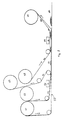
- Step "A” the complex strip intended to form the underside 20 of the envelope is taken from the roller 22. On its face upper, a mark 27 is printed, the recognition of which automatic triggers the following operations.
- Step "B” the machine deposits a point of glue 28 on the part top of the band.
- Step "C” the machine deposits a booklet or object 29 on the point glue.
- Step “D” the machine takes from the strip of the roller 24, the upper part of the envelope and places it on the booklet, in a position such as the non-stick protection 3 of the part upper 21 completely covers the booklet and that the part adhesive tape is placed so as to overflow the booklet.
- the fall of the silicone support is evacuated on the roller 25.
- Step "E” Pressure is exerted on the upper part 21 so as to apply it on the lower part 20, on which its periphery remains stuck, where the anti-adhesive was removed.
- Step "F” the outline of the envelope is cut according to the line 8. The fall is evacuated on a roller 26.
- Stage "G” the silicone band on which the envelopes is wound on a roll 23, for front storage use.
- the invention finds its application in the field of packaging or advertising where it is often necessary to feature an informative document or a thin object, in using an industrial process of automatic depositing on containers, in particular by means of a self-adhesive label presented on reel.
- the part 31 remains in a continuous strip 47 until the end of the operations.
- the booklet 33 is placed on this continuous strip. It is then covered by the part 32 from which the silicone adhesive protector has been removed completely, or only on the edge 38, on the binding side 40 of the booklet, and on the opposite edge. 39, on the opening side of the booklet.
- the non-stick protection can be left in place over the entire surface of part 32 in contact with the top of the booklet.
- Part 32 can be completely transparent to reveal the booklet.
- a pressure being applied on the label the part 32 sticks on the upper part of the part 31 and the booklet is enclosed between the part 31 and the part 32. If you want waterproof protection for the booklet, you can either glue all of part 32, or just the 4 edges of part 32 on part 31.
- the label is then made by adding parts 33 and 32 of 31. Then it undergoes a cut to be brought to its final template along lines 48, parallel to the edge of the continuous strip and along lines 49, perpendicular to the previous ones. If the labels are to be left in a strip for storing them in rolls, the cutouts 48 and 49 spare the support 35, which leaves the labels integral with the continuous strip.
- the shape of the surface 41 can be modified, for example by ending it with cut sides or rounded 50. When sticking the label on a package, remove the non-stick protection 35 from below, while leaving the part 41 which neutralizes the adhesion of 34 at this point. The label therefore adheres over its entire surface except at the location of the strip 41, which does not adhere and is easy to lift and take between the fingers.
- the label By pulling it in the direction of arrow 45, the label is lifted and it begins to take off from the packaging.
- takeoff arrives at cutout 42, the envelope opens, giving access to the booklet.
- the surface 44 between the cutting line 42 and the non-stick strip 41 it is possible to partially leave non-stick 35 or one can partially deposit a non-stick at this point, when the 1st cutting operation 41/42 on the strip 47.
- the silicone strip 41 is removed, revealing a virgin adhesive part.
- the anti-adhesive 41 can be cut into several segments which can be removed one by one as the label is successively closed. There is thus a means of closing the label securely many times.
- the part 32 consists of a simple strip of adhesive 36 which can be a transparent film, from which the anti-adhesive 37 will have been completely removed.
- This strip is stuck on the outside page of the booklet as well as on its periphery, on part 34.
- the same cutouts 42, 46, 48 and 49 being made as previously.
- a reel 51 delivers a complex continuous strip 47, which may include the cutouts 42, 46 more possibly 48 and 49 indicated above, and which will form the part 31 of the labels.
- a series of reels 52 delivers strips 53 which successively deposit on the strip 47 the various sheets constituting the booklet 33. These sheets can for example be cut by a device 56.
- the scraps 54 of the strips 53 are recovered on reels 55.
- the machine is set so that the booklet sheets stack exactly on top of each other. These sheets have in one margin one or more holes which are coincidental. A point of adhesive is deposited in these holes by a device not shown in FIG. 7 and serves as a binding for the booklet and for its attachment to the strip 47.
- a reel 57 delivers a film, for example transparent, adhesive, which is applied to the continuous strip 47 carrying the booklets. It forms part 32 of the label.
- a cutting device 58 completes the labels.
- the scraps 61 are recovered on a roller 59, and the finished labels arrive at 60.
- Figure 7 there is shown for clarity of the drawing, by separate lines, the falls 61 which come from 32 and 34. But in reality these falls are glued one on the other.
- the label according to the invention finds its application in the field of packaging or advertising or it is often necessary to include information on labels whose surface does not allow to contain them; and also when the said information must be consulted and kept several times in succession.
Landscapes
- Engineering & Computer Science (AREA)
- Mechanical Engineering (AREA)
- Physics & Mathematics (AREA)
- General Physics & Mathematics (AREA)
- Theoretical Computer Science (AREA)
- Making Paper Articles (AREA)
- Adhesive Tapes (AREA)
Description
Ces types de pochettes pouvant contenir un document sont certes appréciés des utilisateurs mais demandent, soit une mise en oeuvre complète utilisant un matériel onéreux et des techniques de collage par soudure thermique, soit des enveloppes prêtes à l'emploi que l'on fixe avec un adhésif double face. Le but de la présente invention est de proposer une pochette destinée à être posée sur un emballage par l'utilisateur industriel final. Cette enveloppe pourra pallier les inconvénients cités auparavent et sera mise en oeuvre et remplie de son contenu, soit par un professionnel de l'étiquetage ou du routage moyennant un investissement peu important en matériel, soit par l'utilisateur industriel qui fermera lui-même l'enveloppe après avoir déposé le contenu sur le fond de l'enveloppe.
Sur le devant de cette face arrière, après avoir éventuellement déposé dessus un document ou un objet de faible épaisseur, on colle une étiquette éventuellement transparente, adhésive au verso, qui de ce fait vient en contact avec la face arrière grâce à l'adhésif caractérisé par le fait qu'une zone collante a été privée de son pouvoir adhésif par la présence d'une partie du support protecteur anti-adhésif qui recouvrait le verso de l'étiquette avant qu'une découpe du dit support ait été réalisée; l'ensemble étiquette adhésive + support siliconé représentant à ce moment, un complexe conditionné notamment en bande. Selon un mode avantageux de la présente invention, les enveloppes collantes peuvent être disposées sur un support anti-adhésif présenté en bobine.
- La figure 1 montre une vue de face schématique du mode de réalisation d'enveloppe selon l'invention
- La figure 2 montre une vue coupe, agrandie pour une bonne compréhension
- La figure 3 montre schématiquement les différentes étapes du procédé fabrication de ces enveloppes, ainsi que leur remplissage éventuel
- La figure 4 montre schématiquement vue de dessus, le processus d'élaboration des pochettes adhésives ainsi que leur remplissage
Le dessus 21 vient d'une bande complexe 24 formée d'un auto-adhésif 1 protégé par un support siliconé anti-adhésif 2.
Ce dessus 21 peut être opaque ou transparent, selon que l'on veut cacher ou laisser voir le contenu de l'enveloppe.
Pour former le dessus 21 on découpe d'abord la protection 2 siliconée selon une découpe marquée répère 6 sur les figures 1 et 2 et qui délimite une partie 3, puis on découpe la partie auto-adhésive selon une découpe marquée repère 7 et qui délimite une partie 1.
La partie 1 est de dimensions supérieures à la partie 3, de telle sorte que lorsque le dessus 21 est séparé de la bande anti-adhésive, sa partie centrale reste protégée par l'anti-adhésif 3, alors que sur son pourtour 11, la partie auto-adhésive est mise à nu.
L'enveloppe est ensuite terminée par une découpe marquée repère 8 qui coupe en même temps le dessus 21 et le dessous 20, tout en épargant l'anti-adhésif 5.
L'enveloppe peut ensuite, selon les besoins, être fermée après enlèvement de la protection siliconée, une fois que l'on y a introduit un objet.
L'enveloppe peut aussi être laissée ouverte sur un seul côté de façon à permettre de sortir et de remettre l'objet.
Cette ou ces languettes peuvent être ensuite enlevées pour découvrir l'adhésif et permettre un collage ultérieur du bord de l'enveloppe.
- La figure 3 représente une vue en coupe de la chaine de fabrication
- La figure 4 représente une vue de dessus
- une partie inférieure 31 venant d'une bande complexe 47 formée d'un adhésif 34 muni d'une protection anti-adhésive siliconée 35.
- une partie supérieure 32 découpée dans une bande complexe formée d'un adhésif 36 muni d'une protection anti-adhésive siliconée 37
- une partie intermédiaire 33, par exemple un livret, renfermé dans l'enveloppe constituée par les parties 31 et 32
Sur cette bande continue on dépose le livret 33. On le recouvre ensuite par la partie 32 à laquelle on a enlevé la proctection adhésive siliconée totalement, ou seulement sur le bord 38, du côté de la reliure 40 du livret, et sur le bord opposé 39, du côté de l'ouverture du livret.
La protection anti-adhésive peut être laissée en place sur toute la surface de la partie 32 en contact avec le dessus du livret.
La partie 32 peut être entièrement transparente pour laisser voir le livret.
Si on souhaite une protection étanche du livret, on peut coller soit toute la partie 32, soit seulement les 4 bords de la partie 32 sur la partie 31.
Cependant, cette opération risque de détruire définitivement le collage du bord 39 sur la partie 31.
Or, le plus souvent le livret doit être consulté plusieurs fois. Il faut donc avoir la possibilité de refermer l'enveloppe.
Selon cette caractéristique, la partie inférieure 31 est préparée de la façon suivante :
Ensuite elle subit une découpe pour être mise à son gabarit final selon des lignes 48, parallèles au bord de la bande continue et selon des lignes 49, perpendiculaires aux précédentes.
Si on veut laisser les étiquettes en bande pour les stocker en rouleaux, les découpes 48 et 49 épargnent le support 35, ce qui laisse les étiquettes solidaires de la bande continue.
Pour éviter des points faibles dans la bande continue on peut modifier la forme de la surface 41, par exemple en la terminant par des pans coupés ou des arrondis 50.
Au moment de coller l'étiquette sur un emballage, on enlève la protection anti-adhésive 35 du dessous, tout en laissant la partie 41 qui neutralise à cet endroit l'adhérence de 34.
L'étiquette adhère donc sur toute sa surface sauf à l'endroit de la bande 41, qui n'adhére pas et est facile à soulever et à prendre entre les doigts.
Pour faciliter le décollage, sur la surface 44 comprise entre la ligne de découpe 42 et la bande d'antiadhésif 41, on peut laisser partiellement de l'anti-adhésif 35 ou on peut déposer partiellement un anti-adhésif à cet endroit, lors de la 1ère opération de découpe 41/42 sur la bande 47.
Dans une variante, l'anti-adhésif 41 peut être découpé en plusieurs segments qui peuvent être enlevés un par un au fur et à mesure des fermetures successives de l'étiquette. On a ainsi un moyen pour refermer avec sécurité de nombreuses fois l'étiquette.
Cette bande se colle sur la page extérieure du livret ainsi que sur son pourtour, sur la partie 34. Les mêmes découpes 42, 46, 48 et 49 étant faites comme précédemment.
Une fois l'étiquette collée sur un emballage, on l'ouvre de la même façon. La différence est que lorsque l'on soulève la partie 32, la première feuille du livret qui y est collée l'accompagne et le livret s'ouvre.
Une bobine 51 délivre une bande continue complexe 47, qui peut comporter les découpes 42, 46 plus éventuellement 48 et 49 indiquées ci-dessus, et qui va former la partie 31 des étiquettes. Une suite de bobines 52 délivre des bandes 53 qui déposent successivement sur la bande 47 les différentes feuilles constituant le livret 33. Ces feuilles peuvent par exemple être découpées par un dispositif 56. Les chutes 54 des bandes 53 sont récupérées sur des bobines 55.
La machine est réglée pour que les feuilles du livret s'empilent exactement les unes au dessus des autres.
Ces feuilles comportent dans une marge un ou plusieurs trous qui se trouvent en coincidence. Un point de colle est déposé dans ces trous par un dispositif non représenté sur la figure 7 et sert de reliure au livret et à sa fixation sur la bande 47.
Un dispositif de découpe 58 termine les étiquettes. Les chutes 61 sont récupérées sur un rouleau 59, et les étiquettes finies arrivent en 60.
Sur la figure 7, on a représenté pour la clarté du dessin, par des traits séparés, les chutes 61 qui proviennent d 32 et de 34. Mais en réalité ces chutes sont collées l'une sur l'autre.
L'étiquette selon l'invention trouve son application dans le domaine de l'emballage ou de la publicité ou il est souvent nécessaire de faire figurer des informations sur des étiquettes dont la surface ne permet pas de les contenir ; et aussi lorsque les-dites informations doivent être consultées et conservées plusieurs fois de suite.
Claims (9)
- Enveloppe-étiquette composite comprenant :caractérisée en ce que ladite partie supérieure est formée d'un auto-adhésif (1 ; 36) neutralisé par une partie anti-adhésive (3 ; 37), ladite partie anti-adhésive ayant des dimensions inférieures à celles de ladite partie supérieure (21 ; 32), de telle sorte qu'au moins une partie du pourtour (11 ; 38, 39) de ladite partie supérieure (21 ; 32) est formé d'adhésif (1 ; 36) à nu apte à être collé sur ladite partie inférieure (20 ; 31).une partie inférieure (20 ; 31) etune partie supérieure (21 ; 32) fixée sur ladite partie inférieure,lesdites parties inférieure (20 ; 31) et supérieure (21 ; 32) définissent entre elles un espace de réception d'un objet ou livret (3, 29 ; 33)
- Enveloppe-étiquette selon la revendication 1, caractérisée en ce que ladite partie inférieure (20 ; 31) est auto-adhésive, de telle sorte que l'enveloppe est apte à être collée sur un support.
- Enveloppe-étiquette selon l'une des revendications précédentes, caractérisée en ce que ladite partie anti-adhésive (3) est prolongée, sur au moins un bord, par une ou plusieurs languettes (12) apte(s) à être enlevées pour découvrir l'adhésif (1) et permettre un collage ultérieur du bord de l'enveloppe.
- Enveloppe-étiquette selon l'une des revendications précédentes, caractérisée en ce que ladite partie inférieure (31) est formée d'une feuille adhésive (34) comportant une découpe (42) d'accès à ladite partie intermédiaire (33).
- Enveloppe-étiquette selon la revendication 4, caractérisée en ce que ladite découpe (42) est globalement parallèle à un bord (43) de ladite partie intermédiaire (33), de préférence au niveau de ce bord ou légèrement en retrait de ce bord au niveau de ladite partie intermédiaire.
- Enveloppe-étiquette selon l'une des revendications 4 ou 5, caractérisée en ce qu'une partie (41) de ladite protection anti-adhésive (35) est prévue pour neutraliser l'adhérence de ladite feuille adhésive (34) le long d'un bord de ladite enveloppe.
- Enveloppe-étiquette selon l'une des revendications 4 à 6, caractérisée en ce que ladite protection anti-adhésive (35) est maintenue partiellement, ou un anti-adhésif est déposé sur, une surface (44) de ladite feuille adhésive comprise entre ladite découpe (42) et ladite partie (41) de protection anti-adhésive (35) .
- Enveloppe-étiquette selon l'une des revendications précédentes, caractérisée en ce que ladite partie supérieure (21 ; 32) est transparente.
- Procédé de fabrication d'une enveloppe-étiquette selon l'une quelconque des revendications précédentes, caractérisé par le fait qu'il comporte, les étapes suivantes :"A" : une bande auto-adhésive (22 ; 47) destinée à former la partie inférieure (20 ; 31) est prélevée sur un rouleau (22 ; 51) ;"B" : un point de colle (28) est déposé sur la partie supérieure de ladite bande (22) ou sur un objet (33) posé sur ladite bande (47) ;"C" : un objet (4 ; 29 ; 33) est déposé sur la bande (22 ; 47) avant ou après dépôt du point de colle ;"D" : la partie supérieure (21 ; 32) est déposée sur ledit objet dans une position telle que la protection anti-adhésive (3 ; 37) recouvre complètement ledit objet et qu'une partie adhésive (1 ; 36) de ladite partie supérieure mise à nu soit placée de façon à déborder dudit objet, les chutes (2, 61) étant évacuées ;"E" : une pression est exercée sur ladite partie supérieure (21 ; 32) de façon à l'appliquer sur ladite partie inférieure (20 ; 31) sur laquelle son pourtour (11 ; 38, 39) est collé ;"F" : le contour de l'enveloppe est découpé (58) selon au moins une ligne (8 ; 48 ; 49), les chutes (61) étant évacuées (26 ; 59) ;"G" : ladite bande complexe (22 ; 47) est stockée sur un rouleau (23 ; 60) avant utilisation desdites enveloppes.
Applications Claiming Priority (5)
| Application Number | Priority Date | Filing Date | Title |
|---|---|---|---|
| FR9502539 | 1995-02-28 | ||
| FR9502539A FR2731099B1 (fr) | 1995-02-28 | 1995-02-28 | Etiquette |
| FR9502843 | 1995-03-07 | ||
| FR9502843A FR2731544B3 (fr) | 1995-03-07 | 1995-03-07 | Enveloppe |
| PCT/FR1996/000307 WO1996027177A1 (fr) | 1995-02-28 | 1996-02-28 | Enveloppe adhesive |
Publications (2)
| Publication Number | Publication Date |
|---|---|
| EP0801778A1 EP0801778A1 (fr) | 1997-10-22 |
| EP0801778B1 true EP0801778B1 (fr) | 2000-04-26 |
Family
ID=26231802
Family Applications (1)
| Application Number | Title | Priority Date | Filing Date |
|---|---|---|---|
| EP96904916A Expired - Lifetime EP0801778B1 (fr) | 1995-02-28 | 1996-02-28 | Enveloppe adhesive |
Country Status (5)
| Country | Link |
|---|---|
| EP (1) | EP0801778B1 (fr) |
| DE (1) | DE69607934T2 (fr) |
| DK (1) | DK0801778T3 (fr) |
| ES (1) | ES2145436T3 (fr) |
| WO (1) | WO1996027177A1 (fr) |
Families Citing this family (12)
| Publication number | Priority date | Publication date | Assignee | Title |
|---|---|---|---|---|
| DE19704450C2 (de) * | 1997-02-06 | 1999-07-08 | Ritter & Co | Verfahren und Vorrichtung zum Herstellen von bedruckten Haftzetteln |
| ATE336056T1 (de) * | 1997-06-14 | 2006-09-15 | Pasquini Und Kromer Gmbh | Verfahren zur herstellung eines etikettenstreifens |
| US6357503B1 (en) | 1998-06-13 | 2002-03-19 | Pasquini Und Kromer Gmbh | Device for producing a strip with self-adhesive labels or other materials with parts placed underneath and a device for laterally guiding edges |
| FR2791299B3 (fr) * | 1999-03-09 | 2001-05-18 | Dominique Picourt | Procede de fabrication d'une etiquette multi-volets et etiquette realisee par le procede |
| FR2790708B1 (fr) * | 1999-03-09 | 2001-05-18 | Dominique Picourt | Procede de fabrication d'une etiquette multi-volets et etiquette realisee par le procede |
| DE10209711B4 (de) * | 2002-03-06 | 2018-09-27 | Klug Conservation Walter Klug Gmbh & Co. Kg | Siegelschutzhülle und Verfahren zur Herstellung einer Siegelschutzhülle |
| GB2433121A (en) * | 2005-12-08 | 2007-06-13 | Najib Altawell | A replaceable cylinder containing components for a machine olfactory device or electronic nose. |
| US7646304B2 (en) | 2006-04-10 | 2010-01-12 | Checkpoint Systems, Inc. | Transfer tape strap process |
| BRPI0701897A2 (pt) * | 2007-04-27 | 2008-12-09 | Giuseppe Jeffrey Arippol | disposiÇço em envelope porta-documento ou outros e mÉtodo de alta produtividade de aplicaÇço de envelopes porta-documento ou outros em objetos |
| NL2001516C2 (nl) * | 2008-04-24 | 2009-10-27 | Nl Speciaal Drukkerijen B V | Etiket, en werkwijze voor het vervaardigen van een etiket. |
| GR1007571B (el) * | 2009-07-31 | 2012-04-06 | Αγγελικη Τζαννινη | Προϊον αυτοκολλητη ετικετα-φακελος (σφραγισμενος σε ρολο) |
| US10023375B2 (en) * | 2016-08-17 | 2018-07-17 | Altria Client Services Llc | Auto opening cigarette pack outsert |
Family Cites Families (6)
| Publication number | Priority date | Publication date | Assignee | Title |
|---|---|---|---|---|
| GB2164915B (en) * | 1984-09-27 | 1988-04-07 | Instance Ltd David J | Producing composite labels |
| GB2171386B (en) * | 1985-02-18 | 1988-06-02 | Instance Ltd David J | Labels and manufacture thereof |
| ATE119469T1 (de) * | 1989-09-28 | 1995-03-15 | David John Instance | Etiketten und deren herstellung. |
| GB2247662B (en) * | 1990-08-31 | 1994-11-02 | Instance Ltd David J | Labels and manufacture thereof |
| NL9100560A (nl) * | 1991-03-28 | 1992-10-16 | Avery Dennison Corp | Label. |
| FR2694830A1 (fr) * | 1992-08-17 | 1994-02-18 | Omapi | Etiquette informative. |
-
1996
- 1996-02-28 ES ES96904916T patent/ES2145436T3/es not_active Expired - Lifetime
- 1996-02-28 DE DE69607934T patent/DE69607934T2/de not_active Expired - Fee Related
- 1996-02-28 WO PCT/FR1996/000307 patent/WO1996027177A1/fr not_active Ceased
- 1996-02-28 EP EP96904916A patent/EP0801778B1/fr not_active Expired - Lifetime
- 1996-02-28 DK DK96904916T patent/DK0801778T3/da active
Also Published As
| Publication number | Publication date |
|---|---|
| WO1996027177A1 (fr) | 1996-09-06 |
| DE69607934D1 (de) | 2000-05-31 |
| EP0801778A1 (fr) | 1997-10-22 |
| DK0801778T3 (da) | 2000-08-07 |
| DE69607934T2 (de) | 2000-10-05 |
| ES2145436T3 (es) | 2000-07-01 |
Similar Documents
| Publication | Publication Date | Title |
|---|---|---|
| JP4573232B2 (ja) | 喫煙物パック用ラベル | |
| US5125211A (en) | Reclosable stick gum package | |
| US5029712A (en) | Reclosure stick gum package | |
| US8051979B2 (en) | Innovative packaging for consumer product | |
| EP0801778A1 (fr) | Enveloppe adhesive | |
| WO1999061348A1 (fr) | Emballage muni d'un coupon et procede d'obtention dudit emballage | |
| EP0517566B1 (fr) | Dispositif de fermeture et d'ouverture d'un sachet d'emballage en film mince | |
| WO1991005322A1 (fr) | Procede d'etiquetage | |
| US20070178284A1 (en) | Drinking glass cover | |
| FR2724633A1 (fr) | Procede d'emballage et structure d'emballage pour des articles tels que ceux ayant une forme parallelepipede rectangle. | |
| EP2976272B1 (fr) | Enveloppe de securite apte a assurer une protection anti-ouverture de recipients, objet recouvert d'une telle enveloppe et procede d'inscription d'informations sur une telle enveloppe | |
| FR2731544A1 (fr) | Enveloppe | |
| JP4977802B2 (ja) | 喫煙品用パッケージ | |
| EP0656614A2 (fr) | Dispositif pour certifier l'authenticité ou l'absence de violation d'un objet tel qu'un document ou un emballage | |
| US6675518B1 (en) | Dental x-ray storage and retrieval system | |
| JP3046824U (ja) | 切花収納袋 | |
| EP0668215B1 (fr) | Boite d'emballage pour produits dont la vente est controlee | |
| CN113557200A (zh) | 具有掩蔽元件的可再密封标签和具有可再密封标签的包装膜 | |
| FR2731099A1 (fr) | Etiquette | |
| EP1467335B1 (fr) | Etiquette pour application sur un article, notamment un conditionnement de produit cosmétique | |
| KR100880782B1 (ko) | 담배갑 | |
| FR2622870A1 (fr) | Pochette de conditionnement de graines,a systeme perfectionne de reobturation apres ouverture | |
| EP2765088A1 (fr) | Enveloppe de papeterie autocollante, procédé de fabrication et utilisation correspondants | |
| JP2001115116A (ja) | 包装袋用の粘着テープ | |
| FR2764866A1 (fr) | Dispositif de securite pour garantir l'authenticite et l'inviolabilite d'un contenant et des objets qu'il contient |
Legal Events
| Date | Code | Title | Description |
|---|---|---|---|
| PUAI | Public reference made under article 153(3) epc to a published international application that has entered the european phase |
Free format text: ORIGINAL CODE: 0009012 |
|
| 17P | Request for examination filed |
Effective date: 19970523 |
|
| AK | Designated contracting states |
Kind code of ref document: A1 Designated state(s): BE CH DE DK ES FR GB IE IT LI LU NL SE |
|
| 17Q | First examination report despatched |
Effective date: 19980924 |
|
| GRAG | Despatch of communication of intention to grant |
Free format text: ORIGINAL CODE: EPIDOS AGRA |
|
| GRAG | Despatch of communication of intention to grant |
Free format text: ORIGINAL CODE: EPIDOS AGRA |
|
| GRAH | Despatch of communication of intention to grant a patent |
Free format text: ORIGINAL CODE: EPIDOS IGRA |
|
| GRAH | Despatch of communication of intention to grant a patent |
Free format text: ORIGINAL CODE: EPIDOS IGRA |
|
| GRAA | (expected) grant |
Free format text: ORIGINAL CODE: 0009210 |
|
| AK | Designated contracting states |
Kind code of ref document: B1 Designated state(s): BE CH DE DK ES FR GB IE IT LI LU NL SE |
|
| REG | Reference to a national code |
Ref country code: CH Ref legal event code: EP |
|
| REF | Corresponds to: |
Ref document number: 69607934 Country of ref document: DE Date of ref document: 20000531 |
|
| REG | Reference to a national code |
Ref country code: IE Ref legal event code: FG4D Free format text: FRENCH |
|
| 111L | Licence recorded |
Free format text: 20000422 0100 ETECO S.A.R.L. |
|
| REG | Reference to a national code |
Ref country code: ES Ref legal event code: FG2A Ref document number: 2145436 Country of ref document: ES Kind code of ref document: T3 |
|
| ITF | It: translation for a ep patent filed | ||
| GBT | Gb: translation of ep patent filed (gb section 77(6)(a)/1977) |
Effective date: 20000630 |
|
| REG | Reference to a national code |
Ref country code: DK Ref legal event code: T3 |
|
| PLBE | No opposition filed within time limit |
Free format text: ORIGINAL CODE: 0009261 |
|
| STAA | Information on the status of an ep patent application or granted ep patent |
Free format text: STATUS: NO OPPOSITION FILED WITHIN TIME LIMIT |
|
| 26N | No opposition filed | ||
| REG | Reference to a national code |
Ref country code: GB Ref legal event code: IF02 |
|
| PGFP | Annual fee paid to national office [announced via postgrant information from national office to epo] |
Ref country code: FR Payment date: 20050224 Year of fee payment: 10 |
|
| PGFP | Annual fee paid to national office [announced via postgrant information from national office to epo] |
Ref country code: SE Payment date: 20050228 Year of fee payment: 10 Ref country code: NL Payment date: 20050228 Year of fee payment: 10 Ref country code: LU Payment date: 20050228 Year of fee payment: 10 Ref country code: IE Payment date: 20050228 Year of fee payment: 10 Ref country code: DK Payment date: 20050228 Year of fee payment: 10 |
|
| PGFP | Annual fee paid to national office [announced via postgrant information from national office to epo] |
Ref country code: DE Payment date: 20050308 Year of fee payment: 10 |
|
| PGFP | Annual fee paid to national office [announced via postgrant information from national office to epo] |
Ref country code: CH Payment date: 20050315 Year of fee payment: 10 |
|
| PGFP | Annual fee paid to national office [announced via postgrant information from national office to epo] |
Ref country code: ES Payment date: 20050317 Year of fee payment: 10 |
|
| PGFP | Annual fee paid to national office [announced via postgrant information from national office to epo] |
Ref country code: GB Payment date: 20050323 Year of fee payment: 10 |
|
| PGFP | Annual fee paid to national office [announced via postgrant information from national office to epo] |
Ref country code: BE Payment date: 20050418 Year of fee payment: 10 |
|
| PG25 | Lapsed in a contracting state [announced via postgrant information from national office to epo] |
Ref country code: LU Free format text: LAPSE BECAUSE OF NON-PAYMENT OF DUE FEES Effective date: 20060228 Ref country code: LI Free format text: LAPSE BECAUSE OF NON-PAYMENT OF DUE FEES Effective date: 20060228 Ref country code: IE Free format text: LAPSE BECAUSE OF NON-PAYMENT OF DUE FEES Effective date: 20060228 Ref country code: GB Free format text: LAPSE BECAUSE OF NON-PAYMENT OF DUE FEES Effective date: 20060228 Ref country code: DK Free format text: LAPSE BECAUSE OF NON-PAYMENT OF DUE FEES Effective date: 20060228 Ref country code: CH Free format text: LAPSE BECAUSE OF NON-PAYMENT OF DUE FEES Effective date: 20060228 Ref country code: BE Free format text: LAPSE BECAUSE OF NON-PAYMENT OF DUE FEES Effective date: 20060228 |
|
| PGFP | Annual fee paid to national office [announced via postgrant information from national office to epo] |
Ref country code: IT Payment date: 20060228 Year of fee payment: 11 |
|
| PG25 | Lapsed in a contracting state [announced via postgrant information from national office to epo] |
Ref country code: SE Free format text: LAPSE BECAUSE OF NON-PAYMENT OF DUE FEES Effective date: 20060301 Ref country code: ES Free format text: LAPSE BECAUSE OF NON-PAYMENT OF DUE FEES Effective date: 20060301 |
|
| PG25 | Lapsed in a contracting state [announced via postgrant information from national office to epo] |
Ref country code: NL Free format text: LAPSE BECAUSE OF NON-PAYMENT OF DUE FEES Effective date: 20060901 Ref country code: DE Free format text: LAPSE BECAUSE OF NON-PAYMENT OF DUE FEES Effective date: 20060901 |
|
| REG | Reference to a national code |
Ref country code: DK Ref legal event code: EBP |
|
| REG | Reference to a national code |
Ref country code: CH Ref legal event code: PL |
|
| GBPC | Gb: european patent ceased through non-payment of renewal fee |
Effective date: 20060228 |
|
| NLV4 | Nl: lapsed or anulled due to non-payment of the annual fee |
Effective date: 20060901 |
|
| EUG | Se: european patent has lapsed | ||
| REG | Reference to a national code |
Ref country code: IE Ref legal event code: MM4A |
|
| REG | Reference to a national code |
Ref country code: FR Ref legal event code: ST Effective date: 20061031 |
|
| REG | Reference to a national code |
Ref country code: ES Ref legal event code: FD2A Effective date: 20060301 |
|
| BERE | Be: lapsed |
Owner name: *LEYVAL JEAN-PIERRE Effective date: 20060228 |
|
| PG25 | Lapsed in a contracting state [announced via postgrant information from national office to epo] |
Ref country code: FR Free format text: LAPSE BECAUSE OF NON-PAYMENT OF DUE FEES Effective date: 20060228 |
|
| PG25 | Lapsed in a contracting state [announced via postgrant information from national office to epo] |
Ref country code: IT Free format text: LAPSE BECAUSE OF NON-PAYMENT OF DUE FEES Effective date: 20070228 |