EP0802275A1 - Procédé pour l'amélioration du dégré de blancheur de pâte à papier - Google Patents
Procédé pour l'amélioration du dégré de blancheur de pâte à papier Download PDFInfo
- Publication number
- EP0802275A1 EP0802275A1 EP19970101747 EP97101747A EP0802275A1 EP 0802275 A1 EP0802275 A1 EP 0802275A1 EP 19970101747 EP19970101747 EP 19970101747 EP 97101747 A EP97101747 A EP 97101747A EP 0802275 A1 EP0802275 A1 EP 0802275A1
- Authority
- EP
- European Patent Office
- Prior art keywords
- bleaching
- paper stock
- mechanical processing
- suspension
- chemicals
- Prior art date
- Legal status (The legal status is an assumption and is not a legal conclusion. Google has not performed a legal analysis and makes no representation as to the accuracy of the status listed.)
- Withdrawn
Links
- 238000000034 method Methods 0.000 title claims description 64
- 229920001131 Pulp (paper) Polymers 0.000 title 1
- 238000004061 bleaching Methods 0.000 claims abstract description 54
- 239000002245 particle Substances 0.000 claims abstract description 14
- 239000000835 fiber Substances 0.000 claims abstract description 12
- 239000000463 material Substances 0.000 claims abstract description 12
- 239000000126 substance Substances 0.000 claims description 28
- 239000000725 suspension Substances 0.000 claims description 14
- QVGXLLKOCUKJST-UHFFFAOYSA-N atomic oxygen Chemical compound [O] QVGXLLKOCUKJST-UHFFFAOYSA-N 0.000 claims description 11
- 239000001301 oxygen Substances 0.000 claims description 11
- 229910052760 oxygen Inorganic materials 0.000 claims description 11
- MYMOFIZGZYHOMD-UHFFFAOYSA-N Dioxygen Chemical compound O=O MYMOFIZGZYHOMD-UHFFFAOYSA-N 0.000 claims description 9
- 238000005188 flotation Methods 0.000 claims description 9
- 239000007844 bleaching agent Substances 0.000 claims description 8
- 238000009996 mechanical pre-treatment Methods 0.000 claims description 8
- 239000010893 paper waste Substances 0.000 claims description 7
- XLYOFNOQVPJJNP-UHFFFAOYSA-N water Substances O XLYOFNOQVPJJNP-UHFFFAOYSA-N 0.000 claims description 7
- 239000002761 deinking Substances 0.000 claims description 6
- 229910001882 dioxygen Inorganic materials 0.000 claims description 6
- 239000007789 gas Substances 0.000 claims description 6
- 239000002184 metal Substances 0.000 claims description 6
- 150000002978 peroxides Chemical class 0.000 claims description 6
- 239000006185 dispersion Substances 0.000 claims description 5
- 239000004744 fabric Substances 0.000 claims description 4
- 238000002360 preparation method Methods 0.000 claims description 3
- 230000002829 reductive effect Effects 0.000 claims description 3
- 238000004140 cleaning Methods 0.000 claims description 2
- 238000004519 manufacturing process Methods 0.000 claims description 2
- 239000003795 chemical substances by application Substances 0.000 claims 1
- 239000000470 constituent Substances 0.000 claims 1
- 238000012423 maintenance Methods 0.000 claims 1
- 239000007787 solid Substances 0.000 claims 1
- HEMHJVSKTPXQMS-UHFFFAOYSA-M Sodium hydroxide Chemical compound [OH-].[Na+] HEMHJVSKTPXQMS-UHFFFAOYSA-M 0.000 description 9
- 239000000976 ink Substances 0.000 description 6
- 239000002657 fibrous material Substances 0.000 description 3
- 238000006243 chemical reaction Methods 0.000 description 2
- 239000000975 dye Substances 0.000 description 2
- 229920005610 lignin Polymers 0.000 description 2
- 239000010812 mixed waste Substances 0.000 description 2
- 239000000203 mixture Substances 0.000 description 2
- 230000001590 oxidative effect Effects 0.000 description 2
- 238000000926 separation method Methods 0.000 description 2
- 230000008719 thickening Effects 0.000 description 2
- 238000005406 washing Methods 0.000 description 2
- -1 MgSO 4 Substances 0.000 description 1
- 229910019093 NaOCl Inorganic materials 0.000 description 1
- 238000010793 Steam injection (oil industry) Methods 0.000 description 1
- 239000011230 binding agent Substances 0.000 description 1
- 238000007664 blowing Methods 0.000 description 1
- 239000003153 chemical reaction reagent Substances 0.000 description 1
- 230000003749 cleanliness Effects 0.000 description 1
- 230000006835 compression Effects 0.000 description 1
- 238000007906 compression Methods 0.000 description 1
- 239000000356 contaminant Substances 0.000 description 1
- 238000010586 diagram Methods 0.000 description 1
- 238000010790 dilution Methods 0.000 description 1
- 239000012895 dilution Substances 0.000 description 1
- 230000000694 effects Effects 0.000 description 1
- 238000004880 explosion Methods 0.000 description 1
- 238000010438 heat treatment Methods 0.000 description 1
- 239000012535 impurity Substances 0.000 description 1
- 239000011261 inert gas Substances 0.000 description 1
- 238000009896 oxidative bleaching Methods 0.000 description 1
- 238000009895 reductive bleaching Methods 0.000 description 1
- SUKJFIGYRHOWBL-UHFFFAOYSA-N sodium hypochlorite Chemical compound [Na+].Cl[O-] SUKJFIGYRHOWBL-UHFFFAOYSA-N 0.000 description 1
- 239000000243 solution Substances 0.000 description 1
- 239000002904 solvent Substances 0.000 description 1
- 230000000087 stabilizing effect Effects 0.000 description 1
- 238000003860 storage Methods 0.000 description 1
- 239000002351 wastewater Substances 0.000 description 1
- 238000003911 water pollution Methods 0.000 description 1
- 238000004383 yellowing Methods 0.000 description 1
Images
Classifications
-
- D—TEXTILES; PAPER
- D21—PAPER-MAKING; PRODUCTION OF CELLULOSE
- D21B—FIBROUS RAW MATERIALS OR THEIR MECHANICAL TREATMENT
- D21B1/00—Fibrous raw materials or their mechanical treatment
- D21B1/04—Fibrous raw materials or their mechanical treatment by dividing raw materials into small particles, e.g. fibres
- D21B1/12—Fibrous raw materials or their mechanical treatment by dividing raw materials into small particles, e.g. fibres by wet methods, by the use of steam
- D21B1/30—Defibrating by other means
- D21B1/32—Defibrating by other means of waste paper
-
- D—TEXTILES; PAPER
- D21—PAPER-MAKING; PRODUCTION OF CELLULOSE
- D21C—PRODUCTION OF CELLULOSE BY REMOVING NON-CELLULOSE SUBSTANCES FROM CELLULOSE-CONTAINING MATERIALS; REGENERATION OF PULPING LIQUORS; APPARATUS THEREFOR
- D21C5/00—Other processes for obtaining cellulose, e.g. cooking cotton linters ; Processes characterised by the choice of cellulose-containing starting materials
- D21C5/02—Working-up waste paper
-
- D—TEXTILES; PAPER
- D21—PAPER-MAKING; PRODUCTION OF CELLULOSE
- D21C—PRODUCTION OF CELLULOSE BY REMOVING NON-CELLULOSE SUBSTANCES FROM CELLULOSE-CONTAINING MATERIALS; REGENERATION OF PULPING LIQUORS; APPARATUS THEREFOR
- D21C9/00—After-treatment of cellulose pulp, e.g. of wood pulp, or cotton linters ; Treatment of dilute or dewatered pulp or process improvement taking place after obtaining the raw cellulosic material and not provided for elsewhere
- D21C9/10—Bleaching ; Apparatus therefor
- D21C9/147—Bleaching ; Apparatus therefor with oxygen or its allotropic modifications
-
- B—PERFORMING OPERATIONS; TRANSPORTING
- B41—PRINTING; LINING MACHINES; TYPEWRITERS; STAMPS
- B41M—PRINTING, DUPLICATING, MARKING, OR COPYING PROCESSES; COLOUR PRINTING
- B41M5/00—Duplicating or marking methods; Sheet materials for use therein
- B41M5/26—Thermography ; Marking by high energetic means, e.g. laser otherwise than by burning, and characterised by the material used
- B41M5/382—Contact thermal transfer or sublimation processes
- B41M5/385—Contact thermal transfer or sublimation processes characterised by the transferable dyes or pigments
- B41M5/3852—Anthraquinone or naphthoquinone dyes
-
- B—PERFORMING OPERATIONS; TRANSPORTING
- B41—PRINTING; LINING MACHINES; TYPEWRITERS; STAMPS
- B41M—PRINTING, DUPLICATING, MARKING, OR COPYING PROCESSES; COLOUR PRINTING
- B41M5/00—Duplicating or marking methods; Sheet materials for use therein
- B41M5/26—Thermography ; Marking by high energetic means, e.g. laser otherwise than by burning, and characterised by the material used
- B41M5/382—Contact thermal transfer or sublimation processes
- B41M5/385—Contact thermal transfer or sublimation processes characterised by the transferable dyes or pigments
- B41M5/3854—Dyes containing one or more acyclic carbon-to-carbon double bonds, e.g., di- or tri-cyanovinyl, methine
-
- B—PERFORMING OPERATIONS; TRANSPORTING
- B41—PRINTING; LINING MACHINES; TYPEWRITERS; STAMPS
- B41M—PRINTING, DUPLICATING, MARKING, OR COPYING PROCESSES; COLOUR PRINTING
- B41M5/00—Duplicating or marking methods; Sheet materials for use therein
- B41M5/26—Thermography ; Marking by high energetic means, e.g. laser otherwise than by burning, and characterised by the material used
- B41M5/382—Contact thermal transfer or sublimation processes
- B41M5/385—Contact thermal transfer or sublimation processes characterised by the transferable dyes or pigments
- B41M5/388—Azo dyes
-
- B—PERFORMING OPERATIONS; TRANSPORTING
- B41—PRINTING; LINING MACHINES; TYPEWRITERS; STAMPS
- B41M—PRINTING, DUPLICATING, MARKING, OR COPYING PROCESSES; COLOUR PRINTING
- B41M5/00—Duplicating or marking methods; Sheet materials for use therein
- B41M5/26—Thermography ; Marking by high energetic means, e.g. laser otherwise than by burning, and characterised by the material used
- B41M5/382—Contact thermal transfer or sublimation processes
- B41M5/385—Contact thermal transfer or sublimation processes characterised by the transferable dyes or pigments
- B41M5/39—Dyes containing one or more carbon-to-nitrogen double bonds, e.g. azomethine
-
- Y—GENERAL TAGGING OF NEW TECHNOLOGICAL DEVELOPMENTS; GENERAL TAGGING OF CROSS-SECTIONAL TECHNOLOGIES SPANNING OVER SEVERAL SECTIONS OF THE IPC; TECHNICAL SUBJECTS COVERED BY FORMER USPC CROSS-REFERENCE ART COLLECTIONS [XRACs] AND DIGESTS
- Y02—TECHNOLOGIES OR APPLICATIONS FOR MITIGATION OR ADAPTATION AGAINST CLIMATE CHANGE
- Y02W—CLIMATE CHANGE MITIGATION TECHNOLOGIES RELATED TO WASTEWATER TREATMENT OR WASTE MANAGEMENT
- Y02W30/00—Technologies for solid waste management
- Y02W30/50—Reuse, recycling or recovery technologies
- Y02W30/64—Paper recycling
Definitions
- the invention relates to a method for increasing the whiteness of paper fibers according to the preamble of claim 1.
- Such a method is e.g. known from EP 0 557 651 A1.
- the waste paper is dissolved using NaOH and NaOCl and then subjected to the usual cleaning steps known per se. After further thickening, it is treated with molecular oxygen and peroxide at elevated temperature, releasing oxygen-containing radicals. This causes the chemical reactions known per se, in which in particular the lignin is detached from the fibers. After blowing out of the pressure chamber, the fabric is then washed out. The lignin in solution is removed with the wash water.
- the whiteness of the paper stock can and should be increased, i.e. that the paper subsequently produced from it should be as white as possible, even if it e.g. was obtained from printed waste paper.
- the processing of printed, mixed waste paper to white and mottling-free paper is to be improved.
- the fiber yield should be as high as possible and the wastewater pollution as low as possible.
- oxidizing bleaching chemicals are peroxide, oxygen gas and air containing oxygen.
- NaOH, MgSO 4 , Na 2 Si O 3 can serve as bleaching aids. Both bleaching agents and bleaching aids are often used in combination, for example peroxide and molecular oxygen for bleaching.
- stabilizing chemicals such as Na 2 Si O 3 can be added first and later NaOH.
- the combination of the intensive mechanical treatment of the fiber material with oxidizing bleach under the specified parameters has proven to be particularly advantageous.
- Such a mechanical pretreatment (one or two stages) apparently optimally prepares the fiber material for this use of oxidizing reagents.
- the mechanical pretreatment can also improve the mixing of the fibrous material with the bleaching aids and optionally with the bleaching chemicals.
- dispersion and O 2 - or O 2 + peroxide bleaching increased whiteness and improved cleanliness achieved; especially if flotation or washing is carried out afterwards.
- This means that chemicals can be saved and the bleaching process conditions can be set in a way that is gentle on the fibers, without having to accept insufficient whiteness.
- the water pollution is also reduced since less dissolved substances from the bleaching process or the separation stages downstream of it are produced.
- a combination of two mechanical treatment stages in connection with the bleaching treatment described is particularly effective in solving the problem.
- Such a combination gives e.g. the possibility of mixing in the bleaching aids during the first mechanical processing, just enough to distribute them well without the risk of yellowing of pulp-containing components of the waste paper at this stage of the process due to delignification.
- the subsequent intensive mechanical processing offers the possibility of mixing in gaseous oxygen or an oxygen-containing gas, in which case the bleaching effect can then develop immediately and optimally.
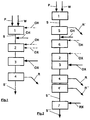
- intensive mechanical processing 2 bleaching 3 and removal 4 of the majority of the ink particles separated from the fibers, that is to say deinking.
- the ink particles accumulate as reject R and are removed from the process.
- intensive mechanical processing 2 specific work of at least 20 kWh / to is transferred, for which purpose a high-consistency kneader or disperser can be used. In many cases, a higher specific work, about 40 kWh / t is an advantage.
- the bleaching aids CH are best admixed prior to intensive mechanical processing 2, because this enables very good mixing.
- Adding them to the material that has already been thickened for mechanical processing is particularly economical. If the thickened substance is heated up anyway, adding it to the hot substance is particularly advantageous. However, it is also conceivable to add the bleaching aids as soon as the pulp P is dissolved in order to allow a longer residence time. As is known, some of the substances that can be used as bleaching chemicals are not very stable chemically, which is why the shortest possible time between addition and the actual bleaching process is sought. On the other hand, mixing the sheet metal chemicals with the material in a mechanical processing machine is particularly effective. Here it is up to the specialist where the addition should take place optimally taking into account all aspects. Peroxide can also be added as a bleaching agent, for example, before the dispersing process.
- a bleaching tower is a device in which the material to be bleached is stacked with a certain dwell time in compliance with the bleaching conditions.
- Both pure oxygen and an oxygen-containing gas, such as air, can be used for sheet metal.
- the pressure and temperature conditions in bleaching 3 depend, among other things, on the concentration in which the gas is present.
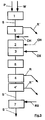
- FIG. 2 The main difference between an embodiment of the method shown in FIG. 2 and FIG. 1 is that after preparation 1 of the suspension S, it is pre-cleaned 5, which is then followed by an additional mechanical pre-treatment 6.
- This pretreatment 6 is carried out with a specific work of at least 10 kWh / to and essentially serves to homogenize the paper stock. It precedes the actual intensive mechanical processing 2, in which at least 20 kWh / to are transmitted.
- Another difference is the two-stage removal 4 and 4 'of the ink particles. This can e.g. two flotation processes connected in series or combinations of flotation and washing.
- FIG. 1 applies in principle.
- a dispersing treatment takes place in a disperser 8.
- a disperser is known to work with very high shear forces and can therefore homogenize the bleached fabric. It is very well prepared for a subsequent removal of the ink particles. It is used here that the treatment of the sheet 3 means that the binders between the color particles and the fiber, which were able to survive the intensive mechanical treatment 2 before bleaching 3, are now destabilized by a chemical attack. The shear forces in the disperser are now suitable for detaching the originally particularly well adhering color particles from the fibers.
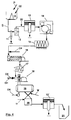
- FIG. 4 A system of the type that can be used to carry out the method according to the invention is shown schematically in FIG. 4.
- Paper P and water W are dissolved and diluted in a high-consistency solvent 10 so that a pumpable suspension S is formed, which is then treated further by means of a hydrocyclone 11 and a stripper 12.
- water W is again added in order to obtain the consistency required for the flotation device 13.
- Detached printing inks and further particulate contaminants are separated in the flotation device 13, that is to say a deinking process step is carried out.
- the cleaned accepted material passes into a thickening device 14, in which a material density of at least 15% is achieved.
- the high-consistency fabric thus produced is then brought to the desired temperature in the heating device 15 with steam injection and is thus fed into a kneader 16, which here carries out a mechanical pretreatment on the paper stock.
- the bleaching aids CH are advantageously mixed in immediately before the kneader 16.
- the kneader shown here is depressurized; therefore, the substance is then fed via a compression device 17 into the dispersing device 18, which is under pressure.
- the combination of pressureless kneader 16 and high-pressure dispersing device 18 is complex, but particularly effective for carrying out the method.
- the mechanical pretreatment in the kneader can be omitted.
- the dispersing device 18 does not necessarily have to be under excess pressure.
- the bleaching chemicals OX are at least partially added to the substance here before it reaches the dispersing device 18. Under certain circumstances, at least some of the bleaching aids CH can also be mixed in at this point.
- the actual bleaching takes place in the bleaching vessel 19. According to the invention, this is under overpressure. At least some of the bleaching chemicals OX can also be introduced into this bleaching vessel 19, which is particularly useful if they are gaseous. After the substance has remained in the bleaching vessel 19 for at least 10 minutes, it can be blown out into a dilution vessel 20 via a lock. A further deinking flotation then takes place in a flotation device 13 ', the material being cleaned once again from the exposed impurities by flotation. Then he arrives in the storage chest 21. As already mentioned, this description of the system is only one way of carrying out the process. Other apparatuses are known to the person skilled in the art in order to carry out the method steps formulated in the claims.
Landscapes
- Engineering & Computer Science (AREA)
- Life Sciences & Earth Sciences (AREA)
- Wood Science & Technology (AREA)
- Mechanical Engineering (AREA)
- Paper (AREA)
Applications Claiming Priority (2)
| Application Number | Priority Date | Filing Date | Title |
|---|---|---|---|
| DE19614947 | 1996-04-16 | ||
| DE1996114947 DE19614947B4 (de) | 1996-04-16 | 1996-04-16 | Verfahren zur Erhöhung des Weißgrades von Papierfaserstoff |
Publications (1)
| Publication Number | Publication Date |
|---|---|
| EP0802275A1 true EP0802275A1 (fr) | 1997-10-22 |
Family
ID=7791398
Family Applications (1)
| Application Number | Title | Priority Date | Filing Date |
|---|---|---|---|
| EP19970101747 Withdrawn EP0802275A1 (fr) | 1996-04-16 | 1997-02-05 | Procédé pour l'amélioration du dégré de blancheur de pâte à papier |
Country Status (4)
| Country | Link |
|---|---|
| US (1) | US5958179A (fr) |
| EP (1) | EP0802275A1 (fr) |
| CA (1) | CA2202714C (fr) |
| DE (1) | DE19614947B4 (fr) |
Cited By (2)
| Publication number | Priority date | Publication date | Assignee | Title |
|---|---|---|---|---|
| US6290811B1 (en) * | 1998-06-27 | 2001-09-18 | Korea Research Institute Of Chemical Technology | Method for recycling of old corrugated container using flotation and kneading treatment |
| EP1254986A1 (fr) * | 2001-05-02 | 2002-11-06 | Voith Paper Patent GmbH | Procédé pour la fabrication d' une pâte à partir de matériaux contenant du papier |
Families Citing this family (16)
| Publication number | Priority date | Publication date | Assignee | Title |
|---|---|---|---|---|
| DE19751173A1 (de) * | 1997-11-19 | 1999-05-27 | Voith Sulzer Papiertech Patent | Verfahren zur Erhöhung des Weißgrades von Papierfaserstoff |
| ATE259442T1 (de) * | 1999-10-29 | 2004-02-15 | Voith Paper Patent Gmbh | Verfahren zur erhöhung der homogenität und des weissgrades von papierfaserstoff |
| DE19954246A1 (de) * | 1999-10-29 | 2001-07-26 | Voith Paper Patent Gmbh | Verfahren zur Erhöhung der Homogenität und des Weißgrades von Papierfaserstoff |
| DE19958038A1 (de) * | 1999-12-03 | 2001-06-07 | Voith Paper Patent Gmbh | Verfahren zur Erhöhung des Wasserrückhaltevermögens von Papierfaserstoffen |
| DE10000181A1 (de) * | 2000-01-05 | 2001-07-12 | Voith Paper Patent Gmbh | Verfahren zur Auflösung von Altpapier |
| US6458240B1 (en) | 2000-01-14 | 2002-10-01 | Georgia-Pacific Corporation | Method for removing contaminants from fibers in recycle fiber pulping |
| DE10135699A1 (de) * | 2001-07-21 | 2003-02-13 | Voith Paper Patent Gmbh | Verfahren zur Aufbereitung von Trockenausschuss |
| FI112805B (fi) * | 2001-10-10 | 2004-01-15 | Megatrex Oy | Menetelmä väriaineiden, erityisesti painovärin irrottamiseksi kierrätyskuitumateriaalista |
| JP2003119679A (ja) * | 2001-10-17 | 2003-04-23 | Aikawa Iron Works Co Ltd | パルプ加熱装置 |
| AT411604B (de) * | 2002-03-27 | 2004-03-25 | Andritz Ag Maschf | Verfahren und vorrichtung zur dispergierung eines papierfaserstoffes |
| DE10219844C1 (de) * | 2002-05-03 | 2003-09-18 | Voith Paper Patent Gmbh | Verfahren zur Heissdispergierung eines Papierfaserstoffes |
| US7297225B2 (en) * | 2004-06-22 | 2007-11-20 | Georgia-Pacific Consumer Products Lp | Process for high temperature peroxide bleaching of pulp with cool discharge |
| US10895038B2 (en) | 2017-05-31 | 2021-01-19 | Gpcp Ip Holdings Llc | High consistency re-pulping method, apparatus and absorbent products incorporating recycled fiber |
| US11591751B2 (en) | 2019-09-17 | 2023-02-28 | Gpcp Ip Holdings Llc | High efficiency fiber bleaching process |
| US12286751B2 (en) | 2021-01-06 | 2025-04-29 | Gpcp Ip Holdings Llc | Oxygen treatment of high kappa fibers |
| US12435469B2 (en) | 2022-02-22 | 2025-10-07 | Gpcp Ip Holdings Llc | High yield chemical pulping and bleaching process |
Citations (7)
| Publication number | Priority date | Publication date | Assignee | Title |
|---|---|---|---|---|
| WO1987005346A1 (fr) * | 1986-03-04 | 1987-09-11 | Sulzer-Escher Wyss Gmbh | Blanchissage chimique de consistance elevee a haute temperature |
| DE4133683A1 (de) * | 1991-09-20 | 1993-03-25 | Voith Gmbh J M | Verfahren zur aufbereitung von bedrucktem altpapier |
| US5211809A (en) | 1991-05-21 | 1993-05-18 | Air Products And Chemicals, Inc,. | Dye removal in oxygen color stripping of secondary fibers |
| EP0557651A1 (fr) | 1992-02-24 | 1993-09-01 | Scott Paper Company | Procédé intégré de mise en pâte de vieux papiers, donnant des fibres aptes à faire du tissue |
| EP0590626A1 (fr) * | 1992-10-02 | 1994-04-06 | J.M. Voith GmbH | Procédé de traitement de vieux papiers imprimés |
| WO1995028517A1 (fr) * | 1994-04-18 | 1995-10-26 | Kamyr, Inc. | Procede et appareil pour controler l'utilisation de produit de blanchiment |
| WO1996012062A1 (fr) * | 1994-10-13 | 1996-04-25 | Aga Aktiebolag | Procede et dispositif de blanchiment de fibres secondaires |
Family Cites Families (1)
| Publication number | Priority date | Publication date | Assignee | Title |
|---|---|---|---|---|
| US5518580A (en) * | 1991-09-20 | 1996-05-21 | J.M. Voith Gmbh | Method of processing printed waste matter |
-
1996
- 1996-04-16 DE DE1996114947 patent/DE19614947B4/de not_active Expired - Fee Related
-
1997
- 1997-02-05 EP EP19970101747 patent/EP0802275A1/fr not_active Withdrawn
- 1997-04-11 US US08/834,482 patent/US5958179A/en not_active Expired - Fee Related
- 1997-04-15 CA CA 2202714 patent/CA2202714C/fr not_active Expired - Fee Related
Patent Citations (7)
| Publication number | Priority date | Publication date | Assignee | Title |
|---|---|---|---|---|
| WO1987005346A1 (fr) * | 1986-03-04 | 1987-09-11 | Sulzer-Escher Wyss Gmbh | Blanchissage chimique de consistance elevee a haute temperature |
| US5211809A (en) | 1991-05-21 | 1993-05-18 | Air Products And Chemicals, Inc,. | Dye removal in oxygen color stripping of secondary fibers |
| DE4133683A1 (de) * | 1991-09-20 | 1993-03-25 | Voith Gmbh J M | Verfahren zur aufbereitung von bedrucktem altpapier |
| EP0557651A1 (fr) | 1992-02-24 | 1993-09-01 | Scott Paper Company | Procédé intégré de mise en pâte de vieux papiers, donnant des fibres aptes à faire du tissue |
| EP0590626A1 (fr) * | 1992-10-02 | 1994-04-06 | J.M. Voith GmbH | Procédé de traitement de vieux papiers imprimés |
| WO1995028517A1 (fr) * | 1994-04-18 | 1995-10-26 | Kamyr, Inc. | Procede et appareil pour controler l'utilisation de produit de blanchiment |
| WO1996012062A1 (fr) * | 1994-10-13 | 1996-04-25 | Aga Aktiebolag | Procede et dispositif de blanchiment de fibres secondaires |
Cited By (2)
| Publication number | Priority date | Publication date | Assignee | Title |
|---|---|---|---|---|
| US6290811B1 (en) * | 1998-06-27 | 2001-09-18 | Korea Research Institute Of Chemical Technology | Method for recycling of old corrugated container using flotation and kneading treatment |
| EP1254986A1 (fr) * | 2001-05-02 | 2002-11-06 | Voith Paper Patent GmbH | Procédé pour la fabrication d' une pâte à partir de matériaux contenant du papier |
Also Published As
| Publication number | Publication date |
|---|---|
| CA2202714C (fr) | 2002-06-25 |
| DE19614947B4 (de) | 2004-04-08 |
| US5958179A (en) | 1999-09-28 |
| CA2202714A1 (fr) | 1997-10-16 |
| DE19614947A1 (de) | 1997-10-23 |
Similar Documents
| Publication | Publication Date | Title |
|---|---|---|
| DE19614947B4 (de) | Verfahren zur Erhöhung des Weißgrades von Papierfaserstoff | |
| DE69204739T2 (de) | Entfernung von Farbe während der Sauerstoffentfärbung von Altpapierfasern. | |
| DE69028797T2 (de) | Verfahren zum Bleichen von Zellstoff mit Ozon | |
| DE69019350T2 (de) | Umweltfreundlicheres verfahren zum bleichen von lignocellulosischen materialien. | |
| EP0538603B1 (fr) | Procédé pour l'élimination d'impuretés fines de la pâte de vieux papiers | |
| DE3017712C2 (de) | Verfahren zur alkalischen Extraktion von Fasermaterial enthaltenden Cellulosesuspensionen nach Behandlung mit Chlor oder Chlordioxid oder Mischungen davon | |
| DE69104566T2 (de) | Verfahren zum De-inken von bedruckten Papieren. | |
| AT395028B (de) | Verfahren zum chlorfreien bleichen von kunstfaserzellstoff | |
| EP0066894B1 (fr) | Procédé de désencrage de vieux papier imprimé | |
| DE69402650T2 (de) | Bleichen von wiederverwendeten zellstoff mittels einer oxydativ-reduktivsequenz | |
| DE68924793T2 (de) | Verfahren zum Bleichen von mechanischem Holzstoff. | |
| DE69217164T2 (de) | Reinigung und Bleichen von Sekundärfasern | |
| DE69506465T2 (de) | Verfahren zur Verminderung der Fluoreszenz in entfärbtem Zellstoff | |
| DE2805445C2 (de) | Verfahren zur Wiederaufbereitung von hochwertigem Altpapier | |
| EP0434662B1 (fr) | Procédé pour blanchir des matières cellulosiques et installation pour la mise en oeuvre de ce procédé | |
| EP0120132B1 (fr) | Procédé de blanchiment de matières premières de papier | |
| DE68928822T2 (de) | Verfahren zur Herstellung von gebleichten chemithermomechanischen Zellstoffen | |
| EP1798329B1 (fr) | Procédé pour enlever des contaminants d'une suspension aqueuse de fibres | |
| DE2407542A1 (de) | Verfahren zum bleichen von pulpe | |
| DE3148749C2 (de) | Papiere, vorzugsweise für den Bogendruck, hergestellt aus aufbereitetem Altpapier, und Verfahren zu deren Herstellung | |
| DE69204457T2 (de) | Verfahren zum bleichen und zur delignifizierung von chemischen papierzellstoffen. | |
| EP0247307B1 (fr) | Procédé de décoloration de papiers colorés dans la masse et de papiers autocopiants | |
| DE19626200C2 (de) | Verfahren zur Erhöhung des Weißgrades von Altpapierfaserstoff | |
| DE102006020981A1 (de) | Verfahren zur Entfernung von Störstoffen aus einer wässrigen Faserstoffsuspension | |
| EP0379858A2 (fr) | Procédé de blanchiment de matière fibreuse pour la fabrication de papier |
Legal Events
| Date | Code | Title | Description |
|---|---|---|---|
| PUAI | Public reference made under article 153(3) epc to a published international application that has entered the european phase |
Free format text: ORIGINAL CODE: 0009012 |
|
| AK | Designated contracting states |
Kind code of ref document: A1 Designated state(s): AT CH DE FI FR GB LI NL SE |
|
| 17P | Request for examination filed |
Effective date: 19980422 |
|
| 17Q | First examination report despatched |
Effective date: 20020416 |
|
| RAP1 | Party data changed (applicant data changed or rights of an application transferred) |
Owner name: VOITH PAPER FIBER SYSTEMS GMBH & CO. KG |
|
| STAA | Information on the status of an ep patent application or granted ep patent |
Free format text: STATUS: THE APPLICATION HAS BEEN WITHDRAWN |
|
| 18W | Application withdrawn |
Effective date: 20041028 |