EP0802415B1 - Stossfühler - Google Patents
Stossfühler Download PDFInfo
- Publication number
- EP0802415B1 EP0802415B1 EP97106273A EP97106273A EP0802415B1 EP 0802415 B1 EP0802415 B1 EP 0802415B1 EP 97106273 A EP97106273 A EP 97106273A EP 97106273 A EP97106273 A EP 97106273A EP 0802415 B1 EP0802415 B1 EP 0802415B1
- Authority
- EP
- European Patent Office
- Prior art keywords
- fet
- coupled
- amplifier
- circuit
- gate
- Prior art date
- Legal status (The legal status is an assumption and is not a legal conclusion. Google has not performed a legal analysis and makes no representation as to the accuracy of the status listed.)
- Expired - Lifetime
Links
- 230000035939 shock Effects 0.000 title claims description 52
- 239000003990 capacitor Substances 0.000 claims description 28
- 238000001514 detection method Methods 0.000 description 6
- 238000005516 engineering process Methods 0.000 description 6
- 238000000034 method Methods 0.000 description 6
- 238000010586 diagram Methods 0.000 description 4
- 238000009792 diffusion process Methods 0.000 description 4
- 230000005540 biological transmission Effects 0.000 description 3
- 230000005669 field effect Effects 0.000 description 3
- 230000010354 integration Effects 0.000 description 3
- XUIMIQQOPSSXEZ-UHFFFAOYSA-N Silicon Chemical compound [Si] XUIMIQQOPSSXEZ-UHFFFAOYSA-N 0.000 description 2
- 230000001133 acceleration Effects 0.000 description 2
- 238000010168 coupling process Methods 0.000 description 2
- 238000005859 coupling reaction Methods 0.000 description 2
- 230000009977 dual effect Effects 0.000 description 2
- 230000007613 environmental effect Effects 0.000 description 2
- 229910021420 polycrystalline silicon Inorganic materials 0.000 description 2
- 229920005591 polysilicon Polymers 0.000 description 2
- 229910052710 silicon Inorganic materials 0.000 description 2
- 239000010703 silicon Substances 0.000 description 2
- 239000010409 thin film Substances 0.000 description 2
- 229910052581 Si3N4 Inorganic materials 0.000 description 1
- 230000003321 amplification Effects 0.000 description 1
- 230000000712 assembly Effects 0.000 description 1
- 238000000429 assembly Methods 0.000 description 1
- 230000002238 attenuated effect Effects 0.000 description 1
- 239000000919 ceramic Substances 0.000 description 1
- 239000011248 coating agent Substances 0.000 description 1
- 238000000576 coating method Methods 0.000 description 1
- 150000001875 compounds Chemical class 0.000 description 1
- 238000004883 computer application Methods 0.000 description 1
- 230000002089 crippling effect Effects 0.000 description 1
- 230000007812 deficiency Effects 0.000 description 1
- 230000001419 dependent effect Effects 0.000 description 1
- 230000002708 enhancing effect Effects 0.000 description 1
- 239000010408 film Substances 0.000 description 1
- 239000012212 insulator Substances 0.000 description 1
- 239000000463 material Substances 0.000 description 1
- 229910044991 metal oxide Inorganic materials 0.000 description 1
- 150000004706 metal oxides Chemical class 0.000 description 1
- 238000003199 nucleic acid amplification method Methods 0.000 description 1
- 238000004806 packaging method and process Methods 0.000 description 1
- 238000009738 saturating Methods 0.000 description 1
- 239000004065 semiconductor Substances 0.000 description 1
- HQVNEWCFYHHQES-UHFFFAOYSA-N silicon nitride Chemical compound N12[Si]34N5[Si]62N3[Si]51N64 HQVNEWCFYHHQES-UHFFFAOYSA-N 0.000 description 1
- 238000004088 simulation Methods 0.000 description 1
- 239000000758 substrate Substances 0.000 description 1
- 238000009966 trimming Methods 0.000 description 1
Images





Classifications
-
- H—ELECTRICITY
- H03—ELECTRONIC CIRCUITRY
- H03H—IMPEDANCE NETWORKS, e.g. RESONANT CIRCUITS; RESONATORS
- H03H11/00—Networks using active elements
- H03H11/02—Multiple-port networks
- H03H11/04—Frequency selective two-port networks
- H03H11/12—Frequency selective two-port networks using amplifiers with feedback
-
- G—PHYSICS
- G01—MEASURING; TESTING
- G01P—MEASURING LINEAR OR ANGULAR SPEED, ACCELERATION, DECELERATION, OR SHOCK; INDICATING PRESENCE, ABSENCE, OR DIRECTION, OF MOVEMENT
- G01P15/00—Measuring acceleration; Measuring deceleration; Measuring shock, i.e. sudden change of acceleration
- G01P15/18—Measuring acceleration; Measuring deceleration; Measuring shock, i.e. sudden change of acceleration in two or more dimensions
Definitions
- the present invention relates to the field of motion sensing in electromechanical assemblies and machines. More particularly, the invention relates to a shock sense circuit of the type defined in the precharacterizing portion of claim 1.
- a circuit of the above-mentioned type is known from US-A-5,034,891.
- the apparatus includes a sensor securable to the vehicle for providing a vibratory electric signal having various frequency components indicative of whether the vehicle is in a deployment condition. The particular frequency components indicative of a deployment condition are not present when the vehicle is in a non-deployment condition.
- a filter circuit is connected to the sensor for providing an electric signal having a value indicative of the value of the particular frequency components.
- An integrator provides a signal having a value indicative of the value of the vibratory electric signal.
- a summing circuit sums the value of the signal from the integrator and from the filter circuit.
- a signal generator provides the actuation signal when the signal from the summing circuit exceeds a predetermined value.
- an accelerometer system which is suitable for measuring both low-frequency accelerations in inertial systems and high-frequency vibrational accelerations is known from GB-A-2 158 243.
- the system comprises a low-frequency inertial quality force feedback accelerometer including a proof mass and a high-frequency accelerometer.
- the output of high-frequency accelerometer is summed at an adder with the feedback signal from a position transducer in the low-frequency accelerometer feedback loop.
- PCs such as laptop and notebook sized computers
- HDA designers To improve their reliability.
- portable computers are subject to some types of failure which would not be a problem for desk top machines. For example, portable computers can be dropped while being carried or worked on, and components in the portable system can be damaged or crippled.
- One of the leading failure causes for portable PCs is in the fragility of the disk drive and its shock vulnerability.
- Hard disks play an important part in delivering the same power and functionality of desk top computers for portable personal computers.
- a typical Hard Drive Assembly (HDA) comprises one or more rotatably mounted disks having an extremely thin magnetic coating deposited on the disk substrate. Information is generally read and written from the hard disks by a read/write head.
- An HDA typically has a very sensitive architecture wherein a very small gap is maintained between the drive head and the disk, and this makes the HDA especially vulnerable to shock damage. Since the smaller this gap is, the more data a hard disk can store, small gap dimensions are the norm for the hard disks.
- HDA Hard Drive Assembly
- a shock detector can be used for this purpose to sense and detect excessive shocks, and signal an embedded microprocessor to stop writing on disk drives.
- the HDA shock detector is implemented with discrete components including resistor and capacitor components.
- using a number of discrete components not only compromises the performance of detection circuitry for cost, but also takes a fair amount of board space to accommodate discrete components.
- a bulkier board usually increases costs due to various factors such as higher board cost and packaging cost.
- a bulkier size could also mean that there is a greater possibility in the system that some components would fail, and thus less overall system reliability.
- FIG. 1 shows a typical prior art front-end filter implemented by using discrete components.
- the filter has two real poles and one transmission zero at zero frequency.
- Shock sensor 101 and resistor 103 of 10 M ⁇ are coupled in parallel via capacitor 105 to the positive input terminal of amplifier 115.
- the positive input terminal of amplifier 115 is also coupled via resistor 107 and bypass capacitor 109 to a circuit reference point such as circuit ground.
- Capacitor 119 and resistor 117 are coupled between the output terminal of amplifier 115 and the negative input terminal of amplifier 115 in parallel.
- the negative input terminal of amplifier 115 is also coupled via resistor 111 and bypass capacitor 113 to a circuit reference point such as circuit ground.
- the capacitor 105 provides AC-coupling for the shock signal input and blocks out DC component.
- the filter circuit shown in Figure 1 provides sufficient rejection on DC component and a gain boost in the passband. But the rejection on high-frequency components is not acceptable for most HDA applications. To overcome this deficiency requires a higher-order filter, which can provide better high-frequency response characteristics. However, this increases the cost and the board space.
- RC-active circuits utilizing operational amplifiers with resistors and capacitors show unstable frequency response characteristics because the filter characteristics are dependent on resistor and capacitor values.
- typical shock filter characteristics require large-value resistors and capacitors to realize low-frequency poles and zeros, which in turn occupy relatively large silicon space in integrated circuit technology.
- prior art RC-active circuits are not suitable for monolithic integration using, for example, CMOS technology, thereby making it difficult to scale down the system.
- shock detectors are designed to detect only one-axis shock for the sake of simplicity and low cost. While this method is satisfactory for some applications, often it is not adequate or sufficient to detect and compensate for excessive shocks and protect the hard disk drives.
- a one-axis shock detector for example, will not have a complete shock detection since shock signal is detected only along one axis, and consequently will result in less accurate sensing of actual physical or mechanical shock than desired. While less accurate shock sensing might be tolerable for desk top computers and work stations, they can often cause critical damage or crippling effect for many portable personal computers such as laptop computers.
- Figure 2 shows a conventional full-wave rectifier with summer and implemented by discrete components.
- input signal VINx is coupled to X-axis full-wave rectifier 211, which is coupled to summer 215 through resistor 219.
- the output of summer 215 is coupled to LPF 217, which outputs to Vout.
- VINy is coupled to Y-axis full-wave rectifier 213, which is also coupled to summer 215 through resistor 221.
- Shock signals from two-axis need to be full-wave rectified individually prior to being added together since the shock can be in either positive or negative direction of either axis.
- two diodes are used to rectify the current in one direction. Not only is the approach unsuitable for CMOS implementation, but also requires a fair amount of silicon area. As discussed, a bulky design adds to costs and is not suitable for portable computer applications.
- a rectifying circuit is known.
- An operational amplifier and a field effect transistor are so operated as to compensate the forward voltage of a thyristor by a feedback resistor.
- a current flows through a bias power source, a diode, the FET and the thyristor, and the circuit operates as a noninverting amplifier amplification factor 1.
- the power source applies a bias voltage so that the FET correctly operates.
- a leakage current determined by the resistor merely flows so that an impedance between the first terminal connected to the current source and a second terminal connected to the resistor and the thyristor becomes very large.
- two Zener diodes prevent the amplifier from saturating.
- the present invention discloses a shock sense circuit of the type mentioned in the beginning, which comprises the features of the characterizing portion of claim 1.
- Filters are preferably integrated with an improved on-chip bias generator so that they can provide stable, trimmable and/or programmable frequency responses with a minimum number of external capacitors.
- Resistor elements are preferably implemented with MOSFETs (Metal Oxide Semiconductor Field Effect Transistors), which are properly biased by an on-chip bias generator.
- the full-wave rectifier is implemented using an integrated circuit technology and comprises an operational amplifier.
- the invention provides dual full-wave rectifiers for X-axis and Y-axis shock sensing so that more accurate and reliable shock detection can be achieved.
- Input signals from X- and Y-axis shock sensors are converted to current and provided to the dual full-wave rectifiers.
- the currents thus full-wave rectified are summed and preferably low-pass filtered to generate an output signal. Since the invention integrates most of its system in monolithic circuitry and requires only a few external components, it is feasible and desirable to house the whole detection circuitry with piezo-ceramic sensors in one package, thus reducing cost and board space.
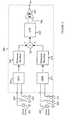
- FIG. 3 shows a functional block diagram of a two-axis shock detector circuit according to the present invention.
- Shock sensors 301 and 307 are implemented by piezoceramic elements mounted on an HDA.
- shock sensors 301 and 307 In response to environmental shocks to the HDA, shock sensors 301 and 307 generate small AC signals (typically, 0.5 millivolt/G) whose amplitudes are proportional to the magnitude of shocks.
- the AC signals from the sensors are first provided to bandpass filters 313 and 317 to be bandlimited.
- the bandlimited signals are then full-wave-rectified by full-wave rectifiers 315 and 319 and summed together by summing circuit 321.
- summing circuit 321 The output of summing circuit 321 is then provided to a lowpass filter 323 to cut off its high-frequency components resulting from full-wave rectification.
- a comparator 325 with a small amount of hysteresis compares the filtered signal with a threshold Vth and generates a logic signal SD, which signals that the HDA has suffered a shock whose magnitude is above a predetermined threshold value.
- the system bounded by dotted lines 300 in Figure 3 denotes a circuit integration comprising bandpass filters 313 and 317, full-wave rectifiers 315 and 319, summing circuit 321,' lowpass filter 323 and comparator 325.
- the logic signal SD is generated on block 300 and provided on an output pin to the external world.
- FIG. 6 shows a preferred embodiment of the invented bandpass filter.
- the bandpass filter is realized by a highpass filter (HPF) 600 cascaded with a lowpass filter (LPF) 602.
- shock sensor 601 is coupled to an external capacitor 603 (capacitance value of C1), which is coupled to the positive input terminal of amplifier 606.
- the positive input terminal of amplifier 606 is also value of R1.
- On-chip resistor 609 (resistance value of R2) and an external capacitor 611 (capacitance value of C2) are coupled in series between reference voltage VR and the negative input terminal of the amplifier 606.
- An on-chip feedback resistor 607 (resistance value of R3) is coupled between the negative input terminal and output terminal of the amplifier 606.
- the output terminal of the amplifier 606 is coupled to resistor 613 (resistance value of R4), which is coupled to node 623.
- Node 623 is coupled to the negative input terminal of the amplifier 620 through resistor 619 (resistance value of R5).
- Node 623 is coupled to a circuit reference point such as circuit ground through capacitor 615 (capacitance value of C3).
- the positive input terminal of the amplifier 620 is coupled to a circuit reference point such as circuit ground.
- the output terminal of the amplifier 620 is coupled to the negative input terminal of the amplifier 620 through capacitor 621 (capacitance value of C4), and coupled to node 623 through resistor 617 (resistance value of R6).
- the non-inverting amplifier 606 plus on-chip resistors 607 and 609 in conjunction with external components 603, 605 and 611 form RC-active highpass filter (HPF) 600 whose transfer function is derived as follows:
- Capacitor 603 and resistor 605 in the first part of HPF transfer function realize one transmission zero at zero frequency and one pole at less than 1 Hz.
- Capacitor 603 is used to provide AC-coupling for the shock signal input and thus block out the DC component of the shock signal.
- Resistor 605 is used to bias the shock signal at a reference voltage VR.
- Resistors 607, 609 and capacitor 611 in the second part of HPF transfer function realize one transmission zero around 100 Hz and one pole around 1 KHz.
- HPF (R2 + R3) provides a gain of; ( R 2 + R 3 ) R 2
- the inverting amplifier 620 with on-chip resistors 613, 617, 619 and capacitors 615, 621 forms RC-active lowpass filter 602 whose transfer function is derived as follows: H ( s ) LPF -( R 6/ R 4) 1 + sR 5 C 4[1+( R 6/ R 4)+( R 6/ R 5)]+ s 2 R 5 R 6 C 3 C 4
- LPF provides a gain of (R 6 /R 4 ).
- the frequency response of the bandpass filter shown in Figure 6 would be as shown in Figure 7.
- Figure 8 is an extended frequency response diagram of Figure 7.
- the filter provides a substantial gain boost of about 15 dB in passband between 1 KHz and 2.5 KHz and has a rejection band that rejects DC and high-frequency components (over 20 KHz) by more than 30 dB (relative to components in the passband).
- the gain boost in the selected passband is designed to provide most sensitive shock detection capability around 1 KHz to 2.5 KHz of input signal frequencies.
- the integrated high-order filter shown in Figure 6 provides better high frequency characteristics than prior art discrete component filters such as shown in Figure 1 and yet requires a minimum number of external capacitors and minimal increase in board space and cost.
- resistors are implemented by polysilicon, p+ diffusion, n+ diffusion, or well, depending upon their applications.
- resistors When resistors are implemented by polysilicon, or p+ diffusion, or n+ diffusion, or well, they typically are subject to process variations and show a wide range of tolerance (more than +30%), thereby shifting the pole and zero locations of the filters significantly. This makes filters with these types of resistors less reliable than desired, and in some cases unacceptable.
- a MOSFET which is biased in the triode region as a linear resistor, is used to implement on-chip resistors in the present invention. Its principle of operation is described referring to Figure 9.
- Figure 9 illustrates a highpass filter constructed according to the present invention.
- input V IN is coupled to the positive input terminal of amplifier 905 through capacitor 901.
- the positive input terminal of amplifier 905 is also coupled to reference voltage VR through resistor 903.
- the negative input terminal of amplifier 905 is coupled to VR through a MOSFET 909 and capacitor 907.
- MOSFETs Ma,1, Ma,2, ..., Ma, N-1 are serially connected between the output terminal of amplifier 905 and the negative input terminal of amplifier 905 with their gates commonly connected to node 913.
- the gate terminal of MOSFET 909 is also coupled to node 913.
- MOSFETs Mb,1, Mb,2, ..., Mb, N are serially connected between a precision current source I B and reference voltage V R with their gates commonly connected to node 913.
- the precision current source IB is also coupled to the negative input terminal of amplifier 911.
- the non-inverting input terminal of the amplifier 911 is coupled to a reference voltage equal to (VR+VX) as shown in Figure 9.
- the output terminal of the amplifier 911 is coupled to node 913.
- the dotted lines in Figure 9 indicate an integrated circuit chip boundary.
- the current from the precision current source IB is forced through a MOSFETs Mb,1, Mb,2, ..., Mb, N which are biased in triode region by a high-gain amplifier 911.
- the equivalent resistance of the Mb,n is, therefore, the voltage across Mb,n, which is forced equal to Vx by the high-gain amplifier 911, divided by the current source IB.
- the Mb,N is then mirrored to implement resistors such as resistors 607 or 609 shown in Figure 6.
- the system in Figure 9 achieves a stable frequency response since both V x and I B are fairly stable over process and temperature variations. Also, either the current source or V x , and thus the frequency response of the filter, can be trimmed for further precision or programmed to adjust their values for various HDA design requirements.
- a MOSFET biased in the triode region as a resistor has a fairly large voltage coefficient.
- the resistor values of 607 and 609 will somewhat vary with the terminal voltages at the MOSFETs.
- the voltage coefficient can be minimized if MOSFET is biased in strong triode region and the voltages across MOSFET are limited within +200 millivolts from its operating point.
- the HSPICE simulation has proved that the resistor values which are implemented in this manner vary less than +10% and in most applications, these are acceptable. For applications that require tighter tolerance of resistor values, however, a circuit depicted in Figure 10 may be used to bias the MOSFETs.
- FIG 10 shows a diagram of an improved bias generator according to the present invention.
- a current source IB is coupled to the positive input terminal of amplifier 931, the negative input terminal of which is coupled to (VR+V x ).
- NMOS transistors M1 and M3 are serially coupled between VCC and GND.
- NMOS transistors M2 and M4 are also serially coupled between VCC and GND.
- the output terminal of amplifier 931 is coupled to the gates of transistors M1 and M2 as bias voltage V B .
- the gate of M3 is coupled to the current source I B .
- PMOS transistors M5 and M6 are connected in parallel between I B and V R .
- VR is also coupled to the gate of M4.
- the gate of transistor M5 is coupled to node 933.
- the gate of transistor M6 is coupled to node 935.
- transistors M1, M2, M3 and M4 are biased in saturation region while M5 and M6 are biased in triode region as linear resistors.
- Figure 10 comprises a PMOS resistor element enclosed in dotted lines.
- the biased voltages for both M5 and M6 are such that the drain-to-source voltage drops of M5 and M6 are equal to V x in the same manner as in Figure 9.
- the biased voltages of transistors M5 and M6 are also derived from their terminal voltages since M3 and M4 are source followers with M1 and M2 as current source loads.
- the circuit eliminates the voltage dependency on terminal voltages of the MOSFET resistor element to the first-order, thereby enhancing the reliability of operation.
- the gates of the transistors M3 and M4 are taken and used as two terminals of a resistor element.
- Figure 11 shows an alternate embodiment of a bias generator according to the present invention.
- NMOS transistors M11 and M12 are connected in parallel between IB and VR.
- the output terminal of amplifier 941 is coupled to the gates of transistors M9 and M10 as bias voltage VB.
- VR is also coupled to the gate of M8.
- the gate of transistor M11 is coupled to node 945.
- the gate of transistor M12 is coupled to node 943.
- the biased voltages for both M11 and M12 are such that the drain-to-source voltage drops of M11 and M12 are equal to V x , as for PMOS resistor of Figure 10.
- the NMOS resistor also eliminates the voltage dependency on terminal voltages of the MOSFET resistor element to the first-order.
- the gates of the transistors M7 and M8 are taken and used as two terminals of a resistor element.
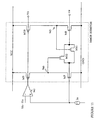
- Figure 12 shows a circuit that comprises two-axis full-wave rectifier circuits, a summation circuit and a lowpass filter and is compatible with IC monolithic technology.
- Figure 12 comprises an X-axis full-wave rectifier 950 and a Y-axis full-wave rectifier 952.
- X-axis sensor signal VIN x is coupled to the negative input terminal of amplifier 951 through resistor R7a.
- the positive input terminal of amplifier 951 is coupled to VR.
- MOS transistors M16, M13, M14, M15 are serially connected between VCC and ground.
- Current source I1 is coupled to the gate of NMOS transistor M13 and the source of PMOS transistor M19, the drain of which is coupled to ground.
- the source of PMOS transistor M14 is also coupled to the negative input terminal of amplifier 951.
- the output of amplifier 951 is coupled to the gates of PMOS transistors M14 and M19.
- VINy is coupled to the negative input terminal of amplifier 953 through resistor R7b.
- the positive input terminal of amplifier 953 is coupled to VR.
- NMOS transistor M20 and PMOS transistor M21 are serially connected.
- the drain of transistor M20 is coupled to the drain of transistor M13.
- the drain of transistor M21 is coupled to the drain of transistor M15.
- Current source I2 is coupled to the gate of NMOS transistor M20 and the source of PMOS transistor M22, the drain of which is coupled to ground.
- the source of PMOS transistor M21 is also coupled to the negative input terminal of amplifier 953.
- the output of amplifier 953 is coupled to the gates of PMOS transistors M21 and M22.
- NMOS transistor M15 The drain of NMOS transistor M15 is coupled to its gate, which is also coupled to the gate of NMOS transistor M18.
- PMOS transistor M17 is coupled between VCC and the gate of transistor M15.
- the gate of transistor M17 is coupled to the gate of transistor M16.
- the drain of transistor M18 is coupled to the negative input terminal of amplifier 955 through resistor 959 with its source connected to ground.
- the positive input terminal of amplifier 955 is coupled to reference voltage VR.
- Capacitor 957 is coupled between ground and the drain of transistor M18.
- Resistor 961 is coupled between the output Vout of amplifier 955 and the drain of transistor M18.
- Capacitor 963 is coupled between the output of amplifier 955 and the negative input terminal of amplifier 955.
- the input voltage VINx is first converted to a current in either direction by a linear resistor R7a.
- a current will flow in the direction of VINX towards R7a and through M14.
- the output of amplifier 951 and thus the gate voltage s of M14 and M19 are driven negative so that M14 and M19 are forced "ON”.
- the gate voltage of M13 is low enough so that M13 is turned “OFF”. This current thus flows through VINx M14 and M15.
- M15 is diode-connected and thus mirrors the same amount of the current flowing through M18.
- the Y-axis full-wave rectifier 952 shown in Figure 12 operates in the same manner and a current proportional to input voltage magnitude
- input voltage magnitude
- input voltage magnitude
- the lowpass filter is generally indicated in Figure 12 at LPF comprising amplifier 955, resistors 959 and 961, and capacitors 957 and 963.
- the resistors in the RC network can be realized by MOSFETs biased in strong triode region as described above. It is noted that the equivalent resistance value of MOSFET resistor is determined by V X and I B . By trimming and/or programming different values for V X and I B , the value of a MOSFET resistor can be adjusted.
- Transistors M15, M16, M17, and M18 in the preferred embodiment of Figure 12 are typically operating in saturation region.
- the present invention thus provides accurate and reliable shock sensing capability built around a compact system design.
- the advantages of the invention are particularly valuable in HDA 10 applications for portable computers.
- the advantages of the present invention are:
- the present invention describes and illustrates various embodiments of resistors, rectifiers, and other circuits using MOSFETs
- FETs can also be used to realize the present invention.
- other thin film materials such as silicon nitride can be used in place of oxide film to form field effect transistors.
- oxide film can be used in place of oxide film to form field effect transistors.
- other insulator thin films are obviously available to form a FET without departing from the scope of the present invention.
- N-type MOS transistors may be replaced by P-type MOS transistors with appropriate changes in voltage polarities, or vice versa.
Landscapes
- Physics & Mathematics (AREA)
- General Physics & Mathematics (AREA)
- Networks Using Active Elements (AREA)
- Amplifiers (AREA)
Claims (5)
- Stoßfühlerschaltung zum Erfassen von Stromsignalen von einem Stoßfühler, mit:dadurch gekennzeichnet, daßeinem ersten Bandfilter (313), das einen Widerstand und einen Kondensator enthält;einem ersten Vollweggleichrichter (315; 950), der mit dem ersten Bandfilter (313) verbunden ist;einem zweiten Bandfilter (317) mit einem zweiten Widerstand und einem zweiten Kondensator;einem zweiten Vollweggleichrichter (319; 952), der mit dem zweiten Bandfilter (317) verbunden ist;einer Summierschaltung (321), die mit dem ersten und dem zweiten Vollweggleichrichter (315, 319; 950, 952) verbunden ist,
der erste Vollweggleichrichter (315; 950) enthält:wobei ein Gate-Anschluß des ersten FET (M13) mit der Stromquelle gekoppelt ist;eine Stromquelle (11);einen Verstärker (951), der mit einem ersten Eingangssignal (VINx) gekoppelt ist;einen ersten FET (M13) und einen zweiten FET (M14), die in Serie zwischen einem ersten Schaltungspunkt und einem zweiten Schaltungspunkt angeschlossen sind;einen dritten FET (M19), der zwischen der Stromquelle und Masse angeschlossen ist;
wobei ein Ausgangsanschluß des Verstärkers (951) mit Gate-Anschlüssen des zweiten und des dritten FET (M14, M19) verbunden ist. - Schaltung nach Anspruch 1, bei der der zweite Vollweggleichrichter (319; 952) enthält:wobei ein Gate-Anschluß des vierten FET (M20) mit der zweiten Stromquelle verbunden ist;eine zweite Stromquelle (12);einen zweiten Verstärker (953), der mit einem zweiten Eingangssignal (VINx) gekoppelt ist;einen vierten FET (M20) und einen fünften FET (M21), die in Serie zwischen dem ersten und dem zweiten Schaltungspunkt angeschlossen sind;einen sechsten FET (M22), der zwischen der zweiten Stromquelle und Masse liegt;
wobei ein Ausgangsanschluß des zweiten Verstärkers (953) mit Gate-Anschlüssen des fünften und des sechsten FET (M21, M22) verbunden ist. - Schaltung nach Anspruch 2, ferner mit einer Stromspiegelschaltung, enthaltend:einen mit dem ersten Schaltungspunkt verbundenen siebten FET (M16) mit einem stromführenden Anschluß, wobei ein Gate-Anschluß des siebten FET (M16) mit dem ersten Schaltungspunkt verbunden ist;einen mit dem zweiten Schaltungspunkt verbundenen achten FET (M15) mit einem stromführenden Anschluß, wobei ein Gate-Anschluß des achten FET (M15) mit dem zweiten Schaltungspunkt verbunden ist; undeinen neunten FET (M17), der mit dem achten FET (M15) verbunden ist.
- Schaltung nach Anspruch 3, ferner mit einem Tiefpaßfilter (323), enthaltend:einen dritten Verstärker (955);einen dritten Widerstand (961) und einen dritten Kondensator (963) parallel zwischen einem negativen Eingangsanschluß des dritten Verstärkers (955) und einem Ausgangsanschluß des dritten Verstärkers (955); undeinen zehnten FET (M18), der zwischen dem negativen Eingangsanschluß des dritten Verstärkers (955) und Masse liegt, wobei ein Gate-Anschluß des zehnten FET (M18) mit dem achten FET (M15) verbunden ist.
- Schaltung nach einem der vorhergehenden Ansprüche, bei der die Widerstandsschaltung des ersten Bandfilters (313) eine FET-Transistorschaltung enthält;
wobei die FET-Transistorschaltung enthält:einen elften FET (M3; M7) und einen dazu in Serie angeschlossenen zwölften FET (M1; M9);einen dreizehnten FET (M4; M8) und einen damit in Serie angeschlossenen vierzehnten FET (M2; M10);einen fünfzehnten FET (M5; M12) sowie einen sechzehnten FET (M6; 11) parallel zwischen den Gate-Anschlüssen des elften FET (M3; M7) und des dreizehnten FET (M4; M8);eine an die Gate-Anschlüsse des zwölften FET (M1; M9) und des vierzehnten FET (M2; M10) angelegte Vorspannung;einen Gate-Anschluß des fünfzehnten FET (M5; M12), der mit einem Anschluß eines Kanals des zwölften FET (M1; M9) verbunden ist;einen Gate-Anschluß des sechzehnten FET (M6; M11), der mit einem Anschluß des Kanals des vierzehnten FET (M2; M10) verbunden ist; undeinen Gate-Anschluß des elften FET (M3; M7) und einen Gate-Anschluß des dreizehnten FET (M4; M8), die als Widerstandsanschlüsse benutzt werden.
Applications Claiming Priority (2)
| Application Number | Priority Date | Filing Date | Title |
|---|---|---|---|
| US08/634,098 US5907258A (en) | 1996-04-17 | 1996-04-17 | Fully integrated two axis shock detector |
| US634098 | 1996-04-17 |
Publications (2)
| Publication Number | Publication Date |
|---|---|
| EP0802415A1 EP0802415A1 (de) | 1997-10-22 |
| EP0802415B1 true EP0802415B1 (de) | 2002-01-23 |
Family
ID=24542431
Family Applications (1)
| Application Number | Title | Priority Date | Filing Date |
|---|---|---|---|
| EP97106273A Expired - Lifetime EP0802415B1 (de) | 1996-04-17 | 1997-04-16 | Stossfühler |
Country Status (5)
| Country | Link |
|---|---|
| US (1) | US5907258A (de) |
| EP (1) | EP0802415B1 (de) |
| DE (1) | DE69709974T2 (de) |
| SG (1) | SG46773A1 (de) |
| TW (1) | TW390997B (de) |
Families Citing this family (3)
| Publication number | Priority date | Publication date | Assignee | Title |
|---|---|---|---|---|
| US7349174B2 (en) * | 2001-11-15 | 2008-03-25 | Seagate Technology Llc | Soft sensor for operating shock in a disc drive |
| US9151777B2 (en) | 2008-04-30 | 2015-10-06 | Movea | Device for detecting a percussion event, and associated mobile system |
| ATE546410T1 (de) | 2009-07-15 | 2012-03-15 | Nxp Bv | Grenzbeschleunigungsaufnehmer und herstellungsverfahren |
Family Cites Families (13)
| Publication number | Priority date | Publication date | Assignee | Title |
|---|---|---|---|---|
| US3605029A (en) * | 1969-06-30 | 1971-09-14 | Raytheon Co | Signal detection apparatus |
| US3614637A (en) * | 1969-10-31 | 1971-10-19 | Us Army | Divergent filter system |
| US4358738A (en) * | 1976-06-07 | 1982-11-09 | Kahn Leonard R | Signal presence determination method for use in a contaminated medium |
| SE406815B (sv) * | 1978-03-10 | 1979-02-26 | Ericsson Telefon Ab L M | Smalbandig nivadetektor for detektering av en periodisk signal bland ett antal foretredesvis periodiska signaler |
| US4212205A (en) * | 1979-02-12 | 1980-07-15 | Reticon Corporation | Container defect detection apparatus |
| US4357549A (en) * | 1980-12-02 | 1982-11-02 | U.S. Government As Represented By The Director Of National Security Agency | Automatic frequency alteration circuit |
| GB2158243B (en) * | 1984-05-05 | 1986-10-22 | Ferranti Plc | Accelerometer system |
| JPH0697852B2 (ja) * | 1986-04-07 | 1994-11-30 | 株式会社東芝 | 整流回路 |
| US4918338A (en) * | 1988-10-04 | 1990-04-17 | North American Philips Corporation | Drain-biassed transresistance device for continuous time filters |
| US5075582A (en) * | 1989-03-30 | 1991-12-24 | Siemens Aktiengesellschaft | Integratable bandpass filter circuit |
| DE3923662A1 (de) * | 1989-07-18 | 1991-01-24 | Leybold Ag | Schaltungsanordnung zum automatischen abstimmen eines anpassungsnetzwerks |
| US5034891A (en) * | 1989-11-03 | 1991-07-23 | Trw Vehicle Safety Systems Inc. | Method and apparatus for sensing a vehicle crash with frequency domain boost |
| US5541953A (en) * | 1995-02-03 | 1996-07-30 | Motorola, Inc. | Data transmission method and apparatus for use in low BW:Rs applications |
-
1996
- 1996-04-17 US US08/634,098 patent/US5907258A/en not_active Expired - Lifetime
-
1997
- 1997-04-15 SG SG1997001208A patent/SG46773A1/en unknown
- 1997-04-16 DE DE69709974T patent/DE69709974T2/de not_active Expired - Fee Related
- 1997-04-16 TW TW086104888A patent/TW390997B/zh not_active IP Right Cessation
- 1997-04-16 EP EP97106273A patent/EP0802415B1/de not_active Expired - Lifetime
Also Published As
| Publication number | Publication date |
|---|---|
| EP0802415A1 (de) | 1997-10-22 |
| TW390997B (en) | 2000-05-21 |
| US5907258A (en) | 1999-05-25 |
| DE69709974D1 (de) | 2002-03-14 |
| DE69709974T2 (de) | 2002-08-29 |
| SG46773A1 (en) | 1998-02-20 |
Similar Documents
| Publication | Publication Date | Title |
|---|---|---|
| EP1553696B1 (de) | Verstärkerschaltung für kapazitive Umformer | |
| KR100329402B1 (ko) | 공통모드범위및동작환경전반에걸쳐정확한입력임피던스및이득특성을나타내는신호조정장치및방법 | |
| US5999043A (en) | On-chip high resistance device for passive low pass filters with programmable poles | |
| US8154271B2 (en) | Semiconductor integrated circuit device | |
| US6522114B1 (en) | Noise reduction architecture for low dropout voltage regulators | |
| US5942921A (en) | Differential comparator with an extended input range | |
| US6011415A (en) | Shock sensor circuitry and method for amplifying an input signal including leakage currents | |
| CN1273648A (zh) | 用于减小便携数据装置中的电能波动的装置和方法 | |
| US7149317B2 (en) | CMOS high impedance circuit | |
| JPH0661432A (ja) | 半導体装置 | |
| EP0802415B1 (de) | Stossfühler | |
| JPH10300769A (ja) | 集積化された2軸衝撃検出器 | |
| KR100494282B1 (ko) | 충분히집적화된2축충격검출기 | |
| JP2989757B2 (ja) | 磁気カードリーダの磁気カード挿入排出検出回路 | |
| US6300752B1 (en) | Common mode bias voltage generator | |
| JPH0637553A (ja) | 増幅器用ダイナミック制限回路 | |
| US4972159A (en) | Amplifier circuit more immune to fluctuation of reference voltage | |
| JPH03503944A (ja) | 静電放電現象によるjfetの損傷を減少するための手段 | |
| JP2001244760A (ja) | レベルシフト回路および集積回路 | |
| JP3300990B2 (ja) | 電源回路 | |
| JP3208012B2 (ja) | フィルタ回路 | |
| JPS5815305A (ja) | 発振回路 | |
| US8536874B1 (en) | Integrated circuit voltage domain detection system and associated methodology | |
| JP2001160719A (ja) | 入力電圧クランプ回路 | |
| JP3243888B2 (ja) | 半導体装置 |
Legal Events
| Date | Code | Title | Description |
|---|---|---|---|
| PUAI | Public reference made under article 153(3) epc to a published international application that has entered the european phase |
Free format text: ORIGINAL CODE: 0009012 |
|
| AK | Designated contracting states |
Kind code of ref document: A1 Designated state(s): DE FR GB IT NL |
|
| 17P | Request for examination filed |
Effective date: 19980409 |
|
| 17Q | First examination report despatched |
Effective date: 19990325 |
|
| GRAG | Despatch of communication of intention to grant |
Free format text: ORIGINAL CODE: EPIDOS AGRA |
|
| GRAG | Despatch of communication of intention to grant |
Free format text: ORIGINAL CODE: EPIDOS AGRA |
|
| GRAH | Despatch of communication of intention to grant a patent |
Free format text: ORIGINAL CODE: EPIDOS IGRA |
|
| GRAH | Despatch of communication of intention to grant a patent |
Free format text: ORIGINAL CODE: EPIDOS IGRA |
|
| GRAA | (expected) grant |
Free format text: ORIGINAL CODE: 0009210 |
|
| REG | Reference to a national code |
Ref country code: GB Ref legal event code: IF02 |
|
| AK | Designated contracting states |
Kind code of ref document: B1 Designated state(s): DE FR GB IT NL |
|
| PG25 | Lapsed in a contracting state [announced via postgrant information from national office to epo] |
Ref country code: NL Free format text: LAPSE BECAUSE OF FAILURE TO SUBMIT A TRANSLATION OF THE DESCRIPTION OR TO PAY THE FEE WITHIN THE PRESCRIBED TIME-LIMIT Effective date: 20020123 Ref country code: IT Free format text: LAPSE BECAUSE OF FAILURE TO SUBMIT A TRANSLATION OF THE DESCRIPTION OR TO PAY THE FEE WITHIN THE PRESCRIBED TIME-LIMIT;WARNING: LAPSES OF ITALIAN PATENTS WITH EFFECTIVE DATE BEFORE 2007 MAY HAVE OCCURRED AT ANY TIME BEFORE 2007. THE CORRECT EFFECTIVE DATE MAY BE DIFFERENT FROM THE ONE RECORDED. Effective date: 20020123 |
|
| REF | Corresponds to: |
Ref document number: 69709974 Country of ref document: DE Date of ref document: 20020314 |
|
| PGFP | Annual fee paid to national office [announced via postgrant information from national office to epo] |
Ref country code: NL Payment date: 20020325 Year of fee payment: 6 |
|
| RAP2 | Party data changed (patent owner data changed or rights of a patent transferred) |
Owner name: TEXAS INSTRUMENTS INCORPORATED |
|
| NLV1 | Nl: lapsed or annulled due to failure to fulfill the requirements of art. 29p and 29m of the patents act | ||
| ET | Fr: translation filed | ||
| PLBE | No opposition filed within time limit |
Free format text: ORIGINAL CODE: 0009261 |
|
| STAA | Information on the status of an ep patent application or granted ep patent |
Free format text: STATUS: NO OPPOSITION FILED WITHIN TIME LIMIT |
|
| REG | Reference to a national code |
Ref country code: GB Ref legal event code: 732E |
|
| 26N | No opposition filed | ||
| PGFP | Annual fee paid to national office [announced via postgrant information from national office to epo] |
Ref country code: FR Payment date: 20090406 Year of fee payment: 13 Ref country code: DE Payment date: 20090430 Year of fee payment: 13 |
|
| REG | Reference to a national code |
Ref country code: FR Ref legal event code: ST Effective date: 20101230 |
|
| PG25 | Lapsed in a contracting state [announced via postgrant information from national office to epo] |
Ref country code: FR Free format text: LAPSE BECAUSE OF NON-PAYMENT OF DUE FEES Effective date: 20100430 |
|
| PG25 | Lapsed in a contracting state [announced via postgrant information from national office to epo] |
Ref country code: DE Free format text: LAPSE BECAUSE OF NON-PAYMENT OF DUE FEES Effective date: 20101103 |
|
| PGFP | Annual fee paid to national office [announced via postgrant information from national office to epo] |
Ref country code: GB Payment date: 20120327 Year of fee payment: 16 |
|
| GBPC | Gb: european patent ceased through non-payment of renewal fee |
Effective date: 20130416 |
|
| PG25 | Lapsed in a contracting state [announced via postgrant information from national office to epo] |
Ref country code: GB Free format text: LAPSE BECAUSE OF NON-PAYMENT OF DUE FEES Effective date: 20130416 |