EP0802639A2 - Système et méthode de routage d'appels téléphoniques sol-air - Google Patents
Système et méthode de routage d'appels téléphoniques sol-air Download PDFInfo
- Publication number
- EP0802639A2 EP0802639A2 EP97106270A EP97106270A EP0802639A2 EP 0802639 A2 EP0802639 A2 EP 0802639A2 EP 97106270 A EP97106270 A EP 97106270A EP 97106270 A EP97106270 A EP 97106270A EP 0802639 A2 EP0802639 A2 EP 0802639A2
- Authority
- EP
- European Patent Office
- Prior art keywords
- ground
- air
- subscriber
- call
- receiving
- Prior art date
- Legal status (The legal status is an assumption and is not a legal conclusion. Google has not performed a legal analysis and makes no representation as to the accuracy of the status listed.)
- Withdrawn
Links
- 238000000034 method Methods 0.000 title claims description 38
- 230000008878 coupling Effects 0.000 claims description 3
- 238000010168 coupling process Methods 0.000 claims description 3
- 238000005859 coupling reaction Methods 0.000 claims description 3
- 238000007689 inspection Methods 0.000 claims 1
- 230000004044 response Effects 0.000 description 8
- 230000011664 signaling Effects 0.000 description 7
- 230000008859 change Effects 0.000 description 6
- 238000012552 review Methods 0.000 description 4
- 230000009471 action Effects 0.000 description 3
- 230000004913 activation Effects 0.000 description 3
- 230000005540 biological transmission Effects 0.000 description 2
- 230000009977 dual effect Effects 0.000 description 1
- 230000000977 initiatory effect Effects 0.000 description 1
- 238000012216 screening Methods 0.000 description 1
Images


Classifications
-
- H—ELECTRICITY
- H04—ELECTRIC COMMUNICATION TECHNIQUE
- H04B—TRANSMISSION
- H04B7/00—Radio transmission systems, i.e. using radiation field
- H04B7/14—Relay systems
- H04B7/15—Active relay systems
- H04B7/185—Space-based or airborne stations; Stations for satellite systems
- H04B7/18502—Airborne stations
- H04B7/18506—Communications with or from aircraft, i.e. aeronautical mobile service
Definitions
- This invention is related to telecommunications, and more particularly to communications between a calling party located on the ground and a called party located aboard an aircraft.
- a passenger who would like to receive calls while airborne is issued a 10-digit "personal aircall number" and a Personal Identification Number, or "PIN".
- the personal aircall number is a number that a person on the ground must have to call the airborne passenger.
- the PIN is a number that the passenger uses to identify himself/herself to the system.
- the passenger activates ground-to-air service by calling a ground database and informing the database of the flight and seat number. Once the service has been activated, a caller wishing to contact the passenger dials a special access number to connect to the ground database. After being connected to the database, the caller enters the passenger's aircall number and their own telephone number. At this point, the caller must hang up and wait for a return call.
- the ground database searches its records for a match of the entered aircall number, and, if it finds such a match, initiates a call to the passenger's aircraft.
- the aircraft phone rings and displays the seat number.
- the passenger for whom the call is intended enters his/her PIN and the telephone responds by displaying the caller's telephone number. At this point, the passenger can either except or reject the call based upon the ground caller's number. If the passenger accepts the call, the aircraft phone places a call to the ground caller's number.
- the present ground-to-air calling system amounts to a paging system which merely adds the ability to return a ground caller's call by pressing the single "accept" button instead of manually dialing the ground caller's number.
- the present invention offers a more robust system for completing ground-to-air phone calls.
- the invention provides for "direct" phone calls to aircraft passengers, and thus does not act like the prior "paging" type ground-to-air systems.
- a passenger activates ground-to-air service by initiating a call to a special service number.
- a special service number By dialing the special service number the passenger is connected to a ground-to-air database subsystem that is located on the ground.
- the passenger gains access to the ground-to-air database subsystem by entering a Master Personal Identification Number (Master PIN).
- Master PIN Master Personal Identification Number
- the passenger may enter one or more ground-to-air forwarding parameters which enable the system to forward ground initiated calls directly to the airborne passenger.
- a person on the ground may initiate a call to the passenger by dialing the special service number.
- a ground caller who dials the special service number is connected to the ground-to-air database subsystem, which prompts the caller for a Personal Identification Number (PIN) - the database subsystem is capable of distinguishing PINs entered by ground callers from subscriber Master PINs.
- PIN Personal Identification Number
- the caller must enter a valid Ground-to-Air User PIN (User PIN) to have the call forwarded to the passenger. If no User PIN is entered, or an invalid User PIN is entered, the call may be terminated or passed to some alternative treatment.
- Fig. 1 is a plan view of a ground-to-air calling system constructed in accordance with the principles of the invention.
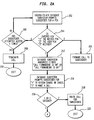
- FIGs 2A and 2B make up a flowchart depicting an exemplary ground-to-air forwarding set up procedure in accordance with the invention.
- a ground-to-air calling system constructed in accordance with the principles of the present invention.
- the ground-to-air system may be used to complete a call initiated from a ground based telephone 102 and directed to a passenger (or "subscriber") aboard an aircraft 104 .
- the system includes a ground-to-air database subsystem 106 .
- the database subsystem is used to store one or more ground-to-air forwarding parameters that are provided by the subscriber as part of a ground-to-air system set up procedure.
- the database subsystem receives ground based calls that are directed to the airborne subscriber and uses the forwarding parameters to forward those calls to the subscriber.
- a ground station 108 provides a two-way radio link between the calling party's telephone and the aircraft.
- the subscriber must execute a ground-to-air set up procedure in order to receive calls while airborne.
- the subscriber dials a special service number which connects the subscriber to the ground-to-air database subsystem.
- the subscriber may initiate the set up procedure from a ground based telephone before boarding the aircraft, in which case conventional telephone network switching equipment may be used to connect the subscriber to the database subsystem; or the subscriber may initiate the set up while on board the aircraft, either before or during flight, in which case the ground station connects the subscriber's call to the telephone network.
- the telephone network may recognize the special service number by its prefix.
- the special service number may be an American Telephone & Telegraph Co., Inc.
- AT&T True Connections® 500 number, which has a 500 prefix.
- a network switch 110 such as an AT&T 5ESS® switch, which recognizes the number by its 500 prefix, and accordingly routes the number to the ground-to-air database subsystem.
- the ground-to-air database subsystem is an AT&T Quantum Data Routing System (QDRS).
- QDRS Quantum Data Routing System
- the subsystem can perform both database and Voice Response Unit (VRU) functions.
- VRU Voice Response Unit
- Master PIN Master Personal Identification Number
- the subsystem may perform the VRU function of prompting the subscriber for a PIN.
- a prompt is not necessary, but it is desired in the preferred embodiment.
- the subscriber must enter the Master PIN.
- One way for the subscriber to enter the Master PIN is to simply recite it over the voice line, another way is through Dual Tone Multi Frequency (DTMF) signaling.
- DTMF Dual Tone Multi Frequency
- the subsystem must be capable of voice recognition.
- the subsystem checks it against the stored Master PIN for the subscriber's special service number, and grants the subscriber access if the PINs match. At this point the subscriber may activate ground-to-air forwarding by transmitting an activation signal to the subsystem, e.g., through one or more DTMF signals.
- ground-to-air forwarding is sufficient to enable ground calls to be forwarded to the subscriber, provided that the ground-to-air database has been previously supplied with an aircall number, at which the subscriber's aircraft can be reached.
- the aircall number, and one or more additional forwarding parameters may be entered into the database subsystem as part of the set up procedure. These additional parameters include: the subscriber's seat number, the start time and duration of ground-to-air forwarding, and a Ground-to-Air User Personal Identification Number (Ground-to-Air User PIN).
- the subscriber's seat number may be used by the system to forward calls directly to a phone associated with the subscriber's seat, if such a phone is available.
- the start time and duration of ground-to-air forwarding allows the subscriber to specify the period of forwarding activation - an alternative being that forwarding is active for a fixed predetermined period of time following a simple off/off indication from the subscriber.
- the Ground-to-Air User PIN (or "User PIN"), to be described in more detail below, can be used as a means of caller screening. When a User PIN is employed, only those ground callers with knowledge of the User PIN can have their calls forwarded to the subscriber. It should be noted that, like the aircall number, any of the foregoing additional parameters may be entered prior to the set up procedure.
- ground based callers may call the airborne subscriber.
- the caller dials the subscriber's special service number.
- the special service number is recognized by a switch 112 in the telephone network, e.g., an AT&T 5ESS® switch, which routes the call to the ground-to-air database subsystem 106 .
- the subsystem then prompts the caller for a PIN. As was the case with the Master PIN, the prompt is optional and the PIN may be entered via voice or DTMF signaling.
- the subsystem recognizes the entered PIN by comparing it to the stored Master PIN and stored User PIN for the subscriber's special service number. If the caller has entered the correct User PIN, the entered User PIN matches the stored User PIN (previously provided by the subscriber) and the subsystem proceeds to forward the call to the subscriber.
- the database subsystem uses the ground station to forward calls to the subscriber. Upon receiving a valid User PIN from the caller, the subsystem retrieves the called subscriber's forwarding parameters and passes them to the ground station. The subsystem also couples the call to the ground station. Both the passing of the parameters and the coupling of the call may be accomplished through the telephone network. As shown in Fig. 1, the parameters and the call may be passed to the Ground Station via switch 110 - the same switch through which the subscriber was coupled to the subsystem for the purpose of ground-to-air set up. However, it should be noted that the configuration of Fig. 1 is selected merely for simplicity of presentation, and that it is not necessary for the subscriber's set up call and the ground caller's call to pass through the same switch.
- the ground station may use the aircall number to establish a radio link with the aircraft. Once the link is established, the caller may carry on two- way communications with the subscriber over the link. If the seat number is present in the subsystem, it too may be passed to the ground station, and used to establish a radio link directly with a phone associated with the subscriber's seat.
- the ground-to-air database may acquire the caller's telephone number (the number of telephone 102 in Fig. 1) via Automatic Number Identification (ANI), and pass that number to the ground station along with the forwarding parameters.
- the ground station may, in turn, pass the caller's number to the aircraft so that it may be displayed at the subscriber's seat phone. In this manner, the subscriber may decide whether or not to answer the call on the basis of the displayed number.
- One possible way for the database subsystem to handle rejection of the call by the subscriber is for the subsystem to play an announcement to the caller indicating that the subscriber is not available and that the caller may leave a message. The message may be recorded and stored by the subsystem itself, or, as an alternative, the subsystem may couple the caller to a messaging system 114 .
- Figs 2A and 2B make up a flowchart depicting an exemplary ground-to-air set up procedure in accordance with the present invention.
- the flowchart begins at the point where the subscriber has dialed the special service number and has been connected to the ground-to-air database subsystem. Accordingly, the next step is for the ground-to-air database subsystem to query the subscriber for a PIN (step 202 ). Once the subscriber has made a PIN entry, the subsystem checks to see if the entry is: 1) the correct Master PIN, 2) the correct User PIN, or 3) neither (step 204 ). In general, a subscriber wishing to execute the set up procedure will not respond to the prompt of step 202 by entering the correct User PIN.
- step 204 is included in Fig. 2A to provide context for the remainder of the Fig. 2A description.
- the entry following step 202 will be the correct User PIN; in which case the subsystem proceeds to forward the call to the subscriber (step 205 ). Additional details concerning the routing of ground calls to the subscriber are not shown in Figures 2A and 2B.
- the subsystem may give the subscriber another chance to enter a PIN.
- the number of permissible access attempts may be limited, for example, to 3, in which case the subsystem checks the number of access attempts following each failed attempt (step 206 ). If the number of attempts is less than 3 the subscriber is allowed another attempt, otherwise the call is terminated (step 208 ) and the set up procedure is exited (step 210 ).
- the subscriber is granted access to the database subsystem. Immediately following a granted access, the subsystem checks the stored records of the accessing subscriber and determines whether the subscriber's call forwarding is active. It then plays an appropriate message to the subscriber, either "Call Forwarding is ON", or "Call Forwarding is OFF” (step 212 ). After the initial announcement, the subsystem prompts the subscriber for the action the subscriber wishes to take (step 214 ). An exemplary prompt appears below:
- the second option in the above described DTMF prompt, "Enter 2 to make a call”, refers to an optional feature of the present invention. This feature allows subscribers aboard the aircraft to place calls directly to the ground based telephones. To illustrate how an airborne subscriber may place a call to a ground based telephone, references are made to Fig. 1.
- a subscriber aboard aircraft 104 may initiate the set up procedure, the subscriber may initiate a call to ground based telephone 102 .
- the subscriber dials the special service number and is linked to database subsystem 106 via the ground station 108 and network switch 110 .
- steps 202 - 214 are executed as described above.
- the subscriber responds to the prompt of step 214 with a '2'.
- the subsystem checks the response to step 214 (step 216 ), it recognizes that a '2' has been entered and then proceeds to route the subscriber's call to the ground telephone (step 218 ).
- the call may be routed through network switch 112 such that the path through which the subscriber's call is routed includes the ground station, switch 110 , the subsystem, and switch 112 .
- the subsystem sets up a route between the ground station and the ground telephone, and then drops from the call. In any event, once the subsystem has routed a call for the subscriber the set up procedure is exited (step 220 ).
- the database subsystem responds by playing one or more possible status messages to the subscriber (step 222 ). Two possible status messages that the subsystem may use are:
- the subsystem prompts the subscriber for the next action (step 224 ).
- the following prompt may be used:
- the subsystem Upon receipt of a response to the detailed set up prompt, the subsystem takes appropriate action (step 234 ). If ground-to-air call forwarding is active and a '1' is received the subsystem simply deactivates the forwarding. If ground-to-air call forwarding is inactive and a '6' is received the subsystem activates the forwarding. If a response of '2', '3' or '5' is received, the subsystem must await receipt of a new parameter; namely, a new aircall number, a new duration of forwarding, or a new User PIN, respectively. In each case, the new parameter may be transmitted by the subscriber via DTMF signaling. A response of '4' indicates that the subscriber wants to receive only selected calls.
- ANI One way for the subscriber to select calls is through ANI.
- the subscriber notifies the subsystem, e.g., through DTMF signaling, of the telephone numbers from which the subscriber will receive calls.
- the subsystem stores these selected numbers, and thereafter, when a ground caller dials the special service number, the subsystem checks the number of the calling telephone (acquired through ANI) against the stored selected numbers. Only if the number of the calling telephone matches one of the stored numbers does the subsystem forward the call to the aircraft.
- the subsystem After the subsystem has serviced the subscriber's response to the detailed set up prompt it plays an exiting announcement to the subscriber (step 228 ) and exits the setup procedure (step 230 ).
- a call to the subscriber is initiated by a person via a conventional telephone.
- the invention is applicable to all types of calls initiated to the subscriber.
- a "call" to the subscriber may take the form of a fax transmission, a computer transmission, a video call, or a multimedia call.
- a "call" to the subscriber may take the form of a fax transmission, a computer transmission, a video call, or a multimedia call.
Landscapes
- Engineering & Computer Science (AREA)
- Physics & Mathematics (AREA)
- Astronomy & Astrophysics (AREA)
- Aviation & Aerospace Engineering (AREA)
- General Physics & Mathematics (AREA)
- Computer Networks & Wireless Communication (AREA)
- Signal Processing (AREA)
- Telephonic Communication Services (AREA)
- Mobile Radio Communication Systems (AREA)
Applications Claiming Priority (2)
| Application Number | Priority Date | Filing Date | Title |
|---|---|---|---|
| US633640 | 1996-04-17 | ||
| US08/633,640 US5805683A (en) | 1996-04-17 | 1996-04-17 | System and method for routing ground-to-air telephone calls |
Publications (2)
| Publication Number | Publication Date |
|---|---|
| EP0802639A2 true EP0802639A2 (fr) | 1997-10-22 |
| EP0802639A3 EP0802639A3 (fr) | 2000-04-19 |
Family
ID=24540488
Family Applications (1)
| Application Number | Title | Priority Date | Filing Date |
|---|---|---|---|
| EP97106270A Withdrawn EP0802639A3 (fr) | 1996-04-17 | 1997-04-16 | Système et méthode de routage d'appels téléphoniques sol-air |
Country Status (4)
| Country | Link |
|---|---|
| US (1) | US5805683A (fr) |
| EP (1) | EP0802639A3 (fr) |
| JP (1) | JPH1098761A (fr) |
| CA (1) | CA2201559C (fr) |
Cited By (3)
| Publication number | Priority date | Publication date | Assignee | Title |
|---|---|---|---|---|
| WO1999012227A3 (fr) * | 1997-09-03 | 1999-05-27 | Nokia Telecommunications Oy | Acheminement d'appels dans un systeme radio |
| WO2002080516A1 (fr) * | 2001-03-29 | 2002-10-10 | Stelcom Co., Ltd. | Systeme et procede servant a fournir des services telephoniques a des voyageurs outre-mer |
| EP1395066A3 (fr) * | 2002-08-28 | 2007-12-26 | TeliaSonera Finland Oyj | Système et procédés de renvoi de contacts et d'établissement d'un renvoi |
Families Citing this family (34)
| Publication number | Priority date | Publication date | Assignee | Title |
|---|---|---|---|---|
| US8081968B2 (en) | 2000-10-11 | 2011-12-20 | Gogo Llc | System for creating an air-to-ground IP tunnel in an airborne wireless cellular network to differentiate individual passengers |
| US6885864B2 (en) * | 1992-03-06 | 2005-04-26 | Aircell, Inc. | Virtual private network for cellular communications |
| US8914022B2 (en) * | 1992-03-06 | 2014-12-16 | Gogo Llc | System for providing high speed communications service in an airborne wireless cellular network |
| US7113780B2 (en) * | 1992-03-06 | 2006-09-26 | Aircell, Inc. | System for integrating an airborne wireless cellular network with terrestrial wireless cellular networks and the public switched telephone network |
| US6650898B2 (en) * | 1992-03-06 | 2003-11-18 | Aircell, Inc. | Signal translating repeater for enabling a terrestrial mobile subscriber station to be operable in a non-terrestrial environment |
| US8145208B2 (en) | 2006-10-31 | 2012-03-27 | Gogo Llc | Air-to-ground cellular communication network terrestrial base station having multi-dimensional sectors with alternating radio frequency polarizations |
| US8060083B2 (en) | 2000-10-11 | 2011-11-15 | Gogo Llc | System for managing an aircraft-oriented emergency services call in an airborne wireless cellular network |
| DE69631382T2 (de) * | 1996-11-11 | 2004-12-02 | Nokia Corp. | Aeronautisches zellulares netzwerk |
| US6799037B1 (en) * | 1996-12-12 | 2004-09-28 | Verizon Airfone Inc. | Method and apparatus for communication with a mobile unit |
| US6006084A (en) * | 1997-05-27 | 1999-12-21 | Motorola, Inc. | Method and apparatus for providing billing services for a mobile group of communication system users |
| WO1999031822A1 (fr) * | 1997-12-12 | 1999-06-24 | At & T Wireless Services, Inc. | Procede et systeme de messagerie courte, pour passagers d'aeronefs |
| US6201797B1 (en) | 1997-12-12 | 2001-03-13 | At&T Wireless Services Inc. | High bandwidth delivery and internet access for airborne passengers |
| US20050124337A9 (en) * | 1998-09-08 | 2005-06-09 | Tenzing Communications, Inc. | System and method for airborne passenger electronic communication |
| US6760778B1 (en) * | 1998-09-09 | 2004-07-06 | At&T Wireless Services, Inc. | System and method for communication between airborne and ground-based entities |
| US6970704B2 (en) * | 1999-01-20 | 2005-11-29 | Satcom Direct, Inc. | System for direct communications with a space craft |
| US6400945B1 (en) | 1999-01-20 | 2002-06-04 | Satcom Direct, Inc. | System for direct communications with a space craft |
| US7177939B2 (en) * | 1999-05-14 | 2007-02-13 | Cingular Wireless Ii, Llc | Aircraft data communications services for users |
| US8457627B2 (en) | 1999-08-24 | 2013-06-04 | Gogo Llc | Traffic scheduling system for wireless communications |
| US8185040B2 (en) * | 1999-08-24 | 2012-05-22 | Gogo Llc | System for managing voice over internet protocol communications in a network |
| US8452276B2 (en) | 2000-10-11 | 2013-05-28 | Gogo Llc | Differentiated services code point mirroring for wireless communications |
| US8081969B2 (en) * | 2000-10-11 | 2011-12-20 | Gogo Llc | System for creating an aircraft-based internet protocol subnet in an airborne wireless cellular network |
| US7702328B2 (en) * | 2000-10-11 | 2010-04-20 | Aircell, Llc | System for handoff of aircraft-based content delivery to enable passengers to receive the remainder of a selected content from a terrestrial location |
| US8068829B2 (en) | 2000-10-11 | 2011-11-29 | Gogo Llc | System for customizing electronic services for delivery to a passenger in an airborne wireless cellular network |
| US8995993B2 (en) | 2000-10-11 | 2015-03-31 | Gogo Llc | System for managing mobile internet protocol addresses in an airborne wireless cellular network |
| US8078163B2 (en) * | 2000-10-11 | 2011-12-13 | Gogo Llc | System for customizing electronic content for delivery to a passenger in an airborne wireless cellular network |
| US20030144014A1 (en) * | 2002-01-31 | 2003-07-31 | International Business Machines Corporation | Method and apparatus for an on-board call |
| US20030233244A1 (en) * | 2002-06-13 | 2003-12-18 | International Business Machines Corporation | System and method for network tracking of passenger travel progress |
| US20040102188A1 (en) * | 2002-11-26 | 2004-05-27 | Boyer David G. | Automatic call forwarding on airplanes |
| US8442519B2 (en) | 2003-12-07 | 2013-05-14 | Gogo Llc | Spectrum sharing between an aircraft-based air-to-ground communication system and existing geostationary satellite services |
| US7328011B2 (en) * | 2004-03-31 | 2008-02-05 | The Boeing Company | Management of mobile networks |
| JP4574282B2 (ja) * | 2004-08-20 | 2010-11-04 | キヤノン株式会社 | 画像供給デバイス及び該デバイスの制御方法及び印刷システムと印刷制御方法 |
| KR100897036B1 (ko) * | 2006-08-30 | 2009-05-20 | 한국표준과학연구원 | 공해상에서의 이동전화 착신 서비스 방법 및 그를 이용한 이동전화 착신 서비스 시스템 |
| US20080144638A1 (en) * | 2006-09-29 | 2008-06-19 | Fm Bay | Vocabulary recognition of analog transmissions in a wireless digital network |
| US10362609B2 (en) * | 2016-08-10 | 2019-07-23 | Panasonic Avionics Corporation | Methods and systems for automatically pairing a personal electronic device on a transportation vehicle |
Citations (1)
| Publication number | Priority date | Publication date | Assignee | Title |
|---|---|---|---|---|
| US4399330A (en) * | 1980-09-10 | 1983-08-16 | Siemens Aktiengesellschaft | Communications system, in particular a telephone system, for connecting mobile subscriber terminal devices |
Family Cites Families (3)
| Publication number | Priority date | Publication date | Assignee | Title |
|---|---|---|---|---|
| US5408515A (en) * | 1988-04-29 | 1995-04-18 | Mobile Telecommunication Technologies | Ground-to-air telephone calling system and related method for directing a call to a particular passenger |
| US5592539A (en) * | 1993-12-30 | 1997-01-07 | At&T | System for completing air-to-ground telephone calls |
| US5519761A (en) * | 1994-07-08 | 1996-05-21 | Qualcomm Incorporated | Airborne radiotelephone communications system |
-
1996
- 1996-04-17 US US08/633,640 patent/US5805683A/en not_active Expired - Lifetime
-
1997
- 1997-04-02 CA CA002201559A patent/CA2201559C/fr not_active Expired - Fee Related
- 1997-04-16 EP EP97106270A patent/EP0802639A3/fr not_active Withdrawn
- 1997-04-17 JP JP9100204A patent/JPH1098761A/ja active Pending
Patent Citations (1)
| Publication number | Priority date | Publication date | Assignee | Title |
|---|---|---|---|---|
| US4399330A (en) * | 1980-09-10 | 1983-08-16 | Siemens Aktiengesellschaft | Communications system, in particular a telephone system, for connecting mobile subscriber terminal devices |
Cited By (4)
| Publication number | Priority date | Publication date | Assignee | Title |
|---|---|---|---|---|
| WO1999012227A3 (fr) * | 1997-09-03 | 1999-05-27 | Nokia Telecommunications Oy | Acheminement d'appels dans un systeme radio |
| US6603967B1 (en) | 1997-09-03 | 2003-08-05 | Nokia Corporation | Call routing in a radio system |
| WO2002080516A1 (fr) * | 2001-03-29 | 2002-10-10 | Stelcom Co., Ltd. | Systeme et procede servant a fournir des services telephoniques a des voyageurs outre-mer |
| EP1395066A3 (fr) * | 2002-08-28 | 2007-12-26 | TeliaSonera Finland Oyj | Système et procédés de renvoi de contacts et d'établissement d'un renvoi |
Also Published As
| Publication number | Publication date |
|---|---|
| EP0802639A3 (fr) | 2000-04-19 |
| MX9702698A (es) | 1998-03-31 |
| JPH1098761A (ja) | 1998-04-14 |
| US5805683A (en) | 1998-09-08 |
| CA2201559A1 (fr) | 1997-10-17 |
| CA2201559C (fr) | 2000-06-13 |
Similar Documents
| Publication | Publication Date | Title |
|---|---|---|
| US5805683A (en) | System and method for routing ground-to-air telephone calls | |
| CA2181401C (fr) | Methode et dispositif de filtrage d'appels utilise pour etablir les communications telephoniques | |
| US5392343A (en) | On demand language interpretation in a telecommunications system | |
| US5644626A (en) | Apparatus and method for connecting telephone calls using automated paging and call bridging | |
| US5283824A (en) | Calling line identification | |
| EP0439927B1 (fr) | Systèmes téléphoniques assurant le secret d'une façor améliorée | |
| US6396920B1 (en) | System for selectively providing a higher level of directory assistance services | |
| US5631904A (en) | Method for automatically establishing a conference call | |
| US5428608A (en) | Call connection technique | |
| US5706329A (en) | Personal mobile communication system having meet-me bridge reconnect feature | |
| US5712902A (en) | Telecommunications answering feature method and apparatus | |
| US5926754A (en) | Directory assistance call processing systems and related methods | |
| EP0346434B1 (fr) | Installations et methode d'acces automatique utilisees avec des systemes telephoniques a touches | |
| US4922526A (en) | Automated access facilities for use with key telephone systems | |
| EP0539102A2 (fr) | Utilisation de l'identification d'une ligne d'appel | |
| US7110520B1 (en) | Method and system for directory assistance services | |
| EP0782363A2 (fr) | Méthode et système de communication utilisant un appel bidirectionnel pour la commande d'appel | |
| US5592539A (en) | System for completing air-to-ground telephone calls | |
| GB2290920A (en) | A voice messaging system | |
| EP0588510A1 (fr) | Schéma pour dériver d'appel avec vérification de présence d'abonné appelé | |
| CA1291550C (fr) | Traitement des appels a l'assistance-annuaire et procedes permettant l'etablissement de la communication sans intervention de la telephoniste | |
| JPH05316219A (ja) | 電話交換網における優先着信方式 | |
| MXPA97002698A (en) | System and method to address earth-to-a telephone calls | |
| AU1697299A (en) | A method and system for automatic answering and recording of messages in a telephone system | |
| CA2178402C (fr) | Methode et systeme d'assistance-annuaire |
Legal Events
| Date | Code | Title | Description |
|---|---|---|---|
| PUAI | Public reference made under article 153(3) epc to a published international application that has entered the european phase |
Free format text: ORIGINAL CODE: 0009012 |
|
| AK | Designated contracting states |
Kind code of ref document: A2 Designated state(s): DE FR GB IT |
|
| PUAL | Search report despatched |
Free format text: ORIGINAL CODE: 0009013 |
|
| AK | Designated contracting states |
Kind code of ref document: A3 Designated state(s): DE FR GB IT |
|
| 17P | Request for examination filed |
Effective date: 20001004 |
|
| 17Q | First examination report despatched |
Effective date: 20011206 |
|
| STAA | Information on the status of an ep patent application or granted ep patent |
Free format text: STATUS: THE APPLICATION IS DEEMED TO BE WITHDRAWN |
|
| 18D | Application deemed to be withdrawn |
Effective date: 20020417 |