EP0802679A2 - Procédé de segmentation d'images - Google Patents
Procédé de segmentation d'images Download PDFInfo
- Publication number
- EP0802679A2 EP0802679A2 EP97201011A EP97201011A EP0802679A2 EP 0802679 A2 EP0802679 A2 EP 0802679A2 EP 97201011 A EP97201011 A EP 97201011A EP 97201011 A EP97201011 A EP 97201011A EP 0802679 A2 EP0802679 A2 EP 0802679A2
- Authority
- EP
- European Patent Office
- Prior art keywords
- image
- regions
- region
- pixels
- new
- Prior art date
- Legal status (The legal status is an assumption and is not a legal conclusion. Google has not performed a legal analysis and makes no representation as to the accuracy of the status listed.)
- Withdrawn
Links
Images
Classifications
-
- H—ELECTRICITY
- H04—ELECTRIC COMMUNICATION TECHNIQUE
- H04N—PICTORIAL COMMUNICATION, e.g. TELEVISION
- H04N19/00—Methods or arrangements for coding, decoding, compressing or decompressing digital video signals
- H04N19/50—Methods or arrangements for coding, decoding, compressing or decompressing digital video signals using predictive coding
- H04N19/503—Methods or arrangements for coding, decoding, compressing or decompressing digital video signals using predictive coding involving temporal prediction
- H04N19/51—Motion estimation or motion compensation
- H04N19/537—Motion estimation other than block-based
- H04N19/543—Motion estimation other than block-based using regions
-
- H—ELECTRICITY
- H04—ELECTRIC COMMUNICATION TECHNIQUE
- H04N—PICTORIAL COMMUNICATION, e.g. TELEVISION
- H04N19/00—Methods or arrangements for coding, decoding, compressing or decompressing digital video signals
- H04N19/20—Methods or arrangements for coding, decoding, compressing or decompressing digital video signals using video object coding
Definitions
- the invention relates to a method for segmenting temporally successive images of an image signal, the image being divided into regions within an image when it is segmented, with neighboring pixels belonging to a region which have similar brightness and / or color values.
- This object is achieved in that an attempt is made in temporally successive images to find regions of an image I n in an image I n + 1 following this in that a motion estimation of the regions of the image I n is carried out using the for each Region by means of motion vectors ascertained, the new position of the region in the image I n + 1 is determined, that the shifted regions are subsequently adapted to the image content of the image I n + 1 and that image points of the image not detected by these regions are subsequently determined I n + 1 of one of these regions or newly formed regions can be added.
- This method can in principle be used for all regions of an image I n. In practice, a large part of the regions of an image I n n in the image I + 1 are retrieved.
- new image content can arise through exposure or camera panning. This new image content becomes one of the regions that may have been adopted from the model. If necessary, new regions can also be formed for these pixels which have not been recorded.
- an image of an image sequence can thus have regions that have been taken over from the original, possibly shifted, regions. However, it can also have newly formed or expanded, old regions. For each region that can be adopted from the model, possibly in a shifted position, the computing effort is reduced. In addition, such regions are easier to code by prediction.
- two regions of an image I n can be mapped onto a common area or partial area of an image I n + 1 on the basis of different movements present.
- the two regions in the image I n + 1 then virtually overlap. Since this is not permissible, it must be decided for each of the pixels that lie in the overlapping region of both regions which of the moving regions it best matches in the image I n + 1 due to its brightness and / or color values. In the overlapping area, a decision is made as to which of the regions each pixel best fits.
- the determined motion vectors for the images In and I n + 1 are compared with additionally determined motion vectors for the images I n-1 and I n and that If, for both motion estimates, significantly different motion vectors have been determined for a region, the motion vectors for this region are regarded as invalid and the pixels of this region are added to one of the other shifted regions or newly formed regions.
- the motion estimation between the images I n and I n + 1 described above can also be advantageously carried out for the images I n-1 and I n . It can be used to estimate how consistent a movement is. If there are significantly different motion vectors for both motion estimates, this is an indication that a motion estimate may have provided incorrect values. This can happen, for example, on the basis of similar image content. Therefore, if both motion estimates have different motion vectors, the regions in the image I n + 1 are newly formed, ie the regions of the image I n + 1 for which a motion has been determined on the basis of the motion estimation are given up.
- post-processing is carried out for the pixels, preferably the shifted regions, in such a way that a similarity to the relevant pixel is checked for each neighboring pixel that is arranged on the left, right, above or below the relevant pixel. If a greater similarity to a pixel of another region is found, the pixel of this region is added. There is thus an adjustment of the regional borders.
- regions that have similar brightness and / or color values are merged for regions newly formed in the image I n + 1 .
- regions newly formed in the image I n + 1 regions with similar brightness and / or color values are merged. However, this only applies to regions newly formed in the image, not to regions that have been taken over or possibly shifted.
- regions that fall below a predetermined minimum size are resolved and that their pixels are added to other regions that match as well as possible.
- Regions that fall below a predetermined minimum size do not offer any significant advantages in terms of coding. They are therefore advantageously dissolved.
- the pixels of the resolved region are assigned to other regions that match as well as possible.
- the minimum size that regions must have so that they are not resolved is larger for regions newly formed in the image I n + 1 than for shifted regions taken over from the image I n .
- regions taken from the image I n these regions already have a consistency, so that they should only be resolved if they are very small.
- the minimum size is set larger, since these regions have to be recoded, ie cannot be coded predictively.
- each region in the image I n + 1 which has arisen by shifting from a region of the image I n , is compared with its neighbors of the image I n and that Regions with the same or similar regions of the image I n can be combined.
- an edge detection is carried out on the basis of the pixel values which do not belong to a region shifted relative to the image I n and that pixels which form an edge are after the formation of the new regions, they are added to the new region to which they best match due to their brightness and / or color values.
- an edge detection can additionally be carried out. Edge detection locally provides very good results for the separation of different image areas. After the formation of the new regions, the edge detection can, if necessary, be used to strike those pixels belonging to an edge to one of the neighboring regions. The region selected is the one that best matches the pixels of the edge due to its brightness and / or color values.
- a scene change detection is carried out in such a way that when strong deviating image content of the image I n + 1 from the image I n no motion estimation is made and only new regions are formed.
- the scene, a camera change or the like can be switched between images I n and I n + 1 of an image sequence, for example. Then, the image contents of these two images are so different that in the image I n discovered regions in the image I n + 1 in any case can not be recovered.
- a scene change detection can therefore advantageously be provided, which detects strongly differing image contents of two successive images. If a greatly differing image content of the images is determined by means of this scene change detection, no motion estimation is carried out and only new regions are formed in the image I n + 1 .
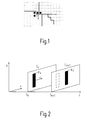
- a template is shown schematically. which form a new region in an image in which no regions have yet been formed, or in image regions in which no shifted region has been found.
- the extent to which a pixel y is shown schematically in FIG. 1 is checked has similar pixel values to the neighboring pixels shown as black dots in FIG. 1.
- the dividing lines shown in FIG. 1 indicate the segmentation that should result from the present brightness and / or color values.
- the dashed lines indicate the pixel grid. In the example shown in FIG. 1, the point y would thus be added to the lower left region.
- a neighboring region may be found to which this pixel value best matches in terms of its brightness and / or color values, i.e. to which it is most similar. In this way, all pixels of an image are captured line by line, so that regions are formed within an image to which neighboring pixels with similar brightness and / or color values belong.
- FIG. 2 shows two successive images of an image sequence.
- An image In was transmitted at a time t n .
- a region R 1 shown dark in the figure was found in the image In. It may have been naturally found in the image I n other regions: the sake of clarity, however, only the region R1 is considered here.
- the image I n + 1 was transmitted at a time t n + 1 . There is movement of at least parts of the image content between these two images of an image sequence. Therefore, the region R 1 of the image I n in the image I n + 1 will not appear at the expected, same position. Instead, the region appears as region R 1 due to the movement of the image content. in a shifted position.
- this new position is found in the image I n + 1 .
- a motion vector v is determined, which determines the relative displacement of the position R 1 in the image I n + 1 to the region R 1 in the image I n .
- the new position of the region R 1 in the image I n + 1 is known.
- the values for this region can thus be adopted. This applies to the brightness and / or color values as well as the size, shape and extent of the regions.
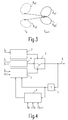
- FIG. 3 schematically shows a special case in which regions R n1 and R n2 of an image I n are subjected to different movements. According to the schematic illustration in FIG. 3 in the following image I n + 1, this leads to the regions partially overlapping. The regions R n1 and R n2 now shifted in the image I n + 1 have common pixels. This is indicated in FIG. 3 by the representation of a black dot.
- FIG. 4 shows a block diagram of a circuit arrangement in schematic form, by means of which the method according to the invention for segmenting images into image sequences can be carried out.
- FIG. 4 shows a circuit block 1 for motion estimation.
- the data of three successive images I n-1 , I n and I n + 1 are fed to this circuit block.
- Fig. 4 also shows a circuit block 2 for segmentation.
- the data of the image I n are fed to this circuit block.
- the output signal of the circuit block 2 reaches a changeover switch 3.
- a circuit block 4 is also provided for scene change detection.
- the circuit block is supplied with the data of the images I n and I n-1 , in which the circuit of the block 4 carries out a scene change detection in such a way that, for these two successive images, a strongly differing image content is determined.
- the changeover switch 3 is controlled by means of the output signal of the circuit block 4 for scene change detection.
- circuit block 5 is also provided for the temporal segment continuation.
- the data of images I n and I n-1 are fed to circuit block 5 on the input side.
- the output signal reaches switch 3.
- the switch controlled by means of the output signal of the circuit block 4 for scene change detection can switch to the output signal of the circuit block 2 for segmentation or of the circuit block 5 for timing Segment continuation can be switched.
- one of the two output signals of block 2 or block 5 reaches an output 6 of the circuit arrangement.
- This output signal of the switch 3 also reaches a delay stage 7, the output signal of which is supplied both to the circuit block 5 for the temporal segment continuation and to the circuit block 1 for motion estimation.
- the output signal of the circuit block 1 also reaches the circuit block 5 for the temporal segment continuation.
- the circuit block 4 for scene change detection indicates whether there is fundamentally similar image content for successive images or not. If similar image content is available, the motion estimation can be used to follow up, if necessary, also moving regions between successive images. However, if the image content of successive images I n and I n-1 deviates greatly from one another, there is a high probability that the scene will change. It must then the image I n completely re-segmented, ie, new regions are formed.
- switch 3 may be switched to the output signal of circuit block 2 for segmentation. This output signal goes to the output 6, so that the segmentation, ie the regions, are present for the image I n at the output 6.
- the region division present in the signal of the output 6 reaches the circuit block 1 after the delay by means of the delay stage 7 for motion estimation.
- This circuit block 1 is used to determine the movement of the regions found in the image In relative to the image I n + 1 . In this way, the new position of those regions is found in the image I n + 1 that are only shifted compared to the image I n .
- a comparison of the determined motion with the motion of the same regions between the images I n-1 and I n can be carried out. The motion estimate is only considered valid if there is a consistent movement between these three images.
- Both the output signal of the circuit block 1 for motion estimation and the region data for the image In delayed by means of the delay stage 7 arrive at the circuit block 5 for temporal segment continuation.
- regions located in unchanged position in the image I n + 1 and the regions found by means of the circuit block 1 can be continued with a shifted position. This means that these regions are taken over by circuit block 5 for the image I n + 1 .
- those image areas which are not covered by the shifted regions or those image areas can be switched by means of the circuit block 5. that belonged to a region in the image In, which was not found in the image I n + 1 , and which has therefore been lost, are added to new regions. New regions can be created for this, or the pixels can be added to existing regions.
- the consistency can be checked in circuit block 5 for all regions, but especially for newly formed regions. This means that it can be checked whether neighboring regions may be combined, whether certain pixels can be added to one of the known regions, whether regions that are too small are resolved, etc.
- the data of the regions taken over and possibly also the data of the newly formed regions reach the output 6 of the circuit arrangement as an output signal via the switch 3 for the image I n + 1 .
Landscapes
- Engineering & Computer Science (AREA)
- Multimedia (AREA)
- Signal Processing (AREA)
- Compression Or Coding Systems Of Tv Signals (AREA)
- Color Television Systems (AREA)
- Television Signal Processing For Recording (AREA)
- Image Analysis (AREA)
Applications Claiming Priority (2)
| Application Number | Priority Date | Filing Date | Title |
|---|---|---|---|
| DE19615492A DE19615492A1 (de) | 1996-04-19 | 1996-04-19 | Verfahren zur Bildsegmentierung |
| DE19615492 | 1996-04-19 |
Publications (2)
| Publication Number | Publication Date |
|---|---|
| EP0802679A2 true EP0802679A2 (fr) | 1997-10-22 |
| EP0802679A3 EP0802679A3 (fr) | 2001-06-27 |
Family
ID=7791745
Family Applications (1)
| Application Number | Title | Priority Date | Filing Date |
|---|---|---|---|
| EP97201011A Withdrawn EP0802679A3 (fr) | 1996-04-19 | 1997-04-07 | Procédé de segmentation d'images |
Country Status (4)
| Country | Link |
|---|---|
| US (1) | US6044114A (fr) |
| EP (1) | EP0802679A3 (fr) |
| JP (1) | JP4094699B2 (fr) |
| DE (1) | DE19615492A1 (fr) |
Cited By (1)
| Publication number | Priority date | Publication date | Assignee | Title |
|---|---|---|---|---|
| WO2021239224A1 (fr) * | 2020-05-27 | 2021-12-02 | Telefonaktiebolaget Lm Ericsson (Publ) | Agencement de module logiciel informatique, agencement de circuits, agencement et procédé de traitement d'image amélioré |
Families Citing this family (4)
| Publication number | Priority date | Publication date | Assignee | Title |
|---|---|---|---|---|
| US7057664B2 (en) * | 2002-10-18 | 2006-06-06 | Broadcom Corporation | Method and system for converting interlaced formatted video to progressive scan video using a color edge detection scheme |
| WO2005094083A1 (fr) * | 2004-03-29 | 2005-10-06 | Koninklijke Philips Electronics N.V. | Codeur video et procede de codage video |
| ATE556390T1 (de) * | 2007-06-29 | 2012-05-15 | Thomson Licensing | Volumenmarkierung mit niederfrequenz |
| US20220051399A1 (en) * | 2018-09-14 | 2022-02-17 | Health Partners Pte Ltd | Method and system for determining well-being indicators |
Family Cites Families (3)
| Publication number | Priority date | Publication date | Assignee | Title |
|---|---|---|---|---|
| US5594504A (en) * | 1994-07-06 | 1997-01-14 | Lucent Technologies Inc. | Predictive video coding using a motion vector updating routine |
| US5608458A (en) * | 1994-10-13 | 1997-03-04 | Lucent Technologies Inc. | Method and apparatus for a region-based approach to coding a sequence of video images |
| EP0731614B1 (fr) * | 1995-03-10 | 2002-02-06 | Kabushiki Kaisha Toshiba | Codeur et décodeur vidéo |
-
1996
- 1996-04-19 DE DE19615492A patent/DE19615492A1/de not_active Withdrawn
-
1997
- 1997-04-07 EP EP97201011A patent/EP0802679A3/fr not_active Withdrawn
- 1997-04-07 US US08/838,488 patent/US6044114A/en not_active Expired - Lifetime
- 1997-04-21 JP JP10327197A patent/JP4094699B2/ja not_active Expired - Fee Related
Non-Patent Citations (2)
| Title |
|---|
| BENOIS J ET AL.: "Joint contour-based and motion-based image sequences segmentation for TV image coding at low bit-rate", PROCEEDING OF THE SPIE - VISUAL COMMUNICATIONS AND IMAGE PROCESSING '94, vol. 2308, 25 September 1994 (1994-09-25) - 28 September 1994 (1994-09-28), Chicago, IL, USA, pages 1074 - 1085, XP007911149, ISSN: 0277-786X * |
| BENOIS J ET AL: "Image segmentation by region-contour cooperation for image coding", PATTERN RECOGNITION, 1992. VOL.III. CONFERENCE C: IMAGE, SPEECH AND SI GNAL ANALYSIS, PROCEEDINGS., 11TH IAPR INTERNATIONAL CONFERENCE ON THE HAGUE, NETHERLANDS 30 AUG.-3 SEPT. 1992, LOS ALAMITOS, CA, USA,IEEE COMPUT. SOC, US, 30 August 1992 (1992-08-30), pages 331 - 334, XP010030131, ISBN: 978-0-8186-2920-4 * |
Cited By (2)
| Publication number | Priority date | Publication date | Assignee | Title |
|---|---|---|---|---|
| WO2021239224A1 (fr) * | 2020-05-27 | 2021-12-02 | Telefonaktiebolaget Lm Ericsson (Publ) | Agencement de module logiciel informatique, agencement de circuits, agencement et procédé de traitement d'image amélioré |
| US12536666B2 (en) | 2020-05-27 | 2026-01-27 | Telefonaktiebolaget Lm Ericsson (Publ) | Computer software module arrangement, a circuitry arrangement, an arrangement and a method for improved image processing |
Also Published As
| Publication number | Publication date |
|---|---|
| JP4094699B2 (ja) | 2008-06-04 |
| US6044114A (en) | 2000-03-28 |
| EP0802679A3 (fr) | 2001-06-27 |
| DE19615492A1 (de) | 1997-10-23 |
| JPH1056614A (ja) | 1998-02-24 |
Similar Documents
| Publication | Publication Date | Title |
|---|---|---|
| DE69032437T2 (de) | Bewegungseinschätzer | |
| DE69126585T2 (de) | Verfahren und Gerät zur Kodierung von bewegten Bildsignalen | |
| DE69225941T2 (de) | Bildkodierung und/oder -dekodierung | |
| DE69618759T2 (de) | Verfahren und system zur kodierung einer sequenz von segmentierten bildern , kodiertes signal und speichermedium, verfahren und system zur dekodierung des kodierten signals | |
| DE69413148T2 (de) | Verfahren zur Bestimmung von Bewegungsvektoren in kleinen Bildsegmenten in Fernsehbildern | |
| DE3587448T2 (de) | Vorrichtung für eine wirksame Kodierung von Fernsehsignalen. | |
| DE69031055T2 (de) | Bewegungsabhängige Videosignalverarbeitung | |
| DE69028160T2 (de) | Verfahren zur Teilung des Bewegungsfeldes eines Bildes zum Kodieren eines Videobildes | |
| DE69737141T2 (de) | Bildsegmentierung | |
| DE19739266B4 (de) | Verfahren und Vorrichtung zum Kodieren binärer Formen | |
| EP0368151A2 (fr) | Procédé pour la détermination de positions de recherche en vue de l'estimation d'un mouvement | |
| DE69021431T2 (de) | Bewegungsabhängige Videosignalverarbeitung. | |
| DE69320461T2 (de) | Bewegungskompensierte Videobildverarbeitung | |
| EP0802680B1 (fr) | Procédé de segmentation d'images | |
| DE69028792T2 (de) | Bewegungsabhängige Videosignalverarbeitung | |
| DE69231187T2 (de) | Verfahren zur schaetzung und hierarchischen kodierung von bewegung in bildfolgen | |
| DE69024002T2 (de) | Vorrichtung zum Codieren von zweidimensionalen Informationen und entsprechende Decodiervorrichtung. | |
| DE69521873T2 (de) | Verfahren zum Auswählen von Bewegungsvektoren und Bildverarbeitungsvorrichtung zur Durchführung des Verfahrens | |
| DE69232215T2 (de) | Einrichtung zur Bildkodierung | |
| DE69711215T2 (de) | Verfahren zur verarbeitung eines videostroms | |
| DE69331542T2 (de) | Ein maschinelles verfahren zur kompensation von nichtlinearen bildwandlungen, z.b. zoom und pan, in einem videobildbewegungskompensierten system | |
| DE69609931T2 (de) | Verfahren zur Datenverarbeitung in matrixförmigen Netzwerken in einem Bewegungsschätzungssystem | |
| EP0897247A2 (fr) | Procédé de calcul de vecteurs de mouvement | |
| DE19615492A1 (de) | Verfahren zur Bildsegmentierung | |
| DE19548451C1 (de) | Verfahren zur rechnergestützten Bewegungsschätzung für Bildpunkte zeitlich aufeinander folgender Bilder einer Videosequenz |
Legal Events
| Date | Code | Title | Description |
|---|---|---|---|
| PUAI | Public reference made under article 153(3) epc to a published international application that has entered the european phase |
Free format text: ORIGINAL CODE: 0009012 |
|
| AK | Designated contracting states |
Kind code of ref document: A2 Designated state(s): DE FR GB |
|
| RAP3 | Party data changed (applicant data changed or rights of an application transferred) |
Owner name: KONINKLIJKE PHILIPS ELECTRONICS N.V. Owner name: PHILIPS CORPORATE INTELLECTUAL PROPERTY GMBH |
|
| PUAL | Search report despatched |
Free format text: ORIGINAL CODE: 0009013 |
|
| AK | Designated contracting states |
Kind code of ref document: A3 Designated state(s): DE FR GB |
|
| 17P | Request for examination filed |
Effective date: 20011227 |
|
| RAP1 | Party data changed (applicant data changed or rights of an application transferred) |
Owner name: KONINKLIJKE PHILIPS ELECTRONICS N.V. Owner name: PHILIPS CORPORATE INTELLECTUAL PROPERTY GMBH |
|
| RAP1 | Party data changed (applicant data changed or rights of an application transferred) |
Owner name: KONINKLIJKE PHILIPS ELECTRONICS N.V. Owner name: PHILIPS INTELLECTUAL PROPERTY & STANDARDS GMBH |
|
| RAP1 | Party data changed (applicant data changed or rights of an application transferred) |
Owner name: NXP B.V. |
|
| 17Q | First examination report despatched |
Effective date: 20100127 |
|
| RAP1 | Party data changed (applicant data changed or rights of an application transferred) |
Owner name: TRIDENT MICROSYSTEMS (FAR EAST) LTD. |
|
| STAA | Information on the status of an ep patent application or granted ep patent |
Free format text: STATUS: THE APPLICATION IS DEEMED TO BE WITHDRAWN |
|
| 18D | Application deemed to be withdrawn |
Effective date: 20111101 |