EP0803563B1 - Méthode de préparation et d'utilisation de marqueurs pour combustible pétrolier - Google Patents
Méthode de préparation et d'utilisation de marqueurs pour combustible pétrolier Download PDFInfo
- Publication number
- EP0803563B1 EP0803563B1 EP97302802A EP97302802A EP0803563B1 EP 0803563 B1 EP0803563 B1 EP 0803563B1 EP 97302802 A EP97302802 A EP 97302802A EP 97302802 A EP97302802 A EP 97302802A EP 0803563 B1 EP0803563 B1 EP 0803563B1
- Authority
- EP
- European Patent Office
- Prior art keywords
- compound
- petroleum fuel
- alkyl
- solution
- petroleum
- Prior art date
- Legal status (The legal status is an assumption and is not a legal conclusion. Google has not performed a legal analysis and makes no representation as to the accuracy of the status listed.)
- Expired - Lifetime
Links
Classifications
-
- C—CHEMISTRY; METALLURGY
- C10—PETROLEUM, GAS OR COKE INDUSTRIES; TECHNICAL GASES CONTAINING CARBON MONOXIDE; FUELS; LUBRICANTS; PEAT
- C10L—FUELS NOT OTHERWISE PROVIDED FOR; NATURAL GAS; SYNTHETIC NATURAL GAS OBTAINED BY PROCESSES NOT COVERED BY SUBCLASSES C10G OR C10K; LIQUIFIED PETROLEUM GAS; USE OF ADDITIVES TO FUELS OR FIRES; FIRE-LIGHTERS
- C10L1/00—Liquid carbonaceous fuels
- C10L1/003—Marking, e.g. coloration by addition of pigments
-
- C—CHEMISTRY; METALLURGY
- C09—DYES; PAINTS; POLISHES; NATURAL RESINS; ADHESIVES; COMPOSITIONS NOT OTHERWISE PROVIDED FOR; APPLICATIONS OF MATERIALS NOT OTHERWISE PROVIDED FOR
- C09B—ORGANIC DYES OR CLOSELY-RELATED COMPOUNDS FOR PRODUCING DYES, e.g. PIGMENTS; MORDANTS; LAKES
- C09B29/00—Monoazo dyes prepared by diazotising and coupling
- C09B29/06—Monoazo dyes prepared by diazotising and coupling from coupling components containing amino as the only directing group
- C09B29/08—Amino benzenes
- C09B29/0805—Amino benzenes free of acid groups
- C09B29/0807—Amino benzenes free of acid groups characterised by the amino group
- C09B29/0809—Amino benzenes free of acid groups characterised by the amino group substituted amino group
- C09B29/0811—Amino benzenes free of acid groups characterised by the amino group substituted amino group further substituted alkylamino, alkenylamino, alkynylamino, cycloalkylamino aralkylamino or arylamino
- C09B29/0813—Amino benzenes free of acid groups characterised by the amino group substituted amino group further substituted alkylamino, alkenylamino, alkynylamino, cycloalkylamino aralkylamino or arylamino substituted by OH, O-C(=X)-R, O-C(=X)-X-R, O-R (X being O,S,NR; R being hydrocarbonyl)
-
- C—CHEMISTRY; METALLURGY
- C09—DYES; PAINTS; POLISHES; NATURAL RESINS; ADHESIVES; COMPOSITIONS NOT OTHERWISE PROVIDED FOR; APPLICATIONS OF MATERIALS NOT OTHERWISE PROVIDED FOR
- C09B—ORGANIC DYES OR CLOSELY-RELATED COMPOUNDS FOR PRODUCING DYES, e.g. PIGMENTS; MORDANTS; LAKES
- C09B31/00—Disazo and polyazo dyes of the type A->B->C, A->B->C->D, or the like, prepared by diazotising and coupling
- C09B31/02—Disazo dyes
- C09B31/04—Disazo dyes from a coupling component "C" containing a directive amino group
- C09B31/043—Amino-benzenes
-
- C—CHEMISTRY; METALLURGY
- C09—DYES; PAINTS; POLISHES; NATURAL RESINS; ADHESIVES; COMPOSITIONS NOT OTHERWISE PROVIDED FOR; APPLICATIONS OF MATERIALS NOT OTHERWISE PROVIDED FOR
- C09B—ORGANIC DYES OR CLOSELY-RELATED COMPOUNDS FOR PRODUCING DYES, e.g. PIGMENTS; MORDANTS; LAKES
- C09B67/00—Influencing the physical, e.g. the dyeing or printing properties of dyestuffs without chemical reactions, e.g. by treating with solvents grinding or grinding assistants, coating of pigments or dyes; Process features in the making of dyestuff preparations; Dyestuff preparations of a special physical nature, e.g. tablets, films
- C09B67/0071—Process features in the making of dyestuff preparations; Dehydrating agents; Dispersing agents; Dustfree compositions
- C09B67/0083—Solutions of dyes
Definitions
- the present invention is directed to preparing solutions of dyes suitable for tagging petroleum fuels.
- dyes which constitute part of a class known as "solid disperse dyes", heretofore used, for example, in textile dyeing are synthesized in a two-phase system, including an acidic aqueous phase and a solvent phase; whereby the dyes disproportionate to the solvent phase. Concentrated solutions of the dyes are thereby obtained, and these concentrated dye solutions are miscible with petroleum fuels, enabling the dyes to be introduced as markers into the petroleum fuels.
- the dyes are used as markers to tag petroleum products at levels of from 0.25 to 100 ppm (parts per million by weight).
- the marker is extracted from the tagged petroleum product with acidic aqueous solution, whereupon the tag undergoes a chromophoric reaction, developing a strong color in the aqueous extraction solution.
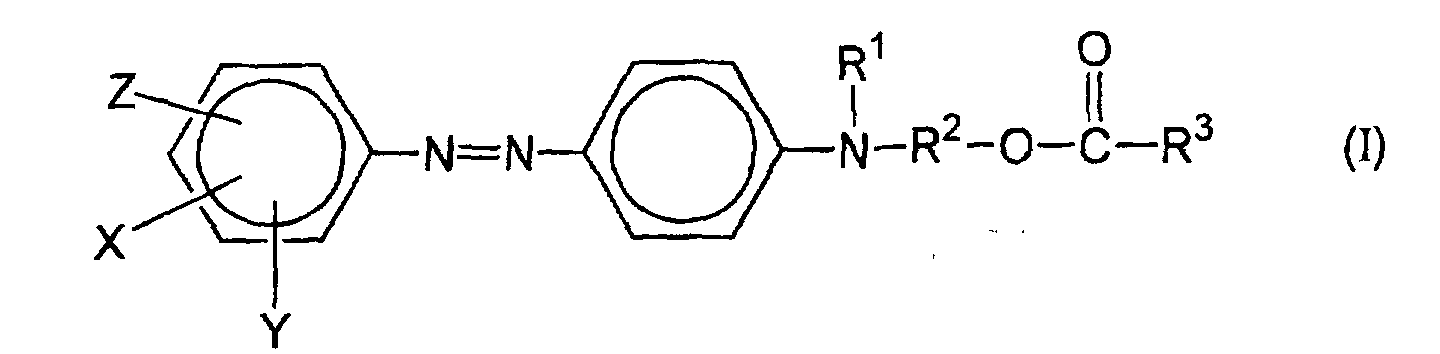
- the dyes used in the present invention have the general formula: where R 1 is C 1 -C 3 -alkyl, R 2 is C 1 -C 3 -alkylene, and R 3 is C 1 -C 2 -alkyl, preferably C 1 -alkyl, X and Y are the same or different and are selected from H, methyl, ethyl, methoxy, halogen, and nitro, and Z is H or wherein X and Y are as defined above.
- the compounds of the above-formula are synthesized in a mixed, two-phase system in which the compounds disproportionate from an acidic aqueous phase into a solvent phase.
- Optimal coupling occurs with the aqueous phase at a pH between 3 and 4.
- the solvent phase can be subsequently reduced to provide solutions of the compounds in the range of 40-60% solids.
- solutions are miscible with petroleum products, such as petroleum fuels, and are useful for solubilizing the compounds in petroleum fuels.
- the solvent phase may be an aromatic solvent, such as toluene, a high-flash aromatic solvent mixture, such as that sold as Aromatic® 200, sec butyl phenol, 2-6-di-secondary butyl phenol, heptyl,octyl- ⁇ -naphthol, and mixtures thereof.
- aromatic solvent such as toluene
- high-flash aromatic solvent mixture such as that sold as Aromatic® 200
- sec butyl phenol 2-6-di-secondary butyl phenol
- heptyl,octyl- ⁇ -naphthol and mixtures thereof.
- Preferred solvents and solvent mixtures for the solvent phase may vary, depending upon the marker compound synthesized.
- reaction sequence is generally as follows.
- a compound of the formula (in which R 1 and R 2 are as defined above): is esterified with an anhydride or chloride of an acid having the formula R 3 COOH (in which R 3 is as defined above) to produce a compound of the formula:
- aniline or an aniline derivative of the formula (in which X, Y and Z are as defined above): is diazotized and coupled with the ester to produce the compounds used in the present invention.
- the volume of the solvent phase to the volume of the aqueous phase ranges from 2:1 to 4:1 although this may vary.
- the two-phase system is agitated during the coupling reaction to provide substantial contact between the phases so as to ensure that the compound that is produced becomes dissolved in the solvent phase, rather than precipitating.
- the particular aniline derivative is weakly basic
- coupling may have to be performed at a very low pH.
- the compounds are typically added at between 0.25 and 100 ppm (parts per million by weight), most typically between about 1 and about 5 ppm. At such low levels, the compounds, though colored, impart relatively little color to the petroleum fuel. Alternatively, any color the marker may impart to the petroleum fuel may be masked by the color of a petroleum fuel dye, such that it is not readily apparent that the petroleum fuel is tagged. If used with a dye, the dye is selected such that it is not extractable from the petroleum fuel with acidic aqueous solution. While compounds used in the method of the invention may be detected at levels as low as about 0.25 ppm, higher levels of marker may be used so that the marker can be detected even when the tagged fuel is admixed with non-tagged fuels.
- a sample of the fuel is extracted with a strongly acidic solution of an acid, such as HCl, phosphoric acid, formic acid, acetic acid and propionic acid.
- pH of the extracting solution is generally about 3.0 or below.
- the strength of the acid and extraction pH will vary, however, with the individual marker used.
- the marker undergoes a chromophoric reaction with the acid, producing a different and a stronger color then the marker had in its non-protiated state within the petroleum fuel.
- the volume of the acidic, aqueous extractant solution to the volume of fuel ranges from about 0.5:1 to about 10:1, but this may vary depending upon the amount of marker in the petroleum fuel and the color intensity of the extracted compound.
- the color of the extracted marker will vary, depending on the substituent groups.
- the color which is developed in the acidic aqueous solution is visible to the naked eye at the concentrations at which the marker compound is added to the petroleum fuel and at the relative volumes of extractant solution to petroleum fuel suggested above, thereby providing a very simple qualitative test for presence of the marker.
- a relatively quantitative determination of the amount of marker present in the petroleum fuel may be made.
- it can be further determined if a tagged petroleum fuel has been adulterated with non-tagged petroleum fuel.
- the esterifying acids when used, have 7 to 12 carbons; i.e., in terms of the formulae set forth above, R 3 is C 6 -C 11 as opposed to C 1 -C 2 , preferably C 1 , in the present invention.
- the Lange compounds are described as useful as dyes for petroleum fuels or mineral oil, they do not function well as extractable markers as do the compounds of the present invention.
- the long-chain alkyl moieties of the esterifying acids in Lange provide good miscibility with non-polar petroleum fuels and mineral oil; in fact, such good miscibility that they are not easily extracted with acidic aqueous solutions.
- Example 1 of Lange It is seen in Example 1 of Lange that 5.7 parts of an -OH functional dye is suspended in 50 parts of toluene. Thus, even at slightly more than a 10% level, the dye is insoluble in toluene. This dye is then reacted with the chloride of an acid having 9 carbon atoms. By this synthetic route, there are two significant sources of fuel-insoluble precipitates. Because the -OH functional dye is only suspended, not dissolved, in the toluene, unreacted dye inherently remains as insoluble fines.
- the conventional method of producing such a dye would be to couple the -OH functional compound to a diazo compound, such as is described in U.S. Patent No. 2,850,493 to Seruto.
- the azo compound is in acidic aqueous solution, and this acidic aqueous solution is added to the -OH functional compound in an alkaline aqueous solution such that coupling takes place at pH 10-12. While coupling take place at an alkaline pH, the change in environment from an acidic aqueous medium to an alkaline aqueous medium results in some decomposition of the diazo compound, resulting in precipitates which are insoluble in petroleum fuels.
- a two-phase system i.e., an acidic aqueous phase and a solvent phase. Because coupling is carried out in the presence of at an acidic aqueous solution, there is no decomposition occasioned by introducing a diazo compound to an alkaline environment. Only solvent-soluble compounds, primarily the intended marker compound, migrate to the solvent phase which consequently carries only dissolved material. The solvent phase may carry upwards of 50 wt% marker, which marker is fully miscible with petroleum fuel.
- Example 2 was repeated replacing the aniline with 63 gm of O-anisidine.
- Example 2 was repeated replacing the aniline with 85 gm of 4-nitro-o-anisidine.
- a petroleum fraction was tagged at a level of 5 ppm with the product of Example 4. 20 milliliters of this fuel was added to 10 ml. of concentrated HCl diluted 1:1 with water. The mixture was shaken and the lower aqueous layer developed a magenta color having at an absorbance maxima of 540 nanometers.
- Dyes as in Examples 2-4 were synthesized, except that in the esterification step (as per Example 1), the anhydrides of propionic acid (R 3 is C 2 ) and isooctyl acid (R 3 is C 7 ). Tagging and extractions were carried out in the manner of Example 5 using a variety of acidic extractants including aqueous solutions of acetic, formic, propionic and phosphoric acids. In each case, the markers using acetic acid and propionic acids as the esterifying acids extracted readily. The markers using isooctyl acid as the esterifying acid extracted either to only a trace degree or up to 20% of the amount of the acetic acid or propionic acid derivatives.
Landscapes
- Chemical & Material Sciences (AREA)
- Organic Chemistry (AREA)
- Chemical Kinetics & Catalysis (AREA)
- Oil, Petroleum & Natural Gas (AREA)
- Engineering & Computer Science (AREA)
- General Chemical & Material Sciences (AREA)
- Organic Low-Molecular-Weight Compounds And Preparation Thereof (AREA)
Claims (4)
- Procédé de préparation d'une solution dans un solvant non miscible à l'eau d'un composé ayant la formuledans laquelle R1 est un groupe alkyle en C1-C3, R2 est un groupe alkylène en C1-C3, R3 est un groupe alkyle en C1-C2, X et Y sont identiques ou différents et sont choisis parmi H, un groupe alkyle en C1-C3, alcoxy en C1-C3, halogéno, et nitro, et Z est H ou un groupe de formule générale :
 dans laquelle X et Y sont tels que définis ci-dessus, le procédé comprenant la diazotation d'un composé ayant la formule
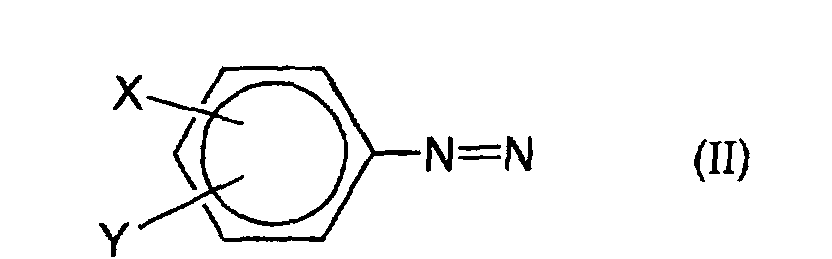 dans laquelle X, Y et Z sont tels que définis ci-dessus,
et le couplage dudit composé diazoté avec un composé ayant la formuledans laquelle R1, R2 et R3 sont tels que définis ci-dessus,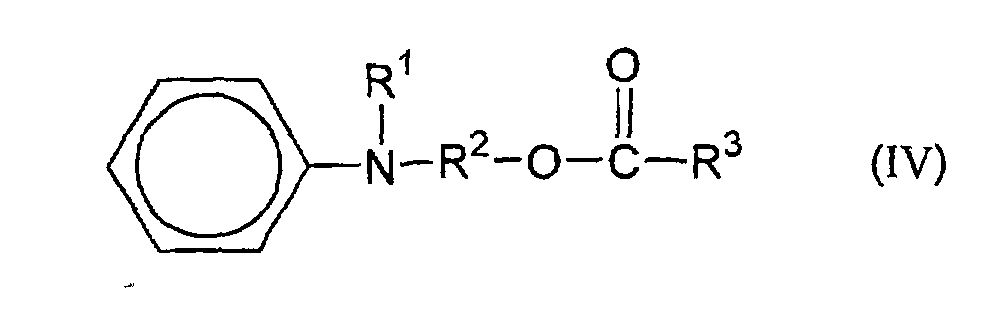
dans un système à deux phases comprenant une phase aqueuse acide et une phase de solvant non miscible à l'eau. - Procédé selon la revendication 1, caractérisé en ce que R3 est un groupe méthyle.
- Procédé de marquage d'un combustible de pétrole et d'identification postérieure du combustible de pétrole marqué, le procédé comprenant la fourniture d'une solution d'un composé de formuledans laquelle R1 est un groupe alkyle en C1-C3, R2 est un groupe alkylène en C1-C3, R3 est un groupe alkyle en C1-C2, X et Y sont identiques ou différents et sont choisis parmi H, un groupe alkyle en C1-C3, alcoxy en C1-C3, halogéno, et nitro, et Z est H ou un groupe de formule générale :
 dans laquelle X et Y sont tels que définis ci-dessus, ledit composé étant dissous dans un solvant organique non miscible à l'eau pour fournir une solution de marquage,
le marquage dudit combustible de pétrole avec ladite solution de marquage, et
l'extraction postérieure dudit composé dudit combustible de pétrole avec une solution aqueuse acide, pour produire ainsi une réaction chromophore dudit composé. - Procédé selon la revendication 3, caractérisé en ce que R3 est un groupe méthyle.
Applications Claiming Priority (4)
| Application Number | Priority Date | Filing Date | Title |
|---|---|---|---|
| US63840996A | 1996-04-26 | 1996-04-26 | |
| US08/771,809 US5737871A (en) | 1996-04-26 | 1996-12-23 | Method of preparing and utilizing petroleum fuel markers |
| US771809 | 1996-12-23 | ||
| US638409 | 2000-08-11 |
Publications (2)
| Publication Number | Publication Date |
|---|---|
| EP0803563A1 EP0803563A1 (fr) | 1997-10-29 |
| EP0803563B1 true EP0803563B1 (fr) | 2001-08-01 |
Family
ID=27093079
Family Applications (1)
| Application Number | Title | Priority Date | Filing Date |
|---|---|---|---|
| EP97302802A Expired - Lifetime EP0803563B1 (fr) | 1996-04-26 | 1997-04-24 | Méthode de préparation et d'utilisation de marqueurs pour combustible pétrolier |
Country Status (8)
| Country | Link |
|---|---|
| US (1) | US5737871A (fr) |
| EP (1) | EP0803563B1 (fr) |
| JP (1) | JP2944960B2 (fr) |
| AR (1) | AR006989A1 (fr) |
| AU (1) | AU699603B2 (fr) |
| BR (1) | BR9701916A (fr) |
| DE (1) | DE69705889T2 (fr) |
| TW (1) | TW403779B (fr) |
Families Citing this family (6)
| Publication number | Priority date | Publication date | Assignee | Title |
|---|---|---|---|---|
| US5905043A (en) * | 1998-05-20 | 1999-05-18 | Morton International, Inc. | Tagging and identifying organic liquids including fuels |
| US6083285A (en) * | 1998-09-24 | 2000-07-04 | Morton International, Inc. | N,N-dialkylaniline azo dye solutions |
| US6294110B1 (en) | 1999-11-18 | 2001-09-25 | Rohm And Haas Company | Color canceling marking systems |
| US7217271B2 (en) * | 2002-09-13 | 2007-05-15 | Symmetry Medical, Inc. | Orthopaedic reamer driver for minimally invasive surgery |
| KR100645357B1 (ko) * | 2005-08-22 | 2006-11-14 | 심현호 | 이중결합 에스테르기를 갖는 형광표지물질, 이를 표지 및 검출하는 방법 |
| US7842102B2 (en) | 2007-11-05 | 2010-11-30 | Sunbelt Corporation | Liquid dye formulations in non-petroleum based solvent systems |
Family Cites Families (16)
| Publication number | Priority date | Publication date | Assignee | Title |
|---|---|---|---|---|
| CH172572A (de) * | 1933-03-20 | 1934-10-15 | Chem Ind Basel | Verfahren zur Herstellung eines neuen Azofarbstoffes. |
| US2689171A (en) * | 1949-12-08 | 1954-09-14 | Us Army | Identifying gasoline and the like |
| US2850493A (en) * | 1953-11-10 | 1958-09-02 | American Cyanamid Co | Oil soluble azo colors |
| BE617305A (fr) * | 1961-05-06 | |||
| DE1470515A1 (de) * | 1964-05-06 | 1969-01-30 | Basf Ag | Gefaerbte Mineraloele mit verbessertem Viskositaetsindex |
| DE1544386A1 (de) * | 1965-11-06 | 1969-05-08 | Basf Ag | Verfahren zur Herstellung fluessiger oder niedrigschmelzender p-Aminoazofarbstoffe |
| US3534016A (en) * | 1965-11-06 | 1970-10-13 | Basf Ag | Liquid or low-melting p-aminoazo dyes |
| NL7103060A (fr) * | 1970-03-11 | 1971-09-14 | ||
| CH645232GA3 (fr) * | 1977-03-15 | 1984-09-28 | ||
| DE2816506A1 (de) * | 1978-04-15 | 1979-10-25 | Basf Ag | In organischen loesungsmitteln loesliche azofarbstoffe |
| DE3627461A1 (de) * | 1986-08-13 | 1988-02-25 | Basf Ag | Farbstoffmischungen |
| DE3700329A1 (de) * | 1987-01-08 | 1988-07-21 | Basf Ag | Verfahren zum nachweis von kennzeichnungsstoffen in dunkel gefaerbten mineraloelprodukten |
| DE4105603A1 (de) * | 1991-02-22 | 1992-08-27 | Basf Ag | Oelloesliche phenylazoanilinfarbstoffe |
| US5428137A (en) * | 1992-01-31 | 1995-06-27 | Orient Chemical Industries, Ltd. | Monoazo liquid dye and solutions thereof |
| DE4334678A1 (de) * | 1993-10-12 | 1995-04-13 | Basf Ag | Verfahren zum Nachweis von markierten Mineralölen sowie neue Azofarbstoffe |
| US5490872A (en) * | 1994-04-28 | 1996-02-13 | Morton International, Inc. | Acid extractable petroleum fuel markers |
-
1996
- 1996-12-23 US US08/771,809 patent/US5737871A/en not_active Expired - Fee Related
-
1997
- 1997-03-28 TW TW086104021A patent/TW403779B/zh not_active IP Right Cessation
- 1997-04-07 AU AU17758/97A patent/AU699603B2/en not_active Ceased
- 1997-04-23 BR BR9701916A patent/BR9701916A/pt not_active IP Right Cessation
- 1997-04-24 EP EP97302802A patent/EP0803563B1/fr not_active Expired - Lifetime
- 1997-04-24 DE DE69705889T patent/DE69705889T2/de not_active Expired - Fee Related
- 1997-04-25 AR ARP970101729A patent/AR006989A1/es unknown
- 1997-04-25 JP JP9108689A patent/JP2944960B2/ja not_active Expired - Lifetime
Also Published As
| Publication number | Publication date |
|---|---|
| AU1775897A (en) | 1998-01-15 |
| JP2944960B2 (ja) | 1999-09-06 |
| AU699603B2 (en) | 1998-12-10 |
| TW403779B (en) | 2000-09-01 |
| BR9701916A (pt) | 1998-08-25 |
| US5737871A (en) | 1998-04-14 |
| JPH1036698A (ja) | 1998-02-10 |
| DE69705889D1 (de) | 2001-09-06 |
| AR006989A1 (es) | 1999-10-13 |
| DE69705889T2 (de) | 2002-04-11 |
| EP0803563A1 (fr) | 1997-10-29 |
Similar Documents
| Publication | Publication Date | Title |
|---|---|---|
| RU2149887C1 (ru) | Флуоресцентный маркер для нефтепродуктов | |
| US4735631A (en) | Colored petroleum markers | |
| RU97114188A (ru) | Флуоресцентный маркер для нефтепродуктов | |
| CA2377300A1 (fr) | Esters aromatiques permettant de produire ou de marquer des produits organiques | |
| US4009008A (en) | Colored water immiscible organic liquid | |
| EP0803563B1 (fr) | Méthode de préparation et d'utilisation de marqueurs pour combustible pétrolier | |
| JPH09504314A (ja) | 標識された鉱油の検出法並びに新規アゾ染料 | |
| EP0499845B1 (fr) | Colorants de type phénylazoaniline solubles dans les huiles | |
| CA2026130C (fr) | Colorants azoiques a base d'aniline et soluble dans l'huile | |
| AU691219B2 (en) | Use of azo dyes for marking hydrocarbons and novel azo dyes | |
| EP0147704B1 (fr) | Liquide immiscible à l'eau comprenant un composé de marquage et méthode pour détecter ce composé de marquage | |
| US4082501A (en) | Mixtures of oil-soluble phenyl- and naphthyl-azo-phenyl dyestuffs | |
| JP3458423B2 (ja) | ペリレン系色素 | |
| US5905043A (en) | Tagging and identifying organic liquids including fuels | |
| EP0313918B1 (fr) | Colorants azoiques | |
| CA2281171C (fr) | Solutions de colorant azoique contenant de la n,n-dialkylaniline | |
| US5326866A (en) | Liquid azo dye and ink composition containing the same | |
| EP0024609B1 (fr) | Procédé de préparation de solutions concentrées de colorants complexes de metal sans groupes sulfoniques | |
| WO2006069664A2 (fr) | Derives azo aromatiques-aliphatiques utilises notamment comme marqueurs pour des produits petroliers, procede de synthese de ces derives, utilisation de ceux-ci et compositions derivees | |
| JP3264057B2 (ja) | アントラキノン系色素 | |
| CA1091655A (fr) | Colorants dicyano-azoiques comportant des coupleurs d'aniline a substitution par l'ether | |
| CA1183131A (fr) | Pigments mono-azoiques | |
| GB2354070A (en) | Markers for identifying liquids | |
| KR100385299B1 (ko) | 아세톡시에틸설폰 반응기를 갖는 분산 반응성 염료 및이의 제조방법 | |
| JPH0551536A (ja) | パーフルオロアルキル基含有アゾ系色素 |
Legal Events
| Date | Code | Title | Description |
|---|---|---|---|
| PUAI | Public reference made under article 153(3) epc to a published international application that has entered the european phase |
Free format text: ORIGINAL CODE: 0009012 |
|
| AK | Designated contracting states |
Kind code of ref document: A1 Designated state(s): DE FR GB |
|
| 17P | Request for examination filed |
Effective date: 19980403 |
|
| 17Q | First examination report despatched |
Effective date: 19991123 |
|
| GRAG | Despatch of communication of intention to grant |
Free format text: ORIGINAL CODE: EPIDOS AGRA |
|
| GRAG | Despatch of communication of intention to grant |
Free format text: ORIGINAL CODE: EPIDOS AGRA |
|
| GRAH | Despatch of communication of intention to grant a patent |
Free format text: ORIGINAL CODE: EPIDOS IGRA |
|
| GRAH | Despatch of communication of intention to grant a patent |
Free format text: ORIGINAL CODE: EPIDOS IGRA |
|
| GRAA | (expected) grant |
Free format text: ORIGINAL CODE: 0009210 |
|
| AK | Designated contracting states |
Kind code of ref document: B1 Designated state(s): DE FR GB |
|
| REF | Corresponds to: |
Ref document number: 69705889 Country of ref document: DE Date of ref document: 20010906 |
|
| EN | Fr: translation not filed | ||
| REG | Reference to a national code |
Ref country code: GB Ref legal event code: IF02 |
|
| EN | Fr: translation not filed |
Free format text: BO 01/52 PAGES: 283, IL Y A LIEU DE SUPPRIMER: LA MENTION DE LA NON REMISE. LA REMISE EST PUBLIEE DANS LE PRESENT BOPI. |
|
| ET | Fr: translation filed | ||
| PLBE | No opposition filed within time limit |
Free format text: ORIGINAL CODE: 0009261 |
|
| STAA | Information on the status of an ep patent application or granted ep patent |
Free format text: STATUS: NO OPPOSITION FILED WITHIN TIME LIMIT |
|
| 26N | No opposition filed | ||
| REG | Reference to a national code |
Ref country code: FR Ref legal event code: TP |
|
| REG | Reference to a national code |
Ref country code: GB Ref legal event code: 732E |
|
| PGFP | Annual fee paid to national office [announced via postgrant information from national office to epo] |
Ref country code: DE Payment date: 20080602 Year of fee payment: 12 |
|
| PGFP | Annual fee paid to national office [announced via postgrant information from national office to epo] |
Ref country code: FR Payment date: 20080417 Year of fee payment: 12 |
|
| PGFP | Annual fee paid to national office [announced via postgrant information from national office to epo] |
Ref country code: GB Payment date: 20080429 Year of fee payment: 12 |
|
| GBPC | Gb: european patent ceased through non-payment of renewal fee |
Effective date: 20090424 |
|
| REG | Reference to a national code |
Ref country code: FR Ref legal event code: ST Effective date: 20091231 |
|
| PG25 | Lapsed in a contracting state [announced via postgrant information from national office to epo] |
Ref country code: DE Free format text: LAPSE BECAUSE OF NON-PAYMENT OF DUE FEES Effective date: 20091103 |
|
| PG25 | Lapsed in a contracting state [announced via postgrant information from national office to epo] |
Ref country code: GB Free format text: LAPSE BECAUSE OF NON-PAYMENT OF DUE FEES Effective date: 20090424 Ref country code: FR Free format text: LAPSE BECAUSE OF NON-PAYMENT OF DUE FEES Effective date: 20091222 |