EP0803612A1 - Bloc de carapace en beton moule monobloc, moule pour la realisation d'un tel bloc - Google Patents
Bloc de carapace en beton moule monobloc, moule pour la realisation d'un tel bloc Download PDFInfo
- Publication number
- EP0803612A1 EP0803612A1 EP97400883A EP97400883A EP0803612A1 EP 0803612 A1 EP0803612 A1 EP 0803612A1 EP 97400883 A EP97400883 A EP 97400883A EP 97400883 A EP97400883 A EP 97400883A EP 0803612 A1 EP0803612 A1 EP 0803612A1
- Authority
- EP
- European Patent Office
- Prior art keywords
- block
- grooves
- protuberances
- blocks
- smooth
- Prior art date
- Legal status (The legal status is an assumption and is not a legal conclusion. Google has not performed a legal analysis and makes no representation as to the accuracy of the status listed.)
- Granted
Links
- 230000001788 irregular Effects 0.000 claims abstract description 6
- 238000000465 moulding Methods 0.000 claims description 8
- 230000000694 effects Effects 0.000 abstract description 4
- 239000011435 rock Substances 0.000 abstract description 2
- 238000005266 casting Methods 0.000 abstract 1
- 239000011248 coating agent Substances 0.000 abstract 1
- 238000000576 coating method Methods 0.000 abstract 1
- 239000000203 mixture Substances 0.000 abstract 1
- 239000002344 surface layer Substances 0.000 description 5
- 230000007547 defect Effects 0.000 description 3
- 238000004519 manufacturing process Methods 0.000 description 3
- 239000000463 material Substances 0.000 description 3
- 239000010438 granite Substances 0.000 description 2
- 239000010410 layer Substances 0.000 description 2
- 230000003313 weakening effect Effects 0.000 description 2
- 239000010426 asphalt Substances 0.000 description 1
- 239000003086 colorant Substances 0.000 description 1
- 239000002131 composite material Substances 0.000 description 1
- 239000000470 constituent Substances 0.000 description 1
- 230000008878 coupling Effects 0.000 description 1
- 238000010168 coupling process Methods 0.000 description 1
- 238000005859 coupling reaction Methods 0.000 description 1
- 230000007423 decrease Effects 0.000 description 1
- 230000008021 deposition Effects 0.000 description 1
- 230000002542 deteriorative effect Effects 0.000 description 1
- 230000007613 environmental effect Effects 0.000 description 1
- 238000009415 formwork Methods 0.000 description 1
- 238000009434 installation Methods 0.000 description 1
- 230000007774 longterm Effects 0.000 description 1
- 230000001105 regulatory effect Effects 0.000 description 1
- 230000035939 shock Effects 0.000 description 1
- 238000009416 shuttering Methods 0.000 description 1
- 239000002023 wood Substances 0.000 description 1
Images


Classifications
-
- E—FIXED CONSTRUCTIONS
- E02—HYDRAULIC ENGINEERING; FOUNDATIONS; SOIL SHIFTING
- E02B—HYDRAULIC ENGINEERING
- E02B3/00—Engineering works in connection with control or use of streams, rivers, coasts, or other marine sites; Sealings or joints for engineering works in general
- E02B3/04—Structures or apparatus for, or methods of, protecting banks, coasts, or harbours
- E02B3/12—Revetment of banks, dams, watercourses, or the like, e.g. the sea-floor
- E02B3/129—Polyhedrons, tetrapods or similar bodies, whether or not threaded on strings
Definitions
- the invention relates to a one-piece molded concrete shell block for a structure for protecting maritime and fluvial structures against waves and currents, and a mold for making such a block.
- the technical characteristics sought in terms of artificial blocks are firstly hydraulic stability and secondly robustness.
- the goal of block designers is to reduce the volume of concrete required for a given shell while having stability and robustness in accordance with their use. For this, the designers play on the dimensions and the angles of the constituent parts of the block in order to increase the volume of the empty spaces between nested blocks.
- the resulting blocks give a significant concrete saving result. However they are less robust and because of this, in the long term, there may appear in the shell a covering defect causing, due to the broken blocks settling, exposing part of the maritime and fluvial works and being able to be at the origin of damage.
- NL-A-8903138 relates to a shell block of molded concrete.
- the aim of this document is to compensate for the fragility of the blocks by a device aimed at reducing the maximum collision force exerted on a block by the other surrounding blocks.
- the proposed solution is to provide the shell block in molded concrete with a surface layer, in asphalt, rubber, or even in cement-rubber composite, of lower rigidity than the shell block. Thus the shocks between blocks are absorbed.
- this surface layer can advantageously, and for the same purpose, have projections or edges made of wood, rubber or concrete to make the surface layer less rigid than the block it covers.
- One of the aims of the present invention is therefore to preserve the optimal dimensional ratios of the existing blocks and to produce on the block surfaces an irregular uneven relief, without influence on the structural strength, constituting a plurality of asperities.
- an isotropic improvement in the attachment is obtained.
- the present invention is completely opposed to the general idea according to which, in order to facilitate its manufacture, and in particular demoulding, the shell blocks in one-piece molded concrete must have a smooth outer skin originating from molding, with possibly, as in NL-A-8903138 an added surface layer.
- the invention therefore relates to a one-piece molded concrete shell block for the protection structure of maritime and river works having an exterior surface of general shape defining a smooth polyhedron.
- at least part of the external surface of the block has protuberances and / or grooves molded in the mass of the block, the protuberances and / or grooves having faces in planes secant to the general local plane of the smooth polyhedron , these protuberances and / or grooves together forming an irregular uneven relief.
- the irregular uneven terrain makes it possible to increase the bonding coefficient between blocks in all directions (isotropic), and therefore to raise the coefficient of hydraulic stability.
- the coefficient of attachment being increased, the elementary inertia of the block (mass of concrete for a block) can be reduced, the reduction in the mass of each block being compensated for by the best attachment between blocks. This allows a saving of concrete on the realization of a given surface of shell.
- the faces of the protrusions and / or of the grooves are as many secondary planes with different orientations which multiply the possibilities of plane-to-plane contact stabilized between blocks with respect to the smooth surfaces of the prior art.
- the protuberances and / or grooves being molded in the mass, the mechanical strength of the block is preserved, and the resulting asperities have a shear resistance much higher than asperities coming in added surface layer.
- the invention relates to a shell block of one-piece molded concrete having protuberances and / or grooves, originating from molding, placed in a place having a given geomorphism.
- the protuberances and / or grooves, originating from molding have a general geomorphism substantially equivalent to the geomorphism of the asperities of the place considered.
- the block having this characteristic has the advantage of replacing the natural riprap without deteriorating the site, and by limiting the constraints linked to the supply and the routing of the natural riprap to the site. .
- the concrete constituting the block can be colored in the tones of the geological environment of the place considered.
- the invention also relates to a mold for producing a block according to the invention.
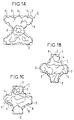
- FIGS. 1A to 1C are schematic views of a block according to the invention.
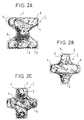
- FIGS. 2A to 2D are schematic views of an exemplary embodiment of a block according to the invention with granite geomorphism.
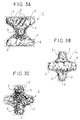
- FIGS. 3A to 3D are schematic views of an exemplary embodiment of a block according to the invention with basalt geomorphism.
- the blocks proposed as an example are blocks having as smooth polyhedron the shape of the blocks of US-A-4347017 however these examples intended for illustration and description are in no way limitative of the basic type of the blocks according to the invention.
- the invention relates to a shell block 1 in one-piece molded concrete for the protection structure of maritime and river works.
- This block 1 consists of legs 2 arranged together at given angles and inter-leg distances.
- This block 1 has an exterior surface 6 of general profile defining a smooth polyhedron 3.
- Smooth polyhedron 3 is the smoothed surface of the exterior profile of the block. In the prior art, this smooth polyhedron corresponds to the gross external formwork surface of the block.
- At least part of the outer surface 6 has, with respect to the smooth polyhedron 3, protrusions 4 and / or grooves 5 originating from molding.
- the smooth polyhedron 3 of block 1 is an imaginary polyhedron corresponding to the exterior surface of an equivalent block which would have been cast in a smooth mold.
- the protrusions 4 and / or the grooves 5 are due to grooves and / or protrusions voluntarily produced in the mold (not shown) of the block 1.
- the mold (not shown) can be the smooth mold of the equivalent smooth-skin block in which protuberant elements have been added comprising or generating grooves between them, so that when the concrete is poured into the mold, this results , in positive, grooves 5 and protrusions 4 on block 1.
- protrusions 4 and / or grooves 5 have constitutive faces in planes secant to the local plane of the smooth polyhedron and together form an irregular uneven relief. As a result, this considerably increases the number of planes in which the nested blocks 1 are likely to find themselves in stabilized support. The resulting overlap presents larger inter-block vacuum spaces than with smooth-skinned blocks while preserving the group effect of the shell.
- FIGS. 2A-2D and 3A-3D represent two examples of blocks according to the invention on which the protuberances 4 and / or the grooves 5 have a similar geomorphism with a granite site and a basalt site respectively.
- the blocks according to the invention integrate into their deposition site without denaturing it.
- the geomorphic block can advantageously be dyed in the mass in a tone similar to the geological colors of the site in which it is deposited.
- the mold according to the present invention can be a rehabilitated smooth mold.
- the production of such a rehabilitated mold can comprise the following stages:
- a homothetic smooth block with a volume less than the volume of the smooth mold to be rehabilitated is produced, so that there is a vacuum thickness between the mold to rehabilitate the block.
- the protuberances and the grooves are sculpted directly on the block; then the sculpted block is kept centered in the mold and a moldable material is poured between the sculpted block and the smooth wall of the mold. A reproducible block molding is thus obtained, and perfectly integrated into smooth molds to be rehabilitated.
- the smooth block is coated with a thickness of easily shaped material in which the protuberances and the grooves are shaped; then the block with shaped outer layer is kept centered in the mold and a moldable material is poured between the block with shaped outer layer and the smooth wall of the mold. A reproducible block molding is thus obtained, and perfectly integrated into smooth molds to be rehabilitated.
- the invention is not limited to the embodiments described and shown, but it is susceptible of numerous variants accessible to a person skilled in the art without departing from the invention.
- the smooth base block can be replaced by any other known block.
Landscapes
- Engineering & Computer Science (AREA)
- General Engineering & Computer Science (AREA)
- Ocean & Marine Engineering (AREA)
- Inorganic Chemistry (AREA)
- Environmental & Geological Engineering (AREA)
- Crystallography & Structural Chemistry (AREA)
- Chemical & Material Sciences (AREA)
- Mechanical Engineering (AREA)
- Civil Engineering (AREA)
- Structural Engineering (AREA)
- Revetment (AREA)
- Moulds, Cores, Or Mandrels (AREA)
- Road Paving Structures (AREA)
- Devices For Post-Treatments, Processing, Supply, Discharge, And Other Processes (AREA)
- Retaining Walls (AREA)
Abstract
Description
- L'invention concerne un bloc de carapace en béton moulé monobloc pour structure de protection des ouvrages maritimes et fluviaux contre les vagues et les courants, et un moule pour la réalisation d'un tel bloc.
- Les caractéristiques techniques recherchées en matière de blocs artificiels sont d'une part la stabilité hydraulique et d'autre part la robustesse.
- Outre ces caractéristiques techniques, le but des concepteurs de blocs est de diminuer le volume de béton nécessaire pour une carapace donnée tout ayant une stabilité et une robustesse en accord avec leur utilisation. Pour cela les concepteurs jouent sur les dimensions, et les angles des parties constitutives du bloc afin d'augmenter le volume des espaces vides entre blocs imbriqués.
- La tendance des concepteurs est de modifier les dimensions et les formes générales des pattes ou enclumes constitutives du bloc de manière à générer une forte imbrication tout en ayant plus d'espaces vides dans les imbriquements de blocs. A cet égard on pourra comparer le bloc du document US-A-4347017 datant des années 80, avec le bloc plus élancé du document US-A-5441362 plus récent. En outre, dans le but de réduire le volume de béton sur chaque bloc, les formes des blocs sont élancées.
- Cela a pour conséquence de fragiliser les pattes des blocs qui sont alors plus longilignes.
- Les blocs résultant donnent un résultat d'économie de béton non négligeable. Cependant ils sont moins robuste et de ce fait, à terme, il peut apparaître dans la carapace un défaut de recouvrement occasionnant , dû aux blocs brisés se tassant, mettant à découvert une partie des ouvrages maritimes et fluviaux et pouvant être à l'origine de dommages.
- NL-A-8903138 concerne un bloc de carapace en béton moulé. Le but que se propose d'atteindre ce document est de compenser la fragilité des blocs par un dispositif visant à diminuer la force de collision maximale exercée sur un bloc par les autres blocs l'entourant.
- La solution proposée est de pourvoir le bloc de carapace en béton moulé d'une couche superficielle, en asphalte, en caoutchouc, ou encore en composite ciment-caoutchouc, de rigidité inférieure au bloc de carapace. Ainsi les chocs entre blocs sont amortis.
- Il est en outre précisé que cette couche superficielle peut avantageusement, et pour le même but, présenter des saillies ou arrêtes faites de bois, de caoutchouc ou de béton pour rendre la couche superficielle moins rigide que le bloc qu'elle recouvre.
- Cependant, les formes de saillies et arrêtes proposées sont géométriquement régulières.
- L'axe de réflexion ayant menée à la présente invention est très différent. Il repose sur une amélioration sensible de l'accrochage des bloc entre eux de manière à améliorer le coefficient hydraulique de la carapace et donc limiter les mouvements et les chocs entre blocs.
- L'un des buts de la présente invention est donc de conserver les rapports dimensionnels optimaux des blocs existants et de réaliser sur les surfaces de blocs un relief accidenté irrégulier, sans influence sur la résistance structurelle, constituant une pluralité d'aspérités. Ainsi, sans affaiblir la résistance structurelle des blocs, on obtient une amélioration isotropique de l'accrochage.
- A cet égard, la présente invention s'oppose complètement à l'idée générale selon laquelle en vue d'en faciliter la fabrication, et notamment le démoulage, les blocs de carapace en béton moulé monobloc doivent présenter une peau extérieure lisse provenant de moulage, avec éventuellement, comme dans NL-A-8903138 une couche superficielle rajoutée.
- En outre le caractère régulier des saillies et arrêtes amortisseurs rajoutées proposées dans NL-A-8903138 va à l'opposé du caractère isotropique d'accrochage des blocs selon l'invention.
- l'invention concerne donc un bloc de carapace en béton moulé monobloc pour structure de protection des ouvrages maritimes et fluviaux ayant une surface extérieure de forme générale définissant un polyèdre lisse. Selon l'invention au moins une partie de la surface extérieure du bloc présente des protubérances et/ou des gorges moulés dans la masse du bloc, les protubérances et/ou les gorges présentant des faces dans des plans sécants au plan général local du polyèdre lisse, ces les protubérances et/ou les gorges formant ensemble un relief accidenté irrégulier.
- Le relief accidenté irrégulier permet d'augmenter le coefficient d'accrochage entre blocs dans toutes les directions (isotropique), et donc d'élever le coefficient de stabilité hydraulique. Le coefficient d'accrochage étant augmenté, l'inertie élémentaire du bloc (masse de béton pour un bloc) peut être réduite, la diminution de la masse de chaque bloc étant compensé par le meilleur accrochage entre blocs. Cela permet une économie de béton sur la réalisation d'une surface donnée de carapace.
- Les faces des protubérances et/ou des gorges sont autant de plans secondaires d'orientations différentes qui multiplient les possibilités de contact plan à plan stabilisé entre blocs par rapport aux surfaces lisses de l'art antérieur.
- La multiplication des possibilités de contact stabilisé plan à plan entre blocs induit une augmentation du volume des espaces vides inter-bloc.
- En outre les protubérances et/ou gorges étant moulées dans la masse, la résistance mécanique du bloc est conservé, et les aspérités résultantes présentent une résistance au cisaillement bien supérieure à des aspérités venant en couche superficielle rapportée
- De ce fait, avec un même nombre de blocs on obtient une carapace de plus grande surface tout en conservant un effet de groupe équivalent à l'art antérieur.
- Les critères environnementaux imposent, de plus en plus, que les ouvrages artificiels s'intègrent au mieux dans le cadre naturel du lieu où ils sont installés. A cet égard les blocs de carapace en béton moulé monobloc à peau lisse ne répondent pas à ces critères et dénaturent les sites où ils sont utilisés. Sur ces chantiers il est alors nécessaire d'utiliser des enrochements naturels issus de carrière. Or l'ouverture de carrières est, elle aussi, sévèrement réglementée et le transport d'enrochements naturels de taille adaptée est source de nuisance (circulation, bruit, pollution, mise en place d'infrastructure d'accès etc...).
- C'est donc un autre but de la présente invention de proposer des blocs de carapace en béton moulé monobloc selon l'invention ayant des protubérances et/ou des gorges, provenant de moulage, de forme générale semblable à la forme générale des aspérités naturelles du type de roche du site où ils sont installés (géomorphisme).
- A cet effet l'invention concerne un bloc de carapace en béton moulé monobloc ayant des protubérances et/ou des gorges, provenant de moulage, disposé dans un lieu ayant un géomorphisme donné. Selon l'invention les protubérances et/ou des gorges, provenant de moulage, présentent un géomorphisme général sensiblement équivalent au géomorphisme des aspérités du lieu considéré.
- Outre les avantages généraux des blocs selon l'invention, le bloc ayant cette caractéristique a pour avantage de remplacer l'enrochement naturel sans détériorer le site, et en limitant les contraintes liées à la fourniture et à l'acheminement des enrochements naturels vers le site.
- Avantageusement le béton constitutif du bloc pourra être coloré dans les tons du milieu géologique du lieu considéré.
- L'invention concerne aussi un moule pour réaliser un bloc selon l'invention.
- D'autres avantages et caractéristiques de la présente invention résulteront de la description qui va suivre en référence aux dessins annexés dans lesquels :
- Les figures 1A à 1C sont des vues schématiques d'un bloc selon l'invention.
- Les figures 2A à 2D sont des vues schématiques d'un exemple de réalisation d'un bloc selon l'invention avec géomorphisme granitique.
- Les figures 3A à 3D sont des vues schématiques d'un exemple de réalisation d'un bloc selon l'invention avec géomorphisme basaltique.
- Les blocs proposés en exemple sont des blocs ayant pour polyèdre lisse la forme des blocs de US-A-4347017 cependant ces exemples destinés à illustration la description ne sont nullement limitatifs du type de base des blocs selon l'invention.
- L'invention concerne un bloc 1 de carapace en béton moulé monobloc pour structure de protection des ouvrages maritimes et fluviaux.
- Ce bloc 1 est constitués de pattes 2 agencées ensemble selon des angles et des écarts inter-patte donnés.
- Ce bloc 1 a une surface extérieure 6 de profil général définissant un polyèdre lisse 3. On appelle polyèdre lisse 3 la surface lissée du profil extérieur du bloc. Dans l'art antérieur ce polyèdre lisse correspond à la surface extérieure brute de décoffrage du bloc.
- Selon l'invention, au moins une partie de la surface extérieure 6 présente, par rapport au polyèdre lisse 3, des protubérances 4 et/ou des gorges 5 provenant de moulage.
- Il est clair que les défauts de surface résultant du décoffrage d'un moule lisse de l'art antérieur ne constituent pas les protubérances 4 et/ou gorges 5 du bloc 1 selon la présente invention.
- Pour un bloc 1 selon l'invention le polyèdre lisse 3 du bloc 1 est polyèdre imaginaire correspondant la surface extérieure d'un bloc équivalent qui aurait été coulé dans un moule lisse.
- Les protubérances 4 et/ou les gorges 5 sont dues à des gorges et/ou protubérances volontairement réalisées dans le moule (non représenté) du bloc 1.
- Avantageusement, le moule (non représenté) peut être le moule lisse du bloc à peau lisse équivalent dans lequel ont été rajoutés des éléments protubérants comprenant ou générant entre eux des gorges, de manière que lorsque le béton est coulé dans le moule, il en résulte, en positif, des gorges 5 et des protubérances 4 sur le bloc 1.
- Ainsi on comprend bien que, tout en respectant les proportions optimales d'un bloc lisse équivalent, le volume élémentaire de béton nécessaire à la réalisation d'un bloc 1 selon l'invention est diminué du volume des éléments protubérants ajoutés dans le moule, ces éléments protubérants créant sur le bloc 1 des gorges 5 et de protubérances 4 venant, du fait de l'augmentation du coefficient d'accrochage, pallier le défaut de masse élémentaire du bloc 1 par rapport à son équivalent lisse.
- Ces protubérances 4 et/ou gorges 5 présentent des faces constitutives dans des plans sécants au plan local du polyèdre lisse et forment ensemble un relief accidenté irrégulier. De ce fait cela augmente considérablement le nombre de plan dans lesquels les blocs 1 imbriqués sont susceptibles de se retrouvés en appui stabilisé. L'imbriquement qui en résulte présente des espaces de vide inter-blocs plus important qu'avec des blocs à peau lisse tout en préservant l'effet de groupe de la carapace.
- Les figures 2A-2D et 3A-3D représentent deux exemples de blocs selon l'invention sur lesquels les protubérances 4 et/ou les gorges 5 présentent un géomorphisme similaire avec respectivement un site granitique et un site basaltique. De cette manière, les blocs selon l'invention s'intègrent dans leur site de dépôt sans le dénaturer.
- Le bloc géomorphique peut être avantageusement teint dans la masse dans un ton semblable aux couleurs géologiques du site dans lequel il est déposé.
- Avantageusement le moule selon la présente invention peut être un moule lisse réhabilité. La réalisation d'un tel moule réhabilité peut comprendre les étapes suivantes :
- On réalise un bloc lisse homothétique de volume inférieur au volume du moule lisse à réhabiliter, de manière qu'il existe une épaisseur de vide entre le moule à réhabiliter le bloc.
- Dans un premier mode de réalisation, on sculpte directement sur le bloc les protubérances et les gorges; puis on maintien le bloc sculpté centré dans le moule et on coule un matériau moulable entre le bloc sculpté et la paroi lisse du moule. On obtient ainsi un moulage du bloc reproductible, et parfaitement intégrée dans des moules lisses à réhabiliter.
- Dans un deuxième mode de réalisation, le bloc lisse est enduit d'une épaisseur de matériau facilement façonnable dans laquelle sont façonnées les protubérances et les gorges; puis on maintien le bloc à couche extérieure façonnée centré dans le moule et on coule un matériau moulable entre le bloc à couche extérieure façonnée et la paroi lisse du moule. On obtient ainsi un moulage du bloc reproductible, et parfaitement intégrée dans des moules lisses à réhabiliter.
- Bien entendu, l'invention n'est pas limitée aux modes de réalisation décrits et représentés, mais elle est susceptible de nombreuses variantes accessibles à l'homme du métier sans que l'on s'écarte de l'invention. En particulier, on pourra, sans sortir du cadre de l'invention, remplacer le bloc de base lisse par tout autre bloc connu. De même on pourra, sans sortir du cadre de l'invention, décliner des blocs ayant des géomorphismes semblables à d'autres géomorphismes naturels que granitique ou basaltique.
Claims (4)
- Bloc de carapace en béton moulé monobloc pour structure de protection des ouvrages maritimes et fluviaux ayant une surface extérieure (6) de forme générale définissant un polyèdre lisse (3), caractérisé en ce qu'au moins une partie de la surface extérieure (6) du bloc présente des protubérances (4) et/ou des gorges (5) provenant de moulage, les protubérances (4) et/ou les gorges (5) présentant des faces dans des plans sécants au plan général local du polyèdre lisse (3), les protubérances et/ou les gorges formant ensemble un relief accidenté irrégulier.
- Bloc de carapace selon la revendication 1 disposé dans un lieu ayant un géomorphisme donné, caractérisé en ce que les protubérances (4) et/ou les gorges (5) du bloc présentent un géomorphisme sensiblement équivalent au géomorphisme des protubérances et/ou les gorges naturelles du lieu considéré.
- Bloc de carapace selon la revendication 2 caractérisé en ce qu'il est teint dans la masse dans les tons du lieu considéré.
- Moule pour bloc de carapace en béton moulé monobloc, caractérisé en ce qu'il comprend des éléments protubérants comprenant ou formant entre eux des gorges de manière à réaliser les gorges (5) et/ou les protubérances (4) d'un bloc de carapace en béton moulé monobloc selon l'une quelconque des revendications 1 à 3.
Applications Claiming Priority (2)
| Application Number | Priority Date | Filing Date | Title |
|---|---|---|---|
| FR9605236 | 1996-04-25 | ||
| FR9605236A FR2748044B1 (fr) | 1996-04-25 | 1996-04-25 | Bloc de carapace en beton moule monobloc, moule pour la realisation d'un tel bloc |
Publications (2)
| Publication Number | Publication Date |
|---|---|
| EP0803612A1 true EP0803612A1 (fr) | 1997-10-29 |
| EP0803612B1 EP0803612B1 (fr) | 2002-03-20 |
Family
ID=9491586
Family Applications (1)
| Application Number | Title | Priority Date | Filing Date |
|---|---|---|---|
| EP97400883A Expired - Lifetime EP0803612B1 (fr) | 1996-04-25 | 1997-04-21 | Bloc de carapace en beton moule monobloc, moule pour la realisation d'un tel bloc |
Country Status (20)
| Country | Link |
|---|---|
| EP (1) | EP0803612B1 (fr) |
| JP (1) | JP3903396B2 (fr) |
| KR (1) | KR100516862B1 (fr) |
| CN (1) | CN1078919C (fr) |
| AR (1) | AR006677A1 (fr) |
| AU (1) | AU722756B2 (fr) |
| BR (1) | BR9701937A (fr) |
| CA (1) | CA2203685A1 (fr) |
| DE (1) | DE69711109T2 (fr) |
| ES (1) | ES2174197T3 (fr) |
| FR (1) | FR2748044B1 (fr) |
| ID (1) | ID16665A (fr) |
| MA (1) | MA24148A1 (fr) |
| MY (1) | MY116884A (fr) |
| NO (1) | NO322965B1 (fr) |
| PT (1) | PT803612E (fr) |
| TN (1) | TNSN97069A1 (fr) |
| TR (1) | TR199700317A2 (fr) |
| TW (1) | TW344774B (fr) |
| ZA (1) | ZA973560B (fr) |
Families Citing this family (4)
| Publication number | Priority date | Publication date | Assignee | Title |
|---|---|---|---|---|
| ES2315193B2 (es) * | 2007-09-07 | 2009-12-04 | Sociedad Anonina Trabajos Y Obras | Molde para fabricacion de cubipodos de hormigon. |
| ES2356964B1 (es) * | 2008-02-11 | 2011-11-29 | Pedro González Requejo | Balasto artificial para infraestructuras ferroviarias. |
| FR3118973B1 (fr) | 2021-01-20 | 2025-02-28 | Soletanche Freyssinet | Méthode de suivi du déplacement de blocs préfabriqués d’une carapace d’une digue |
| CN115233709B (zh) * | 2022-05-17 | 2024-06-21 | 中国水利水电第九工程局有限公司 | 一种河床围堰龙口截流装置及截流方法 |
Citations (3)
| Publication number | Priority date | Publication date | Assignee | Title |
|---|---|---|---|---|
| NL8903138A (nl) * | 1989-12-21 | 1991-07-16 | Hollandsche Betongroep Nv | Golfremmende constructie. |
| US5395577A (en) * | 1991-09-19 | 1995-03-07 | Gorski; Dennis | Process for forming artificial rocks |
| JPH083963A (ja) * | 1994-06-15 | 1996-01-09 | Masashi Yukimoto | かみあわせを有した近自然石ブロックによる多自然型法面工法 |
Family Cites Families (9)
| Publication number | Priority date | Publication date | Assignee | Title |
|---|---|---|---|---|
| US4043826A (en) * | 1974-11-22 | 1977-08-23 | Hum Bing W | Process for making artificial rocks |
| FR2449164A1 (fr) * | 1979-02-14 | 1980-09-12 | Sogreah | Bloc artificiel pour structures maritimes et fluviales |
| US4385088A (en) * | 1981-05-22 | 1983-05-24 | David Baskin | Decorative artificial rock-like article |
| DE3740682A1 (de) * | 1987-12-01 | 1989-06-15 | Gabriele Donath | Verfahren und vorrichtung zum herstellen eines naturgetreu nachgebildeten steines, vorzugsweise eines pflastersteines |
| JP2514887B2 (ja) * | 1992-10-05 | 1996-07-10 | 昌司 行本 | 近自然石ブロックの製造方法 |
| JP2588832B2 (ja) * | 1993-06-01 | 1997-03-12 | 株式会社テトラ | コンクリート製擬石の製造方法 |
| US5441362A (en) * | 1993-09-30 | 1995-08-15 | The United States Of America As Represented By The Secretary Of The Army | Concrete armor unit for protecting coastal and hydraulic structures and shorelines |
| JPH07331636A (ja) * | 1994-06-13 | 1995-12-19 | Masashi Yukimoto | 自然石ブロック工法 |
| US8903138B1 (en) * | 2011-09-06 | 2014-12-02 | Google Inc. | Face recognition using pre-templates |
-
1996
- 1996-04-25 FR FR9605236A patent/FR2748044B1/fr not_active Expired - Lifetime
- 1996-11-04 ID IDP963176A patent/ID16665A/id unknown
-
1997
- 1997-04-09 MY MYPI97001541A patent/MY116884A/en unknown
- 1997-04-11 TW TW086104687A patent/TW344774B/zh not_active IP Right Cessation
- 1997-04-16 AR ARP970101537A patent/AR006677A1/es unknown
- 1997-04-16 TR TR97/00317A patent/TR199700317A2/xx unknown
- 1997-04-21 ES ES97400883T patent/ES2174197T3/es not_active Expired - Lifetime
- 1997-04-21 DE DE69711109T patent/DE69711109T2/de not_active Expired - Lifetime
- 1997-04-21 PT PT97400883T patent/PT803612E/pt unknown
- 1997-04-21 EP EP97400883A patent/EP0803612B1/fr not_active Expired - Lifetime
- 1997-04-22 AU AU19017/97A patent/AU722756B2/en not_active Expired
- 1997-04-23 TN TNTNSN97069A patent/TNSN97069A1/fr unknown
- 1997-04-23 MA MA24563A patent/MA24148A1/fr unknown
- 1997-04-23 NO NO19971871A patent/NO322965B1/no unknown
- 1997-04-24 ZA ZA9703560A patent/ZA973560B/xx unknown
- 1997-04-24 KR KR1019970015402A patent/KR100516862B1/ko not_active Expired - Lifetime
- 1997-04-24 CN CN97110385A patent/CN1078919C/zh not_active Expired - Fee Related
- 1997-04-24 CA CA002203685A patent/CA2203685A1/fr not_active Abandoned
- 1997-04-25 BR BR9701937A patent/BR9701937A/pt not_active IP Right Cessation
- 1997-04-25 JP JP10941397A patent/JP3903396B2/ja not_active Expired - Fee Related
Patent Citations (3)
| Publication number | Priority date | Publication date | Assignee | Title |
|---|---|---|---|---|
| NL8903138A (nl) * | 1989-12-21 | 1991-07-16 | Hollandsche Betongroep Nv | Golfremmende constructie. |
| US5395577A (en) * | 1991-09-19 | 1995-03-07 | Gorski; Dennis | Process for forming artificial rocks |
| JPH083963A (ja) * | 1994-06-15 | 1996-01-09 | Masashi Yukimoto | かみあわせを有した近自然石ブロックによる多自然型法面工法 |
Non-Patent Citations (1)
| Title |
|---|
| DATABASE WPI Derwent World Patents Index; AN 96-094836, XP002020989 * |
Also Published As
| Publication number | Publication date |
|---|---|
| NO322965B1 (no) | 2006-12-18 |
| JP3903396B2 (ja) | 2007-04-11 |
| TR199700317A2 (xx) | 1997-11-21 |
| JPH1096222A (ja) | 1998-04-14 |
| CA2203685A1 (fr) | 1997-10-25 |
| ES2174197T3 (es) | 2002-11-01 |
| AR006677A1 (es) | 1999-09-08 |
| MA24148A1 (fr) | 1997-12-31 |
| PT803612E (pt) | 2002-07-31 |
| AU722756B2 (en) | 2000-08-10 |
| AU1901797A (en) | 1997-10-30 |
| DE69711109T2 (de) | 2002-09-05 |
| CN1078919C (zh) | 2002-02-06 |
| TNSN97069A1 (fr) | 1999-12-31 |
| ID16665A (id) | 1997-10-30 |
| DE69711109D1 (de) | 2002-04-25 |
| BR9701937A (pt) | 1998-09-15 |
| EP0803612B1 (fr) | 2002-03-20 |
| CN1168436A (zh) | 1997-12-24 |
| KR100516862B1 (ko) | 2005-11-21 |
| NO971871D0 (no) | 1997-04-23 |
| FR2748044A1 (fr) | 1997-10-31 |
| NO971871L (no) | 1997-10-27 |
| MX9703058A (es) | 1998-06-30 |
| MY116884A (en) | 2004-04-30 |
| FR2748044B1 (fr) | 1998-07-10 |
| ZA973560B (en) | 1997-11-19 |
| TW344774B (en) | 1998-11-11 |
Similar Documents
| Publication | Publication Date | Title |
|---|---|---|
| EP1488043B1 (fr) | Mur antibruit | |
| EP2337062A3 (fr) | Méthode de fabrication de structures semiconductrices présentant une bonne homogénéité | |
| EP0803612B1 (fr) | Bloc de carapace en beton moule monobloc, moule pour la realisation d'un tel bloc | |
| CA2219469A1 (fr) | Methode pour modeliser la distribution des pores d'un echantillon poreux de porosite variable | |
| WO2002027360A3 (fr) | Microlentilles a gradient d'indice et leurs procedes de conception et de formation | |
| CN201089945Y (zh) | 一种防盗安全井盖 | |
| KR102083120B1 (ko) | 투수지지블록과 블록장식상판의 2원화조립에 의한 조립식 투수블록 및 이를 설치하는 공법 | |
| FR2897375A1 (fr) | Bloc a parement pour construction de murs | |
| EP1279419B1 (fr) | Ski Alpin | |
| WO2014140200A1 (fr) | Structure de protection d'ouvrages maritimes et/ou fluviaux et bloc de protection utilisé | |
| EP0611201B1 (fr) | Procédé de réalisation de revêtement, revêtement et son procédé de pose | |
| EP3734990A1 (fr) | Pavillon acoustique, enceinte acoustique comportant un tel pavillon acoustique et procede de fabrication d'un tel pavillon acoustique | |
| FR3106601A1 (fr) | Dalle de revêtement de surface de voirie | |
| BE1021771B1 (fr) | Element de bardage | |
| FR2511413A1 (fr) | Element de construction tel que entrevous et procede de fabrication d'un tel element | |
| FR2858562A1 (fr) | Procede de fabrication d'une planche de glisse sur neige et planche de glisse a elements de renforcement lateraux | |
| FR3093698A1 (fr) | Écomouillage modulaire biomimétique | |
| WO2005106943A3 (fr) | Realignement entre niveaux apres une etape d'epitaxie | |
| EP0631016A1 (fr) | Dalle de revêtement de sol à absorption de choc | |
| KR100452791B1 (ko) | 인조 피복석의 제조용 형틀 | |
| MXPA97003058A (en) | Block barrier of concrete emptyed in monobloque and form to manufacture a block of this cl | |
| FR2930906A1 (fr) | Parement beton adapte a former un recif artificiel | |
| FR2597394A1 (fr) | Procede de fabrication d'un panneau mural a partir d'elements unitaires et dispositif de moulage pour la mise en oeuvre dudit procede | |
| FR3120009A1 (fr) | Procédé de réalisation d’une pièce par moulage, installation de moulage et utilisation d’un feuil à cet effet | |
| Crema et al. | Benthic community changes produced by physical stresses. |
Legal Events
| Date | Code | Title | Description |
|---|---|---|---|
| PUAI | Public reference made under article 153(3) epc to a published international application that has entered the european phase |
Free format text: ORIGINAL CODE: 0009012 |
|
| AK | Designated contracting states |
Kind code of ref document: A1 Designated state(s): BE CH DE ES FR GB GR IT LI MC NL PT SE |
|
| 17P | Request for examination filed |
Effective date: 19980305 |
|
| RAP1 | Party data changed (applicant data changed or rights of an application transferred) |
Owner name: SOGREAH |
|
| GRAG | Despatch of communication of intention to grant |
Free format text: ORIGINAL CODE: EPIDOS AGRA |
|
| 17Q | First examination report despatched |
Effective date: 20010823 |
|
| GRAG | Despatch of communication of intention to grant |
Free format text: ORIGINAL CODE: EPIDOS AGRA |
|
| GRAH | Despatch of communication of intention to grant a patent |
Free format text: ORIGINAL CODE: EPIDOS IGRA |
|
| REG | Reference to a national code |
Ref country code: GB Ref legal event code: IF02 |
|
| GRAH | Despatch of communication of intention to grant a patent |
Free format text: ORIGINAL CODE: EPIDOS IGRA |
|
| GRAA | (expected) grant |
Free format text: ORIGINAL CODE: 0009210 |
|
| AK | Designated contracting states |
Kind code of ref document: B1 Designated state(s): BE CH DE ES FR GB GR IT LI MC NL PT SE |
|
| REG | Reference to a national code |
Ref country code: CH Ref legal event code: EP |
|
| REF | Corresponds to: |
Ref document number: 69711109 Country of ref document: DE Date of ref document: 20020425 |
|
| PG25 | Lapsed in a contracting state [announced via postgrant information from national office to epo] |
Ref country code: LI Free format text: LAPSE BECAUSE OF NON-PAYMENT OF DUE FEES Effective date: 20020430 Ref country code: CH Free format text: LAPSE BECAUSE OF NON-PAYMENT OF DUE FEES Effective date: 20020430 |
|
| PG25 | Lapsed in a contracting state [announced via postgrant information from national office to epo] |
Ref country code: SE Free format text: LAPSE BECAUSE OF FAILURE TO SUBMIT A TRANSLATION OF THE DESCRIPTION OR TO PAY THE FEE WITHIN THE PRESCRIBED TIME-LIMIT Effective date: 20020620 |
|
| GBT | Gb: translation of ep patent filed (gb section 77(6)(a)/1977) |
Effective date: 20020625 |
|
| REG | Reference to a national code |
Ref country code: PT Ref legal event code: SC4A Free format text: AVAILABILITY OF NATIONAL TRANSLATION Effective date: 20020410 |
|
| REG | Reference to a national code |
Ref country code: GR Ref legal event code: EP Ref document number: 20020402165 Country of ref document: GR |
|
| REG | Reference to a national code |
Ref country code: ES Ref legal event code: FG2A Ref document number: 2174197 Country of ref document: ES Kind code of ref document: T3 |
|
| REG | Reference to a national code |
Ref country code: CH Ref legal event code: PL |
|
| PLBE | No opposition filed within time limit |
Free format text: ORIGINAL CODE: 0009261 |
|
| STAA | Information on the status of an ep patent application or granted ep patent |
Free format text: STATUS: NO OPPOSITION FILED WITHIN TIME LIMIT |
|
| 26N | No opposition filed |
Effective date: 20021223 |
|
| REG | Reference to a national code |
Ref country code: FR Ref legal event code: TP |
|
| PGFP | Annual fee paid to national office [announced via postgrant information from national office to epo] |
Ref country code: DE Payment date: 20120420 Year of fee payment: 16 Ref country code: NL Payment date: 20120425 Year of fee payment: 16 Ref country code: BE Payment date: 20120418 Year of fee payment: 16 |
|
| PGFP | Annual fee paid to national office [announced via postgrant information from national office to epo] |
Ref country code: GR Payment date: 20120425 Year of fee payment: 16 |
|
| REG | Reference to a national code |
Ref country code: FR Ref legal event code: TP Owner name: ARTELIA EAU & ENVIRONNEMENT, FR Effective date: 20120803 Ref country code: FR Ref legal event code: CD Owner name: ARTELIA EAU & ENVIRONNEMENT, FR Effective date: 20120803 |
|
| BERE | Be: lapsed |
Owner name: *SOGREAH CONSULTANTS Effective date: 20130430 |
|
| REG | Reference to a national code |
Ref country code: NL Ref legal event code: V1 Effective date: 20131101 |
|
| REG | Reference to a national code |
Ref country code: ES Ref legal event code: PC2A Owner name: ARTELIA EAU & ENVIRONNEMENT Effective date: 20131127 |
|
| REG | Reference to a national code |
Ref country code: GR Ref legal event code: ML Ref document number: 20020402165 Country of ref document: GR Effective date: 20131104 |
|
| PG25 | Lapsed in a contracting state [announced via postgrant information from national office to epo] |
Ref country code: DE Free format text: LAPSE BECAUSE OF NON-PAYMENT OF DUE FEES Effective date: 20131101 Ref country code: BE Free format text: LAPSE BECAUSE OF NON-PAYMENT OF DUE FEES Effective date: 20130430 |
|
| REG | Reference to a national code |
Ref country code: DE Ref legal event code: R119 Ref document number: 69711109 Country of ref document: DE Effective date: 20131101 |
|
| PG25 | Lapsed in a contracting state [announced via postgrant information from national office to epo] |
Ref country code: NL Free format text: LAPSE BECAUSE OF NON-PAYMENT OF DUE FEES Effective date: 20131101 Ref country code: GR Free format text: LAPSE BECAUSE OF NON-PAYMENT OF DUE FEES Effective date: 20131104 |
|
| REG | Reference to a national code |
Ref country code: GB Ref legal event code: 732E Free format text: REGISTERED BETWEEN 20150402 AND 20150408 |
|
| REG | Reference to a national code |
Ref country code: GB Ref legal event code: 732E Free format text: REGISTERED BETWEEN 20150409 AND 20150415 |
|
| REG | Reference to a national code |
Ref country code: FR Ref legal event code: PLFP Year of fee payment: 20 |
|
| PGFP | Annual fee paid to national office [announced via postgrant information from national office to epo] |
Ref country code: GB Payment date: 20160421 Year of fee payment: 20 Ref country code: MC Payment date: 20160419 Year of fee payment: 20 Ref country code: ES Payment date: 20160413 Year of fee payment: 20 |
|
| PGFP | Annual fee paid to national office [announced via postgrant information from national office to epo] |
Ref country code: IT Payment date: 20160427 Year of fee payment: 20 Ref country code: PT Payment date: 20160419 Year of fee payment: 20 Ref country code: FR Payment date: 20160426 Year of fee payment: 20 |
|
| REG | Reference to a national code |
Ref country code: GB Ref legal event code: PE20 Expiry date: 20170420 |
|
| REG | Reference to a national code |
Ref country code: ES Ref legal event code: FD2A Effective date: 20170728 |
|
| PG25 | Lapsed in a contracting state [announced via postgrant information from national office to epo] |
Ref country code: GB Free format text: LAPSE BECAUSE OF EXPIRATION OF PROTECTION Effective date: 20170420 |
|
| PG25 | Lapsed in a contracting state [announced via postgrant information from national office to epo] |
Ref country code: PT Free format text: LAPSE BECAUSE OF EXPIRATION OF PROTECTION Effective date: 20170503 |
|
| PG25 | Lapsed in a contracting state [announced via postgrant information from national office to epo] |
Ref country code: ES Free format text: LAPSE BECAUSE OF EXPIRATION OF PROTECTION Effective date: 20170422 |