EP0803727A1 - Capteur pour des oxydes d'azote et méthode pour sa production - Google Patents
Capteur pour des oxydes d'azote et méthode pour sa production Download PDFInfo
- Publication number
- EP0803727A1 EP0803727A1 EP97106709A EP97106709A EP0803727A1 EP 0803727 A1 EP0803727 A1 EP 0803727A1 EP 97106709 A EP97106709 A EP 97106709A EP 97106709 A EP97106709 A EP 97106709A EP 0803727 A1 EP0803727 A1 EP 0803727A1
- Authority
- EP
- European Patent Office
- Prior art keywords
- detecting portion
- gas detecting
- nitrogen oxide
- sensor
- gas
- Prior art date
- Legal status (The legal status is an assumption and is not a legal conclusion. Google has not performed a legal analysis and makes no representation as to the accuracy of the status listed.)
- Withdrawn
Links
- MWUXSHHQAYIFBG-UHFFFAOYSA-N Nitric oxide Chemical compound O=[N] MWUXSHHQAYIFBG-UHFFFAOYSA-N 0.000 title claims abstract description 151
- 238000004519 manufacturing process Methods 0.000 title claims abstract description 15
- 239000007789 gas Substances 0.000 claims abstract description 72
- 239000000463 material Substances 0.000 claims abstract description 31
- 229910044991 metal oxide Inorganic materials 0.000 claims abstract description 21
- 239000013078 crystal Substances 0.000 claims abstract description 20
- -1 metal oxide compound Chemical class 0.000 claims abstract description 16
- 238000000034 method Methods 0.000 claims description 28
- 238000010438 heat treatment Methods 0.000 claims description 15
- 238000000608 laser ablation Methods 0.000 claims description 11
- BASFCYQUMIYNBI-UHFFFAOYSA-N platinum Chemical compound [Pt] BASFCYQUMIYNBI-UHFFFAOYSA-N 0.000 claims description 10
- 150000004706 metal oxides Chemical class 0.000 claims description 6
- 229910052697 platinum Inorganic materials 0.000 claims description 5
- 239000003054 catalyst Substances 0.000 claims description 4
- 230000003647 oxidation Effects 0.000 claims description 3
- 238000007254 oxidation reaction Methods 0.000 claims description 3
- 230000035945 sensitivity Effects 0.000 description 37
- 239000010408 film Substances 0.000 description 18
- 230000002441 reversible effect Effects 0.000 description 11
- 238000005245 sintering Methods 0.000 description 11
- 238000000151 deposition Methods 0.000 description 9
- 150000001875 compounds Chemical class 0.000 description 7
- 238000010276 construction Methods 0.000 description 6
- 239000000203 mixture Substances 0.000 description 6
- 239000002243 precursor Substances 0.000 description 5
- XKRFYHLGVUSROY-UHFFFAOYSA-N Argon Chemical compound [Ar] XKRFYHLGVUSROY-UHFFFAOYSA-N 0.000 description 4
- RUDFQVOCFDJEEF-UHFFFAOYSA-N yttrium(III) oxide Inorganic materials [O-2].[O-2].[O-2].[Y+3].[Y+3] RUDFQVOCFDJEEF-UHFFFAOYSA-N 0.000 description 4
- MGWGWNFMUOTEHG-UHFFFAOYSA-N 4-(3,5-dimethylphenyl)-1,3-thiazol-2-amine Chemical compound CC1=CC(C)=CC(C=2N=C(N)SC=2)=C1 MGWGWNFMUOTEHG-UHFFFAOYSA-N 0.000 description 3
- QVGXLLKOCUKJST-UHFFFAOYSA-N atomic oxygen Chemical compound [O] QVGXLLKOCUKJST-UHFFFAOYSA-N 0.000 description 3
- 229910052791 calcium Inorganic materials 0.000 description 3
- 238000012790 confirmation Methods 0.000 description 3
- 239000002178 crystalline material Substances 0.000 description 3
- 230000000694 effects Effects 0.000 description 3
- JCXJVPUVTGWSNB-UHFFFAOYSA-N nitrogen dioxide Inorganic materials O=[N]=O JCXJVPUVTGWSNB-UHFFFAOYSA-N 0.000 description 3
- 239000001301 oxygen Substances 0.000 description 3
- 229910052760 oxygen Inorganic materials 0.000 description 3
- 239000002994 raw material Substances 0.000 description 3
- 239000000758 substrate Substances 0.000 description 3
- 238000012360 testing method Methods 0.000 description 3
- IJGRMHOSHXDMSA-UHFFFAOYSA-N Atomic nitrogen Chemical compound N#N IJGRMHOSHXDMSA-UHFFFAOYSA-N 0.000 description 2
- QPLDLSVMHZLSFG-UHFFFAOYSA-N Copper oxide Chemical compound [Cu]=O QPLDLSVMHZLSFG-UHFFFAOYSA-N 0.000 description 2
- PNEYBMLMFCGWSK-UHFFFAOYSA-N aluminium oxide Inorganic materials [O-2].[O-2].[O-2].[Al+3].[Al+3] PNEYBMLMFCGWSK-UHFFFAOYSA-N 0.000 description 2
- 238000000137 annealing Methods 0.000 description 2
- 229910052786 argon Inorganic materials 0.000 description 2
- 230000015572 biosynthetic process Effects 0.000 description 2
- 229910052797 bismuth Inorganic materials 0.000 description 2
- WMWLMWRWZQELOS-UHFFFAOYSA-N bismuth(iii) oxide Chemical compound O=[Bi]O[Bi]=O WMWLMWRWZQELOS-UHFFFAOYSA-N 0.000 description 2
- 238000006243 chemical reaction Methods 0.000 description 2
- 238000002485 combustion reaction Methods 0.000 description 2
- 229910052593 corundum Inorganic materials 0.000 description 2
- 238000002425 crystallisation Methods 0.000 description 2
- 230000008025 crystallization Effects 0.000 description 2
- 230000008021 deposition Effects 0.000 description 2
- 238000011161 development Methods 0.000 description 2
- 229910001873 dinitrogen Inorganic materials 0.000 description 2
- 238000000691 measurement method Methods 0.000 description 2
- 229910052751 metal Inorganic materials 0.000 description 2
- 239000002184 metal Substances 0.000 description 2
- 238000002488 metal-organic chemical vapour deposition Methods 0.000 description 2
- 229910052756 noble gas Inorganic materials 0.000 description 2
- 239000002245 particle Substances 0.000 description 2
- 238000001552 radio frequency sputter deposition Methods 0.000 description 2
- 239000007858 starting material Substances 0.000 description 2
- 239000010409 thin film Substances 0.000 description 2
- 229910001845 yogo sapphire Inorganic materials 0.000 description 2
- 229910052727 yttrium Inorganic materials 0.000 description 2
- 229910002480 Cu-O Inorganic materials 0.000 description 1
- 229910002370 SrTiO3 Inorganic materials 0.000 description 1
- 238000002679 ablation Methods 0.000 description 1
- 238000002835 absorbance Methods 0.000 description 1
- 238000003915 air pollution Methods 0.000 description 1
- 239000000919 ceramic Substances 0.000 description 1
- 229910052802 copper Inorganic materials 0.000 description 1
- 230000001419 dependent effect Effects 0.000 description 1
- 238000001514 detection method Methods 0.000 description 1
- 230000006866 deterioration Effects 0.000 description 1
- 238000005868 electrolysis reaction Methods 0.000 description 1
- 238000011156 evaluation Methods 0.000 description 1
- 238000002474 experimental method Methods 0.000 description 1
- 239000001307 helium Substances 0.000 description 1
- 229910052734 helium Inorganic materials 0.000 description 1
- SWQJXJOGLNCZEY-UHFFFAOYSA-N helium atom Chemical compound [He] SWQJXJOGLNCZEY-UHFFFAOYSA-N 0.000 description 1
- 230000002427 irreversible effect Effects 0.000 description 1
- 238000005259 measurement Methods 0.000 description 1
- 238000012544 monitoring process Methods 0.000 description 1
- 230000010355 oscillation Effects 0.000 description 1
- 239000012925 reference material Substances 0.000 description 1
- 229910052712 strontium Inorganic materials 0.000 description 1
- LEDMRZGFZIAGGB-UHFFFAOYSA-L strontium carbonate Chemical compound [Sr+2].[O-]C([O-])=O LEDMRZGFZIAGGB-UHFFFAOYSA-L 0.000 description 1
- 229910000018 strontium carbonate Inorganic materials 0.000 description 1
Images



Classifications
-
- G—PHYSICS
- G01—MEASURING; TESTING
- G01N—INVESTIGATING OR ANALYSING MATERIALS BY DETERMINING THEIR CHEMICAL OR PHYSICAL PROPERTIES
- G01N27/00—Investigating or analysing materials by the use of electric, electrochemical, or magnetic means
- G01N27/02—Investigating or analysing materials by the use of electric, electrochemical, or magnetic means by investigating impedance
- G01N27/04—Investigating or analysing materials by the use of electric, electrochemical, or magnetic means by investigating impedance by investigating resistance
- G01N27/12—Investigating or analysing materials by the use of electric, electrochemical, or magnetic means by investigating impedance by investigating resistance of a solid body in dependence upon absorption of a fluid; of a solid body in dependence upon reaction with a fluid, for detecting components in the fluid
-
- G—PHYSICS
- G01—MEASURING; TESTING
- G01N—INVESTIGATING OR ANALYSING MATERIALS BY DETERMINING THEIR CHEMICAL OR PHYSICAL PROPERTIES
- G01N27/00—Investigating or analysing materials by the use of electric, electrochemical, or magnetic means
-
- G—PHYSICS
- G01—MEASURING; TESTING
- G01N—INVESTIGATING OR ANALYSING MATERIALS BY DETERMINING THEIR CHEMICAL OR PHYSICAL PROPERTIES
- G01N33/00—Investigating or analysing materials by specific methods not covered by groups G01N1/00 - G01N31/00
- G01N33/0004—Gaseous mixtures, e.g. polluted air
- G01N33/0009—General constructional details of gas analysers, e.g. portable test equipment
- G01N33/0027—General constructional details of gas analysers, e.g. portable test equipment concerning the detector
- G01N33/0036—General constructional details of gas analysers, e.g. portable test equipment concerning the detector specially adapted to detect a particular component
- G01N33/0037—NOx
-
- Y—GENERAL TAGGING OF NEW TECHNOLOGICAL DEVELOPMENTS; GENERAL TAGGING OF CROSS-SECTIONAL TECHNOLOGIES SPANNING OVER SEVERAL SECTIONS OF THE IPC; TECHNICAL SUBJECTS COVERED BY FORMER USPC CROSS-REFERENCE ART COLLECTIONS [XRACs] AND DIGESTS
- Y02—TECHNOLOGIES OR APPLICATIONS FOR MITIGATION OR ADAPTATION AGAINST CLIMATE CHANGE
- Y02A—TECHNOLOGIES FOR ADAPTATION TO CLIMATE CHANGE
- Y02A50/00—TECHNOLOGIES FOR ADAPTATION TO CLIMATE CHANGE in human health protection, e.g. against extreme weather
- Y02A50/20—Air quality improvement or preservation, e.g. vehicle emission control or emission reduction by using catalytic converters
-
- Y—GENERAL TAGGING OF NEW TECHNOLOGICAL DEVELOPMENTS; GENERAL TAGGING OF CROSS-SECTIONAL TECHNOLOGIES SPANNING OVER SEVERAL SECTIONS OF THE IPC; TECHNICAL SUBJECTS COVERED BY FORMER USPC CROSS-REFERENCE ART COLLECTIONS [XRACs] AND DIGESTS
- Y10—TECHNICAL SUBJECTS COVERED BY FORMER USPC
- Y10T—TECHNICAL SUBJECTS COVERED BY FORMER US CLASSIFICATION
- Y10T436/00—Chemistry: analytical and immunological testing
- Y10T436/17—Nitrogen containing
- Y10T436/177692—Oxides of nitrogen
-
- Y—GENERAL TAGGING OF NEW TECHNOLOGICAL DEVELOPMENTS; GENERAL TAGGING OF CROSS-SECTIONAL TECHNOLOGIES SPANNING OVER SEVERAL SECTIONS OF THE IPC; TECHNICAL SUBJECTS COVERED BY FORMER USPC CROSS-REFERENCE ART COLLECTIONS [XRACs] AND DIGESTS
- Y10—TECHNICAL SUBJECTS COVERED BY FORMER USPC
- Y10T—TECHNICAL SUBJECTS COVERED BY FORMER US CLASSIFICATION
- Y10T436/00—Chemistry: analytical and immunological testing
- Y10T436/17—Nitrogen containing
- Y10T436/177692—Oxides of nitrogen
- Y10T436/178459—Only nitrogen dioxide
-
- Y—GENERAL TAGGING OF NEW TECHNOLOGICAL DEVELOPMENTS; GENERAL TAGGING OF CROSS-SECTIONAL TECHNOLOGIES SPANNING OVER SEVERAL SECTIONS OF THE IPC; TECHNICAL SUBJECTS COVERED BY FORMER USPC CROSS-REFERENCE ART COLLECTIONS [XRACs] AND DIGESTS
- Y10—TECHNICAL SUBJECTS COVERED BY FORMER USPC
- Y10T—TECHNICAL SUBJECTS COVERED BY FORMER US CLASSIFICATION
- Y10T436/00—Chemistry: analytical and immunological testing
- Y10T436/17—Nitrogen containing
- Y10T436/177692—Oxides of nitrogen
- Y10T436/179228—Both nitrogen oxide and dioxide
-
- Y—GENERAL TAGGING OF NEW TECHNOLOGICAL DEVELOPMENTS; GENERAL TAGGING OF CROSS-SECTIONAL TECHNOLOGIES SPANNING OVER SEVERAL SECTIONS OF THE IPC; TECHNICAL SUBJECTS COVERED BY FORMER USPC CROSS-REFERENCE ART COLLECTIONS [XRACs] AND DIGESTS
- Y10—TECHNICAL SUBJECTS COVERED BY FORMER USPC
- Y10T—TECHNICAL SUBJECTS COVERED BY FORMER US CLASSIFICATION
- Y10T436/00—Chemistry: analytical and immunological testing
- Y10T436/20—Oxygen containing
- Y10T436/207497—Molecular oxygen
- Y10T436/208339—Fuel/air mixture or exhaust gas analysis
Definitions
- the present invention relates to a nitrogen oxide sensor for detecting nitrogen oxide for such applications as the art of reducing or decomposing nitrogen oxide, and relates also to a method of manufacturing the sensor.
- nitrogen oxides present in e.g. combustion exhaust gas generated from an internal combustion engine, boiler or the like are major cause of air pollution.
- sensor capable of measuring concentration of nitrogen oxides in the exhaust gas with high precision.
- the sensor needs to be highly sensitive to gas component to be detected (nitrogen oxide), and the sensor also needs to have good selectivity to be able to detect the target gas component as distinct from the other coexisting gas components.
- the senor needs to be able to return to the zero point, i.e. its original resistance, as quickly as possible when the concentration of the gas component becomes '0' (zero).
- the sensor needs to provide reliably constant sensitivity through gas detecting or monitoring operation continued over an extended period of time.
- a primary object of the present invention is to provide a further improved nitrogen oxide sensor which is capable of meeting all of the three requirements, and to provide also a method of manufacturing such sensor.
- a nitrogen oxide sensor which comprises:
- the "crystalline size" referred to above is a value determined by the so-called Wilson method. It should be noted, however, that the specific type of method of this crystalline size measurement is not particularly limited in the present invention. If the crystalline size determined by whatever method available fits within the above-specified range, then, the object, function and effect of the invention can be achieved as will be described next.
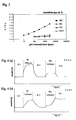
- Fig. 1 graphically illustrates change in the sensitivity which occurs in association with variation in the ratio between Ca and Y in the above-specified formula.
- the horizontal axis represents the ratio of Y
- the vertical axis represents the sensor sensitivity (specifically, a resistance value R for air containing 2500 ppm of NO/a resistance value R 0 for air alone).
- the metal oxide compound employed in this test satisfies the other features of the present invention.
- Fig. 2 illustrates the results obtained from material having crystalline size about 600 ⁇
- Fig. 3 illustrates the results obtained from material having crystalline size about 60 ⁇ , respectively.
- the horizontal axis represents the gas component concentration and the vertical axis represents the sensitivity thereto.
- the kinds of gas employed are denoted with marks. From these, it may be understood that the material of the invention is capable of selectively detecting the target gas component as distinct from the other coexisting gas components.
- Fig. 4(a) shows the reversible sensitivity of the material of the invention comprised mainly of the 2212 phase
- Fig. 4(b) shows that of reference material including other phases (Y 2 Cu 2 O 5 , SrBi 2 O 4 , Sr 3 Bi 2 O 6 ) in abundance.
- the horizontal axis represents time and the vertical axis represents the resistance value corresponding to the sensor sensitivity.
- nitrogen monoxide (NO) and nitrogen dioxide (NO 2 ) were employed as the nitrogen oxides.
- nitrogen monoxide and nitrogen dioxide equilibrate with each other and hence that confirmation of ability to detect nitrogen monoxide may be considered to be equivalent to confirmation of ability to detect nitrogen oxide.
- the compound comprised mainly of the 2212 phase is superior in the reversible sensitivity as least within the shorter time span (i.e. recoverability upon each detection).
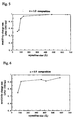
- the horizontal axis represents the crystalline size ( ⁇ ) and the vertical axis represents the sensitivity change rate described above.
- Fig. 5 corresponds to the compound having only Y
- Fig. 8 corresponds to the compound having only Ca.
- the sensitivity change rate is dependent on the crystalline size and that the material having the crystalline size greater than 100 ⁇ achieved the distinguished sensitivity change rate of 0.8 to 0.9 or more approximately.
- the crystalline size should be greater than 100 ⁇ .
- the compound having the crystalline size greater than 100 ⁇ provides good performance in durability as described above. In confirming this, however, the confirmation was made only to 600 ⁇ , which is the physical limit inherent in the Wilson method. In the above range, good results were obtained.
- the gas detecting portion further includes inactive metal oxide which does not chemically react with the nitrogen oxide.
- inactive metal oxide which does not chemically react with the nitrogen oxide.
- the 'inactive metal oxide' referred to above represents any metal oxide which is free from any irreversible reaction, especially, chemical reaction, with the nitrogen oxide. Examples of such inactive metal oxide are SiTiO 2 , MgO and Al 2 O 3 .
- the gas detecting portion further includes, at least on a surface side thereof, an oxidation catalyst layer carrying platinum.
- an oxidation catalyst layer carrying platinum.
- the selectivity to nitrogen oxide may be further enhanced.
- the ratio of the 2212 phase satisfies at least one of the following conditions (a), (b), (c) and (d), Namely;
- the gas detecting portion is constituted mainly from the 2212 phase, thus achieving the above-described advantageous effects.
- a nitrogen oxide sensor having a gas detecting portion including sensitive material having electric property thereof subject to change in association with presence of nitrogen oxide in gas and a pair of electrodes electrically connected with the gas detecting portion, wherein, for manufacturing the gas detecting portion, the method comprises the steps of:
- the deposited layer of this starting material is formed in the depositing step.
- depositing and film forming operation on the plate using the laser ablation method, IBS method, RF sputtering method, MBE method, MOCVD method and so on may be used, for example.
- the deposited layer may be either in the crystalline or non-crystalline state. That is, the layer may be of crystalline structure having extremely small grain size (crystalline size), or the layer may also be of non-crystalline structure.
- the heating step is effected for adjusting the crystal structure and crystalline size (in practice, for making the size greater than 100 ⁇ ). With these, there may be obtained a nitrogen oxide sensor having a gas detecting portion with the advantageous properties described hereinbefore.
- the heating temperature range between 920 and 950 °C. If the heating temperature is below this range, the resultant gas detecting portion may not be formed mainly of the 2212 phase or the crystalline size will tend to be smaller than 100 ⁇ . Conversely, if the temperature is higher than the above range, the detecting portion may not be formed mainly of the 2212 phase.
- the step of forming the deposited layer and the heating step are described as two seemingly separate steps to be effected on after the other.
- these phenomena of layer formation and crystal structure development and size adjustment may take place not so distinctly from each other. In fact, in some cases, these phenomena appear to take place simultaneously.
- the plate which is disposed in opposition to the target, at a relatively high temperature, so as to promote the crystallization in the deposited layer deposited on the plate, simultaneously with the ablation operation.
- the gas detecting portion comprised mainly of the metal oxide compound having the 2212 phase crystal structure and the crystallin size greater than 100 ⁇ may be obtained.
- Fig. 9 shows the construction of a nitrogen oxide sensor according to one embodiment of the invention.
- This sensor 1 includes a heating plate 2 comprising a ceramic heater plate and a gas detecting portion 3 disposed on the plate, and a pair of current applying platinum electrodes 4 and a pair of potential detecting platinum electrodes 5 attached to the gas detecting portion 3.
- the gas detecting portion 3 is in the form of thin film and formed of metal oxide compound specified by the present invention, i.e. having the composition represented by a general formula: Bi 2 Sr 2 (Ca 1-x Y x ) Cu 2 O 8+y (0.8 ⁇ x ⁇ 1; 0 ⁇ y ⁇ 1).
- nitrogen oxide can be reversibly adsorbed. So that, the detecting portion 3 provides different electric resistance values between the condition when the nitrogen oxide is adsorbed thereto and the further condition when no nitrogen oxide is adsorbed thereto.
- the amount of this change in the resistance value corresponds to the amount of adsorbed nitrogen oxide, i.e. the concentration of the nitrogen oxide present in the gas to which the detecting portion is exposed.
- Precursor material is obtained from raw mixture material including, in a predetermined equivalent ratio, essential elements for forming the sensitive material to be used in the gas detecting portion 3.
- raw materials are mixed in such a manner as to obtain the metal components (Bi: Sr: Y: Cu) substantially in the predetermined equivalent ratio of: (2 : 2 : 1: 2).
- the raw materials to be mixed to obtain Bi: Sr: Y: Cu are Bi 2 O 3 , SrCO 3 , Y 2 O 3 , CuO, respectively.
- Preliminary baking and sintering is effected on the precursor material obtained as above, whereby preliminary sintered product is obtained.
- the precursor material is sintered at a lower temperature (780 to 800 °C approximately) than that employed in a main sintering step to be described later for a period of 24 hours or longer, preferably 48 hours approximately.
- the resultant preliminary sintered product is pulverized to adjust its particle diameter to 1 to 20 ⁇ m approximately.
- the pulverized and size-adjusted preliminary sintered product obtained as above is then subjected to at least two cycles of main sintering steps at a temperature range of 815 to 848 °C (T1) in noble gas or nitrogen gas atmosphere containing 20% or more of oxygen.
- laser ablation target comprised mainly of metal oxide compound represented by the formula: Bi 2 Sr 2 Y Cu 2 O 8+y (0 ⁇ y ⁇ 1) and having the 2212 phase crystal structure.
- the material is again pulverized to adjust its particle diameter to 1 to 20 ⁇ m approximately.
- noble gas such as argon gas, helium gas or nitrogen gas is employed.
- T1 temperature range
- the main sintering step is effected for at least two cycles within argon gas atmosphere containing 20% or more of oxygen at a temperature range of 820 to 845 °C (T2) for a period longer than 30 hours.
- the target for the laser ablation is obtained by: the step of obtaining the precursor material from the raw mixture material having the essential components for the target in the predetermined equivalent ratio (i.e. the ratio represented by the general formula above); the preliminary sintering step for effecting preliminary sintering on the precursor material to obtain preliminary sintered product, and the step of subjecting the preliminary sintered product to at least two cycles of main sintering step at the temperature range of 815 to 848 °C.
- the target obtained as above is subjected to the laser ablation to obtain, on the plate, a film formed of non-crystalline material having the above-specified formula.
- This film is formed in the thickness of 1 to 5 ⁇ m approximately.
- the non-crystalline material film formed on the plate is then heated at 920 to 950 °C for a period of 20 to 60 minutes. After this heating treatment, there is consequently obtained the gas detecting portion 3 comprised mainly of the material having the 2212 phase crystal structure and the crystalline size greater than 100 ⁇ .
- the electrodes 4, 5 are attached and also the heating plate 2 is attached to the bottom face of the plate mounting the gas detecting portion thereon. Then, a measuring unit and a control unit (not shown) are connected to the above assembly, whereby the sensor is completed. Further, if necessary and as a further embodiment, an oxidation catalyst layer 6 carrying platinum may be attached to the surface of the gas detecting portion 3, as illustrated in Fig. 10.
- Determination of the characteristics of the nitrogen oxide sensor manufactured as above is carried out as follows.
- a predetermined potential is applied to the heating plate 2 to heat the gas detecting portion 3 to 250 to 450 °C, and a predetermined current is applied to the current applying electrodes 4.
- the sensor is exposed to gas containing a predetermined concentration of nitrogen oxide in the air. And, a potential is obtained from the potential detecting electrodes 5 and an electric resistance developed in the gas detecting portion is obtained.
- the senor having the above construction achieved the afore-described distinguished performance tendency in the sensitivity, selectivity, reversible sensitivity and durability.
- a control sensor having up to 20% of Ca substituted for by Y in the above-described formula achieved substantially the same performance as well.
Landscapes
- Chemical & Material Sciences (AREA)
- Health & Medical Sciences (AREA)
- Life Sciences & Earth Sciences (AREA)
- General Health & Medical Sciences (AREA)
- Immunology (AREA)
- Pathology (AREA)
- Analytical Chemistry (AREA)
- Biochemistry (AREA)
- Physics & Mathematics (AREA)
- General Physics & Mathematics (AREA)
- Engineering & Computer Science (AREA)
- Chemical Kinetics & Catalysis (AREA)
- Electrochemistry (AREA)
- Combustion & Propulsion (AREA)
- Food Science & Technology (AREA)
- Medicinal Chemistry (AREA)
- Investigating Or Analyzing Materials By The Use Of Fluid Adsorption Or Reactions (AREA)
Applications Claiming Priority (2)
| Application Number | Priority Date | Filing Date | Title |
|---|---|---|---|
| JP102148/96 | 1996-04-24 | ||
| JP8102148A JP2920109B2 (ja) | 1996-04-24 | 1996-04-24 | 窒素酸化物センサー及びその製造方法 |
Publications (1)
| Publication Number | Publication Date |
|---|---|
| EP0803727A1 true EP0803727A1 (fr) | 1997-10-29 |
Family
ID=14319666
Family Applications (1)
| Application Number | Title | Priority Date | Filing Date |
|---|---|---|---|
| EP97106709A Withdrawn EP0803727A1 (fr) | 1996-04-24 | 1997-04-23 | Capteur pour des oxydes d'azote et méthode pour sa production |
Country Status (5)
| Country | Link |
|---|---|
| US (1) | US5810984A (fr) |
| EP (1) | EP0803727A1 (fr) |
| JP (1) | JP2920109B2 (fr) |
| KR (1) | KR970070997A (fr) |
| CA (1) | CA2203578A1 (fr) |
Cited By (1)
| Publication number | Priority date | Publication date | Assignee | Title |
|---|---|---|---|---|
| CN113295751A (zh) * | 2021-05-24 | 2021-08-24 | 高鑫环保科技(苏州)有限公司 | 一种新型氮氧传感器标定测试系统 |
Families Citing this family (6)
| Publication number | Priority date | Publication date | Assignee | Title |
|---|---|---|---|---|
| DE19749341C2 (de) * | 1996-11-07 | 2003-02-13 | Honda Motor Co Ltd | NO¶x¶-Abgassensor und Verfahren zu dessen Herstellung |
| WO1998032007A1 (fr) * | 1997-01-20 | 1998-07-23 | Osaka Gas Co., Ltd. | Procede de detection d'oxydes d'azote et element de capteur permettant de detecter des oxydes azotes |
| US6082177A (en) * | 1997-09-22 | 2000-07-04 | Snap-On Tools Company | Nitric oxide enhanced response circuit for gas analyzer |
| WO1999034199A1 (fr) * | 1997-12-31 | 1999-07-08 | Corning Incorporated | Detecteur a oxyde metallique permettant la detection d'oxydes d'azote |
| JP5028453B2 (ja) * | 2009-07-27 | 2012-09-19 | 日立オートモティブシステムズ株式会社 | ガスセンサ及びガス検知方法 |
| US9389212B2 (en) * | 2011-02-28 | 2016-07-12 | Honeywell International Inc. | NOx gas sensor including nickel oxide |
Citations (3)
| Publication number | Priority date | Publication date | Assignee | Title |
|---|---|---|---|---|
| US4701739A (en) * | 1984-03-30 | 1987-10-20 | Figaro Engineering Inc. | Exhaust gas sensor and process for producing same |
| EP0632265A2 (fr) * | 1993-06-30 | 1995-01-04 | Osaka Gas Co., Ltd. | Capteur pour détecter l'oxide d'azote et procédé de fabrication de celui-ci |
| US5397541A (en) * | 1993-09-10 | 1995-03-14 | National Research Council Of Canada | Thin film oxygen sensor |
Family Cites Families (1)
| Publication number | Priority date | Publication date | Assignee | Title |
|---|---|---|---|---|
| US5413981A (en) * | 1991-01-31 | 1995-05-09 | Mitsubishi Denki Kabushiki Kaisha | Oxide superconductor and a method for manufacturing an oxide superconductor |
-
1996
- 1996-04-24 JP JP8102148A patent/JP2920109B2/ja not_active Expired - Lifetime
-
1997
- 1997-04-22 US US08/837,746 patent/US5810984A/en not_active Expired - Fee Related
- 1997-04-23 EP EP97106709A patent/EP0803727A1/fr not_active Withdrawn
- 1997-04-24 KR KR1019970015326A patent/KR970070997A/ko not_active Withdrawn
- 1997-04-24 CA CA002203578A patent/CA2203578A1/fr not_active Abandoned
Patent Citations (3)
| Publication number | Priority date | Publication date | Assignee | Title |
|---|---|---|---|---|
| US4701739A (en) * | 1984-03-30 | 1987-10-20 | Figaro Engineering Inc. | Exhaust gas sensor and process for producing same |
| EP0632265A2 (fr) * | 1993-06-30 | 1995-01-04 | Osaka Gas Co., Ltd. | Capteur pour détecter l'oxide d'azote et procédé de fabrication de celui-ci |
| US5397541A (en) * | 1993-09-10 | 1995-03-14 | National Research Council Of Canada | Thin film oxygen sensor |
Cited By (2)
| Publication number | Priority date | Publication date | Assignee | Title |
|---|---|---|---|---|
| CN113295751A (zh) * | 2021-05-24 | 2021-08-24 | 高鑫环保科技(苏州)有限公司 | 一种新型氮氧传感器标定测试系统 |
| CN113295751B (zh) * | 2021-05-24 | 2023-10-10 | 高鑫环保科技(苏州)有限公司 | 一种新型氮氧传感器标定测试系统 |
Also Published As
| Publication number | Publication date |
|---|---|
| US5810984A (en) | 1998-09-22 |
| KR970070997A (ko) | 1997-11-07 |
| JP2920109B2 (ja) | 1999-07-19 |
| JPH09288078A (ja) | 1997-11-04 |
| CA2203578A1 (fr) | 1997-10-24 |
Similar Documents
| Publication | Publication Date | Title |
|---|---|---|
| Brosha et al. | Mixed potential sensors using lanthanum manganate and terbium yttrium zirconium oxide electrodes | |
| US5942676A (en) | Sensor for the detection of combustible gases | |
| EP0055104B1 (fr) | Capteur et méthode pour sa fabrication | |
| US5397541A (en) | Thin film oxygen sensor | |
| US5389340A (en) | Module and device for detecting NOX gas | |
| DE102008055568A1 (de) | Gassensor und Verfahren zu dessen Herstellung | |
| EP0130785B1 (fr) | Détecteur de gaz | |
| US5810984A (en) | Nitrogen oxide sensor and method of manufacturing the sensor | |
| US6379529B1 (en) | Sensor element design for determining the concentration of oxidizable constituents in a gas mixture | |
| JP3845741B2 (ja) | 窒素酸化物の検出方法及び窒素酸化物検出用センサー素子 | |
| US5734091A (en) | Method of manufacturing nitrogen oxide sensor, and nitrogen oxide sensor manufactured by the method and material therefor | |
| US6513364B1 (en) | Hydrogen sensor | |
| Vignolo et al. | Structural and electrical properties of lanthanum oxide thin films deposited by laser ablation | |
| US5006828A (en) | Exhaust gas sensor and process for producing same | |
| JPH0623710B2 (ja) | NOxガス検知素子 | |
| EP0816844A2 (fr) | Capteur à monoxyde de carbone | |
| CA2127016C (fr) | Capteur d'oxydes d'azote et methode pour sa fabrication | |
| GB2599010A (en) | Gas sensor and method of manufacturing a gas sensor | |
| DE4402117C2 (de) | Hochtemperatur-Gassensor und Verfahren zu seiner Herstellung | |
| Rickerby et al. | Nanostructured metal oxides for sensing toxic air pollutants | |
| Rickerby et al. | Nanostructured metal oxide gas sensors for air-quality monitoring | |
| US5863503A (en) | Nitrogen oxide detecting sensor and method of manufacturing the same | |
| JP3608907B2 (ja) | 一酸化炭素センサ及び一酸化炭素の検出方法 | |
| JPH0676980B2 (ja) | NOxガス検知素子 | |
| Rebane et al. | CVD synthesis and SNMS characterization of thin films of ABO3 perovskite-type materials (PbTiO3, La (Sr) CoO3, La (Sr) MnO3, LaNiO3) |
Legal Events
| Date | Code | Title | Description |
|---|---|---|---|
| PUAI | Public reference made under article 153(3) epc to a published international application that has entered the european phase |
Free format text: ORIGINAL CODE: 0009012 |
|
| AK | Designated contracting states |
Kind code of ref document: A1 Designated state(s): DE FR GB IT |
|
| 17P | Request for examination filed |
Effective date: 19980313 |
|
| STAA | Information on the status of an ep patent application or granted ep patent |
Free format text: STATUS: THE APPLICATION IS DEEMED TO BE WITHDRAWN |
|
| 18D | Application deemed to be withdrawn |
Effective date: 19991103 |