EP0804721B1 - Srecherangepasste spracherkennung - Google Patents
Srecherangepasste spracherkennung Download PDFInfo
- Publication number
- EP0804721B1 EP0804721B1 EP96904480A EP96904480A EP0804721B1 EP 0804721 B1 EP0804721 B1 EP 0804721B1 EP 96904480 A EP96904480 A EP 96904480A EP 96904480 A EP96904480 A EP 96904480A EP 0804721 B1 EP0804721 B1 EP 0804721B1
- Authority
- EP
- European Patent Office
- Prior art keywords
- speaker
- models
- adaptation
- transformation
- states
- Prior art date
- Legal status (The legal status is an assumption and is not a legal conclusion. Google has not performed a legal analysis and makes no representation as to the accuracy of the status listed.)
- Expired - Lifetime
Links
Images


Classifications
-
- G—PHYSICS
- G10—MUSICAL INSTRUMENTS; ACOUSTICS
- G10L—SPEECH ANALYSIS TECHNIQUES OR SPEECH SYNTHESIS; SPEECH RECOGNITION; SPEECH OR VOICE PROCESSING TECHNIQUES; SPEECH OR AUDIO CODING OR DECODING
- G10L15/00—Speech recognition
- G10L15/06—Creation of reference templates; Training of speech recognition systems, e.g. adaptation to the characteristics of the speaker's voice
- G10L15/065—Adaptation
- G10L15/07—Adaptation to the speaker
-
- G—PHYSICS
- G10—MUSICAL INSTRUMENTS; ACOUSTICS
- G10L—SPEECH ANALYSIS TECHNIQUES OR SPEECH SYNTHESIS; SPEECH RECOGNITION; SPEECH OR VOICE PROCESSING TECHNIQUES; SPEECH OR AUDIO CODING OR DECODING
- G10L15/00—Speech recognition
- G10L15/08—Speech classification or search
- G10L15/14—Speech classification or search using statistical models, e.g. Hidden Markov Models [HMMs]
- G10L15/142—Hidden Markov Models [HMMs]
-
- G—PHYSICS
- G10—MUSICAL INSTRUMENTS; ACOUSTICS
- G10L—SPEECH ANALYSIS TECHNIQUES OR SPEECH SYNTHESIS; SPEECH RECOGNITION; SPEECH OR VOICE PROCESSING TECHNIQUES; SPEECH OR AUDIO CODING OR DECODING
- G10L17/00—Speaker identification or verification techniques
-
- G—PHYSICS
- G10—MUSICAL INSTRUMENTS; ACOUSTICS
- G10L—SPEECH ANALYSIS TECHNIQUES OR SPEECH SYNTHESIS; SPEECH RECOGNITION; SPEECH OR VOICE PROCESSING TECHNIQUES; SPEECH OR AUDIO CODING OR DECODING
- G10L15/00—Speech recognition
- G10L15/02—Feature extraction for speech recognition; Selection of recognition unit
Definitions
- This invention relates to automatic speech recognition and, more particularly, to a method and system for adapting the models used in a speech recognition system to a particular speaker.
- This document describes adaption of an originally speaker independent system to a specific speaker to reduce errors, and compares the performance of such a system to a wholly speaker independent system and a wholly speaker dependent system.
- HMMs continuous-mixture-density Hidden Markov Models
- FST Feature-Space Transformation-based approach
- the second main family of adaptation methods follows a Bayesian approach of progressively transforming the HMMs so that the models best predict adaptation data from the individual speaker.
- model parameters are re-estimated using some prior knowledge of model parameter values.
- the Bayesian approach usually has desirable asymptotic properties, that is, the performance of the speaker-adaptive system will converge to the performance of a speaker-dependent trained system as the amount of adaptation speech increases. This method has the disadvantage that the adaptation rate is usually slow.
- What is needed is a speaker adaptive method and system that has superior performance for individual speakers, including those who speak with very different accents from the training population, but that can adapt quickly to a particular speaker using a small amount of adaptation data.
- a speaker adaptive speech recognition system as set forth in claim 1 and a method for developing speech recognition models as set forth in claim 10.
- a speech recognition system adapts itself to a particular speaker by applying a constrained maximum likelihood transformation (CML) to its stored speech recognition models.
- CML constrained maximum likelihood transformation
- This CML approach represents a third main family of adaptation method.
- the constrained linear transformation is derived from a relatively small amount of speaker dependent (SD) training data.
- SI speaker independent
- SA speaker adapted
- a speech recognition system uses the CML approach in combination with a Bayesian approach to achieve superior performance.
- Figs. 1A, 1B, 1C are a representation of the known Bayesian Approach, the CML Approach of the present invention, and the Combination Approach.
- Fig. 1A depicts the CML approach according to the invention.
- Adaptation data 12 is used to derive a transformation 22.
- This transformation 22 is then used to transform the parameters of the SI Models 10 to derive SA Models 20.
- Fig. 1B depicts the known Bayesian approach for adapting a speech recognition to a particular speaker.
- the system starts initially having some "prior knowledge" about model parameters, represented as the SI Models 10.
- Adaptation data 12 from a particular speaker is then processed by a Baum-Welch algorithm 14 to produce SD Models 16.
- these SD Models are then combined with SI models by adder to produce a set of SA recognition models 20.
- the SA models 20 can then be substituted in the method for the prior knowledge SI models 10 and the process can be repeated to better improve the SA models.
- Fig. 1C depicts the Combination approach according to the invention.
- SA Models 20 are derived as in the CML approach and are then used as "prior knowledge" in a Bayesian type approach to produce SA" Models 22 by combining the SA models with SD models 16.
- One particular type of speech recognition system in which the present invention may be effectively employed uses multi-dimensional Gaussian mixture densities to model the probability functions of various speech states that are stored in the recognition models.
- the Gaussian mixture densities are derived from the SI training data when the models are trained and are stored in the recognition system as a weighted sum of simple Gaussian curves.
- the SI training data typically consist of speech samples from a number of different speakers (the "training population") each speaking a transcribed speech sample.
- the Gaussian mixture density of a particular state in such a system is generally stored as a weighted sum of simple Gaussian curves.
- the set of simple Gaussian curves used to model a particular state is referred to in the art as a "codebook.”
- codebook In a fully-tied speech recognition system, one codebook of simple Gaussian curves is used to model the probability density functions of all of the speech states in the system and each probability density function has associated with it only a set of weighting coefficients that are applied to the Gaussians in the shared codebook.
- a separate codebook of simple Gaussian curves is used to model the probability density function of each separate speech state in the system.
- US-A-5 825 978 disclosed a type of a partially-tied system, in which there are multiple codebooks, and a single codebook of simple Gaussian curves is used to model the probability density function of a group or "cluster' of related speech states.
- the invention achieves: rapid and efficient adaptation in such a recognition system by assuming that the same transformation can be effectively used for all of the Gaussians in a particular codebook. Therefore, with even a small amount of SD data, a transformation can be computed for all of the stored Gaussians.
- a linear. transformation may be shared by different related codebooks.
- the invention uses a CML approach to estimate parameters for transforming the speech recognition models, rather than transforming the speech data directly.
- This technique allows the invention to use the well-known Expectation-Maximization (EM) algorithm to determine Maximum Likelihood (ML) estimates of these parameters.
- EM Expectation-Maximization
- ML Maximum Likelihood
- the invention was evaluated on the large-vocabulary Wall Street Journal corpus, for both native and non-native speakers of American English.
- native speakers the recognition performance after adaptation is similar to that of speaker-dependent systems that use 6 times as much training data.
- non-native speakers the recognition error rate is approximately halved, approaching that of native speakers, with only a small amount of adaptation data.
- HMMs Hidden Markov Models
- One HMM speech recognition system constructs, for each phone, a three-state directed HMM. Training the HMM consists of extracting features from a collection of speech samples from various speakers speaking known phrases of speech and using the extracted features to determine optimal HMM parameters. The process of extracting features divides a speech signal into a number of temporal windows, generally of equal duration, referred to in the art as frames. Once the parameters for each HMM have been determined, the trained HMMs, with their parameters, are stored in the speech recognition system. The recognition system is then ready to process an unknown speech signal and determine the most likely words spoken by comparing features extracted from that speech with the probability functions for speech states stored in the HMMs.
- Fig. 2 depicts one type of three-state HMM for a single phone, such as the phone "ao" representing the first vowel sound in the word "water.”
- the three states, s 1 , s 2 , and s 3 are associated with a collection of features that might be detected during a given frame.
- a probability of taking that transition between frames is not set at the time the model is selected, but it is determined in the training step using actual speech data.
- the transition probability distributions implicitly model varying durations possible in different parts of speech due to different speech rates or different pronunciations.
- the HMM further includes six transitions t1-6, with associated probability functions P(s 1
- a transition occurs at every frame boundary and the aforementioned transition probability functions determine the probability that a particular transition will be taken given that the system is in the particular state.
- the system designer determines the form of the probability equations P(y
- s 1 ) represents the equations as a sum of weighted Gaussian curves. Such a sum is represented in Fig. 2.
- Curve 60 represents P(y
- the speech recognition system designer wishes to develop a probability function for P(y
- the training data may be represented by a sum of weighted Gaussian probability functions, shown as curves 62a-e.
- curves 62a-e are a one-dimensional representation of the actual multi-dimensional Gaussian functions.
- This weighted Gaussian sum is referred to in the art as a "Gaussian mixture.”
- each Gaussian curve, 62a-e is represented by a weighted Gaussian function ⁇ i G i (y)
- s 1 ) may be represented by the function: where s represents the HMM state, y the observed features at a given frame t, G i (y) a series of Gaussian curves, and ⁇ i a series of weighting constants.
- the task of training the model is to determine a set of Gaussian curves G, and weighting factors ⁇ i that best fit the observed training data for each HMM state.
- Gaussian curves and weighting factors are stored by the system for use in recognition.
- a speech recognition system adapts the stored Gaussian curves G, and in one embodiment, the weighting constants ⁇ , to a particular speaker in order to improve recognition performance of that speaker.
- Gaussian curves 62a-e are shared between different HMM states.
- a different set of Gaussian curves G si is estimated and stored for each different HMM state.
- Other systems have some degree of mixture tying.
- the same set of Gaussian curves is used for more than one HMM state and only the weighting coefficients, ⁇ i , are modified for HMM states that are tied.
- codebook is used generally in the art to denote the set G Ci of Gaussian curves used to approximate the HMM states in a tied-mixture system.
- Fig. 4 is a block diagram of a speech recognition system built according to the invention.
- the system consists of a microphone 100, a feature extraction module 103, a training engine 107, a recognition engine 110, an adaptation engine 113, a set of stored SI models 117, a clustering engine 120, a set of stored SA models 123, and an output device 125.
- Microphone 100 receives speech signals. Extractor 103 decodes the signals into data that can be manipulated by the rest of the system. Initially, the speech signals are training data consisting of transcribed sentences spoken by a group of speakers. Training engine 107 uses these transcribed sentences to determine initial parameters for untied codebooks for the speech states in the system and stores those parameters in 117.
- Clustering engine 120 operates on the trained models 117 to create a set of tied models according to a method disclosed in above referenced related patent application.
- Clustering engine 120 identifies states sharing similar Gaussians, groups those states into clusters, splits the clusters, and then creates an individual "codebook” or "genone” for each cluster.
- the codebooks contain a set of Gaussians used to estimate the states in that cluster.
- the probability function stored in 117 for a state s may be written as where G Ci is a Gaussian in the codebook for cluster C.
- Gaussian codebooks created by clustering engine 117 with an arbitrary degree of mixture tying may be referred to as "genones” and HMM systems with an arbitrary degree of genone sharing are referred to as genonic HMMs.
- the models may be used by recognition engine 110 to recognize untranscribed speech as follows. Untranscribed speech is received by microphone 100 and its features are extracted by 103. Extractor 103 supplies feature data set x to recognition engine 110. Recognition engine 110 uses the models stored in 117 having the form of (2) to determine a most probable path of speech states for data x. This most probable state path is associated with particular words as depicted in Fig. 1. Recognizer 110 may display the recognized words on output device 125.
- recognition engine 110 is ready to recognize untranscribed speech.
- a new speaker using the system may have an accent or speech pattern that is very different from the training data used to train the models.
- the recognition error rate will be high.
- Adaptation engine 113 may be used according to the present invention to improve the performance of recognition engine 110 as follows. Signals from a new speaker speaking into microphone 100 are processed by extractor 103 and the feature data set y is supplied to recognition engine 110 and to adaptation engine 113. Recognition engine 110 then determines recognized states from the feature data, and makes those states known to adaptation engine 113.
- Adaptation engine 113 compares the stored SI data for the recognized states with the actual data from the new speaker and determines a set of transformations for the probability models for those states so that the probability models better fit the actual data from the new speaker. After receiving a limited number amount data from the new speaker, adaptation engine 113 then applies the transformations to all the states in the SI HMMS to generate a set of SA HMMs 123. Once SA HMMs 123 are generated, those HMMs are used by recognition engine 110 to identify states in the incoming speech signal. According to one embodiment, adaptation engine 113 may continue to improve the SA HMMs throughout the time that the new speaker is speaking such that the SA HMMs gradually approach the form of models developed for that particular speaker.
- Equation (2) The transformation employed by adaptation engine 113 of the present invention may be more easily explained if the probability density function of equation (2) is rewritten as a speaker-independent HMM for the SI vector process [ y t ] with observation densities of the form: where P(w 1
- Adaptation of this system is achieved according to one embodiment of the invention by jointly transforming all the Gaussians of each genone.
- ML Maximum Likelihood estimation of the constrained Gaussian-mixture model is equivalent to estimating the regression parameters A, b using only observations of the dependent variable x and the knowledge of the distribution of the unobserved variable y.
- the same transformations can be applied to different HMM states, and this tying of transformations can be used to optimize performance based on the amount of available adaptation data.
- EM Expectation Maximization
- the Gaussian adaptation transformation employed by the invention is an instance of the Baum-Welch algorithm for HMMs with constrained mixture densities, it can be implemented efficiently. Specifically, the sufficient statistics are the same as in the case of unconstrained mixture densities. Hence, the E-step at each iteration of the adaptation algorithm requires the computation and storage of these statistics and is equivalent to the E-step of the Baum-Welch algorithm for unconstrained mixture densities. The computational requirements of the M-step are very small compared to the E-step.
- the above transformation can also be modified to monotonically approach speaker-dependent (SD) training as the amount of adaptation speech is increased by setting a threshold and re-estimating without constraints all individual Gaussians for which the number of samples assigned to them is larger than the threshold.
- SD speaker-dependent
- all Gaussians with a sufficiently large amount of adaptation speech are re-estimated independently, whereas Gaussians with little or no adaptation data are adapted in groups.
- an identity transformation is used for all of its Gaussians.
- the transformation-based speaker adaptation technique is effectively combined with a known Bayesian adaptation technique to achieve superior recognition performance.
- Bayesian adaptation techniques the limited amount of adaptation data is optimally combined with the prior knowledge derived from the speaker independent training data.
- the maximum a posteriori (MAP) estimates for the means and covariances of HMMs with single-Gaussian observation densities can be obtained using linear combinations of the speaker-dependent counts and some quantities that depend on the parameters of the prior distributions (See Lee 1991).
- counts denotes the sufficient statistics collected by performing one iteration of the forward-backward algorithm on the adaptation data.
- MAP estimates for the parameters of continuous mixture-density HMMs can also be obtained in the same way, (See Lee 1993).
- the MAP estimate for the mean ⁇ of the ith Gaussian in the HMM mixture density of state s can be obtained using where ⁇ , (s) is the probability of being at state s at time t given the current HMM parameters, and ⁇ it ( s ) is the posterior probability of the ith mixture component
- ⁇ i (s), m i (s) are parameters of the joint prior density of the mixture parameters, which was chosen as a product of the Dirichlet and normal-Wishart densities.
- the parameter ⁇ i (s) is usually estimated empirically and can be used to control the adaptation rate.
- the means and covariances of each Gaussian component density can then be estimated using the combined counts.
- the weight ⁇ controls the adaptation rate. This method may be referred to as approximate Bayesian adaptation. Similar adaptation schemes have also appeared for discrete HMMs (See Huang 1993), and can be used to adapt the mixture weights in the approximate Bayesian scheme described here.
- the weight ⁇ controls the adaptation rate.
- Bayesian adaptation schemes only the Gaussians of the speaker-independent models that are most likely to have generated some of the adaptation data will be adapted to the speaker. These Gaussians may represent only a small fraction of the total number in continuous HMMs with a large number of Gaussians.
- the speaker-dependent statistics will dominate the speaker-independent priors and Bayesian techniques will approach speaker-dependent performance.
- the invention first transforms the speaker-independent counts using the transformation parameters estimated with the constrained ML (CML) method described above.
- CML constrained ML
- the number of distinct output distributions was clustered down to 6,300 (a 3-fold reduction) using state-based clustering since a more compact system with fewer parameters is better suited for adaptation.
- the performance of the adaptation algorithm was evaluated on 100 sentences from each of six male speakers (001, 00b, 00c, 00d, 400, and 431) for varying amounts of training/adaptation sentences.
- the SI word error rate for these speakers was 15.51 %, including deletions and insertions.
- genonic HMMs an arbitrary degree of mixture tying across different HMM states can be selected through an agglomerative clustering procedure. If the degree of tying is small, and consequently the number of genones is large (as in the 500- and 950-genone systems in Fig. 7), then a large number of linear transformations may have to be estimated during adaptation. We can overcome this problem by using tying of the transformations across different genones, and the agglomerative clustering scheme used for the genone construction is very suitable for this. Each node in the tree that is generated during the clustering procedure corresponds to a set of states, with the leaves of the tree corresponding to single HMM states.
- the degree of tying used in a particular system can be represented by a cut through the tree.
- the location of the cut is determined by the stopping criterion of the agglomerative clustering.
- the third column in Fig.7 indicates the number of linear transformations used in re-estimating the Gaussian distributions. In the first two systems we used one transformation per genone. In the remaining two systems with large numbers of genones, we grouped the transformations in order to reduce the number of parameters to be estimated.
- the SI word error rates for the various systems were similar, ranging from 28.7 % to 30.1 %.
- the SA error rates were reduced from 17.7% and 16.6% to 15.8% and 15.1%, respectively.
- the SA error rate of 15.1 % was the lowest overall for all the systems that we examined, and the average improvement due to the adaptation algorithm for the five speakers was 47%.
- the SA error rate for our best system with the mixture-weight adaptation disabled was 15.6%.
- Fig. 9 we have plotted the word error rates of the combined scheme for the same numbers of transformations and adaptation sentences as in Fig. 8.
- the systems used to obtain the results of Fig. 8 are used as priors for the subsequent Bayesian estimation step, as explained in Section 3.
- the performance of the combined scheme becomes less sensitive to the number of transformations used, especially with larger numbers of adaptation sentences. This behavior should be expected, since Bayesian schemes will asymptotically converge to speaker dependent performance as the amount of adaptation data increases.
- the number of adaptation sentences is small, it is important to select the appropriate number of transformations and provide the Bayesian step with good prior information.
- Fig. 10 we compare the word error rates of the transformation-only method with 20 and 160 transformations, the approximate Bayesian method with conventional priors, and the combined method for various amounts of adaptation data. In the latter, the number of transformations was optimized according to the available amount of adaptation data.
- the transformation-only method with 20 transformations outperforms the Bayesian scheme with conventional priors when less than 10 sentences are used for adaptation, whereas the situation reverses as more adaptation sentences are used. This is consistent with our claim that transformation-based methods adapt faster, whereas Bayesian schemes have better asymptotic properties.
- the performance of the transformation approach for large amounts of adaptation data can be improved by increasing the number of transformations.
Landscapes
- Engineering & Computer Science (AREA)
- Physics & Mathematics (AREA)
- Acoustics & Sound (AREA)
- Multimedia (AREA)
- Health & Medical Sciences (AREA)
- Audiology, Speech & Language Pathology (AREA)
- Human Computer Interaction (AREA)
- Computational Linguistics (AREA)
- Probability & Statistics with Applications (AREA)
- Artificial Intelligence (AREA)
- Information Retrieval, Db Structures And Fs Structures Therefor (AREA)
- Measurement Of Mechanical Vibrations Or Ultrasonic Waves (AREA)
- Machine Translation (AREA)
- Devices For Executing Special Programs (AREA)
Claims (13)
- Sprecheradaptives Spracherkennungssystem, das aufweist:einen Satz von sprecherunabhängigen Modellen, die ausgewählte Untereinheiten der Sprache darstellen, wobei jedes Modell eine Mehrzahl von verknüpften Zuständen hat und jeder Zustand mit einer Summe von Wahrscheinlichkeitsfunktionen, die aus Trainingsdaten bestimmt wurden, verknüpft ist, wobei die Trainingsdaten von einer Mehrzahl von Sprechern aus einer Trainingspopulation abgeleitet werden, wobei die sprecherunabhängigen Modelle in Cluster entsprechend der Wahrscheinlichkeitsfunktionen, die von den sprecherunabhängigen Modellen in jedem Cluster gemeinsam genutzt werden, angeordnet sind,eine Einrichtung für das Sammeln von Sprecheradaptionsdaten entsprechend zumindest einem, jedoch nicht notwendigerweise von allen der sprecherunabhängigen Modelle,eine Einrichtung für das Erzeugen eines Satzes von sprecheradaptierten Modellen entsprechend den sprecherunabhängigen Modellen, wobei die Einrichtung für die Erzeugung aufweist:eine Einrichtung für das Bewerten, wie gut die Adaptionsmerkmale, die mit den erkannten Zuständen in den Adaptionsdaten koordiniert sind, durch die entsprechenden Zustände der sprecherunabhängigen Modelle beschrieben werden,eine Einrichtung für das gemeinsame Abschätzen einer Mehrzahl von verbesserten Wahrscheinlichkeitsfunktionen für entsprechende Cluster von sprecherunabhängigen Modellen basierend auf Adaptionsdaten, die in diesen Clustern für sprecherunabhängige Modelle verfügbar sind,eine Einrichtung für das unabhängige emeute Abschätzen zumindest einer verbesserten Wahrscheinlichkeitsfunktion für ein sprecherunabhängiges Modell, für das mehr als eine vorbestimmte Grenzmenge von entsprechenden Adaptionsdaten verfügbar sind,eine Einrichtung für das Bestimmen einer Transformation entsprechend der verbesserten Wahrscheinlichkeitsfunktionen für das Transformieren des Satzes von sprecherunabhängigen Modellen in den Satz von entsprechenden sprecheradaptierten Modellen undeine Einrichtung für das Anwenden der Transformation, um die sprecheradaptierten Modelle zu erzeugen, wobei die Transformation angewendet werden kann, um zumindest ein sprecheradaptiertes Modell zu erzeugen, ungeachtet dessen, wie viele Adaptionsdaten für das entsprechende sprecherunabhängige Modell verfügbar sind, undeine Einrichtung für das Verwenden des Satzes von sprecheradaptierten Modellen, um nachfolgende Sprachdaten zu erkennen.
- System nach Anspruch 1, bei dem die Summe der Wahrscheinlichkeitsfunktionen eine Mischung aus einfachen Wahrscheinlichkeitsfunktionen aufweist, und wobei das Anwenden der Transformation das Transformieren der einfachen Wahrscheinlichkeitsfunktionen aufweist
- System nach Anspruch 2, bei dem die einfachen Wahrscheinlichkeitsfunktionen Gauß-Funktionen sind.
- System nach Anspruch 1, bei dem die Zustände der sprecherunabhängigen Modelle Gauß-Mischungen in der Form von

- System nach Anspruch 4, bei dem die Summe der Wahrscheinlichkeitsfunktionen der sprecheradaptierten Modelle die Form hat

- System nach Anspruch 5, das weiterhin aufweist:wobei γ i (s i ) die Wahrscheinlichkeit ist, den Zustand si zur Zeit t zu haben, wobei die gegenwärtigen HMM-Parameter λk gegeben sind, die Summe über alle Zeiten und HMM-Zustände verläuft, die dieselben Mischkomponenten zeigen, und it (s t ) die Posterior-Wahrscheinlichkeiteine Einrichtung für das Initialisieren aller Transformationen mit A g (0) = I,b g (0) = 0, g =1,..., N i ,eine Einrichtung für das Einstellen von k = 0,eine Einrichtung für das Durchführen eines E-Schrittes: Durchführen einer Iteration eines Vorwärts-Rückwärts-Algorithmus auf den Sprachdaten unter Verwendung von Gauß-Funktionen, die mit dem gegenwärtigen Wert der Transformationen Ag(k), bg(k) transformiert sind,eine Einrichtung für das Ansammeln für alle Komponenten der Gauß-Funktionen und aller Genone g der ausreichenden Statistiken:
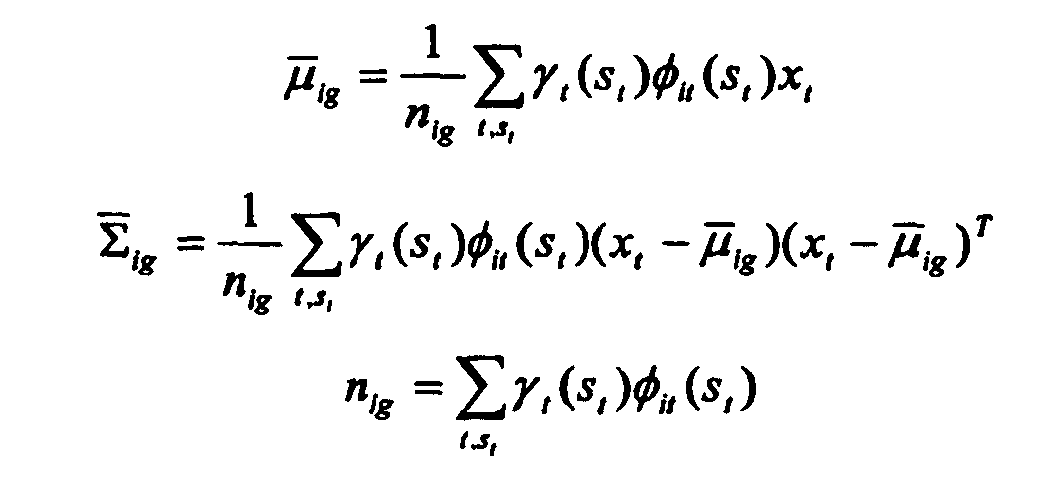 ist,
ist, wobei der Offsetwert b gegeben ist durcheine Einrichtung für das Durchführen eines M-Schrittes: Berechnen der neuen Transformationsparameter Ag (k+1), bg (k+ 1), die erhalten werden durch Lösen der folgenden Gleichungen für jedes g
 wobei die Variablen µ i , σ 2 / i,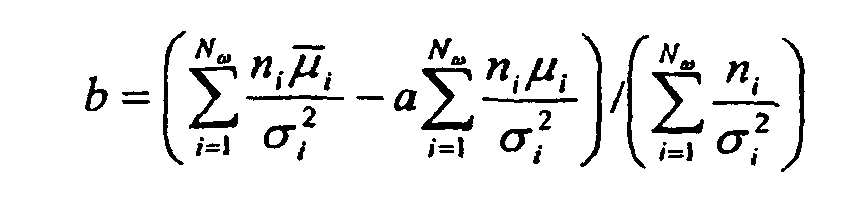
µ i ,σ 2 / i die Elemente der Vektoren und Diagonalmatrizen µ ig , Σ ig ,µ ig ,Σ ig undeine Einrichtung für das Gehen zum E-Schritt, falls ein Konvergenzkriterium nicht erfüllt ist. - System nach Anspruch 1, das weiterhin aufweist:eine Einrichtung für das Speichern einer Mehrzahl von sprecherunabhängigen Modellen, die durch die Trainingsengine für einen individuellen Sprecher trainiert wurden,eine Einrichtung für das Kombinieren von Parametern der sprecheradaptierten Modelle mit Parametern der sprecherunabhängigen Modelle, um verbesserte sprecherabhängige Modelle zu erzeugen.
- System nach Anspruch 7, bei dem die verbesserten Sprecherabhängigen Modelle Parameter haben, die entsprechend der Gleichungen abgeleitet wurden mit der Form:

- Sprecheradaptives Spracherkennungssystem nach Anspruch 8, das weiterhin beinhaltet:eine Mehrzahl von Codebüchern, wobei jedes Codebuch einen Satz von einfachen Wahrscheinlichkeitsfunktionen enthält, wobei jedes Codebuch mit einer Mehrzahl der Zustände verknüpft ist, wobei die Wahrscheinlichkeitsfunktion von jedem der Zustände eine gewichtete Summe der einfachen Wahrscheinlichkeitsfunktion ist, die in deren verknüpftem Codebuch abgelegt sind,eine Einrichtung für das Verwenden der Transformation auf den Satz von Modellen, um einen Satz von sprecheradaptierten Modellen zu erzeugen durch Anwenden der Transformation, die aus einem Zustand abgeleitet ist, an das Codebuch, das mit diesem Zustand verknüpft ist, wodurch das Modell für alle anderen Zustände, die mit diesem Codebuch verknüpft sind, transformiert wird.
- Verfahren zum Entwickeln von Spracherkennungsmodellen, die an einen individuellen Sprecher angepaßt sind, wobei das Verfahren die Schritte aufweist:Bereitstellen eines Satzes von sprecherunabhängigen Modellen, die ausgewählte Untereinheiten der Sprache darstellen, wobei jedes Modell mit einer Mehrzahl von Zuständen verknüpft ist und jeder Zustand mit einer Summe von Wahrscheinlichkeitsfunktionen verknüpft ist, die aus Trainingsdaten bestimmt wurden, wobei die Trainingsdaten aus einer Mehrzahl von Sprechern aus einer Trainingspopulation abgeleitet wurden, wobei die sprecherunabhängigen Modelle in Clustern entsprechend der Wahrscheinlichkeitsfunktionen, die in jedem Cluster durch die sprecherunabhängigen Modelle gemeinsam genutzt werden, angeordnet sind,Sammeln von Sprecheradaptionsdaten entsprechend zumindest einiger, jedoch nicht notwendigerweise aller sprecherunabhängigen Modelle,Erzeugen eines Satzes von sprecheradaptierten Modellen entsprechend der sprecherunabhängigen Modelle, wobei das Erzeugen aufweist:Bewerten, wie gut die Adaptionsmerkmale, die mit erkannten Zuständen in den Adaptionsdaten ausgerichtet sind, durch die entsprechenden Zustände der sprecherunabhängigen Modelle beschrieben werden,gemeinsames Abschätzen einer Mehrzahl von verbesserten Wahrscheinlichkeitsfunktionen für die entsprechenden Cluster der sprecherunabhängigen Modelle basierend auf Adaptionsdaten, die in diesen Clustern für sprecherunabhängige Modelle verfügbar sind,unabhängiges erneutes Abschätzen zumindest einer verbesserten Wahrscheinlichkeitsfunktion für ein sprecherunabhängiges Modell, für das mehr als eine vorbestimmte Grenzmenge von entsprechenden Adaptionsdaten verfügbar ist,Bestimmen einer Transformation entsprechend der verbesserten Wahrscheinlichkeitsfunktionen für das Transformieren des Satzes von sprecherunabhängigen Modellen in den Satz von entsprechenden sprecheradaptierten Modellen undAnwenden der Transformation, um die sprecherangepaßten Modelle zu erzeugen, wobei das Anwenden der Transformation das Erzeugen zumindest eines sprecherangepaßten Modells aufweist, unabhängig davon, wie viele Adaptionsdaten für das entsprechende sprecherunabhängige Modell verfügbar sind.
- Verfahren nach Anspruch 10, wobei die Wahrscheinlichkeitsfunktionen Gauß-Funktionen sind.
- Verfahren nach Anspruch 10, bei dem die Anzahl von Clustern eine willkürliche Zahl ist, die basierend auf Systemressourcen und gewünschten Leistungscharakteristika ausgewählt wird.
- Verfahren nach einem der Ansprüche 10 bis 12, das weiterhin aufweist:Speichern einer Mehrzahl von sprecherabhängigen Modellen, die für einen individuellen Sprecher trainiert wurden,Kombinieren von Parametern der sprecheradaptierten Modelle mit Parametern der sprecherabhängigen Modelle, um verbesserte sprecherabhängige Modelle zu erzeugen.
Applications Claiming Priority (3)
| Application Number | Priority Date | Filing Date | Title |
|---|---|---|---|
| US08/375,908 US5864810A (en) | 1995-01-20 | 1995-01-20 | Method and apparatus for speech recognition adapted to an individual speaker |
| PCT/US1996/000762 WO1996022514A2 (en) | 1995-01-20 | 1996-01-19 | Method and apparatus for speech recognition adapted to an individual speaker |
| US375908 | 1999-08-17 |
Publications (2)
| Publication Number | Publication Date |
|---|---|
| EP0804721A2 EP0804721A2 (de) | 1997-11-05 |
| EP0804721B1 true EP0804721B1 (de) | 2005-12-28 |
Family
ID=23482858
Family Applications (1)
| Application Number | Title | Priority Date | Filing Date |
|---|---|---|---|
| EP96904480A Expired - Lifetime EP0804721B1 (de) | 1995-01-20 | 1996-01-19 | Srecherangepasste spracherkennung |
Country Status (8)
| Country | Link |
|---|---|
| US (1) | US5864810A (de) |
| EP (1) | EP0804721B1 (de) |
| JP (1) | JP4217275B2 (de) |
| AT (1) | ATE314718T1 (de) |
| CA (1) | CA2210887C (de) |
| DE (1) | DE69635655T2 (de) |
| ES (1) | ES2252752T3 (de) |
| WO (1) | WO1996022514A2 (de) |
Families Citing this family (144)
| Publication number | Priority date | Publication date | Assignee | Title |
|---|---|---|---|---|
| US6081660A (en) * | 1995-12-01 | 2000-06-27 | The Australian National University | Method for forming a cohort for use in identification of an individual |
| EP0925579B1 (de) * | 1996-09-10 | 2001-11-28 | Siemens Aktiengesellschaft | Verfahren zur anpassung eines hidden-markov-lautmodelles in einem spracherkennungssystem |
| US6151575A (en) * | 1996-10-28 | 2000-11-21 | Dragon Systems, Inc. | Rapid adaptation of speech models |
| US6128587A (en) * | 1997-01-14 | 2000-10-03 | The Regents Of The University Of California | Method and apparatus using Bayesian subfamily identification for sequence analysis |
| JP3886024B2 (ja) * | 1997-11-19 | 2007-02-28 | 富士通株式会社 | 音声認識装置及びそれを用いた情報処理装置 |
| US6807537B1 (en) * | 1997-12-04 | 2004-10-19 | Microsoft Corporation | Mixtures of Bayesian networks |
| US6073096A (en) * | 1998-02-04 | 2000-06-06 | International Business Machines Corporation | Speaker adaptation system and method based on class-specific pre-clustering training speakers |
| US6148284A (en) * | 1998-02-23 | 2000-11-14 | At&T Corporation | Method and apparatus for automatic speech recognition using Markov processes on curves |
| JP3412496B2 (ja) * | 1998-02-25 | 2003-06-03 | 三菱電機株式会社 | 話者適応化装置と音声認識装置 |
| US6263309B1 (en) * | 1998-04-30 | 2001-07-17 | Matsushita Electric Industrial Co., Ltd. | Maximum likelihood method for finding an adapted speaker model in eigenvoice space |
| US6327565B1 (en) * | 1998-04-30 | 2001-12-04 | Matsushita Electric Industrial Co., Ltd. | Speaker and environment adaptation based on eigenvoices |
| US6343267B1 (en) * | 1998-04-30 | 2002-01-29 | Matsushita Electric Industrial Co., Ltd. | Dimensionality reduction for speaker normalization and speaker and environment adaptation using eigenvoice techniques |
| EP0953971A1 (de) * | 1998-05-01 | 1999-11-03 | Entropic Cambridge Research Laboratory Ltd. | System und Verfahren zur Spracherkennung |
| AU3889799A (en) * | 1998-05-08 | 1999-11-29 | T-Netix, Inc. | Channel estimation system and method for use in automatic speaker verification systems |
| JP3156668B2 (ja) * | 1998-06-19 | 2001-04-16 | 日本電気株式会社 | 音声認識装置 |
| US6269334B1 (en) * | 1998-06-25 | 2001-07-31 | International Business Machines Corporation | Nongaussian density estimation for the classification of acoustic feature vectors in speech recognition |
| US6192337B1 (en) * | 1998-08-14 | 2001-02-20 | International Business Machines Corporation | Apparatus and methods for rejecting confusible words during training associated with a speech recognition system |
| US6185530B1 (en) | 1998-08-14 | 2001-02-06 | International Business Machines Corporation | Apparatus and methods for identifying potential acoustic confusibility among words in a speech recognition system |
| US6269335B1 (en) | 1998-08-14 | 2001-07-31 | International Business Machines Corporation | Apparatus and methods for identifying homophones among words in a speech recognition system |
| US6725195B2 (en) * | 1998-08-25 | 2004-04-20 | Sri International | Method and apparatus for probabilistic recognition using small number of state clusters |
| US6256607B1 (en) * | 1998-09-08 | 2001-07-03 | Sri International | Method and apparatus for automatic recognition using features encoded with product-space vector quantization |
| US8457903B1 (en) | 1999-01-19 | 2013-06-04 | Codexis Mayflower Holdings, Llc | Method and/or apparatus for determining codons |
| US7873477B1 (en) | 2001-08-21 | 2011-01-18 | Codexis Mayflower Holdings, Llc | Method and system using systematically varied data libraries |
| US7702464B1 (en) | 2001-08-21 | 2010-04-20 | Maxygen, Inc. | Method and apparatus for codon determining |
| DE69924596T2 (de) * | 1999-01-20 | 2006-02-09 | Sony International (Europe) Gmbh | Auswahl akustischer Modelle mittels Sprecherverifizierung |
| US6205426B1 (en) * | 1999-01-25 | 2001-03-20 | Matsushita Electric Industrial Co., Ltd. | Unsupervised speech model adaptation using reliable information among N-best strings |
| US6684186B2 (en) * | 1999-01-26 | 2004-01-27 | International Business Machines Corporation | Speaker recognition using a hierarchical speaker model tree |
| WO2000054257A1 (en) * | 1999-03-11 | 2000-09-14 | British Telecommunications Public Limited Company | Speaker recognition |
| US6463413B1 (en) | 1999-04-20 | 2002-10-08 | Matsushita Electrical Industrial Co., Ltd. | Speech recognition training for small hardware devices |
| DE19944325A1 (de) * | 1999-09-15 | 2001-03-22 | Thomson Brandt Gmbh | Verfahren und Vorrichtung zur Spracherkennung |
| KR100307623B1 (ko) * | 1999-10-21 | 2001-11-02 | 윤종용 | 엠.에이.피 화자 적응 조건에서 파라미터의 분별적 추정 방법 및 장치 및 이를 각각 포함한 음성 인식 방법 및 장치 |
| US6526379B1 (en) | 1999-11-29 | 2003-02-25 | Matsushita Electric Industrial Co., Ltd. | Discriminative clustering methods for automatic speech recognition |
| US6571208B1 (en) | 1999-11-29 | 2003-05-27 | Matsushita Electric Industrial Co., Ltd. | Context-dependent acoustic models for medium and large vocabulary speech recognition with eigenvoice training |
| US6466908B1 (en) * | 2000-01-14 | 2002-10-15 | The United States Of America As Represented By The Secretary Of The Navy | System and method for training a class-specific hidden Markov model using a modified Baum-Welch algorithm |
| US6539351B1 (en) * | 2000-02-04 | 2003-03-25 | International Business Machines Corporation | High dimensional acoustic modeling via mixtures of compound gaussians with linear transforms |
| GB0004097D0 (en) * | 2000-02-22 | 2000-04-12 | Ibm | Management of speech technology modules in an interactive voice response system |
| US6789062B1 (en) * | 2000-02-25 | 2004-09-07 | Speechworks International, Inc. | Automatically retraining a speech recognition system |
| US6470314B1 (en) * | 2000-04-06 | 2002-10-22 | International Business Machines Corporation | Method and apparatus for rapid adapt via cumulative distribution function matching for continuous speech |
| US6587824B1 (en) | 2000-05-04 | 2003-07-01 | Visteon Global Technologies, Inc. | Selective speaker adaptation for an in-vehicle speech recognition system |
| US7047196B2 (en) | 2000-06-08 | 2006-05-16 | Agiletv Corporation | System and method of voice recognition near a wireline node of a network supporting cable television and/or video delivery |
| US6751590B1 (en) * | 2000-06-13 | 2004-06-15 | International Business Machines Corporation | Method and apparatus for performing pattern-specific maximum likelihood transformations for speaker recognition |
| US7216077B1 (en) * | 2000-09-26 | 2007-05-08 | International Business Machines Corporation | Lattice-based unsupervised maximum likelihood linear regression for speaker adaptation |
| DE10047718A1 (de) * | 2000-09-27 | 2002-04-18 | Philips Corp Intellectual Pty | Verfahren zur Spracherkennung |
| DE10047723A1 (de) * | 2000-09-27 | 2002-04-11 | Philips Corp Intellectual Pty | Verfahren zur Ermittlung eines Eigenraums zur Darstellung einer Mehrzahl von Trainingssprechern |
| US7454341B1 (en) * | 2000-09-30 | 2008-11-18 | Intel Corporation | Method, apparatus, and system for building a compact model for large vocabulary continuous speech recognition (LVCSR) system |
| EP1197949B1 (de) * | 2000-10-10 | 2004-01-07 | Sony International (Europe) GmbH | Vermeidung von Online-Sprecherüberanpassung bei der Spracherkennung |
| US7003465B2 (en) * | 2000-10-12 | 2006-02-21 | Matsushita Electric Industrial Co., Ltd. | Method for speech recognition, apparatus for the same, and voice controller |
| US7451085B2 (en) | 2000-10-13 | 2008-11-11 | At&T Intellectual Property Ii, L.P. | System and method for providing a compensated speech recognition model for speech recognition |
| US7457750B2 (en) * | 2000-10-13 | 2008-11-25 | At&T Corp. | Systems and methods for dynamic re-configurable speech recognition |
| US7024359B2 (en) * | 2001-01-31 | 2006-04-04 | Qualcomm Incorporated | Distributed voice recognition system using acoustic feature vector modification |
| US8095370B2 (en) * | 2001-02-16 | 2012-01-10 | Agiletv Corporation | Dual compression voice recordation non-repudiation system |
| US6895376B2 (en) * | 2001-05-04 | 2005-05-17 | Matsushita Electric Industrial Co., Ltd. | Eigenvoice re-estimation technique of acoustic models for speech recognition, speaker identification and speaker verification |
| WO2003034281A1 (en) * | 2001-10-19 | 2003-04-24 | Intel Zao | Method and apparatus to provide a hierarchical index for a language model data structure |
| US7209881B2 (en) * | 2001-12-20 | 2007-04-24 | Matsushita Electric Industrial Co., Ltd. | Preparing acoustic models by sufficient statistics and noise-superimposed speech data |
| US7013275B2 (en) * | 2001-12-28 | 2006-03-14 | Sri International | Method and apparatus for providing a dynamic speech-driven control and remote service access system |
| US6687672B2 (en) | 2002-03-15 | 2004-02-03 | Matsushita Electric Industrial Co., Ltd. | Methods and apparatus for blind channel estimation based upon speech correlation structure |
| US7016849B2 (en) * | 2002-03-25 | 2006-03-21 | Sri International | Method and apparatus for providing speech-driven routing between spoken language applications |
| US20030212761A1 (en) * | 2002-05-10 | 2003-11-13 | Microsoft Corporation | Process kernel |
| US7716047B2 (en) * | 2002-10-16 | 2010-05-11 | Sony Corporation | System and method for an automatic set-up of speech recognition engines |
| US7523034B2 (en) * | 2002-12-13 | 2009-04-21 | International Business Machines Corporation | Adaptation of Compound Gaussian Mixture models |
| US7676366B2 (en) * | 2003-01-13 | 2010-03-09 | Art Advanced Recognition Technologies Inc. | Adaptation of symbols |
| US7340396B2 (en) * | 2003-02-18 | 2008-03-04 | Motorola, Inc. | Method and apparatus for providing a speaker adapted speech recognition model set |
| US7499857B2 (en) | 2003-05-15 | 2009-03-03 | Microsoft Corporation | Adaptation of compressed acoustic models |
| US7539617B2 (en) * | 2003-07-01 | 2009-05-26 | France Telecom | Method and system for analysis of vocal signals for a compressed representation of speakers using a probability density representing resemblances between a vocal representation of the speaker in a predetermined model and a predetermined set of vocal representations reference speakers |
| US7480615B2 (en) * | 2004-01-20 | 2009-01-20 | Microsoft Corporation | Method of speech recognition using multimodal variational inference with switching state space models |
| KR100612840B1 (ko) * | 2004-02-18 | 2006-08-18 | 삼성전자주식회사 | 모델 변이 기반의 화자 클러스터링 방법, 화자 적응 방법및 이들을 이용한 음성 인식 장치 |
| EP1810277A1 (de) * | 2004-11-08 | 2007-07-25 | France Telecom S.A. | Verfahren zur verteilten konstruktion eines stimmenerkennungsmodells sowie vorrichtung, server und computerprogramme zu seiner implementierung |
| WO2006076661A2 (en) * | 2005-01-14 | 2006-07-20 | Tremor Media Llc | Dynamic advertisement system and method |
| US7885817B2 (en) | 2005-03-08 | 2011-02-08 | Microsoft Corporation | Easy generation and automatic training of spoken dialog systems using text-to-speech |
| US20060206333A1 (en) * | 2005-03-08 | 2006-09-14 | Microsoft Corporation | Speaker-dependent dialog adaptation |
| US7734471B2 (en) * | 2005-03-08 | 2010-06-08 | Microsoft Corporation | Online learning for dialog systems |
| US7707131B2 (en) * | 2005-03-08 | 2010-04-27 | Microsoft Corporation | Thompson strategy based online reinforcement learning system for action selection |
| US20070033044A1 (en) * | 2005-08-03 | 2007-02-08 | Texas Instruments, Incorporated | System and method for creating generalized tied-mixture hidden Markov models for automatic speech recognition |
| WO2007034478A2 (en) * | 2005-09-20 | 2007-03-29 | Gadi Rechlis | System and method for correcting speech |
| WO2007056344A2 (en) | 2005-11-07 | 2007-05-18 | Scanscout, Inc. | Techiques for model optimization for statistical pattern recognition |
| US20070129943A1 (en) * | 2005-12-06 | 2007-06-07 | Microsoft Corporation | Speech recognition using adaptation and prior knowledge |
| US7539616B2 (en) * | 2006-02-20 | 2009-05-26 | Microsoft Corporation | Speaker authentication using adapted background models |
| US8170868B2 (en) * | 2006-03-14 | 2012-05-01 | Microsoft Corporation | Extracting lexical features for classifying native and non-native language usage style |
| US7877255B2 (en) * | 2006-03-31 | 2011-01-25 | Voice Signal Technologies, Inc. | Speech recognition using channel verification |
| KR100815115B1 (ko) * | 2006-03-31 | 2008-03-20 | 광주과학기술원 | 타 언어권 화자 음성에 대한 음성 인식시스템의 성능향상을 위한 발음 특성에 기반한 음향모델 변환 방법 및이를 이용한 장치 |
| US8214213B1 (en) | 2006-04-27 | 2012-07-03 | At&T Intellectual Property Ii, L.P. | Speech recognition based on pronunciation modeling |
| WO2007142102A1 (ja) * | 2006-05-31 | 2007-12-13 | Nec Corporation | 言語モデル学習システム、言語モデル学習方法、および言語モデル学習用プログラム |
| US20080004876A1 (en) * | 2006-06-30 | 2008-01-03 | Chuang He | Non-enrolled continuous dictation |
| US7689417B2 (en) * | 2006-09-04 | 2010-03-30 | Fortemedia, Inc. | Method, system and apparatus for improved voice recognition |
| US20080109391A1 (en) * | 2006-11-07 | 2008-05-08 | Scanscout, Inc. | Classifying content based on mood |
| US8386254B2 (en) * | 2007-05-04 | 2013-02-26 | Nuance Communications, Inc. | Multi-class constrained maximum likelihood linear regression |
| US20090006085A1 (en) * | 2007-06-29 | 2009-01-01 | Microsoft Corporation | Automated call classification and prioritization |
| US8577996B2 (en) * | 2007-09-18 | 2013-11-05 | Tremor Video, Inc. | Method and apparatus for tracing users of online video web sites |
| US8549550B2 (en) * | 2008-09-17 | 2013-10-01 | Tubemogul, Inc. | Method and apparatus for passively monitoring online video viewing and viewer behavior |
| US8775416B2 (en) * | 2008-01-09 | 2014-07-08 | Yahoo!Inc. | Adapting a context-independent relevance function for identifying relevant search results |
| CN101281746A (zh) * | 2008-03-17 | 2008-10-08 | 黎自奋 | 一个百分之百辨认率的国语单音与句子辨认方法 |
| US20090259551A1 (en) * | 2008-04-11 | 2009-10-15 | Tremor Media, Inc. | System and method for inserting advertisements from multiple ad servers via a master component |
| EP2161718B1 (de) * | 2008-09-03 | 2011-08-31 | Harman Becker Automotive Systems GmbH | Spracherkennung |
| US8645135B2 (en) * | 2008-09-12 | 2014-02-04 | Rosetta Stone, Ltd. | Method for creating a speech model |
| US8145488B2 (en) * | 2008-09-16 | 2012-03-27 | Microsoft Corporation | Parameter clustering and sharing for variable-parameter hidden markov models |
| US9612995B2 (en) | 2008-09-17 | 2017-04-04 | Adobe Systems Incorporated | Video viewer targeting based on preference similarity |
| US8155961B2 (en) | 2008-12-09 | 2012-04-10 | Nokia Corporation | Adaptation of automatic speech recognition acoustic models |
| US9418662B2 (en) * | 2009-01-21 | 2016-08-16 | Nokia Technologies Oy | Method, apparatus and computer program product for providing compound models for speech recognition adaptation |
| EP2216775B1 (de) * | 2009-02-05 | 2012-11-21 | Nuance Communications, Inc. | Sprechererkennung |
| US9026444B2 (en) | 2009-09-16 | 2015-05-05 | At&T Intellectual Property I, L.P. | System and method for personalization of acoustic models for automatic speech recognition |
| US20110093783A1 (en) * | 2009-10-16 | 2011-04-21 | Charles Parra | Method and system for linking media components |
| EP2502195A2 (de) * | 2009-11-20 | 2012-09-26 | Tadashi Yonezaki | Verfahren und vorrichtung zur optimierung einer zuweisung von werbeinhalten |
| US9478216B2 (en) | 2009-12-08 | 2016-10-25 | Nuance Communications, Inc. | Guest speaker robust adapted speech recognition |
| GB2480084B (en) * | 2010-05-05 | 2012-08-08 | Toshiba Res Europ Ltd | A speech processing system and method |
| US8725506B2 (en) * | 2010-06-30 | 2014-05-13 | Intel Corporation | Speech audio processing |
| US9785613B2 (en) * | 2011-12-19 | 2017-10-10 | Cypress Semiconductor Corporation | Acoustic processing unit interface for determining senone scores using a greater clock frequency than that corresponding to received audio |
| US9324323B1 (en) | 2012-01-13 | 2016-04-26 | Google Inc. | Speech recognition using topic-specific language models |
| US8965763B1 (en) | 2012-02-02 | 2015-02-24 | Google Inc. | Discriminative language modeling for automatic speech recognition with a weak acoustic model and distributed training |
| US8543398B1 (en) | 2012-02-29 | 2013-09-24 | Google Inc. | Training an automatic speech recognition system using compressed word frequencies |
| US8775177B1 (en) * | 2012-03-08 | 2014-07-08 | Google Inc. | Speech recognition process |
| US8838448B2 (en) * | 2012-04-05 | 2014-09-16 | Nuance Communications, Inc. | Forced/predictable adaptation for speech recognition |
| US8374865B1 (en) | 2012-04-26 | 2013-02-12 | Google Inc. | Sampling training data for an automatic speech recognition system based on a benchmark classification distribution |
| US9406299B2 (en) * | 2012-05-08 | 2016-08-02 | Nuance Communications, Inc. | Differential acoustic model representation and linear transform-based adaptation for efficient user profile update techniques in automatic speech recognition |
| TWI466101B (zh) * | 2012-05-18 | 2014-12-21 | Asustek Comp Inc | 語音識別方法及系統 |
| US8571859B1 (en) * | 2012-05-31 | 2013-10-29 | Google Inc. | Multi-stage speaker adaptation |
| US8805684B1 (en) * | 2012-05-31 | 2014-08-12 | Google Inc. | Distributed speaker adaptation |
| US8880398B1 (en) | 2012-07-13 | 2014-11-04 | Google Inc. | Localized speech recognition with offload |
| US9946699B1 (en) * | 2012-08-29 | 2018-04-17 | Intuit Inc. | Location-based speech recognition for preparation of electronic tax return |
| US9123333B2 (en) | 2012-09-12 | 2015-09-01 | Google Inc. | Minimum bayesian risk methods for automatic speech recognition |
| US9564125B2 (en) * | 2012-11-13 | 2017-02-07 | GM Global Technology Operations LLC | Methods and systems for adapting a speech system based on user characteristics |
| WO2014097748A1 (ja) | 2012-12-18 | 2014-06-26 | インターナショナル・ビジネス・マシーンズ・コーポレーション | 特定の話者の音声を加工するための方法、並びに、その電子装置システム及び電子装置用プログラム |
| US9922639B1 (en) | 2013-01-11 | 2018-03-20 | Amazon Technologies, Inc. | User feedback for speech interactions |
| US20140222423A1 (en) * | 2013-02-07 | 2014-08-07 | Nuance Communications, Inc. | Method and Apparatus for Efficient I-Vector Extraction |
| US9406298B2 (en) * | 2013-02-07 | 2016-08-02 | Nuance Communications, Inc. | Method and apparatus for efficient i-vector extraction |
| US9865266B2 (en) * | 2013-02-25 | 2018-01-09 | Nuance Communications, Inc. | Method and apparatus for automated speaker parameters adaptation in a deployed speaker verification system |
| DK2797078T3 (en) * | 2013-04-26 | 2017-01-23 | Agnitio S L | Assessment of reliability in speech recognition |
| US9258425B2 (en) | 2013-05-22 | 2016-02-09 | Nuance Communications, Inc. | Method and system for speaker verification |
| WO2017060828A1 (en) | 2015-10-08 | 2017-04-13 | Cordio Medical Ltd. | Assessment of a pulmonary condition by speech analysis |
| CN107564513B (zh) * | 2016-06-30 | 2020-09-08 | 阿里巴巴集团控股有限公司 | 语音识别方法及装置 |
| US10847177B2 (en) | 2018-10-11 | 2020-11-24 | Cordio Medical Ltd. | Estimating lung volume by speech analysis |
| US10803875B2 (en) | 2019-02-08 | 2020-10-13 | Nec Corporation | Speaker recognition system and method of using the same |
| US12494224B2 (en) | 2019-03-12 | 2025-12-09 | Cordio Medical Ltd. | Analyzing speech using speech-sample alignment and segmentation based on acoustic features |
| US12512114B2 (en) | 2019-03-12 | 2025-12-30 | Cordio Medical Ltd. | Analyzing speech using speech models and segmentation based on acoustic features |
| US11011188B2 (en) | 2019-03-12 | 2021-05-18 | Cordio Medical Ltd. | Diagnostic techniques based on speech-sample alignment |
| US12488805B2 (en) | 2019-03-12 | 2025-12-02 | Cordio Medical Ltd. | Using optimal articulatory event-types for computer analysis of speech |
| US11024327B2 (en) | 2019-03-12 | 2021-06-01 | Cordio Medical Ltd. | Diagnostic techniques based on speech models |
| KR102913056B1 (ko) * | 2019-12-18 | 2026-01-15 | 엘지전자 주식회사 | 신규 도메인의 간투어 검출 모델 생성 방법 및 장치 |
| US11484211B2 (en) | 2020-03-03 | 2022-11-01 | Cordio Medical Ltd. | Diagnosis of medical conditions using voice recordings and auscultation |
| US10841424B1 (en) | 2020-05-14 | 2020-11-17 | Bank Of America Corporation | Call monitoring and feedback reporting using machine learning |
| US11417342B2 (en) * | 2020-06-29 | 2022-08-16 | Cordio Medical Ltd. | Synthesizing patient-specific speech models |
| US12334105B2 (en) | 2020-11-23 | 2025-06-17 | Cordio Medical Ltd. | Detecting impaired physiological function by speech analysis |
| CN112599121B (zh) * | 2020-12-03 | 2023-06-20 | 天津大学 | 基于辅助数据正则化的说话人自适应方法 |
| US12518774B2 (en) | 2023-02-05 | 2026-01-06 | Cordio Medical Ltd. | Identifying optimal articulatory event-types for computer analysis of speech |
| US12555595B2 (en) | 2023-05-18 | 2026-02-17 | Cordio Medical Ltd. | Converting a sequence of speech records of a human subject into a sequence of indicators of a physiological state of the subject |
Family Cites Families (10)
| Publication number | Priority date | Publication date | Assignee | Title |
|---|---|---|---|---|
| JPS62232000A (ja) * | 1986-03-25 | 1987-10-12 | インタ−ナシヨナル・ビジネス・マシ−ンズ・コ−ポレ−シヨン | 音声認識装置 |
| JPS62231993A (ja) * | 1986-03-25 | 1987-10-12 | インタ−ナシヨナル ビジネス マシ−ンズ コ−ポレ−シヨン | 音声認識方法 |
| US4817156A (en) * | 1987-08-10 | 1989-03-28 | International Business Machines Corporation | Rapidly training a speech recognizer to a subsequent speaker given training data of a reference speaker |
| JPH01102599A (ja) * | 1987-10-12 | 1989-04-20 | Internatl Business Mach Corp <Ibm> | 音声認識方法 |
| JPH0636156B2 (ja) * | 1989-03-13 | 1994-05-11 | インターナショナル・ビジネス・マシーンズ・コーポレーション | 音声認識装置 |
| US4977598A (en) * | 1989-04-13 | 1990-12-11 | Texas Instruments Incorporated | Efficient pruning algorithm for hidden markov model speech recognition |
| US5075896A (en) * | 1989-10-25 | 1991-12-24 | Xerox Corporation | Character and phoneme recognition based on probability clustering |
| US5450523A (en) * | 1990-11-15 | 1995-09-12 | Matsushita Electric Industrial Co., Ltd. | Training module for estimating mixture Gaussian densities for speech unit models in speech recognition systems |
| EP0515709A1 (de) * | 1991-05-27 | 1992-12-02 | International Business Machines Corporation | Verfahren und Einrichtung zur Darstellung von Segmenteinheiten zur Text-Sprache-Umsetzung |
| US5199077A (en) * | 1991-09-19 | 1993-03-30 | Xerox Corporation | Wordspotting for voice editing and indexing |
-
1995
- 1995-01-20 US US08/375,908 patent/US5864810A/en not_active Expired - Lifetime
-
1996
- 1996-01-19 ES ES96904480T patent/ES2252752T3/es not_active Expired - Lifetime
- 1996-01-19 DE DE69635655T patent/DE69635655T2/de not_active Expired - Lifetime
- 1996-01-19 WO PCT/US1996/000762 patent/WO1996022514A2/en not_active Ceased
- 1996-01-19 AT AT96904480T patent/ATE314718T1/de not_active IP Right Cessation
- 1996-01-19 CA CA002210887A patent/CA2210887C/en not_active Expired - Lifetime
- 1996-01-19 EP EP96904480A patent/EP0804721B1/de not_active Expired - Lifetime
- 1996-01-19 JP JP52240696A patent/JP4217275B2/ja not_active Expired - Fee Related
Non-Patent Citations (2)
| Title |
|---|
| HUANG X.; LEE K.F.: "On speaker-independent, speaker-dependent, and speaker-adaptive speech recognition", IEEE TRANSACTIONS ON SPEECH AND AUDIO PROCESSING, vol. 1, no. 2, April 1993 (1993-04-01), pages 150 - 157 * |
| LEGGETTER C.J.; WOODLAND P.C.: "Speaker adaptation of continuous density HMMs using multivariate linear regression", ICSLP 1994, vol. 2, 18 September 1994 (1994-09-18), YOKOHAMA : ASJ, JP, pages 451 - 454, XP000855283 * |
Also Published As
| Publication number | Publication date |
|---|---|
| EP0804721A2 (de) | 1997-11-05 |
| JPH10512686A (ja) | 1998-12-02 |
| DE69635655D1 (de) | 2006-02-02 |
| ATE314718T1 (de) | 2006-01-15 |
| ES2252752T3 (es) | 2006-05-16 |
| JP4217275B2 (ja) | 2009-01-28 |
| DE69635655T2 (de) | 2006-09-14 |
| WO1996022514A3 (en) | 1996-09-26 |
| CA2210887A1 (en) | 1996-07-25 |
| WO1996022514A2 (en) | 1996-07-25 |
| CA2210887C (en) | 2009-03-31 |
| US5864810A (en) | 1999-01-26 |
Similar Documents
| Publication | Publication Date | Title |
|---|---|---|
| US5864810A (en) | Method and apparatus for speech recognition adapted to an individual speaker | |
| WO1996022514A9 (en) | Method and apparatus for speech recognition adapted to an individual speaker | |
| Chesta et al. | Maximum a posteriori linear regression for hidden Markov model adaptation. | |
| US6151574A (en) | Technique for adaptation of hidden markov models for speech recognition | |
| US5839105A (en) | Speaker-independent model generation apparatus and speech recognition apparatus each equipped with means for splitting state having maximum increase in likelihood | |
| EP0771461B1 (de) | Verfahren und vorrichtung zur spracherkennung mittels optimierter partieller buendelung von wahrscheinlichkeitsmischungen | |
| EP1269464B1 (de) | Diskriminatives Trainieren von Hidden Markov Modellen für die Erkennung fliessender Sprache | |
| US6260013B1 (en) | Speech recognition system employing discriminatively trained models | |
| EP0635820B1 (de) | Training von kombinierten Kettenmodellen mit minimaler Fehlerrate | |
| EP2189976B1 (de) | Verfahren zur Adaption eines Codierungsbuches für Spracherkennung | |
| US5794192A (en) | Self-learning speaker adaptation based on spectral bias source decomposition, using very short calibration speech | |
| EP0866442A2 (de) | Kombination von nichtlinearer Frequenzverzerrung und spektraler Formung in einem Markov basierten Spracherkenner | |
| US20080300875A1 (en) | Efficient Speech Recognition with Cluster Methods | |
| Gunawardana et al. | Discriminative speaker adaptation with conditional maximum likelihood linear regression. | |
| US20020152069A1 (en) | Apparatus and method for robust pattern recognition | |
| US20030055640A1 (en) | System and method for parameter estimation for pattern recognition | |
| US5946656A (en) | Speech and speaker recognition using factor analysis to model covariance structure of mixture components | |
| Hazen | A comparison of novel techniques for rapid speaker adaptation | |
| Kim et al. | Using VTLN for broadcast news transcription | |
| US6148284A (en) | Method and apparatus for automatic speech recognition using Markov processes on curves | |
| Sankar | Experiments with a Gaussian merging-splitting algorithm for HMM training for speech recognition | |
| Lee et al. | Bayesian adaptive learning and MAP estimation of HMM | |
| Zhang et al. | Recent progress on the discriminative region-dependent transform for speech feature extraction. | |
| Cui et al. | Stereo hidden Markov modeling for noise robust speech recognition | |
| Furui | Generalization problem in ASR acoustic model training and adaptation |
Legal Events
| Date | Code | Title | Description |
|---|---|---|---|
| PUAI | Public reference made under article 153(3) epc to a published international application that has entered the european phase |
Free format text: ORIGINAL CODE: 0009012 |
|
| 17P | Request for examination filed |
Effective date: 19970731 |
|
| AK | Designated contracting states |
Kind code of ref document: A2 Designated state(s): AT BE CH DE DK ES FR GB GR IE IT LI LU MC NL PT SE |
|
| RIN1 | Information on inventor provided before grant (corrected) |
Inventor name: RTISCHEV, DIMITRY Inventor name: NEUMEYER, LEONARDO Inventor name: DIGALAKIS, VASSILIOS |
|
| 17Q | First examination report despatched |
Effective date: 20030811 |
|
| GRAP | Despatch of communication of intention to grant a patent |
Free format text: ORIGINAL CODE: EPIDOSNIGR1 |
|
| RIC1 | Information provided on ipc code assigned before grant |
Ipc: 7G 10L 15/06 A |
|
| RTI1 | Title (correction) |
Free format text: SPEAKER ADAPTIVE SPEECH RECOGNITION |
|
| GRAS | Grant fee paid |
Free format text: ORIGINAL CODE: EPIDOSNIGR3 |
|
| GRAA | (expected) grant |
Free format text: ORIGINAL CODE: 0009210 |
|
| AK | Designated contracting states |
Kind code of ref document: B1 Designated state(s): AT BE CH DE DK ES FR GB GR IE IT LI LU MC NL PT SE |
|
| PG25 | Lapsed in a contracting state [announced via postgrant information from national office to epo] |
Ref country code: NL Free format text: LAPSE BECAUSE OF FAILURE TO SUBMIT A TRANSLATION OF THE DESCRIPTION OR TO PAY THE FEE WITHIN THE PRESCRIBED TIME-LIMIT Effective date: 20051228 Ref country code: BE Free format text: LAPSE BECAUSE OF FAILURE TO SUBMIT A TRANSLATION OF THE DESCRIPTION OR TO PAY THE FEE WITHIN THE PRESCRIBED TIME-LIMIT Effective date: 20051228 Ref country code: AT Free format text: LAPSE BECAUSE OF FAILURE TO SUBMIT A TRANSLATION OF THE DESCRIPTION OR TO PAY THE FEE WITHIN THE PRESCRIBED TIME-LIMIT Effective date: 20051228 |
|
| REG | Reference to a national code |
Ref country code: GB Ref legal event code: FG4D |
|
| REG | Reference to a national code |
Ref country code: CH Ref legal event code: EP |
|
| REG | Reference to a national code |
Ref country code: IE Ref legal event code: FG4D |
|
| PG25 | Lapsed in a contracting state [announced via postgrant information from national office to epo] |
Ref country code: MC Free format text: LAPSE BECAUSE OF NON-PAYMENT OF DUE FEES Effective date: 20060131 Ref country code: LU Free format text: LAPSE BECAUSE OF NON-PAYMENT OF DUE FEES Effective date: 20060131 |
|
| REF | Corresponds to: |
Ref document number: 69635655 Country of ref document: DE Date of ref document: 20060202 Kind code of ref document: P |
|
| REG | Reference to a national code |
Ref country code: CH Ref legal event code: NV Representative=s name: MICHELI & CIE INGENIEURS-CONSEILS |
|
| PG25 | Lapsed in a contracting state [announced via postgrant information from national office to epo] |
Ref country code: SE Free format text: LAPSE BECAUSE OF FAILURE TO SUBMIT A TRANSLATION OF THE DESCRIPTION OR TO PAY THE FEE WITHIN THE PRESCRIBED TIME-LIMIT Effective date: 20060328 Ref country code: GR Free format text: LAPSE BECAUSE OF FAILURE TO SUBMIT A TRANSLATION OF THE DESCRIPTION OR TO PAY THE FEE WITHIN THE PRESCRIBED TIME-LIMIT Effective date: 20060328 Ref country code: DK Free format text: LAPSE BECAUSE OF FAILURE TO SUBMIT A TRANSLATION OF THE DESCRIPTION OR TO PAY THE FEE WITHIN THE PRESCRIBED TIME-LIMIT Effective date: 20060328 |
|
| REG | Reference to a national code |
Ref country code: ES Ref legal event code: FG2A Ref document number: 2252752 Country of ref document: ES Kind code of ref document: T3 |
|
| PG25 | Lapsed in a contracting state [announced via postgrant information from national office to epo] |
Ref country code: PT Free format text: LAPSE BECAUSE OF FAILURE TO SUBMIT A TRANSLATION OF THE DESCRIPTION OR TO PAY THE FEE WITHIN THE PRESCRIBED TIME-LIMIT Effective date: 20060529 |
|
| NLV1 | Nl: lapsed or annulled due to failure to fulfill the requirements of art. 29p and 29m of the patents act | ||
| ET | Fr: translation filed | ||
| PLBE | No opposition filed within time limit |
Free format text: ORIGINAL CODE: 0009261 |
|
| STAA | Information on the status of an ep patent application or granted ep patent |
Free format text: STATUS: NO OPPOSITION FILED WITHIN TIME LIMIT |
|
| 26N | No opposition filed |
Effective date: 20060929 |
|
| PGFP | Annual fee paid to national office [announced via postgrant information from national office to epo] |
Ref country code: CH Payment date: 20120125 Year of fee payment: 17 Ref country code: IE Payment date: 20120126 Year of fee payment: 17 Ref country code: FR Payment date: 20120130 Year of fee payment: 17 |
|
| PGFP | Annual fee paid to national office [announced via postgrant information from national office to epo] |
Ref country code: IT Payment date: 20120124 Year of fee payment: 17 |
|
| PGFP | Annual fee paid to national office [announced via postgrant information from national office to epo] |
Ref country code: ES Payment date: 20120126 Year of fee payment: 17 |
|
| REG | Reference to a national code |
Ref country code: CH Ref legal event code: PL |
|
| REG | Reference to a national code |
Ref country code: IE Ref legal event code: MM4A |
|
| REG | Reference to a national code |
Ref country code: FR Ref legal event code: ST Effective date: 20130930 |
|
| PG25 | Lapsed in a contracting state [announced via postgrant information from national office to epo] |
Ref country code: LI Free format text: LAPSE BECAUSE OF NON-PAYMENT OF DUE FEES Effective date: 20130131 Ref country code: CH Free format text: LAPSE BECAUSE OF NON-PAYMENT OF DUE FEES Effective date: 20130131 |
|
| PG25 | Lapsed in a contracting state [announced via postgrant information from national office to epo] |
Ref country code: FR Free format text: LAPSE BECAUSE OF NON-PAYMENT OF DUE FEES Effective date: 20130131 |
|
| PG25 | Lapsed in a contracting state [announced via postgrant information from national office to epo] |
Ref country code: IT Free format text: LAPSE BECAUSE OF NON-PAYMENT OF DUE FEES Effective date: 20130119 |
|
| PG25 | Lapsed in a contracting state [announced via postgrant information from national office to epo] |
Ref country code: IE Free format text: LAPSE BECAUSE OF NON-PAYMENT OF DUE FEES Effective date: 20130119 |
|
| REG | Reference to a national code |
Ref country code: ES Ref legal event code: FD2A Effective date: 20140324 |
|
| PGFP | Annual fee paid to national office [announced via postgrant information from national office to epo] |
Ref country code: DE Payment date: 20140129 Year of fee payment: 19 |
|
| PG25 | Lapsed in a contracting state [announced via postgrant information from national office to epo] |
Ref country code: ES Free format text: LAPSE BECAUSE OF NON-PAYMENT OF DUE FEES Effective date: 20130120 |
|
| PGFP | Annual fee paid to national office [announced via postgrant information from national office to epo] |
Ref country code: GB Payment date: 20140127 Year of fee payment: 19 |
|
| REG | Reference to a national code |
Ref country code: DE Ref legal event code: R119 Ref document number: 69635655 Country of ref document: DE |
|
| GBPC | Gb: european patent ceased through non-payment of renewal fee |
Effective date: 20150119 |
|
| PG25 | Lapsed in a contracting state [announced via postgrant information from national office to epo] |
Ref country code: DE Free format text: LAPSE BECAUSE OF NON-PAYMENT OF DUE FEES Effective date: 20150801 Ref country code: GB Free format text: LAPSE BECAUSE OF NON-PAYMENT OF DUE FEES Effective date: 20150119 |