EP0953971A1 - System und Verfahren zur Spracherkennung - Google Patents
System und Verfahren zur Spracherkennung Download PDFInfo
- Publication number
- EP0953971A1 EP0953971A1 EP98303440A EP98303440A EP0953971A1 EP 0953971 A1 EP0953971 A1 EP 0953971A1 EP 98303440 A EP98303440 A EP 98303440A EP 98303440 A EP98303440 A EP 98303440A EP 0953971 A1 EP0953971 A1 EP 0953971A1
- Authority
- EP
- European Patent Office
- Prior art keywords
- state
- log
- likelihood
- output
- representing
- Prior art date
- Legal status (The legal status is an assumption and is not a legal conclusion. Google has not performed a legal analysis and makes no representation as to the accuracy of the status listed.)
- Withdrawn
Links
- 238000000034 method Methods 0.000 title claims abstract description 61
- 239000000203 mixture Substances 0.000 claims abstract description 86
- 239000013598 vector Substances 0.000 claims abstract description 54
- 238000012545 processing Methods 0.000 claims abstract description 18
- 238000005315 distribution function Methods 0.000 claims description 11
- 238000003491 array Methods 0.000 claims description 7
- 241001505523 Gekko gecko Species 0.000 claims description 3
- 238000009826 distribution Methods 0.000 description 13
- 238000011156 evaluation Methods 0.000 description 12
- 238000004364 calculation method Methods 0.000 description 10
- 230000006870 function Effects 0.000 description 2
- 238000010606 normalization Methods 0.000 description 2
- 230000008569 process Effects 0.000 description 2
- 238000012549 training Methods 0.000 description 2
- 230000008901 benefit Effects 0.000 description 1
- 230000001419 dependent effect Effects 0.000 description 1
- 230000008030 elimination Effects 0.000 description 1
- 238000003379 elimination reaction Methods 0.000 description 1
- 230000014509 gene expression Effects 0.000 description 1
- 238000003064 k means clustering Methods 0.000 description 1
- 239000011159 matrix material Substances 0.000 description 1
- 230000007246 mechanism Effects 0.000 description 1
- 230000009467 reduction Effects 0.000 description 1
- 238000001228 spectrum Methods 0.000 description 1
- 238000012360 testing method Methods 0.000 description 1
- 230000009466 transformation Effects 0.000 description 1
Images

Classifications
-
- G—PHYSICS
- G10—MUSICAL INSTRUMENTS; ACOUSTICS
- G10L—SPEECH ANALYSIS TECHNIQUES OR SPEECH SYNTHESIS; SPEECH RECOGNITION; SPEECH OR VOICE PROCESSING TECHNIQUES; SPEECH OR AUDIO CODING OR DECODING
- G10L15/00—Speech recognition
- G10L15/08—Speech classification or search
- G10L15/14—Speech classification or search using statistical models, e.g. Hidden Markov Models [HMMs]
- G10L15/142—Hidden Markov Models [HMMs]
- G10L15/144—Training of HMMs
-
- G—PHYSICS
- G10—MUSICAL INSTRUMENTS; ACOUSTICS
- G10L—SPEECH ANALYSIS TECHNIQUES OR SPEECH SYNTHESIS; SPEECH RECOGNITION; SPEECH OR VOICE PROCESSING TECHNIQUES; SPEECH OR AUDIO CODING OR DECODING
- G10L15/00—Speech recognition
- G10L15/08—Speech classification or search
- G10L15/10—Speech classification or search using distance or distortion measures between unknown speech and reference templates
Definitions
- the present invention relates to a system and methods for employment in speech recognition.
- HMMs Hidden Markov Models
- An alternative system uses a discrete probability distribution (rather than the usual continuous one) for each possible output state. This is because with a discrete distribution a simple table look-up is all that is needed to determine the likelihood of each output state corresponding to the input speech. There is, however, a considerable reduction in accuracy, compared to the employment of continuous probability distributions.
- evaluation of the likelihood of the various output states corresponding to the speech vector is achieved by evaluating the likelihood of each mixture component and then summing these likelihoods for the respective output state. Repeating this for all possible output states determines the likelihood of each output state, but is computationally very expensive.
- the present invention is directed towards systems using continuous probability distributions and their methods and seeks to overcome some of the problems associated with them, such as their need for high processing speed and large amounts of processing capability.
- a method of processing speech comprising:
- a method of processing speech comprising:
- a method of processing speech comprising:
- the present invention processes speech by generating a speech vector representing a sample of the speech to be processed, and then determining which of a number of possible output states most closely represents the speech vector.
- the grammar and dictionary together specify the possible sequences of states.
- the likelihood of the input speech matching different state sequences together with the known probability of different word sequences can be combined to find the word sequence which best matches the input speech.
- the comparison of the speech vector with each of the possible output states is a computationally expensive task.
- the cost of the calculation can be reduced by simplifying the calculation required for each of the possible output states.
- the invention uses a broad state classification which can be determined using a predetermined look up table. This indicates the approximate likelihood of each output state depending on which of the generic components most closely represents the input speech vector.
- This classification can then be used to control the accuracy with which a state is evaluated.
- a simple approximation such as the use of a constant value, is acceptable.
- the state is somewhat unlikely more accuracy is required and just one of the many components comprising the state probability distribution can be evaluated and used to approximate the actual state likelihood.
- evaluation of the more likely states uses a simplified (but approximate) mechanism for determining which of the state's many mixture components need to be evaluated to maintain the accuracy of the final state likelihood value.
- the invention also uses a small number of generic distributions together with state mixture component specific weights to approximate the actual state distribution. Using this technique the approximation for each state mixture component is evaluated by comparing the scalar product of the state mixture component specific weights with the likelihood and each of the generic probability distribution functions with a fixed threshold. This procedure is repeated for each component of each state being considered and only for those components for with the product exceeds the threshold does the accurate likelihood need to be calculated.
- the invention also allows fast determination of whether a scalar product exceeds a threshold. By using single bit approximations many terms in the scalar product can be combined into a single computer word and evaluated in one operation.
- the system shown in Figure 1 comprises a microphone 10 which is coupled to a decoder 14, via an acoustic processing unit 12.
- the decoder 14, which operates to decode input speech received via the processing unit 12, is connected a computer terminal 16 which is able to display the decoded speech or use the speech as input commands allowing the computer operation to be controlled.
- speech is spoken into the microphone 10 which generates an analogue signal representing the speech waveform.
- This analogue signal is fed to the acoustic processing unit 12 which samples the speech waveform at a rate of approximately 16kHz, although this will depend on the specific implementation of the system.
- the acoustic processing unit 12 divides the sampled speech into frames of approximately 10ms duration, which are referred to as speech vectors (o r ). Each frame undergoes a Fast Fourier transform (fft) so as to generate a power spectrum, which is in turn parameterised to generate a set of Cepstral Parameters. Each set of Cepstral Parameters, which corresponds to a respective frame of speech, is transferred to the decoding unit 14.
- fft Fast Fourier transform
- the cepstral parameters used are mel-frequency cepstral coefficient parameters which are a cosine transformation of mel-frequency scaled filterbank amplitudes followed by a channel normalisation operation and appended with delta and delta-delta versions of the same parameters.
- mel-frequency cepstral coefficient parameters which are a cosine transformation of mel-frequency scaled filterbank amplitudes followed by a channel normalisation operation and appended with delta and delta-delta versions of the same parameters.
- the decoding unit 14 comprises a processor 20, a language model processing unit 22 and a memory 24. These components are connected via a bus 26 which is also coupled to the acoustic processing unit 12 and the computer terminal 16.
- the set of Cepstral parameters for a given speech vector (o r ) are transferred to the processor 20.
- the processor 20 compares the speech vector (o r ) defined by the set of Cepstral parameters to a number of possible output states (j), details of which are stored in the memory 24. By determining which output state (j) most closely matches the input speech vector (o r ), the processor 20 effectively decodes the input speech by combining state likelihoods to generate an indication of the most likely word sequence which is transferred to the computer terminal 16, via the bus 26.
- Each output state (j), to which the processor 20 compares the speech vector (o r ), is represented by a mixture of a number of probability density functions known as state mixture components (m).
- state mixture components a number of probability density functions known as state mixture components (m).
- output states (j) there can be many thousands of output states (j), with each output state having any number of different state mixture components associated therewith. In the present example, there are 2200 output states (j), each having 10 mixture components (m).
- Each probability distribution function is approximated by a weighted sum of a number of shared generic probability distribution functions (x).
- both the shared generic and the state mixture component probability distribution functions used are Gaussians, although Laplacian or other distributions could also be used.
- the weighted sum is defined by respective weighting parameters (w jmx ) which are associated with each generic component (x) for each state (j) for each mixture component (m).
- the generic components (x) and the weighting parameters (w jmx ) are stored in the memory 24.
- the weighting parameters (w jmx ) are determined in one of two ways. Either, the weights of the state mixture components (m) are determined from training data and the respective weighting parameters (w jmx ) calculated accordingly. Or, the weighting parameters (w jmx ) may be determined directly from normal model set parameters. This latter procedure means no access to training data is required.
- the example system requires the set of generic probability distribution functions (generic components), which are used to approximate the various state mixture components (m), to be calculated. For most practical systems, there will be in the region of 50 to 200 predefined generic components (x) and these are stored in the memory 24.
- generic probability distribution functions generator components
- a set of state classification tables is also required providing, in this example, a classification (C j [x]) of "poor”, “okay”, or “good” for each output state (j), along with a set of best state mixture component tables, which identify the most dominant state mixture component (B j [x]) (i.e. the state mixture component (m) that contributes most to the overall output state likelihood) for respective output states (j).
- C j [x] classification of "poor”, “okay”, or "good” for each output state (j)
- B j [x] the most dominant state mixture component
- m state mixture component
- weighting parameters (w jmx ) for each generic component (x) for each state mixture component (m) or the single bit approximation to them explained later are also stored in the memory 24.
- the generic distributions are found by performing a standard K-means clustering of the continuous density HMM system state mixture component mean vectors and computing a global variance for the input speech vectors. This is a well known technique.
- Each state classification table is generated, for a respective output state (j) by considering if a selected generic component (x) were the "most likely" generic component (i.e. the generic component which has the most in common with the input speech vector), what would be the probability or likelihood of the respective output state (j) being the output state that most closely represents the input speech vector (o r ).
- each state classification table provides an indication of the likelihood of the respective output state (j) being the actual output state, for any "most likely” generic component (x).
- the matrix used to compute L 2 XM is deliberately weighted towards the case that the possible output state (j) is relatively unlikely, since choosing the best component correctly is most important in the case in which the probability of only one state mixture component (m) is evaluated.
- the weighting parameters (w jmx ) for each generic component (x) of each state mixture component (m) are determined by approximating the probability distribution of the state mixture component (m) to a weighted sum of the generic components (x).
- the generic weights could be determined in other ways, such as the use of a conventional Baum-Welch re-estimation, or computed from the continuous distribution. Employment of the above formulae has, however, the benefit of allowing rapid re- calculation of the generic weights if the HMM parameters are adapted during recognition.
- the processor 20 computes the required state likelihoods as follows.
- the relative likelihoods (probabilities) (P r x ) of each of the generic components (x) being the actual speech vector (o r ) are computed, using:
- the index of the most likely generic component I r for the respective speech vector (o r ) is subsequently used to index the state classification and best state mixture component tables described above.
- the state classification table can be used to obtain the likelihood classification (C r j [x]) of any possible output state (j) being the output state which represents the input speech vector (o r ).
- the best generic component table indicates the most dominant state mixture component (B r j [x]) which contributes most to the overall likelihood each output state (j).
- the likelihood is calculated based on the likelihood of a single state mixture component (m) of the state. By selecting the most dominant state mixture component (m) this ensures this simplified likelihood is a reasonably accurate approximation of the actual state likelihood.
- the likelihoods are combined with language model probabilities transferred from the language model processing unit 22.
- the combined likelihoods are then used together with the constraints on state sequences specified by the dictionary and grammar, to determine the most probable word sequence. An indication of this is then transferred to the computer terminal 16.
- the present invention reduces the amount of computation required reducing the computation to a small number of bits and making use of the processors ability to process many bits in parallel.
- the first step is by carrying out the calculation in the log domain.
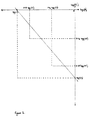
- the second is to approximate the comparison by specifying that it is only true if any individual term exceeds the threshold (clearly in this case the sum does exceed the threshold although some cases in which the accurate comparison is true will be missed).
- the comparison of a sum A+B and a threshold T can be reduced to a single bit AND operation where, as in this case, A, B and T all have a negative value.
- each term in the product is represented by single bits in respective bit arrays for the respective values A i and B i . If all calculations are carried out using 32 bit words by the processor 20, then this allows 32 calculations to be carried out simultaneously.
- each bit of a first bit array is set equal to "1" if the respective weighting parameter Wjmx exceeds a threshold and for the generic component likelihoods each bit of a second bit array is set equal to "1" if the respective probability Prx exceeds a threshold.
- each respective generic component (x) of the weighted sum defining the state mixture component (m) is set based on:
- a similar procedure is used to set the bit of the corresponding respective weighting parameters W jmx . Accordingly, the first and second bit arrays are then combined using a logical AND operation such that the bits of the weighting parameters and respective generic components are logically ANDed. If the resultant bit has a value "1", the term A i + B i exceeds the threshold T.
- each bit array two bits of each bit array are defined for each term of the weighted sum which defines the respective state mixture component (m).
- the first bit is set equal to "1” if: and the second bit is set equal to "1" if:
- Similar criteria are used to define the corresponding bits of the weighting parameter bit array.
- the bit arrays are combined using a logical AND combination to form a third bit array. This time the threshold is exceeded by the term if either the first or second bit of the third bit array equals "1". Obviously, in practice, the remaining 30 bits of each array will also be defined, with each pairs of bit corresponding to a respective term in the scalar product.
- This 2 bit mask provides a better fit approximation than the 1 bit mask but could exclude components that would be included by accurate evaluation. It will therefore be realised that any number of bits could be used to represent each term in the scalar product. However, although the accuracy increases as the number of bits used per term increases, so does the amount of computation required. It is therefore necessary to strike a balance between accuracy and efficiency and in the present invention this is achieved using two bits per term.
- the combined scalar product computation and threshold comparison is reduced to one or a few word sized bit-AND operations.
Landscapes
- Engineering & Computer Science (AREA)
- Physics & Mathematics (AREA)
- Probability & Statistics with Applications (AREA)
- Computational Linguistics (AREA)
- Health & Medical Sciences (AREA)
- Audiology, Speech & Language Pathology (AREA)
- Human Computer Interaction (AREA)
- Acoustics & Sound (AREA)
- Multimedia (AREA)
- Complex Calculations (AREA)
- Machine Translation (AREA)
Priority Applications (6)
| Application Number | Priority Date | Filing Date | Title |
|---|---|---|---|
| EP98303440A EP0953971A1 (de) | 1998-05-01 | 1998-05-01 | System und Verfahren zur Spracherkennung |
| EP99918167A EP1074018B1 (de) | 1998-05-01 | 1999-04-26 | Vorrichtung und verfahren zur spracherkennung |
| PCT/GB1999/001261 WO1999057716A1 (en) | 1998-05-01 | 1999-04-26 | Speech recognition system and method |
| AU36199/99A AU3619999A (en) | 1998-05-01 | 1999-04-26 | Speech recognition system and method |
| DE69915817T DE69915817T2 (de) | 1998-05-01 | 1999-04-26 | Vorrichtung und verfahren zur spracherkennung |
| US09/302,370 US6370505B1 (en) | 1998-05-01 | 1999-04-30 | Speech recognition system and method |
Applications Claiming Priority (1)
| Application Number | Priority Date | Filing Date | Title |
|---|---|---|---|
| EP98303440A EP0953971A1 (de) | 1998-05-01 | 1998-05-01 | System und Verfahren zur Spracherkennung |
Publications (1)
| Publication Number | Publication Date |
|---|---|
| EP0953971A1 true EP0953971A1 (de) | 1999-11-03 |
Family
ID=8234806
Family Applications (2)
| Application Number | Title | Priority Date | Filing Date |
|---|---|---|---|
| EP98303440A Withdrawn EP0953971A1 (de) | 1998-05-01 | 1998-05-01 | System und Verfahren zur Spracherkennung |
| EP99918167A Expired - Lifetime EP1074018B1 (de) | 1998-05-01 | 1999-04-26 | Vorrichtung und verfahren zur spracherkennung |
Family Applications After (1)
| Application Number | Title | Priority Date | Filing Date |
|---|---|---|---|
| EP99918167A Expired - Lifetime EP1074018B1 (de) | 1998-05-01 | 1999-04-26 | Vorrichtung und verfahren zur spracherkennung |
Country Status (5)
| Country | Link |
|---|---|
| US (1) | US6370505B1 (de) |
| EP (2) | EP0953971A1 (de) |
| AU (1) | AU3619999A (de) |
| DE (1) | DE69915817T2 (de) |
| WO (1) | WO1999057716A1 (de) |
Cited By (1)
| Publication number | Priority date | Publication date | Assignee | Title |
|---|---|---|---|---|
| US6370505B1 (en) | 1998-05-01 | 2002-04-09 | Julian Odell | Speech recognition system and method |
Families Citing this family (6)
| Publication number | Priority date | Publication date | Assignee | Title |
|---|---|---|---|---|
| JP4201470B2 (ja) * | 2000-09-12 | 2008-12-24 | パイオニア株式会社 | 音声認識システム |
| US6931351B2 (en) * | 2001-04-20 | 2005-08-16 | International Business Machines Corporation | Decision making in classification problems |
| US7308614B2 (en) * | 2002-04-30 | 2007-12-11 | Honeywell International Inc. | Control sequencing and prognostics health monitoring for digital power conversion and load management |
| US20050273333A1 (en) * | 2004-06-02 | 2005-12-08 | Philippe Morin | Speaker verification for security systems with mixed mode machine-human authentication |
| US20070088552A1 (en) * | 2005-10-17 | 2007-04-19 | Nokia Corporation | Method and a device for speech recognition |
| US8589163B2 (en) * | 2009-12-04 | 2013-11-19 | At&T Intellectual Property I, L.P. | Adapting language models with a bit mask for a subset of related words |
Citations (3)
| Publication number | Priority date | Publication date | Assignee | Title |
|---|---|---|---|---|
| EP0559349A1 (de) * | 1992-03-02 | 1993-09-08 | AT&T Corp. | Lernverfahren und Gerät zur Spracherkennung |
| EP0706171A1 (de) * | 1994-10-07 | 1996-04-10 | Canon Kabushiki Kaisha | Einrichtung und Verfahren zur Spracherkennung |
| US5664059A (en) * | 1993-04-29 | 1997-09-02 | Panasonic Technologies, Inc. | Self-learning speaker adaptation based on spectral variation source decomposition |
Family Cites Families (8)
| Publication number | Priority date | Publication date | Assignee | Title |
|---|---|---|---|---|
| US5473728A (en) * | 1993-02-24 | 1995-12-05 | The United States Of America As Represented By The Secretary Of The Navy | Training of homoscedastic hidden Markov models for automatic speech recognition |
| JPH075892A (ja) * | 1993-04-29 | 1995-01-10 | Matsushita Electric Ind Co Ltd | 音声認識方法 |
| US5825978A (en) * | 1994-07-18 | 1998-10-20 | Sri International | Method and apparatus for speech recognition using optimized partial mixture tying of HMM state functions |
| US5533530A (en) | 1994-09-01 | 1996-07-09 | R. J. Reynolds Tobacco Company | Tobacco reconstitution process |
| GB9419388D0 (en) * | 1994-09-26 | 1994-11-09 | Canon Kk | Speech analysis |
| US5864810A (en) * | 1995-01-20 | 1999-01-26 | Sri International | Method and apparatus for speech recognition adapted to an individual speaker |
| US5806030A (en) * | 1996-05-06 | 1998-09-08 | Matsushita Electric Industrial Co Ltd | Low complexity, high accuracy clustering method for speech recognizer |
| EP0953971A1 (de) | 1998-05-01 | 1999-11-03 | Entropic Cambridge Research Laboratory Ltd. | System und Verfahren zur Spracherkennung |
-
1998
- 1998-05-01 EP EP98303440A patent/EP0953971A1/de not_active Withdrawn
-
1999
- 1999-04-26 AU AU36199/99A patent/AU3619999A/en not_active Abandoned
- 1999-04-26 DE DE69915817T patent/DE69915817T2/de not_active Expired - Lifetime
- 1999-04-26 EP EP99918167A patent/EP1074018B1/de not_active Expired - Lifetime
- 1999-04-26 WO PCT/GB1999/001261 patent/WO1999057716A1/en not_active Ceased
- 1999-04-30 US US09/302,370 patent/US6370505B1/en not_active Expired - Fee Related
Patent Citations (3)
| Publication number | Priority date | Publication date | Assignee | Title |
|---|---|---|---|---|
| EP0559349A1 (de) * | 1992-03-02 | 1993-09-08 | AT&T Corp. | Lernverfahren und Gerät zur Spracherkennung |
| US5664059A (en) * | 1993-04-29 | 1997-09-02 | Panasonic Technologies, Inc. | Self-learning speaker adaptation based on spectral variation source decomposition |
| EP0706171A1 (de) * | 1994-10-07 | 1996-04-10 | Canon Kabushiki Kaisha | Einrichtung und Verfahren zur Spracherkennung |
Non-Patent Citations (1)
| Title |
|---|
| WATANABE T ET AL: "HIGH SPEED SPEECH RECOGNITION USING TREE-STRUCTURED PROBABILITY DENSITY FUNCTION", PROCEEDINGS OF THE INTERNATIONAL CONFERENCE ON ACOUSTICS, SPEECH, AND SIGNAL PROCESSING (ICASSP), DETROIT, MAY 9 - 12, 1995 SPEECH, vol. 1, 9 May 1995 (1995-05-09), INSTITUTE OF ELECTRICAL AND ELECTRONICS ENGINEERS, pages 556 - 559, XP000658054 * |
Cited By (1)
| Publication number | Priority date | Publication date | Assignee | Title |
|---|---|---|---|---|
| US6370505B1 (en) | 1998-05-01 | 2002-04-09 | Julian Odell | Speech recognition system and method |
Also Published As
| Publication number | Publication date |
|---|---|
| AU3619999A (en) | 1999-11-23 |
| DE69915817D1 (de) | 2004-04-29 |
| EP1074018B1 (de) | 2004-03-24 |
| WO1999057716A1 (en) | 1999-11-11 |
| DE69915817T2 (de) | 2009-10-01 |
| EP1074018A1 (de) | 2001-02-07 |
| US6370505B1 (en) | 2002-04-09 |
Similar Documents
| Publication | Publication Date | Title |
|---|---|---|
| US6260013B1 (en) | Speech recognition system employing discriminatively trained models | |
| EP1070314B1 (de) | Dynamisch konfigurierbares akustisches modell für spracherkennungssysteme | |
| US5333236A (en) | Speech recognizer having a speech coder for an acoustic match based on context-dependent speech-transition acoustic models | |
| US6493667B1 (en) | Enhanced likelihood computation using regression in a speech recognition system | |
| US6278970B1 (en) | Speech transformation using log energy and orthogonal matrix | |
| JP3114975B2 (ja) | 音素推定を用いた音声認識回路 | |
| US6539353B1 (en) | Confidence measures using sub-word-dependent weighting of sub-word confidence scores for robust speech recognition | |
| EP1488411B1 (de) | Vorrichtung zur bestimmung von parametern eines gauss'schen mischungmodells (gmm) oder eines gmm basierten hidden markov modells | |
| EP0804721B1 (de) | Srecherangepasste spracherkennung | |
| US6292779B1 (en) | System and method for modeless large vocabulary speech recognition | |
| US7054810B2 (en) | Feature vector-based apparatus and method for robust pattern recognition | |
| EP0771461B1 (de) | Verfahren und vorrichtung zur spracherkennung mittels optimierter partieller buendelung von wahrscheinlichkeitsmischungen | |
| EP0617827B1 (de) | Mehrteiliger expertsystem | |
| WO1996022514A9 (en) | Method and apparatus for speech recognition adapted to an individual speaker | |
| US20010025276A1 (en) | Model adaptive apparatus and model adaptive method, recording medium, and pattern recognition apparatus | |
| US7689419B2 (en) | Updating hidden conditional random field model parameters after processing individual training samples | |
| EP0535380B1 (de) | Sprachkodiergerät | |
| EP1647970A1 (de) | Verstekte bedingte Zufallfeldermodelle für phonetische Klassifizierung und Spracherkennung | |
| US7272557B2 (en) | Method and apparatus for quantizing model parameters | |
| EP1074018B1 (de) | Vorrichtung und verfahren zur spracherkennung | |
| US20030097263A1 (en) | Decision tree based speech recognition | |
| EP0688012B1 (de) | Vorrichtung zur Spracherkennung | |
| US20020133343A1 (en) | Method for speech recognition, apparatus for the same, and voice controller | |
| US5828998A (en) | Identification-function calculator, identification-function calculating method, identification unit, identification method, and speech recognition system | |
| JP2938866B1 (ja) | 統計的言語モデル生成装置及び音声認識装置 |
Legal Events
| Date | Code | Title | Description |
|---|---|---|---|
| PUAI | Public reference made under article 153(3) epc to a published international application that has entered the european phase |
Free format text: ORIGINAL CODE: 0009012 |
|
| AK | Designated contracting states |
Kind code of ref document: A1 Designated state(s): AT BE CH CY DE DK ES FI FR GB GR IE IT LI LU MC NL PT SE |
|
| AX | Request for extension of the european patent |
Free format text: AL;LT;LV;MK;RO;SI |
|
| AKX | Designation fees paid | ||
| REG | Reference to a national code |
Ref country code: DE Ref legal event code: 8566 |
|
| STAA | Information on the status of an ep patent application or granted ep patent |
Free format text: STATUS: THE APPLICATION IS DEEMED TO BE WITHDRAWN |
|
| 18D | Application deemed to be withdrawn |
Effective date: 20000504 |