EP0804767B1 - Procedes et appareils de traitement d'une base de donnees bilingue - Google Patents
Procedes et appareils de traitement d'une base de donnees bilingue Download PDFInfo
- Publication number
- EP0804767B1 EP0804767B1 EP94918443A EP94918443A EP0804767B1 EP 0804767 B1 EP0804767 B1 EP 0804767B1 EP 94918443 A EP94918443 A EP 94918443A EP 94918443 A EP94918443 A EP 94918443A EP 0804767 B1 EP0804767 B1 EP 0804767B1
- Authority
- EP
- European Patent Office
- Prior art keywords
- portions
- word
- aligned
- pair
- corpora
- Prior art date
- Legal status (The legal status is an assumption and is not a legal conclusion. Google has not performed a legal analysis and makes no representation as to the accuracy of the status listed.)
- Expired - Lifetime
Links
Images

Classifications
-
- G—PHYSICS
- G06—COMPUTING OR CALCULATING; COUNTING
- G06F—ELECTRIC DIGITAL DATA PROCESSING
- G06F40/00—Handling natural language data
- G06F40/40—Processing or translation of natural language
- G06F40/42—Data-driven translation
- G06F40/45—Example-based machine translation; Alignment
-
- G—PHYSICS
- G06—COMPUTING OR CALCULATING; COUNTING
- G06F—ELECTRIC DIGITAL DATA PROCESSING
- G06F40/00—Handling natural language data
- G06F40/40—Processing or translation of natural language
- G06F40/42—Data-driven translation
- G06F40/49—Data-driven translation using very large corpora, e.g. the web
-
- G—PHYSICS
- G06—COMPUTING OR CALCULATING; COUNTING
- G06F—ELECTRIC DIGITAL DATA PROCESSING
- G06F40/00—Handling natural language data
- G06F40/40—Processing or translation of natural language
- G06F40/51—Translation evaluation
Definitions
- the invention relates to methods and apparatuses for processing a bilingual or multi-lingual database comprising aligned corpora, methods and apparatuses for automatic translation using such databases.
- Aligned corpora are two (or more) bodies of text divided into aligned portions, such that each portion in a first language corpus is mapped onto a corresponding portion in a second language corpus. Each portion may typically comprise a single sentence or phrase, but can also comprise one word or perhaps a whole paragraph.
- the aligned corpora can be used as a database in automated translation systems in which, given a word, phrase or sentence in a first language, a corresponding translation in a second language may be obtained automatically, provided it matches or in some way resembles a portion already present in the database. This principle may be extended, such that more than two corpora are aligned to allow translation into several languages.
- GB-A-2272091 describes an automated system for generating aligned corpora.
- the automated system responds to the formatting codes that are inserted by word processing apparatus in most documents, for example to indicate a new chapter heading or new entries in a table.
- the portions of text between such formatting codes are small enough to be used as the aligned portions in aligned corpora.
- the system described in the prior application is relatively simple, in that it is not required to judge the meanings of the words, nor parse the text into sentences or smaller units.
- the resulting alignment will not be perfect, such that the database includes "noise" in the form of incorrect alignments.
- Brown et al describes a random check performed by manual effort on a small sample of automatically generated aligned corpora (1000 out of 1000000 pairs of sentences). This effort revealed that there are errors with a certain observed probability, but, given that it would be impractical to check the entire database by human effort, it does not suggest any practical method of detecting and correcting any significant proportion of the errors. Moreover, large sections (about 10 percent of the corpora) had already been discarded, because a comparison of "anchor points" revealed mismatch between sections. Since the method automatic alignments proposed by Gale and Church is based on probable correlations of sentence lengths, those authors suggest that many erroneous alignments can be eliminated by simply ignoring the least probable alignments. This option may be valuable, but the quality of the database remains limited by the assumption that correlation of sentence lengths is the only key to alignment.
- the translation system of Brown et al (EP-A-0525470) employs relatively complex statistical models of the source and target languages and of translations between them, such that low level of "noise" in the database can be tolerated.
- memory-bases systems of the type described in US 5,140,522 and GB-A-2272091 each incorrect alignment can result in a wholly incorrect translation being output for a given sentence.
- EP-A-0499366 (The British and Foreign Bible Society) describes a process for checking a bilingual corpus that has been produced by translation. This process calculates scores for pairs of words and, by an iterative process, builds up a "dictionary" of translations. This is then used to highlight possible inconsistencies in the translation of certain words.
- EP-A-04993667 thus describes a method of operating a processing apparatus wherein aligned corpora are divided into portions, are analysed to obtain a statistical database and an evaluation is carried out to obtain a correlation measure for pairs of words in aligned portions such that the accuracy of translations is judged on a word by word basis so as to derive a translation on a word by word basis.
- the present invention provides a method of operating a processing apparatus for processing a bilingual database as set out in claim 1.
- the present invention provides a processing apparatus as set out in claim 20.
- the invention employs statistical techniques to detect probable errors in aligned text portions. It may be used for removing erroneous alignments from the database before use, and/or for rejecting erroneous translations which have been obtained using a "noisy" database or in some other way.
- a score to be derived to measure the correlation of bilingual word pairs. Word pair scores can then be combined to derive a score for any proposed pair of aligned portions.
- the portions may be received externally, or may be aligned portions from the database itself. Alignments which appear to be erroneous, in comparison with the statistics of the database as a whole, can be removed from the database.
- the invention therefore allows improvement of databases comprising aligned corpora, with minimal human intervention and processing requirement.
- the processes implemented remain statistically based and the processor remains oblivious to the semantics and syntax of the corpora, it has been found in practice that the generation of high quality aligned corpora can be performed quickly by relatively inexpensive processing equipment.
- the technique can be implemented independently of whatever technique was used to generate the aligned corpora from previously translated documents, it can be used to improve existing databases, and will detect errors not suggested by the apparatus which performed the original alignment.
- the invention further provides translation methods and apparatuses, processed databases and the like, as set forth in the dependent claims.
- An Appendix having parts A to G presents an example of aligned corpora in English and Dutch, and the results of operation of the analyser and evaluation module for that example.
- a processor unit 14 comprises a central processor (CPU), semiconductor memory (RAM and ROM) and interface circuitry, all of conventional construction.
- a magnetic and/or optical disc memory 16 provides mass storage for storing multi-lingual databases, texts to be translated, and programs for controlling the operation of the system as a whole.
- a removable disc memory 18 is provided for the communication of new data and programs to and from the system.
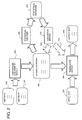
- Figure 2 shows the operational structure of the system of Figure 1.
- the system stores source data including one or more reference texts which already exist in two or more languages.
- a text REFTEXT1E shown at 200 in Figure 2 is an English translation of a French document REFTEXT1F stored at 202.
- An alignment module 204 is provided which can read such pairs of texts and generate corresponding aligned pair of corpora, shown at 206 in Figure 2.
- the aligned corpora 206 form the major part of a bilingual database to be used for a translation of a new document.
- An analyser module 208 is provided which generates for the aligned corpora 206 a statistical database 210.
- An evaluation module 212 is provided which uses the information in the statistical database 210 to measure a quality of alignment in the aligned corpora, or in other texts.
- a translation module 214 is provided which reads an input text (for example via the magnetic disc drive 18), to generate an output text file 218. Interaction with a human operator is possible for any of the modules, for example so that the translation module 214 can consult with a skilled human translator.
- the translation module and the analysis and evaluation modules 204, 208 and 212 may be provided in separate apparatuses, with the database information 206 and/or 210 being generated in one apparatus and communicated to a second apparatus for use in translation.
- the aligned corpora generator 204 may be of known design, for example as described in prior application GB-A-2272091 or as described in the papers by Gale and Church or Brown et al. Moreover, the method by which the original aligned corpora are generated is not relevant for an understanding of the present invention and will not be described in detail.
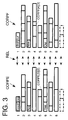
- Figure 3 shows schematically the structure of the bilingual database 206 insofar as it contains a pair of aligned corpora. The example of Figure 3 is small and presented schematically only, while a small but complete example will be described later, with reference to the Appendix.
- an English corpus CORPE comprises a plurality of portions of text, which are addressable by number and will be referred to as "chunks" CORPE[I], where I equals 1, 2, 3 etc..
- each chunk may correspond approximately to a sentence of an original source document, or to a longer or shorter portion of text.
- each chunk CORPE[I] comprises a variable number of smaller elements referenced CORPE[I][J].
- These smaller elements are, in the present example, individual words of English text.
- the chunk CORPE[1] comprises two words: CORPE[1][1] is "Good” and CORPE[1][2] is "day".
- CORPE[3][1] is the word "No", while CORPE[6][1] is the word "Yes”.
- Words CORPE[5][2] and CORPF[4][3] are labelled in the Figure for further illustration.
- French language corpus CORPF contains an identical number of chunks CORPF[I], each of which corresponds to the like-numbered chunk CORPE[I] of the English corpus.
- a relationship REL specifies that each English chunk CORPE[I] is, at least in some nominal sense, a translation of the corresponding French chunk CORPF[I].
- each chunk is aligned with exactly one chunk in the opposite corpus, the number of words within aligned chunks need not be the same.
- the first chunk in the French corpus comprises the single word "Bonjour”
- the first chunk in the English corpus comprises the two words "Good” and "Day", as shown.
- the references also describe examples where a portion comprising one sentence is aligned with a portion containing two sentences.
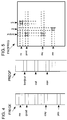
- Figures 4 and 5 illustrate the output of the statistical analyser 208, which in the present embodiment produces frequency tables as follows.
- Table FREQE ( Figure 4) is a table of word frequencies for the English corpus CORPE.
- the index to an entry in table FREQE is a single word from the English corpus, and the entry stored under that word is the number of occurrences of that word in the corpus.
- Several conventional programming languages are known which provide for such so-called "associative addressing". These languages include Lisp, POP-11, PERL, AWK. Of course, in environments where associative addressing is not provided, it can be implemented explicitly by the system designer.
- a second word frequency table FREQF contains the word frequencies for the French corpus CORPF.
- the tables are not case-sensitive in the present embodiment so that "Yes” and “yes” are treated as the same word.
- the associative addressing is indicated herein by use of "braces” or curly brackets ⁇ ⁇ .
- a third table PAIRFREQ ( Figure 5) stores the word pair frequencies for the aligned corpora. This is a conceptually two-dimensional table, of which each entry is associatively addressable by a word pair; one word from the English corpus CORPE and another word from the French corpus CORPF. For a given word pair, for example "good” and "bonjour", the table entry PAIRFREQ ⁇ good,bon journey ⁇ stores a number of times that those two words appear in corresponding chunks of the aligned corpora.
- the total number of words is stored, which will equal the sum of all entries in table FREQE or FREQF as the case may be. Similarly a total of all word pairs is recorded, which is naturally the sum of all entries in the two dimensional pair frequency table PAIRFREQ.
- the table PAIRFREQ is a one-dimensional associative array, similar to the arrays FREQE and FREQF. This can be achieved very simply by concatenating the words of a pair into a single string to index the table.
- the entire string "good_bonjour” can be treated as a single, one dimensional item for associative addressing of the corresponding entry in the table PAIRFREQ.
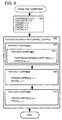
- Figure 6 illustrates in schematic flowchart form the operations of the statistical analyser 208, as it generates the statistical database 210 from the aligned corpora CORPE and CORPF.
- space is reserved for the pair frequency table PAIRFREQ, and all entries thereof are zeroed.
- space is reserved for the word frequency tables FREQE and FREQF, and the entries of these are zeroed also.
- a pair counting variable PAIRTOTAL is established and set to 0, as are word counting variables ETOTAL and FTOTAL.
- a main loop 602 is executed once for each aligned pair of chunks CORPE[I] and CORPF[I], where I is incremented each time through the loop from one upwards, until every aligned pair of chunks has been considered.
- a further loop 604 is executed once for each word CORPE[I][J] within the current chunk of the English corpus.
- a yet further loop 606 is executed once for each word CORPF[I][K] of the corresponding chunk in the French corpus CORPF.
- an entry corresponding to the current word pair in the pair frequency table PAIRFREQ is incremented by 1.
- the array PAIRFREQ is addressable associatively by reference to an English-French word pair.
- the counter variable PAIRTOTAL is incremented.
- a further loop 608 is executed once for each word CORPE[I][J] in the current chunk of the English corpus.
- An entry in the word frequency table FREQE is incremented by 1, and the total word count ETOTAL for the English corpus is incremented also.
- a further loop 610 within the main loop 602 is executed once for each word CORPF[I][K] within the French corpus.
- the entry in the word frequency table FREQF is incremented to record the occurrence of the word CORPF[I][K], and the total word count FTOTAL for the French corpus is also incremented.
- the table PAIRFREQ contains a record of the number of occurrences of every unique word pair in aligned chunks
- table FREQE records the number of occurrences of each unique word in the English corpus
- table FREQF records the number of occurrences for each unique word in the French corpus.
- the total number of word pairs is recorded in variable PAIRTOTAL
- the total number of words in the English corpus is recorded in variable ETOTAL
- the total number of words in the French corpus CORPF is recorded in the variable FTOTAL.
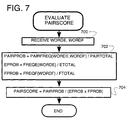
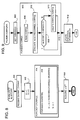
- Figures 7 and 8 illustrate the operation of the evaluation module 212 shown in Figure 1, in particular in that Figure 7 illustrates the calculation of a correlation measure or "score" for each word pair, and Figure 8 illustrates the calculation of a score for each aligned pair of chunks, using the pair scores of the word pairs contained therein.
- step 700 in which a pair of words WORDE and WORDF are received.
- step 702 three probability values are calculated, using the tables of the statistical database 210.
- a pair probability value PAIRPROB is calculated for the word pair by dividing a word pair frequency PAIRFREQ ⁇ WORDE,WORDF ⁇ recorded in the pair frequency table ( Figure 5) by the total number PAIRTOTAL of word pairs recorded in that table. PAIRPROB thus measures the observed probability of the received word pair occurring in any two aligned chunks in the aligned corpora of the database.
- a value EPROB is calculated by dividing the frequency of occurrence of the English word WORDE alone in the English corpus by the total number of words in the English corpus. That is to say, the table entry FREQE ⁇ WORDE ⁇ is divided by the value ETOTAL. The value EPROB thus measures the probability of the English word of the received pair occurring on its own in the English corpus. Similarly for the French word WORDF of the received word pair, probability value FPROB is calculated by dividing a table entry FREQF ⁇ WORDF ⁇ by the total number FTOTAL of words in the French corpus. Value FPROB measures the probability of the word WORDF occurring, based on the contents of the French corpus CORPF.
- a scoring value PAIRSCORE for the received word pair WORDE, WORDF is calculated by dividing the pair probability value PAIRPROB by the individual word probability values EPROB and FPROB.
- a value PAIRSCORE equal to unity would indicate that a frequency of occurrence of this word pair in aligned chunks is no more than would be expected by random chance based on the observed probabilities of the individual words occurring in their respective corpora.
- a value PAIRSCORE greater than unity will indicate that the frequency of occurrence of this pair of words is greater than would be expected from the individual word frequencies.
- the pair score is a measure of correlation between the two words of the pair.
- the statistical database and the pair scoring method of Figure 7 can be used to measure the quality of alignment of two chunks of text each comprising one or more words in a respective language for example, English and French.
- the operations of Figure 8 begin in step 800 where two chunks of text CHUNKE and CHUNKF are received for the module 212 to evaluate their alignment score.
- a score variable S is set to 1
- a counting variable N is set to 0.
- an alignment score ALSCORE is calculated in step 808 by taking the Nth root of the product S.
- the alignment score ALSCORE is the "geometric mean" of the pair scores PAIRSCORE of all word pairs in the received chunks.
- the alignment score ALSCORE for a pair of chunks of text is a "likelihood” measure combining the pair scores of all the possible word pairs between the two chunks.
- the values ALSCORE are normalised in a manner similar to the pair scores, such that a value ALSCORE of unity indicates that, based on the word frequencies and word pair frequencies recorded in the statistical database 210, that the two chunks received in 800 are only as likely as to correspond as would be expected from the individual word probabilities.
- an alignment score greater than unity suggests that there is on average a degree of correlation between the words of the two chunks, more than would be suggested by random chance and the observed word frequencies alone.
- the product S may attain large values, and the calculation of many multiplications and divisions is generally cumbersome in an automatic processing apparatus. It may be advantageous in practice for the geometric mean calculation in step 808 to be performed by calculating the arithmetic mean of the logarithms of the pair scores Logarithms can be added and subtracted to effect multiplication and division.
- the logarithm of S can be divided by N to obtain the logarithm of the Nth root of S.
- the frequency tables and count values of the statistical database 210 are derived from the source corpora 200 and 202 and the alignments indicated between them, the word pairs received in step 700, and the chunk pairs received in step 800 can be derived from the aligned corpora themselves, or alternatively from any pair of texts whose alignments are being evaluated.
- the received chunk CHUNKE might be the result of a human translator translating the received CHUNKF, and this compared with the statistical database of the existing aligned corpora CORPE and CORPF by means of the alignment score ALSCORE.
- a value greater than 1 indicates that the human translator is broadly in agreement with the existing aligned corpora, while a score much less than unity would indicate disagreement, for example because of errors in the alignment of the corpora, errors in the human translation, or simply a difference in the two fields of subject matter being considered in the existing database and in the mind of the translator.
- Figure 9 shows a method of using the evaluation module 212 to improve or "filter” the existing database, that is the aligned corpora 206 and the statistical database 210.
- a threshold is set for comparison with alignment score values. Many possible ways of choosing the threshold are possible, as will be described below. For the present description, simply setting the threshold to unity will be sufficient, but in general, the best threshold will be dependent on the actual data.
- the process next executes a loop 902, once for each chunk CORPE[I] in the English corpus for which there is an aligned chunk CORPF[I] in the French corpus. Within the loop 902, step 904 reads the aligned chunk CORPF[I], and in step 906 the alignment score ALSCORE(CORPE[I],CORPF[I]) is evaluated using the procedure of Figure 8 for the present pair of chunks.
- step 908 this alignment score is compared with the threshold set in step 900. If the alignment score exceeds the threshold, control continues to 912 whereupon the loop 902 is executed for the next value of I, that is to say for the next pair of aligned chunks in the aligned corpora 206. If the alignment score is below the threshold in step 908, control passes to step 910, and the current pair of aligned chunks is deleted from the aligned corpora, or at least marked as being suspect for deletion later. This latter option may be convenient in a given implementation, and would also allow dialogue with a human translator, before a decision is finally taken.
- step 910 control again passes to point 912, where I is incremented and the loop 902 is executed for the next pair of aligned chunks.
- step 914 control passes to step 914, where the statistical database 210 is updated to take account of the deletions (if any) performed in step 910.
- corpora derived from operating manuals for electronic equipment such as photocopiers and facsimile machines, for example, there are often parts of text which do not correspond at all, for example, because the legal requirements in different countries require different safety messages to be presented.
- Another common source of noise is where part of each corpus is a list of items arranged in alphabetical order. The order of these items will not be the same in two different languages, even though the number of items and their general appearance may be indistinguishable to the alignment module 204.
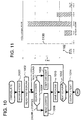
- the alignment scores for a pair of chunks can be used during the translation of a new text using the aligned corpora, as shown in Figure 10.
- a new text ETEXT (216, Figure 2) to be translated by translation module 214 from English to French is received at step 1000.
- a first chunk ECHUNK of the English text is identified at step 1002 and at step 1004 the existing aligned English corpus CORPE is searched for any occurrence of this chunk. If it is found that for some value I the chunk CORPE[I] of the English aligned corpus is equal to the received chunk ECHUNK, control passes to step 1006 where the corresponding chunk CORPF[I] of the French corpus is read. In step 1010 this chunk is saved as a corresponding chunk FCHUNK of the desired French translation (output text 218).
- step 1004 If the search in step 1004 does not find an equivalent of the current chunk ECHUNK, control passes to a user dialogue step 1008. Here a human translator is asked to supply a translation for the English chunk ECHUNK, which translation is then saved in step 1010 as a translation FCHUNK. At step 1012 a next English language chunk is identified in the received text ETEXT, and control returns to the search step 1004. When the entire input text ETEXT has been translated, the concatenation of all the chunks FCHUNK saved in step 1010 is output as a translated, French language text FTEXT in step 1014.
- the translations supplied by the user in step 1008 may also be used to augment the existing database, by adding the unfamiliar English language chunk CHUNKE and the user-supplied French translation to the aligned corpora 206. Such behaviour is described in US 5,140,522, for example.
- the statistical database 210 can also be updated at this stage.
- the output file FTEXT may simply contain questions for a human translator to consider at a later date.
- the step 1010 of saving the translated chunk FCHUNK may for example include a step of evaluating an alignment score for the chunks ECHUNK and FCHUNK, to verify that this is indeed a likely translation. In the event that the alignment score falls below a predetermined threshold, user dialogue may be entered into, either "live” or by entering suitable questions in the output file FTEXT. This may serve to correct erroneous alignments not removed by the filtering process of Figure 9.
- a further technique to reduce the number of pairs considered is to ignore very common words such as "the”, "and” and so on.
- the less frequent words are assumed to carry a greater burden of information.
- the English sentence: "The man killed a big dog” can be reduced to "man killed big dog” with little loss of meaning.
- FREQE,FREQF word frequency tables
- PAIRFREQ word pair frequency table
- the corpora of the Appendix comprise the contents listing of an operating manual for a facsimile apparatus, the first in the English language and the second in the Dutch language. These corpora are presented at A and B in the Appendix, respectively, with line numbers 1 to 30 indicating the aligned pairs of chunks 1 to 30 in the two corpora. An incorrect alignment is present in line 30, in that "sending documents" is not an English translation of the Dutch phrase "problemen oplossen". As will generally be the case, the aligned corpora so include elsewhere correct alignments of chunks including the words "problemen” and "oplossen", namely "troubleshooting" (chunk pairs 23 and 27).
- the word frequencies for the English corpora are presented. It will be seen for example that there are seven occurrences of the word "sending" and only one occurrence of the word "confidential". The total number of words in the English corpus is 118. Thus, for example, the probability of occurrence of the word "sending" in the English corpus is 7 divided by 118, or 0.059322.
- the word frequency table for the Dutch corpora is presented.
- the word “problemen” with a frequency of 4 out of 106 words, has an observed probability of 0.037736.
- the statistical database is not case-sensitive. That is, there is no distinction between "Problemen” in chunk 23 of the corpus and "problemen” in chunk 6.
- the word pair frequency table of Appendix D shows for example that there are four pairs of chunks in which the English chunk contains the word "part” while the corresponding Dutch chunk contains the word "en”.
- a quick inspection of the two corpora shows that this pair of words occurs in the aligned chunks 2, 3, 5 and 6. Note, however, that the database makes no representation that the words "part” and "en” are translations of one another. It happens that both words are common in their respective corpora, so that there is a reasonable probability of both words occurring purely at random in any pair of chunks.
- the word pair scores are calculated and shown for the 427 different word pairs in the example corpora. Whereas in part D of the Appendix the pairs were arranged in pair frequency order, in part E they are arranged in descending order of pair score. Compared with the frequency table, it may be noted that there is a much greater tendency for words which are actually translations of one another to attain a high score. The scores range from 24.525490 down to 0.383211. There is, however, no possibility of using individual word pair scores from part A of the Appendix to verify the accuracy of any word-by-word translation.
- Figure 11 is a histogram showing graphically the distribution of alignment scores for the 30 chunks of the example corpora.
- the vertical axis plots frequency, while the horizontal axis for convenience plots the logarithm (base 2) of the alignment score.
- base 2 For example a range 3 to 4 in the logarithm of the alignment score (horizontal axis) corresponds to the range 8 to 16 in the alignment score itself.
- thresholds may be desirable or necessary, depending on the contents of the statistical database. In many cases, it should be possible to distinguish, as in the present example, between a main body of the distribution of alignment scores in the aligned corpora, and a secondary distribution which is due to erroneous alignments. In the event that these two populations are clearly separated, as in the present example, it is a simple matter to set the threshold between the two.
- a more subtle approach to setting the threshold may be necessary.
- One such approach would be to set a percentile threshold, for example, by choosing that the most improbable five percent of alignments should be rejected.
- the alignment score threshold can then be set accordingly, or may simply be implicit in the action of deleting the worst five percent of alignments.
Landscapes
- Engineering & Computer Science (AREA)
- Theoretical Computer Science (AREA)
- Health & Medical Sciences (AREA)
- Artificial Intelligence (AREA)
- Audiology, Speech & Language Pathology (AREA)
- Computational Linguistics (AREA)
- General Health & Medical Sciences (AREA)
- Physics & Mathematics (AREA)
- General Engineering & Computer Science (AREA)
- General Physics & Mathematics (AREA)
- Machine Translation (AREA)
- Information Retrieval, Db Structures And Fs Structures Therefor (AREA)
Claims (42)
- Procédé d'actionnement d'un appareil de traitement pour traiter une banque de données bilingue, le procédé comprenant les étapes :de stockage dans l'appareil d'une banque de données comprenant un premier et un deuxième domaines de rationalité (206) alignés, divisés chacun en parties, de telle sorte qu'au moins un sous-ensemble des parties du premier domaine de rationalité est identifié par une relation de correspondance avec des parties respectives du deuxième domaine de rationalité, au moins certaines desdites parties étant en outre divisées en plusieurs mots ;d'analyse des domaines de rationalité alignés pour obtenir une banque de données statistique (210) comprenant des données de fréquence de mots représentant les fréquences auxquelles des mots apparaissent dans chaque domaine de rationalité et des données de fréquence de paires de mots représentant les fréquences auxquelles des paires de mots consistant chacun en un mot de chaque domaine de rationalité, apparaissent dans des parties alignées du domaine de rationalité ; et caractérisé par :pour chacune d'un certain nombre de paires de mots dans des parties alignées, d'utilisation de la banque de données statistique (210) pour obtenir une mesure de la probabilité observée de recherche de chaque mot dans son domaine de rationalité respectif, et pour obtenir une mesure de la probabilité observée de recherche de la paire dans les parties alignées du domaine de rationalité, et de combinaison de la probabilité de paire avec les probabilités de mots individuels pour obtenir une mesure de corrélation entre les mots de la paire ; etd'évaluation d'une mesure de corrélation des parties en combinant les mesures de corrélation obtenues de paires de mots contenues dans les parties alignées.
- Procédé selon la revendication 1, comprenant en outre la réception d'autres paires alignées de parties de texte et l'accroissement des domaines de rationalité alignés (206) et de la banque de données statistique (210) pour inclure les parties reçues.
- Procédé selon la revendication 2, dans lequel ladite mesure de corrélation est évaluée pour chaque autre paire de parties, et les domaines de rationalité alignés (206) sont accrus de manière conditionnelle, en fonction du résultat de ladite évaluation.
- Procédé selon l'une quelconque des revendications précédentes, dans lequel chaque mesure de corrélation de paires de mots est obtenue sans obtenir une probabilité que l'un ou l'autre mot de la paire est réellement une traduction de l'autre.
- Procédé selon l'une quelconque des revendications précédentes, dans lequel la combinaison de mesures de corrélation de paire de mots est effectuée quelles que soient les positions des mots d'une paire à l'intérieur de leurs parties respectives.
- Procédé selon l'une quelconque des revendications 1 à 4, dans lequel la combinaison de mesures de corrélation de paire de mots est limitée à des paires de mots qui apparaissent approximativement dans des positions correspondantes dans leurs parties de texte respectives.
- Procédé selon l'une quelconque des revendications précédentes, dans lequel, pour la combinaison de mesures de corrélation de paires de mots, certains mots communs sont identifiés et ignorés.
- Procédé selon l'une quelconque des revendications précédentes, dans lequel lesdites fréquences de paires de mots sont comptées pour toutes les paires de mots de chaque paire de parties de texte, quelles que soient les positions des mots à l'intérieur de chaque partie.
- Procédé selon l'une quelconque des revendications 1 à 7, dans lequel le comptage de paires de mots est limité à des paires de mots qui apparaissent approximativement dans des positions correspondantes dans leurs parties alignées respectives du domaine de rationalité.
- Procédé selon l'une quelconque des revendications précédentes, dans lequel, pour le comptage de paires de mots, certains mots communs sont identifiés et ignorés.
- Procédé selon l'une quelconque des revendications précédentes comprenant en outre :une identification, à partir des mesures de corrélation, d'exemples de parties alignées, d'alignement improbable ; etune correction d'alignements incorrects identifiés par modification des domaines de rationalité alignés pour supprimer au moins les alignements les plus improbables.
- Procédé selon la revendication 11, comprenant en outre une mise à jour de la banque de données statistique (210) en fonction de la modification des domaines de rationalité alignés.
- Procédé selon la revendication 12, comprenant en outre la répétition du procédé au moins une fois pour modifier à nouveau les domaines de rationalité alignés en utilisant la banque de données statistique (210) mise à jour.
- Procédé selon la revendication 11, 12 ou 13, dans lequel l'étape de modification comporte une interaction avec un traducteur humain pour vérifier que les alignements improbables identifiés sont incorrects.
- Procédé d'actionnement d'un appareil de traitement pour automatiser une traduction d'un texte source d'un langage source en un langage cible, le procédé comprenant :un stockage dans l'appareil d'une banque de données bilingue comportant des domaines de rationalité alignés (206) dans les langues source et cible ;une modification des domaines de rationalité alignés par un procédé selon l'une quelconque des revendications 11 à 14 ;une séparation en parties du texte source ;une recherche des domaines de rationalité alignés de la langue source pour des parties correspondant aux parties de texte source ; et(i) pour des parties de texte source où une correspondance est trouvée, une délivrance de la partie correspondante du domaine de rationalité (218) de langue cible sous la forme d'une traduction à inclure dans un texte de sortie ; et (ii) pour des parties où aucune correspondance n'est trouvée, une délivrance d'un message d'interrogation indiquant qu'une traduction n'a pas été faite.
- Procédé d'actionnement d'un appareil de traitement pour automatiser une traduction d'un texte source, d'une langue source vers une langue cible, le procédé comprenant :un stockage dans l'appareil d'une banque de données bilingue comprenant des domaines de rationalité alignés (206) dans les langues source et cible ;une séparation en parties du texte source ;une obtention d'une traduction candidate de chaque partie de texte source sous la forme d'une partie candidate de langue cible ; etune vérification de la traduction par évaluation d'une mesure de corrélation pour la partie de langue source et la partie candidate de langue cible par un procédé selon l'une quelconque des revendications 1 à 15 ;une délivrance de parties candidates vérifiées (218) pour une inclusion dans un texte cible.
- Procédé selon la revendication 16, dans lequel l'étape de vérification comporte l'application d'un seuil à la mesure de corrélation d'une partie candidate.
- Procédé selon la revendication 16 ou 17, comportant en outre l'étape de délivrance d'un message d'interrogation indiquant qu'une traduction vérifiée n'a pas été faite pour la partie de langue source.
- Procédé selon la revendication 15, 16, 17 ou 18, dans lequel les parties traduites et l'un quelconque des messages d'interrogation sont enchaínés et délivrés ensemble sous la forme d'une partie d'un texte de sortie unique.
- Appareil de traitement pour traiter une banque de données bilingue, comprenant :un moyen (16) de stockage pour stocker une banque de données comprenant un premier et un deuxième domaines de rationalité (206) alignés, divisés chacun en parties de telle sorte qu'au moins un sous-ensemble des parties du premier domaine de rationalité est identifié par une relation de correspondance avec des parties respectives du deuxième domaine de rationalité, au moins certaines desdites parties étant en outre divisées en plusieurs mots ;un moyen (208) d'analyse pour analyser les domaines de rationalité alignés pour obtenir une banque de données statistique (210) comprenant des données de fréquence de mots représentant les fréquences auxquelles des mots apparaissent dans chaque domaine de rationalité et des données de fréquence de paires de mots représentant les fréquences auxquelles des paires de mots consistant chacun en un mot de chaque domaine de rationalité, apparaissent dans des parties alignées du domaine de rationalité ; et caractérisé par :un moyen (212) d'obtention, pour chacune d'un certain nombre de paires de mots dans des parties alignées, en utilisant la banque de données statistique pour obtenir une mesure de la probabilité observée de recherche de chaque mot dans son domaine de rationalité respectif, pour obtenir une mesure de la probabilité observée de recherche de la paire dans les parties alignées du domaine de rationalité, et pour combiner la probabilité de paire avec les probabilités de mots individuels afin d'obtenir une mesure de corrélation entre les mots de la paire ; etun moyen (212) d'évaluation pour évaluer une mesure de corrélation des parties en combinant les mesures de corrélation obtenues de paires de mots contenues dans les parties alignées.
- Appareil de traitement selon la revendication 20, comprenant en outre un moyen de réception pour recevoir d'autres paires alignées de parties de texte et un moyen d'accroissement pour accroítre les domaines de rationalité alignés et la banque de données statistique pour inclure les parties reçues.
- Appareil de traitement selon la revendication 21, dans lequel ledit moyen d'évaluation est agencé pour évaluer ladite mesure de corrélation pour chaque autre paire de parties, et ledit moyen d'accroissement est agencé pour accroítre les domaines de rationalité alignés (206) de manière conditionnelle, en fonction du résultat de ladite évaluation.
- Appareil de traitement selon l'une quelconque des revendications 20 à 22, dans lequel ledit moyen d'obtention (212) est agencé pour obtenir ladite mesure de corrélation de paire de mots sans obtenir une probabilité que l'un ou l'autre mot de la paire est réellement une traduction de l'autre.
- Appareil de traitement selon l'une quelconque des revendications 20 à 23, dans lequel ledit moyen d'obtention (212) est agencé pour combiner des mesures de corrélation de paire de mots quelles que soient les positions des mots d'une paire à l'intérieur de leurs parties respectives.
- Appareil de traitement selon l'une quelconque des revendications 20 à 23, dans lequel ledit moyen d'obtention (212) est agencé pour limiter la combinaison de mesures de corrélation de paires de mots à des paires de mots qui apparaissent approximativement dans des positions correspondantes dans leurs parties de texte respectives.
- Appareil de traitement selon l'une quelconque des revendications 20 à 25, dans lequel ledit moyen d'obtention (212) est agencé pour identifier et ignorer certains mots communs lors de la combinaison de mesures de corrélation de paires de mots.
- Appareil de traitement selon l'une quelconque des revendications 20 à 26, dans lequel ledit moyen d'analyse (208) est agencé pour compter les fréquences de paires de mots pour toutes les paires de mots de chaque paire de parties de texte, quelles que soient les positions de mots à l'intérieur de chaque partie.
- Appareil de traitement selon l'une quelconque des revendications 20 à 26, dans lequel ledit moyen d'analyse (208) est agencé pour limiter le comptage de paires de mots à des paires de mots qui apparaissent approximativement dans des positions correspondantes dans leurs parties alignées respectives du domaine de rationalité.
- Appareil de traitement selon l'une quelconque des revendications 20 à 28, dans lequel ledit moyen d'analyse (208) est agencé pour identifier et ignorer certains mots communs lors du comptage de paires de mots.
- Appareil de traitement selon l'une quelconque des revendications 20 à 29, comprenant en outre un moyen d'identification (212) pour identifier, à partir des mesures de corrélation d'exemples de parties alignées, d'un alignement improbable ; et
un moyen de correction (212) pour corriger les alignements incorrects identifiés par modification des domaines de rationalité alignés pour supprimer au moins les alignements les plus improbables. - Appareil de traitement selon la revendication 30, comprenant en outre un moyen de mise à jour pour mettre à jour la banque de données statistique en fonction de la modification des domaines de rationalité alignés.
- Appareil de traitement selon la revendication 31, comprenant en outre :
un moyen (14) de commande pour conduire les domaines de rationalité modifiés à être à nouveau modifiés en utilisant la banque de données statistique mise à jour. - Appareil de traitement selon la revendication 30, 31 ou 32, dans lequel le moyen de correction peut être actionné pour interagir avec un traducteur humain pour vérifier que les alignements improbables identifiés sont incorrects.
- Appareil de traduction pour traduire un texte source d'une langue source en une langue cible, l'appareil comprenant :un appareil de traitement selon l'une quelconque des revendications 32 à 35, dans lequel le moyen de stockage est agencé pour stocker une banque de données bilingue comportant des domaines de rationalité alignés dans les langues source et cible ;un moyen de séparation pour séparer en parties le texte source ;un moyen de recherche pour rechercher les domaines de rationalité alignés de la langue source pour des parties correspondant aux parties de texte source ; etun moyen de sortie afin de délivrer :(i) pour des parties de texte source où une correspondance est trouvée, la partie correspondante du domaine de rationalité de langue cible sous la forme d'une traduction à inclure dans un texte de sortie ; et (ii) pour des parties où aucune correspondance n'est trouvée, un message d'interrogation indiquant qu'une traduction n'a pas été faite.
- Appareil de traduction pour traduire un texte source d'une langue source en une langue cible, l'appareil comprenant :un appareil de traitement selon l'une quelconque des revendications 20 à 33, dans lequel le moyen de stockage est agencé pour stocker une banque de données bilingue comprenant des domaines de rationalité alignés dans les langues source et cible ;un moyen de séparation pour séparer en parties le texte source ;un moyen d'obtention pour obtenir une traduction candidate de chaque partie de texte source sous la forme d'une partie candidate de langue cible ; etun moyen de vérification pour vérifier la traduction en utilisant une mesure de corrélation pour la partie de langue source et la partie candidate de langue cible fournie par ledit moyen d'évaluation ; etun moyen de sortie pour délivrer des parties candidates vérifiées pour une inclusion dans un texte cible.
- Appareil selon la revendication 35, dans lequel le moyen de vérification est agencé pour appliquer un seuil à la mesure de corrélation d'une partie candidate.
- Appareil selon la revendication 35 ou 36, dans lequel le moyen de sortie est agencé pour délivrer un message d'interrogation lorsqu'une traduction vérifiée n'a pas été faite pour la partie de langue source.
- Appareil selon la revendication 34, 35, 36 ou 37, dans lequel le moyen de sortie est agencé pour enchaíner et délivrer ensemble sous la forme d'une partie d'un texte de sortie unique, les parties traduites et l'un quelconque des messages d'interrogation.
- Procédé de production d'une banque de données bilingue qui comprend l'utilisation d'un procédé selon l'une quelconque des revendications 1 à 19.
- Procédé selon la revendication 39, comprenant en outre le stockage de la banque de données bilingue dans un dispositif de stockage.
- Produit formant programme d'ordinateur comprenant des instructions pouvant être mises en oeuvre par processeur pour conduire un processeur à être configuré pour mettre en oeuvre un procédé selon l'une quelconque des revendications 1 à 19, 39 ou 40.
- Support d'enregistrement stockant un produit formant programme d'ordinateur selon la revendication 41.
Applications Claiming Priority (3)
| Application Number | Priority Date | Filing Date | Title |
|---|---|---|---|
| GB9312598A GB2279164A (en) | 1993-06-18 | 1993-06-18 | Processing a bilingual database. |
| GB9312598 | 1993-06-18 | ||
| PCT/GB1994/001321 WO1995000912A1 (fr) | 1993-06-18 | 1994-06-17 | Procedes et appareils de traitement d'une base de donnees bilingue |
Publications (2)
| Publication Number | Publication Date |
|---|---|
| EP0804767A1 EP0804767A1 (fr) | 1997-11-05 |
| EP0804767B1 true EP0804767B1 (fr) | 2002-02-13 |
Family
ID=10737376
Family Applications (1)
| Application Number | Title | Priority Date | Filing Date |
|---|---|---|---|
| EP94918443A Expired - Lifetime EP0804767B1 (fr) | 1993-06-18 | 1994-06-17 | Procedes et appareils de traitement d'une base de donnees bilingue |
Country Status (7)
| Country | Link |
|---|---|
| US (1) | US5867811A (fr) |
| EP (1) | EP0804767B1 (fr) |
| JP (1) | JPH08500691A (fr) |
| CN (1) | CN1110757C (fr) |
| DE (1) | DE69429881T2 (fr) |
| GB (1) | GB2279164A (fr) |
| WO (1) | WO1995000912A1 (fr) |
Families Citing this family (139)
| Publication number | Priority date | Publication date | Assignee | Title |
|---|---|---|---|---|
| DE19636739C1 (de) * | 1996-09-10 | 1997-07-03 | Siemens Ag | Verfahren zur Mehrsprachenverwendung eines hidden Markov Lautmodelles in einem Spracherkennungssystem |
| US6085162A (en) * | 1996-10-18 | 2000-07-04 | Gedanken Corporation | Translation system and method in which words are translated by a specialized dictionary and then a general dictionary |
| EP0932897B1 (fr) * | 1997-06-26 | 2003-10-08 | Koninklijke Philips Electronics N.V. | Procede gere par la machine et dispositif de traduction d'un texte source organise par mots en un texte cible organise par mots |
| DE69837979T2 (de) * | 1997-06-27 | 2008-03-06 | International Business Machines Corp. | System zum Extrahieren einer mehrsprachigen Terminologie |
| US7574649B1 (en) * | 1997-08-14 | 2009-08-11 | Keeboo Sarl | Book metaphor for modifying and enforcing sequential navigation of documents |
| US6782510B1 (en) * | 1998-01-27 | 2004-08-24 | John N. Gross | Word checking tool for controlling the language content in documents using dictionaries with modifyable status fields |
| US6195631B1 (en) * | 1998-04-15 | 2001-02-27 | At&T Corporation | Method and apparatus for automatic construction of hierarchical transduction models for language translation |
| US6345243B1 (en) * | 1998-05-27 | 2002-02-05 | Lionbridge Technologies, Inc. | System, method, and product for dynamically propagating translations in a translation-memory system |
| US6345244B1 (en) * | 1998-05-27 | 2002-02-05 | Lionbridge Technologies, Inc. | System, method, and product for dynamically aligning translations in a translation-memory system |
| US7447626B2 (en) * | 1998-09-28 | 2008-11-04 | Udico Holdings | Method and apparatus for generating a language independent document abstract |
| US6535842B1 (en) * | 1998-12-10 | 2003-03-18 | Global Information Research And Technologies, Llc | Automatic bilingual translation memory system |
| JP3055545B1 (ja) * | 1999-01-19 | 2000-06-26 | 富士ゼロックス株式会社 | 関連文検索装置 |
| US6278969B1 (en) * | 1999-08-18 | 2001-08-21 | International Business Machines Corp. | Method and system for improving machine translation accuracy using translation memory |
| US6393389B1 (en) * | 1999-09-23 | 2002-05-21 | Xerox Corporation | Using ranked translation choices to obtain sequences indicating meaning of multi-token expressions |
| US6473729B1 (en) * | 1999-12-20 | 2002-10-29 | Xerox Corporation | Word phrase translation using a phrase index |
| US6604101B1 (en) * | 2000-06-28 | 2003-08-05 | Qnaturally Systems, Inc. | Method and system for translingual translation of query and search and retrieval of multilingual information on a computer network |
| CA2408819C (fr) * | 2000-05-11 | 2006-11-07 | University Of Southern California | Techniques de traduction automatique |
| US6519557B1 (en) * | 2000-06-06 | 2003-02-11 | International Business Machines Corporation | Software and method for recognizing similarity of documents written in different languages based on a quantitative measure of similarity |
| US7155517B1 (en) | 2000-09-28 | 2006-12-26 | Nokia Corporation | System and method for communicating reference information via a wireless terminal |
| US6782356B1 (en) * | 2000-10-03 | 2004-08-24 | Hewlett-Packard Development Company, L.P. | Hierarchical language chunking translation table |
| US20020069049A1 (en) * | 2000-12-06 | 2002-06-06 | Turner Geoffrey L. | Dynamic determination of language-specific data output |
| US6996518B2 (en) * | 2001-01-03 | 2006-02-07 | International Business Machines Corporation | Method and apparatus for automated measurement of quality for machine translation |
| US8874431B2 (en) * | 2001-03-16 | 2014-10-28 | Meaningful Machines Llc | Knowledge system method and apparatus |
| US20030093261A1 (en) * | 2001-03-16 | 2003-05-15 | Eli Abir | Multilingual database creation system and method |
| US7483828B2 (en) * | 2001-03-16 | 2009-01-27 | Meaningful Machines, L.L.C. | Multilingual database creation system and method |
| US20030083860A1 (en) * | 2001-03-16 | 2003-05-01 | Eli Abir | Content conversion method and apparatus |
| US7711547B2 (en) * | 2001-03-16 | 2010-05-04 | Meaningful Machines, L.L.C. | Word association method and apparatus |
| US20030135357A1 (en) * | 2001-03-16 | 2003-07-17 | Eli Abir | Multilingual database creation system and method |
| US8744835B2 (en) * | 2001-03-16 | 2014-06-03 | Meaningful Machines Llc | Content conversion method and apparatus |
| US7860706B2 (en) | 2001-03-16 | 2010-12-28 | Eli Abir | Knowledge system method and appparatus |
| JP4574047B2 (ja) * | 2001-03-30 | 2010-11-04 | 富士通株式会社 | 訳例辞書を用いて翻訳を行う機械翻訳装置およびプログラム |
| WO2002097663A1 (fr) * | 2001-05-31 | 2002-12-05 | University Of Southern California | Decodeur de programmation en nombres entiers pour traduction automatique |
| US7191115B2 (en) * | 2001-06-20 | 2007-03-13 | Microsoft Corporation | Statistical method and apparatus for learning translation relationships among words |
| EP1271341A3 (fr) * | 2001-06-30 | 2005-11-30 | Unilever N.V. | Système pour l'analyse de données textuelles |
| WO2003005166A2 (fr) | 2001-07-03 | 2003-01-16 | University Of Southern California | Modele de traduction statistique fonde sur la syntaxe |
| US7361881B2 (en) * | 2002-03-13 | 2008-04-22 | Oy Ajat Ltd | Ganged detector pixel, photon/pulse counting radiation imaging device |
| AU2003269808A1 (en) * | 2002-03-26 | 2004-01-06 | University Of Southern California | Constructing a translation lexicon from comparable, non-parallel corpora |
| JP2005521952A (ja) * | 2002-03-27 | 2005-07-21 | ユニバーシティ・オブ・サザン・カリフォルニア | 統計的機械翻訳用の句間結合確率モデル |
| US7031911B2 (en) * | 2002-06-28 | 2006-04-18 | Microsoft Corporation | System and method for automatic detection of collocation mistakes in documents |
| US7016895B2 (en) | 2002-07-05 | 2006-03-21 | Word Data Corp. | Text-classification system and method |
| US7024408B2 (en) | 2002-07-03 | 2006-04-04 | Word Data Corp. | Text-classification code, system and method |
| US20040006459A1 (en) * | 2002-07-05 | 2004-01-08 | Dehlinger Peter J. | Text-searching system and method |
| US7386442B2 (en) * | 2002-07-03 | 2008-06-10 | Word Data Corp. | Code, system and method for representing a natural-language text in a form suitable for text manipulation |
| US7003516B2 (en) * | 2002-07-03 | 2006-02-21 | Word Data Corp. | Text representation and method |
| AU2002346060A1 (en) * | 2002-07-03 | 2004-01-23 | Iotapi.Com, Inc. | Text-processing code, system and method |
| US20040006547A1 (en) * | 2002-07-03 | 2004-01-08 | Dehlinger Peter J. | Text-processing database |
| US7181451B2 (en) * | 2002-07-03 | 2007-02-20 | Word Data Corp. | Processing input text to generate the selectivity value of a word or word group in a library of texts in a field is related to the frequency of occurrence of that word or word group in library |
| US20040054520A1 (en) * | 2002-07-05 | 2004-03-18 | Dehlinger Peter J. | Text-searching code, system and method |
| US7293015B2 (en) * | 2002-09-19 | 2007-11-06 | Microsoft Corporation | Method and system for detecting user intentions in retrieval of hint sentences |
| US7194455B2 (en) * | 2002-09-19 | 2007-03-20 | Microsoft Corporation | Method and system for retrieving confirming sentences |
| CN100380373C (zh) * | 2002-10-29 | 2008-04-09 | 埃里·阿博 | 知识系统方法和装置 |
| US7249012B2 (en) | 2002-11-20 | 2007-07-24 | Microsoft Corporation | Statistical method and apparatus for learning translation relationships among phrases |
| WO2004055691A1 (fr) * | 2002-12-18 | 2004-07-01 | Ricoh Company, Ltd. | Systeme d'aide a la traduction et programme correspondant |
| US7356457B2 (en) * | 2003-02-28 | 2008-04-08 | Microsoft Corporation | Machine translation using learned word associations without referring to a multi-lingual human authored dictionary of content words |
| US7283949B2 (en) * | 2003-04-04 | 2007-10-16 | International Business Machines Corporation | System, method and program product for bidirectional text translation |
| US20040243391A1 (en) * | 2003-05-28 | 2004-12-02 | Nelson David D. | Apparatus, system, and method for multilingual regulation management |
| US20100070265A1 (en) * | 2003-05-28 | 2010-03-18 | Nelson David D | Apparatus, system, and method for multilingual regulation management |
| JP3943582B2 (ja) * | 2003-05-30 | 2007-07-11 | 富士通株式会社 | 対訳文対応付け装置 |
| JP2004362249A (ja) * | 2003-06-04 | 2004-12-24 | Advanced Telecommunication Research Institute International | 翻訳知識最適化装置、翻訳知識最適化のためのコンピュータプログラム、コンピュータ及び記憶媒体 |
| US7734627B1 (en) | 2003-06-17 | 2010-06-08 | Google Inc. | Document similarity detection |
| AU2004202391A1 (en) * | 2003-06-20 | 2005-01-13 | Microsoft Corporation | Adaptive machine translation |
| US7383542B2 (en) * | 2003-06-20 | 2008-06-03 | Microsoft Corporation | Adaptive machine translation service |
| US7711545B2 (en) * | 2003-07-02 | 2010-05-04 | Language Weaver, Inc. | Empirical methods for splitting compound words with application to machine translation |
| US8548794B2 (en) * | 2003-07-02 | 2013-10-01 | University Of Southern California | Statistical noun phrase translation |
| JP3790825B2 (ja) * | 2004-01-30 | 2006-06-28 | 独立行政法人情報通信研究機構 | 他言語のテキスト生成装置 |
| US7287027B2 (en) * | 2004-03-01 | 2007-10-23 | Sap Ag | System and method for entering a default field value through statistical defaulting |
| US7698125B2 (en) * | 2004-03-15 | 2010-04-13 | Language Weaver, Inc. | Training tree transducers for probabilistic operations |
| US8296127B2 (en) * | 2004-03-23 | 2012-10-23 | University Of Southern California | Discovery of parallel text portions in comparable collections of corpora and training using comparable texts |
| US20050216253A1 (en) * | 2004-03-25 | 2005-09-29 | Microsoft Corporation | System and method for reverse transliteration using statistical alignment |
| US8666725B2 (en) * | 2004-04-16 | 2014-03-04 | University Of Southern California | Selection and use of nonstatistical translation components in a statistical machine translation framework |
| US20060047656A1 (en) * | 2004-09-01 | 2006-03-02 | Dehlinger Peter J | Code, system, and method for retrieving text material from a library of documents |
| DE112005002534T5 (de) * | 2004-10-12 | 2007-11-08 | University Of Southern California, Los Angeles | Training für eine Text-Text-Anwendung, die eine Zeichenketten-Baum-Umwandlung zum Training und Decodieren verwendet |
| US7774192B2 (en) * | 2005-01-03 | 2010-08-10 | Industrial Technology Research Institute | Method for extracting translations from translated texts using punctuation-based sub-sentential alignment |
| US8676563B2 (en) | 2009-10-01 | 2014-03-18 | Language Weaver, Inc. | Providing human-generated and machine-generated trusted translations |
| US8886517B2 (en) | 2005-06-17 | 2014-11-11 | Language Weaver, Inc. | Trust scoring for language translation systems |
| CA2612404C (fr) * | 2005-06-17 | 2014-05-27 | National Research Council Of Canada | Moyen et procede pour une traduction de langue adaptee |
| US7974833B2 (en) | 2005-06-21 | 2011-07-05 | Language Weaver, Inc. | Weighted system of expressing language information using a compact notation |
| US20070010989A1 (en) * | 2005-07-07 | 2007-01-11 | International Business Machines Corporation | Decoding procedure for statistical machine translation |
| US7389222B1 (en) | 2005-08-02 | 2008-06-17 | Language Weaver, Inc. | Task parallelization in a text-to-text system |
| US7813918B2 (en) * | 2005-08-03 | 2010-10-12 | Language Weaver, Inc. | Identifying documents which form translated pairs, within a document collection |
| CN1916889B (zh) * | 2005-08-19 | 2011-02-02 | 株式会社日立制作所 | 语料库制作装置及其方法 |
| US8700383B2 (en) * | 2005-08-25 | 2014-04-15 | Multiling Corporation | Translation quality quantifying apparatus and method |
| US7653531B2 (en) * | 2005-08-25 | 2010-01-26 | Multiling Corporation | Translation quality quantifying apparatus and method |
| KR100739726B1 (ko) * | 2005-08-30 | 2007-07-13 | 삼성전자주식회사 | 문자열 매칭 방법 및 시스템과 그 방법을 기록한 컴퓨터판독 가능한 기록매체 |
| US7624020B2 (en) * | 2005-09-09 | 2009-11-24 | Language Weaver, Inc. | Adapter for allowing both online and offline training of a text to text system |
| US10319252B2 (en) * | 2005-11-09 | 2019-06-11 | Sdl Inc. | Language capability assessment and training apparatus and techniques |
| US7536295B2 (en) * | 2005-12-22 | 2009-05-19 | Xerox Corporation | Machine translation using non-contiguous fragments of text |
| JP2007233486A (ja) * | 2006-02-27 | 2007-09-13 | Fujitsu Ltd | 翻訳者支援プログラム,翻訳者支援装置及び翻訳者支援方法 |
| US8943080B2 (en) * | 2006-04-07 | 2015-01-27 | University Of Southern California | Systems and methods for identifying parallel documents and sentence fragments in multilingual document collections |
| WO2007133625A2 (fr) * | 2006-05-12 | 2007-11-22 | Eij Group Llc | Extraction d'information multilingue |
| US8886518B1 (en) | 2006-08-07 | 2014-11-11 | Language Weaver, Inc. | System and method for capitalizing machine translated text |
| JP2008090555A (ja) * | 2006-09-29 | 2008-04-17 | Oki Electric Ind Co Ltd | 訳文評価装置、訳文評価方法およびコンピュータプログラム |
| US9633005B2 (en) | 2006-10-10 | 2017-04-25 | Abbyy Infopoisk Llc | Exhaustive automatic processing of textual information |
| US8195447B2 (en) | 2006-10-10 | 2012-06-05 | Abbyy Software Ltd. | Translating sentences between languages using language-independent semantic structures and ratings of syntactic constructions |
| US8145473B2 (en) | 2006-10-10 | 2012-03-27 | Abbyy Software Ltd. | Deep model statistics method for machine translation |
| US9495358B2 (en) | 2006-10-10 | 2016-11-15 | Abbyy Infopoisk Llc | Cross-language text clustering |
| US9235573B2 (en) | 2006-10-10 | 2016-01-12 | Abbyy Infopoisk Llc | Universal difference measure |
| US8433556B2 (en) | 2006-11-02 | 2013-04-30 | University Of Southern California | Semi-supervised training for statistical word alignment |
| GB2444084A (en) * | 2006-11-23 | 2008-05-28 | Sharp Kk | Selecting examples in an example based machine translation system |
| US9122674B1 (en) | 2006-12-15 | 2015-09-01 | Language Weaver, Inc. | Use of annotations in statistical machine translation |
| US8468149B1 (en) | 2007-01-26 | 2013-06-18 | Language Weaver, Inc. | Multi-lingual online community |
| US8615389B1 (en) | 2007-03-16 | 2013-12-24 | Language Weaver, Inc. | Generation and exploitation of an approximate language model |
| US8959011B2 (en) * | 2007-03-22 | 2015-02-17 | Abbyy Infopoisk Llc | Indicating and correcting errors in machine translation systems |
| US8175864B1 (en) * | 2007-03-30 | 2012-05-08 | Google Inc. | Identifying nearest neighbors for machine translation |
| US8831928B2 (en) * | 2007-04-04 | 2014-09-09 | Language Weaver, Inc. | Customizable machine translation service |
| US8825466B1 (en) | 2007-06-08 | 2014-09-02 | Language Weaver, Inc. | Modification of annotated bilingual segment pairs in syntax-based machine translation |
| JP5105513B2 (ja) | 2007-07-20 | 2012-12-26 | インターナショナル・ビジネス・マシーンズ・コーポレーション | 処理対象として適切なテキストを選択する技術 |
| WO2009097459A1 (fr) * | 2008-01-29 | 2009-08-06 | Educational Testing Service | Système et procédé permettant la désembiguisation de l'effet de la longueur d'un document textuel sur des scores de similarité vectoriels |
| JP5100445B2 (ja) * | 2008-02-28 | 2012-12-19 | 株式会社東芝 | 機械翻訳する装置および方法 |
| US8594992B2 (en) * | 2008-06-09 | 2013-11-26 | National Research Council Of Canada | Method and system for using alignment means in matching translation |
| US20100070482A1 (en) * | 2008-09-12 | 2010-03-18 | Murali-Krishna Punaganti Venkata | Method, system, and apparatus for content search on a device |
| US8818992B2 (en) * | 2008-09-12 | 2014-08-26 | Nokia Corporation | Method, system, and apparatus for arranging content search results |
| WO2010061733A1 (fr) | 2008-11-27 | 2010-06-03 | インターナショナル・ビジネス・マシーンズ・コーポレーション | Dispositif et procédé pour prendre en charge la détection d’une erreur de traduction |
| US8185373B1 (en) * | 2009-05-05 | 2012-05-22 | The United States Of America As Represented By The Director, National Security Agency, The | Method of assessing language translation and interpretation |
| US8990064B2 (en) | 2009-07-28 | 2015-03-24 | Language Weaver, Inc. | Translating documents based on content |
| CN101996166B (zh) * | 2009-08-14 | 2015-08-05 | 张龙哺 | 双语句对模式化记录方法以及翻译方法和翻译系统 |
| US8380486B2 (en) | 2009-10-01 | 2013-02-19 | Language Weaver, Inc. | Providing machine-generated translations and corresponding trust levels |
| US10417646B2 (en) | 2010-03-09 | 2019-09-17 | Sdl Inc. | Predicting the cost associated with translating textual content |
| US9767095B2 (en) | 2010-05-21 | 2017-09-19 | Western Standard Publishing Company, Inc. | Apparatus, system, and method for computer aided translation |
| US8954447B1 (en) * | 2011-02-07 | 2015-02-10 | Amazon Technologies, Inc. | Annotation-based content rankings |
| US11003838B2 (en) | 2011-04-18 | 2021-05-11 | Sdl Inc. | Systems and methods for monitoring post translation editing |
| US8694303B2 (en) | 2011-06-15 | 2014-04-08 | Language Weaver, Inc. | Systems and methods for tuning parameters in statistical machine translation |
| US8886515B2 (en) | 2011-10-19 | 2014-11-11 | Language Weaver, Inc. | Systems and methods for enhancing machine translation post edit review processes |
| CN103164390B (zh) * | 2011-12-15 | 2016-05-18 | 富士通株式会社 | 文档处理方法和文档处理装置 |
| US9256597B2 (en) * | 2012-01-24 | 2016-02-09 | Ming Li | System, method and computer program for correcting machine translation information |
| US8942973B2 (en) | 2012-03-09 | 2015-01-27 | Language Weaver, Inc. | Content page URL translation |
| US10261994B2 (en) | 2012-05-25 | 2019-04-16 | Sdl Inc. | Method and system for automatic management of reputation of translators |
| US9081762B2 (en) * | 2012-07-13 | 2015-07-14 | Enyuan Wu | Phrase-based dictionary extraction and translation quality evaluation |
| US9152622B2 (en) | 2012-11-26 | 2015-10-06 | Language Weaver, Inc. | Personalized machine translation via online adaptation |
| US9213694B2 (en) | 2013-10-10 | 2015-12-15 | Language Weaver, Inc. | Efficient online domain adaptation |
| JP6328409B2 (ja) * | 2013-11-28 | 2018-05-23 | シャープ株式会社 | 翻訳装置 |
| JP5843117B2 (ja) * | 2013-12-04 | 2016-01-13 | 国立研究開発法人情報通信研究機構 | 学習装置、翻訳装置、学習方法、翻訳方法、およびプログラム |
| RU2592395C2 (ru) | 2013-12-19 | 2016-07-20 | Общество с ограниченной ответственностью "Аби ИнфоПоиск" | Разрешение семантической неоднозначности при помощи статистического анализа |
| RU2586577C2 (ru) | 2014-01-15 | 2016-06-10 | Общество с ограниченной ответственностью "Аби ИнфоПоиск" | Фильтрация дуг в синтаксическом графе |
| JP2015138414A (ja) * | 2014-01-22 | 2015-07-30 | 富士通株式会社 | 機械翻訳装置、翻訳方法、及び、そのプログラム |
| WO2016058138A1 (fr) * | 2014-10-15 | 2016-04-21 | Microsoft Technology Licensing, Llc | Construction d'un lexique pour un contexte sélectionné |
| US9626358B2 (en) | 2014-11-26 | 2017-04-18 | Abbyy Infopoisk Llc | Creating ontologies by analyzing natural language texts |
| JP6607482B2 (ja) * | 2015-02-02 | 2019-11-20 | 国立研究開発法人情報通信研究機構 | 構文解析装置、学習装置、機械翻訳装置、およびプログラム |
| US9836457B2 (en) | 2015-05-25 | 2017-12-05 | Panasonic Intellectual Property Corporation Of America | Machine translation method for performing translation between languages |
Family Cites Families (6)
| Publication number | Priority date | Publication date | Assignee | Title |
|---|---|---|---|---|
| US5140522A (en) * | 1988-10-28 | 1992-08-18 | Kabushiki Kaisha Toshiba | Method and apparatus for machine translation utilizing previously translated documents |
| GB9103080D0 (en) * | 1991-02-14 | 1991-04-03 | British And Foreign Bible The | Analysing textual documents |
| JPH04264971A (ja) * | 1991-02-20 | 1992-09-21 | Nippon Computer Kenkyusho:Kk | 学習型共起辞書作成装置 |
| US5477451A (en) * | 1991-07-25 | 1995-12-19 | International Business Machines Corp. | Method and system for natural language translation |
| US5541836A (en) * | 1991-12-30 | 1996-07-30 | At&T Corp. | Word disambiguation apparatus and methods |
| US5510981A (en) * | 1993-10-28 | 1996-04-23 | International Business Machines Corporation | Language translation apparatus and method using context-based translation models |
-
1993
- 1993-06-18 GB GB9312598A patent/GB2279164A/en not_active Withdrawn
-
1994
- 1994-06-17 JP JP7502560A patent/JPH08500691A/ja active Pending
- 1994-06-17 US US08/387,717 patent/US5867811A/en not_active Expired - Lifetime
- 1994-06-17 WO PCT/GB1994/001321 patent/WO1995000912A1/fr not_active Ceased
- 1994-06-17 DE DE69429881T patent/DE69429881T2/de not_active Expired - Lifetime
- 1994-06-17 EP EP94918443A patent/EP0804767B1/fr not_active Expired - Lifetime
- 1994-06-17 CN CN94190391A patent/CN1110757C/zh not_active Expired - Lifetime
Also Published As
| Publication number | Publication date |
|---|---|
| EP0804767A1 (fr) | 1997-11-05 |
| CN1110882A (zh) | 1995-10-25 |
| DE69429881T2 (de) | 2002-07-04 |
| WO1995000912A1 (fr) | 1995-01-05 |
| GB9312598D0 (en) | 1993-08-04 |
| GB2279164A (en) | 1994-12-21 |
| US5867811A (en) | 1999-02-02 |
| CN1110757C (zh) | 2003-06-04 |
| JPH08500691A (ja) | 1996-01-23 |
| DE69429881D1 (de) | 2002-03-21 |
Similar Documents
| Publication | Publication Date | Title |
|---|---|---|
| EP0804767B1 (fr) | Procedes et appareils de traitement d'une base de donnees bilingue | |
| US6236958B1 (en) | Method and system for extracting pairs of multilingual terminology from an aligned multilingual text | |
| US4868750A (en) | Collocational grammar system | |
| US5418717A (en) | Multiple score language processing system | |
| US6098034A (en) | Method for standardizing phrasing in a document | |
| US6983240B2 (en) | Method and apparatus for generating normalized representations of strings | |
| EP1351158A1 (fr) | Traduction par machine | |
| KR101507521B1 (ko) | IPC 자동 분류 방법 및 F-Term 추천 방법과 그 장치 | |
| US10210249B2 (en) | Method and system of text synthesis based on extracted information in the form of an RDF graph making use of templates | |
| EP1855211A2 (fr) | Translation de machine en utilisant des morceaux élastiques | |
| JP2008033931A (ja) | テキストを追補する方法、クエリーに応答してテキストを取得する方法、およびシステム | |
| JP3765799B2 (ja) | 自然言語処理装置、自然言語処理方法及び自然言語処理プログラム | |
| US8335681B2 (en) | Machine-translation apparatus using multi-stage verbal-phrase patterns, methods for applying and extracting multi-stage verbal-phrase patterns | |
| McTait et al. | A language-neutral sparse-data algorithm for extracting translation patterns | |
| EP0887748B1 (fr) | Système pour extraire une terminologie multilingue | |
| JP2016164707A (ja) | 自動翻訳装置及び翻訳用モデル学習装置 | |
| Sangati et al. | Multiword expression identification with recurring tree fragments and association measures | |
| CN121233615A (zh) | 基于自然语言的数据库查询方法、系统、设备和介质 | |
| CN114003750B (zh) | 物料上线方法、装置、设备及存储介质 | |
| KR20210105626A (ko) | 기술문서 번역 지원 시스템 | |
| Anik et al. | An approach towards multilingual translation by semantic-based verb identification and root word analysis | |
| Généreux et al. | NLP challenges in dealing with OCR-ed documents of derogated quality | |
| Pal et al. | Word Alignment-Based Reordering of Source Chunks in PB-SMT. | |
| RU2643438C2 (ru) | Обнаружение языковой неоднозначности в тексте | |
| EP1365331A2 (fr) | Détermination d'une photo sémantique instantanée |
Legal Events
| Date | Code | Title | Description |
|---|---|---|---|
| PUAI | Public reference made under article 153(3) epc to a published international application that has entered the european phase |
Free format text: ORIGINAL CODE: 0009012 |
|
| 17P | Request for examination filed |
Effective date: 19950619 |
|
| AK | Designated contracting states |
Kind code of ref document: A1 Designated state(s): DE FR GB NL |
|
| RAP1 | Party data changed (applicant data changed or rights of an application transferred) |
Owner name: CANON EUROPA N.V. Owner name: CANON RESEARCH CENTRE EUROPE LTD. |
|
| 17Q | First examination report despatched |
Effective date: 19990827 |
|
| GRAG | Despatch of communication of intention to grant |
Free format text: ORIGINAL CODE: EPIDOS AGRA |
|
| RIC1 | Information provided on ipc code assigned before grant |
Free format text: 7G 06F 17/28 A |
|
| RTI1 | Title (correction) |
Free format text: METHODS AND APPARATUSES FOR PROCESSING A BILINGUAL DATABASE |
|
| GRAG | Despatch of communication of intention to grant |
Free format text: ORIGINAL CODE: EPIDOS AGRA |
|
| GRAH | Despatch of communication of intention to grant a patent |
Free format text: ORIGINAL CODE: EPIDOS IGRA |
|
| GRAH | Despatch of communication of intention to grant a patent |
Free format text: ORIGINAL CODE: EPIDOS IGRA |
|
| GRAA | (expected) grant |
Free format text: ORIGINAL CODE: 0009210 |
|
| REG | Reference to a national code |
Ref country code: GB Ref legal event code: IF02 |
|
| AK | Designated contracting states |
Kind code of ref document: B1 Designated state(s): DE FR GB NL |
|
| PG25 | Lapsed in a contracting state [announced via postgrant information from national office to epo] |
Ref country code: NL Free format text: LAPSE BECAUSE OF FAILURE TO SUBMIT A TRANSLATION OF THE DESCRIPTION OR TO PAY THE FEE WITHIN THE PRESCRIBED TIME-LIMIT Effective date: 20020213 |
|
| REG | Reference to a national code |
Ref country code: GB Ref legal event code: 732E |
|
| REF | Corresponds to: |
Ref document number: 69429881 Country of ref document: DE Date of ref document: 20020321 |
|
| NLV1 | Nl: lapsed or annulled due to failure to fulfill the requirements of art. 29p and 29m of the patents act | ||
| PLBE | No opposition filed within time limit |
Free format text: ORIGINAL CODE: 0009261 |
|
| STAA | Information on the status of an ep patent application or granted ep patent |
Free format text: STATUS: NO OPPOSITION FILED WITHIN TIME LIMIT |
|
| 26N | No opposition filed |
Effective date: 20021114 |
|
| REG | Reference to a national code |
Ref country code: FR Ref legal event code: TP |
|
| PGFP | Annual fee paid to national office [announced via postgrant information from national office to epo] |
Ref country code: GB Payment date: 20130624 Year of fee payment: 20 Ref country code: DE Payment date: 20130630 Year of fee payment: 20 |
|
| PGFP | Annual fee paid to national office [announced via postgrant information from national office to epo] |
Ref country code: FR Payment date: 20130718 Year of fee payment: 20 |
|
| REG | Reference to a national code |
Ref country code: DE Ref legal event code: R071 Ref document number: 69429881 Country of ref document: DE |
|
| REG | Reference to a national code |
Ref country code: DE Ref legal event code: R071 Ref document number: 69429881 Country of ref document: DE |
|
| REG | Reference to a national code |
Ref country code: GB Ref legal event code: PE20 Expiry date: 20140616 |
|
| PG25 | Lapsed in a contracting state [announced via postgrant information from national office to epo] |
Ref country code: GB Free format text: LAPSE BECAUSE OF EXPIRATION OF PROTECTION Effective date: 20140616 |
|
| PG25 | Lapsed in a contracting state [announced via postgrant information from national office to epo] |
Ref country code: DE Free format text: LAPSE BECAUSE OF EXPIRATION OF PROTECTION Effective date: 20140618 |