EP0804952A1 - Verfahren zur Herstellung von feinstteiligen Kristallisationsprodukten - Google Patents
Verfahren zur Herstellung von feinstteiligen Kristallisationsprodukten Download PDFInfo
- Publication number
- EP0804952A1 EP0804952A1 EP97106252A EP97106252A EP0804952A1 EP 0804952 A1 EP0804952 A1 EP 0804952A1 EP 97106252 A EP97106252 A EP 97106252A EP 97106252 A EP97106252 A EP 97106252A EP 0804952 A1 EP0804952 A1 EP 0804952A1
- Authority
- EP
- European Patent Office
- Prior art keywords
- surfactant
- solution
- sprayed
- containing liquid
- crystal suspension
- Prior art date
- Legal status (The legal status is an assumption and is not a legal conclusion. Google has not performed a legal analysis and makes no representation as to the accuracy of the status listed.)
- Granted
Links
Images
Classifications
-
- B—PERFORMING OPERATIONS; TRANSPORTING
- B01—PHYSICAL OR CHEMICAL PROCESSES OR APPARATUS IN GENERAL
- B01J—CHEMICAL OR PHYSICAL PROCESSES, e.g. CATALYSIS OR COLLOID CHEMISTRY; THEIR RELEVANT APPARATUS
- B01J2/00—Processes or devices for granulating materials, e.g. fertilisers in general; Rendering particulate materials free flowing in general, e.g. making them hydrophobic
- B01J2/02—Processes or devices for granulating materials, e.g. fertilisers in general; Rendering particulate materials free flowing in general, e.g. making them hydrophobic by dividing the liquid material into drops, e.g. by spraying, and solidifying the drops
- B01J2/04—Processes or devices for granulating materials, e.g. fertilisers in general; Rendering particulate materials free flowing in general, e.g. making them hydrophobic by dividing the liquid material into drops, e.g. by spraying, and solidifying the drops in a gaseous medium
-
- A—HUMAN NECESSITIES
- A61—MEDICAL OR VETERINARY SCIENCE; HYGIENE
- A61K—PREPARATIONS FOR MEDICAL, DENTAL OR TOILETRY PURPOSES
- A61K9/00—Medicinal preparations characterised by special physical form
- A61K9/14—Particulate form, e.g. powders, Processes for size reducing of pure drugs or the resulting products, Pure drug nanoparticles
- A61K9/141—Intimate drug-carrier mixtures characterised by the carrier, e.g. ordered mixtures, adsorbates, solid solutions, eutectica, co-dried, co-solubilised, co-kneaded, co-milled, co-ground products, co-precipitates, co-evaporates, co-extrudates, co-melts; Drug nanoparticles with adsorbed surface modifiers
- A61K9/145—Intimate drug-carrier mixtures characterised by the carrier, e.g. ordered mixtures, adsorbates, solid solutions, eutectica, co-dried, co-solubilised, co-kneaded, co-milled, co-ground products, co-precipitates, co-evaporates, co-extrudates, co-melts; Drug nanoparticles with adsorbed surface modifiers with organic compounds
-
- B—PERFORMING OPERATIONS; TRANSPORTING
- B01—PHYSICAL OR CHEMICAL PROCESSES OR APPARATUS IN GENERAL
- B01D—SEPARATION
- B01D9/00—Crystallisation
- B01D9/0018—Evaporation of components of the mixture to be separated
- B01D9/0027—Evaporation of components of the mixture to be separated by means of conveying fluid, e.g. spray-crystallisation
-
- B—PERFORMING OPERATIONS; TRANSPORTING
- B01—PHYSICAL OR CHEMICAL PROCESSES OR APPARATUS IN GENERAL
- B01D—SEPARATION
- B01D9/00—Crystallisation
- B01D9/005—Selection of auxiliary, e.g. for control of crystallisation nuclei, of crystal growth, of adherence to walls; Arrangements for introduction thereof
Definitions
- the invention relates to a process for the production of crystallization products with an average grain diameter of ⁇ 1 ⁇ m by spraying a solution and simultaneous evaporation of the solvent. Crystals are formed by atomizing the product solution and by evaporating the solvent.
- nanoparticles are possible using a variety of methods. Overviews are e.g. listed in [1] and in [2].
- Bioavailable carotenoid hydrosol is achieved according to [6] by dissolving the carotenoid in a water-miscible solvent at a high temperature (> 100 ° C) and then rapidly aqueous precipitation in the presence of a stabilizing polymer colloid.
- the magnitude of the solids content and the surfactant content are not mentioned.
- the size of the particles is between 50 nm and 500 nm.
- the invention is based on the object of producing a narrowly distributed to monodisperse crystal suspension of inorganic and in particular organic compounds whose average grain size diameter is less than 1 micrometer. This grain size must be stable at least over a period of several days to 2 weeks.
- the exposure of the substance to be crystallized to high temperatures should be avoided.
- the solids content of the suspension should also be able to be set to values greater than 1% by weight.
- a method in which a solution is sprayed and the solvent is evaporated.
- the sprayed solution A is crystallized out in a gas atmosphere and at the same time brought into contact with a swarm of droplets of a surfactant-containing liquid B, whereby an aerosol mixture A, B is generated, which is then precipitated as a colloidal crystal suspension with the surfactant-containing liquid as a continuous phase.
- the swarm of droplets of the surfactant-containing liquid B is preferably also produced by spraying.
- the process is carried out either in such a way that solution A is sprayed into the droplet of surfactant-containing liquid B or vice versa, the surfactant-containing liquid B is sprayed into sprayed solution A.
- the crystal suspension is advantageously at least partially recycled and sprayed as surfactant-containing liquid B.
- a variant which is advantageously used in a continuously carried out process consists in that the crystal suspension is concentrated in a separating apparatus and the depleted crystal suspension is recycled and sprayed as liquid B containing surfactant.
- the aerosol mixture A, B formed can be passed through a gas scrubber.
- Volatile liquids which have a vapor pressure> 0.1 mbar at room temperature are preferably used as solvents for the compound to be crystallized.
- Water with a surfactant additive is expediently used as the surfactant-containing liquid.
- Another option is to add a surfactant to Solution A.
- crystal suspension is used as a formulation for parenteral drug preparations.
- nanoparticles by the direct production of native crystals has a clear advantage over the production by mechanical grinding (e.g. pearl milling).
- the crushing creates fracture surfaces which, from an energetic point of view, show an increased tendency to heal and grow, whereby the particle size of the particles increases again due to recrystallization or agglomeration.
- the method of surfactant-stabilized spray crystallization described also has the advantage that no pre-emulsion of the substance to be crystallized has to be prepared.
- the solution of the desired solid used instead can be adjusted flexibly in terms of solubility in the concentration and, with a suitable choice of the solvent, also very high in the content of the product.
- a simple, non-pulsating pump system e.g. a syringe pump
- a simple, non-pulsating pump system can be used to process the solution.
- the particles form from the evaporating droplets of the atomized solution and are trapped by surfactant-containing water drops during the course of the process according to the invention.
- the suitably selected commercially available surfactants (for example with a view to a high wetting and stabilizing capacity at interfaces) envelop the crystallite produced and thus largely prevent further mass transfer processes. Therefore, agglomeration processes and recrystallization processes of the colloidal particles can be prevented.
- the amount of surfactant-containing water used, which is used in the circuit (recycling), can be flexibly adjusted to the desired solids concentration in the product suspension.
- a prefiltration connected to the circuit can optionally draw off a concentrated partial stream with the nanoparticles generated.
- Process control is suitable for both continuous and batch operation.
- the substance A of interest to be crystallized is dissolved in a volatile solvent.
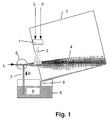
- This solution A is conveyed according to Fig. 1 through the 0.4 mm channel of a two-substance nozzle 1, while the compressed air L required to operate the two-substance nozzle with an absolute pressure of e.g. 3 bar flows through 6 holes to the narrowest cross section of the concentric gap of the two-fluid nozzle with an equivalent diameter of 0.55 mm.
- the solute crystallizes out in fine particles.
- the spray cone 2 is penetrated by a swarm of droplets 4 which is injected into the chamber 3 and consists of a stabilizing phase.
- a stabilizing phase e.g. Water with an addition of 10 wt .-% surfactant used.
- the swarm of drops 4 is generated with the aid of an atomizing device 5.
- the freshly generated nano-crystal particles are wetted with surfactants.
- a simple glass atomizer can be used which, like the two-substance nozzle 1, is supplied with compressed air L for spraying the surfactant-water mixture supplied via the riser pipe 7.
- the aerosol mixture A, B generated in the chamber 3 due to the penetration of the spray cone 2 with the swarm of drops 4 is deposited on the walls of the chamber 3 and forms the desired colloidal crystal suspension, which flows freely from the chamber 3 into the reservoir 6 as a liquid layer 8 .
- the surfactant-containing water was placed in container 6. Since constantly during the process through the two-fluid nozzle 1 new solution is supplied, the solids concentration in the container 6 continues to accumulate. The process is terminated when the crystal suspension in container 6 has reached the desired final concentration.
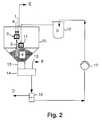
- FIG. 2 A technical concept for implementing the method according to the invention is shown in FIG. 2.
- the product-containing liquid A is atomized with compressed air L through a miniature two-substance nozzle 9 in a closed chamber 10 to form a spray cone 2.
- the finest crystallites form due to the spontaneous evaporation of the solvent.
- this spray cone Before this spray cone can hit the wall surfaces of the surrounding chamber 10, it passes through a swarm of droplets 4 of surfactant-containing water drops that wet the crystallites and is generated with the aid of a commercially available single-substance or two-substance nozzle 11.
- the mini nozzle 9 is charged with surfactant-containing water B, which is placed in a container 12.
- venturi scrubber 13 At the exit of the chamber 10 there is a venturi scrubber 13, in which the surfactant-containing water drops are brought into intensive contact with the product / air aerosol jet (spray cone 2) emerging from the miniature two-substance nozzle 9.
- the resulting droplet aerosol containing the crystals flows from there into a gas separator 14.
- the resulting exhaust air E from the air flow L used for the spraying and the evaporating solvent fractions from the solution A is partly discharged directly from the spray chamber 10 and partly with the other part derived the collection of the aerosol in the separator 14 through the nozzle 15 and fed to a reprocessing or disposal.
- the chamber 10 can also be operated with a slight negative pressure.
- the crystal suspension in the separator 14 contains the nanometer-sized product crystals, which are enriched in a further step by a cross-flow filter 16 and discharged in the form of a suspension D with a higher solids content, while the surfactant-containing filtrate is recycled into the container 12 by means of the pump 17.
Landscapes
- Chemical & Material Sciences (AREA)
- Chemical Kinetics & Catalysis (AREA)
- Health & Medical Sciences (AREA)
- Crystallography & Structural Chemistry (AREA)
- Engineering & Computer Science (AREA)
- Bioinformatics & Cheminformatics (AREA)
- Epidemiology (AREA)
- Pharmacology & Pharmacy (AREA)
- Medicinal Chemistry (AREA)
- Life Sciences & Earth Sciences (AREA)
- Animal Behavior & Ethology (AREA)
- General Health & Medical Sciences (AREA)
- Public Health (AREA)
- Veterinary Medicine (AREA)
- Organic Chemistry (AREA)
- Organic Low-Molecular-Weight Compounds And Preparation Thereof (AREA)
- Colloid Chemistry (AREA)
- Medicinal Preparation (AREA)
Abstract
Description
- Die Erfindung betrifft ein Verfahren zur Herstellung von Kristallisationsprodukten mit einem mittleren Korndurchmesser < 1 µm durch Versprühen einer Lösung und gleichzeitige Verdampfung des Lösungsmittels. Dabei werden durch Verdüsung der Produktlösung und durch Verdampfung des Lösemittels Kristalle gebildet.
- Die Erzeugung von Nanopartikeln ist nach vielfältigen Methoden möglich. Übersichten sind z.B. in [1] und in [2] aufgeführt.
- Die dort beschriebenen Verfahren eignen sich aber fast ausschließlich zur Erzeugung von anorganischen Partikeln. Dies sind z.B. Fällverfahren in Tensidsystemen oder Mikroemulsionen zur Herstellung von Oxiden [3] oder Edelmetallen [4].
- Einige Literaturstellen befassen sich auch mit Methoden zur Erzeugung von submikronen Partikeln aus organischen Stoffen, speziell pharmazeutischen Wirkstoffen.
- In [5] ist die Präparation von schlecht wasserlöslichen Wirkstoffen aus Öl-in-Wasser Emulsionen beschrieben. Dabei wird die feinteilige Feststoffbildung aus den die gelöste Substanz enthaltenden Öl-Tropfen durch Abdampfung dieses Öls in einem Rotationsverdampfer erreicht. Die Konzentration des Feststoff (Cholesterylacetat) beträgt in etwa 1-2 Gew %, wenn Teilchen Kleiner 1 Mikrometer erreicht wurden und der Gehalt an Tensid wird auf die organische Phase bezogen mit bis zu 20 Gew.-% angegeben. In eigenen Experimenten wurde festgestellt, daß diese Verfahrensweise nur für spezielle Stoffsysteme zum Erfolg führt, da mit zwei anderen Teststoffen (u.a. Naphthalin) keine stabilen kolloidalen Suspensionen erzeugt werden konnten.
- Bioverfügbares Carotenoid-Hydrosol wird gemäß [6] durch Lösung des Carotenoids in einem wassermischbarem Lösemittel bei einer hohen Temperatur (> 100 °C) und anschließender schnellen wässrigen Fällung in Anwesenheit eines stabilisierenden Polymer-Kolloids erreicht. Die Größenordnung des Feststoffgehaltes und des Tensidgehaltes werden nicht genannt. Die Größenordnung der Teilchen liegt zwischen 50 nm und 500 nm.
- Eine Übersicht über Mikro- und Nanopartikeln als Arzneistoffträgersysteme enthält die Literaturstelle [7]; allerdings sind die dort oberflächlich erwähnten Sprühverfahren nicht konkret für ein Beispiel der Nanopartikel-Herstellung nachvollziehbar.
- Der Erfindung liegt die Aufgabe zu Grunde eine engverteilte bis monodisperse Kristallsuspension anorganischer und insbesondere organischer Verbindungen herzustellen, deren mittlerer Korngrößendurchmesser unterhalb von 1 Mikrometer liegt. Diese Korngröße muß zumindest über einen Zeitraum von mehreren Tagen bis 2 Wochen stabil vorliegen.
- Die Belastung des zu kristallisierenden Stoffes durch hohe Temperaturen soll dabei vermieden werden. Der Feststoffgehalt der Suspension soll dabei auch auf Werte von größer als 1 Gew.-% eingestellt werden können.
- Zur Lösung dieser Aufgabe dient ein Verfahren, bei dem eine Lösung versprüht und das Lösungsmittel verdampft wird. Dabei wird erfindungsgemäß die versprühte Lösung A in einer Gasatmossphäre auskristallisiert und gleichzeitig mit einem Tropfenschwarm einer tensidhaltigen Flüssigkeit B in Kontakt gebracht, wodurch eine Aerosolmischung A,B erzeugt wird, die anschließend als kolloide Kristallsuspension mit der tensidhaltigen Flüssigkeit als kontinuierliche Phase niedergeschlagen wird.
- Vorzugsweise wird der Tropfenschwarm der tensidhaltigen Flüssigkeit B ebenfalls durch Versprühen erzeugt.
- Das Verfahren wird entweder in der Weise ausgeübt, daß die Lösung A in den Tropfenschwarm der tensidhaltigen Flüssigkeit B oder vice versa die tensidhaltige Flüssigkeit B in die versprühte Lösung A eingedüst wird.
- Vorteilhaft wird die Kristallsupension zumindest teilweise rezykliert und als tensidhaltige Flüssigkeit B versprüht.
- Eine Variante, die vorteilhaft bei einem kontinuierlich durchgeführten Verfahren eingesetzt wird, besteht darin, daß die Kristallsuspension in einem Trennapparat aufkonzentriert wird und die abgereicherte Kristallsuspension rezykliert und als tensidhaltige Flüssigkeit B versprüht wird.
- Um die Durchmischung des Tropfenschwarms mit der versprühten Lösung A zu intensivieren, kann die gebildete Aerosolmischung A,B durch einen Gaswäscher geleitet werden.
- Als Lösungsmittel für die zu kristallisierende Verbindung werden vorzugsweise leichtflüchtige Flüssigkeiten eingesetzt, die bei Zimmertemperatur einen Dampfdruck > 0,1 mbar aufweisen.
- Als tensidhaltige Flüssigkeit wird zweckmäßig Wasser mit einem Tensid-Zusatz verwendet.
- Eine weitere Option besteht darin, daß der Lösung A ebenfalls ein Tensid zugesetzt wird.
- Eine wichtige Anwendung des Verfahrens besteht darin, daß die Kristallsuspension als Formulierung für parenterale Arzneistoffzubereitungen verwendet wird.
- Die Herstellung von Partikeln im Größenbereich kleiner 1 Mikrometer ist von großem Interesse für industrielle Anwendungen, da das Eigenschaftenprofil der kolloidalen Partikeln gegenüber dem der konventionellen Partikeln oberhalb der 1 Mikrometergrenze deutlich unterschiedlich ist. Für organische Partikel, speziell pharmazeutische Wirkstoffe, sind dies z.B. das veränderte Lösevermögen ("Bioverfügbarkeit") oder die Verwendbarkeit als parenterale Lösung für pharmazeutische Zwecke trotz des partikulären Charakters ("Depoteffekt").
- Die Erzeugung von Nanopartikeln durch direkte Herstellung nativer Kristalle hat deutlichen Vorteil gegenüber der Herstellung durch mechanisches Zerkleinern (z.B. Perlmahlen). Bei der Zerkleinerung entstehen Bruchflächen, die energetisch betrachtet eine verstärkte Tendenz zum Ausheilen und Wachsen aufweisen, wodurch die Korngröße der Partikel durch Rekristallisation oder Agglomeration wieder ansteigt.
- Das vorgestellte Verfahren eignet sich insbesondere für die Erzeugung von organischen Kristallen, wohingegen die meisten andere Verfahren zur Nanopartikelerzeugung durch die Wahl der Prozeßparameter (z.B. hohe Temperaturen) nur für die Herstellung von anorganischen Feinstpartikeln einsetzbar sind.
- Die beschriebene Methode der tensidstabilisierten Sprühkristallisation hat auch den Vorteil, daß keine Voremulsion der zu kristallisierenden Substanz hergestellt werden muß.
- Die statt dessen verwendete Lösung des gewünschten Feststoffes kann dagegen im Rahmen der Löslichkeit flexibel in der Konzentration und bei geeigneter Wahl des Lösemittels auch sehr hoch in dem Gehalt an Produkt eingestellt werden.
- Die zur Erzeugung von Emulsionen notwendige Dispergierungs- und Homogenisierungs-Energie (z.B. durch Ultra-Turax oder Hochdruckhomogenisierung) wird eingespart. Ebenso ist die unter Umständen kritische Suche einer Tensidkombinationen zur Stabilisierung des zu emulgierenden Stoffsystems nicht notwendig.
- Zur Verarbeitung der Lösung kann ein einfaches, nicht pulsierendes Pumpensystem (z.B. eine Spritzenpumpe) verwendet werden. Es sind keine hohen Drücke (> 10 bar) oder hohen Temperaturen (> 100°C) notwendig. Dies macht die Methode besonders für temperaturempfindliche organische Stoffe anwendbar.
- Durch die Verdüsung der Lösung in feine Tropfen wird der Dampfdruck des Lösemittels heraufgesetzt, so daß auch Umgebungsdruck oder leichtes Vakuum zur Entfernung des Lösemittels ausreicht. Dies ist ein Vorteil im Gegensatz zu Methoden, bei denen das Lösemittel aus der kompletten Emulsion im hohen Vakuum abgezogen werden muß.
- Die Partikel bilden sich aus den verdampfenden Tröpfchen der verdüsten Lösung und werden in der erfindungsgemäßen Prozeßführung noch im Verlauf ihrer Trocknung von tensidhaltigen Wassertropfen abgefangen. Die geeignet ausgewählten handelsüblichen Tenside (z.B. im Hinblick auf ein hohes Benetzungs- und Stabilisierungs-Vermögen an Grenzflächen) umhüllen den erzeugten Kristallit und verhindern so weitestgehend weitere Stoffaustauschvorgänge. Daher können Agglomerationsvorgänge und Rekristallisationsvorgänge der kolloidalen Teilchen verhindert werden. Die verwendete Menge an tensidhaltigem Wasser, das im Kreislauf verwendet wird (Rezyklierung), kann flexibel auf die gewünschte Feststoffkonzentration in der Produktsuspension eingestellt werden. Eine in den Kreislauf geschaltete Vorfiltration kann gegebenenfalls einen aufkonzentrierten Teilstrom mit den erzeugten Nanopartikeln abziehen.
- Die Prozeßführung eignet sich sowohl für einen kontinuierlichen als auch einen batchweisen Betrieb.
- Im folgenden wird die Erfindung an Hand von Ausführungsbeispielen und Zeichnungen näher beschrieben. Es zeigen:
- Fig. 1 das Prinzip einer Versuchsanlage
- Fig. 2 das Konzept einer technischen Anlage und
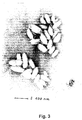
- Fig. 3 eine elektronenmikroskopische Aufnahme der gebildeten Kristallite
- Der interessierende zu kristallisierende Stoff A wird in einem leichtflüchtigen Lösemittel gelöst. Diese Lösung A wird gemäß Fig. 1 durch den 0.4 mm-Kanal einer Zweistoffdüse 1 gefördert, während die zum Betrieb der Zweistoffdüse erforderliche Druckluft L mit einem absoluten Druck von z.B. 3 bar über 6 Bohrungen zum engsten Querschnitt des konzentrischen Spaltes der Zweistoffdüse mit einem äquivalenten Durchmesser von 0.55 mm strömt. Dadurch werden feinste Tröpfchen (Aerosol) in Form eines Sprühkegels 2 in der Kammer 3 erzeugt. Während das Lösungsmittel verdampft, kristallisiert der gelöste Stoff feinstteilig aus. Der Sprühkegel 2 wird, bevor er auf die Wandflächen der umgebenden Sprühkammer 3 auftreffen kann, von einem in die Kammer 3 eingedüsten Tropfenschwarm 4 durchdrungen, der aus einer stabilisierenden Phase besteht. Als stabilisierende Phase wird z.B. Wasser mit einem Zusatz von 10 Gew.-% Tensid eingesetzt. Der Tropfenschwarm 4 wird mit Hilfe einer Zerstäubungsvorrichtung 5 erzeugt. Auf diese Weise wird eine Benetzung der frisch erzeugten Nano-Kristallpartikel mit Tensiden erreicht. Zur Zerstäubung des tensidhaltigen Wassers, das in einem Reservoir 6 vorgelegt wird, kann gem. Figur 1 ein einfacher Glaszerstäuber verwendet werden, der wie auch die Zweistoffdüse 1 mit Druckluft L zur Versprühung des über das Steigrohr 7 zugeführten Tensid-Wasser-Gemisches beschickt wird.
- Die in der Kammer 3 auf Grund der Durchdringung des Sprühkegels 2 mit dem Tropfenschwarm 4 erzeugte Aerosolmischung A,B wird an den Wänden der Kammer 3 niedergeschlagen und bildet die gewünschte kolloidale Kristallsuspension, die aus der Kammer 3 freifließend als Flüssigkeitsschicht 8 in das Reservoir 6 abfließt. Zu Beginn des Verfahrens war in denn Behälter 6 nur das tensidhaltige Wasser vorgelegt. Da während des Verfahrens durch die Zweistoffdüse 1 ständig neue Lösung zugeführt wird, reichert sich die Feststoffkonzentration im Behälter 6 immer weiter an. Das Verfahren wird abgebrochen, wenn die Kristallsuspension im Behälter 6 die gewünschte Endkonzentration erreicht hat.
- Ein wichtiger Schritt bei der Kristallisation ist der Lösemittelentzug. Daher wird eine möglichst spontane Verdampfung aus der produkthaltigen Lösung A angestrebt.
- Ein technisches Konzept für die Durchführung des erfindungsgemäßen Verfahrens ist in Fig. 2 dargestellt.
- Die produkthaltige Flüssigkeit A wird mit Druckluft L durch eine Miniatur-Zweistoffdüse 9 in einer geschlossenen Kammer 10 zu einem Sprühkegel 2 zerstäubt. Dabei bilden sich, wie schon an Hand von Fig. 1 beschrieben, auf Grund der spontan einsetzenden Verdampfung des Lösungsmittels feinste Kristallite. Bevor dieser Sprühkegel auf die Wandflächen der umgebenden Kammer 10 auftreffen kann, durchtritt er einen die Kristallite benetzenden Tropfenschwarm 4 aus tensidhaltigen Wassertropfen, der mit Hilfe einer handelsüblichen Einstoff- oder Zweistoffdüse 11 erzeugt wird. Die Minidüse 9 wird mit tensidhaltigen Wasser B beschickt, das in einem Behälter 12 vorgelegt ist . An den Ausgang der Kammer 10 schließt sich ein Venturi-Wäscher 13 an, in dem die tensidhaltigen Wassertropfen in intensiven Kontakt mit dem aus der Miniatur-Zweistoffdüse 9 austretenden Produkt/Luft-Aerosol-Strahl (Sprühkegel 2) gebracht werden. Das resultierende, die Kristalle enthaltende Tropfen-Aerosol strömt von dort in einen Gasabscheider 14. Die entstehende Abluft E aus dem zur Versprühung verwendeten Luftstrom L und den verdampfenden Lösemittelanteilen aus der Lösung A wird zum Teil aus der Sprühkammer 10 direkt abgeleitet und zum anderen Teil bei der Sammlung des Aerosols im Abscheider 14 durch den Stutzen 15 abgeleitet und einer Wiederaufarbeitung bzw. Entsorgung zugeführt. Zur besseren Enfernung von Lösungsmitteldämpfen kann die Kammer 10 auch mit leichtem Unterdruck betrieben werden.
- Die Kristallsuspension im Abscheider 14 enthält die Nanometer-großen Produktkristalle, die in einem weiteren Schritt durch ein Querstromfilter 16 angereichert und in Form einer Suspension D mit höherem Feststoffgehalt ausgeschleust werden, während das tensidhaltige Filtrat mittels der Pumpe 17 in den Behälter 12 rezykliert wird.
- In der Apparatur gemäß Figur 1 wurde das erfindungsgemäße Verfahren im Labormaßstab mit folgenden Daten durchgeführt :
- a) Die Temperatur betrug ca 20 °C (Raumtemperatur).
- b) Die Lösung A bestand aus einer 5 Gew.-% Naphthalin-Chloroform Lösung mit einer Dichte von 1,5 g/ml (0,75 g Naphthalin in Chloroform, insgesamt 15 g). Chloroform hat bei Raumtemperatur einen Dampfdruck von 0.211 mbar und eine Wasserlöslichkeit von 0.82 Gew.-% .
- c) Die tensidhaltige Flüssigkeit B bestand aus 3,17 g ®Triton X 100 (nichtionisches Tensid), 1,93 g ®Marlon A 375 (anionisch: Nadodecylbenzolsulfonat) und 44,9 g Wasser (Tensidanteil etwa 10 Gew.-%). Diese Tensid-Mischung besitzt ein hohes Benetzungs- und Stabilisierungs-Vermögen an Grenzflächen. Bei den genannten Tensiden handelt es sich um preisgünstige technische Handelsprodukte.
- d) Zur dosierten Zuführung der Lösung A wurde eine Spritzenpumpe verwendet. Der Volumenstrom der Lösung A betrug während der 15-min Versuchsdauer 60 ml/h.
- e) Die Druckluft L wurde mit einem absoluten Druck von 3 bar zugeführt, was in der Zweistoffdüse 1 einem Durchsatz von etwa 500 l/h Luft entspricht.
- Proben der so hergestellten Kristallsuspension wurden durch Elektronenmikroskopie (TEM-Aufnähme, siehe Figur 3) auf die erreichte Korngrößenverteilung hin untersucht. In der Aufnahme sind die annähernd ellipsoidförmigen Kristallite gut zu erkennen. 8 mm auf dem Bild entsprechen 1 Mikrometer der Probe. Die Partikel liegen im Größenbereich von 100 nm mit einer engen Korngrößenverteilung. Auch nach einer Standzeit von 19 Tagen konnten noch keine Rekristallisate beobachtet werden. Rechnerisch (ohne Berücksichtigung der Verluste) ergab sich eine Feststoffkonzentration von 1,5 Gew.-% und eine Tensidkonzentration von 10 Gew.-% in der kolloidalen Kristallsuspension.
- [1] Preparation of monodispersed colloidal particles Sugimoto, T. Advances in colloid and interface science 28 (1987) S.65-108
- [2] The world of fine particles (Feinste Partikel, hergestellt durch Ausfälle oder chemische Reaktionen mit Tropfen) Matijevic, E. Chemtech 21 (1991) 3, S.176-181
- [3] Verfahren zur Herstellung nanoskaliger Oxidteilchen Schmidt, H. DE 4 118 185 A1 ( 3.6.1991)
- [4] Suspension of platinum group metal particles in microemulsion with uniform particle size, useful for making catalysts Stenius, P. WO 81/ 02688 (1.10.1981)
- [5] A method for the preparation of submicron particles of sparingly water-soluble drugs by precipitation in oil-in-water emulsions: part I & part II Sjöström Brita, Kronberg B., Carlfors J. J. Pharm. Sci. 82 (6), (1993), S. 579-589
- [6] Preparation and characterization of microdisperse bioavailable carotenoid Hydrosols D. Horn Die angewandte makromolekulare Chemie 166/167 (1989) S.139-153 (2874)
- [7] Mikro- und Nanopartikeln als Arzneistoffträgersysteme unter besonderer Berücksichtigung der Herstellungsmethoden Bornschein M., Melegari P., Bismarck Ch., Keipert,S. Die Pharmazie 44(9) (1989) S.585-593
Claims (10)
- Verfahren zur Herstellung von Kristallisationsprodukten mit einem mittleren Korndurchmesser < 1 µm durch Versprühen einer Lösung und gleichzeitige Verdampfung des Lösungsmittels, dadurch gekennzeichnet, daß die versprühte Lösung A in einer Gasatmossphäre auskristallisiert und gleichzeitig mit einem Tropfenschwarm (4) einer tensidhaltigen Flüssigkeit B in Kontakt gebracht wird, wodurch eine Aerosolmischung A,B erzeugt wird, die anschließend als kolloide Kristallsuspension mit der tensidhaltigen Flüssigkeit B als kontinuierliche Phase niedergeschlagen wird.
- Verfahren nach Anspruch 1, dadurch gekennzeichnet, daß der Tropfenschwarm (4) der tensidhaltigen Flüssigkeit ebenfalls durch Versprühen erzeugt wird.
- Verfahren nach Anspruch 2, dadurch gekennzeichnet, daß die Lösung A in den Tropfenschwarm (4) der tensidhaltigen Flüssigkeit B oder vice versa die tensidhaltige Flüssigkeit B in die versprühte Lösung A eingedüst wird.
- Verfahren nach Anspruch 1 bis 3, dadurch gekennzeichnet, daß die Kristallsupension zumindest teilweise rezykliert und als tensidhaltige Flüssigkeit B versprüht wird.
- Verfahren nach Anspruch 1 bis 3, dadurch gekennzeichnet, daß die Kristallsuspension in einem Trennapparat (16) aufkonzentriert wird und die abgereicherte Kristallsuspension rezykliert und und als tensidhaltige Flüssigkeit B versprüht wird.
- Verfahren nach Anspruch 1 bis 5, dadurch gekennzeichnet, daß die Aerosolmischung A,B zur Intensivierung der Durchmischung durch einen Gaswäscher (13) geleitet wird.
- Verfahren nach Anspruch 1 bis 6, dadurch gekennzeichnet, daß das Lösungsmittel für die zu kristallisierende Verbindung bei Zimmertemperatur einen Dampfdruck > 0,1 mbar aufweist.
- Verfahren nach Anspruch 1 bis 7, dadurch gekennzeichnet, daß als tensidhaltige Flüssigkeit B Wasser mit einem Tensid-Zusatz verwendet wird.
- Verfahren nach Anspruch 1 bis 8, dadurch gekennzeichnet, daß der Lösung A ebenfalls ein Tensid zugesetzt wird.
- Verfahren nach Anspruch 1 bis 9, dadurch gekennzeichnet, daß die Kristallsuspension als Formulierung für parenterale Arzneistoffzubereitungen verwendet wird.
Applications Claiming Priority (2)
| Application Number | Priority Date | Filing Date | Title |
|---|---|---|---|
| DE19617085A DE19617085A1 (de) | 1996-04-29 | 1996-04-29 | Verfahren zur Herstellung von feinstteiligen Kristallisationsprodukten |
| DE19617085 | 1996-04-29 |
Publications (2)
| Publication Number | Publication Date |
|---|---|
| EP0804952A1 true EP0804952A1 (de) | 1997-11-05 |
| EP0804952B1 EP0804952B1 (de) | 2002-09-18 |
Family
ID=7792770
Family Applications (1)
| Application Number | Title | Priority Date | Filing Date |
|---|---|---|---|
| EP97106252A Expired - Lifetime EP0804952B1 (de) | 1996-04-29 | 1997-04-16 | Verfahren zur Herstellung von feinstteiligen Kristallisationsprodukten |
Country Status (4)
| Country | Link |
|---|---|
| US (1) | US6074441A (de) |
| EP (1) | EP0804952B1 (de) |
| JP (1) | JPH1043502A (de) |
| DE (2) | DE19617085A1 (de) |
Cited By (1)
| Publication number | Priority date | Publication date | Assignee | Title |
|---|---|---|---|---|
| WO2001074332A1 (en) * | 2000-04-05 | 2001-10-11 | Vectura Limited | Pharmaceutical preparations and their manufacture |
Families Citing this family (11)
| Publication number | Priority date | Publication date | Assignee | Title |
|---|---|---|---|---|
| TR200101891T2 (tr) * | 1999-01-29 | 2001-12-21 | Bristol-Myers Squibb Company | Sonik etkili jet kristalleşme aparat ve cihazı. |
| JP3259033B2 (ja) * | 2000-06-07 | 2002-02-18 | 広島大学長 | 特定成分溶解液の濃縮装置 |
| WO2002078674A1 (en) | 2001-03-30 | 2002-10-10 | Trustees Of Princeton University | A process and apparatuses for preparing nanoparticle compositions with amphiphilic copolymers and their use |
| KR20050006201A (ko) * | 2002-04-29 | 2005-01-15 | 브리스톨-마이어스 스큅 컴퍼니 | 아토마이징을 이용하는 결정화 시스템 |
| EP1511546A4 (de) * | 2002-05-10 | 2005-08-03 | Bristol Myers Squibb Co | Homogenisierung verwendendes kristallisationssystem |
| JP5154078B2 (ja) * | 2003-02-21 | 2013-02-27 | ザ ユニヴァーシティ オブ バース | 粒子の製造プロセス |
| ES2265262B1 (es) * | 2005-01-31 | 2008-03-01 | Activery Biotech, S.L.(Titular Al 50%) | Procedimiento para la obtencion de sistemas micro- y nanodispersos. |
| KR100864379B1 (ko) * | 2007-05-18 | 2008-10-28 | (주)솔고나노어드벤스 | 보급형 귀금속 나노콜로이드 메이커 |
| DE102009008478A1 (de) * | 2009-02-11 | 2010-08-19 | PHAST Gesellschaft für pharmazeutische Qualitätsstandards mbH | Vorrichtung und Verfahren zur Herstellung pharmazeutisch hochfeiner Partikel sowie zur Beschichtung solcher Partikel in Mikroreaktoren |
| NZ602674A (en) | 2010-03-22 | 2013-10-25 | Mjr Pharmjet Gmbh | Method and device for producing microparticles or nanoparticles |
| CN103561855B (zh) * | 2011-03-08 | 2016-04-13 | 公立大学法人名古屋市立大学 | 胶体晶体的制造方法及胶体晶体 |
Citations (4)
| Publication number | Priority date | Publication date | Assignee | Title |
|---|---|---|---|---|
| WO1981002688A1 (en) * | 1980-03-24 | 1981-10-01 | Ytkemiska Inst | A liquid suspension of particles of a metal belonging to the platinum group,and a method for the manufacture of such a suspension |
| US4985239A (en) * | 1985-09-13 | 1991-01-15 | Kao Corporation | Microlatex hair cosmetic composition |
| DE4118185A1 (de) * | 1991-06-03 | 1992-12-10 | Inst Neue Mat Gemein Gmbh | Verfahren zur herstellung nanoskaliger oxidteilchen |
| WO1994007582A1 (en) * | 1992-10-06 | 1994-04-14 | Merck & Co., Inc. | Dual jet crystallizer apparatus |
Family Cites Families (14)
| Publication number | Priority date | Publication date | Assignee | Title |
|---|---|---|---|---|
| US2728678A (en) * | 1946-09-19 | 1955-12-27 | Foremost Dairies Inc | Process for drying solutions containing crystallizable material, and product produced thereby |
| DE1267666B (de) * | 1964-03-05 | 1968-05-09 | Inst Leichtbau Und Oekonomisch | Vorrichtung zum Vakuumkristallisieren von Salzloesungen |
| AU413469B2 (en) * | 1966-03-09 | 1971-05-24 | Knapsack Ag | Process forthe manufacture of detergent compositions |
| GB1263697A (en) * | 1968-05-13 | 1972-02-16 | Shell Int Research | Crystallization process |
| US3929291A (en) * | 1973-05-24 | 1975-12-30 | Pfrengle Otto | Spray mixing nozzle |
| DE2431529C2 (de) * | 1974-07-01 | 1982-11-18 | Henkel KGaA, 4000 Düsseldorf | Verfahren zur Herstellung sprühgetrockneter, nichtionische Tenside enthaltender Waschmittel |
| US4031301A (en) * | 1975-09-10 | 1977-06-21 | The United States Of America As Represented By The Secretary Of The Army | Micro particle generation |
| DE2856278A1 (de) * | 1978-12-27 | 1980-07-10 | Degussa | Verfahren zur herstellung feinstteiliger natriumaluminiumsilikate |
| DE3744329A1 (de) * | 1987-12-28 | 1989-07-06 | Schwarz Pharma Gmbh | Verfahren zur herstellung einer mindestens einen wirkstoff und einen traeger umfassenden zubereitung |
| DE3833446A1 (de) * | 1988-10-01 | 1990-04-05 | Hoechst Ag | Verfahren zur herstellung von arzneimittelwirkstoff-partikeln mit verbesserten fliess-, lager- und formulierungseigenschaften sowie arzneimittel, die diese arzneimittelwirkstoff-partikeln enthalten |
| DE3835728A1 (de) * | 1988-10-20 | 1990-04-26 | Nmi Naturwissenschaftl U Mediz | Verfahren zur herstellung von pulvern im teilchengroessenbereich 1-1000 nm und formkoerpern daraus und deren verwendung |
| CA2054983A1 (en) * | 1990-11-08 | 1992-05-09 | Sotoo Asakura | Suspendible composition and process for preparing the same |
| US5637560A (en) * | 1992-02-12 | 1997-06-10 | Henkel Kommanditgesellschaft Auf Aktien | Process for the production of surface-active anionic surfactant salts using superheated steam |
| DE4425968A1 (de) * | 1994-07-25 | 1996-02-01 | Henkel Kgaa | Verfahren zur Herstellung von Tensidgranulaten |
-
1996
- 1996-04-29 DE DE19617085A patent/DE19617085A1/de not_active Withdrawn
-
1997
- 1997-04-16 DE DE59708227T patent/DE59708227D1/de not_active Expired - Fee Related
- 1997-04-16 EP EP97106252A patent/EP0804952B1/de not_active Expired - Lifetime
- 1997-04-23 JP JP9118642A patent/JPH1043502A/ja not_active Withdrawn
- 1997-04-28 US US08/848,005 patent/US6074441A/en not_active Expired - Fee Related
Patent Citations (4)
| Publication number | Priority date | Publication date | Assignee | Title |
|---|---|---|---|---|
| WO1981002688A1 (en) * | 1980-03-24 | 1981-10-01 | Ytkemiska Inst | A liquid suspension of particles of a metal belonging to the platinum group,and a method for the manufacture of such a suspension |
| US4985239A (en) * | 1985-09-13 | 1991-01-15 | Kao Corporation | Microlatex hair cosmetic composition |
| DE4118185A1 (de) * | 1991-06-03 | 1992-12-10 | Inst Neue Mat Gemein Gmbh | Verfahren zur herstellung nanoskaliger oxidteilchen |
| WO1994007582A1 (en) * | 1992-10-06 | 1994-04-14 | Merck & Co., Inc. | Dual jet crystallizer apparatus |
Cited By (1)
| Publication number | Priority date | Publication date | Assignee | Title |
|---|---|---|---|---|
| WO2001074332A1 (en) * | 2000-04-05 | 2001-10-11 | Vectura Limited | Pharmaceutical preparations and their manufacture |
Also Published As
| Publication number | Publication date |
|---|---|
| JPH1043502A (ja) | 1998-02-17 |
| DE59708227D1 (de) | 2002-10-24 |
| EP0804952B1 (de) | 2002-09-18 |
| US6074441A (en) | 2000-06-13 |
| DE19617085A1 (de) | 1997-10-30 |
Similar Documents
| Publication | Publication Date | Title |
|---|---|---|
| DE69420844T2 (de) | Salmeterol xinafoate mit kontrolliertem teilchenform | |
| DE69722023T2 (de) | Eine neue kristalline polymorphe form von fluticasonepropionat, ein verfahren zu ihrer herstellung und pharmazeutische präparate davon | |
| DE3230743C2 (de) | Als Aerosol versprühbare Masse und Verfahren zu deren Herstellung | |
| EP0804952B1 (de) | Verfahren zur Herstellung von feinstteiligen Kristallisationsprodukten | |
| DE69905460T2 (de) | Verfahren und vorrichtung zur herstellung von partikeln | |
| DE60315489T2 (de) | Teilchen erhalten durch extraktion einer emulsion mittels eines superkritischen fluids | |
| DE60310967T2 (de) | Herstellungsverfahren für verbundteilchen | |
| DE69512942T2 (de) | Verfahren zur Herstellung von Silber-Palladium Pulver durch Aerosol Zersetzung | |
| DE60012558T2 (de) | Vorrichtung und verfahren zur herstellung von kristallinen partikeln | |
| DE60118983T3 (de) | Verfahren zur Herstellung von Nano- und Mikro-Teilchen | |
| DE69415320T2 (de) | Verfahren und vorrichtung zur herstellung von partikeln unter verwendung eines superkritischen mediums | |
| DE69314326T2 (de) | Verfahren und vorrichtung zur wirkstofffreisetzung durch überkritischen lösungen | |
| DE69422627T2 (de) | Zinkoxid und ein verfahren zu seiner herstellung | |
| DE60211004T2 (de) | Pulververarbeitung mit unter druck stehenden gasförmigen fluids | |
| DE69637288T2 (de) | Beclomethason-Nanopartikel Dispersionen enthaltende Aerosole | |
| EP1688394B1 (de) | Verfahren zur Herstellung von Metalloxidpulvern | |
| EP0850876B1 (de) | Mittels Aerosol dotierte, pyrogen hergestellte Oxide | |
| EP0845505B1 (de) | Kugelförmige Pigmente, Verfahren zu ihrer Herstellung und deren Verwendung | |
| DE69510954T2 (de) | VERFAHREN ZUR HERSTELLUNG VON TENSID-STABILISIERTEN MONO- UND BIMETALKOLLOIDEN AUS METALLEN DER GRUPPE VIII UND Ib DES PERIODENSYSTEMS ALS KATALYSATORVORLÄUFER, DIE ISOLIERBAR UND IN HÖHER KONZENTRATION WASSERLÖSCHLICH SIND. | |
| WO1995021688A1 (de) | Verfahren zur herstellung von partikeln bzw. pulvern | |
| DE102009008478A1 (de) | Vorrichtung und Verfahren zur Herstellung pharmazeutisch hochfeiner Partikel sowie zur Beschichtung solcher Partikel in Mikroreaktoren | |
| DE4128910A1 (de) | Verfahren zur kontinuierlichen herstellung feinverteilter kolloidsysteme in form von nanokapseln oder nanopartikeln | |
| DE2650225A1 (de) | Verfahren zur herstellung von granulatfoermigem natriumperborat-monohydrat und das dabei erhaltene produkt | |
| DE4040252A1 (de) | Verfahren zur herstellung von erdalkalialkoholaten mit sphaerischem partikelhabitus | |
| DE2623682C3 (de) | Verfahren zur Herstellung einer Sorbinsäure als feine Teilchen in hoher Konzentration enthaltenden wäßrigen Dispersion |
Legal Events
| Date | Code | Title | Description |
|---|---|---|---|
| PUAI | Public reference made under article 153(3) epc to a published international application that has entered the european phase |
Free format text: ORIGINAL CODE: 0009012 |
|
| AK | Designated contracting states |
Kind code of ref document: A1 Designated state(s): BE CH DE FR GB LI |
|
| 17P | Request for examination filed |
Effective date: 19980506 |
|
| GRAG | Despatch of communication of intention to grant |
Free format text: ORIGINAL CODE: EPIDOS AGRA |
|
| GRAG | Despatch of communication of intention to grant |
Free format text: ORIGINAL CODE: EPIDOS AGRA |
|
| GRAH | Despatch of communication of intention to grant a patent |
Free format text: ORIGINAL CODE: EPIDOS IGRA |
|
| 17Q | First examination report despatched |
Effective date: 20020322 |
|
| GRAH | Despatch of communication of intention to grant a patent |
Free format text: ORIGINAL CODE: EPIDOS IGRA |
|
| GRAA | (expected) grant |
Free format text: ORIGINAL CODE: 0009210 |
|
| AK | Designated contracting states |
Kind code of ref document: B1 Designated state(s): BE CH DE FR GB LI |
|
| REG | Reference to a national code |
Ref country code: GB Ref legal event code: FG4D Free format text: NOT ENGLISH |
|
| REG | Reference to a national code |
Ref country code: CH Ref legal event code: EP |
|
| GBT | Gb: translation of ep patent filed (gb section 77(6)(a)/1977) |
Effective date: 20020918 |
|
| REG | Reference to a national code |
Ref country code: CH Ref legal event code: NV Representative=s name: E. BLUM & CO. PATENTANWAELTE |
|
| REF | Corresponds to: |
Ref document number: 59708227 Country of ref document: DE Date of ref document: 20021024 |
|
| ET | Fr: translation filed | ||
| PLBE | No opposition filed within time limit |
Free format text: ORIGINAL CODE: 0009261 |
|
| STAA | Information on the status of an ep patent application or granted ep patent |
Free format text: STATUS: NO OPPOSITION FILED WITHIN TIME LIMIT |
|
| 26N | No opposition filed |
Effective date: 20030619 |
|
| PGFP | Annual fee paid to national office [announced via postgrant information from national office to epo] |
Ref country code: DE Payment date: 20060324 Year of fee payment: 10 |
|
| PGFP | Annual fee paid to national office [announced via postgrant information from national office to epo] |
Ref country code: GB Payment date: 20060412 Year of fee payment: 10 Ref country code: FR Payment date: 20060412 Year of fee payment: 10 |
|
| PGFP | Annual fee paid to national office [announced via postgrant information from national office to epo] |
Ref country code: BE Payment date: 20060427 Year of fee payment: 10 |
|
| PGFP | Annual fee paid to national office [announced via postgrant information from national office to epo] |
Ref country code: CH Payment date: 20060505 Year of fee payment: 10 |
|
| REG | Reference to a national code |
Ref country code: CH Ref legal event code: PFA Owner name: BAYER AG Free format text: BAYER AG# #51368 LEVERKUSEN (DE) -TRANSFER TO- BAYER AG# #51368 LEVERKUSEN (DE) |
|
| REG | Reference to a national code |
Ref country code: CH Ref legal event code: PL |
|
| GBPC | Gb: european patent ceased through non-payment of renewal fee |
Effective date: 20070416 |
|
| BERE | Be: lapsed |
Owner name: *BAYER A.G. Effective date: 20070430 |
|
| PG25 | Lapsed in a contracting state [announced via postgrant information from national office to epo] |
Ref country code: DE Free format text: LAPSE BECAUSE OF NON-PAYMENT OF DUE FEES Effective date: 20071101 |
|
| PG25 | Lapsed in a contracting state [announced via postgrant information from national office to epo] |
Ref country code: LI Free format text: LAPSE BECAUSE OF NON-PAYMENT OF DUE FEES Effective date: 20070430 Ref country code: CH Free format text: LAPSE BECAUSE OF NON-PAYMENT OF DUE FEES Effective date: 20070430 |
|
| PG25 | Lapsed in a contracting state [announced via postgrant information from national office to epo] |
Ref country code: BE Free format text: LAPSE BECAUSE OF NON-PAYMENT OF DUE FEES Effective date: 20070430 |
|
| PG25 | Lapsed in a contracting state [announced via postgrant information from national office to epo] |
Ref country code: GB Free format text: LAPSE BECAUSE OF NON-PAYMENT OF DUE FEES Effective date: 20070416 |
|
| PG25 | Lapsed in a contracting state [announced via postgrant information from national office to epo] |
Ref country code: FR Free format text: LAPSE BECAUSE OF NON-PAYMENT OF DUE FEES Effective date: 20070430 |