EP0804973B1 - Oberflächebehandlung von Metallblechen - Google Patents
Oberflächebehandlung von Metallblechen Download PDFInfo
- Publication number
- EP0804973B1 EP0804973B1 EP97400825A EP97400825A EP0804973B1 EP 0804973 B1 EP0804973 B1 EP 0804973B1 EP 97400825 A EP97400825 A EP 97400825A EP 97400825 A EP97400825 A EP 97400825A EP 0804973 B1 EP0804973 B1 EP 0804973B1
- Authority
- EP
- European Patent Office
- Prior art keywords
- film
- sheet
- product
- varnish
- treatment
- Prior art date
- Legal status (The legal status is an assumption and is not a legal conclusion. Google has not performed a legal analysis and makes no representation as to the accuracy of the status listed.)
- Expired - Lifetime
Links
- 238000004381 surface treatment Methods 0.000 title claims abstract description 28
- 229910052751 metal Inorganic materials 0.000 title claims description 32
- 239000002184 metal Substances 0.000 title claims description 32
- 239000002966 varnish Substances 0.000 claims abstract description 57
- 238000000034 method Methods 0.000 claims abstract description 24
- 239000002904 solvent Substances 0.000 claims abstract description 17
- 229910000831 Steel Inorganic materials 0.000 claims abstract description 16
- 239000010959 steel Substances 0.000 claims abstract description 16
- 230000008569 process Effects 0.000 claims abstract description 13
- 239000007788 liquid Substances 0.000 claims abstract description 7
- 238000004806 packaging method and process Methods 0.000 claims abstract description 7
- 235000021056 liquid food Nutrition 0.000 claims abstract description 3
- 235000021055 solid food Nutrition 0.000 claims abstract description 3
- 238000011282 treatment Methods 0.000 claims description 56
- 238000010438 heat treatment Methods 0.000 claims description 14
- 238000004519 manufacturing process Methods 0.000 claims description 9
- VYZAMTAEIAYCRO-UHFFFAOYSA-N Chromium Chemical compound [Cr] VYZAMTAEIAYCRO-UHFFFAOYSA-N 0.000 claims description 8
- HCHKCACWOHOZIP-UHFFFAOYSA-N Zinc Chemical compound [Zn] HCHKCACWOHOZIP-UHFFFAOYSA-N 0.000 claims description 6
- 239000011701 zinc Substances 0.000 claims description 6
- 229910052725 zinc Inorganic materials 0.000 claims description 6
- 229910052804 chromium Inorganic materials 0.000 claims description 5
- 239000011651 chromium Substances 0.000 claims description 5
- 239000004593 Epoxy Substances 0.000 claims description 4
- BLRPTPMANUNPDV-UHFFFAOYSA-N Silane Chemical compound [SiH4] BLRPTPMANUNPDV-UHFFFAOYSA-N 0.000 claims description 4
- ATJFFYVFTNAWJD-UHFFFAOYSA-N Tin Chemical compound [Sn] ATJFFYVFTNAWJD-UHFFFAOYSA-N 0.000 claims description 4
- 150000001412 amines Chemical class 0.000 claims description 4
- 150000001732 carboxylic acid derivatives Chemical class 0.000 claims description 4
- 229910000077 silane Inorganic materials 0.000 claims description 4
- 229910052718 tin Inorganic materials 0.000 claims description 4
- ISWSIDIOOBJBQZ-UHFFFAOYSA-N phenol group Chemical group C1(=CC=CC=C1)O ISWSIDIOOBJBQZ-UHFFFAOYSA-N 0.000 claims description 3
- 125000000391 vinyl group Chemical group [H]C([*])=C([H])[H] 0.000 claims description 3
- 229920002554 vinyl polymer Polymers 0.000 claims description 3
- 229910000599 Cr alloy Inorganic materials 0.000 claims description 2
- 229910001128 Sn alloy Inorganic materials 0.000 claims description 2
- 229910001297 Zn alloy Inorganic materials 0.000 claims description 2
- 239000000788 chromium alloy Substances 0.000 claims description 2
- 238000000576 coating method Methods 0.000 abstract description 18
- 239000011248 coating agent Substances 0.000 abstract description 16
- 229920006395 saturated elastomer Polymers 0.000 abstract description 2
- 239000010408 film Substances 0.000 description 52
- 238000005260 corrosion Methods 0.000 description 43
- 230000007797 corrosion Effects 0.000 description 43
- ZQPPMHVWECSIRJ-KTKRTIGZSA-N oleic acid Chemical compound CCCCCCCC\C=C/CCCCCCCC(O)=O ZQPPMHVWECSIRJ-KTKRTIGZSA-N 0.000 description 21
- 238000012360 testing method Methods 0.000 description 21
- WRIDQFICGBMAFQ-UHFFFAOYSA-N (E)-8-Octadecenoic acid Natural products CCCCCCCCCC=CCCCCCCC(O)=O WRIDQFICGBMAFQ-UHFFFAOYSA-N 0.000 description 19
- LQJBNNIYVWPHFW-UHFFFAOYSA-N 20:1omega9c fatty acid Natural products CCCCCCCCCCC=CCCCCCCCC(O)=O LQJBNNIYVWPHFW-UHFFFAOYSA-N 0.000 description 19
- QSBYPNXLFMSGKH-UHFFFAOYSA-N 9-Heptadecensaeure Natural products CCCCCCCC=CCCCCCCCC(O)=O QSBYPNXLFMSGKH-UHFFFAOYSA-N 0.000 description 19
- ZQPPMHVWECSIRJ-UHFFFAOYSA-N Oleic acid Natural products CCCCCCCCC=CCCCCCCCC(O)=O ZQPPMHVWECSIRJ-UHFFFAOYSA-N 0.000 description 19
- 239000005642 Oleic acid Substances 0.000 description 19
- QXJSBBXBKPUZAA-UHFFFAOYSA-N isooleic acid Natural products CCCCCCCC=CCCCCCCCCC(O)=O QXJSBBXBKPUZAA-UHFFFAOYSA-N 0.000 description 19
- XEEYBQQBJWHFJM-UHFFFAOYSA-N Iron Chemical compound [Fe] XEEYBQQBJWHFJM-UHFFFAOYSA-N 0.000 description 18
- 238000004532 chromating Methods 0.000 description 11
- 238000005238 degreasing Methods 0.000 description 10
- 238000002360 preparation method Methods 0.000 description 10
- 229910052742 iron Inorganic materials 0.000 description 9
- 239000005028 tinplate Substances 0.000 description 9
- OKTJSMMVPCPJKN-UHFFFAOYSA-N Carbon Chemical group [C] OKTJSMMVPCPJKN-UHFFFAOYSA-N 0.000 description 8
- 239000000523 sample Substances 0.000 description 7
- 229910052799 carbon Inorganic materials 0.000 description 6
- 235000013305 food Nutrition 0.000 description 6
- 238000007654 immersion Methods 0.000 description 6
- 229920000642 polymer Polymers 0.000 description 6
- 239000013074 reference sample Substances 0.000 description 6
- 238000007493 shaping process Methods 0.000 description 6
- 238000003860 storage Methods 0.000 description 6
- 239000002253 acid Substances 0.000 description 5
- 239000003921 oil Substances 0.000 description 5
- CSCPPACGZOOCGX-UHFFFAOYSA-N Acetone Chemical compound CC(C)=O CSCPPACGZOOCGX-UHFFFAOYSA-N 0.000 description 4
- 230000008901 benefit Effects 0.000 description 4
- IPCSVZSSVZVIGE-UHFFFAOYSA-N hexadecanoic acid Chemical compound CCCCCCCCCCCCCCCC(O)=O IPCSVZSSVZVIGE-UHFFFAOYSA-N 0.000 description 4
- 230000001681 protective effect Effects 0.000 description 4
- 239000000243 solution Substances 0.000 description 4
- 125000004432 carbon atom Chemical group C* 0.000 description 3
- KRKNYBCHXYNGOX-UHFFFAOYSA-N citric acid Chemical compound OC(=O)CC(O)(C(O)=O)CC(O)=O KRKNYBCHXYNGOX-UHFFFAOYSA-N 0.000 description 3
- 239000007822 coupling agent Substances 0.000 description 3
- 238000004132 cross linking Methods 0.000 description 3
- 238000000151 deposition Methods 0.000 description 3
- 235000014113 dietary fatty acids Nutrition 0.000 description 3
- 229930195729 fatty acid Natural products 0.000 description 3
- 239000000194 fatty acid Substances 0.000 description 3
- 150000004665 fatty acids Chemical class 0.000 description 3
- JEIPFZHSYJVQDO-UHFFFAOYSA-N iron(III) oxide Inorganic materials O=[Fe]O[Fe]=O JEIPFZHSYJVQDO-UHFFFAOYSA-N 0.000 description 3
- 238000005461 lubrication Methods 0.000 description 3
- 238000010422 painting Methods 0.000 description 3
- 238000002161 passivation Methods 0.000 description 3
- 239000011135 tin Substances 0.000 description 3
- NJWSNNWLBMSXQR-UHFFFAOYSA-N 2-hexyloxirane Chemical compound CCCCCCC1CO1 NJWSNNWLBMSXQR-UHFFFAOYSA-N 0.000 description 2
- 229920004688 Altek® Polymers 0.000 description 2
- 235000021314 Palmitic acid Nutrition 0.000 description 2
- XTXRWKRVRITETP-UHFFFAOYSA-N Vinyl acetate Chemical compound CC(=O)OC=C XTXRWKRVRITETP-UHFFFAOYSA-N 0.000 description 2
- 150000007513 acids Chemical class 0.000 description 2
- 125000003545 alkoxy group Chemical group 0.000 description 2
- XAGFODPZIPBFFR-UHFFFAOYSA-N aluminium Chemical compound [Al] XAGFODPZIPBFFR-UHFFFAOYSA-N 0.000 description 2
- 238000007743 anodising Methods 0.000 description 2
- 238000006243 chemical reaction Methods 0.000 description 2
- ZCDOYSPFYFSLEW-UHFFFAOYSA-N chromate(2-) Chemical compound [O-][Cr]([O-])(=O)=O ZCDOYSPFYFSLEW-UHFFFAOYSA-N 0.000 description 2
- 238000001035 drying Methods 0.000 description 2
- 150000002148 esters Chemical class 0.000 description 2
- 238000009434 installation Methods 0.000 description 2
- WQEPLUUGTLDZJY-UHFFFAOYSA-N n-Pentadecanoic acid Natural products CCCCCCCCCCCCCCC(O)=O WQEPLUUGTLDZJY-UHFFFAOYSA-N 0.000 description 2
- 239000003973 paint Substances 0.000 description 2
- 238000001420 photoelectron spectroscopy Methods 0.000 description 2
- 229920000098 polyolefin Polymers 0.000 description 2
- 238000012545 processing Methods 0.000 description 2
- 238000005211 surface analysis Methods 0.000 description 2
- 239000010409 thin film Substances 0.000 description 2
- QZCLKYGREBVARF-UHFFFAOYSA-N Acetyl tributyl citrate Chemical compound CCCCOC(=O)CC(C(=O)OCCCC)(OC(C)=O)CC(=O)OCCCC QZCLKYGREBVARF-UHFFFAOYSA-N 0.000 description 1
- ZAMOUSCENKQFHK-UHFFFAOYSA-N Chlorine atom Chemical compound [Cl] ZAMOUSCENKQFHK-UHFFFAOYSA-N 0.000 description 1
- 229910000669 Chrome steel Inorganic materials 0.000 description 1
- PXGOKWXKJXAPGV-UHFFFAOYSA-N Fluorine Chemical compound FF PXGOKWXKJXAPGV-UHFFFAOYSA-N 0.000 description 1
- 239000004698 Polyethylene Substances 0.000 description 1
- 229910001037 White iron Inorganic materials 0.000 description 1
- 240000008042 Zea mays Species 0.000 description 1
- 229910052782 aluminium Inorganic materials 0.000 description 1
- 238000004458 analytical method Methods 0.000 description 1
- 239000012736 aqueous medium Substances 0.000 description 1
- 239000007864 aqueous solution Substances 0.000 description 1
- 238000009835 boiling Methods 0.000 description 1
- 150000007942 carboxylates Chemical class 0.000 description 1
- 239000003795 chemical substances by application Substances 0.000 description 1
- 229910052801 chlorine Inorganic materials 0.000 description 1
- 239000000460 chlorine Substances 0.000 description 1
- 238000004320 controlled atmosphere Methods 0.000 description 1
- 238000007796 conventional method Methods 0.000 description 1
- 230000008878 coupling Effects 0.000 description 1
- 238000010168 coupling process Methods 0.000 description 1
- 238000005859 coupling reaction Methods 0.000 description 1
- 238000000354 decomposition reaction Methods 0.000 description 1
- 230000008021 deposition Effects 0.000 description 1
- 238000003795 desorption Methods 0.000 description 1
- MIMDHDXOBDPUQW-UHFFFAOYSA-N dioctyl decanedioate Chemical compound CCCCCCCCOC(=O)CCCCCCCCC(=O)OCCCCCCCC MIMDHDXOBDPUQW-UHFFFAOYSA-N 0.000 description 1
- 230000008034 disappearance Effects 0.000 description 1
- KPUWHANPEXNPJT-UHFFFAOYSA-N disiloxane Chemical class [SiH3]O[SiH3] KPUWHANPEXNPJT-UHFFFAOYSA-N 0.000 description 1
- 238000001704 evaporation Methods 0.000 description 1
- 229910052731 fluorine Inorganic materials 0.000 description 1
- 239000011737 fluorine Substances 0.000 description 1
- 230000007062 hydrolysis Effects 0.000 description 1
- 238000006460 hydrolysis reaction Methods 0.000 description 1
- 230000006872 improvement Effects 0.000 description 1
- 238000012432 intermediate storage Methods 0.000 description 1
- 230000002045 lasting effect Effects 0.000 description 1
- 230000000670 limiting effect Effects 0.000 description 1
- 230000001050 lubricating effect Effects 0.000 description 1
- 239000010687 lubricating oil Substances 0.000 description 1
- 238000005259 measurement Methods 0.000 description 1
- 239000002609 medium Substances 0.000 description 1
- 150000002894 organic compounds Chemical class 0.000 description 1
- 230000036961 partial effect Effects 0.000 description 1
- 239000002798 polar solvent Substances 0.000 description 1
- -1 polyethylene Polymers 0.000 description 1
- 229920000573 polyethylene Polymers 0.000 description 1
- 229920000915 polyvinyl chloride Polymers 0.000 description 1
- 239000004800 polyvinyl chloride Substances 0.000 description 1
- 230000005855 radiation Effects 0.000 description 1
- 230000000284 resting effect Effects 0.000 description 1
- 230000002441 reversible effect Effects 0.000 description 1
- 150000003839 salts Chemical class 0.000 description 1
- 230000001954 sterilising effect Effects 0.000 description 1
- 238000004659 sterilization and disinfection Methods 0.000 description 1
- 239000000126 substance Substances 0.000 description 1
- 239000000758 substrate Substances 0.000 description 1
- 230000002110 toxicologic effect Effects 0.000 description 1
- 231100000027 toxicology Toxicity 0.000 description 1
- 239000002699 waste material Substances 0.000 description 1
- XLYOFNOQVPJJNP-UHFFFAOYSA-N water Substances O XLYOFNOQVPJJNP-UHFFFAOYSA-N 0.000 description 1
Images
Classifications
-
- B—PERFORMING OPERATIONS; TRANSPORTING
- B82—NANOTECHNOLOGY
- B82Y—SPECIFIC USES OR APPLICATIONS OF NANOSTRUCTURES; MEASUREMENT OR ANALYSIS OF NANOSTRUCTURES; MANUFACTURE OR TREATMENT OF NANOSTRUCTURES
- B82Y30/00—Nanotechnology for materials or surface science, e.g. nanocomposites
-
- B—PERFORMING OPERATIONS; TRANSPORTING
- B05—SPRAYING OR ATOMISING IN GENERAL; APPLYING FLUENT MATERIALS TO SURFACES, IN GENERAL
- B05D—PROCESSES FOR APPLYING FLUENT MATERIALS TO SURFACES, IN GENERAL
- B05D1/00—Processes for applying liquids or other fluent materials
- B05D1/18—Processes for applying liquids or other fluent materials performed by dipping
- B05D1/185—Processes for applying liquids or other fluent materials performed by dipping applying monomolecular layers
-
- B—PERFORMING OPERATIONS; TRANSPORTING
- B05—SPRAYING OR ATOMISING IN GENERAL; APPLYING FLUENT MATERIALS TO SURFACES, IN GENERAL
- B05D—PROCESSES FOR APPLYING FLUENT MATERIALS TO SURFACES, IN GENERAL
- B05D7/00—Processes, other than flocking, specially adapted for applying liquids or other fluent materials to particular surfaces or for applying particular liquids or other fluent materials
- B05D7/14—Processes, other than flocking, specially adapted for applying liquids or other fluent materials to particular surfaces or for applying particular liquids or other fluent materials to metal, e.g. car bodies
- B05D7/16—Processes, other than flocking, specially adapted for applying liquids or other fluent materials to particular surfaces or for applying particular liquids or other fluent materials to metal, e.g. car bodies using synthetic lacquers or varnishes
-
- B—PERFORMING OPERATIONS; TRANSPORTING
- B82—NANOTECHNOLOGY
- B82Y—SPECIFIC USES OR APPLICATIONS OF NANOSTRUCTURES; MEASUREMENT OR ANALYSIS OF NANOSTRUCTURES; MANUFACTURE OR TREATMENT OF NANOSTRUCTURES
- B82Y40/00—Manufacture or treatment of nanostructures
-
- C—CHEMISTRY; METALLURGY
- C09—DYES; PAINTS; POLISHES; NATURAL RESINS; ADHESIVES; COMPOSITIONS NOT OTHERWISE PROVIDED FOR; APPLICATIONS OF MATERIALS NOT OTHERWISE PROVIDED FOR
- C09D—COATING COMPOSITIONS, e.g. PAINTS, VARNISHES OR LACQUERS; FILLING PASTES; CHEMICAL PAINT OR INK REMOVERS; INKS; CORRECTING FLUIDS; WOODSTAINS; PASTES OR SOLIDS FOR COLOURING OR PRINTING; USE OF MATERIALS THEREFOR
- C09D5/00—Coating compositions, e.g. paints, varnishes or lacquers, characterised by their physical nature or the effects produced; Filling pastes
- C09D5/002—Priming paints
-
- Y—GENERAL TAGGING OF NEW TECHNOLOGICAL DEVELOPMENTS; GENERAL TAGGING OF CROSS-SECTIONAL TECHNOLOGIES SPANNING OVER SEVERAL SECTIONS OF THE IPC; TECHNICAL SUBJECTS COVERED BY FORMER USPC CROSS-REFERENCE ART COLLECTIONS [XRACs] AND DIGESTS
- Y10—TECHNICAL SUBJECTS COVERED BY FORMER USPC
- Y10T—TECHNICAL SUBJECTS COVERED BY FORMER US CLASSIFICATION
- Y10T428/00—Stock material or miscellaneous articles
- Y10T428/31504—Composite [nonstructural laminate]
- Y10T428/31678—Of metal
Definitions
- the invention relates to a surface treatment of metal sheets, in particular of bare steel or coated with a metallic layer.
- the surface treatment according to the invention relates more particularly these three types of application.
- the first area is that of preparing a surface for deposition of a coating.
- tinned sheets To manufacture food packaging, commonly used tinned sheets (tinplate) coated with a layer of protective varnish.
- the application of the protective varnish requires a prior treatment of the metal surface, necessary in particular to obtain good adhesion of the varnish to the surface, including in an aqueous medium, in a medium solvent, or in a corrosive environment.
- This preliminary treatment of the metal surface commonly consists of a passivation treatment of the chemical chromation type or electrochemical.
- the surface treatment described in this document replaces advantageously a chromating treatment to promote the adhesion of the sheet metal varnish.
- this surface treatment requires a preliminary step anodizing, which complicates the process; otherwise this step is not necessarily achievable on other types of substrates, such as on sheets of steel coated with a metallic layer, for example steel sheets tinned, chrome or zinc plated.
- the drawback of such a method is also that it requires a reaction step, for example by irradiation, to react and adhere the polymer layer on the surface treatment film.
- the second and third possible fields of application of the invention are those of corrosion protection and lubrication for shape, especially stamping.
- the sheets are generally oiled to ensure corrosion protection, at least temporary, i.e. at least during a storage period (at least a day, sometimes even a few month).
- oils used for this protection must also be adapted to facilitate shaping, directly out of storage and without prior degreasing.
- oils intended for these applications are for example di-octyl-sebaçate or acetyl-tributyl-citrate base.
- the object of the invention is a surface treatment of metal sheets applicable for protection against corrosion and lubrication on the one hand, for coating preparation while limiting refusals of other varnishes go.
- the application of the film and its heating can be successive or simultaneous.
- the subject of the invention is also a steel sheet, bare or coated with a metallic layer, coated on the outer surface with a film of said product organic, crosslinked and fixed, resulting from the surface treatment of said sheet according to the invention.
- the invention also relates to the use of a painted steel sheet according to the invention for the manufacture of packaging for liquid or solid food.
- the invention may also have the characteristic that the period between said first step and said second step is more than 1 day.
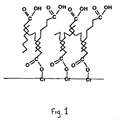
- FIG. 1 schematizes the typical structure of a treatment according to the invention of a steel sheet chromated by a fatty acid.
- the metal sheet whose surface is to be treated, is for example a sheet steel, bare or coated with tin (tinplate), chromium or zinc.
- the polar radical is chosen from at least one of the following radicals: carboxylic acid, phenolic, epoxy, vinyl, amine or silane.
- the number of carbon atoms in the linear chain main frame is weak enough that the product is easy to apply in a liquid state and high enough not to evaporate quickly when heating the film applied to the surface.
- the number of successive carbon in the linear chain is preferably greater than or equal to 8.
- the linear main frame chain does not include so no polar ramifications, and on the opposite side of the end with a polar radical, all the C-C bonds in the chain are saturated.
- organic products which can be used to implement the invention, there may be mentioned oleic acid, palmitic acid, epoxyoctane.
- this product can be diluted in a solvent.
- the polar radicals are positioned at the outside of the “balls”, whereas in the absence of solvent or if a apolar solvent, these are the apolar linear carbon chains which are turned towards the outside of the "balls".
- the sheet coated with its product film is then heated to a temperature and for a suitable time to react the product with the metal surface and make it react with itself, that is to say that part of the product is fixed on the surface to be treated and part of the product crosslinks partially.
- Heating also aims to break down the "balls" of molecules so that the polar radicals turn to outside the film, towards the metal surface or towards the external surface of the film and so that the linear carbon chains remain on the contrary tangled in the thickness of the film.
- heating is also suitable for evaporating this solvent.
- oleic acid When using oleic acid, you can for example choose a heating temperature of approximately 200 ° C for approximately 5 seconds, or 140 ° C for approximately 5 minutes.
- this temperature is at least equal to 120 ° C.
- this temperature is approximately 10 to 60 ° C lower than the boiling or decomposition temperature of the organic product.
- the product is applied while making it react and crosslink in the same operation, for example by immersing the sheet in a bath of said product; bath temperature and immersion time are then adapted as before to obtain fixing and crosslinking part of the product on the surface to be treated.
- the product can even be applied on a hot sheet, previously heated.
- a sheet is then obtained coated with a homogeneous film of product, at least part of the product being fixed and / or having crosslinked on the surface.
- the polar radicals are particularly important for bonding and fixing with the surface to be treated and that the Apolar linear chains are particularly important for obtaining a crosslinking of part of the film product applied to the surface.
- the organic product molecules in the applied film are considered to be fixed or crosslinked on the surface when linked to this surface either by a polar terminal function of a molecule, or indirectly when they are nested, entangled or crosslinked in another product molecule directly linked to the surface.
- the heating conditions of the applied film must allow nesting of at least two monomolecular layers through entangled apolar chains.
- Application and heating conditions can be checked by surface analysis, as described below.
- organic product which, during heating, did not settle and / or did not settle not crosslinked on the surface; this part not fixed and / or not crosslinked, it is say "free” can be considered to be in a liquid state.
- the rinsing solvent has a polar character.
- the sheet After rinsing, the sheet is dried.
- a sheet is then obtained coated on the external surface with a film of said organic product, crosslinked and adhering to the sheet, this film comprising at least two monomolecular layers of said organic product.
- a means of controlling the application conditions (sufficient quantity of product) and heating (proper orientation of the molecules) consists of verify by these means of analysis that the proportion of polar radicals to the surface of the treatment film is greater than the stoichiometric proportion of these radicals in the molecules of the organic surface treatment product.
- the treatment can be repeated on the surface already treated a first time and / or modify the application conditions and / or heating for subsequent treatments.
- the treatment according to the invention therefore coats the metal surface with a film very thin, with a thickness corresponding to only a few molecules of the product used.
- This very thin film is sufficiently crosslinked to resist water and solvents.
- This treatment film is strongly linked to the metal surface.
- This treatment film has a polar outer surface, as illustrated by FIG. 1 which represents a treatment film according to the invention applied on a chrome steel surface, the organic product used for the treatment being here a fatty acid.
- a coating for example varnish or paint
- the coatings applied to the surfaces treated according to the invention adhered to the less as well as coatings applied to the same surfaces treated by chromation according to the prior art.
- the treatment according to the invention therefore advantageously replaces the chromate treatments; unlike chromating treatments, it is a treatment without risks of pollution and / or corrosion, and whose effluents are easier to treat.
- the treatment according to the invention therefore resembles a treatment of surface passivation.
- the treatment according to the invention can be substitute a protective and / or lubricating oil.
- the treatment according to the invention alone provides superior corrosion protection obtained by oiling sheets, even passivated.
- a varnish on a sheet treated according to the invention much more easily than on an oiled sheet for storage and then degreased: in fact, not only avoids a degreasing operation before applying the varnish, but also no more refusal of varnish is observed after application of the varnish.
- the treatment according to the invention improves the tribological properties of the surface as would a conventional oiling.
- sheets treated according to the invention are protected against corrosion during a storage period between one day and several months, and remain directly usable, after storage, both for a forming operation only for a coating operation, in particular varnish type, without other intermediate degreasing and surface treatment (chromate type).
- the treatment according to the invention is therefore particularly advantageous in exit from the sheet metal production line, in preparation for storage and whatever or the destination of the sheet.
- the processing according to the invention therefore makes it possible to simplify the scheduling at the end of the sheet metal production line, as it simplifies the sheet metal coating, in particular with varnishes.
- varnishing or painting of sheet metal such as treatment according to the invention is both an adhesion treatment, passivation and protection, there is no need to apply varnish at all or painting directly after surface treatment, unlike process described in document US 5 103 550.
- a large number of organic products which can be used to the invention are compatible with food applications, especially fatty acids, without toxicological risks or even pollution in terms of effluents, which makes the process advantageous for the preparation sheet for food packaging.
- the layer deposited on the surface of the sheet according to the invention is resistant to solvents, in other words, that the sheet treated according to the invention is not easily “degreasable”.
- the sheet treated according to does the invention retain its protection against corrosion and elsewhere also its tribological properties.
- the treatment according to the invention can therefore replace other operations than sheet oiling; it can, for example, replace the exterior varnishing of metallic food packaging; he can, by example, used to protect and lubricate the external bottoms of boxes stackable metal.
- the temperature at which the product is submitted during or after application is always less than that used in the invention.
- the purpose of this example is to illustrate an embodiment of the invention in which the treatment product film is simultaneously applied and heated.
- This sheet to be treated is soaked in a hot oleic acid bath: either for approximately 5 seconds at approximately 200 ° C, i.e. for approximately 5 minutes at 140 ° C approximately.
- oleic acid in the surface film covering the sheet is in liquid form, but some of the oleic acid is fixed and crosslinked on the surface to be treated during immersion.
- the sheet is then rinsed in a stirred acetone bath for one minute approx., to remove the part of the applied film which has not fixed and / or crosslinked.
- XPS photoelectron spectroscopy
- the purpose of this example is to illustrate an embodiment of the invention in which the treatment product film is applied and then heated.
- this film could be easily removed by rinsing in a solvent.
- the sheet to be treated is then heated for approximately 5 minutes to a temperature of about 180 ° C.
- rinsing in a solvent is not necessary, because the applied film is already very thin and most of the applied oleic acid was able to bind and / or crosslink during heating.
- the purpose of this example is to illustrate that the surface treatment according to the invention can be carried out on an oiled sheet, without it being necessary to degrease before.
- Example 2 We then proceed as in Example 1, with the difference that increases the immersion time in hot oleic acid to allow desorption of the oily layer in oleic acid.
- immersion in oleic acid serves both to clean the sheet metal surface and coat with oleic acid.
- the purpose of this example is to illustrate corrosion protection provided by treatments according to the invention.
- the corrosion test consists of evaluating the number of cycles (1 to 20) required on the one hand to see rust appear, on the other hand to observe a complete coiling of the sample.
- the treatment according to the invention provides a higher corrosion resistance than the treatments used commonly used for temporary protection such as oiling.
- the purpose of this example is to illustrate the advantage that the invention provides for prepare a metal surface for coating, especially varnish.
- the essential goal sought by the application of a varnish on a sheet is provide very high resistance to corrosion, especially corrosion aqueous.
- aqueous corrosion - of varnished samples to be tested they are subjected to a standard corrosion test then the corrosion level is measured on these samples.
- the standard corrosion test is to soak the samples in an aqueous solution containing 50 g / l of citric acid, to keep them in this solution for one hour at the boil then for seven days at ambient temperature.
- the surface treatment according to the invention improves significantly the corrosion protection provided by a layer of varnish on this surface (this improvement may remain less than what we obtained with chromating) avoiding the disadvantages, in particular of pollution and corrosion, linked to the use of chromating solutions.
- This example is also intended to illustrate the benefit of the invention to prepare the application of a varnish.
- the treatment according to the invention simplifies the operations for preparing surface (no risk of pollution and / or chromium corrosion) and improves or maintains at least the ability to varnish metal surfaces (no risk of varnish rejection).
- the ALTEK method consists in depositing, on the surface to be tested, a weight three kilograms resting on the surface through three feet semi-spherical and measure the force required to drag the weight over this surface; the force / weight ratio gives the coefficient of friction.
- the treatment according to the invention improves the tribological properties of the surface, without necessarily reaching the level of lubrication provided with oiling classic of the prior art, nor, a fortiori, that provided by a layer of varnish.
Landscapes
- Engineering & Computer Science (AREA)
- Chemical & Material Sciences (AREA)
- Nanotechnology (AREA)
- Condensed Matter Physics & Semiconductors (AREA)
- Wood Science & Technology (AREA)
- General Physics & Mathematics (AREA)
- Materials Engineering (AREA)
- Crystallography & Structural Chemistry (AREA)
- Physics & Mathematics (AREA)
- Life Sciences & Earth Sciences (AREA)
- Composite Materials (AREA)
- Manufacturing & Machinery (AREA)
- Organic Chemistry (AREA)
- Application Of Or Painting With Fluid Materials (AREA)
- Laminated Bodies (AREA)
- Preventing Corrosion Or Incrustation Of Metals (AREA)
- Paints Or Removers (AREA)
- Chemical Treatment Of Metals (AREA)
- Cleaning And De-Greasing Of Metallic Materials By Chemical Methods (AREA)
Claims (12)
- Oberflächenbehandlung eines Metallblechs, dadurch gekennzeichnet, dass:auf die metallische Oberfläche ein homogener Film eines organischen Produkts auf der Basis von Molekülen aufgebracht wird, deren Hauptgerüst in Form einer apolaren linearen Kette vorliegt, die aus Kohlenstoff-Kohlenstoff-Bindungen gebildet wird, welche an einem Ende gesättigt sind, und die nur an dem anderen Ende eine polare Gruppe trägt,der Film während einer Zeitspanne auf eine Temperatur erwärmt wird, die geeignet ist, um einen Teil des Produkts auf der Oberfläche zu fixieren und das Produkt auf der Oberfläche teilweise zu vernetzen, undgegebenenfalls anschließend mit Hilfe eines Lösungsmittels für das organische Produkt aus dem Film den Anteil des organischen Produkts zu entfernen, der nicht auf der Oberfläche haftet und/oder nicht vernetzt ist.
- Oberflächenbehandlung nach Anspruch 1, dadurch gekennzeichnet, dass die Bedingungen beim Auftragen und Erwärmen des Films so gewählt sind, dass nach der Behandlung der Anteil der polaren Gruppen an der Oberfläche des Films über dem stöchiometrischen Anteil dieser Gruppen in den Molekülen des organischen Produkts liegt.
- Oberflächenbehandlung nach einem der vorhergehenden Ansprüche, dadurch gekennzeichnet, dass die polare Gruppe unter mindestens einer der folgenden Gruppen ausgewählt ist: Carbonsäure, Phenolgruppe, Epoxygruppe, Vinylgruppe, Aminogruppe oder Silangruppe.
- Stahlblech, das blank oder mit einer Metallschicht überzogen ist und das an der äußeren Oberfläche mit einem Film des vemetzten und fixierten organischen Produkts beschichtet ist, der bei der Oberflächenbehandlung des Blechs nach einem der vorhergehenden Ansprüche gebildet wird.
- Stahlblech nach Anspruch 4, dadurch gekennzeichnet, dass die Dicke des Films mindestens zwei monomolekulare Schichten des organischen Produkts beträgt.
- Stahlblech nach einem der Ansprüche 4 bis 5, das mit einer Metallschicht überzogen ist, dadurch gekennzeichnet, dass die Metallschicht aus Zink, einer Zinklegierung, Zinn, einer Zinnlegierung, Chrom oder einer Chromlegierung besteht.
- Verfahren zum Aufbringen von Lack auf die Oberfläche eines Stahlblechs, das blank vorliegt oder mit einer Metallschicht beschichtet ist, mit den folgenden Schritten:in einem ersten Schritt wird die Oberfläche nach einem der Ansprüche 1 bis 3 behandelt, undanschließend wird dann in einem zweiten Schritt genau genommen der Lack direkt auf die behandelte Oberfläche aufgebracht.
- Verfahren nach Anspruch 7, dadurch gekennzeichnet, dass die Zeitspanne zwischen dem ersten Schritt und dem zweiten Schritt über einem Tag liegt.
- Verfahren nach einem der Ansprüche 7 bis 8, dadurch gekennzeichnet, dass der Lack ein Lack vom polaren Typ ist.
- Verwendung eines nach einem der Ansprüche 7 bis 9 lackierten Stahlblechs zur Herstellung von Verpackungen für flüssige oder feste Lebensmittel.
- Verfahren zur Formgebung eines Stahlblechs, das blank oder mit einer Metallschicht überzogen ist, mit Hilfe eines Formwerkzeugs, wobei:in einem ersten Schritt die Oberfläche des Blechs, bevor es mit dem Formwerkzeug in Kontakt gebracht wird, nach einem der Ansprüche 1 bis 3 behandelt wird, undin einem zweiten Schritt die Formgebung mit dem Formwerkzeug erfolgt.
- Verfahren nach Anspruch 11, dadurch gekennzeichnet, dass die Zeitspanne zwischen dem ersten Schritt und dem zweiten Schritt über einem Tag liegt.
Applications Claiming Priority (2)
| Application Number | Priority Date | Filing Date | Title |
|---|---|---|---|
| FR9605267 | 1996-04-26 | ||
| FR9605267A FR2747945B1 (fr) | 1996-04-26 | 1996-04-26 | Traitement de surface de tole metallique |
Publications (2)
| Publication Number | Publication Date |
|---|---|
| EP0804973A1 EP0804973A1 (de) | 1997-11-05 |
| EP0804973B1 true EP0804973B1 (de) | 2003-06-04 |
Family
ID=9491612
Family Applications (1)
| Application Number | Title | Priority Date | Filing Date |
|---|---|---|---|
| EP97400825A Expired - Lifetime EP0804973B1 (de) | 1996-04-26 | 1997-04-11 | Oberflächebehandlung von Metallblechen |
Country Status (7)
| Country | Link |
|---|---|
| US (1) | US5925417A (de) |
| EP (1) | EP0804973B1 (de) |
| JP (1) | JPH1060677A (de) |
| AT (1) | ATE242063T1 (de) |
| DE (1) | DE69722509T2 (de) |
| ES (1) | ES2197318T3 (de) |
| FR (1) | FR2747945B1 (de) |
Families Citing this family (9)
| Publication number | Priority date | Publication date | Assignee | Title |
|---|---|---|---|---|
| JP3866811B2 (ja) * | 1996-12-27 | 2007-01-10 | 松下電器産業株式会社 | 単分子膜およびその製造方法 |
| JP3297861B2 (ja) * | 1998-06-29 | 2002-07-02 | 日本航空電子工業株式会社 | めっき材 |
| US7104850B2 (en) * | 2004-08-18 | 2006-09-12 | Yazaki Corporation | Low insertion-force connector terminal, method of producing the same and substrate for the same |
| DE102005059058A1 (de) | 2005-12-08 | 2007-06-14 | Beiersdorf Ag | Acrylatklebemasse mit wasserfesten Klebeeigenschaften |
| WO2007112312A2 (en) * | 2006-03-24 | 2007-10-04 | 3M Innovative Properties Company | Medicinal formulation container with a treated metal surface |
| WO2016178963A1 (en) | 2015-05-01 | 2016-11-10 | Novelis Inc. | Continuous coil pretreatment process |
| CN109148736B (zh) * | 2017-06-19 | 2020-05-22 | Tcl科技集团股份有限公司 | 一种基于有机薄膜与无机薄膜交替的器件封装方法 |
| CN109148732B (zh) * | 2017-06-19 | 2020-08-18 | Tcl科技集团股份有限公司 | 一种基于金属粒子与有机小分子交联的器件封装方法 |
| CN108448006B (zh) * | 2018-03-29 | 2021-01-22 | 京东方科技集团股份有限公司 | 封装结构、电子装置以及封装方法 |
Family Cites Families (16)
| Publication number | Priority date | Publication date | Assignee | Title |
|---|---|---|---|---|
| US3284248A (en) * | 1963-01-07 | 1966-11-08 | Brown Co | Metal surface treatment |
| FR1395228A (fr) * | 1963-05-09 | 1965-04-09 | Unilever Nv | Lames de rasoir |
| US3644566A (en) * | 1970-11-17 | 1972-02-22 | Cook Paint & Varnish Co | Silicon acrylic copolymers |
| FR2166404A5 (en) * | 1971-08-30 | 1973-08-17 | Massin Michel Francois | Non-stitck coating - for glass, metal or ceramic |
| US4169904A (en) * | 1978-01-05 | 1979-10-02 | International Business Machines Corporation | Preparation of polymer monomolecular films |
| US4564557A (en) * | 1984-04-14 | 1986-01-14 | Chisso Corporation | Thermoset acrylic resin composition for coating metallic materials and stainless steel coated with the composition |
| NZ222904A (en) * | 1987-01-15 | 1989-09-27 | Glidden Co | Acrylic modified silicone resins |
| US5103550A (en) * | 1989-12-26 | 1992-04-14 | Aluminum Company Of America | Method of making a food or beverage container |
| DE4021733A1 (de) * | 1990-07-07 | 1992-01-09 | Hoechst Ag | Verfahren zur herstellung anorganischer mikrostrukturen aus langmuir-blodgett-schichten |
| US5238746A (en) * | 1990-11-06 | 1993-08-24 | Matsushita Electric Industrial Co., Ltd. | Fluorocarbon-based polymer lamination coating film and method of manufacturing the same |
| EP0511548B1 (de) * | 1991-04-30 | 1997-07-09 | Matsushita Electric Industrial Co., Ltd. | Chemisch adsorbierte Schicht und Verfahren zu deren Herstellung |
| FR2681334A1 (fr) * | 1991-09-18 | 1993-03-19 | Siderurgie Fse Inst Rech | Procede et dispositif de revetement d'un produit metallurgique par des couches de polymere et produit obtenu par ce procede. |
| BR9104402A (pt) * | 1991-10-10 | 1993-04-20 | Glasurit Do Brasil Limitada | Polimero de emulsao diluivel na agua,processo para a preparacao de um polimero de emulsao diluivel na agua,composicao de revestimento aquosa e emprego do polimero |
| US5435839A (en) * | 1992-12-24 | 1995-07-25 | Matsushita Electric Industrial Co., Ltd. | Finishing agents and method of manufacturing the same |
| US5409739A (en) * | 1993-09-17 | 1995-04-25 | University Technologies International Inc. | Monolayer coating |
| CA2192450A1 (en) * | 1994-06-13 | 1995-12-21 | Ernest Byron Wysong | Corrosion inhibitor composition for steel |
-
1996
- 1996-04-26 FR FR9605267A patent/FR2747945B1/fr not_active Expired - Fee Related
-
1997
- 1997-04-11 ES ES97400825T patent/ES2197318T3/es not_active Expired - Lifetime
- 1997-04-11 AT AT97400825T patent/ATE242063T1/de not_active IP Right Cessation
- 1997-04-11 EP EP97400825A patent/EP0804973B1/de not_active Expired - Lifetime
- 1997-04-11 DE DE1997622509 patent/DE69722509T2/de not_active Expired - Fee Related
- 1997-04-22 JP JP11874197A patent/JPH1060677A/ja not_active Withdrawn
- 1997-04-28 US US08/845,834 patent/US5925417A/en not_active Expired - Fee Related
Also Published As
| Publication number | Publication date |
|---|---|
| US5925417A (en) | 1999-07-20 |
| EP0804973A1 (de) | 1997-11-05 |
| DE69722509T2 (de) | 2004-05-13 |
| DE69722509D1 (de) | 2003-07-10 |
| FR2747945B1 (fr) | 1998-08-21 |
| FR2747945A1 (fr) | 1997-10-31 |
| JPH1060677A (ja) | 1998-03-03 |
| ES2197318T3 (es) | 2004-01-01 |
| ATE242063T1 (de) | 2003-06-15 |
Similar Documents
| Publication | Publication Date | Title |
|---|---|---|
| JP4227999B2 (ja) | 金属基体の腐食防止用の方法及び組成物 | |
| ATE518922T1 (de) | Verfahren zur vorbehandlung oder/und beschichtung von metallischen oberflächen vor der umformung mit einem lackähnlichen überzug und verwendung der derart beschichteten substrate | |
| CA2479060C (fr) | Composition de revetement de substrat metallique | |
| EP0804973A1 (de) | Oberflächebehandlung von Metallblechen | |
| FR2937048A1 (fr) | Procede de nettoyage de surfaces mettant en oeuvre un liquide ionique de type pils | |
| WO2013054066A1 (fr) | Procédé de traitement anticorrosion d'un substrat métallique solide et substrat métallique susceptible d'être obtenu par un tel procédé | |
| CA2099449C (fr) | Procede de protection contre la corrosion de pieces metalliques et pieces metalliques obtenues par ce procede | |
| CA2442502C (fr) | Procede de traitement par carboxylatation de surfaces metalliques | |
| FR2796655A1 (fr) | Procede et composition de traitement anti-corrosion d'un substrat metallique prealablement protege par une couche de revetement a base de zinc | |
| EP0517586B1 (de) | Verfahren zum Erzeugen einer Antikorrosionsbeschichtung auf Copolymerbasis auf einer Metalloberfläche | |
| US8252381B1 (en) | Molecular coating on metal surfaces | |
| JP2528698B2 (ja) | 脱脂性に優れた塗油アルミニウム合金板の製造方法 | |
| WO2018150056A1 (en) | Surface activation | |
| EP0295980B1 (de) | Verfahren zum Färben von Metalloberflächen aus Zink, aus Zinklegierungen oder von mit Zink plattierten Oberflächen | |
| KR940004904B1 (ko) | 내 흑청성 및 내식성이 우수한 아연도금강판용 크로메이트 처리용액 | |
| JP2025135487A (ja) | 金属表面処理剤、塗装体の製造方法、および車両 | |
| WO2002040419A1 (fr) | Objet a couche metallique, procede de fabrication et applications | |
| FR2747685A1 (fr) | Collage d'un film polyethylene sur une surface polaire | |
| FR2687693A1 (fr) | Procede de traitement de surface d'un produit forme d'un substrat metallique comportant un revetement metallique multicouche et un revetement organique et produits obtenus par ce procede. | |
| CN121228152A (zh) | 一种金属表面的易清洁涂层及其制备方法 | |
| FR2778186A1 (fr) | Composition hydrosoluble comme revetement de surfaces metalliques sous forme de films secs etanches a la corrosion atmospherique | |
| JPH01198458A (ja) | 高耐食性表面処理鋼板 | |
| FR2827615A1 (fr) | Procede de galvanisation a chaud de toles d'acier | |
| FR2737217A1 (fr) | Revetement protecteur, en particulier pour substrat metallique, obtention et applications | |
| BE849581A (fr) | Procede pour appliquer un revetement sur un objet metallique creux |
Legal Events
| Date | Code | Title | Description |
|---|---|---|---|
| PUAI | Public reference made under article 153(3) epc to a published international application that has entered the european phase |
Free format text: ORIGINAL CODE: 0009012 |
|
| AK | Designated contracting states |
Kind code of ref document: A1 Designated state(s): AT BE CH DE DK ES FI FR GB GR IE IT LI LU NL PT SE |
|
| 17P | Request for examination filed |
Effective date: 19971119 |
|
| GRAH | Despatch of communication of intention to grant a patent |
Free format text: ORIGINAL CODE: EPIDOS IGRA |
|
| GRAH | Despatch of communication of intention to grant a patent |
Free format text: ORIGINAL CODE: EPIDOS IGRA |
|
| GRAA | (expected) grant |
Free format text: ORIGINAL CODE: 0009210 |
|
| AK | Designated contracting states |
Designated state(s): AT BE CH DE DK ES FI FR GB GR IE IT LI LU NL PT SE |
|
| PG25 | Lapsed in a contracting state [announced via postgrant information from national office to epo] |
Ref country code: IE Free format text: LAPSE BECAUSE OF FAILURE TO SUBMIT A TRANSLATION OF THE DESCRIPTION OR TO PAY THE FEE WITHIN THE PRESCRIBED TIME-LIMIT Effective date: 20030604 Ref country code: FI Free format text: LAPSE BECAUSE OF FAILURE TO SUBMIT A TRANSLATION OF THE DESCRIPTION OR TO PAY THE FEE WITHIN THE PRESCRIBED TIME-LIMIT Effective date: 20030604 Ref country code: AT Free format text: LAPSE BECAUSE OF FAILURE TO SUBMIT A TRANSLATION OF THE DESCRIPTION OR TO PAY THE FEE WITHIN THE PRESCRIBED TIME-LIMIT Effective date: 20030604 |
|
| REG | Reference to a national code |
Ref country code: GB Ref legal event code: FG4D Free format text: NOT ENGLISH |
|
| REG | Reference to a national code |
Ref country code: CH Ref legal event code: EP |
|
| REG | Reference to a national code |
Ref country code: IE Ref legal event code: FG4D Free format text: FRENCH |
|
| REF | Corresponds to: |
Ref document number: 69722509 Country of ref document: DE Date of ref document: 20030710 Kind code of ref document: P |
|
| PG25 | Lapsed in a contracting state [announced via postgrant information from national office to epo] |
Ref country code: SE Free format text: LAPSE BECAUSE OF FAILURE TO SUBMIT A TRANSLATION OF THE DESCRIPTION OR TO PAY THE FEE WITHIN THE PRESCRIBED TIME-LIMIT Effective date: 20030904 Ref country code: PT Free format text: LAPSE BECAUSE OF FAILURE TO SUBMIT A TRANSLATION OF THE DESCRIPTION OR TO PAY THE FEE WITHIN THE PRESCRIBED TIME-LIMIT Effective date: 20030904 Ref country code: GR Free format text: LAPSE BECAUSE OF FAILURE TO SUBMIT A TRANSLATION OF THE DESCRIPTION OR TO PAY THE FEE WITHIN THE PRESCRIBED TIME-LIMIT Effective date: 20030904 Ref country code: DK Free format text: LAPSE BECAUSE OF FAILURE TO SUBMIT A TRANSLATION OF THE DESCRIPTION OR TO PAY THE FEE WITHIN THE PRESCRIBED TIME-LIMIT Effective date: 20030904 |
|
| GBT | Gb: translation of ep patent filed (gb section 77(6)(a)/1977) | ||
| REG | Reference to a national code |
Ref country code: ES Ref legal event code: FG2A Ref document number: 2197318 Country of ref document: ES Kind code of ref document: T3 |
|
| REG | Reference to a national code |
Ref country code: IE Ref legal event code: FD4D |
|
| PGFP | Annual fee paid to national office [announced via postgrant information from national office to epo] |
Ref country code: NL Payment date: 20040331 Year of fee payment: 8 Ref country code: GB Payment date: 20040331 Year of fee payment: 8 |
|
| PGFP | Annual fee paid to national office [announced via postgrant information from national office to epo] |
Ref country code: DE Payment date: 20040408 Year of fee payment: 8 |
|
| PLBE | No opposition filed within time limit |
Free format text: ORIGINAL CODE: 0009261 |
|
| STAA | Information on the status of an ep patent application or granted ep patent |
Free format text: STATUS: NO OPPOSITION FILED WITHIN TIME LIMIT |
|
| PG25 | Lapsed in a contracting state [announced via postgrant information from national office to epo] |
Ref country code: LU Free format text: LAPSE BECAUSE OF NON-PAYMENT OF DUE FEES Effective date: 20040411 |
|
| PGFP | Annual fee paid to national office [announced via postgrant information from national office to epo] |
Ref country code: FR Payment date: 20040415 Year of fee payment: 8 |
|
| PGFP | Annual fee paid to national office [announced via postgrant information from national office to epo] |
Ref country code: ES Payment date: 20040422 Year of fee payment: 8 |
|
| PG25 | Lapsed in a contracting state [announced via postgrant information from national office to epo] |
Ref country code: LI Free format text: LAPSE BECAUSE OF NON-PAYMENT OF DUE FEES Effective date: 20040430 Ref country code: CH Free format text: LAPSE BECAUSE OF NON-PAYMENT OF DUE FEES Effective date: 20040430 Ref country code: BE Free format text: LAPSE BECAUSE OF NON-PAYMENT OF DUE FEES Effective date: 20040430 |
|
| 26N | No opposition filed |
Effective date: 20040305 |
|
| BERE | Be: lapsed |
Owner name: S.A. *SOLLAC Effective date: 20040430 |
|
| REG | Reference to a national code |
Ref country code: CH Ref legal event code: PL |
|
| PG25 | Lapsed in a contracting state [announced via postgrant information from national office to epo] |
Ref country code: IT Free format text: LAPSE BECAUSE OF NON-PAYMENT OF DUE FEES;WARNING: LAPSES OF ITALIAN PATENTS WITH EFFECTIVE DATE BEFORE 2007 MAY HAVE OCCURRED AT ANY TIME BEFORE 2007. THE CORRECT EFFECTIVE DATE MAY BE DIFFERENT FROM THE ONE RECORDED. Effective date: 20050411 Ref country code: GB Free format text: LAPSE BECAUSE OF NON-PAYMENT OF DUE FEES Effective date: 20050411 |
|
| PG25 | Lapsed in a contracting state [announced via postgrant information from national office to epo] |
Ref country code: ES Free format text: LAPSE BECAUSE OF NON-PAYMENT OF DUE FEES Effective date: 20050412 |
|
| PG25 | Lapsed in a contracting state [announced via postgrant information from national office to epo] |
Ref country code: NL Free format text: LAPSE BECAUSE OF NON-PAYMENT OF DUE FEES Effective date: 20051101 Ref country code: DE Free format text: LAPSE BECAUSE OF NON-PAYMENT OF DUE FEES Effective date: 20051101 |
|
| GBPC | Gb: european patent ceased through non-payment of renewal fee |
Effective date: 20050411 |
|
| PG25 | Lapsed in a contracting state [announced via postgrant information from national office to epo] |
Ref country code: FR Free format text: LAPSE BECAUSE OF NON-PAYMENT OF DUE FEES Effective date: 20051230 |
|
| NLV4 | Nl: lapsed or anulled due to non-payment of the annual fee |
Effective date: 20051101 |
|
| REG | Reference to a national code |
Ref country code: FR Ref legal event code: ST Effective date: 20051230 |
|
| REG | Reference to a national code |
Ref country code: ES Ref legal event code: FD2A Effective date: 20050412 |