EP0805441A1 - Optische Speichermedien mit hoher Kapazität, die Xanthenfarbstoffe enthalten - Google Patents
Optische Speichermedien mit hoher Kapazität, die Xanthenfarbstoffe enthalten Download PDFInfo
- Publication number
- EP0805441A1 EP0805441A1 EP97810248A EP97810248A EP0805441A1 EP 0805441 A1 EP0805441 A1 EP 0805441A1 EP 97810248 A EP97810248 A EP 97810248A EP 97810248 A EP97810248 A EP 97810248A EP 0805441 A1 EP0805441 A1 EP 0805441A1
- Authority
- EP
- European Patent Office
- Prior art keywords
- alkyl
- halogen
- independently
- coo
- recording medium
- Prior art date
- Legal status (The legal status is an assumption and is not a legal conclusion. Google has not performed a legal analysis and makes no representation as to the accuracy of the status listed.)
- Granted
Links
- 230000003287 optical effect Effects 0.000 title claims abstract description 19
- 239000001018 xanthene dye Substances 0.000 title abstract description 6
- 125000000217 alkyl group Chemical group 0.000 claims abstract description 65
- -1 organometallic anion Chemical class 0.000 claims abstract description 54
- 229910052736 halogen Inorganic materials 0.000 claims abstract description 45
- 229910052739 hydrogen Inorganic materials 0.000 claims abstract description 44
- 150000002367 halogens Chemical class 0.000 claims abstract description 42
- 239000001257 hydrogen Substances 0.000 claims abstract description 35
- 125000003710 aryl alkyl group Chemical group 0.000 claims abstract description 27
- 125000000304 alkynyl group Chemical group 0.000 claims abstract description 26
- 239000000758 substrate Substances 0.000 claims abstract description 19
- 125000003545 alkoxy group Chemical group 0.000 claims abstract description 16
- 125000004414 alkyl thio group Chemical group 0.000 claims abstract description 16
- 125000003118 aryl group Chemical group 0.000 claims abstract description 14
- 229910052751 metal Inorganic materials 0.000 claims abstract description 13
- 239000002184 metal Substances 0.000 claims abstract description 13
- 125000000896 monocarboxylic acid group Chemical group 0.000 claims abstract description 6
- 125000004430 oxygen atom Chemical group O* 0.000 claims abstract description 4
- QGZKDVFQNNGYKY-UHFFFAOYSA-N Ammonia Chemical compound N QGZKDVFQNNGYKY-UHFFFAOYSA-N 0.000 claims abstract description 3
- 125000004433 nitrogen atom Chemical group N* 0.000 claims abstract description 3
- XYFCBTPGUUZFHI-UHFFFAOYSA-O phosphonium Chemical compound [PH4+] XYFCBTPGUUZFHI-UHFFFAOYSA-O 0.000 claims abstract description 3
- 239000010410 layer Substances 0.000 claims description 78
- 238000000034 method Methods 0.000 claims description 40
- UFHFLCQGNIYNRP-UHFFFAOYSA-N Hydrogen Chemical compound [H][H] UFHFLCQGNIYNRP-UHFFFAOYSA-N 0.000 claims description 35
- 125000003358 C2-C20 alkenyl group Chemical group 0.000 claims description 29
- 239000000975 dye Substances 0.000 claims description 26
- 229910004013 NO 2 Inorganic materials 0.000 claims description 24
- 239000000203 mixture Substances 0.000 claims description 19
- 238000010521 absorption reaction Methods 0.000 claims description 17
- 125000004070 6 membered heterocyclic group Chemical group 0.000 claims description 14
- 239000011241 protective layer Substances 0.000 claims description 14
- 238000002310 reflectometry Methods 0.000 claims description 14
- 150000002431 hydrogen Chemical class 0.000 claims description 12
- 239000000463 material Substances 0.000 claims description 11
- 238000003860 storage Methods 0.000 claims description 10
- 150000001450 anions Chemical class 0.000 claims description 8
- YMWUJEATGCHHMB-UHFFFAOYSA-N Dichloromethane Chemical compound ClCCl YMWUJEATGCHHMB-UHFFFAOYSA-N 0.000 claims description 7
- 239000003446 ligand Substances 0.000 claims description 6
- 125000001624 naphthyl group Chemical group 0.000 claims description 5
- 125000001997 phenyl group Chemical group [H]C1=C([H])C([H])=C(*)C([H])=C1[H] 0.000 claims description 5
- 229910052723 transition metal Inorganic materials 0.000 claims description 5
- 150000003624 transition metals Chemical class 0.000 claims description 5
- 229910052782 aluminium Inorganic materials 0.000 claims description 4
- 239000010949 copper Substances 0.000 claims description 4
- QGZKDVFQNNGYKY-UHFFFAOYSA-O Ammonium Chemical compound [NH4+] QGZKDVFQNNGYKY-UHFFFAOYSA-O 0.000 claims description 3
- 229910045601 alloy Inorganic materials 0.000 claims description 3
- 239000000956 alloy Substances 0.000 claims description 3
- XAGFODPZIPBFFR-UHFFFAOYSA-N aluminium Chemical compound [Al] XAGFODPZIPBFFR-UHFFFAOYSA-N 0.000 claims description 3
- 229910052802 copper Inorganic materials 0.000 claims description 3
- 229910052737 gold Inorganic materials 0.000 claims description 3
- 239000010931 gold Substances 0.000 claims description 3
- 229910052709 silver Inorganic materials 0.000 claims description 3
- RYGMFSIKBFXOCR-UHFFFAOYSA-N Copper Chemical compound [Cu] RYGMFSIKBFXOCR-UHFFFAOYSA-N 0.000 claims description 2
- BQCADISMDOOEFD-UHFFFAOYSA-N Silver Chemical compound [Ag] BQCADISMDOOEFD-UHFFFAOYSA-N 0.000 claims description 2
- 125000004432 carbon atom Chemical group C* 0.000 claims description 2
- 125000006297 carbonyl amino group Chemical group [H]N([*:2])C([*:1])=O 0.000 claims description 2
- 239000003989 dielectric material Substances 0.000 claims description 2
- PCHJSUWPFVWCPO-UHFFFAOYSA-N gold Chemical compound [Au] PCHJSUWPFVWCPO-UHFFFAOYSA-N 0.000 claims description 2
- 125000004356 hydroxy functional group Chemical group O* 0.000 claims description 2
- ISWSIDIOOBJBQZ-UHFFFAOYSA-N phenol group Chemical group C1(=CC=CC=C1)O ISWSIDIOOBJBQZ-UHFFFAOYSA-N 0.000 claims description 2
- 239000004332 silver Substances 0.000 claims description 2
- 229910052757 nitrogen Inorganic materials 0.000 abstract description 18
- JCXJVPUVTGWSNB-UHFFFAOYSA-N Nitrogen dioxide Chemical compound O=[N]=O JCXJVPUVTGWSNB-UHFFFAOYSA-N 0.000 abstract description 8
- 125000003342 alkenyl group Chemical group 0.000 abstract description 6
- 229910006074 SO2NH2 Inorganic materials 0.000 abstract description 2
- 229910006069 SO3H Inorganic materials 0.000 abstract description 2
- 125000004397 aminosulfonyl group Chemical group NS(=O)(=O)* 0.000 abstract description 2
- 125000003917 carbamoyl group Chemical group [H]N([H])C(*)=O 0.000 abstract description 2
- 125000000020 sulfo group Chemical group O=S(=O)([*])O[H] 0.000 abstract description 2
- XFXPMWWXUTWYJX-UHFFFAOYSA-N Cyanide Chemical compound N#[C-] XFXPMWWXUTWYJX-UHFFFAOYSA-N 0.000 abstract 6
- 125000005843 halogen group Chemical group 0.000 abstract 3
- 125000000623 heterocyclic group Chemical group 0.000 abstract 3
- MDFFNEOEWAXZRQ-UHFFFAOYSA-N aminyl Chemical compound [NH2] MDFFNEOEWAXZRQ-UHFFFAOYSA-N 0.000 abstract 1
- 125000004093 cyano group Chemical group *C#N 0.000 abstract 1
- 125000004435 hydrogen atom Chemical group [H]* 0.000 abstract 1
- 125000000449 nitro group Chemical group [O-][N+](*)=O 0.000 abstract 1
- 125000002924 primary amino group Chemical group [H]N([H])* 0.000 abstract 1
- LFQSCWFLJHTTHZ-UHFFFAOYSA-N Ethanol Chemical compound CCO LFQSCWFLJHTTHZ-UHFFFAOYSA-N 0.000 description 150
- 150000001875 compounds Chemical class 0.000 description 37
- VEXZGXHMUGYJMC-UHFFFAOYSA-N Hydrochloric acid Chemical compound Cl VEXZGXHMUGYJMC-UHFFFAOYSA-N 0.000 description 24
- OKKJLVBELUTLKV-UHFFFAOYSA-N Methanol Chemical compound OC OKKJLVBELUTLKV-UHFFFAOYSA-N 0.000 description 24
- 238000010992 reflux Methods 0.000 description 24
- IJGRMHOSHXDMSA-UHFFFAOYSA-N Atomic nitrogen Chemical compound N#N IJGRMHOSHXDMSA-UHFFFAOYSA-N 0.000 description 22
- 239000011541 reaction mixture Substances 0.000 description 20
- VYPSYNLAJGMNEJ-UHFFFAOYSA-N Silicium dioxide Chemical compound O=[Si]=O VYPSYNLAJGMNEJ-UHFFFAOYSA-N 0.000 description 19
- 239000000741 silica gel Substances 0.000 description 19
- 229910002027 silica gel Inorganic materials 0.000 description 19
- XLYOFNOQVPJJNP-UHFFFAOYSA-N water Substances O XLYOFNOQVPJJNP-UHFFFAOYSA-N 0.000 description 19
- 239000000460 chlorine Substances 0.000 description 18
- 238000004809 thin layer chromatography Methods 0.000 description 17
- 238000003756 stirring Methods 0.000 description 15
- LRHPLDYGYMQRHN-UHFFFAOYSA-N N-Butanol Chemical compound CCCCO LRHPLDYGYMQRHN-UHFFFAOYSA-N 0.000 description 14
- 239000000843 powder Substances 0.000 description 14
- 239000000725 suspension Substances 0.000 description 14
- 239000002904 solvent Substances 0.000 description 13
- ZMXDDKWLCZADIW-UHFFFAOYSA-N N,N-Dimethylformamide Chemical compound CN(C)C=O ZMXDDKWLCZADIW-UHFFFAOYSA-N 0.000 description 12
- 239000012074 organic phase Substances 0.000 description 12
- RFFLAFLAYFXFSW-UHFFFAOYSA-N 1,2-dichlorobenzene Chemical compound ClC1=CC=CC=C1Cl RFFLAFLAYFXFSW-UHFFFAOYSA-N 0.000 description 10
- CSCPPACGZOOCGX-UHFFFAOYSA-N Acetone Chemical compound CC(C)=O CSCPPACGZOOCGX-UHFFFAOYSA-N 0.000 description 10
- 239000007787 solid Substances 0.000 description 10
- HEMHJVSKTPXQMS-UHFFFAOYSA-M Sodium hydroxide Chemical compound [OH-].[Na+] HEMHJVSKTPXQMS-UHFFFAOYSA-M 0.000 description 9
- 239000000047 product Substances 0.000 description 9
- 230000005855 radiation Effects 0.000 description 9
- IUVCFHHAEHNCFT-INIZCTEOSA-N 2-[(1s)-1-[4-amino-3-(3-fluoro-4-propan-2-yloxyphenyl)pyrazolo[3,4-d]pyrimidin-1-yl]ethyl]-6-fluoro-3-(3-fluorophenyl)chromen-4-one Chemical compound C1=C(F)C(OC(C)C)=CC=C1C(C1=C(N)N=CN=C11)=NN1[C@@H](C)C1=C(C=2C=C(F)C=CC=2)C(=O)C2=CC(F)=CC=C2O1 IUVCFHHAEHNCFT-INIZCTEOSA-N 0.000 description 8
- 239000013078 crystal Substances 0.000 description 8
- 238000000921 elemental analysis Methods 0.000 description 8
- PYWVYCXTNDRMGF-UHFFFAOYSA-N rhodamine B Chemical compound [Cl-].C=12C=CC(=[N+](CC)CC)C=C2OC2=CC(N(CC)CC)=CC=C2C=1C1=CC=CC=C1C(O)=O PYWVYCXTNDRMGF-UHFFFAOYSA-N 0.000 description 8
- FOFUWJNBAQJABO-UHFFFAOYSA-N 8-hydroxyjulolidine Chemical compound C1CCN2CCCC3=C2C1=CC=C3O FOFUWJNBAQJABO-UHFFFAOYSA-N 0.000 description 7
- FAPWRFPIFSIZLT-UHFFFAOYSA-M Sodium chloride Chemical compound [Na+].[Cl-] FAPWRFPIFSIZLT-UHFFFAOYSA-M 0.000 description 7
- WEHWNAOGRSTTBQ-UHFFFAOYSA-N dipropylamine Chemical compound CCCNCCC WEHWNAOGRSTTBQ-UHFFFAOYSA-N 0.000 description 7
- 229940043267 rhodamine b Drugs 0.000 description 7
- 229910052801 chlorine Inorganic materials 0.000 description 6
- BDAGIHXWWSANSR-UHFFFAOYSA-N methanoic acid Natural products OC=O BDAGIHXWWSANSR-UHFFFAOYSA-N 0.000 description 6
- 229920000515 polycarbonate Polymers 0.000 description 6
- 239000004417 polycarbonate Substances 0.000 description 6
- 239000011734 sodium Substances 0.000 description 6
- WAVOOWVINKGEHS-UHFFFAOYSA-N 3-(diethylamino)phenol Chemical compound CCN(CC)C1=CC=CC(O)=C1 WAVOOWVINKGEHS-UHFFFAOYSA-N 0.000 description 5
- 230000008859 change Effects 0.000 description 5
- 235000011837 pasties Nutrition 0.000 description 5
- 230000035945 sensitivity Effects 0.000 description 5
- ZYECOAILUNWEAL-NUDFZHEQSA-N (4z)-4-[[2-methoxy-5-(phenylcarbamoyl)phenyl]hydrazinylidene]-n-(3-nitrophenyl)-3-oxonaphthalene-2-carboxamide Chemical compound COC1=CC=C(C(=O)NC=2C=CC=CC=2)C=C1N\N=C(C1=CC=CC=C1C=1)/C(=O)C=1C(=O)NC1=CC=CC([N+]([O-])=O)=C1 ZYECOAILUNWEAL-NUDFZHEQSA-N 0.000 description 4
- 0 CCN(CC)c(cc1)cc(OC2(C)C3)c1C(C(C=C1)=C(*)C=CC1(C)[N+]([O-])=O)=C2C=CC3=[N+](CC)CC Chemical compound CCN(CC)c(cc1)cc(OC2(C)C3)c1C(C(C=C1)=C(*)C=CC1(C)[N+]([O-])=O)=C2C=CC3=[N+](CC)CC 0.000 description 4
- KFZMGEQAYNKOFK-UHFFFAOYSA-N Isopropanol Chemical compound CC(C)O KFZMGEQAYNKOFK-UHFFFAOYSA-N 0.000 description 4
- 238000002835 absorbance Methods 0.000 description 4
- 238000000576 coating method Methods 0.000 description 4
- 239000000706 filtrate Substances 0.000 description 4
- 239000004033 plastic Substances 0.000 description 4
- 229920003023 plastic Polymers 0.000 description 4
- 150000003839 salts Chemical class 0.000 description 4
- COIVODZMVVUETJ-UHFFFAOYSA-N sulforhodamine 101 Chemical compound OS(=O)(=O)C1=CC(S([O-])(=O)=O)=CC=C1C1=C(C=C2C3=C4CCCN3CCC2)C4=[O+]C2=C1C=C1CCCN3CCCC2=C13 COIVODZMVVUETJ-UHFFFAOYSA-N 0.000 description 4
- 229910052717 sulfur Inorganic materials 0.000 description 4
- ANRHNWWPFJCPAZ-UHFFFAOYSA-M thionine Chemical compound [Cl-].C1=CC(N)=CC2=[S+]C3=CC(N)=CC=C3N=C21 ANRHNWWPFJCPAZ-UHFFFAOYSA-M 0.000 description 4
- NBUKAOOFKZFCGD-UHFFFAOYSA-N 2,2,3,3-tetrafluoropropan-1-ol Chemical compound OCC(F)(F)C(F)F NBUKAOOFKZFCGD-UHFFFAOYSA-N 0.000 description 3
- OSWFIVFLDKOXQC-UHFFFAOYSA-N 4-(3-methoxyphenyl)aniline Chemical compound COC1=CC=CC(C=2C=CC(N)=CC=2)=C1 OSWFIVFLDKOXQC-UHFFFAOYSA-N 0.000 description 3
- RTZKZFJDLAIYFH-UHFFFAOYSA-N Diethyl ether Chemical compound CCOCC RTZKZFJDLAIYFH-UHFFFAOYSA-N 0.000 description 3
- LGRFSURHDFAFJT-UHFFFAOYSA-N Phthalic anhydride Natural products C1=CC=C2C(=O)OC(=O)C2=C1 LGRFSURHDFAFJT-UHFFFAOYSA-N 0.000 description 3
- 239000002253 acid Substances 0.000 description 3
- JHIWVOJDXOSYLW-UHFFFAOYSA-N butyl 2,2-difluorocyclopropane-1-carboxylate Chemical compound CCCCOC(=O)C1CC1(F)F JHIWVOJDXOSYLW-UHFFFAOYSA-N 0.000 description 3
- PFKFTWBEEFSNDU-UHFFFAOYSA-N carbonyldiimidazole Chemical compound C1=CN=CN1C(=O)N1C=CN=C1 PFKFTWBEEFSNDU-UHFFFAOYSA-N 0.000 description 3
- 235000019253 formic acid Nutrition 0.000 description 3
- 239000007789 gas Substances 0.000 description 3
- 239000011521 glass Substances 0.000 description 3
- VLKZOEOYAKHREP-UHFFFAOYSA-N n-Hexane Chemical compound CCCCCC VLKZOEOYAKHREP-UHFFFAOYSA-N 0.000 description 3
- PXHVJJICTQNCMI-UHFFFAOYSA-N nickel Substances [Ni] PXHVJJICTQNCMI-UHFFFAOYSA-N 0.000 description 3
- 239000012071 phase Substances 0.000 description 3
- 239000002244 precipitate Substances 0.000 description 3
- 238000004528 spin coating Methods 0.000 description 3
- 239000007858 starting material Substances 0.000 description 3
- 229920001169 thermoplastic Polymers 0.000 description 3
- 229920001187 thermosetting polymer Polymers 0.000 description 3
- 239000004416 thermosoftening plastic Substances 0.000 description 3
- RHUYHJGZWVXEHW-UHFFFAOYSA-N 1,1-Dimethyhydrazine Chemical compound CN(C)N RHUYHJGZWVXEHW-UHFFFAOYSA-N 0.000 description 2
- XNWFRZJHXBZDAG-UHFFFAOYSA-N 2-METHOXYETHANOL Chemical compound COCCO XNWFRZJHXBZDAG-UHFFFAOYSA-N 0.000 description 2
- KHSTZMGCKHBFJX-UHFFFAOYSA-N 3-(dibutylamino)phenol Chemical compound CCCCN(CCCC)C1=CC=CC(O)=C1 KHSTZMGCKHBFJX-UHFFFAOYSA-N 0.000 description 2
- MMVIDXVHQANYAE-UHFFFAOYSA-N 5-nitro-2-benzofuran-1,3-dione Chemical compound [O-][N+](=O)C1=CC=C2C(=O)OC(=O)C2=C1 MMVIDXVHQANYAE-UHFFFAOYSA-N 0.000 description 2
- NLXLAEXVIDQMFP-UHFFFAOYSA-N Ammonia chloride Chemical compound [NH4+].[Cl-] NLXLAEXVIDQMFP-UHFFFAOYSA-N 0.000 description 2
- WKBOTKDWSSQWDR-UHFFFAOYSA-N Bromine atom Chemical compound [Br] WKBOTKDWSSQWDR-UHFFFAOYSA-N 0.000 description 2
- OKTJSMMVPCPJKN-UHFFFAOYSA-N Carbon Chemical compound [C] OKTJSMMVPCPJKN-UHFFFAOYSA-N 0.000 description 2
- ZAMOUSCENKQFHK-UHFFFAOYSA-N Chlorine atom Chemical compound [Cl] ZAMOUSCENKQFHK-UHFFFAOYSA-N 0.000 description 2
- ROSDSFDQCJNGOL-UHFFFAOYSA-N Dimethylamine Chemical compound CNC ROSDSFDQCJNGOL-UHFFFAOYSA-N 0.000 description 2
- CSNNHWWHGAXBCP-UHFFFAOYSA-L Magnesium sulfate Chemical compound [Mg+2].[O-][S+2]([O-])([O-])[O-] CSNNHWWHGAXBCP-UHFFFAOYSA-L 0.000 description 2
- NQRYJNQNLNOLGT-UHFFFAOYSA-N Piperidine Chemical compound C1CCNCC1 NQRYJNQNLNOLGT-UHFFFAOYSA-N 0.000 description 2
- 239000004642 Polyimide Substances 0.000 description 2
- 239000004809 Teflon Substances 0.000 description 2
- 229920006362 Teflon® Polymers 0.000 description 2
- 150000001298 alcohols Chemical class 0.000 description 2
- 230000005540 biological transmission Effects 0.000 description 2
- 230000015572 biosynthetic process Effects 0.000 description 2
- GDTBXPJZTBHREO-UHFFFAOYSA-N bromine Substances BrBr GDTBXPJZTBHREO-UHFFFAOYSA-N 0.000 description 2
- 229910052794 bromium Inorganic materials 0.000 description 2
- 239000000969 carrier Substances 0.000 description 2
- 150000001768 cations Chemical class 0.000 description 2
- 238000005229 chemical vapour deposition Methods 0.000 description 2
- 239000011651 chromium Substances 0.000 description 2
- 239000012043 crude product Substances 0.000 description 2
- JQVDAXLFBXTEQA-UHFFFAOYSA-N dibutylamine Chemical compound CCCCNCCCC JQVDAXLFBXTEQA-UHFFFAOYSA-N 0.000 description 2
- 238000001035 drying Methods 0.000 description 2
- 239000012535 impurity Substances 0.000 description 2
- ZXEKIIBDNHEJCQ-UHFFFAOYSA-N isobutanol Chemical compound CC(C)CO ZXEKIIBDNHEJCQ-UHFFFAOYSA-N 0.000 description 2
- 238000002372 labelling Methods 0.000 description 2
- 238000004519 manufacturing process Methods 0.000 description 2
- 150000002739 metals Chemical class 0.000 description 2
- 229910052759 nickel Inorganic materials 0.000 description 2
- 229920000728 polyester Polymers 0.000 description 2
- 229920001721 polyimide Polymers 0.000 description 2
- 229920000642 polymer Polymers 0.000 description 2
- 230000008569 process Effects 0.000 description 2
- 238000004544 sputter deposition Methods 0.000 description 2
- PPPHYGCRGMTZNA-UHFFFAOYSA-M trifluoromethyl sulfate Chemical compound [O-]S(=O)(=O)OC(F)(F)F PPPHYGCRGMTZNA-UHFFFAOYSA-M 0.000 description 2
- 238000001771 vacuum deposition Methods 0.000 description 2
- 125000004178 (C1-C4) alkyl group Chemical group 0.000 description 1
- 125000003903 2-propenyl group Chemical group [H]C([*])([H])C([H])=C([H])[H] 0.000 description 1
- MESJRHHDBDCQTH-UHFFFAOYSA-N 3-(dimethylamino)phenol Chemical compound CN(C)C1=CC=CC(O)=C1 MESJRHHDBDCQTH-UHFFFAOYSA-N 0.000 description 1
- BMGSGGYIUOQZBZ-UHFFFAOYSA-N 3-morpholin-4-ylphenol Chemical compound OC1=CC=CC(N2CCOCC2)=C1 BMGSGGYIUOQZBZ-UHFFFAOYSA-N 0.000 description 1
- KHXKYJYWAPRBDH-UHFFFAOYSA-L 3h-dithiole-3-carboxylate;nickel(2+) Chemical compound [Ni+2].[O-]C(=O)C1SSC=C1.[O-]C(=O)C1SSC=C1 KHXKYJYWAPRBDH-UHFFFAOYSA-L 0.000 description 1
- ULSOWUBMELTORB-UHFFFAOYSA-N 5,6-dichloro-2-benzofuran-1,3-dione Chemical compound C1=C(Cl)C(Cl)=CC2=C1C(=O)OC2=O ULSOWUBMELTORB-UHFFFAOYSA-N 0.000 description 1
- MPVDXIMFBOLMNW-ISLYRVAYSA-N 7-hydroxy-8-[(E)-phenyldiazenyl]naphthalene-1,3-disulfonic acid Chemical compound OC1=CC=C2C=C(S(O)(=O)=O)C=C(S(O)(=O)=O)C2=C1\N=N\C1=CC=CC=C1 MPVDXIMFBOLMNW-ISLYRVAYSA-N 0.000 description 1
- GJCOSYZMQJWQCA-UHFFFAOYSA-N 9H-xanthene Chemical compound C1=CC=C2CC3=CC=CC=C3OC2=C1 GJCOSYZMQJWQCA-UHFFFAOYSA-N 0.000 description 1
- QTBSBXVTEAMEQO-UHFFFAOYSA-M Acetate Chemical compound CC([O-])=O QTBSBXVTEAMEQO-UHFFFAOYSA-M 0.000 description 1
- BVKZGUZCCUSVTD-UHFFFAOYSA-M Bicarbonate Chemical compound OC([O-])=O BVKZGUZCCUSVTD-UHFFFAOYSA-M 0.000 description 1
- CPELXLSAUQHCOX-UHFFFAOYSA-M Bromide Chemical compound [Br-] CPELXLSAUQHCOX-UHFFFAOYSA-M 0.000 description 1
- IXCLHHZZFWQSTR-UHFFFAOYSA-O CCN(CC)c(cc1O2)ccc1C(C(C(C(O)=O)=C1)=CC=CC1(C)[N+]([O-])=O)=C(C=C1)C2=CC1=[N+](CC)CC Chemical compound CCN(CC)c(cc1O2)ccc1C(C(C(C(O)=O)=C1)=CC=CC1(C)[N+]([O-])=O)=C(C=C1)C2=CC1=[N+](CC)CC IXCLHHZZFWQSTR-UHFFFAOYSA-O 0.000 description 1
- CWOZSHYNKJSBDQ-UHFFFAOYSA-N Cc(c([N-][NH+]1c(c(O2)c3)c(cccc4)c4c3S)c3O[Cl]121Oc([n](-c2ccccc2)nc2C)c2[N-][NH+]1c(c(OC)c1)c(cccc2)c2c1S(O)(=O)=O)n[n]3-c1ccccc1 Chemical compound Cc(c([N-][NH+]1c(c(O2)c3)c(cccc4)c4c3S)c3O[Cl]121Oc([n](-c2ccccc2)nc2C)c2[N-][NH+]1c(c(OC)c1)c(cccc2)c2c1S(O)(=O)=O)n[n]3-c1ccccc1 CWOZSHYNKJSBDQ-UHFFFAOYSA-N 0.000 description 1
- 229910052684 Cerium Inorganic materials 0.000 description 1
- VEXZGXHMUGYJMC-UHFFFAOYSA-M Chloride anion Chemical compound [Cl-] VEXZGXHMUGYJMC-UHFFFAOYSA-M 0.000 description 1
- SNRUBQQJIBEYMU-UHFFFAOYSA-N Dodecane Natural products CCCCCCCCCCCC SNRUBQQJIBEYMU-UHFFFAOYSA-N 0.000 description 1
- 229910052692 Dysprosium Inorganic materials 0.000 description 1
- 229910052691 Erbium Inorganic materials 0.000 description 1
- 229910052693 Europium Inorganic materials 0.000 description 1
- KRHYYFGTRYWZRS-UHFFFAOYSA-M Fluoride anion Chemical compound [F-] KRHYYFGTRYWZRS-UHFFFAOYSA-M 0.000 description 1
- PXGOKWXKJXAPGV-UHFFFAOYSA-N Fluorine Chemical compound FF PXGOKWXKJXAPGV-UHFFFAOYSA-N 0.000 description 1
- 229910052688 Gadolinium Inorganic materials 0.000 description 1
- 229910001218 Gallium arsenide Inorganic materials 0.000 description 1
- 229910052689 Holmium Inorganic materials 0.000 description 1
- 241000394591 Hybanthus Species 0.000 description 1
- 229910052765 Lutetium Inorganic materials 0.000 description 1
- AFVFQIVMOAPDHO-UHFFFAOYSA-N Methanesulfonic acid Chemical compound CS(O)(=O)=O AFVFQIVMOAPDHO-UHFFFAOYSA-N 0.000 description 1
- BAVYZALUXZFZLV-UHFFFAOYSA-O Methylammonium ion Chemical compound [NH3+]C BAVYZALUXZFZLV-UHFFFAOYSA-O 0.000 description 1
- 229910052779 Neodymium Inorganic materials 0.000 description 1
- MUBZPKHOEPUJKR-UHFFFAOYSA-N Oxalic acid Chemical compound OC(=O)C(O)=O MUBZPKHOEPUJKR-UHFFFAOYSA-N 0.000 description 1
- 229910019142 PO4 Inorganic materials 0.000 description 1
- 239000002033 PVDF binder Substances 0.000 description 1
- NBIIXXVUZAFLBC-UHFFFAOYSA-L Phosphate ion(2-) Chemical compound OP([O-])([O-])=O NBIIXXVUZAFLBC-UHFFFAOYSA-L 0.000 description 1
- 239000004952 Polyamide Substances 0.000 description 1
- 229910052777 Praseodymium Inorganic materials 0.000 description 1
- 229910052772 Samarium Inorganic materials 0.000 description 1
- PMZURENOXWZQFD-UHFFFAOYSA-L Sodium Sulfate Chemical compound [Na+].[Na+].[O-]S([O-])(=O)=O PMZURENOXWZQFD-UHFFFAOYSA-L 0.000 description 1
- UIIMBOGNXHQVGW-UHFFFAOYSA-M Sodium bicarbonate Chemical class [Na+].OC([O-])=O UIIMBOGNXHQVGW-UHFFFAOYSA-M 0.000 description 1
- 229910052771 Terbium Inorganic materials 0.000 description 1
- PPWHTZKZQNXVAE-UHFFFAOYSA-N Tetracaine hydrochloride Chemical compound Cl.CCCCNC1=CC=C(C(=O)OCCN(C)C)C=C1 PPWHTZKZQNXVAE-UHFFFAOYSA-N 0.000 description 1
- 229910052775 Thulium Inorganic materials 0.000 description 1
- 229910010413 TiO 2 Inorganic materials 0.000 description 1
- RHQDFWAXVIIEBN-UHFFFAOYSA-N Trifluoroethanol Chemical compound OCC(F)(F)F RHQDFWAXVIIEBN-UHFFFAOYSA-N 0.000 description 1
- 229910052769 Ytterbium Inorganic materials 0.000 description 1
- HCHKCACWOHOZIP-UHFFFAOYSA-N Zinc Chemical compound [Zn] HCHKCACWOHOZIP-UHFFFAOYSA-N 0.000 description 1
- 239000006096 absorbing agent Substances 0.000 description 1
- 150000001252 acrylic acid derivatives Chemical class 0.000 description 1
- 125000003670 adamantan-2-yl group Chemical group [H]C1([H])C(C2([H])[H])([H])C([H])([H])C3([H])C([*])([H])C1([H])C([H])([H])C2([H])C3([H])[H] 0.000 description 1
- 239000000654 additive Substances 0.000 description 1
- 239000002318 adhesion promoter Substances 0.000 description 1
- 239000012790 adhesive layer Substances 0.000 description 1
- 238000005054 agglomeration Methods 0.000 description 1
- 230000002776 aggregation Effects 0.000 description 1
- 125000003277 amino group Chemical group 0.000 description 1
- 235000019270 ammonium chloride Nutrition 0.000 description 1
- 125000002178 anthracenyl group Chemical group C1(=CC=CC2=CC3=CC=CC=C3C=C12)* 0.000 description 1
- 229910052787 antimony Inorganic materials 0.000 description 1
- 125000001204 arachidyl group Chemical group [H]C([*])([H])C([H])([H])C([H])([H])C([H])([H])C([H])([H])C([H])([H])C([H])([H])C([H])([H])C([H])([H])C([H])([H])C([H])([H])C([H])([H])C([H])([H])C([H])([H])C([H])([H])C([H])([H])C([H])([H])C([H])([H])C([H])([H])C([H])([H])[H] 0.000 description 1
- 150000004984 aromatic diamines Chemical class 0.000 description 1
- 239000000987 azo dye Substances 0.000 description 1
- 125000002511 behenyl group Chemical group [H]C([*])([H])C([H])([H])C([H])([H])C([H])([H])C([H])([H])C([H])([H])C([H])([H])C([H])([H])C([H])([H])C([H])([H])C([H])([H])C([H])([H])C([H])([H])C([H])([H])C([H])([H])C([H])([H])C([H])([H])C([H])([H])C([H])([H])C([H])([H])C([H])([H])C([H])([H])[H] 0.000 description 1
- IZJDCINIYIMFGX-UHFFFAOYSA-N benzo[f][2]benzofuran-1,3-dione Chemical compound C1=CC=C2C=C3C(=O)OC(=O)C3=CC2=C1 IZJDCINIYIMFGX-UHFFFAOYSA-N 0.000 description 1
- WPYMKLBDIGXBTP-UHFFFAOYSA-N benzoic acid Chemical compound OC(=O)C1=CC=CC=C1 WPYMKLBDIGXBTP-UHFFFAOYSA-N 0.000 description 1
- 125000001797 benzyl group Chemical group [H]C1=C([H])C([H])=C(C([H])=C1[H])C([H])([H])* 0.000 description 1
- VBQDSLGFSUGBBE-UHFFFAOYSA-N benzyl(triethyl)azanium Chemical compound CC[N+](CC)(CC)CC1=CC=CC=C1 VBQDSLGFSUGBBE-UHFFFAOYSA-N 0.000 description 1
- YOUGRGFIHBUKRS-UHFFFAOYSA-N benzyl(trimethyl)azanium Chemical compound C[N+](C)(C)CC1=CC=CC=C1 YOUGRGFIHBUKRS-UHFFFAOYSA-N 0.000 description 1
- 229910052797 bismuth Inorganic materials 0.000 description 1
- 230000001680 brushing effect Effects 0.000 description 1
- 229910052793 cadmium Inorganic materials 0.000 description 1
- 239000012876 carrier material Substances 0.000 description 1
- 238000005266 casting Methods 0.000 description 1
- 238000009750 centrifugal casting Methods 0.000 description 1
- 239000000919 ceramic Substances 0.000 description 1
- 229910052729 chemical element Inorganic materials 0.000 description 1
- 229910052804 chromium Inorganic materials 0.000 description 1
- 150000001844 chromium Chemical class 0.000 description 1
- 239000011248 coating agent Substances 0.000 description 1
- 239000003086 colorant Substances 0.000 description 1
- 150000004696 coordination complex Chemical class 0.000 description 1
- 229920001577 copolymer Polymers 0.000 description 1
- 125000001995 cyclobutyl group Chemical group [H]C1([H])C([H])([H])C([H])(*)C1([H])[H] 0.000 description 1
- 125000000113 cyclohexyl group Chemical group [H]C1([H])C([H])([H])C([H])([H])C([H])(*)C([H])([H])C1([H])[H] 0.000 description 1
- 125000001511 cyclopentyl group Chemical group [H]C1([H])C([H])([H])C([H])([H])C([H])(*)C1([H])[H] 0.000 description 1
- 238000013500 data storage Methods 0.000 description 1
- 125000003493 decenyl group Chemical class [H]C([*])=C([H])C([H])([H])C([H])([H])C([H])([H])C([H])([H])C([H])([H])C([H])([H])C([H])([H])C([H])([H])[H] 0.000 description 1
- 125000002704 decyl group Chemical group [H]C([H])([H])C([H])([H])C([H])([H])C([H])([H])C([H])([H])C([H])([H])C([H])([H])C([H])([H])C([H])([H])C([H])([H])* 0.000 description 1
- 230000001066 destructive effect Effects 0.000 description 1
- XBPCUCUWBYBCDP-UHFFFAOYSA-O dicyclohexylazanium Chemical compound C1CCCCC1[NH2+]C1CCCCC1 XBPCUCUWBYBCDP-UHFFFAOYSA-O 0.000 description 1
- HPNMFZURTQLUMO-UHFFFAOYSA-N diethylamine Chemical compound CCNCC HPNMFZURTQLUMO-UHFFFAOYSA-N 0.000 description 1
- NBIIXXVUZAFLBC-UHFFFAOYSA-M dihydrogenphosphate Chemical compound OP(O)([O-])=O NBIIXXVUZAFLBC-UHFFFAOYSA-M 0.000 description 1
- 150000002009 diols Chemical class 0.000 description 1
- 238000007598 dipping method Methods 0.000 description 1
- 125000005066 dodecenyl group Chemical class C(=CCCCCCCCCCC)* 0.000 description 1
- 125000003438 dodecyl group Chemical group [H]C([H])([H])C([H])([H])C([H])([H])C([H])([H])C([H])([H])C([H])([H])C([H])([H])C([H])([H])C([H])([H])C([H])([H])C([H])([H])C([H])([H])* 0.000 description 1
- 230000000694 effects Effects 0.000 description 1
- 239000003480 eluent Substances 0.000 description 1
- 238000005516 engineering process Methods 0.000 description 1
- 239000003822 epoxy resin Substances 0.000 description 1
- 125000001495 ethyl group Chemical group [H]C([H])([H])C([H])([H])* 0.000 description 1
- QUSNBJAOOMFDIB-UHFFFAOYSA-O ethylaminium Chemical compound CC[NH3+] QUSNBJAOOMFDIB-UHFFFAOYSA-O 0.000 description 1
- 238000003818 flash chromatography Methods 0.000 description 1
- 229910052731 fluorine Inorganic materials 0.000 description 1
- 239000011737 fluorine Substances 0.000 description 1
- 229910052735 hafnium Inorganic materials 0.000 description 1
- LNEPOXFFQSENCJ-UHFFFAOYSA-N haloperidol Chemical compound C1CC(O)(C=2C=CC(Cl)=CC=2)CCN1CCCC(=O)C1=CC=C(F)C=C1 LNEPOXFFQSENCJ-UHFFFAOYSA-N 0.000 description 1
- 125000000755 henicosyl group Chemical group [H]C([*])([H])C([H])([H])C([H])([H])C([H])([H])C([H])([H])C([H])([H])C([H])([H])C([H])([H])C([H])([H])C([H])([H])C([H])([H])C([H])([H])C([H])([H])C([H])([H])C([H])([H])C([H])([H])C([H])([H])C([H])([H])C([H])([H])C([H])([H])C([H])([H])[H] 0.000 description 1
- 125000006038 hexenyl group Chemical class 0.000 description 1
- 229920001519 homopolymer Polymers 0.000 description 1
- XMBWDFGMSWQBCA-UHFFFAOYSA-N hydrogen iodide Chemical compound I XMBWDFGMSWQBCA-UHFFFAOYSA-N 0.000 description 1
- QAOWNCQODCNURD-UHFFFAOYSA-M hydrogensulfate Chemical compound OS([O-])(=O)=O QAOWNCQODCNURD-UHFFFAOYSA-M 0.000 description 1
- 229910052738 indium Inorganic materials 0.000 description 1
- 229910052500 inorganic mineral Inorganic materials 0.000 description 1
- PNDPGZBMCMUPRI-UHFFFAOYSA-N iodine Chemical compound II PNDPGZBMCMUPRI-UHFFFAOYSA-N 0.000 description 1
- 150000002500 ions Chemical class 0.000 description 1
- 229910052741 iridium Inorganic materials 0.000 description 1
- 229910052742 iron Inorganic materials 0.000 description 1
- 125000000959 isobutyl group Chemical group [H]C([H])([H])C([H])(C([H])([H])[H])C([H])([H])* 0.000 description 1
- 125000001449 isopropyl group Chemical group [H]C([H])([H])C([H])(*)C([H])([H])[H] 0.000 description 1
- JJWLVOIRVHMVIS-UHFFFAOYSA-O isopropylaminium Chemical compound CC(C)[NH3+] JJWLVOIRVHMVIS-UHFFFAOYSA-O 0.000 description 1
- 229910052747 lanthanoid Inorganic materials 0.000 description 1
- 229910052746 lanthanum Inorganic materials 0.000 description 1
- 229910052745 lead Inorganic materials 0.000 description 1
- QDLAGTHXVHQKRE-UHFFFAOYSA-N lichenxanthone Natural products COC1=CC(O)=C2C(=O)C3=C(C)C=C(OC)C=C3OC2=C1 QDLAGTHXVHQKRE-UHFFFAOYSA-N 0.000 description 1
- 239000004611 light stabiliser Substances 0.000 description 1
- 125000002463 lignoceryl group Chemical group [H]C([*])([H])C([H])([H])C([H])([H])C([H])([H])C([H])([H])C([H])([H])C([H])([H])C([H])([H])C([H])([H])C([H])([H])C([H])([H])C([H])([H])C([H])([H])C([H])([H])C([H])([H])C([H])([H])C([H])([H])C([H])([H])C([H])([H])C([H])([H])C([H])([H])C([H])([H])C([H])([H])C([H])([H])[H] 0.000 description 1
- 239000011777 magnesium Substances 0.000 description 1
- 229910052943 magnesium sulfate Inorganic materials 0.000 description 1
- 235000019341 magnesium sulphate Nutrition 0.000 description 1
- 238000005259 measurement Methods 0.000 description 1
- 150000002734 metacrylic acid derivatives Chemical class 0.000 description 1
- 125000002496 methyl group Chemical group [H]C([H])([H])* 0.000 description 1
- JZMJDSHXVKJFKW-UHFFFAOYSA-M methyl sulfate(1-) Chemical compound COS([O-])(=O)=O JZMJDSHXVKJFKW-UHFFFAOYSA-M 0.000 description 1
- ZUZLIXGTXQBUDC-UHFFFAOYSA-N methyltrioctylammonium Chemical compound CCCCCCCC[N+](C)(CCCCCCCC)CCCCCCCC ZUZLIXGTXQBUDC-UHFFFAOYSA-N 0.000 description 1
- 235000010755 mineral Nutrition 0.000 description 1
- 239000011707 mineral Substances 0.000 description 1
- 150000007522 mineralic acids Chemical class 0.000 description 1
- 229910052750 molybdenum Inorganic materials 0.000 description 1
- 125000002950 monocyclic group Chemical group 0.000 description 1
- 239000000178 monomer Substances 0.000 description 1
- 125000001421 myristyl group Chemical group [H]C([*])([H])C([H])([H])C([H])([H])C([H])([H])C([H])([H])C([H])([H])C([H])([H])C([H])([H])C([H])([H])C([H])([H])C([H])([H])C([H])([H])C([H])([H])C([H])([H])[H] 0.000 description 1
- 125000004108 n-butyl group Chemical group [H]C([H])([H])C([H])([H])C([H])([H])C([H])([H])* 0.000 description 1
- 125000001280 n-hexyl group Chemical group C(CCCCC)* 0.000 description 1
- 125000000740 n-pentyl group Chemical group [H]C([H])([H])C([H])([H])C([H])([H])C([H])([H])C([H])([H])* 0.000 description 1
- 125000004123 n-propyl group Chemical group [H]C([H])([H])C([H])([H])C([H])([H])* 0.000 description 1
- 125000001971 neopentyl group Chemical group [H]C([*])([H])C(C([H])([H])[H])(C([H])([H])[H])C([H])([H])[H] 0.000 description 1
- 229910052758 niobium Inorganic materials 0.000 description 1
- 125000005187 nonenyl group Chemical class C(=CCCCCCCC)* 0.000 description 1
- 125000001400 nonyl group Chemical group [H]C([*])([H])C([H])([H])C([H])([H])C([H])([H])C([H])([H])C([H])([H])C([H])([H])C([H])([H])C([H])([H])[H] 0.000 description 1
- 125000005064 octadecenyl group Chemical class C(=CCCCCCCCCCCCCCCCC)* 0.000 description 1
- 125000004365 octenyl group Chemical class C(=CCCCCCC)* 0.000 description 1
- 150000007524 organic acids Chemical class 0.000 description 1
- 235000005985 organic acids Nutrition 0.000 description 1
- 239000003960 organic solvent Substances 0.000 description 1
- 229910052762 osmium Inorganic materials 0.000 description 1
- 229910052763 palladium Inorganic materials 0.000 description 1
- 125000000913 palmityl group Chemical group [H]C([*])([H])C([H])([H])C([H])([H])C([H])([H])C([H])([H])C([H])([H])C([H])([H])C([H])([H])C([H])([H])C([H])([H])C([H])([H])C([H])([H])C([H])([H])C([H])([H])C([H])([H])C([H])([H])[H] 0.000 description 1
- JRCNNGRDCFZVPA-UHFFFAOYSA-N pentadecylazanium;chloride Chemical compound Cl.CCCCCCCCCCCCCCCN JRCNNGRDCFZVPA-UHFFFAOYSA-N 0.000 description 1
- 125000003538 pentan-3-yl group Chemical group [H]C([H])([H])C([H])([H])C([H])(*)C([H])([H])C([H])([H])[H] 0.000 description 1
- VLTRZXGMWDSKGL-UHFFFAOYSA-M perchlorate Inorganic materials [O-]Cl(=O)(=O)=O VLTRZXGMWDSKGL-UHFFFAOYSA-M 0.000 description 1
- VLTRZXGMWDSKGL-UHFFFAOYSA-N perchloric acid Chemical compound OCl(=O)(=O)=O VLTRZXGMWDSKGL-UHFFFAOYSA-N 0.000 description 1
- KHIWWQKSHDUIBK-UHFFFAOYSA-N periodic acid Chemical compound OI(=O)(=O)=O KHIWWQKSHDUIBK-UHFFFAOYSA-N 0.000 description 1
- 230000000737 periodic effect Effects 0.000 description 1
- 125000005561 phenanthryl group Chemical group 0.000 description 1
- NBIIXXVUZAFLBC-UHFFFAOYSA-K phosphate Chemical compound [O-]P([O-])([O-])=O NBIIXXVUZAFLBC-UHFFFAOYSA-K 0.000 description 1
- 239000010452 phosphate Substances 0.000 description 1
- 229910052697 platinum Inorganic materials 0.000 description 1
- 239000002798 polar solvent Substances 0.000 description 1
- 229920000058 polyacrylate Polymers 0.000 description 1
- 229920002647 polyamide Polymers 0.000 description 1
- 125000003367 polycyclic group Chemical group 0.000 description 1
- 229920000647 polyepoxide Polymers 0.000 description 1
- 229920000193 polymethacrylate Polymers 0.000 description 1
- 229920000098 polyolefin Polymers 0.000 description 1
- 229920002635 polyurethane Polymers 0.000 description 1
- 239000004814 polyurethane Substances 0.000 description 1
- 229920000915 polyvinyl chloride Polymers 0.000 description 1
- 239000004800 polyvinyl chloride Substances 0.000 description 1
- 229920002981 polyvinylidene fluoride Polymers 0.000 description 1
- 239000011148 porous material Substances 0.000 description 1
- 229910052703 rhodium Inorganic materials 0.000 description 1
- 229910052707 ruthenium Inorganic materials 0.000 description 1
- 125000002914 sec-butyl group Chemical group [H]C([H])([H])C([H])([H])C([H])(*)C([H])([H])[H] 0.000 description 1
- 239000004065 semiconductor Substances 0.000 description 1
- 229920002050 silicone resin Polymers 0.000 description 1
- 239000010944 silver (metal) Substances 0.000 description 1
- 239000011780 sodium chloride Substances 0.000 description 1
- 229910052938 sodium sulfate Inorganic materials 0.000 description 1
- 235000011152 sodium sulphate Nutrition 0.000 description 1
- KKVTYAVXTDIPAP-UHFFFAOYSA-M sodium;methanesulfonate Chemical compound [Na+].CS([O-])(=O)=O KKVTYAVXTDIPAP-UHFFFAOYSA-M 0.000 description 1
- DZXBHDRHRFLQCJ-UHFFFAOYSA-M sodium;methyl sulfate Chemical compound [Na+].COS([O-])(=O)=O DZXBHDRHRFLQCJ-UHFFFAOYSA-M 0.000 description 1
- 239000007790 solid phase Substances 0.000 description 1
- 230000003595 spectral effect Effects 0.000 description 1
- 238000009987 spinning Methods 0.000 description 1
- 239000003381 stabilizer Substances 0.000 description 1
- 125000004079 stearyl group Chemical group [H]C([*])([H])C([H])([H])C([H])([H])C([H])([H])C([H])([H])C([H])([H])C([H])([H])C([H])([H])C([H])([H])C([H])([H])C([H])([H])C([H])([H])C([H])([H])C([H])([H])C([H])([H])C([H])([H])C([H])([H])C([H])([H])[H] 0.000 description 1
- 239000011232 storage material Substances 0.000 description 1
- 239000000126 substance Substances 0.000 description 1
- 229910052715 tantalum Inorganic materials 0.000 description 1
- 238000010345 tape casting Methods 0.000 description 1
- 125000000999 tert-butyl group Chemical group [H]C([H])([H])C(*)(C([H])([H])[H])C([H])([H])[H] 0.000 description 1
- DZLFLBLQUQXARW-UHFFFAOYSA-N tetrabutylammonium Chemical compound CCCC[N+](CCCC)(CCCC)CCCC DZLFLBLQUQXARW-UHFFFAOYSA-N 0.000 description 1
- AUHHYELHRWCWEZ-UHFFFAOYSA-N tetrachlorophthalic anhydride Chemical compound ClC1=C(Cl)C(Cl)=C2C(=O)OC(=O)C2=C1Cl AUHHYELHRWCWEZ-UHFFFAOYSA-N 0.000 description 1
- 125000005063 tetradecenyl group Chemical class C(=CCCCCCCCCCCCC)* 0.000 description 1
- CBXCPBUEXACCNR-UHFFFAOYSA-N tetraethylammonium Chemical compound CC[N+](CC)(CC)CC CBXCPBUEXACCNR-UHFFFAOYSA-N 0.000 description 1
- QEMXHQIAXOOASZ-UHFFFAOYSA-N tetramethylammonium Chemical compound C[N+](C)(C)C QEMXHQIAXOOASZ-UHFFFAOYSA-N 0.000 description 1
- 239000010409 thin film Substances 0.000 description 1
- 229910052718 tin Inorganic materials 0.000 description 1
- 229910052719 titanium Inorganic materials 0.000 description 1
- SRPWOOOHEPICQU-UHFFFAOYSA-N trimellitic anhydride Chemical compound OC(=O)C1=CC=C2C(=O)OC(=O)C2=C1 SRPWOOOHEPICQU-UHFFFAOYSA-N 0.000 description 1
- 150000004072 triols Chemical class 0.000 description 1
- 229910052721 tungsten Inorganic materials 0.000 description 1
- 229910052720 vanadium Inorganic materials 0.000 description 1
- 238000007740 vapor deposition Methods 0.000 description 1
- 238000005019 vapor deposition process Methods 0.000 description 1
- 125000000391 vinyl group Chemical group [H]C([*])=C([H])[H] 0.000 description 1
- 229920002554 vinyl polymer Polymers 0.000 description 1
- 229910052727 yttrium Inorganic materials 0.000 description 1
- 229910052725 zinc Inorganic materials 0.000 description 1
- 239000011701 zinc Substances 0.000 description 1
- 229910052726 zirconium Inorganic materials 0.000 description 1
Classifications
-
- G—PHYSICS
- G11—INFORMATION STORAGE
- G11B—INFORMATION STORAGE BASED ON RELATIVE MOVEMENT BETWEEN RECORD CARRIER AND TRANSDUCER
- G11B7/00—Recording or reproducing by optical means, e.g. recording using a thermal beam of optical radiation by modifying optical properties or the physical structure, reproducing using an optical beam at lower power by sensing optical properties; Record carriers therefor
- G11B7/24—Record carriers characterised by shape, structure or physical properties, or by the selection of the material
- G11B7/241—Record carriers characterised by shape, structure or physical properties, or by the selection of the material characterised by the selection of the material
- G11B7/242—Record carriers characterised by shape, structure or physical properties, or by the selection of the material characterised by the selection of the material of recording layers
- G11B7/244—Record carriers characterised by shape, structure or physical properties, or by the selection of the material characterised by the selection of the material of recording layers comprising organic materials only
- G11B7/246—Record carriers characterised by shape, structure or physical properties, or by the selection of the material characterised by the selection of the material of recording layers comprising organic materials only containing dyes
-
- C—CHEMISTRY; METALLURGY
- C09—DYES; PAINTS; POLISHES; NATURAL RESINS; ADHESIVES; COMPOSITIONS NOT OTHERWISE PROVIDED FOR; APPLICATIONS OF MATERIALS NOT OTHERWISE PROVIDED FOR
- C09B—ORGANIC DYES OR CLOSELY-RELATED COMPOUNDS FOR PRODUCING DYES, e.g. PIGMENTS; MORDANTS; LAKES
- C09B11/00—Diaryl- or thriarylmethane dyes
- C09B11/28—Pyronines ; Xanthon, thioxanthon, selenoxanthan, telluroxanthon dyes
-
- G—PHYSICS
- G11—INFORMATION STORAGE
- G11B—INFORMATION STORAGE BASED ON RELATIVE MOVEMENT BETWEEN RECORD CARRIER AND TRANSDUCER
- G11B7/00—Recording or reproducing by optical means, e.g. recording using a thermal beam of optical radiation by modifying optical properties or the physical structure, reproducing using an optical beam at lower power by sensing optical properties; Record carriers therefor
- G11B7/24—Record carriers characterised by shape, structure or physical properties, or by the selection of the material
- G11B7/241—Record carriers characterised by shape, structure or physical properties, or by the selection of the material characterised by the selection of the material
- G11B7/242—Record carriers characterised by shape, structure or physical properties, or by the selection of the material characterised by the selection of the material of recording layers
- G11B7/244—Record carriers characterised by shape, structure or physical properties, or by the selection of the material characterised by the selection of the material of recording layers comprising organic materials only
- G11B7/249—Record carriers characterised by shape, structure or physical properties, or by the selection of the material characterised by the selection of the material of recording layers comprising organic materials only containing organometallic compounds
-
- G—PHYSICS
- G11—INFORMATION STORAGE
- G11B—INFORMATION STORAGE BASED ON RELATIVE MOVEMENT BETWEEN RECORD CARRIER AND TRANSDUCER
- G11B7/00—Recording or reproducing by optical means, e.g. recording using a thermal beam of optical radiation by modifying optical properties or the physical structure, reproducing using an optical beam at lower power by sensing optical properties; Record carriers therefor
- G11B7/24—Record carriers characterised by shape, structure or physical properties, or by the selection of the material
- G11B7/241—Record carriers characterised by shape, structure or physical properties, or by the selection of the material characterised by the selection of the material
- G11B7/252—Record carriers characterised by shape, structure or physical properties, or by the selection of the material characterised by the selection of the material of layers other than recording layers
-
- G—PHYSICS
- G11—INFORMATION STORAGE
- G11B—INFORMATION STORAGE BASED ON RELATIVE MOVEMENT BETWEEN RECORD CARRIER AND TRANSDUCER
- G11B7/00—Recording or reproducing by optical means, e.g. recording using a thermal beam of optical radiation by modifying optical properties or the physical structure, reproducing using an optical beam at lower power by sensing optical properties; Record carriers therefor
- G11B7/24—Record carriers characterised by shape, structure or physical properties, or by the selection of the material
- G11B7/241—Record carriers characterised by shape, structure or physical properties, or by the selection of the material characterised by the selection of the material
- G11B7/252—Record carriers characterised by shape, structure or physical properties, or by the selection of the material characterised by the selection of the material of layers other than recording layers
- G11B7/253—Record carriers characterised by shape, structure or physical properties, or by the selection of the material characterised by the selection of the material of layers other than recording layers of substrates
-
- G—PHYSICS
- G11—INFORMATION STORAGE
- G11B—INFORMATION STORAGE BASED ON RELATIVE MOVEMENT BETWEEN RECORD CARRIER AND TRANSDUCER
- G11B7/00—Recording or reproducing by optical means, e.g. recording using a thermal beam of optical radiation by modifying optical properties or the physical structure, reproducing using an optical beam at lower power by sensing optical properties; Record carriers therefor
- G11B7/24—Record carriers characterised by shape, structure or physical properties, or by the selection of the material
- G11B7/241—Record carriers characterised by shape, structure or physical properties, or by the selection of the material characterised by the selection of the material
- G11B7/252—Record carriers characterised by shape, structure or physical properties, or by the selection of the material characterised by the selection of the material of layers other than recording layers
- G11B7/258—Record carriers characterised by shape, structure or physical properties, or by the selection of the material characterised by the selection of the material of layers other than recording layers of reflective layers
-
- G—PHYSICS
- G11—INFORMATION STORAGE
- G11B—INFORMATION STORAGE BASED ON RELATIVE MOVEMENT BETWEEN RECORD CARRIER AND TRANSDUCER
- G11B7/00—Recording or reproducing by optical means, e.g. recording using a thermal beam of optical radiation by modifying optical properties or the physical structure, reproducing using an optical beam at lower power by sensing optical properties; Record carriers therefor
- G11B7/24—Record carriers characterised by shape, structure or physical properties, or by the selection of the material
- G11B7/241—Record carriers characterised by shape, structure or physical properties, or by the selection of the material characterised by the selection of the material
- G11B7/252—Record carriers characterised by shape, structure or physical properties, or by the selection of the material characterised by the selection of the material of layers other than recording layers
- G11B7/253—Record carriers characterised by shape, structure or physical properties, or by the selection of the material characterised by the selection of the material of layers other than recording layers of substrates
- G11B7/2533—Record carriers characterised by shape, structure or physical properties, or by the selection of the material characterised by the selection of the material of layers other than recording layers of substrates comprising resins
- G11B7/2534—Record carriers characterised by shape, structure or physical properties, or by the selection of the material characterised by the selection of the material of layers other than recording layers of substrates comprising resins polycarbonates [PC]
-
- Y—GENERAL TAGGING OF NEW TECHNOLOGICAL DEVELOPMENTS; GENERAL TAGGING OF CROSS-SECTIONAL TECHNOLOGIES SPANNING OVER SEVERAL SECTIONS OF THE IPC; TECHNICAL SUBJECTS COVERED BY FORMER USPC CROSS-REFERENCE ART COLLECTIONS [XRACs] AND DIGESTS
- Y10—TECHNICAL SUBJECTS COVERED BY FORMER USPC
- Y10S—TECHNICAL SUBJECTS COVERED BY FORMER USPC CROSS-REFERENCE ART COLLECTIONS [XRACs] AND DIGESTS
- Y10S428/00—Stock material or miscellaneous articles
- Y10S428/913—Material designed to be responsive to temperature, light, moisture
-
- Y—GENERAL TAGGING OF NEW TECHNOLOGICAL DEVELOPMENTS; GENERAL TAGGING OF CROSS-SECTIONAL TECHNOLOGIES SPANNING OVER SEVERAL SECTIONS OF THE IPC; TECHNICAL SUBJECTS COVERED BY FORMER USPC CROSS-REFERENCE ART COLLECTIONS [XRACs] AND DIGESTS
- Y10—TECHNICAL SUBJECTS COVERED BY FORMER USPC
- Y10S—TECHNICAL SUBJECTS COVERED BY FORMER USPC CROSS-REFERENCE ART COLLECTIONS [XRACs] AND DIGESTS
- Y10S430/00—Radiation imagery chemistry: process, composition, or product thereof
- Y10S430/146—Laser beam
-
- Y—GENERAL TAGGING OF NEW TECHNOLOGICAL DEVELOPMENTS; GENERAL TAGGING OF CROSS-SECTIONAL TECHNOLOGIES SPANNING OVER SEVERAL SECTIONS OF THE IPC; TECHNICAL SUBJECTS COVERED BY FORMER USPC CROSS-REFERENCE ART COLLECTIONS [XRACs] AND DIGESTS
- Y10—TECHNICAL SUBJECTS COVERED BY FORMER USPC
- Y10T—TECHNICAL SUBJECTS COVERED BY FORMER US CLASSIFICATION
- Y10T428/00—Stock material or miscellaneous articles
- Y10T428/21—Circular sheet or circular blank
-
- Y—GENERAL TAGGING OF NEW TECHNOLOGICAL DEVELOPMENTS; GENERAL TAGGING OF CROSS-SECTIONAL TECHNOLOGIES SPANNING OVER SEVERAL SECTIONS OF THE IPC; TECHNICAL SUBJECTS COVERED BY FORMER USPC CROSS-REFERENCE ART COLLECTIONS [XRACs] AND DIGESTS
- Y10—TECHNICAL SUBJECTS COVERED BY FORMER USPC
- Y10T—TECHNICAL SUBJECTS COVERED BY FORMER US CLASSIFICATION
- Y10T428/00—Stock material or miscellaneous articles
- Y10T428/31504—Composite [nonstructural laminate]
- Y10T428/31678—Of metal
Definitions
- WORM optical information storage on storage media which can be labeled once, the information bits differing in the described and unwritten locations due to the different optical properties of a colorant.
- This technology is commonly referred to as "WORM” (for example, “CD-R” or “DVD-R”); these names have been adopted here.
- Compact discs which can be written at a wavelength of 770 to 830 nm are known from "Optical Data Storage 1989", Technical Digest Series, Vol. 1, 45 (1989). They are read with reduced readout performance. According to the Orange Book Standard, the medium must have a basic reflectivity of 65% and more at the recording wavelength. Examples of recording media which can be used are cyanine dyes (JP 58/125 246), phthalocyanines (EP 676 751, EP 712 904), azo dyes (US Pat. No. 5,441,844), double salts (US Pat. No.
- newer compact, high-performance red diode lasers which emit in the range from 630 to 690 nm, makes it possible to improve the data pack density 5 to 8 times by changing the track spacing (distance between 2 turns of the information track) and the size of the Bits can be reduced to about half the value compared to the conventional CD.
- EP 676 751 describes an optical recording medium which can be recorded and read both at 770 to 830 nm and at 630 to 690 nm.
- the basic reflectivity of this recording medium is very low in the range from 630 to 690 nm, so that the recording must nevertheless preferably take place in the range from 770 to 830 nm, where, as is known, the desired higher storage density cannot be achieved, however.
- Another problem is the practical necessity of using dye mixtures with the associated undesirable occurrence mutual effects.
- JP 06/40162 describes an optical recording medium which contains a trimethine cyanine dye and can be recorded at 630 nm.
- this recording medium is also unable to meet the high requirements, in particular with regard to sensitivity to red laser radiation and light stability in daylight.
- JP-3 / 51'182 describes optical recording media which contain a cyanine dye cation and an electrophilic azometal complex anion and are said to have increased light stability.
- Phenolazonaphthol chromium complexes are disclosed as an azo metal complex anions.
- these optical recording media have a very broad absorption and flat absorption edge in the range from 600 to 900 nm.
- US 5,426,015 discloses a deep blue colored salt of a cyanine dye cation and a bis-azopyridone-nickel anion, which also has a broadband absorption. Labeling and reading take place at 788 nm, so that a high storage capacity cannot be achieved with this system either.
- EP-438'225 describes conventional optical disks containing fluorescent substances, including rhodamine. These media can be read with a laser beam at 780 nm, but cannot be labeled optically.
- the object of the invention was to provide an optical recording medium, the recording layer of which has a high storage capacity and outstanding other properties.
- This recording medium should be able to be both labeled and read at the same wavelength in the range from 600 to 700 nm.
- Main features of the recording layer according to the invention are the very high initial reflectivity in the wavelength range of the laser diodes, which can be changed with high sensitivity, the high refractive index, the narrow absorption band in the solid state, the good uniformity of the font width with different pulse durations as well as the good light resistance and the good solubility in polar solvents.
- the use of certain xanthene dyes as the recording layer has made it possible to provide an optical recording medium whose properties are surprisingly better than in the case of previously known recording media.
- formula (I) should be interpreted as meaning that it is a mixture of a certain molar composition, the individual components can optionally also be of different stoichiometry.
- Anions of inorganic or organic acids are, for example, fluoride, chloride, bromide, iodide, perchlorate, periodate, carbonate, hydrogen carbonate, sulfate, hydrogen sulfate, phosphate, hydrogen phosphate, dihydrogen phosphate, tetrafluoroborate, hexafluoroantimonate, acetate, oxalate, methanesulfonate, methyl sulfate, trifluoromethane sulfate, trifluoromethane sulfate , Benzoate or a negatively charged metal complex.
- Metal, ammonium or phosphonium cations are, for example, Li + , Na + , K + , Mg 2+ , Ca 2+ , Cu 2+ , Ni 2+ , Fe 2+ , Co 2+ , Zn 2+ , Sn 2 + , La 3+ , methylammonium, ethylammonium, pentadecylamonium, isopropylammonium, dicyclohexylammonium, tetramethylammonium, tetraethylammonium, tetrabutylammonium, benzyltrimethylammonium, benzyltriethylammonium, methyltrioctylammonium, trididonylyloniumphonium, tridyliumphonium, tridyliumphonium, tridyliumphonium, tridylphonium, tridylphonium, trifunctional
- Alkyl, alkenyl or alkynyl for example C 1 -C 20 alkyl, C 2 -C 20 alkenyl or C 2 -C 20 alkynyl, can be straight-chain, branched, monocyclic or polycyclic.
- C 1 -C 20 alkyl is therefore, for example, methyl, ethyl, n-propyl, isopropyl, n-butyl, sec-butyl, isobutyl, tert-butyl, cyclobutyl, n-pentyl, 2-pentyl, 3-pentyl, 2,2-dimethylpropyl, cyclopentyl, n-hexyl, cyclohexyl, n-octyl, 1,1,3,3-tetramethylbutyl, 2-ethylhexyl, nonyl, trimethylcyclohexyl, decyl, menthyl, thujyl, bomyl, 1-adamantyl, 2- Adamantyl, dodecyl, tetradecyl, hexadecyl, octadecyl or eicosyl.
- C 1 -C 24 alkyl can also
- C 2 -C 20 alkenyl is C 2 -C 20 alkyl which is mono- or polyunsaturated, it being possible for two or more double bonds to be isolated or conjugated, for example vinyl, allyl, 2-propen-2-yl, 2- Buten-1-yl, 3-buten-1-yl, 1,3-butadien-2-yl, 2-cydobuten-1-yl, 2-penten-1-yl, 3-penten-2-yl, 2- Methyl-1-buten-3-yl, 2-methyl-3-buten-2-yl, 3-methyl-2-buten-1-yl, 1,4-pentadien-3-yl, 2-cydopenten-1- yl, 2-cydohexen-1-yl, 3-cydohexen-1-yl, 2,4-cyclohexadien-1-yl, 1-p-menthen-8-yl, 4 (10) -Thujen-10-yl, 2 -Norbornen-1-
- C 2 -C 20 alkynyl is C 2 -C 20 alkyl or C 2 -C 20 alkenyl, which is one or more times double is unsaturated, the triple bonds optionally being isolated or conjugated with one another or with double bonds, for example 1-propin-3-yl, 1-butyn-4-yl, 1-pentyn-5-yl, 2-methyl-3- butin-2-yl, 1,4-pentadiin-3-yl, 1,3-pentadiin-5-yl, 1-hexin-6-yl, cis-3-methyl-2-penten-4-in-1- yl, trans-3-methyl-2-penten-4-yn-1-yl, 1,3-hexadiyn-5-yl, 1-octin-8-yl, 1-nonin-9-yl, 1-decin 10-yl or 1-tetracosin-24-yl.
- C 7 -C 18 aralkyl is, for example, benzyl, 2-benzyl-2-propyl, ⁇ -phenyl-ethyl, 9-fluorenyl, ⁇ , ⁇ -dimethylbenzyl, ⁇ -phenyl-butyl, ⁇ -phenyl-octyl, ⁇ -phenyl -dodecyl or 3-methyl-5- (1 ', 1', 3 ', 3'-tetramethylbutyl) benzyl.
- C 7 -C 24 aralkyl can also mean, for example, 2,4,6-tri-tert-butyl-benzyl or 1- (3,5-dibenzyl-phenyl) -3-methyl-2-propyl. If C 7- C 18 aralkyl is substituted, both the alkyl and the aryl part of the aralkyl group can be substituted, the latter alternative being preferred.
- C 6- C 14 aryl is, for example, phenyl, naphthyl, biphenylyl, 2-fluorenyl, phenanthryl, anthracenyl or terphenylyl.
- C 1 -C 8 alkoxy is OC 1 -C 18 alkyl
- C 1 -C 8 alkylthio is SC 1 -C 18 alkyl
- Halogen is chlorine, bromine, fluorine or iodine, preferably chlorine or bromine.
- the recording medium according to the invention can additionally contain salts, for example ammonium chloride, pentadecylammonium chloride, sodium chloride, sodium sulfate, sodium methyl sulfonate or sodium methyl sulfate, the ions of which may originate, for example, from the components used.
- the additional salts are preferably present in amounts of up to 20% by weight, based on the total weight of the recording layer.
- Substructures of formula (I) are understood to mean their three non-bonded components [xanthene] 0 , (Y m- ) p and (Z n + ) q .
- Y m - is a transition metal complex anion of the formula (II), [(L 1 ) M (L 2 )] m- (II) wherein L 1 and L 2 independently of one another ligands of the formulas are, where R 26 , R 27 , R 28 and R 29 independently of one another are hydrogen, halogen, R 30 , NO 2 , NR 30 R 31 , NHCO-R 30 , NHCOO-R 30 , SO 2 -R 30 , SO 2 NH 2 , SO 2 NH-R 30, SO 2 NR 30 R 31, SO 3 - or SO 3 H, wherein R 30 and R 31 are independently unsubstituted or substituted by hydroxy, halogen or C 1 -C 6 alkoxy-substituted C 1 -C 12 Mean alkyl; and M stands for Cr 3+ or Co 3+ .
- Z n + is [NH 2 R 32 R 33 ] + , where R 32 is hydrogen or C 1 -C 12 alkyl and R 33 C 1 -C 24 alkyl or C 7 - C 24 is aralkyl, and R 32 and R 33 together have from 8 to 25 carbon atoms.
- the compounds of formulas (I) and (II) are known compounds which can be looked up, for example, in Ullmann's Encyclopedia of Industrial Chemistry 23, 381 (4th edition 1983) or in the Color Index 4, 4417 (3rd Edition 1971). Some of them are still new, but they can be prepared analogously to the known compounds by methods known per se, for example those which are disclosed in EP 333 649 or EP 468 821.
- Metal complexes, preferably those of formula (II) are well known from the specialist literature. In particular, these can be those metal complexes which are described in GB 1 599 812 or EP 450 421, the teaching of which is expressly referred to here.
- the xanthene dyes used according to the invention have a narrow absorption band in ethanolic solution, the maximum of which is 540 to 610 nm and the half-value bandwidth at a concentration of 10 -5 mol / l is preferably at most 60 nm. Surprisingly, they also have a comparatively weak tendency towards agglomeration in the solid state, so that the absorption curve remains advantageously narrow even in the solid state.
- the xanthene dyes used according to the invention also have a high refractive index on the longer-wave flank of the absorption band, which preferably reaches a peak value of 2.0 to 3.0 in the range from 600 to 700 nm, which means that a medium with high reflectivity and high sensitivity and good reproduction characteristics is made possible in the desired spectral range. It is also unnecessary to add another dye to the recording layer so that very good lightfastness is achieved.
- the substrate which acts as a carrier for the layers applied thereon, is expediently semi-transparent (T ⁇ 10%) or preferably transparent (T ⁇ 90%).
- the carrier can have a thickness of 0.01 to 10 mm, preferably 0.1 to 5 mm.
- the recording layer is preferably applied between the transparent substrate and the reflecting layer.
- the thickness of the recording layer is from 10 to 1000 nm, preferably from 50 to 500 nm, particularly preferably around 100 nm, for example from 80 to 150 nm.
- the absorption of the recording layer is typically from 0.1 to 1.0 at the absorption maximum.
- the layer thickness is very particularly preferably selected in a known manner, depending on the respective refractive indices in the unlabelled or in the inscribed state at the reading wavelength, in such a way that constructive interference results in the unlabelled state and destructive interference in the labeled state, or vice versa.
- the reflective layer preferably has a high reflectivity (R 70 70%) coupled with a low transparency (T 10 10%).
- the uppermost layer for example the reflection layer or the recording layer, is expediently additionally provided with a protective layer which has a thickness of 0.1 to 1000 ⁇ m, preferably 0.1 to 50 ⁇ m and particularly preferably 0.5 to 15 ⁇ m can have.
- This protective layer can optionally also serve as an adhesion promoter for a second substrate layer applied thereon, which is preferably from 0.1 to 5 mm thick and consists of the same material as the carrier substrate.
- the reflectivity of the entire recording medium is preferably at least 60%.
- the recording medium according to the invention is neither inscribable nor legible with the infrared laser diodes of the conventional CD devices in accordance with the requirements of the Orange Book Standard, because at 780 nm the refractive indices (n) are typically between 1.4 and 1.9 and their imaginary parts (k) between 0 and at most 0.04.
- the risk of damage in the event of an erroneous lettering attempt in a device that is not capable of high resolution is advantageously largely eliminated.
- the use of dyes of the formula (I) advantageously gives homogeneous, amorphous and low-scatter recording layers, and the refractive index edge is surprisingly particularly steep even in the solid phase. Further advantages are the high light stability in daylight combined with high sensitivity under laser radiation with high power density, the even font width as well as the good thermal and storage stability.
- Suitable substrates are, for example, glasses, minerals, ceramics and thermosets or thermoplastics.
- Preferred carriers are glasses and homo- or copolymeric plastics.
- Suitable plastics are, for example, thermoplastic polycarbonates, polyamides, polyesters, polyacrylates and polymethacrylates, polyurethanes, polyolefins, polyvinyl chloride, polyvinylidene fluoride, polyimides, thermosetting polyesters and epoxy resins.
- the substrate can be in pure form or can also contain customary additives, for example UV absorbers or dyes, as is proposed, for example, in JP 04/167 239 as light protection for the recording layer. In the latter case, it may be expedient for the dye added to the carrier substrate to have an absorption maximum which is hypsochromically shifted by at least 10 nm, preferably by at least 20 nm, relative to the dye of the recording layer.
- the substrate is expediently transparent in at least part of the range from 600 to 700 nm, so that it is transparent to at least 90% of the light of the labeling or reading wavelength that falls on it.
- the substrate preferably has a spiral guide groove on the coating side, with a groove depth of 50 to 500 nm, a groove width of 0.2 to 0.8 ⁇ m and a distance between two turns of 0.4 to 1.6 ⁇ m, particularly preferably with a groove depth of 100 to 200 nm, a groove width of 0.3 ⁇ m and a distance between two turns of 0.6 to 0.8 ⁇ m.
- the recording layer can consist exclusively or essentially of one or more xanthene dyes according to the invention.
- known stabilizers can also be added in customary amounts, such as a nickel dithiolate described in JP 04/025 493 as a light stabilizer.
- additional dyes can also be added, the amount of which, however, is expediently at most 50% by weight, preferably at most 10% by weight, based on the recording layer.
- the recording layer should consist essentially of a dye of the formula (I)
- the optionally added dye has an absorption maximum which is hypsochromically shifted relative to the dye of the formula (I), and that the amount of the added dye is kept so small that the proportion of the latter in the total absorption of the recording layer in the range from 600 to 700 nm is at most 20%, preferably at most 10%.
- no additional dye is particularly preferably added.
- Particularly suitable as reflecting material for the reflective layer are metals which reflect the laser radiation used for recording and reproduction well, for example the metals of the third, fourth and fifth main group and the subgroups of the periodic system of chemical elements.
- Al, In, Sn, Pb, Sb, Bi, Cu, Ag, Au, Zn, Cd, Hg, Sc, Y, La, Ti, Zr, Hf, V, Nb, Ta, Cr, Mo, W are particularly suitable , Fe, Co, Ni, Ru, Rh, Pd, Os, Ir, Pt and the lanthanide metals Ce, Pr, Nd, Pm, Sm, Eu, Gd, Tb, Dy, Ho, Er, Tm, Yb and Lu, as well their alloys.
- a reflection layer made of aluminum, silver, copper, gold or their alloys is particularly preferred.
- Suitable materials for the protective layer are mainly plastics which are applied in a thin layer either directly or with the aid of adhesive layers to the support or the top layer. It is advisable to choose mechanically and thermally stable plastics with good surface properties that can be modified, for example described. It can be both thermosetting and thermoplastic. Radiation-hardened (for example with UV radiation) protective layers which are particularly simple and economical to produce are preferred. A large number of radiation-curable materials are known.
- radiation-curable monomers and oligomers are acrylates and methacrylates of diols, triols and tetrols, polyimides from aromatic tetracarboxylic acids and aromatic diamines with C 1 -C 4 alkyl groups in at least two ortho positions of the amino groups, and oligomers with dialkyl, for example dimethylmaleimidyl groups.
- the recording media according to the invention can also have additional layers, such as interference layers. It is also possible to construct recording media with several (e.g. two) recording layers. The structure and the use of such materials are known to the person skilled in the art. Interference layers which are arranged between the recording layer and the reflecting layer and / or between the recording layer and the substrate and which consist of a dielectric material, for example, as described in EP 353 393, of TiO 2 , Si 3 N 4 , ZnS or are preferred Silicone resins.
- the recording media according to the invention can be produced by methods known per se, different coating methods being able to be used depending on the materials used and their mode of operation.
- Suitable coating processes are, for example, dipping, pouring, brushing, knife coating and centrifugal casting, and vapor deposition processes which are carried out in a high vacuum.
- solutions in organic solvents are generally used.
- solvents it must be ensured that the carriers used are insensitive to these solvents.
- Suitable coating processes and solvents are described for example in EP 401 791.
- the recording layer is preferably applied by spinning on a dye solution, the solvents used being, in particular, alcohols, such as 2-methoxyethanol, isopropanol, isobutanol or n-butanol, or preferably fluorinated alcohols, such as 2,2,2-trifluoroethanol or 2,2 , 3,3-tetrafluoro-1-propanol, and mixtures thereof, have proven themselves.
- alcohols such as 2-methoxyethanol, isopropanol, isobutanol or n-butanol
- fluorinated alcohols such as 2,2,2-trifluoroethanol or 2,2 , 3,3-tetrafluoro-1-propanol, and mixtures thereof, have proven themselves.
- the metallic reflection layer is preferably applied by sputtering, vapor deposition in a vacuum or chemical vapor deposition (CVD).
- the sputtering technique is particularly preferred because of the high adhesion to the carrier for the application of the metallic reflection layer.
- the structure of the recording medium according to the invention mainly depends on the readout method; Known functional principles are the measurement of the change in the transmission or, preferably, the reflection.
- the following structures can be used, for example: transparent support / recording layer (possibly multi-layered) / reflection layer and, if appropriate, protective layer (not necessarily transparent), or support (not necessarily transparent) / Reflective layer / recording layer and, if appropriate, transparent protective layer.
- transparent support / recording layer possibly multi-layered
- protective layer not necessarily transparent
- support not necessarily transparent
- Reflective layer / recording layer and, if appropriate, transparent protective layer.
- the first case the light is radiated in from the carrier side, while in the latter case the radiation is incident from the recording layer or, if appropriate, from the protective layer side.
- the light detector is on the same side as the light source.
- the first-mentioned structure of the recording material to be used according to the invention is generally preferred.
- the following other structure is possible, for example: transparent support / recording layer (possibly multi-layered) and, if appropriate, transparent protective layer.
- the light for recording and for reading out can be irradiated either from the carrier side or the recording layer or, if appropriate, the protective layer side, the light detector always being in this case located on the opposite side.
- Suitable lasers are, for example, commercially available diode lasers, in particular semiconductor diode lasers, for example He / Ne, Kr, GaAsAl, InGaAlP or GaAs laser diodes with a wavelength of 602, 612, 633, 635, 647, 650, 670 or 680 nm.
- the recording can be made point by point using a light modulator.
- Diode lasers are preferably used, the radiation of which is focused on the recording layer.
- the method according to the invention enables information to be stored with a high degree of reliability and durability, which is distinguished by very good mechanical and thermal stability as well as by high light stability and sharp edge zones.
- the surprisingly high signal / noise ratio of carrier material for information marking, which permits flawless reading, is particularly advantageous.
- the high storage capacity is particularly valuable in the video area.
- the information is read out according to methods known per se by registering the change in absorption or reflection using laser radiation, for example as in "CD player and R-DAT recorder” (Claus Biaesch-Wiepke, Vogel Buchverlag, Würzburg 1992) described.
- the novel information-containing medium is in particular an optical information material of the WORM type. It may, for example, as a playable CD (c ompact d isc), as storage material for computers or as identity and security card or for the production of diffractive optical elements, for example, Holograms.
- Another object of the invention is therefore a method for optical recording, storage and reproduction of information, characterized in that a recording medium according to the invention is used.
- the recording and the reproduction are preferably carried out in the wavelength range from 600 to 700 nm.
- the reaction mixture is poured onto 500 ml of 1N HCl and extracted 4 times with 150 ml of CH 2 Cl 2 each.
- the combined organic phases are washed with 100 ml of 1N HCl and 4 ⁇ with 100 ml of water each time, dried over MgSO 4 , filtered and evaporated.
- the residue is dissolved in 200 ml of acetone under reflux, cooled to RT, 800 ml of Et 2 O are carefully added and the suspension is stirred at 0 ° C. for 15 minutes.
- the mixture is then filtered, the residue is washed 3 times with 50 ml of Et 2 O and dried at 60 ° C./165 mbar.
- the reaction mixture is poured onto 80 ml of 1N HCl and extracted 4 times with 80 ml of CH 2 Cl 2 .
- the combined organic phases are washed with 50 ml of 1N HCl and 4 ⁇ with 80 ml of water, dried over MgSO 4 , filtered and evaporated.
- the residue is dissolved in 2 ml of acetone, 200 ml of Et 2 O are carefully added and the suspension is stirred at 0 ° C. for 15 minutes.
- the mixture is then filtered and the residue is washed 3 times with 10 ml of Et 2 O and dried at 60 ° C./165 mbar.
- Example A52 The procedure is analogous to Example A52, but 95% of the equimolar amount of sulforhodamine 101 free acid is used, plus 5% of the equimolar amount of the dye prepared according to Example 2 of EP 0 540 468 A1.
- Example A1 2% by weight of the product according to Example A1 are dissolved in 2,2,3,3-tetrafluoro-1-propanol and the solution is filtered through a teflon filter with a pore size of 0.2 ⁇ m and a 1.2 mm thick surface , grooved polycarbonate disc with a diameter of 120 mm was applied by spin coating at 1000 rpm. The excess solution is thrown off by increasing the number of revolutions. When the solvent is evaporated, the dye remains as a uniform, amorphous solid layer. After drying, the solid layer has an absorbance of 0.16 at 635 nm. A 100 nm thick aluminum layer is then applied to the recording layer in a vacuum coating apparatus.
- a 13 ⁇ m thick protective layer made of a UV-curable photopolymer (SD-17, Dainippon Ink) is then applied by means of spin coating.
- the record carrier has a basic reflectivity of 67% at 635 nm.
- a 10 mW laser diode with a wavelength of 635 nm is written into the active layer with a power of 8 mW. This process causes a change in reflection from 67% to 35% at labeled locations.
- the brands are read again with reduced performance.
- the reflectivity changes locally from high to low, and the signal / noise ratio is excellent.
- sulforhodamine 101 free acid [CA Reg.-Nr. 60311-02-6] is dissolved in 2,2,3,3-tetrafluoro-1-propanol, filtered through a 0.2 ⁇ m Teflon filter and, as in Example B1, spun onto the surface of a grooved polycarbonate disc. After the solvent has evaporated off, the dye remains as a uniform, amorphous solid layer.
- the storage layer produced in this way has an absorbance of 0.58 at an absorption maximum of 604 nm.
- a reflective layer and a protective layer are applied.
- the record carrier has a basic reflectivity of 70% at 650 nm. On the medium mentioned with a pulsed dye laser with a wavelength of 635 nm marks, the power being 9 mW and the pulse duration being 15 ns. The marks appear circular and dark under the microscope.
- Example A33 2.0% by weight of the product of the formula prepared analogously to Example A33 is dissolved in methoxyethanol, filtered and applied by spin coating to a polycarbonate substrate at 200 rpm as in Example B1 and centrifuged at 800 rpm. After drying, the solid layer has an absorbance of 0.7 at 566 nm. A reflection layer and a polymer protective layer according to Example B1 are then applied. A laser energy of 15 nJ / pixel is used to write into the active layer at a linear speed of 1 m / sec at a write wavelength of 635 nm. The brands achieved in this way show a high contrast.
- Example B3 The procedure is as in Example B3, but the dye is replaced by Color Index Solvent Red 127.
- the solid layer has an absorbance of 0.8 at 569 nm.
- a reflection layer and a polymer protective layer according to Example B1 are then applied. With a laser power of 5mW, marks are written at a linear speed of 0.5 m / s at 635 nm.
- Example B4 The procedure is as in Example B4, but the dye is replaced by the product according to Example A53.
- the reflectivity measured with a microscope spectrophotometer (UMSP 80, Zeiss) is 62%. With a laser power of 6 mW, marks are written at a linear speed of 0.5 m / s at 635 nm. In labeled areas, the reflectivity is 25%.
- Example B3 The light stability of a solid layer according to Example B3 at a radiation power of 80 klux is checked in an exposure device (Cl 35, Atlas). The optical density at the absorption maximum is still 80% of the original value after 40 hours.
Landscapes
- Chemical & Material Sciences (AREA)
- Organic Chemistry (AREA)
- Optical Record Carriers And Manufacture Thereof (AREA)
- Thermal Transfer Or Thermal Recording In General (AREA)
- Nitrogen Condensed Heterocyclic Rings (AREA)
- Pyrane Compounds (AREA)
Abstract
Description
- Umfeld der Erfindung ist die optische Informationsspeicherung auf einmal beschriftbaren Speichermedien, wobei die Informationsbits sich durch die unterschiedlichen optischen Eigenschaften eines Farbmittels an beschriebenen und unbeschriebenen Stellen unterscheiden. Diese Technologie wird gewöhnlich als "WORM" bezeichnet (zum Beispiel "CD-R" oder "DVD-R"); diese Bezeichnungen wurden hier übernommen.
- Bei eine Wellenlänge von 770 bis 830 nm beschreibbare Compact Discs sind aus "Optical Data Storage 1989", Technical Digest Series, Vol. 1, 45 (1989) bekannt. Sie werden mit reduzierter Ausleseleistung gelesen. Gemäss Orange Book Standard muss das Medium bei der Aufzeichnungswellenlänge eine Basisreflektivität von 65% und mehr aufweisen. Als Aufzeichnungsmedien können zum Beispiel Cyaninfarbstoffe (JP 58/125 246), Phthalocyanine (EP 676 751, EP 712 904), Azofarbstoffe (US 5 441 844), Doppelsalze (US 4 626 496), Dithioethenmetallkomplexe (JP Kokai 63/288 785, JP Kokai 63/288 786), Azometallkomplexe (US 5 272 047, US 5 294 471, EP 649 133, EP 649 880) oder Gemische davon (EP-649 884) verwendet werden.
- Durch den Einsatz von neueren kompakten, leistungsstarken roten Diodenlaser, die im Bereich von 630 bis 690 nm emittieren, ist prinzipiell eine 5- bis 8-malige Verbesserung der Datenpackdichte möglich, indem der Trackabstand (Distanz zwischen 2 Windungen der Informationsspur) und die Grösse der Bits etwa auf etwa den halben Wert gegenüber der herkömmlichen CD verringert werden können.
- Dies stellt jedoch ausserordentlich hohe Anforderungen an die zu verwendende Aufzeichnungsschicht, wie hoher Brechungsindex, Gleichmässigkeit der Schriftbreite bei unterschiedlich langer Pulsdauer sowie hohe Lichtstabilität am Tageslicht bei gleichzeitiger hoher Empfindlichkeit gegen energiereiche Laserstrahlung. Die bekannten Aufzeichnungsschichten besitzen diese Eigenschaften nur in unbefriedigendem Masse.
- So beschreibt EP 676 751 ein optisches Aufzeichnungsmedium, welches sowohl bei 770 bis 830 nm als auch bei 630 bis 690 nm aufgezeichnet und gelesen werden kann. Im Bereich von 630 bis 690 nm ist jedoch die Basisreflektivität dieses Aufzeichnungsmediums sehr niedrig, so dass die Aufzeichnung doch vorzugsweise im Bereich von 770 bis 830 nm erfolgen muss, wo bekanntlich die erwünschte höhere Speicherdichte jedoch nicht erreicht werden kann. Ein weiteres Problem ist die praktische Notwendigkeit der Verwendung von Farbstoffgemischen mit dem damit öfters verbundenen Auftreten unerwünschter gegenseitiger Effekte.
- Andererseits beschreibt JP 06/40162 ein optisches Aufzeichnungsmedium, welches einen Trimethincyanin-Farbstoff enthält und bei 630 nm aufgezeichnet werden kann. Dieses Aufzeichnungsmedium vermag jedoch den hohen Anforderungen insbesondere in bezug auf die Empfindlichkeit für rote Laserstrahlung und die Lichtstabilität am Tageslicht auch nicht zu genügen.
- JP-3/51'182 beschreibt optische Aufzeichnungsmedien, welche ein Cyaninfarbstoff-Kation sowie ein elektrophiles Azometallkomplex-Anion enthalten und eine erhöhte Lichtstabilität besitzen sollen. Als Azometallkomplex-Anionen werden Phenolazonaphtholchromkomplexe offenbart. Diese optischen Aufzeichnungsmedien weisen jedoch im Bereich von 600 bis 900 nm eine sehr breite Absorption und flacher Absorptionskante auf.
- US-5,426,015 offenbart ein tiefblau gefärbtes Salz aus einem Cyaninfarbstoff-Kation und einem Bis-azopyridon-nickel-Anion, welches ebenfalls eine breitbandige Absorption aufweist. Beschriftung und Ablesung erfolgen bei 788 nm, so dass auch mit diesem System keine hohe Speicherkapazität erreicht werden kann.
- EP-438'225 beschreibt konventionelle optische Platten enthaltend fluoreszierende Stoffe, darunter auch Rhodamin. Diese Medien sind mit einem Laserstrahl bei 780 nm lesbar, jedoch keineswegs optisch beschriftbar.
- Ziel der Erfindung war die Bereitstellung eines optischen Aufzeichnungsmediums, dessen Aufzeichnungsschicht hohe Speicherkapazität bei hervorragenden sonstigen Eigenschaften besitzt. Dieses Aufzeichnungsmedium sollte bei der gleichen Wellenlänge im Bereich von 600 bis 700 nm sowohl beschriftet als auch gelesen werden können. Hauptmerkmale der erfindungsgemässen Aufzeichnungsschicht sind die sehr hohe Anfangsreflektivität im genannten Wellenlängenbereich der Laserdioden, welche mit hoher Empfindlichkeit geändert werden kann, der hohe Brechungsindex, die schmale Absorptionsbande im Festzustand, die gute Gleichmässigkeit der Schriftbreite bei unterschiedlichen Pulsdauern sowie die gute Lichtbeständigkeit und die gute Löslichkeit in polaren Lösungsmitteln.
- Ganz überraschend konnte durch die Verwendung bestimmter Xanthen-Farbstoffe als Aufzeichnungsschicht ein optisches Aufzeichnungsmedium bereitgestellt werden, dessen Eigenschaften erstaunlich besser sind, als bei bisher bekannten Aufzeichnungsmedien.
- Die Erfindung betrifft demnach ein optisches Aufzeichnungsmedium, enthaltend ein Substrat, eine reflektierende Schicht und eine Aufzeichnungsschicht, dadurch gekennzeichnet, dass diese Aufzeichnungsschicht im wesentlichen aus einem oder mehreren Farbstoffen der Formel (I) besteht,

- R1, R2, R6 und R7 unabhängig voneinander für Wasserstoff, unsubstituiertes oder mit Halogen, C1-C8Alkoxy, C1-C8Alkylthio, NO2, CN, NR12R13, COO-, COOH, COO-C1-C8Alkyl, SO3 - , SO3H oder SO3-C1-C8Alkyl einfach oder mehrfach substituiertes C1-C20Alkyl, C2-C20Alkenyl oder C2C-20Alkinyl oder unsubstituiertes oder mit C1-C8Alkyl, C1-C8Alkoxy, C1-C8Alkylthio, Halogen, NO2, CN, NR12R13, SO3 -, SO3R12, SO2NR12R13, COO-, COOR12, CONR12R13, PO3 -, PO(OR12)(OR13) oder SiR14R15R16 einfach oder mehrfach substituiertes C7C-18Aralkyl oder C6-C14Aryl stehen, jedoch R1 und R6 sowie R2 und R7 nicht jeweils beide gleichzeitig Wasserstoff, wobei R1 und R2 sowie R6 und R7 unabhängig voneinander je paarweise getrennt oder, falls sie substituierbare Stellen enthalten, über eine Direktbindung oder über eine Brücke -O- oder -NR12- miteinander so verbunden sein können, dass mit dem gemeinsamen N+ ein fünf- oder sechsgliedriger Heterozyklus gebildet wird;
- R3, R4, R5, R8, R9 und R10 unabhängig voneinander für Wasserstoff, Halogen, OR17, SR17, NO2, NR18R19 oder unsubstituiertes oder mit Halogen, C1-C8Alkoxy, C1-C8Alkylthio, NO2, CN oder NR18R19 einfach oder mehrfach substituiertes C1-C20Alkyl, C2-C20Alkenyl, C2-C20Alkinyl oder C7-C18Aralkyl stehen, wobei R1 und R3, R2 und R4, R6 und R8 sowie R7 und R9 unabhängig voneinander je paarweise getrennt, oder, falls jeweils beide mindestens eine substituierbare Stelle enthalten, über eine Direktbindung oder über eine Brücke -O- oder -NR20- miteinander so verbunden sind, dass mit der gemeinsamen Gruppe C-C=N+, C=C-N oder C-C-N ein fünf- oder sechsgliedriger Heterozyklus gebildet wird,
- oder R4 und R5 oder davon unabhängig R9 und R10 sind zusammen unsubstituiertes oder mit C1-C8Alkyl, C1-C8Alkoxy, C1-C8Alkylthio, Halogen, NO2, CN, NR18R19, SO3 - , SO3R17, SO2NR18R19, COO-, COOR17, CONR18R19, PO3 -, PO(OR18)(OR19) oder SiR21R22R23 einfach oder mehrfach substituiertes 1,4-Buta-1,3-dienylen, so dass gegebenenfalls mit der gemeinsamen C=C-Gruppe ein sechsgliedriger aromatischer Ring gebildet wird;
- R11 für Wasserstoff, (CH2)kCOO- , (CH2)kCOOR24, C1-C20Alkyl, C2-C20Alkenyl, C2-C20Alkinyl oder unsubstituiertes oder einfach oder mehrfach mit Halogen, NO2, CN, NR24R25, SO3 -, SO3R24, SO2NR24R25, COO-, (CH2)kOR24, (CH2)kOCOR24, COOR24, CONR24R25, OR24, SR24, PO3 -, PO(OR24)(OR25) oder SiR21R22R23 substituiertes C7-C18Aralkyl oder C6-C14Aryl steht;
- R12, R13, R17, R18, R19, R20, R24 und R25 unabhängig voneinander für Wasserstoff, C1-C20Alkyl, C2-C20Alkenyl, C2-C20Alkinyl oder C7-C18Aralkyl, oder für unsubstituiertes oder mit C1-C8Alkyl, C1-C8Alkoxy, C1-C8Alkylthio, Halogen, NO2, CN, NH2, NHR21, NR21R22, SO3 -, SO3R23, SO2NH2, SO2NHR21, SO2NR21R22, COO-, COOR23, CONH2, CONHR21, CONR21R22, PO3 -, PO(OR21)(OR22) oder SiR14R15R16 einfach oder mehrfach substituiertes C6-C14Aryl stehen,
- oder NR12R13, NR18R19, NR21R22 oder NR24R25 einen fünf- oder sechsgliedrigen, gegebenenfalls einen weiteren N oder O-Atom enthaltenden Heterozyklus bedeuten, welcher einfach oder mehrfach mit C1-C8Alkyl substituiert sein kann;
- R14, R15, R16, R21, R22 und R23 unabhängig voneinander für C1-C20Alkyl, C2-C20Alkenyl, C2-C20Alkinyl oder C7-C18Aralkyl stehen;
- Y für ein anorganisches, organisches oder metallorganisches Anion, oder für ein Gemisch davon, steht;
- Z für ein Proton oder ein Metall-, Ammonium- oder Phosphonium-Kation, oder für ein Gemisch davon, steht;
- k für eine ganze Zahl von 1 bis 10 steht;
- m, n und o unabhängig voneinander je für eine ganze Zahl von 1 bis 3 stehen; und
- p und q je für eine Zahl von 0 bis 4 stehen, wobei o, p und q je nach Ladung der zugehörigen Teilstrukturen in einem solchen Verhältnis zueinander stehen, dass in Formel (I) keine überschüssige positive oder negative Ladung resultiert.
- Sind die Zahlen p und q keine ganzen Zahlen, so ist Formel (I) dahin zu interpretieren, dass es sich dabei um ein Gemisch bestimmter molarer Zusammensetzung handelt, dessen einzelnen Komponenten gegebenenfalls auch unterschiedlicher Stöchiometrie sein können.
- Anione anorganischer oder organischer Säuren sind beispielsweise Fluorid, Chlorid, Bromid, lodid, Perchlorat, Periodat, Carbonat, Hydrogencarbonat, Sulfat, Hydrogensulfat, Phosphat, Hydrogenphosphat, Dihydrogenphosphat, Tetrafluoroborat, Hexafluoroantimonat, Acetat, Oxalat, Methansulfonat, Trifluormethansulfonat, Tosylat, Methylsulfat, Phenolat, Benzoat oder ein negativ geladener Metallkomplex.
- Metall-, Ammonium- oder Phosphonium-Katione sind beispielsweise Li+, Na+, K+, Mg2+, Ca2+, Cu2+, Ni2+, Fe2+, Co2+, Zn2+, Sn2+, La3+, Methylammonium, Ethylammonium, Pentadecylamonium, Isopropylammonium, Dicyclohexylammonium, Tetramethylammonium, Tetraethylammonium, Tetrabutylammonium, Benzyltrimethylammonium, Benzyltriethylammonium, Methyltrioctylammonium, Tridodecylmethylammonium, Tetrabutylphosphonium, Tetraphenylphosphonium, Butyltriphenylphosphonium oder Ethyltriphenylphosphonium.
- Alkyl, Alkenyl oder Alkinyl, beispielsweise C1-C20Alkyl, C2-C20Alkenyl oder C2-C20Alkinyl, kann geradkettig, verzweigt, monozyclisch oder polyzyclisch sein. C1-C20Alkyl ist daher zum Beispiel Methyl, Ethyl, n-Propyl, Isopropyl, n-Butyl, sec.-Butyl, Isobutyl, tert.-Butyl, Cyclobutyl, n-Pentyl, 2-Pentyl, 3-Pentyl, 2,2-Dimethylpropyl, Cyclopentyl, n-Hexyl, Cyclohexyl, n-Octyl, 1,1,3,3-Tetramethylbutyl, 2-Ethylhexyl, Nonyl, Trimethylcyclohexyl, Decyl, Menthyl, Thujyl, Bomyl, 1-Adamantyl, 2-Adamantyl, Dodecyl, Tetradecyl, Hexadecyl, Octadecyl oder Eicosyl. C1-C24Alkyl kann darüberhinaus beispielsweise auch Heneicosyl, Docosyl oder Tetracosyl bedeuten.
- C2-C20Alkenyl ist C2-C20Alkyl, welches ein- oder mehrfach ungesättigt ist, wobei zwei oder mehr Doppelbindungen gegebenenfalls isoliert oder konjugiert sein können, zum Beispiel Vinyl, Allyl, 2-Propen-2-yl, 2-Buten-1-yl, 3-Buten-1-yl, 1,3-Butadien-2-yl, 2-Cydobuten-1-yl, 2-Penten-1-yl, 3-Penten-2-yl, 2-Methyl-1-buten-3-yl, 2-Methyl-3-buten-2-yl, 3-Methyl-2-buten-1-yl, 1,4-Pentadien-3-yl, 2-Cydopenten-1-yl, 2-Cydohexen-1-yl, 3-Cydohexen-1-yl, 2,4-Cyclohexadien-1-yl, 1-p-Menthen-8-yl, 4(10)-Thujen-10-yl, 2-Norbornen-1-yl, 2,5-Norbornadien-1-yl, 7,7-Dimethyl-2,4-norcaradien-3-yl oder die verschiedenen Isomeren von Hexenyl, Octenyl, Nonenyl, Decenyl, Dodecenyl, Tetradecenyl, Hexadecenyl, Octadecenyl, Eicosenyl, Heneicosenyl, Docosenyl, Tetracosenyl, Hexadienyl, Octadienyl, Nonadienyl, Decadienyl, Dodecadienyl, Tetradecadienyl, Hexadecadienyl, Octadecadienyl oder Eicosadienyl.
- C2-C20Alkinyl ist C2-C20Alkyl oder C2-C20Alkenyl, welches ein- oder mehrfach doppelt ungesättigt ist, wobei die Dreifachbindungen gegebenenfalls isoliert oder unter sich oder mit Doppelbindungen konjugiert sein können, zum Beispiel 1-Propin-3-yl, 1-Butin-4-yl, 1-Pentin-5-yl, 2-Methyl-3-butin-2-yl, 1,4-Pentadiin-3-yl, 1,3-Pentadiin-5-yl, 1-Hexin-6-yl, cis-3-Methyl-2-penten-4-in-1-yl, trans-3-Methyl-2-penten-4-in-1-yl, 1 ,3-Hexadiin-5-yl, 1-Octin-8-yl, 1-Nonin-9-yl, 1-Decin-10-yl oder 1-Tetracosin-24-yl.
- C7-C18Aralkyl ist zum Beispiel Benzyl, 2-Benzyl-2-propyl, β-Phenyl-ethyl, 9-Fluorenyl, α,α-Dimethylbenzyl, ω-Phenyl-butyl, ω-Phenyl-octyl, ω-Phenyl-dodecyl oder 3-Methyl-5-(1',1',3',3'-tetramethyl-butyl)-benzyl. C7-C24Aralkyl kann darüberhinaus beispielsweise auch 2,4,6-Tri-tert.-butyl-benzyl oder 1-(3,5-Dibenzyl-phenyl)-3-methyl-2-propyl bedeuten. Ist C7-C18Aralkyl substituiert, so können sowohl der Alkyl- als auch am Aryl-Teil der Aralkyl-Gruppe substituiert sein, wobei letztere Altemative bevorzugt ist.
- C6-C14Aryl ist zum Beispiel Phenyl, Naphthyl, Biphenylyl, 2-Fluorenyl, Phenanthryl, Anthracenyl oder Terphenylyl.
- C1-C8Alkoxy ist O-C1-C18Alkyl, und C1-C8Alkylthio ist S-C1-C18Alkyl.
- Halogen ist Chlor, Brom, Fluor oder Jod, bevorzugt Chlor oder Brom.
- Das erfindungsgemässe Aufzeichnungsmedium kann neben den Verbindungen der Formel (I) zusätzlich Salze enthalten, beispielsweise Ammoniumchlorid, Pentadecylammoniumchlorid, Natriumchlorid, Natriumsulfat, Natriummethylsulfonat oder Natriummethylsulfat, deren Ionen beispielsweise von den verwendeten Komponenten stammen können. Gegebenenfalls sind die zusätzlichen Salze bevorzugt in Mengen bis 20 Gew.-% enthalten, bezogen auf das Totalgewicht der Aufzeichnungsschicht.
- Bevorzugt sind Verbindungen der Formel (I), worin R1, R2, R6 und R7 unabhängig voneinander für Wasserstoff oder unsubstituiertes oder mit COO-, COOH, COO-C1-C8Alkyl, SO3 -, SO3H oder SO3-C1-C8Alkyl einfach oder mehrfach substituiertes C1-C20Alkyl, C2-C20Alkenyl oder C2-C20Alkinyl, jedoch R1 und R6 sowie R2 und R7 nicht jeweils beide gleichzeitig für Wasserstoff, stehen;
- wobei R1 und R2 sowie R6 und R7 unabhängig voneinander je paarweise getrennt oder, falls sie substituierbare Stellen enthalten, über eine Direktbindung oder über eine Brücke -O-oder -NR12- miteinander so verbunden sein können, dass mit dem gemeinsamen N+ ein fünf- oder sechsgliedriger Heterozyklus gebildet wird;
- R3 und R8 unabhängig voneinander für Wasserstoff, Halogen, OR17, NO2, C1-C20Alkyl, C2-C20Alkenyl, C2-C20Alkinyl oder C7-C18Aralkyl steht;
- R4, R5, R9 und R10 unabhängig voneinander für Wasserstoff, Halogen, NO2, OR17 oder unsubstituiertes C1-C20Alkyl, C2-C20Alkenyl, C2-C20Alkinyl oder C7-C18Aralkyl stehen;
- wobei R1 und R3, R2 und R4, R6 und R8 sowie R7 und R9 unabhängig voneinander je paarweise getrennt, oder, falls jeweils beide mindestens eine substituierbare Stelle enthalten, über eine Direktbindung miteinander so verbunden sind, dass mit der gemeinsamen Gruppe C-C=N+, C=C-N oder C-C-N ein fünf- oder sechsgliedriger Heterozyklus gebildet wird;
- R11 für Wasserstoff, (CH2)kCOO-, (CH2)kCOOR24 oder unsubstituiertes oder einfach oder mehrfach mit Halogen, NO2, NR24R25, SO3 -, SO3R24, SO2NR24R25, (CH2)kOR24, COO-, COOR24, CONR24R25 oder OR24 substituiertes Phenyl oder Naphthyl steht;
- R17, R19, R24 und R25 unabhängig voneinander für Wasserstoff oder unsubstituiertes C1-C20Alkyl, C2-C20Alkenyl, C2-C20Alkinyl oder C7-C18Aralkyl stehen; und
- o für eine ganze Zahl 1 oder 2 steht; oder
- Ym- für ein Übergangsmetallkomplexanion, welches mindestens eine phenolische oder phenylcarboxylische Azoverbindung als Ligand enthält, m für eine ganze Zahl 1 oder 2, und p für eine Zahl von 0 bis 2 stehen; oder
- Z für ein Proton oder ein Metall- oder Ammonium-Kation, n für eine ganze Zahl 1 oder 2, und q für eine Zahl von 0 bis 3 stehen;
- wobei im Übrigen sämtliche oben angegebenen Überbrückungsmöglichkeiten, Einschränkungen und Definitionen unverändert bleiben.
- Besonders bevorzugt sind Verbindungen der Formel (I), worin R1, R2, R6 und R7 unabhängig voneinander für unsubstituiertes C1-C20Alkyl stehen, wobei R1 und R2 sowie R6 und R7 unabhängig voneinander je paarweise getrennt oder über eine Direktbindung oder über eine Brücke -O- oder -NR12- miteinander so verbunden sein können, dass mit dem gemeinsamen N+ ein fünf- oder sechsgliedriger Heterozyklus gebildet wird;
- R3, R4, R8 und R9 unabhängig voneinander für Wasserstoff oder unsubstituiertes C1-C20Alkyl stehen, wobei R1 und R3, R2 und R4, R6 und R8 sowie R7 und R9 unabhängig voneinander je paarweise getrennt oder über eine Direktbindung miteinander so verbunden sind, dass mit der gemeinsamen Gruppe C-C=N+, C=C-N oder C-C-N ein fünf- oder sechsgliedriger Heterozyklus gebildet wird;
- R5 und R10 für Wasserstoff stehen;
- R11 für unsubstituiertes oder einfach oder mehrfach mit Halogen, NO2, SO3 -, SO3R24, SO2NR24R25, COO-, COOR24 oder CONR24R25 substituiertes Phenyl oder Naphthyl steht;
- R12 für Wasserstoff oder unsubstituiertes C1-C4Alkyl steht; und
- R24 und R25 unabhängig voneinander für Wasserstoff oder unsubstituiertes C1-C20Alkyl stehen.
- Diese Bevorzungen gelten für jede der in Formel (I) enthaltenen Teilstrukturen jeweils unabhängig von den gegebenenfalls vorhandenen anderen Teilstrukturen, sofem die in Formel (I) inhärente Bedingung eingehalten wird, dass keine überschüssige positive oder negative Ladung resultiert. Unter Teilstrukturen von Formel (I) werden deren drei miteinander nicht gebundenen Komponenten [Xanthen]0, (Ym-)p und (Zn+)q verstanden.
- Besonders bevorzugt, insbesondere wegen ihrer hoher Lichtechtheit, sind Verbindungen der Formel (I), worin Ym- ein Übergangsmetallkomplexanion der Formel (II) darstellt,
[(L1)M(L2)]m- (II)
worin L1 und L2 unabhängig voneinander Liganden der Formeln

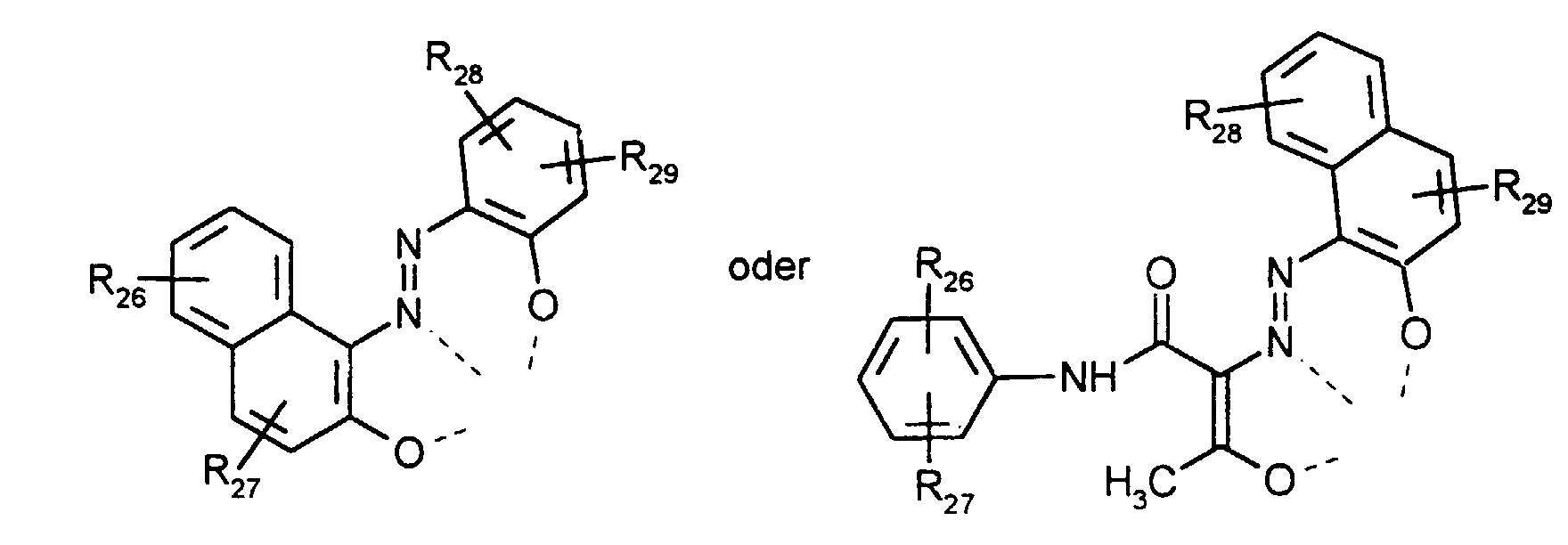
wobei R26, R27, R28 und R29 unabhängig voneinander Wasserstoff, Halogen, R30, NO2, NR30R31, NHCO-R30, NHCOO-R30, SO2-R30, SO2NH2, SO2NH-R30, SO2NR30R31, SO3 - oder SO3H sind, worin R30 und R31 unabhängig voneinander unsubstituiertes oder mit Hydroxy, Halogen oder C1-C6Alkoxy substituiertes C1-C12Alkyl bedeuten; und
M für Cr3+ oder Co3+ steht. - Ganz besonders bevorzugt sind dabei Verbindungen der Formel (I), worin Ym- ein Übergangsmetallkomplexanion der Formel (II) darstellt, worin L1 und L2 unabhängig voneinander Liganden der Formeln


- Besonders bevorzugt sind auch Verbindungen der Formel (I), worin Zn+ für [NH2R32R33]+ steht, wobei R32 Wasserstoff oder C1-C12Alkyl und R33 C1-C24Alkyl oder C7-C24Aralkyl bedeuten, und R32 und R33 zusammen von 8 bis 25 Kohlenstoffatome besitzen.
- Besonders bevorzugt sind insbesondere auch Verbindungen der Formel (I), worin m, n und o je die Zahl 1, p eine Zahl von 0 bis 2½, und q eine Zahl von 0 bis 1½ sind, wobei die Summe von o und q gleich p ist, so dass in Formel (II) keine überschüssige positive oder negative Ladung resultiert.
- Ganz besonders bevorzugt sind die Verbindungen der Formeln


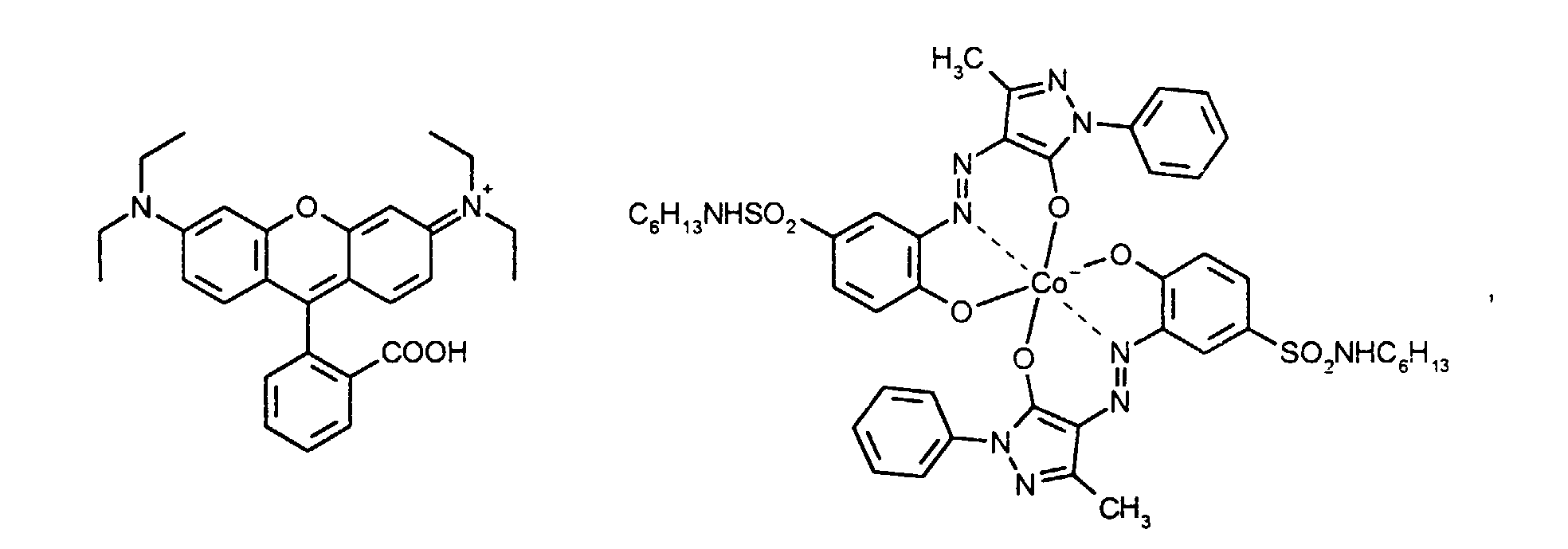


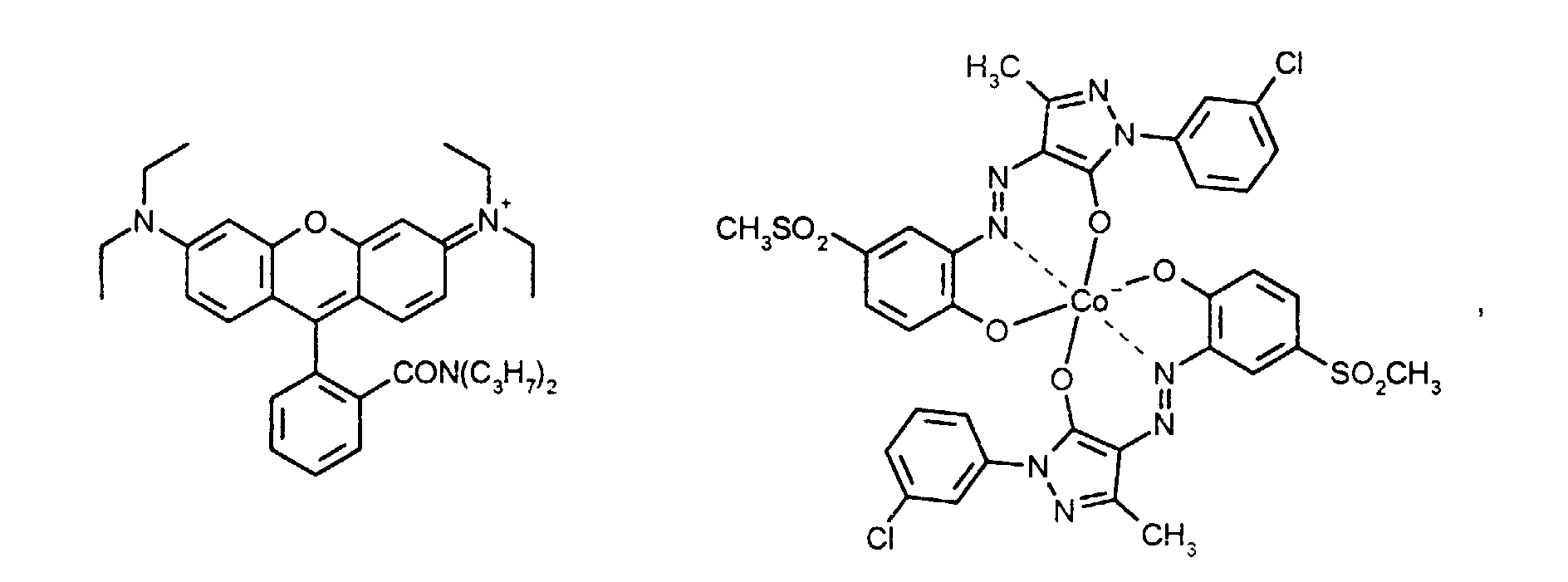


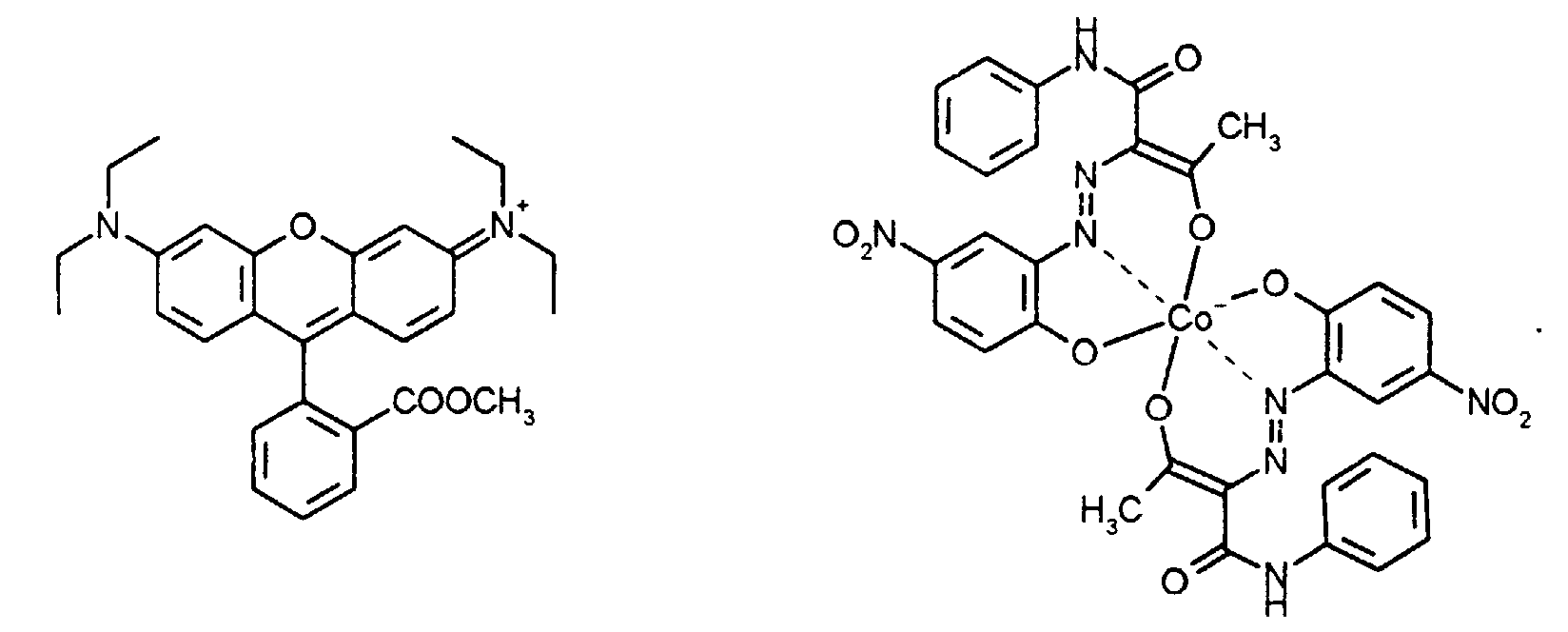
- Die Verbindungen der Formeln (I) und (II) sind bekannte Verbindungen, welche zum Beispiel in Ullmanns Encyklopädie der technischen Chemie 23, 381 (4. Auflage 1983) oder im Colour Index 4, 4417 (3rd Edition 1971) nachgeschlagen werden können. Einige davon sind noch neu, aber sie können analog zu den bekannten Verbindungen nach an sich bekannten Methoden hergestellt werden, zum Beispiel nach denjenigen, welche in EP 333 649 oder EP 468 821 offenbart sind. Metallkomplexe, bevorzugt diejenigen der Formel (II), sind aus der Fachliteratur wohlbekannt. Insbesondere kann es sich dabei um diejenigen Metallkomplexe handeln, welche in GB 1 599 812 oder EP 450 421 beschrieben werden, auf dessen Lehre hier ausdrücklich hingewiesen wird.
- Die erfindungsgemäss verwendeten Xanthenfarbstoffe weisen in ethanolischer Lösung eine schmale Absorptionsbande auf, deren Maximum bei 540 bis 610 nm liegt und deren Halbwertsbandbreite bei einer Konzentration von 10-5 Mol/l bevorzugt höchstens 60 nm beträgt. Sehr überraschend besitzen sie zudem eine vergleichsweise schwache Tendenz zur Agglomeration im Festzustand, so dass die Absorptionskurve auch im Festzustand vorteilhaft schmal bleibt.
- Die erfindungsgemäss verwendeten Xanthenfarbstoffe weisen auch an der längerwelligen Flanke der Absorptionsbande einen hohen Brechungsindex auf, welcher bevorzugt einen Spitzenwert von 2,0 bis 3,0 im Bereich von 600 bis 700 nm erreicht, wodurch ein Medium mit hoher Reflektivität sowie hoher Empfindlichkeit und guter Wiedergabecharakteristik im erwünschten Spektralbereich ermöglicht wird. Es ist zudem unnötig, einen weiteren Farbstoff der Aufzeichnungsschicht beizumischen, so dass eine sehr gute Lichtechtheit erreicht wird.
- Das Substrat, welches als Träger für die darauf angebrachten Schichten fungiert, ist zweckmässig semi-transparent (T ≥ 10%) oder bevorzugt transparent (T ≥ 90%). Der Träger kann eine Dicke von 0,01 bis 10 mm, bevorzugt von 0,1 bis 5 mm aufweisen.
- Die Aufzeichnungsschicht ist bevorzugt zwischen dem transparenten Substrat und der reflektierenden Schicht angebracht. Die Dicke der Aufzeichnungsschicht beträgt von 10 bis 1000 nm, bevorzugt von 50 bis 500 nm, besonders bevorzugt um zirka 100 nm, beispielsweise von 80 bis 150 nm. Die Absorption der Aufzeichnungsschicht beträgt dabei beim Absorptionsmaximum typisch von 0,1 bis 1,0. Ganz besonders bevorzugt wird die Schichtdicke abhängig von den jeweiligen Brechungsindizes im nichtbeschrifteten, beziehungsweise im beschrifteten Zustand bei der Lesewellenlänge auf bekannte Weise so gewählt, dass im nichtbeschrifteten Zustand eine konstruktive Interferenz und im beschrifteten Zustand dagegen eine destruktive Interferenz resultieren, oder umgekehrt.
- Die reflektierende Schicht, deren Dicke von 10 bis 150 nm betragen kann, hat bevorzugt eine hohe Reflektivität (R ≥ 70%), gekoppelt mit einer niedrigen Transparenz (T ≤ 10%).
- Die je nach Schichtaufbau oberste Schicht, zum Beispiel die Reflexionsschicht oder die Aufzeichnungsschicht, wird zweckmässig zusätzlich mit einer Schutzschicht versehen, welche eine Dicke von 0,1 bis 1000 µm, bevorzugt 0,1 bis 50 µm und besonders bevorzugt 0,5 bis 15 µm aufweisen kann. Diese Schutzschicht kann gegebenenfalls auch als Haftvermittler für eine darauf angebrachte, zweite Substratschicht dienen, welche bevorzugt von 0,1 bis 5 mm dick ist und aus dem gleichen Material wie das Trägersubstrat besteht.
- Die Reflektivität des gesamten Aufzeichnungsmediums beträgt bevorzugt mindestens 60%.
- Das erfindungsgemässe Aufzeichnungsmedium ist mit den Infrarotlaserdioden der üblichen CD-Geräten nach den Anforderungen des Orange Book Standards weder beschriftbar noch lesbar, denn bei 780 nm liegen charakteristisch die Brechungsindizes (n) zwischen 1,4 und 1,9 und deren Imaginärteile (k) zwischen 0 und höchstens 0,04. Dadurch ist die Gefahr einer Beschädigung bei einem irrtümlichen Beschriftungsversuch in einem zu hohe Auflösung nicht befähigten Gerät vorteilhaft weitgehend gebannt. Durch die Verwendung von Farbstoffen der Formel (I) ergeben sich vorteilhaft homogene, amorphe und streuungsarme Aufzeichnungsschichten, und die Brechungsindexkante ist überraschend auch in der Festphase besonders steil. Weitere Vorteile sind die hohe Lichtstabilität am Tageslicht bei gleichzeitiger hoher Empfindlichkeit unter Laserstrahlung hoher Leistungsdichte, die gleichmässige Schriftbreite sowie die gute Thermo- und Lagerstabilität.
- Geeignete Substrate sind zum Beispiel Gläser, Mineralien, Keramiken und duroplastische oder thermoplastische Kunststoffe. Bevorzugte Träger sind Gläser und homo- oder copolymere Kunststoffe. Geeignete Kunststoffe sind zum Beispiel thermoplastische Polycarbonate, Polyamide, Polyester, Polyacrylate und Polymethacrylate, Polyurethane, Polyolefine, Polyvinylchlorid, Polyvinylidenfluorid, Polyimide, duroplastische Polyester und Epoxidharze. Das Substrat kann in reiner Form sein oder auch übliche Additive enthalten, beispielsweise UV-Absorber oder Farbstoffe, wie zum Beispiel in JP 04/167 239 als Lichtschutz für die Aufzeichnungsschicht vorgeschlagen wird. In letzterem Fall ist es gegebenenfalls zweckmässig, dass der zum Trägersubstrat zugesetzte Farbstoff ein relativ zum Farbstoff der Aufzeichnungsschicht um mindestens 10 nm, bevorzugt um mindestens 20 nm hypsochrom verschobenes Absorptionsmaximum aufweist.
- Zweckmässig ist das Substrat in mindestens einem Teil des Bereichs von 600 bis 700 nm transparent, so dass es für mindestens 90% des darauf fallenden Lichtes der Beschriftungs- oder Auslesewellenlänge durchlässig ist. Das Substrat weist bevorzugt auf der Beschichtungsseite eine spiralförmige Führungsrille auf, mit einer Rillentiefe von 50 bis 500 nm, einer Rillenbreite von 0,2 bis 0,8 µm und einem Abstand zwischen 2 Windungen von 0,4 bis 1,6 µm, besonders bevorzugt mit einer Rillentiefe von 100 bis 200 nm, einer Rillenbreite von 0,3 µm und einem Abstand zwischen 2 Windungen von 0,6 bis 0,8 µm.
- Die Aufzeichnungsschicht kann ausschliesslich oder im wesentlichen aus einem oder mehreren erfindungsgemässen Xanthenfarbstoffen bestehen. Zur nochmaligen Steigerung der Beständigkeit können aber gegebenenfalls auch bekannte Stabilisatoren in üblichen Mengen zugesetzt werden, wie zum Beispiel ein in JP 04/025 493 beschriebenes Nickeldithiolat als Lichtstabilisator. Gegebenenfalls können auch zusätzliche Farbstoffe zugesetzt werden, deren Menge jedoch zweckmässig höchstens 50 Gew.-%, bevorzugt höchstens 10 Gew.-%, bezogen auf die Aufzeichnungsschicht, beträgt. Da die Aufzeichnungsschicht im wesentlichen aus einem Farbstoff der Formel (I) bestehen soll, ist es zweckmässig, dass der gegebenenfalls zugesetzte Farbstoff ein relativ zum Farbstoff der Formel (I) hypsochrom verschobenes Absorptionsmaximum aufweist, und dass die Menge des zugesetzten Farbstoffes so klein gehalten wird, dass der Anteil des letzteren an der Gesamtabsorption der Aufzeichnungsschicht im Bereich von 600 bis 700 nm höchstens 20%, bevorzugt höchstens 10% beträgt. Besonders bevorzugt wird jedoch kein zusätzlicher Farbstoff zugesetzt.
- Als reflektierendes Material für die Reflexionsschicht eignen sich besonders Metalle, welche die zur Aufzeichnung und Wiedergabe verwendete Laserstrahlung gut reflektieren, zum Beispiel die Metalle der dritten, vierten und fünften Hauptgruppe und der Nebengruppen des periodischen Systems der chemischen Elemente. Besonders geeignet sind Al, In, Sn, Pb, Sb, Bi, Cu, Ag, Au, Zn, Cd, Hg, Sc, Y, La, Ti, Zr, Hf, V, Nb, Ta, Cr, Mo, W, Fe, Co, Ni, Ru, Rh, Pd, Os, Ir, Pt und die Lanthanidenmetalle Ce, Pr, Nd, Pm, Sm, Eu, Gd, Tb, Dy, Ho, Er, Tm, Yb und Lu, sowie deren Legierungen. Besonders bevorzugt ist aus Gründen der hohen Reflektivität und leichten Herstellbarkeit eine Reflexionsschicht aus Aluminium, Silber, Kupfer, Gold oder deren Legierungen.
- Als Material für die Schutzschicht eignen sich hauptsächlich Kunststoffe, die in dünner Schicht entweder direkt oder mit Hilfe von Haftschichten auf den Träger oder die oberste Schicht aufgetragen sind. Man wählt zweckmässig mechanisch und thermisch stabile Kunststoffe mit guten Oberflächeneigenschaften, die noch modifiziert, zum Beispiel beschrieben werden können. Es kann sich sowohl um duroplastische wie auch um thermoplastische Kunststoffe handeln. Bevorzugt sind strahlungsgehärtete (zum Beispiel mit UV-Strahlung) Schutzschichten, die besonders einfach und wirtschaftlich herstellbar sind. Strahlungshärtbare Materialien sind in grosser Vielzahl bekannt. Beispiele für strahlungshärtbare Monomere und Oligomere sind Acrylate und Methacrylate von Diolen, Triolen und Tetrolen, Polyimide aus aromatischen Tetracarbonsäuren und aromatischen Diaminen mit C1-C4Alkylgruppen in mindestens zwei Orthostellungen der Aminogruppen, und Oligomere mit Dialkyl-, zum Beispiel Dimethylmaleinimidylgruppen.
- Die erfindungsgemässen Aufzeichnungsmedien können auch zusätzliche Schichten aufweisen, wie zum Beispiel Interferenzschichten. Es ist auch möglich, Aufzeichnungsmedien mit mehreren (zum Beispiel zwei) Aufzeichnungsschichten aufzubauen. Der Aufbau und die Verwendung solcher Materiale sind dem Fachmann bekannt. Bevorzugt sind gegebenenfalls Interferenzschichte, welche zwischen der Aufzeichnungsschicht und der reflektierenden Schicht und/oder zwischen der Aufzeichnungsschicht und dem Substrat angeordnet sind und aus einem dielektrischen Material bestehen, zum Beispiel wie in EP 353 393 beschrieben aus TiO2, Si3N4, ZnS oder Silikonharzen.
- Die erfindungsgemässen Aufzeichnungsmedien können nach an sich bekannten Verfahren hergestellt werden, wobei je nach verwendeten Materialien und deren Funktionsweise unterschiedliche Beschichtungsmethoden angewandt werden können.
- Geeignete Beschichtungsverfahren sind zum Beispiel Tauchen, Giessen, Streichen, Rakeln und Schleudergiessen, sowie Aufdampfverfahren, die im Hochvakuum durchgeführt werden. Bei der Anwendung von zum Beispiel Giessverfahren werden im allgemeinen Lösungen in organischen Lösungsmitteln verwendet. Bei der Verwendung von Lösungsmitteln ist darauf zu achten, dass die verwendeten Träger gegen diese Lösungsmittel unempfindlich sind. Geeignete Beschichtungsverfahren und Lösungsmittel sind zum Beispiel in EP 401 791 beschrieben.
- Die Aufzeichnungsschicht wird bevorzugt durch Aufschleudem einer Farbstofflösung aufgebracht, wobei als Lösungsmittel insbesondere Alkohole, wie zum Beispiel 2-Methoxyethanol, Isopropanol, Isobutanol oder n-Butanol, oder bevorzugt fluorierte Alkohole, wie zum Beispiel 2,2,2-Trifluorethanol oder 2,2,3,3-Tetrafluor-1-propanol, und Gemische davon, sich bewährt haben.
- Das Aufbringen der metallischen Reflexionsschicht erfolgt bevorzugt durch Sputtem, Aufdampfen im Vakuum oder chemische Dampfaufscheidung (CVD). Die Sputtertechnik wird wegen der hohen Haftfähigkeit zum Träger für das Aufbringen der metallischen Reflexionsschicht besonders bevorzugt. Diese Techniken sind bekannt und in Fachbüchem beschrieben (z.B. J.L. Vossen und W. Kern, "Thin Film Processes", Academic Press, 1978).
- Der Aufbau des erfindungsgemässen Aufzeichnungsmediums richtet sich hauptsächlich nach der Auslesemethode; bekannte Funktionsprinzipien sind die Messung der Veränderung der Transmission oder, bevorzugt, der Reflexion.
- Wenn das Aufzeichnungsmaterial gemäss der Veränderung der Reflexion aufgebaut wird, so können zum Beispiel folgende Strukturen zur Anwendung kommen: transparenter Träger/Aufzeichnungsschicht (gegebenenfalls mehrschichig)/Reflexionsschicht und falls zweckmässig, Schutzschicht (nicht unbedingt transparent), oder Träger (nicht unbedingt transparent)/Reflexionsschicht/Aufzeichnungsschicht und falls zweckmässig transparente Schutzschicht. Im ersten Fall wird das Licht von der Trägerseite eingestrahlt, während im letzten Fall die Strahlung von der Aufzeichnungsschicht- bzw. gegebenenfalls von der Schutzschichtseite einfällt. In beiden Fällen befindet sich der Lichtdetektor auf gleicher Seite wie die Lichtquelle. Der ersterwähnte Aufbau des erfindungsgemäss zu verwendenden Aufzeichnungsmaterials ist im allgemeinen bevorzugt.
- Wenn das Aufzeichnungsmaterial gemäss der Veränderung der Lichttransmission aufgebaut wird, kommt zum Beispiel folgende andere Struktur in Frage: transparenter Träger/Aufzeichnungsschicht (gegebenenfalls mehrschichtig) und, falls zweckmässig, transparente Schutzschicht. Das Licht zur Aufzeichnung sowie zum Auslesen kann entweder von der Trägerseite oder der Aufzeichnungsschicht- bzw. gegebenenfalls der Schutzschichtseite eingestrahlt werden, wobei sich der Lichtdetektor in diesem Fall immer auf der Gegenseite befindet.
- Geeignete Laser sind zum Beispiel handelsübliche Diodenlaser, insbesondere Halbleiter-Diodenlaser, zum Beispiel He/Ne-, Kr-, GaAsAl-, lnGaAlP- oder GaAs-Laserdioden einer Wellenlänge von 602, 612, 633, 635, 647, 650, 670 oder 680 nm. Die Aufzeichnung kann mit Hilfe eines Lichtmodulators Punkt für Punkt vorgenommen werden. Bevorzugt werden Diodenlaser verwendet, deren Strahlung auf die Aufzeichnungsschicht fokussiert wird.
- Das erfindungsgemässe Verfahren ermöglicht eine Speicherung von Informationen mit hoher Zuverlässigkeit und Beständigkeit, welche sich durch eine sehr gute mechanische und thermische Stabilität sowie durch eine hohe Lichtstabilität und scharfe Randzonen auszeichnen. Besonders vorteilhaft ist das überraschend hohe Signal/Rauschverhältnis von Trägermaterial zur Informationsmarkierung, das ein einwandfreies Auslesen zulässt. Die hohe Speicherkapazität ist insbesondere im Videobereich wertvoll.
- Das Auslesen der Information erfolgt nach an sich bekannten Methoden durch Registrierung der Veränderung der Absorption oder der Reflexion unter Verwendung von Laserstrahlung, zum Beispiel wie in "CD-Player und R-DAT Recorder" (Claus Biaesch-Wiepke, Vogel Buchverlag, Würzburg 1992) beschrieben.
- Das erfindungsgemässe Informationen enthaltende Medium stellt insbesondere ein optisches Informationsmaterial vom WORM-Typ dar. Es kann zum Beispiel als abspielbare CD (compact disc), als Speichermaterial für Computer oder als Ausweis- und Sicherheitskarte oder für die Herstellung von diffraktiven optischen Elementen, beispielsweise Hologrammen, verwendet werden.
- Ein weiterer Gegenstand der Erfindung ist daher ein Verfahren zur optischen Aufzeichnung, Speicherung und Wiedergabe von Information, dadurch gekennzeichnet, dass ein erfindungsgemässes Aufzeichnungsmedium verwendet wird. Die Aufzeichnung und die Wiedergabe erfolgen bevorzugt im Wellenlängenbereich von 600 bis 700 nm.
- Die nachfolgenden Beispiele erläutern die Erfindung näher:
- In einem 100 ml Dreihalskolben, versehen mit Thermometer, Rührer und Wasserabscheider, werden 2,84 g (15 mMol) 8-Hydroxyjulolidin, 2,36 g (16 mMol) Phthalsäureanhydrid und 30 g o-Dichlorbenzol vorgelegt und unter Rühren während 15 Min auf Rückfluss erhitzt. Anschliessend werden 1,8 g (10 mMol) 8-Hydroxyjulolidin innerhalb einer Stunde portionenweise (6x je 0,3 g) zugegeben. Danach wird das Reaktionsgemisch nochmals 3 Std unter Rückfluss gerührt. Das violette, pastöse Reaktionsgemisch wird abgekühlt, auf 33 g 3%ige NaOH-Lösung gegossen und ½ Std gerührt. Das Gemisch wird dreimal mit Methylenchlorid extrahiert, die vereinigten organischen Phasen mit Wasser gewaschen, über Magnesiumsulfat getrocknet, filtriert und eingedampft. Der Rückstand wird in 250 ml Hexan suspendiert und 3 Std stark gerührt, filtriert und 48 Std bei 80°C getrocknet. Man erhält 5,5 g (83,5% d.Th.) eines rot-violetten Pulvers der Formel

- In einem 100 ml Dreihalskolben, versehen mit Thermometer, Rührer und Wasserabscheider, werden 10,0 g ( 60,5 mMol) 3-Diethylaminophenol, 17,05 g (88,8 mMol) Trimellitsäureanhydrid und 23,3 g o-Dichlorbenzol vorgelegt und unter Rühren während 6 Std auf Rückfluss erhitzt. Das violette, pastöse Reaktionsgemisch wird in 40 ml Wasser und 200 ml Ethanol gelöst und bei 90°C eingedampft. Der Rückstand wird in 90 ml gesättigter Natriumhydrogencarbonat-Lösung gelöst, filtriert und das Filtrat mit konz. Salzsäure auf pH 4 angesäuert. Das ausgefallene Rohprodukt wird abfiltriert, mit 500 ml Wasser gewaschen und bei 70°C / 165 mbar getrocknet. Man erhält 16 g eines violetten Pulvers, welches nach DC (Laufmittel Ethanol) noch polare Verunreinigungen enthält. Das Rohprodukt wird chromatographisch auf Kieselgel in einer Flashsäule mit Ethanol als Laufmittel gereinigt. Man erhält 2,8 g (9% d.Th.) eines violetten Pulvers der Formel:

DC (Kieselgel; Ethanol): Rf = 0,20 bzw. 0,11 für die beiden möglichen Isomeren. - In einem 1000 ml Dreihalskolben, versehen mit Magnetrührer, Thermometer, Rückflusskühler und Stickstoffüberleitung, werden innerhalb von 10 Min 25 ml konz. H2SO4 zu 500 ml vorgelegtes Methanol getropft. Anschliessend werden 10 g (20,8 mMol) Rhodamin B zugegeben und die rote Lösung 16 Std auf Rückfluss erhitzt. Danach wird das Reaktionsgemisch abgekühlt und das Lösungsmittel eingedampft. Der Rückstand wird auf 250 ml gesättigte NaCl-Lösung gegossen und 3x mit je 250 ml CH2Cl2 extrahiert. Die vereinigten organischen Phasen werden 2x mit je 250 ml Wasser gewaschen, über MgSO4 getrocknet, filtriert und eingedampft. Der rot-violette Rückstand wird in 30 ml Methanol unter Rückfluss gelöst. Die Lösung wird unter Rühren auf 0°C abgekühlt und dann langsam mit 150 ml Diethyläther (Et2O) versetzt, bis Kristallbildung einsetzt. Danach werden weitere 300 ml Et2O zugegeben und die Suspension 15 Min gerührt. Der Niederschlag wird abfiltriert, 3x mit je 50 ml Et2O gewaschen und bei 60°C / 165 mbar getrocknet. Man erhält 8,64 g (84,2% d.Th.) grün-violette, metallisch glänzende Kristalle der Formel:
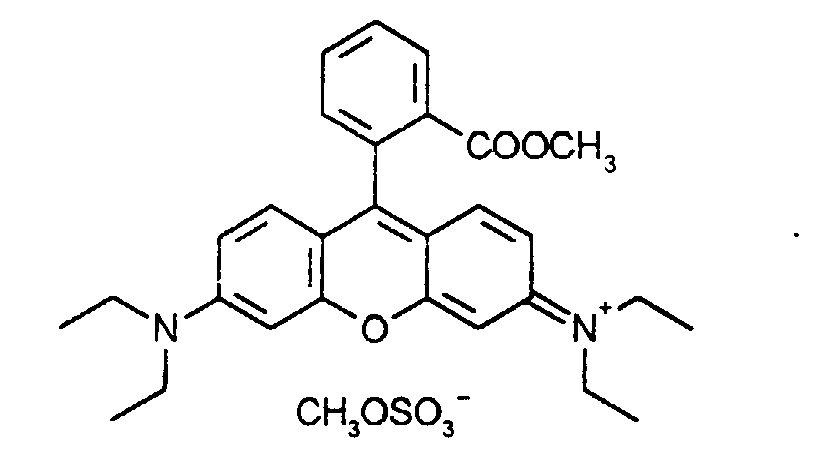
DC (Kieselgel; Ethanol / 1N HCI 20:1): Rf = 0,56.Elementaranalyse C 63,91% H 6,35% N 5,17% S 5,65%; ( theoretisch C 63,36% H 6,38% N 4,93% S 5,64% ). - In einem 250 ml Dreihalskolben, versehen mit Magnetrührer, Thermometer, Rückflusskühler, Tropftrichter und Stickstoffüberleitung, werden 10 g (20,8 mMol) Rhodamin B in 100 ml Dimethylformamid (DMF) vorgelegt. Unter Rühren werden 10,15 g (62,6 mMol) Carbonyl-diimidazol zugegeben und das Gemisch auf 40°C erwärmt. Nach 30 Min ist die Gasentwicklung beendet und das Reaktionsgemisch wird auf Raumtemperatur (RT) abgekühlt. 7 g (68,9 mMol) Di-n-propylamin werden zugetropft und das Gemisch 45 Min gerührt. Nach DC (Kieselgel; Ethanol / 1N HCI 20:1) ist kein Edukt mehr vorhanden.
- Das Reaktionsgemisch wird auf 500 ml 1N HCI gegossen und 4x mit je 150 ml CH2Cl2 extrahiert. Die vereinigten organischen Phasen werden mit 100 ml 1N HCI und 4x mit je 100 ml Wasser gewaschen, über MgSO4 getrocknet, filtriert und eingedampft. Der Rückstand wird in 200 ml Aceton unter Rückfluss gelöst, auf RT abgekühlt, vorsichtig mit 800 ml Et2O versetzt und die Suspension 15 Min. bei 0°C gerührt. Anschliessend wird filtriert, der Rückstand 3 mal mit 50 ml Et2O gewaschen und bei 60°C / 165 mbar getrocknet. Man erhält 7,0 g (59,7% d.Th.) violette, metallisch glänzende Kristalle der Formel:
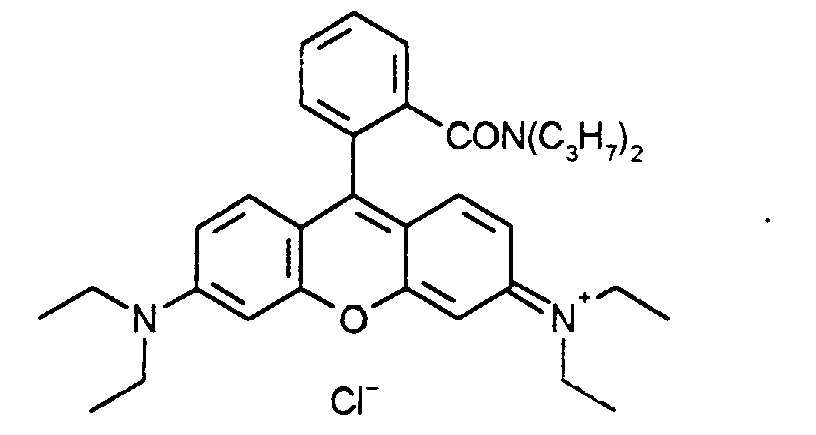
DC (Kieselgel; Ethanol / 1N HCI 20:1): Rf = 0,69.Elementaranalyse C 71,05% H 7,82% N 7,35% Cl 5,69% ; ( theoretisch C 72,64% H 7,89% N 7,47% Cl 6,31% ) . - In einem 100 ml Dreihalskolben, versehen mit Thermometer, Rührer und Wasserabscheider, werden 3,6 g (21,6 mMol) 3-Diethylaminophenol, 4,8 g (25 mMol) 4-Nitro-phthalsäureanhydrid und 30 g o-Dichlorbenzol vorgelegt und unter Rühren während 7 Std auf Rückfluss erhitzt. Das violette Reaktionsgemisch wird mit 33 g 3%iger wässriger NaOH-Lösung versetzt, die Phasen getrennt und die organische Phase mit 66 g 5%iger H2SO4 sauer gestellt. Das Gemisch wird 3x mit je 100 ml CH2Cl2 extrahiert, die vereinigten organischen Phasen mit 150 ml gesättigter NaCl-Lösung gewaschen, über MgSO4 getrocknet, filtriert und eingedampft. Der Rückstand wird mit Ethanol / 1N HCI 100:1 über 250 g Kieselgel filtriert, um unpolare Verunreinigungen zu enffernen.
Man erhält 1,6 g (28,3% d.Th.) eines violetten Pulvers der Formel:
-1 ;
DC (Kieselgel; Ethanol / 1N HCI 100:1): Rf = 0,29 bzw. 0,51 für die beiden möglichen Isomeren. - In einem 25 ml Dreihalskolben, versehen mit Magnetrührer, Thermometer, Rückflusskühler, Tropftrichter und Stickstoffüberleitung, werden 0,6 g (1,14 mMol) der nach Beispiel A5 hergestellten Verbindung in 10 ml DMF vorgelegt. Unter Rühren werden 0,55 g (3,43 mMol) Carbonyl-diimidazol zugegeben und das Gemisch auf 40°C erwärmt. Nach 30 Min ist die Gasentwicklung beendet und das Reaktionsgemisch wird auf RT abgekühlt. 0,38 g (3,76 mMol) Dipropylamin werden zugetropft und das Gemisch 20 Std gerührt. Nach DC (Kieselgel; Ethanol / 1N HCI 100:1) ist noch sehr wenig Edukt vorhanden. Das Reaktionsgemisch wird auf 80 ml 1N HCI gegossen und 4 mal mit 80 ml CH2Cl2 extrahiert. Die vereinigten organischen Phasen werden mit 50 ml 1N HCI und 4x mit 80 ml Wasser gewaschen, über MgSO4 getrocknet, filtriert und eingedampft. Der Rückstand wird in 2 ml Aceton gelöst, vorsichtig mit 200 ml Et2O versetzt und die Suspension 15 Min bei 0°C gerührt. Anschliessend wird filtriert und der Rückstand 3x mit je 10 ml Et2O gewaschen und bei 60°C / 165 mbar getrocknet. Man erhält 0,3 g (43,3% d.Th.) violette Kristalle der Formel:
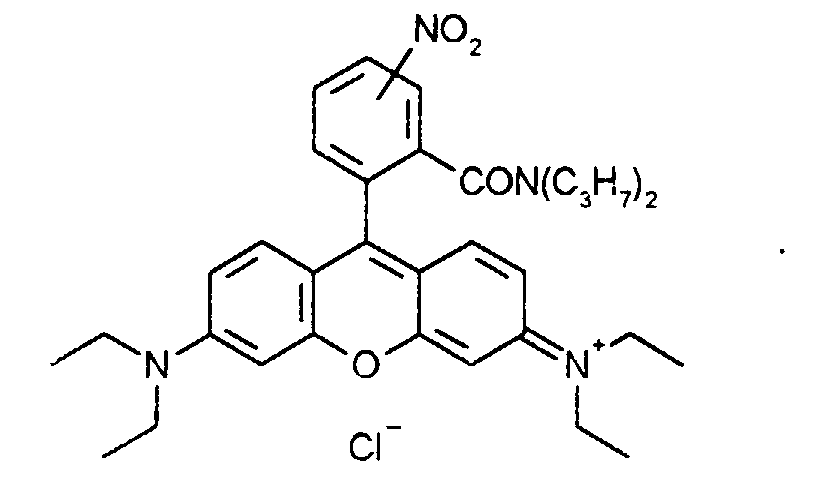
DC (Kieselgel; Ethanol / 1N HCI 100:1): Rf = 0,57 und 0,71 für die beiden möglichen Isomeren. - In einem 100 ml Dreihalskolben, versehen mit Thermometer, Rührer und Wasserabscheider, werden 3,6 g (21,6 mMol) 3-Diethylaminophenol, 5,42 g (25 mMol) 4,5-Dichlor-phthalsäureanhydrid und 30 g o-Dichlorbenzol vorgelegt und unter Rühren während 6 Std auf Rückfluss erhitzt. Das violette Reaktionsgemisch wird mit 33 g 3%iger wässriger NaOH-Lösung versetzt, die Phasen getrennt und die organsiche Phase mit 66 g 5%ige H2SO4 sauer gestellt. Die Phasen werden getrennt, die organische Phase mit 100 ml gesättigter NaCl-Lösung gewaschen, über MgSO4 getrocknet, filtriert und eingedampft. Der Rückstand wird in 100 ml Aceton gelöst und vorsichtig mit 500 ml Et2O versetzt. Die Suspension wird 15 Min gerührt, filtriert, der Rückstand 3x mit je 50 ml Et2O gewaschen und bei 60°C / 165 mbar getrocknet.
Man erhält 3,2 g (54,2% d.Th.) eines violetten Pulvers der Formel:
DC (Kieselgel; Ethanol / 1N HCI 100:1): Rf = 0,48. - In einem 100 ml Dreihalskolben, versehen mit Magnetrührer, Thermometer, Rückflusskühler und Stickstoffüberleitung, werden 50 ml Methanol vorgelegt und innerhalb von 10 Min 2,5 ml konz. H2SO4 zugetropft. Anschliessend wird 1 g (1,82 mMol) der nach Beispiel A7 hergestellten Verbindung zugegeben und die rote Lösung 17 Std auf Rückfluss erhitzt. Danach wird das Reaktionsgemisch abgekühlt und das Lösungsmittel eingedampft. Der Rückstand wird auf 100 ml Wasser gegossen und 4x mit je 80 ml CH2Cl2 extrahiert. Die vereinigten organischen Phasen werden mit 100 ml Wasser gewaschen, über MgSO4 getrocknet, filtriert und eingedampft. Der rot-violette Rückstand wird in 7 ml Aceton gelöst. Die Lösung wird unter Rühren mit 300 ml Et2O versetzt und die sich bildende Suspension 15 Min gerührt. Der Niederschlag wird abfiltriert, 3x mit je 10 ml Et2O gewaschen und bei 60°C / 165 mbar getrocknet. Man erhält 0,70 g (60,3% d.Th.) violette Kristalle der Formel:

DC (Kieselgel; Ethanol / 1N HCI 100:1): Rf = 0,81.Elementaranalyse C 54,55% H 5,22% N 4,04% S 4,57% Cl 10,55%; ( theoretisch C 56,52% H 5,39% N 4,39% S 5,03% Cl 11,12% ). - In einem 100 ml Dreihalskolben, versehen mit Magnetrührer, Thermometer, Rückflusskühler und Stickstoffüberleitung, werden 50 ml Methanol vorgelegt und innerhalb von 10 Min 2,5 ml konz. H2SO4 zugetropft. Anschliessend wird 1 g (1,82 mMol) der nach Beispiel A1 hergestellten Verbindung zugegeben und die rote Lösung 17 Std auf Rückfluss erhitzt. Danach wird das Reaktionsgemisch abgekühlt und das Lösungsmittel eingedampft. Der Rückstand wird auf 100 ml gesättigte NaCl-Lösung gegossen und 4x mit je 80 ml CH2Cl2 extrahiert. Die vereinigten organischen Phasen werden 2x mit je 80 ml Wasser gewaschen, über MgSO4 getrocknet, filtriert und eingedampft. Der rot-violette Rückstand wird in 4 ml Aceton gelöst. Die Lösung wird unter Rühren mit 300 ml Et2O versetzt bis Kristallbildung einsetzt und die Suspension 15 Min gerührt. Der Niederschlag wird abfiltriert, 3x mit je 10 ml Et2O gewaschen und bei 60°C / 165 mbar getrocknet.
Man erhält 0,50 g (46,8% d.Th.) violette Kristalle der Formel:
DC (Kieselgel; Ethanol / 1N HCI 100:1): Rf = 0,50. - In einem 100 ml Dreihalskolben, versehen mit Thermometer, Rührer und Wasserabscheider, werden 5,0 g (26,4 mMol) 8-Hydroxyjulolidin, 5,9 g (30,65 mMol) 4-Nitro-phthalsäureanhydrid und 40 g o-Dichlorbenzol vorgelegt und unter Rühren während 3 Std auf Rückfluss erhitzt. Das violette, pastöse Reaktionsgemisch wird abgekühlt und bei 80°C / 1·10-3 mbar möglichst vollständig eingedampft.
Der Rückstand wird mit Ethanol / 1N HCI 100:1 an Kieselgel flashchromatographiert. Man erhält 1,7 g (22,5% d.Th.) eines violetten Pulvers der Formel:
DC (Kieselgel; Ethanol / 1N HCI 100:1): Rf = 0,18 und 0,27 für die zwei möglichen Isomeren. - In einem 100 ml Dreihalskolben, versehen mit Magnetrührer, Thermometer, Rückflusskühler und Stickstoffüberleitung, werden 30 ml Methanol vorgelegt und innerhalb von 10 Min 1,5 ml konz. H2SO4 zugetropft. Anschliessend wird 0,6 g (1,05 mMol) der nach Beispiel A10 hergestellten Verbindung zugegeben und die Lösung 16 Std auf Rückfluss erhitzt. Danach wird das Reaktionsgemisch abgekühlt und das Lösungsmittel eingedampft. Der Rückstand wird auf 80 ml gesättigte NaCl-Lösung gegossen und 6x mit je 50 ml CH2Cl2 extrahiert. Die vereinigten organischen Phasen werden 2x mit je 80 ml Wasser gewaschen, über MgSO4 getrocknet, filtriert und eingedampft.
Man erhält 0,60 g (97,5% d.Th.) violettes Pulver der Formel:
DC (Kieselgel; Ethanol / 1N HCI 100:1): Rf = 0,49. - In einem 50 ml Dreihalskolben, versehen mit Magnetrührer, Thermometer, Rückflusskühler, Tropftrichter und Stickstoffüberleitung, werden 1,7 g (2,97 mMol) der nach Beispiel A10 hergestellten Verbindung in 20 ml DMF vorgelegt. Unter Rühren werden 4,8 g (29,7 mMol) Carbonyl-diimidazol zugegeben und das Gemisch auf 40°C erwärmt. Nach 45 Min ist die Gasentwicklung beendet und das Reaktionsgemisch wird auf RT abgekühlt. 3,6 g (35,7 mMol) Di-n-propylamin werden zugetropft und das Gemisch 1½ Std gerührt. Nach DC (Kieselgel; Ethanol / 1N HCI 20:1) ist noch sehr wenig Edukt vorhanden. Das Reaktionsgemisch wird auf 100 ml 1N HCI gegossen und 5x mit je 90 ml CH2Cl2 extrahiert. Die vereinigten organischen Phasen werden mit 100 ml 1N HCI und 4x mit je 80 ml Wasser gewaschen, über MgSO4 getrocknet, filtriert und eingedampft. Der Rückstand wird mit 250 ml Et2O versetzt und die Suspension 15 Min gerührt. Anschliessend wird filtriert, der Rückstand 3x mit je 20 ml Et2O gewaschen und bei 60°C / 165 mbar getrocknet.
Man erhält 1,2 g (61,7% d.Th.) violette Kristalle der Formel:
DC (Kieselgel; Ethanol / 1N HCI 100:1): Rf = 0,46. - In einem 50 ml Dreihalskolben, versehen mit Magnetrührer, Thermometer, Rückflusskühler und Stickstoffüberleitung, werden 0,7 g (1,07 mMol) der nach Beispiel A12 hergestellten Verbindung, 60 mg Aktivkohle, 3 mg FeCl3 und 0,64 g (10,7 mMol) N,N-Dimethylhydrazin in 20 ml Methanol vorgelegt und die Suspension unter Rühren während 18 Std auf Rückfluss erhitzt. Anschliessend wird das Reaktionsgemisch abgekühlt und das Lösungsmittel eingedampft. Der Rückstand wird mit Ethanol / 1N HCI 100:1 mittels Flashchromatographie an Kieselgel gereinigt.
Man erhält 0,6 g (89,7% d.Th.) eines blauen Pulvers der Formel:
- In einem 100 ml Dreihalskolben, versehen mit Magnetrührer, Thermometer, Rückflusskühler und Stickstoffüberleitung, werden 3,8 g (5 mMol) ®Orasol Gelb 3R (Ciba-Geigy AG) und 30 ml n-Butanol vorgelegt und unter Rühren auf 70°C erhitzt. Anschliessend werden 2,4 g (5 mMol) Rhodamin B zugegeben, dann stellt man den pH auf 2 mit ca. 1 ml Ameisensäure. Das Reaktionsgemisch wird 5 Std bei 70°C gerührt, danach wird 1 g Filterhilfsmittel zugegeben und die Suspension heiss filtriert. Der Rückstand wird mit 100 ml heissem n-Butanol gewaschen und das Filtrat eingedampft. Der pastöse Rückstand wird mit 300 ml Et2O versetzt und die sich bildende Suspension 10 Min gerührt. Danach wird filtriert und der Rückstand 3x mit je 50 ml Et2O gewaschen.
Man erhält 5,2 g (87,9% d.Th.) eines roten Pulvers der Formel:
Elementaranalyse: Na 648 ppm. - In einem 100 ml Dreihalskolben, versehen mit Magnetrührer, Thermometer, Rückflusskühler und Stickstoffüberleitung, werden 2,0 g (2,66 mMol) ®Orasol Gelb 3R (Ciba-Geigy AG) und 30 ml n-Butanol vorgelegt und unter Rühren auf 70°C erhitzt. Anschliessend werden 1,5 g (2,66 mMol) der nach Beispiel A4 hergestellten Verbindung zugegeben, dann stellt man den pH auf 2 mit ca. 1,5 ml Ameisensäure. Das Reaktionsgemisch wird 5 Std bei 70°C gerührt, danach wird 1 g Filterhilfsmittel zugegeben und die Suspension heiss filtriert. Der Rückstand wird mit 100 ml heissem n-Butanol gewaschen und das Filtrat eingedampft. Der pastöse Rückstand wird mit 200 ml Et2O versetzt und die sich bildende Suspension 10 Min gerührt. Danach wird filtriert und der Rückstand mit 80 ml Et2O gewaschen. Man erhält 3,0 g (89,0% d.Th.) eines roten Pulvers der Formel:

Elementaranalyse: Na 0,41%. - In einem 100 ml Kolben werden 1 g (1,76 mMol) der gemäss Beispiel A3 hergestellten Verbindung, 1,34 g (1,76 mMol) ®Orasol Gelb 3R (Ciba-Geigy AG) und 30 ml CH2Cl2 vorgelegt. Die rote Lösung wird anschliessend bei 50°C eingedampft und der Rückstand bei 60°C / 165 mbar getrocknet.
Man erhält 2,3 g (98,3% d.Th.) eines dunkelroten Pulvers der Formel:
- In einem 100 ml Kolben werden 1 g (1,78 mMol) der gemäss Beispiel A4 hergestellten Verbindung, 1,36 g (1,78 mmol) ®Orasol Gelb 3R (Ciba-Geigy AG) und 30 ml CH2Cl2 vorgelegt. Die rote Lösung wird anschliessend bei 50°C eingedampft und der Rückstand bei 60°C / 165 mbar getrocknet.
Man erhält 2,3 g (97,4% d.Th.) eines dunkelroten Pulvers der Formel:
- Das gemäss Beispiel A17 hergestellte Produkt wird in 50 ml Wasser suspendiert, 30 Min gerührt, filtriert, mit 100 ml Wasser gewaschen und getrocknet.
Man erhält in quantitativer Ausbeute ein dunkelrotes Pulver der Formel:
Elementaranalyse: Na 0,62%. - In einem 100 ml Kolben werden 1 g (1,78 mMol) der gemäss Beispiel A4 hergestellten Verbindung, 1,36 g (1,78 mMol) ®Orasol Gelb 3R (Ciba-Geigy AG) und 40 ml CH2Cl2 vorgelegt. Die rote Lösung wird 3x mit je 100 ml Wasser gewaschen, über MgSO4 getrocknet und eingedampft. Der Rückstand wird bei 60°C / 165 mbar getrocknet.
Man erhält 2,2 g (97,6% d.Th.) eines dunkelroten Pulvers der Formel:
Elementaranalyse: Na 0,16%. - In einem 100 ml Dreihalskolben, versehen mit Magnetrührer, Thermometer, Rückflusskühler und Stickstoffüberleitung, werden 2,4 g (2,66 mMol) ®Orasol Rot GL (Ciba-Geigy AG) und 30 ml n-Butanol vorgelegt und unter Rühren auf 70°C erhitzt. Anschliessend werden 1,5 g (2,66 mMol) der gemäss Beispiel A4 hergestellten Verbindung zugegeben, danach stellt man den pH auf 2 mit ca. 1,5 ml Ameisensäure. Das Reaktionsgemisch wird 5 Std bei 70°C gerührt, dann werden 1 g Filterhilfsmittel zugegeben, die Suspension heiss filtriert und der Rückstand mit 80 ml heissem n-Butanol nachgewaschen. Das Filtrat wird eingedampft und der Rückstand mit 200 ml Et2O versetzt. Die sich bildende Suspension wird 10 Min gerührt und dann filtriert. Der Rückstand wird mit 80 ml Et2O gewaschen und bei 50°C / 165 mbar getrocknet.
Man erhält 3,4 g (90,7% d.Th.) eines dunkelroten Pulvers der Formel:
Elementaranalyse: Na 0,17%. - Man verfährt analog zum Beispiel A15, verwendet jedoch anstatt von ®Orasol Gelb 3R jeweils eine äquimolare Menge ®Orasol Rot 2BL, ®Orasol Rot 3GL oder


- Man verfährt analog zu den Beispielen A21-A23, verwendet jedoch anstatt der Verbindung nach Beispiel A4 jeweils eine äquimolare Menge der Verbindung nach Beispiel A3. Man erhält folgende Verbindungen:

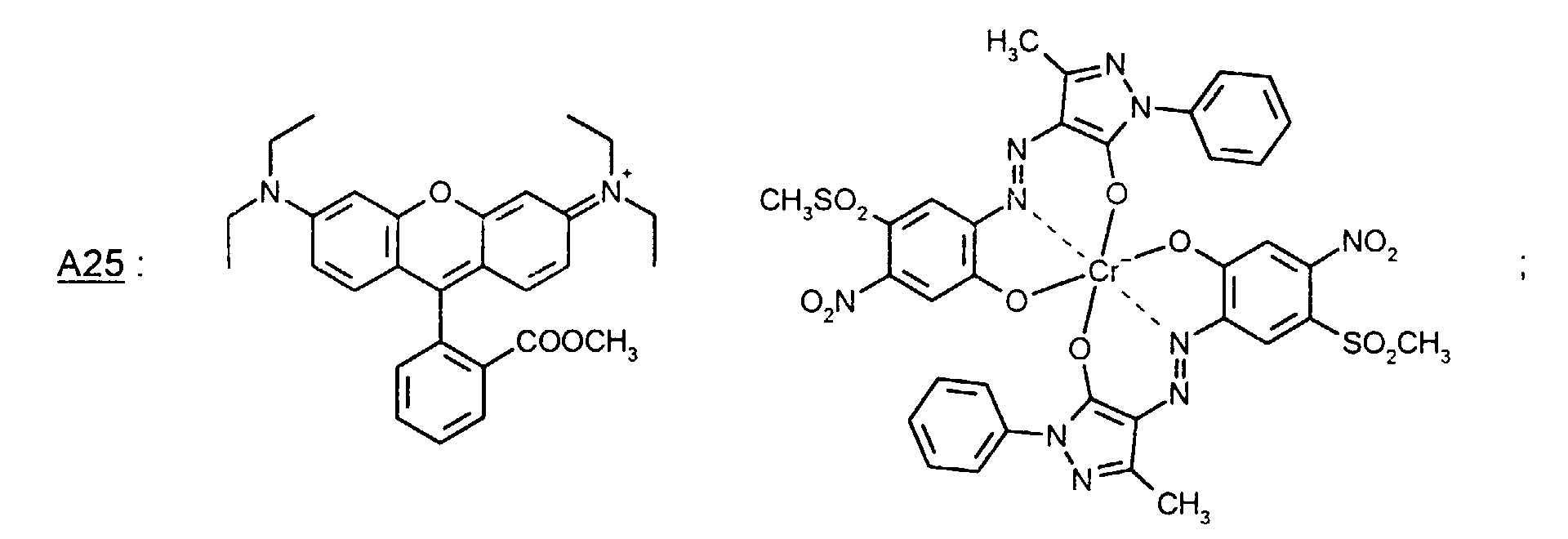
UV/VIS (Ethanol): λmax = 563 nm, ε = 119'030 l.mol-1.cm-1;
- Man verfährt analog zum Beispiel A17, verwendet jedoch anstatt von ®Orasol Gelb 3R jeweils eine äquimolare Menge ®Orasol Gelb 2RLN, ®Orasol Orange G, ®Orasol Rot 2B oder ®Orasol Gelb 2GLN. Dann verfährt man weiter analog zum Beispiel 18. Man erhält folgende Verbindungen:

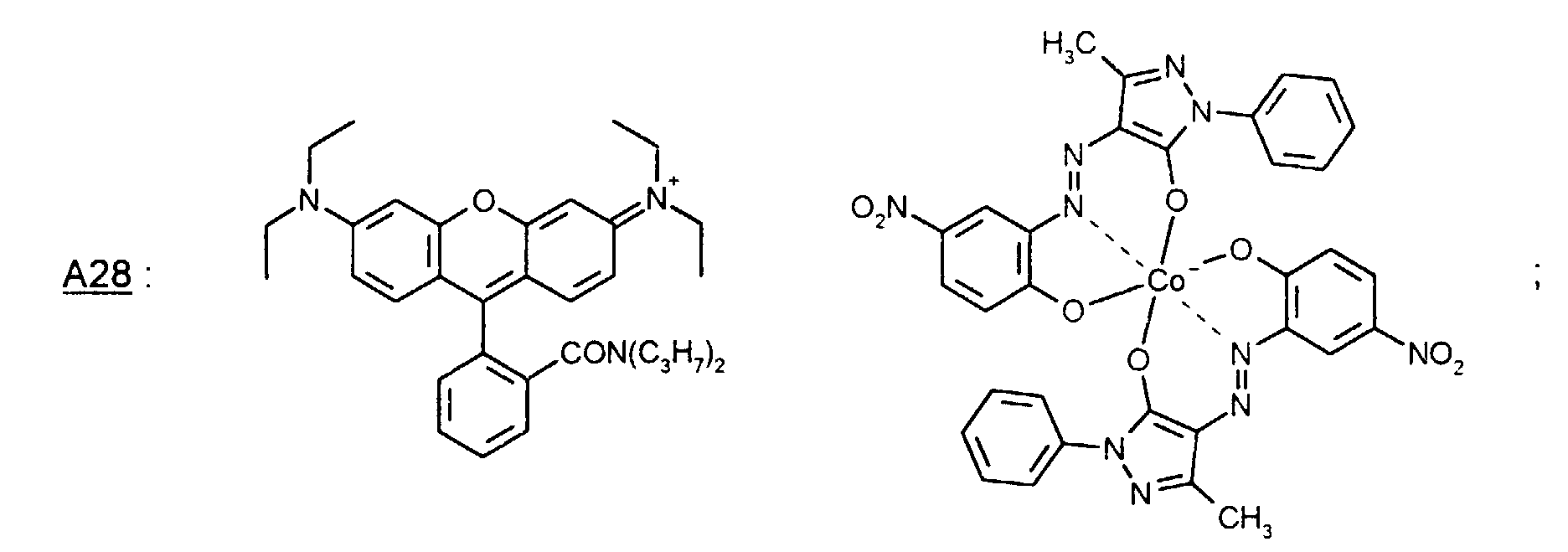


- Man verfährt analog zu den Beispielen A27-A30, verwendet jedoch anstatt der Verbindung nach Beispiel A4 jeweils eine äquimolare Menge der Verbindung nach Beispiel A3. Man erhält folgende Verbindungen:


- Man verfährt analog zum Beispiel A17, verwendet jedoch anstatt von ®Orasol Gelb 3R eine äquimolare Menge ®Orasol Orange RG, sowie anstatt der Verbindung nach Beispiel A4 eine äquimolare Menge der Verbindung nach Beispiel A3.
Man erhält folgende Verbindung:
- Man verfährt analog zu Beispiel A1, verwendet jedoch anstatt von Phthalsäureanhydrid eine äquimolare Menge Tetrachlorphthalsäureanhydrid. Man erhält folgende Verbindung:

- Man verfährt analog zum Beispiel A1, verwendet jedoch anstatt von 8-Hydroxyjulolidin eine äquimolare Menge 3-Dimethylamino-phenol. Man erhält folgende Verbindung:

- Man verfährt analog zum Beispiel A1, verwendet jedoch anstatt von 8-Hydroxyjulolidin eine äquimolare Menge 3-Dibutylamino-phenol.
Man erhält folgende Verbindung:
- Man verfährt analog zum Beispiel A1, verwendet jedoch anstatt von 8-Hydroxyjulolidin eine äquimolare Menge 3-Morpholino-phenol.
Man erhält folgende Verbindung: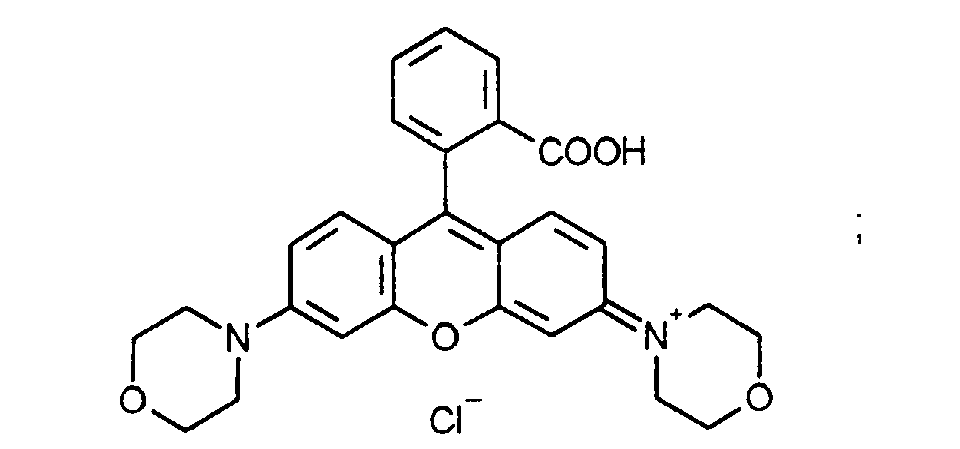
- Man verfährt analog zum Beispiel A1, verwendet jedoch anstatt von 8-Hydroxyjulolidin und Phthalsäureanhydrid äquimolare Mengen 3-Diethylamino-phenol und 2,3-Naphthalin-dicarbonsäure-anhydrid. Man erhält folgende Verbindung:
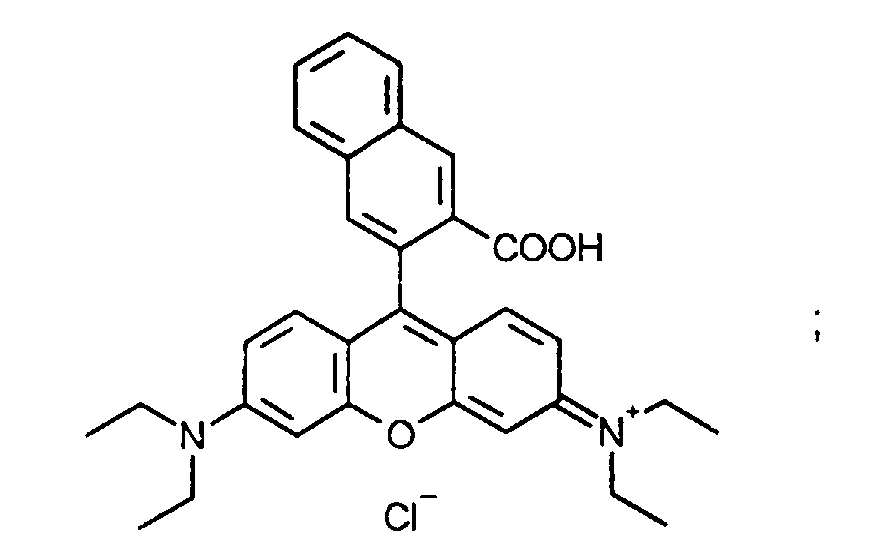
- Man verfährt analog zum Beispiel A3, verwendet jedoch Ethanol anstatt von Methanol. Man erhält folgende Verbindung:

- Man verfährt analog zum Beispiel A3, verwendet jedoch Isopropanol anstatt von Methanol. Man erhält folgende Verbindung:
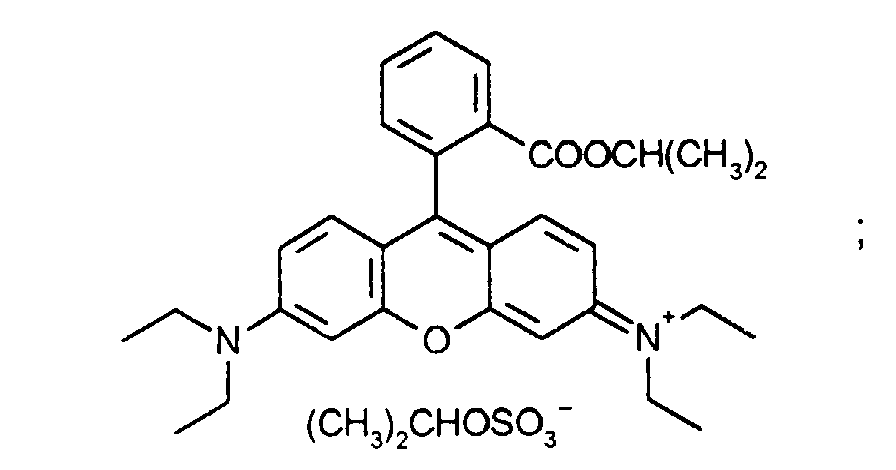
- Man verfährt analog zum Beispiel A3, verwendet jedoch anstatt von Rhodamin B eine äquimolare Menge der Verbindung des Beispiels A37.
Man erhält folgende Verbindung: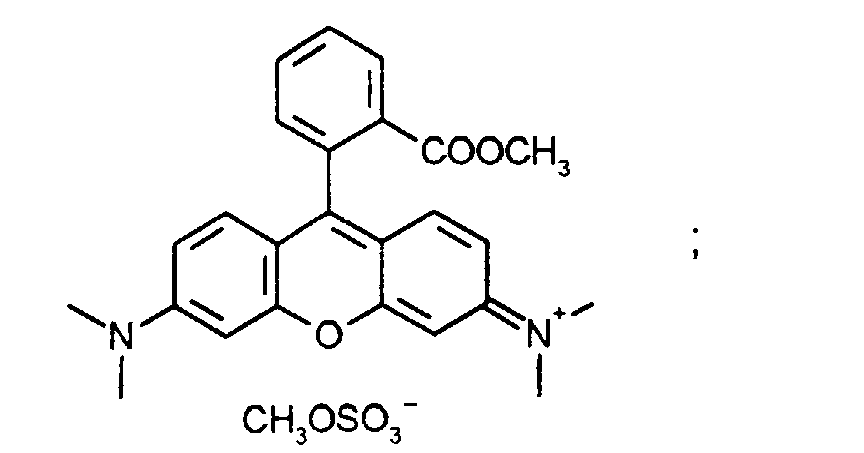
- Man verfährt analog zum Beispiel A3, verwendet jedoch anstatt von Rhodamin B eine äquimolare Menge der Verbindung des Beispiels A38. Man erhält folgende Verbindung:

- Man verfährt analog zum Beispiel A3, verwendet jedoch anstatt von Rhodamin B eine äquimolare Menge der Verbindung des Beispiels A39.
Man erhält folgende Verbindung: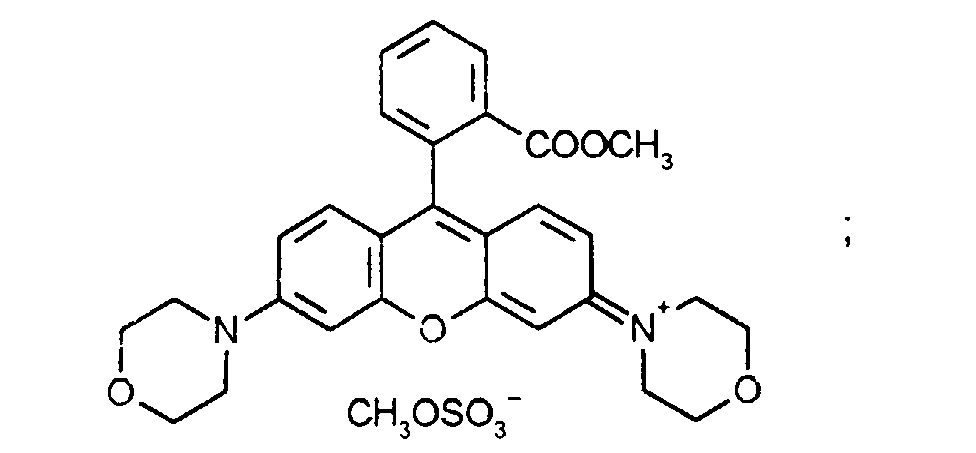
- Man verfährt analog zum Beispiel A3, verwendet jedoch anstatt von Rhodamin B eine äquimolare Menge der Verbindung des Beispiels A40. Man erhält folgende Verbindung:

- Man verfährt analog zum Beispiel A4, verwendet jedoch anstatt von Dipropylamin eine äquimolare Menge Dimethylamin. Man erhält folgende Verbindung:

- Man verfährt analog zum Beispiel A4, verwendet jedoch anstatt von Dipropylamin eine äquimolare Menge Diethylamin. Man erhält folgende Verbindung:

- Man verfährt analog zum Beispiel A4, verwendet jedoch anstatt von Dipropylamin eine äquimolare Menge Dibutylamin. Man erhält folgende Verbindung:

- Man verfährt analog zum Beispiel A4, verwendet jedoch anstatt von Dipropylamin eine äquimolare Menge Piperidin. Man erhält folgende Verbindung:

- Man verfährt analog zum Beispiel A17, verwendet jedoch anstatt der Verbindung nach Beispiel A4 eine äquimolare Menge der Verbindung nach Beispiel A2. Man erhält folgende Verbindung:

- Man verfährt analog zum Beispiel A17, verwendet jedoch anstatt der Verbindung nach Beispiel A4 eine äquimolare Menge Sulforhodamin 101 freie Säure. Man erhält folgende Verbindung:

- Man verfährt analog zum Beispiel A52, verwendet jedoch 95% der äquimolaren Menge Sulforhodamin 101 freie Säure zuzüglich 5% der äquimolaren Menge des nach Beispiel 2 von EP 0 540 468 A1 hergestellten Farbstoffes.
- Man verfährt analog zum Beispiel A5, verwendet jedoch anstatt von 3-Diethylaminophenol eine äquimolare Menge 3-Dibutylaminophenol.
Man erhält folgende Verbindung:
- Man verfährt analog zum Beispiel A6, verwendet jedoch anstatt des Produktes nach Beispiel A5 eine äquimolare Menge des Produktes nach Beispiel A54. Man erhält folgende Verbindung:
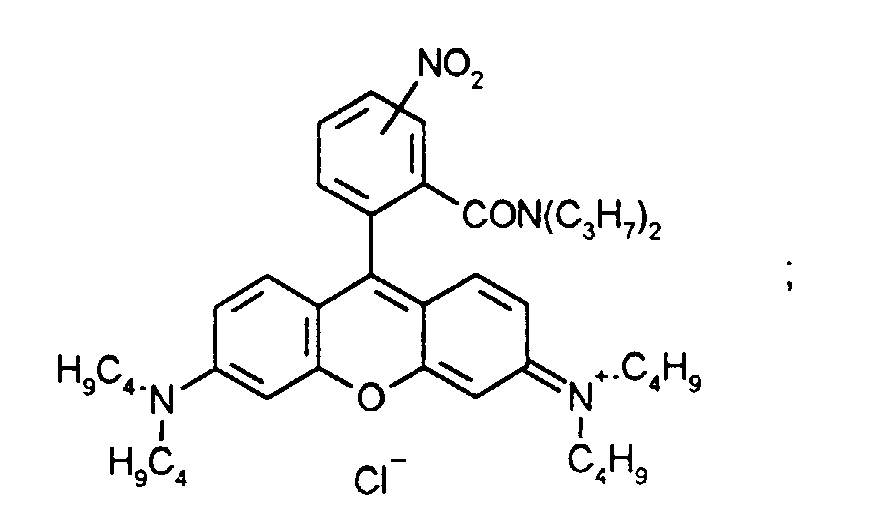
- Man verfährt analog zum Beispiel A17, verwendet jedoch anstatt der Verbindung nach Beispiel A4 jeweils eine Verbindung aus einem in der folgenden Tabelle angegebenen Beispiel. Dann verfährt man weiter analog zum Beispiel 18. Man erhält folgende Verbindungen:


- 2 Gew.-% des Produktes nach Beispiel A1 werden in 2,2,3,3-Tetrafluor-1-propanol gelöst und die Lösung wird durch einen Teflonfilter mit Porenweite 0,2 µm filtriert und auf die Oberfläche einer 1,2 mm dicken, gerillten Polycarbonatscheibe vom Durchmesser 120 mm nach dem Schleuderbeschichtungsverfahren bei 1000 U/min aufgetragen. Der Überschuss an Lösung wird durch Erhöhen der Umdrehungszahl abgeschleudert. Beim Abdampfen des Lösungsmittels bleibt der Farbstoff als gleichmässige, amorphe Feststoffschicht zurück. Nach dem Trocknen weist die Feststoffschicht eine Absorbance von 0,16 bei 635 nm auf. In einer Vakuumbeschichtungsapparatur wird dann eine 100 nm dicke Aluminiumschicht auf die Aufzeichnungsschicht aufgebracht. Anschliessend wird darauf eine 13 µm dicke Schutzschicht aus einem UV-härtbaren Photopolymer (SD-17, Dainippon Ink) mittels Schleuderbeschichtung aufgebracht. Der Aufzeichnungsträger weist bei 635 nm eine Grundreflektivität von 67% auf. Mit einer 10 mW Laserdiode der Wellenlänge 635 nm wird mit einer Leistung von 8 mW in die aktive Schicht eingeschrieben. Dieser Vorgang bewirkt an beschrifteten Stellen eine Reflexionsänderung von 67% auf 35%. Mit reduzierter Leistung werden die Marken wieder ausgelesen. Die Reflektivität ändert sich lokal von hoch nach tief, wobei das Signal/Rausch-Verhältnis ausgezeichnet ist.
- 1 Gew.-% Sulforhodamin 101 freie Säure [C.A. Reg.-Nr. 60311-02-6] wird in 2,2,3,3-Tetrafluor-1-propanol gelöst, über einen 0,2 µm Teflonfilter filtriert und wie in Beispiel B1 auf die Oberfläche einer gerillten Polycarbonatscheibe aufgeschleudert. Nach dem Abdampfen des Lösungsmittels bleibt der Farbstoff als gleichmässige, amorphe Feststoffschicht zurück. Die so hergestellte Speicherschicht weist eine Absorbance von 0,58 beim Absorptionsmaximum von 604 nm auf. Wie in Beispiel B1 werden darauf eine Reflexionschicht und eine Schutzschicht aufgetragen. Der Aufzeichnungsträger weist eine Grundreflektivität von 70% bei 650 nm auf. Auf dem erwähnten Medium werden mit einem gepulsten Farbstofflaser der Wellenlänge 635 nm Marken beschriftet, wobei die Leistung 9 mW und die Pulsdauer 15 ns betragen. Unter dem Mikroskop erscheinen die Marken kreisrund und dunkel.
- 2,0 Gew.-% des analog Beispiel A33 hergestellten Produktes der Formel

- Man verfährt wie in Beispiel B3, ersetzt jedoch den Farbstoff durch Colour Index Solvent Red 127. Die Feststoffschicht hat eine Absorbance von 0,8 bei 569 nm. Danach werden eine Reflexionsschicht und eine Polymerschutzschicht gemäss Beispiel B1 aufgebracht. Mit einer Laserleistung von 5mW werden Marken mit einer linearen Geschwindigkeit von 0,5 m/s bei 635 nm eingeschrieben.
- Man verfährt wie in Beispiel B4, ersetzt jedoch den Farbstoff durch das Produkt nach Beispiel A53. Die mit einem Mikroskopspektralphotometer (UMSP 80, Zeiss) gemessene Reflektivität beträgt 62%. Mit einer Laserleistung von 6 mW werden Marken mit einer linearen Geschwindigkeit von 0,5 m/s bei 635 nm eingeschrieben. An beschrifteten Stellen beträgt die Reflektivität 25%.
- Die Produkte der Beispiele A14-A35, A51-A53 und A56-A74 werden analog zum Beispiel B1 auf Polycarbonatscheiben beschichtet, beschriftet und gelesen. Die Resultate sind sehr gut.
- Die Produkte der Beispiele A2-A13, A36-A50 und A54-A55 werden analog zum Beispiel B1 auf Polycarbonatscheiben beschichtet, beschriftet und gelesen. Die Resultate sind gut.
- Eine Feststoffschicht des Produktes nach Beispiel A69 wird auf einen Glasträger aufgebracht und spektralellipsometrisch (Sopra Instrument) vermessen. Bei der Aufzeichnungswellenlänge von 635 nm wird ein Brechungsindex von n=2,15 und ein Absorptionskoeffizient von k=0,01 ermittelt.
- In einem Belichtungsgerät (Cl 35, Atlas) wird die Lichtstabilität einer Feststoffschicht nach Beispiel B3 bei einer Strahlungsleistung von 80 klux geprüft. Die optische Dichte beim Absorptionsmaximum beträgt nach 40 Stunden noch 80% des ursprünglichen Wertes.
Claims (18)
- Optisches Aufzeichnungsmedium, enthaltend ein Substrat, eine reflektierende Schicht und eine Aufzeichnungsschicht, dadurch gekennzeichnet, dass diese Aufzeichnungsschicht im wesentlichen aus einem oder mehreren Farbstoffen der Formel (I) besteht,
 R1, R2, R6 und R7 unabhängig voneinander für Wasserstoff, unsubstituiertes oder mit Halogen, C1-C8Alkoxy, C1-C8Alkylthio, NO2, CN, NR12R13, COO-, COOH, COO-C1-C8Alkyl, SO3 - , SO3H oder SO3-C1-C8Alkyl einfach oder mehrfach substituiertes C1-C20Alkyl, C2-C20Alkenyl oder C2-C20Alkinyl, oder unsubstituiertes oder mit C1-C8Alkyl, C1-C8Alkoxy, C1-C8Alkylthio, Halogen, NO2, CN, NR12R13, SO3 -, SO3R12, SO2NR12R13, COO-, COOR12, CONR12R13, PO3 -, PO(OR12)(OR13) oder SiR14R15R16 einfach oder mehrfach substituiertes C7-C18Aralkyl oder C6-C14Aryl stehen, jedoch R1 und R6 sowie R2 und R7 nicht jeweils beide gleichzeitig Wasserstoff, wobei R1 und R2 sowie R6 und R7 unabhängig voneinander je paarweise getrennt oder, falls sie substituierbare Stellen enthalten, über eine Direktbindung oder über eine Brücke -O- oder -NR12- miteinander so verbunden sein können, dass mit dem gemeinsamen N+ ein fünf- oder sechsgliedriger Heterozyklus gebildet wird;R3, R4, R5, R8, R9 und R10 unabhängig voneinander für Wasserstoff, Halogen, OR17, SR17, NO2, NR18R19 oder unsubstituiertes oder mit Halogen, C1-C8Alkoxy, C1-C8Alkylthio, NO2, CN oder NR18R19 einfach oder mehrfach substituiertes C1-C20Alkyl, C2-C20Alkenyl, C2-C20Alkinyl oder C7-C18Aralkyl stehen, wobei R1 und R3, R2 und R4, R6 und R8 sowie R7 und R9 unabhängig voneinander je paarweise getrennt, oder, falls jeweils beide mindestens eine substituierbare Stelle enthalten, über eine Direktbindung oder über eine Brücke -O- oder -NR20- miteinander so verbunden sind, dass mit der gemeinsamen Gruppe C-C=N+, C=C-N oder C-C-N ein fünf- oder sechsgliedriger Heterozyklus gebildet wird,oder R4 und R5 oder davon unabhängig R9 und R10 sind zusammen unsubstituiertes oder mit C1-C8Alkyl, C1-C8Alkoxy, C1-C8Alkylthio, Halogen, NO2, CN, NR18R19, SO3 -, SO3R17, SO2NR18R19, COO-, COOR17, CONR18R19, PO3 -, PO(OR18)(OR19) oder SiR21R22R23 einfach oder mehrfach substituiertes 1,4-Buta-1,3-dienylen, so dass gegebenenfalls mit der gemeinsamen C=C-Gruppe ein sechsgliedriger aromatischer Ring gebildet wird;R11 für Wasserstoff, (CH2)kCOO-, (CH2)kCOOR24, C1-C20Alkyl, C2-C20Alkenyl, C2-C20Alkinyl oder unsubstituiertes oder einfach oder mehrfach mit Halogen, NO2, CN, NR24R25, SO3 -, SO3R24, SO2NR24R25, COO-, (CH2)kOR24, (CH2)kOCOR24, COOR24, CONR24R25, OR24, SR24, PO3 -, PO(OR24)(OR25) oder SiR21R22R23 substituiertes C7-C18Aralkyl oder C6-C14Aryl steht;R12, R13, R17, R18, R19, R20, R24 und R25 unabhängig voneinander für Wasserstoff, C1-C20Alkyl, C2-C20Alkenyl, C2-C20Alkinyl oder C7-C18Aralkyl, oder für unsubstituiertes oder mit C1-C8Alkyl, C1-C8Alkoxy, C1-C8Alkylthio, Halogen, NO2, CN, NH2, NHR21, NR21R22, SO3 -, SO3R23, SO2NH2, SO2NHR21, SO2NR21R22, COO-, COOR23, CONH2, CONHR21, CONR21R22, PO3 -, PO(OR21)(OR22) oder SiR14R15R16 einfach oder mehrfach substituiertes C6-C14Aryl stehen,oder NR12R13, NR18R19, NR21R22 oder NR24R25 einen fünf- oder sechsgliedrigen, gegebenenfalls einen weiteren N oder O-Atom enthaltenden Heterozyklus bedeuten, welcher einfach oder mehrfach mit C1-C8Alkyl substituiert sein kann;R14, R15, R16, R21, R22 und R23 unabhängig voneinander für C1-C20Alkyl, C2-C20Alkenyl, C2-C20Alkinyl oder C7-C18Aralkyl stehen;Y für ein anorganisches, organisches oder metallorganisches Anion, oder für ein Gemisch davon, steht;Z für ein Proton oder ein Metall-, Ammonium- oder Phosphonium-Kation, oder für ein Gemisch davon, steht;k für eine ganze Zahl von 1 bis 10 steht;m, n und o unabhängig voneinander je für eine ganze Zahl von 1 bis 3 stehen; undp und q je für eine Zahl von 0 bis 4 stehen, wobei o, p und q je nach Ladung der zugehörigen Teilstrukturen in einem solchen Verhältnis zueinander stehen, dass in Formel (I) keine überschüssige positive oder negative Ladung resultiert.
 - Aufzeichnungsmedium nach Anspruch 1, worin R1, R2, R6 und R7 unabhängig voneinander für Wasserstoff oder unsubstituiertes oder mit COO-, COOH, COO-C1-C8Alkyl, SO3 -, SO3H oder SO3-C1-C8Alkyl einfach oder mehrfach substituiertes C1-C20Alkyl, C2-C20Alkenyl oder C2-C20Alkinyl, jedoch R1 und R6 sowie R2 und R7 nicht jeweils beide gleichzeitig für Wasserstoff, stehen;wobei R1 und R2 sowie R6 und R7 unabhängig voneinander je paarweise getrennt oder, falls sie substituierbare Stellen enthalten, über eine Direktbindung oder über eine Brücke -O-oder -NR12- miteinander so verbunden sein können, dass mit dem gemeinsamen N+ ein fünf- oder sechsgliedriger Heterozyklus gebildet wird;R3 und R8 unabhängig voneinander für Wasserstoff, Halogen, OR17, NO2, C1-C20Alkyl, C2-C20Alkenyl, C2-C20Alkinyl oder C7-C18Aralkyl steht;R4, R5, R9 und R10 unabhängig voneinander für Wasserstoff, Halogen, NO2, OR17 oder unsubstituiertes C1-C20Alkyl, C2-C20Alkenyl, C2-C20Alkinyl oder C7-C18Aralkyl stehen;wobei R1 und R3, R2 und R4, R6 und R8 sowie R7 und R9 unabhängig voneinander je paarweise getrennt, oder, falls jeweils beide mindestens eine substituierbare Stelle enthalten, über eine Direktbindung miteinander so verbunden sind, dass mit der gemeinsamen Gruppe C-C=N+, C=C-N oder C-C-N ein fünf- oder sechsgliedriger Heterozyklus gebildet wird;R11 für Wasserstoff, (CH2)kCOO-, (CH2)kCOOR24 oder unsubstituiertes oder einfach oder mehrfach mit Halogen, NO2, NR24R25, SO3 -, SO3R24, SO2NR24R25, (CH2)kOR24, COO-, COOR24, CONR24R25 oder OR24 substituiertes Phenyl oder Naphthyl steht;R17, R19, R24 und R25 unabhängig voneinander für Wasserstoff oder unsubstituiertes C1-C20Alkyl, C2-C20Alkenyl, C2-C20Alkinyl oder C7-C18Aralkyl stehen; undo für eine ganze Zahl 1 oder 2 steht.
- Aufzeichnungsmedium nach Anspruch 2, worin R1, R2, R6 und R7 unabhängig voneinander für unsubstituiertes C1-C20Alkyl stehen, wobei R1 und R2 sowie R6 und R7 unabhängig voneinander je paarweise getrennt oder über eine Direktbindung oder über eine Brücke -O- oder -NR12- miteinander so verbunden sein können, dass mit dem gemeinsamen N+ ein fünf- oder sechsgliedriger Heterozyklus gebildet wird;R3, R4, R8 und R9 unabhängig voneinander für Wasserstoff oder unsubstituiertes C1-C20Alkyl stehen, wobei R1 und R3, R2 und R4, R6 und R8 sowie R7 und R9 unabhängig voneinander je paarweise getrennt oder über eine Direktbindung miteinander so verbunden sind, dass mit der gemeinsamen Gruppe C-C=N+, C=C-N oder C-C-N ein fünf- oder sechsgliedriger Heterozyklus gebildet wird;R5 und R10 für Wasserstoff stehen;R11 für unsubstituiertes oder einfach oder mehrfach mit Halogen, NO2, SO3 -, SO3R24, SO2NR24R25, COO-, COOR24 oder CONR24R25 substituiertes Phenyl oder Naphthyl steht;R12 für Wasserstoff oder unsubstituiertes C1-C4Alkyl steht; undR24 und R25 unabhängig voneinander für Wasserstoff oder unsubstituiertes C1-C20Alkyl stehen.
- Aufzeichnungsmedium nach Anspruch 1, worin Ym- für ein Übergangsmetallkomplexanion, welches mindestens eine phenolische oder phenylcarboxylische Azoverbindung als Ligand enthält, m für eine ganze Zahl 1 oder 2, und p für eine Zahl von 0 bis 2 stehen.
- Aufzeichnungsmedium nach Anspruch 1, worin Z für ein Proton oder ein Metall- oder Ammonium-Kation, n für eine ganze Zahl 1 oder 2, und q für eine Zahl von 0 bis 3 stehen.
- Aufzeichnungsmedium nach Anspruch 4, worin Ym- ein Übergangsmetallkomplexanion der Formel (II) darstellt,
[(L1)M(L2)]m- (II)
worin L1 und L2 unabhängig voneinander Liganden der Formeln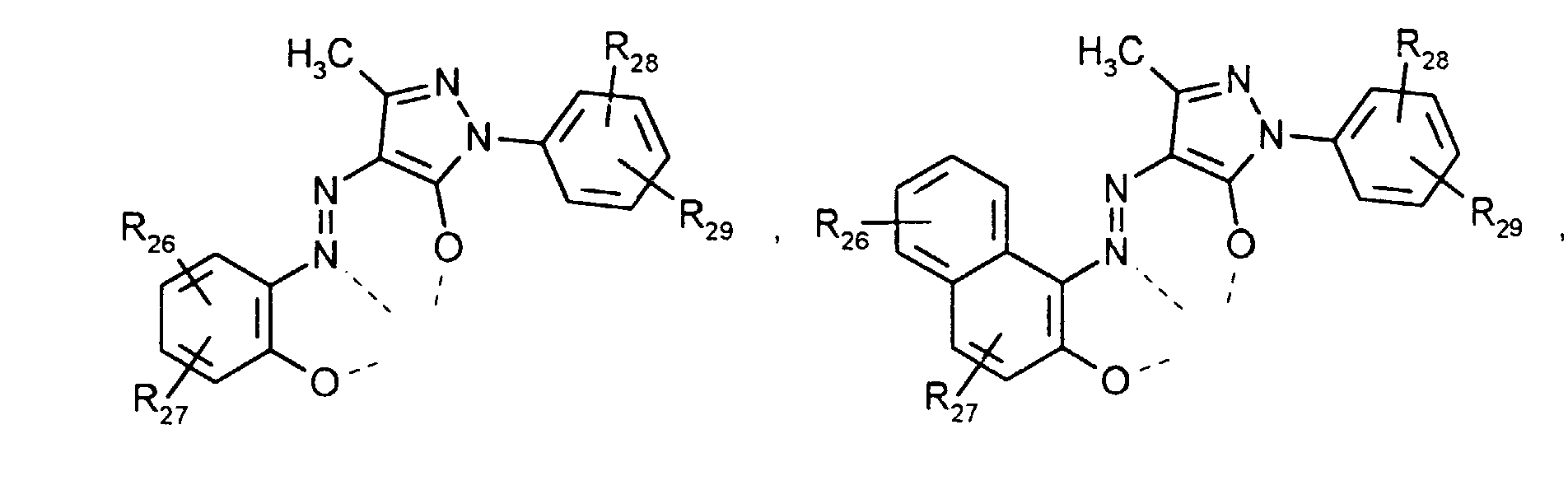


wobei R26, R27, R28 und R29 unabhängig voneinander Wasserstoff, Halogen, R30, NO2, NR30R31, NHCO-R30, NHCOO-R30, SO2-R30, SO2NH2, SO2NH-R30, SO2NR30R31, SO3 - oder SO3H sind, worin R30 und R31 unabhängig voneinander unsubstituiertes oder mit Hydroxy, Halogen oder C1-C6alkoxy substituiertes C1-C12Alkyl bedeuten; und
M für Cr3+ oder Co3+ steht. - Aufzeichnungsmedium nach Anspruch 1, worin Zn+ für [NH2R32R33]+ steht, wobei R32 Wasserstoff oder C1-C12Alkyl und R33 C1-C24Alkyl oder C7-C24Aralkyl bedeuten, und R32 und R33 zusammen von 8 bis 25 Kohlenstoffatome besitzen.
- Aufzeichnungsmedium nach Anspruch 1, worin m, n und o je die Zahl 1, p eine Zahl von 0 bis 2½, und q eine Zahl von 0 bis 1½ sind, wobei die Summe von o und q gleich p ist, so dass in Formel (II) keine überschüssige positive oder negative Ladung resultiert.
- Aufzeichnungsmedium nach Anspruch 1, worin Formel (I) für


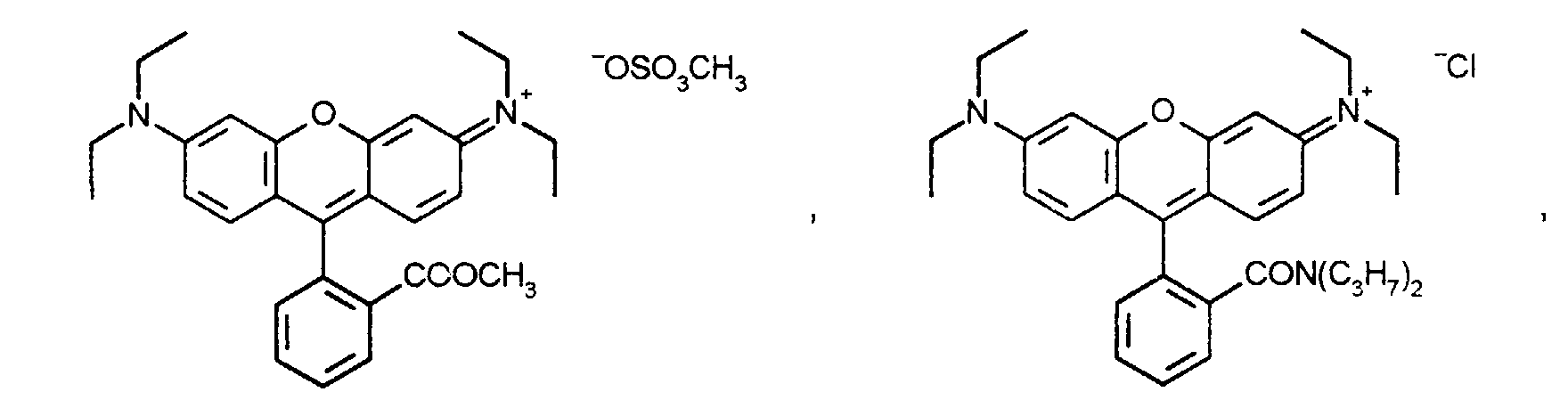


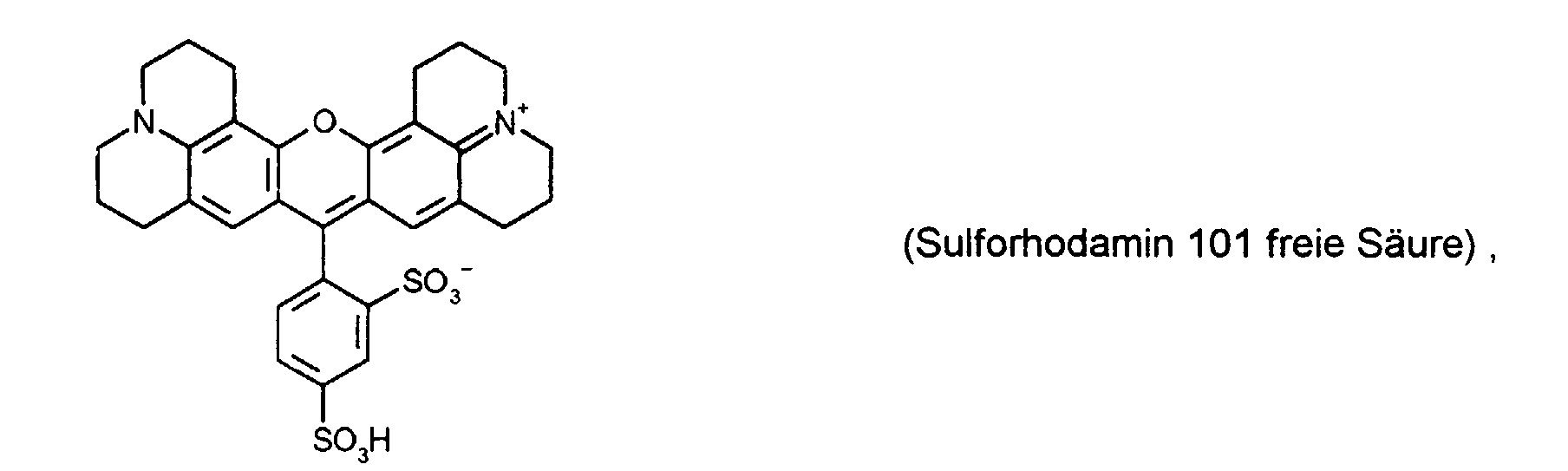


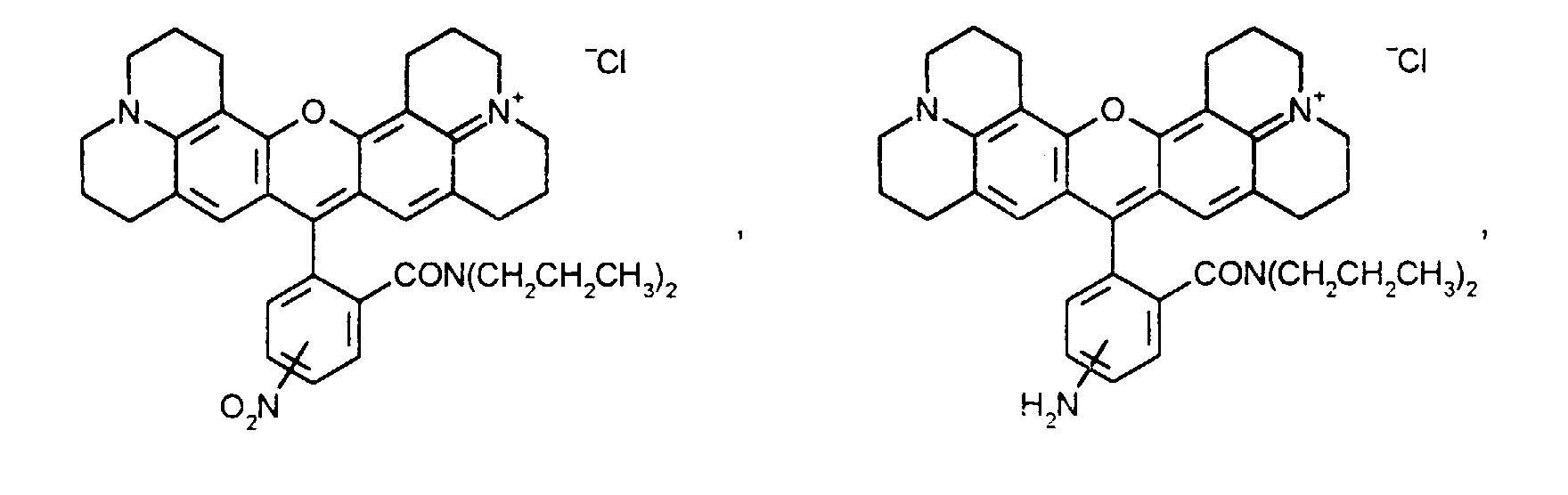


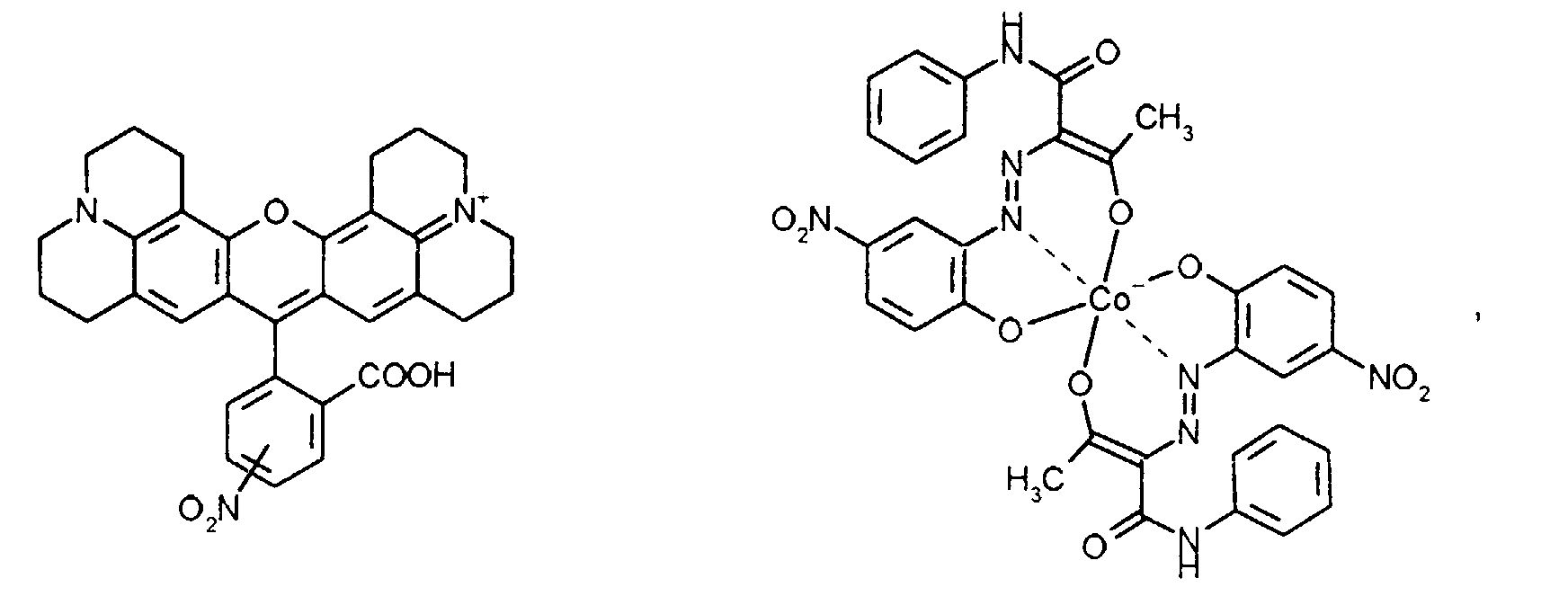

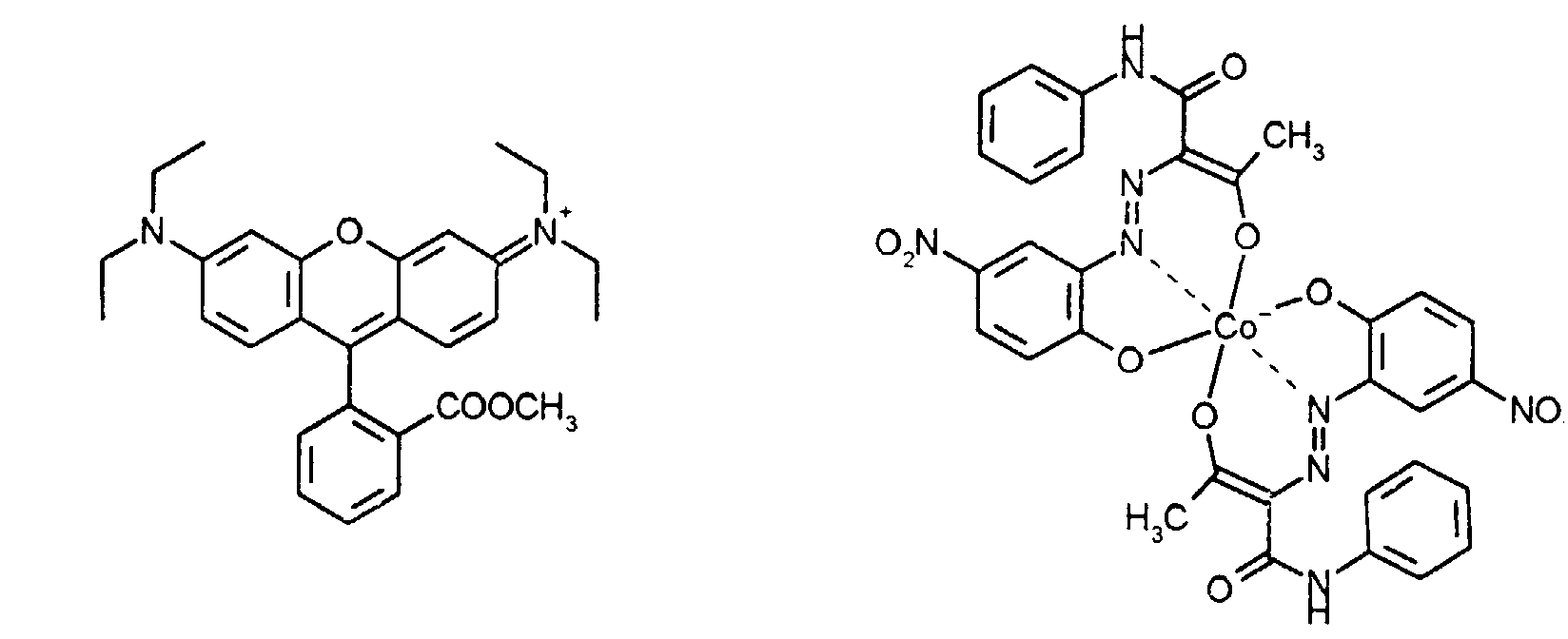
- Aufzeichnungsmedium nach Anspruch 1, worin der Farbstoff der Formel (I) ein Absorptionsmaximum bei 540 bis 610 nm in ethanolischer Lösung und einen Brechungsindex von 2,0 bis 3,0 im Bereich von 600 bis 700 nm besitzt.
- Aufzeichnungsmedium nach Anspruch 1, worin das Substrat eine Transparenz von mindestens 90% und eine Dicke von 0,01 bis 10 mm, bevorzugt von 0,1 bis 5 mm aufweist.
- Aufzeichnungsmedium nach Anspruch 1, worin die reflektierende Schicht aus Aluminium, Silber, Kupfer, Gold oder deren Legierungen besteht, und eine Reflektivität von mindestens 70% und eine Dicke von 10 bis 150 nm aufweist.
- Aufzeichnungsmedium nach Anspruch 1, worin die Aufzeichnungsschicht sich zwischen dem transparenten Substrat und der reflektierenden Schicht befindet, und eine Dicke von 10 bis 1000 nm, bevorzugt von 50 bis 500 nm, besonders bevorzugt von 80 bis 150 nm aufweist.
- Aufzeichnungsmedium nach Anspruch 1, dessen oberste Schicht mit einer zusätzlichen Schutzschicht, deren Dicke von 0,1 bis 1000 µm, bevorzugt 0,1 bis 50 µm und besonders bevorzugt 0,5 bis 15 µm beträgt, versehen ist, worauf gegebenenfalls noch eine zweite Substratschicht angebracht sein kann, welche bevorzugt von 0,1 bis 5 mm dick ist und aus dem gleichen Material wie das Trägersubstrat besteht.
- Aufzeichnungsmedium nach Anspruch 1, welches eine Reflektivität von mindestens 60% aufweist.
- Aufzeichnungsmedium nach Anspruch 1, worin zwischen der Aufzeichnungsschicht und der reflektierenden Schicht und/oder zwischen der Aufzeichnungsschicht und dem Substrat zusätzlich mindestens eine aus einem dielektrischen Material bestehende Interferenzschicht angeordnet ist.
- Verfahren zur optischen Aufzeichnung, Speicherung und Wiedergabe von Information, dadurch gekennzeichnet, dass ein Aufzeichnungsmedium nach Anspruch 1 verwendet wird.
- Verfahren nach Anspruch 17, worin die Aufzeichnung und die Wiedergabe im Wellenlängenbereich von 600 bis 700 nm erfolgen.
Applications Claiming Priority (3)
| Application Number | Priority Date | Filing Date | Title |
|---|---|---|---|
| CH1135/96 | 1996-05-03 | ||
| CH113596 | 1996-05-03 | ||
| CH113596 | 1996-05-03 |
Publications (2)
| Publication Number | Publication Date |
|---|---|
| EP0805441A1 true EP0805441A1 (de) | 1997-11-05 |
| EP0805441B1 EP0805441B1 (de) | 2003-10-08 |
Family
ID=4203309
Family Applications (1)
| Application Number | Title | Priority Date | Filing Date |
|---|---|---|---|
| EP97810248A Expired - Lifetime EP0805441B1 (de) | 1996-05-03 | 1997-04-22 | Optische Speichermedien mit hoher Kapazität, die Xanthenfarbstoffe enthalten |
Country Status (7)
| Country | Link |
|---|---|
| US (1) | US5851621A (de) |
| EP (1) | EP0805441B1 (de) |
| JP (1) | JPH1097732A (de) |
| KR (1) | KR100466374B1 (de) |
| CA (1) | CA2204209A1 (de) |
| DE (1) | DE59710824D1 (de) |
| TW (1) | TW338020B (de) |
Cited By (20)
| Publication number | Priority date | Publication date | Assignee | Title |
|---|---|---|---|---|
| WO2002077984A1 (de) * | 2001-03-28 | 2002-10-03 | Bayer Aktiengesellschaft | Optischer datenträger enthaltend in der informationsschicht einen xanthenfarbstoff als lichtabsorbierende verbindung |
| EP1517317A1 (de) * | 2003-09-19 | 2005-03-23 | Clariant International Ltd. | Triarylmethan / Monoazokomplexfarbstoff-Zusammensetzungen zur optischen Datenaufzeichnung |
| EP1528085A1 (de) * | 2003-10-30 | 2005-05-04 | Clariant International Ltd. | Neue Triarylmethan/Bisazometallkomplexfarbstoff-Verbindungen zur optischen Datenaufzeichnung |
| WO2010067078A3 (en) * | 2008-12-10 | 2010-11-18 | Wista Laboratories Ltd. | 3,6-disubstituted xanthylium salts as medicaments |
| DE102010042634A1 (de) * | 2010-10-19 | 2012-04-19 | Atto-Tec Gmbh | Neue Amin-substituierte tricyclische Fluoreszenzfarbstoffe |
| US10059876B2 (en) | 2015-11-16 | 2018-08-28 | StoreDot Ltd. | Color conversion films with plasmon enhanced fluorescent dyes |
| US10059843B2 (en) | 2015-11-16 | 2018-08-28 | StoreDot Ltd. | Rhodamine derivatives dyes, color-conversion-layer and uses thereof |
| US10072153B2 (en) | 2015-11-16 | 2018-09-11 | StoreDot Ltd. | Color conversion in LCD displays with silica nanoparticles |
| US10100197B2 (en) | 2016-08-31 | 2018-10-16 | StoreDot Ltd. | Rhodamine derivatives dyes and uses thereof |
| US10227492B2 (en) | 2015-11-16 | 2019-03-12 | StoreDot Ltd. | Modifications of the sol-gel films and production processes thereof |
| US10465110B2 (en) | 2015-11-16 | 2019-11-05 | StoreDot Ltd. | Rhodamine based salts |
| US10473968B2 (en) | 2015-11-16 | 2019-11-12 | StoreDot Ltd. | Protective layers produced by sol gel processes |
| US10472520B2 (en) | 2015-11-16 | 2019-11-12 | StoreDot Ltd. | Red enhancement in white LED displays using UV-cured color conversion films |
| US10473979B2 (en) | 2015-11-16 | 2019-11-12 | StoreDot Ltd. | Color conversion films produced by UV curing processes |
| US10495917B2 (en) | 2015-11-16 | 2019-12-03 | StoreDot Ltd. | Protective layers produced by UV curing processes |
| US10519314B2 (en) | 2015-11-16 | 2019-12-31 | StoreDot Ltd. | Red-enhanced white LCD displays comprising sol-gel-based color conversion films |
| US10533091B2 (en) | 2015-11-16 | 2020-01-14 | StoreDot Ltd. | Color conversion with solid matrix films |
| US20210246589A1 (en) * | 2016-03-17 | 2021-08-12 | Card-Monroe Corp. | Tufting machine and method of tufting |
| US11275265B2 (en) | 2015-11-16 | 2022-03-15 | Moleculed Ltd. | Control of illumination spectra for LCD displays |
| USRE49362E1 (en) | 2006-05-18 | 2023-01-10 | Illumina Cambridge Limited | Dye compounds and the use of their labelled conjugates |
Families Citing this family (23)
| Publication number | Priority date | Publication date | Assignee | Title |
|---|---|---|---|---|
| JP3441410B2 (ja) * | 1998-10-19 | 2003-09-02 | Tdk株式会社 | 光記録媒体 |
| WO2000049387A2 (en) * | 1999-02-19 | 2000-08-24 | Idexx Laboratories, Inc. | High numerical aperture flow cytometer and method of using same |
| KR20010089419A (ko) * | 1999-09-14 | 2001-10-06 | 하야시바라 켄 | 스티릴색소 |
| WO2001060933A2 (en) | 2000-02-21 | 2001-08-23 | Kao Corporation | Water-based ink |
| WO2003007296A1 (en) * | 2001-07-13 | 2003-01-23 | Ciba Specialty Chemicals Holding Inc. | Fast-writable and precision-writable high-capacity optical storage media |
| US20050008974A1 (en) * | 2001-11-15 | 2005-01-13 | Colin Morton | Writable high-capacity optical storage media containing metal complexes |
| EP1506547A1 (de) * | 2002-05-17 | 2005-02-16 | Ciba Specialty Chemicals Holding Inc. | Hochleistungsmedien für optische aufzeichnung |
| CN1653531A (zh) * | 2002-05-17 | 2005-08-10 | 西巴特殊化学品控股有限公司 | 由五环呫吨鎓染料组成的光学存储介质 |
| DE10259374A1 (de) * | 2002-12-18 | 2004-07-08 | Atto-Tec Gmbh | Carboxamid-substituierte Farbstoffe für analytische Anwendungen |
| KR20060006900A (ko) * | 2003-04-04 | 2006-01-20 | 시바 스페셜티 케미칼스 홀딩 인크. | 고용량 광저장 매체 |
| WO2004100140A1 (en) * | 2003-05-07 | 2004-11-18 | Koninklijke Philips Electronics N.V. | Write-once optical record carrier for high-speed recording |
| ES2279997T3 (es) * | 2004-07-29 | 2007-09-01 | Clariant Finance (Bvi) Limited | Ligandos azoicos a base de aminoantipirinas y sus complejos metalicos de utilidad como medios de registro optico. |
| CN101482699B (zh) * | 2007-12-14 | 2015-07-01 | 住友化学株式会社 | 着色感光性树脂组合物 |
| TW201035677A (en) * | 2008-12-09 | 2010-10-01 | Sumitomo Chemical Co | Colored photosensitive resin composition |
| JP5531586B2 (ja) * | 2008-12-09 | 2014-06-25 | 住友化学株式会社 | 化合物 |
| CN102193315B (zh) * | 2010-03-15 | 2015-01-14 | 住友化学株式会社 | 着色感光性树脂组合物 |
| JP5807568B2 (ja) * | 2011-02-14 | 2015-11-10 | 住友化学株式会社 | 着色感光性樹脂組成物及び化合物 |
| CN102304295A (zh) * | 2011-07-12 | 2012-01-04 | 核工业理化工程研究院 | 一种适合532nm激光泵浦的罗丹明101酯激光染料的制备方法 |
| CN102796395B (zh) * | 2012-08-17 | 2013-11-06 | 大连理工大学 | 一类罗丹明荧光染料,其制备方法及应用 |
| JP6256127B2 (ja) * | 2014-01-29 | 2018-01-10 | 東洋インキScホールディングス株式会社 | カラーフィルタ用ローダミン色素、およびその用途 |
| JP7307653B2 (ja) * | 2018-11-26 | 2023-07-12 | 保土谷化学工業株式会社 | キサンテン系色素、該色素を含有する着色組成物、カラーフィルター用着色剤およびカラーフィルター |
| CN110333646A (zh) * | 2019-07-17 | 2019-10-15 | 深圳市华星光电技术有限公司 | 一种红色彩膜光刻胶 |
| CN113563298B (zh) * | 2021-07-20 | 2023-07-28 | 北京大学 | 一类含水溶性取代基罗丹明荧光染料其制备方法和应用 |
Citations (6)
| Publication number | Priority date | Publication date | Assignee | Title |
|---|---|---|---|---|
| DE3503995A1 (de) * | 1984-02-06 | 1985-08-08 | Ricoh Co., Ltd., Tokio/Tokyo | Optischer informationsaufzeichnungstraeger |
| US4809022A (en) * | 1983-06-27 | 1989-02-28 | Optical Disc Corporation | Direct read after write optical storage medium |
| EP0174054B1 (de) * | 1984-09-04 | 1989-06-28 | Polaroid Corporation | Wärmeempfindliches Material zur Verwendung bei Wärmeaufzeichnungsverfahren |
| US4994352A (en) * | 1988-11-25 | 1991-02-19 | The Dow Chemical Company | Dye-enhanced deposition of elemental metals and metalloids on substrates |
| EP0649133A1 (de) * | 1993-10-18 | 1995-04-19 | Eastman Kodak Company | Metallisiertes Azo-Dianon mit zwei kationischen Farbstoff-Gegenionen für ein optisches Medium zur Aufzeichung von Informationen |
| WO1995034890A1 (en) * | 1994-06-10 | 1995-12-21 | Nanogen | Dna optical storage |
Family Cites Families (17)
| Publication number | Priority date | Publication date | Assignee | Title |
|---|---|---|---|---|
| US4304834A (en) * | 1979-12-26 | 1981-12-08 | Polaroid Corporation | Novel xanthene compounds and photographic products and processes employing the same |
| US4258118A (en) * | 1979-12-26 | 1981-03-24 | Polaroid Corporation | Novel xanthene compounds and photographic products and processes employing the same |
| JPS60236131A (ja) * | 1984-05-10 | 1985-11-22 | Ricoh Co Ltd | 光情報記録媒体 |
| US4626496A (en) * | 1984-06-19 | 1986-12-02 | Ricoh Co., Ltd. | Optical information recording medium |
| DE3537539A1 (de) * | 1984-10-23 | 1986-04-24 | Ricoh Co., Ltd., Tokio/Tokyo | Optisches informationsaufzeichnungsmaterial |
| US5145963A (en) * | 1988-10-12 | 1992-09-08 | Ricoh Company, Ltd. | Optical information recording medium and nickel dithiolate complex compounds employed in the same |
| JPH0351182A (ja) * | 1989-07-19 | 1991-03-05 | Matsushita Electric Ind Co Ltd | 光記録媒体 |
| JPH07111785B2 (ja) * | 1990-01-19 | 1995-11-29 | 富士通株式会社 | 光ディスク |
| JP3026586B2 (ja) * | 1990-07-20 | 2000-03-27 | 株式会社リコー | 光情報記録媒体 |
| JPH04167239A (ja) * | 1990-10-30 | 1992-06-15 | Sony Corp | 光記録媒体 |
| US5312906A (en) * | 1991-07-25 | 1994-05-17 | Ricoh Company, Ltd. | Optical information recording media and bisazo compounds for use therein |
| JPH0640162A (ja) * | 1992-01-22 | 1994-02-15 | Nippon Columbia Co Ltd | 光記録媒体 |
| US5272047A (en) * | 1992-06-26 | 1993-12-21 | Eastman Kodak Company | Optical information recording medium using azo dyes |
| US5294471A (en) * | 1993-02-01 | 1994-03-15 | Eastman Kodak Company | Optical information recording medium using metallized formazan dyes |
| EP0649880B1 (de) * | 1993-10-21 | 2000-01-12 | Eastman Kodak Company | Metallisierte Azo-ether-farbstoffe für optische Aufzeichnungsschichten |
| JPH07186547A (ja) * | 1993-10-21 | 1995-07-25 | Eastman Kodak Co | 光学記録層用色素混合物 |
| US5633106A (en) * | 1994-04-08 | 1997-05-27 | Mitsui Toatsu Chemicals, Inc. | Optical recording media and a method of recording and reproducing information |
-
1997
- 1997-04-22 DE DE59710824T patent/DE59710824D1/de not_active Expired - Fee Related
- 1997-04-22 EP EP97810248A patent/EP0805441B1/de not_active Expired - Lifetime
- 1997-04-23 US US08/842,292 patent/US5851621A/en not_active Expired - Fee Related
- 1997-05-01 TW TW086105782A patent/TW338020B/zh active
- 1997-05-01 CA CA002204209A patent/CA2204209A1/en not_active Abandoned
- 1997-05-02 JP JP9114730A patent/JPH1097732A/ja not_active Abandoned
- 1997-05-02 KR KR1019970017047A patent/KR100466374B1/ko not_active Expired - Fee Related
Patent Citations (6)
| Publication number | Priority date | Publication date | Assignee | Title |
|---|---|---|---|---|
| US4809022A (en) * | 1983-06-27 | 1989-02-28 | Optical Disc Corporation | Direct read after write optical storage medium |
| DE3503995A1 (de) * | 1984-02-06 | 1985-08-08 | Ricoh Co., Ltd., Tokio/Tokyo | Optischer informationsaufzeichnungstraeger |
| EP0174054B1 (de) * | 1984-09-04 | 1989-06-28 | Polaroid Corporation | Wärmeempfindliches Material zur Verwendung bei Wärmeaufzeichnungsverfahren |
| US4994352A (en) * | 1988-11-25 | 1991-02-19 | The Dow Chemical Company | Dye-enhanced deposition of elemental metals and metalloids on substrates |
| EP0649133A1 (de) * | 1993-10-18 | 1995-04-19 | Eastman Kodak Company | Metallisiertes Azo-Dianon mit zwei kationischen Farbstoff-Gegenionen für ein optisches Medium zur Aufzeichung von Informationen |
| WO1995034890A1 (en) * | 1994-06-10 | 1995-12-21 | Nanogen | Dna optical storage |
Cited By (29)
| Publication number | Priority date | Publication date | Assignee | Title |
|---|---|---|---|---|
| WO2002077984A1 (de) * | 2001-03-28 | 2002-10-03 | Bayer Aktiengesellschaft | Optischer datenträger enthaltend in der informationsschicht einen xanthenfarbstoff als lichtabsorbierende verbindung |
| EP1517317A1 (de) * | 2003-09-19 | 2005-03-23 | Clariant International Ltd. | Triarylmethan / Monoazokomplexfarbstoff-Zusammensetzungen zur optischen Datenaufzeichnung |
| EP1528085A1 (de) * | 2003-10-30 | 2005-05-04 | Clariant International Ltd. | Neue Triarylmethan/Bisazometallkomplexfarbstoff-Verbindungen zur optischen Datenaufzeichnung |
| USRE49362E1 (en) | 2006-05-18 | 2023-01-10 | Illumina Cambridge Limited | Dye compounds and the use of their labelled conjugates |
| US10399955B2 (en) | 2008-12-10 | 2019-09-03 | Wista Laboratories Ltd. | 3,6-disubstituted xanthylium salts |
| WO2010067078A3 (en) * | 2008-12-10 | 2010-11-18 | Wista Laboratories Ltd. | 3,6-disubstituted xanthylium salts as medicaments |
| CN102307878B (zh) * | 2008-12-10 | 2014-10-15 | 维斯塔实验室有限公司 | 3,6-二取代的呫吨鎓盐 |
| AU2009326173B2 (en) * | 2008-12-10 | 2014-10-30 | TauRx Therapeutics Management Ltd | 3,6-disubstituted xanthylium salts as medicaments |
| EP3112358A3 (de) * | 2008-12-10 | 2017-01-11 | WisTa Laboratories Ltd. | 3,6-disubstituierte xanthyliumsalze |
| EP3689346A1 (de) * | 2008-12-10 | 2020-08-05 | WisTa Laboratories Ltd. | 3,6-disubstituierte xanthyliumsalze |
| DE102010042634A1 (de) * | 2010-10-19 | 2012-04-19 | Atto-Tec Gmbh | Neue Amin-substituierte tricyclische Fluoreszenzfarbstoffe |
| US9651490B2 (en) | 2010-10-19 | 2017-05-16 | Atto-Tec Gmbh | Amine-substituted tricyclic fluorescent dyes |
| US10519314B2 (en) | 2015-11-16 | 2019-12-31 | StoreDot Ltd. | Red-enhanced white LCD displays comprising sol-gel-based color conversion films |
| US10072153B2 (en) | 2015-11-16 | 2018-09-11 | StoreDot Ltd. | Color conversion in LCD displays with silica nanoparticles |
| US10059876B2 (en) | 2015-11-16 | 2018-08-28 | StoreDot Ltd. | Color conversion films with plasmon enhanced fluorescent dyes |
| US11275265B2 (en) | 2015-11-16 | 2022-03-15 | Moleculed Ltd. | Control of illumination spectra for LCD displays |
| US10465110B2 (en) | 2015-11-16 | 2019-11-05 | StoreDot Ltd. | Rhodamine based salts |
| US10473968B2 (en) | 2015-11-16 | 2019-11-12 | StoreDot Ltd. | Protective layers produced by sol gel processes |
| US10472520B2 (en) | 2015-11-16 | 2019-11-12 | StoreDot Ltd. | Red enhancement in white LED displays using UV-cured color conversion films |
| US10473979B2 (en) | 2015-11-16 | 2019-11-12 | StoreDot Ltd. | Color conversion films produced by UV curing processes |
| US10495917B2 (en) | 2015-11-16 | 2019-12-03 | StoreDot Ltd. | Protective layers produced by UV curing processes |
| US10227492B2 (en) | 2015-11-16 | 2019-03-12 | StoreDot Ltd. | Modifications of the sol-gel films and production processes thereof |
| US10533091B2 (en) | 2015-11-16 | 2020-01-14 | StoreDot Ltd. | Color conversion with solid matrix films |
| US10059843B2 (en) | 2015-11-16 | 2018-08-28 | StoreDot Ltd. | Rhodamine derivatives dyes, color-conversion-layer and uses thereof |
| US10808127B2 (en) | 2015-11-16 | 2020-10-20 | Moleculed Ltd. | Color conversion with solid matrix films and green rhodamines |
| US20210246589A1 (en) * | 2016-03-17 | 2021-08-12 | Card-Monroe Corp. | Tufting machine and method of tufting |
| US11708654B2 (en) * | 2016-03-17 | 2023-07-25 | Card-Monroe Corp. | Tufting machine and method of tufting |
| US10100197B2 (en) | 2016-08-31 | 2018-10-16 | StoreDot Ltd. | Rhodamine derivatives dyes and uses thereof |
| US10240042B2 (en) | 2016-08-31 | 2019-03-26 | StoreDot Ltd. | Photoluminescent compounds and uses thereof |
Also Published As
| Publication number | Publication date |
|---|---|
| KR100466374B1 (ko) | 2005-06-23 |
| TW338020B (en) | 1998-08-11 |
| EP0805441B1 (de) | 2003-10-08 |
| KR970076596A (ko) | 1997-12-12 |
| DE59710824D1 (de) | 2003-11-13 |
| US5851621A (en) | 1998-12-22 |
| JPH1097732A (ja) | 1998-04-14 |
| CA2204209A1 (en) | 1997-11-03 |
Similar Documents
| Publication | Publication Date | Title |
|---|---|---|
| EP0805441B1 (de) | Optische Speichermedien mit hoher Kapazität, die Xanthenfarbstoffe enthalten | |
| DE69725607T2 (de) | Polymethin-komplex-farbstoffe und ihre verwendung | |
| DE60204981T2 (de) | Zusammensetzungen enthaltend mindestens einen oxonol-farbstoff und mindestens einen metallkomplex | |
| DE69612189T2 (de) | Optisches aufzeichnungsmaterial und optischer aufzeichnungsträger | |
| DE69920699T2 (de) | Aminiumsalz- oder diimoniumsalz-verbindungen und ihre anwendung | |
| DE69422132T2 (de) | Metallisiertes Azo-Dianon mit zwei kationischen Farbstoff-Gegenionen für ein optisches Medium zur Aufzeichung von Informationen | |
| DE69814258T2 (de) | Phthalocyaninverbindungen | |
| EP0540468B1 (de) | NIR-Farbstoffe, Verfahren zu ihrer Herstellung und ihre Verwendung | |
| DE3927872C2 (de) | Dithiolat-Metallkomplexverbindungen, Verfahren zu ihrer Herstellung und sie enthaltendes optisches Informationsaufzeichnungsmaterial | |
| DE69713512T2 (de) | Substituierte phtalocyanine und deren verwendung | |
| DE69318625T2 (de) | Element, das Azofarbstoffe verwendet, für die Aufzeichnung optischer Informationen | |
| DE69812259T2 (de) | Photostabilisierte cyaninfarbstoffe und optischer aufzeichnungsträger | |
| DE69839010T2 (de) | Beschreibbare und löschbare optische aufzeichnungsmedien mit hoher dichte | |
| DE69824920T2 (de) | Optisches Medium zur Aufzeichnung von Informationen und Verfahren zur Herstellung dafür | |
| DE3711762A1 (de) | Gemischte phthalo-naphthalocyanine sowie duenne strahlungsempfindliche beschichtungsfilme, die diese verbindungen enthalten | |
| EP0822546B1 (de) | Speichermedien mit hoher Kapazität | |
| US20040096775A1 (en) | Optical recording materials having high storage density | |
| DE10249654A1 (de) | Neue Indolstyryl-Verbindungen und ihre Verwendungen in Aufzeichnungsmedien mit hoher Dichte | |
| EP0291848B1 (de) | Optisches Aufzeichnungsmedium, das eine Reflektorschicht aufweist, die ein Silicium-Phthalocyaninderivat enthält | |
| EP1377968A2 (de) | Optischer datenträger enthaltend in der informationsschicht einen heterocyclischen azofarbstoff als lichtabsorbierende verbindung | |
| DE602004001135T2 (de) | Materialien für optische aufzeichnung mit hoher speicherdichte | |
| DE69316808T2 (de) | Optisches Aufzeichnungsmedium | |
| DE3724981C2 (de) | ||
| DE3829851A1 (de) | Tetraazaporphyrine sowie strahlungsempfindliche beschichtungsfilme | |
| DE3888820T2 (de) | Phthalocyaninbestandteil und dieses verwendender optischer Speicherstoff. |
Legal Events
| Date | Code | Title | Description |
|---|---|---|---|
| PUAI | Public reference made under article 153(3) epc to a published international application that has entered the european phase |
Free format text: ORIGINAL CODE: 0009012 |
|
| AK | Designated contracting states |
Kind code of ref document: A1 Designated state(s): CH DE FR GB IT LI NL SE |
|
| 17P | Request for examination filed |
Effective date: 19980217 |
|
| 17Q | First examination report despatched |
Effective date: 20020708 |
|
| GRAH | Despatch of communication of intention to grant a patent |
Free format text: ORIGINAL CODE: EPIDOS IGRA |
|
| GRAS | Grant fee paid |
Free format text: ORIGINAL CODE: EPIDOSNIGR3 |
|
| GRAA | (expected) grant |
Free format text: ORIGINAL CODE: 0009210 |
|
| AK | Designated contracting states |
Kind code of ref document: B1 Designated state(s): CH DE FR GB IT LI NL SE |
|
| REG | Reference to a national code |
Ref country code: GB Ref legal event code: FG4D Free format text: NOT ENGLISH |
|
| REG | Reference to a national code |
Ref country code: CH Ref legal event code: EP |
|
| REF | Corresponds to: |
Ref document number: 59710824 Country of ref document: DE Date of ref document: 20031113 Kind code of ref document: P |
|
| GBT | Gb: translation of ep patent filed (gb section 77(6)(a)/1977) |
Effective date: 20031114 |
|
| REG | Reference to a national code |
Ref country code: SE Ref legal event code: TRGR |
|
| ET | Fr: translation filed | ||
| PLBE | No opposition filed within time limit |
Free format text: ORIGINAL CODE: 0009261 |
|
| STAA | Information on the status of an ep patent application or granted ep patent |
Free format text: STATUS: NO OPPOSITION FILED WITHIN TIME LIMIT |
|
| 26N | No opposition filed |
Effective date: 20040709 |
|
| PGFP | Annual fee paid to national office [announced via postgrant information from national office to epo] |
Ref country code: FR Payment date: 20050316 Year of fee payment: 9 Ref country code: CH Payment date: 20050316 Year of fee payment: 9 |
|
| PGFP | Annual fee paid to national office [announced via postgrant information from national office to epo] |
Ref country code: SE Payment date: 20050321 Year of fee payment: 9 |
|
| PGFP | Annual fee paid to national office [announced via postgrant information from national office to epo] |
Ref country code: NL Payment date: 20050322 Year of fee payment: 9 Ref country code: GB Payment date: 20050322 Year of fee payment: 9 |
|
| PGFP | Annual fee paid to national office [announced via postgrant information from national office to epo] |
Ref country code: DE Payment date: 20050324 Year of fee payment: 9 |
|
| PG25 | Lapsed in a contracting state [announced via postgrant information from national office to epo] |
Ref country code: GB Free format text: LAPSE BECAUSE OF NON-PAYMENT OF DUE FEES Effective date: 20060422 |
|
| PG25 | Lapsed in a contracting state [announced via postgrant information from national office to epo] |
Ref country code: SE Free format text: LAPSE BECAUSE OF NON-PAYMENT OF DUE FEES Effective date: 20060423 |
|
| PG25 | Lapsed in a contracting state [announced via postgrant information from national office to epo] |
Ref country code: LI Free format text: LAPSE BECAUSE OF NON-PAYMENT OF DUE FEES Effective date: 20060430 Ref country code: CH Free format text: LAPSE BECAUSE OF NON-PAYMENT OF DUE FEES Effective date: 20060430 |
|
| PGFP | Annual fee paid to national office [announced via postgrant information from national office to epo] |
Ref country code: IT Payment date: 20060430 Year of fee payment: 10 |
|
| PG25 | Lapsed in a contracting state [announced via postgrant information from national office to epo] |
Ref country code: NL Free format text: LAPSE BECAUSE OF NON-PAYMENT OF DUE FEES Effective date: 20061101 Ref country code: DE Free format text: LAPSE BECAUSE OF NON-PAYMENT OF DUE FEES Effective date: 20061101 |
|
| REG | Reference to a national code |
Ref country code: CH Ref legal event code: PL |
|
| EUG | Se: european patent has lapsed | ||
| GBPC | Gb: european patent ceased through non-payment of renewal fee |
Effective date: 20060422 |
|
| NLV4 | Nl: lapsed or anulled due to non-payment of the annual fee |
Effective date: 20061101 |
|
| REG | Reference to a national code |
Ref country code: FR Ref legal event code: ST Effective date: 20061230 |
|
| PG25 | Lapsed in a contracting state [announced via postgrant information from national office to epo] |
Ref country code: FR Free format text: LAPSE BECAUSE OF NON-PAYMENT OF DUE FEES Effective date: 20060502 |
|
| PG25 | Lapsed in a contracting state [announced via postgrant information from national office to epo] |
Ref country code: IT Free format text: LAPSE BECAUSE OF NON-PAYMENT OF DUE FEES Effective date: 20070422 |