EP0806427B1 - Procédé pour la préparation de composés organosiliciques à fonction vinylique - Google Patents
Procédé pour la préparation de composés organosiliciques à fonction vinylique Download PDFInfo
- Publication number
- EP0806427B1 EP0806427B1 EP97104745A EP97104745A EP0806427B1 EP 0806427 B1 EP0806427 B1 EP 0806427B1 EP 97104745 A EP97104745 A EP 97104745A EP 97104745 A EP97104745 A EP 97104745A EP 0806427 B1 EP0806427 B1 EP 0806427B1
- Authority
- EP
- European Patent Office
- Prior art keywords
- process according
- group
- organosilicon compound
- acetylene
- liquid phase
- Prior art date
- Legal status (The legal status is an assumption and is not a legal conclusion. Google has not performed a legal analysis and makes no representation as to the accuracy of the status listed.)
- Expired - Lifetime
Links
- 150000003961 organosilicon compounds Chemical class 0.000 title claims description 25
- 238000004519 manufacturing process Methods 0.000 title claims description 4
- 125000000391 vinyl group Chemical group [H]C([*])=C([H])[H] 0.000 title description 3
- 238000000034 method Methods 0.000 claims description 79
- 125000002534 ethynyl group Chemical group [H]C#C* 0.000 claims description 48
- HSFWRNGVRCDJHI-UHFFFAOYSA-N alpha-acetylene Natural products C#C HSFWRNGVRCDJHI-UHFFFAOYSA-N 0.000 claims description 47
- 239000003054 catalyst Substances 0.000 claims description 27
- 239000007791 liquid phase Substances 0.000 claims description 24
- 239000002904 solvent Substances 0.000 claims description 20
- 238000006243 chemical reaction Methods 0.000 claims description 16
- 238000004821 distillation Methods 0.000 claims description 14
- 239000011541 reaction mixture Substances 0.000 claims description 14
- 125000004432 carbon atom Chemical group C* 0.000 claims description 12
- BASFCYQUMIYNBI-UHFFFAOYSA-N platinum Chemical compound [Pt] BASFCYQUMIYNBI-UHFFFAOYSA-N 0.000 claims description 11
- 125000003118 aryl group Chemical group 0.000 claims description 9
- 125000001188 haloalkyl group Chemical group 0.000 claims description 9
- 238000010626 work up procedure Methods 0.000 claims description 8
- 239000000203 mixture Substances 0.000 claims description 7
- 125000003545 alkoxy group Chemical group 0.000 claims description 6
- 125000000217 alkyl group Chemical group 0.000 claims description 6
- KTQYJQFGNYHXMB-UHFFFAOYSA-N dichloro(methyl)silicon Chemical compound C[Si](Cl)Cl KTQYJQFGNYHXMB-UHFFFAOYSA-N 0.000 claims description 6
- 239000005048 methyldichlorosilane Substances 0.000 claims description 6
- 239000002638 heterogeneous catalyst Substances 0.000 claims description 5
- 239000002815 homogeneous catalyst Substances 0.000 claims description 5
- 229910052697 platinum Inorganic materials 0.000 claims description 5
- QABCGOSYZHCPGN-UHFFFAOYSA-N chloro(dimethyl)silicon Chemical compound C[Si](C)Cl QABCGOSYZHCPGN-UHFFFAOYSA-N 0.000 claims description 4
- MROCJMGDEKINLD-UHFFFAOYSA-N dichlorosilane Chemical group Cl[SiH2]Cl MROCJMGDEKINLD-UHFFFAOYSA-N 0.000 claims description 4
- 238000009835 boiling Methods 0.000 claims description 3
- AUHZEENZYGFFBQ-UHFFFAOYSA-N mesitylene Substances CC1=CC(C)=CC(C)=C1 AUHZEENZYGFFBQ-UHFFFAOYSA-N 0.000 claims description 3
- 125000001827 mesitylenyl group Chemical group [H]C1=C(C(*)=C(C([H])=C1C([H])([H])[H])C([H])([H])[H])C([H])([H])[H] 0.000 claims description 3
- 239000008246 gaseous mixture Substances 0.000 claims description 2
- 239000012442 inert solvent Substances 0.000 claims description 2
- 239000003921 oil Substances 0.000 claims description 2
- 239000011877 solvent mixture Substances 0.000 claims description 2
- 239000007858 starting material Substances 0.000 claims description 2
- 239000010409 thin film Substances 0.000 claims description 2
- UHUUYVZLXJHWDV-UHFFFAOYSA-N trimethyl(methylsilyloxy)silane Chemical compound C[SiH2]O[Si](C)(C)C UHUUYVZLXJHWDV-UHFFFAOYSA-N 0.000 claims description 2
- 125000004122 cyclic group Chemical group 0.000 claims 1
- 239000007789 gas Substances 0.000 description 12
- 239000000047 product Substances 0.000 description 11
- -1 Phenyl- Chemical group 0.000 description 7
- BLRPTPMANUNPDV-UHFFFAOYSA-N Silane Chemical compound [SiH4] BLRPTPMANUNPDV-UHFFFAOYSA-N 0.000 description 6
- 125000001624 naphthyl group Chemical group 0.000 description 6
- 229910000077 silane Inorganic materials 0.000 description 6
- 150000003377 silicon compounds Chemical class 0.000 description 6
- 238000002156 mixing Methods 0.000 description 5
- 229910003849 O-Si Inorganic materials 0.000 description 4
- 229910003872 O—Si Inorganic materials 0.000 description 4
- 239000007795 chemical reaction product Substances 0.000 description 4
- YLJJAVFOBDSYAN-UHFFFAOYSA-N dichloro-ethenyl-methylsilane Chemical compound C[Si](Cl)(Cl)C=C YLJJAVFOBDSYAN-UHFFFAOYSA-N 0.000 description 4
- 229910052739 hydrogen Inorganic materials 0.000 description 4
- 239000001257 hydrogen Substances 0.000 description 4
- 238000006459 hydrosilylation reaction Methods 0.000 description 4
- 238000002360 preparation method Methods 0.000 description 4
- 238000011084 recovery Methods 0.000 description 4
- 125000001797 benzyl group Chemical group [H]C1=C([H])C([H])=C(C([H])=C1[H])C([H])([H])* 0.000 description 3
- 239000007788 liquid Substances 0.000 description 3
- 125000001997 phenyl group Chemical group [H]C1=C([H])C([H])=C(*)C([H])=C1[H] 0.000 description 3
- UKRDPEFKFJNXQM-UHFFFAOYSA-N vinylsilane Chemical class [SiH3]C=C UKRDPEFKFJNXQM-UHFFFAOYSA-N 0.000 description 3
- XSDCTSITJJJDPY-UHFFFAOYSA-N chloro-ethenyl-dimethylsilane Chemical compound C[Si](C)(Cl)C=C XSDCTSITJJJDPY-UHFFFAOYSA-N 0.000 description 2
- 238000009833 condensation Methods 0.000 description 2
- 230000005494 condensation Effects 0.000 description 2
- QWTDNUCVQCZILF-UHFFFAOYSA-N isopentane Chemical compound CCC(C)C QWTDNUCVQCZILF-UHFFFAOYSA-N 0.000 description 2
- 239000000463 material Substances 0.000 description 2
- 239000012071 phase Substances 0.000 description 2
- ZDHXKXAHOVTTAH-UHFFFAOYSA-N trichlorosilane Chemical compound Cl[SiH](Cl)Cl ZDHXKXAHOVTTAH-UHFFFAOYSA-N 0.000 description 2
- 239000005052 trichlorosilane Substances 0.000 description 2
- 229920002554 vinyl polymer Polymers 0.000 description 2
- 238000006886 vinylation reaction Methods 0.000 description 2
- KWEKXPWNFQBJAY-UHFFFAOYSA-N (dimethyl-$l^{3}-silanyl)oxy-dimethylsilicon Chemical compound C[Si](C)O[Si](C)C KWEKXPWNFQBJAY-UHFFFAOYSA-N 0.000 description 1
- WZJUBBHODHNQPW-UHFFFAOYSA-N 2,4,6,8-tetramethyl-1,3,5,7,2$l^{3},4$l^{3},6$l^{3},8$l^{3}-tetraoxatetrasilocane Chemical compound C[Si]1O[Si](C)O[Si](C)O[Si](C)O1 WZJUBBHODHNQPW-UHFFFAOYSA-N 0.000 description 1
- UFHFLCQGNIYNRP-UHFFFAOYSA-N Hydrogen Chemical compound [H][H] UFHFLCQGNIYNRP-UHFFFAOYSA-N 0.000 description 1
- GJWAPAVRQYYSTK-UHFFFAOYSA-N [(dimethyl-$l^{3}-silanyl)amino]-dimethylsilicon Chemical compound C[Si](C)N[Si](C)C GJWAPAVRQYYSTK-UHFFFAOYSA-N 0.000 description 1
- NQCZAYQXPJEPDS-UHFFFAOYSA-N [(dimethylsilylamino)-methylsilyl]methane Chemical compound C[SiH](C)N[SiH](C)C NQCZAYQXPJEPDS-UHFFFAOYSA-N 0.000 description 1
- 239000002253 acid Substances 0.000 description 1
- 230000015572 biosynthetic process Effects 0.000 description 1
- FSIJKGMIQTVTNP-UHFFFAOYSA-N bis(ethenyl)-methyl-trimethylsilyloxysilane Chemical compound C[Si](C)(C)O[Si](C)(C=C)C=C FSIJKGMIQTVTNP-UHFFFAOYSA-N 0.000 description 1
- 239000006227 byproduct Substances 0.000 description 1
- 229910052799 carbon Inorganic materials 0.000 description 1
- 238000006555 catalytic reaction Methods 0.000 description 1
- YGHUUVGIRWMJGE-UHFFFAOYSA-N chlorodimethylsilane Chemical compound C[SiH](C)Cl YGHUUVGIRWMJGE-UHFFFAOYSA-N 0.000 description 1
- 239000012043 crude product Substances 0.000 description 1
- NWKBSEBOBPHMKL-UHFFFAOYSA-N dichloro(methyl)silane Chemical compound C[SiH](Cl)Cl NWKBSEBOBPHMKL-UHFFFAOYSA-N 0.000 description 1
- MAYIDWCWWMOISO-UHFFFAOYSA-N dichloro-bis(ethenyl)silane Chemical compound C=C[Si](Cl)(Cl)C=C MAYIDWCWWMOISO-UHFFFAOYSA-N 0.000 description 1
- 239000003085 diluting agent Substances 0.000 description 1
- AFABGHUZZDYHJO-UHFFFAOYSA-N dimethyl butane Natural products CCCC(C)C AFABGHUZZDYHJO-UHFFFAOYSA-N 0.000 description 1
- NVYQDQZEMGUESH-UHFFFAOYSA-N dimethylsilyloxy(dimethyl)silane Chemical compound C[SiH](C)O[SiH](C)C NVYQDQZEMGUESH-UHFFFAOYSA-N 0.000 description 1
- 125000004435 hydrogen atom Chemical group [H]* 0.000 description 1
- 238000011835 investigation Methods 0.000 description 1
- 150000002576 ketones Chemical class 0.000 description 1
- 229910000510 noble metal Inorganic materials 0.000 description 1
- 125000002524 organometallic group Chemical group 0.000 description 1
- 238000005191 phase separation Methods 0.000 description 1
- 239000010970 precious metal Substances 0.000 description 1
- 238000004064 recycling Methods 0.000 description 1
- 230000008929 regeneration Effects 0.000 description 1
- 238000011069 regeneration method Methods 0.000 description 1
- 230000001105 regulatory effect Effects 0.000 description 1
- 150000004756 silanes Chemical class 0.000 description 1
- 229910052710 silicon Inorganic materials 0.000 description 1
- 239000010703 silicon Substances 0.000 description 1
- GQIUQDDJKHLHTB-UHFFFAOYSA-N trichloro(ethenyl)silane Chemical compound Cl[Si](Cl)(Cl)C=C GQIUQDDJKHLHTB-UHFFFAOYSA-N 0.000 description 1
- PPDADIYYMSXQJK-UHFFFAOYSA-N trichlorosilicon Chemical compound Cl[Si](Cl)Cl PPDADIYYMSXQJK-UHFFFAOYSA-N 0.000 description 1
- 239000005050 vinyl trichlorosilane Substances 0.000 description 1
Images
Classifications
-
- C—CHEMISTRY; METALLURGY
- C07—ORGANIC CHEMISTRY
- C07F—ACYCLIC, CARBOCYCLIC OR HETEROCYCLIC COMPOUNDS CONTAINING ELEMENTS OTHER THAN CARBON, HYDROGEN, HALOGEN, OXYGEN, NITROGEN, SULFUR, SELENIUM OR TELLURIUM
- C07F7/00—Compounds containing elements of Groups 4 or 14 of the Periodic Table
- C07F7/02—Silicon compounds
- C07F7/08—Compounds having one or more C—Si linkages
- C07F7/0801—General processes
-
- C—CHEMISTRY; METALLURGY
- C07—ORGANIC CHEMISTRY
- C07F—ACYCLIC, CARBOCYCLIC OR HETEROCYCLIC COMPOUNDS CONTAINING ELEMENTS OTHER THAN CARBON, HYDROGEN, HALOGEN, OXYGEN, NITROGEN, SULFUR, SELENIUM OR TELLURIUM
- C07F7/00—Compounds containing elements of Groups 4 or 14 of the Periodic Table
- C07F7/02—Silicon compounds
- C07F7/08—Compounds having one or more C—Si linkages
- C07F7/0803—Compounds with Si-C or Si-Si linkages
- C07F7/0825—Preparations of compounds not comprising Si-Si or Si-cyano linkages
- C07F7/0827—Syntheses with formation of a Si-C bond
- C07F7/0829—Hydrosilylation reactions
-
- B—PERFORMING OPERATIONS; TRANSPORTING
- B01—PHYSICAL OR CHEMICAL PROCESSES OR APPARATUS IN GENERAL
- B01J—CHEMICAL OR PHYSICAL PROCESSES, e.g. CATALYSIS OR COLLOID CHEMISTRY; THEIR RELEVANT APPARATUS
- B01J19/00—Chemical, physical or physico-chemical processes in general; Their relevant apparatus
- B01J19/24—Stationary reactors without moving elements inside
- B01J19/2455—Stationary reactors without moving elements inside provoking a loop type movement of the reactants
-
- B—PERFORMING OPERATIONS; TRANSPORTING
- B01—PHYSICAL OR CHEMICAL PROCESSES OR APPARATUS IN GENERAL
- B01J—CHEMICAL OR PHYSICAL PROCESSES, e.g. CATALYSIS OR COLLOID CHEMISTRY; THEIR RELEVANT APPARATUS
- B01J19/00—Chemical, physical or physico-chemical processes in general; Their relevant apparatus
- B01J19/24—Stationary reactors without moving elements inside
- B01J19/2455—Stationary reactors without moving elements inside provoking a loop type movement of the reactants
- B01J19/2465—Stationary reactors without moving elements inside provoking a loop type movement of the reactants externally, i.e. the mixture leaving the vessel and subsequently re-entering it
-
- B—PERFORMING OPERATIONS; TRANSPORTING
- B01—PHYSICAL OR CHEMICAL PROCESSES OR APPARATUS IN GENERAL
- B01J—CHEMICAL OR PHYSICAL PROCESSES, e.g. CATALYSIS OR COLLOID CHEMISTRY; THEIR RELEVANT APPARATUS
- B01J19/00—Chemical, physical or physico-chemical processes in general; Their relevant apparatus
- B01J19/26—Nozzle-type reactors, i.e. the distribution of the initial reactants within the reactor is effected by their introduction or injection through nozzles
-
- B—PERFORMING OPERATIONS; TRANSPORTING
- B01—PHYSICAL OR CHEMICAL PROCESSES OR APPARATUS IN GENERAL
- B01J—CHEMICAL OR PHYSICAL PROCESSES, e.g. CATALYSIS OR COLLOID CHEMISTRY; THEIR RELEVANT APPARATUS
- B01J23/00—Catalysts comprising metals or metal oxides or hydroxides, not provided for in group B01J21/00
- B01J23/38—Catalysts comprising metals or metal oxides or hydroxides, not provided for in group B01J21/00 of noble metals
- B01J23/40—Catalysts comprising metals or metal oxides or hydroxides, not provided for in group B01J21/00 of noble metals of the platinum group metals
- B01J23/42—Platinum
-
- C—CHEMISTRY; METALLURGY
- C07—ORGANIC CHEMISTRY
- C07F—ACYCLIC, CARBOCYCLIC OR HETEROCYCLIC COMPOUNDS CONTAINING ELEMENTS OTHER THAN CARBON, HYDROGEN, HALOGEN, OXYGEN, NITROGEN, SULFUR, SELENIUM OR TELLURIUM
- C07F7/00—Compounds containing elements of Groups 4 or 14 of the Periodic Table
- C07F7/02—Silicon compounds
- C07F7/08—Compounds having one or more C—Si linkages
- C07F7/0803—Compounds with Si-C or Si-Si linkages
-
- C—CHEMISTRY; METALLURGY
- C07—ORGANIC CHEMISTRY
- C07F—ACYCLIC, CARBOCYCLIC OR HETEROCYCLIC COMPOUNDS CONTAINING ELEMENTS OTHER THAN CARBON, HYDROGEN, HALOGEN, OXYGEN, NITROGEN, SULFUR, SELENIUM OR TELLURIUM
- C07F7/00—Compounds containing elements of Groups 4 or 14 of the Periodic Table
- C07F7/02—Silicon compounds
- C07F7/08—Compounds having one or more C—Si linkages
- C07F7/12—Organo silicon halides
-
- C—CHEMISTRY; METALLURGY
- C07—ORGANIC CHEMISTRY
- C07F—ACYCLIC, CARBOCYCLIC OR HETEROCYCLIC COMPOUNDS CONTAINING ELEMENTS OTHER THAN CARBON, HYDROGEN, HALOGEN, OXYGEN, NITROGEN, SULFUR, SELENIUM OR TELLURIUM
- C07F7/00—Compounds containing elements of Groups 4 or 14 of the Periodic Table
- C07F7/02—Silicon compounds
- C07F7/08—Compounds having one or more C—Si linkages
- C07F7/12—Organo silicon halides
- C07F7/14—Preparation thereof from optionally substituted halogenated silanes and hydrocarbons hydrosilylation reactions
-
- C—CHEMISTRY; METALLURGY
- C07—ORGANIC CHEMISTRY
- C07F—ACYCLIC, CARBOCYCLIC OR HETEROCYCLIC COMPOUNDS CONTAINING ELEMENTS OTHER THAN CARBON, HYDROGEN, HALOGEN, OXYGEN, NITROGEN, SULFUR, SELENIUM OR TELLURIUM
- C07F7/00—Compounds containing elements of Groups 4 or 14 of the Periodic Table
- C07F7/02—Silicon compounds
- C07F7/08—Compounds having one or more C—Si linkages
- C07F7/18—Compounds having one or more C—Si linkages as well as one or more C—O—Si linkages
-
- B—PERFORMING OPERATIONS; TRANSPORTING
- B01—PHYSICAL OR CHEMICAL PROCESSES OR APPARATUS IN GENERAL
- B01J—CHEMICAL OR PHYSICAL PROCESSES, e.g. CATALYSIS OR COLLOID CHEMISTRY; THEIR RELEVANT APPARATUS
- B01J2208/00—Processes carried out in the presence of solid particles; Reactors therefor
- B01J2208/00008—Controlling the process
- B01J2208/00017—Controlling the temperature
- B01J2208/0053—Controlling multiple zones along the direction of flow, e.g. pre-heating and after-cooling
Definitions
- DE-OS 21 31 742 teaches a process for the preparation of alkenylsilanes, wherein the addition of optionally substituted acetylene to silanes in disilylethanes at 120 to 220 ° C and 0.1 to 5.0 atmospheres overpressure and that Alkenylsilane obtained in the extent of its formation steadily and only in gaseous form from the reaction space Will get removed.
- the preferred catalyst system here is the Reaction products of platinum (IV) chloro acid used with ketones.
- JP-A 56-046 888 (1981) describes the preparation of halogenated vinylsilanes by Hydrosilylation of acetylene in the presence of a platinum catalyst, where here how Excess acetylene is returned to the process even in the aforementioned processes can be traced back. It is known that usually one Recycle gas compressor used.
- the object is achieved according to the information in the Claims resolved.
- the comparatively simple method according to the invention is thus characterized large space-time yields, d. that is, very high selectivities at almost 100% conversion achieved with regard to the H-Si group-containing starting materials.
- the method according to the invention is particularly economical because it is excess used acetylene in the process and also without the Use of a cycle gas compressor for the acetylene recycle can be operated, d. that is, in addition to minimal acetylene losses, the present process offers in particular from an economic point of view the additional option of investing in one Circulating gas compressors to be dispensed with.
- Jet nozzle or jet nozzle loop reactors as they can also be suitably used in the process according to the invention, and their general mode of action can be found in the following references, among others: Nagel et al. CIT 42 (1970) pp. 474-479; Nagel et al. CIT 42 (1970) pp. 921-926; Hübner CT 16 (1987) pp. 87-92; Warnecke et al. CIT 59 (1987) pp. 798-799.
- a preferred embodiment of the reactor used in the process according to the invention is e.g. B. the jet nozzle loop reactor of the "System BURDOSA" type from Burdosa, Germany, but suitably identical or similar types can also be used.
- the process according to the invention is generally carried out in such a way that first the organic silicon Compound containing at least one H-Si group with the acetylene and / or with the liquid phase to the jet nozzle loop reactor.
- the process is preferably the acetylene with an operating pressure of> 1 bar abs. and ⁇ 1.4 bar abs. fed.
- the organic silicon compound is used preferably containing methyldichlorosilane or dimethylchlorosilane or mixtures thereof Educts or dichlorosilane or tetramethyldisiloxane.
- the molar ratio of acetylene to the respective silicon-organic Compound containing at least one H-Si group is made in the invention Process suitably to a value between 1.5: 1 to 20: 1 a.
- the organic silicon compound at least one, is preferably converted Contains H-Si group, and the acetylene before being fed into the jet nozzle loop reactor into a gaseous mixture.
- the present gas or mixture is in the generally sucked in through the mixing nozzle, compressed to the system pressure and in the Mixing nozzle mixed with the supplied liquid phase.
- This liquid phase becomes the Mixing nozzle suitably fed via a high-performance pump.
- gas / mixture can then and liquid phase are intimately mixed. Suitably, they are largely warmed inert liquid phase before being fed into the jet nozzle loop reactor.
- the jet nozzle loop reactor is operated in usually at a temperature in the range between 50 and 200 ° C, preferably between 70 and 140 ° C, the system pressure in the jet nozzle loop reactor suitably between> 1 bar abs. and 4 bar abs., preferably between 2 and 3 bar abs., lies.
- the maximum system pressure is due to safety considerations limited and by the recognized technical rules for handling acetylene set under pressure at the respective temperatures. These limits are incorrect with the pressure / temperature limit curves for the self-decay of acetylene.
- a suitably inert solvent or solvent mixture is suitably used as the liquid phase in the process according to the invention.
- Suitable solvents are, for example, mesitylene, heat transfer oils, in particular tritoluole, such as. B. MARLOTHERM®.
- the liquid phase can also contain so-called "bisadducts" of vinylation.
- the addition catalyst can be used both in the process according to the invention use a heterogeneous as well as homogeneous catalyst.
- heterogeneous catalysts for example, catalysts such as those described in DE-PSS 40 35 032 and 40 35 033 can be seen.
- a heterogeneous catalyst is classified in the process according to the invention suitably in the jet nozzle loop reactor , for example as a fixed bed.
- the fixed bed can also contain inert mixing elements as well Flow improver be attached.
- a homogeneous catalyst is suitably dissolved in the liquid phase used in the present process. To adequate To have quantities of fresh homogeneous catalyst available for the reaction, it may be necessary to use fresh catalyst in the process again to supply and discharge the used liquid phase to the same extent.
- Platinum-containing Catalysts have proven particularly useful in the process according to the invention, however, other noble metal catalysts, for example Rh catalysts, be used.
- the jet nozzle loop reactor can be followed by a condensation unit in order to remove the reaction mixture - solvent / if necessary. "Until adduct" / if necessary. Roughly separate the catalyst / product and acetylene and possibly other similarly volatile components, whereby the acetylene separated here can be recycled as a feedstock while maintaining pressure.
- the distillative workup can be carried out in a single- or multi-stage distillation, for example using thin-film evaporators and / or distillation columns.
- the process according to the invention it is also possible to work up the reaction mixture also perform under reduced pressure. So there is present method also the possibility of mono-vinylated, di-vinylated as well to obtain multi-vinylated organic silicon compound, wherein the The process according to the invention is generally carried out continuously.
- the process can also be a catalyst workup for the regeneration of the catalyst and for Recovery of the precious metal can be activated.
- organic silicon compounds such as Vinylmethyldichlorosilane, vinyldimethylchlorosilane, divinyldichlorosilane, vinyl and Divinyltetramethyldisiloxane can be produced.
- yields are generally greater than Process, based on the silicon-organic compound used, from around 95 to 98% realized.
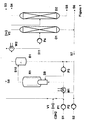
- a continuously operated jet nozzle loop reactor (R 1) is fed with 0.8 mol / h of liquid methyldichlorosilane (S 1) via the pump (P 1) and the evaporator (W 1) together with fresh acetylene (C 2 H 2 ). Before entering the evaporator, the fresh acetylene is mixed with the acetylene cycle (S 8).
- the reaction temperature is 80 ° C, the pressure 1.5 bar abs. This creates a solvent cycle (S 9) of approx. 80 l / h via the circulation pump (P 3) and before the entry into the jet nozzle (R 1) to about 10 bar abs. compacted.
- the concentration of Vinylmethyldichlorosilane is approximately 15% by weight.
- phase separation (B 1) acetylene and the product mixture consisting of the desired vinylsilane as well as pre and post components from the solvent Cut.
- the solvent enters the solvent circuit (S 9) via the pump (P 3) back.
- the product mixture is condensed in the condenser (W 2) and used as feed (S 11) fed to the distillation column (D 1) via the pump (P 4).
- the excess acetylene reaches the reactor again via the circuit (S 8).
- Via the valve (V 2) System pressure in the reactor (R 1) regulated. Residual gas leaves the system via the Residual gas outlet (S 3).
- the reactor was started up with pure solvent, here mesitylene.
- a conventional, homogeneously dissolved hydrosilylation catalyst based on H 2 PtCl 6 was used as the catalyst.
- the Pt concentration was approx. 3 ppm.
- the catalyst / solvent (S 2) is supplied via the pump (P 2).
- Example 1 In the apparatus according to Example 1, a mixture of 70 mol% Methyldichlorosilane and 30 mol% isopentane used and in the same way as in Example 1 proceed as described.
- the silane metering was 0.8 mol / h and the acetylene stream 1 mol / h. With a silane conversion of 98% a yield could Vinylmethyldichlorosilane of 97% can be achieved.
- Dimethylchlorosilane was used in the apparatus according to Example 1.
- the Silane metering was 1 mol / h
- the acetylene stream was 1.2 mol / h.
- the reaction temperature was 92 ° C. With a silane conversion of 99.8%, selectivity regarding Vinyldimethylchlorosilane of 98% achieved.
Landscapes
- Chemical & Material Sciences (AREA)
- Organic Chemistry (AREA)
- Chemical Kinetics & Catalysis (AREA)
- Engineering & Computer Science (AREA)
- Materials Engineering (AREA)
- Low-Molecular Organic Synthesis Reactions Using Catalysts (AREA)
- Catalysts (AREA)
Claims (28)
- Procédé de préparation de composés organiques du silicium qui contiennent au moins un groupe H2C=CH-Si, par réaction d'un composé organique du silicium qui contient au moins un groupe H-Si, avec l'acétylène en phase gazeuse/liquide en présence d'au moins un catalyseur d'addition et extraction du composé organique du silicium qui contient au moins un groupe H2C=CH-Si, à partir du mélange réactionnel,
caractérisé en ce qu'
on rassemble un composé organique du silicium qui contient au moins un groupe H-Si, de l'acétylène qu'on met en oeuvre en excès, et une phase liquide largement inerte dans un réacteur à écoulement à bulles avec éjecteur, en présence d'un catalyseur le plus intimement et on extrait ultérieurement le composé organosilicique qui contient au moins un groupe H2C=CH-Si du mélange réactionnel et on ramène l'acétylène en excès dans le processus. - Procédé selon la revendication 1,
caractérisé en ce qu'
on ramène le composé organique du silicium qui contient au moins un groupe H-Si avec l'acétylène et/ou avec la phase liquide, au réacteur à écoulement à bulles avec éjecteur. - Procédé selon l'une quelconque des revendications 1 ou 2,
caractérisé en ce qu'
on transfère le composé organique du silicium qui contient au moins un groupe H-Si, et l'acétylène avant l'amenée dans le réacteur à écoulement à bulles avec éjecteur, dans un mélange gazeux. - Procédé selon l'une quelconque des revendications 1 à 3,
caractérisé en ce qu'
on préchauffe la phase largement inerte de liquide avant l'amenée dans le réacteur à écoulement à bulles avec éjecteur. - Procédé selon l'une quelconque des revendications 1 à 4,
caractérisé en ce qu'
on met en fonctionnement le réacteur à écoulement à bulles avec éjecteur à une température dans la plage comprise entre 50 et 200°C, de préférence entre 70 et 140°C. - Procédé selon l'une quelconque des revendications 1 à 5,
caractérisé en ce qu'
on amène l'acétylène au processus à une pression de fonctionnement entre > 1 bar abs. et ≤ 1,4 bar abs., au processus. - Procédé selon l'une quelconque des revendications 1 à 6,
caractérisé en ce qu'
on met en fonctionnement le réacteur à écoulement à bulles avec éjecteur, à une pression du système comprise entre > 1 bar abs. et la pression autorisée au maximum pour l'acétylène selon les règles techniques connues à la température ambiante, de préférence entre 1 et 3 bars abs. - Procédé selon l'une quelconque des revendications 1 à 7,
caractérisé en ce qu'
on met en oeuvre comme phase liquide, un solvant ou un mélange de solvants largement inerte. - Procédé selon la revendication 8,
caractérisé en ce que
le solvant respectif dans la phase liquide possède un point d'ébullition plus élevé que le composé organique du silicium qui est extrait du mélange réactionnel et qui contient au moins un groupe H2C=CH-Si. - Procédé selon l'une quelconque des revendications 8 ou 9,
caractérisé en ce qu'
on met en oeuvre comme solvant, du mésitylène. - Procédé selon l'une quelconque des revendications 8 à 10,
caractérisé en ce qu'
on met en oeuvre comme solvant des huiles caloporteuses, de préférence le trinitrotoluène. - Procédé selon l'une quelconque des revendications 1 à 11,
caractérisé en ce qu'
on met en oeuvre un catalyseur homogène. - Procédé selon la revendication 12,
caractérisé en ce qu'
on dissout le catalyseur homogène dans la phase liquide. - Procédé selon l'une quelconque des revendications 1 à 11,
caractérisé en ce qu'
on met en oeuvre un catalyseur hétérogène. - Procédé selon la revendication 14,
caractérisé en ce qu'
on dispose le catalyseur hétérogène dans le réacteur à écoulement à bulles avec éjecteur. - Procédé selon l'une quelconque des revendications 1 à 15,
caractérisé en ce qu'
on met en oeuvre un catalyseur contenant du platine. - Procédé selon l'une quelconque des revendications 1 à 16,
caractérisé en ce qu'
on met en oeuvre comme composé organique du silicium, un composé qui contient au moins un groupe H-Si, un hydrogénosilane de formule générale I,- R :
- est un alkyle ayant de 1 à 8 atomes de carbone, un groupe halogénoalkyle, ainsi qu'un groupe aryle dans lesquels R est identique ou différent,
- X :
- est Cl-, OH-, un groupe alkoxy ayant de 1 à 4 atomes de carbone,
- Y :
- est -((CH2)d Si R2')c (CH2)d Si R3' avec R' = H, R ainsi que X, dans laquelle R' est identique ou différent et d est = 1, 2, 3 ou 4 et e = 0, 1, ou 2
- a:
- est 0, 1 , 2 ou 3
- b:
- est O, 1, 2 ou 3 et
- c:
- est 0 ou 1 (dans lesquels a + b + c est ≤ 3) ou un hydrogénosiloxane de formule générale
- R :
- est un groupe alkyle ayant de 1 à 8 atomes de carbone, un groupe halogénoalkyle, ainsi qu'un groupe aryle dans lesquels R est identique ou différent,
- X :
- est Cl-, OH-, un groupe alkoxy ayant de 1 à 4 atomes de carbone,
- Y :
- est (-O-Si R'2)f-O-Si R'3, avec R': H, R ainsi que X, dans lesquels R' est identique ou différent et f = 1, 2, 3, 4 ou 5 et
- a :
- est 0, 1, ou 2
- b :
- est O, 1 ou 2 pour lesquels (a+b) ≤ 2
- X :
- est Cl-, OH-, un groupe alkoxy ayant de 1 à 4 atomes de carbone,
- q :
- est 0 ou 1
- r :
- est 0 ou 1 pour lesquels (q+r) est ≤ 1
- s :
- est 3 ou 4.
- Procédé selon l'une quelconque des revendications 1 à 17,
caractérisé en ce qu'
on met en oeuvre comme composé organique du silicium un éduit contenant essentiellement du méthyldichlorosilane, ou du diméthylchlorosilane ou leurs mélanges ou du dichlorosilane ou du tétraméthyldisiloxane. - Procédé selon l'une quelconque des revendications 1 à 18,
caractérisé en ce qu'
on met en oeuvre le composé organique du silicium qui contient au moins un groupe H-Si, avec une pureté de 10 à 100 %. - Procédé selon l'une quelconque des revendications 1 à 19,
caractérisé en ce qu'
on ajuste le rapport molaire de l'acétylène au composé organique du silicium respectif qui contient au moins un groupe H-Si, à une valeur comprise entre 1,5:1 et 20:1. - Procédé selon l'une quelconque des revendications 1 à 20,
caractérisé en ce qu'
on effectue le traitement du mélange réactionnel par distillation pour l'extraction du composé organique du silicium contenant au moins un groupe H2C = Si et la phase liquide qui se produit de cette manière dans le pot, est recyclée en partie prépondérante dans le processus. - Procédé selon l'une quelconque des revendications 1 à 21,
caractérisé en ce qu'
on effectue le traitement par distillation mono-multiétagée. - Procédé selon l'une quelconque des revendications 1 à 22,
caractérisé en ce qu'
on met en oeuvre pour le traitement par distillation un évaporateur en couche mince et/ou une colonne de distillation. - Procédé selon l'une quelconque des revendications 1 à 23,
caractérisé en ce qu'
on extrait le composé organique du silicium monovinylé. - Procédé selon l'une quelconque des revendications 1 à 24,
caractérisé en ce qu'
on extrait le composé organique du silicium divinylé. - Procédé selon l'une quelconque des revendications 1 à 25,
caractérisé en ce qu'
on extrait un composé organique du silicium plusieurs fois vinylé. - Procédé selon l'une quelconque des revendications 1 à 26,
caractérisé en ce qu'
on effectue le traitement du mélange réactionnel sous pression réduite. - Procédé selon l'une quelconque des revendications 1 à 27,
caractérisé en ce qu'
on conduit le procédé en continu.
Applications Claiming Priority (2)
| Application Number | Priority Date | Filing Date | Title |
|---|---|---|---|
| DE19619138 | 1996-05-11 | ||
| DE19619138A DE19619138C2 (de) | 1996-05-11 | 1996-05-11 | Verfahren zur Herstellung von vinylierten Silicium-organischen Verbindungen |
Publications (3)
| Publication Number | Publication Date |
|---|---|
| EP0806427A2 EP0806427A2 (fr) | 1997-11-12 |
| EP0806427A3 EP0806427A3 (fr) | 1999-10-27 |
| EP0806427B1 true EP0806427B1 (fr) | 2003-02-19 |
Family
ID=7794113
Family Applications (1)
| Application Number | Title | Priority Date | Filing Date |
|---|---|---|---|
| EP97104745A Expired - Lifetime EP0806427B1 (fr) | 1996-05-11 | 1997-03-20 | Procédé pour la préparation de composés organosiliciques à fonction vinylique |
Country Status (8)
| Country | Link |
|---|---|
| US (1) | US5929269A (fr) |
| EP (1) | EP0806427B1 (fr) |
| JP (1) | JPH1059982A (fr) |
| KR (1) | KR970074785A (fr) |
| CN (1) | CN1170723A (fr) |
| DE (2) | DE19619138C2 (fr) |
| ES (1) | ES2189900T3 (fr) |
| TW (1) | TW467916B (fr) |
Families Citing this family (10)
| Publication number | Priority date | Publication date | Assignee | Title |
|---|---|---|---|---|
| GB9502342D0 (en) * | 1995-02-07 | 1995-03-29 | Exxon Chemical Patents Inc | Hydrocarbon treatment and catalyst therefor |
| DE19859759C1 (de) * | 1998-12-23 | 2000-06-29 | Goldschmidt Ag Th | Verfahren und Vorrichtung zur Durchführung kontinuierlicher Hydrosilylierungsreaktionen |
| WO2010002443A1 (fr) * | 2008-07-01 | 2010-01-07 | Momentive Performance Materials, Inc. | Procédé d'hydrosilylation d'hydrocarbures insaturés gazeux |
| DE102010043996A1 (de) * | 2010-11-16 | 2012-05-16 | Wacker Chemie Ag | Verfahren zur Herstellung alkoxysubstituierter 1,2-Bis-Silyl-Ethane |
| CN103183701B (zh) * | 2011-12-30 | 2016-02-03 | 浙江新安化工集团股份有限公司 | 乙烯基含氯硅烷的制备方法 |
| US8987494B2 (en) * | 2012-04-11 | 2015-03-24 | Gelest Technologies, Inc. | Low molecular weight carbosilanes, precursors thereof, and methods of preparation |
| CN103570756A (zh) * | 2012-08-07 | 2014-02-12 | 山东万达有机硅新材料有限公司 | 一种制备乙烯基三氯硅烷化合物的方法 |
| CN102875585B (zh) * | 2012-10-17 | 2015-09-02 | 嘉兴联合化学有限公司 | 一种制备四甲基二乙烯基二硅氧烷的方法 |
| CN103113399B (zh) * | 2013-03-08 | 2015-12-23 | 嘉兴学院 | 一种制备二甲基乙烯基氯硅烷的方法 |
| WO2023222245A1 (fr) | 2022-05-20 | 2023-11-23 | Wacker Chemie Ag | Procédé de production de composes organosiliciés |
Family Cites Families (11)
| Publication number | Priority date | Publication date | Assignee | Title |
|---|---|---|---|---|
| US2851473A (en) * | 1955-12-23 | 1958-09-09 | Union Carbide Corp | Processes for the reaction of silanic hydrogen-bonded compounds with unsaturated hydrocarbons |
| NL132148C (fr) * | 1963-12-18 | |||
| DE2131742C3 (de) * | 1971-06-25 | 1974-11-14 | Wacker-Chemie Gmbh, 8000 Muenchen | Verfahren zur Herstellung von Alkenylsilanen |
| JPS5935591B2 (ja) * | 1978-03-10 | 1984-08-29 | 田辺製薬株式会社 | グルタチオンの製造法 |
| DE2851456C2 (de) * | 1978-11-28 | 1982-09-23 | Wacker-Chemie GmbH, 8000 München | Verfahren zur Herstellung von Organosiliciumverbindungen |
| JPS606358B2 (ja) * | 1979-09-25 | 1985-02-18 | 信越化学工業株式会社 | アルケニルハロシランの製造方法 |
| EP0346771B1 (fr) * | 1988-06-17 | 1994-10-26 | Norton Company | Procédé d'obtention d'un matériau composite, particulièrement une matrice métallique avec une dispersion céramique |
| JPH0314592A (ja) * | 1989-06-09 | 1991-01-23 | Toshiba Silicone Co Ltd | 有機ケイ素化合物およびその製造方法 |
| JPH0314590A (ja) * | 1989-06-09 | 1991-01-23 | Toshiba Silicone Co Ltd | 不飽和基含有有機ケイ素化合物およびその製造方法 |
| US4898961A (en) * | 1989-07-17 | 1990-02-06 | Dow Corning Corporation | Method for preparing alkenylsilanes |
| JP2676001B2 (ja) * | 1990-03-08 | 1997-11-12 | 工業技術院長 | 1,2―ビスシリルエチレン誘導体の製造方法 |
-
1996
- 1996-05-11 DE DE19619138A patent/DE19619138C2/de not_active Expired - Fee Related
-
1997
- 1997-03-20 ES ES97104745T patent/ES2189900T3/es not_active Expired - Lifetime
- 1997-03-20 EP EP97104745A patent/EP0806427B1/fr not_active Expired - Lifetime
- 1997-03-20 DE DE59709326T patent/DE59709326D1/de not_active Expired - Lifetime
- 1997-05-08 TW TW086106116A patent/TW467916B/zh not_active IP Right Cessation
- 1997-05-08 JP JP9117338A patent/JPH1059982A/ja active Pending
- 1997-05-09 KR KR1019970017762A patent/KR970074785A/ko not_active Ceased
- 1997-05-09 US US08/853,452 patent/US5929269A/en not_active Expired - Lifetime
- 1997-05-09 CN CN97113516A patent/CN1170723A/zh active Pending
Also Published As
| Publication number | Publication date |
|---|---|
| JPH1059982A (ja) | 1998-03-03 |
| CN1170723A (zh) | 1998-01-21 |
| ES2189900T3 (es) | 2003-07-16 |
| KR970074785A (ko) | 1997-12-10 |
| DE59709326D1 (de) | 2003-03-27 |
| DE19619138C2 (de) | 2002-04-18 |
| EP0806427A2 (fr) | 1997-11-12 |
| TW467916B (en) | 2001-12-11 |
| EP0806427A3 (fr) | 1999-10-27 |
| US5929269A (en) | 1999-07-27 |
| DE19619138A1 (de) | 1997-11-13 |
Similar Documents
| Publication | Publication Date | Title |
|---|---|---|
| DE69416236T2 (de) | Verfahren zur Herstellung von Isocyanatoorganosilanen | |
| EP0032376B1 (fr) | Procédé pour la préparation en continu de silanes ou polysiloxanes contenant un groupement SiOC | |
| EP1245271A2 (fr) | Appareil et procédé pour préparer trialkoxysilanes practiquement exempts de chlore | |
| EP0167924B1 (fr) | Procédé et dispositif pour la fabrication en continu d'alkoxypolysiloxanes | |
| EP0806427B1 (fr) | Procédé pour la préparation de composés organosiliciques à fonction vinylique | |
| DE69819948T2 (de) | Verfahren zur Herstellung von Monosilanen | |
| DE2908249A1 (de) | Verfahren zur herstellung von octamethylcyclotetrasiloxan | |
| DE102010043646A1 (de) | Verfahren zur Herstellung von Trichlorsilan | |
| DE10336545B3 (de) | Verfahren zur Herstellung von Chlorsilanen | |
| DE1289842B (de) | Verfahren zur Spaltung von Disilanen | |
| EP0601479A1 (fr) | Procédé pour l'élimination de hydrosilanes de méthylchloresilanes | |
| EP2550281B1 (fr) | Derives cyclique sila-oxa | |
| DE69323687T2 (de) | Methode und Vorrichtung zur Herstellung von 3-[N-(2-Aminoethyl)]aminopropylalkoxysilan | |
| DE3702631C2 (de) | Verfahren zur Herstellung primärer Aminosiloxane | |
| EP0823434A1 (fr) | Procédé pour la préparation continue de propyl-3 halogènes organosilanes | |
| EP0082969B1 (fr) | Procédé de scission d'organosiloxanes | |
| EP0031436B1 (fr) | Procédé de dissociation de siloxanes | |
| EP0601578B1 (fr) | Procédé pour l'élimination des hydrosilanes dans les silanes | |
| WO2016091240A1 (fr) | Procédé pour la production d'hexachlorodisilane à partir de mélanges de chlorosilanes contenus dans des flux d'effluents gazeux de procédé | |
| DE69907511T2 (de) | Verfahren zur herstellung von alkylwasserstoffhalosilanen mittels katalytischer hydrierung | |
| EP1103556B1 (fr) | Procédé de préparation de composés de 1,2-disilaethane halogénées | |
| DE2533400C3 (de) | Verfahren zur Herstellung von Dichlorsilan und Phenyltrichlorsilan | |
| DE2141881A1 (de) | Verfahren zur Herstellung von Chlor silanen aus Disiloxanen | |
| EP1732936B1 (fr) | Procede de separation de chlorure d'aluminium de silanes organochlores | |
| DE3882866T2 (de) | Entfernung von Olefinen von Organohalosilanen. |
Legal Events
| Date | Code | Title | Description |
|---|---|---|---|
| PUAI | Public reference made under article 153(3) epc to a published international application that has entered the european phase |
Free format text: ORIGINAL CODE: 0009012 |
|
| AK | Designated contracting states |
Kind code of ref document: A2 Designated state(s): BE CH DE ES FR GB IT LI NL |
|
| PUAL | Search report despatched |
Free format text: ORIGINAL CODE: 0009013 |
|
| RAP1 | Party data changed (applicant data changed or rights of an application transferred) |
Owner name: DEGUSSA-HUELS AKTIENGESELLSCHAFT |
|
| AK | Designated contracting states |
Kind code of ref document: A3 Designated state(s): BE CH DE ES FR GB IT LI NL |
|
| 17P | Request for examination filed |
Effective date: 20000330 |
|
| RAP1 | Party data changed (applicant data changed or rights of an application transferred) |
Owner name: DEGUSSA AG |
|
| 17Q | First examination report despatched |
Effective date: 20010530 |
|
| GRAG | Despatch of communication of intention to grant |
Free format text: ORIGINAL CODE: EPIDOS AGRA |
|
| GRAG | Despatch of communication of intention to grant |
Free format text: ORIGINAL CODE: EPIDOS AGRA |
|
| GRAH | Despatch of communication of intention to grant a patent |
Free format text: ORIGINAL CODE: EPIDOS IGRA |
|
| GRAH | Despatch of communication of intention to grant a patent |
Free format text: ORIGINAL CODE: EPIDOS IGRA |
|
| GRAA | (expected) grant |
Free format text: ORIGINAL CODE: 0009210 |
|
| AK | Designated contracting states |
Designated state(s): BE CH DE ES FR GB IT LI NL |
|
| PG25 | Lapsed in a contracting state [announced via postgrant information from national office to epo] |
Ref country code: NL Free format text: LAPSE BECAUSE OF FAILURE TO SUBMIT A TRANSLATION OF THE DESCRIPTION OR TO PAY THE FEE WITHIN THE PRESCRIBED TIME-LIMIT Effective date: 20030219 |
|
| REG | Reference to a national code |
Ref country code: GB Ref legal event code: FG4D Free format text: NOT ENGLISH |
|
| REG | Reference to a national code |
Ref country code: CH Ref legal event code: EP |
|
| PG25 | Lapsed in a contracting state [announced via postgrant information from national office to epo] |
Ref country code: ES Free format text: LAPSE BECAUSE OF NON-PAYMENT OF DUE FEES Effective date: 20030321 |
|
| REF | Corresponds to: |
Ref document number: 59709326 Country of ref document: DE Date of ref document: 20030327 Kind code of ref document: P |
|
| PG25 | Lapsed in a contracting state [announced via postgrant information from national office to epo] |
Ref country code: LI Free format text: LAPSE BECAUSE OF NON-PAYMENT OF DUE FEES Effective date: 20030331 Ref country code: CH Free format text: LAPSE BECAUSE OF NON-PAYMENT OF DUE FEES Effective date: 20030331 Ref country code: BE Free format text: LAPSE BECAUSE OF NON-PAYMENT OF DUE FEES Effective date: 20030331 |
|
| GBT | Gb: translation of ep patent filed (gb section 77(6)(a)/1977) |
Effective date: 20030327 |
|
| PG25 | Lapsed in a contracting state [announced via postgrant information from national office to epo] |
Ref country code: GB Free format text: LAPSE BECAUSE OF NON-PAYMENT OF DUE FEES Effective date: 20030519 |
|
| REG | Reference to a national code |
Ref country code: ES Ref legal event code: FG2A Ref document number: 2189900 Country of ref document: ES Kind code of ref document: T3 |
|
| NLV1 | Nl: lapsed or annulled due to failure to fulfill the requirements of art. 29p and 29m of the patents act | ||
| BERE | Be: lapsed |
Owner name: *DEGUSSA A.G. Effective date: 20030331 |
|
| ET | Fr: translation filed | ||
| REG | Reference to a national code |
Ref country code: CH Ref legal event code: PL |
|
| PLBE | No opposition filed within time limit |
Free format text: ORIGINAL CODE: 0009261 |
|
| STAA | Information on the status of an ep patent application or granted ep patent |
Free format text: STATUS: NO OPPOSITION FILED WITHIN TIME LIMIT |
|
| GBPC | Gb: european patent ceased through non-payment of renewal fee |
Effective date: 20030519 |
|
| 26N | No opposition filed |
Effective date: 20031120 |
|
| REG | Reference to a national code |
Ref country code: ES Ref legal event code: FD2A Effective date: 20030321 |
|
| PG25 | Lapsed in a contracting state [announced via postgrant information from national office to epo] |
Ref country code: IT Free format text: LAPSE BECAUSE OF NON-PAYMENT OF DUE FEES;WARNING: LAPSES OF ITALIAN PATENTS WITH EFFECTIVE DATE BEFORE 2007 MAY HAVE OCCURRED AT ANY TIME BEFORE 2007. THE CORRECT EFFECTIVE DATE MAY BE DIFFERENT FROM THE ONE RECORDED. Effective date: 20050320 |
|
| REG | Reference to a national code |
Ref country code: FR Ref legal event code: ST Effective date: 20080229 |
|
| PG25 | Lapsed in a contracting state [announced via postgrant information from national office to epo] |
Ref country code: FR Free format text: LAPSE BECAUSE OF NON-PAYMENT OF DUE FEES Effective date: 20030331 |
|
| PGFP | Annual fee paid to national office [announced via postgrant information from national office to epo] |
Ref country code: DE Payment date: 20140319 Year of fee payment: 18 |
|
| REG | Reference to a national code |
Ref country code: DE Ref legal event code: R119 Ref document number: 59709326 Country of ref document: DE |
|
| PG25 | Lapsed in a contracting state [announced via postgrant information from national office to epo] |
Ref country code: DE Free format text: LAPSE BECAUSE OF NON-PAYMENT OF DUE FEES Effective date: 20151001 |