EP0806429B1 - Résines époxy résistant aux flammes et agents ignifugeants pour résines époxy - Google Patents
Résines époxy résistant aux flammes et agents ignifugeants pour résines époxy Download PDFInfo
- Publication number
- EP0806429B1 EP0806429B1 EP97250149A EP97250149A EP0806429B1 EP 0806429 B1 EP0806429 B1 EP 0806429B1 EP 97250149 A EP97250149 A EP 97250149A EP 97250149 A EP97250149 A EP 97250149A EP 0806429 B1 EP0806429 B1 EP 0806429B1
- Authority
- EP
- European Patent Office
- Prior art keywords
- epoxy
- radicals
- phosphorus
- epoxy resin
- epoxy resins
- Prior art date
- Legal status (The legal status is an assumption and is not a legal conclusion. Google has not performed a legal analysis and makes no representation as to the accuracy of the status listed.)
- Revoked
Links
- 0 CS(*)(*1)C(*)C(*)C(*)(**)P1=O Chemical compound CS(*)(*1)C(*)C(*)C(*)(**)P1=O 0.000 description 5
- PXBSIGBRXBJHAE-UHFFFAOYSA-N CC1C(CC[O]#C)CCC1 Chemical compound CC1C(CC[O]#C)CCC1 PXBSIGBRXBJHAE-UHFFFAOYSA-N 0.000 description 1
- XAZKFISIRYLAEE-UHFFFAOYSA-N CC1CC(C)CC1 Chemical compound CC1CC(C)CC1 XAZKFISIRYLAEE-UHFFFAOYSA-N 0.000 description 1
- GDOPTJXRTPNYNR-UHFFFAOYSA-N CC1CCCC1 Chemical compound CC1CCCC1 GDOPTJXRTPNYNR-UHFFFAOYSA-N 0.000 description 1
Classifications
-
- C—CHEMISTRY; METALLURGY
- C08—ORGANIC MACROMOLECULAR COMPOUNDS; THEIR PREPARATION OR CHEMICAL WORKING-UP; COMPOSITIONS BASED THEREON
- C08G—MACROMOLECULAR COMPOUNDS OBTAINED OTHERWISE THAN BY REACTIONS ONLY INVOLVING UNSATURATED CARBON-TO-CARBON BONDS
- C08G59/00—Polycondensates containing more than one epoxy group per molecule; Macromolecules obtained by polymerising compounds containing more than one epoxy group per molecule using curing agents or catalysts which react with the epoxy groups
- C08G59/18—Macromolecules obtained by polymerising compounds containing more than one epoxy group per molecule using curing agents or catalysts which react with the epoxy groups ; e.g. general methods of curing
- C08G59/20—Macromolecules obtained by polymerising compounds containing more than one epoxy group per molecule using curing agents or catalysts which react with the epoxy groups ; e.g. general methods of curing characterised by the epoxy compounds used
- C08G59/22—Di-epoxy compounds
- C08G59/30—Di-epoxy compounds containing atoms other than carbon, hydrogen, oxygen and nitrogen
- C08G59/304—Di-epoxy compounds containing atoms other than carbon, hydrogen, oxygen and nitrogen containing phosphorus
-
- C—CHEMISTRY; METALLURGY
- C07—ORGANIC CHEMISTRY
- C07F—ACYCLIC, CARBOCYCLIC OR HETEROCYCLIC COMPOUNDS CONTAINING ELEMENTS OTHER THAN CARBON, HYDROGEN, HALOGEN, OXYGEN, NITROGEN, SULFUR, SELENIUM OR TELLURIUM
- C07F9/00—Compounds containing elements of Groups 5 or 15 of the Periodic Table
- C07F9/02—Phosphorus compounds
- C07F9/547—Heterocyclic compounds, e.g. containing phosphorus as a ring hetero atom
- C07F9/655—Heterocyclic compounds, e.g. containing phosphorus as a ring hetero atom having oxygen atoms, with or without sulfur, selenium, or tellurium atoms, as the only ring hetero atoms
- C07F9/65502—Heterocyclic compounds, e.g. containing phosphorus as a ring hetero atom having oxygen atoms, with or without sulfur, selenium, or tellurium atoms, as the only ring hetero atoms the oxygen atom being part of a three-membered ring
-
- C—CHEMISTRY; METALLURGY
- C07—ORGANIC CHEMISTRY
- C07F—ACYCLIC, CARBOCYCLIC OR HETEROCYCLIC COMPOUNDS CONTAINING ELEMENTS OTHER THAN CARBON, HYDROGEN, HALOGEN, OXYGEN, NITROGEN, SULFUR, SELENIUM OR TELLURIUM
- C07F9/00—Compounds containing elements of Groups 5 or 15 of the Periodic Table
- C07F9/02—Phosphorus compounds
- C07F9/547—Heterocyclic compounds, e.g. containing phosphorus as a ring hetero atom
- C07F9/6564—Heterocyclic compounds, e.g. containing phosphorus as a ring hetero atom having phosphorus atoms, with or without nitrogen, oxygen, sulfur, selenium or tellurium atoms, as ring hetero atoms
- C07F9/6571—Heterocyclic compounds, e.g. containing phosphorus as a ring hetero atom having phosphorus atoms, with or without nitrogen, oxygen, sulfur, selenium or tellurium atoms, as ring hetero atoms having phosphorus and oxygen atoms as the only ring hetero atoms
- C07F9/657163—Heterocyclic compounds, e.g. containing phosphorus as a ring hetero atom having phosphorus atoms, with or without nitrogen, oxygen, sulfur, selenium or tellurium atoms, as ring hetero atoms having phosphorus and oxygen atoms as the only ring hetero atoms the ring phosphorus atom being bound to at least one carbon atom
- C07F9/657172—Heterocyclic compounds, e.g. containing phosphorus as a ring hetero atom having phosphorus atoms, with or without nitrogen, oxygen, sulfur, selenium or tellurium atoms, as ring hetero atoms having phosphorus and oxygen atoms as the only ring hetero atoms the ring phosphorus atom being bound to at least one carbon atom the ring phosphorus atom and one oxygen atom being part of a (thio)phosphinic acid ester: (X = O, S)
-
- C—CHEMISTRY; METALLURGY
- C08—ORGANIC MACROMOLECULAR COMPOUNDS; THEIR PREPARATION OR CHEMICAL WORKING-UP; COMPOSITIONS BASED THEREON
- C08G—MACROMOLECULAR COMPOUNDS OBTAINED OTHERWISE THAN BY REACTIONS ONLY INVOLVING UNSATURATED CARBON-TO-CARBON BONDS
- C08G59/00—Polycondensates containing more than one epoxy group per molecule; Macromolecules obtained by polymerising compounds containing more than one epoxy group per molecule using curing agents or catalysts which react with the epoxy groups
- C08G59/14—Polycondensates modified by chemical after-treatment
- C08G59/1433—Polycondensates modified by chemical after-treatment with organic low-molecular-weight compounds
- C08G59/1488—Polycondensates modified by chemical after-treatment with organic low-molecular-weight compounds containing phosphorus
-
- C—CHEMISTRY; METALLURGY
- C08—ORGANIC MACROMOLECULAR COMPOUNDS; THEIR PREPARATION OR CHEMICAL WORKING-UP; COMPOSITIONS BASED THEREON
- C08K—Use of inorganic or non-macromolecular organic substances as compounding ingredients
- C08K5/00—Use of organic ingredients
- C08K5/49—Phosphorus-containing compounds
- C08K5/51—Phosphorus bound to oxygen
- C08K5/53—Phosphorus bound to oxygen bound to oxygen and to carbon only
- C08K5/5313—Phosphinic compounds, e.g. R2=P(:O)OR'
-
- H—ELECTRICITY
- H05—ELECTRIC TECHNIQUES NOT OTHERWISE PROVIDED FOR
- H05K—PRINTED CIRCUITS; CASINGS OR CONSTRUCTIONAL DETAILS OF ELECTRIC APPARATUS; MANUFACTURE OF ASSEMBLAGES OF ELECTRICAL COMPONENTS
- H05K1/00—Printed circuits
- H05K1/02—Details
- H05K1/03—Use of materials for the substrate
- H05K1/0313—Organic insulating material
- H05K1/032—Organic insulating material consisting of one material
- H05K1/0326—Organic insulating material consisting of one material containing O
Definitions
- the invention relates to flame retardants for epoxy resins and products made therefrom as well as for compositions, which contain epoxy compounds.
- the invention relates to new compounds and compositions, which are suitable for the stated purpose, and a method of making the compositions.
- the invention relates to flame-retardant epoxy resins and their use.
- Epoxy resins or epoxy resin systems are nowadays in used in a wide variety of areas of application, since they have a broad, individually adaptable range of properties and very good mechanical after curing and have chemical characteristics. Be like that Epoxy resin systems in paints and coatings, in bonds the most varied of materials, in form and casting compounds, for the production of composite materials (and their preliminary stage, the prepregs) and many more Areas used.
- Flame retardants such as aluminum oxide hydrates, basic Aluminum carbonates, magnesium hydroxides, various borates and phosphates, which the epoxy resin systems as not reactive additive can be added.
- Reactive systems are especially halogen compounds, especially brominated aromatics, die (often using antimony compounds as synergists) chemically before or during curing integrated into the three-dimensional network of the epoxy system will.
- DE 26 52 007 A1 discloses phosphorus-containing epoxy resins, Process for their production and their use for Flame retardant equipment. In the manufacturing process the epoxy resin reacted with a phospholane.
- Epoxy resin which is made up of structural units which are derived from (a) polyepoxide compounds with at least two epoxy groups per molecule and (b) at least one compound selected from the group Phosphinic acids, phosphonic acids, pyrophosphonic acids and Phosphonic acid half-esters.
- the phosphinic acids are dialkylphosphinic acids, preferably with 1-6 carbon atoms in the alkyl radical, alkylarylphosphinic acids or diarylphosphinic acids.
- Phosphinic acids mentioned by way of example are dimethylphosphinic acid, Methylethylphosphinic acid, diethylphosphinic acid, Dipropylphosphinic acid, ethylphenylphosphinic acid and diphenylphosphinic acid.
- JP 60 248 728 discloses flame-retardant polyesters which are produced by polycondensation of ethylene glycol terephthalate with P -phenyl derivatives of 9,10-dihydro-9-oxa-10-phosphaphenanthrene-10-oxide.
- the P -phenyl units are substituted with groups that can react with polyesters.
- the Japanese laid-open specification JP 60 161 993 relates to Glycidyl propanoate derivatives of phosphine oxides, phosphinic acids and Phosphonic acids, as well as their use as a stabilizer for organic substances, in particular high molecular weight organic substances Substances or as flame retardants and as a basic unit high molecular weight compounds.
- the epoxy group is said to be the groups Activate -P (O) - and -C (O) -.
- a chemical incorporation of a Epoxy group in a resin is not disclosed.
- EP 0 646 587 A1 describes units derived from phosphate Flame retardants for epoxy resins.
- EP 0 675 131 A1 discloses Polyglycidyl ethers derived from phosphane oxides and below their use produced curable flame-retardant epoxy resin compositions.
- epoxy resin mixtures for Manufacture of prepregs and composites without the Difficult to add external flame retardants supply flammable molding materials.
- These epoxy resin mixtures contain an aromatic polyamine as a hardener a phosphorus-modified epoxy resin that consists of structural units which are derived from (a) from Polyepoxy compounds with at least two epoxy groups per molecule and (b) of phosphinic and / or phosphonic anhydrides.
- the DE 43 40 834 A1 relates to phosphorus-modified epoxy resins, Process for their manufacture and their use.
- the epoxy resins contain structural units that are derive (a) from polyepoxide compounds with at least two epoxy groups per molecule and (b) of pyrophosphonic acids and / or phosphonic acid half-esters.
- DT 26 46 218 A1 does not concern epoxy resins, but flame retardant polyester.
- flame retardants are in particular Derivatives of 9,10-dihydro-9-oxa-10-phosphaphenanthrene-10-oxide (hereinafter referred to as DOP) is used.
- the flame retardants are made by the DOP, which optionally substitutes on the benzene nucleus is, with an unsaturated compound with an ester-forming functional group is implemented, or by Esterification with a diol or a carboxylic acid at the same time or after the aforementioned reaction.
- the unsaturated compound is preferably made from dicarboxylic acids, such as maleic acid, fumaric acid, itaconic acid, acrylic acid, Methacrylic acid, mesaconic acid, citraconic acid, glutaconic acid etc., or their anhydrides and esters. Particularly itaconic acid or lower alkyl esters are preferred or the anhydride of itaconic acid.
- dicarboxylic acids such as maleic acid, fumaric acid, itaconic acid, acrylic acid, Methacrylic acid, mesaconic acid, citraconic acid, glutaconic acid etc.
- itaconic acid or lower alkyl esters are preferred or the anhydride of itaconic acid.
- the object of the invention is to provide new To create compounds and compositions that are suitable for are suitable for the stated purpose.
- To the task also includes the creation of a method of manufacture of the new compositions.
- the task also includes in addition to the new compounds and compositions too compounds known as such for use as To propose flame retardants for epoxy resin systems.
- the task concerns new, flame-retardant epoxy resins, their use and products made from them.
- the task is defined by the independent claims designated embodiments of the invention solved. Particularly preferred embodiments result from the dependent claims.
- a particular advantage of the flame retardant finish according to the invention consists in their universal applicability, i.e. their usability in completely different Areas of application such as composites (composite materials), PCBs, casting compounds, molding materials, adhesives, Paints, coatings, etc.
- Usual standard hardeners can in combination with the flame retardant finish according to the invention be used. Perfect miscibility of the flame retardants according to the invention with epoxy resin systems is given so that the flame retardant equipment The requirements of the respective application can be adapted can and an optimal processability is guaranteed.
- the ring-opened acid form is obtained by splitting off Water converted into the cyclic ester form. It stands the cyclic ester form in equilibrium with the ring-opened Acid form. This equilibrium can be thermal to be influenced. Both the cyclic and the ring-opened Form, as well as the mixture of both, in each possible ratio, can according to the invention for flame retardant finishing are used by epoxy resin systems.
- the radicals R 1 to R 8 are preferably hydrocarbon radicals which are part of cyclic, aliphatic or aromatic systems. In particular, these are five or six rings. Heterocyclic and / or polynuclear compounds can also be used to achieve the flame-retardant properties.
- the epoxy compounds in excess with the ring-opened and / or ring-closed Phosphorus compound reacted so that as a product an epoxy-functional, phosphorus-containing compound is formed.
- Mixtures of ring-open and ring-closed can also be used Phosphorus compound, its epoxy-functionalized Reaction products and unreacted reagent are present. Multiple reagents can also be used as can the pure reaction products or the above further additives were added to the mixtures described e.g. reactive thinner for setting a certain viscosity or surfactants as wetting aids.
- the invention also relates to production or use of intermediates resulting from the previously phosphorus-containing compounds described for the flame-retardant finishing of epoxy resins. This can be an advantage when implementing further with an epoxy functional compound such as a Bisphenol-A resin, should be precisely controlled.
- the epoxy-functional derivative according to the invention preferably has a phosphorus content of 2 to 16% by weight. With this phosphorus content, the derivative is a particularly effective flame retardant.
- the phosphorus content can be adjusted within the stated range by suitable selection of the radicals R 1 to R 8. For example, the greater the total number of carbon atoms in the radicals R 1 to R 8 , the smaller the relative contribution of phosphorus from the phosphinic acid group to the molecular weight. On the other hand, the phosphorus content can be increased in that one of the radicals R 1 to R 8 contains phosphorus as a heteroatom.
- the phosphorus content should in particular be 2 to 10% by weight and most preferably 3 to 8% by weight.
- R 1 to R 8 together contain 6 to 100 carbon atoms.
- a derivative of 4-hydroxybutane-1-phosphinic acid or its intramolecular ester which is particularly preferred according to the invention is characterized in that the ester form corresponds to the following formula: in which R 9 has the meaning given and the radicals R 10 are independently hydrogen, halogen or a hydrocarbon group which optionally contains one or more heteroatoms selected from oxygen, nitrogen, sulfur, phosphorus, silicon and halogen, it being possible for two or more of the radicals R 10 to be linked to form rings .
- the radical R 9 has at least one epoxy function.
- any radicals which have at least one epoxy function can be used.
- the radicals R 9 can be based on aliphatic, alicyclic or aromatic hydrocarbons, combinations such as alkylaryl or arylalkyl radicals also having to be considered.
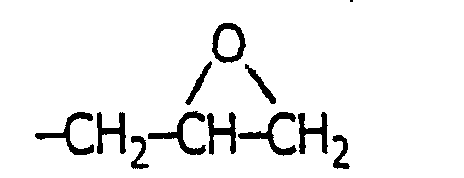
- the radical R 9 is preferably derived from epichlorohydrin or the adduct of bisphenol A and epichlorohydrin. In these cases, R 9 corresponds to the following formulas:
- the radical R 9 can also be derived from the adduct of bisphenol F and epichlorohydrin. There is also an adduct that is derived from a mixture of bisphenol-A and bisphenol-F and epichlorohydrin.
- As component a) is preferably a derivative with a Phosphorus content of 4 to 29 wt .-%, in particular 5 to 12 wt%, most preferably 6 to 10 wt% used.
- reaction product obtained composition has a phosphorus content of 2 to 16% by weight.
- a derivative is preferably used as component a) in which the radicals R 1 to R 8 together contain 6 to 100 carbon atoms.
- Such Compositions can, for example, as a product the respective ring-opened or ring-closed phosphorus compound mixed with the epoxy-functionalized Phosphorus compound and the unreacted reagent, e.g. a bisphenol-A resin.
- the product can also the ring-open and the ring-closed Phosphorus compound both in monosubstituted and are in disubstituted form.
- a derivative of 4-hydroxy-butane-1-phosphinic acid or its intramolecular ester is used in the process for producing the composition, the ester form of which corresponds to the following formula: in which the radicals R 10 have the meaning given above.
- the invention relates to what has been described above Manufacturing processes, as well as the compositions that are obtainable according to this procedure. Further concerns the invention the use of these compositions as Flame retardants for epoxy resins in uncrosslinked, partially reticulated or reticulated shape, for using products made from epoxy resins, and for Compositions containing low molecular weight epoxy compounds contain and consist of these, such as, in particular, reactive thinners.
- the derivative used in the present invention preferably has a phosphorus content of 2 to 16% by weight, in particular of 2 to 10% by weight and most preferably from 3 to 8% by weight.
- a derivative is preferably used in which the radicals R 1 to R 8 together contain 6 to 100 carbon atoms.
- the invention relates to flame retardant epoxy resins. It extends to both uncrosslinked or partially crosslinked flame retardant epoxy resins as well as under crosslinking and curing obtained flame-retardant epoxy resin products.
- the flameproof Epoxy resins can using the invention Flame retardants are produced.
- the flame-retardant epoxy resin according to the invention preferably contains 2 to 7% by weight of phosphorus in the resin composition. Included is under "resin mass" only the total weight of the used Understand epoxy resin and flame retardants. Further any components used such as hardener, filler or fiberglass mat remain in the determination of the Phosphorus content out of consideration.
- An advantage of the invention flame-retardant epoxy resins can be seen in it, that they are using a reactive flame retardant have been manufactured. At least part of the reactive flame retardant reacts with the epoxy resin and / or any hardener used. It is According to the invention, it is preferred that at least 50% by weight of the Phosphorus content chemically bound into the epoxy resin are.
- the flame-retardant epoxy resin according to the invention can also be defined directly via a structural feature.
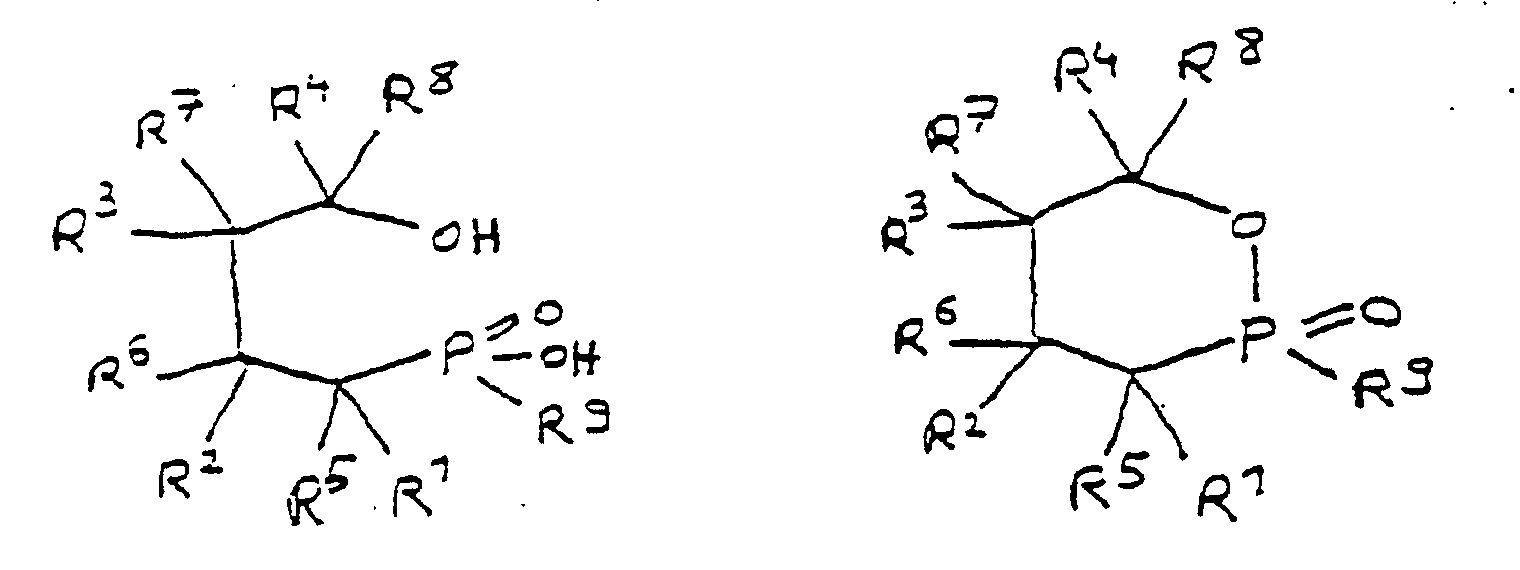
- the epoxy resin is characterized in that, as part of its uncrosslinked, partially crosslinked or crosslinked structure, it has units which are derived from 4-hydroxy-butane-1-phosphinic acid and / or its intramolecular ester and are bonded via their phosphorus atom, the units following formulas correspond, in which R 1 to R 8 are independently hydrogen or a hydrocarbon group which optionally contains one or more heteroatoms selected from oxygen, nitrogen, sulfur, phosphorus, silicon or halogen, two or more of the radicals R 1 to R 8 under Formation of cycles can be linked.
- radicals R 1 to R 4 in the units are hydrogen.
- radicals R 1 to R 8 together contain 6 to 100 carbon atoms.
- the epoxy resin 2 to 7% by weight of phosphorus in the resin composition with below Resin mass is the total weight of resin used and Flame retardants without considering other components such as hardener, filler or fiberglass mat is.
- the flame-retardant epoxy resin is characterized in that it has units which are derived from 4-hydroxy-butan-1-phosphinic acid and / or its intramolecular ester, the ester form corresponding to the units of the following formula in which the radicals R 10 have the meaning given above.
- All embodiments of the invention relate to derivatives of 4-hydroxy-butane-1-phosphinic acid and / or its intramolecular ester, the radicals R 1 to R 8 being present in all formulas, which independently of one another denote hydrogen or a hydrocarbon group.
- the hydrocarbons can be linear or branched alkyl groups, cycloalkyl groups, aryl groups, alkylaryl groups or arylalkyl groups, combinations of the abovementioned possibilities also being considered.
- the hydrocarbon groups can be linked to one another to form saturated and unsaturated rings, five-membered and six-membered rings being preferred. Linking to benzene nuclei with the inclusion of the basic structure is particularly preferred.
- the radicals R 5 to R 8 if present, are normally hydrogen.
- the phosphorus compound used was 9,10-dihydro-9-oxa-10-phospanthrene-10-oxide used in the ring-opened form (Melting point approx. 95 ° C), referred to here as DOP 95.
- Example 3 The procedure was as in Example 3), but with the following Differentiated: The temperature of the bisphenol A standard resin was 160 ° C, and 0.04% of a catalyst was also added added to control the reaction. after the the entire amount of DOP 118 was added in portions, was stirred for a further two hours at 160 ° C to to get a complete implementation. After cooling down a solid, transparent resin was present. The epoxy equivalent weight was found to be 720, the softening point was 79 ° C.
- the resin was made with the appropriate stoichiometric Amounts of a) MHHPSA, b) triethylenetetramine and c) dicyandiamide 2 hours each at 140 ° C (in case c) at 170 ° C) hardened. All cast bodies fulfilled regardless of Hardener type and the hardener amount V0 according to UL 94.
- the resulting, highly viscous, slightly cloudy product showed a fixed salary of 86%, an EEW of 720 and a dynamic one Viscosity (25 ° C) of 800 Pa * s.
- Example 4 The procedure was as in Example 4), but one 1: 1 mixture of DGEBA and the triglycidyl ether of trimethylolpropane used instead of the standard resin.
- the product is a clear solid resin with a softening point of 51 ° C and an EEW of 440.
- the EEW of the product was determined to be 320.
- a mixture of 100 g of the product with 150 g of a standard bisphenol A resin was with the stoichiometric amount of a) MHHPSA and b) dicyandiamide cured (2 hours at 140 ° C or 2 hours at 170 ° C).
- the specimens of both Cures fulfilled V0 according to UL 94.
- DOP 118 was first reacted with itaconic acid and through Purified crystallization.
- the conversion product it be called DOP-ITS, is a white powder with a Melting point of 188 ° C.
- test specimens were made produced (curing 2 hours at 140 ° C). These fulfilled in the fire test V1 according to UL94.
- the DOP mentioned in the above examples or its Derivatives substituted on the benzene nucleus can be selected from 2-hydroxybiphenyl or its ring-substituted derivatives and phosphorus trichloride can be synthesized (cf. J.P.-AS 45397/1974).
- the phosphorus content can be lower than that of the invention Flame retardants. This follows from the areas specified above.
- the mechanical properties of the invention Flame retardant epoxies are so good that no noticeable Difference from the properties of corresponding Products can be found that do not use the inventive Flame retardants have been manufactured. However, it can be different if the amount is too large of the flame retardant is used.
Landscapes
- Chemical & Material Sciences (AREA)
- Organic Chemistry (AREA)
- Health & Medical Sciences (AREA)
- Chemical Kinetics & Catalysis (AREA)
- Medicinal Chemistry (AREA)
- Polymers & Plastics (AREA)
- Life Sciences & Earth Sciences (AREA)
- Biochemistry (AREA)
- General Health & Medical Sciences (AREA)
- Molecular Biology (AREA)
- General Chemical & Material Sciences (AREA)
- Epoxy Resins (AREA)
- Compositions Of Macromolecular Compounds (AREA)
- Fireproofing Substances (AREA)
Claims (29)
- Dérivé de l'acide 4-hydroxybutane-1-phosphinique et/ou de son ester intramoléculaire, correspondant aux formules suivantes :

 dans lesquelles R1 à R8 représentent, indépendamment les uns des autres, un atome d'hydrogène ou un groupe hydrocarboné qui contient éventuellement un ou plusieurs hétéroatomes choisis parmi l'oxygène, l'azote, le soufre, le phosphore, le silicium ou un halogène, étant entendu qu'au maximum trois des radicaux R1 à R4 représentent un atome d'hydrogène, et deux ou plus des radicaux R1 à R8 peuvent être liés avec formation de cycles, et R9 est un groupe qui comporte au moins une fonction époxy, R9
 (i) étant un groupe hydrocarboné aliphatique, alicyclique ou aromatique qui comporte au moins une fonction époxy, ou(ii) étant un groupe alkylaryle ou arylalkyle qui comporte au moins une fonction époxy, ou(iii) étant dérivé de l'adduit de bisphénol A et d'épichlorhydrine, correspondant à la formuleou
 (iv) étant dérivé de l'adduit de bisphénol F et d'épichlorhydrine, ou(v) étant dérivé de résines époxy à base de Novolaque et/ou de résines époxy à base de Novolaque/crésol, ou(vi) étant dérivé de diluants réactifs qui contiennent au moins un composé choisi parmi des composés aliphatiques, cycloaliphatiques ou aromatiques à fonction di- à pentaépoxyde, ou(vii) étant dérivé de composés N-glycidyliques à base d'amines ou de polyamines aromatiques ou cycloaliphatiques.
 - Dérivé selon la revendication 1, caractérisé en ce qu'il présente une teneur en phosphore de 2 à 16 % en poids.
- Dérivé selon la revendication 1 ou 2, caractérisé en ce que R1 à R8 contiennent ensemble de 6 à 100 atomes de carbone.
- Dérivé de l'acide 4-hydroxybutane-1-phosphinique et/ou de son ester intramoléculaire selon la revendication 3, caractérisé en ce que la forme ester correspond à la formule suivante :dans laquelle R9 a la signification indiquée, et

les radicaux R10 représentent; indépendamment les uns des autres, un atome d'hydrogène ou d'halogène ou un groupe hydrocarboné qui contient éventuellement un ou plusieurs hétéroatomes choisis parmi l'oxygène, l'azote, le soufre, le phosphore, le silicium et un halogène, deux ou plus de deux des radicaux R10 pouvant être liés avec formation de cycles. - Dérivé selon l'une quelconque des revendications 1 à 4, caractérisé en ce que R9 est dérivé d'épichlorhydrine et correspond à la formule
- Procédé pour la préparation d'une composition à propriétés ignifuges, caractérisé en ce qu'on fait réagiret la composition obtenue en tant que produit de réaction comporte des groupes époxy réactifs, en utilisant comme composant b)a) au moins un dérivé de l'acide 4-hydroxybutane-1-phosphonique et/ou de son ester intramoléculaire correspondant aux formules suivantes :
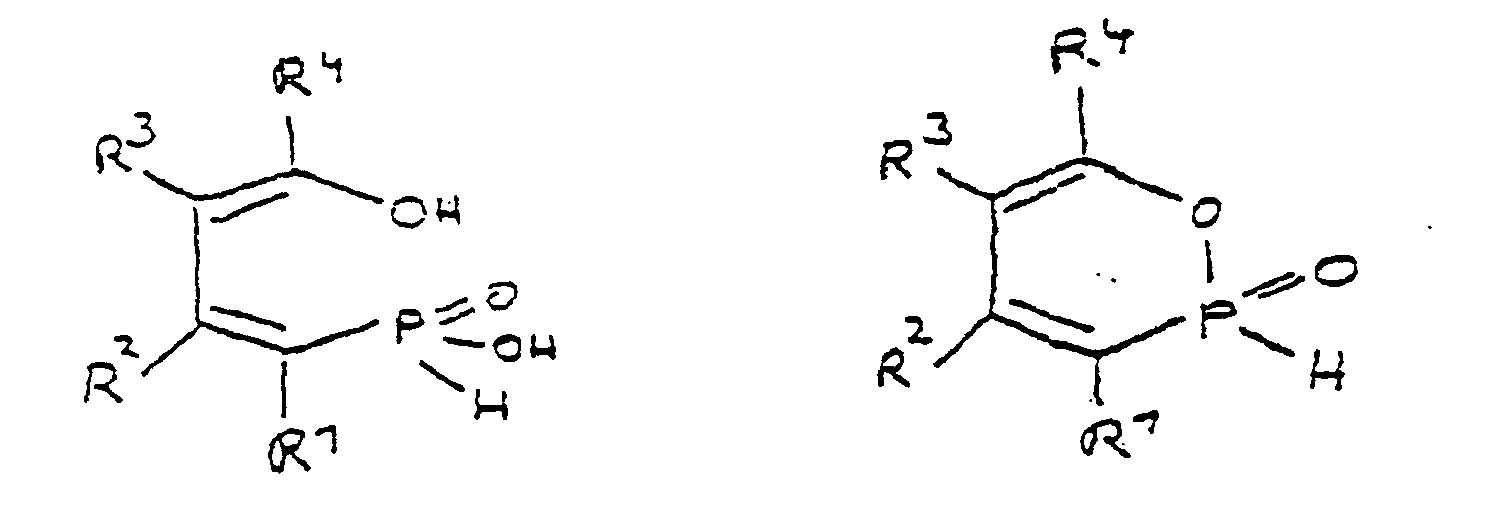
 dans lesquelles R1 à R8 représentent, indépendamment les uns des autres, un atome d'hydrogène ou un groupe hydrocarboné qui contient éventuellement un ou plusieurs hétéroatomes choisis parmi l'oxygène, l'azote, le soufre, le phosphore, le silicium ou un halogène, étant entendu qu'au maximum trois des radicaux R1 à R4 représentent un atome d'hydrogène, deux ou plus de deux des radicaux R1 à R8 pouvant être liés avec formation de cycles, avec
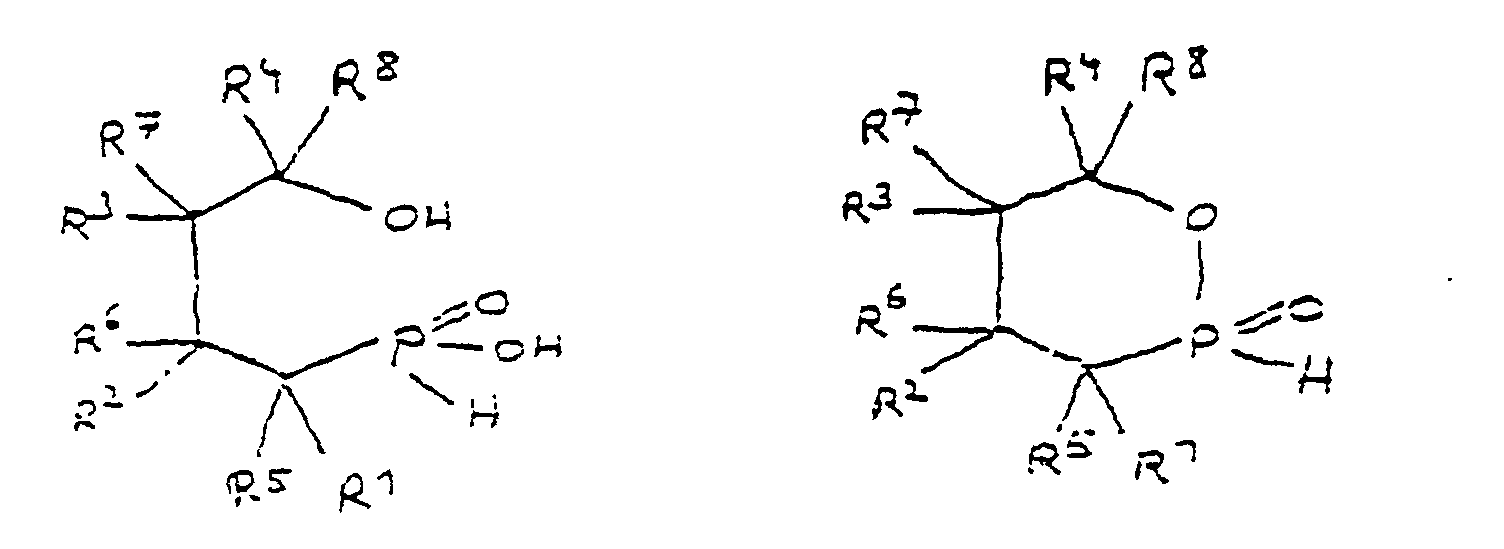 b) au moins un composant qui comporte dans sa molécule au moins un groupe époxy, et est capable de réagir avec le groupe phosphino du dérivé a) avec formation d'une liaison phosphore-carbone,l'épichlorhydrine oul'adduit de bisphénol A et d'épichlorhydrine oul'adduit de bisphénol F et d'épichlorhydrine ouun mélange de l'adduit de bisphénol F et d'épichlorhydrine avec l'adduit de bisphénol A et d'épichlorhydrine oudes résines époxy à base de Novolaque et/ou des résines époxy à base de Novolaque/crésol oudes diluants réactifs qui contiennent au moins un composé choisi parmi des composés aliphatiques, cycloaliphatiques ou aromatiques à fonction di- à pentaépoxy, oudes composés N-glycidyliques à base d'amines ou de polyamines aromatiques ou cycloaliphatiques.
 - Procédé selon la revendication 6, caractérisé en ce qu'on utilise comme composant a) un dérivé ayant une teneur en phosphore de 4 à 29 % en poids.
- Procédé selon la revendication 6 ou 7, caractérisé en ce qu'on prépare un produit de réaction ayant une teneur en phosphore de 2 à 16 % en poids.
- Procédé selon l'une quelconque des revendications 6 à 8, caractérisé en ce qu'on utilise comme composant a) un dérivé dans lequel les radicaux R1 à R8 contiennent ensemble de 6 à 100 atomes de carbone.
- Procédé selon la revendication 9, caractérisé en ce qu'on utilise un dérivé de l'acide 4-hydroxybutane-1-phosphinique et/ou son ester intramoléculaire, dont la forme ester correspond à la formule suivante :dans laquelle les radicaux R10 représentent, indépendamment les uns des autres, un atome d'hydrogène ou d'halogène ou un groupe hydrocarboné qui contient éventuellement un ou plusieurs hétéroatomes choisis parmi l'oxygène, l'azote, le soufre, le phosphore, le silicium et un halogène, deux ou plus de deux des radicaux R10 pouvant être liés avec formation de cycles.

- Composition à propriétés ignifuges, qui comporte des groupes époxy réactifs, pouvant être obtenue par le procédé selon l'une quelconque des revendications 6 à 10.
- Utilisation de la composition selon la revendication 11, en tant qu'agent ignifuge pour (i) des résines époxy sous forme réticulée, partiellement réticulée ou non réticulée, (ii) des produits préparés avec utilisation de résines époxy et (iii) des compositions qui contiennent des composés époxy de faible masse moléculaire ou consistent en ceux-ci, en particulier des diluants réactifs.
- Utilisation de dérivés de l'acide 4-hydroxybutane-1-phosphinique et/ou de son ester intramoléculaire correspondant aux formules suivantes :
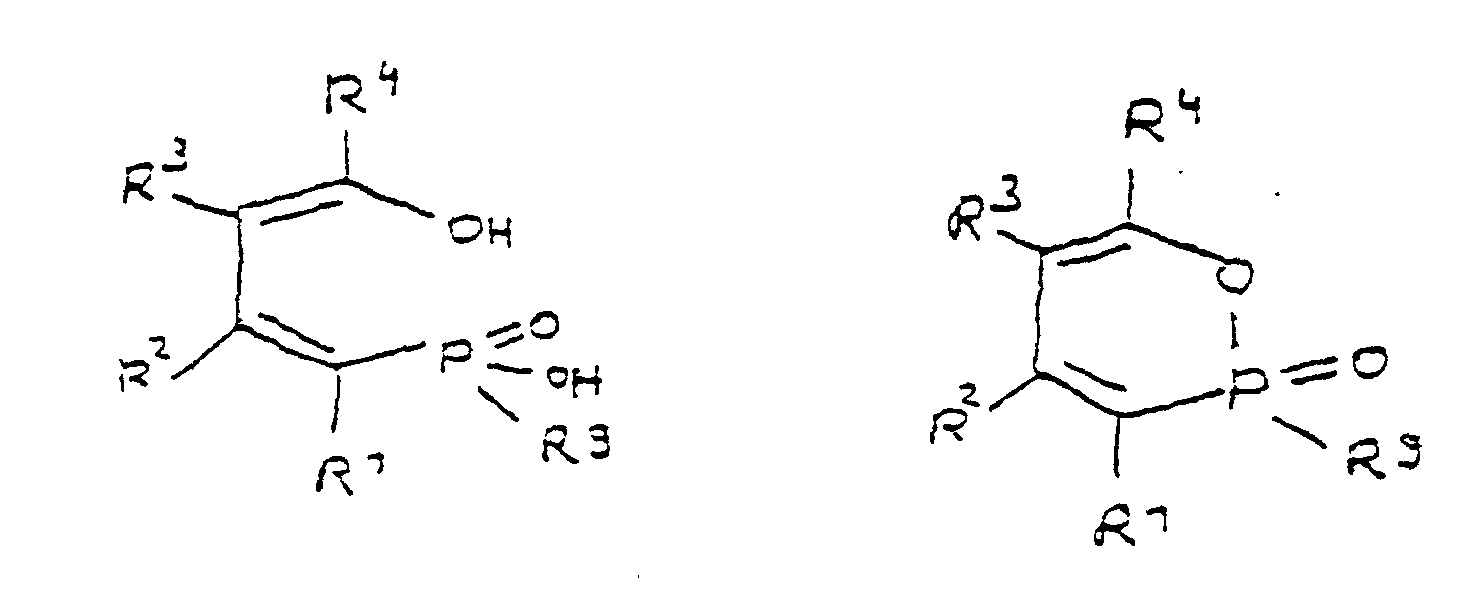
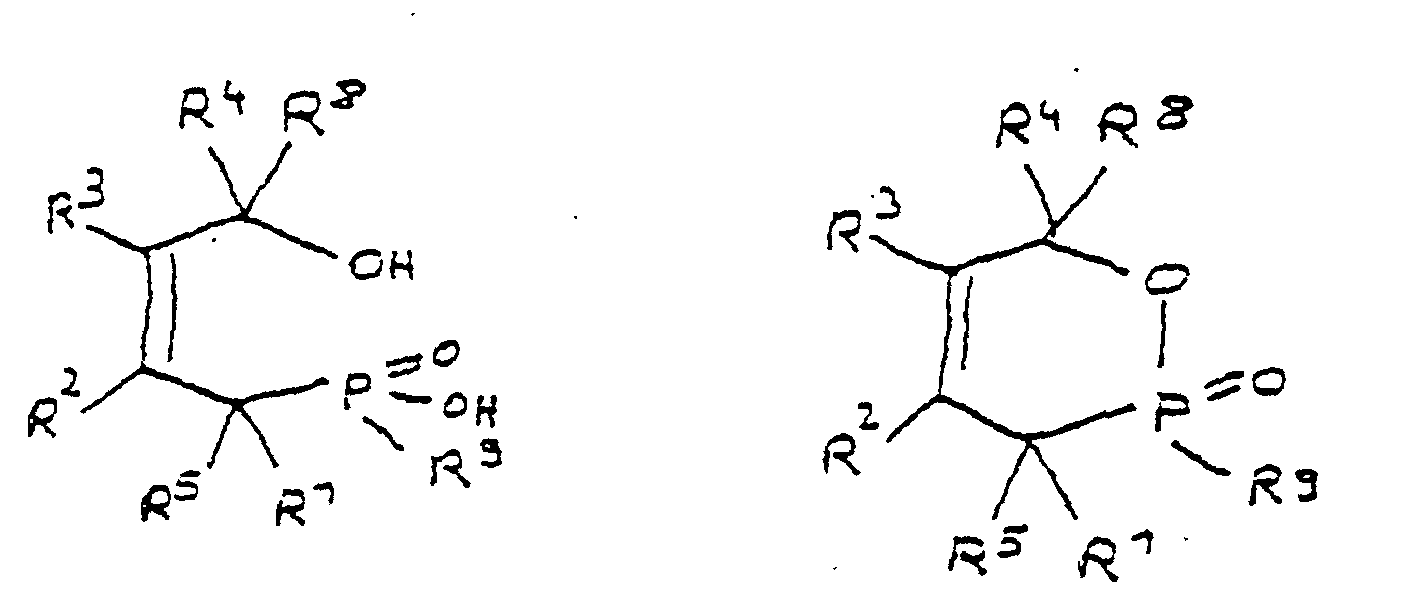 dans lesquelles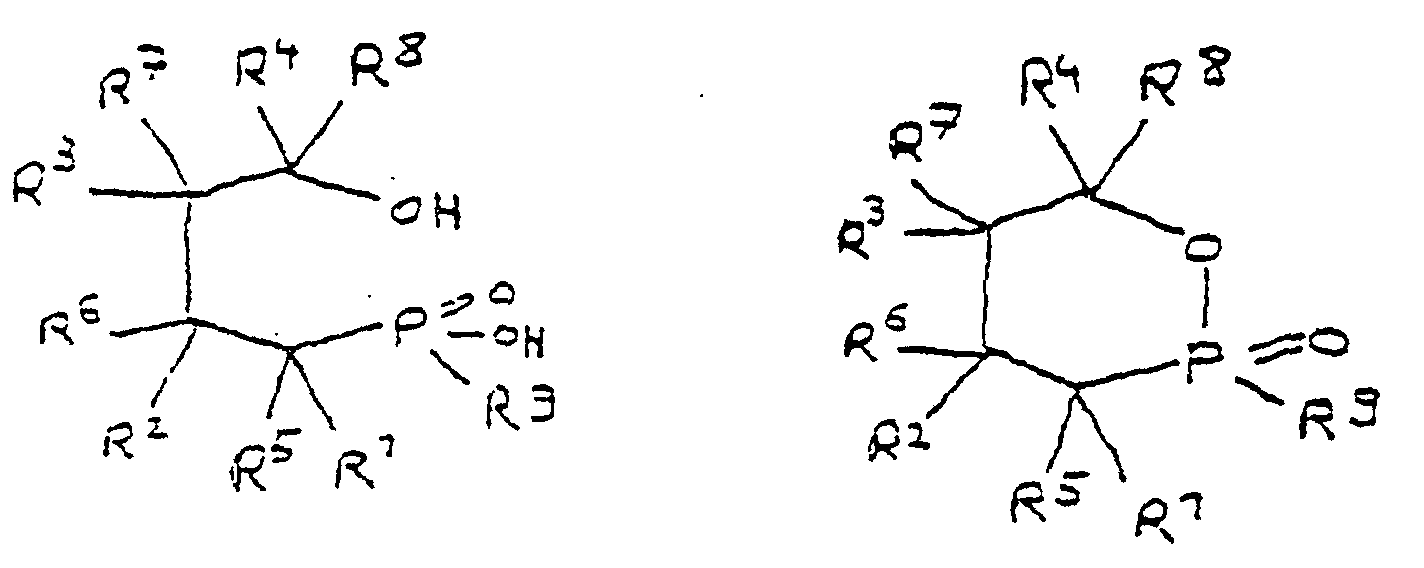
- R1 à R8
- représentent, indépendamment les uns des autres, un atome d'hydrogène ou un groupe hydrocarboné qui contient éventuellement un ou plusieurs hétéroatomes choisis parmi l'oxygène, l'azote, le soufre, le phosphore, le silicium ou un halogène, étant entendu qu'au maximum trois des radicaux R1 à R4 représentent des atomes d'hydrogène, et deux ou plus de deux des radicaux R1 à R8 peuvent être liés avec formation de cycles, et
- R9
- est un atome d'hydrogène ou
- R9
- est un groupe qui comporte au moins une fonction époxy, R9
- (i) étant un groupe hydrocarboné aliphatique, alicyclique ou aromatique qui comporte au moins une fonction époxy, ou
- (ii) étant un groupe alkylaryle ou arylalkyle qui comporte au moins une fonction époxy, ou
- (iii) étant dérivé de l'adduit de bisphénol A et d'épichlorhydrine et correspondant
à la formule
ou

- (iv) étant dérivé de l'adduit de bisphénol F et d'épichlorhydrine, ou
- (v) étant dérivé de résines époxy à base de Novolaque et/ou de résines époxy à base de Novolaque/crésol, ou
- (vi) étant dérivé de diluants réactifs qui contiennent au moins un composé choisi parmi des composés aliphatiques, cycloaliphatiques ou aromatiques à fonction di- à pentaépoxy, ou
- (vii) étant dérivé de composés N-glycidyliques à base d'amines ou de polyamines aromatiques ou cycloaliphatiques,
- Utilisation selon la revendication 13, caractérisée en ce que le dérivé présente une teneur en phosphore de 2 à 16 % en poids.
- Utilisation selon la revendication 13 ou 14, caractérisée en ce que les radicaux R1 à R8 contiennent ensemble de 6 à 100 atomes de carbone.
- Utilisation selon la revendication 15, caractérisée en ce qu'il s'agit d'un dérivé de l'acide 4-hydroxybutane-1-phosphinique et/ou de son ester intramoléculaire, dans lequel la forme ester correspond à la formule suivante :dans laquelle R9 a la signification indiquée, et
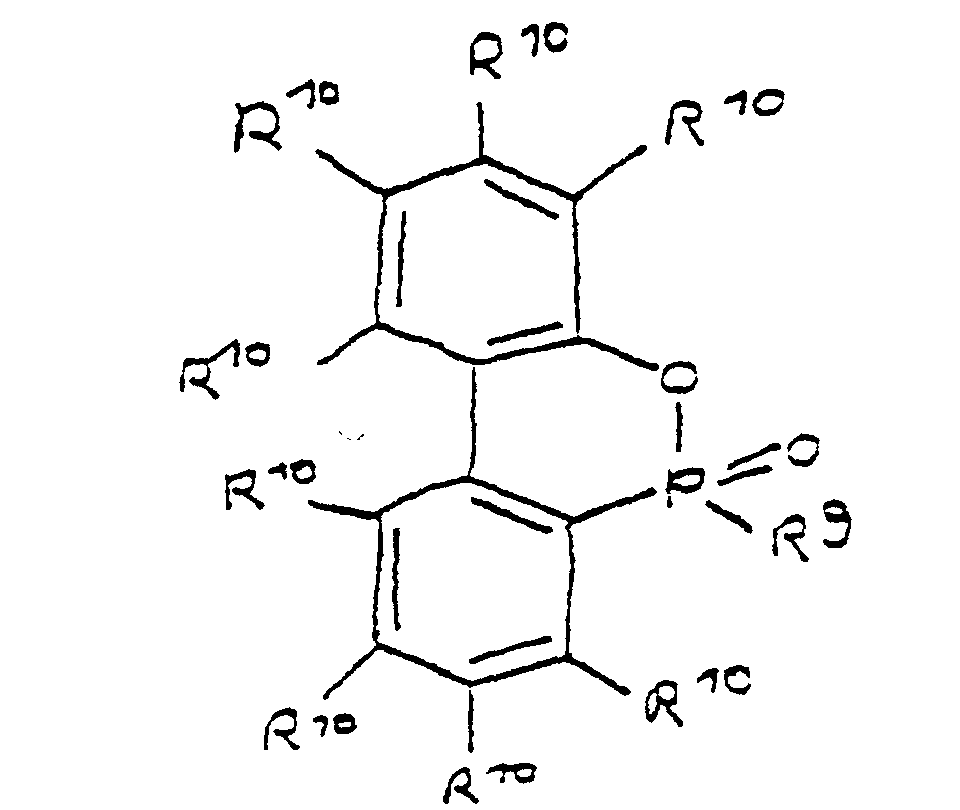
les radicaux R10 représentent, indépendamment les uns des autres, un atome d'hydrogène ou d'halogène ou un groupe hydrocarboné qui contient éventuellement un ou plusieurs hétéroatomes choisis parmi l'oxygène, l'azote, le soufre, le phosphore, le silicium et un halogène, deux ou plus de deux des radicaux R10 pouvant être liés avec formation de cycles. - Utilisation selon l'une quelconque des revendications 12 à 16, caractérisée en ce qu'on mélange l'agent ignifuge avec la résine époxy non réticulée
ou partiellement réticulée, on y ajoute au moins un durcisseur et, lors du durcissement, la composition ainsi obtenue se transforme en le produit recherché. - Résine époxy ignifuge sous forme non réticulée ou partiellement réticulée ou sous forme d'un produit obtenu par réticulation et durcissement, obtenue avec utilisation d'un agent ignifuge selon l'une quelconque des revendications 12 à 17.
- Résine époxy selon la revendication 18, caractérisée en ce qu'elle contient de 2 à 7 % en poids de phosphore dans la masse de la résine, par masse de la résine devant être entendu le poids total de la résine utilisée et de l'agent ignifuge, sans tenir compte d'autres composants tels que durcisseur, charge ou nappe de fibres de verre.
- Résine époxy selon la revendication 19, caractérisée en ce qu'au moins une partie de l'agent ignifuge a réagi avec la résine époxy et/ou le durcisseur éventuellement utilisé, de sorte qu'au moins 50 % de la teneur en phosphore sont liés chimiquement à la résine époxy.
- Résine époxy ignifuge qui contient de 2 à 7 % en poids de phosphore dans la masse de la résine, par masse de la résine devant être entendu le poids total de la résine utilisée et de l'agent ignifuge, sans tenir compte d'autres composants tels que durcisseur, charge ou nappe de fibres de verre, et qui comporte en tant que partie de sa structure réticulée, partiellement réticulée ou non réticulée, des motifs qui sont issus d'au moins un dérivé de l'acide 4-hydroxybutane-1-phosphinique et/ou de son ester intramoléculaire et sont liés à la résine par leur atome de phosphore, les motifs correspondants aux formules suivantes :
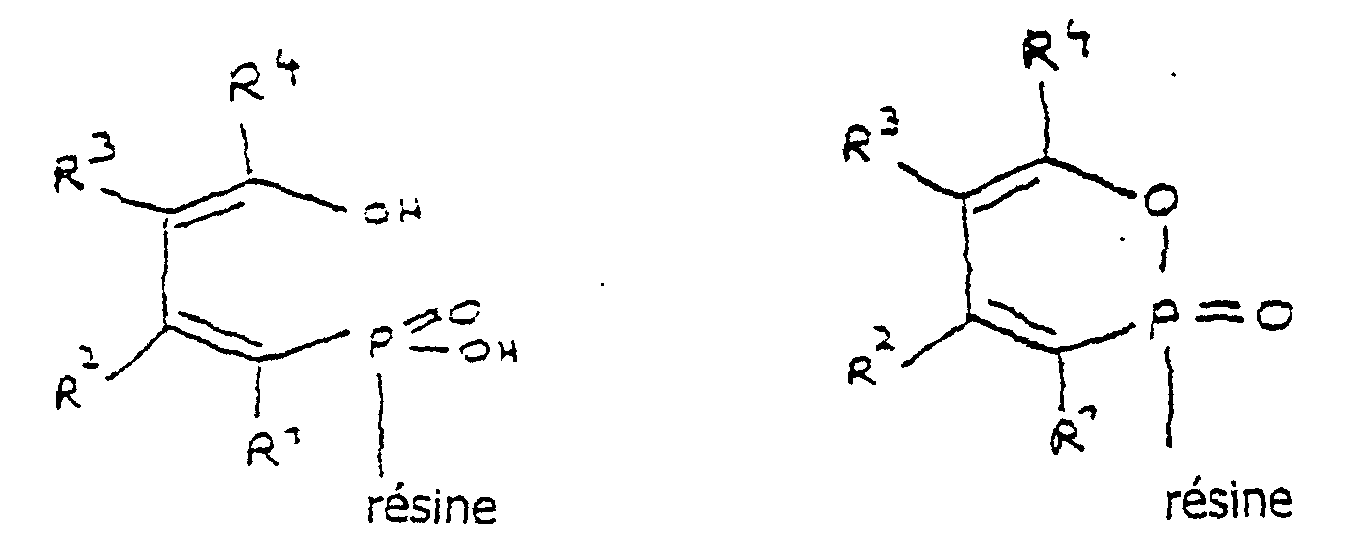
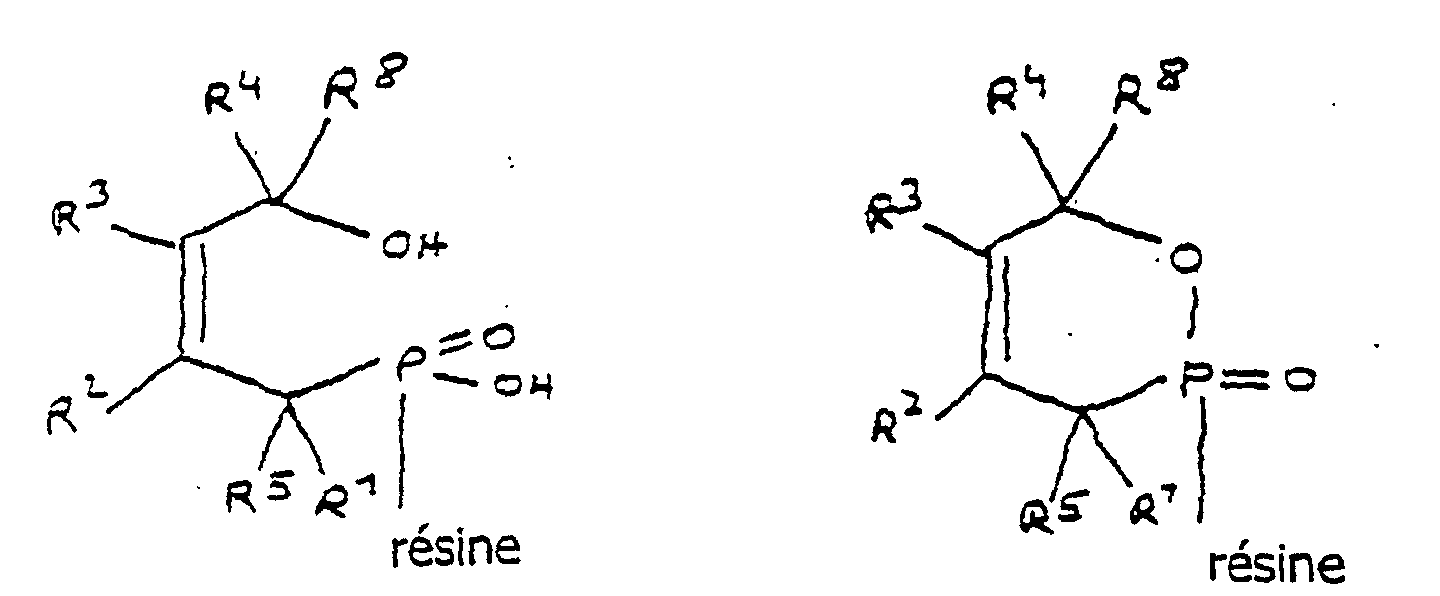 dans lesquelles R1 à R8 représentent, indépendamment les uns des autres, un atome d'hydrogène ou un groupe hydrocarboné qui contient éventuellement un ou plusieurs hétéroatomes choisis parmi l'oxygène, l'azote, le soufre, le phosphore, le silicium ou un halogène, deux ou plus de deux des radicaux R1 à R8 pouvant être liés avec formation de cycles.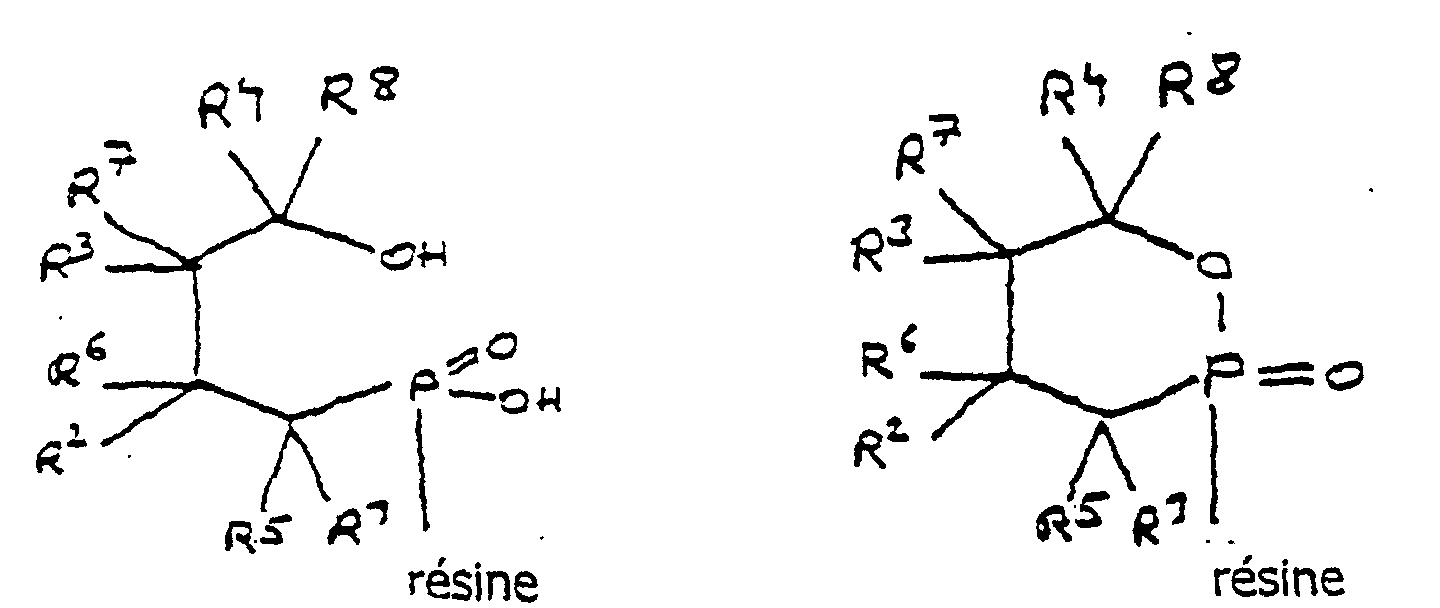
- Résine époxy selon la revendication 21, caractérisée en ce qu'au moins trois des radicaux R1 à R4 sont des atomes d'hydrogène.
- Résine époxy selon la revendication 21 ou 22, caractérisée en ce que les radicaux R1 à R8 contiennent ensemble de 6 à 100 atomes de carbone.
- Résine époxy selon la revendication 23, caractérisée en ce qu'elle comporte des motifs qui sont dérivés de l'acide 4-hydroxybutane-1-phosphinique
ou de son ester intramoléculaire, la forme ester des motifs correspondant à la formule suivante :dans laquelle les radicaux R10 représentent, indépendamment les uns des autres, un atome d'hydrogène ou d'halogène ou un groupe hydrocarboné qui contient éventuellement un ou plusieurs hétéroatomes choisis parmi l'oxygène, l'azote, le soufre, le phosphore, le silicium et un halogène, deux ou plus de deux des radicaux R10 pouvant être liés avec formation de cycles.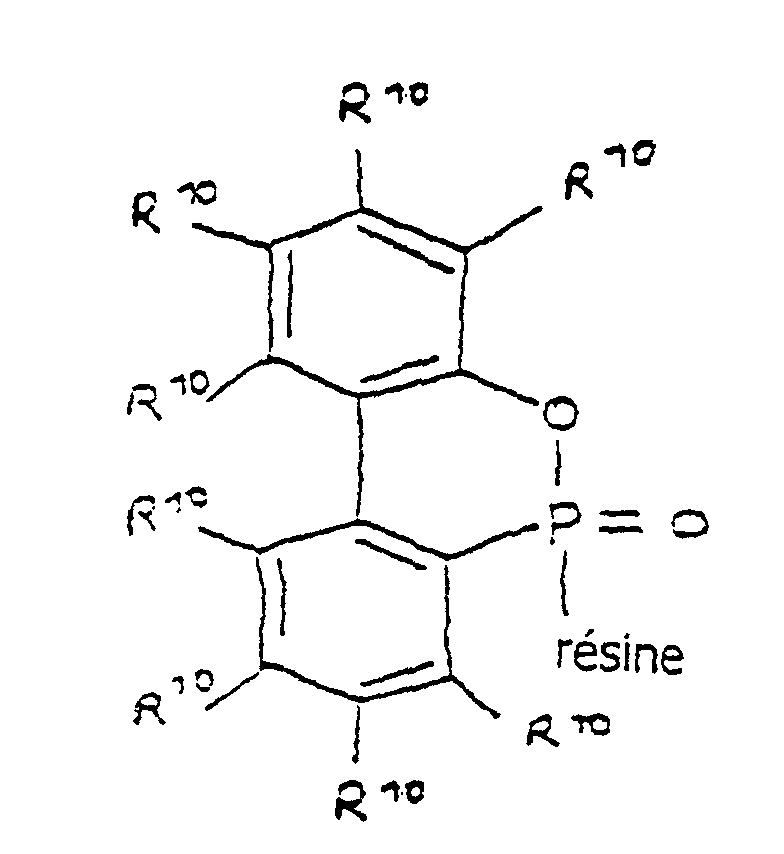
- Utilisation de la résine époxy selon l'une quelconque des revendications 18 à 24, pour la fabrication de corps moulés ou de revêtements à propriétés ignifuges.
- Matériaux préimprégnés et composites à base de matériaux de renforcement organiques ou minéraux sous forme de fibres, non-tissés ou tissus ou nappes, fabriqués à partir d'une résine époxy selon l'une quelconque des revendications 18 à 24.
- Plaquettes pour circuits imprimés à base de préimprégnés, fabriquées à partir de tissu de fibres de verre et de compositions de résine époxy selon l'une quelconque des revendications 18 à 24.
- Plaquettes pour circuits imprimés selon la revendication 27, caractérisées en ce que la composition utilisée comme agent ignifuge est issue d'au moins un dérivé de l'ester intramoléculaire de l'acide 4-hydroxybutane-1-phosphinique.
- Utilisation selon l'une quelconque des revendications 12 à 17, dans la mise en oeuvre de résines époxy dans le secteur électronique, la composition utilisée comme agent ignifuge étant issue d'au moins un dérivé de l'ester intramoléculaire de l'acide 4-hydroxybutane-1-phosphinique.
Applications Claiming Priority (2)
| Application Number | Priority Date | Filing Date | Title |
|---|---|---|---|
| DE19619095A DE19619095A1 (de) | 1996-05-06 | 1996-05-06 | Flammfeste Epoxidharze und Flammschutzmittel für Epoxidharze |
| DE19619095 | 1996-05-06 |
Publications (3)
| Publication Number | Publication Date |
|---|---|
| EP0806429A2 EP0806429A2 (fr) | 1997-11-12 |
| EP0806429A3 EP0806429A3 (fr) | 1998-10-07 |
| EP0806429B1 true EP0806429B1 (fr) | 2001-12-19 |
Family
ID=7794081
Family Applications (1)
| Application Number | Title | Priority Date | Filing Date |
|---|---|---|---|
| EP97250149A Revoked EP0806429B1 (fr) | 1996-05-06 | 1997-05-06 | Résines époxy résistant aux flammes et agents ignifugeants pour résines époxy |
Country Status (4)
| Country | Link |
|---|---|
| EP (1) | EP0806429B1 (fr) |
| AT (1) | ATE211144T1 (fr) |
| DE (2) | DE19619095A1 (fr) |
| ES (1) | ES2167676T3 (fr) |
Cited By (4)
| Publication number | Priority date | Publication date | Assignee | Title |
|---|---|---|---|---|
| US8389901B1 (en) | 2010-05-27 | 2013-03-05 | Awds Technologies Srl | Welding wire guiding liner |
| US8674263B2 (en) | 2009-07-20 | 2014-03-18 | Awds Technologies Srl | Wire guiding liner, in particular a welding wire liner, with biasing means between articulated guiding bodies |
| US8882018B2 (en) | 2011-12-19 | 2014-11-11 | Sidergas Spa | Retainer for welding wire container and welding wire container with retainer |
| TWI481635B (zh) * | 2011-04-27 | 2015-04-21 | Nippon Steel & Sumikin Chem Co | 含磷及氮的環氧樹脂 |
Families Citing this family (29)
| Publication number | Priority date | Publication date | Assignee | Title |
|---|---|---|---|---|
| DE19614424A1 (de) | 1996-04-12 | 1997-10-16 | Hoechst Ag | Synergistische Flammschutzmittel-Kombination für Polymere |
| TW528769B (en) * | 1998-06-19 | 2003-04-21 | Nat Science Council | Flame retardant advanced epoxy resins and cured epoxy resins, and preparation thereof |
| DE19903707C2 (de) * | 1999-01-30 | 2003-05-28 | Clariant Gmbh | Flammwidrige duroplastische Massen |
| DE10006592A1 (de) | 2000-02-09 | 2001-08-23 | Schill & Seilacher | Latente Kombinationsverbindungen und latente Ammoniumsalze aus Epoxidharzhärter und Flammschutzmittel sowie daraus hergestellte Epoxidharz-Systeme und -Produkte |
| AU2001237386A1 (en) * | 2000-02-14 | 2001-08-20 | Resolution Research Nederland B.V. | Halogen-free phosphorous-containing flame-resistant epoxy resin compositions |
| DE10043205A1 (de) * | 2000-09-01 | 2002-03-28 | Siemens Ag | Epoxidharzmischung |
| TW593526B (en) | 2001-09-20 | 2004-06-21 | Wangsuen Su Jen | Phosphorus group containing flame retardant hardener, advanced epoxy resins and cured epoxy resins thereof |
| DE10203969C1 (de) * | 2002-01-31 | 2003-10-02 | Thueringisches Inst Textil | Verfahren zur Herstellung mehrfach DOPO-haltiger organischer Verbindungen und ihre Verwendung |
| KR100968737B1 (ko) * | 2003-06-18 | 2010-07-08 | 튀링기셰스 인슈티투트 퓌르 텍스틸-운트 쿤스트슈토프-포르슝 이.브이. | 폴리-dopo를 함유하는 유기 화합물의 제조방법 및 이의용도 |
| DE10332291A1 (de) * | 2003-07-16 | 2005-02-17 | Schill + Seilacher "Struktol" Ag | Derivate von 9,10-Dihydro-9-oxa-10-phosphaphenanthren-10-oxid |
| DE10338116A1 (de) | 2003-08-15 | 2005-03-17 | Schill + Seilacher "Struktol" Ag | Verfahren zur Herstellung von 9,10-Dihydro-9-oxa-10-organyl-phosphaphenanthren-10-oxid und an den Phenylgruppen substituierten Derivaten desselben |
| DE10338131A1 (de) | 2003-08-15 | 2005-03-17 | Schill + Seilacher "Struktol" Ag | Verfahren zur Herstellung von 9,10-Dihydro-9-oxa-10-organyloxy-phosphaphenanthren-10-oxid oder -thion und an den Phenylgruppen substitutierten Derivaten desselben |
| DE10359269B4 (de) * | 2003-12-17 | 2012-05-24 | Fraunhofer-Gesellschaft zur Förderung der angewandten Forschung e.V. | Verwendung hydroxylgruppenhaltiger Phosphinate als und zur Herstellung von Flammschutzmitteln, die sich zur Einbindung in Polymerharze eignen oder als Bestandteil flammgeschützter Polymere, mit diesen Phosphinaten hergestellte neue Phosphinate mit organisch polymerisierbaren Gruppen, deren Herstellung sowie Verwendung in flammgeschützten Polymerharzen |
| CN102653598B (zh) | 2004-05-28 | 2015-05-13 | 陶氏环球技术有限责任公司 | 可用于制造无卤素抗引燃聚合物的含磷化合物 |
| DE102005005879A1 (de) | 2005-02-09 | 2006-08-17 | Schill + Seilacher "Struktol" Ag | Stickstoffhaltige verbrückte Derivate von 6H-Dibenz[c,e][1,2]-oxaphosphorin-6-oxiden, Verfahren zu ihrer Herstellung sowie ihre Verwendung |
| DE102005015605B4 (de) | 2005-04-05 | 2008-04-17 | Schill + Seilacher "Struktol" Aktiengesellschaft | Phosphororganische Verbindungen enthaltende Prepolymere und Verwendungen dafür |
| DE102006015084A1 (de) | 2006-03-31 | 2007-10-04 | Schill + Seilacher "Struktol" Ag | Halogenfreie flammgeschützte Epoxidharz-Formulierungen |
| US9267030B2 (en) | 2010-01-29 | 2016-02-23 | Blue Cube Ip Llc | Compositions having phosphorus-containing compounds |
| DE102011116178A1 (de) | 2011-10-14 | 2013-04-18 | Schill + Seilacher "Struktol" Gmbh | Halogenfreies, phosphorhaltiges Flammschutzmittel |
| DE102011118490B4 (de) | 2011-11-11 | 2014-05-15 | Schill + Seilacher "Struktol" Gmbh | Halogenfreie, flammfeste Epoxidharz-Zusammensetzungen und deren Verwendung |
| US10343231B2 (en) | 2014-05-28 | 2019-07-09 | Awds Technologies Srl | Wire feeding system |
| US10010962B1 (en) | 2014-09-09 | 2018-07-03 | Awds Technologies Srl | Module and system for controlling and recording welding data, and welding wire feeder |
| US10350696B2 (en) | 2015-04-06 | 2019-07-16 | Awds Technologies Srl | Wire feed system and method of controlling feed of welding wire |
| US9950857B1 (en) | 2016-10-17 | 2018-04-24 | Sidergas Spa | Welding wire container |
| DE102017204982A1 (de) | 2017-03-24 | 2018-09-27 | Siemens Aktiengesellschaft | Faserverbundbauteil |
| DE102017009661A1 (de) * | 2017-08-14 | 2019-02-14 | Diehl Aviation Laupheim Gmbh | Harzzusammensetzung, Prepregmaterial und Verfahren zur Herstellung einer Harzzusammensetzung |
| US11278981B2 (en) | 2020-01-20 | 2022-03-22 | Awds Technologies Srl | Device for imparting a torsional force onto a wire |
| US11174121B2 (en) | 2020-01-20 | 2021-11-16 | Awds Technologies Srl | Device for imparting a torsional force onto a wire |
| CN113861510B (zh) * | 2021-10-09 | 2023-02-28 | 常州大学 | 一种含磷氮硫阻燃剂及其制备方法和应用方法 |
Family Cites Families (11)
| Publication number | Priority date | Publication date | Assignee | Title |
|---|---|---|---|---|
| JPS4945397B1 (fr) | 1968-05-21 | 1974-12-04 | ||
| US4127590A (en) | 1975-10-14 | 1978-11-28 | Toyo Boseki Kabushiki Kaisha | Phosphorus-containing compounds |
| DE2652007A1 (de) | 1976-11-15 | 1978-05-18 | Hoechst Ag | Neue, phosphorhaltige epoxidharze, verfahren zu ihrer herstellung und ihre verwendung zur flammfestausruestung |
| JPS60161993A (ja) | 1984-02-01 | 1985-08-23 | Sanko Kagaku Kk | 含りんエポキシ化合物及びその製造方法 |
| JPS60248728A (ja) | 1984-05-24 | 1985-12-09 | Nippon Ester Co Ltd | 耐炎性ポリエステルの製造法 |
| DE4308187A1 (de) | 1993-03-15 | 1994-09-22 | Siemens Ag | Epoxidharzmischungen |
| DE4340834A1 (de) | 1993-03-15 | 1994-09-22 | Siemens Ag | Phosphormodifizierte Epoxidharze, Verfahren zu ihrer Herstellung sowie ihre Verwendung |
| DE4308184A1 (de) | 1993-03-15 | 1994-09-22 | Siemens Ag | Epoxidharzmischungen |
| DE4318013A1 (de) | 1993-05-29 | 1994-12-01 | Hoechst Ag | Fünfwertige Phosphorverbindungen und Verfahren zu ihrer Herstellung |
| TW280824B (fr) | 1993-09-09 | 1996-07-11 | Ciba Geigy Ag | |
| EP0675131B1 (fr) | 1994-03-24 | 1999-12-01 | Shell Internationale Researchmaatschappij B.V. | Composition de résine époxy ignifugeante |
-
1996
- 1996-05-06 DE DE19619095A patent/DE19619095A1/de not_active Ceased
-
1997
- 1997-05-06 DE DE59705842T patent/DE59705842D1/de not_active Expired - Lifetime
- 1997-05-06 AT AT97250149T patent/ATE211144T1/de not_active IP Right Cessation
- 1997-05-06 ES ES97250149T patent/ES2167676T3/es not_active Expired - Lifetime
- 1997-05-06 EP EP97250149A patent/EP0806429B1/fr not_active Revoked
Cited By (4)
| Publication number | Priority date | Publication date | Assignee | Title |
|---|---|---|---|---|
| US8674263B2 (en) | 2009-07-20 | 2014-03-18 | Awds Technologies Srl | Wire guiding liner, in particular a welding wire liner, with biasing means between articulated guiding bodies |
| US8389901B1 (en) | 2010-05-27 | 2013-03-05 | Awds Technologies Srl | Welding wire guiding liner |
| TWI481635B (zh) * | 2011-04-27 | 2015-04-21 | Nippon Steel & Sumikin Chem Co | 含磷及氮的環氧樹脂 |
| US8882018B2 (en) | 2011-12-19 | 2014-11-11 | Sidergas Spa | Retainer for welding wire container and welding wire container with retainer |
Also Published As
| Publication number | Publication date |
|---|---|
| DE19619095A1 (de) | 1997-11-13 |
| EP0806429A3 (fr) | 1998-10-07 |
| DE59705842D1 (de) | 2002-01-31 |
| ES2167676T3 (es) | 2002-05-16 |
| ATE211144T1 (de) | 2002-01-15 |
| EP0806429A2 (fr) | 1997-11-12 |
Similar Documents
| Publication | Publication Date | Title |
|---|---|---|
| EP0806429A2 (fr) | Résines époxy résistants aux flammes et agents ignifugeantes pour résines époxy | |
| DE60213372T2 (de) | Neue hydroxyphenylphosphinoxid zusammensetzung, glycidylether und epoxidharzmischungen und davon abgeleitete verbundwerkstoffe und laminate | |
| EP1125960B1 (fr) | Composé latent de combinaison et un sel d'ammonium latent à partir d'un agent durcisseur de résines époxydes et d'un agent retardant la flamme, systèmes- ou produits de résines époxydes qui en sont préparés | |
| EP1454949B1 (fr) | Dispersion d'agent ignifugeant | |
| EP0779905B1 (fr) | Melanges de resines epoxy pour preimpregnes et materiaux composites | |
| EP1498448A1 (fr) | Préparation d'agent antifeu | |
| EP2090618B1 (fr) | Formule de résine époxyde durcissable avec un produit ignifuge polyester | |
| EP0799845B1 (fr) | Compositions de résines époxydes modifiées par du phosphore | |
| DE1745796B2 (de) | Verfahren zur herstellung von flammfesten epoxydpolyaddukten | |
| EP1046661B1 (fr) | Résines époxy ignifuges, modifiées par du phosphore | |
| WO2016166226A1 (fr) | Durcisseur et accélérateur de durcissement avec effet retardateur de flamme pour le durcissement de résines époxydes | |
| EP1354885B1 (fr) | Compositions ignifuges pour des polymères contenant un mélange de deux phosphates d'aryl différentes, leur préparation et utilisation | |
| DE19613064C2 (de) | Phosphormodifizierte Epoxidharzmischungen aus Epoxidharzen, phosphorhaltigen Verbindungen und einem Härter, Verfahren zu ihrer Herstellung und ihre Verwendung | |
| EP3926024A1 (fr) | Mélanges phosphoreux retardeurs de flammes contenant du phosphore, leur procédé de fabrication et leur utilisation ainsi que formulations de résine époxy contenant lesdits mélanges retardeurs de flammes | |
| DE2538675A1 (de) | Verfahren zur herstellung von phosphorhaltigen epoxidharzen und ihre verwendung zur flammfestausruestung | |
| EP0799848B1 (fr) | Résines époxydes modifiées par du phosphore à partir de résines époxydes et des composés contenant du phosphore | |
| DE19613063C2 (de) | Phosphormodifizierte Epoxidharze und ein Verfahren zu ihrer Herstellung | |
| EP0799849B1 (fr) | Procédé pour la préparation de résines époxydes modifiées par du phospore | |
| EP0799846B1 (fr) | Mélange de résines époxy, modifiées par du phosphore contenant des résines époxy, des composés contenant du phosphore et un durcisseur | |
| WO2007118507A1 (fr) | Formulations de résines époxydes ignifugées sans halogènes | |
| DE69513548T2 (de) | Flammhemmende Epoxyharzzusammensetzung | |
| DE19608613A1 (de) | Lagerstabile, phosphormodifizierte Epoxidharze | |
| DE19709519A1 (de) | Phosphormodifizierte Epoxidharzmischungen aus Epoxidharzen, phosphorhaltigen Verbindungen und einem Härter | |
| WO2026017505A1 (fr) | Dérivés de dopo utilisés en tant qu'ignifuges |
Legal Events
| Date | Code | Title | Description |
|---|---|---|---|
| PUAI | Public reference made under article 153(3) epc to a published international application that has entered the european phase |
Free format text: ORIGINAL CODE: 0009012 |
|
| AK | Designated contracting states |
Kind code of ref document: A2 Designated state(s): AT CH DE ES FR GB IT LI NL |
|
| PUAL | Search report despatched |
Free format text: ORIGINAL CODE: 0009013 |
|
| AK | Designated contracting states |
Kind code of ref document: A3 Designated state(s): AT CH DE ES FR GB IT LI NL |
|
| 17P | Request for examination filed |
Effective date: 19981104 |
|
| 17Q | First examination report despatched |
Effective date: 19991119 |
|
| GRAG | Despatch of communication of intention to grant |
Free format text: ORIGINAL CODE: EPIDOS AGRA |
|
| RAP1 | Party data changed (applicant data changed or rights of an application transferred) |
Owner name: SCHILL & SEILACHER "STRUKTOL" AKTIENGESELLSCHAFT |
|
| GRAH | Despatch of communication of intention to grant a patent |
Free format text: ORIGINAL CODE: EPIDOS IGRA |
|
| GRAG | Despatch of communication of intention to grant |
Free format text: ORIGINAL CODE: EPIDOS AGRA |
|
| GRAH | Despatch of communication of intention to grant a patent |
Free format text: ORIGINAL CODE: EPIDOS IGRA |
|
| GRAA | (expected) grant |
Free format text: ORIGINAL CODE: 0009210 |
|
| AK | Designated contracting states |
Kind code of ref document: B1 Designated state(s): AT CH DE ES FR GB IT LI NL |
|
| REF | Corresponds to: |
Ref document number: 211144 Country of ref document: AT Date of ref document: 20020115 Kind code of ref document: T |
|
| RIN1 | Information on inventor provided before grant (corrected) |
Inventor name: SPRENGER, STEPHAN, DR. Inventor name: UTZ, RAINER, DR. |
|
| REG | Reference to a national code |
Ref country code: CH Ref legal event code: NV Representative=s name: E. BLUM & CO. PATENTANWAELTE Ref country code: CH Ref legal event code: EP |
|
| REG | Reference to a national code |
Ref country code: GB Ref legal event code: IF02 |
|
| REF | Corresponds to: |
Ref document number: 59705842 Country of ref document: DE Date of ref document: 20020131 |
|
| GBT | Gb: translation of ep patent filed (gb section 77(6)(a)/1977) |
Effective date: 20020314 |
|
| REG | Reference to a national code |
Ref country code: ES Ref legal event code: FG2A Ref document number: 2167676 Country of ref document: ES Kind code of ref document: T3 |
|
| ET | Fr: translation filed | ||
| PLBQ | Unpublished change to opponent data |
Free format text: ORIGINAL CODE: EPIDOS OPPO |
|
| PLBI | Opposition filed |
Free format text: ORIGINAL CODE: 0009260 |
|
| 26 | Opposition filed |
Opponent name: SANKO CO., LTD. Effective date: 20020919 |
|
| PLBF | Reply of patent proprietor to notice(s) of opposition |
Free format text: ORIGINAL CODE: EPIDOS OBSO |
|
| NLR1 | Nl: opposition has been filed with the epo |
Opponent name: SANKO CO., LTD. |
|
| PLBF | Reply of patent proprietor to notice(s) of opposition |
Free format text: ORIGINAL CODE: EPIDOS OBSO |
|
| PLBF | Reply of patent proprietor to notice(s) of opposition |
Free format text: ORIGINAL CODE: EPIDOS OBSO |
|
| PLAX | Notice of opposition and request to file observation + time limit sent |
Free format text: ORIGINAL CODE: EPIDOSNOBS2 |
|
| PLAX | Notice of opposition and request to file observation + time limit sent |
Free format text: ORIGINAL CODE: EPIDOSNOBS2 |
|
| PLBB | Reply of patent proprietor to notice(s) of opposition received |
Free format text: ORIGINAL CODE: EPIDOSNOBS3 |
|
| PLAB | Opposition data, opponent's data or that of the opponent's representative modified |
Free format text: ORIGINAL CODE: 0009299OPPO |
|
| REG | Reference to a national code |
Ref country code: CH Ref legal event code: PFA Owner name: SCHILL+SEILACHER "STRUKTOL" AKTIENGESELLSCHAFT Free format text: SCHILL+SEILACHER "STRUKTOL" AKTIENGESELLSCHAFT#MOORFLEETERSTRASSE 28#22113 HAMBURG (DE) -TRANSFER TO- SCHILL+SEILACHER "STRUKTOL" AKTIENGESELLSCHAFT#MOORFLEETERSTRASSE 28#22113 HAMBURG (DE) |
|
| R26 | Opposition filed (corrected) |
Opponent name: SANKO CO., LTD. Effective date: 20020919 |
|
| NLR1 | Nl: opposition has been filed with the epo |
Opponent name: SANKO CO., LTD. |
|
| APBP | Date of receipt of notice of appeal recorded |
Free format text: ORIGINAL CODE: EPIDOSNNOA2O |
|
| APAH | Appeal reference modified |
Free format text: ORIGINAL CODE: EPIDOSCREFNO |
|
| APBQ | Date of receipt of statement of grounds of appeal recorded |
Free format text: ORIGINAL CODE: EPIDOSNNOA3O |
|
| PGFP | Annual fee paid to national office [announced via postgrant information from national office to epo] |
Ref country code: NL Payment date: 20080501 Year of fee payment: 12 |
|
| PGFP | Annual fee paid to national office [announced via postgrant information from national office to epo] |
Ref country code: AT Payment date: 20090515 Year of fee payment: 13 |
|
| NLV4 | Nl: lapsed or anulled due to non-payment of the annual fee |
Effective date: 20091201 |
|
| PG25 | Lapsed in a contracting state [announced via postgrant information from national office to epo] |
Ref country code: NL Free format text: LAPSE BECAUSE OF NON-PAYMENT OF DUE FEES Effective date: 20091201 |
|
| PGFP | Annual fee paid to national office [announced via postgrant information from national office to epo] |
Ref country code: ES Payment date: 20100525 Year of fee payment: 14 |
|
| PGFP | Annual fee paid to national office [announced via postgrant information from national office to epo] |
Ref country code: CH Payment date: 20100525 Year of fee payment: 14 |
|
| PG25 | Lapsed in a contracting state [announced via postgrant information from national office to epo] |
Ref country code: AT Free format text: LAPSE BECAUSE OF NON-PAYMENT OF DUE FEES Effective date: 20100506 |
|
| PGFP | Annual fee paid to national office [announced via postgrant information from national office to epo] |
Ref country code: FR Payment date: 20110607 Year of fee payment: 15 |
|
| PGFP | Annual fee paid to national office [announced via postgrant information from national office to epo] |
Ref country code: GB Payment date: 20110520 Year of fee payment: 15 |
|
| APBU | Appeal procedure closed |
Free format text: ORIGINAL CODE: EPIDOSNNOA9O |
|
| PGFP | Annual fee paid to national office [announced via postgrant information from national office to epo] |
Ref country code: IT Payment date: 20110527 Year of fee payment: 15 Ref country code: DE Payment date: 20110525 Year of fee payment: 15 |
|
| REG | Reference to a national code |
Ref country code: CH Ref legal event code: PL |
|
| PG25 | Lapsed in a contracting state [announced via postgrant information from national office to epo] |
Ref country code: CH Free format text: LAPSE BECAUSE OF NON-PAYMENT OF DUE FEES Effective date: 20110531 Ref country code: LI Free format text: LAPSE BECAUSE OF NON-PAYMENT OF DUE FEES Effective date: 20110531 |
|
| RDAF | Communication despatched that patent is revoked |
Free format text: ORIGINAL CODE: EPIDOSNREV1 |
|
| REG | Reference to a national code |
Ref country code: DE Ref legal event code: R103 Ref document number: 59705842 Country of ref document: DE Ref country code: DE Ref legal event code: R064 Ref document number: 59705842 Country of ref document: DE |
|
| RDAG | Patent revoked |
Free format text: ORIGINAL CODE: 0009271 |
|
| STAA | Information on the status of an ep patent application or granted ep patent |
Free format text: STATUS: PATENT REVOKED |
|
| 27W | Patent revoked |
Effective date: 20120716 |
|
| GBPR | Gb: patent revoked under art. 102 of the ep convention designating the uk as contracting state |
Effective date: 20120716 |
|
| REG | Reference to a national code |
Ref country code: DE Ref legal event code: R107 Ref document number: 59705842 Country of ref document: DE Effective date: 20130110 |
|
| PG25 | Lapsed in a contracting state [announced via postgrant information from national office to epo] |
Ref country code: IT Free format text: LAPSE BECAUSE OF NON-PAYMENT OF DUE FEES Effective date: 20120506 |
|
| REG | Reference to a national code |
Ref country code: AT Ref legal event code: MA03 Ref document number: 211144 Country of ref document: AT Kind code of ref document: T Effective date: 20120716 |
|
| PG25 | Lapsed in a contracting state [announced via postgrant information from national office to epo] |
Ref country code: ES Free format text: LAPSE BECAUSE OF NON-PAYMENT OF DUE FEES Effective date: 20110507 |