EP1125960B1 - Composé latent de combinaison et un sel d'ammonium latent à partir d'un agent durcisseur de résines époxydes et d'un agent retardant la flamme, systèmes- ou produits de résines époxydes qui en sont préparés - Google Patents
Composé latent de combinaison et un sel d'ammonium latent à partir d'un agent durcisseur de résines époxydes et d'un agent retardant la flamme, systèmes- ou produits de résines époxydes qui en sont préparés Download PDFInfo
- Publication number
- EP1125960B1 EP1125960B1 EP01100119A EP01100119A EP1125960B1 EP 1125960 B1 EP1125960 B1 EP 1125960B1 EP 01100119 A EP01100119 A EP 01100119A EP 01100119 A EP01100119 A EP 01100119A EP 1125960 B1 EP1125960 B1 EP 1125960B1
- Authority
- EP
- European Patent Office
- Prior art keywords
- latent
- epoxy resin
- component
- compound
- ring
- Prior art date
- Legal status (The legal status is an assumption and is not a legal conclusion. Google has not performed a legal analysis and makes no representation as to the accuracy of the status listed.)
- Expired - Lifetime
Links
- 0 *C(C(*)(N)O*)C(*)=C(P(*)(O)=O)[Ru] Chemical compound *C(C(*)(N)O*)C(*)=C(P(*)(O)=O)[Ru] 0.000 description 3
- HXPXISSNEJVFRA-UHFFFAOYSA-N CCC(C)N(CC)CC Chemical compound CCC(C)N(CC)CC HXPXISSNEJVFRA-UHFFFAOYSA-N 0.000 description 1
Classifications
-
- C—CHEMISTRY; METALLURGY
- C08—ORGANIC MACROMOLECULAR COMPOUNDS; THEIR PREPARATION OR CHEMICAL WORKING-UP; COMPOSITIONS BASED THEREON
- C08G—MACROMOLECULAR COMPOUNDS OBTAINED OTHERWISE THAN BY REACTIONS ONLY INVOLVING UNSATURATED CARBON-TO-CARBON BONDS
- C08G59/00—Polycondensates containing more than one epoxy group per molecule; Macromolecules obtained by polymerising compounds containing more than one epoxy group per molecule using curing agents or catalysts which react with the epoxy groups
- C08G59/18—Macromolecules obtained by polymerising compounds containing more than one epoxy group per molecule using curing agents or catalysts which react with the epoxy groups ; e.g. general methods of curing
- C08G59/68—Macromolecules obtained by polymerising compounds containing more than one epoxy group per molecule using curing agents or catalysts which react with the epoxy groups ; e.g. general methods of curing characterised by the catalysts used
- C08G59/688—Macromolecules obtained by polymerising compounds containing more than one epoxy group per molecule using curing agents or catalysts which react with the epoxy groups ; e.g. general methods of curing characterised by the catalysts used containing phosphorus
-
- C—CHEMISTRY; METALLURGY
- C07—ORGANIC CHEMISTRY
- C07F—ACYCLIC, CARBOCYCLIC OR HETEROCYCLIC COMPOUNDS CONTAINING ELEMENTS OTHER THAN CARBON, HYDROGEN, HALOGEN, OXYGEN, NITROGEN, SULFUR, SELENIUM OR TELLURIUM
- C07F9/00—Compounds containing elements of Groups 5 or 15 of the Periodic Table
- C07F9/02—Phosphorus compounds
- C07F9/28—Phosphorus compounds with one or more P—C bonds
- C07F9/30—Phosphinic acids [R2P(=O)(OH)]; Thiophosphinic acids ; [R2P(=X1)(X2H) (X1, X2 are each independently O, S or Se)]
- C07F9/301—Acyclic saturated acids which can have further substituents on alkyl
-
- C—CHEMISTRY; METALLURGY
- C08—ORGANIC MACROMOLECULAR COMPOUNDS; THEIR PREPARATION OR CHEMICAL WORKING-UP; COMPOSITIONS BASED THEREON
- C08G—MACROMOLECULAR COMPOUNDS OBTAINED OTHERWISE THAN BY REACTIONS ONLY INVOLVING UNSATURATED CARBON-TO-CARBON BONDS
- C08G59/00—Polycondensates containing more than one epoxy group per molecule; Macromolecules obtained by polymerising compounds containing more than one epoxy group per molecule using curing agents or catalysts which react with the epoxy groups
- C08G59/18—Macromolecules obtained by polymerising compounds containing more than one epoxy group per molecule using curing agents or catalysts which react with the epoxy groups ; e.g. general methods of curing
-
- H—ELECTRICITY
- H05—ELECTRIC TECHNIQUES NOT OTHERWISE PROVIDED FOR
- H05K—PRINTED CIRCUITS; CASINGS OR CONSTRUCTIONAL DETAILS OF ELECTRIC APPARATUS; MANUFACTURE OF ASSEMBLAGES OF ELECTRICAL COMPONENTS
- H05K1/00—Printed circuits
- H05K1/02—Details
- H05K1/03—Use of materials for the substrate
- H05K1/0313—Organic insulating material
- H05K1/032—Organic insulating material consisting of one material
- H05K1/0326—Organic insulating material consisting of one material containing O
-
- H—ELECTRICITY
- H05—ELECTRIC TECHNIQUES NOT OTHERWISE PROVIDED FOR
- H05K—PRINTED CIRCUITS; CASINGS OR CONSTRUCTIONAL DETAILS OF ELECTRIC APPARATUS; MANUFACTURE OF ASSEMBLAGES OF ELECTRICAL COMPONENTS
- H05K1/00—Printed circuits
- H05K1/02—Details
- H05K1/03—Use of materials for the substrate
- H05K1/0313—Organic insulating material
- H05K1/0353—Organic insulating material consisting of two or more materials, e.g. two or more polymers, polymer + filler, + reinforcement
- H05K1/0373—Organic insulating material consisting of two or more materials, e.g. two or more polymers, polymer + filler, + reinforcement containing additives, e.g. fillers
-
- Y—GENERAL TAGGING OF NEW TECHNOLOGICAL DEVELOPMENTS; GENERAL TAGGING OF CROSS-SECTIONAL TECHNOLOGIES SPANNING OVER SEVERAL SECTIONS OF THE IPC; TECHNICAL SUBJECTS COVERED BY FORMER USPC CROSS-REFERENCE ART COLLECTIONS [XRACs] AND DIGESTS
- Y10—TECHNICAL SUBJECTS COVERED BY FORMER USPC
- Y10S—TECHNICAL SUBJECTS COVERED BY FORMER USPC CROSS-REFERENCE ART COLLECTIONS [XRACs] AND DIGESTS
- Y10S428/00—Stock material or miscellaneous articles
- Y10S428/901—Printed circuit
-
- Y—GENERAL TAGGING OF NEW TECHNOLOGICAL DEVELOPMENTS; GENERAL TAGGING OF CROSS-SECTIONAL TECHNOLOGIES SPANNING OVER SEVERAL SECTIONS OF THE IPC; TECHNICAL SUBJECTS COVERED BY FORMER USPC CROSS-REFERENCE ART COLLECTIONS [XRACs] AND DIGESTS
- Y10—TECHNICAL SUBJECTS COVERED BY FORMER USPC
- Y10T—TECHNICAL SUBJECTS COVERED BY FORMER US CLASSIFICATION
- Y10T428/00—Stock material or miscellaneous articles
- Y10T428/31504—Composite [nonstructural laminate]
- Y10T428/31511—Of epoxy ether
Definitions
- the invention relates to latent combination compounds Epoxy resin hardener and flame retardant. Furthermore, it relates a method, these latent combination compounds with water and / or react mono- or polyhydric hydroxy compounds, and the resulting in this reaction latent ammonium salts. Selected latent ammonium salts are alternative presented method available.
- the latent combination compounds and latent ammonium salts can be used to prepare One-component resin systems and moldings accessible therefrom and coatings with flame-retardant properties, in heat-curable Einkomponentenepoxidharz adhesives used and in resin injection process be used.
- the invention includes furthermore prepregs and composites as well as printed circuit boards.
- Low-curing epoxy resin systems (curing at about 100 ° C) with sufficiently high glass transition temperature (T g about 200 ° C) can be obtained if a high exothermicity of the polymerization is achieved.
- T g glass transition temperature
- anionic homopolymerization of the epoxy resins Particularly good results are obtained when the polymerization initiators, often called accelerators in epoxy resin chemistry, are released suddenly or abruptly. This principle is called latent acceleration and is realized in one-component resins.
- these accelerators are deactivated by mechanical encapsulation or by formation of chelate complexes. By increasing the temperature, the actual accelerator substances are released again. It is crucial for the application in Harzinjetechnischsvon that this release is extremely abrupt. This is an essential prerequisite for the fact that the resin systems can be processed well flowable at elevated temperature (60 to 80 ° C), after a slight further increase in temperature (to about 100 ° C) but quickly harden.
- hardener and accelerator in the Epoxidharzchemie not clear from each other are delimitable, especially the substances that are epoxy resin systems be added, not either a hardener or a Accelerator effect assignable. Both terms, “hardener” and “Accelerator”, therefore, in the description of this Invention uses the ability of the presented substances expressing, curing any epoxy resin system or the Accelerate hardening.
- the known one-component resins which are latently accelerated can, contain Lewis adducts of tertiary amines and meet the requirements are not. They have to be at low temperatures be stored and accelerate the polymerization unevenly, so that a Wegemperm after the actual polymerization necessary is.
- EP 0 589 166 B1 and EP 0 589 167 B1 disclose the preparation of transition metal heterocyclic complexes known as latent polymerization catalysts for epoxy resins proposed become.
- the compounds mentioned are solids, which have to be dissolved in solvents and their application in Monocomponent resins, their use in resin injection processes and in composite materials is impossible because of segregation unavoidable problems occur that affect the mechanical properties of the epoxy resin material and product deteriorate.
- Modifier For high performance applications are additional modifiers (Modifier) necessary to meet special requirements Material and material properties to achieve. It acts Above all, it is an improvement in elasticity (NBR modifier) and fire behavior (FST modifier).
- Flame retardant which reactively incorporated in epoxy resin can be, are from DE 44 47 277 A1, DE 43 08 184 A1 and EP 0 806 429 A2.
- Epoxy resin systems containing these flame retardants are added in their processing properties but inadequate, especially are pre-reacted Epoxy resins sensitive to moisture and not storage stable.
- US-A-3 328 319 relates to a method of curing Epoxy resins with carboxylic anhydrides with the addition of certain organophosphorus compounds used as curing catalysts Act.
- the object of the present invention is therefore one-component epoxy resin systems for the production of flame retardant equipped products, whereby the easy selection of a specific desired curing temperature must be possible.
- the epoxy resin systems should be excellent themselves stable on storage, above all long-term storage stable, and in Resin injection process can be used.
- novel epoxy resin materials are intended excellent mechanical properties, e.g. breaking strength and low brittleness, show, and at the same time excellent Flame retardancy properties, without toxicological in case of fire to be questionable.
- the invention relates, inter alia. a group of phosphinic acid amides, for the following also the term “latent combination compounds” on the other hand, a group of ammonium phosphinates, also referred to as “latent ammonium salts” become.
- inventive chemical compounds is common that they are capable of increasing the temperature are to harden the epoxy resin system to which they have been added, i.e. they are latent hardeners / accelerators; simultaneously enable the flame retardant of the epoxy resin and the made from them.
- Scheme 1 presents reactions of a substance (PD 3710) that according to the terms used later, the ring-closed shape (intramolecular ester) of a derivative of 4-hydroxy-butane-1-phosphinic acid represents.
- Scheme 2 shows possible reactions of a derivative of the phospholane (Oxa-phospholane).
- a secondary amine it may come to the formation of chemical equilibrium 2-V (the The above compound again provides a latent combination compound wherein the alcoholysis leads to 2-VIIa, the hydrolysis 2-VIa, while the reaction with a tertiary amine 2-VII results.
- the compounds 2-VIa, 2-VIIa and 2-VIII are in As used in the description of the present invention used terminology latent ammonium salts.
- Scheme 3 shows possible reactions of a derivative of the phospholane (Oxa-phospholane) in the reaction with a tertiary amine.
- component (c) when component (c) is an alcohol, it is esterified (3-VIIb), the component (c) is water, may be u. the free Carboxylic acid before (3-VIb).
- 3-VIb and 3-VIIb are Ammonium phosphinates (latent ammonium salts).
- R 0 is hydrogen or a linear or branched, saturated or unsaturated hydrocarbon group of 1 to 100 carbon atoms optionally containing one or more heteroatoms selected from oxygen, nitrogen, sulfur, phosphorus, silicon and halogen can.
- the number of heteroatoms is preferably limited to 3 heteroatoms per 10 carbon atoms, preferably 1 heteroatom per 10 carbon atoms.
- Particularly preferred are hydrocarbon groups containing 0 to 2 heteroatoms.
- the groups represented by a) AZ and b) R 1 in formula I are preferably different.
- the number of heteroatoms on 3 heteroatoms each be limited to 10 carbon atoms, preferably 1 heteroatom every 10 carbon atoms. Particularly preferred are groups Z, the 0 to 2 heteroatoms included. In another preferred Embodiment, the group Z in the chain is not a heteroatom on.
- the group R 1 is preferably not a pure aryl group, eg it is not a phenyl group C 6 H 5 or an aryl group derived from a phenyl group without any aliphatic character.
- the group R 1 is preferably selected from those known from EP 0 806 429 A2 and also methyl and hydrogen.
- R 1 may be hydrogen or an aliphatic, alicyclic or aromatic hydrocarbon group. Combinations such as alkylaryl or arylalkyl groups are also contemplated for the hydrocarbyl group, and may further contain one or more heteroatoms selected from oxygen, nitrogen, sulfur, phosphorus, silicon and halogen.
- the hydrocarbon group is an aliphatic hydrocarbon group, for example methyl.
- the hydrocarbyl group contains at least one functional group selected from epoxy groups, ⁇ , ⁇ -diol groups and carboxylic acid, ester and anhydride groups.
- R 1 is particularly preferably selected from among hydrogen, methyl and hydrocarbon groups which have at least one epoxy function. Functionalized hydrocarbon groups which are bonded to a phosphorus atom of a phosphinic acid derivative are known, for example, from EP 0 806 429 A2.
- R 2 is preferably not hydrogen; more preferably, both R 2 and R 3 are not hydrogen.
- the latter is the case, for example, in those phosphinic acid amides according to formula I which contain an imidazol-1-yl group as NR 2 R 3 group.
- R 2 and R 3 are hydrogen or a hydrocarbon group which optionally contains one or more heteroatoms selected from oxygen, nitrogen, sulfur, phosphorus, silicon or halogen.
- the hydrocarbon groups may be linear or branched alkyl groups, cycloalkyl groups, aryl groups, alkylaryl groups or arylalkyl groups, whereby combinations of the abovementioned possibilities are also to be considered.
- at least one of R 2 and R 3 is a hydrocarbyl group, and this hydrocarbyl group is selected from linear or branched aliphatic or arylaliphatic hydrocarbon groups.
- the hydrocarbon groups R 2 and R 3 may be linked together to form saturated or unsaturated cycles, with five-membered rings and six-membered rings being preferred. Particularly preferred is the linkage of R 2 and R 3 to form five or six-membered rings, it being possible for these rings to contain further heteroatoms. When linked to cycles, the nitrogen atom can be incorporated.
- the NR 2 R 3 function can be derived, for example, from imidazole, 2-methylimidazole and 2-ethyl-4-methylimidazole.
- inventive latent Combination compound in its formula I corresponding form in epoxy resin precursors (for example in one-component resin systems) or epoxy resin finished products, e.g. epoxy resin adhesives, be used advantageously.
- inventive latent combination compounds in their formula I corresponding form must be isolated in substance.
- the Preparation of substances which are covered by formula I can are omitted on their isolation, so they can in situ be further processed. This is for example, but not exclusively, then the case when the latent combination compound should not be used as such.
- the invention also relates to a method in which the latent Combination compound according to formula I with at least one Reagent is reacted, wherein the P-N bond of the latent Combination compound is split hydrolytically, and the latent ammonium salts obtainable by the hydrolysis process.
- the reagent comprises Water.
- a latent combination compound, where A is COOH, with at least reacted with a reagent which contains at least one compound selected from water and mono- or polyhydric hydroxy compounds includes.
- this latent ammonium salt may be added be isolated.
- latent ammonium salt here on the one hand comprises an ammonium phosphinate resulting from the formula I wherein the phosphinate phosphorus atom is either monosubstituted (when R 1 is hydrogen) or disubstituted (when R 1 is not hydrogen).
- ammonium cation should not imply that the ammonium cation in the latent ammonium salt may not comprise species other than [H 2 NR 2 R 3 ] + .
- the reagent with which the latent combination compound of the present invention is reacted includes, besides water, one or more of the later mentioned hardeners or accelerators, nitrogen containing compounds which also include tertiary amines, then the term ammonium cation also includes these nitrogen containing compounds.
- ammonium cation of the latent ammonium salt is derived from NR 2 R 3 , is therefore [H 2 NR 2 R 3 ] + wherein in a first preferred embodiment, the ammonium cation is not NH 4 + , ie at least one of the groups R 2 or R 3 should be different from hydrogen.
- the term ammonium cation includes the NH 4 + and at least a) another ammonium cation which is not NH 4 + and / or b) one of the later-mentioned nitrogenous compounds.
- the phosphinate anions - R 2 is not hydrogen, more preferably both R 2 and R 3 are not hydrogen, this is, for example the case when the ammonium cation is derived from an imidazol-1-yl group.
- Preferred ammonium cations are the protonated forms of imidazole, 2-methylimidazole and 2-ethyl-4-methylimidazole and 2-ethyl-4-methylimidazole, the ammonium cations including those resulting from protonation of the nitrogen atom in formula I, wherein the preferred embodiments of the radicals R 2 and R 3 are carried out above.
- the reagent is thereby defines that there is at least one connection selected from Water and mono- or polyhydric hydroxy compounds.
- A is COOH
- reagent does not necessarily have to be water contain.
- COOH of the latent invention Combination compound with at least one mono- or polyvalent Esterified hydroxy compound. This reaction is preferred (see also Examples 1-3). That through the esterification liberated water then reacts with the P-N bond in the latent combination compound, which is also an ammonium phosphinate results.
- Preferred mono- or polyhydric hydroxy compounds are monovalent and polyvalent, linear and branched, aliphatic, arylaliphatic and aromatic alcohols and Phenols, especially monohydric or polyhydric alcohols and phenols. Phenol itself is a possible hydroxy compound.
- Phenols are for example: resorcinol, Hydroquinone, 2,2-bis- (4-hydroxyphenyl) -propane (bisphenol A), Isomer mixtures of dihydroxydiphenylmethane (bisphenol F), 4,4-dihydroxydiphenylcyclohexane, 4,4'-dihydroxy-3,3'-dimethyldiphenylpropane, 4,4'-dihydroxydiphenyl, 4,4'-dihydroxybenzophenone, Bis- (4-hydroxyphenyl) -1,1-ethane, bis- (4-hydroxyphenyl) -1,1'-isobutane, Bis (4-hydroxy-tert-butylphenyl) -2,2-propane, bis (2-hydroxynaphthyl) -methane, 1,5-dihydroxynaphthalene, tris- (4-hydroxyphenyl) -methane, Bis- (4-hydroxyphenyl) -1,1'-ether, wherein
- monohydric aliphatic alcohols suitable, for example, methanol, ethanol, and the isomers (iso, tert., sec, n) propanols, butanols, pentanols and hexanols.
- polyhydric aliphatic alcohols are hydroxy compounds suitable.
- examples of such polyhydric alcohols are 1,4-butanediol, 1,6-hexanediol, polyalkylene glycols, glycerol, Trimethylolpropane, bis (4-hydroxycyclohexyl) -2,2-propane, 1,2-ethylene glycol, Called 1,2-propylene glycol and pentaerythritol.
- latent ammonium salt also includes those Ammonium salts whose formation by the esterification of a polyhydric alcohol is introduced and that via the alcohol group contains linked phosphinate units (see example 3).
- the water used (or if A is COOH and esterification takes place, the water produced during the esterification) at another Position as the P-N bond, without the P-N bond hydrolytic is split, water is preferably added further, until the P-N bond is cleaved.
- the ammonium cation may react with the group A when the group A is COX to form the amide and thus formally present another salt of the phosphinate anion. If X is O - M + , then the phosphinate is formally present as the metal salt after amide formation and can be converted to other salts with other cations.
- Scheme 2 another of these rearrangement reactions is shown: in the ammonium phosphinate 2-VIII, the ammonium cation is not derived from the (here secondary) amine with which the oxa-phospholane was converted to 2-V, but from one (here tertiary ) Amine, which was later introduced.
- Preferred components (a) are those from i) EP 0 806 429 A2 or ii) DE 44 47 277 A1 known phosphorus-containing compounds.
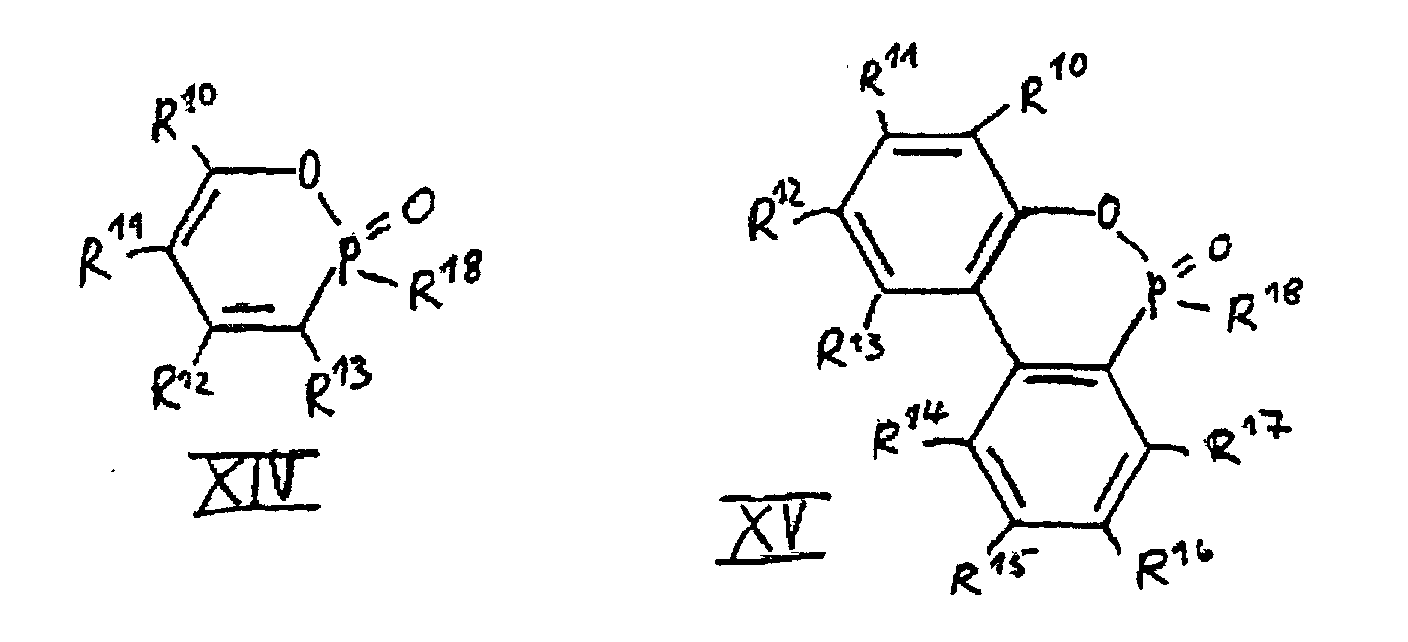
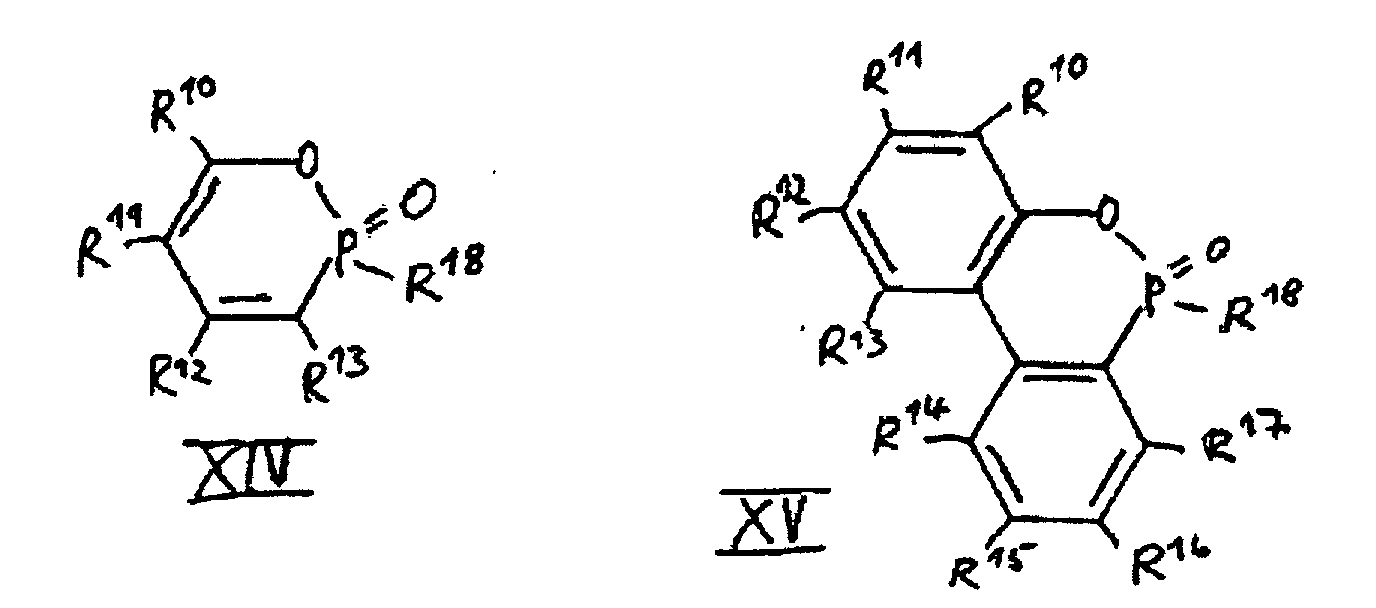
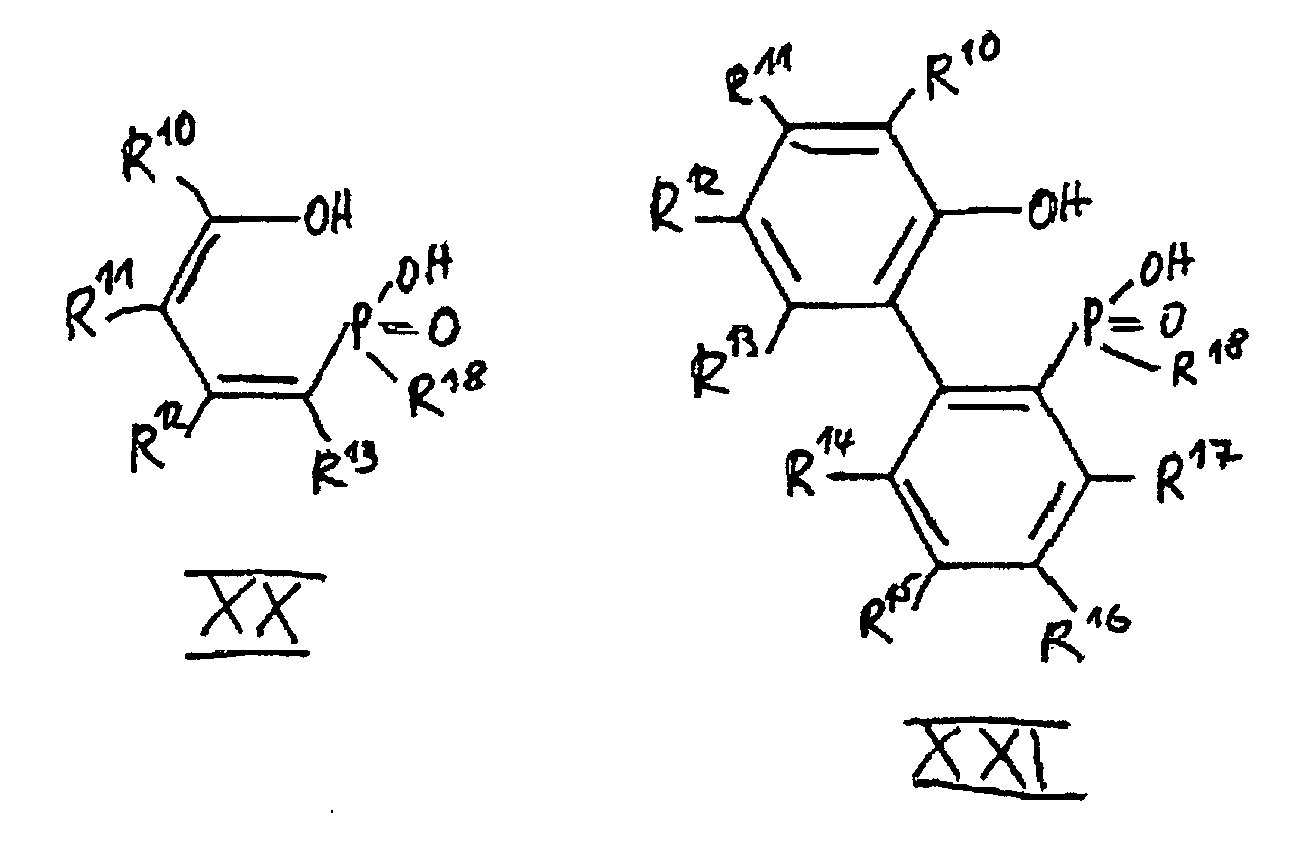
- R 18 and R 34 are those mentioned above for R 1 .
- the radicals R 10 to R 17 and R 30 to R 33 are each independently hydrogen or a hydrocarbon group, for example a linear or denatured aliphatic hydrocarbon group.
- the hydrocarbon groups may be linear or branched alkyl groups, cycloalkyl groups, aryl groups, alkylaryl groups or arylalkyl groups, whereby combinations of the abovementioned possibilities are also to be considered.
- the hydrocarbon groups may be linked together to form saturated and unsaturated cycles, with five- and six-membered rings being preferred. Particularly preferred is the link to benzene nuclei and inclusion of the group scaffold.
- the radicals R 10 to R 17 and R 30 to are particularly preferred. R 33, however, free of heteroatoms.
- a plurality of R 10 to R 17 and R 30 to R 33 are hydrogen, for example, all R 10 to R 17 and R 30 to R 33 are hydrogen.
- nitrogen-containing compound includes the nitrogen-containing Compounds suitable for ammonium salt formation, i. Quaternization, are capable. But here is the present of purely quaternary compounds or groups, e.g. tetramethylammonium or N-methylimidazolium salts or groups, not locked out.
- the nitrogen-containing compound to which all of the following comments refer is not NH 3 .
- NH 3 preferably can not be included in component (b) or that the reaction generally has to take place preferably in the absence of NH 3 , but only that if NH 3 should be present, NH 3 is not the only one preferred nitrogen-containing compound according to the following statements.
- the nitrogen-containing compound may be an ammonium salt (in the conventional meaning of the term), i. she contains one or more non-basic groups (e.g. be quaternized in a polyamine several nitrogen atoms), as long as the nitrogenous compound is the mandatory one Conditions fulfilled.
- This ammonium group can be derived from an organic or a mineral acid. For the sake of simplicity, the following is not always explicit referred to these salts.
- Preferred nitrogen-containing compounds (b) are those in the state the technique known as a hardener or accelerator.
- Amines or imidazoles are used as nitrogen-containing But compounds are also suitable polyamines, ureas, Triazines, triazoles, triazone, pyrimidines, thiodiazoles and similar heterocycles and derivatives of said.
- exemplary nitrogen-containing compounds are tetramethylethylenediamine, Dimethyloctylamine, dimethylaminoethanol, dimethylbenzylamine, 2,4,6-tris (dimethylaminomethyl) phenol, N, N'-tetramethyldiaminodiphenylmethane, N, N'-dimethylpiperazine, N-methylmorpholine, N-methylpiperidine, N-ethyl pyrrolidine, 1,4-diazabicyclo [2.2.2] octane and quinolines.
- Suitable imidazoles are, for example, 1-methylimidazole, 2-methylimidazole, 1,2-dimethylimidazole, 1,2,4,5-tetramethylimidazole, 2-ethyl-4-methylimidazole, 1-cyanoethyl-2-phenylimidazole and 1- (4,6-diamino-s-triazinyl-2-ethyl) -2-phenylimidazole.
- 1-methylimidazole and dimethylbenzylamine particularly preferred.
- As a nitrogen-containing compound furthermore imidazole, 2-methylimidazole and 2-ethyl-4-methylimidazole prefers.
- Preferred aliphatic amines are those amines which are derived from the group NR 2 R 3 , where the radicals R 2 and R 3 have the meaning given above.
- the phosphorus-containing Component (a) in its ring-closed form is in the embodiment i) to a Derivative of the intramolecular ester of 4-hydroxybutane-1-phosphinic acid or to the intramolecular ester of 4-hydroxybutane-1-phosphinic acid (Formulas X-XV) or ii) a derivative of intramolecular Anhydride of 2-hydroxycarbonyl-ethyl-phosphinic acid or the intramolecular anhydride of 2-hydroxycarbonyl-ethyl-phosphinic acid (Formulas XXX and XXI).
- Preferred mono- or polyhydric hydroxy compounds are the ones in the section "Latent Ammonium Salts" mono- or polyhydric hydroxy compounds already mentioned, preferably the said aliphatic mono- or polyvalent ones Alcohols and mono- or polyhydric phenols.
- the ring opening of the ring-closed Form of component (a) under reaction of component (a) with the Component (c) expires.
- Is the component (a) ii) of the ring-closed Form of 2-hydroxycarbonyl-ethyl-phosphinic acid derived it may, for example, to esterify the carboxylic acid group resulting in a 2-position carboxylic ester functionalized Ethylphosphinic acid can be formed.
- the hydroxy compound is a polyvalent hydroxy compound, so it can lead to the linking of several phosphinic acid groups.
- component (b) which is a nitrogen-containing compound comprising at least one basic NH function
- component (a) is present in the ring-closed form, then the process according to the invention can be carried out in such a way that a ring-opening reaction is then achieved when the Component (b) comprises a nitrogen-containing compound which has at least one basic NH function.
- the Component (b) comprises a nitrogen-containing compound which has at least one basic NH function.
- one (or more) nitrogenous ones can of course be used Compound (s) are used, the no has basic NH function.
- mole equivalents refers to mole equivalents. This means, for example, the mono- or polyhydric hydroxy compound (and the same applies to the nitrogen-containing compound), that one mole equivalent 1 / n-tel of the amount of n-valent Hydroxy compound.
- the processes of the invention that is the process of hydrolysis the latent combination compound and the implementation of Components (a), (b) and optionally (c) are not on limited molar reactions.
- the latent combination compound only with a submolar Amount of reagent to hydrolyze, resulting in a mixture of latent Combination compound and latent ammonium salt could result.
- component (a), component (b) and optionally component (c) in one reacted molar ratio, i. in any order added to each other.
- the inventive methods are usually with a chemical reaction equation describable, selected reactions are shown in Schemes 1-3.
- the method makes it possible that in superimposed reactions further rearrangements of the latent combination compounds according to the invention or latent ammonium salts.
- Such superimposed reaction for example, under formal splitting of water, e.g. can this dehydration intramolecular or intermolecular and on esterification, Etherification, anhydride formation, amide formation, etc. go back.
- One Example is that in Scheme 1 from 1-I to 1-III De-hydration reaction, which has already been discussed. This water of reaction can in the process according to the invention intervene, in Scheme 1 this is exemplified by the hydrolysis of 1-I to 1-IIa shown.
- the Epoxy resin system also a solvent (dilution) medium include.
- This solvent (diluent) may be selected from the Preparation of the latent combination compound according to the invention or the latent ammonium salt according to the invention, for Example, if this according to a method of the invention were manufactured. Then the inventive method was in performed this solvent.
- the solvent (dilution) agent but you can also introduce later in the epoxy resin.
- Exemplary solvents are aprotic and preferably have polar character. Examples of these are: N-methylpyrrolidone; dimethylformamide; Ethers, such as diethyl ether, tetrahydrofuran, Dioxane, ethylene glycol mono- or diether, propylene glycol mono- or diether, butylene glycol mono- or diether of monoalcohols with an optionally branched alkyl radical of 1 to 6 carbon atoms; Ketones, such as acetone, Methyl ethyl ketone, methyl isopropyl ketone, methyl isobutyl ketone, Cyclohexanone and the like; Esters, such as ethyl acetate, butyl acetate, Ethyl glycol acetate, methoxypropyl acetate; halogenated hydrocarbons; However, (cyclo) aliphatic and / or aromatic hydrocarbons, such as hexane, h
- the latent combination compounds of the invention and latent ammonium salts can Mixtures based on epoxy resin compounds as reactive Be added to the ingredient and thus to the latent Curing / acceleration and flame retardant of the networked Epoxy material can be used.
- the used Amount of compounds of the invention within wide limits vary, generally from 0.1 to 100 parts by weight, based on 100 parts by weight of epoxy resin, preferably 0.5 up to 30 parts. It is known that for certain applications, e.g. Printed circuit boards, up to 30% by weight of flame retardants are necessary, to achieve the appropriate specifications.
- the cheapest Amount of latent combination compounds and latent ones Ammonium salts in the respective epoxy resin system depends, for example from the nature of the epoxy resin and the type and presence other components - including flame retardants and co-hardeners / accelerators - from and can in the individual case by the specialist in simple and fast way set by few attempts be, where the epoxy resin system is a broad or a very specific application potential may have.
- the invention also relates to compositions containing a latent Combination compound or a latent ammonium salt together with an epoxy resin, and compositions containing a Pre-extended epoxy resin based on one of the invention Contain connections.
- Pre-extended epoxy resins are still free epoxide-containing pre-reacted adducts of one or a plurality of epoxy resins with one or more compounds, the contain at least two functional groups per molecule, the react with epoxide groups.
- compositions of the invention may also further conventional additives and modifiers in one for the each purpose suitable amount, such as Heat stabilizers, light stabilizers, UV absorbers, antioxidants, antistatic agents, preservatives, adhesion promoters, Fillers, pigments, lubricants, foaming agents, Fungicides, plasticizers, processing aids, others Flame retardant additives, further hardeners / accelerators and agents to reduce smoke.
- additives and modifiers in one for the each purpose suitable amount, such as Heat stabilizers, light stabilizers, UV absorbers, antioxidants, antistatic agents, preservatives, adhesion promoters, Fillers, pigments, lubricants, foaming agents, Fungicides, plasticizers, processing aids, others Flame retardant additives, further hardeners / accelerators and agents to reduce smoke.
- the epoxy resin system processed in a resin injection process.
- the necessary sufficient processing stability at medium temperatures as well as short curing time at higher temperatures are going through the latent combination compounds of the invention and latent ammonium salts of this invention possible. Also does the possibility of comparatively low curing temperatures Systems also for the rational processing of adhesives interesting.
- the invention relates to a process for the preparation of fiber reinforced composites with flame retardant properties, which is characterized in that it is the cure a erfindungemeze field prepreg at a temperature between 70 ° C and 160 ° C, in particular 90 ° C and 140 ° C, comprises.
- the invention relates to a fiber-reinforced composite material with flame-retardant properties, the hardened form a prepreg according to the invention.
- the latent ones obtainable by the present invention Combination compounds and latent ammonium salts can be fluid and offer compared to conventional hardeners, which are solids, numerous processing benefits.
- novel one-component epoxy resin systems the problem of segregation of the hardener / accelerator component from the resin during storage and / or curing be overcome.
- the epoxy resin systems according to the invention are at medium temperatures in resin injection systems Easy to process while at slightly higher temperatures completely harden.
- the epoxy resin system comprises at least one epoxy resin component and at least one of the latent combination compounds of the invention or latent ammonium salts, the use of Mixtures of latent combination compound and latent Ammonium salt, with each other and / or with other ingredients (e.g., the above additives and modifiers), in any ratio, is possible.
- the epoxy resin systems obtainable by this invention have a defined curing temperature, which is due to a latency of inventive compounds is achieved.
- the initiation temperature is by chemical modification of the latent Combination compounds and latent ammonium salts set.
- the products that are made by the invention accessible to novel unicomponent resins, Flame retardant equipped.
- a phosphorus-containing component (a) of the ring-closed formula XXX was used in which R 30 to R 33 were hydrogen and R 34 was methyl:
- component (b) 1-methylimidazole (N-methylimidazole) is selected, and component (c) is methanol.
- reaction of components (a), (b) and (c) may be in any Order and gives in all cases 1-Methylimidazolium- (2-methoxycarbonyl-ethyl) (methyl) phosphinate.
- This latent ammonium salt of the invention is at room temperature liquid.
- a mixture of 10 wt .-% latent ammonium salt and 90% by weight of epoxy resin was prepared.
- the system is independent Resin type, storage stable at room temperature, and hardens even at 70 ° C for several hours not what its suitability for the application in Harzinjetechnischsvon clarified.
- a phosphorus-containing component (a) of the ring-closed formula XXX was used in which R 30 to R 33 were hydrogen and R 34 was methyl (see Example 1).
- component (b) 1-methylimidazole (N-methylimidazole) was chosen, and component (c) is phenol.
- reaction of components (a), (b) and (c) may be in any Order and gives in all cases 1-methylimidazolium (2-phenoxycarbonyl-ethyl) (methyl) phosphinate.
- This latent ammonium salt of the invention is at room temperature liquid.
- a mixture of 10 wt .-% latent ammonium salt and 90% by weight of epoxy resin was prepared.
- the epoxy resin system is, regardless of resin type, storage stable at room temperature and hardens even at 70 ° C for several hours not.
- a phosphorus-containing component (a) of the ring-closed formula XXX was used in which R 30 to R 33 were hydrogen and R 34 was methyl (see Example 1).
- component (b) 1-methylimidazole (N-methylimidazole) was selected, and component (c) is ethylene glycol.
- reaction of components (a), (b) and (c) may be in any order and in all cases gives the di- (1-methylimidazolium) salt of the bis-phosphinate linked by the dihydroxy compound ethylene glycol.
- the latent ammonium salt is shown below:
- This latent ammonium salt of the invention is at room temperature also liquid.
- a mixture of 10% by weight latent Ammonium salt and 90% by weight of epoxy resin were prepared.
- the Epoxy resin system is, regardless of resin type, at room temperature stable on storage and does not harden even at 70 ° C for several hours.
Landscapes
- Chemical & Material Sciences (AREA)
- Organic Chemistry (AREA)
- Health & Medical Sciences (AREA)
- Chemical Kinetics & Catalysis (AREA)
- Medicinal Chemistry (AREA)
- Polymers & Plastics (AREA)
- Life Sciences & Earth Sciences (AREA)
- Biochemistry (AREA)
- General Health & Medical Sciences (AREA)
- Molecular Biology (AREA)
- Epoxy Resins (AREA)
- Compositions Of Macromolecular Compounds (AREA)
Claims (45)
- Composé de combinaison latent répondant à la formule Idans laquelle R1 est un reste général R0, où

R0 est un hydrogène ou un groupement hydrocarboné saturé ou insaturé, linéaire ou ramifié, ayant de 1 à 100 atomes de carbone, qui peut éventuellement contenir un ou plusieurs hétéroatomes choisis parmi l'oxygène, l'azote, le soufre, le phosphore, le silicium et les halogènes,
R2 et R3, indépendants l'un de l'autre, ont la signification donnée pour R0, dans laquelle R2 et R3 peuvent être reliés pour former un ou plusieurs cycles,
A est choisi dans le groupe constitué de OH et COX, où X est choisi dans le groupe constitué de OH, NH2, NHRa, NRbRc ou bien est O-M+, où Ra à Rc, indépendants les uns des autres, ont la signification donnée pour R0, où Rb et Rc peuvent être reliés pour former un ou plusieurs cycles, et où M+ est un cation métallique quelconque, et
Z est une chaíne hydrocarbonée divalente, linéaire ou ramifiée, saturée ou insaturée, ayant de 2 à 100 atomes de carbone, qui peut éventuellement contenir un ou plusieurs cycles et peut éventuellement contenir un ou plusieurs hétéroatomes choisis parmi l'oxygène, l'azote, le soufre, le phosphore, le silicium et les halogènes. - Composé de combinaison latent selon la revendication 1, caractérisé en ce que R1 est différent de A-Z.
- Composé de combinaison latent selon la revendication 1 ou 2, caractérisé en ce que R2 n'est pas un hydrogène.
- Composé de combinaison latent selon la revendication 3, caractérisé en ce que ni R2 et ni R3 ne sont des hydrogènes.
- Composé de combinaison latent selon l'une des revendications précédentes, caractérisé en ce que R1 est choisi parmi l'hydrogène, le méthyle et les groupements hydrocarbonés qui présentent au moins une fonction époxy.
- Composé de combinaison latent selon l'une des revendications précédentes, caractérisé en ce qu'au moins l'un des restes R2 et R3 est un groupement hydrocarboné, et en ce que ce groupement hydrocarboné est choisi parmi les groupements hydrocarbonés linéaires ou ramifiés, aliphatiques ou arylaliphatiques.
- Composé de combinaison latent selon l'une des revendications précédentes, caractérisé en ce que, dans NR2R3, les groupements R2 et R3 sont reliés et dérivent de l'imidazole, du 2-méthylimidazole et du 2-éthyl-4-méthylimidazole.
- Composé de combinaison latent selon l'une des revendications précédentes, caractérisé en ce que Z n'est pas interrompu par des hétéroatomes dans la chaíne hydrocarbonée.
- Composé de combinaison latent selon la revendication 8, caractérisé en ce que Z ne contient pas d'hétéroatome.
- Composé de combinaison latent selon l'une des revendications précédentes, caractérisé en ce quea) A est égal à OH etb) Z comporte, dans la chaíne, 4 atomes de carbone.
- Composé de combinaison latent selon la revendication 10, caractérisé en ce que Z est choisi parmi un biphén-2,2'-diyle et un dérivé de biphén-2,2'-diyle.
- Composé de combinaison latent selon l'une des revendications 1 à 9, caractérisé en ce quea) A est COOHb) R1 est un méthyle ou un hydrogène etc) Z est linéaire ou ramifié, et est un alcan-(α,β)-diyle ou un arylalcan-(α,β)-diyle.
- Composé de combinaison latent selon la revendication 12, caractérisé en ce queb) R1 est un méthyle.
- Composé de combinaison latent selon la revendication 12 ou la revendication 13, caractérisé en ce quec) Z est -CH2CH2-.
- Procédé de préparation d'un sel d'ammonium latent, caractérisé en ce qu'on fait réagir au moins un composé de combinaison latent selon l'une des revendications 1 à 4 avec au moins un réactif, lequel contient de l'eau, dans lequel la liaison P-N représentée dans la formule I de la revendication 1 est rompue par hydrolyse.
- Procédé de préparation d'un sel d'ammonium latent, caractérisé en ce qu'on fait réagir au moins un composé de combinaison latent selon l'une des revendications 1 à 9 et 12 à 14, dans laquelle A est égal à COOH, avec au moins un réactif, lequel comprend au moins un composé choisi parmi l'eau et un composé hydroxylé mono ou polyvalent, dans lequel la liaison P-N représentée dans la formule I de la revendication 1 est rompue par hydrolyse.
- Procédé selon la revendication 16, caractérisé en ce que le composé hydroxylé est choisi parmi les phénols mono ou polyvalents et les alcools mono ou polyvalents.
- Procédé selon la revendication 17, caractérisé en ce que le composé hydroxylé est choisi parmi le phénol et les alcools mono ou polyvalents aliphatiques.
- Procédé selon l'une des revendications 16 à 18, caractérisé en ce qu'il comprend l'estérification du groupement A par un composé hydroxylé mono ou polyvalent.
- Sel d'ammonium latent, susceptible d'être obtenu par le procédé selon l'une des revendications 15 à 19.
- Procédé de préparation d'un composé de combinaison latent ou d'un sel d'ammonium latent, caractérisé en ce qu'on fait réagir au moins un composant contenant du phosphore (a) choisi parmiavec un composant (b) qui comprend un composé contenant de l'azote, lequel ne comporte pas de fonction NH basique, le procédé comprenant la réaction avec au moins un composant (c) choisi parmi l'eau et un composé hydroxylé mono ou polyvalent.i) les dérivés de l'ester intramoléculaire de l'acide 4-hydroxy-butan-1-phosphinique répondant à l'une des formules à cycle fermé X à XV suivantes :
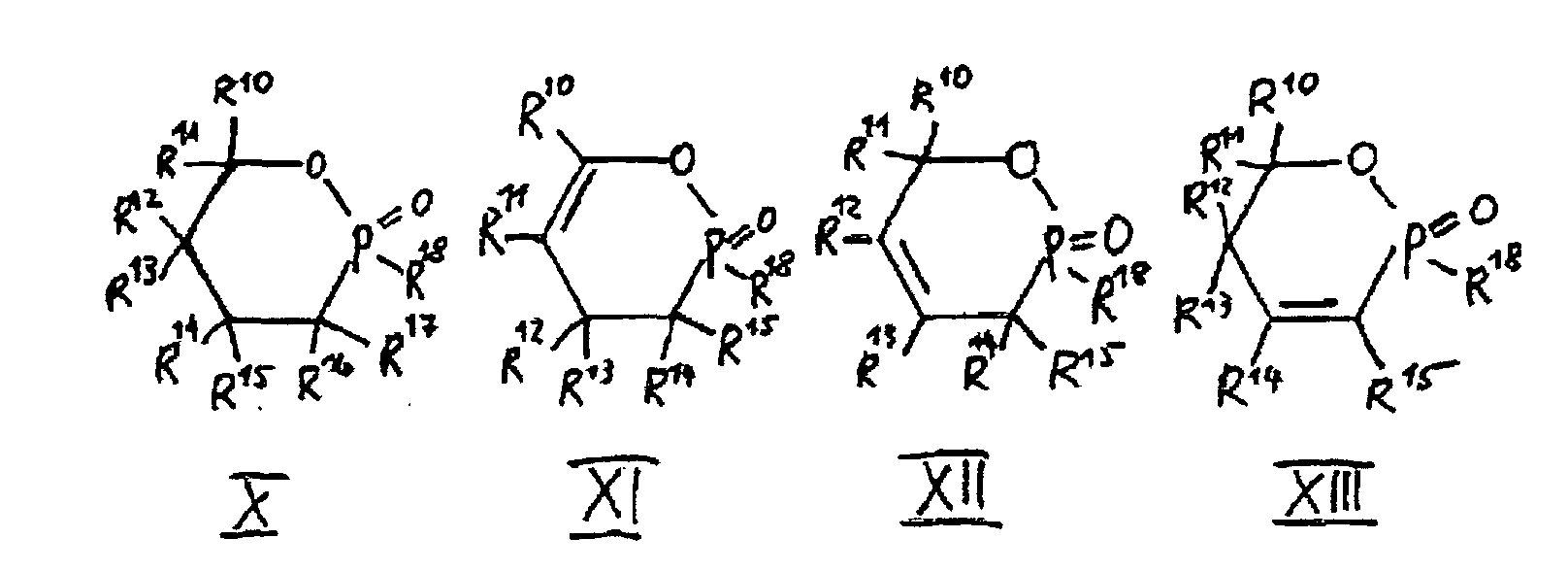 dans lesquelles les groupes R10 à R18 ont, indépendants les uns des autres, la signification générale donnée pour R0 dans la revendication 1, dans lequel deux ou plusieurs des R10 à R17 pouvant être reliés pour former un ou plusieurs cycles, et
 ii) les dérivés du phospholane répondant à l'une des formules à cycle fermé XXX et XXXI suivantes :dans lesquelles les groupes R30 à R34ont, indépendants les uns des autres, la signification générale donnée pour R0 dans la revendication 1, et où un ou plusieurs des R30 à R33 peuvent être reliés pour former un ou plusieurs cycles,
- Procédé de préparation d'un composé de combinaison latent ou d'un sel d'ammonium latent, caractérisé en ce qu'on fait réagir au moins un composant contenant du phosphore (a) choisi parmiavec un composant (b) qui comprend un composé contenant de l'azote, lequel comporte au moins une fonction NH basique.i) les dérivés de l'ester intramoléculaire de l'acide 4-hydroxy-butane-1-phosphinique répondant à l'une des formules à cycle fermé X à XV suivantes :
 dans lesquelles les groupes R10 à R18 ont, indépendants les uns des autres, la signification générale donnée pour R0 dans la revendication 1, deux ou plusieurs des R10 à R17 pouvant être reliés pour former un ou plusieurs cycles et
 ii) les dérivés du phospholane répondant à l'une des formules à cycle fermé XXX et XXXI suivantes :dans lesquelles les groupes R30 à R34 ont, indépendants les uns des autres, la signification générale donnée pour R0 dans la revendication 1, et un ou plusieurs des R30 à R33 peuvent être réliés pour former un ou plusieurs cycles,
- Procédé de préparation d'un composé de combinaison latent ou d'un sel d'ammonium latent, caractérisé en ce qu'on fait réagir au moins un composé contenant du phosphore (a) choisi parmiavec un composant (b) qui comprend un composé contenant de l'azote.i) les dérivés de l'acide 4-hydroxy-butane-1-phosphinique répondant à l'une des formules à cycle fermé XVI à XXI suivantes :
 dans lesquelles les groupes R10 à R18 ont, indépendants les uns des autres, la signification générale donnée pour R0 dans la revendication 1, deux ou plusieurs des R10 à R17 pouvant être reliés pour former un ou plusieurs cycles, et
 ii) les dérivés du phospholane répondant à l'une des formules à cycle ouvert XXXII et XXXIII suivantes :dans lesquelles les groupes R30 à R34 ont, indépendants les uns des autres, la signification donnée pour R0 dans la revendication 1, et un ou plusieurs des R30 à R33 peuvent être reliés pour former un ou plusieurs cycles,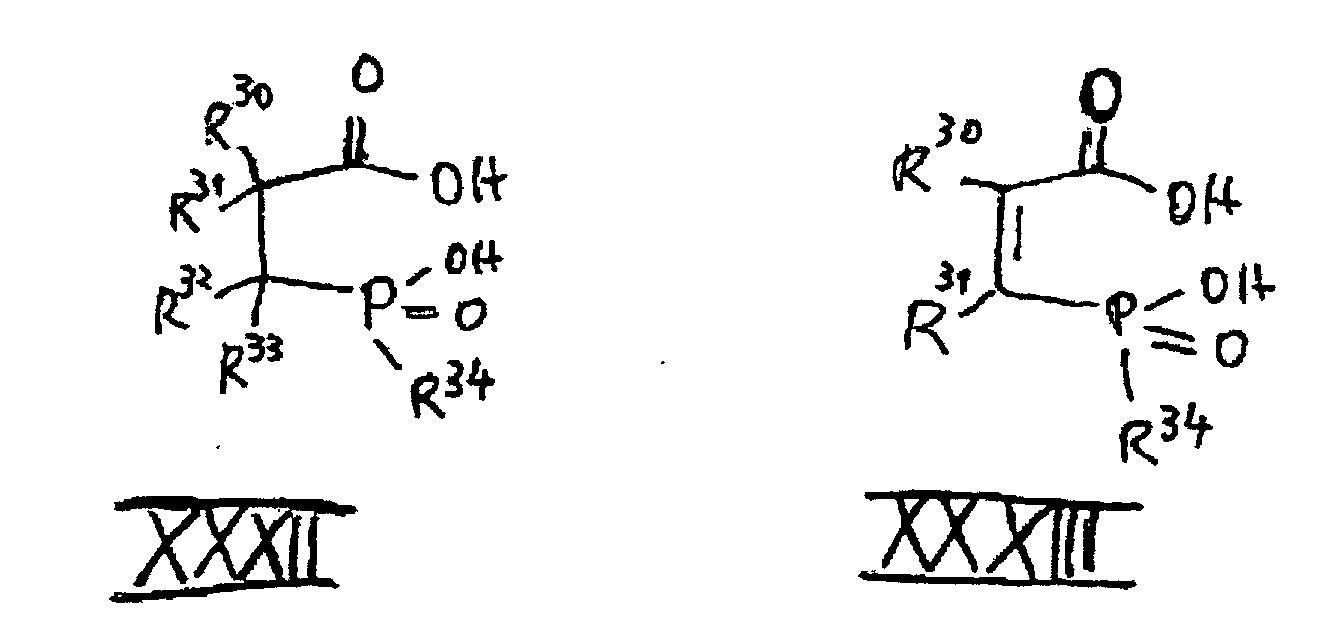
- Procédé selon l'une des revendications 21 à 23, caractérisé en ce que les R10 à R17 et R30 à R33, sont choisis, indépendants les uns des autres, parmi l'hydrogène et les groupements hydrocarbonés linéaires ou ramifiés aliphatiques.
- Procédé selon la revendication 24, caractérisé en ce que les groupes R10 à R17 et R30 à R33 sont tous des hydrogènes.
- Procédé selon l'une des revendications 21 à 25, caractérisé en ce que les groupes R18 à R34 sont, indépendants les uns des autres, choisis dans le groupe constitué par l'hydrogène, le méthyle et les groupements hydrocarbonés qui comportent au moins une fonction époxy.
- Procédé selon l'une des revendications 21 à 26, caractérisé en ce que dans le phospholane des formules XXX à XXXIII, les groupes R30 à R33 sont des hydrogènes, et R34 est un méthyle.
- Procédé selon l'une des revendications 22 à 27, caractérisé en ce qu'il comprend une réaction avec au moins un réactif choisi parmi l'eau et les composés hydroxylés mono ou polyvalents.
- Procédé selon la revendication 21 ou 28, caractérisé en ce que le composé hydroxylé mono ou polyvalent est choisi parmi les phénols mono ou polyvalents et les alcools mono ou polyvalents.
- Procédé selon la revendication 29, caractérisé en ce que le composé hydroxylé est choisi parmi le phénol et les alcools aliphatiques mono ou polyvalents.
- Procédé selon l'une des revendications 22 à 29, caractérisé en ce que le composé contenant de l'azote est choisi dans le groupe constitué par l'imidazole, le 2-méthylimidazole et le 2-éthyl-4-méthylimidazole, ainsi que leurs sels.
- Procédé selon l'une des revendications 21 et 23 à 30, caractérisé en ce que le composé contenant de l'azote est choisi dans le groupe constitué par la tétraméthyléthylènediamine, la diméthyloctylamine, le diméthylaminoéthanol, la diméthylbenzylamine, le 2,4,6-tris(diméthylaminométhyl)-phénol, le N,N'-tétraméthyldiaminodiphénylméthane, la N,N'-diméthylpipérazine, la N-méthylmorpholine, la N-méthylpipéridine, la N-éthylpyrrolidine, le 1,4-diazabicyclo[2.2.2]-octane, la quinoléine, le 1-méthylimidazole, le 1,2-diméthylimidazole, le 1,2,4,5-tétraméthylimidazole, le 1-cyanoéthyl-2-phénylimidazole et le 1-(4,6-diamino-s-triazinyl-2-éthyl)-2-phénylimidazole, et leurs sels.
- Utilisation d'un composé de combinaison latent ou du sel d'ammonium latent selon l'une des revendications 1 à 14 et 20 ou obtenu selon le procédé de l'une des revendications 21 à 32 dans un système de résine époxy à un seul composant.
- Utilisation selon la revendication 33, caractérisé en ce que le système de résine époxy à un seul composant est un matériau adhésif en résine époxy à un seul composant.
- Système de résine époxy à un seul composant, caractérisé en ce qu'il comprend au moins un composant de résine époxy et au moins un composant durcisseur/accélérateur choisi parmi les composés de combinaison latents et les sels d'ammonium latents selon l'une des revendications 1 à 14 et 20 ou obtenu selon le procédé de l'une des revendications 21 à 32.
- Matériau adhésif en résine époxy à un seul composant, caractérisé en ce qu'il comprend au moins un composant en résine époxy et au moins un composant durcisseur/accélérateur choisi parmi les composés de combinaison latents et les sels d'ammonium latents selon l'une des revendications 1 à 14 et 20 ou obtenu par le procédé selon l'une des revendications 21 à 32.
- Procédé de préparation de corps moulés, d'enrobages et de collages avec des propriétés ignifugeantes, caractérisé en ce qu'il comprend l'utilisation d'un système de résine époxy à un seul composant selon la revendication 35 ou d'un matériau adhésif en résine époxy à un seul composant selon la revendication 36 et une étape de durcissement.
- Corps moulés, enrobages et collages avec des propriétés ignifugeantes, caractérisé en ce qu'ils sont susceptibles d'être obtenus par durcissement d'un système de résine époxy à un seul composant selon la revendication 35 ou d'un matériau adhésif en résine époxy à un seul composant selon la revendication 36.
- Procédé d'injection de résine pour des matériaux composites renforcés par des fibres et avec des propriétés ignifugeantes, caractérisé en ce qu'il comprenda) l'imprégnation d'un matériau de renforcement minéral ou organique sous la forme de fibres, d'un voile, d'un tissu ou d'un matériau de surface, avec un système de résine époxy à un seul composant selon la revendication 35 etb) le durcissement du matériau de renforcement imprégné à une température comprise entre 70 °C et 160°C.
- Procédé selon la revendication 39, caractérisé en ce que le durcissement a lieu à une température comprise entre 90 °C et 140 °C.
- Préimprégné, caractérisé en ce qu'il comprend un matériau de renforcement minéral ou organique sous la forme de fibres, d'un voile, d'un tissu ou d'un matériau de surface, lequel est imprégné d'un système de résine époxy à un seul composant selon la revendication 35.
- Procédé de préparation de matériaux composites renforcés par des fibres et avec des propriétés ignifugeantes, caractérisé en ce qu'il comprend le durcissement d'un préimprégné selon la revendication 41 à une température comprise entre 70 °C et 160 °C.
- Procédé selon la revendication 42, caractérisé en ce que le durcissement a lieu à une température comprise entre 90 °C et 140 °C.
- Matériau composite renforcé par des fibres et avec des propriétés ignifugeantes, caractérisé en ce qu'il se présente sous la forme d'un préimprégné selon la revendication 41, durci.
- Plaquette à base de préimprégné, caractérisée en ce que sa structure comprend au moins un matériau composite selon la revendication 44.
Applications Claiming Priority (2)
| Application Number | Priority Date | Filing Date | Title |
|---|---|---|---|
| DE10006592 | 2000-02-09 | ||
| DE10006592A DE10006592A1 (de) | 2000-02-09 | 2000-02-09 | Latente Kombinationsverbindungen und latente Ammoniumsalze aus Epoxidharzhärter und Flammschutzmittel sowie daraus hergestellte Epoxidharz-Systeme und -Produkte |
Publications (3)
| Publication Number | Publication Date |
|---|---|
| EP1125960A2 EP1125960A2 (fr) | 2001-08-22 |
| EP1125960A3 EP1125960A3 (fr) | 2002-08-21 |
| EP1125960B1 true EP1125960B1 (fr) | 2005-05-11 |
Family
ID=7630914
Family Applications (1)
| Application Number | Title | Priority Date | Filing Date |
|---|---|---|---|
| EP01100119A Expired - Lifetime EP1125960B1 (fr) | 2000-02-09 | 2001-01-12 | Composé latent de combinaison et un sel d'ammonium latent à partir d'un agent durcisseur de résines époxydes et d'un agent retardant la flamme, systèmes- ou produits de résines époxydes qui en sont préparés |
Country Status (4)
| Country | Link |
|---|---|
| US (1) | US6555227B2 (fr) |
| EP (1) | EP1125960B1 (fr) |
| AT (1) | ATE295385T1 (fr) |
| DE (2) | DE10006592A1 (fr) |
Families Citing this family (24)
| Publication number | Priority date | Publication date | Assignee | Title |
|---|---|---|---|---|
| DE10242017B4 (de) * | 2002-09-11 | 2006-12-21 | Schill + Seilacher Aktiengesellschaft | Härter für Epoxidharze, dessen Verwendung und damit gehärtetes Epoxidharz |
| DE102006058414A1 (de) | 2006-12-12 | 2008-06-19 | Clariant International Limited | Carboxyethyl(alkyl)phosphinsäure-Alkylestersalze |
| CN102057010A (zh) * | 2008-04-11 | 2011-05-11 | 3M创新有限公司 | 单组分环氧基结构粘合剂 |
| DK2288469T3 (da) | 2008-05-27 | 2013-07-08 | Awds Technologies Srl | Trådføringssystem |
| CN102159534B (zh) | 2008-07-23 | 2014-05-07 | 3M创新有限公司 | 反应性液体改性剂 |
| US8491749B2 (en) | 2008-07-23 | 2013-07-23 | 3M Innovative Properties Company | Two-part epoxy-based structural adhesives |
| KR20110034673A (ko) | 2008-07-23 | 2011-04-05 | 쓰리엠 이노베이티브 프로퍼티즈 컴파니 | 이액형 에폭시계 구조용 접착제 |
| DK2174741T3 (da) | 2008-10-07 | 2012-10-01 | Sidergas Spa | Låg til svejsetrådsbeholder |
| US8674263B2 (en) | 2009-07-20 | 2014-03-18 | Awds Technologies Srl | Wire guiding liner, in particular a welding wire liner, with biasing means between articulated guiding bodies |
| US8389901B1 (en) | 2010-05-27 | 2013-03-05 | Awds Technologies Srl | Welding wire guiding liner |
| US8882018B2 (en) | 2011-12-19 | 2014-11-11 | Sidergas Spa | Retainer for welding wire container and welding wire container with retainer |
| CN103087312B (zh) * | 2012-12-19 | 2015-04-29 | 宁波长阳科技有限公司 | 一种p-n型阻燃母粒,阻燃尼龙工程塑料及其制备方法 |
| US20150353832A1 (en) * | 2013-01-30 | 2015-12-10 | H & C Scientific Resources International, LLC | Phosphinate ionic liquid compositions and methods of use |
| US10294065B2 (en) | 2013-06-06 | 2019-05-21 | Sidergas Spa | Retainer for a welding wire container and welding wire container |
| US10343231B2 (en) | 2014-05-28 | 2019-07-09 | Awds Technologies Srl | Wire feeding system |
| US10010962B1 (en) | 2014-09-09 | 2018-07-03 | Awds Technologies Srl | Module and system for controlling and recording welding data, and welding wire feeder |
| US10350696B2 (en) | 2015-04-06 | 2019-07-16 | Awds Technologies Srl | Wire feed system and method of controlling feed of welding wire |
| CN105153223B (zh) * | 2015-07-31 | 2018-03-20 | 江汉大学 | 一种用于3d打印的sla型含磷丙烯酸酯预聚物及其制备方法 |
| CN106008596B (zh) * | 2016-05-17 | 2018-05-08 | 安徽国星生物化学有限公司 | 一种草胺膦中间体4-(羟基甲基磷酰基)-2-羰基丁酸的制备方法 |
| US9950857B1 (en) | 2016-10-17 | 2018-04-24 | Sidergas Spa | Welding wire container |
| CN108641091B (zh) * | 2018-04-24 | 2021-03-30 | 利尔化学股份有限公司 | 聚甲基次磷酸乙二醇酯铝盐及其制备方法和应用 |
| CN109134929B (zh) * | 2018-08-24 | 2020-05-12 | 北京理工大学 | 一种螺环膨胀阻燃剂及其制备方法 |
| US11174121B2 (en) | 2020-01-20 | 2021-11-16 | Awds Technologies Srl | Device for imparting a torsional force onto a wire |
| US11278981B2 (en) | 2020-01-20 | 2022-03-22 | Awds Technologies Srl | Device for imparting a torsional force onto a wire |
Citations (7)
| Publication number | Priority date | Publication date | Assignee | Title |
|---|---|---|---|---|
| US3224889A (en) * | 1960-12-17 | 1965-12-21 | Hoechst Ag | Anti-static high molecular weight compounds |
| US3328319A (en) * | 1963-12-21 | 1967-06-27 | Henkel & Cie Gmbh | Process for the hardening of epoxide resins |
| US3595873A (en) * | 1968-05-24 | 1971-07-27 | Dow Chemical Co | Imidazolyl phosphinates and phosphinothioates |
| US4308197A (en) * | 1980-04-21 | 1981-12-29 | Mcdonnell Douglas Corporation | Fire resistant composites |
| US4880892A (en) * | 1987-08-31 | 1989-11-14 | Ciba-Geigy Corporation | Composition comprising an epoxy resin, a phenol and an advancement catalyst |
| EP0806429A2 (fr) * | 1996-05-06 | 1997-11-12 | Schill & Seilacher GmbH & Co. | Résines époxy résistants aux flammes et agents ignifugeantes pour résines époxy |
| US5830973A (en) * | 1996-04-01 | 1998-11-03 | Hoechst Aktiengesellschaft | Phosphorus-modified epoxy resins comprising epoxy resins and phosphorus-containing compounds |
Family Cites Families (12)
| Publication number | Priority date | Publication date | Assignee | Title |
|---|---|---|---|---|
| DE1154624B (de) * | 1960-08-12 | 1963-09-19 | Schering Ag | Haerter fuer Epoxyharze |
| US3359276A (en) * | 1963-12-24 | 1967-12-19 | Monsanto Res Corp | Phosphinic amides |
| US3324889A (en) * | 1964-08-31 | 1967-06-13 | Barksdale Mfg Corp | Solenoid-actuated valve |
| US3635894A (en) | 1969-11-06 | 1972-01-18 | Ppg Industries Inc | Curable epoxy resin compositions containing organoimidazolium salt |
| US3632427A (en) | 1970-05-15 | 1972-01-04 | Air Prod & Chem | Epoxy resin and imidazole alkyl acid phosphate fiber treatment |
| US3642698A (en) | 1970-05-15 | 1972-02-15 | Air Prod & Chem | Epoxy resin curing with imidazole alkyl acid phosphate salt catalyst |
| US3678007A (en) | 1971-08-23 | 1972-07-18 | Ppg Industries Inc | Metal salt complexes of imidazolium salts as curing agents for one part epoxy resins |
| DE4231622C2 (de) | 1992-09-22 | 1996-09-05 | Bakelite Ag | Verfahren zur Herstellung von Metallneutralkomplexen mit hoher Koordinationszahl und deren Verwendung |
| DE4231680A1 (de) | 1992-09-22 | 1994-03-24 | Ruetgerswerke Ag | Verfahren zur Herstellung von Metallkomplexen mit hoher Koordinationszahl und deren Verwendung |
| DE4308184A1 (de) | 1993-03-15 | 1994-09-22 | Siemens Ag | Epoxidharzmischungen |
| DE4447277A1 (de) | 1994-12-30 | 1996-07-04 | Hoechst Ag | Stabilisierte, phosphormodifizierte Epoxidharze und ihre Verwendung |
| US6228912B1 (en) * | 1999-01-22 | 2001-05-08 | General Electric Company | Flame retardant resin compositions containing phosphoramides and method for making |
-
2000
- 2000-02-09 DE DE10006592A patent/DE10006592A1/de not_active Withdrawn
-
2001
- 2001-01-12 EP EP01100119A patent/EP1125960B1/fr not_active Expired - Lifetime
- 2001-01-12 AT AT01100119T patent/ATE295385T1/de not_active IP Right Cessation
- 2001-01-12 DE DE50106154T patent/DE50106154D1/de not_active Expired - Fee Related
- 2001-02-02 US US09/776,273 patent/US6555227B2/en not_active Expired - Fee Related
Patent Citations (7)
| Publication number | Priority date | Publication date | Assignee | Title |
|---|---|---|---|---|
| US3224889A (en) * | 1960-12-17 | 1965-12-21 | Hoechst Ag | Anti-static high molecular weight compounds |
| US3328319A (en) * | 1963-12-21 | 1967-06-27 | Henkel & Cie Gmbh | Process for the hardening of epoxide resins |
| US3595873A (en) * | 1968-05-24 | 1971-07-27 | Dow Chemical Co | Imidazolyl phosphinates and phosphinothioates |
| US4308197A (en) * | 1980-04-21 | 1981-12-29 | Mcdonnell Douglas Corporation | Fire resistant composites |
| US4880892A (en) * | 1987-08-31 | 1989-11-14 | Ciba-Geigy Corporation | Composition comprising an epoxy resin, a phenol and an advancement catalyst |
| US5830973A (en) * | 1996-04-01 | 1998-11-03 | Hoechst Aktiengesellschaft | Phosphorus-modified epoxy resins comprising epoxy resins and phosphorus-containing compounds |
| EP0806429A2 (fr) * | 1996-05-06 | 1997-11-12 | Schill & Seilacher GmbH & Co. | Résines époxy résistants aux flammes et agents ignifugeantes pour résines époxy |
Also Published As
| Publication number | Publication date |
|---|---|
| ATE295385T1 (de) | 2005-05-15 |
| EP1125960A3 (fr) | 2002-08-21 |
| DE10006592A1 (de) | 2001-08-23 |
| EP1125960A2 (fr) | 2001-08-22 |
| US20010014706A1 (en) | 2001-08-16 |
| DE50106154D1 (de) | 2005-06-16 |
| US6555227B2 (en) | 2003-04-29 |
Similar Documents
| Publication | Publication Date | Title |
|---|---|---|
| EP1125960A2 (fr) | Composé latent de combinaison et un sel d'ammonium latent à partir d'un agent durcisseur de résines époxydes et d'un agent retardant la flamme, systèmes- ou produits de résines époxydes qui en sont préparés | |
| EP0806429B1 (fr) | Résines époxy résistant aux flammes et agents ignifugeants pour résines époxy | |
| DE60108271T2 (de) | Mittel zur flammschutzausrüstung | |
| DE60213372T2 (de) | Neue hydroxyphenylphosphinoxid zusammensetzung, glycidylether und epoxidharzmischungen und davon abgeleitete verbundwerkstoffe und laminate | |
| EP0689558A1 (fr) | Resines epoxy modifiees par du phosphore, procede pour leur production et leur utilisation | |
| DE19613067C2 (de) | Phosphormodifizierte Epoxidharzmischungen aus Epoxidharzen, phosphorhaltigen Verbindungen und einem Härter, ein Verfahren zu deren Herstellung und ihre Verwendung | |
| DE60302673T2 (de) | Härter für epoxidharze, verwendung davon und damit gehärtetes epoxidharz | |
| EP3283494B1 (fr) | Durcisseur et accélérateur de durcissement avec effet retardateur de flamme pour le durcissement de résines époxydes | |
| DE4308185A1 (de) | Phosphormodifizierte Epoxidharze, Verfahren zu ihrer Herstellung sowie deren Verwendung | |
| EP1046661A1 (fr) | Résines époxy ignifuges, modifiées par du phosphore | |
| DE19613064C2 (de) | Phosphormodifizierte Epoxidharzmischungen aus Epoxidharzen, phosphorhaltigen Verbindungen und einem Härter, Verfahren zu ihrer Herstellung und ihre Verwendung | |
| DE2538675A1 (de) | Verfahren zur herstellung von phosphorhaltigen epoxidharzen und ihre verwendung zur flammfestausruestung | |
| EP2718399B1 (fr) | Fabrication de résines époxy durcies à l'aide de phosphonates ignifuges | |
| DE1300695B (de) | Verfahren zur Herstellung von Formkoerpern, UEberzuegen und Verklebungen auf der Basis von Epoxydpolyaddukten | |
| EP0799848B1 (fr) | Résines époxydes modifiées par du phosphore à partir de résines époxydes et des composés contenant du phosphore | |
| EP0799850B1 (fr) | Résiunes époxydes modifiées par du phosphore et un procédé pour leur préparation | |
| EP0799849B1 (fr) | Procédé pour la préparation de résines époxydes modifiées par du phospore | |
| DE1301135B (de) | Verfahren zur Herstellung von Formkoerpern | |
| DE602004002546T2 (de) | Verfahren zur Herstellung von Glyzidyl-2-hydroxyisobutyrat | |
| EP0799846B1 (fr) | Mélange de résines époxy, modifiées par du phosphore contenant des résines époxy, des composés contenant du phosphore et un durcisseur | |
| DE19608613A1 (de) | Lagerstabile, phosphormodifizierte Epoxidharze | |
| DE2330667A1 (de) | Produkte aus einem imidazol und schwefeldioxid, diese enthaltende massen und verfahren zur herstellung der produkte und massen | |
| DE1420805C (de) | Verfahren zur Herstellung von Formkörpern oder Überzügen auf der Basis von Epoxyd-Polyaddukten | |
| DE19709519A1 (de) | Phosphormodifizierte Epoxidharzmischungen aus Epoxidharzen, phosphorhaltigen Verbindungen und einem Härter | |
| DE1643295A1 (de) | Verfahren zur Herstellung von Thiobisphenolaethern |
Legal Events
| Date | Code | Title | Description |
|---|---|---|---|
| PUAI | Public reference made under article 153(3) epc to a published international application that has entered the european phase |
Free format text: ORIGINAL CODE: 0009012 |
|
| AK | Designated contracting states |
Kind code of ref document: A2 Designated state(s): AT BE CH CY DE DK ES FI FR GB GR IE IT LI LU MC NL PT SE TR |
|
| AX | Request for extension of the european patent |
Free format text: AL;LT;LV;MK;RO;SI |
|
| RAP1 | Party data changed (applicant data changed or rights of an application transferred) |
Owner name: SCHILL & SEILACHER "STRUKTOL" AKTIENGESELLSCHAFT |
|
| PUAL | Search report despatched |
Free format text: ORIGINAL CODE: 0009013 |
|
| AK | Designated contracting states |
Kind code of ref document: A3 Designated state(s): AT BE CH CY DE DK ES FI FR GB GR IE IT LI LU MC NL PT SE TR |
|
| AX | Request for extension of the european patent |
Free format text: AL;LT;LV;MK;RO;SI |
|
| RIC1 | Information provided on ipc code assigned before grant |
Free format text: 7C 08G 59/68 A, 7C 07F 9/22 B, 7C 08K 5/5399 B, 7C 08G 59/40 B |
|
| 17P | Request for examination filed |
Effective date: 20020923 |
|
| AKX | Designation fees paid |
Designated state(s): AT BE CH CY DE DK ES FI FR GB GR IE IT LI LU MC NL PT SE TR |
|
| 17Q | First examination report despatched |
Effective date: 20030821 |
|
| GRAP | Despatch of communication of intention to grant a patent |
Free format text: ORIGINAL CODE: EPIDOSNIGR1 |
|
| GRAS | Grant fee paid |
Free format text: ORIGINAL CODE: EPIDOSNIGR3 |
|
| GRAA | (expected) grant |
Free format text: ORIGINAL CODE: 0009210 |
|
| AK | Designated contracting states |
Kind code of ref document: B1 Designated state(s): AT BE CH CY DE DK ES FI FR GB GR IE IT LI LU MC NL PT SE TR |
|
| PG25 | Lapsed in a contracting state [announced via postgrant information from national office to epo] |
Ref country code: NL Free format text: LAPSE BECAUSE OF FAILURE TO SUBMIT A TRANSLATION OF THE DESCRIPTION OR TO PAY THE FEE WITHIN THE PRESCRIBED TIME-LIMIT Effective date: 20050511 Ref country code: IE Free format text: LAPSE BECAUSE OF FAILURE TO SUBMIT A TRANSLATION OF THE DESCRIPTION OR TO PAY THE FEE WITHIN THE PRESCRIBED TIME-LIMIT Effective date: 20050511 Ref country code: FI Free format text: LAPSE BECAUSE OF FAILURE TO SUBMIT A TRANSLATION OF THE DESCRIPTION OR TO PAY THE FEE WITHIN THE PRESCRIBED TIME-LIMIT Effective date: 20050511 |
|
| REG | Reference to a national code |
Ref country code: GB Ref legal event code: FG4D Free format text: NOT ENGLISH |
|
| REG | Reference to a national code |
Ref country code: CH Ref legal event code: EP |
|
| REG | Reference to a national code |
Ref country code: IE Ref legal event code: FG4D Free format text: LANGUAGE OF EP DOCUMENT: GERMAN |
|
| REF | Corresponds to: |
Ref document number: 50106154 Country of ref document: DE Date of ref document: 20050616 Kind code of ref document: P |
|
| PG25 | Lapsed in a contracting state [announced via postgrant information from national office to epo] |
Ref country code: DK Free format text: LAPSE BECAUSE OF FAILURE TO SUBMIT A TRANSLATION OF THE DESCRIPTION OR TO PAY THE FEE WITHIN THE PRESCRIBED TIME-LIMIT Effective date: 20050811 Ref country code: SE Free format text: LAPSE BECAUSE OF FAILURE TO SUBMIT A TRANSLATION OF THE DESCRIPTION OR TO PAY THE FEE WITHIN THE PRESCRIBED TIME-LIMIT Effective date: 20050811 Ref country code: GR Free format text: LAPSE BECAUSE OF FAILURE TO SUBMIT A TRANSLATION OF THE DESCRIPTION OR TO PAY THE FEE WITHIN THE PRESCRIBED TIME-LIMIT Effective date: 20050811 |
|
| GBT | Gb: translation of ep patent filed (gb section 77(6)(a)/1977) |
Effective date: 20050725 |
|
| PG25 | Lapsed in a contracting state [announced via postgrant information from national office to epo] |
Ref country code: ES Free format text: LAPSE BECAUSE OF FAILURE TO SUBMIT A TRANSLATION OF THE DESCRIPTION OR TO PAY THE FEE WITHIN THE PRESCRIBED TIME-LIMIT Effective date: 20050822 |
|
| PG25 | Lapsed in a contracting state [announced via postgrant information from national office to epo] |
Ref country code: PT Free format text: LAPSE BECAUSE OF FAILURE TO SUBMIT A TRANSLATION OF THE DESCRIPTION OR TO PAY THE FEE WITHIN THE PRESCRIBED TIME-LIMIT Effective date: 20051019 |
|
| NLV1 | Nl: lapsed or annulled due to failure to fulfill the requirements of art. 29p and 29m of the patents act | ||
| REG | Reference to a national code |
Ref country code: IE Ref legal event code: FD4D |
|
| PG25 | Lapsed in a contracting state [announced via postgrant information from national office to epo] |
Ref country code: AT Free format text: LAPSE BECAUSE OF NON-PAYMENT OF DUE FEES Effective date: 20060112 |
|
| PG25 | Lapsed in a contracting state [announced via postgrant information from national office to epo] |
Ref country code: LU Free format text: LAPSE BECAUSE OF NON-PAYMENT OF DUE FEES Effective date: 20060131 Ref country code: LI Free format text: LAPSE BECAUSE OF NON-PAYMENT OF DUE FEES Effective date: 20060131 Ref country code: MC Free format text: LAPSE BECAUSE OF NON-PAYMENT OF DUE FEES Effective date: 20060131 Ref country code: BE Free format text: LAPSE BECAUSE OF NON-PAYMENT OF DUE FEES Effective date: 20060131 Ref country code: CH Free format text: LAPSE BECAUSE OF NON-PAYMENT OF DUE FEES Effective date: 20060131 |
|
| ET | Fr: translation filed | ||
| PLBE | No opposition filed within time limit |
Free format text: ORIGINAL CODE: 0009261 |
|
| STAA | Information on the status of an ep patent application or granted ep patent |
Free format text: STATUS: NO OPPOSITION FILED WITHIN TIME LIMIT |
|
| 26N | No opposition filed |
Effective date: 20060214 |
|
| REG | Reference to a national code |
Ref country code: CH Ref legal event code: PL |
|
| BERE | Be: lapsed |
Owner name: SCHILL + SEILACHER "STRUKTOL" A.G. Effective date: 20060131 |
|
| PGFP | Annual fee paid to national office [announced via postgrant information from national office to epo] |
Ref country code: GB Payment date: 20080109 Year of fee payment: 8 Ref country code: IT Payment date: 20080131 Year of fee payment: 8 |
|
| PG25 | Lapsed in a contracting state [announced via postgrant information from national office to epo] |
Ref country code: TR Free format text: LAPSE BECAUSE OF FAILURE TO SUBMIT A TRANSLATION OF THE DESCRIPTION OR TO PAY THE FEE WITHIN THE PRESCRIBED TIME-LIMIT Effective date: 20050511 |
|
| PGFP | Annual fee paid to national office [announced via postgrant information from national office to epo] |
Ref country code: FR Payment date: 20080108 Year of fee payment: 8 |
|
| PG25 | Lapsed in a contracting state [announced via postgrant information from national office to epo] |
Ref country code: CY Free format text: LAPSE BECAUSE OF FAILURE TO SUBMIT A TRANSLATION OF THE DESCRIPTION OR TO PAY THE FEE WITHIN THE PRESCRIBED TIME-LIMIT Effective date: 20050511 |
|
| PGFP | Annual fee paid to national office [announced via postgrant information from national office to epo] |
Ref country code: DE Payment date: 20090108 Year of fee payment: 9 |
|
| GBPC | Gb: european patent ceased through non-payment of renewal fee |
Effective date: 20090112 |
|
| REG | Reference to a national code |
Ref country code: FR Ref legal event code: ST Effective date: 20091030 |
|
| PG25 | Lapsed in a contracting state [announced via postgrant information from national office to epo] |
Ref country code: GB Free format text: LAPSE BECAUSE OF NON-PAYMENT OF DUE FEES Effective date: 20090112 |
|
| PG25 | Lapsed in a contracting state [announced via postgrant information from national office to epo] |
Ref country code: FR Free format text: LAPSE BECAUSE OF NON-PAYMENT OF DUE FEES Effective date: 20090202 |
|
| PG25 | Lapsed in a contracting state [announced via postgrant information from national office to epo] |
Ref country code: DE Free format text: LAPSE BECAUSE OF NON-PAYMENT OF DUE FEES Effective date: 20100803 |
|
| PG25 | Lapsed in a contracting state [announced via postgrant information from national office to epo] |
Ref country code: IT Free format text: LAPSE BECAUSE OF NON-PAYMENT OF DUE FEES Effective date: 20090112 |