EP0806621A1 - Elektronisch gesteuerte Reichweite für Waffen mit Antwortfeuer - Google Patents
Elektronisch gesteuerte Reichweite für Waffen mit Antwortfeuer Download PDFInfo
- Publication number
- EP0806621A1 EP0806621A1 EP97107224A EP97107224A EP0806621A1 EP 0806621 A1 EP0806621 A1 EP 0806621A1 EP 97107224 A EP97107224 A EP 97107224A EP 97107224 A EP97107224 A EP 97107224A EP 0806621 A1 EP0806621 A1 EP 0806621A1
- Authority
- EP
- European Patent Office
- Prior art keywords
- participant
- return fire
- interactive
- central controller
- simulated
- Prior art date
- Legal status (The legal status is an assumption and is not a legal conclusion. Google has not performed a legal analysis and makes no representation as to the accuracy of the status listed.)
- Withdrawn
Links
- 230000004044 response Effects 0.000 claims abstract description 26
- 230000002452 interceptive effect Effects 0.000 claims description 29
- 238000000034 method Methods 0.000 claims description 16
- 230000007246 mechanism Effects 0.000 claims description 12
- 230000003287 optical effect Effects 0.000 claims description 12
- 238000010304 firing Methods 0.000 claims description 4
- 238000003384 imaging method Methods 0.000 claims description 3
- 230000001939 inductive effect Effects 0.000 claims description 3
- 238000012544 monitoring process Methods 0.000 claims 3
- 230000003247 decreasing effect Effects 0.000 claims 2
- 238000012634 optical imaging Methods 0.000 claims 1
- 238000012549 training Methods 0.000 abstract description 5
- 231100001160 nonlethal Toxicity 0.000 description 9
- 238000004088 simulation Methods 0.000 description 9
- 230000009471 action Effects 0.000 description 3
- 238000013459 approach Methods 0.000 description 3
- 230000000007 visual effect Effects 0.000 description 3
- 244000309464 bull Species 0.000 description 2
- 230000000694 effects Effects 0.000 description 2
- 238000011156 evaluation Methods 0.000 description 2
- 239000008188 pellet Substances 0.000 description 2
- 230000006978 adaptation Effects 0.000 description 1
- 230000003466 anti-cipated effect Effects 0.000 description 1
- 230000000903 blocking effect Effects 0.000 description 1
- -1 building structures Substances 0.000 description 1
- 238000000576 coating method Methods 0.000 description 1
- 238000004590 computer program Methods 0.000 description 1
- 230000001934 delay Effects 0.000 description 1
- 238000001514 detection method Methods 0.000 description 1
- 239000004744 fabric Substances 0.000 description 1
- 230000008014 freezing Effects 0.000 description 1
- 238000007710 freezing Methods 0.000 description 1
- 230000006870 function Effects 0.000 description 1
- 230000001771 impaired effect Effects 0.000 description 1
- 239000004973 liquid crystal related substance Substances 0.000 description 1
- 239000003973 paint Substances 0.000 description 1
- 230000008569 process Effects 0.000 description 1
- 238000012545 processing Methods 0.000 description 1
- 230000001681 protective effect Effects 0.000 description 1
- 239000011435 rock Substances 0.000 description 1
- 230000035945 sensitivity Effects 0.000 description 1
Images



Classifications
-
- F—MECHANICAL ENGINEERING; LIGHTING; HEATING; WEAPONS; BLASTING
- F41—WEAPONS
- F41G—WEAPON SIGHTS; AIMING
- F41G3/00—Aiming or laying means
- F41G3/26—Teaching or practice apparatus for gun-aiming or gun-laying
- F41G3/2616—Teaching or practice apparatus for gun-aiming or gun-laying using a light emitting device
- F41G3/2622—Teaching or practice apparatus for gun-aiming or gun-laying using a light emitting device for simulating the firing of a gun or the trajectory of a projectile
- F41G3/2627—Cooperating with a motion picture projector
- F41G3/2633—Cooperating with a motion picture projector using a TV type screen, e.g. a CRT, displaying a simulated target
-
- F—MECHANICAL ENGINEERING; LIGHTING; HEATING; WEAPONS; BLASTING
- F41—WEAPONS
- F41G—WEAPON SIGHTS; AIMING
- F41G3/00—Aiming or laying means
- F41G3/26—Teaching or practice apparatus for gun-aiming or gun-laying
- F41G3/2616—Teaching or practice apparatus for gun-aiming or gun-laying using a light emitting device
- F41G3/2622—Teaching or practice apparatus for gun-aiming or gun-laying using a light emitting device for simulating the firing of a gun or the trajectory of a projectile
- F41G3/2655—Teaching or practice apparatus for gun-aiming or gun-laying using a light emitting device for simulating the firing of a gun or the trajectory of a projectile in which the light beam is sent from the weapon to the target
Definitions
- the present invention relates to simulated weapons use environments, and more particularly to simulated weapons use environments with return fire.
- Weapons ranges provide environments in which users can be trained in the use of weapons or can refine weapons use skills. At such weapons ranges, users may train with conventional firearms, such as pistols and rifles, or may use a variety of alternative weapons, such as bows and arrows. Also, users may wish to train in more exotic or more primitive weapons, such as spears or slingshots.
- weapons ranges typically include a participation zone in which the participant is positioned. The participant then projects some form of projectile from the participation zone toward a target. For example, a participant may fire a pistol from a shooting location toward a bull's-eye paper target. Similarly, a participant may fire arrows from a shooting location toward a pin cushion-type target.
- some weapons ranges have replaced such fixed targets with animated video images, typically projected onto a display screen.
- the animated images present moving targets and/or simulated return threats toward which the participant fires.
- a participant fires at a display screen upon which an image is projected.
- a position detector then identifies the "hit" location of bullets and compares the hit location to a target area to evaluate the response of the participant.
- U.S. Patent No. 4,695,256 to Eichweber, incorporates a calculated projectile flight time, target distance, and target velocity to determine the hit position.
- United Kingdom Patent No.1,246,271 to Foges et al., teaches freezing a projected image at an anticipated hit time to provide a visual representation of the hit.
- combat games such as laser tag or paint ball.
- each participant is armed with a simulated fire-producing weapon in a variety of scenarios.
- Such combat games have limited effectiveness in training and evaluation, because the scenarios experienced by the participants cannot be tightly controlled.
- combat games typically require multiple participants and a relatively large area for participation.
- An electronically controlled weapons range environment includes electronically activated return fire simulators that emit simulated return fire toward a participant.
- the weapons range environment includes a target zone that contains a display screen, impact sensors, a video camera, and return fire simulators.
- An image projector presents selected scenarios on the display screen and the impact sensors detect a participant's simulated fire directed toward the display screen in response.
- the return fire simulators emit nonlethal return fire, such as actual projectiles, toward the participant.
- speakers emit sounds corresponding to the simulated scenario.
- the return fire simulators are electronically aimed by respective aiming servos that can sweep the return fire horizontally and elevationally.
- the central controller receives image information from the video camera and attempts to identify exposed portions of the participant.
- the central controller controls the aiming servos and activates the return fire simulators to direct simulated return fire toward the participant.
- Obstructions are positioned between the return fire simulators and the participant to provide cover for the participant.
- each participant's fire is monitored through separate, wavelength selective impact sensors.
- an X-Y sensor lies beneath the participation zone.
- an overhead camera is positioned above the participation zone to provide image information to the central controller.
- the central controller can track the position of more than one participant.
- the central controller imposes a time-based inaccuracy and a damage-based inaccuracy on the return fire.
- the time-based inaccuracy simulates gradual refinement of an enemy's aim over time.
- the damage-based inaccuracy simulates the effect of nonlethal hits on the enemy's aim.
- Figure 1 is a side elevational view of an electronically controlled weapons range having return fire simulators.
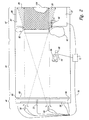
- Figure 2 is a top plan view of the weapons range of Figure 1 showing exposed and obscured regions for the return fire simulators.
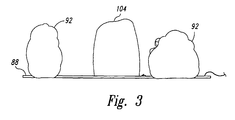
- Figure 3 is a cross-sectional elevational view of the weapons range of Figure 1 taken along the line 3-3 and showing partial concealment of the participant.
- Figure 4 is a flowchart representing the method of operation of the weapons training environment of Figure 1.
- Figure 5 is a side elevational view of an alternative embodiment of the weapons range having an overhead camera.
- Figure 6 is a top plan view of the weapons range environment showing two participants.
- a weapons training range 40 is broken into three adjacent zones, a participation zone 42, an intermediate zone 44, and a target zone 46. Additionally, a microprocessor based central controller 72 is positioned outside of the zones 42, 44, 46 to control, monitor and evaluate activities within the zones 42, 44, 46. The structure and operation of the central controller 72 will be described in greater detail below.
- the target zone 46 is the zone in which a simulated scenario is presented and toward which a participant 90 will fire.
- the target zone 46 includes a rear wall 48 carrying a display screen 50 that faces the participation zone 42.
- the display screen 50 is any suitable display screen upon which a readily visible image can be projected.
- the display screen 50 can be produced from a continuous sheet of white denier cloth suspended from the rear wall 48.
- the display screen 50 can be replaced by an array of cathode ray tube based devices, liquid crystal displays or any other suitable structure for presenting visible images to the participant 90.
- Such alternative displays may require adaptation for use in the weapons range 40, such as protective shielding.
- Such alternative displays may also be used when the participant's fire is nondestructive fire such as an optical beam.
- a video camera 52 is mounted on a servo mechanism 54 held to the rear wall 48 by a bracket.
- the video camera 52 is a conventional wide angle video camera, including a two-dimensional CCD array, and is angled toward the participation zone 42 to allow imaging of substantially the entire participation zone 42.
- the video camera 52 can thus provide video information regarding action and exposure of the participant 90, as will be discussed in greater detail below.
- a pair of electronically controlled return fire simulators 58, 60 are also mounted to the rear wall 48 behind the display screen 50 at vertically and horizontally offset locations.
- Each of the return fire simulators 58, 60 is preferably a known electronically actuated rifle or similar gun employing nonlethal ammunition and aimed at the participation zone 42. When activated, the return fire simulators 58, 60 emit pellets or similar nonlethal projectiles toward the participation zone 42. Small apertures 63 allow the projectiles to pass through the display screen 50.
- the return fire simulators 58, 60 are mounted to separate electronically controlled aiming servos 62, 64 controlled by the central controller 72.
- the aiming servos 62, 64 pivot the return fire simulators 58, 60 in two orthogonal planes (i.e., horizontal and vertical).
- the aiming servos 62, 64 can thereby pivot in the horizontal plane to "sweep" the return fire laterally across the participation zone 42 and can pivot in the vertical plane to provide electrical control of the return fire.
- the target zone 46 further includes a pair of impact sensors 66, 68 mounted near the display screen 50 and aligned to a retroreflective region 69 that partially encircles the target zone 46.
- the impact sensors 66, 68 are preferably optical sensors employing light reflected from the retroreflective region 69, as described in greater detail in co-pending U.S. Application Serial No. 08/310,290 to Treat et al. which is commonly assigned with the present application and is incorporated herein by reference.
- the impact sensors 66, 68 can be any other conventional structure for detecting impact locations of simulated or actual fire directed toward the display screen 50.
- the impact sensors 66, 68, the video camera 52, the servo mechanism 54, the return fire simulators 58, 60, and the aiming servos 62, 64 are connected to the central controller 72 by respective cables 70 routed outside of the target and participation zones 46, 42.
- a microprocessor 74 operates the central controller 72 in response to a selected computer program and/or input from an input panel 76, which may be a keyboard, mouse, touch screen, voice recognition, or other conventional input device.
- the central controller 72 includes an X-Y decoder 78, a discriminator 80, a laser disk player 82 and a local monitor 86.
- the structure and operation of the microprocessor 74, the X-Y decoder 78, the discriminator 80, the disk player 82 and the display will be described in greater detail below.
- the participation zone 42 provides an area for a participant 90 to participate.
- the participant 90 is armed with a weapon 91 that shoots projectiles, such as bullets or pellets, toward the display screen 50.
- the weapon 91 also includes a shot counter coupled to a small transmitter (not visible) that provides a shot count to the microprocessor 74 through an antenna 106, as discussed below.
- a conventional acoustic sensor can detect the weapon's report to monitor shots fired by the weapon 91.
- the weapon 91 preferably fires actual projectiles, weapons 91 emitting other forms of simulated fire, such as optical beams, may also be within the scope of the invention.
- An X-Y sensor 88 coupled to the X-Y decoder 78, lies beneath the participation zone 42 to detect the participant's position.
- the X-Y sensor 88 is a pressure sensitive pad that detects the location of a participant 90 by sensing the weight of the participant 90.
- the X-Y sensor 88 transmits this information to the X-Y decoder 78 which produces locational information to the microprocessor 74.
- the participation zone 42 also includes obstructions 92 positioned between the X-Y sensor 88 and the target zone 46, preferably immediately adjacent the X-Y sensor 88.
- the obstructions 92 are simulated structures, such as simulated rocks, building structures, garbage cans, or any other type of obstruction that might be found in a "real life" environment.
- the obstructions 92 produce fully shielded regions 93, partially shielded regions 95 and exposed regions 97 within the participation zone 42 by blocking return fire from the return fire simulators 58, 60.
- the participant 90 is free to move around the obstructions 92, because the weapon 91 is untethered. Thus, the participant 90 can move freely among the regions 93, 95, 97.
- the intermediate zone 44 separates the target zone 46 and the participation zone 42.
- the intermediate zone 44 contains an image projector 94, such as a television projector, a secondary impact sensor 96 and speakers 98.
- the image projector 94 projects images on the display screen 50 in response to input signals from the disk player 82 which is controlled by the microprocessor 74.
- the disk player 82 is a commercially available laser disk player such as a Pioneer LD4400 disk player.
- the disk player 82 contains a conventional optical disk containing a selected multi-branch simulation, where the branches are selected by a software program stored in a memory coupled to the microprocessor 74. Such multi-branch simulations and related programs are known, being found in common video games.
- the microprocessor 74 selects successive branches based upon input from the impact sensors 66, 68, 96, the discriminator 80, the X-Y decoder 78, the input panel 76, and the weapon 91.
- the microprocessor 74 can thus select scenarios from those stored on the laser disk to present to the participants 90.
- the speakers 98 provide audio information, such as sounds corresponding to the displayed scenario or commands to the participant 90.
- the secondary impact sensor 96 is an optical sensor that detects the impact location of fire from the participant 90 and provides additional information regarding hit locations to the central controller 72.
- the secondary impact sensor 96 can also allow detection of simulated fire when the weapon 91 is an optical emitter rather than a projectile emitter.
- the image projector 94, secondary impact sensor 96 and speakers 98 are positioned out of the line of fire.
- the simulated experience begins when the participant 90 is positioned in the participation zone 42 or is positioned to enter the participation zone 42, in step 402.
- the microprocessor 74 activates the disk player 82 in step 404.
- the video camera 52 images the participation zone 42 in step 406 and provides a visual display to an observer (not shown) on the monitor 86 in step 408.
- step 410 the microprocessor 74 selects a branch of the multi-branch simulation to cause the image projector 94 and speakers 98 to present to the participant 90 a simulated initial scenario, such as a combat environment or simulated police action environment.
- step 412 the microprocessor 74 selects a branch of the multi-branch simulation containing a threatening subscenario, such as an armed enemy. The microprocessor 74 then sets an initial aiming accuracy in step 414 and detects the participant's rough X-Y position in step 416, as will be discussed below.
- the image projector 94 and speakers 98 present the threatening subscenario in the form of a projected image and related sounds, in step 418.
- the microprocessor 74 also determines one or more target regions in the target zone 46, in step 420.
- the target regions are regions toward which the participant 90 is intended to fire.
- a target region may be a central region of a projected enemy, a spotlight, a tank, or any other object toward which fire might be directed.
- the target region may also include one or more subregions or "kill zones" which, when struck, kill the enemy or otherwise terminate the threat.
- the participant 90 activates the weapon 91 to produce simulated fire in step 422.
- the microprocessor 74 identifies if a shot has been fired within a time out period in steps 423 and 425. If no shot is fired, the program jumps to step 441, as will be discussed below with respect to timing out of the subscenario. Otherwise, as the simulated fire (represented by arrow 100 in Figure 1), travels toward the display screen 50, the impact sensors 66, 68 and/or the secondary impact sensor 96 identify the impact location 102 in step 424 and provide the impact location 102 to the microprocessor 74. In step 426, the microprocessor 74 simultaneously increments the shot count for each shot fired.
- the microprocessor 74 compares the detected impact location 102 to the target region in step 428. Depending upon the desirability of the return fire and the impact location 102, the microprocessor 74 may modify the on-going scenario. For example, if the impact location 102 corresponds to a desired kill zone within the target region, the threatening subscenario may terminate at step 430. If the impact location is within the kill zone, the microprocessor 74 then determines if any more subscenarios remain, in step 432. If more subscenarios remain, the next subscenario is selected in step 412 and the above-described steps are repeated.
- the participant's performance is evaluated in a conventional manner.
- the software may provide efficiency and accuracy scores based upon number of shots fired, estimated damage to the enemy and estimated damage to the participant 90, in step 433.
- the monitor 86 then presents the results of the evaluation in step 435.
- the microprocessor 74 determines whether the impact location 102 is in a damaging, but nonlethal subregion of the target region in step 434. In response to such a "nonlethal hit," the microprocessor 74 may modify the subscenario in one of several selected fashions in step 456. For example, the microprocessor 74 may select a wounding subscenario where the enemy remains active, but impaired in step 436. The microprocessor 74 in step 438 may also adjust the accuracy of return fire based upon the nonlethal hit. For example, if the participant 90 scores a nonlethal hit at a location that would be expected to decrease the accuracy of the threat (e.g., the enemy's shooting hand), the microprocessor 74 increases the aiming error in step 438.
- the microprocessor 74 increases the aiming accuracy as a function of elapsed time in step 440 to improve the realism of the simulation.
- the gradual increase in aiming accuracy over time simulates refinement of the enemy's aim.
- Timing of the subscenario also allows the subscenario to end without a kill.
- step 441 if too much time elapses without a kill, the subscenario ends and the program returns to step 432 to determine if additional subscenarios remain.
- the microprocessor 74 may selectively activate one or both of the return fire simulators 58, 60 to produce return fire. To produce the return fire, the microprocessor 74 first activates the aiming servos 62, 64 in step 442 to aim the return fire simulators 58, 60 at the approximate location of the participant 90 determined in step 416. Next, in step 444 the microprocessor 74 attempts to identify exposed portions of the participant 90. To identify exposed portions of the participant 90, the video camera 52 provides the image information to the discriminator 80.
- the discriminator 80 is a commercially available image processing device.
- the discriminator 80 monitors the image signal from the video camera 52 and identifies local contrasts in the image signal that may be caused by exposed portions of the participant 90.
- the participant 90 wears clothing having a reflective, retroreflective, or selectively colored exterior. The clothing thus increases contrast between the participant 90 and the rest of the participation zone 42.
- the microprocessor 74 receives the information concerning exposed portions of the participant 90 and adjusts the aiming according to an aiming program in step 446. If the discriminator 80 identifies a clearly exposed portion of the participant 90, the microprocessor 74 adjusts the aim of the return fire simulators 58, 60 through the aiming servos 62, 64 in step 446 to direct the simulated return fire at the exposed portion identified in step 448.
- the microprocessor 74 may elect in step 448 to direct return fire at or near the perimeter of the nearest obstruction 92. Such fire provides a deterrent to prevent the participant 90 from moving to an exposed position. Such fire also provides an audible indication of return fire accuracy by striking the obstruction 92 to produce noise or to produce a "whizzing" sound as projectiles pass nearby.
- the microprocessor 74 may aim the return fire simulators 58, 60 to direct deflected fire toward the participant 90. For example, as seen in Figure 2, return fire from the return fire simulator 60 is blocked from directly reaching the participant 90. However, the return fire simulator 60 may aim at a rear obstruction 104 in an attempted "bank shot.” That is, the return fire simulator 60 may direct the simulated return fire at the rear obstruction 104 such that the simulated return fire can rebound from the rear obstruction 104 toward the participant 90.
- the program returns to step 416 to determine whether the participant has moved and the threat is reinvoked in step 418. The above-described steps are repeated until the enemy is killed in step 430 or the maximum time elapses in step 441.
- the weapon 91 In addition to directing fire toward the target zone 46, the weapon 91 also transmits through the antenna 106 a coded digital signal indicating the firing of shots.
- a receiver 108 in the central controller 72 detects the signal from the antenna 106 and provides an update to the microprocessor 74 of the number of shots fired by the weapon 91.
- the microprocessor 74 tracks the number of shots fired and compares them to the number of hits to provide a scoring summary indicating the accuracy and efficiency of the participant 90 in the scenario.
- the microprocessor 74 can adapt the subscenario according to the shot count. For example, the microprocessor 74 may detect when the participant 90 is out of "ammunition” and adjust the actions of the enemy in response. Additionally, in some embodiments, the weapon 91 includes a radio receiver and a disable circuit (not shown). In such embodiments, the microprocessor 74 activates a transmitter 110 to produce a disable signal. The weapon 91 receives the disable signal and disables firing. When the microprocessor 74 determines that the participant 90 has successfully reloaded, either through a reloading timer or a signal from the weapon 91, the microprocessor 74 transmits an enable signal through the transmitter 110. The weapon 91 receives the enable signal through the antenna 106 and reenables firing. Such temporary disabling of the weapon 91 more realistically simulates the real world environment by inducing the participant 90 to more selectively utilize ammunition and by imposing reloading delays.
- Figures 5 and 6 show an alternative embodiment of the range 40 that allows more than one participant 90 to participate in a simulation.
- the X-Y sensor 88 is replaced by an overhead camera 112.
- the overhead camera 112 images the participation zone 42 and provides to the microprocessor 74 a continuous indication of the participants' positions.
- the coded digital signals transmitted by the weapons 91 to the receiver 108 include an additional data field identifying the particular weapon 91.
- the microprocessor 74 can therefore track shot counts for more than one weapon 91.
- the alternative range 40 of Figures 5 and 6 also includes two separate sets of impact sensors 66, 68 and the weapons 91 fire retroreflectively coated projectiles.
- the retroreflective coatings on the projectiles are color selective so that projectiles from the first weapon 91 reflect different wavelengths of light from those of the second weapon.
- the impact sensors 66, 68 in each set are optimized to the wavelength of their respective weapons, so that the impact sensors 66, 68 can distinguish between simultaneous fire from the first and second weapons 91.
- the weapons 91 can emit optical beams rather than coated projectiles.
- the secondary impact sensor 96 detects the impact location of the respective optical beams.
- the respective optical beams can be at different wavelengths or can be pulsed in readily distinguishable patterns.
- the return fire simulators 58, 60 are described herein as being aimed by aiming servos 62, 64 from fixed locations. However, a variety of other aiming mechanisms may be within the scope of the invention. Similarly, the return fire simulators 58, 60 need not be mounted at fixed locations. Instead, the return fire simulators 58, 60 may be made mobile by mounting to tracks or any other suitable moving mechanism.
- the preferred embodiment employs a multi-branch program on a laser disk.
- a variety of other types of devices may be employed for producing the simulation and displaying scenarios and subscenarios.
- the scenarios and subscenarios can be produced through computer-generated or other animation.
- the display screen 50 may be rear illuminated, may be a cathode ray tube or LCD system, or the subscenarios may be presented through mechanically mounted images.
- the disk player 82 can be eliminated or replaced with an alternative source of a multibranch simulation.
- the simulated return fire is preferably in the form of emitted projectiles
- other types of simulated return fire may be within the scope of the invention.
- the simulated return fire may be an optical beam directed toward the participant 90. Hits on the participant 90 would then be identified by optical sensors on the participant's clothing.
- the preferred embodiment of the invention employs the video camera 52 and discriminator 80, any other suitable system for identifying the participant's location and the location of any exposed portions may be within the scope of the invention. Accordingly, the invention is not limited except as by the appended claims.
Landscapes
- Engineering & Computer Science (AREA)
- Radar, Positioning & Navigation (AREA)
- General Engineering & Computer Science (AREA)
- Aiming, Guidance, Guns With A Light Source, Armor, Camouflage, And Targets (AREA)
- Management, Administration, Business Operations System, And Electronic Commerce (AREA)
Priority Applications (1)
| Application Number | Priority Date | Filing Date | Title |
|---|---|---|---|
| EP01120820A EP1174674A1 (de) | 1996-05-02 | 1997-04-30 | Elektronisch gesteuerte Reichweite für Waffen mit Antwortfeuer |
Applications Claiming Priority (2)
| Application Number | Priority Date | Filing Date | Title |
|---|---|---|---|
| US644445 | 1996-05-02 | ||
| US08/644,445 US5823779A (en) | 1996-05-02 | 1996-05-02 | Electronically controlled weapons range with return fire |
Publications (1)
| Publication Number | Publication Date |
|---|---|
| EP0806621A1 true EP0806621A1 (de) | 1997-11-12 |
Family
ID=24584934
Family Applications (2)
| Application Number | Title | Priority Date | Filing Date |
|---|---|---|---|
| EP01120820A Withdrawn EP1174674A1 (de) | 1996-05-02 | 1997-04-30 | Elektronisch gesteuerte Reichweite für Waffen mit Antwortfeuer |
| EP97107224A Withdrawn EP0806621A1 (de) | 1996-05-02 | 1997-04-30 | Elektronisch gesteuerte Reichweite für Waffen mit Antwortfeuer |
Family Applications Before (1)
| Application Number | Title | Priority Date | Filing Date |
|---|---|---|---|
| EP01120820A Withdrawn EP1174674A1 (de) | 1996-05-02 | 1997-04-30 | Elektronisch gesteuerte Reichweite für Waffen mit Antwortfeuer |
Country Status (5)
| Country | Link |
|---|---|
| US (2) | US5823779A (de) |
| EP (2) | EP1174674A1 (de) |
| AU (1) | AU3115997A (de) |
| CA (1) | CA2253378C (de) |
| WO (1) | WO1997041402A1 (de) |
Cited By (5)
| Publication number | Priority date | Publication date | Assignee | Title |
|---|---|---|---|---|
| FR2772908A1 (fr) * | 1997-12-24 | 1999-06-25 | Aerospatiale | Simulateur de tir de missiles avec immersion du tireur dans un espace virtuel |
| WO2001094872A3 (en) * | 2000-06-09 | 2002-04-11 | Beamhit Llc | Firearm laser training system and method facilitating firearm training with various targets and visual feedback of simulated projectile impact locations |
| US6575753B2 (en) | 2000-05-19 | 2003-06-10 | Beamhit, Llc | Firearm laser training system and method employing an actuable target assembly |
| US7329127B2 (en) | 2001-06-08 | 2008-02-12 | L-3 Communications Corporation | Firearm laser training system and method facilitating firearm training for extended range targets with feedback of firearm control |
| US10451376B2 (en) | 2014-12-16 | 2019-10-22 | Kurt S. SCHULZ | Firearm simulators |
Families Citing this family (78)
| Publication number | Priority date | Publication date | Assignee | Title |
|---|---|---|---|---|
| JPH09152307A (ja) * | 1995-12-01 | 1997-06-10 | Sega Enterp Ltd | 座標検出装置、その方法およびゲーム装置 |
| US5823779A (en) * | 1996-05-02 | 1998-10-20 | Advanced Interactive Systems, Inc. | Electronically controlled weapons range with return fire |
| AU6612296A (en) * | 1996-07-05 | 1998-02-02 | Vlg Virtual Laser Games Gmbh | Computerized game system |
| US6129549A (en) * | 1997-08-22 | 2000-10-10 | Thompson; Clyde H. | Computer system for trapshooting competitions |
| US6196844B1 (en) * | 1998-02-19 | 2001-03-06 | Michael S. Bradshaw | Integrated target system |
| US6217027B1 (en) * | 1998-03-02 | 2001-04-17 | United States Of America | Computerized portable pneumatic target apparatus |
| US6110215A (en) * | 1998-06-19 | 2000-08-29 | Microsoft Corporation | Heightened realism for computer-controlled units in real-time activity simulation |
| US6763325B1 (en) | 1998-06-19 | 2004-07-13 | Microsoft Corporation | Heightened realism for computer-controlled units in real-time activity simulation |
| US7749089B1 (en) | 1999-02-26 | 2010-07-06 | Creative Kingdoms, Llc | Multi-media interactive play system |
| US6761637B2 (en) | 2000-02-22 | 2004-07-13 | Creative Kingdoms, Llc | Method of game play using RFID tracking device |
| US7445550B2 (en) | 2000-02-22 | 2008-11-04 | Creative Kingdoms, Llc | Magical wand and interactive play experience |
| US7878905B2 (en) | 2000-02-22 | 2011-02-01 | Creative Kingdoms, Llc | Multi-layered interactive play experience |
| DE10012217A1 (de) * | 2000-03-10 | 2001-09-13 | Kehl Hermann | Laserpistole |
| JP2002052243A (ja) * | 2000-08-11 | 2002-02-19 | Konami Co Ltd | 対戦式ビデオゲーム装置 |
| US7066781B2 (en) | 2000-10-20 | 2006-06-27 | Denise Chapman Weston | Children's toy with wireless tag/transponder |
| US6579097B1 (en) * | 2000-11-22 | 2003-06-17 | Cubic Defense Systems, Inc. | System and method for training in military operations in urban terrain |
| SG96259A1 (en) * | 2000-11-29 | 2003-05-23 | Ruag Electronics | Method and device for simulating detonating projectiles |
| US20020173940A1 (en) * | 2001-05-18 | 2002-11-21 | Thacker Paul Thomas | Method and apparatus for a simulated stalking system |
| ES2189685B1 (es) * | 2001-12-19 | 2004-10-16 | Industrias El Gamo, S.A. | Cazabalines con deteccion electronica de impacto en el blanco y metodo de deteccion empleado. |
| US6967566B2 (en) | 2002-04-05 | 2005-11-22 | Creative Kingdoms, Llc | Live-action interactive adventure game |
| US20070066396A1 (en) | 2002-04-05 | 2007-03-22 | Denise Chapman Weston | Retail methods for providing an interactive product to a consumer |
| FR2840064B1 (fr) * | 2002-05-22 | 2004-07-16 | Christian Georges Gera Saunier | Procede de simulation interactif comportemental de formation a la chasse au gibier |
| RU2211433C1 (ru) * | 2002-07-17 | 2003-08-27 | Институт прикладной механики УрО РАН | Оптико-электронный стрелковый тренажер коллективного боя |
| US7674184B2 (en) | 2002-08-01 | 2010-03-09 | Creative Kingdoms, Llc | Interactive water attraction and quest game |
| US7291014B2 (en) * | 2002-08-08 | 2007-11-06 | Fats, Inc. | Wireless data communication link embedded in simulated weapon systems |
| HK1079866B (en) * | 2002-08-09 | 2009-11-20 | Meggitt Training Systems, Inc. | Gas operating system for firearm simulators |
| US6746334B1 (en) | 2002-12-27 | 2004-06-08 | Creative Kingdoms, Llc | Play structure with active targeting system |
| US8123526B2 (en) * | 2003-01-27 | 2012-02-28 | Hoover Steven G | Simulator with fore and AFT video displays |
| US9446319B2 (en) | 2003-03-25 | 2016-09-20 | Mq Gaming, Llc | Interactive gaming toy |
| US7140387B2 (en) * | 2003-07-31 | 2006-11-28 | Fats, Inc. | Regulated gas supply system |
| US20060105299A1 (en) * | 2004-03-15 | 2006-05-18 | Virtra Systems, Inc. | Method and program for scenario provision in a simulation system |
| KR101222447B1 (ko) * | 2004-07-15 | 2013-01-15 | 큐빅 코포레이션 | 시뮬레이팅된 트레이닝 시스템들에서의 조준점의 강화 |
| US7949295B2 (en) * | 2004-08-18 | 2011-05-24 | Sri International | Automated trainee monitoring and performance evaluation system |
| NZ556012A (en) * | 2004-11-24 | 2011-01-28 | Dynamic Animation Systems Inc | Instructor-lead training environment and interfaces therewith |
| US20080115660A1 (en) * | 2004-12-30 | 2008-05-22 | Edward Hensel | Remotely Controlled Marker For Hunting Games |
| JP2009503653A (ja) * | 2005-07-19 | 2009-01-29 | ファッツ・インコーポレイティッド | 二段階気体調整組立体 |
| US7922491B2 (en) * | 2005-09-28 | 2011-04-12 | Raytheon Company | Methods and apparatus to provide training against improvised explosive devices |
| US20070160960A1 (en) * | 2005-10-21 | 2007-07-12 | Laser Shot, Inc. | System and method for calculating a projectile impact coordinates |
| US8360776B2 (en) * | 2005-10-21 | 2013-01-29 | Laser Shot, Inc. | System and method for calculating a projectile impact coordinates |
| US20110281242A1 (en) * | 2005-11-17 | 2011-11-17 | Rovatec Ltd. | Training aid for firearms using rotating and non-rotating bolts |
| EP1840496A1 (de) * | 2006-03-30 | 2007-10-03 | Saab Ab | Rückschusseinheit und Verfahren zum Rückschuss gegen einen ein Ziel verfehlenden Schützen |
| US20110053120A1 (en) * | 2006-05-01 | 2011-03-03 | George Galanis | Marksmanship training device |
| US20070287134A1 (en) * | 2006-05-26 | 2007-12-13 | Chung Bobby H | System and Method to Minimize Laser Misalignment Error in a Firearms Training Simulator |
| EP2032226A1 (de) * | 2006-06-14 | 2009-03-11 | Robonica Pty. Ltd. | Zielsystem für eine roboterspielumgebung |
| US20080220397A1 (en) * | 2006-12-07 | 2008-09-11 | Livesight Target Systems Inc. | Method of Firearms and/or Use of Force Training, Target, and Training Simulator |
| US7735832B2 (en) * | 2006-12-21 | 2010-06-15 | James Carl Bliehall | Moving target system for training in marksmanship and target identification |
| NZ577829A (en) * | 2006-12-21 | 2012-06-29 | Pathfinder Events Pty Ltd | Live combat simulation |
| WO2008147820A1 (en) * | 2007-05-22 | 2008-12-04 | S/R Industries, Inc. | System and method for electronic projectile play |
| CN101796369A (zh) * | 2007-07-05 | 2010-08-04 | 美吉特培训系统公司 | 从仿真弹药无线读写数据的方法 |
| US20090131173A1 (en) * | 2007-11-20 | 2009-05-21 | Gurnsey Lori A | Electronic elimination game system and method |
| US7900927B1 (en) | 2007-12-31 | 2011-03-08 | James Bliehall | Portable, carriage driven, moving target system for training in marksmanship and target identification |
| CN101614504B (zh) * | 2008-06-24 | 2012-07-11 | 刘林运 | 一种真人对抗模拟射击系统、对战平台及其操作方法 |
| US20100092925A1 (en) * | 2008-10-15 | 2010-04-15 | Matvey Lvovskiy | Training simulator for sharp shooting |
| JP5342855B2 (ja) * | 2008-11-21 | 2013-11-13 | 東芝電波プロダクツ株式会社 | 射撃訓練用模擬対抗装置 |
| JP2010121915A (ja) * | 2008-11-21 | 2010-06-03 | Toshiba Denpa Products Kk | 射撃訓練用模擬対抗装置 |
| WO2010141119A2 (en) * | 2009-02-25 | 2010-12-09 | Light Prescriptions Innovators, Llc | Passive electro-optical tracker |
| US8205888B2 (en) * | 2009-03-09 | 2012-06-26 | Deatherage Jr Robert Henry | Marksmanship target apparatus |
| US8655257B2 (en) * | 2009-08-24 | 2014-02-18 | Daniel Spychaiski | Radio controlled combat training device and method of using the same |
| KR101319159B1 (ko) * | 2009-08-25 | 2013-10-17 | 주식회사 홍인터내셔날 | 다트 게임 장치 및 다트 게임 장치의 게임 데이터 인증 방법 |
| US7927252B1 (en) * | 2009-12-31 | 2011-04-19 | Jeffrey Richard M | Conditioning apparatus and related methods |
| WO2011094177A2 (en) * | 2010-01-26 | 2011-08-04 | Ehud Dribben | Monitoring shots of firearms |
| US9151565B2 (en) | 2010-06-15 | 2015-10-06 | Cold Fire, LLC. | Compact cycle and recoil system for semi-automatic pistols |
| US8354958B2 (en) | 2010-11-22 | 2013-01-15 | Raytheon Company | Alignment system |
| US8777226B1 (en) | 2012-06-21 | 2014-07-15 | Robert Hubert Decker, Jr. | Proxy target system |
| US20140199661A1 (en) * | 2013-01-15 | 2014-07-17 | Jeffrey James Quail | Threat Training System and Method Using Simulated Projectiles |
| DE102014201180A1 (de) * | 2014-01-23 | 2015-07-23 | Thales Deutschland Gmbh | Verfahren zum Trainieren der Benutzung und des Einsatzes von Feuerwaffen in einem Waffensimulator, Waffensimulator zur Ausführung eines solchen Verfahrens, zentraler Steuerrechner eines solchen Waffensimulators und Computerprogramm zum Ablauf auf einem solchen Steuerrechner |
| US9759530B2 (en) | 2014-03-06 | 2017-09-12 | Brian D. Miller | Target impact sensor transmitter receiver system |
| EP2924387A1 (de) * | 2014-03-28 | 2015-09-30 | Patents Factory Ltd. Sp. z o.o. | Schießziel |
| US9486700B2 (en) * | 2014-04-10 | 2016-11-08 | Dean Schumacher | Video game incorporating safe live-action combat |
| US9445208B2 (en) * | 2014-09-04 | 2016-09-13 | The United States Of America, As Represented By The Secretary Of The Army | Emission of a commencement sound and a conclusion sound |
| US10458758B2 (en) | 2015-01-20 | 2019-10-29 | Brian D. Miller | Electronic audible feedback bullet targeting system |
| US10088280B2 (en) | 2015-11-21 | 2018-10-02 | Norma Zell | Control module for autonomous target system |
| DE102016201183A1 (de) * | 2016-01-27 | 2017-07-27 | Joerg Zilske | Schießkino für den Bogen-, Armbrust-, und Dartsport |
| US10048043B2 (en) | 2016-07-12 | 2018-08-14 | Paul Rahmanian | Target carrier with virtual targets |
| US10922992B2 (en) | 2018-01-09 | 2021-02-16 | V-Armed Inc. | Firearm simulation and training system and method |
| US10613426B1 (en) | 2018-06-14 | 2020-04-07 | Dhpc Technologies, Inc. | System, method and device for a long range, real size weapon systems plume simulator for testing optical detection devices in the field |
| JP6770145B1 (ja) * | 2019-07-05 | 2020-10-14 | 任天堂株式会社 | 情報処理プログラム、情報処理システム、情報処理装置、および、情報処理方法 |
| US12154458B2 (en) * | 2020-10-08 | 2024-11-26 | Lion Group, Inc. | Emergency response training system |
Citations (2)
| Publication number | Priority date | Publication date | Assignee | Title |
|---|---|---|---|---|
| DE3332582A1 (de) * | 1983-09-09 | 1985-03-28 | Wegmann & Co GmbH, 3500 Kassel | Einrichtung zur ueberwachung von kampffahrzeugen, insbesondere von kampfpanzern |
| US5213503A (en) * | 1991-11-05 | 1993-05-25 | The United States Of America As Represented By The Secretary Of The Navy | Team trainer |
Family Cites Families (61)
| Publication number | Priority date | Publication date | Assignee | Title |
|---|---|---|---|---|
| US1197567A (en) * | 1915-11-26 | 1916-09-05 | Lydia B Koch | Cinematograph target apparatus. |
| GB459313A (en) * | 1935-07-29 | 1937-01-06 | Gen La Cinematographie Francai | A shooting target with cinematographic or animated pictures |
| GB536641A (en) * | 1939-08-17 | 1941-05-22 | Arthur Ernest Macdonald | Improvements in or relating to control devices for kinematograh machines associated with e.g. kinematograph targets |
| GB545196A (en) * | 1940-11-12 | 1942-05-14 | Anthony Edgar Somers | Improvements in or relating to cinematograph target apparatus |
| US2362473A (en) * | 1941-12-10 | 1944-11-14 | James V Dunham | Recordation of the path of movable bodies |
| US2404653A (en) * | 1944-05-08 | 1946-07-23 | Charles J Strebel | Electric target game |
| US3047723A (en) * | 1958-12-31 | 1962-07-31 | Aircraft Armaments Inc | Photoelectric hit detector system |
| US3398958A (en) * | 1963-03-04 | 1968-08-27 | Brunswick Corp | Archery target with point of impact detecting and indicating means |
| US3341204A (en) * | 1963-09-03 | 1967-09-12 | Donald F Pettigrew | Method and apparatus for reading archery targets |
| US3411785A (en) * | 1965-01-18 | 1968-11-19 | Crosman Arms Company Inc | Stop control for moving picture target projector |
| GB1246271A (en) * | 1967-06-12 | 1971-09-15 | Walter Arthur Foges | Marksmanship testing apparatus |
| US3619630A (en) * | 1969-02-14 | 1971-11-09 | Brunswick Corp | Arrow detection system employing a sweeping laser beam |
| US3590225A (en) * | 1969-02-14 | 1971-06-29 | Brunswick Corp | Digital arrow location computer |
| US3623065A (en) * | 1969-02-14 | 1971-11-23 | Brunswick Corp | Arrow hit location indicator |
| IL38807A (en) * | 1971-02-23 | 1977-01-31 | Australasian Training Aids Pty | Method and apparatus for determining the passing of a projectile through an area in space |
| US3727069A (en) * | 1971-07-21 | 1973-04-10 | Litton Systems Inc | Target measurement system for precise projectile location |
| US3849910A (en) * | 1973-02-12 | 1974-11-26 | Singer Co | Training apparatus for firearms use |
| GB1522832A (en) * | 1975-06-24 | 1978-08-31 | Rfd Systems Eng Ltd | Gunnery training aids having screen assemblies |
| GB1530959A (en) * | 1975-09-30 | 1978-11-01 | Brunswick Corp | Marine jet drives |
| US4019262A (en) * | 1975-12-22 | 1977-04-26 | The United States Of America As Represented By The Secretary Of The Navy | Direct fire weapon trainer incorporating hit and data delay responses |
| IT1068983B (it) * | 1976-11-18 | 1985-03-21 | Filippini Gennaro | Perfezionamento nei sistemi di rilevazione a distanza dei colpi presenti su un bersaglio |
| US3996674A (en) * | 1976-01-29 | 1976-12-14 | The United States Of America As Represented By The Secretary Of The Army | Distribution of fire display technique for moving target screens |
| GB1580253A (en) * | 1977-02-21 | 1980-11-26 | Australasian Training Aids Pty | Firing range |
| US4222564A (en) * | 1977-06-13 | 1980-09-16 | Aba Electromechanical Systems, Inc. | Automated scoring target system |
| US4150825A (en) * | 1977-07-18 | 1979-04-24 | Wilson Robert F | Golf game simulating apparatus |
| GB2035523A (en) * | 1978-11-10 | 1980-06-18 | Applied Interior Design Ltd | Target equipment for rifle and the like shooting ranges |
| US4324977A (en) * | 1979-03-08 | 1982-04-13 | Brauer Malcolm M | Synthesized target system |
| US4290757A (en) * | 1980-06-09 | 1981-09-22 | The United States Of America As Represented By The Secretary Of The Navy | Burst on target simulation device for training with rockets |
| DE3128073C2 (de) * | 1981-07-16 | 1984-01-26 | Fa. Aug. Winkhaus, 4404 Telgte | Alarmmelder zur Sicherung eines Durchgangs oder eines Durchgangsabschnitts |
| DE3134561C2 (de) * | 1981-09-01 | 1983-09-15 | Kempf, Alfons, Dipl.-Ing. (FH), 8950 Kaufbeuren | Verfahren und Vorrichtung zur Trefferauswertung von Schießscheiben |
| US4533144A (en) * | 1983-07-11 | 1985-08-06 | Manuel Juarez | Electronic game |
| DE3405016A1 (de) * | 1983-09-09 | 1985-08-14 | Wegmann & Co GmbH, 3500 Kassel | Einrichtung zur ueberwachung von kampffahrzeugen, insbesondere von kampfpanzern |
| FR2556827B1 (fr) * | 1983-12-15 | 1988-04-22 | Giravions Dorand | Dispositif d'entrainement au tir en salle |
| US4695058A (en) * | 1984-01-31 | 1987-09-22 | Photon Marketing Limited | Simulated shooting game with continuous transmission of target identification signals |
| CH665901A5 (de) * | 1984-03-16 | 1988-06-15 | Polytronic Ag | Bildprojektions-schiessanlage. |
| US4611993A (en) * | 1984-05-31 | 1986-09-16 | The United States Of America As Represented By The Secretary Of The Army | Laser projected live fire evasive target system |
| US4680012A (en) * | 1984-07-07 | 1987-07-14 | Ferranti, Plc | Projected imaged weapon training apparatus |
| US4789932A (en) * | 1984-09-21 | 1988-12-06 | Austin T. Musselman | Apparatus and method for automatically scoring a dart game |
| US4695256A (en) * | 1984-12-31 | 1987-09-22 | Precitronic Gesellschaft | Method for practicing aiming with the use of a laser firing simulator and of a retroreflector on the target side, as well as firing simulator for carrying out this method |
| US4702475A (en) * | 1985-08-16 | 1987-10-27 | Innovating Training Products, Inc. | Sports technique and reaction training system |
| US4788441A (en) * | 1985-12-16 | 1988-11-29 | Acme-Cleveland Corporation | Range finder wherein distance between target and source is determined by measuring scan time across a retroreflective target |
| US4763903A (en) * | 1986-01-31 | 1988-08-16 | Max W. Goodwin | Target scoring and display system and method |
| US4949972A (en) * | 1986-01-31 | 1990-08-21 | Max W. Goodwin | Target scoring and display system |
| US4685330A (en) * | 1986-03-12 | 1987-08-11 | Ford Lindy R | Position selectable delay generator for mechanism trigger |
| US4804325A (en) * | 1986-05-15 | 1989-02-14 | Spartanics, Ltd. | Weapon training simulator system |
| IL88661A (en) * | 1988-12-12 | 1991-12-12 | A T Ltd Sa | Toy for aiming and firing a radiation beam at a target |
| US4934937A (en) * | 1988-12-14 | 1990-06-19 | Tommy Judd | Combat training system and apparatus |
| US4948371A (en) * | 1989-04-25 | 1990-08-14 | The United States Of America As Represented By The United States Department Of Energy | System for training and evaluation of security personnel in use of firearms |
| US5194006A (en) * | 1991-05-15 | 1993-03-16 | Zaenglein Jr William | Shooting simulating process and training device |
| US5215464A (en) * | 1991-11-05 | 1993-06-01 | Marshall Albert H | Aggressor shoot-back simulation |
| US5215465A (en) * | 1991-11-05 | 1993-06-01 | The United States Of America As Represented By The Secretary Of The Navy | Infrared spot tracker |
| US5333874A (en) * | 1992-05-06 | 1994-08-02 | Floyd L. Arnold | Sports simulator |
| US5328190A (en) * | 1992-08-04 | 1994-07-12 | Dart International, Inc. | Method and apparatus enabling archery practice |
| US5273291A (en) * | 1993-03-26 | 1993-12-28 | Archery Visions, Inc. | Target range apparatus for bow hunters |
| US5320358A (en) * | 1993-04-27 | 1994-06-14 | Rpb, Inc. | Shooting game having programmable targets and course for use therewith |
| US5320362A (en) * | 1993-09-07 | 1994-06-14 | Thomas Bear | Computer controlled amusement structure |
| JPH07275511A (ja) * | 1994-04-06 | 1995-10-24 | Sega Enterp Ltd | シューティングゲームシステムのアトラクション展開方法 |
| US5596509A (en) * | 1994-05-12 | 1997-01-21 | The Regents Of The University Of California | Passive infrared bullet detection and tracking |
| US5599187A (en) * | 1994-12-21 | 1997-02-04 | Mesiano; Dominick N. | Firearm use training device and method |
| US5641288A (en) * | 1996-01-11 | 1997-06-24 | Zaenglein, Jr.; William G. | Shooting simulating process and training device using a virtual reality display screen |
| US5823779A (en) * | 1996-05-02 | 1998-10-20 | Advanced Interactive Systems, Inc. | Electronically controlled weapons range with return fire |
-
1996
- 1996-05-02 US US08/644,445 patent/US5823779A/en not_active Expired - Lifetime
-
1997
- 1997-04-24 CA CA002253378A patent/CA2253378C/en not_active Expired - Lifetime
- 1997-04-24 WO PCT/US1997/006945 patent/WO1997041402A1/en not_active Ceased
- 1997-04-24 AU AU31159/97A patent/AU3115997A/en not_active Abandoned
- 1997-04-30 EP EP01120820A patent/EP1174674A1/de not_active Withdrawn
- 1997-04-30 EP EP97107224A patent/EP0806621A1/de not_active Withdrawn
-
1998
- 1998-04-06 US US09/055,854 patent/US5980254A/en not_active Expired - Lifetime
Patent Citations (2)
| Publication number | Priority date | Publication date | Assignee | Title |
|---|---|---|---|---|
| DE3332582A1 (de) * | 1983-09-09 | 1985-03-28 | Wegmann & Co GmbH, 3500 Kassel | Einrichtung zur ueberwachung von kampffahrzeugen, insbesondere von kampfpanzern |
| US5213503A (en) * | 1991-11-05 | 1993-05-25 | The United States Of America As Represented By The Secretary Of The Navy | Team trainer |
Cited By (10)
| Publication number | Priority date | Publication date | Assignee | Title |
|---|---|---|---|---|
| US6296486B1 (en) | 1997-12-23 | 2001-10-02 | Aerospatiale Societe Nationale Industrielle | Missile firing simulator with the gunner immersed in a virtual space |
| FR2772908A1 (fr) * | 1997-12-24 | 1999-06-25 | Aerospatiale | Simulateur de tir de missiles avec immersion du tireur dans un espace virtuel |
| WO1999034163A1 (fr) * | 1997-12-24 | 1999-07-08 | Aerospatiale Societe Nationale Industrielle | Simulateur de tir de missiles avec immersion du tireur dans un espace virtuel |
| US6575753B2 (en) | 2000-05-19 | 2003-06-10 | Beamhit, Llc | Firearm laser training system and method employing an actuable target assembly |
| WO2001094872A3 (en) * | 2000-06-09 | 2002-04-11 | Beamhit Llc | Firearm laser training system and method facilitating firearm training with various targets and visual feedback of simulated projectile impact locations |
| US6616452B2 (en) | 2000-06-09 | 2003-09-09 | Beamhit, Llc | Firearm laser training system and method facilitating firearm training with various targets and visual feedback of simulated projectile impact locations |
| US6966775B1 (en) | 2000-06-09 | 2005-11-22 | Beamhit, Llc | Firearm laser training system and method facilitating firearm training with various targets and visual feedback of simulated projectile impact locations |
| US7329127B2 (en) | 2001-06-08 | 2008-02-12 | L-3 Communications Corporation | Firearm laser training system and method facilitating firearm training for extended range targets with feedback of firearm control |
| US10451376B2 (en) | 2014-12-16 | 2019-10-22 | Kurt S. SCHULZ | Firearm simulators |
| US11112204B2 (en) | 2014-12-16 | 2021-09-07 | Kurt S. SCHULZ | Firearm simulators |
Also Published As
| Publication number | Publication date |
|---|---|
| AU3115997A (en) | 1997-11-19 |
| CA2253378C (en) | 2005-06-21 |
| US5980254A (en) | 1999-11-09 |
| CA2253378A1 (en) | 1997-11-06 |
| EP1174674A1 (de) | 2002-01-23 |
| US5823779A (en) | 1998-10-20 |
| WO1997041402A1 (en) | 1997-11-06 |
Similar Documents
| Publication | Publication Date | Title |
|---|---|---|
| US5823779A (en) | Electronically controlled weapons range with return fire | |
| US5194006A (en) | Shooting simulating process and training device | |
| US8360776B2 (en) | System and method for calculating a projectile impact coordinates | |
| US5641288A (en) | Shooting simulating process and training device using a virtual reality display screen | |
| WO1997041402B1 (en) | Electronically controlled weapons range with return fire | |
| EP1007896B1 (de) | Mit einem laser funktionierende übungswaffe welche mit einem netzwerk verbunden ist | |
| US20040014010A1 (en) | Archery laser training system and method of simulating weapon operation | |
| US8888491B2 (en) | Optical recognition system and method for simulated shooting | |
| US8678824B2 (en) | Shooting simulation system and method using an optical recognition system | |
| EP2249117A1 (de) | Schusstrainingssysteme mit eingebetteter Lichtmesstafel | |
| US9504907B2 (en) | Simulated shooting system and method | |
| WO1994003246A1 (en) | Method and apparatus enabling archery practice | |
| US8777226B1 (en) | Proxy target system | |
| CA2361478C (en) | Method and device for simulating detonating projectiles | |
| WO2011078422A1 (ko) | 레이저 좌표추적에 의한 스크린 실탄 사격장치 | |
| CN113834373B (zh) | 真人演绎虚拟现实室内室外攻防对抗作战训练系统及方法 | |
| US20030027103A1 (en) | Simulated weapon training and sensor system and associated methods | |
| US20070254266A1 (en) | Marksmanship training device | |
| US20070160960A1 (en) | System and method for calculating a projectile impact coordinates | |
| RU2046272C1 (ru) | Способ тренировки стрелка на стенде и устройство для его осуществления | |
| JP2020046083A (ja) | ヘリコプタ用誘導弾回避訓練装置 | |
| TR2022001799A1 (tr) | Lazer görüntü işlemeli kuru sıkı, kuru tetik poligon atış sistemi. | |
| RU2845405C1 (ru) | Мишенная установка, имитирующая стрельбу противника | |
| CN111433553A (zh) | 使用鱼眼镜头相机的集成射击模拟系统 | |
| TR2023005629U5 (tr) | Tank eği̇ti̇m atiş si̇stemi̇ |
Legal Events
| Date | Code | Title | Description |
|---|---|---|---|
| PUAI | Public reference made under article 153(3) epc to a published international application that has entered the european phase |
Free format text: ORIGINAL CODE: 0009012 |
|
| AK | Designated contracting states |
Kind code of ref document: A1 Designated state(s): AT BE CH DE DK ES FI FR GB GR IT LI NL PT SE |
|
| 17P | Request for examination filed |
Effective date: 19980505 |
|
| RAP3 | Party data changed (applicant data changed or rights of an application transferred) |
Owner name: ADVANCED INTERACTIVE SYSTEMS, INC. |
|
| 17Q | First examination report despatched |
Effective date: 20010306 |
|
| RIN1 | Information on inventor provided before grant (corrected) |
Inventor name: TREAT, ERWIN C. JR. Inventor name: MUEHLE, ERIC G. |
|
| GRAH | Despatch of communication of intention to grant a patent |
Free format text: ORIGINAL CODE: EPIDOS IGRA |
|
| STAA | Information on the status of an ep patent application or granted ep patent |
Free format text: STATUS: THE APPLICATION IS DEEMED TO BE WITHDRAWN |
|
| 18D | Application deemed to be withdrawn |
Effective date: 20021210 |