EP0806656A2 - Capteur de gaz et procédé de fabrication d'un capteur de gaz - Google Patents
Capteur de gaz et procédé de fabrication d'un capteur de gaz Download PDFInfo
- Publication number
- EP0806656A2 EP0806656A2 EP97106736A EP97106736A EP0806656A2 EP 0806656 A2 EP0806656 A2 EP 0806656A2 EP 97106736 A EP97106736 A EP 97106736A EP 97106736 A EP97106736 A EP 97106736A EP 0806656 A2 EP0806656 A2 EP 0806656A2
- Authority
- EP
- European Patent Office
- Prior art keywords
- gas
- sensor
- layer
- gas sensor
- sensitivity
- Prior art date
- Legal status (The legal status is an assumption and is not a legal conclusion. Google has not performed a legal analysis and makes no representation as to the accuracy of the status listed.)
- Withdrawn
Links
- 238000000034 method Methods 0.000 title claims description 22
- 238000004519 manufacturing process Methods 0.000 title claims description 6
- 229910005191 Ga 2 O 3 Inorganic materials 0.000 claims description 28
- 230000008569 process Effects 0.000 claims description 21
- 229910044991 metal oxide Inorganic materials 0.000 claims description 20
- 150000004706 metal oxides Chemical class 0.000 claims description 20
- 238000005496 tempering Methods 0.000 claims description 20
- 229910004298 SiO 2 Inorganic materials 0.000 claims description 12
- 239000000758 substrate Substances 0.000 claims description 8
- OFPXSFXSNFPTHF-UHFFFAOYSA-N oxaprozin Chemical compound O1C(CCC(=O)O)=NC(C=2C=CC=CC=2)=C1C1=CC=CC=C1 OFPXSFXSNFPTHF-UHFFFAOYSA-N 0.000 claims description 6
- 229960002739 oxaprozin Drugs 0.000 claims description 6
- 238000004544 sputter deposition Methods 0.000 claims description 5
- 229910010413 TiO 2 Inorganic materials 0.000 claims description 3
- 238000005566 electron beam evaporation Methods 0.000 claims description 3
- 238000007704 wet chemistry method Methods 0.000 claims description 3
- -1 WO 3 Inorganic materials 0.000 claims 1
- 230000008020 evaporation Effects 0.000 claims 1
- 238000001704 evaporation Methods 0.000 claims 1
- 230000035945 sensitivity Effects 0.000 abstract description 49
- AJNVQOSZGJRYEI-UHFFFAOYSA-N digallium;oxygen(2-) Chemical compound [O-2].[O-2].[O-2].[Ga+3].[Ga+3] AJNVQOSZGJRYEI-UHFFFAOYSA-N 0.000 abstract description 34
- 229910001195 gallium oxide Inorganic materials 0.000 abstract description 34
- 229910052782 aluminium Inorganic materials 0.000 abstract description 15
- XAGFODPZIPBFFR-UHFFFAOYSA-N aluminium Chemical compound [Al] XAGFODPZIPBFFR-UHFFFAOYSA-N 0.000 abstract description 15
- LSGOVYNHVSXFFJ-UHFFFAOYSA-N vanadate(3-) Chemical compound [O-][V]([O-])([O-])=O LSGOVYNHVSXFFJ-UHFFFAOYSA-N 0.000 abstract description 15
- VYPSYNLAJGMNEJ-UHFFFAOYSA-N Silicium dioxide Chemical compound O=[Si]=O VYPSYNLAJGMNEJ-UHFFFAOYSA-N 0.000 abstract description 6
- GWEVSGVZZGPLCZ-UHFFFAOYSA-N Titan oxide Chemical compound O=[Ti]=O GWEVSGVZZGPLCZ-UHFFFAOYSA-N 0.000 abstract description 5
- BPUBBGLMJRNUCC-UHFFFAOYSA-N oxygen(2-);tantalum(5+) Chemical compound [O-2].[O-2].[O-2].[O-2].[O-2].[Ta+5].[Ta+5] BPUBBGLMJRNUCC-UHFFFAOYSA-N 0.000 abstract description 5
- 229910001936 tantalum oxide Inorganic materials 0.000 abstract description 5
- OGIDPMRJRNCKJF-UHFFFAOYSA-N titanium oxide Inorganic materials [Ti]=O OGIDPMRJRNCKJF-UHFFFAOYSA-N 0.000 abstract description 4
- QGLKJKCYBOYXKC-UHFFFAOYSA-N nonaoxidotritungsten Chemical compound O=[W]1(=O)O[W](=O)(=O)O[W](=O)(=O)O1 QGLKJKCYBOYXKC-UHFFFAOYSA-N 0.000 abstract description 3
- 235000012239 silicon dioxide Nutrition 0.000 abstract description 3
- 239000000377 silicon dioxide Substances 0.000 abstract description 3
- 229910001930 tungsten oxide Inorganic materials 0.000 abstract description 3
- 239000007789 gas Substances 0.000 description 133
- 238000005259 measurement Methods 0.000 description 28
- LFQSCWFLJHTTHZ-UHFFFAOYSA-N Ethanol Chemical compound CCO LFQSCWFLJHTTHZ-UHFFFAOYSA-N 0.000 description 25
- 238000010586 diagram Methods 0.000 description 22
- VNWKTOKETHGBQD-UHFFFAOYSA-N methane Chemical compound C VNWKTOKETHGBQD-UHFFFAOYSA-N 0.000 description 18
- QGZKDVFQNNGYKY-UHFFFAOYSA-N Ammonia Chemical compound N QGZKDVFQNNGYKY-UHFFFAOYSA-N 0.000 description 11
- QVGXLLKOCUKJST-UHFFFAOYSA-N atomic oxygen Chemical compound [O] QVGXLLKOCUKJST-UHFFFAOYSA-N 0.000 description 11
- 239000001301 oxygen Substances 0.000 description 11
- 229910052760 oxygen Inorganic materials 0.000 description 11
- 230000002829 reductive effect Effects 0.000 description 10
- 239000000463 material Substances 0.000 description 9
- 238000000137 annealing Methods 0.000 description 8
- VQTUBCCKSQIDNK-UHFFFAOYSA-N Isobutene Chemical compound CC(C)=C VQTUBCCKSQIDNK-UHFFFAOYSA-N 0.000 description 6
- 238000005516 engineering process Methods 0.000 description 6
- 238000001914 filtration Methods 0.000 description 6
- 229910052739 hydrogen Inorganic materials 0.000 description 6
- 229910021529 ammonia Inorganic materials 0.000 description 5
- 239000001257 hydrogen Substances 0.000 description 5
- CSCPPACGZOOCGX-UHFFFAOYSA-N Acetone Chemical compound CC(C)=O CSCPPACGZOOCGX-UHFFFAOYSA-N 0.000 description 4
- 230000008859 change Effects 0.000 description 4
- 230000001419 dependent effect Effects 0.000 description 4
- 230000000694 effects Effects 0.000 description 4
- 238000010438 heat treatment Methods 0.000 description 4
- 229910021536 Zeolite Inorganic materials 0.000 description 3
- HNPSIPDUKPIQMN-UHFFFAOYSA-N dioxosilane;oxo(oxoalumanyloxy)alumane Chemical compound O=[Si]=O.O=[Al]O[Al]=O HNPSIPDUKPIQMN-UHFFFAOYSA-N 0.000 description 3
- 150000002431 hydrogen Chemical class 0.000 description 3
- 230000004044 response Effects 0.000 description 3
- 239000002904 solvent Substances 0.000 description 3
- 238000012360 testing method Methods 0.000 description 3
- 239000010457 zeolite Substances 0.000 description 3
- IJGRMHOSHXDMSA-UHFFFAOYSA-N Atomic nitrogen Chemical compound N#N IJGRMHOSHXDMSA-UHFFFAOYSA-N 0.000 description 2
- UFHFLCQGNIYNRP-UHFFFAOYSA-N Hydrogen Chemical compound [H][H] UFHFLCQGNIYNRP-UHFFFAOYSA-N 0.000 description 2
- MWUXSHHQAYIFBG-UHFFFAOYSA-N Nitric oxide Chemical compound O=[N] MWUXSHHQAYIFBG-UHFFFAOYSA-N 0.000 description 2
- XLOMVQKBTHCTTD-UHFFFAOYSA-N Zinc monoxide Chemical compound [Zn]=O XLOMVQKBTHCTTD-UHFFFAOYSA-N 0.000 description 2
- 230000004888 barrier function Effects 0.000 description 2
- 230000008901 benefit Effects 0.000 description 2
- 239000000919 ceramic Substances 0.000 description 2
- 238000006243 chemical reaction Methods 0.000 description 2
- 238000001514 detection method Methods 0.000 description 2
- GNTDGMZSJNCJKK-UHFFFAOYSA-N divanadium pentaoxide Chemical compound O=[V](=O)O[V](=O)=O GNTDGMZSJNCJKK-UHFFFAOYSA-N 0.000 description 2
- 230000002209 hydrophobic effect Effects 0.000 description 2
- 230000002452 interceptive effect Effects 0.000 description 2
- 239000000203 mixture Substances 0.000 description 2
- 230000004048 modification Effects 0.000 description 2
- 238000012986 modification Methods 0.000 description 2
- 229910018072 Al 2 O 3 Inorganic materials 0.000 description 1
- XMWRBQBLMFGWIX-UHFFFAOYSA-N C60 fullerene Chemical class C12=C3C(C4=C56)=C7C8=C5C5=C9C%10=C6C6=C4C1=C1C4=C6C6=C%10C%10=C9C9=C%11C5=C8C5=C8C7=C3C3=C7C2=C1C1=C2C4=C6C4=C%10C6=C9C9=C%11C5=C5C8=C3C3=C7C1=C1C2=C4C6=C2C9=C5C3=C12 XMWRBQBLMFGWIX-UHFFFAOYSA-N 0.000 description 1
- 239000002156 adsorbate Substances 0.000 description 1
- 229910021486 amorphous silicon dioxide Inorganic materials 0.000 description 1
- 230000003247 decreasing effect Effects 0.000 description 1
- 238000000151 deposition Methods 0.000 description 1
- 230000008021 deposition Effects 0.000 description 1
- 238000011161 development Methods 0.000 description 1
- 230000018109 developmental process Effects 0.000 description 1
- 238000009792 diffusion process Methods 0.000 description 1
- 230000005684 electric field Effects 0.000 description 1
- 229910003472 fullerene Inorganic materials 0.000 description 1
- 125000002887 hydroxy group Chemical group [H]O* 0.000 description 1
- 239000012528 membrane Substances 0.000 description 1
- 229910052757 nitrogen Inorganic materials 0.000 description 1
- 229910000069 nitrogen hydride Inorganic materials 0.000 description 1
- TWNQGVIAIRXVLR-UHFFFAOYSA-N oxo(oxoalumanyloxy)alumane Chemical compound O=[Al]O[Al]=O TWNQGVIAIRXVLR-UHFFFAOYSA-N 0.000 description 1
- JMOHEPRYPIIZQU-UHFFFAOYSA-N oxygen(2-);tantalum(2+) Chemical compound [O-2].[Ta+2] JMOHEPRYPIIZQU-UHFFFAOYSA-N 0.000 description 1
- 230000036961 partial effect Effects 0.000 description 1
- 239000002245 particle Substances 0.000 description 1
- 239000011148 porous material Substances 0.000 description 1
- 230000008092 positive effect Effects 0.000 description 1
- 230000009467 reduction Effects 0.000 description 1
- 230000027756 respiratory electron transport chain Effects 0.000 description 1
- 230000000717 retained effect Effects 0.000 description 1
- 238000003980 solgel method Methods 0.000 description 1
- 238000006557 surface reaction Methods 0.000 description 1
- 239000002341 toxic gas Substances 0.000 description 1
- ZNOKGRXACCSDPY-UHFFFAOYSA-N tungsten trioxide Chemical compound O=[W](=O)=O ZNOKGRXACCSDPY-UHFFFAOYSA-N 0.000 description 1
- 239000011787 zinc oxide Substances 0.000 description 1
Images






Classifications
-
- G—PHYSICS
- G01—MEASURING; TESTING
- G01N—INVESTIGATING OR ANALYSING MATERIALS BY DETERMINING THEIR CHEMICAL OR PHYSICAL PROPERTIES
- G01N33/00—Investigating or analysing materials by specific methods not covered by groups G01N1/00 - G01N31/00
- G01N33/0004—Gaseous mixtures, e.g. polluted air
- G01N33/0009—General constructional details of gas analysers, e.g. portable test equipment
- G01N33/0027—General constructional details of gas analysers, e.g. portable test equipment concerning the detector
- G01N33/0036—General constructional details of gas analysers, e.g. portable test equipment concerning the detector specially adapted to detect a particular component
- G01N33/005—H2
-
- G—PHYSICS
- G01—MEASURING; TESTING
- G01N—INVESTIGATING OR ANALYSING MATERIALS BY DETERMINING THEIR CHEMICAL OR PHYSICAL PROPERTIES
- G01N27/00—Investigating or analysing materials by the use of electric, electrochemical, or magnetic means
- G01N27/02—Investigating or analysing materials by the use of electric, electrochemical, or magnetic means by investigating impedance
- G01N27/04—Investigating or analysing materials by the use of electric, electrochemical, or magnetic means by investigating impedance by investigating resistance
- G01N27/12—Investigating or analysing materials by the use of electric, electrochemical, or magnetic means by investigating impedance by investigating resistance of a solid body in dependence upon absorption of a fluid; of a solid body in dependence upon reaction with a fluid, for detecting components in the fluid
- G01N27/125—Composition of the body, e.g. the composition of its sensitive layer
Definitions
- the invention relates to a gas sensor based on a metal oxide for the detection of a gas in a gas mixture.
- Gas sensors based on a metal oxide fundamentally change their electrical conductivity depending on the surrounding gas.
- a gas sensor for the detection of certain combustible and toxic gases is known from the prior art US 4,347,732.
- the gas sensor has a gas-sensitive layer which contains zinc oxide doped with gallium oxide. This layer is covered with a filter layer made of a zeolite, for example 3 A zeolite.
- the gas sensor is operated at a temperature of 200 ° C.
- the gas sensor is not suitable for temperatures between 600 and 1000 ° C because the zeolite layer evaporates in this temperature range.
- the object of the invention is to provide a gas sensor, the selectivity and the sensitivity of which is increased in relation to the gas to be measured.
- a filter layer which has silicon dioxide (SiO 2 ) has the advantage that it is insensitive to aggressive gases.
- the thickness of the filter layer between 300 and 500 nm, since the selectivity disappears when the filter layer is too thin and the sensitivity is reduced too much when the filter layer is too thick.
- the operating temperature has to be between 600 ° C and 700 ° C. At a lower temperature, the electrical resistance of the gas-sensitive layer is too high. At a higher temperature, the sensitivity goes back to H 2 .
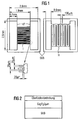
- Fig. 1 shows the top view of the sensor.
- Metallic contact surfaces KF are provided on a substrate SUB, between which an interdigital structure I is arranged.
- a section of the interdigital structure I is shown enlarged in FIG. 1 below.
- a gas-sensitive layer made of Ga 2 O 3 is provided over the interdigital structure I.
- a heating arrangement H is applied to the underside of the substrate SUB, shown on the right in FIG. 1.
- FIG. 2 shows the sensor in a highly simplified form in cross section.
- a 2 ⁇ m thick Ga 2 O 3 layer is applied to the substrate SUB.
- a filter layer, also referred to as surface covering, made of SiO 2 is arranged above this layer.
- the thickness of the filter layer is approximately 300 nm.
- the interdigital structure I and the heating arrangement H are not shown in FIG. 1.
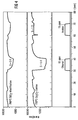
- the gas sensor according to the invention is compared to a conventional sensor based on Ga 2 O 3 .
- the time t (in minutes) shows how long the sensor is exposed to which gas.
- the resistance R in kOhm is plotted on the ordinate of the two diagrams.
- the sensitivity S results from the quotient of the ohmic resistance of the sensor in synthetic air and the ohmic resistance of the sensor in the test gas.
- the comparison of the sensor according to the invention with the conventional gas sensor shows that the methane, ethanol and isobutene sensitivity could be reduced by the SiO 2 surface covering, whereas the hydrogen sensitivity has increased significantly.
- the SiO 2 layer is only permeable to hydrogen. This means that the air humidity is kept away from the gas-sensitive layer, whereby the resistance of the sensor according to the invention compared to the conventional sensor is a factor of 5 higher (cf. FIG. 3, approx. 1 MOhm for the conventional gas sensor and 5 MOhm for the gas sensor according to the invention) .
- the sensitivity to hydrogen in the sensor according to the invention thus also increases. In the test, both sensors were operated at an operating temperature of 700 ° C.
- the sensor according to the invention can advantageously be implemented in inexpensive and microsystem-compatible planar technology. From the point of view of the reproducibility of the manufacturing technology, the planar technology is preferable to the bulk ceramic structure.
- the Ga 2 O 3 sensor is produced in the known manner, for example by deposition.
- the crystallinity and the stoichiometry of the Ga 2 O 3 layer can be improved by a first annealing process at temperatures between 700 and 1200 ° C.
- the additional layer of SiO 2 is applied to the surface of the Ga 2 O 3 a few nanometers to micrometers thick.
- This surface is stabilized by a suitable second annealing process.
- the gas sensitivity can be greatly influenced by the surface coverage.
- the sensitivities to certain gases can be increased and the cross-sensitivities to interfering gases reduced or partially eliminated.
- the filtering effect of the SiO 2 layer is based on 2 effects:
- the pore size of the layer determines which gas particles reach the gas-sensitive material.
- the polar character (hydrophilic, hydrophobic) of the gas filtering layer and the gases is crucial. It is conceivable that only polar or non-polar gas molecules, depending on the polar state of the filter layer, can pass through them (e.g. moisture barrier through hydrophobic membrane). That is, if the gas and the filter layer have different polar states, the gas cannot pass through the filter layer.
- the filtering layer made of SiO 2 not only improves the selectivity, but also the sensitivity to certain gases. This behavior can be explained by the fact that the gases to be detected occur in practice in connection with moisture. The moisture can be retained by the filtering layer. This increases the sensitivity, since this is calculated as the quotient of the electrical resistance of the sensor in synthetic air and the electrical resistance of the sensor in the gas to be detected. In addition, the sensitivity drops to NH 3 , which has a strong measuring effect in dry air in a conventional gas sensor. Since the moisture-impermeable layer prevents the Ga 2 O 3 surface from being covered with OH groups, a sensor with a high sensitivity to NH 3 can be produced.
- Non-porous, amorphous SiO 2 is a material with the properties mentioned above.
- non-conductive SiO 2 layer can be placed between the gas-sensitive layer and the filter layer.
- the operating temperature of the gas sensor must be between 600 ° C and 700 ° C. At a lower temperature, the electrical resistance of the gas-sensitive Ga 2 O 3 layer is too high. At a higher temperature, the sensitivity to H 2 is lost.
- the substrate SUB on one side of which the heating arrangement H and on the other side the measuring electrodes in the form of an interdigital structure I in connection with the gas-sensitive Ga 2 O 3 layer and the filter layer, are applied from an Al 2 O 3 (aluminum oxide) Layer and an overlying electrically non-conductive SiO 2 (silicon dioxide) layer.
- the SiO 2 layer also represents a diffusion barrier layer.
- a 2 ⁇ m thick Ga 2 O 3 layer is applied to the substrate SUB (cf. FIG. 2).
- a gas-sensitive metal oxide layer is applied over this layer.
- the thickness of the gas sensitive metal oxide layer depends on the metal oxide used. As a rule, it is between 30 nm and 300 nm.
- the gas sensor is manufactured as follows:
- a 2 ⁇ m thick gallium oxide layer is applied to the substrate SUB, which is covered on one side with the heating electrode structure H and on the other side with the measuring electrode structure I. It is applied, for example, by sputtering. This is followed by a first annealing process at an annealing temperature ⁇ T between 700 and 1200 ° C. This improves the crystallinity and the stoichiometry of the gallium oxide layer.
- a gas-sensitive metal oxide layer with a layer thickness between 3 and 300 nm is applied to the surface of the gallium oxide. This surface modification can be produced by cathode sputtering CVD, electron beam evaporation, molecular beam processes or by a wet chemical process.
- Gas-sensitive metal oxides such as titanium oxide (TiO 2 ), aluminum vanadate (AlVO 4 ), V 2 O 5 , tungsten oxide (WO 3 ) or tantalum oxide (TaO) are used for the second layer.
- TiO 2 titanium oxide
- AlVO 4 aluminum vanadate
- V 2 O 5 tungsten oxide
- TaO tantalum oxide
- This is followed by a second annealing process, which takes about 15 hours and whose tempering temperature ⁇ T is between 850 ° C and 1100 ° C depending on the operating temperature ⁇ B.
- the tempering temperature ⁇ T should always be chosen higher than the intended operating temperature ⁇ B.
- the following table shows the corresponding layer thickness, the tempering temperature ⁇ T , the operating temperature ⁇ B and the respective gas sensitivity of the sensor for the respective gas-sensitive metal oxide.
- a second layer of aluminum vanadate applied after the first annealing process becomes vanadium pentoxide (V 2 O 5 ) by the second annealing process.
- the electrons that contribute to changing the conductivity come from the gas-sensitive metal oxide layer (second layer), but not from gallium oxide.
- the electrons or the electric field migrate from the gas-sensitive metal oxide into the gallium oxide and cause a change in conductivity there. It is not the gas-sensitive properties of gallium oxide that are used, but rather those of the metal oxide applied as the second layer or a combination of the second layer and gallium oxide.
- the gas to be measured is chemisorbed on the surface of the gallium oxide layer or surface reactions occur on the semiconducting gallium oxide layer and there is an electron transfer from the adsorbate and sensor material and thus an increase in conductivity.
- the following are examples of selective sensors that have a gas-sensitive metal oxide layer.
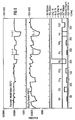
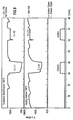
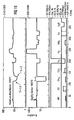
- FIG. 5 shows the gas-sensitive behavior of a gas sensor provided with a titanium oxide layer (layer thickness 300 nm) in comparison to a conventional (uncoated) Ga 2 O 3 sensor.
- the sensor according to the invention is suitable for solvents.
- the sensitivity for ethanol is 17, for acetone 12 and for isobutene 4.2. For all other measured gases, the sensitivity is below 1.5.
- the electrical resistance of the sensor in synthetic air is approximately 10 times lower than that of the conventional gallium oxide sensor.
- the response time of the gas sensor according to the invention could be reduced compared to the conventional gallium oxide sensor.
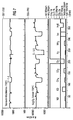
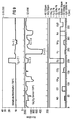
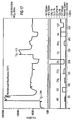
- FIGS. 7 and 8 show the gas-sensitive behavior of a gas sensor coated with tantalum oxide (layer thickness 300 nm) in comparison to an untreated Ga 2 O 3 sensor.
- the sensitivity of the sensor according to the invention is less than 1.7.
- the electrical resistance of the sensor according to the invention in synthetic air is approximately 5 times lower than that of the conventional gas sensor.
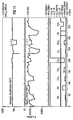
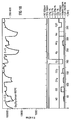
- FIGS. 9 and 10 show the gas-sensitive behavior of a gas sensor coated with aluminum vanadate (layer thickness 300 nm) compared to an uncoated Ga 2 O 3 sensor.
- the sensitivity of the gas sensor according to the invention to the other specified measurement gases is negligible.
- the electrical resistance of the invention The sensor in synthetic air is approximately 100 times smaller than that of the conventional gas sensor.
- the sensor signal of the gas sensor according to the invention is very stable and its response time is short.
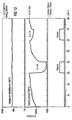
- FIGS. 11 and 12 show the gas-sensitive behavior of a gas sensor coated with aluminum vanadate (layer thickness 300 nm) in comparison to a conventional Ga 2 O 3 sensor.
- the electrical resistance of the sensor according to the invention in synthetic air is also considerably lower here than in the case of a conventional Ga 2 O 3 sensor.
- the sensor signal of the sensor according to the invention is very stable.
- FIGS. 13 and 14 show the gas-sensitive behavior of a gas sensor provided with an aluminum vanadate layer (layer thickness 300 nm) in comparison to a conventional Ga 2 O 3 sensor.
- ⁇ B 950 ° C.
- the sensitivity to other measuring gases is considerably lower.
- the specified sensor according to the invention can be used as a gas-insensitive reference element.
- FIGS. 15 and 16 show the gas-sensitive behavior of a gas sensor coated with aluminum vanadate (layer thickness 30 nm) compared to a conventional Ga 2 O 3 sensor.
- the tempering temperature ⁇ T is 1050 ° C
- the operating temperature ⁇ B is 1000 ° C.
- the advantage of this sensor according to the invention lies not in the selectivity for methane, but in the reduction in sensitivity to ethanol, which can be particularly disruptive for certain applications.
- the sensitivity to ethanol was reduced by a factor of 2, that of methane to a factor of 4 if the response times were the same.
- the methane sensitivity was reduced more.
- FIGS. 15 and 16 show the gas-sensitive behavior of a gas sensor coated with tungsten oxide (layer thickness 30 nm) compared to an untreated Ga 2 O 3 sensor.
- the tempering temperature ⁇ T is 350 ° C
- the operating temperature ⁇ B is 300 ° C.
- a conventional gallium oxide sensor cannot be operated below 600 ° C due to the high electrical resistance of the sensitive layer. Since the highest NO sensitivity is available at 600 ° C, this operating temperature is used for comparison.
- the electrical resistance of the sensor according to the invention in air is approximately 1 megohm and is therefore also 100 times lower than that of the conventional gallium oxide gas sensor.
- the sensor according to the invention is advantageously made in inexpensive and microsystem-compatible planar technology manufactured. From the point of view of the reproducibility of the manufacturing technology, this technology is to be preferred over bulk ceramic structures.
- the gas sensitivity could be influenced to a high degree.
- the sensitivities to certain target gases could be increased, the cross-sensitivities to interfering gases reduced or partially eliminated.
- the very high ethanol sensitivity of a conventional gallium oxide gas sensor could be greatly reduced in the sensor according to the invention, the methane sensitivity only decreasing slightly (see FIG. 16).
- the gas-sensitive reference element according to FIGS. 13 and 14 can be used to eliminate temperature fluctuations. As a result, it is no longer necessary to regulate the temperature of the sensor. Please refer to registration P 44 32 729.3.
- a gas sensor is specified there, which has a gas-dependent and temperature-dependent arrangement and an only temperature-dependent arrangement arranged in the immediate vicinity thereof. By forming the difference or ratio of the output signals of the two arrangements, a measurement variable that is independent of temperature fluctuations and is only gas-dependent can be obtained.
- the first layer of Ga 2 O 3 provides the stable basic electrical conductivity.
Landscapes
- Chemical & Material Sciences (AREA)
- Health & Medical Sciences (AREA)
- Life Sciences & Earth Sciences (AREA)
- Analytical Chemistry (AREA)
- General Health & Medical Sciences (AREA)
- Pathology (AREA)
- Immunology (AREA)
- Physics & Mathematics (AREA)
- Engineering & Computer Science (AREA)
- Biochemistry (AREA)
- General Physics & Mathematics (AREA)
- Combustion & Propulsion (AREA)
- Medicinal Chemistry (AREA)
- Food Science & Technology (AREA)
- Chemical Kinetics & Catalysis (AREA)
- Electrochemistry (AREA)
- Investigating Or Analyzing Materials By The Use Of Fluid Adsorption Or Reactions (AREA)
Applications Claiming Priority (2)
| Application Number | Priority Date | Filing Date | Title |
|---|---|---|---|
| DE19618935A DE19618935C2 (de) | 1996-05-10 | 1996-05-10 | Gassensor und Verfahren zur Herstellung eines Gassensors |
| DE19618935 | 1996-05-10 |
Publications (2)
| Publication Number | Publication Date |
|---|---|
| EP0806656A2 true EP0806656A2 (fr) | 1997-11-12 |
| EP0806656A3 EP0806656A3 (fr) | 1999-07-14 |
Family
ID=7793992
Family Applications (1)
| Application Number | Title | Priority Date | Filing Date |
|---|---|---|---|
| EP97106736A Withdrawn EP0806656A3 (fr) | 1996-05-10 | 1997-04-23 | Capteur de gaz et procédé de fabrication d'un capteur de gaz |
Country Status (4)
| Country | Link |
|---|---|
| US (1) | US6012327A (fr) |
| EP (1) | EP0806656A3 (fr) |
| JP (1) | JP2859601B2 (fr) |
| DE (1) | DE19618935C2 (fr) |
Cited By (3)
| Publication number | Priority date | Publication date | Assignee | Title |
|---|---|---|---|---|
| FR2793025A1 (fr) * | 1999-04-27 | 2000-11-03 | Valeo Climatisation | Capteur d'humidite relative protege, notamment pour appareil de chauffage et/ou climatisation |
| EP0940679A3 (fr) * | 1998-03-02 | 2001-06-13 | SIEMENS MATSUSHITA COMPONENTS GmbH & CO. KG | Système de détection d'incendie et méthode et détecteur notamment pour ce système |
| EP0945722A3 (fr) * | 1998-03-26 | 2001-10-17 | Siemens Aktiengesellschaft | Détecteur de gaz semi-conducteur |
Families Citing this family (33)
| Publication number | Priority date | Publication date | Assignee | Title |
|---|---|---|---|---|
| US7416699B2 (en) * | 1998-08-14 | 2008-08-26 | The Board Of Trustees Of The Leland Stanford Junior University | Carbon nanotube devices |
| US6346189B1 (en) * | 1998-08-14 | 2002-02-12 | The Board Of Trustees Of The Leland Stanford Junior University | Carbon nanotube structures made using catalyst islands |
| EP1067377A3 (fr) * | 1999-06-23 | 2001-09-26 | Siemens Aktiengesellschaft | Détecteur de gaz |
| US7086111B2 (en) | 2001-03-16 | 2006-08-08 | Braun Gmbh | Electric dental cleaning device |
| WO2002011131A1 (fr) | 2000-07-27 | 2002-02-07 | Imation Corp. | Supports d'enregistrement magnetiques et procedes de revetement |
| US6908538B2 (en) * | 2001-10-22 | 2005-06-21 | Perkinelmer Instruments Llc | Electrochemical gas sensor having a porous electrolyte |
| US7183228B1 (en) | 2001-11-01 | 2007-02-27 | The Board Of Trustees Of The Leland Stanford Junior University | Carbon nanotube growth |
| US7022541B1 (en) | 2001-11-19 | 2006-04-04 | The Board Of Trustees Of The Leland Stanford Junior University | Patterned growth of single-walled carbon nanotubes from elevated wafer structures |
| US6960385B2 (en) | 2002-09-10 | 2005-11-01 | Imation Corp. | Magnetic recording medium |
| ITTO20030318A1 (it) * | 2003-04-24 | 2004-10-25 | Sacmi | Dispositivo sensore di gas a film sottile semiconduttore. |
| US20080017510A1 (en) * | 2004-05-26 | 2008-01-24 | Nair Balakrishnan G | NOx Gas Sensor Method and Device |
| DE102004028701B3 (de) * | 2004-06-14 | 2005-11-24 | Siemens Ag | Gassensor zur Bestimmung von Ammoniak |
| US20080008625A1 (en) * | 2004-10-27 | 2008-01-10 | Thomas Ross C | Infrared sensor |
| US20090065370A1 (en) * | 2004-12-28 | 2009-03-12 | Nair Balakrishnan G | Ammonia gas sensor method and device |
| US7611612B2 (en) * | 2005-07-14 | 2009-11-03 | Ceramatec, Inc. | Multilayer ceramic NOx gas sensor device |
| US20070289870A1 (en) * | 2006-06-14 | 2007-12-20 | Nair Balakrishnan G | Ammonia Gas Sensor With Dissimilar Electrodes |
| US7547953B2 (en) * | 2007-01-29 | 2009-06-16 | General Electric Company | Porous gallium oxide films and methods for making and patterning the same |
| WO2008103311A2 (fr) * | 2007-02-16 | 2008-08-28 | Ceramatec, Inc. | Capteur de nox à sélectivité et sensibilité améliorées |
| US7827852B2 (en) * | 2007-12-20 | 2010-11-09 | General Electric Company | Gas sensor and method of making |
| CN102037349A (zh) * | 2008-04-06 | 2011-04-27 | H2Scan公司 | 用于应用催化金属的固态气体传感器的保护涂层 |
| US20100215547A1 (en) * | 2009-02-23 | 2010-08-26 | Patrick Dolan | Chemical vapor sensor with improved aging and temperature characteristics |
| DE102009054435A1 (de) * | 2009-11-25 | 2011-05-26 | Kechter, Andreas, Dipl.-Ing. | Heizbarer Gassensor und Verfahren zu dessen Herstellung |
| GB2476122A (en) * | 2009-12-14 | 2011-06-15 | Graviner Ltd Kidde | MOS gas sensor apparatus and method of use |
| GB2476123A (en) * | 2009-12-14 | 2011-06-15 | Graviner Ltd Kidde | MOS gas sensor apparatus and method of use |
| US20110200487A1 (en) * | 2010-02-18 | 2011-08-18 | Patrick Dolan | Chemical vapor sensor with improved aging and temperature characteristics |
| WO2011119469A1 (fr) | 2010-03-22 | 2011-09-29 | T3 Scientific Llc | Revêtement protecteur sélectif vis-à-vis de l'hydrogène, article revêtu et procédé |
| US8815160B2 (en) | 2010-11-15 | 2014-08-26 | Patrick Dolan | Chemical vapor sensor with improved temperature characteristics and manufacturing technique |
| US9164080B2 (en) | 2012-06-11 | 2015-10-20 | Ohio State Innovation Foundation | System and method for sensing NO |
| FR3011331B1 (fr) * | 2013-10-01 | 2017-02-17 | Univ Aix Marseille | Capteur a gaz a couche sensible chauffee |
| WO2018053656A1 (fr) | 2016-09-21 | 2018-03-29 | Sensirion Ag | Capteur de gaz |
| JP6840170B2 (ja) * | 2016-12-15 | 2021-03-10 | ヌヴォトンテクノロジージャパン株式会社 | 水素検出装置、燃料電池自動車、水素漏洩監視システム、複合センサモジュール、水素検出方法、およびプログラム |
| DE102018208097A1 (de) * | 2018-05-23 | 2019-11-28 | Robert Bosch Gmbh | Gassensor mit mikrostruktureller Beschichtung |
| EP3705879A1 (fr) * | 2019-03-06 | 2020-09-09 | Sensirion AG | Capteur de gaz à oxyde métallique résistif |
Citations (1)
| Publication number | Priority date | Publication date | Assignee | Title |
|---|---|---|---|---|
| US4347732A (en) * | 1980-08-18 | 1982-09-07 | Leary David J | Gas monitoring apparatus |
Family Cites Families (12)
| Publication number | Priority date | Publication date | Assignee | Title |
|---|---|---|---|---|
| GB1288539A (fr) * | 1970-05-22 | 1972-09-13 | ||
| US4601914A (en) * | 1982-06-07 | 1986-07-22 | Airtech, Inc. | Method for fabricating a semiconductor gas sensor |
| JPH04212048A (ja) * | 1990-06-11 | 1992-08-03 | Ricoh Co Ltd | ガスセンサ |
| DE59009246D1 (de) * | 1990-07-04 | 1995-07-20 | Siemens Ag | Sauerstoffsensor mit halbleitendem Galliumoxid. |
| EP0464244B1 (fr) * | 1990-07-04 | 1995-06-14 | Siemens Aktiengesellschaft | Capteur pour la détection de gaz réducteurs |
| EP0527258B1 (fr) * | 1991-08-14 | 1995-10-25 | Siemens Aktiengesellschaft | Matrice de détecteurs de gaz pour la détection des composants individuels dans un mélange de gaz |
| DE4401885C2 (de) * | 1994-01-24 | 1997-04-30 | Siemens Ag | Detektor zum Nachweis reduzierender Gase |
| DE4423289C1 (de) * | 1994-07-02 | 1995-11-02 | Karlsruhe Forschzent | Gassensor für reduzierende oder oxidierende Gase |
| DE4428155C2 (de) * | 1994-08-09 | 1996-12-19 | Siemens Ag | Verfahren zur Herstellung eines Gassensors |
| DE4432729C1 (de) * | 1994-09-14 | 1996-04-11 | Siemens Ag | Gassensor |
| US5767388A (en) * | 1995-04-26 | 1998-06-16 | Siemens Aktiengesellschaft | Methane sensor and method for operating a sensor |
| US5635628A (en) * | 1995-05-19 | 1997-06-03 | Siemens Aktiengesellschaft | Method for detecting methane in a gas mixture |
-
1996
- 1996-05-10 DE DE19618935A patent/DE19618935C2/de not_active Expired - Fee Related
-
1997
- 1997-04-23 EP EP97106736A patent/EP0806656A3/fr not_active Withdrawn
- 1997-05-09 JP JP9119354A patent/JP2859601B2/ja not_active Expired - Fee Related
- 1997-05-12 US US08/854,482 patent/US6012327A/en not_active Expired - Fee Related
Patent Citations (1)
| Publication number | Priority date | Publication date | Assignee | Title |
|---|---|---|---|---|
| US4347732A (en) * | 1980-08-18 | 1982-09-07 | Leary David J | Gas monitoring apparatus |
Cited By (3)
| Publication number | Priority date | Publication date | Assignee | Title |
|---|---|---|---|---|
| EP0940679A3 (fr) * | 1998-03-02 | 2001-06-13 | SIEMENS MATSUSHITA COMPONENTS GmbH & CO. KG | Système de détection d'incendie et méthode et détecteur notamment pour ce système |
| EP0945722A3 (fr) * | 1998-03-26 | 2001-10-17 | Siemens Aktiengesellschaft | Détecteur de gaz semi-conducteur |
| FR2793025A1 (fr) * | 1999-04-27 | 2000-11-03 | Valeo Climatisation | Capteur d'humidite relative protege, notamment pour appareil de chauffage et/ou climatisation |
Also Published As
| Publication number | Publication date |
|---|---|
| US6012327A (en) | 2000-01-11 |
| DE19618935A1 (de) | 1997-11-13 |
| JPH1048170A (ja) | 1998-02-20 |
| DE19618935C2 (de) | 2002-11-28 |
| EP0806656A3 (fr) | 1999-07-14 |
| JP2859601B2 (ja) | 1999-02-17 |
Similar Documents
| Publication | Publication Date | Title |
|---|---|---|
| DE19618935C2 (de) | Gassensor und Verfahren zur Herstellung eines Gassensors | |
| DE68919970T2 (de) | Sensor zur Bestimmung der relativen Quantität von einem Sauerstoff enthaltenden Gas in einer Gasmischung. | |
| EP0799417B1 (fr) | Detecteur permettant de detecter des gaz inflammables | |
| EP1236038A1 (fr) | Capteur capacitif | |
| DE4423289C1 (de) | Gassensor für reduzierende oder oxidierende Gase | |
| DE69422892T2 (de) | Verwendung von halbleitergassensoren | |
| DE68917821T2 (de) | Messung und Kontrolle des Abgaskreislaufs mit einer Sauerstoffpumpvorrichtung. | |
| WO1995010774A1 (fr) | Detecteur d'oxyde d'azote | |
| DE19549147C2 (de) | Gassensor | |
| DE4445033A1 (de) | Verfahren zur Messung der Konzentration eines Gases in einem Gasgemisch sowie elektrochemischer Sensor zur Bestimmung der Gaskonzentration | |
| DE2824609C2 (de) | Vorrichtung zur Feuchtigkeitsmessung durch elektrostatische Kapazitätsänderung | |
| EP0046989B1 (fr) | Capteur de gaz sélectif en couches minces de hautes sensibilité et stabilité pour la détection et la mesure d'impuretés gazeuses organiques dans l'air à base d'oxyde semi-conducteur de tungstène, ainsi que son procédé de fabrication | |
| DE19929625A1 (de) | Stickoxidgassensor | |
| DE3876056T2 (de) | Verfahren zur herstellung von mikrohohlraeumen und anwendung fuer einen elektrochemischen sensor und fuer einen gaschromatografen. | |
| DE602006000374T2 (de) | Sensor für oxidierendes Gas und dessen Herstellungsverfahren | |
| DE112016000301B4 (de) | NOx-Sensor | |
| DE68909386T2 (de) | Halbleitermessaufnehmer zur Feststellung der Konzentration von Wasserstoff und/oder von NOx und Verfahren zur dessen Herstellung. | |
| DE10144900A1 (de) | Metalloxid-Halbleitergassensor und Verfahren zu seiner Herstellung | |
| WO1999057548A1 (fr) | Detecteur pour hydrogene | |
| DE19924083C2 (de) | Leitfähigkeitssensor zur Detektion von Ozon | |
| WO1999019719A1 (fr) | Detecteur nanocristallin et son procede de fabrication | |
| DE19732601C2 (de) | Katalytisches Schichtsystem | |
| DE3151891A1 (de) | Halbleiter-sensor fuer die messung der konzentration von teilchen in fluiden | |
| DE102016206445B4 (de) | Coulometrischer Feuchtesensor mit gelförmigem Elektrolyt und Herstellungsverfahren für einen Coulometrischen Feuchtesensor mit gelförmigem Elektrolyt | |
| DE4210398A1 (de) | Anordnung zur Bestimmung eines Gaspartialdruckes in einem Gasgemisch |
Legal Events
| Date | Code | Title | Description |
|---|---|---|---|
| PUAI | Public reference made under article 153(3) epc to a published international application that has entered the european phase |
Free format text: ORIGINAL CODE: 0009012 |
|
| AK | Designated contracting states |
Kind code of ref document: A2 Designated state(s): CH DE FR GB LI NL |
|
| PUAL | Search report despatched |
Free format text: ORIGINAL CODE: 0009013 |
|
| AK | Designated contracting states |
Kind code of ref document: A3 Designated state(s): CH DE FR GB LI NL |
|
| 17P | Request for examination filed |
Effective date: 19990805 |
|
| RAP1 | Party data changed (applicant data changed or rights of an application transferred) |
Owner name: EPCOS AG |
|
| RAP1 | Party data changed (applicant data changed or rights of an application transferred) |
Owner name: EPCOS AG |
|
| 17Q | First examination report despatched |
Effective date: 20050303 |
|
| STAA | Information on the status of an ep patent application or granted ep patent |
Free format text: STATUS: THE APPLICATION IS DEEMED TO BE WITHDRAWN |
|
| 18D | Application deemed to be withdrawn |
Effective date: 20050914 |