EP0806769A2 - Motor für Anwendung in Informationsaufzeichnungsanordnung - Google Patents
Motor für Anwendung in Informationsaufzeichnungsanordnung Download PDFInfo
- Publication number
- EP0806769A2 EP0806769A2 EP97106768A EP97106768A EP0806769A2 EP 0806769 A2 EP0806769 A2 EP 0806769A2 EP 97106768 A EP97106768 A EP 97106768A EP 97106768 A EP97106768 A EP 97106768A EP 0806769 A2 EP0806769 A2 EP 0806769A2
- Authority
- EP
- European Patent Office
- Prior art keywords
- motor
- rotational accuracy
- information recording
- recording device
- rotational
- Prior art date
- Legal status (The legal status is an assumption and is not a legal conclusion. Google has not performed a legal analysis and makes no representation as to the accuracy of the status listed.)
- Granted
Links
Images


Classifications
-
- H—ELECTRICITY
- H02—GENERATION; CONVERSION OR DISTRIBUTION OF ELECTRIC POWER
- H02K—DYNAMO-ELECTRIC MACHINES
- H02K37/00—Motors with rotor rotating step by step and without interrupter or commutator driven by the rotor, e.g. stepping motors
- H02K37/22—Damping units
-
- G—PHYSICS
- G11—INFORMATION STORAGE
- G11B—INFORMATION STORAGE BASED ON RELATIVE MOVEMENT BETWEEN RECORD CARRIER AND TRANSDUCER
- G11B19/00—Driving, starting, stopping record carriers not specifically of filamentary or web form, or of supports therefor; Control thereof; Control of operating function ; Driving both disc and head
- G11B19/20—Driving; Starting; Stopping; Control thereof
- G11B19/2009—Turntables, hubs and motors for disk drives; Mounting of motors in the drive
Definitions
- the present invention relates to a motor for use in an information recording device, such as an FDD, for example, which accesses information by rotating a disk-shaped recording medium at a constant speed, and in particular, it relates to a spindle motor which drives a recording medium directly.
- An FDD Flexible Disk Drive
- a brushless DC motor has been employed as the spindle motor for driving rotation of a floppy disk in an FDD.
- Brushless DC motors present no problems whatsoever in terms of performance or reliability, but since they require rotor position detectors and a speed detector, the motors themselves are unavoidably expensive.
- feedback control of the rotational speed is required in the drive, in order to ensure rotational accuracy, and hence the circuit composition becomes large in size, and such systems have been unable to meet recent demands for cost reduction.
- the spindle motor represents a large cost element in the device, and lowering the cost of tee spindle motor has become an important objective.
- an object of the present invention to provide a motor for an information recording device, wherein an inexpensive stepping motor is used to drive a recording disk, the disk being driven under open-loop control by means of inexpensive digital circuit technology, without employing rotor positions detectors or a speed detector, and the rotational accuracy of the recording disk is raised to a level suitable for application, without increasing cost, by constituting the aforementioned step operation (having poor rotational accuracy) to be inherent in the stepping motor such that certain relationships are formed between the structural parameters of the information recording device (moment of inertia of total rotating portion, rotational speed of driven disk and required rotational accuracy) and the structural parameters of the motor such as basic step number and detent torque.
- each of the parameters is set such that the following conditions are satisfied.
- the motor is designed such that the relationship between the aforementioned rotational accuracy ⁇ and the rotational accuracy ⁇ a required in the device is: ⁇ ⁇ ⁇ a.
- the stepping motor can be caused to rotate sufficiently smoothly by designing a device such that the relationship above is satisfied, and as a result, the required rotational accuracy for the device can be achieved.
- a stepping motor according to the present invention is used as a spindle motor for an FDD information recording device, it is desirable for the moment of inertia J (g ⁇ cm 2 ) of the total rotating portion of the motor, the basic step number N (steps), and the peak-to-peak value for the detent torque 2Td (g ⁇ cm), to be set such that the rotational accuracy ⁇ (%) is 0.3 ⁇ ⁇ ⁇ 1.2.
- the stepping motor according to the present invention is used as a 3.5-inch FDD spindle motor , it is desirable for the basic step number N to be 48 ⁇ N ⁇ 188.
- a 3.5-inch FDD (Floppy Disk Drive) is taken as one example of an information recording device according to the present invention.
- Figs.1(a) and (b) show only those parts of the structure of a 3.5-inch FDD which are necessary in order to describe the present invention.
- Fig.1(a) shows a recording disk in a released state; and
- Fig.1(b) shows a recording disk in an engaged state.
- Figs.1(a) and (b) 1 is a disk-shaped recording medium (hereafter, called “recording disk”): magnetic particles are coated onto both surfaces of this recording disk 1, and a dish-shaped steel chucking hub 1' containing two holes is fitted to the center portion thereof.
- the whole recording disk 1 is housed in a plastic case (omitted from drawing) in order to protect the surfaces of the recording medium and improve portability.
- the recording disk 2 denotes a magnetic head, which contacts the recording disk 1 and reads out information recorded on this recording disk 1, in the form of magnetic variations in the magnetic particles, by means of a coil in the magnetic read-out head 2. Furthermore, information is written in by applying magnetic variations to the magnetic particles in the recording disk 1 by means of the recording head 2.
- the magnetic head 2 has the functions of reading out information stored on the recording disk 1, and writing information onto the recording disk 1.
- the head carriage 3 denotes a part called the head carriage, the magnetic head 2 being attached to the end region thereof.
- the head carriage 3 is a mechanism for moving the magnetic head 2 linearly to an appropriate location (track) on the recording disk 1, and it comprises an actuator motor 6, and a screw 5 which converts the rotational movement thereof to linear movement.
- an actuator motor 6 and a screw 5 which converts the rotational movement thereof to linear movement.
- a portion 3a of the head carriage 3 fits into the grooves in the screw 5, and hence, when the screw 5 rotates, the whole head carriage 3 makes linear movement.
- the magnetic head 2 can be moved as appropriate to a desired track position on the recording disk 1 by means of a position instruction supplied to the actuator motor 6 (determined by a number of pulses supplied to the actuator motor 6).
- a chucking mechanism 8 which rotates the steel chucking hub 1' at the center of the recording disk 1, whilst holding it in a stable state, is provided at the end of the rotating portion of said motor 7. As a result, the recording disk 1 rotates stably in a state whereby it is clamped directly to the chucking mechanism 8 of the spindle motor 7.
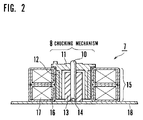
- Fig.2 shows a section of a two-phase claw pole stepping motor which is particularly effective as an embodiment of the present invention.
- the actual structure of the motor is that of a standard claw pole stepping motor as shown in Fig.2, the only point of difference being that, as stated previously, a chucking mechanism 8 for interfacing in order to drive a recording disk is fitted at one end of the rotor section.
- a cylindrical hub 11 is fixed to the upper portion of a spindle 10 which extends vertically in the center region of the motor, and a magnet 12 is fixed to the outer rim of the hub 11.
- the spindle 10 is supported by an axle bearing 13 and a thrust bearing 14.
- a ring-shaped stator yoke 15 is provided on the outer side of the magnet 12, separated therefrom by a small gap, and inside this stator yoke 15, a coil 17 is wound about a core 16.
- This assembly is attached to a motor mounting plate 18.
- An object of the present invention is to find a way of achieving smooth rotation or high rotational accuracy using a stepping motor based on a step operation, in other words, a way of setting the step number, detent torque and moment of inertia of the total rotating portion in a motor, appropriately, without altering the basic mechanism of the motor.
- a two-phase claw pole stepping motor is described as an example, but the technological concepts of the present invention may naturally be applied to all types of stepping motor.
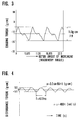
- a stepping motor In general, a stepping motor is driven at a constant rotational speed in synchronization with an input clock. In a stepping motor, whilst the average speed matches a target value (by synchronization to an input clock), due to the inherent step movement of the motor's basic operation, the motor alternates between high speed and low speed (the speed is irregular), when observed closely; in other words, rotational accuracy is poor.
- This rotational accuracy is an especially important factor in a spindle motor driving a recording medium in an information recording device, and it must be kept below a certain value in order that the information stored on the recording disk can be accessed accurately .
- the detent torque should be lowered, and the moment of inertia, rotational speed, and basic step number should be increased.
- rotational speed is predetermined by the conditions of the device, and cannot be changed.
- Factors which can be changed in a motor are the moment of inertia, the basic step number, and the detent torque.
- the moment of inertia is related to the motor dimensions allowed by the device, and the motor size is naturally limited.
- the motor is made too large, although rotational accuracy is good, a reciprocal problem arises in that the start-up time becomes longer. Therefore, in cases where a stepping motor is installed in a device as a spindle motor, it is of course necessary to determine these physical relationships logically.
- a logical correlation is formed between the aforementioned factors 1) to 5) and the rotational accuracy ⁇ , due to the motor structure, as determined by means of various experimentation and physical laws, and, separately from this, between these factors and the required rotational accuracy ⁇ a, for ensuring data access in the device.
- rotational accuracy is raised firstly by properly coordinating the electrical energy input intermittently at constant time intervals (in a stepping motor, this energy is supplied by switching excitation at a timing synchronized to an input clock, regardless of the load state), with the moment of inertia of the rotating portion, at the rated rotational speed for ensuring rotational accuracy.
- the rotational accuracy is raised by smoothly converting (storing) the intermittently input electrical energy into mechanical energy, by means of adding suitable moment of inertia. In such case, it is advantageous for the moment of inertia of the rotating portion to be large, and as a result, cases may occur where the motor cannot self-start at the rated rotational speed.
- the required rotational accuracy ⁇ a is specified in terms of ISV (Instant Speed Variation) during actual read-out of information on the recording medium via the magnetic head, and the practical value for this is 4% or less.
- ISV indicates the instant maximum speed variation, and furthermore, since this value is derived via the magnetic head, it differs from pure rotational accuracy found from physical laws on the assumption of linear conditions, as described above.
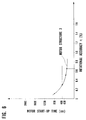
- Fig.5 shows the relationship between ⁇ and ISV in experimentation. From Fig.5, the aforementioned relationships are shown to be appropriate.
- Fig.5 shows results for three different motor structures (motor structures 1 to 3), and in this experiment, the rotational accuracy ⁇ for the different motor structures was found by raising the inertia J and actually measuring the ISV in an FDD, with respect to the different moment of inertia values for J.
- the minimum rotational accuracy ⁇ satisfying an FDD start-up time specification of 480 ms maximum is 0.29. Therefore, if a margin is allowed in the rotational accuracy ⁇ , and it is considered along with the maximum conditions for the rotational accuracy ⁇ described above, then the range for the rotational accuracy ⁇ in an FDD is 0.3 ⁇ ⁇ ⁇ 1.2 .
- the minimum value for the basic number of steps is determined by the conditions for required rotational accuracy, as described previously.
- the maximum value is determined by mechanical processing constraints in allocating pole teeth on the stator yoke.
- the maximum dimension of the motor is a diameter D of approximately 60 mm due to the size of the recording disk, and its height "h" is 8 mm at the most, due to the thickness of the drive. If the motor is an inner rotor-type, as in the present embodiment, a rotor diameter of half the external diameter, namely, 30 mm, or less, is suitable from the viewpoint of motor balancing.
- the basic step number N (steps) can be derived to be 48 ⁇ N ⁇ 189. If the motor is a two-phase claw pole stepping motor, then the number of basic steps N is multiplied by a factor of 4, and hence becomes 48 ⁇ N ⁇ 188.
- the motor size is significantly altered due to the aforementioned conditions, it is not possible to change the basic step number N by a large amount by means of the rotor diameter.
- the range of the basic step number N is 48 ⁇ N ⁇ 188.
- an inner rotor-type motor was described, but with an outer rotor-type motor also, the range of the basic step number N is the same.
- outer rotor-type motors whilst advantageous in terms of moment of inertia, have a drawback in that detent torque is raised due to both to the larger diameter and the promotion of magnetic saturation caused by the increased magnetomotive force of the magnet, and thus the effects are cancelled out. Consequently, an outer rotor-type motor cannot be perceived as having any inherently beneficial structural conditions.
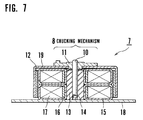
- a structural example of an outer rotor-type motor is shown in Fig.7.
- the outer rotor-type motor is different only in that the stator and rotor positions are reversed. Namely, in an outer rotor-type motor, the stator is on the inside and a rotor containing a magnet rotates on the outer side thereof.
- a spindle 10 is held by an axle bearing 13 and a thrust bearing 14 attached to a motor mounting plate 18, and a hub 11 is fixed to the upper portion of the spindle 10.
- a bowl-shaped rotor yoke 19 is fixed to the hub 11 and a magnet 12 is attached to the inner surface of this rotor yoke 19.
- a coil 17 is wound about a core 16 inside the stator yoke 15, the coil 17 being slightly separated from the magnet 12 on the inner side of the rotor yoke 19.
- the point where a chucking mechanism 8 engages with the upper surface of the rotor is the same as in the inner rotor-type motor shown in Fig.2.
- detent torque which, desirably, should be low from the viewpoint of maintaining high rotational accuracy, since it causes disturbance, as stated previously.
- detent torque is not produced by magnetic saturation effects, as mentioned in the description of an outer rotor-type motor. This is because magnetic saturation is a non-linear phenomenon, and it is not in a region where the aforementioned physical laws apply.
- Td must be Td ⁇ 20 (g ⁇ cm).
- an inexpensive stepping motor (a two-phase stepping motor is particularly effective) as a spindle motor for use in an information recording device, such as an FDD, and significant cost reduction in recording devices can be achieved. Furthermore, in this, since the required rotational accuracy can be obtained simply by setting the motor step number, rotor inertia and detent torque appropriately, without altering the structure of the motor, there is no increase in cost. There is no need to adopt a special drive system for the motor (standard digital voltage drive is suitable), which not only means that the drive circuit itself is inexpensive, but also makes it possible to incorporate the actual motor drive circuit in a one-chip microcomputer built into the device.
Landscapes
- Engineering & Computer Science (AREA)
- Power Engineering (AREA)
- Control Of Stepping Motors (AREA)
- Rotational Drive Of Disk (AREA)
Applications Claiming Priority (3)
| Application Number | Priority Date | Filing Date | Title |
|---|---|---|---|
| JP11404496 | 1996-05-09 | ||
| JP114044/96 | 1996-05-09 | ||
| JP8114044A JPH09308216A (ja) | 1996-05-09 | 1996-05-09 | 情報記録装置用モータ |
Publications (3)
| Publication Number | Publication Date |
|---|---|
| EP0806769A2 true EP0806769A2 (de) | 1997-11-12 |
| EP0806769A3 EP0806769A3 (de) | 1998-12-09 |
| EP0806769B1 EP0806769B1 (de) | 2002-08-28 |
Family
ID=14627633
Family Applications (1)
| Application Number | Title | Priority Date | Filing Date |
|---|---|---|---|
| EP97106768A Expired - Lifetime EP0806769B1 (de) | 1996-05-09 | 1997-04-24 | Motor für Anwendung in Informationsaufzeichnungsanordnung |
Country Status (5)
| Country | Link |
|---|---|
| US (1) | US5880569A (de) |
| EP (1) | EP0806769B1 (de) |
| JP (1) | JPH09308216A (de) |
| CN (1) | CN1166718A (de) |
| DE (1) | DE69714905T2 (de) |
Families Citing this family (4)
| Publication number | Priority date | Publication date | Assignee | Title |
|---|---|---|---|---|
| US6959839B2 (en) * | 2003-02-10 | 2005-11-01 | Donna Roth | Flavoring component holding dispenser for use with consumable beverages |
| US7477469B2 (en) | 2006-04-27 | 2009-01-13 | Seagate Technology Llc | Active protection system |
| EP2496297B1 (de) | 2009-11-03 | 2020-09-16 | ResMed Pty Ltd | Cpap-systeme |
| US10902871B2 (en) * | 2018-07-19 | 2021-01-26 | Western Digital Technologies, Inc. | Low-profile ball screw cam elevator mechanism for cold storage data storage device |
Family Cites Families (9)
| Publication number | Priority date | Publication date | Assignee | Title |
|---|---|---|---|---|
| US4115726A (en) * | 1977-01-04 | 1978-09-19 | Hewlett-Packard Company | Open-loop electric drive with corrective controller |
| JPS63213456A (ja) * | 1987-02-27 | 1988-09-06 | Tokyo Electric Co Ltd | メデイア駆動装置 |
| JPH01176367A (ja) * | 1987-12-29 | 1989-07-12 | Tokyo Electric Co Ltd | フロツピーデイスクドライブ装置 |
| JPH01220261A (ja) * | 1988-02-29 | 1989-09-01 | Tokyo Electric Co Ltd | フロッピディスク駆動装置 |
| US5048005A (en) * | 1989-10-10 | 1991-09-10 | Ekhoff Donald L | Spindle clamp having a unitary lock member |
| JPH04308499A (ja) * | 1991-04-05 | 1992-10-30 | Matsushita Electric Ind Co Ltd | 3相ステッピングモータの駆動方法 |
| US5304879A (en) * | 1991-12-07 | 1994-04-19 | Minebea Kabushiki-Kaisha (Minebea Co., Ltd) | Outer rotor motor |
| JP3427410B2 (ja) * | 1993-02-24 | 2003-07-14 | ソニー株式会社 | 光ディスク記録装置および光ディスク再生装置 |
| JP3013288B2 (ja) * | 1995-08-31 | 2000-02-28 | ミネベア株式会社 | ステッピングモータ |
-
1996
- 1996-05-09 JP JP8114044A patent/JPH09308216A/ja active Pending
-
1997
- 1997-04-18 US US08/844,387 patent/US5880569A/en not_active Expired - Fee Related
- 1997-04-24 DE DE69714905T patent/DE69714905T2/de not_active Expired - Fee Related
- 1997-04-24 EP EP97106768A patent/EP0806769B1/de not_active Expired - Lifetime
- 1997-05-09 CN CN97111143A patent/CN1166718A/zh active Pending
Also Published As
| Publication number | Publication date |
|---|---|
| JPH09308216A (ja) | 1997-11-28 |
| CN1166718A (zh) | 1997-12-03 |
| US5880569A (en) | 1999-03-09 |
| EP0806769B1 (de) | 2002-08-28 |
| EP0806769A3 (de) | 1998-12-09 |
| DE69714905D1 (de) | 2002-10-02 |
| DE69714905T2 (de) | 2003-04-30 |
Similar Documents
| Publication | Publication Date | Title |
|---|---|---|
| US5157295A (en) | Under-the-hub disk drive spin motor | |
| US4965476A (en) | Stabilized disk drive spin motor | |
| KR19980703722A (ko) | 다상 브러쉬리스 영구 자석 모터용 스위치 모드 사인파 구동기 | |
| JPS6240782B2 (de) | ||
| JP3243517B2 (ja) | 情報記録装置の記録円盤駆動装置及び駆動方法 | |
| US5825151A (en) | Apparatus for driving stepping motor | |
| US5880569A (en) | Motor for use in information recording device | |
| US5400197A (en) | Disc drive spindle motor | |
| JP3958819B2 (ja) | 情報記憶装置の記録円盤駆動装置に用いられる2相クローポール型ステッピングモータの駆動方法 | |
| JPH0295192A (ja) | ホールモータの回転制御回路 | |
| JP3275038B2 (ja) | 情報記録装置の記録円盤駆動方式 | |
| US5369537A (en) | Disk driving device with improved disk mounting surface | |
| US6977477B2 (en) | Systems, apparatus, and methods for motor control | |
| US5875069A (en) | Claw-pole synchronous motor for driving a storage device | |
| US8368282B2 (en) | Disk drive device rotationally driving recording disk | |
| JP2003264955A (ja) | 永久磁石モータ | |
| JPS593754A (ja) | 磁気デイスク装置 | |
| US5914581A (en) | Information recording device | |
| JP3192671B2 (ja) | ディスクファイル装置 | |
| KR20000035572A (ko) | 대용량 기억 장치에서 3상 모터를 구동하기 위한 방법 및시스템 | |
| JPS6313167A (ja) | 磁気デイスク装置 | |
| JPS593752A (ja) | 磁気デイスク装置 | |
| JP2616219B2 (ja) | 電動機 | |
| JPH03254464A (ja) | メモリーディスクの駆動方法及びメモリーディスク | |
| JPH0746433B2 (ja) | 光学式再生装置のトラツキング制御装置 |
Legal Events
| Date | Code | Title | Description |
|---|---|---|---|
| PUAI | Public reference made under article 153(3) epc to a published international application that has entered the european phase |
Free format text: ORIGINAL CODE: 0009012 |
|
| AK | Designated contracting states |
Kind code of ref document: A2 Designated state(s): DE FR GB IT |
|
| PUAL | Search report despatched |
Free format text: ORIGINAL CODE: 0009013 |
|
| AK | Designated contracting states |
Kind code of ref document: A3 Designated state(s): DE FR GB IT |
|
| 17P | Request for examination filed |
Effective date: 19990115 |
|
| 17Q | First examination report despatched |
Effective date: 20010209 |
|
| GRAG | Despatch of communication of intention to grant |
Free format text: ORIGINAL CODE: EPIDOS AGRA |
|
| GRAG | Despatch of communication of intention to grant |
Free format text: ORIGINAL CODE: EPIDOS AGRA |
|
| GRAG | Despatch of communication of intention to grant |
Free format text: ORIGINAL CODE: EPIDOS AGRA |
|
| GRAH | Despatch of communication of intention to grant a patent |
Free format text: ORIGINAL CODE: EPIDOS IGRA |
|
| GRAH | Despatch of communication of intention to grant a patent |
Free format text: ORIGINAL CODE: EPIDOS IGRA |
|
| GRAA | (expected) grant |
Free format text: ORIGINAL CODE: 0009210 |
|
| AK | Designated contracting states |
Kind code of ref document: B1 Designated state(s): DE FR GB IT |
|
| REG | Reference to a national code |
Ref country code: GB Ref legal event code: FG4D |
|
| REF | Corresponds to: |
Ref document number: 69714905 Country of ref document: DE Date of ref document: 20021002 |
|
| ET | Fr: translation filed | ||
| PLBE | No opposition filed within time limit |
Free format text: ORIGINAL CODE: 0009261 |
|
| STAA | Information on the status of an ep patent application or granted ep patent |
Free format text: STATUS: NO OPPOSITION FILED WITHIN TIME LIMIT |
|
| 26N | No opposition filed |
Effective date: 20030530 |
|
| PGFP | Annual fee paid to national office [announced via postgrant information from national office to epo] |
Ref country code: FR Payment date: 20080312 Year of fee payment: 12 Ref country code: DE Payment date: 20080502 Year of fee payment: 12 |
|
| PGFP | Annual fee paid to national office [announced via postgrant information from national office to epo] |
Ref country code: IT Payment date: 20080428 Year of fee payment: 12 |
|
| PGFP | Annual fee paid to national office [announced via postgrant information from national office to epo] |
Ref country code: GB Payment date: 20080430 Year of fee payment: 12 |
|
| GBPC | Gb: european patent ceased through non-payment of renewal fee |
Effective date: 20090424 |
|
| REG | Reference to a national code |
Ref country code: FR Ref legal event code: ST Effective date: 20091231 |
|
| PG25 | Lapsed in a contracting state [announced via postgrant information from national office to epo] |
Ref country code: DE Free format text: LAPSE BECAUSE OF NON-PAYMENT OF DUE FEES Effective date: 20091103 |
|
| PG25 | Lapsed in a contracting state [announced via postgrant information from national office to epo] |
Ref country code: GB Free format text: LAPSE BECAUSE OF NON-PAYMENT OF DUE FEES Effective date: 20090424 Ref country code: FR Free format text: LAPSE BECAUSE OF NON-PAYMENT OF DUE FEES Effective date: 20091222 |
|
| PG25 | Lapsed in a contracting state [announced via postgrant information from national office to epo] |
Ref country code: IT Free format text: LAPSE BECAUSE OF NON-PAYMENT OF DUE FEES Effective date: 20090424 |