EP0807142B1 - Methode et composition photopolymerisable de protection de glaces en matiere plastique pour projecteurs de vehicules - Google Patents
Methode et composition photopolymerisable de protection de glaces en matiere plastique pour projecteurs de vehicules Download PDFInfo
- Publication number
- EP0807142B1 EP0807142B1 EP96903041A EP96903041A EP0807142B1 EP 0807142 B1 EP0807142 B1 EP 0807142B1 EP 96903041 A EP96903041 A EP 96903041A EP 96903041 A EP96903041 A EP 96903041A EP 0807142 B1 EP0807142 B1 EP 0807142B1
- Authority
- EP
- European Patent Office
- Prior art keywords
- monoacrylate
- sheet
- acrylate
- layer
- composition
- Prior art date
- Legal status (The legal status is an assumption and is not a legal conclusion. Google has not performed a legal analysis and makes no representation as to the accuracy of the status listed.)
- Expired - Lifetime
Links
- 239000000203 mixture Substances 0.000 title claims abstract description 67
- 238000000034 method Methods 0.000 title claims abstract description 33
- 230000002633 protecting effect Effects 0.000 title claims abstract description 7
- 239000004033 plastic Substances 0.000 title claims description 15
- 229920003023 plastic Polymers 0.000 title claims description 15
- 239000011521 glass Substances 0.000 title abstract description 21
- 230000005855 radiation Effects 0.000 claims abstract description 29
- 229920000515 polycarbonate Polymers 0.000 claims abstract description 21
- 239000004417 polycarbonate Substances 0.000 claims abstract description 21
- 238000006116 polymerization reaction Methods 0.000 claims abstract description 16
- QSHDDOUJBYECFT-UHFFFAOYSA-N mercury Chemical compound [Hg] QSHDDOUJBYECFT-UHFFFAOYSA-N 0.000 claims abstract description 5
- 229910052753 mercury Inorganic materials 0.000 claims abstract description 4
- 239000002966 varnish Substances 0.000 claims description 48
- 239000010410 layer Substances 0.000 claims description 40
- 230000009975 flexible effect Effects 0.000 claims description 26
- 239000002904 solvent Substances 0.000 claims description 23
- 230000008569 process Effects 0.000 claims description 18
- 230000001681 protective effect Effects 0.000 claims description 18
- 239000011347 resin Substances 0.000 claims description 15
- 229920005989 resin Polymers 0.000 claims description 15
- 230000004224 protection Effects 0.000 claims description 14
- NKDDWNXOKDWJAK-UHFFFAOYSA-N dimethoxymethane Chemical compound COCOC NKDDWNXOKDWJAK-UHFFFAOYSA-N 0.000 claims description 13
- 239000000178 monomer Substances 0.000 claims description 12
- 239000003085 diluting agent Substances 0.000 claims description 10
- 239000000463 material Substances 0.000 claims description 10
- JYEUMXHLPRZUAT-UHFFFAOYSA-N 1,2,3-triazine Chemical compound C1=CN=NN=C1 JYEUMXHLPRZUAT-UHFFFAOYSA-N 0.000 claims description 9
- KPUWHANPEXNPJT-UHFFFAOYSA-N disiloxane Chemical class [SiH3]O[SiH3] KPUWHANPEXNPJT-UHFFFAOYSA-N 0.000 claims description 8
- UHESRSKEBRADOO-UHFFFAOYSA-N ethyl carbamate;prop-2-enoic acid Chemical compound OC(=O)C=C.CCOC(N)=O UHESRSKEBRADOO-UHFFFAOYSA-N 0.000 claims description 8
- 230000009471 action Effects 0.000 claims description 7
- 150000001412 amines Chemical class 0.000 claims description 6
- 230000007935 neutral effect Effects 0.000 claims description 6
- 239000011241 protective layer Substances 0.000 claims description 6
- 206010073306 Exposure to radiation Diseases 0.000 claims description 5
- 230000001678 irradiating effect Effects 0.000 claims description 5
- ZJCCRDAZUWHFQH-UHFFFAOYSA-N Trimethylolpropane Chemical compound CCC(CO)(CO)CO ZJCCRDAZUWHFQH-UHFFFAOYSA-N 0.000 claims description 4
- 238000000151 deposition Methods 0.000 claims description 4
- 238000010438 heat treatment Methods 0.000 claims description 4
- RZVINYQDSSQUKO-UHFFFAOYSA-N 2-phenoxyethyl prop-2-enoate Chemical compound C=CC(=O)OCCOC1=CC=CC=C1 RZVINYQDSSQUKO-UHFFFAOYSA-N 0.000 claims description 3
- KBLWLMPSVYBVDK-UHFFFAOYSA-N cyclohexyl prop-2-enoate Chemical compound C=CC(=O)OC1CCCCC1 KBLWLMPSVYBVDK-UHFFFAOYSA-N 0.000 claims description 3
- 230000008021 deposition Effects 0.000 claims description 3
- XMBWDFGMSWQBCA-UHFFFAOYSA-N hydrogen iodide Chemical compound I XMBWDFGMSWQBCA-UHFFFAOYSA-N 0.000 claims description 3
- 238000002156 mixing Methods 0.000 claims description 3
- MDYPDLBFDATSCF-UHFFFAOYSA-N nonyl prop-2-enoate Chemical compound CCCCCCCCCOC(=O)C=C MDYPDLBFDATSCF-UHFFFAOYSA-N 0.000 claims description 3
- 239000005056 polyisocyanate Substances 0.000 claims description 3
- 229920001228 polyisocyanate Polymers 0.000 claims description 3
- 238000005507 spraying Methods 0.000 claims description 3
- 238000009281 ultraviolet germicidal irradiation Methods 0.000 claims description 3
- 150000002009 diols Chemical class 0.000 claims description 2
- 230000003213 activating effect Effects 0.000 claims 3
- XPEMPJFPRCHICU-UHFFFAOYSA-N (1-tert-butylcyclohexyl) prop-2-enoate Chemical compound C=CC(=O)OC1(C(C)(C)C)CCCCC1 XPEMPJFPRCHICU-UHFFFAOYSA-N 0.000 claims 2
- GOXQRTZXKQZDDN-UHFFFAOYSA-N 2-Ethylhexyl acrylate Chemical compound CCCCC(CC)COC(=O)C=C GOXQRTZXKQZDDN-UHFFFAOYSA-N 0.000 claims 2
- 229940074076 glycerol formal Drugs 0.000 claims 2
- 238000006748 scratching Methods 0.000 claims 2
- 230000002393 scratching effect Effects 0.000 claims 2
- MUTNCGKQJGXKEM-UHFFFAOYSA-N tamibarotene Chemical compound C=1C=C2C(C)(C)CCC(C)(C)C2=CC=1NC(=O)C1=CC=C(C(O)=O)C=C1 MUTNCGKQJGXKEM-UHFFFAOYSA-N 0.000 claims 2
- 239000000126 substance Substances 0.000 abstract description 10
- 239000004814 polyurethane Substances 0.000 abstract description 6
- 229920002635 polyurethane Polymers 0.000 abstract description 6
- 229920000642 polymer Polymers 0.000 abstract description 5
- 230000032683 aging Effects 0.000 abstract description 4
- 238000004807 desolvation Methods 0.000 abstract description 4
- NIXOWILDQLNWCW-UHFFFAOYSA-N acrylic acid group Chemical group C(C=C)(=O)O NIXOWILDQLNWCW-UHFFFAOYSA-N 0.000 abstract description 3
- 239000000243 solution Substances 0.000 description 10
- 230000003287 optical effect Effects 0.000 description 8
- 239000000047 product Substances 0.000 description 7
- NIXOWILDQLNWCW-UHFFFAOYSA-M Acrylate Chemical compound [O-]C(=O)C=C NIXOWILDQLNWCW-UHFFFAOYSA-M 0.000 description 6
- YMWUJEATGCHHMB-UHFFFAOYSA-N Dichloromethane Chemical compound ClCCl YMWUJEATGCHHMB-UHFFFAOYSA-N 0.000 description 6
- XEKOWRVHYACXOJ-UHFFFAOYSA-N Ethyl acetate Chemical compound CCOC(C)=O XEKOWRVHYACXOJ-UHFFFAOYSA-N 0.000 description 6
- 238000004383 yellowing Methods 0.000 description 6
- 230000004913 activation Effects 0.000 description 5
- 150000001875 compounds Chemical class 0.000 description 5
- 238000005336 cracking Methods 0.000 description 5
- 238000010790 dilution Methods 0.000 description 5
- 239000012895 dilution Substances 0.000 description 5
- 238000004519 manufacturing process Methods 0.000 description 5
- JOYRKODLDBILNP-UHFFFAOYSA-N Ethyl urethane Chemical compound CCOC(N)=O JOYRKODLDBILNP-UHFFFAOYSA-N 0.000 description 4
- 239000012948 isocyanate Substances 0.000 description 4
- 230000002829 reductive effect Effects 0.000 description 4
- ZWEHNKRNPOVVGH-UHFFFAOYSA-N 2-Butanone Chemical compound CCC(C)=O ZWEHNKRNPOVVGH-UHFFFAOYSA-N 0.000 description 3
- 239000006096 absorbing agent Substances 0.000 description 3
- 230000015556 catabolic process Effects 0.000 description 3
- 238000000576 coating method Methods 0.000 description 3
- 238000006731 degradation reaction Methods 0.000 description 3
- 238000001914 filtration Methods 0.000 description 3
- 150000002513 isocyanates Chemical class 0.000 description 3
- 238000012423 maintenance Methods 0.000 description 3
- 230000014759 maintenance of location Effects 0.000 description 3
- 230000009467 reduction Effects 0.000 description 3
- 238000012360 testing method Methods 0.000 description 3
- 150000003918 triazines Chemical class 0.000 description 3
- 101100268168 Homo sapiens ZNF239 gene Proteins 0.000 description 2
- LRHPLDYGYMQRHN-UHFFFAOYSA-N N-Butanol Chemical compound CCCCO LRHPLDYGYMQRHN-UHFFFAOYSA-N 0.000 description 2
- 239000004904 UV filter Substances 0.000 description 2
- 102100021121 Zinc finger protein 239 Human genes 0.000 description 2
- -1 aliphatic isocyanates Chemical class 0.000 description 2
- 230000008901 benefit Effects 0.000 description 2
- 230000015572 biosynthetic process Effects 0.000 description 2
- 239000003795 chemical substances by application Substances 0.000 description 2
- 239000011248 coating agent Substances 0.000 description 2
- 238000004132 cross linking Methods 0.000 description 2
- 238000001723 curing Methods 0.000 description 2
- 238000001035 drying Methods 0.000 description 2
- 229940082150 encore Drugs 0.000 description 2
- YLHXLHGIAMFFBU-UHFFFAOYSA-N methyl phenylglyoxalate Chemical compound COC(=O)C(=O)C1=CC=CC=C1 YLHXLHGIAMFFBU-UHFFFAOYSA-N 0.000 description 2
- 239000004848 polyfunctional curative Substances 0.000 description 2
- 238000002203 pretreatment Methods 0.000 description 2
- 230000001012 protector Effects 0.000 description 2
- 238000007493 shaping process Methods 0.000 description 2
- 230000035939 shock Effects 0.000 description 2
- DEQUKPCANKRTPZ-UHFFFAOYSA-N (2,3-dihydroxyphenyl)-phenylmethanone Chemical class OC1=CC=CC(C(=O)C=2C=CC=CC=2)=C1O DEQUKPCANKRTPZ-UHFFFAOYSA-N 0.000 description 1
- OMIGHNLMNHATMP-UHFFFAOYSA-N 2-hydroxyethyl prop-2-enoate Chemical compound OCCOC(=O)C=C OMIGHNLMNHATMP-UHFFFAOYSA-N 0.000 description 1
- NDWUBGAGUCISDV-UHFFFAOYSA-N 4-hydroxybutyl prop-2-enoate Chemical compound OCCCCOC(=O)C=C NDWUBGAGUCISDV-UHFFFAOYSA-N 0.000 description 1
- 229920000877 Melamine resin Polymers 0.000 description 1
- 239000004972 Polyurethane varnish Substances 0.000 description 1
- XBDQKXXYIPTUBI-UHFFFAOYSA-M Propionate Chemical compound CCC([O-])=O XBDQKXXYIPTUBI-UHFFFAOYSA-M 0.000 description 1
- 238000003848 UV Light-Curing Methods 0.000 description 1
- 230000006750 UV protection Effects 0.000 description 1
- 240000008042 Zea mays Species 0.000 description 1
- 230000002745 absorbent Effects 0.000 description 1
- 239000002250 absorbent Substances 0.000 description 1
- 238000000862 absorption spectrum Methods 0.000 description 1
- KXKVLQRXCPHEJC-UHFFFAOYSA-N acetic acid trimethyl ester Natural products COC(C)=O KXKVLQRXCPHEJC-UHFFFAOYSA-N 0.000 description 1
- 239000002253 acid Substances 0.000 description 1
- 238000007259 addition reaction Methods 0.000 description 1
- 230000001464 adherent effect Effects 0.000 description 1
- 230000003679 aging effect Effects 0.000 description 1
- 230000003321 amplification Effects 0.000 description 1
- QRUDEWIWKLJBPS-UHFFFAOYSA-N benzotriazole Chemical compound C1=CC=C2N[N][N]C2=C1 QRUDEWIWKLJBPS-UHFFFAOYSA-N 0.000 description 1
- 239000012964 benzotriazole Substances 0.000 description 1
- 150000001565 benzotriazoles Chemical class 0.000 description 1
- 230000000903 blocking effect Effects 0.000 description 1
- FBYUNLMTXMFAQK-UHFFFAOYSA-N butyl dodecanoate Chemical compound CCCCCCCCCCCC(=O)OCCCC.CCCCCCCCCCCC(=O)OCCCC FBYUNLMTXMFAQK-UHFFFAOYSA-N 0.000 description 1
- 210000004027 cell Anatomy 0.000 description 1
- 238000006243 chemical reaction Methods 0.000 description 1
- 238000004140 cleaning Methods 0.000 description 1
- 238000004737 colorimetric analysis Methods 0.000 description 1
- 239000013065 commercial product Substances 0.000 description 1
- 238000013016 damping Methods 0.000 description 1
- 230000007547 defect Effects 0.000 description 1
- 238000011161 development Methods 0.000 description 1
- 230000018109 developmental process Effects 0.000 description 1
- 238000007865 diluting Methods 0.000 description 1
- 239000000428 dust Substances 0.000 description 1
- 230000000694 effects Effects 0.000 description 1
- 238000001704 evaporation Methods 0.000 description 1
- 230000008020 evaporation Effects 0.000 description 1
- 238000002474 experimental method Methods 0.000 description 1
- 239000012467 final product Substances 0.000 description 1
- 239000004615 ingredient Substances 0.000 description 1
- 230000002401 inhibitory effect Effects 0.000 description 1
- 239000003999 initiator Substances 0.000 description 1
- GJRQTCIYDGXPES-UHFFFAOYSA-N iso-butyl acetate Natural products CC(C)COC(C)=O GJRQTCIYDGXPES-UHFFFAOYSA-N 0.000 description 1
- FGKJLKRYENPLQH-UHFFFAOYSA-M isocaproate Chemical compound CC(C)CCC([O-])=O FGKJLKRYENPLQH-UHFFFAOYSA-M 0.000 description 1
- OQAGVSWESNCJJT-UHFFFAOYSA-N isovaleric acid methyl ester Natural products COC(=O)CC(C)C OQAGVSWESNCJJT-UHFFFAOYSA-N 0.000 description 1
- WABPQHHGFIMREM-UHFFFAOYSA-N lead(0) Chemical compound [Pb] WABPQHHGFIMREM-UHFFFAOYSA-N 0.000 description 1
- 230000000670 limiting effect Effects 0.000 description 1
- 238000005259 measurement Methods 0.000 description 1
- JDSHMPZPIAZGSV-UHFFFAOYSA-N melamine Chemical compound NC1=NC(N)=NC(N)=N1 JDSHMPZPIAZGSV-UHFFFAOYSA-N 0.000 description 1
- 238000003199 nucleic acid amplification method Methods 0.000 description 1
- 125000002524 organometallic group Chemical group 0.000 description 1
- 230000036961 partial effect Effects 0.000 description 1
- 239000004014 plasticizer Substances 0.000 description 1
- 229920000058 polyacrylate Polymers 0.000 description 1
- 229920000728 polyester Polymers 0.000 description 1
- 230000000379 polymerizing effect Effects 0.000 description 1
- 229920005862 polyol Polymers 0.000 description 1
- 150000003077 polyols Chemical class 0.000 description 1
- 238000002360 preparation method Methods 0.000 description 1
- 230000002035 prolonged effect Effects 0.000 description 1
- 238000010992 reflux Methods 0.000 description 1
- 238000007086 side reaction Methods 0.000 description 1
- 239000007787 solid Substances 0.000 description 1
- 230000002269 spontaneous effect Effects 0.000 description 1
- 230000000087 stabilizing effect Effects 0.000 description 1
- 239000000758 substrate Substances 0.000 description 1
- 229920001169 thermoplastic Polymers 0.000 description 1
- 239000004416 thermosoftening plastic Substances 0.000 description 1
- 239000001993 wax Substances 0.000 description 1
Classifications
-
- C—CHEMISTRY; METALLURGY
- C08—ORGANIC MACROMOLECULAR COMPOUNDS; THEIR PREPARATION OR CHEMICAL WORKING-UP; COMPOSITIONS BASED THEREON
- C08J—WORKING-UP; GENERAL PROCESSES OF COMPOUNDING; AFTER-TREATMENT NOT COVERED BY SUBCLASSES C08B, C08C, C08F, C08G or C08H
- C08J7/00—Chemical treatment or coating of shaped articles made of macromolecular substances
- C08J7/12—Chemical modification
- C08J7/16—Chemical modification with polymerisable compounds
- C08J7/18—Chemical modification with polymerisable compounds using wave energy or particle radiation
-
- C—CHEMISTRY; METALLURGY
- C08—ORGANIC MACROMOLECULAR COMPOUNDS; THEIR PREPARATION OR CHEMICAL WORKING-UP; COMPOSITIONS BASED THEREON
- C08J—WORKING-UP; GENERAL PROCESSES OF COMPOUNDING; AFTER-TREATMENT NOT COVERED BY SUBCLASSES C08B, C08C, C08F, C08G or C08H
- C08J7/00—Chemical treatment or coating of shaped articles made of macromolecular substances
- C08J7/04—Coating
- C08J7/0427—Coating with only one layer of a composition containing a polymer binder
-
- C—CHEMISTRY; METALLURGY
- C08—ORGANIC MACROMOLECULAR COMPOUNDS; THEIR PREPARATION OR CHEMICAL WORKING-UP; COMPOSITIONS BASED THEREON
- C08J—WORKING-UP; GENERAL PROCESSES OF COMPOUNDING; AFTER-TREATMENT NOT COVERED BY SUBCLASSES C08B, C08C, C08F, C08G or C08H
- C08J7/00—Chemical treatment or coating of shaped articles made of macromolecular substances
- C08J7/04—Coating
- C08J7/046—Forming abrasion-resistant coatings; Forming surface-hardening coatings
-
- C—CHEMISTRY; METALLURGY
- C09—DYES; PAINTS; POLISHES; NATURAL RESINS; ADHESIVES; COMPOSITIONS NOT OTHERWISE PROVIDED FOR; APPLICATIONS OF MATERIALS NOT OTHERWISE PROVIDED FOR
- C09D—COATING COMPOSITIONS, e.g. PAINTS, VARNISHES OR LACQUERS; FILLING PASTES; CHEMICAL PAINT OR INK REMOVERS; INKS; CORRECTING FLUIDS; WOODSTAINS; PASTES OR SOLIDS FOR COLOURING OR PRINTING; USE OF MATERIALS THEREFOR
- C09D4/00—Coating compositions, e.g. paints, varnishes or lacquers, based on organic non-macromolecular compounds having at least one polymerisable carbon-to-carbon unsaturated bond ; Coating compositions, based on monomers of macromolecular compounds of groups C09D183/00 - C09D183/16
- C09D4/06—Organic non-macromolecular compounds having at least one polymerisable carbon-to-carbon unsaturated bond in combination with a macromolecular compound other than an unsaturated polymer of groups C09D159/00 - C09D187/00
-
- C—CHEMISTRY; METALLURGY
- C08—ORGANIC MACROMOLECULAR COMPOUNDS; THEIR PREPARATION OR CHEMICAL WORKING-UP; COMPOSITIONS BASED THEREON
- C08J—WORKING-UP; GENERAL PROCESSES OF COMPOUNDING; AFTER-TREATMENT NOT COVERED BY SUBCLASSES C08B, C08C, C08F, C08G or C08H
- C08J2369/00—Characterised by the use of polycarbonates; Derivatives of polycarbonates
-
- C—CHEMISTRY; METALLURGY
- C08—ORGANIC MACROMOLECULAR COMPOUNDS; THEIR PREPARATION OR CHEMICAL WORKING-UP; COMPOSITIONS BASED THEREON
- C08J—WORKING-UP; GENERAL PROCESSES OF COMPOUNDING; AFTER-TREATMENT NOT COVERED BY SUBCLASSES C08B, C08C, C08F, C08G or C08H
- C08J2433/00—Characterised by the use of homopolymers or copolymers of compounds having one or more unsaturated aliphatic radicals, each having only one carbon-to-carbon double bond, and only one being terminated by only one carboxyl radical, or of salts, anhydrides, esters, amides, imides, or nitriles thereof; Derivatives of such polymers
Definitions
- the present invention relates to a method for protecting against scratches and weathering of the windows for vehicle headlamps made in synthetic plastic, especially polycarbonate.
- the invention relates to in addition a polymerizable composition which can be used in particular in this method.
- windows for vehicle headlamps must have optimal optical performance, high transparency, suitability for easy shaping so that they can be shaped in any way desired, good robustness and a suitable weight. All these features cannot be obtained with traditional glass ices.
- the trend current is therefore to replace the glass windows with windows made in plastics, which are lighter and susceptible to easier shaping.
- An optimal material from this point of view is polycarbonate which also has optical characteristics almost equal to those of glass.
- polycarbonate is a material particularly tender and therefore susceptible to easily being scratched, which leads to a reduction in the optical characteristics of the glass.
- prolonged exposure to sunlight, weather and / or agents chemicals can produce aging, which makes it fragile, and above all causes yellowing and loss of transparency of the ice.
- the projector glass made of polycarbonate (or other similar plastics) must be protected, at least on their outer surface which remains exposed during use, by the application of special transparent varnishes.
- a first possibility consists in using compositions based on polyester-acrylate polymerization systems of the melamine or siloxane type self-crosslinking, that is to say compositions which, after polymerization, create on the ice a film of high hardness which, therefore, protects it very well against scratches and against wear due to the friction of atmospheric dust.
- the protective layer must have reduced thickness (5 to 8 microns) and must be applied, not directly on ice, but on a more flexible intermediate layer. This results in a complication in the manufacturing process, and especially serious drawbacks mechanical.
- the projector glass also supports frequent thermal shocks due to variations in temperature of the ice which suddenly warms up when the projector is turned on, to cool down just as suddenly, especially in winter when the projector is turned off and the ice returns to room temperature.
- the high hardness and reduced thickness of the protective film are therefore the because of a low resistance to these thermal shocks, with the consequence that this film, during use, can easily crack, removing protection chemical of the underlying material. In this case, cleaning with solvents may cause detachment of the protective varnish following attack on the support.
- the reduced thickness provides insufficient protection against the sunlight and its aging effects.
- a second possibility, which overcomes the disadvantages described, is to use flexible protective polymer compositions known as protective varnishes "self-healing", well known in the form of two-component polyurethane varnishes with three-dimensional crosslinking, obtained by mixing a polyisocyanate prepolymer with a polyol.
- These products make it possible to make layers protective with a thickness of 24 to 40 microns ensuring protection better against chemical attack in case of surface cracking and allow to incorporate UV filters and other substances into the composition photo-absorbing and photo-inhibiting, which slow down or completely eliminate aging process of the base material, thus ensuring the maintenance of optimal optical characteristics over time.
- thermoplastic step is also particularly long, being linked to the evaporation of solvents necessary for the application and formation of the polymer, which makes it necessary to minus an additional 10 minutes of waiting before placing in the oven for actual polymerization.
- the object of the invention is to provide a method of protecting plastic windows for vehicle headlamps which do not have the disadvantages described, in particular by making it possible to reconcile protection high mechanical and chemical ice with reduced application times and polymerization of the protective layer, and which ensures the maintenance optical characteristics of the ice over time.
- the invention relates more precisely to a method for varnishing a surface, in particular a plastic plastic projector surface, in particular in polycarbonate, using a polymerizable composition self-healing so flexible or flexible type.
- the hardness of a coating is evaluated, according to French standard NFT 30016, by measuring the amortization time of a PERSOZ pendulum which beats the second.
- the calibration is done with a reference glass whose hardness must not not be less than 420 seconds.
- the harder varnishes leave a white mark of surface breakage and the headlight gradually loses its transparency and its lighting function.
- Flexible varnishes on the other hand, must be applied in a thicker layer to ensure this damping function of the gravel.
- the thicknesses of the layers of flexible varnish are generally greater than 25 ⁇ m and can reach 40 ⁇ m .
- Polycarbonate due to its structure, is highly sensitive to yellowing during outdoor exposure. It is therefore necessary to introduce into the composition of the varnish of the products making it itself stable to yellowing and to degradation by cracking resulting from a depolymerization of the chains polymeric.
- the addition of UVB and UVA filters is therefore mandatory in the varnish.
- their concentration is limited in varnishes because these absorbers provide a clean color and, because they are non-reactive, they act as a plasticizer, leading to exudation or a reduction in chemical resistance of the varnish. Furthermore, the exudation leads to a loss of transparency.
- the protection of polycarbonate is therefore closely related to the residual thickness. This correlation is governed by law from Beer-Lambert. In other words, if the applied thickness is small, the UV filter concentration must grow very quickly and will affect performance of the varnish making it unusable in UV polymerization.
- the work of the inventors of the present invention has led them to develop a technique and a composition particularly suited to the development of self-healing layers intended to protect against scratches and bad weather a synthetic plastic lens for floodlights vehicles, in particular a polycarbonate lens.
- the invention relates to a method for protect plastic glass from scratches and bad weather synthetic for vehicle headlamps, said method comprising the steps varnishing at least one exposed surface of the glass with a composition self-healing polymerizable and polymerizing said composition into a solid, flexible or flexible layer adhering to said exposed surface, characterized in that said flexible or flexible layer having a hardness PERSOZ measured according to standard NFT 30016 less than 120 seconds, from preferably less than 100 seconds, more preferably less than 80 seconds, is obtained from a self-healing polymerizable composition monocomponent based on polyurethane-acrylic further comprising at least a photoabsorbent substance in a first predetermined interval of wavelengths, capable of ensuring the protection of the ice against the action of sunlight and in that said polymerization step is performed by UV photopolymerization activated by exposure of said layer deposited on the ice at radiations of wavelengths included in a second interval predetermined wavelengths greater than those of the first interval.
- compositions within the meaning of the invention, it is means compositions which can be used without the addition of an agent hardener at the time of their implementation, as opposed to compositions polyurethane classics, which are so-called “two-component” compositions requiring the mixture of a base and a hardener.
- this hardness is preferably less than 100 seconds, more preferably less at 80 seconds.
- the thickness of the layer of varnish deposited according to the process of the invention is at least 20 ⁇ m, measured on the dry film and preferably at least minus 25 ⁇ m.
- This thickness is preferably between 25 and 35 ⁇ m.
- said polymerization step is carried out by irradiation of the ice and of the said composition deposited thereon with a mercury lamp charged with lead iodide, capable of emitting radiation of wavelengths between 365 and 415 nm, after having deposited on ice a layer of at least 20 microns (measured on the dry film) of said one-component polymerizable composition.
- said polymerizable composition further comprises triemethylpropane formal monoacrylate in which the other ingredients are in solution.
- the diluting function is provided by dimethoxymethane.
- the UV curing technique is applicable without that we renounce optimal protection of the glass against light and UV solar, thus ensuring the maintenance of the optical characteristics of the ice in time.
- the invention relates the use of the composition according to the invention to protect against scratches and bad weather synthetic plastic windows, in particular polycarbonate, vehicle headlamps.
- the plastic material from which the glass to be protected is made is advantageously polycarbonate.
- the experience acquired by the inventors in the opening on the polycarbonate has established that the yellowing of the system "material + varnish "is directly related to the aggressiveness of the solvent vis-à-vis the substrate.
- the retention of the solvent in the varnish film can be avoided by the use of solvents as light as possible, excluding, for ecological reasons, chlorinated solvents.
- the solvent used in the present invention is used as diluent of the polymerizable composition in order to be able to carry out its application as a protective varnish on ice, in particular the solvent used is dimethoxymethane, better known as "Methylal".
- the measurement of the yellowing index is conventionally performed by a technique consisting in measuring the ⁇ b index according to the benchmark Well known lab in colorimetry.
- the amount of solvent can range from 30 to 50 parts by weight per 100 parts of composition "dry", that is to say without solvent.
- the suitable resins must reconcile the hardness-flexibility-reactivity compromise, to meet the standards imposed in the vehicle sector, in particular of the automobile.
- Resins suitable for this purpose may as well be linear or weakly branched polyesters, than aliphatic isocyanates modified. Based on the many experiments carried out, were selected classes of these resins modified with acrylic terminations.
- a resin which consists of at least one urethane acrylate.
- This urethane acrylate is advantageously prepared as explained below by a mixture of a polyisocyanate prepolymer with monoacrylate of diol.
- An isocyanate such as DESMODUR-2010 from BAYER, in combination with 1.4 butancdiol monoacrylate, equivalent 1: 1 or 1: 0.5, with a semi-equivalent blocking of the isocyanate by butanol normal.
- Other terminal acrylic polymers which can be used are hydroxyethylacrylate and linear oligocaprolactone monoacrylate of a weight equivalent of 240, 344, 480, 690, 940.
- a monofunctional acrylic monomer of the genus 2-ethyl acrylate hexyl, nonyl acrylate, phenoxyethyl acrylate, cyclohexyl acrylate, terbutyl-cyclohexyl acrylate, formaldehyde glycerol monoacrylate, acrylate tetrahydrofurfuryle.
- TMP formal monoacrylate of purity equivalent to that of commercial product LAROMER-8887 from BASF.
- the resins are highly crystalline and lead to the formation of poorly soluble waxes and / or microgels insoluble in conventional solvents.
- the components of the composition are in solution in trimethylol propane formal monoacrylate, which is present in the composition according to the invention in proportions of 30 to 50% by weight calculated on the resin content.
- the oligomer is prepared in solution in using 60 parts of resin for 35/45 parts of TMP formal.
- the known systems which are commonly used are combinations of UV absorbent, in particular benzotriazole, and HALS.
- the HALS although effective, provokes Michael's addition reaction yellow colorations of the prepolymer and harm the initial ⁇ b of the product.
- UV absorbers are always used in combination with HALS or "prevented amines" which improve the crack resistance of coating.
- UV absorbers dihydroxybenzophenones and benzotriazoles. We also use triazines to perform this function.
- HALS Amine-terminated HALS cause side reactions undesirable by addition of Michael on the double bonds of UV varnish.
- triazines are preferably used in the presence of the invention.
- HALS are in particular known for acid catalyzed varnishes.
- the protective polymerizable composition according to the invention includes preferably photoabsorbent stabilizing compounds based on triazines combined with neutral HALS, such as for example TBO2 marketed by SANDOZ, which have an optimal absorption spectrum for radiation of wavelengths between 280 and 360 nm and which can reach up to 370 nm.
- the amount of these substances present in the composition according to the invention ranges from 1% to 3% by weight.
- photo-initiators are used even (or only) activable by radiation of wavelengths included in a predetermined interval, and in any case greater than those which are absorbed by photoabsorbents.
- a weak overlap of wavelengths between the two intervals, around 360/370 nm, for example, is possible and practically harmless and does not go out of field of the present invention.
- VICURE-55 from the company STAUFFER
- PI 3000 from the company RAHN
- LUCERIN-TEPO 8893x
- the coatings very flexible protectors have the disadvantage of being little or not at all slippery and for this reason to retain the dirt which is deposited there, which, during use, can accelerate the surface degradation of the protective layer.
- this disadvantage is overcome by also including in the composition a photopolymerizable or hydroxylated siloxane, which greatly increases the character sliding from the diaper surface.
- the products are advantageously used EFKA-83 or 88, BYK-371 and TEGO-LA148. The best compromise is obtained especially by using EFKA-33 and EFKA-88 in the ratio 1: 1, in quantities between 3 and 5% by weight on the total of the composition.
- a step of tensioning the layer of protective polymerizable composition applied to the ice is also carried out.
- This tensioning step is advantageously carried out by irradiating the layer with medium infrared rays emitted by a lamp emitting radiations of between 2.5 and 3 microns, for example a lamp from the company FRANCE RAYONNEMENT with a radiated power of 14 kW. / m 2 approximately.
- the base resin (DL18 resin) is prepared by mixing the following components in the proportions indicated (expressed in grams): DESMODUR 2010 (BAYER) 44.7 Butanediol monoacrylate 15.3 TMP formal (LAROMER 8887) 38, 4 Dibutyl dilaurate 0.152 Ethyl acetate 1.368
- the base resin is mixed with the following other components, in the proportions indicated in Table 1, so as to obtain two different compositions (indicated as comp. 1 and comp. 2), capable of being applied as varnish: Components Comp. 1 (g) Comp. 2 (g) Base resin (DL 18) 75 85 TB02 2 4 Vicure55 / TEPO-mixture 2: 1 2 5 EFKA-83 1 1 EFKA-88 1 3 SARBOX400 3 6 METHYLAL 30 60
- compositions of table 1 are applied to polycarbonate control glass in layers of 20 and 30 microns thick for compositions 1 and 2, respectively by spraying in two successive layers, after prior irradiation of the bare glass with UV at the frequency of 365 nm, performed for periods sufficient to discharge on the ice an energy of 7J / cm 2 .
- the varnished polycarbonate glasses are then kept in an oven at 50 ° C for 5 minutes or at 25 ° C for 10 minutes with an air speed of 0.5 m / second before being subjected to an IR irradiation treatment for 10 seconds.
- the varnish is photopolymerized by UV irradiation performed using an Hg-Pb lamp capable of emitting understood radiation between 365 and 415 nm wavelengths and this is completed by baking with oven at 130 ° C for 10 min.
- the polymerized protective layers obtained with both prepared compositions are highly flexible, transparent, resistant and well adherent to the polycarbonate surface.
- Table 2 below gives the results of the tests carried out according to ISO 11341 on two polycarbonate supports coated respectively with a layer of varnish according to the invention of 30 ⁇ m, applied under the conditions described above.
Landscapes
- Chemical & Material Sciences (AREA)
- Health & Medical Sciences (AREA)
- Organic Chemistry (AREA)
- Polymers & Plastics (AREA)
- Chemical Kinetics & Catalysis (AREA)
- Medicinal Chemistry (AREA)
- General Chemical & Material Sciences (AREA)
- Toxicology (AREA)
- Life Sciences & Earth Sciences (AREA)
- Engineering & Computer Science (AREA)
- Materials Engineering (AREA)
- Wood Science & Technology (AREA)
- Non-Portable Lighting Devices Or Systems Thereof (AREA)
- Lighting Device Outwards From Vehicle And Optical Signal (AREA)
- Paints Or Removers (AREA)
Abstract
Description
- les vernis dits "durs", de dureté Persoz supérieure à 300 secondes, ont été les premiers vernis utilisés. Ces vernis peuvent être soit des vernis bicomposants, généralement séchés thermiquement ou des vernis dits "vernis UV" à séchage sous radiation UV. Ces vernis sont obligatoirement déposés en couche mince, généralement de 5 à 7 µm. De tels vernis présentent l'inconvénient de mal supporter les tests de gravillonnage. Parmi ces vernis, les vernis durs de type UV sont utilisés pour simplifier le process de production mais les épaisseurs applicables restent encore inférieures à 15 µm à cause du risque de fissuration spontané après polymérisation. De tels vernis durs de type "UV" sont, en particulier, décrits dans le brevet EP-A-0 445 570 où il apparaít qu'ils sont déposés en couche d'épaisseur de l'ordre de 4 à 15 µm.
- Les vernis "souples ou flexibles" de dureté Persoz inférieure à
120 secondes sont, eux aussi, regroupés en deux familles :
- des vernis de type polyuréthane réticulé (PUR) bicomposants à séchage thermique à des températures comprises entre 120 et 130° pendant des durées de l'ordre de 40 à 60 min,
- des vernis de type "UV" séchés sous radiation ultraviolette.
- au moins un uréthane acrylate en solution dans un monoacrylate, de préférence l'acrylate de TMP formal,
- au moins un solvant constitué par du diméthoxyméthane,
- au moins un composé photoabsorbant UV susceptible de filtrer des radiations de longueurs d'ondes comprises dans un premier intervalle prédéterminé,
- au moins un composé photoinitiateur UV activable par exposition à des radiations comprises dans un deuxième intervalle de longueurs d'ondes, les longueurs d'ondes comprises dans ledit deuxième intervalle étant supérieures à celles du premier intervalle.
dichlorométhane < Méthylal < acétate de méthyle < Méthyléthylcétone < acétate d'éthyle < acétate d'isobutyle.
- on effectue en premier lieu un pré-traitement d'activation de la glace, et plus précisément d'au moins la surface exposée de celle-ci, par irradiation UV effectuée de façon à décharger sur la glace une énergie non inférieure à 7 joules/cm2. Cette irradiation est effectuée à l'aide de lampes traditionnelles à moyenne pression (HOK2 de PHILIPS, par exemple, ou équivalentes) travaillant autour de la longueur d'onde de 365 nm,
- ensuite, on effectue le dépôt sur la glace d'une couche d'épaisseur supérieure à 20 microns avantageusement comprise entre 20 et 30 microns (mesurés sur film sec) de la composition polymérisable monocomposante décrite ci-dessus, en effectuant le dépôt, au moins sur ladite surface exposée de la glace, par projection, en deux temps successifs (en pratique, on applique deux couches de vernis protecteur),
- on effectue une désolvatation de la couche de vernis protecteur déposée en dernier par chauffage de celle-ci à une température supérieure à 25 °C et pour un temps non supérieur à 10 mn. De préférence, on travaille dans un four à une température de 50°C et pendant 5 mn,
- ensuite, on effectue l'étape de photopolymérisation, cette étape, selon l'invention, étant effectuée par irradiation de la couche de composition protectrice appliquée sur la glace par des radiations de longueurs d'ondes comprises entre 365 et 415 nm. Cette étape est effectuée, par exemple, à l'aide d'une lampe à mercure chargée à l'iodure de plomb (lampe Hg-Pb de PHILIPS), de façon à décharger sur la couche, en cours de polymérisation, une énergie totale comprise entre 1,6 et 2 J/cm2.
- enfin, on effectue encore une cuisson au four pendant 10 minutes à 130°C en vue de compléter la polymérisation.
| DESMODUR 2010 (BAYER) | 44,7 |
| Monoacrylate de butanediol | 15,3 |
| TMP formal (LAROMER 8887) | 38, 4 |
| Dibutyl-dilaurate | 0,152 |
| Acétate d'éthyle | 1,368 |
| Composants | Comp. 1 (g) | Comp. 2 (g) |
| Résine de base (DL 18) | 75 | 85 |
| TB02 | 2 | 4 |
| Vicure55/TEPO-mélange 2:1 | 2 | 5 |
| EFKA-83 | 1 | 1 |
| EFKA-88 | 1 | 3 |
| SARBOX400 | 3 | 6 |
| METHYLAL | 30 | 60 |
| Δb à 500h | Δb à 1000h | Δb à 1500h | Δb à 2000h | Δb à 3000h | Δb à 4000h | Rétention brillant à 4000h | Δb à 5000h | Rétention brillant à 5000h | |
| Comp. 1 | -0,8 | -0,6 | -0,3 | -0,2 | 0,1 | 0,3 | 96 % | 0,8 | 91 |
| Comp. 2 | -0,2 | -0,4 | -0,1 | 0,2 | 0,3 | 0,4 | 96 % | 0,6 | 90 |
Claims (21)
- Méthode pour protéger contre les éraflures et les intempéries les glaces en matière plastique synthétique pour projecteurs de véhicules par une couche souple ou flexible présentant une dureté Persoz mesurée selon la norme NFT 30016 inférieure à 120 secondes, ladite méthode comprenant les étapes suivantes :(1) pré-traitement d'activation de la glace par irradiation(2) dépôt sur la glace d'une couche d'épaisseur supérieure à 20 µm (mesurée sur film sec) d'une composition polymérisable autocicatrisante mono-composante comprenant :ce dépôt étant effectué par projection en deux temps successifs au moins sur ladite surface exposée de la glace.(a) au moins un uréthane acrylate en solution dans un monomère de dilution de type monoacrylate,(b) un solvant constitué par du diméthoxyméthane,(c) une combinaison photoabsorbante UV comprenant au moins une triazine, en combinaison avec une amine à empêchement stérique (HALS) neutre, susceptible de filtrer les radiations de longueurs d'ondes comprises dans un premier intervalle prédéterminé de 280 à 360 nm et d'assurer la protection de la glace contre l'action de la lumière solaire,(d) au moins un composé photoinitiateur UV activable par exposition à des radiations comprises dans un deuxième intervalle prédéterminé de longueurs d'ondes, les longueurs d'ondes comprises dans ledit deuxième intervalle étant comprises entre 365 et 415 nm,(e) un siloxane photopolymérisable ou hydroxylé,(3) désolvatation de la couche de vernis protecteur déposée en dernier par chauffage de celle-ci à une température supérieure à 25°C et pour un temps non supérieur à 10 minutes.(4) photopolymérisation par irradiation de la couche protectrice par des radiations de longueurs d'ondes comprises entre 365 et 415 nm dans le deuxième intervalle prédéterminé de longueurs d'ondes.
- Méthode selon la revendication 1, caractérisée en ce que lesdites glaces sont constitués de polycarbonate.
- Méthode selon l'une des revendications 1 ou 2, caractérisée en ce que ledit pré-traitement d'activation de la glace est effectué de façon à décharger sur la glace une énergie inférieure à 7 joules/cm2.
- Méthode selon l'une des revendications 1 à 3, caractérisée en ce que ledit monomère de dilution de type monoacrylate est choisi dans le groupe constitué de l'acrylate d'éthyl-2 hexyle, de l'acrylate de nonyle, de l'acrylate de phénoxyéthyle, de l'acrylate de cyclohexyle, de l'acrylate de terbutyl-cyclohexyle, du monoacrylate de glycérol formal, de l'acrylate de tétrahydrofurfuryle et du triméthylol propane formal monoacrylate (TMP formal monoacrylate).
- Méthode selon la revendication 4, caractérisée en ce que ledit monomère de dilution est le TMP formai monoacrylate.
- Méthode selon la revendication 5, caractérisée en ce que ledit monomère de dilution est constitué par du triméthylol propane formai monoacrylate dans des proportions de 30 à 50 % en poids calculées sur le contenu de la résine.
- Méthode selon l'une des revendications 1 à 6, caractérisée en ce que l'épaisseur de la couche (mesurée sur film sec), est supérieure à 25 µm, de préférence comprise entre 25 et 35 µm.
- Méthode selon l'une des revendications 1 à 7, caractérisée en ce que ladite étape de polymérisation est effectuée par irradiation de la glace et de ladite composition déposée sur celle-ci à l'aide d'une lampe à mercure chargée d'iodure de plomb.
- Méthode selon l'une des revendications 1 à 8, caractérisée en ce qu'elle comprend en outre une étape (5) de cuisson au four pour compléter la polymérisation.
- Méthode selon l'une des revendications 1 à 9, caractérisée en ce que l'on utilise une glace en polycarbonate et en ce qu'elle comprend, en combinaison, les étapes suivantes :pré-traitement d'activation au moins de ladite surface exposée de la glace par irradiation UV de la glace à l'aide de lampes opérant à une longueur d'onde de 365 nm environ,dépôt sur la glace par projection en deux temps successifs d'une couche d'au moins 20 µm (mesurée sur film sec) de ladite composition polymérisable monocomposante,désolvatation de ladite couche par chauffage de celle-ci à une température supérieure à 25°C et pour un temps non supérieur à 10 mn,irradiation de la couche par des rayonnements de longueurs d'ondes comprises entre 365 et 415 nm,cuisson au four.
- Méthode selon la revendication 10, caractérisée en ce que, avant l'étape d'irradiation et après l'étape de désolvatation, on effectue une étape de tension de la couche de ladite composition polymérisable appliquée à la glace, ladite étape de tension étant constituée par une irradiation de la couche aux infrarouges.
- Méthode selon la revendication 11, caractérisée en ce que ladite irradiation à l'infrarouge est effectuée de façon à irradier sur la couche de vernis une énergie de 14 kW/m2 en 10 secondes.
- Méthode selon l'une des revendications 1 à 12, caractérisée en ce que ladite étape de pré-traitement est effectuée de façon à décharger sur la glace une énergie non inférieure à 7 joule/cm2 et en ce que ladite étape d'irradiation pour obtenir la polymérisation est effectuée de façon à décharger sur ladite couche une énergie comprise entre 1,6 et 2J/cm2.
- Composition polymérisable transparente comprenant en combinaison :(a) au moins un uréthane acrylate en solution dans un monomère de dilution de type monoacrylate,(b) un solvant constitué par du diméthoxyméthane,(c) une combinaison photoabsorbante UV comprenant au moins une triazine, en combinaison avec un HALS neutre, susceptible de filtrer les radiations de longueurs d'ondes comprises dans un premier intervalle prédéterminé de 280 à 360 nm et d'assurer la protection de la glace contre l'action de la lumière solaire,(d) au moins un composé photoinitiateur UV activable par exposition à des radiations comprises dans un deuxième intervalle prédéterminé de longueurs d'ondes, les longueurs d'ondes comprises dans ledit deuxième intervalle étant comprises entre 365 et 415 nm,(e) un siloxane photopolymérisable ou hydroxylé.
- Composition selon la revendication 14, caractérisée en ce que ledit monomère de dilution de type monoacrylate est choisi dans le groupe constitué de l'acrylate d'éthyl-2 hexyle, de l'acrylate de nonyle, de l'acrylate de phénoxyéthyle, de l'acrylate de cyclohexyle, de l'acrylate de terbutyl-cyclohexyle, du monoacrylate de glycérol formai, de l'acrylate de tétrahydrofurfuryle et du triméthylol propane formai monoacrylate (TMP formai monoacrylate).
- Composition selon la revendication 15, caractérisée en ce que ledit monomère de dilution est le TMP formai monoacrylate.
- Composition selon la revendication 16, caractérisée en ce que ledit monomère de dilution est constitué par du TMP formai monoacrylate dans des proportions de 30 à 50 % en poids calculées sur le contenu de la résine.
- Composition selon l'une des revendications 14 à 17, caractérisée en ce que ledit uréthane acrylate est préparé par mélange d'un prépolymère polyisocyanate avec un monoacrylate de diol.
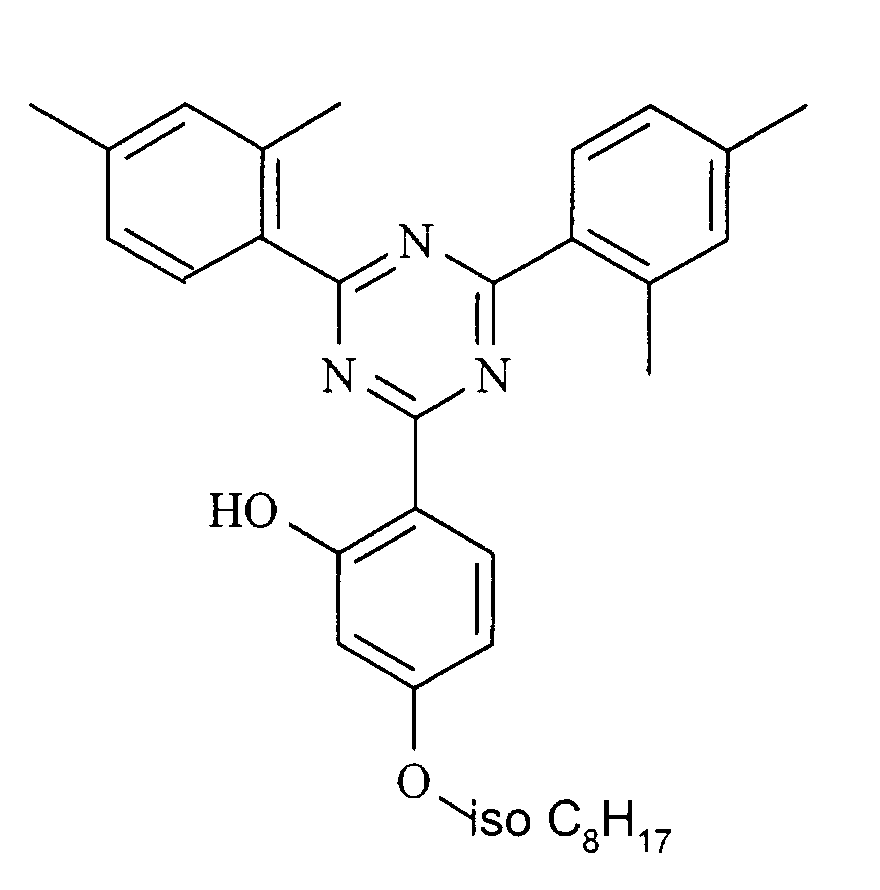
- Composition selon l'une des revendications 14 à 18, caractérisé en ce que ladite triazine répond à la formule

- Composition polymérisable selon l'une des revendications 14 à 19, caractérisé en ce que ces différents composants à l'exception du diméthoxyméthane sont en solution dans ledit monoacrylate, la fonction de diluant pour l'application de la composition polymérisable étant assurée par le diméthoxyméthane.
- Utilisation d'une composition selon l'une des revendications 14 à 20 pour protéger contre les éraflures et les intempéries les glaces en matière plastique synthétique, en particulier en polycarbonate, des projecteurs de véhicules.
Applications Claiming Priority (3)
| Application Number | Priority Date | Filing Date | Title |
|---|---|---|---|
| FR9501235 | 1995-02-02 | ||
| FR9501235A FR2730239B1 (fr) | 1995-02-02 | 1995-02-02 | Methode de protection de glaces en matiere plastique pour projecteurs de vehicules et composition photopolymerisable utilisee dans cette methode |
| PCT/FR1996/000177 WO1996023836A1 (fr) | 1995-02-02 | 1996-02-02 | Methode et composition photopolymerisable de protection de glaces en matiere plastique pour projecteurs de vehicules |
Publications (2)
| Publication Number | Publication Date |
|---|---|
| EP0807142A1 EP0807142A1 (fr) | 1997-11-19 |
| EP0807142B1 true EP0807142B1 (fr) | 2001-10-10 |
Family
ID=9475791
Family Applications (1)
| Application Number | Title | Priority Date | Filing Date |
|---|---|---|---|
| EP96903041A Expired - Lifetime EP0807142B1 (fr) | 1995-02-02 | 1996-02-02 | Methode et composition photopolymerisable de protection de glaces en matiere plastique pour projecteurs de vehicules |
Country Status (8)
| Country | Link |
|---|---|
| EP (1) | EP0807142B1 (fr) |
| BR (1) | BR9607578A (fr) |
| DE (1) | DE69615819T2 (fr) |
| ES (1) | ES2166876T3 (fr) |
| FR (1) | FR2730239B1 (fr) |
| PL (1) | PL321666A1 (fr) |
| TR (1) | TR199700737T1 (fr) |
| WO (1) | WO1996023836A1 (fr) |
Families Citing this family (6)
| Publication number | Priority date | Publication date | Assignee | Title |
|---|---|---|---|---|
| FR2782726B1 (fr) | 1998-08-28 | 2003-09-12 | Basf Coatings | Compositions de vernis acryliques photopolymerisables contenant un agent anti-oxydant de la famille des phenols encombres steriquement |
| DE102008029580A1 (de) | 2008-06-21 | 2009-12-24 | Basf Coatings Ag | Verfahren zur Beschichtung eines Substrats mit einer durch Elektronenstrahlen härtbaren wasserhaltigen Beschichtungszusammensetzung |
| DE102012022440A1 (de) | 2012-11-16 | 2014-05-22 | Benjamin Wilden | Verfahren zur Realisierung einer selbstregenerierenden und wachsenden Oberflächenbeschichtung |
| ES2779007T3 (es) * | 2016-01-21 | 2020-08-13 | Basf Coatings Gmbh | Agente de recubrimiento endurecible por radiación, procedimiento para producir revestimientos resistentes a los arañazos, empleo del agente de recubrimiento y sustrato recubierto con un agente de recubrimiento |
| DE102016212106A1 (de) | 2016-07-04 | 2018-01-04 | Tesa Se | Selbstheilende Oberflächenschutzfolie mit acrylatfunktionellem Top-Coat |
| CN117327321A (zh) * | 2022-06-27 | 2024-01-02 | 中国石油化工股份有限公司 | 一种透明高硬度聚碳酸酯材料及其制备方法和应用 |
Family Cites Families (5)
| Publication number | Priority date | Publication date | Assignee | Title |
|---|---|---|---|---|
| US4129667A (en) * | 1977-12-29 | 1978-12-12 | Gaf Corporation | Radiation curable coating composition comprising an acryl urethane oligomer and an ultra-violet absorber |
| JPS59202229A (ja) * | 1983-05-02 | 1984-11-16 | Sumitomo Bakelite Co Ltd | 透明コ−テイングフイルムの製造方法 |
| JPS63178145A (ja) * | 1987-01-19 | 1988-07-22 | Kanto Seiki Co Ltd | 合成樹脂製品 |
| JPH02163134A (ja) * | 1988-12-16 | 1990-06-22 | Mitsubishi Rayon Co Ltd | 耐摩耗性、耐候性の改善されたポリカーボネート樹脂成形品およびその製造法 |
| EP0445570B1 (fr) * | 1990-03-05 | 1996-05-08 | General Electric Company | Compositions de revêtement durcissables par rayons UV, stratifiés thermoplastiques stabilisés contre les rayons UV résistant à l'abrasion, et méthode |
-
1995
- 1995-02-02 FR FR9501235A patent/FR2730239B1/fr not_active Expired - Fee Related
-
1996
- 1996-02-02 BR BR9607578A patent/BR9607578A/pt not_active Application Discontinuation
- 1996-02-02 PL PL96321666A patent/PL321666A1/xx unknown
- 1996-02-02 WO PCT/FR1996/000177 patent/WO1996023836A1/fr not_active Ceased
- 1996-02-02 TR TR97/00737T patent/TR199700737T1/xx unknown
- 1996-02-02 EP EP96903041A patent/EP0807142B1/fr not_active Expired - Lifetime
- 1996-02-02 DE DE69615819T patent/DE69615819T2/de not_active Expired - Fee Related
- 1996-02-02 ES ES96903041T patent/ES2166876T3/es not_active Expired - Lifetime
Also Published As
| Publication number | Publication date |
|---|---|
| WO1996023836A1 (fr) | 1996-08-08 |
| FR2730239B1 (fr) | 1997-04-25 |
| PL321666A1 (en) | 1997-12-22 |
| DE69615819T2 (de) | 2002-06-13 |
| BR9607578A (pt) | 1998-07-07 |
| DE69615819D1 (de) | 2001-11-15 |
| ES2166876T3 (es) | 2002-05-01 |
| EP0807142A1 (fr) | 1997-11-19 |
| TR199700737T1 (xx) | 1998-03-21 |
| FR2730239A1 (fr) | 1996-08-09 |
Similar Documents
| Publication | Publication Date | Title |
|---|---|---|
| EP2960298B1 (fr) | Rayonnement actinique et composition durcissable à l'humidité | |
| EP3030530B1 (fr) | Substrat portant un revetement fonctionnel et une couche de protection temporaire | |
| CH625745A5 (fr) | ||
| CA1309796C (fr) | Composition pour revetement antibuee, produit revetu de cette composition et procede de preparation de ce produit | |
| EP3006512B1 (fr) | Composition de peinture durcissable par rayonnement et produit moulé comprenant une couche de revêtement durcie formée à partir de celle-ci | |
| EP0089279A1 (fr) | Composition liquide de base convenant pour la réalisation de revêtements transparents sur des surfaces solides, procédé d'application et revêtements obtenus | |
| FR2665905A1 (fr) | Vernis durcissable aux rayons uv, utilisation de ce vernis, procede de revetement d'elements moules et elements ainsi revetus. | |
| EP3600883A1 (fr) | Vitrage feuilleté avec empilement de couches | |
| EP0807142B1 (fr) | Methode et composition photopolymerisable de protection de glaces en matiere plastique pour projecteurs de vehicules | |
| EP2188656B1 (fr) | Article d'optique comportant un revetement temporaire bicouche | |
| EP3727857B1 (fr) | Article comprenant un revetement fonctionnel et une couche de protection temporaire en resine polyfuranique | |
| FR2550105A1 (fr) | Procede pour former sur un support un revetement resistant a l'abrasion et apte a la coloration, et articles obtenus par ce procede | |
| EP1798272A1 (fr) | Procédé de fabrication d'un article optique et article ainsi obtenu | |
| JP2021503392A (ja) | 相互侵入ポリマー網目を備えた熱可塑性ポリマーフィルム | |
| EP1785747A1 (fr) | Lentille ophtalmique comportant un revêtement de protection contre la photodégradation et procédé pour preparer une telle lentille ophtalmique | |
| CA1263493A (fr) | Couche de revetement transparente ayant des proprietes d'autocicatrisation et de resistance a la buee utilisable dans des vitrages | |
| FR3041970B1 (fr) | Encapsulation de dispositifs electroniques flexibles, avec un adhesif incluant des particules extra-fines ameliorant la protection contre la permeabilite aux gaz | |
| EP3360174B1 (fr) | Adhésif dont le précurseur est appliqué sous forme liquide et polymérisé uv, pour l'encapsulation de dispositifs électroniques flexibles, améliorant la protection contre la perméabilité aux gaz | |
| EP0643997B1 (fr) | Procédé de traitement des glaces en matière plastique | |
| FR2595365A1 (fr) | Composition de revetement photodurcissable contenant un absorbeur uv pour la protection contre le vieillissement du poly(chlorure de vinyle) et poly(chlorure de vinyle) ainsi protege | |
| EP0279722A2 (fr) | Couche transparente en polyuréthane résistant à l'embuage, procédé de fabrication et vitrage muni de cette couche | |
| WO2020016527A1 (fr) | Vitrage contrôle solaire ou bas émissif comprenant une couche organique de protection | |
| EP3823937A1 (fr) | Vitrage contrôle solaire ou bas émissif comprenant une couche organique de protection | |
| WO2018229434A1 (fr) | Procédé de fabrication d' un film multicouche de recouvrement étirable à froid | |
| FR3135457A3 (fr) | Vitrage de toit monolithique pour automobile |
Legal Events
| Date | Code | Title | Description |
|---|---|---|---|
| PUAI | Public reference made under article 153(3) epc to a published international application that has entered the european phase |
Free format text: ORIGINAL CODE: 0009012 |
|
| 17P | Request for examination filed |
Effective date: 19970730 |
|
| AK | Designated contracting states |
Kind code of ref document: A1 Designated state(s): BE DE ES FR GB IT LU NL |
|
| 17Q | First examination report despatched |
Effective date: 19971121 |
|
| RAP1 | Party data changed (applicant data changed or rights of an application transferred) |
Owner name: MAGNETI MARELLI S.P.A. Owner name: BASF COATINGS |
|
| APAB | Appeal dossier modified |
Free format text: ORIGINAL CODE: EPIDOS NOAPE |
|
| APAB | Appeal dossier modified |
Free format text: ORIGINAL CODE: EPIDOS NOAPE |
|
| APAD | Appeal reference recorded |
Free format text: ORIGINAL CODE: EPIDOS REFNE |
|
| APAB | Appeal dossier modified |
Free format text: ORIGINAL CODE: EPIDOS NOAPE |
|
| RAP1 | Party data changed (applicant data changed or rights of an application transferred) |
Owner name: MAGNETI MARELLI S.P.A. Owner name: BASF COATINGS AG |
|
| GRAG | Despatch of communication of intention to grant |
Free format text: ORIGINAL CODE: EPIDOS AGRA |
|
| GRAG | Despatch of communication of intention to grant |
Free format text: ORIGINAL CODE: EPIDOS AGRA |
|
| GRAH | Despatch of communication of intention to grant a patent |
Free format text: ORIGINAL CODE: EPIDOS IGRA |
|
| GRAH | Despatch of communication of intention to grant a patent |
Free format text: ORIGINAL CODE: EPIDOS IGRA |
|
| GRAA | (expected) grant |
Free format text: ORIGINAL CODE: 0009210 |
|
| AK | Designated contracting states |
Kind code of ref document: B1 Designated state(s): BE DE ES FR GB IT LU NL |
|
| PG25 | Lapsed in a contracting state [announced via postgrant information from national office to epo] |
Ref country code: NL Free format text: LAPSE BECAUSE OF FAILURE TO SUBMIT A TRANSLATION OF THE DESCRIPTION OR TO PAY THE FEE WITHIN THE PRESCRIBED TIME-LIMIT Effective date: 20011010 |
|
| REF | Corresponds to: |
Ref document number: 69615819 Country of ref document: DE Date of ref document: 20011115 |
|
| REG | Reference to a national code |
Ref country code: GB Ref legal event code: IF02 |
|
| GBT | Gb: translation of ep patent filed (gb section 77(6)(a)/1977) |
Effective date: 20011221 |
|
| PG25 | Lapsed in a contracting state [announced via postgrant information from national office to epo] |
Ref country code: LU Free format text: LAPSE BECAUSE OF NON-PAYMENT OF DUE FEES Effective date: 20020202 |
|
| NLV1 | Nl: lapsed or annulled due to failure to fulfill the requirements of art. 29p and 29m of the patents act | ||
| REG | Reference to a national code |
Ref country code: ES Ref legal event code: FG2A Ref document number: 2166876 Country of ref document: ES Kind code of ref document: T3 |
|
| PLBE | No opposition filed within time limit |
Free format text: ORIGINAL CODE: 0009261 |
|
| STAA | Information on the status of an ep patent application or granted ep patent |
Free format text: STATUS: NO OPPOSITION FILED WITHIN TIME LIMIT |
|
| 26N | No opposition filed | ||
| PGFP | Annual fee paid to national office [announced via postgrant information from national office to epo] |
Ref country code: GB Payment date: 20030124 Year of fee payment: 8 |
|
| PGFP | Annual fee paid to national office [announced via postgrant information from national office to epo] |
Ref country code: ES Payment date: 20030206 Year of fee payment: 8 |
|
| PGFP | Annual fee paid to national office [announced via postgrant information from national office to epo] |
Ref country code: BE Payment date: 20030224 Year of fee payment: 8 |
|
| PGFP | Annual fee paid to national office [announced via postgrant information from national office to epo] |
Ref country code: DE Payment date: 20030306 Year of fee payment: 8 |
|
| PG25 | Lapsed in a contracting state [announced via postgrant information from national office to epo] |
Ref country code: GB Free format text: LAPSE BECAUSE OF NON-PAYMENT OF DUE FEES Effective date: 20040202 |
|
| PG25 | Lapsed in a contracting state [announced via postgrant information from national office to epo] |
Ref country code: ES Free format text: LAPSE BECAUSE OF NON-PAYMENT OF DUE FEES Effective date: 20040203 |
|
| PG25 | Lapsed in a contracting state [announced via postgrant information from national office to epo] |
Ref country code: BE Free format text: LAPSE BECAUSE OF NON-PAYMENT OF DUE FEES Effective date: 20040228 |
|
| BERE | Be: lapsed |
Owner name: *MAGNETI MARELLI S.P.A. Effective date: 20040228 Owner name: *BASF COATINGS A.G. Effective date: 20040228 |
|
| PG25 | Lapsed in a contracting state [announced via postgrant information from national office to epo] |
Ref country code: DE Free format text: LAPSE BECAUSE OF NON-PAYMENT OF DUE FEES Effective date: 20040901 |
|
| GBPC | Gb: european patent ceased through non-payment of renewal fee |
Effective date: 20040202 |
|
| REG | Reference to a national code |
Ref country code: ES Ref legal event code: FD2A Effective date: 20040203 |
|
| APAH | Appeal reference modified |
Free format text: ORIGINAL CODE: EPIDOSCREFNO |
|
| PGFP | Annual fee paid to national office [announced via postgrant information from national office to epo] |
Ref country code: IT Payment date: 20120222 Year of fee payment: 17 |
|
| PGFP | Annual fee paid to national office [announced via postgrant information from national office to epo] |
Ref country code: FR Payment date: 20130325 Year of fee payment: 18 |
|
| REG | Reference to a national code |
Ref country code: FR Ref legal event code: ST Effective date: 20141031 |
|
| PG25 | Lapsed in a contracting state [announced via postgrant information from national office to epo] |
Ref country code: FR Free format text: LAPSE BECAUSE OF NON-PAYMENT OF DUE FEES Effective date: 20140228 |
|
| PG25 | Lapsed in a contracting state [announced via postgrant information from national office to epo] |
Ref country code: IT Free format text: LAPSE BECAUSE OF NON-PAYMENT OF DUE FEES Effective date: 20140202 |