EP0807715A2 - Road traffic sign of solid graphic pattern - Google Patents
Road traffic sign of solid graphic pattern Download PDFInfo
- Publication number
- EP0807715A2 EP0807715A2 EP96309487A EP96309487A EP0807715A2 EP 0807715 A2 EP0807715 A2 EP 0807715A2 EP 96309487 A EP96309487 A EP 96309487A EP 96309487 A EP96309487 A EP 96309487A EP 0807715 A2 EP0807715 A2 EP 0807715A2
- Authority
- EP
- European Patent Office
- Prior art keywords
- traffic sign
- road traffic
- road
- solid
- graphic pattern
- Prior art date
- Legal status (The legal status is an assumption and is not a legal conclusion. Google has not performed a legal analysis and makes no representation as to the accuracy of the status listed.)
- Granted
Links
- 239000007787 solid Substances 0.000 title claims abstract description 50
- 230000000007 visual effect Effects 0.000 claims abstract description 26
- 239000000463 material Substances 0.000 claims description 47
- 239000003973 paint Substances 0.000 claims description 12
- -1 acrylic compound Chemical class 0.000 claims description 8
- 229920005989 resin Polymers 0.000 claims description 8
- 239000011347 resin Substances 0.000 claims description 8
- 239000010426 asphalt Substances 0.000 claims description 6
- 239000004567 concrete Substances 0.000 claims description 6
- 239000011521 glass Substances 0.000 claims description 6
- 229920003002 synthetic resin Polymers 0.000 claims description 5
- 239000000057 synthetic resin Substances 0.000 claims description 5
- RSWGJHLUYNHPMX-UHFFFAOYSA-N Abietic-Saeure Natural products C12CCC(C(C)C)=CC2=CCC2C1(C)CCCC2(C)C(O)=O RSWGJHLUYNHPMX-UHFFFAOYSA-N 0.000 claims description 4
- KHPCPRHQVVSZAH-HUOMCSJISA-N Rosin Natural products O(C/C=C/c1ccccc1)[C@H]1[C@H](O)[C@@H](O)[C@@H](O)[C@@H](CO)O1 KHPCPRHQVVSZAH-HUOMCSJISA-N 0.000 claims description 4
- 239000003822 epoxy resin Substances 0.000 claims description 4
- 239000012943 hotmelt Substances 0.000 claims description 4
- 239000003208 petroleum Substances 0.000 claims description 4
- 229920000647 polyepoxide Polymers 0.000 claims description 4
- 239000004645 polyester resin Substances 0.000 claims description 4
- 229920001225 polyester resin Polymers 0.000 claims description 4
- KHPCPRHQVVSZAH-UHFFFAOYSA-N trans-cinnamyl beta-D-glucopyranoside Natural products OC1C(O)C(O)C(CO)OC1OCC=CC1=CC=CC=C1 KHPCPRHQVVSZAH-UHFFFAOYSA-N 0.000 claims description 4
- 239000002969 artificial stone Substances 0.000 claims description 3
- 239000011449 brick Substances 0.000 claims description 3
- 239000004568 cement Substances 0.000 claims description 3
- 239000000919 ceramic Substances 0.000 claims description 3
- 229910052751 metal Inorganic materials 0.000 claims description 3
- 239000002184 metal Substances 0.000 claims description 3
- XLYOFNOQVPJJNP-UHFFFAOYSA-N water Substances O XLYOFNOQVPJJNP-UHFFFAOYSA-N 0.000 claims description 3
- 239000003995 emulsifying agent Substances 0.000 claims description 2
- 238000000465 moulding Methods 0.000 claims 1
- 230000002708 enhancing effect Effects 0.000 abstract 1
- 238000000034 method Methods 0.000 description 5
- XEEYBQQBJWHFJM-UHFFFAOYSA-N Iron Chemical compound [Fe] XEEYBQQBJWHFJM-UHFFFAOYSA-N 0.000 description 4
- 239000000203 mixture Substances 0.000 description 4
- 239000011324 bead Substances 0.000 description 3
- 238000010586 diagram Methods 0.000 description 3
- 238000005286 illumination Methods 0.000 description 3
- 229910000831 Steel Inorganic materials 0.000 description 2
- 239000005084 Strontium aluminate Substances 0.000 description 2
- 239000005083 Zinc sulfide Substances 0.000 description 2
- 238000009434 installation Methods 0.000 description 2
- 229910052742 iron Inorganic materials 0.000 description 2
- 239000007769 metal material Substances 0.000 description 2
- 238000003909 pattern recognition Methods 0.000 description 2
- 239000010959 steel Substances 0.000 description 2
- FNWBQFMGIFLWII-UHFFFAOYSA-N strontium aluminate Chemical compound [O-2].[O-2].[O-2].[O-2].[O-2].[Al+3].[Al+3].[Sr+2].[Sr+2] FNWBQFMGIFLWII-UHFFFAOYSA-N 0.000 description 2
- 229910052984 zinc sulfide Inorganic materials 0.000 description 2
- DRDVZXDWVBGGMH-UHFFFAOYSA-N zinc;sulfide Chemical compound [S-2].[Zn+2] DRDVZXDWVBGGMH-UHFFFAOYSA-N 0.000 description 2
- NIXOWILDQLNWCW-UHFFFAOYSA-N acrylic acid group Chemical group C(C=C)(=O)O NIXOWILDQLNWCW-UHFFFAOYSA-N 0.000 description 1
- 230000000694 effects Effects 0.000 description 1
- 239000000839 emulsion Substances 0.000 description 1
- 238000004519 manufacturing process Methods 0.000 description 1
- 235000012736 patent blue V Nutrition 0.000 description 1
- 230000035807 sensation Effects 0.000 description 1
Images





Classifications
-
- E—FIXED CONSTRUCTIONS
- E01—CONSTRUCTION OF ROADS, RAILWAYS, OR BRIDGES
- E01F—ADDITIONAL WORK, SUCH AS EQUIPPING ROADS OR THE CONSTRUCTION OF PLATFORMS, HELICOPTER LANDING STAGES, SIGNS, SNOW FENCES, OR THE LIKE
- E01F9/00—Arrangement of road signs or traffic signals; Arrangements for enforcing caution
- E01F9/50—Road surface markings; Kerbs or road edgings, specially adapted for alerting road users
- E01F9/506—Road surface markings; Kerbs or road edgings, specially adapted for alerting road users characterised by the road surface marking material, e.g. comprising additives for improving friction or reflectivity; Methods of forming, installing or applying markings in, on or to road surfaces
- E01F9/512—Preformed road surface markings, e.g. of sheet material; Methods of applying preformed markings
Definitions
- the present invention relates to a road traffic sign formed on a road so as to be visually recognizable by a passer-by or a driver of a running vehicle.
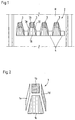
- Fig. 1 is a plan view showing a constitution of an embodiment of the invention.
- Fig. 2 is a plan view showing a form of each section in Fig. 1.
- Fig. 3 is a plan view showing a constitution of other embodiment of the invention.
- Fig. 4 is a plan view showing a form of each section in Fig. 3.
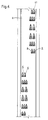
- Fig. 5 is a plan view showing a state of forming a sign pattern shown in Fig. 3 on a road surface.
- Fig. 6 is a plan view showing other state of forming a sign pattern shown in Fig. 3 on a road surface.
- Fig. 7 is a plan view showing a constitution of a different embodiment of the invention.
- Fig. 8 is a plan view showing a state of forming the sign pattern shown in Fig. 1 on a road surface.
- Fig. 9 is a plan view showing a constitution of other different embodiment of the invention.
- Fig. 10 is a plan view showing a constitution of a further different embodiment of the invention.
- Fig. 11 is a plan view showing a constitution of a still different embodiment of the invention.
- Fig. 12 is a plan view showing a constitution of still other different embodiment of the invention.
- Fig. 13 is a plan view showing a constitution of a still further different embodiment of the invention.
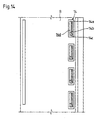
- Fig. 14 is a plan view showing a constitution of another embodiment of the invention.
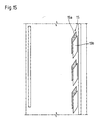
- Fig. 15 is a plan view showing a constitution of still another embodiment of the invention.
- the road traffic sign of solid graphic pattern of the invention is a road traffic sign composed of a marking pattern divided in plural sections, formed tightly on the road, in which adjacent sections differ in lightness from each other, so that the solid image of the visual image of the marking pattern may be recognized.
- the solid image of the visual image includes, for example, convex and concave shape, and is any one in which a three-dimensional image can be recognized.
- adjacent sections mutually have a lightness difference of Munsell value of 1 or more, and the lightness of each section is selected in a lightness of two to four stages individually set at different Munsell values.
- the process for forming a solid pattern to be drawn is easy and practical when the number of plane portions is two to four.
- manufacture of this road traffic sign for example, by preparing sheet pieces differing in lightness in two to four stages, they can be used generally.
- adjacent sections may be colored in the hue mutually different in lightness.
- the adjacent sections are mutually different in lightness, shades are expressed in the marking pattern, and in this marking pattern, a solid image can be recognized as visual image.
- the lightness difference of adjacent sections are set at 1 or more of Munsell value and the lightness of each section is selected in the lightness of two or four stages individually set at different Munsell values, enough and sufficient shades to be recognized as solid image can be formed, and the visual recognition is enhanced. It is the most preferred to employ the lightness difference of adjacent sections being set at 2 or more Munsell value. In such a case, a more solid visual image can be obtained.
- the shape of the material for composing the sections may include sheet, plate, block, coat film, etc.
- the sheet material may be obtained by curing rosin resin, petroleum resin, other hot-melt, epoxy resin, polyester resin, other synthetic resin, or acrylic compound. By adhering such sheet materials on the road surface, the marking pattern is formed.
- Plate and block materials may include artificial stone concrete, concrete, brick, tile, glass, asphalt, metal, synthetic resin, and ceramics.
- This metal materials may include color iron and steel sheet and alminum plate. These materials are partly buried in the road, and partly exposed.
- coat film materials for example, water-based paint, oil-based paint, colored white cement, colored asphalt, colored emulsifier, material used as the above sheet material, other sheet form material and other paints are used.
- the paint is applied on the road surface.
- the road sign can be installed relatively at low cost, and it does not require huge machinery for installation, and hence the installation is easy.
- these materials may be mixed with recursive reflection material such as glass beads, or light reserve material such as strontium aluminate and zinc sulfide.
- recursive reflection material such as glass beads
- light reserve material such as strontium aluminate and zinc sulfide.
- Fig. 1 is a plan view showing a constitution of an embodiment of the invention
- Fig. 2 is a plan view showing a form of each section in Fig. 1.
- a road traffic sign 2 of solid graphic pattern in the embodiment of the invention is arranged on a road R in a row in a vertical direction to the running (passing) direction on the road R.
- This road traffic sign 2 is composed of plural marking patterns 3...3, and white linking patterns 4...4 interposed in gaps of the respective marking patterns 3...3.
- the patterns are composed of sheet pieces, and in the marking pattern 3, a prismoid is formed as a visual image.
- This prismoid is composed of a sheet piece 1a forming the left side in white color (Munsell value about 9), a sheet piece 1b forming the top side in yellow color (Munsell value about 6), a sheet piece 1c forming the front side in red color (Munsell value about 5), and a sheet piece 1d forming the right side in brown color (Munsell value about 3).
- the lightness of the sheet pieces 1 is highest in white, being followed by yellow, red and brown in this order.
- a solid image is formed in the arrangement in which the lightness is highest at the left side, and gradually becomes darker in the top side, front side, and right side, and the lightness difference between sheet pieces can be recognized as the shade conforming to the shade drawing technique.
- the ray of light is emitted from above the left front side, and looks darker in the sequence of the top side, front side and right side, and since the lightness difference of the adjacent sheet pieces of these sheet pieces 1a, 1b, 1c, 1d is 1 or more in Munsell value, so that a sufficient shade recognized as solid image is expressed.
- the boundary value is about 1 in Munsell value, and hence the lightness difference is required to be 1 or more of Munsell value.
- sheet piece materials those obtained by curing rosin resin, petroleum resin, other hot-melt, epoxy resin, polyester resin, other synthetic resin, or acrylic compound may be used. Furthermore, these materials may be mixed with recursive reflection material such as glass beads, or light reserve material such as strontium aluminate and zinc sulfide. In the composition blended with such recursive reflection material or light reserve material, a sufficient lightness may be maintained at night only by a slight illumination or headlight, and the visual recognition is not lowered. By adhering such sheet materials on the road surface, the marking pattern is formed.
- recursive reflection material such as glass beads
- light reserve material such as strontium aluminate and zinc sulfide
- This sheet piece 1 may have only a lightness difference such as white, gray and black and may not have hue, but as in the above constitution, when plural sheet pieces 1a, 1b, 2c, 1d are colored in hues of different lightness degrees, the difference of sides will be more clear and it is easier to be recognized three-dimensionally.
- the road traffic sign 2 shown in Fig. 1 is composed of four sides, that is, left side, top side, front side, and right side, and the sheet pieces 1a, 1b, 1c, 1d are set in four stages of lightness.
- the sheet piece 1 is composed of the same number of sheet pieces 1 as the number of sections for forming a solid pattern, but not limited to this, to express the shade more precisely, one section may be composed of plural sheet pieces.
- plural marking patterns 3...3 are formed on the road in a row in a direction vertical to the running direction, and these marking patterns 3...3 are linked with a white linkage sheet 4 in order to form a stop-line, but this linkage sheet 4 may be omitted.
- the road traffic sign 2 of solid graphic pattern is not limited to the composition composed of four sides, but as shown in Fig. 3, it may be colored in different hues in three stages of lightness, or as shown in Fig. 4, three sheet pieces 6a, 6b, 6c may be disposed on the left slope, right slope, and front side to compose marking patterns 5...5. These sheet pieces 6a, 6b, 6c are colored respectively in white (Munsell value about 9), blue (Munsell value about 3), and yellow (Munsell value about 6), and a solid pattern of a triangular shape in vertical section is formed on the whole.
- a solid pattern composed of the left slope of the highest lightness, and front side and right slope of the second and third lightness is formed, and this lightness difference is recognized as shade, and this shade becomes darker to the front side and right slope, and this solid pattern is recognized to be illuminated from the left front upper side of the marking patterns 5...5 in the diagram.
- the marking patterns 6...6 are formed on the road in a row in a direction vertical to the running direction, and they are linked with a white linkage sheet 4 to form a stop-line, but the linkage sheet piece 4 may be omitted.
- the example of arrangement using the marking pattern 6 in Fig. 3 is not limited to a lateral row, as mentioned above, but, for example, two rows may be arranged laterally as shown in Fig. 5. In this case, as compared with one lateral row, the visual recognition is enhanced, and the marking effect is greater.
- Fig. 6 shows a constitution of a different embodiment.
- the marking pattern 6 shown in Fig. 3 is arranged in plural pieces to the right and left as shown in Fig. 6, and this road traffic sign 61 urges the driver to run in an S-curve so as to avoid these marking patterns 6...6.
- the lanes may be changed as required.
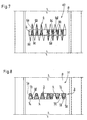
- Fig. 7 shows a constitution of other different embodiment.
- the marking pattern 6 shown in Fig. 3 is arranged as in Fig. 7, and the road traffic sign 62 is composed so as to be recognized three-dimensionally from both the running lane and the opposite lane of the road R.
- plural marking patterns 6 are arranged in each lane in a row in mutually reverse directions in the running lane and opposite lane, and are linked with a white linkage sheet 4 so as to mark stop-lines, and further by arranging sheet pieces 6d of yellow (Munsell value about 6) in inverted triangular shape before the linkage sheet 4, this triangular marking pattern 6 appears floating on the road R. Therefore, for the driver, this road traffic sign 62 is more easily recognized visually, and the visual recognition is enhanced.
- Fig. 8 shows a constitution of a further different embodiment.
- the marking pattern 3 shown in Fig. 1 is arranged as in Fig. 8, so that the road traffic sign 31 can be recognized three-dimensionally from both the running lane and the opposite lane of the road R.
- plural marking patterns 3 are arranged in each lane in a row in mutually reverse directions in the running lane and opposite lane, and are linked with a white linkage sheet 4 so as to mark stop-lines.
- the constitution of this road traffic sign 31 is, same as in the preceding embodiment, high in visual recognition.
- Fig. 9 shows a constitution of a still different embodiment.
- the left side and front side are formed of sheet pieces 7b of red (Munsell value about 5), and the top side is formed of a sheet piece 7a of white (Munsell value about 9) to compose square columnar marking patterns 7...7, and a plurality thereof are formed on the road in a row in a direction vertical to the running direction, thereby marking stop-lines.
- square columnar marking patterns 8 may be arranged on the road R so as to be recognized three-dimensionally from both the running lane and the opposite lane.
- This square columnar marking pattern 8 when seen from the direction of arrow X1, is composed of a sheet piece 8a forming the top side in white (Munsell value about 9), a sheet piece 8b forming the left side in red (Munsell value about 5), and a sheet piece 8c forming the right side in yellow (Munsell value about 6).
- a sheet piece 8d in white (Munsell value about 9) is formed as a linkage sheet for linking these plural marking patterns 8...8.
- the marking patterns 8...8 arranged in a row for marking the stop-line of the road R are composed of sheet pieces 8a, 8b, 8c, 8d having different lightness degrees, as mentioned above, in the directions of both running lane and opposite lane, so that the square columnar solid shape can be recognized visually.
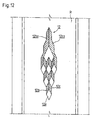
- a modified example as shown in Fig. 12 may be also applied.
- This road traffic sign 12 is composed to express the median strip of the road R.
- a plurality of square columnar solid patterns composed of a sheet piece 12a in white (Munsell value about 9) formed on the top side, a sheet piece 12b in yellow (Munsell value about 6) formed on the left side, and a sheet piece 12c in red (Munsell value about 5) formed on the right side are arranged continuously, and a continuous sheet 12b 0 consecutive to the left side, and a continuous sheet 12c 0 consecutive to the right side are arranged continuously.
- Sheet pieces 11a 1 , 11a 2 , 11a 3 in white (Munsell value about 9) are arranged on the top side, and sheet pieces 11b 1 , 11b 2 , 11b 3 in blue (Munsell value about 3) are arranged on the right side.
- the road traffic sign 11 is recognized as a solid figure bulged up on an X-form in the state as if illuminated from the left side in the diagram.
- Fig. 13 shows a constitution of another different embodiment.
- this road traffic sign 13 to express the intersection on the road R, a sheet piece 13a in white (Munsell value about 9) is formed on the top side, and sheet pieces 13b 1 , 13b 2 , 13b 3 in blue (Munsell value about 3) are formed on the sides, thereby forming the road traffic sign 13 in a cross form.
- the road traffic sign 13 is recognized as a bulged solid cross form in the state as if illuminated from the right front upper side in the diagram.
- Embodiments shown in Fig. 14 and Fig. 15 relate to visual images looking as if grooves were formed in the road surface.
- a road traffic sign 14 shown in Fig. 14 is formed along the edge of road R, whose inner space is rectangularly hollowed to be divided into three sections, and is composed of a sheet piece 14b in blue (Munsell value about 3) and a sheet piece 14c in sky-blue (Munsell value about 7) as two of the three sections and a sheet piece 14a in white (Munsell value about 9) arranged around the rectangle.
- a divided section 14d is the surface of the road R itself, which is composed of asphalt.
- This road traffic sign 15 is formed along the edge of the road R same as in Fig. 14, and is composed of a sheet piece 15b of parallelogram in white (Munsell value about 9) and a sheet piece 15a of parallelogram in blue (Munsell value about 3).
- the sheet piece 15a having a shape formed as being deviated in one direction to the sheet piece 15b, is adjacent to two sides adjoined each other of the sheet piece 15b of parallelogram.
- the road traffic signs in solid pattern formed by disposing plural sheet pieces are not limited to the above-mentioned linear and geometric patterns only, but may be expressed in characters, curved shapes or other solid figures.
- Such sheet material may be obtained by curing hot-melt type such as rosin resin and petroleum resin, or epoxy resin, polyester resin, or acrylic compound. Furthermore, these sheet materials may be mixed with recursive reflection material such as glass beads, or light reserve material, and in the composition blended with such recursive reflection material or light reserve material, a sufficient lightness may be maintained at night only by a slight illumination or headlight, and the visual recognition is not lowered.
- each divided section the marking pattern is formed of a sheet piece, but the shape of the material for composing the sections may be either plate or block. When using materials of such shape, they may be partly buried in the road, and partly exposed. As the shape of the material for composing sections, moreover, a coat film may be used. The coat film is formed by applying a paint on the road.
- artificial stone concrete, concrete, brick, tile, glass, asphalt, metal, synthetic resin, and ceramics may be properly used.
- This metal materials may include color iron and steel sheet and alminum plate.
- paints such as water-based paint such as acrylic emulsion, oil-based paint such as carpenter's paint, and colored matter such as white cement may be used.
Landscapes
- Engineering & Computer Science (AREA)
- Architecture (AREA)
- Civil Engineering (AREA)
- Structural Engineering (AREA)
- Road Signs Or Road Markings (AREA)
Abstract
Description
- The present invention relates to a road traffic sign formed on a road so as to be visually recognizable by a passer-by or a driver of a running vehicle.
- To assure safety of road traffic, various road traffic signs are drawn on the road surface. When these road traffic signs are visually recognized by the passers-by and drivers, caution is alerted and safety is assured. Hitherto, these road traffic signs were generally characters and patterns drawn as a flat pattern, and it was not sufficient to alert attention to vehicles running at high speed, in particular, and these road traffic signs were often overlooked.
- Accordingly, for vehicles running at high speed, by drawing lateral lines at equal intervals on the road surface, it was intended to cause the driver to recognize the sensation of speed and slow down the speed intentionally. In Great Britain, white zigzag lines are drawn at both sides of the road surface near the pedestrian crossing, and it is intended so that the driver may recognize the presence of pedestrian crossing and slow down the speed intentionally. Such road traffic signs can enhance the visual recognition, but, same as in the above prior art, it is still likely to be overlooked because the form of sign is a flat pattern recognition.
- Accordingly, instead of the road traffic sign for flat pattern recognition, it is also attempted to bulge part of the road surface, so that the bulged part may be recognized to slow down the speed forcedly. In this method, however, if the vehicle rides over the bulge at high speed, it causes noise, and is accompanied by danger. It also needs tremendous labor in the work for bulging part of the road surface.
- Fig. 1 is a plan view showing a constitution of an embodiment of the invention.
- Fig. 2 is a plan view showing a form of each section in Fig. 1.
- Fig. 3 is a plan view showing a constitution of other embodiment of the invention.
- Fig. 4 is a plan view showing a form of each section in Fig. 3.
- Fig. 5 is a plan view showing a state of forming a sign pattern shown in Fig. 3 on a road surface.
- Fig. 6 is a plan view showing other state of forming a sign pattern shown in Fig. 3 on a road surface.
- Fig. 7 is a plan view showing a constitution of a different embodiment of the invention.
- Fig. 8 is a plan view showing a state of forming the sign pattern shown in Fig. 1 on a road surface.
- Fig. 9 is a plan view showing a constitution of other different embodiment of the invention.
- Fig. 10 is a plan view showing a constitution of a further different embodiment of the invention.
- Fig. 11 is a plan view showing a constitution of a still different embodiment of the invention.
- Fig. 12 is a plan view showing a constitution of still other different embodiment of the invention.
- Fig. 13 is a plan view showing a constitution of a still further different embodiment of the invention.
- Fig. 14 is a plan view showing a constitution of another embodiment of the invention.
- Fig. 15 is a plan view showing a constitution of still another embodiment of the invention.
- It is hence an object of the invention to enhance the visual recognition of road traffic sign, prevent danger in road traffic, and ensure smooth traffic, by presenting a road traffic sign composed of a solid pattern having shades as visual image.
- To achieve the object, the road traffic sign of solid graphic pattern of the invention is a road traffic sign composed of a marking pattern divided in plural sections, formed tightly on the road, in which adjacent sections differ in lightness from each other, so that the solid image of the visual image of the marking pattern may be recognized. Herein, the solid image of the visual image includes, for example, convex and concave shape, and is any one in which a three-dimensional image can be recognized. In this constitution, adjacent sections mutually have a lightness difference of Munsell value of 1 or more, and the lightness of each section is selected in a lightness of two to four stages individually set at different Munsell values. Herein, by setting of lightness in two to four stages, the process for forming a solid pattern to be drawn is easy and practical when the number of plane portions is two to four. In manufacture of this road traffic sign, for example, by preparing sheet pieces differing in lightness in two to four stages, they can be used generally.
- Or, adjacent sections may be colored in the hue mutually different in lightness.
- In this constitution, since the adjacent sections are mutually different in lightness, shades are expressed in the marking pattern, and in this marking pattern, a solid image can be recognized as visual image. Moreover, in the constitution in which the lightness difference of adjacent sections are set at 1 or more of Munsell value and the lightness of each section is selected in the lightness of two or four stages individually set at different Munsell values, enough and sufficient shades to be recognized as solid image can be formed, and the visual recognition is enhanced. It is the most preferred to employ the lightness difference of adjacent sections being set at 2 or more Munsell value. In such a case, a more solid visual image can be obtained. Moreover, when adjacent sections are colored in the hue individually different in lightness, a more solid visual image can be obtained by the difference in hue of sections, and the visual recognition is further improved. Still more, in the road traffic sign of the invention, if the vehicle rides over this road traffic sign, although it is recognized as a solid image visually, it is not actually bulged up, and hence it is not accompanied by danger.
- In a preferred embodiment of the invention, the shape of the material for composing the sections may include sheet, plate, block, coat film, etc.
- The sheet material may be obtained by curing rosin resin, petroleum resin, other hot-melt, epoxy resin, polyester resin, other synthetic resin, or acrylic compound. By adhering such sheet materials on the road surface, the marking pattern is formed.
- Plate and block materials may include artificial stone concrete, concrete, brick, tile, glass, asphalt, metal, synthetic resin, and ceramics. This metal materials may include color iron and steel sheet and alminum plate. These materials are partly buried in the road, and partly exposed.
- As the coat film materials, for example, water-based paint, oil-based paint, colored white cement, colored asphalt, colored emulsifier, material used as the above sheet material, other sheet form material and other paints are used. In this constitution, the paint is applied on the road surface. In the constitution of such coat film, the road sign can be installed relatively at low cost, and it does not require huge machinery for installation, and hence the installation is easy.
- Furthermore, these materials may be mixed with recursive reflection material such as glass beads, or light reserve material such as strontium aluminate and zinc sulfide. In the composition blended with such recursive reflection material or light reserve material, a sufficient lightness may be maintained at night only by a slight illumination or headlight, and the visual recognition is not lowered.
- Incidentally, when drawing a marking pattern on the road, it is preferred to employ a stereographic technique such as conformal projection and gradient method. In such a case, an accurate solid image is obtained, and the reliability as solid image is high.
- Referring now to the drawings, preferred embodiments of the invention are described in detail below.
- Fig. 1 is a plan view showing a constitution of an embodiment of the invention, and Fig. 2 is a plan view showing a form of each section in Fig. 1.
- A
road traffic sign 2 of solid graphic pattern in the embodiment of the invention is arranged on a road R in a row in a vertical direction to the running (passing) direction on the road R. Thisroad traffic sign 2 is composed of plural marking patterns 3...3, and white linkingpatterns 4...4 interposed in gaps of the respective marking patterns 3...3. The patterns are composed of sheet pieces, and in the marking pattern 3, a prismoid is formed as a visual image. This prismoid is composed of asheet piece 1a forming the left side in white color (Munsell value about 9), asheet piece 1b forming the top side in yellow color (Munsell value about 6), asheet piece 1c forming the front side in red color (Munsell value about 5), and asheet piece 1d forming the right side in brown color (Munsell value about 3). The lightness of thesheet pieces 1 is highest in white, being followed by yellow, red and brown in this order. In this marking pattern 3, a solid image is formed in the arrangement in which the lightness is highest at the left side, and gradually becomes darker in the top side, front side, and right side, and the lightness difference between sheet pieces can be recognized as the shade conforming to the shade drawing technique. That is, in this solid image, the ray of light is emitted from above the left front side, and looks darker in the sequence of the top side, front side and right side, and since the lightness difference of the adjacent sheet pieces of thesesheet pieces - As such sheet piece materials, those obtained by curing rosin resin, petroleum resin, other hot-melt, epoxy resin, polyester resin, other synthetic resin, or acrylic compound may be used. Furthermore, these materials may be mixed with recursive reflection material such as glass beads, or light reserve material such as strontium aluminate and zinc sulfide. In the composition blended with such recursive reflection material or light reserve material, a sufficient lightness may be maintained at night only by a slight illumination or headlight, and the visual recognition is not lowered. By adhering such sheet materials on the road surface, the marking pattern is formed.
- This
sheet piece 1 may have only a lightness difference such as white, gray and black and may not have hue, but as in the above constitution, whenplural sheet pieces road traffic sign 2 shown in Fig. 1 is composed of four sides, that is, left side, top side, front side, and right side, and thesheet pieces sheet piece 1 is composed of the same number ofsheet pieces 1 as the number of sections for forming a solid pattern, but not limited to this, to express the shade more precisely, one section may be composed of plural sheet pieces. - Thus, in the structure shown in Fig. 1, plural marking patterns 3...3 are formed on the road in a row in a direction vertical to the running direction, and these marking patterns 3...3 are linked with a
white linkage sheet 4 in order to form a stop-line, but thislinkage sheet 4 may be omitted. - The
road traffic sign 2 of solid graphic pattern is not limited to the composition composed of four sides, but as shown in Fig. 3, it may be colored in different hues in three stages of lightness, or as shown in Fig. 4, threesheet pieces patterns 5...5. Thesesheet pieces patterns 5...5 formed on thesheet piece 6a of the highest lightness,yellow sheet piece 6b of the middle, andblue sheet 6c of the lowest, a solid pattern composed of the left slope of the highest lightness, and front side and right slope of the second and third lightness is formed, and this lightness difference is recognized as shade, and this shade becomes darker to the front side and right slope, and this solid pattern is recognized to be illuminated from the left front upper side of the markingpatterns 5...5 in the diagram. - Thus, in the structure shown in Fig. 3, same as in Fig. 1, the marking
patterns 6...6 are formed on the road in a row in a direction vertical to the running direction, and they are linked with awhite linkage sheet 4 to form a stop-line, but thelinkage sheet piece 4 may be omitted. - The example of arrangement using the
marking pattern 6 in Fig. 3 is not limited to a lateral row, as mentioned above, but, for example, two rows may be arranged laterally as shown in Fig. 5. In this case, as compared with one lateral row, the visual recognition is enhanced, and the marking effect is greater. - Fig. 6 shows a constitution of a different embodiment. In this example, the
marking pattern 6 shown in Fig. 3 is arranged in plural pieces to the right and left as shown in Fig. 6, and thisroad traffic sign 61 urges the driver to run in an S-curve so as to avoid these markingpatterns 6...6. In such arrangement, the lanes may be changed as required. - Fig. 7 shows a constitution of other different embodiment. In this example, the
marking pattern 6 shown in Fig. 3 is arranged as in Fig. 7, and theroad traffic sign 62 is composed so as to be recognized three-dimensionally from both the running lane and the opposite lane of the road R. In this example,plural marking patterns 6 are arranged in each lane in a row in mutually reverse directions in the running lane and opposite lane, and are linked with awhite linkage sheet 4 so as to mark stop-lines, and further by arrangingsheet pieces 6d of yellow (Munsell value about 6) in inverted triangular shape before thelinkage sheet 4, thistriangular marking pattern 6 appears floating on the road R. Therefore, for the driver, thisroad traffic sign 62 is more easily recognized visually, and the visual recognition is enhanced. - Fig. 8 shows a constitution of a further different embodiment. In this example, the marking pattern 3 shown in Fig. 1 is arranged as in Fig. 8, so that the
road traffic sign 31 can be recognized three-dimensionally from both the running lane and the opposite lane of the road R. In this example, plural marking patterns 3 are arranged in each lane in a row in mutually reverse directions in the running lane and opposite lane, and are linked with awhite linkage sheet 4 so as to mark stop-lines. The constitution of thisroad traffic sign 31 is, same as in the preceding embodiment, high in visual recognition. - Furthermore, Fig. 9 shows a constitution of a still different embodiment. In this example, the left side and front side are formed of
sheet pieces 7b of red (Munsell value about 5), and the top side is formed of asheet piece 7a of white (Munsell value about 9) to compose squarecolumnar marking patterns 7...7, and a plurality thereof are formed on the road in a row in a direction vertical to the running direction, thereby marking stop-lines. - As such square columnar marking pattern, still more, as shown in Fig. 10, square columnar marking patterns 8 may be arranged on the road R so as to be recognized three-dimensionally from both the running lane and the opposite lane. This square columnar marking pattern 8, when seen from the direction of arrow X1, is composed of a sheet piece 8a forming the top side in white (Munsell value about 9), a
sheet piece 8b forming the left side in red (Munsell value about 5), and a sheet piece 8c forming the right side in yellow (Munsell value about 6). At the nearer side, asheet piece 8d in white (Munsell value about 9) is formed as a linkage sheet for linking these plural marking patterns 8...8. On the other hand, when seen from the opposite lane confronting the running lane in the direction of arrow X1, that is, from the direction of arrow X2, the sheet piece 8a of this constitution forming the top side forms a linkage sheet, and thelinkage sheet 8d forms the top side. Thus, the marking patterns 8...8 arranged in a row for marking the stop-line of the road R are composed ofsheet pieces - As the constitution for arranging a plurality of marking patterns, a modified example as shown in Fig. 12 may be also applied.
- This
road traffic sign 12 is composed to express the median strip of the road R. A plurality of square columnar solid patterns composed of asheet piece 12a in white (Munsell value about 9) formed on the top side, asheet piece 12b in yellow (Munsell value about 6) formed on the left side, and asheet piece 12c in red (Munsell value about 5) formed on the right side are arranged continuously, and acontinuous sheet 12b0 consecutive to the left side, and acontinuous sheet 12c0 consecutive to the right side are arranged continuously. - As the constitution for expressing such median strip of the road R, other example is shown in Fig. 11.
- Sheet pieces 11a1, 11a2, 11a3 in white (Munsell value about 9) are arranged on the top side, and sheet pieces 11b1, 11b2, 11b3 in blue (Munsell value about 3) are arranged on the right side. In this constitution, the
road traffic sign 11 is recognized as a solid figure bulged up on an X-form in the state as if illuminated from the left side in the diagram. - Further, Fig. 13 shows a constitution of another different embodiment. In this
road traffic sign 13, to express the intersection on the road R, a sheet piece 13a in white (Munsell value about 9) is formed on the top side, and sheet pieces 13b1, 13b2, 13b3 in blue (Munsell value about 3) are formed on the sides, thereby forming theroad traffic sign 13 in a cross form. By the arrangement of the sheet pieces 13a, 13b1, 13b2, 13b3 for forming theroad traffic sign 13 with a lightness difference, theroad traffic sign 13 is recognized as a bulged solid cross form in the state as if illuminated from the right front upper side in the diagram. - The above embodiments refer to the visual image of solid shape in convex form, but such solid shape may be also a visual image in concave form.
- Embodiments shown in Fig. 14 and Fig. 15 relate to visual images looking as if grooves were formed in the road surface.
- A
road traffic sign 14 shown in Fig. 14 is formed along the edge of road R, whose inner space is rectangularly hollowed to be divided into three sections, and is composed of asheet piece 14b in blue (Munsell value about 3) and a sheet piece 14c in sky-blue (Munsell value about 7) as two of the three sections and asheet piece 14a in white (Munsell value about 9) arranged around the rectangle. A divided section 14d is the surface of the road R itself, which is composed of asphalt. By disposing a plurality of thus constitutedroad traffic signs 14, a visual image recognizing a state of forming of plural grooves is obtained in the edge portion along the running lane in the road R. As a constitution for obtaining such concave form solid image, further, a constitution as shown in Fig. 15 may be considered. Thisroad traffic sign 15 is formed along the edge of the road R same as in Fig. 14, and is composed of asheet piece 15b of parallelogram in white (Munsell value about 9) and asheet piece 15a of parallelogram in blue (Munsell value about 3). Thesheet piece 15a, having a shape formed as being deviated in one direction to thesheet piece 15b, is adjacent to two sides adjoined each other of thesheet piece 15b of parallelogram. By disposing a plurality of suchroad traffic signs 15, same as in Fig. 14, plural concave solid images formed in the edge portion along the running lane of the road R can be visually recognized. - The road traffic signs in solid pattern formed by disposing plural sheet pieces are not limited to the above-mentioned linear and geometric patterns only, but may be expressed in characters, curved shapes or other solid figures.
- When using such sheet pieces, they are adhered on the road to form the marking patterns. Such sheet material may be obtained by curing hot-melt type such as rosin resin and petroleum resin, or epoxy resin, polyester resin, or acrylic compound. Furthermore, these sheet materials may be mixed with recursive reflection material such as glass beads, or light reserve material, and in the composition blended with such recursive reflection material or light reserve material, a sufficient lightness may be maintained at night only by a slight illumination or headlight, and the visual recognition is not lowered.
- In the illustrated examples, each divided section the marking pattern is formed of a sheet piece, but the shape of the material for composing the sections may be either plate or block. When using materials of such shape, they may be partly buried in the road, and partly exposed. As the shape of the material for composing sections, moreover, a coat film may be used. The coat film is formed by applying a paint on the road.
- As plate and block materials, artificial stone concrete, concrete, brick, tile, glass, asphalt, metal, synthetic resin, and ceramics may be properly used. This metal materials may include color iron and steel sheet and alminum plate.
- As the material for forming a coat film, paints such as water-based paint such as acrylic emulsion, oil-based paint such as carpenter's paint, and colored matter such as white cement may be used.
Claims (13)
- A road traffic sign of solid graphic pattern, being a road traffic sign having a marking pattern divided in plural sections formed tightly on the road, characterized by forming a visual image of the marking pattern in a solid figure, by setting adjacent sections in a mutually different lightness.
- A road traffic sign of solid graphic pattern of claim 1, wherein the adjacent sections have a lightness difference of 1 or more of Munsell value, and the lightness of each section is selected in the lightness in two to four stages set at mutually different Munsell values.
- A road traffic sign of solid graphic pattern of claim 1 or claim 2, wherein the adjacent sections are colored in hues mutually differing in lightness.
- A road traffic sign of solid graphic pattern of claim 1, 2 or 3, wherein the shape of the material for composing the sections is a sheet form, and this sheet form material is adhered on the road.
- A road traffic sign of solid graphic pattern of claim 1, 2 or 3, wherein the shape of the material for composing the sections is either plate form or block form, and the materials of these shapes are partly buried in the road and partly exposed.
- A road traffic sign of solid graphic pattern of claim 1, 2 or 3, wherein the shape of the material for composing the sections is a coat film, and this coat film is formed by applying a paint on the road.
- A road traffic sign of solid graphic pattern of claim 1, 2, 3 or 4, wherein the sheet form material is formed of hot melt selectively using rosin resin and petroleum resin.
- A road traffic sign of solid graphic pattern of claim 1, 2, 3 or 4, wherein the sheet form material is formed by selectively using epoxy resin and polyester resin.
- A road traffic sign of solid graphic pattern of claim 1, 2, 3 or 4, wherein the sheet form material is a molding obtained by curing an acrylic compound.
- A road traffic sign of solid graphic pattern of claim 1, 2, 3 or 5, wherein the plate or block material is formed by selectively using artificial stone concrete, concrete, brick, tile, glass, asphalt, metal, synthetic resin, and ceramics.
- A road traffic sign of solid graphic pattern of claim 1, 2, 3 or 6, wherein the material for forming the coat film is formed by selectively using water-based paint, oil-based paint, colored white cement, colored asphalt, and colored emulsifier.
- A road traffic sign of solid graphic pattern of claim 1, 2, 3, 4, 5, 6, 7, 8, 9, 10 or 11, wherein a recursive reflection material or heat reserve material is selectively mixed in the sheet form material, plate or block material, and material for forming a coat film.
- A road traffic sign of solid graphic pattern of claim 1, 2, 3, 4, 5, 6, 7, 8, 9, 10, 11 or 12, wherein the marking pattern is characterized by the solid figure to be used as the marking patter being drawing on the road by stereographic projection.
Applications Claiming Priority (3)
| Application Number | Priority Date | Filing Date | Title |
|---|---|---|---|
| JP118031/96 | 1996-05-13 | ||
| JP11803196 | 1996-05-13 | ||
| JP8118031A JP2816135B2 (en) | 1996-05-13 | 1996-05-13 | Road marking in three-dimensional figure shape |
Publications (3)
| Publication Number | Publication Date |
|---|---|
| EP0807715A2 true EP0807715A2 (en) | 1997-11-19 |
| EP0807715A3 EP0807715A3 (en) | 1999-07-21 |
| EP0807715B1 EP0807715B1 (en) | 2006-09-27 |
Family
ID=14726349
Family Applications (1)
| Application Number | Title | Priority Date | Filing Date |
|---|---|---|---|
| EP96309487A Expired - Lifetime EP0807715B1 (en) | 1996-05-13 | 1996-12-24 | Road traffic sign of solid graphic pattern |
Country Status (5)
| Country | Link |
|---|---|
| US (1) | US5839850A (en) |
| EP (1) | EP0807715B1 (en) |
| JP (1) | JP2816135B2 (en) |
| CN (1) | CN1195924C (en) |
| DE (1) | DE69636576T2 (en) |
Cited By (2)
| Publication number | Priority date | Publication date | Assignee | Title |
|---|---|---|---|---|
| WO2001086071A1 (en) * | 2000-05-12 | 2001-11-15 | Tseng Shao Chien | A positioning method of standing type of watching boards for developing dynamic images |
| EP1944414A1 (en) * | 2007-01-11 | 2008-07-16 | Zign-Up ApS | Road element |
Families Citing this family (19)
| Publication number | Priority date | Publication date | Assignee | Title |
|---|---|---|---|---|
| AUPR094100A0 (en) * | 2000-10-23 | 2000-11-16 | Lazar, Michael | A method for marking concrete and other surfaces |
| JP2002161518A (en) * | 2000-11-22 | 2002-06-04 | Natl Inst For Land & Infrastructure Management Mlit | Vehicle traffic boundary |
| JP4159518B2 (en) * | 2004-06-17 | 2008-10-01 | 日本電信電話株式会社 | Pedestrian walkway illusion sheet |
| JP4581696B2 (en) * | 2005-01-17 | 2010-11-17 | 株式会社デンソーウェーブ | Location information provision system |
| CN104893609A (en) * | 2005-04-22 | 2015-09-09 | 因赛特解决方案有限责任公司 | Floor marking tape |
| US20070012237A1 (en) * | 2005-07-16 | 2007-01-18 | Zdenek Nielsen | Pedestrian cross walk marker |
| US20100119303A1 (en) * | 2008-11-10 | 2010-05-13 | Mattern Edward A | Reflective marker for traffic-control devices & applications thereof |
| CN102416766A (en) * | 2011-09-13 | 2012-04-18 | 苏州市伦琴工业设计有限公司 | Method for continuously printing three-dimensional road barrier patterns |
| CN102381068B (en) * | 2011-09-13 | 2014-03-12 | 苏州市伦琴工业设计有限公司 | Stereoscopic highway lane separation line printing method |
| JP5995552B2 (en) * | 2012-06-28 | 2016-09-21 | 積水樹脂株式会社 | Deceleration guidance marking system |
| KR101251370B1 (en) * | 2012-09-18 | 2013-04-05 | 이창수 | Road marking using optical illusion |
| JP2014223935A (en) * | 2013-05-17 | 2014-12-04 | アサヒビール株式会社 | Metal can |
| CN104372731B (en) * | 2013-10-25 | 2016-06-22 | 武汉理工大学 | City crossing-fiver bridge traffic Landscape Design Method based on multifrequency color information |
| US11124933B2 (en) * | 2017-03-15 | 2021-09-21 | 3M Innovative Properties Company | Pavement marking system for lane identification |
| CN107486052B (en) * | 2017-09-26 | 2019-12-06 | 阜阳佰恩得新材料技术有限公司 | Large-scale proportioning mixing production process of high-brightness hot-melt type reflective coating |
| CN109610358A (en) * | 2018-12-22 | 2019-04-12 | 深圳市华海科技研发有限公司 | The method for reducing traffic accident at crossing |
| CN110593148B (en) * | 2019-09-03 | 2021-05-07 | 华北水利水电大学 | Road anti-reverse sign |
| JP6995293B1 (en) * | 2020-10-20 | 2022-01-31 | 英雄 鈴木 | A method for detecting a stereoscopically recognized planar image and automatically traveling, a machine, a device and a collision prevention system, a collision prevention method and a computer program. |
| CN112942019A (en) * | 2021-04-02 | 2021-06-11 | 容科培 | Photoelectric marking and guiding system for road |
Family Cites Families (10)
| Publication number | Priority date | Publication date | Assignee | Title |
|---|---|---|---|---|
| US824374A (en) * | 1906-06-26 | Albert H Munsell | Color chart or scale. | |
| US2318722A (en) * | 1939-01-18 | 1943-05-11 | Guidalite Corp | Highway-illuminating system |
| US2834133A (en) * | 1955-03-02 | 1958-05-13 | Clarence A Carmack | Highway sign |
| FR1547707A (en) * | 1967-10-18 | 1968-11-29 | Improvements to road signs known as shaker bars | |
| US3722109A (en) * | 1970-10-06 | 1973-03-27 | N Jacobson | Fine and graphics arts products for enabling amateurs and others to select and-utilize color materials with optical results of increased predictability |
| US3768383A (en) * | 1970-11-03 | 1973-10-30 | Tucker Ass Inc | Directional marker device for automobile roadbeds |
| GB2246799B (en) * | 1990-08-08 | 1994-06-29 | Marshalls Mono Ltd | Blocks,slabs and other components |
| FI934888L (en) * | 1992-03-06 | 1993-11-04 | Plastiroute Sa | AV GENOMSKINLIGT MATERIAL BESTAOENDE REFLEKTERANDE KROPPARS PLACERANDE PAO TRAFIKOMRAODEN ELLER TRAFIKSTYRNINGSOMRAODEN |
| DE9206820U1 (en) * | 1992-05-20 | 1993-09-23 | H. Debuschewitz GmbH & Co. KG Verkehrstechnische Anlagen, 51105 Köln | TRAFFIC RELEASE DEVICE |
| DE4228666A1 (en) * | 1992-08-28 | 1994-03-03 | Klasen Geb Tesdorff Renate | Fitting cross- or kerb-ties, protruding above road surface - provides depression in road surface, into which at least part of tie is fitted |
-
1996
- 1996-05-13 JP JP8118031A patent/JP2816135B2/en not_active Expired - Lifetime
- 1996-12-24 DE DE69636576T patent/DE69636576T2/en not_active Expired - Lifetime
- 1996-12-24 EP EP96309487A patent/EP0807715B1/en not_active Expired - Lifetime
- 1996-12-30 CN CNB961234326A patent/CN1195924C/en not_active Expired - Lifetime
- 1996-12-31 US US08/775,645 patent/US5839850A/en not_active Expired - Lifetime
Non-Patent Citations (1)
| Title |
|---|
| None |
Cited By (2)
| Publication number | Priority date | Publication date | Assignee | Title |
|---|---|---|---|---|
| WO2001086071A1 (en) * | 2000-05-12 | 2001-11-15 | Tseng Shao Chien | A positioning method of standing type of watching boards for developing dynamic images |
| EP1944414A1 (en) * | 2007-01-11 | 2008-07-16 | Zign-Up ApS | Road element |
Also Published As
| Publication number | Publication date |
|---|---|
| EP0807715B1 (en) | 2006-09-27 |
| DE69636576D1 (en) | 2006-11-09 |
| CN1165223A (en) | 1997-11-19 |
| DE69636576T2 (en) | 2007-08-09 |
| CN1195924C (en) | 2005-04-06 |
| JP2816135B2 (en) | 1998-10-27 |
| JPH09302632A (en) | 1997-11-25 |
| EP0807715A3 (en) | 1999-07-21 |
| US5839850A (en) | 1998-11-24 |
Similar Documents
| Publication | Publication Date | Title |
|---|---|---|
| US5839850A (en) | Road traffic sign of solid graphic pattern | |
| US3996556A (en) | Light emitting marker for roadway pavements, for traffic safety | |
| CN110998026A (en) | Oriented ground marking safety and guidance equipment and systems | |
| US20150140294A1 (en) | Preformed Thermoplastic Pavement Marking and Method for High Skid Resistance with Maintained High Retroreflectivity | |
| CN110863446B (en) | A low-level lighting line-of-sight guidance system for extra-large bridges on urban expressways in foggy areas | |
| KR960042484A (en) | Road traffic signal control system | |
| CN106157658A (en) | Road speed limit identification device | |
| Hawkins Jr | Evolution of the MUTCD: Early Editions of the MUTCD | |
| CA2963559A1 (en) | Preformed thermoplastic pavement marking and method for high skid resistance with maintained high retroreflectivity | |
| JP2007529765A (en) | Pavement advertising system and method | |
| KR200419650Y1 (en) | Road Marking Bottle Using Fusion Paint | |
| KR100675512B1 (en) | Concrete and Asphalt Mix Road | |
| KR100390852B1 (en) | hot-Tape for Road And Construoting method thereof | |
| KR102905632B1 (en) | Composite functional high-performance lane painting device and painting method | |
| KR20010106358A (en) | The formation of a road sign | |
| JP3224130U (en) | Sign structure | |
| WO2019204478A1 (en) | Directional marking devices for roadways | |
| FI104506B (en) | Method for improving the visibility of road traffic signs and road traffic sign | |
| GB2205341A (en) | Road marking | |
| KR20020013633A (en) | a formed traffic line | |
| KR100507350B1 (en) | A indicator of road surface and it's formation method of traffic-lane by indicator | |
| US20220098123A1 (en) | Marking trafficked pavement substrates using a dry polymer modified cement | |
| KR20020026327A (en) | a perpetuity concrete style of a road indcate line | |
| Luttrell et al. | Case Study on the Application of Temporary Orange Pavement Markings in Work Zones | |
| KR101181900B1 (en) | A display block |
Legal Events
| Date | Code | Title | Description |
|---|---|---|---|
| PUAI | Public reference made under article 153(3) epc to a published international application that has entered the european phase |
Free format text: ORIGINAL CODE: 0009012 |
|
| AK | Designated contracting states |
Kind code of ref document: A2 Designated state(s): DE FR GB IT NL |
|
| 17P | Request for examination filed |
Effective date: 19980731 |
|
| PUAL | Search report despatched |
Free format text: ORIGINAL CODE: 0009013 |
|
| AK | Designated contracting states |
Kind code of ref document: A3 Designated state(s): DE FR GB IT NL |
|
| 17Q | First examination report despatched |
Effective date: 20020516 |
|
| GRAP | Despatch of communication of intention to grant a patent |
Free format text: ORIGINAL CODE: EPIDOSNIGR1 |
|
| RIN1 | Information on inventor provided before grant (corrected) |
Inventor name: INAGAKI, YOHEI Inventor name: NAGATA, TAKESHI Inventor name: DEKI, NOBUHISA Inventor name: NOGUCHI, KAZUHIRO |
|
| GRAS | Grant fee paid |
Free format text: ORIGINAL CODE: EPIDOSNIGR3 |
|
| GRAA | (expected) grant |
Free format text: ORIGINAL CODE: 0009210 |
|
| AK | Designated contracting states |
Kind code of ref document: B1 Designated state(s): DE FR GB IT NL |
|
| PG25 | Lapsed in a contracting state [announced via postgrant information from national office to epo] |
Ref country code: IT Free format text: LAPSE BECAUSE OF FAILURE TO SUBMIT A TRANSLATION OF THE DESCRIPTION OR TO PAY THE FEE WITHIN THE PRESCRIBED TIME-LIMIT;WARNING: LAPSES OF ITALIAN PATENTS WITH EFFECTIVE DATE BEFORE 2007 MAY HAVE OCCURRED AT ANY TIME BEFORE 2007. THE CORRECT EFFECTIVE DATE MAY BE DIFFERENT FROM THE ONE RECORDED. Effective date: 20060927 |
|
| REG | Reference to a national code |
Ref country code: GB Ref legal event code: FG4D |
|
| REF | Corresponds to: |
Ref document number: 69636576 Country of ref document: DE Date of ref document: 20061109 Kind code of ref document: P |
|
| ET | Fr: translation filed | ||
| PLBE | No opposition filed within time limit |
Free format text: ORIGINAL CODE: 0009261 |
|
| STAA | Information on the status of an ep patent application or granted ep patent |
Free format text: STATUS: NO OPPOSITION FILED WITHIN TIME LIMIT |
|
| 26N | No opposition filed |
Effective date: 20070628 |
|
| REG | Reference to a national code |
Ref country code: FR Ref legal event code: PLFP Year of fee payment: 20 |
|
| PGFP | Annual fee paid to national office [announced via postgrant information from national office to epo] |
Ref country code: GB Payment date: 20151223 Year of fee payment: 20 Ref country code: DE Payment date: 20151215 Year of fee payment: 20 |
|
| PGFP | Annual fee paid to national office [announced via postgrant information from national office to epo] |
Ref country code: NL Payment date: 20151210 Year of fee payment: 20 Ref country code: FR Payment date: 20151110 Year of fee payment: 20 |
|
| REG | Reference to a national code |
Ref country code: DE Ref legal event code: R071 Ref document number: 69636576 Country of ref document: DE |
|
| REG | Reference to a national code |
Ref country code: NL Ref legal event code: MK Effective date: 20161223 |
|
| REG | Reference to a national code |
Ref country code: GB Ref legal event code: PE20 Expiry date: 20161223 |
|
| PG25 | Lapsed in a contracting state [announced via postgrant information from national office to epo] |
Ref country code: GB Free format text: LAPSE BECAUSE OF EXPIRATION OF PROTECTION Effective date: 20161223 |